Select Page

The Battery-Electric Ford F-150 Lightning pickup

The Battery-Electric Ford F-150 Lightning pickup

The big reveal of the all-electric Ford F-150 Lightning was a massive moment for the automaker, said Ford President Jim Farley.

Ford world headquarters display

The F-150 Lightning is expected to go on sale in spring, 2022. (All photos courtesy of Ford Motor)


BY MARK MAYNARD

An electric pickup is one thing. An electric pickup that is also an emergency power generator for the home adds a whole new level of consumer usability in this complicated era of climate change.

Ford Motor pulled the camouflage from its striking, all-electric F-150 Lightning last night in a big reveal at its world headquarters in Dearborn, Mich. It was a massive moment for Ford, said Ford President and CEO Jim Farley.

The F-150 Lightning is expected to go on sale in spring, 2022. It will be sold in four series and two battery options.

The exterior styling looks traditional F-150, but much has been modified under the military-grade aluminum skin. The truck introduces an independent rear suspension, standard four-wheel drive, and dual in-board motors pushing 563 horsepower.

Two levels of lithium-ion battery packs will be offered. Ford has targeted a driving range of 230 miles with the standard-range battery and 300 miles with the extended-range battery.

A payload of 2,000 pounds is expected for base models with a max tow rating of 10,000 pounds. Official specifications will be released closer to the on-sale date.

“It’s quicker than a Raptor, with standard 4×4 and independent rear suspension,” said CEO Farley.

Ford F-150 Lightning pricing

3 F-150 Lightning pickups

2022 Ford F-150 Lightning Platinum, Lariat, and XLT. Available spring 2022.

The electric pickup will be sold in four series in crew-cab body styles with a 5.5-foot-long bed. The commercial-grade model starts at $39,974 before any federal or state tax credits. The mid-range XLT model starts at $52,974. Pricing was not announced for the top-line Platinum, but a spokesman said its MSRP could be around $90,000 with the extended range battery.

Pricing does not include the freight charge from the Rouge Electric Vehicle Center in Dearborn, Mich.

The 2022 F-150 Lightning can be reserved here with a $100 deposit.

Powertrain

2022 Ford F-150 Lightning schematic

The powertrain layout shows the two in-board motors and lithium-ion battery storage.

The powertrain of the F-150 Lightning targets 563-hp and 775 foot-pounds of near-instantaneous torque. That’s more than any F-150 ever, Ford says. Acceleration to 60 mph is in the mid-4-second range with the extended-range battery.

Power at home
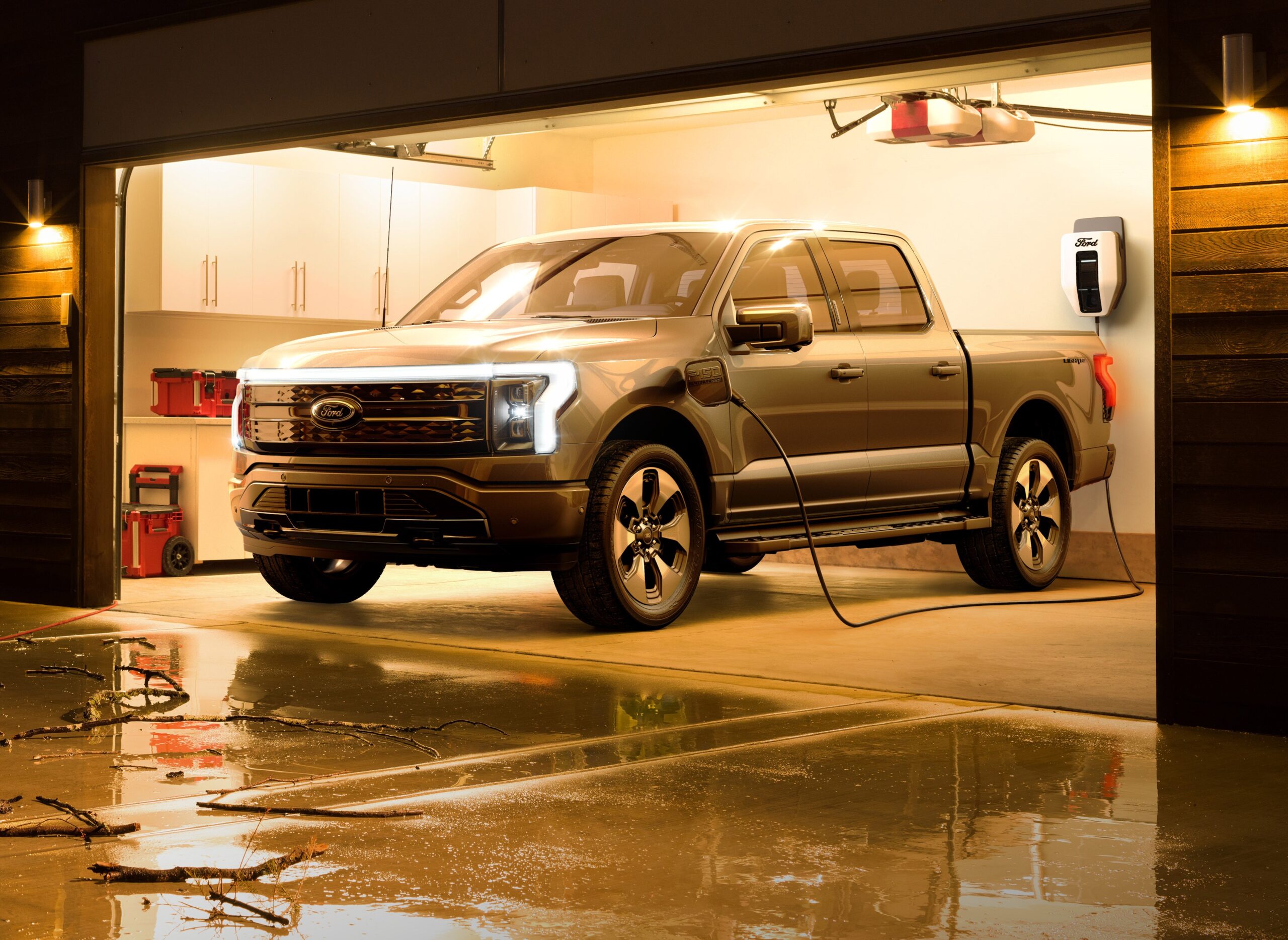
2022 Ford F-150 Lightning powering a home in an emergency

The Intelligent Backup Power system can power a home for three days, Ford says.

The debut of the Ford Intelligent Backup Power turns the truck into a substantial source of power for a home. The system can tap into 9.6 kilowatts of power — 9600 watts. That is enough backup power to maintain household lighting during an outage. It also will be enough to power other utilities, such as home appliances and security systems. (According to online reports, an average-size home in the U.S. uses about 900 kWh per month.)

The backup power system requires the optional 80-amp Ford Charge Station Pro and home management system (for which Ford can help with installation). In an emergency, the F-150 Lightning will automatically activate to power the house. Once power is restored, the truck automatically reverts to charging its battery.

Based on the average use of 30kWh per day, the entire system with an extended-range battery can provide full home power for up to three days. With careful use, the power can last as long as 10 days, Ford says.
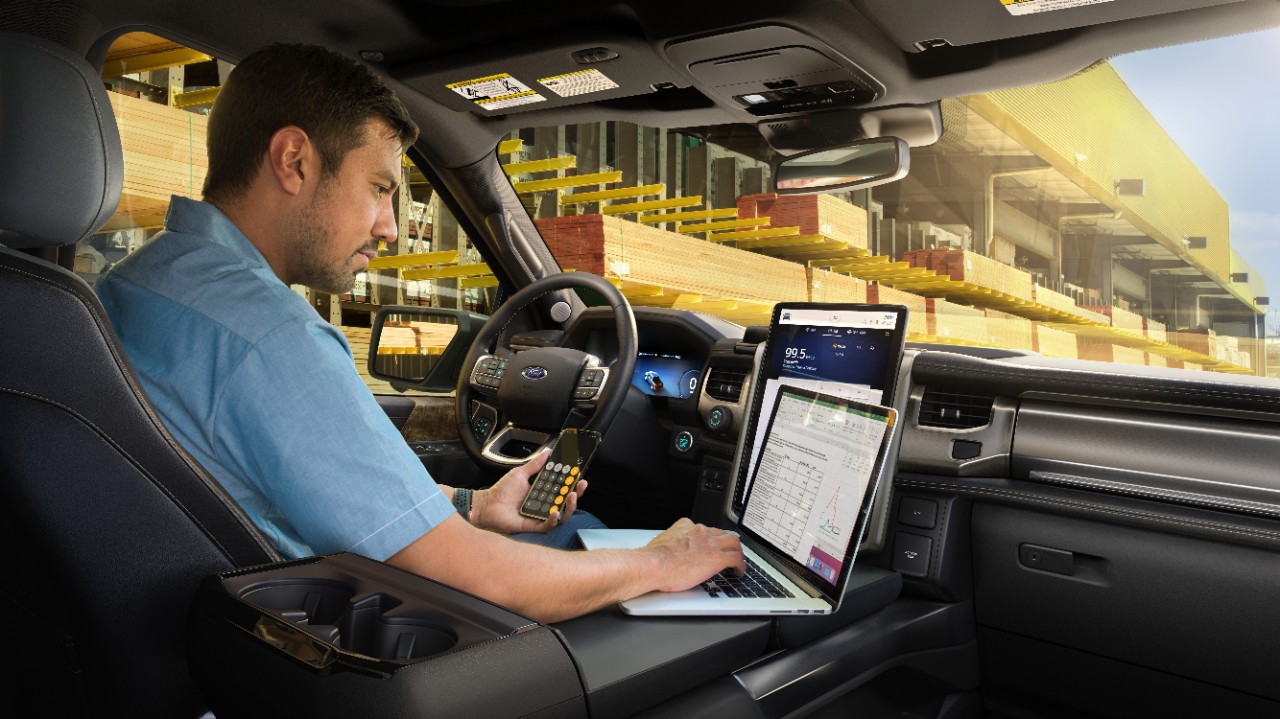
Ford F-150 Lightning optional work surface.

The optional fold-out Interior Work Surface.

For a later introduction, the Ford Intelligent Power system can use the truck to power homes during high-cost, peak-energy hours while taking advantage of low-cost overnight rates to charge the vehicle in time for the morning drive. The owner saves money on electricity while also taking pressure off the grid in peak usage times, Ford says.

Ford partnered with Sunrun, a leading solar company, to facilitate the installation of the 80-amp Ford Charge Station Pro and home integration system. Customers will also have the opportunity to install solar energy on their homes, tapping into clean, affordable energy and be able to charge their F-150 Lightning.

Battery power

Ford F-150 Lightning charge door on front left fender.

The secure charge door.

F-150 Lightning offers two levels of battery power: a standard-range battery targets 230 miles of EPA-estimated range and the extended-range battery targets 300 miles of EPA-estimated range.

Standard with the truck is an 80-amp charge station to maintain an extended-range truck at home. This system has a dual onboard charging system that can add an average range of 30 miles per charging hour. Fully charging an extended-range truck from 15 percent to 100 percent would take about eight hours, Ford says.

On the road, users have access to the ChargePoint public charging network, considered North America’s largest system. Using FordPass, drivers will have access to more than 63,000 charging plugs and growing. On a 150-kW DC fast charger, the extended-range battery is targeted to get up to 54 miles of range in 10 minutes and charge from 15 percent to 80 percent in about 41 minutes, Ford says.

The FordPass Power My Trip function identifies charging routes in advance of an extended drive. The truck’s, Intelligent Range mode calculates range while factoring in weather, traffic, payload, and towing weights, Ford says. Cloud-connected navigation on SYNC 4 also identifies public charging locations.

Truck as generator

Ford F-150 Lighting tailgate work suface.

The optional Tailgate Work Surface.

The enhanced Pro Power Onboard provides built-in electrical outlets to power a variety of tools, electronics, and appliances. Base trims have 2.4 kilowatts of power with the option for more. Lariat and Platinum models have 9.6 kilowatts of power — a combination of up to 2.4 kilowatts available through the frunk and up to 7.2 kilowatts through outlets in the cab and bed.

Customers will receive a FordPass notification if their truck’s battery falls below a third of its total range. And the truck can be programmed to stop using Pro Power Onboard if the battery level approaches the distance to the nearest charging station.

Front trunk

Ford F-150 Lightning frunk.

The front trunk, or frunk, is power opened and closed.

The newfound space under the hood allowed for a  lockable “mega power frunk” that is power opened and closed. The storage capacity has about 14 cubic feet of volume and a 400-pound payload. Ford says that’s enough space for two carry-on travel bags and one checked bag, or two sets of golf clubs.

The water-resistant space has four electrical outlets and two USB chargers. Drain holes in the floor allow the frunk to be used as a cooler. With 2.4 kilowatts of power, there’s enough electrical capacity to plug in power tools, TVs, laptops and speakers, or even a crockpot and other appliances.

Testing
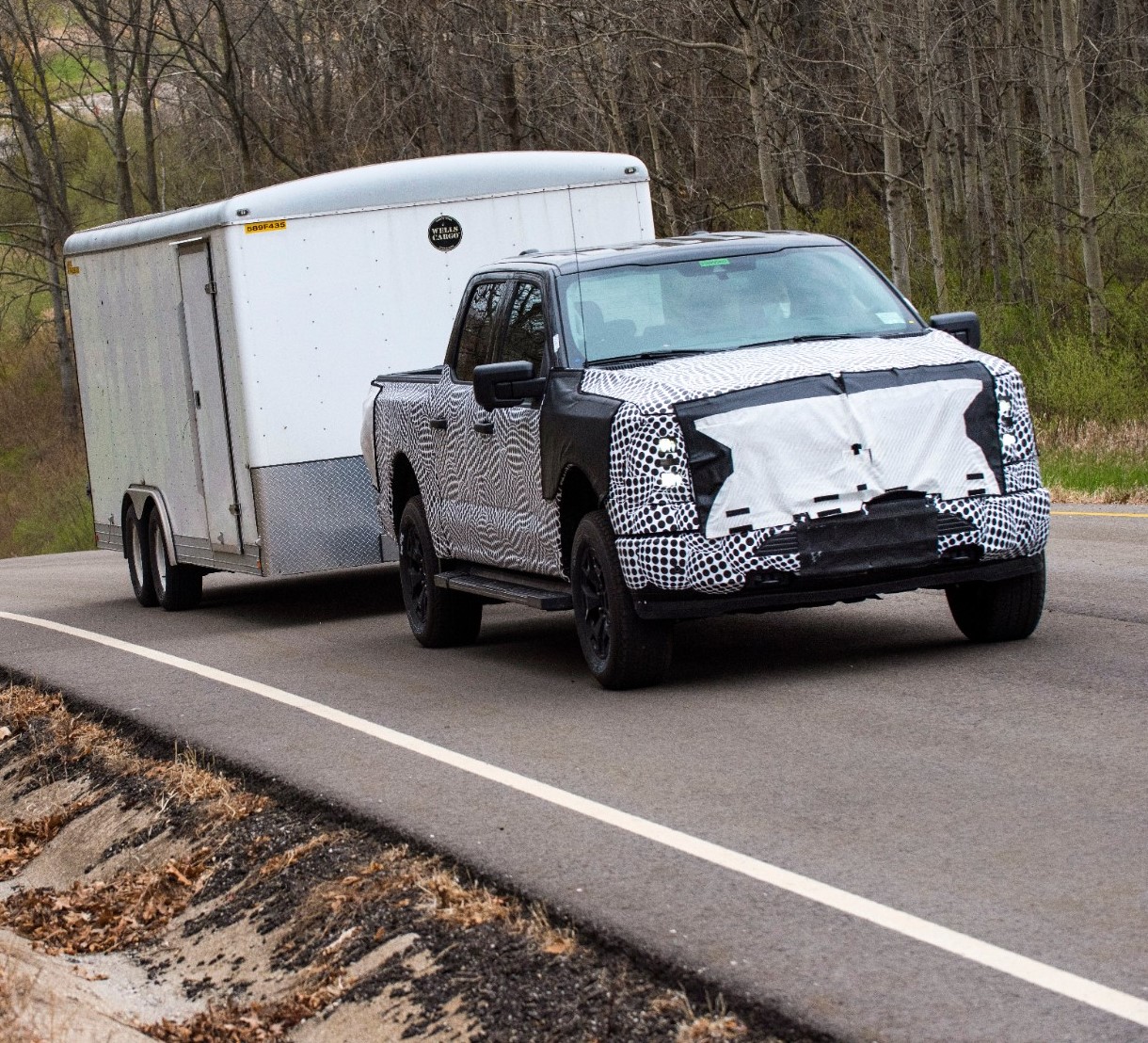
A Ford F-150 Lighting in camouflage while testing tow capacity.

Endurance testing included running the truck through Iowa Hill, Calif.

The F-150 Lightning was put through the same endurance testing as all F-Series trucks. The military-grade aluminum-alloy body and upgraded frame were engineered to support the advanced battery. The first F-Series independent rear suspension and low center of gravity help improve noise isolation from the road and provide a more stable ride.

No compromises on space or utility were made, Ford says. The cab and bed have the same dimensions as the gas models.

The truck’s four-wheel-drive system features four selectable drive modes: Normal, Sport, Off-Road, and Tow-Haul. Metal underbody skid plates protect the battery and inboard motors. The battery itself is secured inside a waterproof casing that is surrounded by crash-absorption protection. It has been tested at temperatures as extreme as minus-40 degrees.

To maintain steady thermal conditions, the F-150 Lightning was engineered with an advanced liquid cooling system and powertrain layout to manage heat distribution.

Endurance testing included running the truck through Iowa Hill, Calif. In the testing, loaded trailers were towed for long durations up and down the steep Iowa Hill Road, where there are no safety guardrails, according to Wikipedia

Ford F-150 Lightning aerodynamics

Ford F-150 Lightning payload capacity and tow ratings.

Base models are expected to have a max tow rating of 10,000 pounds.

F-150 Lightning is the most aerodynamic F-150 ever, Ford says. Styling enhancements include newly shaped running boards, a sculpted hood to reduce drag, and grilles with a smoother, textured surface.

2022 Ford F-150 Lightning specifications

Body style: full-size, 5-seat crew-cab pickup with a 5.5-foot-long bed

Electric motors: Two inboard three-phase fixed magnet AC

Battery type: Liquid-cooled lithium-ion pouch with battery management

Targeted horsepower: 426 hp standard range; 563-hp extended range

Targeted peak torque: 775 foot-pounds for both battery packs

Onboard charger power, (input/output): 11.3 kW/10.5 kW standard range; 19.2 kW/17.6 kW extended range

Targeted EPA driving range: 230 miles standard battery; 300 miles extended range battery

TARGETED CHARGING TIMES:
Level 3 fast charge: 15%-80% in 44 minutes standard range; 41 minutes extended range

Level 2 home charging: NA

80-amp Ford Charge Station Pro: 15%-100% in 10 hours standard range; 8 hours extended range

32-amp/240-watt onboard charger: 15%-100% in 14 hours standard range; 19 hours extended range

BY THE NUMBERS

Targeted maximum payload: 2,000 lbs. standard battery; 1,800 lbs. extended-range battery

Targeted maximum towing: 7,700 lbs. with the standard battery; 10,000 lbs. with the extended-range battery

Length/wheelbase: 232.7/145.5 inches

Cab height/width: 78.9/*96 inches. *w/mirrors folded 83.6 in.

Ground clearance: 8.9 inches

Open tailgate to the ground: 37.2 inches

Front trunk liftover height: 35 inches

Curb weight: NA

Turning circle: NA

WARRANTIES

Bumper to bumper: 3-years/36,000-miles

Roadside assistance: 5-years/60,000-miles;

Electric vehicle components: 8-years or 100,000-miles, including the battery that is expected to retain a minimum of 70% of its original capacity over that period
2022 Kia EV6 Reveal

2022 Kia EV6 Reveal

The EV6 crossover will usher in new era of electric driving, Kia says

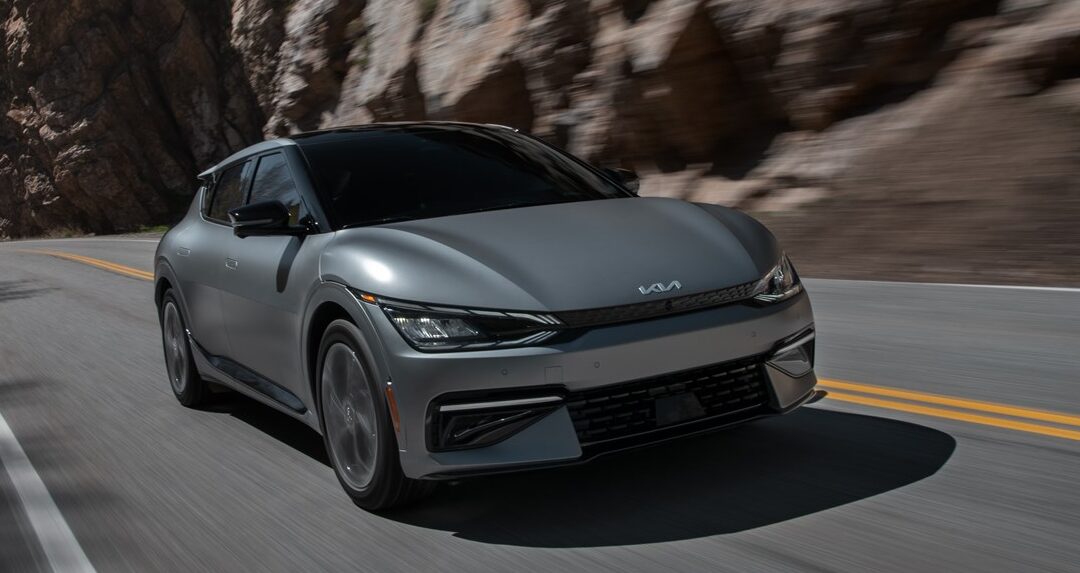
2022 Kia EV6 exterior in Steel Gray Matte paint.

Starting with the EV6, Kia’s EV lineup will have the “EV” designation followed by a number for the car’s position in the lineup. (All photos courtesy of Kia)

BY MARK MAYNARD

Kia drove into New York’s Times Square last night for a Hollywood-style reveal of its first dedicated EV, the EV6 crossover SUV. The battery-powered EV6 signals the beginning of the brand’s transformative “Plan S” electrification strategy that will deliver 11 new electrified models across the world by 2026, the company said in the debut release.

Unique naming convention: Starting with the EV6, Kia’s EV lineup will have the “EV” designation followed by a number that indicates the car’s position in the lineup.

An overhead view of the 2022 Kia EV6, which rexpected to go on sale in early 2022

The first EV6 models are expected to go on sale in early 2022.

The E-GMP modular platform will allow multiple vehicle segments – sedans, CUVs, SUVs, with dual-motor options for all-wheel drive. The architecture provides an adaptable foundation with a long wheelbase and wide stance, Kia said. The EV6 has the same 114.2-inch wheelbase as the full-size Kia Telluride SUV and compares with the width of a Ford Mustang Mach E and the wheelbase and ground clearance of a Tesla Model Y.

The first EV6 models are expected to go on sale in early 2022 in all 50 states with the GT arriving in late 2022.

2022 Kia EV6 will be sold in rear-wheel drive or dual-motor all-wheel drive

The Kia EV6 will be sold in rear-wheel drive or dual-motor AWD. 

EV6 bullet points

  • New Electric-Global Modular Platform (E-GMP) underpins all-new CUV in rear-wheel drive or dual-motor all-wheel drive.
  • 800-volt multi-charging architecture enables ultra-fast DC charging capability from 10 percent to 80 percent charge (up to 210 miles range) in less than 18 minutes. (EPA certified range unavailable at the time of printing and is expected late 2021.)
  • A 77.4-kWh high-density lithium-ion battery allows up to a targeted 300-mile range.
  • 114.2-inch wheelbase equivalent to the Telluride SUV.
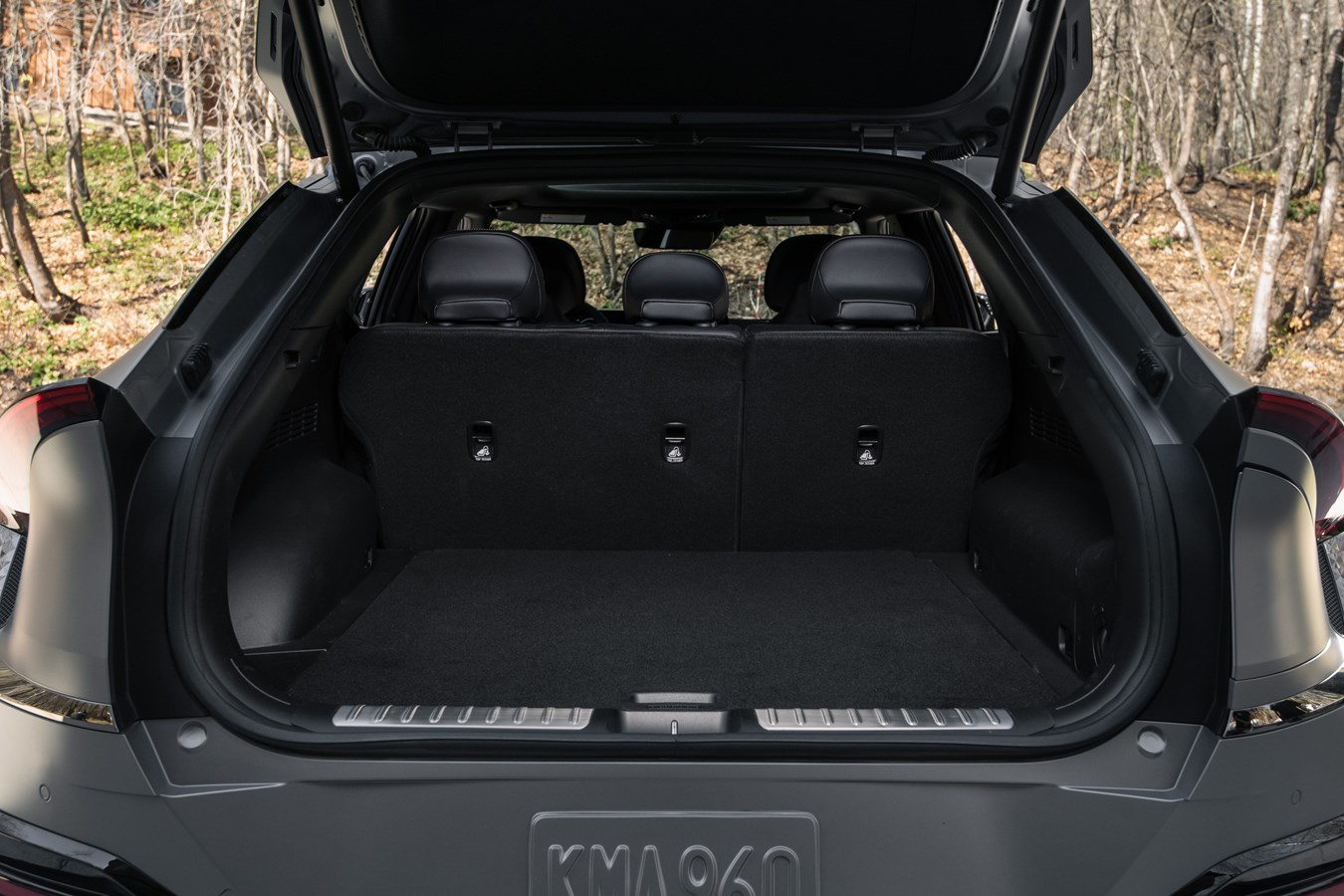
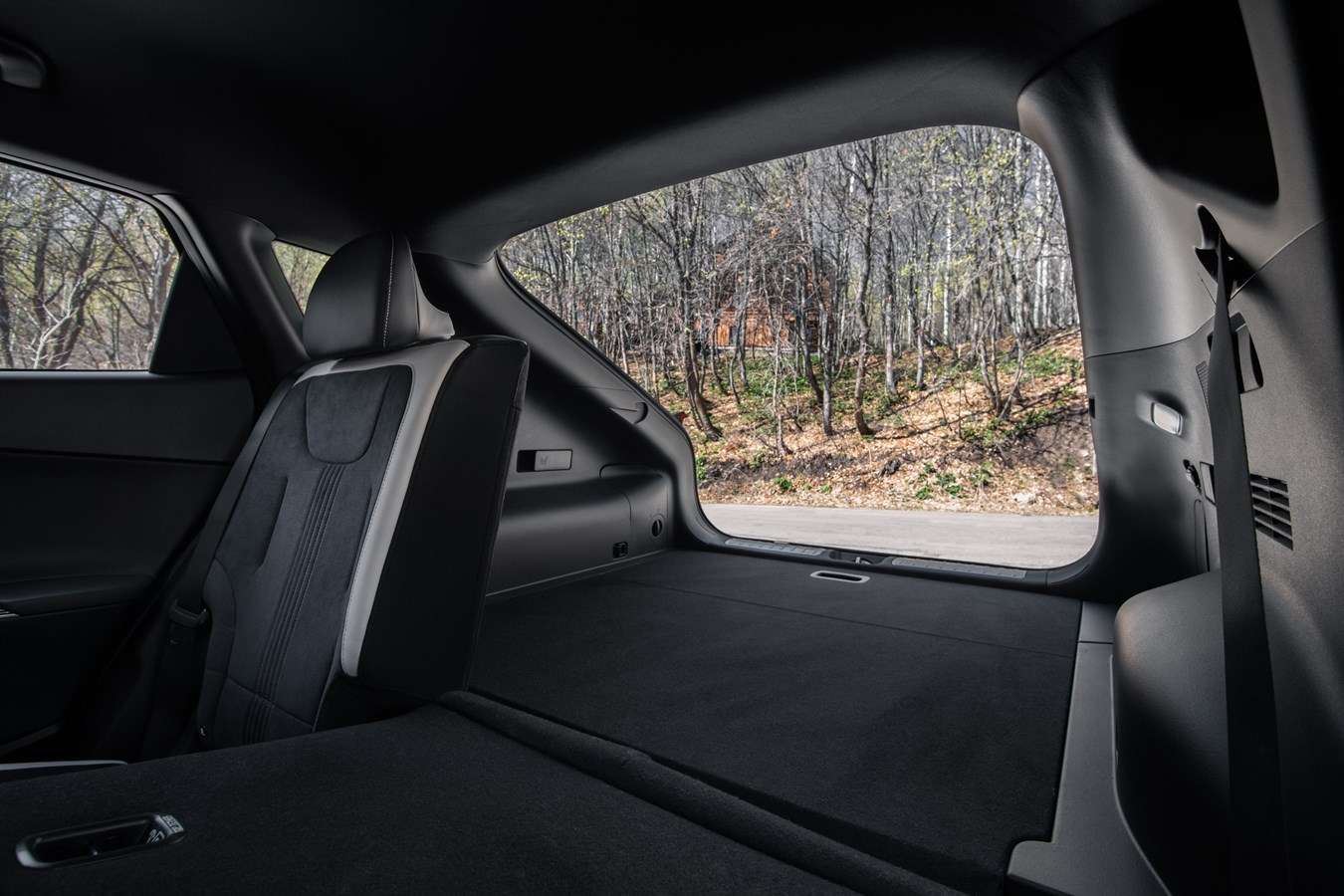
  • 102 cubic feet of passenger room with a flat-floor design that yields 27.7 cubic feet of cargo room behind the second row and 53.5 cu.-ft. of space with the second-row seats folded.
  • GT model has 576 horsepower capable of 0-60 mph acceleration in less than 3.5 seconds.
  • 21 standard active advanced driver assistance systems with semi-autonomous driver capabilities including Highway Driving Assist 2.

EV6 First Edition

2022 EV6 First Edition in Matte Gray paint.

The EV6 First Edition will be available for preorder starting June 3.

Kia will offer a special EV6 First Edition available by advanced reservation at Kia.com starting June 3. Limited to 1,500 vehicles, the EV6 First Edition, with dual-motor AWD and a 77.4 kWh battery, will have such exterior details as black wheel arches in a fully loaded package. Also included will be the Augmented Reality (AR) head-up display, remote smart parking assist, wide sunroof, 20-inch wheels, 14-speaker Meridian audio system, and a two-year subscription to SiriusXM.

Three color combinations feature Glacier with dark green seats, Urban Yellow with black seats (exclusive for the First Edition) or Steel Gray Matte with black seats. Illuminated door sills will show the First Edition designation and there will be a numbered interior badge.

Performance

An energy-dense nickel-cobalt-manganese (80/10/10) battery pack will be available in two sizes: 58 kWh and 77.4 kWh. The low-mounted, underfloor pack delivers energy to both RWD and AWD electric motor layouts with varying horsepower at the front and rear axles.

RWD: 58 kWh battery with a 160kW rear motor yields 167 horsepower;

RWD: 77.4 kWh battery with a 160kW rear motor yields 218 hp;

AWD: 77.4 kWh battery with a 70kW front motor and a 160kW rear motor yields 313 hp. Estimated zero-to-60 performance in 5.1 seconds;

AWD: 77.4 kWh battery with a 160kW front motor and a 270kW rear motor yields 576 hp in the GT model. Estimated zero-to-60 mph performance in less than 3.5 seconds. Not available until late 2022.

Ultra-fast charging

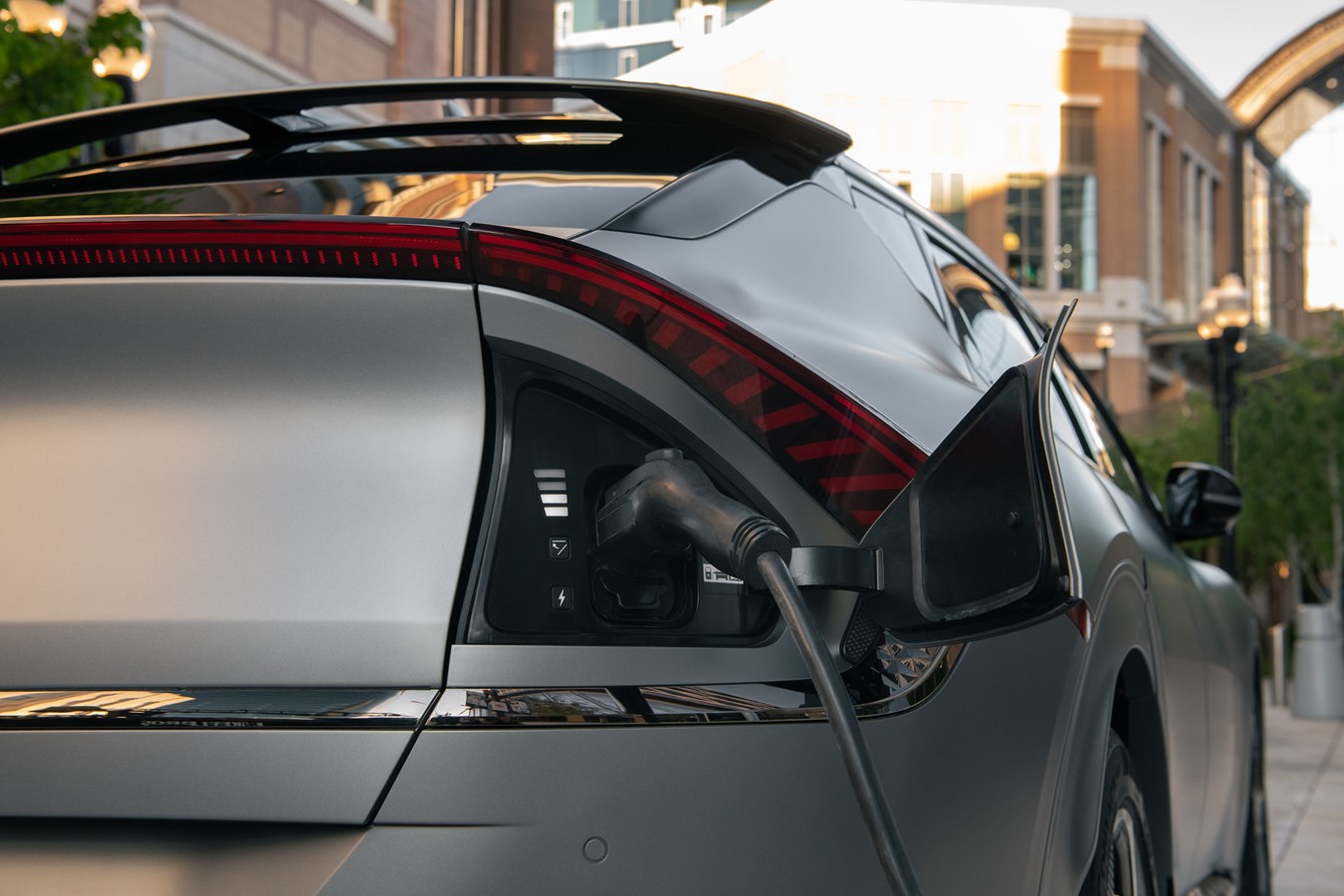
The charge port in a taillight of the 2022 EV6.

The EV6 charging system supports 400- and 800-volt DC charging.

Kia says its “world’s first” patented multi-charging system supports 400-volt and 800-volt DC charging, which works on DC chargers with speeds ranging from 50kW to 350kW.

The 800v DC fast charging from a 350-kW charger allows nearly 70 miles added in less than 5 minutes and up to 210-miles (10-to-80 percent) added in less than 18 minutes.

The 11kW onboard charger for Level 2 can recharge the system from 10-to-100 percent in 7 hours, 10 minutes (240-volt AC at 40-amps) for the larger 77.4 kWh battery versions.

Vehicle-to-Load utility

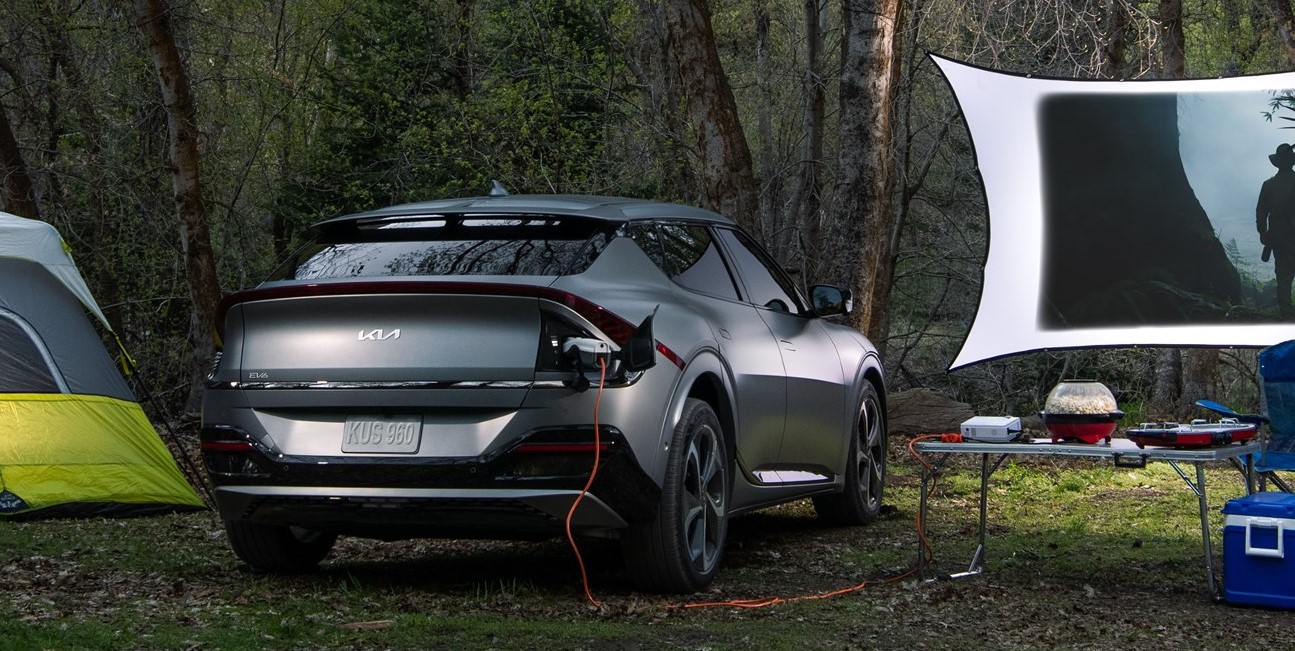
2022 EV6 will be a mobile power source for computers, camping, tailgating and home back-up.

The EV6 can be used as a mobile power source.

An innovative Vehicle-to-Load (V2L) functionality allows the EV6 to be a power source to support everything from computers to home improvement projects to camping and tailgating. Electricity flows from the high-energy battery to an integrated charging control unit (ICCU), providing 1900 watts of power to electrical appliances, devices, tools, and recreational equipment.

The system includes a 110-volt power outlet in a socket on the front of the second-row seat base using an adapter to draw power from the external charge port. From a full charge, power can be drawn from the vehicle for 36 or more consecutive hours, Kia says. And the EV6 is able to charge vehicle-to-vehicle at 1.1 kW, equivalent to a 110V charger.

Interior

2022 EV6 interior materials.

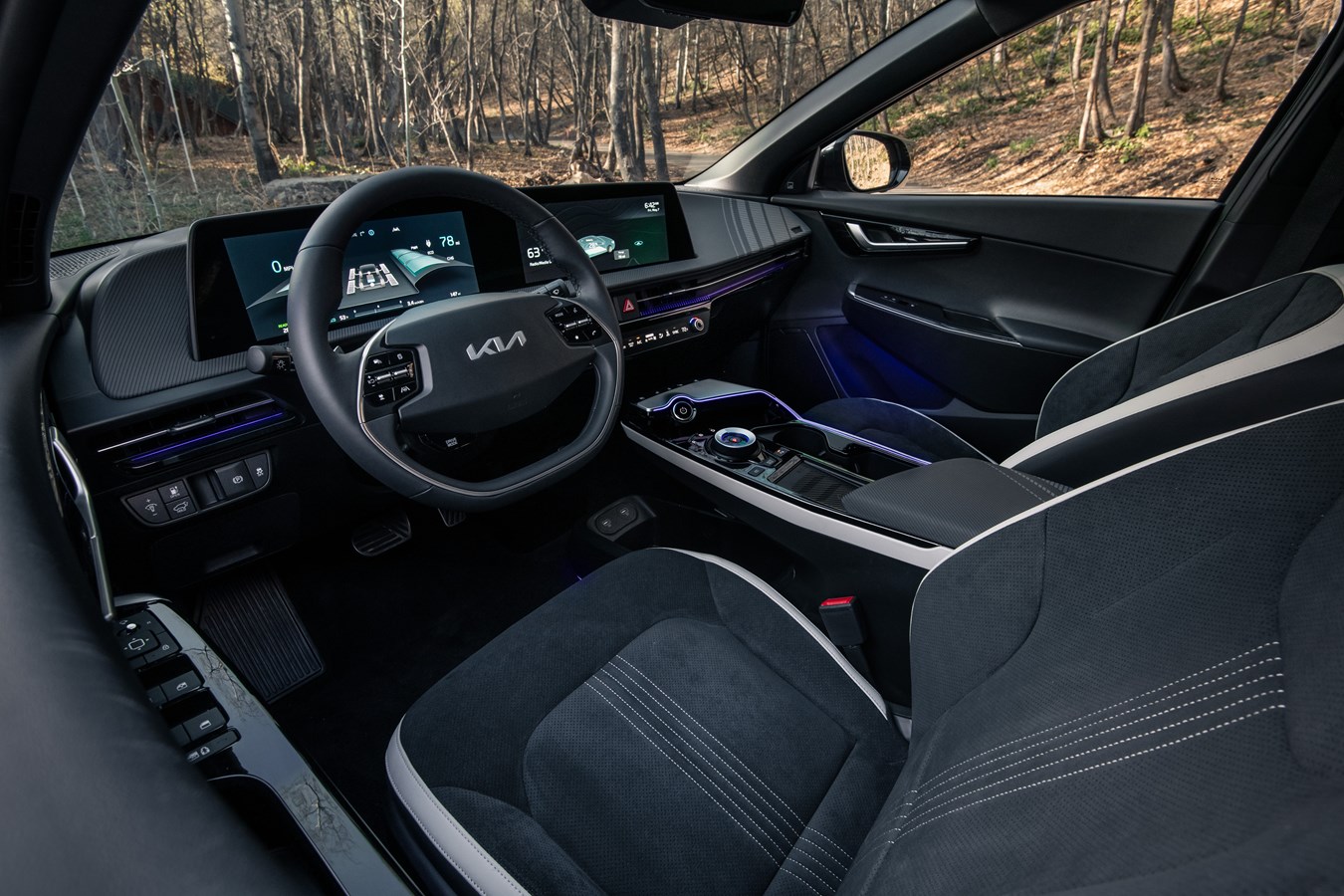
The EV6 cabin is focused on modern and eco-friendly materials.

The EV6 cabin is focused on modern and eco-friendly materials. Recycled plastic is used extensively throughout the interior with 100-percent vegan leather surfaces on some trims and 100 percent LED lighting inside and out.

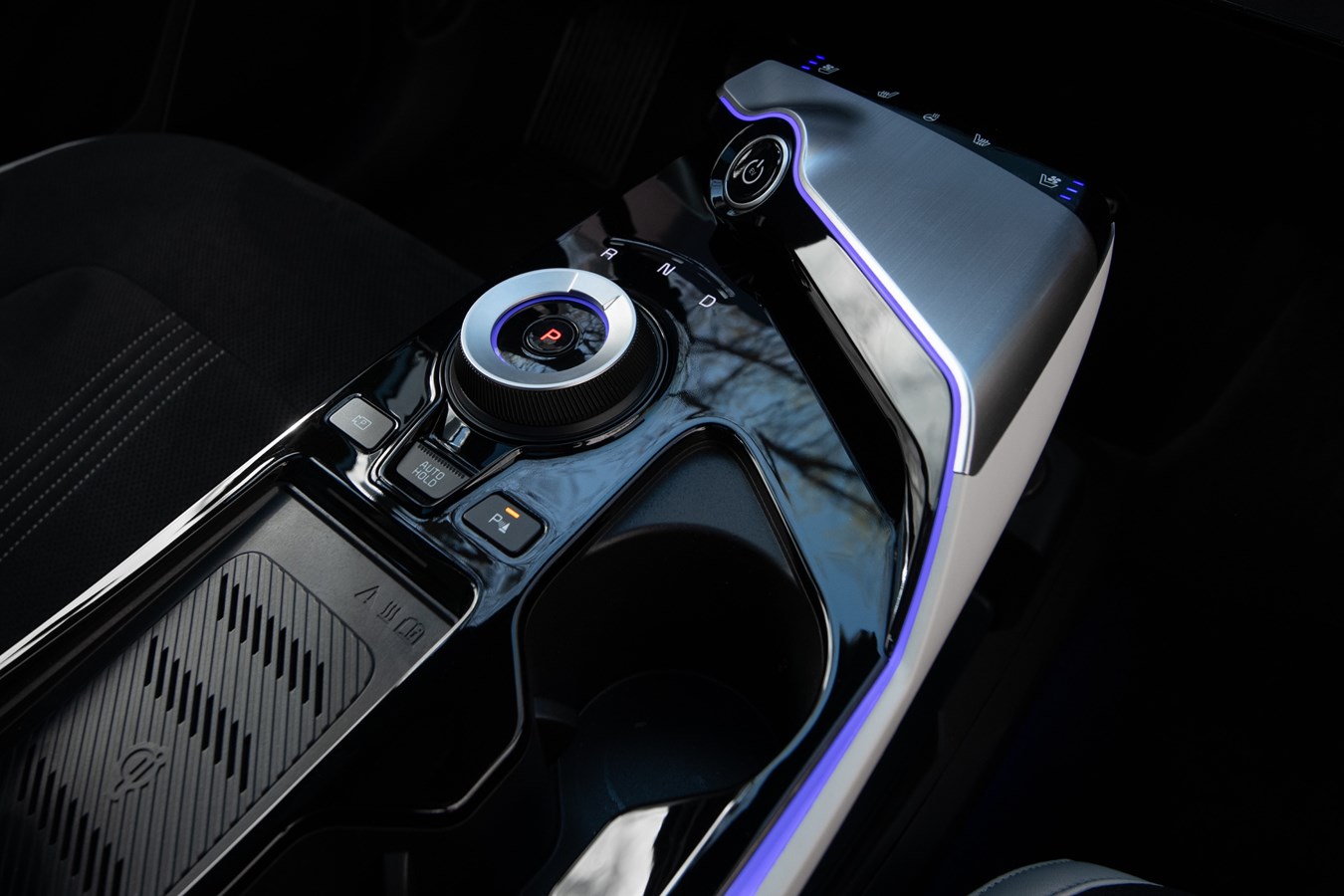
2022 Kia EV6 SUV Crossover shift console.

The 2022 EV6 will have Bluetooth and wireless phone charging. 

A seamless high-tech curved high-definition audio visual and navigation screen creates an immersive experience for the driver, Kia says, with a minimal number of physical buttons for an uncluttered and driving-focused experience.

Cargo space behind the back seat in the 2022 Kia EV6.

A flat-floor design yields expandable cargo space. 

Cargo space in the 2022 Kia EV6 with the back seat folded.ia EV6.

The slim dashboard extends from the steering wheel across to the center of the car. Below the navigation screen are controls for heat, ventilation, and AC that have electronic haptic-touch buttons.

Thin seat frames use ultra-light “giga-steel” to maximize rear-seat space and knee room due to a slim seatback design.

2022 Kia EV6 SUV Crossover navigation screen.

The EV6 will have an option for panoramic center cluster and infotainment screens. 

Standard and available features

  • Panoramic dual integrated 12-inch TFT center cluster and infotainment screens that form a wide, horizontal, curved display extending across the instrument panel;
  • Blue light-filtered screens to reduce eye strain and fatigue;
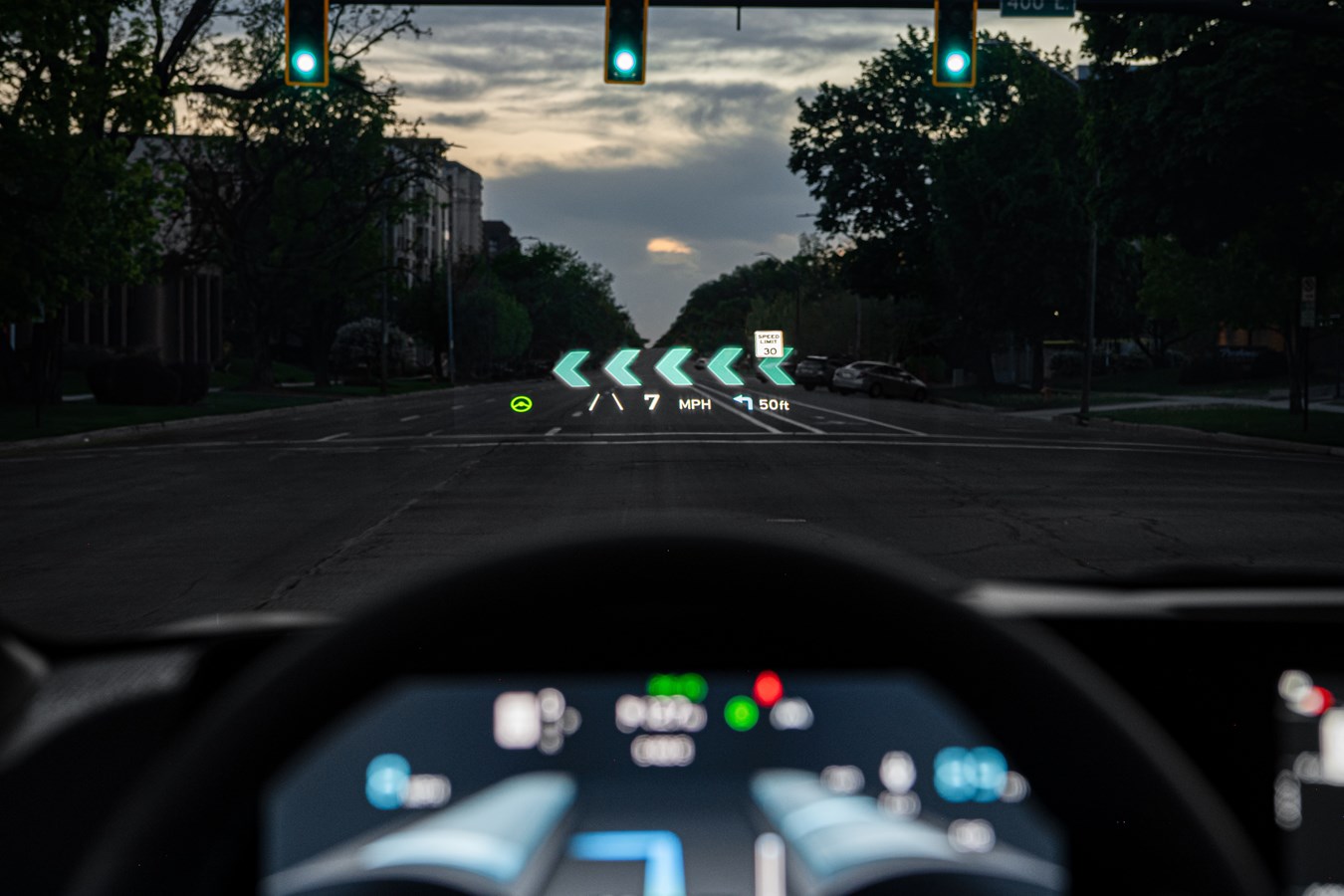
2022 EV6 ugmented Reality head-up display system projects three-dimensional images on windshield.

The Augmented Reality head-up display system. (Kia)

  • Augmented Reality (AR) Head-Up Display (HUD) system. Projects graphics from the base of the windshield in a large three-dimensional image. Functions include speed and driver assistance system alerts, vehicle information, lane guidance, and turn-by-turn navigation instructions;
  • Bluetooth functionality and wireless smartphone charging;
  • Meridian 14-speaker audio system with Intelli Q technology. Corrects audio volume and sound quality according to vehicle speed change;
  • Surround View Monitor for a 360-degree image around the vehicle;
  • Parking Collision-Avoidance Assist-Reverse. Detects certain objects behind the vehicle and will give an audible warning when an obstruction is detected. The system will automatically assist with emergency braking if there is a risk of collision;
  • Remote Smart Parking Assist. Allows remote parking or exiting a parking spot with the driver operating the EV6 from outside the vehicle;
  • Safe Exit Assist. Audibly alerts the driver or passengers opening their door not to exit the vehicle when the system detects approaching traffic. The system can intervene to lock the rear doors when the vehicle is equipped with an available Power Child Lock.


A screwdriver hunt — and other tools I cannot throw away

A screwdriver hunt — and other tools I cannot throw away

I went looking for a Phillips head screwdriver for a DIY task and was shocked at what I found

A kitchen sink with a loose faucet handle

The culprit kitchen sink hot-water handle.


BY MARK MAYNARD

I had set out on a simple DIY fix to snug up the handles on the kitchen faucet.

At the time, the girlfriend-wife was zeroing in on the task with a steak knife. It was a good steak knife with a wooden handle and part of a six-piece set I’d bought at Home Depot for $10.

“Noooo! I screamed” — in my head. “Let me handle that, puh-leeze,” I said. And then I might I also have said something aloud like, “A knife is not a good screwdriver.” But those words and breath were quite wasted. A resourceful, non-tool-respecting person will use whatever is handy — without having to rummage through toolboxes, wherever they might be.

A steak knife, or any knife blade, whether it be butter or putty, should not be used to turn a screw. Unless, of course, the do-it-yourselfer is stranded at the side of the road, and then I’ve even tried a fingernail.

Junk and stuff

So, I then turned to the kitchen junk drawer, just to the right of the sink.

A respectable home cook and do-it-yourselfer will have a kitchen junk drawer. And in it should be a small pair of needle-nose pliers (to pull fish bones), a standard pair of pliers (for just in case), a slotted-blade screwdriver, and a Phillip’s head.

Is that so peculiar?

The kitchen junk drawer.

The kitchen junk drawer.

But in the drawer, I found:

  • 10  paper-wrapped packs of carry-out wooden chopsticks;
  • A plastic melon baller;
  • Two or three meat thermometers, but one might be a candy thermometer;
  • My mom’s 1950s twist-off jar-lid remover plus a newer black plastic model;
  • Birthday-cake candles (several varieties, some used briefly) in a tattered Baggie, with a couple of packs of book matches;
  • A gaggle of the thick rubber bands from bunches of broccoli or asparagus;
  • Restaurant to-go menus;
  • My collection of grocery coupons and store list (also avoided by the girlfriend-wife);
  • Another Baggie with several pairs of nutcrackers and picks (which we use for the twice-annual lobster feasts);
  • Heart-shaped metal tin with all sorts of weird flotsam, such as a rolled-up seamstresses’ tape measure, an antique faucet handle, two little plastic babies from New Orleans-style King cakes, a packet of screws and anchors;
  • Assorted chip clips in another old Baggie;
  • Plastic cake decorating tips, new and unopened;
  • Cheesecloth, unused in a slim pack;
  • A turkey baster with no squeeze bulb.
A metal tin of odds and ends in the kitchen junk drawer.

The heart-shaped tin of stuff.

But no screwdriver — or any of the other tools I was sure I had stashed there.

So out to the garage, I trod, on a mission.

My trusty Sears tool cart will have the right tool, somewhere. Pulling open the top drawer, so smooth with its track gliders. The first-level drawer (of four) is where I have aligned my screwdrivers for quick access.

Over time, however, some of my so-called “quick access” tools have migrated there. Finger-sorting among the items, there was a utility knife and a pencil sharpened with the utility knife, a pair of desk scissors, a handy-dandy blade- and tool-sharpener and a couple of pair of vice-grips.

There were two water-pump pliers, two pairs of diagonal cutters, steel nail nippers, and a small roll of black electrician’s tape. My grandad’s claw hammer (the style with the stacked leather handle) is top-center and along the right side is a vintage sleeve of pipe cleaners and a roll of small-gauge brass wire.

Dismay set in as I stood back to look at the collection of mismatched tools. Of the 18 flat-blade screwdrivers I found, there were four Phillips’. And those were tiny or the star-blades were rounded off.

How could this be? My honorary do-it-yourselfer’s badge was in jeopardy?

A graveyard of tired tools

Eyeing the jumbled drawer it was more of a graveyard for tired tools.

There was one Phillips’ head that would do the job. But was I just an undiagnosed tool hoarder?

Some of the screwdrivers in my collection I’d been carting around since I left the Ohio farm in 1976. A couple of them came from my first Sears toolbox bought for me as a Christmas gift by my first father-in-law. That was in about 1980.

A Craftsman tool cart displaying tools and screwdrivers.

Top drawer of my trusty Sears tool cart.

Should I just scoop up the lot and drop them in the dumpster?

Harbor Freight sells plenty-packs of screwdrivers starting at $3 for six, a 22-piece set for $11, a 70-piece set, with a four-leg storage rack, for $28, or a pro mechanic’s set of eight for $50. It might be helpful to own a few long-reach screwdrivers, precision screwdrivers, magnetic screwdrivers, and bit sets.

Like most do-it-yourselfers, I do have two, maybe three, screwdriver bit sets. But digging through those takes more time than opening a drawer and finding a blade that’d be good enough.

My children, sort of

On some level, my tools — like my microfiber car-care towels — are like my children. I just can’t off-load them. There’s even a slender antique sewing machine screwdriver, slotted, with a nifty bulb-like wooden handle. And there’s my dad’s stainless-steel, right-angle screwdriver. Gotta keep that one, even it is seldom used.

Throwing away a tool is like throwing away a partial bottle of good booze. Just because I haven’t poured a drink in years is no reason to just give it the heave.

Buying new screwdrivers just seems like cheating or betrayal of those old soldiers I’ve been carting around. To be gifted new screwdrivers is a whole other thing and that’s OK.

As I turned to head back to the kitchen with the good-enough Phillips’ head, I pulled open drawer No. 3. And oh my, I was faced with another category of psychiatric care: sockets. How do I have so many?

But that’s another do-it-yourself column and after that one, there are the random wrenches, kitchen cutting boards, and doormats. So many deserving of a decent burial.


2022 Honda Civic Redesign Overview

2022 Honda Civic Redesign Overview

The 11th-generation Honda Civic sedan to go on sale summer 2021

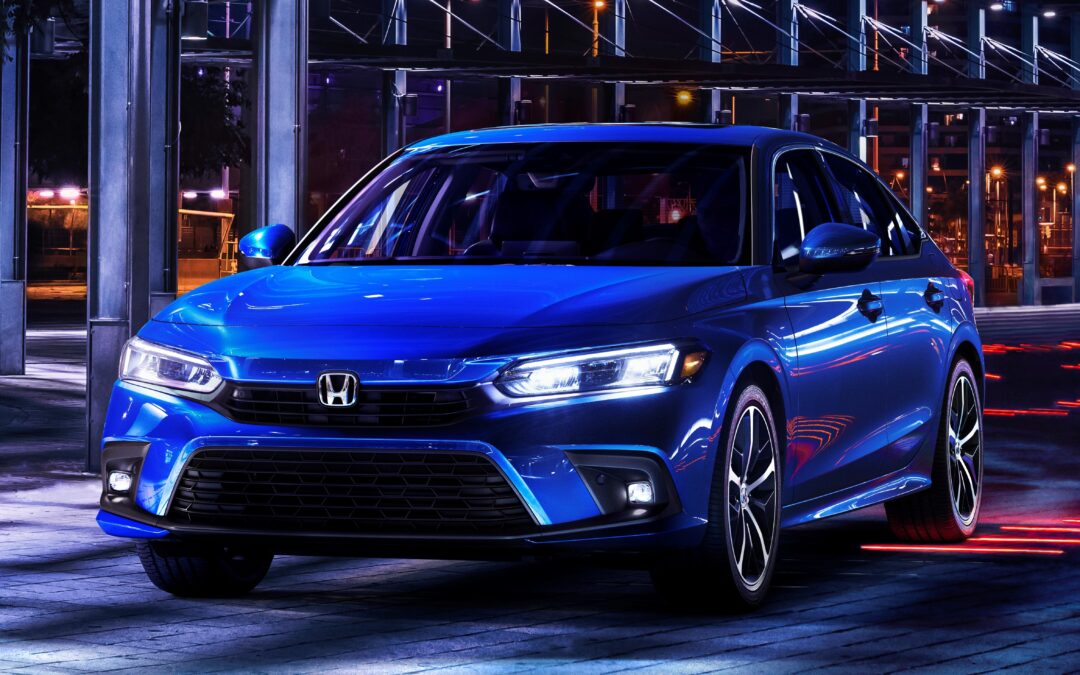
Redesigned 2022 Honda Civic sedan.

The redesigned 2022 Honda Civic sedan. (Photos courtesy of Honda)

BY MARK MAYNARD

Acompletely redesigned and re-engineered 2022 Honda Civic sedan goes on sale this summer with a “thin and light” body design. With new materials and technologies, the carmaker hopes the new model will be a “breath of fresh air” in the segment.

Civic competitors included the Hyundai Elantra, Kia Forte, Mazda 3, Subaru Impreza, and Toyota Corolla.

Four-door cars are declining in interest today, but the Honda Civic sedan is and has been a bread-winner model for Honda.

“Despite auto industry new vehicle sales being almost 80 percent light trucks (CUV, SUV, pickups) and last year being very negatively impacted by COVID-19, we still sold over 260,000 Civics in 2020,” said Honda spokesman Carl Pulley in an email.

The Honda Civic interior design emphasizes visibility, intuitive ergonomics, extraordinary passenger volume and driver-focused technology

The interior styling follows the “Man-Maximum, Machine-Minimum” approach. (Honda)

As Honda’s longest-running automotive nameplate in the United States, more than 12 million Civics have been sold since 1973. That legacy makes it one of the top three best-selling passenger cars in America, said Dave Gardner, executive vice president of National Operations, American Honda Motor Co., in a statement.

Since the launch of the 10th-gen model in 2015, Civic has been the No. 1 vehicle in America with first-time buyers, millennials, Gen Z and multicultural customers, Gardner said. It has had more than 1.7 million units over the last five years.

The 2022 Honda Civic redesigned interior with fingerprint and scratch resistant materials.h

High-touch areas feature quality materials that are fingerprint and scratch resistant. (Honda)

New Honda Civic sedan features

  • First all-digital LCD instrument display in the top-line Touring;
  • Standard 7-inch color touch screen with Apple CarPlay and Android Auto;
  • First Bose premium sound system with 12 speakers and wireless charging, for the Touring;
  • New front air bags are designed to reduce traumatic brain and neck injuries. Rear seat side air bags are a Civic first;
  • Updated Honda Sensing system with a front wide-view camera. The Touring model gets new Traffic Jam Assist and Low Speed Braking Control.

The design

In designing the 11th-generation Civic, the stylists and engineers focused on the original Honda design approach of “Man-Maximum, Machine-Minimum.”

The new styling seems to represent a coming of age and appears more mature, uncluttered and upscale than the previous styling.

Key to the exterior design was moving the bottom of the windshield pillars rearward by nearly 2 inches. The revised design elongates the hood for a premium silhouette, Honda said in the release. It is a subtle design element that emphasizes its wheels and tires for a stable, planted stance.

The 2022 Honda Civic interior features he redesigned dash incorporates a series of mesh panels to create a clean, continuous look.

The redesigned dash incorporates a series of mesh panels to create a clean, continuous look. (Honda)

The pulled-back windshield pillars, low hood, flat dashboard and hidden windshield wipers enable a windshield with clearly defined corners for a panoramic view.

Redesigned Honda Civic GT sedan

The Sport trim adds matching gloss-black side mirrors, 18-inch wheels and a chrome exhaust tip. (Honda)

Dimensions and body structure

Sizewise, the 2022 model is 1.3 inches longer (184 inches) but the same width and height, 70.9/55.7 inches, as before. Curb weights are up 106-114 pounds across the trim levels. And trunk space was trimmed by just 0.3 cubic feet, but still large at 14.8 cubic feet.

The body structure is the most rigid in Civic history, Honda says. It was improved by 8 percent in torsional rigidity and 13 percent in bending rigidity. It also reduces road and wind noise in the cabin.

The stiffer structure aids ride quality and sharpens suspension response for better handling.  A slightly wider rear track (0.5-inch) also enhances stability.

As before, the Civic continues as front-wheel drive with no plan yet for AWD.

Interior

Inside, the styling follows the “Man-Maximum, Machine-Minimum” approach, Honda says. The treatment emphasizes “exceptional visibility, intuitive ergonomics, extraordinary passenger volume and driver-focused technology,” Honda says.

High-quality materials are used throughout the interior, especially on touchpoints. Special attention was given to the operation of  switchgear and controls. And all trim levels have a new front seat design to firmly hold the body and enhance comfort on long drives.

Materials were also chosen for practicality, such as the new center console trim that is designed to hide fingerprints and smudges.

2022 Honda Civic GT gauge array turns red

In Sport mode, the 10.2-inch digital gauge array turns red. (Honda)

Digital displays

For the first time, all Civic sedan trims have either a partial or full (Touring) digital instrument display, with larger standard and available color touch screens.

LX, Sport and EX trim levels have a 7-inch color LCD instrument display. An all-digital speedometer and tachometer are on the left side of the display, with a physical speedometer dial to the right.

Touring models also get the first all-digital color instrument display for a Civic. The 10.2-inch high-def panel is customizable from the steering wheel and features several modes. The array can be configured to show traditional round gauges or bar graphs, flanking the left and right of the screen.

There also is a new multimedia 7-inch color touch screen in the LX, Sport and EX trims. It is “the largest standard screen in Civic history, Honda says.” Functionality was improved by adding a power-volume knob and a tuning-selection knob.

The top-line Civic Sedan Touring debuts a new 9-inch color touch screen. It features a physical volume knob, easy-to-recognize icons and a simplified format with fewer embedded menus.

The touch-screen systems have wireless Apple CarPlay and Android Auto integration. Only the Touring has Qi-compatible wireless charging.

The 2022 Honda Civic tire and wheels

Tire sizes range from 16- to 18-inches, with gloss-black wheels on the Sport trim (shown).  (Honda)

Honda Civic sedan Powertrains

As with the outgoing Civic sedan, two four-cylinder engines make up the powertrain. The standard engine is a naturally aspirated 158-horsepower 2.0-liter. The EX and Touring trims use a 180-hp, turbocharged 1.5-liter. Both engines run on 87 octane gasoline.

Both engines are paired with an updated continuously variable automatic transmission. The CVT now gives early downshifts during braking with revised programming to simulate gear changes under hard acceleration.

Power delivery, engine sound, overall refinement were improved. And EPA fuel economy ratings of both engines are up by 1 or 2 mpgs, Honda says.

EPA fuel-economy ratings for the 2.0-liter in the LX are 31 mpg city, 40 highway and 35 mpg combined. The Sport trim has ratings of 30/37/33 mpg.

The more powerful 1.5-liter engine (up 6 hp from last model year) has mileage ratings of 33/42/36 mpg city/highway/combined.

Honda Civic sedan safety features

The 2022 Honda Civic sedan can boast what Honda calls the world’s first application of front driver and passenger air bags. The design will better control head motions and reduce conditions associated with brain injury, Honda says.

The driver’s air bag is donut-shaped to cradle and hold the head to reduce rotation. The passenger-side air bag uses a three-chamber design for a similar result. In total, there are 10 air bags.

Side impact protection has been improved throughout. There are stiffer structures in the roof and doors, side sills and door pillars, rear wheel arches and rear window pillar.

The Civic sedan is Honda’s longest-running automotive nameplate in the U.S.

More than 12 million Civics have been sold since 1973. (Honda)

Pricing

Official pricing will not be released until just before the on-sale date. But expect the 2022 Civic sedan to cost about the same as the outgoing 2021 model. It has starting prices of $22,245-$29,295, including the current freight charge of $995 from Greensburg, Ind.

There is a financing incentive on 2021 Civics (except Type R) that will run through July 6, 2021. That is likely the cutoff date before the 2022 model goes on sale. Qualified buyers can take advantage of 1.9 percent APR for 24-60 months or 2.9 percent for 61-72 months, with a 10 percent down payment.

Honda's outgoing 2021 Honda Civic sedan.

The outgoing 2021 Civic sedan.  (Honda)

Industry sources say the new sedan will be followed by the Civic hatchback, sporty Si and high-performance Type R.

1960 GMC 1000

1960 GMC 1000

The 1960 model year was pivotal for General Motors’ light trucks

A 1960 GMC pickup in two-tone red and white.

The first GMC pickup with a full-width hood debuted in 1960. (GM media archives)

The debut of Jet Age styling


The market for pickups was booming in 1960 and the emphasis on styling, comfort, and power was stronger than ever. “All major manufacturers vied for a piece of this expanding pie,” said Mike McNessor in a Jan. 2021 report in Hemmings Classic Car.

The evolution of the Chevrolet Task Force and GMC Blue Chip trucks during the 1950s helped popularize many features that are commonplace today, McNessor said. Among the new features were fleetside boxes, V-8 engines, automatic transmissions and comfortable interiors.

“But, for 1960, GM upped the ante even further, implementing radical new Jet Age styling with full-width hoods accented by jet engine-inspired front air intakes,” McNessor said.

Styling of the 1960 GMC Pickup

The curves of the previous generation trucks were gone, replaced with sharper angles and creases accenting boxy cabs.

Under the skin, the 1960 GMC pickup had double-wall roof construction that included insulation between the sheet-metal layers. There were new front inner fender skirts, safety-catch door latches, sturdier hinges, and rubber insulated cab mounts. A full-length rocker panel, tied to front and rear cab supports, replaced the old-timey interior step that previous GM trucks incorporated into their floors.

GMC truck engine for 1960

For the 1960 model year, GMC was the first brand to introduce V-6 engines in pickup trucks. There was also a V-12, known as the Twin Six. (GM media archives)

1960 GMC Pickup Interior Redesign

“Inside the cockpit for ’60, there were suspended clutch and brake pedals that eliminated difficult-to-seal holes in the floor. A 26-percent increase in windshield area gave operators a better view of the road, while longer wiper blades kept more of that glass clear in stormy weather. There was nearly 6 inches more hip room, plus more shoulder room, headroom, and legroom over previous GM trucks, all in the name of driver comfort.”

Beginning in 1920, GMC and Chevrolet trucks became largely similar, according to the page in Wikipedia. Built as variants of the same platform, the two brands shared much of the same body sheetwork, except for nameplates and grilles — though their differences, especially engines, have varied over the years,

A print ad for the 1960 GMC truck line

GMC boasted in print ads a “breakthrough” in truck engines “to give triple the life” without a major overhaul. (GM media archives)


A Breakthrough In Truck Engines

“GMC advertising marketed its trucks to commercial buyers and businesses, whereas Chevrolet’s advertising was directed toward private owners. Beginning in 1928, GMCs used Pontiac’s 186-cubic-inch six-cylinder engines in their lighter trucks. Medium-duty trucks relied on Oldsmobile straight-6 engines, while the heaviest trucks used GMC’s own “Standard Big Brute” engine.

“From 1939 to 1974 GMC had its own line of six-cylinder engines, first the inline sixes known as “Jimmys” from 1939 to 1959, and then their own V-6 from 1960 until 1974, of which a V-8 and a V-12 version also existed.

“Additionally, from 1955 through 1959, the less than 2-ton, domestic GMC gasoline trucks were equipped with Pontiac, Buick and Oldsmobile V-8s —whereas the Canadian models used Chevrolet engines.”

See more vintage car photos here.

Mark Maynard