Select Page

5 U.S. Museums for Rare Volkswagens

5 U.S. Museums for Rare Volkswagens

Connect the highway lines to these 5 Volkswagen museums for some fun summer road trip exploration


BY MARK MAYNARD

Like spring peepers emerging from vernal pools, America also has begun to emerge from the muck of a pandemic lockdown. With cautious optimism, a road trip looks to be a safe form of travel into new adventures. Consider these five Volkswagen automotive museums across the U.S.

Here are five automotive museums across the U.S. that have helped preserve some of the world’s rarest Volkswagens. The institutions of preservation feature everything — from a never-been-titled 1974 Karmann Ghia to a 1966 Volkswagen Type 2 Bus that is a piece of civil rights history.

With expansive collections available to the public, anyone can admire these classic cars. Whether these five museums are pit stops or your destination, their collections of vintage Volkswagens are worth seeking out.

1. LeMay – America’s Car Museum, Tacoma, Wash.

A 1967 Type 2 double-door camper.

A 1967 Type 2 double-door camper at LeMay Automotive Museum. (LeMay)

America’s Car Museum preserves the history, technology, and influence of cars in the U.S. through its 12 rotating exhibits. Among the museum’s collection of more than 250 cars is a light green 1967 Volkswagen Type 2 double-door camper. It has been restored with its original interior, wooden cabinets, fold-down table, and bed. The car was donated by renowned blown-glass sculptor Dale Chihuly, who was born in Tacoma. The museum also features a turquoise 1962 Volkswagen Karmann Ghia that was owned by museum founders Harold and Nancy LeMay.

2. Don Garlits Museum of Drag Racing, Ocala, Fla.

A 1974 Karmann Ghia.

The 1974 Karmann Ghia at the Don Garlits Museum of Drag Racing.

Automotive engineer and racecar driver Don Garlits is considered the father of drag racing. As a young man, Garlits would buy a new Volkswagen every year, and the vintage vehicle wing of his museum reflects his love of the brand. Most notable in his collection is his green 1974 Volkswagen Karmann Ghia that he purchased from a car dealership auction. The vehicle has only been driven for 27 dealer test miles and has never been titled. From the same auction, Garlits also purchased a black 1950 Volkswagen Beetle. It is one of only 151 that were imported to the U.S. that year. Garlits restored it himself before displaying it at his museum.

3. Volo Museum, Volo, Ill.

The animatronic 1963 Volkswagen Beetle, "Herbie"

The animatronic 1963 Volkswagen Beetle at the Volo Museum. (Volo Museum)

On a trip to the Windy City, head north about 50 miles to the suburbs to the Volo Museum. It is an entertainment zone classic cars, including many from TV and movies. The pearl white, No. 53 Beetle is a movie star worth visiting. About 35 models of the iconic car were built for the 2005 sequel, “Herbie: Fully Reloaded.” The car on view really does come to life from a network of more than a mile of wires concealed under the hood. The museum has rigged it to a motion sensor, so the Beetle still reacts when someone walks by.

4. The National Automobile Museum, Reno, Nev.

A restored 1947 Volkswagen Type II Limousine.

This restored 1947 Type II Limousine at the National Automotive Museum in Reno, Nev.

This collection of more than 200 vintage vehicles dates as far back as the 1890s in downtown Reno’s National Automobile Museum. An air-cooled, four-cylinder black 1947 Volkswagen Type II Limousine is on display. Visitors are often surprised to see that the four-seat car is called a “limousine,” but in Germany where the car was built, the term simply means “full-sized sedan.” A ruby-red 1964 Volkswagen 1200 Deluxe Convertible is also on display, after being completely disassembled and restored by the museum.

5. The Petersen Automotive Museum, Los Angeles.

The so-called Jenkins 1966 Type 2 VW bus

At the Petersen Museum, view this 1966 Type 2, formerly used by civil rights pioneers Esau and Janie B. Jenkins. (Historic Vehicle Association)

With more than 100,000 square feet of exhibits and 300 vehicles, the Petersen Museum is one of the world’s largest automotive museums. Its exhibits feature many iconic Volkswagens, including the yellow 1979 Volkswagen Transporter Van from the 2006 film, “Little Miss Sunshine.”

Also on display is the 1966 Volkswagen Type 2 “Jenkins Bus” that was used by civil rights pioneers Esau and Janie B. Jenkins in Johns Island, S.C. The bus was used to transport hundreds of residents of the island to attend high school. The Jenkins family helped Black citizens pass discriminatory voting literacy tests, and later opened businesses on Johns Island to support the community. The bus has been carefully preserved and still bears the marks of its over 40 years with the Jenkins family.

2021 Toyota Sienna XSE Review

2021 Toyota Sienna XSE Review

The 2021 Toyota Sienna is a complete redesign and exclusively powered as a gasoline-electric hybrid

2021 Toyota Sienna XSE exterior.

The sport-themed 2021 Toyota Sienna XSE adds dark 20-inch split five-spoke wheels, more aggressive front and rear bumpers and a black headliner. (Photography by Toyota)


BY MARK MAYNARD

You can fit just about anything in a minivan — except an ego. These three-row people movers are the most efficient modes of transportation, yet ownership has been traumatized ever since the damning label of “Soccer Mom Mobile” was applied. It nearly killed the segment. Mention of the word brings polarized responses, like “hell-no never” to “make way for the welcome wagon.”

To spackle over the crazed aversion, manufacturers have long tried to offer sporty variants, which were usually received with a shrug and “Meh.” Anybody who wanted a van, didn’t need it to be cladded-up and those who didn’t want a van would not be tempted by cosmetic enhancements.
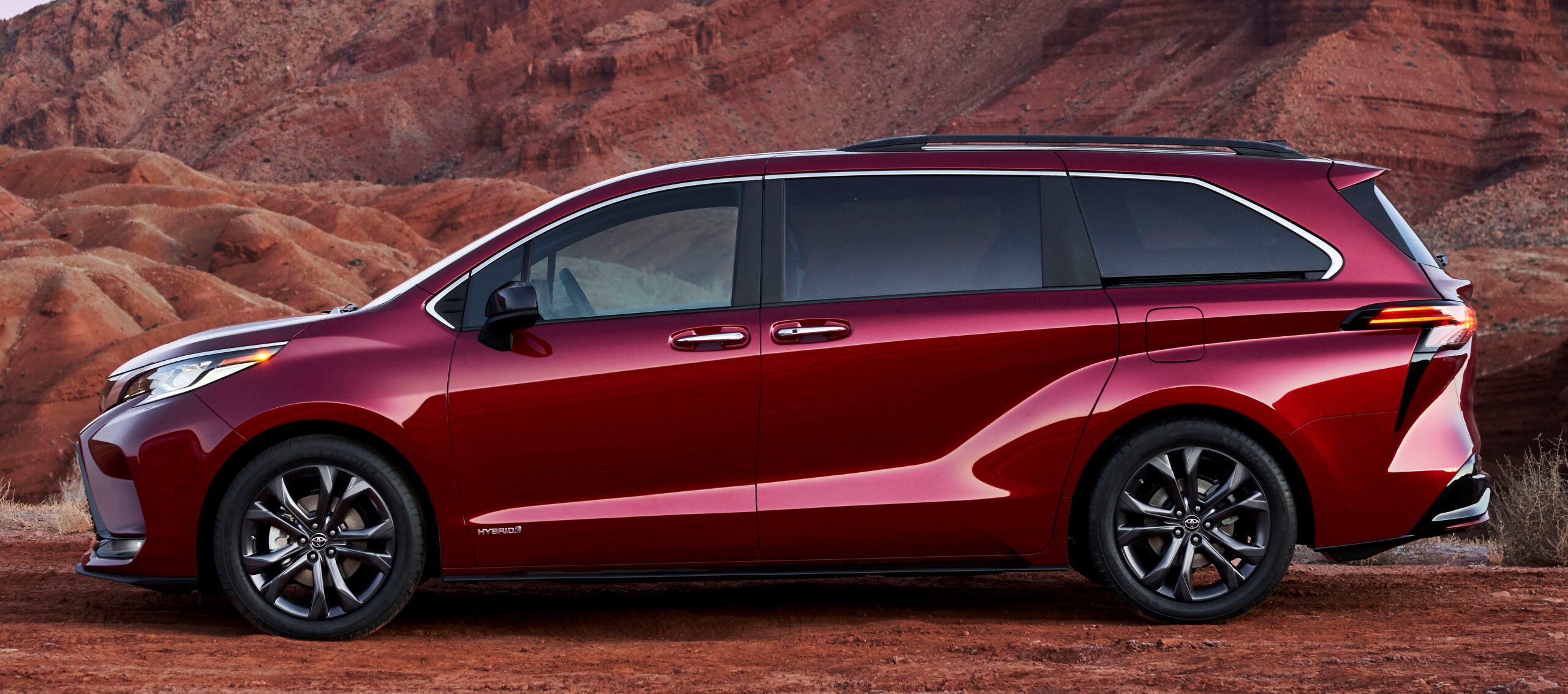
A side view of the new Sienna minivan

The 17-foot-long Sienna drives “small” with a high seating position.

So those carmakers with struggling minivans sales dumped them, including Ford and GM. Today, there are just four 2021 minivan choices: the Chrysler Pacifica, Honda Odyssey, Kia Sedona (soon to be replaced by the Carnival), and today’s tester, the Toyota Sienna.

Toyota’s sculpted redesign of its 2021 Sienna makes for a more credible sporty variant in the new XSE model. Whether for minivan-hating parents or their children, the Sienna is a big toy box of possibilities, and now a greener choice.
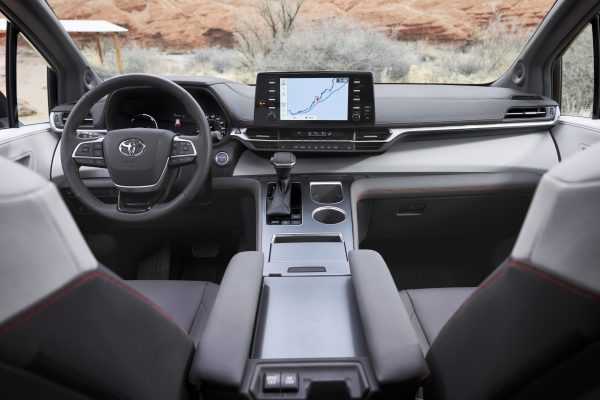
Front seats in the Sienna minivan.

The shifter and necessary functions are all within easy reach.

2021 Toyota Sienna Pricing

The first Sienna went on sale in the United States as a 1998 model and is now in its fourth generation. It has been designed, engineered, and assembled in the U.S. since it debuted.

The 2021 Toyota Sienna is a complete redesign and exclusively powered as a gasoline-electric hybrid, with optional all-wheel drive and seating for seven or eight.

A view of the Sienna's rear end

Toyota applied a few styling tricks to tone down the traditional minivan styling.

The Sienna is sold in five trim levels of LE, XLE, XSE, Limited, and Platinum. Starting prices range from $35,635 for the eight-seat, front-drive LE to $51,710 for the seven-seat Platinum AWD. Pricing includes the $1,175 freight charge from Princeton, Ind.

Some Sienna XLE models and the XSE, Limited, and Platinum are seven-seat models and feature the super-long-slide second-row captain’s chairs, and the Limited and Platinum FWD models have ottomans.

Electronic on-demand AWD is just a $760 option.

The XSE Plus package ($1,000) adds wireless phone charging, black roof rails, 12-speaker JBL audio, 9-inch touch screen, and dynamic navigation with a 3-year trial and connected services.

Pricing incentives for APR, cash, and lease.

2021 Toyota Sienna front seat features with the under-console storage area.

The broad span of the instrument panel has a step-down shelf.

Warranty Coverage

Hybrid-related components that require repairs to correct defects in materials or workmanship are covered for 8 years or 100,000 miles from the original date of first use when sold as new. The hybrid battery is covered for 10-years/150,000-miles and is transferrable across ownership.

The new-vehicle warranty includes 3-years/36,000-miles bumper to bumper; 5-years/60,000-miles powertrain; and 2-years/25,000-miles ToyotaCare, free factory scheduled services, and 24/7 roadside assistance.

Super long slide second-row seats.

Super-long-slide second-row captain’s chairs.

Styling

Here’s how Toyota tried to take the minivan out of the styling:

•A speedy pillar at the rear cabin is dynamically angled forward;
•Thin bands of LED lighting at the taillight flow from the body to the rear to create a signature impression;
•Integrated black taillight canard looks cool but also improves aerodynamics;
•Sculpted tailgate with an integrated spoiler is made possible by a molded resin process.

The minivan's gearshift console.

The shift console is cleverly integrates storage and cup holders. 

Ride and Handling

No tachometer, no wedgie-inducing front seats, no problem.

As a father now graduated from child-rearing years, I always liked testing minivans, and not just because my two charges ran to do homework in the van.

It’s the view from the inside out that mattered — not that I might be judged a “soccer dad,” though my step-daughter was a brutally effective club soccer player.

Ride quality in the XSE is slightly sport-tuned but never harsh or pitchy. There is good driver connectivity between the steering input, braking response, and acceleration.

Second-row captain's chairs.

The storage areas are a vertical ecosystem of tiers, trays, and cubbies.

20-inch Tires and Wheels

The front-drive XSE has 20-inch Michelin Primacy all-season tires, P235/50; AWD models get 18-inch tires, P235/60. Its exterior appearance is somewhat sportified by dark 20-inch split five-spoke wheels and aggressive front and rear bumpers.

Despite the Sienna’s 17-foot-length, it drives “small” with a high seating position, low step-in height, and big windows, with privacy glass behind the front row. Driver sightlines are open across the hood and over the shoulder and the turning circle is refreshingly modest at 38.2 feet, though you’ll have to swing a little wider when steering into the parking stall.

Four-wheel disc brakes work without regen-grab common to some of Toyota’s other hybrid models. Ventilated discs front and rear are towing capable (up to 3,500 pounds) with 12.9-inch discs front, 12.5 inches rear.

The XSE has dark chrome wheels and all-season tires.

The Sienna XSE has dark 20-inch split five-spoke wheels.

Sienna Safety Features

The Toyota Safety Sense (TSS 2.0) system includes a pre-collision system with daytime and low-light vehicle and pedestrian detection, plus daytime bicyclist detection. Automatic braking is activated by PCS if the driver does not react in time in certain emergency situations. The system also can detect a vehicle ahead, a bicyclist, or a pedestrian in low light situations.

Other standard equipment on all trim levels are 10 air bags, stability, and traction controls, brake-force distribution, brake assist, blind-spot monitor with rear cross-traffic alert.

Driver-Assist Systems

The standard Toyota Safety Sense 2.0 package of technologies allows Level 2 semi-autonomous driving while keeping both hands on the wheel. Keeping the Sienna on the correct track is enhanced by all-speed dynamic radar cruise control and lane change assist, lane tracing assist, front cross-traffic alert, and pedestrian alert.

The system capably keeps the car centered in the lane, but like most systems, it will randomly shut off, sometimes due to variable light and road-surface conditions. This type of safety system will be beneficial for those drivers who have daily commutes in heavy traffic. It is an extra six eyes on the road to watch for less attentive drivers.

2021 Toyota Sienna Softex trimmed seat upholstery.

Softex-trimmed seat upholstery and heated power front seats are standard on the XSE.

Sienna Hybrid Powertrain

The Sienna’s gasoline-electric hybrid system integrates a 176-horsepower, direct-injection 2.5-liter four-cylinder with two electric motors, a front-drive 134 kW (180-hp) permanent-magnet synchronous, and a 40-kW rear.

Toyota’s use of a nickel-metal hydride battery pack isn’t as technologically high-powered as a lithium-ion battery pack, but I couldn’t tell a difference, it just works. With  288-volts, the battery pack lets the Sienna roll for blocks on silent battery power at low speeds or creeping in traffic. This is the same well-tested system Toyota has used for years.

With a combined power of 245-hp, there was no lag in launch power and it will cruise comfortably at highway speeds. The electronic continuously variable transmission (eCVT) has a sequential shift mode, but I didn’t feel the need. The CVT kept the power easily controlled under my right foot.

Official fuel economy ratings are 36 mpg city, 36 highway, and 36 mpg combined for front-drive and 35/36/35 mpg AWD, using the recommended 87 octane. In a test week of 142 miles, my average fuel economy ranged from 27.5 to 29.8 mpg, and it was still building when I had to exit the freeway.

Interior Function

The entire cabin of the 2021 Toyota Sienna is well-soundproofed and quiet rolling with the Michelins.

Interior storage opportunities are a vertical ecosystem of tiers, trays, and cubbies. In all, there are seven USBs, six of them for charging, 18 cup holders, onboard Wi-Fi, and the optional Driver Easy Speak, which is essentially a built-in PA system that carries the driver’s voice through the audio system to the rear seats to the source of the disturbance.

The broad span of the instrument panel has a step-down shelf, handy for the passenger to lay a phone and the door panels have spacious bottle storage and a shallow tray. Toyota says the unique Bridge Console is key to allocating personalized space to the driver and front passenger. Positioned high between the driver and passenger, the bridge connects the instrument panel to the center armrest. Beneath the bridge is a large open area to stow out of sight larger items such as a purse or bag. But the bridge takes away the once-familiar step-through for parents to slip into the back seat for child care or discipline.

Clever Engineering

The shift console is cleverly designed to integrate storage and cup holders, of which there are four. A cutout for the two smaller cup holders nearest to the driver’s elbow is made dual purpose with a tip-back lid that leaves a 6-inch-wide by 1.24-inch slot for a phone, errand list, or note pad. One of the larger cup holders nearest the wireless charging pad and a charging USB also integrates a phone-size slot.

There is deep storage in the armrest console (12 inches to the bottom) with a pair of charging USBs. The space is handy for holding the pair of wireless headphones for the optional rear-seat entertainment system.

The Toyota Sienna's cargo area with folded third-row seats

Split & Stow third-row seats are cleverly engineered. (Mark Maynard)

Back Seats and Cargo

Kick-activated sliding doors and the back seat step-in height of 18 inches are child-reasonable. There is nearly 3 feet of NBA-class legroom provided by the super-long-slide second-row captain’s chairs, which also recline. Manual sunshades in the second row are assets as are two more charging USBs.

Power ports in the Toyota Sienna's cargo area.

The cargo area has a 1500-watt household power plug. (Mark Maynard)

And there is another pair of charging USBs in the third row, which is a Split & Stow design. It takes a hefty tug to stow or restore the seats and the flat area when the seats are stowed has no covering so dog crates or other such materials might not ride flat without bolstering.

Woodland Special Edition

Adventurers will be able to embrace their nomad lifestyle this fall with the Sienna Woodland Special Edition. Pricing has not been announced but is expected to start at around $45,000, including all-wheel drive and raised suspension.

Special features include:

•1500-watt capable power outlet (to power most household items for a day trip or an overnight camping excursion);
•Tow hitch with a 3,500-pound trailer weight;
•Roof rails with crossbars;
•Exclusive Cement paint color;
•Black sport trimmed seats with unique stitch color;
•18-inch wheels;
•Dark chrome-colored accents;
•Black badging;
•Navigation with 12-speaker JBL 1200-watt audio system.

Other standard Woodland Edition equipment includes super-long-slide second-row captain’s chairs, Split & Stow 3rd Row Seat, kick-activated sliding doors, heated front driver and passenger seats, sunshades in the second row, and seven USB ports across all three rows.

And with every sale, Toyota will make a $250 donation to the National Environmental Education Foundation. The effort will be a guaranteed minimum donation of $250,000 to support NEEF’s mission to make the environment more accessible, relatable, and connected to people’s lives.

The 2022 Toyota Sienna Woodland Edition.

The 2022 Woodland Edition features the exclusive Cement paint color.

Why Buy the 2021 Toyota Sienna?

With the substantial baggage most drivers drag along with them every day, a rational society might think that a minivan would be a top seller. But minivans are like green vegetables — we know should eat more of them, but for many, it is the sexiness of SUV fast food that wins the sale.

The Sienna is green and very inviting for an extended road trip. My average fuel economy of 28-plus-mpg was impressive, though I never transported a van full of people.

Its exterior styling is attractive and somewhat eye-catching on the road … for a minivan. But it is the inside where this minivan far exceeds any utility of an SUV or its fuel economy or ease of entry — and all that with a tow rating of 3,500 pounds.

2021 Toyota Sienna XSE FWD Specifications

Body style: Full-size 7- to 8-seat front- or AWD minivan

Engine: 176-hp, direct-injection 2.5-liter 4-cylinder; 176 lb.-ft. torque at 4,400 rpm

Electric motors: 134 kW (180 hp) permanent-magnet synchronous front; 40 kW rear

Hybrid battery pack: Nickel metal hydride; 288 volts; 40 cells, 7.2-volts per cell; 650 volts maximum

Combined net power: 245-hp

Transmission: eCVT with sequential shift mode

Fuel economy: 36/36/36 (FWD) 35/36/35 (AWD) city/hwy/combined; 87 octane

BY THE NUMBERS

Fuel tank: 18 gallons

Cargo space: 33.5-75.2 cu. ft. behind 2nd/3rd rows

Front head/leg room: 40.1/40.3 in.

2nd-row head/leg room: 39.3/39.9 in.

3rd-row head/leg room: 37.4/38.7 in.

Length/wheelbase: 204.1/120.5 in.

Curb weight: 4,675 lbs.

Turning circle: 39.2 ft. FWD (20-inch wheels); 38.3 ft. AWD (18-inch wheels)

Tow capacity: 3,500 lbs.

Coefficient of drag: 0.28

Safety features include: 10 air bags, Toyota’s Star Safety System (stability and traction controls), brake-force distribution, brake assist and smart-stop technology, blind-spot monitor with rear cross-traffic alert.

Toyota Safety Sense 2.0, includes a pre-collision system with daytime and low-light vehicle and pedestrian detection, and daytime bicyclist detection; full-speed range dynamic radar cruise control; lane departure alert with steering assist; automatic high-beam headlights; lane tracing assist; and road sign assist

PRICING

Base price: $42,000, including the $1,175 freight charge. Price as tested $46,843

Options on test vehicle: Ruby Pearl metallic paint $425; Rear seat entertainment system with 2 wireless headphones $1,415; XSE Plus package $1,000; 1,500-watt power inverter $300; Rear bumper applique $69; Floor and cargo mat package $294; wheel locks $65

Where assembled: Princeton, Ind.

Warranty: 3-years/36,000-miles basic bumper to bumper; 5-years/60,000-miles powertrain; 10-years/150,000-miles hybrid battery; 8-years/100,000-miles hybrid system; 2-years/25,000-miles ToyotaCare, free factory scheduled services and 24/7 roadside assistance

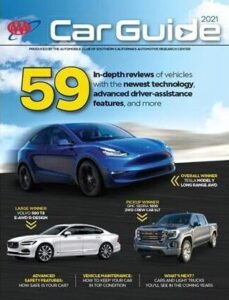
2021 edition of the AAA Car Guide

2021 edition of the AAA Car Guide

Annual guide ranks and rates the latest in-vehicle technologies, including alternative fuel vehicles

The 2020 Tesla Model Y long range EV SUV earned the overall top score in the 2021 AAA Car Guide

The 2020 Tesla Model Y long range EV SUV earned the overall top score in the 2021 AAA Car Guide. (Tesla)


BY MARK MAYNARD

With new car sales booming post-pandemic and a shortage of new vehicles due to a shortage of microchips, shoppers need the best and latest information to make informed decisions. To help consumers navigate the marketplace, AAA created its annual AAA Car Guide. It ranks and rates the latest in-vehicle technologies, including alternative fuel vehicles.

The just-released 2021 edition of the guide includes comprehensive, easy-to-read reviews of each new vehicle focusing on 13 criteria. Among the test features are the number of advanced driver-assist safety features,  braking, acceleration and fuel economy, and handling and ride comfort.

2021 edition of the AAA Car GuideAccording to AAA, driver interest in advanced safety technology is high. When asked which of these systems they want in their next vehicle, two-thirds (67 percent) of drivers said automatic emergency braking, followed by reverse automatic emergency braking (63 percent) and lane-keeping assistance (61percent). A majority of new vehicle models come equipped with at least one of these systems.

The Car Guide highlights how many advanced driver assistance systems (ADAS) are included in the vehicle and other criteria and information.

The majority of the category winners for 2021 are either electric, plug-in electric hybrids or hybrids because manufacturers tend to load up these with the newest in safety technology. As an example, the 2020 Tesla Model Y Long-Range EV SUV has earned the overall top score.

The 2020 Chevrolet Bolt EV Premier (electric) took top honors in the AAA auto guide.

In the category of Best $35,000-$50,000, the 2020 Chevrolet Bolt EV Premier (electric) took top honors.  (Chevrolet)

The vehicles are tested, scored and placed in one of five categories by the Automotive Research Center of the Automobile Club of Southern California, a member of the AAA federation of motor clubs.

“We know that consumers are very interested in new vehicle technology for the safety features,” said Megan McKernan, manager of the Automotive Research Center. “However, AAA research also shows that drivers don’t always understand the technical limits of these features and the AAA Car Guide is an easy-to-understand resource that can help improve their understanding.”

2020 Volvo S90 T8 plug-in hybrid won in the AAA Car Guide's large-car group.

The 2020 Volvo S90 T8 plug-in hybrid won in the large-car group. (Volvo)

After about a year of learning to sell vehicles during a pandemic, dealers are experienced in keeping employees and customers safe. There are new protocols for cleaning and disinfecting dealership facilities and vehicles and how to safely handle sales operations.

Compared to even five years ago, today’s vehicles have many more features and systems that a driver must learn, said McKernan. There are learning curves for new vehicle technology and how the vehicle is powered — either gasoline, an alternative fuel, hybrid, plug-in hybrid or electric, she said. “The learning curve and decisions to be made can be daunting, and our evaluations in the AAA Car Guide are designed to help drivers select a safe and comfortable vehicle that meets their needs.”

The diesel-powered 2020 GMC Sierra 1500 Crew Cab led among pickups in the AAA Car Guide.

Among pickups, the diesel-powered 2020 GMC Sierra 1500 2WD Crew Cab SLT was the winner. A Denali model is shown. (GMC)

Each of the 2021 AAA Car Guide winners has numerous ADAS safety features, which generates a higher score. The highest-ranked by category are:

Overall: 2020 Tesla Model Y Long Range (electric)

Small: 2020 Chevrolet Bolt EV Premier (electric)

Midsize: 2020 Hyundai Sonata Hybrid

Large: 2020 Volvo S90 T8 (plug-in hybrid)

Pickup: 2020 GMC Sierra 1500 2WD Crew Cab SLT (diesel)

SUV/Minivan: 2020 Tesla Model Y Long Range (electric)

Best Under $35,000: 2020 Subaru Outback premium (gasoline)

Best $35,000-$50,000: 2020 Chevrolet Bolt EV Premier (electric)

Best Over $50,000: 2020 Tesla Model Y Long Range (electric)

The AAA Car Guide also contains a compendium of AAA’s recent research of current automotive technologies and topics. Among the highlights are advanced driver assistance systems, gasoline quality, headlight effectiveness, and how to safely transport a pet in the vehicle.

Read more about the winners, detailed evaluation criteria, vehicle reviews, and an in-depth analysis of the ADAS technology at aaa.com/carguide.

About AAA

The not-for-profit, fully tax-paying American Automobile Association has been a leader and advocate for safe mobility since 1902. Drivers can request roadside assistance, identify nearby gas prices, locate discounts, book a hotel or map a route via the AAA Mobile app. To join, visit AAA.com.

Mark Maynard

The Ford Trimotor ‘Tin Goose’

The Ford Trimotor ‘Tin Goose’

An photograph of a Ford Trimotor "Tin Goose"

A Ford Trimotor sits along the grassy edge of a dirt airfield. The location is unidentified in this vintage photograph, but it is likely to be somewhere along the West Coast.

The year is sometime between 1925 and 1933. This three-engine transport aircraft was in production by Ford Motor Co.’s aircraft division.

Nicknamed the “Tin Goose,” the trimotor was designed for civil aviation market (passenger use).  But it also could haul cargo (with seats removed) and the plane saw some military service.

“The original (commercial production) 4-AT had three air-cooled Wright radial engines, according to Wikipedia. “It carried a crew of three: a pilot, a copilot and a stewardess. And there were seats for eight or nine passengers. The later 5-AT had more powerful Pratt & Whitney engines.

All models had an aluminum corrugated sheet-metal body and wings. The metallic construction made it “the safest airliner around,” Henry Ford said.

“In the early 1920s, Henry Ford, along with a group of 19 other investors including his son Edsel, invested in the Stout Metal Airplane Company,” according to the Wiki report. “Stout, a bold and imaginative salesman, sent a mimeographed form letter to leading manufacturers, blithely asking for $1,000 and adding: ‘For your one thousand dollars you will get one definite promise: You will never get your money back.’  Stout raised $20,000, including $1,000 each from Edsel and Henry Ford.

“In 1925, Ford bought Stout and its aircraft designs. The single-engined Stout monoplane was turned into a trimotor, the Stout 3-AT with three Curtiss-Wright air-cooled radial engines.

A total of 199 Ford Trimotors were made between 1926 and 1933.

See these authentic PR images from manufacturer archives

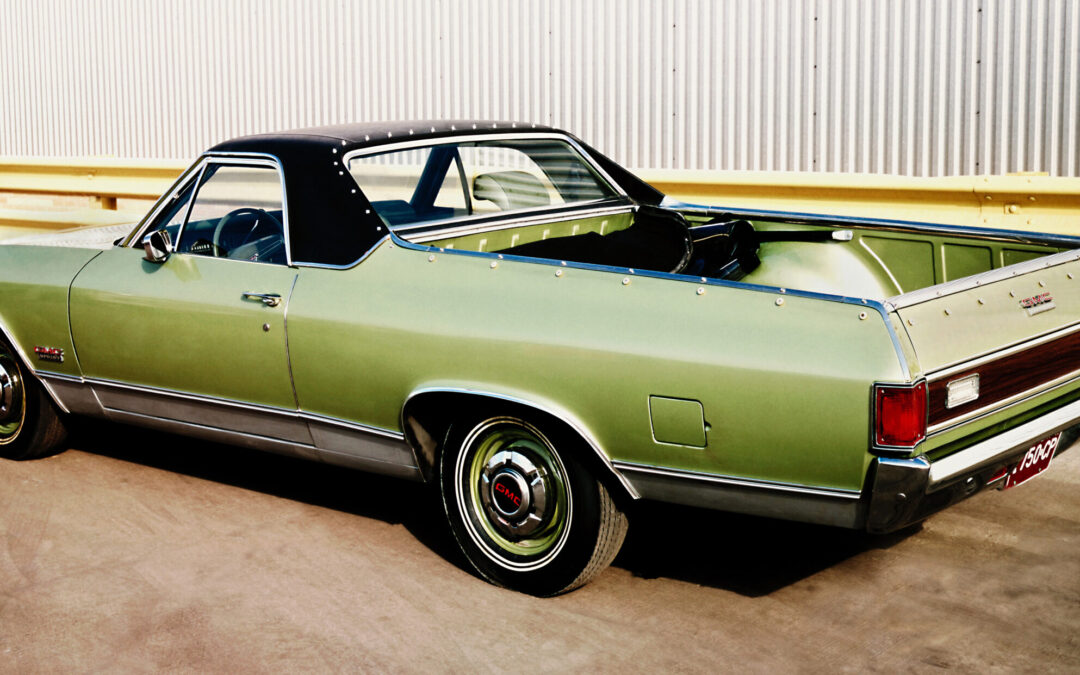
1972 GMC Sprint

1972 GMC Sprint

Badge-engineered from the Chevrolet El Camino, 1971-1987

The GMC Sprint shared exterior and interior elements with the Chevelle Malibu and El Camino. A 1971 Sprint is shown. (GM media archives)

BY MARK MAYNARD

I have walked among thousands of vintage vehicles at dozens of car shows, but I learned something new today while researching a 1960 GMC pickup. Trolling the GM media archives I came upon an image for a 1971 GMC Sprint.

How had I never heard of this badge-engineered version of the Chevrolet El Camino. Maybe I had just overlooked it in the years of enjoying car shows, but in my defense, surely its production numbers were a sliver of the very popular El Camino.

According to its page in Wikipedia, the GMC Sprint (a coupe utility-pickup) was produced for the 1971-1977 model years. It was renamed Caballero for the 1978 model year and produced through 1987.

“It was identical to the El Camino except for the name. The chassis for both variants was based on the Chevrolet Chevelle station wagon and four-door sedan.

“The vehicles were built on the GM A platform through 1981; for 1982, it was re-designated the G platform as the A platform switched to front-wheel drive.

Difficult Time To Debut

The Sprint’s debut in the early 1970s was not a happy time for performance cars in the United States. It was the first year for mandated lower-octane unleaded fuel, which necessitated a reduction in engine compression. GM’s A.I.R. system, a “smog pump,” was added to control tailpipe emissions.

The GMC Sprint was sold with several engine choices for 1971-72.  The base engine was a 145-hp, 250-cubic-inch OHV inline-six. Optional engines included small-block V-8s of 307 and 350 cubic inches and big-block V-8s of 402- and 454-cubic-inch displacements.

“For 1972, horsepower measurements were switched to the ‘net’ figures as installed in a vehicle with all accessories and emission controllers hooked up,” according to the Wiki report. “This change brought the horsepower ratings for 1972 down to a range from 110 horsepower for the six to 270 for the 454 V8.”

The Sprint, sold in trim levels of Standard or Custom, shared exterior and interior trims with the Chevelle Malibu and El Camino. Both years featured rear-end styling taken from the Chevelle station wagon (and were shared with El Camino). The interiors featured cloth and vinyl or all-vinyl bench seats and deep twist carpeting. All-vinyl Strato bucket seats and center console were optional.

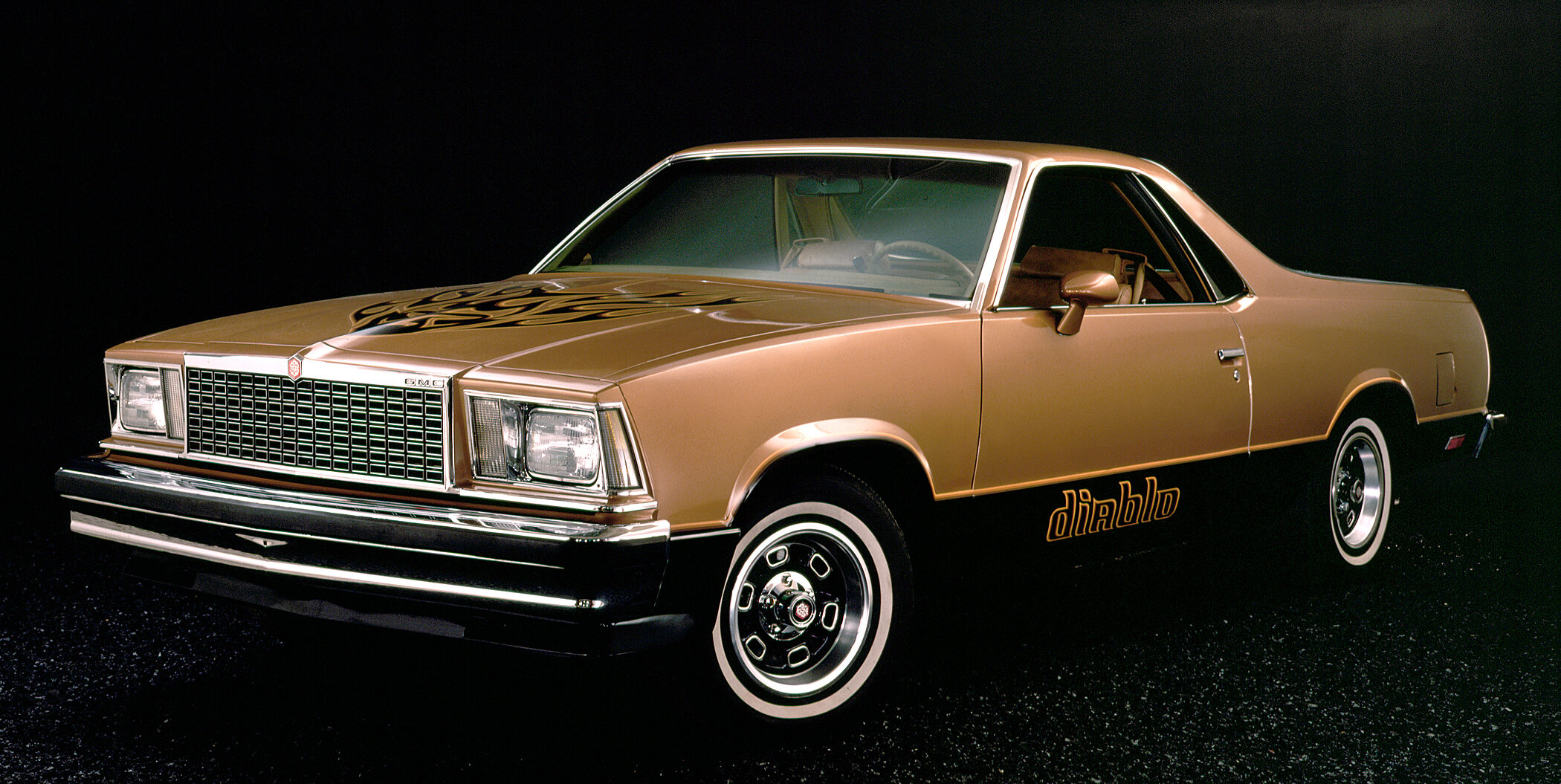
The 1979 GMC Caballero.

The GMC Sprint Diablo package was added in 1978 as an equivalent to the El Camino’s Black Knight (1978) and then the Royal Knight, post-1978, which was an upgrade from the long-running Super Sport package.

The Royal Knight and the Diablo carried a hood graphic in a symmetrical flame pattern that resembled a demon. Diablo also came with lower-body accent paint, body-color mirrors, black-trimmed window frames. Exterior separators also included a front air dam, color-matched steel “Rally” wheels and a large “Diablo” decal on the tailgate.

Sprint SP

The GMC Sprint SP package, only offered on the Sprint Custom, was GMC’s equivalent of the Chevrolet SS package. It was designated as option package, RPO YE7, rather than a distinct model. Engines were an L48 350 four-barrel, LS3 400 (402) big block and the LS5 454 365-hp big block.

On The Auction Block

A 1972 GMC Sprint, in orange paint and black interior, will be among the vehicles slated to auctioned by Mecum at its 34th annual Indy Spring Classic, May 14-22, 2021. It will be Lot T104 and is a “Star” car.

According to the seller’s description:

•This Sprint is one of 749 SP models produced in 1972 and has the original build sheet;
•454-cubic-inch V-8, automatic transmission, disc brakes and power steering;
•Air conditioning;
•Built at Leeds plant in Kansas City, Mo.;
•Sold new at Burnett Buick