Select Page

VW Atlas Cross Sport Review

VW Atlas Cross Sport Review

Volkswagen applied just about everything to its rakish 2021 Atlas Cross Sport, but is it enough for it to stand out?

The VW Atlas Cross Sport

The midsize VW Atlas Cross Sport 5-seat SUV redistributes space for a wealth of back-seat and cargo space

BY MARK MAYNARD

Volkswagen’s new Atlas Cross Sport shares a rich bloodline that also underpins the Lamborghini Urus, Audi Q8 and Porsche Cayenne Coupe, if not other nameplates in the VW Group global family. Consider it the sporting alter ego to the three-row, seven-passenger Atlas SUV.

Using the footprint of the family-oriented Atlas, the Cross Sport adopts a shaved roofline with a styling slant at the rear with redistributed back seat space for a long 40.4 inches of legroom.

Compared to the full-size Atlas, the Cross Sport is 5.2 inches shorter with a roofline lowered by 2.2 inches. Front headroom is still tall at 39.4 inches with a long 41.6 inches for legs. And even the cargo space is fully functional at 40.3 cubic feet behind the back seat (stacked to the ceiling) and 77.8 cu. ft. with the 60/40 back seat folded.

An interior view out the windshield of the VW

The cabin has broad front shoulder room of 61.5 inches and tall headroom of 39.4 inches. (VW)

New for 2021

The Cross Sport was new for 2020 and received a few technology updates for 2021. The next-generation MIB3 infotainment system with wireless app-connect and multi-phone pairing is now standard on SE models and above. And VW’s newest driver-assistance features of Travel Assist and Emergency Assist were added to SEL models and above.

Travel Assist is a semi-autonomous driving system that when activated will steer, accelerate and brake the vehicle when driving on a divided highway. The system is good at lane centering, but, as with many of these semi-autonomous systems, the vehicle will drift wide along sweeping highway corners.

The electronic Digital Cockpit (gauge display) can be configured to include the navigation map. (VW)

Atlas Cross Sport Pricing

The Cross Sport is sold in eight trim levels — S, SE, SE with Technology, SE with Technology R-Line, SEL, SEL R-Line, SEL Premium, and SEL Premium R-Line — in front- or 4Motion all-wheel drive.

Starting prices range from $32,050 for the entry front-drive model to $51,220 for the top-line V6 SEL Premium R-Line 4Motion (today’s tester); pricing includes the $1,195 freight charge from Chattanooga, Tenn. The tester, in Aurora Red metallic paint ($395), was $51,615.

The bumper-to-bumper warranty (including powertrain) of 4-years/50,000-miles includes free maintenance for 2 years or 20,000 miles.

Standard equipment on all models includes power and heated side mirrors, LED headlights-taillights-running lights, 18-inch alloy wheels, six-way adjustable driver’s seat, rearview camera, 6.5-inch color touch screen and 11 cup holders.

Find Atlas and Atlas Sport lease and financing incentives here.

The seats are Euro firm and the seat bottoms will feel hard after a couple of hours on the road. (VW)

Cross Sport Safety Features

Among the standard VW Cross Sport safety features are six air bags, forward collision warning and autonomous emergency braking. In addition, there is pedestrian monitoring, a blind-spot monitor, and rear traffic alert.

The 2020 and 2021 Atlas and Atlas Cross Sport received NHTSA five-Star overall crash safety ratings.

The 276-hp, direct-injection 3.6-liter VR6 and eight-speed automatic is rated for towing up to 5,000 pounds. (VW)

Cross Sport Powertrains

Powertrain choices are either a 235-horsepower, turbocharged and direct-injected 2.0-liter four-cylinder engine or 276-hp, direct-injected 3.6-liter VR6. Both engines are paired with an eight-speed automatic transmission.

Fellow car critics say the turbocharged 2.0-liter engine will be adequate for most needs. But those who tow will want the V-6. And there’s not much incentive to go for the four.

The 2.0-liter has fuel economy ratings of 21/24/22 mpg and nearly the same with AWD at 20/24/22 mpg.

The V-6 has EPA ratings of 18/23/20 mpg front-drive or 17/23/29 mpg AWD, using premium fuel for maximum power, but 87 octane is acceptable. In highway driving, I worked up to 24.2 mpg, but around-town mileage was typically between 15-18 mpg. The 19.5-gallon tank should provide commuters around 400 or more miles before refueling.
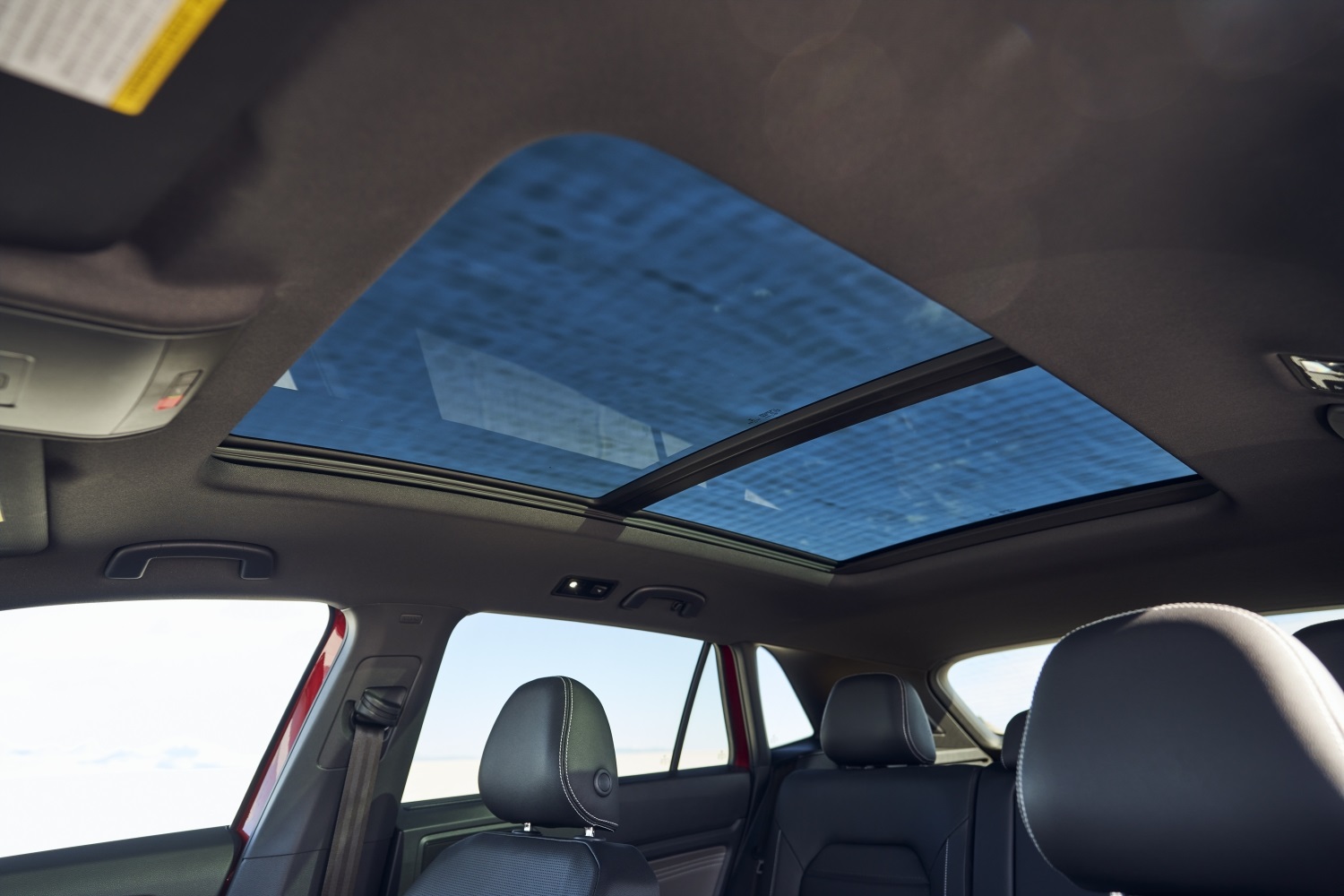
The big sunroof in the Cross Sport

There is chauffeur-class appeal to the second row. (VW)

Cross Sport Interior Function

The SEL Premium cabin is well stocked with creature comforts and useful technologies, which made it easy to forgive the liberal use of black plastic in lower areas; it’s tough looking but not with a cheap finish.

The SEL’s heated seats and steering wheel have three heat settings, which I’d not seen before on a steering wheel. The e-bin on the shift console has two charging USB ports and a wireless pad, but the pad was fussy for my iPhone 8 and wouldn’t function unless I removed its official Apple cover. The deep center armrest console hides another USB port.

I bonded with the lush rotation of the electric steering and how easily I trolled the mall parking in search of a space. The official turning circle is 40.5 feet, but it seems much tighter as the big SUV curls easily into parking slots. The wide-screen camera with an overhead view is helpful when parking, but a front view would be more helpful.

There is solid assembly and contemporary styling elements to the interior, despite the liberal use of black plastic in lower areas. (VW)

Steel-slab security

There is a strong sense of steel-slab security in the architecture. There is a generous space inset from the doors, which is functional as crush space in a side impact.

Sightlines are somewhat complicated by large side mirrors and the broad base of the windshield pillars, which are good for roof-crush standards — but the mirrors can block views of vehicles and pedestrians when turning at intersections. Over-the-shoulder views are unimpeded and I had no issue with seeing out the slimmer back glass.

The e-bin on the shift console has two charging USB ports and a wireless pad, but it was fussy for my iPhone 8. (VW)

After a couple of hours on the road, the seat bottoms will feel hard — so much so that I wanted to pull the wallet from my back pocket. The driver’s seat helps compensate with 10-way power adjustment, though I would have preferred some up-and-down adjustment to the lumbar. The passenger has an eight-way power seat.

The sliding visors have large coverage and there is equally large door-panel storage, with a large, locking glove box.

21-inch Pirelli tires on the Cross Sport

The all-season, 21-inch Pirelli Scorpion Zero tires roll quite smoothly. (VW)

Ride and Handling

There is bullish durability in how solidly the Cross Sport V-6 feels on the road and yet how deftly it managed the tester’s hefty all-wheel-drive curb weight of 4,484 pounds.

It is not quick in its handling and in standard drive mode the ride quality is soft, for a German-engineered SUV, with some bounding over intersection transitions, but it is comfortable. Switch to Sport mode and the shifts become aggressive (almost too much for in-town) and the suspension tightens significantly.

Braking is solid with four-wheel disc brakes, 13.2-inch vented rotors front and 2.2-inch solid rear rotors. The all-season, 21-inch Pirelli Scorpion Zero tires (265/45) have a wide footprint and roll quite smoothly.

Cross Sport back seat

The long doors ease access to the second row. (VW)

Cross Sport Back Seat

There is damn-nice back-seat space accommodations that are almost too nice for children. No parent has the arm length to reach back to subdue squabbles. There is a limousine-class 40.4 inches of legroom and a slightly cropped 37.8 inches of headroom with just a low hump at the transmission tunnel. The seatbacks recline and there is generous two-level stash space in the door panels. There are a pair of vents in the rear of the console, but no fan speed or temp controls.

The back seats, which recline, have 40.4 inches of leisurely legroom. (VW)

There is lots of black plastic and the leather isn’t a showpiece but the tester’s window seats were heated and have a perforated back and cushions. The pull-down armrest has cup-can holders and there are two charging USBs and a 150-watt 115-volt household plug.

Cargo Area

There is a tall lift-up to the cargo floor, which has huge cubic footage behind the second row — 40.3 to 77.8 cu. ft. with the back seat folded. The space is 47 inches wide by 46 inches deep with a height-challenged 29 inches to the headliner.

Cargo space is 47 inches wide by 46 inches deep with a height-challenged 29 inches to the headliner. (VW)

Why Buy the Atlas Cross Sport?

Way back in the 1990s, carmakers would offer two-door versions of their midsize SUVs as the sportier variant. Those short-wheelbase models didn’t fare well in evasive maneuvers or ride quality. Today, the trend is the more rakishly styled five-door SUV variant with the sloped roof to make it look sporty. Basically, it’s an ego purchase in which the buyer pays more and gets less (space) for a still-functional format.

For $51k, the topline V-6 SEL Premium R-Line, is loaded with desirable features and details, but it is not without its quirks. Elements as simple as floor mats and a cargo area roller cover are options, $105 and $180. Its fuel economy is among the lowest among the towing-capable competitors (including the Chevrolet Blazer, Jeep Grand Cherokee, Ford Explorer or Honda Pilot), but its good German engineering is an engaging separator.

But it might not be stylistically different enough from the seven-seat Atlas to be a convincing purchase.

A top-line seven-seat Atlas SEL Premium comparably equipped to the Cross Sport tester works out to be about $1,000 less. But the seven-seater also has the option for second-row captain’s chairs ($695), which are not offered for the Cross Sport.

VW might be missing out on not offering an “Executive Black” seating format and promoting the Cross Sport as the prestigious dressed-for-success SUV.
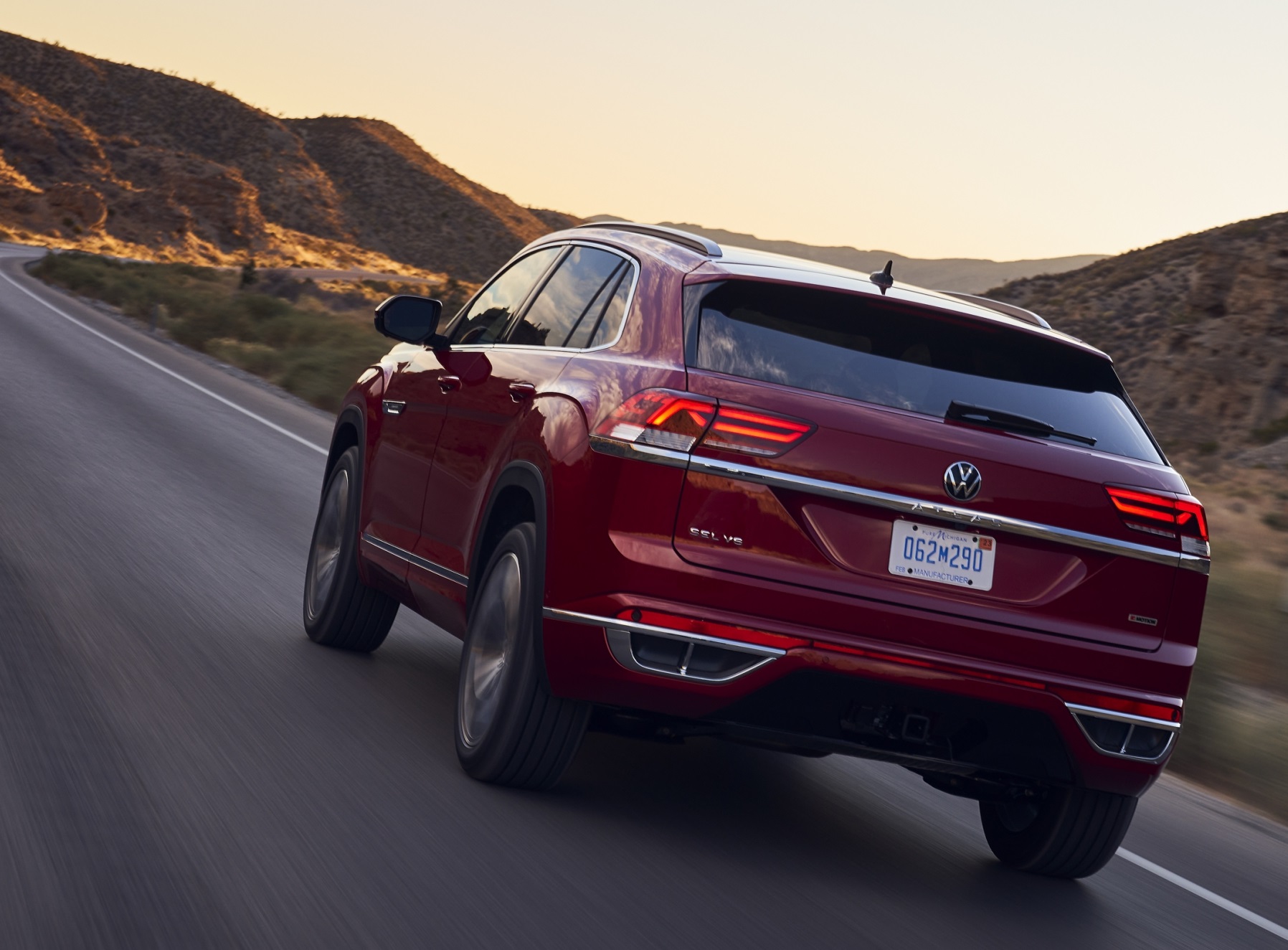
A rear view of the Atlas Cross Sport

There is bullish durability in how solidly the Cross Sport V6 feels on the road. (VW)

2021 Atlas Cross Sport V6 SEL Premium R-Line 

Body style: midsize, 5-seat, 5-door AWD SUV

Engine: 276-hp, direct-injection 3.6-liter VR6 with auto stop-start at idle; 266 lb.-ft. torque at 3,500 rpm

Transmission: 8-speed automatic with 4MOTION permanent all-wheel drive with four performance modes

Fuel economy: 17/23/19 mpg city/hwy/combined; premium preferred for peak power but 87 octane recommended

BY THE NUMBERS

Fuel tank: 19.5 gallons

Cargo space: 40.3-77.8 cu. ft.

Front head/leg room: 39.4/41.6 in.

Rear head/leg room: 37.8/40.4 in.

Length/wheelbase: 195.5/117.3 in.

Curb weight: 4,484 lbs.

Turning circle: 40.5 ft.

Tow capacity: 2,000 lbs. or 5,000-lbs. with tow package ($550)

FEATURES

Standard equipment includes: smart-key locking and push-button ignition, power tilt-and-slide panoramic sunroof, heated and ventilated front seats, 10-way power driver’s seat, 8-way power front passenger seat, 17 cup holders, heated rear (window) seats, electric parking brake, Digital Cockpit (gauge display), power (heated) side mirrors with turn signals, Park Assist with steering assistant, park-distance control front and rear with tones, rearview camera with overhead view, 8-inch touch screen display for navigation-audio-apps, 12-speaker Fender premium audio system with satellite radio, Climatronic dual-zone cabin temperature control, e-bin with 2 USB charging ports and wireless pad, manual lift-up rear window sunshades, ambient cabin lighting, lighted and covered vanity mirrors with sliding visors, stainless-steel pedal covers, 21-inch wheels with 21-inch Pirelli Scorpion Zero tires (265/45), LED headlights-taillights-fog-running lights, trailer hitch, R-Line bumpers-badging-trim, rain-sensing wipers with heated nozzles

Safety features include: 6 air bags, engine-brake assist and electronic differential lock, hill hold and hill-descent control, automatic post-collision braking

IQ.Drive features: Travel Assist (semi-autonomous driver assist), adaptive cruise control with stop-and-go, Lane Assist lane-keeping system, semi-automated Emergency Assist, forward collision warning and autonomous emergency braking and pedestrian monitoring, Active Side assist (blind-spot monitor) and rear traffic alert

PRICING

Base price: $51,220, including $1,195 freight charge; price as tested $51,615

Options on test vehicle: Aurora Red Metallic paint $395

Where assembled: Chattanooga, Tenn.

Warranty: 4-years/50,000-miles includes the powertrain and free maintenance for 2-years or 20,000 miles.

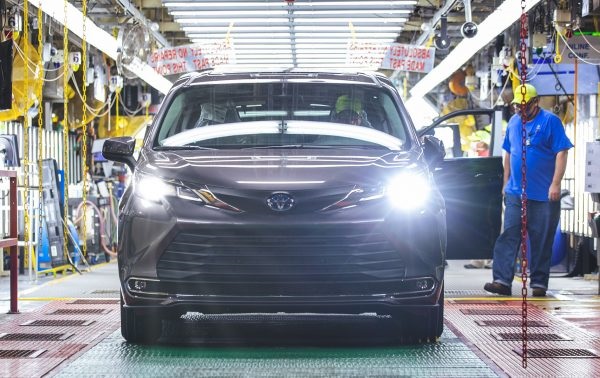
Toyota heralds 30-millionth U.S.-built vehicle

Toyota heralds 30-millionth U.S.-built vehicle

The “milestone” vehicle was the hybrid 2021 Toyota Sienna minivan

The Indiana-built  Sienna entered Toyota’s history books today.  (Toyota)

BY MARK MAYNARD

The 30-millionth U.S.-assembled Toyota vehicle rolled off the line this week at the Princeton, Ind., manufacturing plant.  The “milestone” vehicle was the most recent major model redesign by Toyota, the hybrid 2021 Toyota Sienna minivan.

With a flash of its lights and a honk of the horn, the fourth generation of the family-mover, in Predawn Mica paint, moved off the production line and into Toyota’s history book.

The 2021 Sienna is the first minivan in the segment to be offered with all-hybrid technology, Toyota says.

With seating for eight, the minivan is sold in five trim levels in front- or all-wheel-drive configurations. Starting prices range from $35,635 to $51,075, including the $1,175 freight charge from Princeton, Ind. Find the Sienna configurator here.

The gasoline-electric powertrain is comprised of a 189-horsepower, 2.5-liter four-cylinder, a 134 kW (180 hp) electric motor, and a 40-cell, 288-volt nickel-metal hydride battery pack. Total combined system power adds up to a net 245 hp. Its electronically controlled continuously variable automatic transmission has a sequential shift mode.

Certified as a Super Ultra Low Emission Vehicle, the new Sienna has EPA fuel economy ratings of 36 mpg city, 36 highway and 36 mpg for front-drive models and 35/36/35 mpg for AWD; on the recommended 87 octane fuel.

Toyota to debut 3 new electrified vehicles for U.S. market

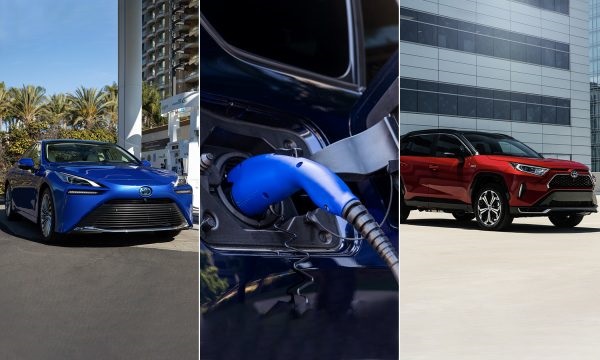
This group photo illustrates Toyota's new electrified vehicles.

This group photo illustrates Toyota’s new electrified vehicles.

Toyota Motor North America also announced today its plans to debut in the U.S. market this year, three new electrified models – two battery-electrics and a plug-in model. The new models were not identified.

The carmaker says that by 2025, its goal is to have 25 percent of new vehicle sales be electrified models, and by 2030 expects that to increase to nearly 70 percent. And between now and 2025, Toyota and Lexus models, globally, will have an electrified option.

According to Toyota research, a purely electric vehicle and a plug-in hybrid can provide similar environmental benefits for reducing greenhouse gas emissions.

Company research also claims the PHEV is much less expensive to buy and own, compared to the BEV. Without any incentives, the five-year Total Cost of Ownership of a long-range BEV is significantly higher than the PHEV. And even with pricing incentives, the TCO of a long-range BEV is much higher.

WD-40 renews partnership with Habitat for Humanity

WD-40 renews partnership with Habitat for Humanity

An ad image of the WD-40 and Habitat for Humanity fundraiser

BY MARK MAYNARD

Lift a hammer, lift a life with WD-40 as it partners with Habitat for Humanity International. For every 12-ounce can of WD-40 Smart Straw sold at participating Lowe’s Home Improvement stores, the San Diego-based maker of multi-purpose lubricants will donate 50 cents to the grassroots Christian housing organization.

The effort marks the second year in which WD-40 Brand is supporting Habitat for Humanity.

Through April 30, 2021, WD-40 will donate up to $50,000 to assist the global nonprofit housing group in creating safe and affordable housing.

A Place To Call Home

Having a place to call home means more now than ever — and WD-40 Brand is helping to make that happen for families across the globe, Erin Bala, director of brand management and innovation at WD-40 Co., said in a statement.

“WD-40 Company values making things better than they are today with its products and through partnerships with organizations like Habitat for Humanity,” said Bala. “Throughout the pandemic, Habitat for Humanity has continued to advocate for housing solutions that will allow more people to gain access to affordable housing and we’re proud to help the organization achieve its goals.”

The need for affordable housing has never been greater and the continued support of WD-40 Co. will help communities become stronger and more resilient, said Julie Laird Davis, VP of corporate and cause marketing partnerships at Habitat for Humanity International.

“In 2021, we will continue to support communities around the world by helping families build and improve their homes,” she said.

Lowe’s also has been a long-time supporter of Habitat for Humanity, including the Women Build initiative and other programs and advocacy work. As a continuation of the partnership, 100 percent of all donations made through Lowe’s “Be the Change” campaign from January 2021 to March 31, 2021, will be donated to Habitat for Humanity International.

About WD-40 Brand

For nearly 70 years, WD-40 Multi-Use Product, America’s No. 1 multi-purpose lubricant, has helped users stop squeaks, remove grease and grime, penetrate stuck parts and displace moisture. And a line of specialist products consists of lubricants, penetrants, greases, cleaners and degreasers and rust-management solutions.

The WD-40 brand is also well-known for such products as 3-IN-ONE, X-14, 2000 Flushes, Carpet Fresh, Spot Shot and Lava soap.

Learn more about WD-40 Brand at wd40.com  and Habitat for Humanity at Habitat.org.

2022 Nissan Frontier Pickup Overview

2022 Nissan Frontier Pickup Overview

Third-generation 2022 Nissan Frontier is about the same size as before and with a standard V-6 powertrain

A front view of the2022 Nissan Frontier

2022 Frontier midsize pickup has been completely redesigned and re-engineered. (Photos courtesy of Nissan)

By MARK MAYNARD

Nissan just released details today on the 2022 Pathfinder SUV and Frontier midsize pickup.

As said senior VP for Global Design for Nissan Motor Co. Alfonso Albaisa in the video presentation: “The Frontier has been around for a while.”

It had become the elder of midsize pickups, with the second-gen model on sale since 2005.

The interior of the new Frontier pickup

Standard Zero-gravity front seats.

The new Nissan Frontier is about the same size as before but a complete re-engineering with some exterior styling cues from Nissan’s full-size Titan pickup. Look for its “brutally vertical face” and interlocking-style grille.

It will debut with a simplified build order. There is one powertrain choice of a V-6 engine and a nine-speed automatic transmission. As before, there will be rear- or four-wheel drive. And there will be two body-style configurations of King Cab and Crew cab, in short- or long-wheelbase lengths.

The AroundView camera system in the Nissan Frontier

The AroundView camera system includes an off-road front view.

Pricing was not announced today, but don’t expect it to be far off from the Chevrolet Colorado, Ford Ranger, or Toyota Tacoma. Find Nissan pricing here.

Frontier fundamentals

An overhead view of the Frontier bed

King or Crew Cab body styles.

The driver area

With a digital dashboard.

Nissan Frontier Powertrain

  • 310-hp, direct-injected 3.8-liter V-6; 281-lb.-ft. torque;
  • 9-speed automatic transmission with 7-position drive mode, with tow mode;
  • 4WD with high and low gearing transfer case;
  • Top payload: 1,610 pounds – 2WD

The back seat Dimensions

  • Standard wheelbase (SWB): 210.2 in.;
  • Overall length: 210.2 in. SWB; 224.2-in, LWB;
  • Width: 73 in.

Bed

  • Length: 59.5 in. for SWB Crew Cab S/SV; 58.9 inches for PRO model; 73.3 in. – LWB Crew Cab and standard King Cab
  • Width: 61.4 in. (at C-Channel);
  • Depth: 19.4 in.

Trim levels

  • King Cab: S, SV – 2WD or 4WD;
  • Crew Cab: S, SV – 2WD or 4WD;
  • PRO-X (2WD only), PRO-4X (4WD only)
  • Crew Cab long wheelbase: SV 2WD, SV 4WD

Frame and suspension

  • Heavy-duty fully boxed ladder frame;
  • Double-wishbone front suspension with twin-tube shock absorbers; overslung rear multi-leaf with a solid axle;
  • 6,720-lb. maximum tow capacity;
  • 16- or 17-inch wheel packages with tires sizes of 265/70R16, 265/65R17 or 265/70R17

Safety features

  • 8 airbags
  • Standard Intelligent Forward Collision Warning;
  • Optional Traffic Sign Recognition and Nissan Safety Shield 360 on every trim

Other details

Around view monitor with an off-road front view; an optional 9-inch display screen; 4-liter center console capacity; Zero-gravity front seats; electric power steering; digital dashboard; head-up display; Apple CarPlay and Android Auto, with optional wireless versions.

A side view of the new Frontier

The new Nissan Frontier is about the same size as before.

Airstream Flying Cloud a Freewheeling Home Office

Airstream Flying Cloud a Freewheeling Home Office

2021 Flying Cloud Office charts new course for travel lifestyle and work on the road

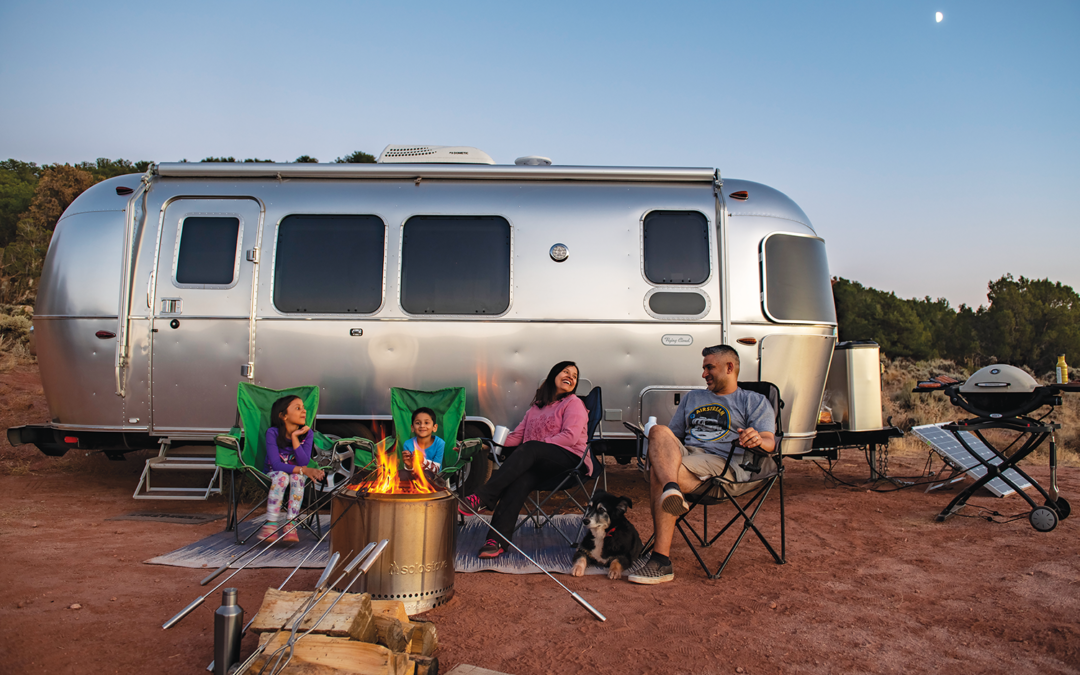
The Airstream Flying Cloud 30FB Office

Pricing for the Airstream Flying Cloud 30FB Office starts at $107,500. (Photos courtesy of Airstream)

BY MARK MAYNARD

Airstream, the iconic maker of the so-called “silver bullet” travel trailers, had circled its wagons during the coronavirus pandemic, which shifted the entire travel landscape.

Spurred by feedback from owners already working remotely from the comfort of their RV, Airstream rethought the traditional floor plan for one of its most popular travel trailers, the Flying Cloud, introduced in 1949.

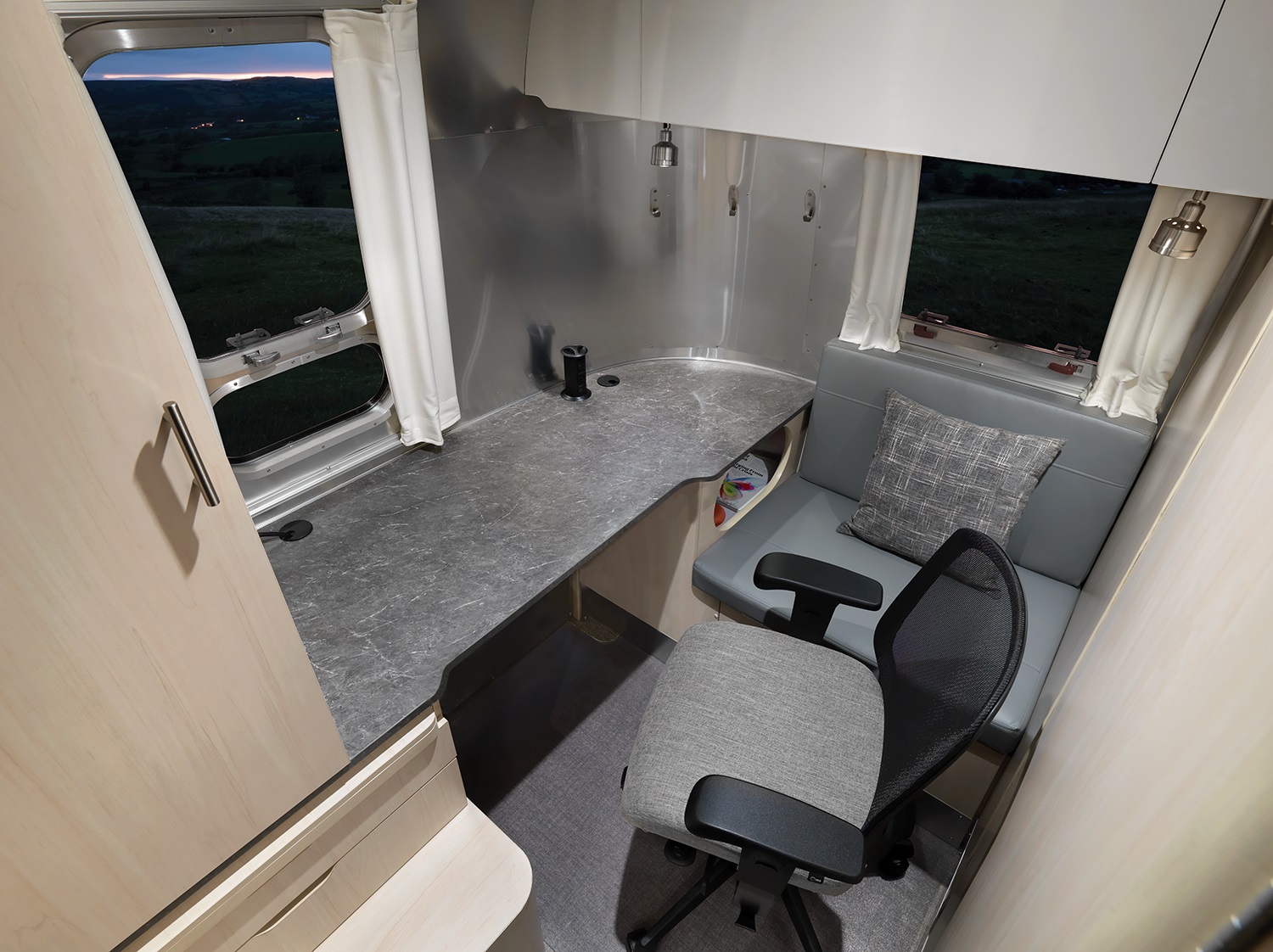
Flying Cloud 30FB Office space

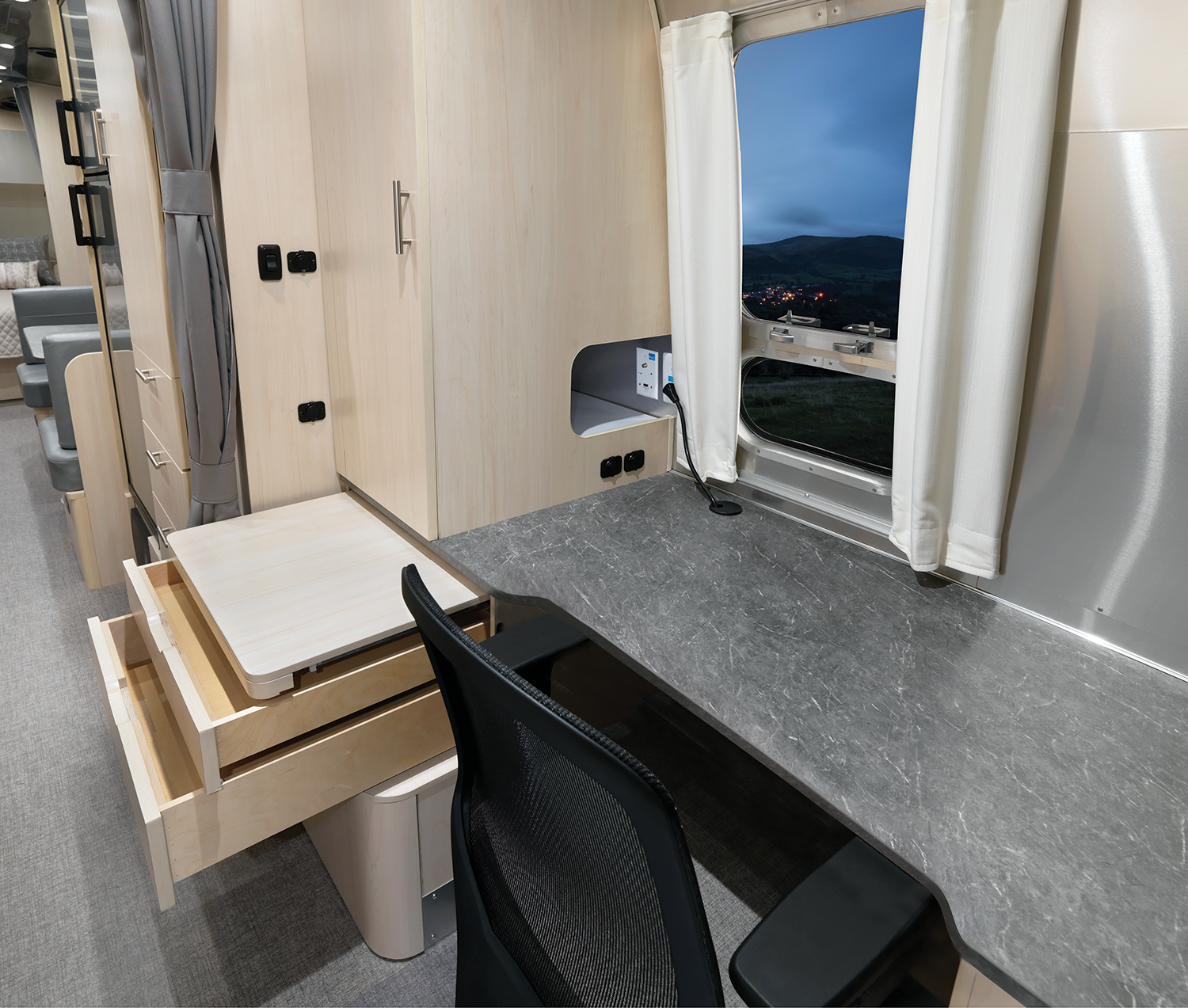
Three windows in the office provide maximum light and views. 

The re-imagined format was just announced for the Flying Cloud 30FB Office. The rear corner sleeping area was redesigned as a dedicated office space for a “work from anywhere” option.

The 30FB Office is made for charting a course into the new reality of how we play, work, learn and live while traveling, Bob Wheeler, Airstream President and CEO, said in a statement.

Sliding drawers and storage cubbies provide organization. A pop-up USB/AC power outlet is supported by the 1000-watt inverter.

“We know that the work landscape will forever be changed by the pandemic,” said Wheeler. “We learned a lot — not only about the necessity of connectivity and options for increased power, but about the joy of closing your laptop and stepping out onto the trail.”

The dedicated workspace includes a supportive office chair that slides into a recessed groove on the edge of the desk. The space can easily convert into a sleeping or relaxing area for one, as needed. Sliding drawers and storage cubbies provide organization, while a privacy divider and black-out curtains provide a measure of privacy while doing video calls on the road.

Flying Cloud 30FB Office with black-out curtains

Black out-curtains and a privacy divider provide a muted video environment.

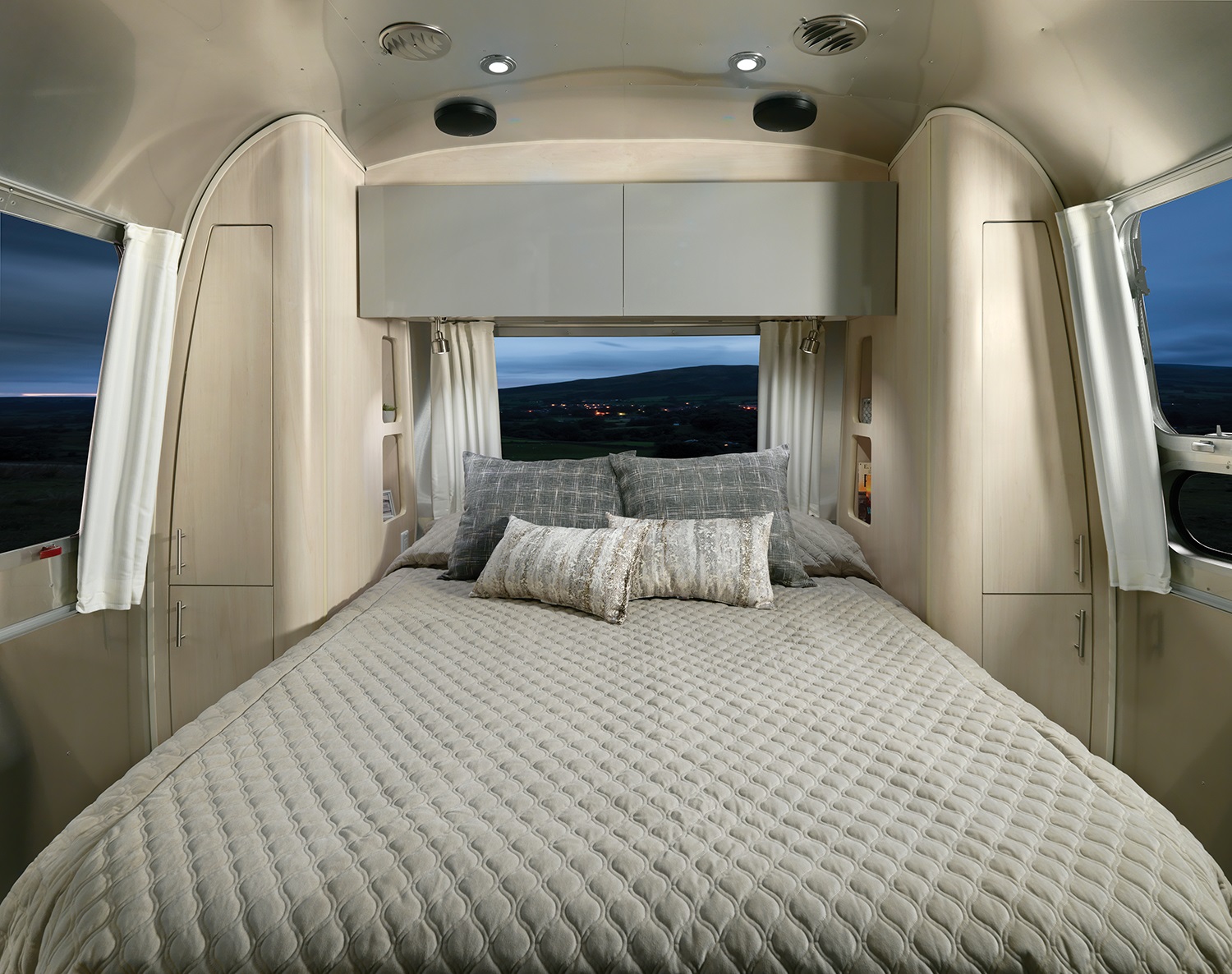
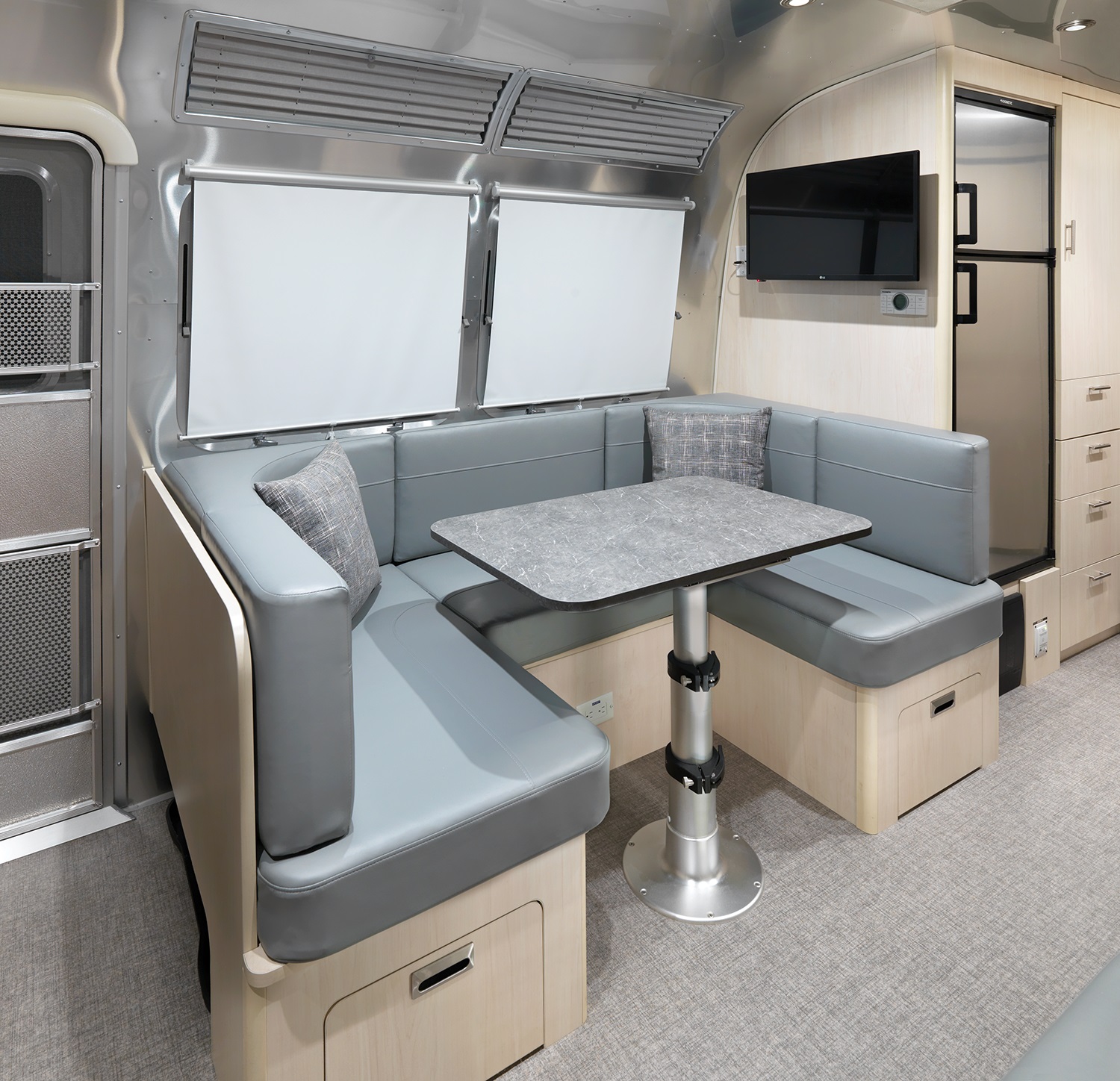
And the Flying Cloud 30FB Office preserves all the amenities and refinement expected of an Airstream. It retains a queen bed, plus a bench and convertible dinette, providing sleeping space for up to six.

Three windows give the office space a nearly panoramic view, while blackout curtains allow users to control light for video calls, or even block the window views for better concentration.

Flying Cloud 30FB Office bathroom

The bathroom includes a shower, sink and toilet.

Standard features, such as Airstream Connected are pre-wired for easy bundling of dealer-installed upgrades, like Airstream Power Plus and the Solar Package, for owners to stay connected — and stay off the grid and working for longer.

Flying Cloud 30FB Office main living area

The 30-foot-long Flying Cloud has an interior height of 6 feet, 7.5 inches.

Floor plan innovations include:

  • Desk with sliding drawer storage and additional storage cubbies;
  • An office chair that i secured with a strap during travel;
  • Several USB ports are located throughout the desk area;
  • Pop-up USB/AC outlet supported by the 1000-watt power inverter;
  • Pull-out table for more workspace and it slides out of sight when not in use;
  • Access to the satellite TV/HDMI outlets from onboard Blu-Ray DVD player;
  • Privacy divider;
  • Two desk grommets for organizing cables or mounting monitors;
  • Overhead storage cabinets with dry-erase surfaces and under-mount LED lights.

The queen-size bed has a memory foam mattress.

The Flying Cloud has evolved since its introduction in 1949, but it’s always been a popular option for families and couples, Justin Humphreys, Airstream VP of Sales said in the statement.

“This new unit makes a small change to an already excellent floor plan, and it transforms the way you can use your Airstream,” Humphreys said. “It gives you even more flexibility to get outdoors, spend time with family and stay connected to your work.”

The dinette can be converted to a sleep space, allowing up to six for overnights.

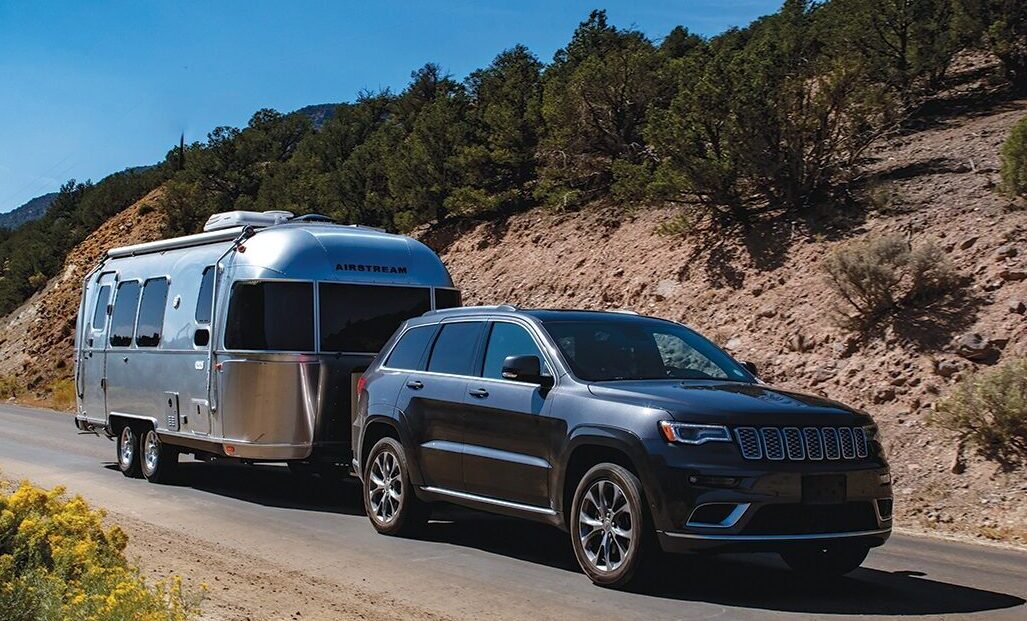
The Flying Cloud 30FB Office has a base weight of 6,757 pounds and a maximum trailer capacity (GVWR) of 8,800 pounds. The trailer is intended to be pulled by a range of SUVs and pickups, Airstream says.

Pricing starts at $107,500.

Airstream Flying Cloud Specifications

Exterior length: 30 feet, 10 inches

Exterior width: 8 feet, 5.5 inches

Interior width: 8 feet, 1 inch

Exterior Height with A/C: 9 feet, 9 inches Interior Height with A/C: 6 feet, 7.5 inches

Fresh-water tank: 52 gallons

Gray-water tank: 42 gallons

Black-water tank: 35 gallons

Refrigerator: 2-way, 8 cubic feet

Oven: LP gas

Information: Airstream.com.