Select Page

New tires provide a rewarding new-car feel on a budget

The new tire centers at JBA Speed Shop are a Tire Rack top five-star installer. (Photos by Mark Maynard) 


JBA Speed Shop now provides full tire services and front-end alignment, including for high-performance vehicles


By MARK MAYNARD

New tires are one of the simplest and least expensive ways to give your old ride that new-car feel. Even if the tread does not appear to be unevenly worn or down to the wear-bar indicators, the National Highway Traffic Safety Administration and new-vehicle manufacturers suggest a tire is only 100 percent safe to use until it turns 5 to 6 years old. Of course, a tire can be operable up to 10 years if you check it for issues annually after the fifth year.

In 2013, I had re-tired my 2008 Ford Escape Hybrid (bought in 2012) with four new Goodyear Assurance Fuel Max all-season touring tires. They were promoted as an affordable choice with low-rolling resistance to stretch fuel mileage. They have a tread-life warranty of 6-years or 65,000-miles, which put my set of Goodyears at the end of their life cycle, even though they had substantial tread remaining.

The 7-year-old Goodyear Assurance tires appeared to have good tread remaining, but the cracks of old age were apparent on closer examination.

They did not appear worn out, but upon closer examination, there were visible surface cracks from age — and the tires now rode like hard, black checkers. On the highway I could average 30 mpg and 17-24 around town.

During a suspension check-up for shock absorbers and other suspension elements, the technician advised that the tires were old and should be replaced. They also were out of balance and a front-end alignment was needed.

All of those necessary service points had crept up over the last few years and I had accepted that the tires were just hard and noisy. And I had also accepted that the choppy ride at highway speeds was just how the compact, front-drive SUV handled. I never pushed it for cornering maneuvers, so how it handled was just fine as a daily driver.

But after replacing the front struts and rear shock absorbers, the handling and ride quality improved dramatically. And then I knew that new tires would really improve the ride.

But not just any new tires.

The MeltdownTires center specializes in high-performance applications.

There are many brands of tires for a compact SUV, but it is difficult to choose a winner when the user reviews contradict each other. I was shopping a premium all-season tire and had written a short story on Pirelli’s Scorpion Verde All Season Plus II tires.

Checking various tire sites, the Scorpion Verde had many positive reviews. So I started shopping prices at Tirebuyer.com, which often has the lowest pricing, especially when shipped directly to an installer.

JBA owner J. Bittle bought the best equipment money can buy, he says, including the state-of-the-art Hunter machines.

A set of Scorpion Verdes, size 235/70R16, would cost $590 or $147.50, with free shipping to a tire shop of my choice. And at the time there was a $40 discount if I ordered by a deadline.

For a comparison, I called the JBA Speed Shop in the Kearny Mesa area of San Diego. Owner J. Bittle had recently opened a tire facility in an annex building at his compound. Among the speed shop’s specialties are dynamometer testing for chassis and engine, machine-shop services for custom engine builds and the blueprinting of an engine and a “plumbing” center for braided steel lines, military-spec fuel lines, oil lines and brake lines.

His tire center includes an online tire-shopping link that populates all the major brands and their common pricing. The link listed the same pricing as at Tirebuyer.com. And JBA is a Tire Rack top five-star installer; tires can be purchased online and shipped to JBA for installation.

JBA stocks top brand names in wheels and tires.

I liked the idea of supporting the home-grown business and had JBA order the tires, which were shipped to the shop in about five days.

Bittle has added two levels of tire service. His JBA Tire Center offers basic tires and wheels, “for the best service for the best price,” he says. And the MeltdownTires Performance Center specializes in high-performance tires, including race rubber and custom wheels, whether for a new car or a full custom hot rod.

“A standard alignment center does not understand what occurs when you lower vehicles, so we brought it in-house because we couldn’t outsource anymore,” he said. “It’s becoming more and more difficult to find trusted vendors,” he said, “especially for balancing Plus-1 or Plus-2 tire fitments [adding larger and wider wheels by 1, 2 or 3 inches].

“There are only a couple of facilities in town that have the facilities that we do,” he said. “Our Hunter machines are state of the art and we bought the best equipment money can buy.”

I made an appointment to have the tires installed and an alignment. The tires, mounting and balancing ($20 each) and other fees (tire disposal and recycling) came to a no-regrets $738.34 plus $98 for the alignment.

Premium tire upgrade

Unless you are putting tires on a junker to sell, upgrading to more premium tire brings rewards you will appreciate and value every time you drive. And I also noted a significant boost in fuel economy.

The Goodyear Assurance Fuel Max tires I replaced were good for about 30 mpg on the highway and 17 to 24 mpg around town. While making a recent 80-mile highway run last week on the new Pirellis, I was quite surprised to see that the Escape’s mileage counter had hit 33.3 mpg and it might have gone higher with more highway driving. Around town, the tires are helping to deliver an average of 24-27 mpg. When new, my Escape had factory mileage ratings of 34/30/32 mpg city/hwy combined.

What Pirelli says

I found the Scorpion Verde tires to be quiet rolling and supple, and very responsive in cornering.

The Scorpion Verde tires are quiet rolling and supple. A side benefit has been improved fuel economy.

Pirelli says its Scorpion Verde All Season Plus II tires are an extremely well-balanced choice for SUVs and crossovers. The eco-friendly tire (verde meaning “green” in Italian) delivers high performance, low noise and excellent handling, the company says.

The all-season touring tire was updated in mid-2019 with a new tread compound and a larger footprint for improved wet and dry handling and wet braking. The second-gen formula maintains the mileage, comfort, noise and winter performance of the previous generation, Pirelli says.

Sold in 40 sizes, from 16 to 22 inches, the Scorpion Verde All Season Plus II is covered by a 65,000-mile limited tread wear warranty. Depending on the size, pricing can range from $140 to $255 each. And Pirelli offers a 30-day trial offer, called Confidence Plus Plan. If a buyer is not satisfied with a set of four new tires, they can be exchanged for a new set of four Pirelli tires at the original place of purchase, within 30 days from the original date of purchase.

Older vehicles run great, until they don’t — and then it can be a major expense to get them back to what we had before, which might not feel like the cost was worth it. New tires, however, are like a halo of good feelings and give reassurance of safety in foul weather.

With good tires, you will know exactly where your money went — and you’ll remind yourself to do it sooner next time.
MarkMaynard@cox.net

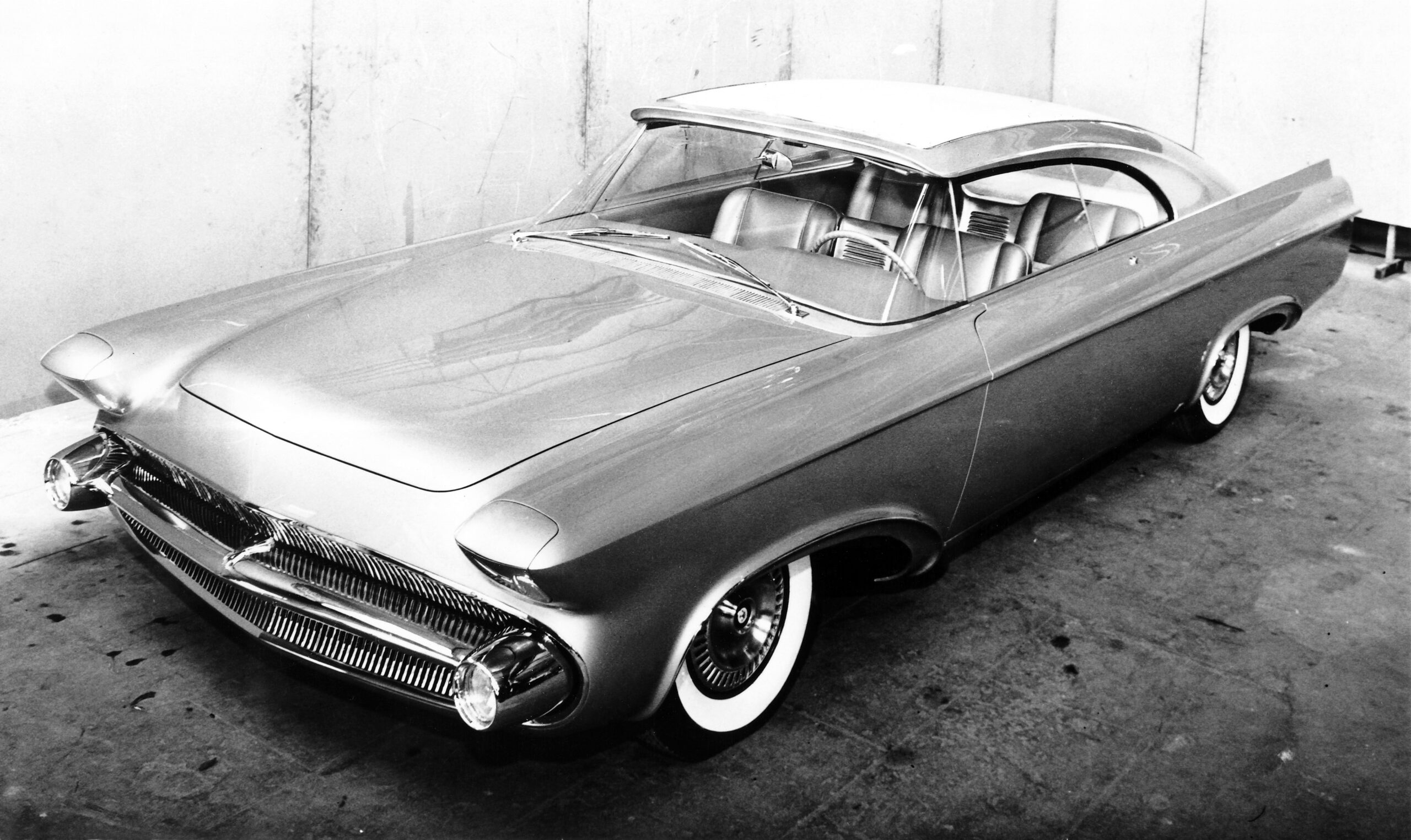
1956 Chrysler Norseman concept

1956 Chrysler Norseman concept

The 1956 Chrysler Norseman was lost at sea. (FCA US photos)

BY MARK MAYNARD

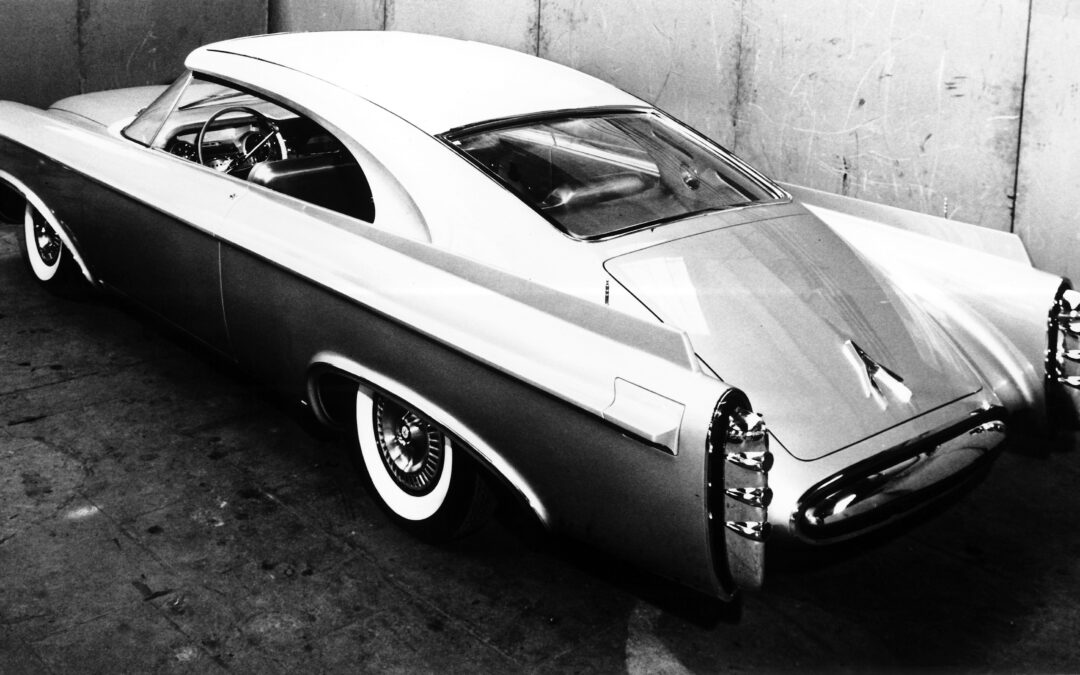
The Chryser Norseman was a four-seat fastback concept coupe built in 1956. Although designed by Chrysler’s stylists, the actual construction was contracted out to the Italian coach-building firm of Carrozzeria Ghia. The concept car was lost during the sinking of the SS Andrea Doria.

According to Wikipedia, “Chrysler wanted a fully drivable vehicle, not just a rolling mockup, so all normal systems for the powertrain, braking, suspension, were installed. Power was from a modified 5.4-liter, 331 cubic inch Chrysler Hemi engine producing 235 hp with a pushbutton-controlled Powerflite automatic transmission.

“The body panels on the car were made of aluminum with “a sharply sloping hood, upswept tail fins and a covered, smooth underbody for aerodynamic efficiency.” The Norseman combined a “sweeping fastback rear end design and Chrysler’s own take on a tailfin and bumper treatment.”

1969 Dodge Charger Daytona

1969 Dodge Charger Daytona

The most conspicuously styled Dodge of all time. (Stellantis)

BY MARK MAYNARD

The 1969 Dodge Charger was the most conspicuously styled Dodge of all times and served as the homologation model for the Dodge stock cars entered in NASCAR races. Only 505 units were built for NASCAR homologation.

U.S. pricing started at $3,860 U.S. dollars.

The road-going version of the model was powered by the 7-liter, 425-horsepower Hemi 426. The tuned race version reached speeds in excess of 200 mph on oval racetracks.

Overview

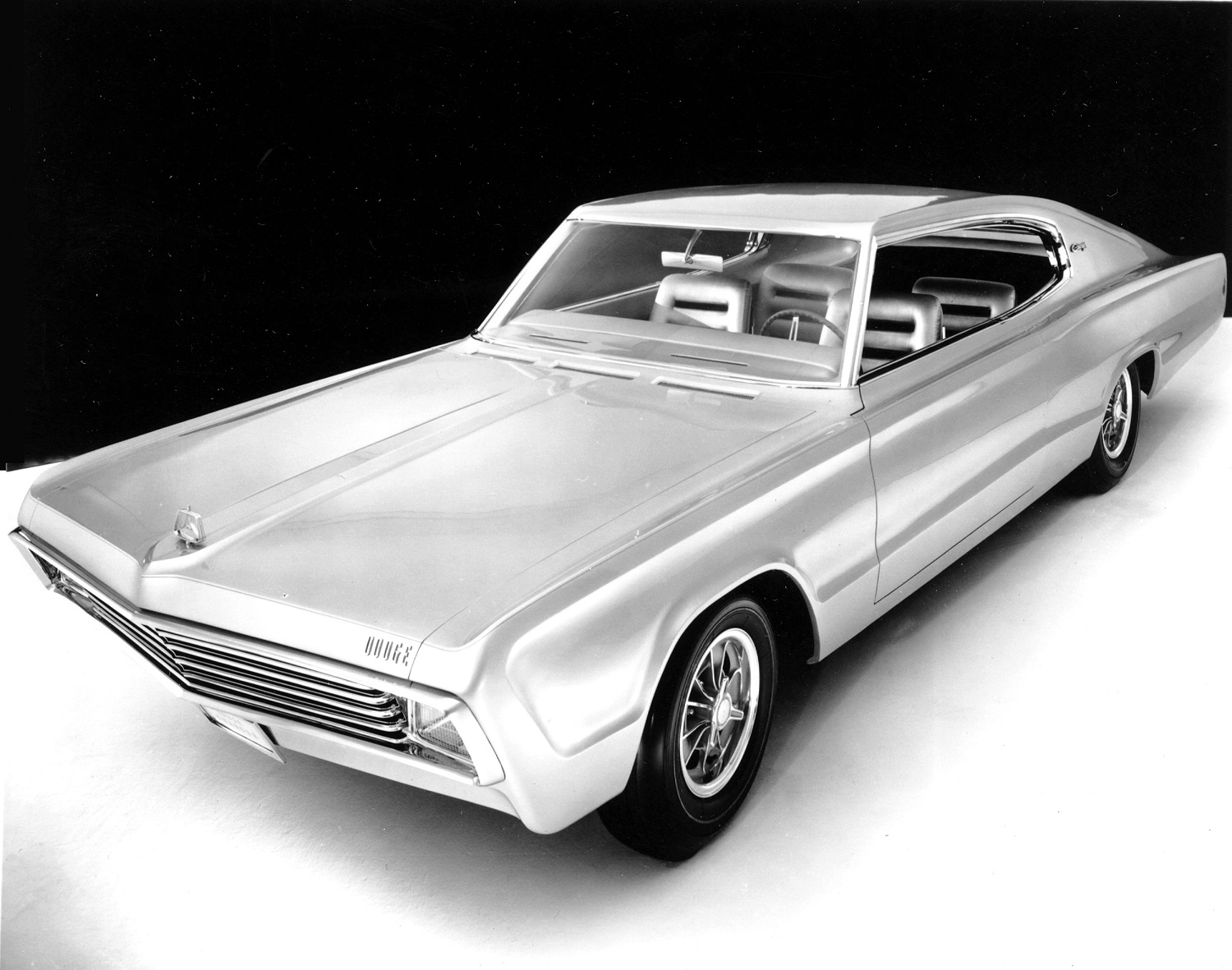
The Dodge Charger was introduced on Jan. 1, 1966. It was built off the Dodge Coronet chassis, but it had its own fastback body.  It featured many styling cues from the Charger II concept car like a fastback roof design and full-width taillamps.

The Charger was positioned to take on AMC’s conceptually similar Rambler Marlin. The Charger was better looking but somewhat more expensive. Pricing ranged from $2,850 to $3,100 —  or $22,733 to $24,727 in 2020 dollars.

Significantly, the Charger’s interior was different from all other cars, with a full-length center console and “all bucket seating” front and rear.

Also an innovation, the rear’s pseudo-buckets could be folded down to create interior space accessible via the enormous rear hatch.

The Charger wasn’t intended to compete head-to-head in performance with pony cars but was available with Chrysler’s famed 426 Hemi V8.[9]

The Charger came with a standard 5.2-liter, 318 cubic-inch V-8 engine delivering 230 horsepower. Other available engines included a 265-hp 361 cubic-inch V-8 engine, or a 325-hp 6.2-liter, 383 cubic-inch V-8.

However, it was the availability of a massive 426 cubic-inch Street HEMI engine that provided 425 horsepower and 490 foot-p;ounds of torque that forever defined the vehicle.

The 1969 Dodge Charger body style carried over from 1968 with minor exterior changes like a new grille and taillamps.

The HEMI engine was installed in less than 2 percent of ’69 Dodge Chargers, yet contributed immensely to the image and desirability of the Charger lineup.

The 1969 Charger gained fame as the tire-squealing getaway car driven by Bo and Luke Duke for seven seasons on the TV series, Dukes of Hazzard.

1965 Dodge Charger II concept

The Dodge Charger featured many styling cues from the Charger II concept car.

Dodge Charger At the Track

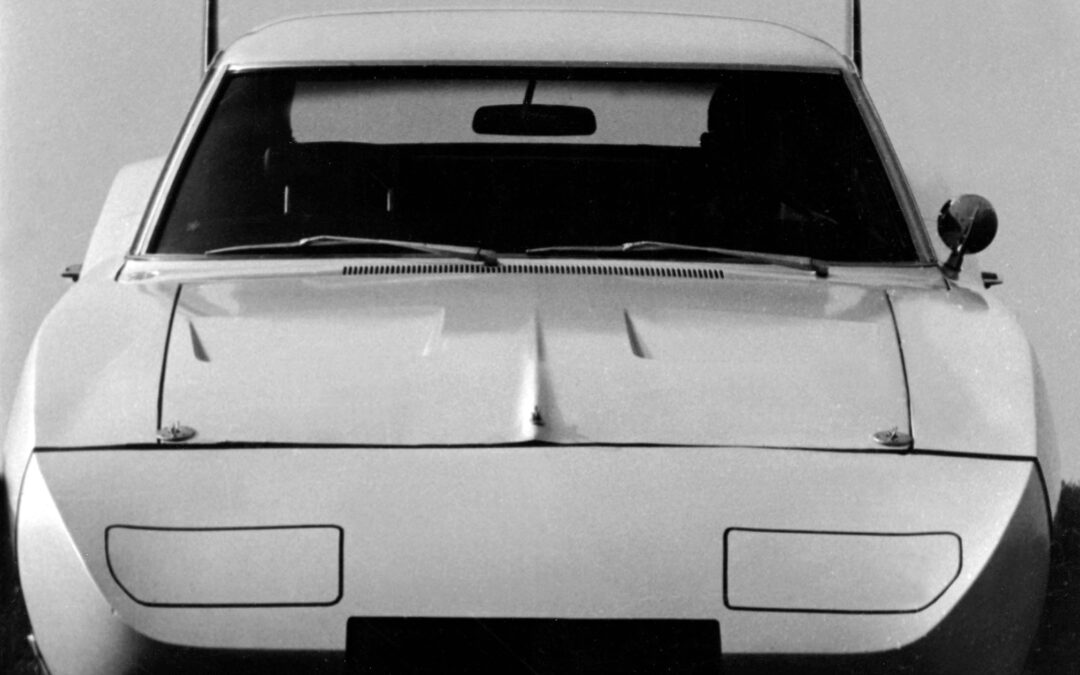
The 1969 Dodge Charger 500, featuring a flush rear window to improve aerodynamics, was introduced especially for NASCAR.

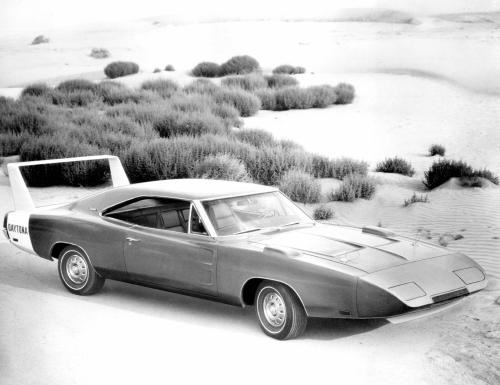
The Charger Daytona was introduced in September and built specifically for NASCAR competition.

The Daytona featured a large aerodynamic nose and a huge “wing” spoiler in the rear that stood 58 inches above the trunk.

All Dodge Charger Daytona models were powered by either a 440 Magnum cid or 426 HEMI engine.

Dodge Charger Daytona won its first NASCAR Grand National race at Talladega (Ala.) in September followed by a win at Texas International Speedway.

From September 14, 1969, through the next year, Charger Daytona and the Charger 500 won 45 out of the next 59 races.

The car dominated racing so much that NASCAR eventually placed restrictions on the HEMI engine by forcing the use of carburetor restrictor plates on Chrysler models featuring the HEMI engine and limiting engine displacement to a maximum of 305 cubic inches on Charger Daytona and Plymouth Superbird models.

Driver Buddy Baker, behind the wheel of a HEMI-powered Charger, became the first to top the 200 mph mark on a closed-circuit course in 1970.

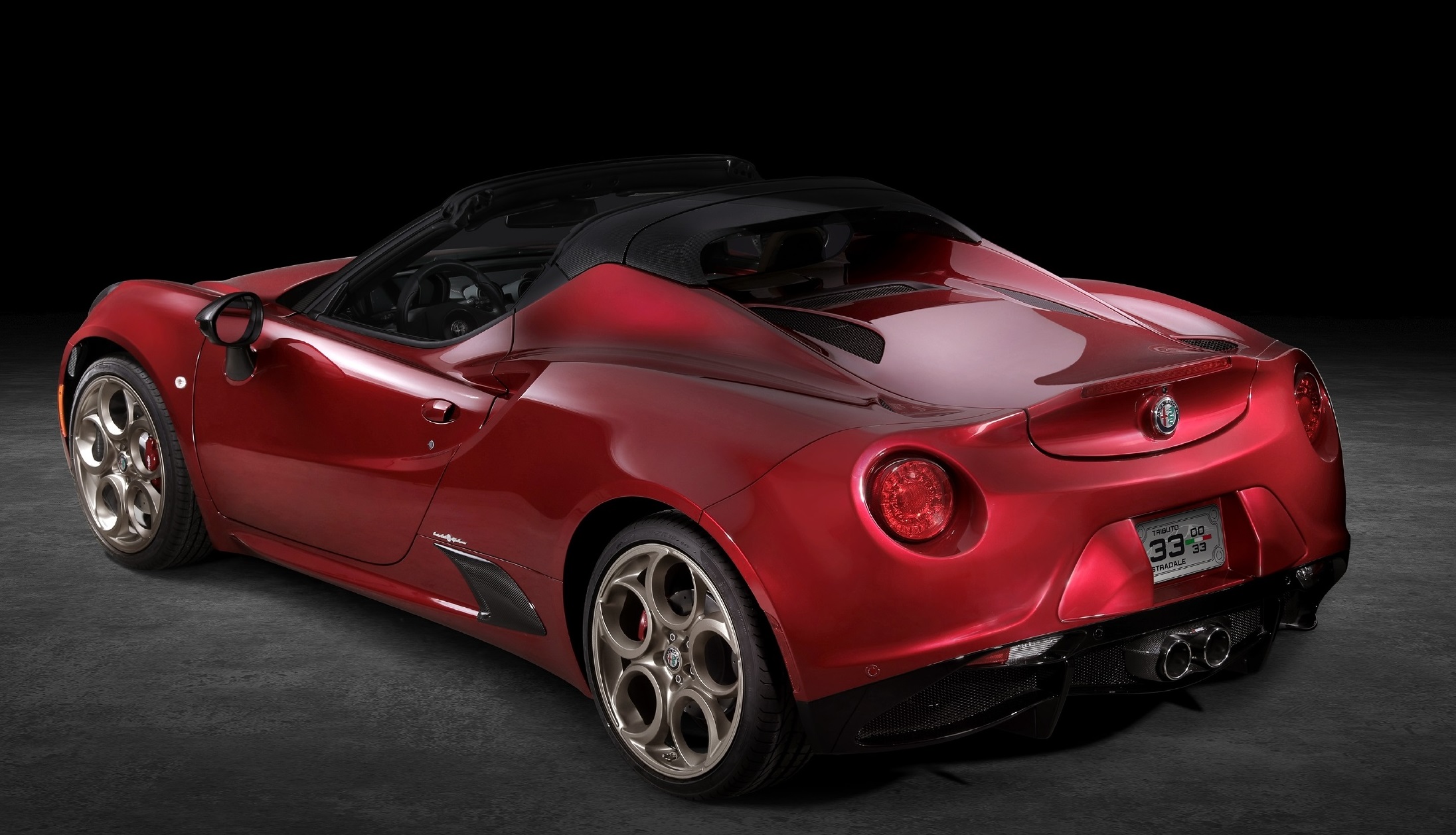
Homage to a legend: 2020 Alfa Romeo 4C Spider 33 Stradale Tributo

Hand-assembled in Modena, Italy, the 4C Spider 33 Stradale Tributo honors the 1967 Alfa Romeo 33 Stradale supercar. (Alfa Romeo)

Limited-edition Stradale Tributo marks final run of the 4C Spider for North America


BY MARK MAYNARD

Alfa Romeo unveiled today, Dec. 14, the 4C Spider 33 Stradale Tributo, inspired by the 1967 Alfa Romeo 33 Stradale, one of the first mid-engine supercars. Only 33 units of this limited-edition Stradale Tributo will be produced for North America. The Stradale Tributo marks the final production run of the 4C Spider for North America.

Pricing starts at $79,995 U.S. MSRP, excluding the $1,595 freight charge from Modena, Italy.

The upcoming Tonale PHEV compact-class crossover. (Alfa Romeo)

Tim Kuniskis, Global Head of Alfa Romeo said in a statement that “The 4C Spider 33 Stradale Tributo … passes the torch to the next generation of iconic Alfa Romeo vehicles, including the upcoming Tonale PHEV crossover that will start production next year.”

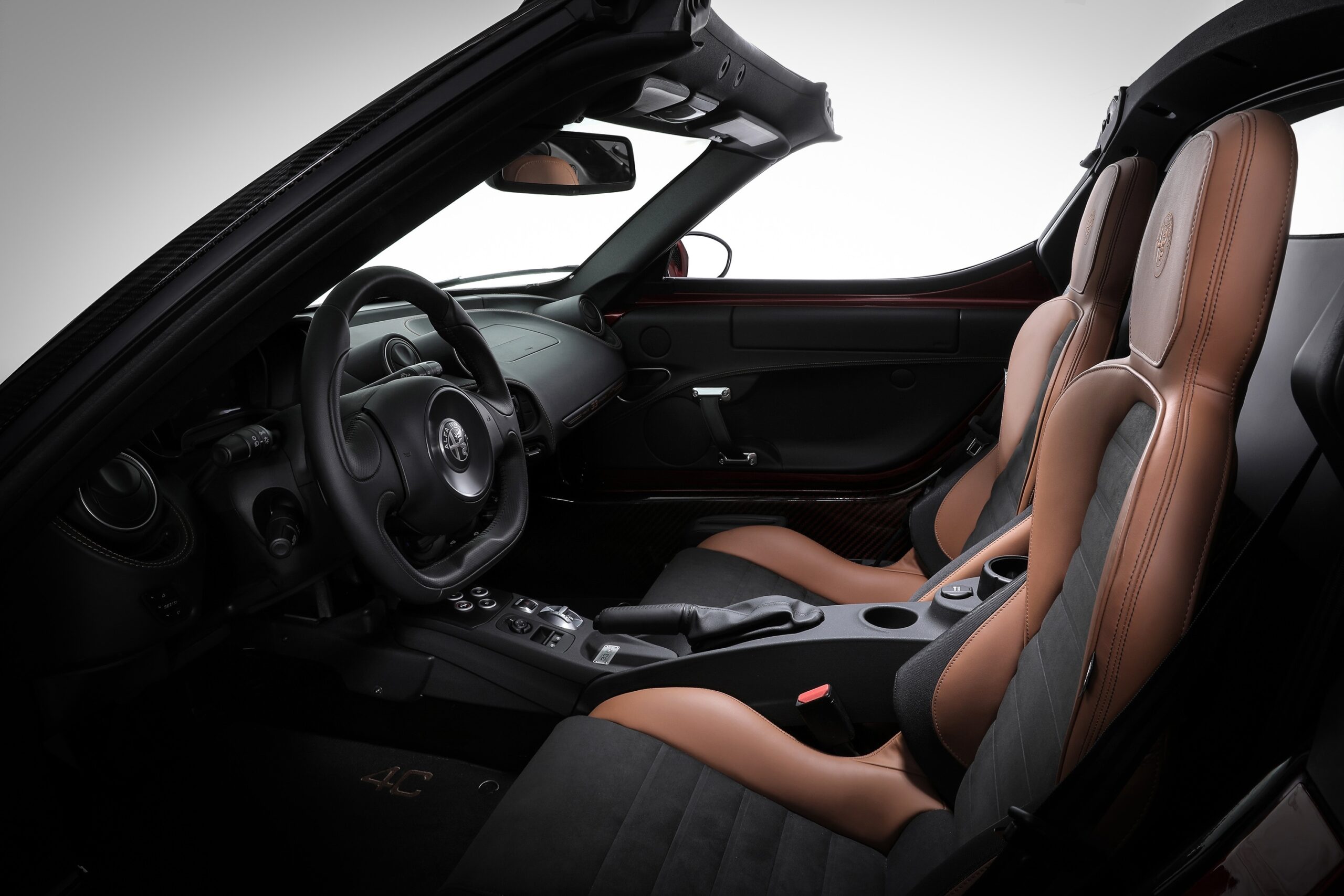
The Stradale Tributo comes exclusively in Rosso Villa d’Este tri-coat red paint with gray-gold alloy wheels (18-inch front and 19-inch rear) and composite sport seats covered in black Dinamica suede and tobacco leather.

The cockpit will be displayed with “33” plaques in the cockpit, side sills and center console, the last of which is progressively numbered.

The premium black-and-tobacco interior. (Alfa Romeo)

Customers also will be given a matching, numbered book designed by Centro Stile (Design Center) that chronicles the 4C’s design concept, technology, materials and Modena assembly facility as well as the history of the 33 Stradale.

The 33 Stradale Tributo comes with commemorative badging, plaques and book. (Alfa Romeo)

The Stradale Tributo is loaded with extra features, including an Akrapovic dual-mode center-mounted exhaust (usually a $3,100 upgrade), race-tuned suspension ($800), bi-xenon headlamps ($1,100), battery charger ($150), car cover ($400), suede/leather seats and carbon fiber halo, rear wing and Italian flag mirror caps ($900). The exterior will be set off by “Centro Stile Alfa Romeo” badges and available piano-black front air intake and rear diffuser.

Weighing less than 2,500 pounds, the 4C Spider is powered by a 237-horsepower, direct-injection 1750cc turbocharged four-cylinder with dual intercoolers and a six-speed Alfa twin-clutch transmission. Alfa Romeo cites 0-60 mph acceleration in 4.1 seconds and a top speed of 160 mph.

Limited to just 33 cars, the limited-edition 4C features exclusive Rosso Villa d’Este tri-coat paint, gray-gold 5-hole alloy wheels and black-and-tobacco interior. (Alfa Romeo)

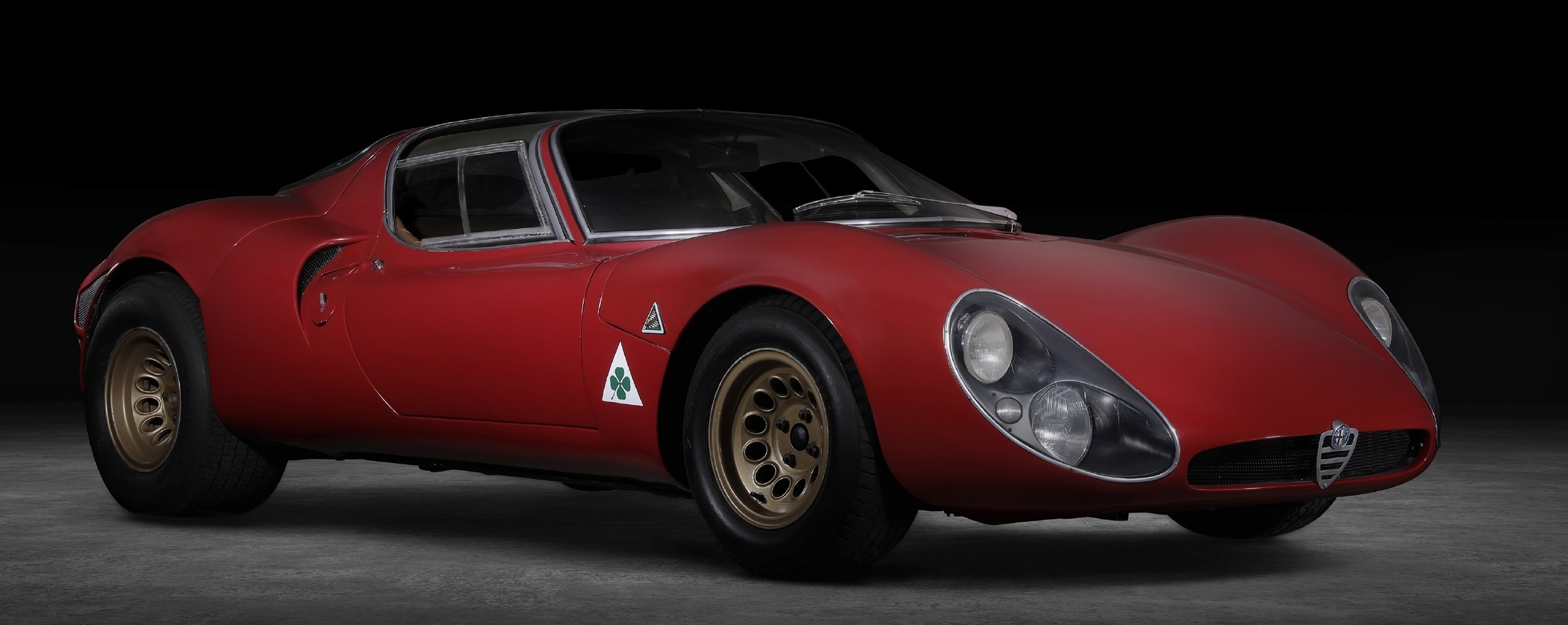
The 33 Stradale

Italian for “road-going,” the 33 Stradale was a hand-built mid-engine exotic based on the Tipo 33 race car that won its class at the 1968 24 Hours of Daytona. (Alfa Romeo)

The 1967 33 Stradale made its public debut at the Monza circuit on Aug. 31, 1967, on the eve of the 1967 Formula One Italian Grand Prix.

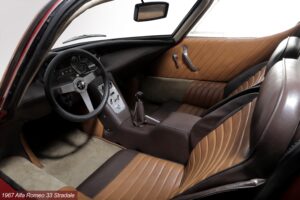
The black-and-tobacco interior of the ’67 33 Stradale. (Alfa Romeo)

Italian for “road-going,” with a top speed of 162 mph, the 33 Stradale was a hand-built Franco Scaglione-penned mid-engine exotic based on the Tipo 33 race car that won its class at the 1968 24 Hours of Daytona.

To this day it represents a singular blend of leading-edge technology, racing mechanics and inspirational design, a fitting forebear to the 4C Spider. Only 18 chassis were ever produced, with most completed cars painted in Alfa’s signature red, with gray-gold wheels and black-and-tobacco interior.

To reserve a 2020 Stradale Tributo, email sales@alfaromeo.com.

2020 Alfa Romeo 4C Spider 33 Stradale Tributo alongside the ’67 33 Stradale. (Alfa Romeo)

Holiday gift ideas by Mopar

Holiday gift ideas by Mopar

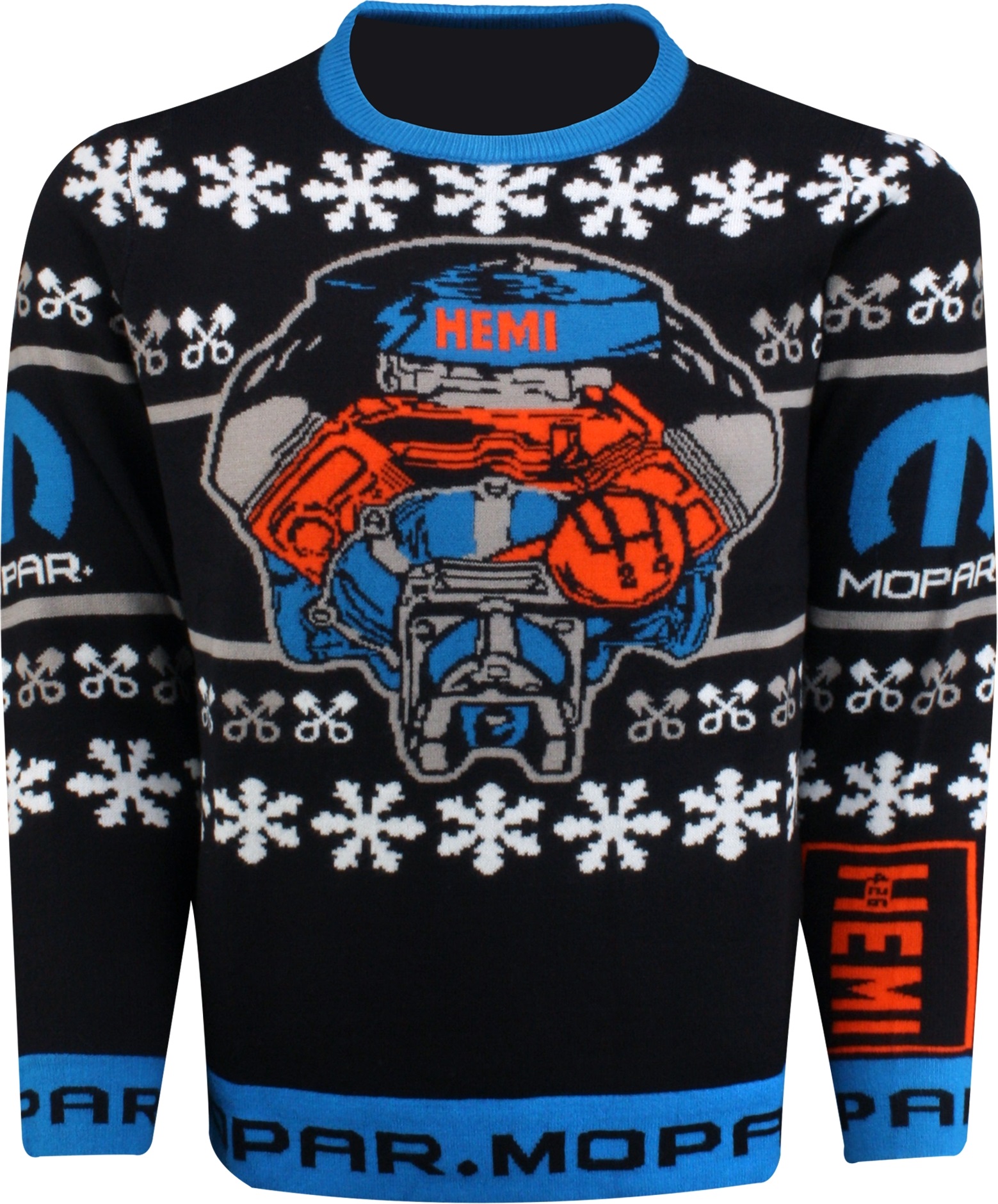
Mopar ugly holiday sweater, $54.95.

From an ugly sweater to a face mask to a Hellcrate Redeye 6.2-liter Supercharged crate V-8


BY MARK MAYNARD

If all you want for Christmas is an 807-horsepower Hellcrate Redeye 6.2-liter Supercharged HEMI V- 8, Mopar can gift wrap it! In all, the Motor Parts Division of Chrysler FCA US has more than a dozen holiday gift ideas ready to ship. Shop online at www.WearMopar.com and www.Mopar.com.

Through Dec. 31, 2020, Mopar customers receive 15 percent off accessory and performance part purchases.

From the www.WearMopar.com section of the website, use promo code “JOLLY75” at checkout for free standard ground shipping to U.S. locations this holiday season when spending $75 or more on branded merchandise; valid through Dec. 31, 2020.

Here are some ideas to get you in the holiday spirit:

Mopar crystal holiday ornament, $29.95. The etched crystal holiday ornament that features the Omega M Mopar logo etched in the center of one side. The ornament is three inches in diameter and includes a two-inch silver-elastic hanging string and gift box.

Mopar ugly holiday sweater, $44.95. Custom-knit design sweater is highlighted by a rear view of a classic HEMI V-8 engine on the front and “Do you hear what I hear” on the back. Available in medium, large and XL; in black, blue, white or orange.

Mopar women’s soft-shell jacket, $100.95. Ultra-smooth, ultra-soft, athletic-fit women’s soft-shell three-season jacket features front zip pockets with Omega M-stacked Mopar logo embroidered on the left-chest area in white and blue. Available in sizes ranging from small to XXXL.

Media screen protector, $20 each for 7- or 8.4-inch touchscreens. Made from tough, clear static-cling film.

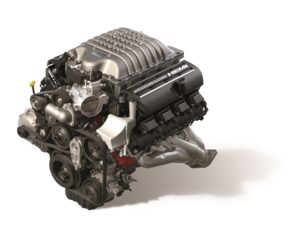
Hellcrate Redeye 6.2-liter Supercharged HEMI V-8 engine, $21,807. The most powerful production muscle car crate engine ever has 807 horsepower and 717 lb.-ft. of torque.

Cargo tote, $50. Secure items with this portable cargo-management tote that folds easily for storage and unfolds to 24 inches by 15 inches. Fits all Jeep vehicles.

Men’s HEMI hoodie, $49.95. The Lime green and black hoodie features a HEMI graphic in black on the left chest just above the large kangaroo pocket, along with Mopar wording on the right sleeve. Available in sizes ranging from small to XXXL.

Mopar Oakley Holbrook backpack, $78.95. The spacious backpack features a dual-zipper main compartment, a padded internal sleeve that fits up to a 15-inch laptop or tablet, and padded back and shoulder straps. The blue Omega M-stacked Mopar logo is embroidered on the front.

Reusable Mopar cotton face mask, $5.95: The super-soft, black, 100 percent cotton face mask features the Omega M-stacked Mopar logo. One size fits most.

All-weather floor mats, $115-$265 per set. The high-wall, bucket-style mats will provide maximum coverage and protection. All mats include the specific vehicle’s brand logo and are molded in black. Ram mats are also available in brown.

Pet kennel, $190. The black nylon mesh carrier includes two pockets, carrying handle, three doors, webbing zipper pulls and straps to secure the kennel.

Doors-off mirror kit, $295. Available for current-generation Jeep Wrangler and Jeep Gladiator models. When the original, factory-installed front doors with attached mirrors are removed, two separately mounted side mirrors may be quickly and easily installed for an enhanced rear view.

Mopar Vehicle Protection (MVP) Plans: Plans include full mechanical coverage with Maximum Care, Road Hazard Tire & Wheel, Auto Appearance, Scheduled Maintenance and more. Protection plans for lease vehicles are also available. For information on various MVP plan offerings, visit www.moparvehicleprotection.com.

• In addition, prepaid MVP oil change plans are available through Dec. 31, 2020 at participating dealerships:
Synthetic blend and multipoint inspection – $29.95 for single oil change / $70 for three oil changes
Full synthetic and multipoint inspection – $45.95 for single oil change / $100 for three oil changes
Diesel and multipoint inspection – $109.95 for single oil change / $315 for three oil changes