Select Page

Volkswagen Beetle Production Began Dec. 27, 1945

Volkswagen Beetle Production Began Dec. 27, 1945

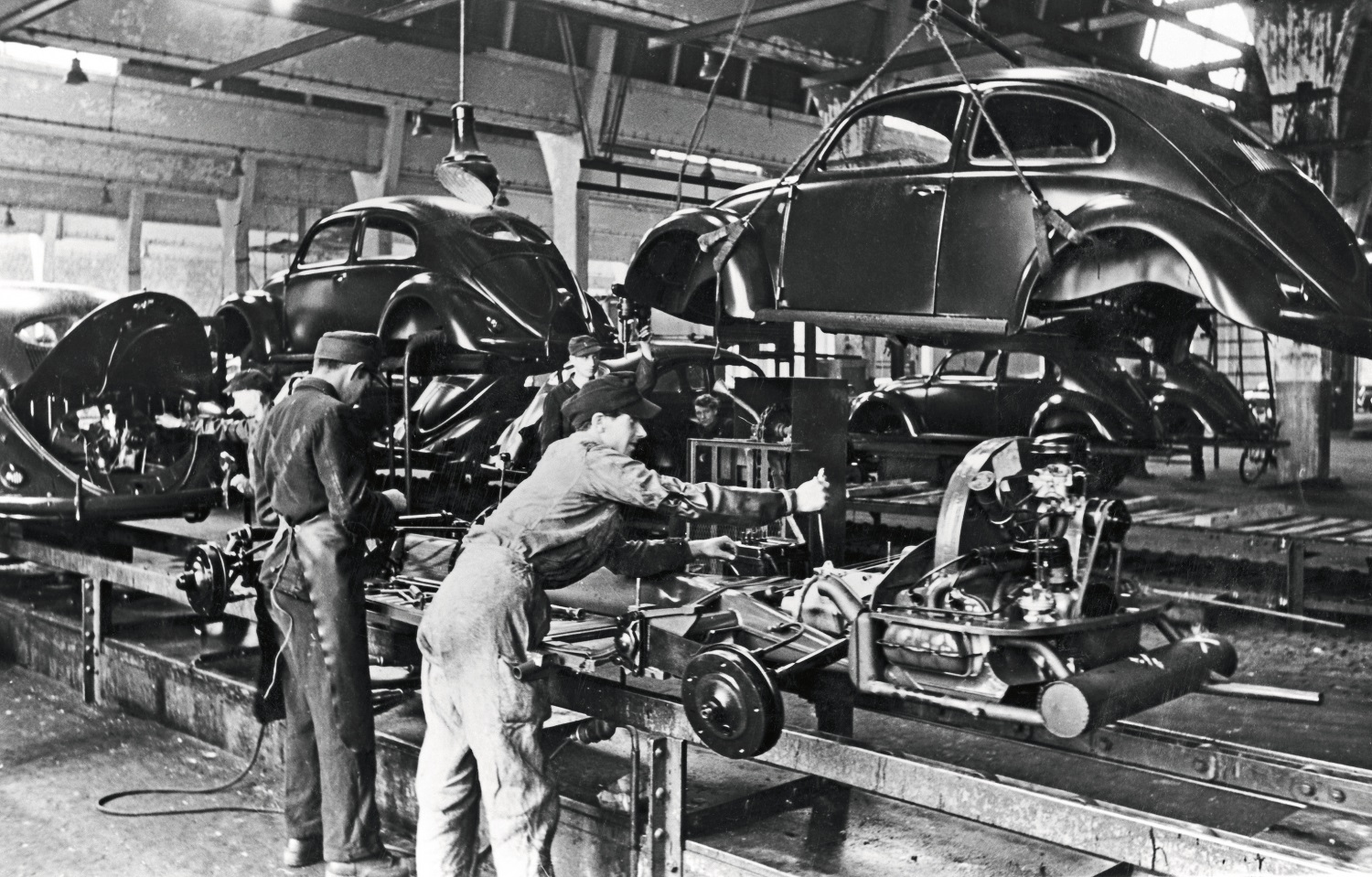
Start of Type 1 VW Beetle production in 1945 at the factory in Wolfsburg, Germany. (VW US)

BY MARK MAYNARD

Series production of the Volkswagen “Beetle” Limousine began on Dec. 27, 1945. It was referred to internally as “Type 1,” and later became world-famous as the “Beetle.” The little sedan’s success story started in Wolfsburg, Germany, and is credited to British Major Ivan Hirst.

According to a release by VW US, in June 1945, the British Military Government Series assumed the trusteeship over Volkswagenwerk GmbH. Following the end of World War II, the production of the Volkswagen Type 1 sedan (limousine) began as a vehicle for transport tasks.

Major Hirst’s British was known for his pragmatism and talent for improvisation. The two traits made it possible for him to transform an armaments plant into a civilian industrial company in an impressively short timeline.

The British Military Government issued an order for 20,000 vehicles in August 1945. The start of production was a visible sign of a new beginning and hope. The factory had been largely destroyed by the end of World War II.

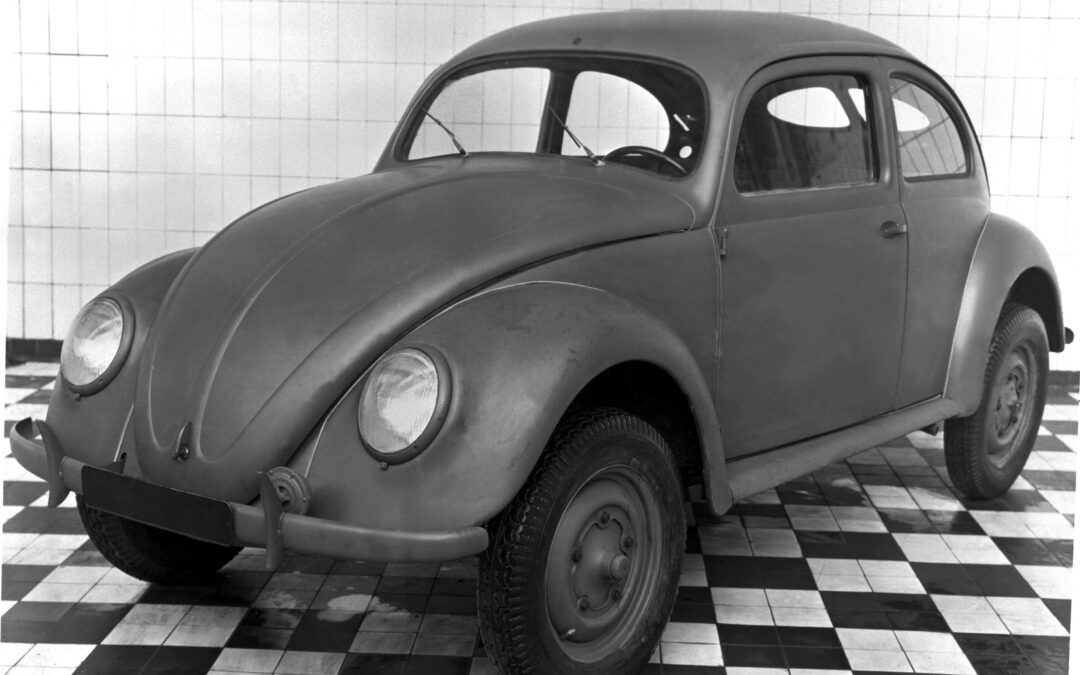
The first Beetle, with the split rear window. (VW US)

Wartime Challenges

There were many wartime challenges. There were personnel shortages to support the workforce and production bottlenecks for raw materials and energy. But the first Volkswagen sedan left the production line just after Christmas. By the end of 1945, 55 cars had been produced.

From 1946 to the currency reform of 1948, about 1,000 vehicles were produced per month. It was not possible to produce more vehicles with the material shortages, rationing, and lack of personnel. Sales were jump-started in 1947 with exports of the car.

Volkswagen discontinued production of the original VW Beetle in Mexico in 2003. By then 21,529,464 VW Beetles had been manufactured, including about 15.8 million in Germany.

For more on the so-called “People’s Car” see its Wikipedia page.

Debut of the signature Chevrolet bowtie badge

Debut of the signature Chevrolet bowtie badge

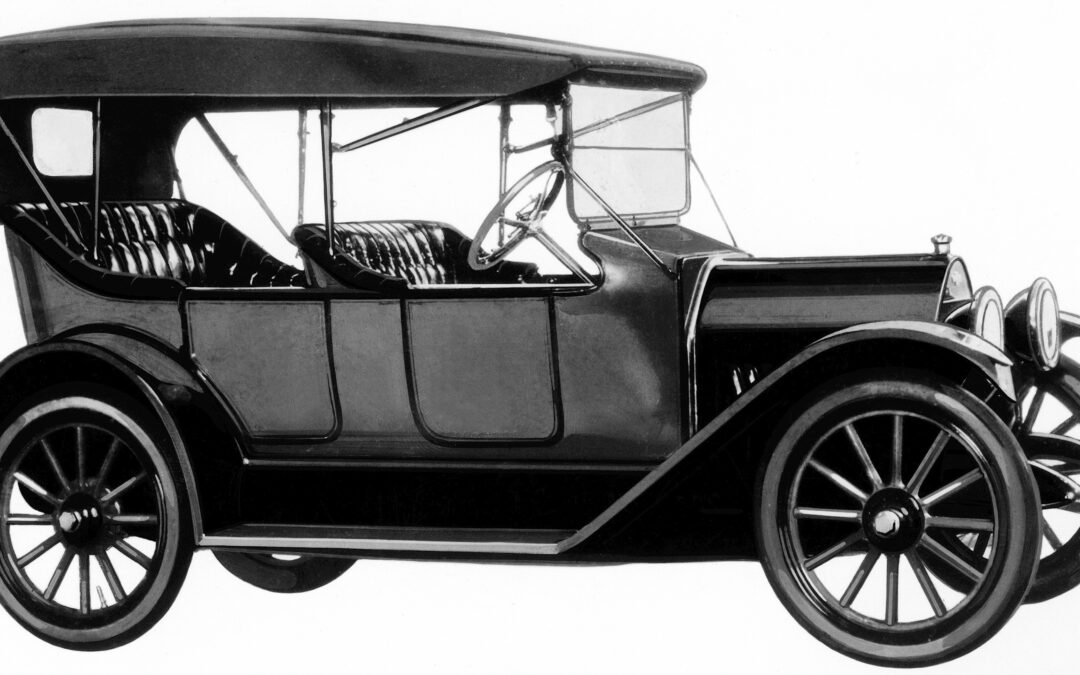
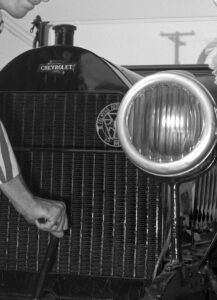
The signature Chevrolet “bowtie” badge, as it debuted in 1913. (GM)

In 1913, Chevrolet co-founder William C. Durant introduced the signature Chevy bowtie on the 1914 Chevrolet H-2 Royal Mail and the H-4 Baby Grand, centered at the front of both models.

“Billy” Crapo Durant. (GM)

The Baby Grand was part of Durant’s idea to build a car to compete with the popular and affordable Ford Model T, according to Wikipedia.

“When it first came out, it was priced at $875 as a four-door, 5-passenger touring car (a 1914 Model T touring was $500).

“A speedometer was standard. One advantage over a Model T Ford was that a Baby Grand could get an electric starter. (The Model T did not get them until 1919).

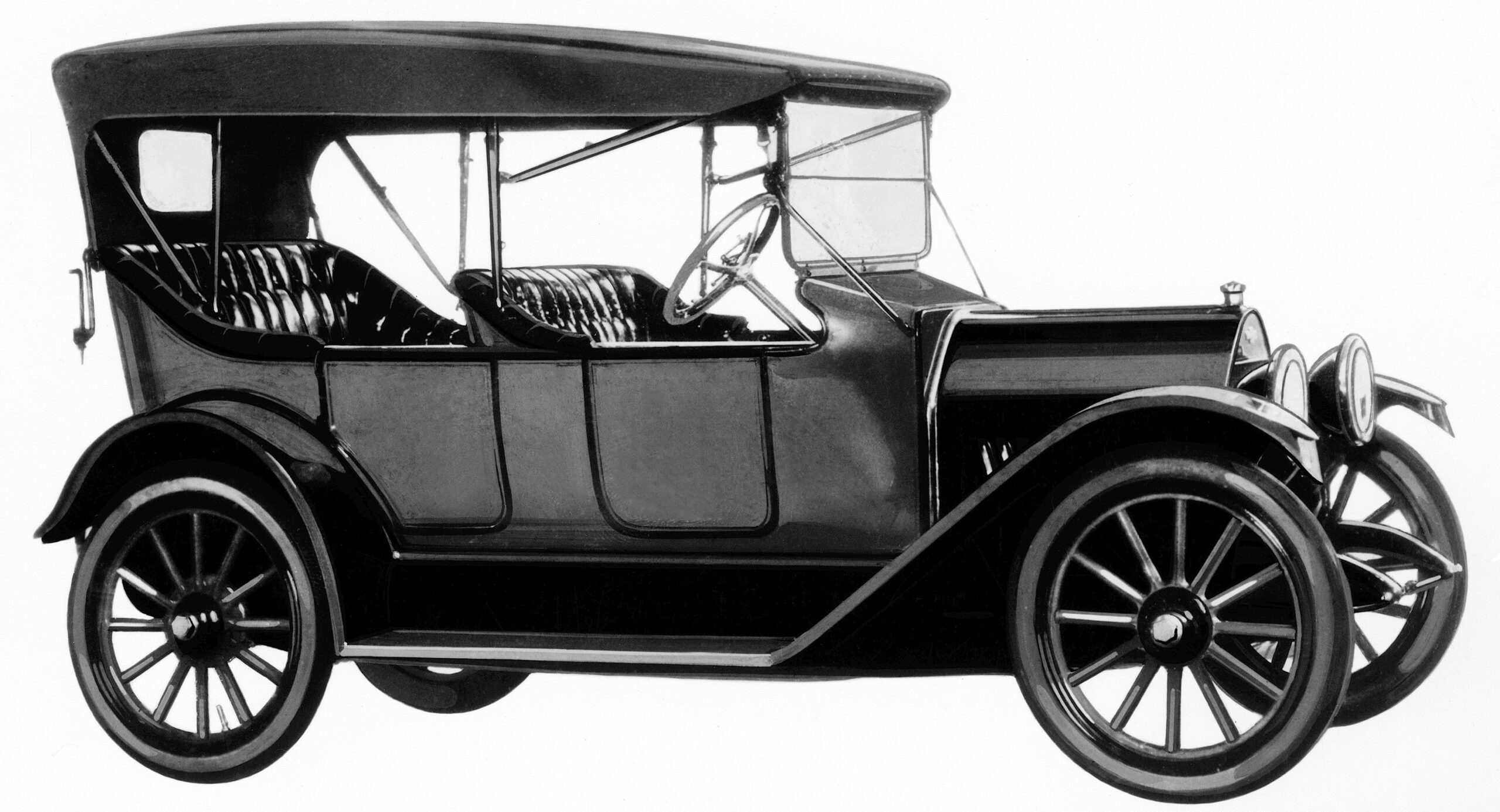
The 1914 Chevrolet H-4 Baby Grand. (GM)

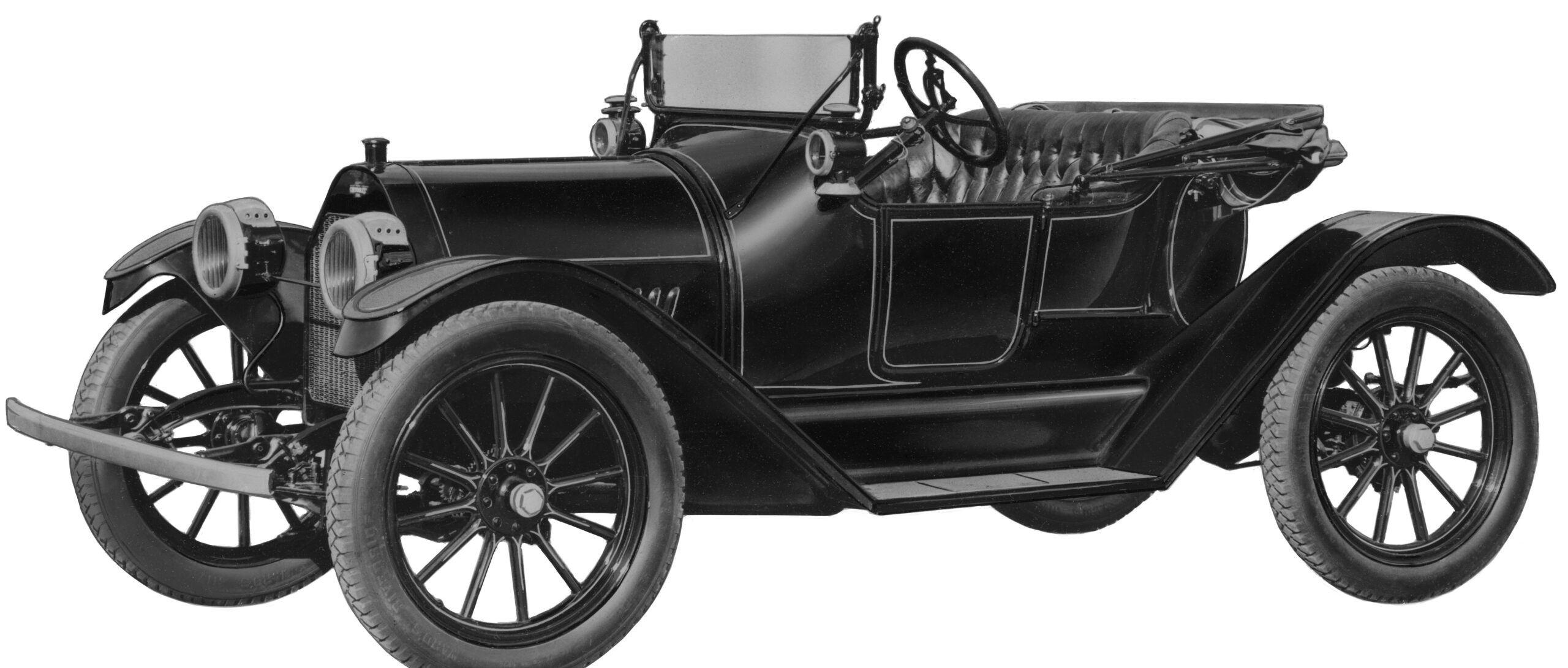
“In 1914 the Series H debuted with the H-2 Royal Mail Roadster and the H-4 5-seater Baby Grand Touring model, both with a 104-inch wheelbase.

The 1914 Chevrolet H-2 Royal Mail roadster. (GM)

The 1914 Baby Grand. (GM)

“In 1916, the Royal Mail model H-2½ was introduced, which was the first integral trunk for Chevrolet with gas tank in the rear between the frame rails.

“The Series H models were moved upmarket when the $490 Chevrolet 490 was introduced in June 1915 to compete directly with the Ford Model T.

“Total Chevrolet production for 1913 was 5,987.”

New tires provide a rewarding new-car feel on a budget

The new tire centers at JBA Speed Shop are a Tire Rack top five-star installer. (Photos by Mark Maynard) 


JBA Speed Shop now provides full tire services and front-end alignment, including for high-performance vehicles


By MARK MAYNARD

New tires are one of the simplest and least expensive ways to give your old ride that new-car feel. Even if the tread does not appear to be unevenly worn or down to the wear-bar indicators, the National Highway Traffic Safety Administration and new-vehicle manufacturers suggest a tire is only 100 percent safe to use until it turns 5 to 6 years old. Of course, a tire can be operable up to 10 years if you check it for issues annually after the fifth year.

In 2013, I had re-tired my 2008 Ford Escape Hybrid (bought in 2012) with four new Goodyear Assurance Fuel Max all-season touring tires. They were promoted as an affordable choice with low-rolling resistance to stretch fuel mileage. They have a tread-life warranty of 6-years or 65,000-miles, which put my set of Goodyears at the end of their life cycle, even though they had substantial tread remaining.

The 7-year-old Goodyear Assurance tires appeared to have good tread remaining, but the cracks of old age were apparent on closer examination.

They did not appear worn out, but upon closer examination, there were visible surface cracks from age — and the tires now rode like hard, black checkers. On the highway I could average 30 mpg and 17-24 around town.

During a suspension check-up for shock absorbers and other suspension elements, the technician advised that the tires were old and should be replaced. They also were out of balance and a front-end alignment was needed.

All of those necessary service points had crept up over the last few years and I had accepted that the tires were just hard and noisy. And I had also accepted that the choppy ride at highway speeds was just how the compact, front-drive SUV handled. I never pushed it for cornering maneuvers, so how it handled was just fine as a daily driver.

But after replacing the front struts and rear shock absorbers, the handling and ride quality improved dramatically. And then I knew that new tires would really improve the ride.

But not just any new tires.

The MeltdownTires center specializes in high-performance applications.

There are many brands of tires for a compact SUV, but it is difficult to choose a winner when the user reviews contradict each other. I was shopping a premium all-season tire and had written a short story on Pirelli’s Scorpion Verde All Season Plus II tires.

Checking various tire sites, the Scorpion Verde had many positive reviews. So I started shopping prices at Tirebuyer.com, which often has the lowest pricing, especially when shipped directly to an installer.

JBA owner J. Bittle bought the best equipment money can buy, he says, including the state-of-the-art Hunter machines.

A set of Scorpion Verdes, size 235/70R16, would cost $590 or $147.50, with free shipping to a tire shop of my choice. And at the time there was a $40 discount if I ordered by a deadline.

For a comparison, I called the JBA Speed Shop in the Kearny Mesa area of San Diego. Owner J. Bittle had recently opened a tire facility in an annex building at his compound. Among the speed shop’s specialties are dynamometer testing for chassis and engine, machine-shop services for custom engine builds and the blueprinting of an engine and a “plumbing” center for braided steel lines, military-spec fuel lines, oil lines and brake lines.

His tire center includes an online tire-shopping link that populates all the major brands and their common pricing. The link listed the same pricing as at Tirebuyer.com. And JBA is a Tire Rack top five-star installer; tires can be purchased online and shipped to JBA for installation.

JBA stocks top brand names in wheels and tires.

I liked the idea of supporting the home-grown business and had JBA order the tires, which were shipped to the shop in about five days.

Bittle has added two levels of tire service. His JBA Tire Center offers basic tires and wheels, “for the best service for the best price,” he says. And the MeltdownTires Performance Center specializes in high-performance tires, including race rubber and custom wheels, whether for a new car or a full custom hot rod.

“A standard alignment center does not understand what occurs when you lower vehicles, so we brought it in-house because we couldn’t outsource anymore,” he said. “It’s becoming more and more difficult to find trusted vendors,” he said, “especially for balancing Plus-1 or Plus-2 tire fitments [adding larger and wider wheels by 1, 2 or 3 inches].

“There are only a couple of facilities in town that have the facilities that we do,” he said. “Our Hunter machines are state of the art and we bought the best equipment money can buy.”

I made an appointment to have the tires installed and an alignment. The tires, mounting and balancing ($20 each) and other fees (tire disposal and recycling) came to a no-regrets $738.34 plus $98 for the alignment.

Premium tire upgrade

Unless you are putting tires on a junker to sell, upgrading to more premium tire brings rewards you will appreciate and value every time you drive. And I also noted a significant boost in fuel economy.

The Goodyear Assurance Fuel Max tires I replaced were good for about 30 mpg on the highway and 17 to 24 mpg around town. While making a recent 80-mile highway run last week on the new Pirellis, I was quite surprised to see that the Escape’s mileage counter had hit 33.3 mpg and it might have gone higher with more highway driving. Around town, the tires are helping to deliver an average of 24-27 mpg. When new, my Escape had factory mileage ratings of 34/30/32 mpg city/hwy combined.

What Pirelli says

I found the Scorpion Verde tires to be quiet rolling and supple, and very responsive in cornering.

The Scorpion Verde tires are quiet rolling and supple. A side benefit has been improved fuel economy.

Pirelli says its Scorpion Verde All Season Plus II tires are an extremely well-balanced choice for SUVs and crossovers. The eco-friendly tire (verde meaning “green” in Italian) delivers high performance, low noise and excellent handling, the company says.

The all-season touring tire was updated in mid-2019 with a new tread compound and a larger footprint for improved wet and dry handling and wet braking. The second-gen formula maintains the mileage, comfort, noise and winter performance of the previous generation, Pirelli says.

Sold in 40 sizes, from 16 to 22 inches, the Scorpion Verde All Season Plus II is covered by a 65,000-mile limited tread wear warranty. Depending on the size, pricing can range from $140 to $255 each. And Pirelli offers a 30-day trial offer, called Confidence Plus Plan. If a buyer is not satisfied with a set of four new tires, they can be exchanged for a new set of four Pirelli tires at the original place of purchase, within 30 days from the original date of purchase.

Older vehicles run great, until they don’t — and then it can be a major expense to get them back to what we had before, which might not feel like the cost was worth it. New tires, however, are like a halo of good feelings and give reassurance of safety in foul weather.

With good tires, you will know exactly where your money went — and you’ll remind yourself to do it sooner next time.

MarkMaynard@cox.net

1956 Chrysler Norseman concept

1956 Chrysler Norseman concept

The 1956 Chrysler Norseman was lost at sea. (FCA US photos)

BY MARK MAYNARD

The Chryser Norseman was a four-seat fastback concept coupe built in 1956. Although designed by Chrysler’s stylists, the actual construction was contracted out to the Italian coach-building firm of Carrozzeria Ghia. The concept car was lost during the sinking of the SS Andrea Doria.

According to Wikipedia, “Chrysler wanted a fully drivable vehicle, not just a rolling mockup, so all normal systems for the powertrain, braking, suspension, were installed. Power was from a modified 5.4-liter, 331 cubic inch Chrysler Hemi engine producing 235 hp with a pushbutton-controlled Powerflite automatic transmission.

“The body panels on the car were made of aluminum with “a sharply sloping hood, upswept tail fins and a covered, smooth underbody for aerodynamic efficiency.” The Norseman combined a “sweeping fastback rear end design and Chrysler’s own take on a tailfin and bumper treatment.”