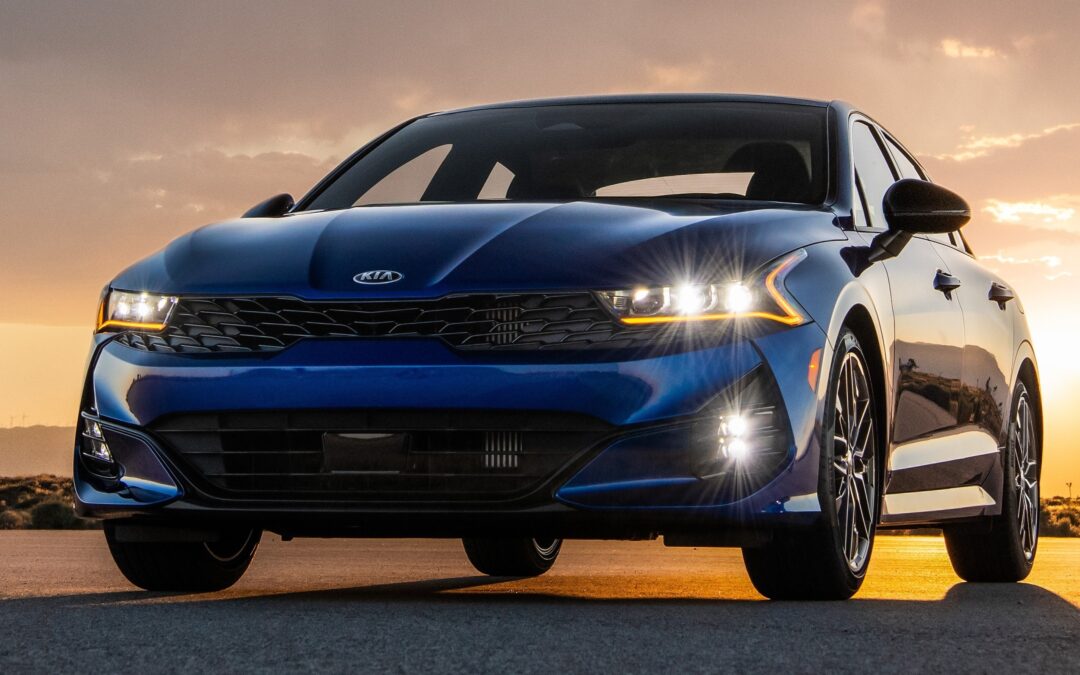
The “all-new” 2021 Kia K5 sedan represents one of the biggest leaps forward between generations in recent automotive history, the carmaker says.

The 2021 Kia K5 is the brand’s third generation midsize sedan, formerly known as Optima. (Photos courtesy of Kia America)
Wholistic coup d’sedan
BY MARK MAYNARD
If there is a spark of ownership urgency remaining in the mainstream midsize sedan segment, Kia hopes its renamed and re-invented K5 will get drivers fired up.
The “all-new” Kia K5 sedan represents one of the biggest leaps forward between generations in recent automotive history, Kia says. Worthy of renaming, the Korean automaker says the K5 emphasizes revolutionary design on a new safety and performance enhanced “N3” platform, turbocharged engines, optional all-wheel drive and high-impact technologies. The new platform will also be the foundation for future Kia models
Its predecessor, the Optima, debuted in 2011 and, as today, it is a corporate partner to the Hyundai Sonata. The K5 designation is simply a global name, Kia says. The K5 and K900 are the first U.S. models to use the integrated global market names. Whether the other models will be eventually renamed, “is being looked at holistically from both a market and a global level and is determined by model,” a spokesman said.

K5 EX features include leatherette upholstery and 10-way power driver’s seat.
Good Times
These are good times to buy a sedan. The big three top-sellers in the current lineup of choices — Honda Accord, Toyota Camry, Nissan Altima — have distinct identities, which might be key to connecting with drivers. And the remaining choices, of which there are several, are at the peak of their games, too.
As many drivers have migrated to an SUV as their preferred body style, manufacturers — those that still have a sedan lineup — are hoping that their revolutionary improvements will reinvent the midsize sedan into something other than what it is.
Kia cut to the chase with a regrouped business plan for the K5, calling “Give It Everything.” And it is packaged at a reasonable price.

The lower roofline allows reasonably tall headroom with the large sunroof.
Kia K5 By the Numbers
Dimensionally, the Kia K5 sedan sits lower, longer, and wider than its predecessor. At 193.1 inches long it is 2 inches longer and an inch wider but 0.8-inch lower at the roofline. The wheelbase was stretched 1.8 inches, now at 112.2 inches.
Kia K5 Pricing
There are five trim levels of Kia K5 — LX, LXS, GT-Line, EX — and the performance-tuned GT. The standard trims use a 180-horsepower 1.6-liter turbocharged four-cylinder engine and eight-speed automatic transmission. The GT is spiked with a 290-hp 2.5-liter turbocharged four-cylinder (with 311 foot-pounds of torque from 1,650-4,500 rpm). Its eight-speed automatic is a “wet” dual-clutch automated manual transmission. (The wet dual-clutch, rather than dry, uses an electric oil pump for lubrication and to provide more cooling for higher torque outputs and smoother shifts.
Pricing for front-wheel-drive models with the 1.6T powertrain ranges from $24,555 for the entry LX to $29,055 for the EX 1.6T, The AWD GT-Line 1.6T starts at $30,155. The front-drive GT 2.5T GDI with an eight-speed dual-clutch automatic starts at $31,555. Pricing includes the $965 freight charge from West Point, Ga.
K5 in Front- or All-Wheel-Drive
All-wheel drive is available only on the K5 LXS or GT-Line trims. The front-drive system uses electro-hydraulics for a quicker coupling response, Kia says. The 1.6 LXS option is $2,100 and includes heated seats; the GT-Line is $3,700 and is part of the Premium package, which includes Special Edition Wolf Gray paint with red SynTex upholstery, 10.25-inch Touch-screen, navigation with smart cruise control and Highway Driving Assist.
At the time of posting this story, there were several Kia K5 sedan pricing discounts for cash, leasing or zero-percent financing for 60 months, with a $750 cash-back offer. See them here.
And there is Kia’s desirable new-vehicle warranties of 5-years/60,000-miles bumper to bumper with roadside assistance and 10-years/100,000-miles powertrain.
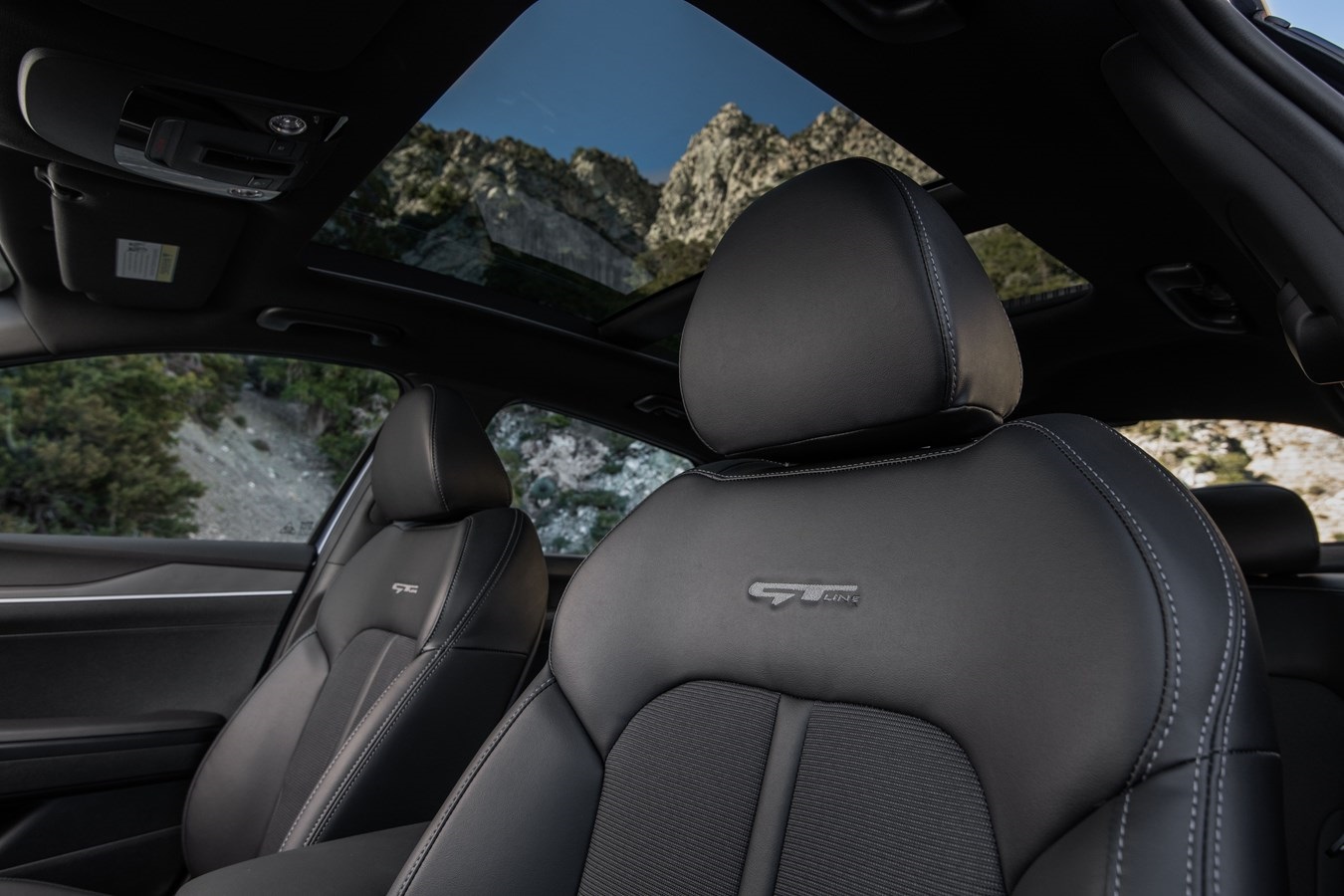
Part of the K5 EX package, the panoramic sunroof has a power sunshade.
Standard Kia K5 Features
K5 base models are competitively equipped with such standard features as remote locking, 8-inch infotainment touch screen, fabric upholstery, Android Auto and Apple CarPlay with Bluetooth phone and music, six-speaker audio system, steering-wheel controls for audio and cruise control, two USB ports (one for charging), power side mirrors and windows, lighted visor vanity mirrors, six-way manually adjusted front seats, electric parking brake with auto-hold and 16-inch alloy wheels.
Standard K5 safety features and technologies are loaded, including nine air bags, forward collision avoidance assist with pedestrian detection, driver-attention warning with lead-vehicle-departure warning, lane-keep assist and lane-following assist, lane-departure warning, and high-beam (dimming) assist.
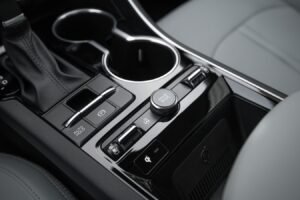
The K5 EX has almost as many USB ports as cup holders.
The EX upgrade
The K5 EX tester, $32,355, added such features as leatherette seat trim and leather-wrapped steering wheel, 10-way power driver’s seat with power lumbar, heated and ventilated front seats, panoramic sunroof with power sunshade, wireless phone charging, 18-inch alloy wheels, and parking-distance warning reverse.
The EX Premium package, $3,400, added desirable technology pieces, including navigation with a 10.25-inch touch screen and MapCare, Bose audio upgrade, a power front passenger seat with power lumbar, and heated steering wheel.
K5 Safety Features
Safety features include forward collision avoidance alert cyclist, forward collision avoidance-assist junction turning, smart cruise control with stop-and-go, highway driving assist, safe-exit assist with power child lock, and parking collision avoidance rear.
Highway Driving Assist (HDA) controls steering and acceleration-deceleration to keep a safe distance from the vehicle directly ahead. Using navigation input, the system can determine whether the vehicle is on a state highway or Interstate. Using the front view camera and front radar, HDA monitors the lane position and speed of the vehicle directly ahead.

Driver controls are placed for easy access.
The integrated technologies create a semi-autonomous driving mode, but with hands remaining on the wheel. The guidance system is at its best on multi-lane expressways, but the guidance system can still allow the car to drift wide and across lane markings before correcting course, while giving the driver a warning tone.
As a safety suite, the assist systems elevate the EX trim level to a safe and efficient long-distance commuter.
Kia K5 Fuel Economy
Fuel economy and what Kia calls real-world torque have improved with the new 1.6-liter engine, which replaced a 2.4-liter.
Only the base LX model, which Kia considers its fuel efficiency trim, is equipped with automatic stop-start at idle. The LX has fuel-economy ratings of 29 mpg city, 38 highway, and 32 mpg combined, on 87 octane. Compare that to 25/35/29 for the 2.4-liter. But at 14.8 gallons, the K5 LX has a gallon smaller fuel tank than the other trims; The Optima’s tank was 18.5 gallons.
The other 1.6T models have mileage ratings of 27/37/31 mpg city/highway/combined. AWD has ratings of 26/34/29 mpg. And the GT has ratings of 24/32/27 mpg. The 15.8-gallon tank in the EX could provide more than 500 miles of range.
Driving in the transmission’s “smart” mode, I worked up to 37.4 mpg with much highway driving, which settled to an accumulated average mpg of 26.4 mpg, over 610 miles. Smart mode mimics the driver’s acceleration style to provide consistent power.
The body styling has a low, wind-cheating 0.27 coefficient of drag, which compares to 0.26 for the Altima and 0.28 for the Camry.
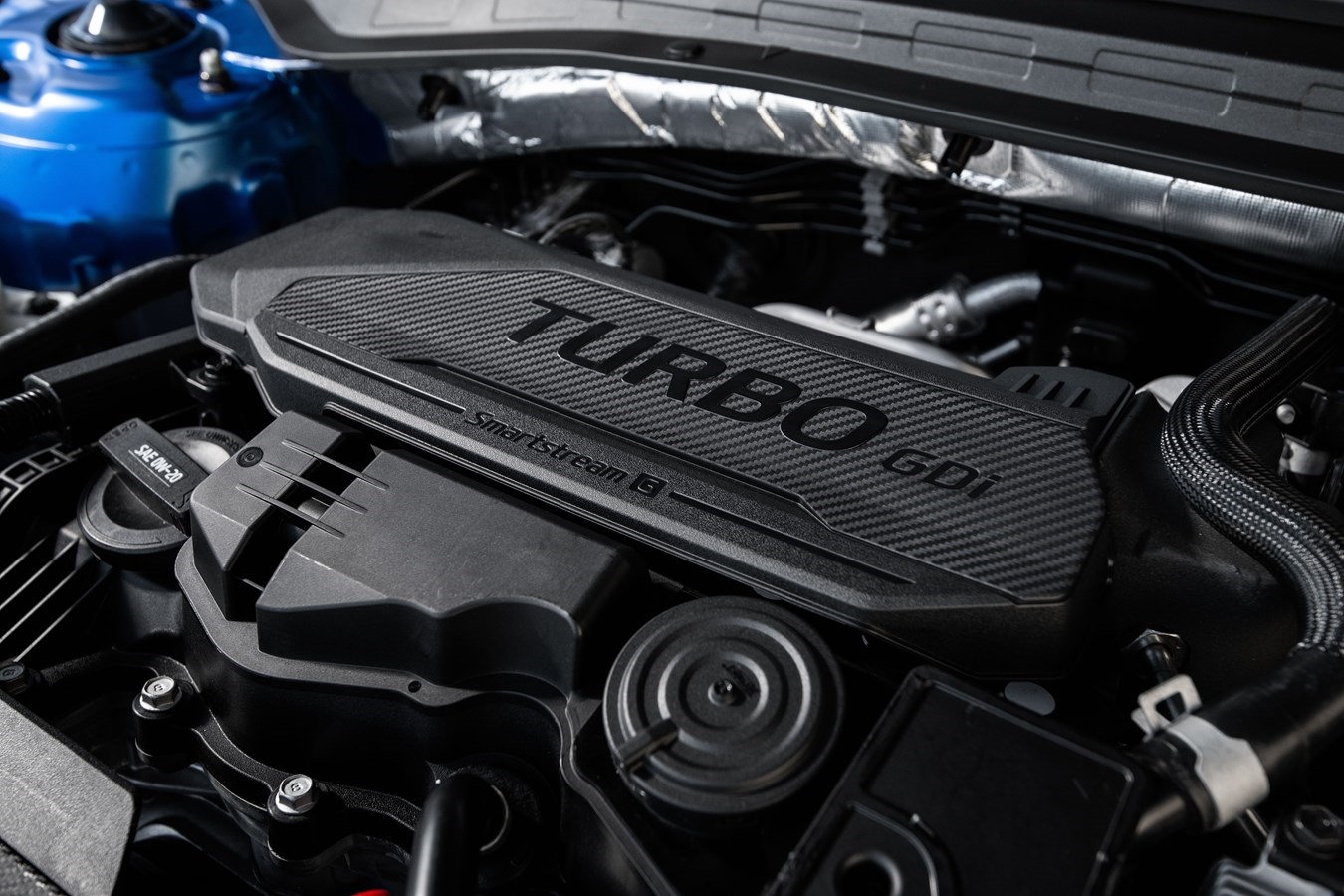
The base K5 engine is a 180-hp, turbocharged four-cylinder.
K5 Ride and Handling
Kia probably erred on the side of sportiness for the K5. It has a pedigree of the Stinger sport sedan built into the presence of the K5, which can be seen first in the exterior styling and then the driving attitude.
The rigidity of Kia’s new N3 platform is a great enabler in controlled cornering and evasive maneuvers, yet ride quality is forgiving. Kia cites a 60/40 front to rear weight distribution for the 1.6T trims and 61/39 on GT.
Drivers can choose from four drive modes (or five with AWD) for Smart, Normal, Sport, and Custom, which allows a deeper dive to set distinct preferences for suspension, throttle, and steering.
I found Sport mode to be overly enthusiastic in town, but it is an asset out on the twisty roads as calibrations hold shifts when neatly clipping an apex. The car turns and rotates flatly, which also keeps the driver in a command position. And Custom
K5 Power
The eight-speed automatic in the K5 rolls easily through gear changes. And what, no paddle shifters? No problem! Acceleration is not greatly impacted by turbo spooling, which is helped by the trim curb weight of 3,228 pounds, among the lightest in the segment.
Standard K5 models have four-wheel disc brakes 12-inch vented rotors front, 11.2-inch solid rotors rear. The GT is upgraded with 13.6- rotors front and 12.8-inches rear.
The turning circle is another asset, at 36 feet or a little wider with 18- or 19-inch wheels — but still a tidy arc for U-turns in most neighborhood streets.
K5 Interior Function
Inside the Kia K5, the interior design achieves a futuristic and high-tech appearance. There is great attention to detail in the trim elements. And improved sound-deadening materials create a quieter and more premium cabin, Kia says.
The standard 8-inch infotainment supports Apple CarPlay or Android Auto, but opting for the 10.25-inch display does not allow those apps.
Settling into the front seats is quite supportive and comfortable for the long haul, but the seat-bottom squabs (bolsters) give a little goose on exit. (A female friend who bought a new Kia Sportage spent $300 to have those bolsters trimmed back to prevent the wedgie, and the results look “factory.”
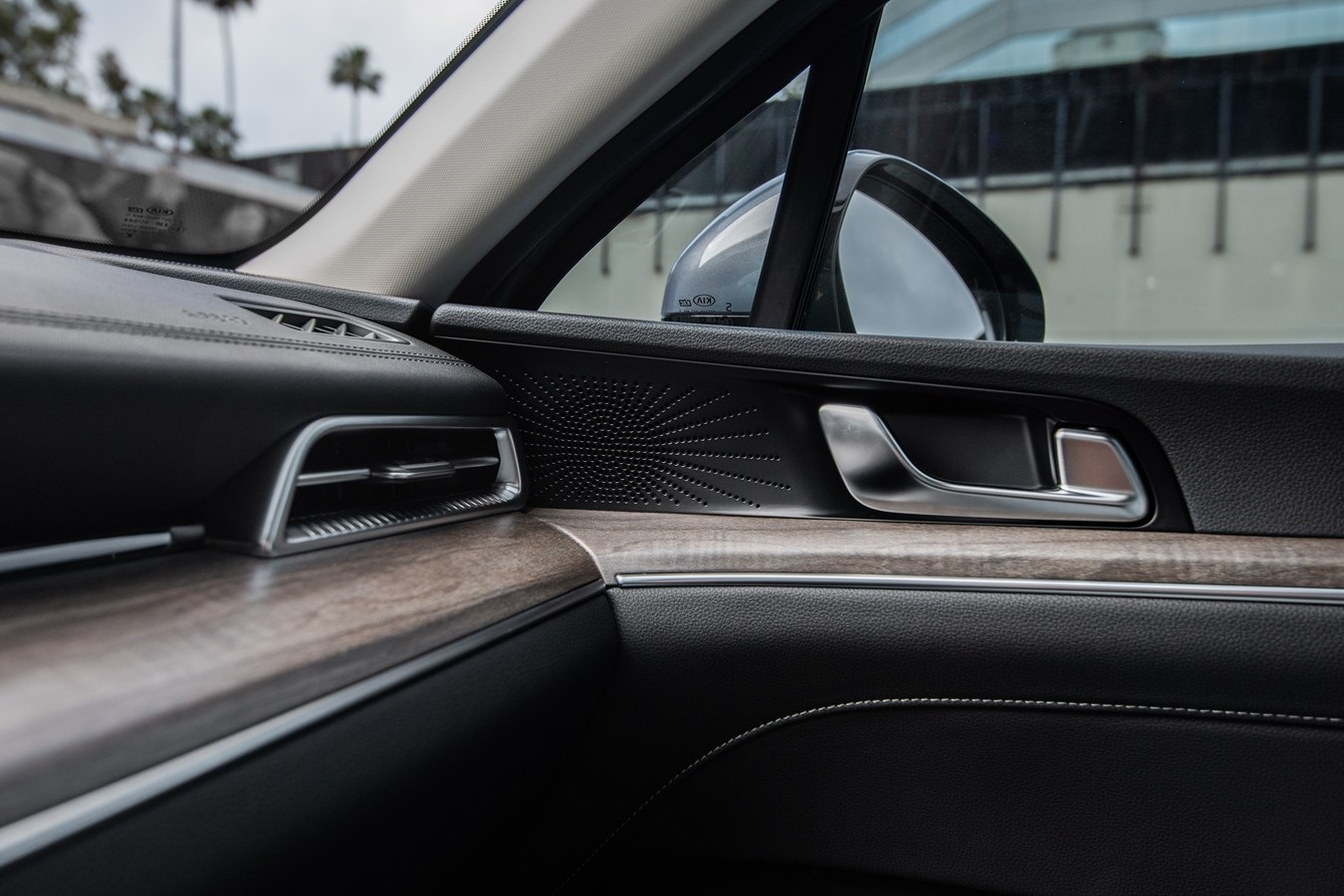
Interior materials have a premium-quality appearance.
Some new sedans are built so low to the ground (for aerodynamics to improve fuel economy) that it compromises comfortable entry and with a heave-ho on exit. But the K5 maintains a reasonable entry height.
The doors open to almost right angles and for the driver, the designers built in a stylish ridge in piano black at the window controls. It is an ideal leverage point to comfortably close the door.
Front headroom, even with the lower roofline, is reasonably tall (38.4 inches) with the large sunroof. Cars without the sunroof gain 1.8 inches of hair space, at 40.2 inches. Legroom of 46.1 inches is accommodating for those in the big-and-tall club.
Ergonomic Controls
Interior design of the K5 cockpit places driver controls, switches, and digital displays in position for easy access. Small corner glass greatly opens sightlines at the front side mirrors and at the rear three-quarters. At first glance, it might appear the shallow arc of the back glass might be an issue, but it is not when the side mirrors are correctly positioned.
Glancing at the large rearview-camera screen is liberating in parking situations, and there is a reverse park-distance warning. Because of the long hood, a front camera would be an asset, too.
The cabin of the K5 EX has almost as many USB ports as cup holders, plus wireless charging with a broad slot for a variety of phones. And the leatherette upholstery in the EX looks and feels better than many grades of leather.
K5 Back Seat Comfort
There are comfortable dimensions in the K5 back seat and the doors open wide for colleagues or growing children. The seatback angle is relaxed and with 35.2 inches of legroom, the designer did not have to create a seat cushion with a knees-up angle to stretch leg space.
There is just a modest height intrusion from the exhaust-AWD tunnel, which eases footroom when sharing space with a center-seat occupant, which would be a child (or forgiving colleague). Amenities include the broad fold-down armrest with cup holders and two charging USBs.
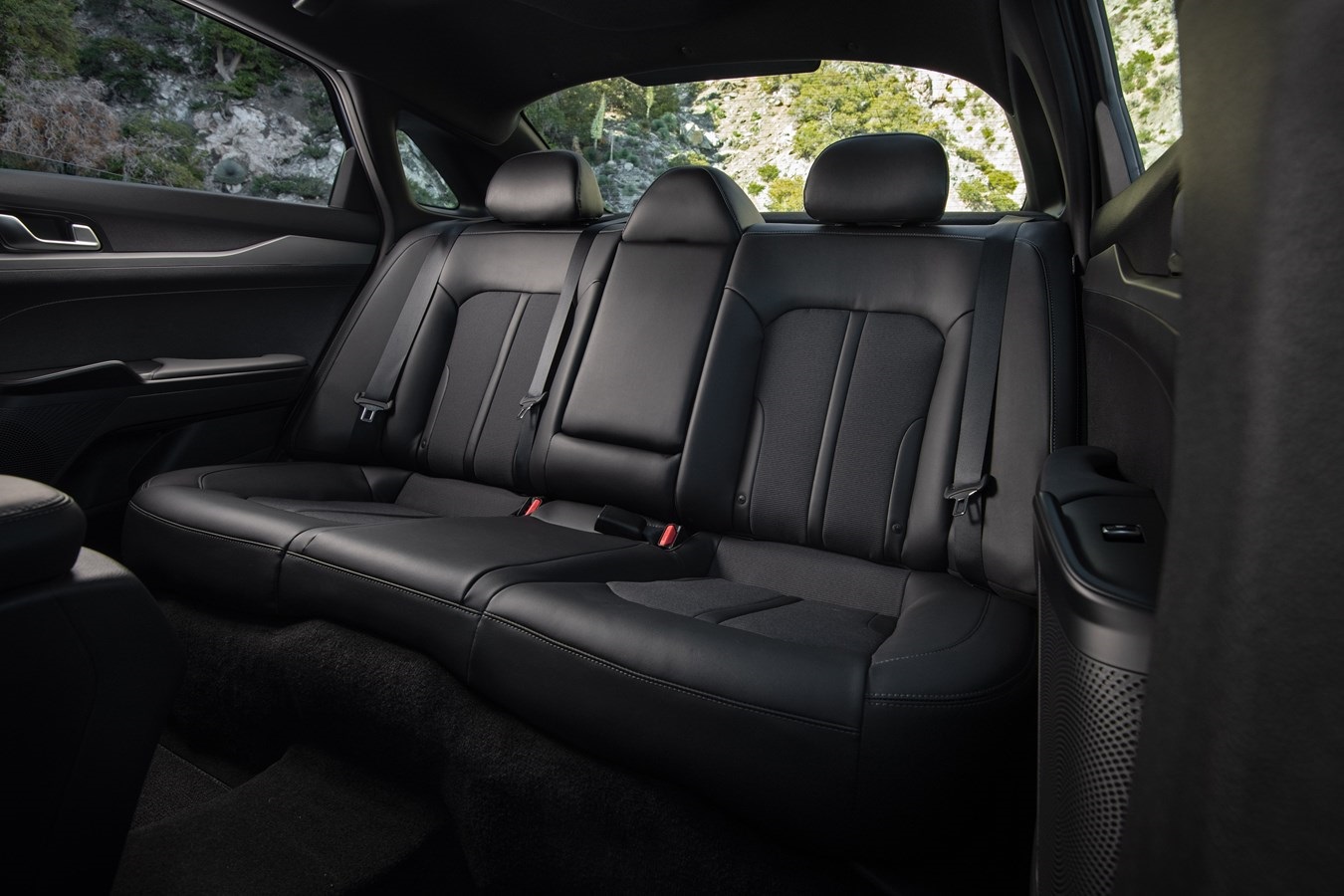
The back seat has comfortable dimensions for colleagues or growing children.
K5 Trunk Capacity
The Kia K5 has a roomy,16-cubic-foot trunk that is a broad 44 inches wide and low. But the smallish loading aperture (17 inches) will limit the size of big-box items to haul home. The 60/40 folding seatback includes pulls to release the seats.

Th K5’s 16 cubic feet of trunk space is wide and low.
Why Buy the Kia K5?
As midsize sedans have evolved, manufacturers have introduced more luxury-class features with a “premium” presentation to support the cars’ higher price points.
For Kia, the K5’s ground-up remake was as well planned and budgeted as a sedan can be in this age of anti-sedan.
The K5 has been designed for smart use of interior space. There are several small-storage areas and finger-reach controls to keep eyes on the road. The cabin has some of the best attention to detail in interior materials and switchgear. The driver area is straightforward and without unnecessary glitz or gimmicks, all of which will appeal to the contemporary driver.
But I can’t be alone in wishing the EX trim included the option for the 2.5-liter engine and the choice for AWD.
What would it take to get you into a midsize sedan today?
MarkMaynard@cox.net

Built on a new N3 platform, the Kia K5 is stronger, longer, wider, and lower.
2021 Kia K5 EX Premium Specifications
Body style: midsize 5-passenger, front-drive sedan
Engine: 180-hp, direct-injection and turbocharged 1.6-liter 4-cylinder; 195 lb.-ft. torque 1,500-4,500 rpm
Transmission: 8-speed automatic
Fuel economy: 27/37/31 mpg city/hwy/combined; 87 octane or higher
BY THE NUMBERS
Fuel tank: 15.8 gallons
Trunk space: 16 cu. ft.
Front head/leg room: 38.4*/46.1 in. *40.2 w/o sunroof
Rear head/leg room: 37.4/35.2 inches
Length/wheelbase: 193.1/112.2 inches
Curb weight: 3,228 pounds
Turning circle: 36 feet
FEATURES
Standard equipment includes: smart key locking and push-button ignition, dual-zone automatic climate control, acoustic windshield, steering wheel controls for Bluetooth-audio-cruise, tilt-telescopic steering wheel, power windows with one-touch up-down driver’s window, rear-occupant alert, 8-inch touch screen with Android Auto and Apple CarPlay, rearview camera with guidance lines, USB media and charging ports, multi-adjustable front seats, high-beam assist, LED headlights and amber running lights, power-heated side mirrors, automatic headlights, 16-inch alloy wheels and compact spare, electric parking brake with auto-hold
K5 EX Features: leatherette seat trim and leather-wrapped steering wheel, power driver’s seat with power lumbar, heated and ventilated front seats, panoramic sunroof with power sunshade, wireless phone charging, auto up-down to front passenger window, 18-inch machined alloy wheels, UVO Link, satellite radio with free 3-month subscription, rear USB charger ports and rear air vents, parking distance warning reverse
Safety features include: 9 air bags, electronic stability control, forward collision-avoidance assist-pedestrian, blind-spot collision-avoidance assist, rear cross-traffic collision avoidance, safe exit assist, lane-keep assist and lane-following assist, driver attention warning, leading vehicle departure alert
PRICING
Base price: $28,955 including $965 freight charge; price as tested $32,355
Options on test vehicle: EX Premium package, $3,400, includes navigation with 10.25-inch touch screen and MapCare, Bose premium audio system, power front passenger seat with power lumbar, heated steering wheel, forward collision-avoidance alert cyclist, forward collision-avoidance-assist junction turning, smart cruise control with stop-and-go, highway driving assist, safe-exit assist with power child lock, parking collision avoidance rear, LED rear combination lights, memory driver’s seat and side mirrors
Where assembled: West Point, Ga.
Warranty: 5-years/60,000-miles bumper to bumper with roadside assistance; 10-years/100,000-miles powertrain
Mark Maynard






 The Ridgeline’s midcycle redesign features new exterior styling from the windshield pillars forward, including new fenders and hood, a squared off nose and upright grille. (Honda)