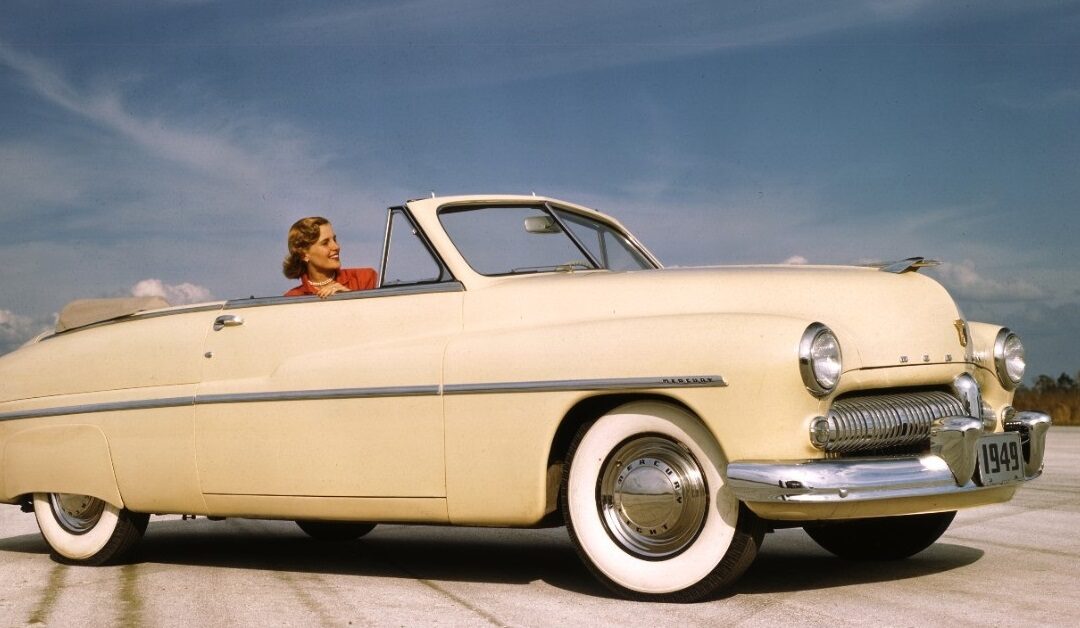
The post-war 1949 Mercury had breakaway styling. (Ford archives)
The third-generation 1949 Mercury was the first new design following World War II, according to Wikipedia.
The so-called “ponton” or pontoon styling helped differentiate it from its Ford cousin. The ’49 also became the definitive “lead sled” for customizers, including the Barris brothers, Sam and George.
The all-new postwar Mercurys were introduced toward the end of the 1948 model year, on April 29,1948, according to a report by the Automotive History Preservation Society. The cars did not look like fancy Fords but instead shared Lincoln styling and basic body shells.
“The engine was still a flathead V-8 now upped to 255 CID with 110 horsepower. A new and optional overdrive system was activated by a handle under the dash.
“The Mercury Eight used full instrumentation in round dials. There were two dials on either side of the large central speedometer. An optional eight-tube radio and electric clock were centered on the dashboard.
“The transverse leaf spring suspension was gone. The front suspension was independent coil-spring with telescopic-type shock absorbers mounted inside front springs. A stabilizer bar was fitted to reduce body roll. The rear suspension had longitudinal, semi-elliptic leaf springs with telescopic shock absorbers. A semi-floating rear axle with hypoid-type ring gear and pinion was fitted.
“The ’49 Merc grille resembled a shiny coil. It was divided in the center by a large vertical chrome “Eight” stamped.
“A nearly full-length, mid-body chrome spear stretched across the sides. The 1949 Mercury also had wraparound front and rear bumpers.
Paint Colors
There more than a dozen paint choices: Alaska Gray, Cairo Gray, Midland Maroon, Black, Alberta Blue, Royal Bronze Maroon, Dakota Gray, Lima Tan, Biscay Blue, Berwick Green, Tampico Red, Haiti Beige, Bermuda Cream and Banff Green
“The 1949 Mercury Eight production totaled an astounding 301,307 units. It was far and away Mercury’s best ever year.”
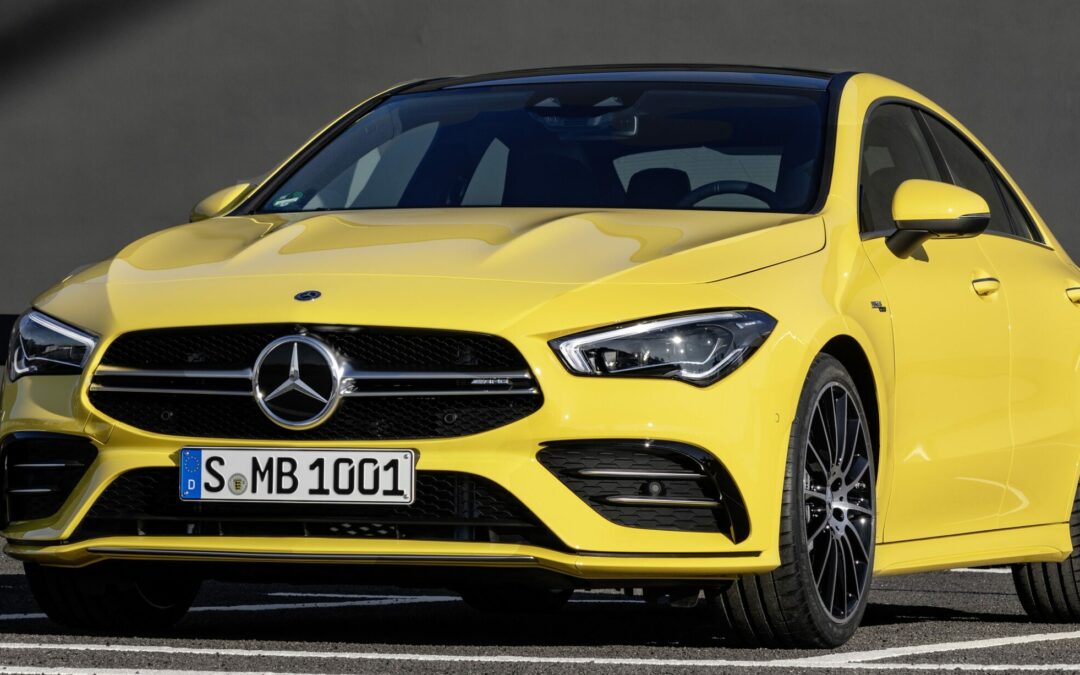
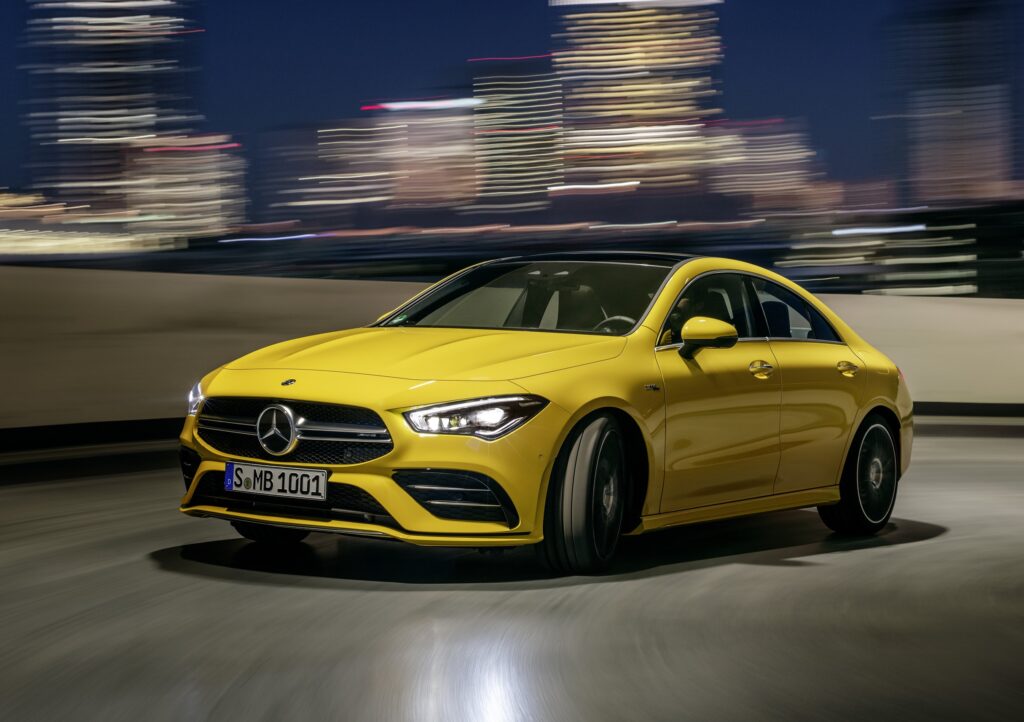
The Mercedes-AMG CLA 35 has a starting price of $47,895 for the performance-tuned 302-hp, 2.0-liter. As equipped, the Sun Yellow tester was $61,335. (Mercedes-AMG)
Strategic precision in a compact four-door “coupe”
BY MARK MAYNARD
Highland Valley Road is a tangled black shoelace of two-lane country road in northeastern San Diego County. It’s a favorite for car-club runs and leisure drives to get some fresh air. The meandering road leads past acres of growing land for landscape nurseries and pine-tree farms before ascending to an area of vineyards and wineries. Mature scrub oaks form shaded canopies along stretches amid a background of boulder-strewn mountainscapes.
The road is unforgiving of reckless driving but a strategic 13 miles or so with blind corners, decreasing radius turns and rollercoaster drops and rises. (Midday and midweek will have the lightest traffic.)
In this environment, the compact Mercedes-AMG CLA35 carves the road with surgical precision. The fortified focus of Sport and Sport-plus modes opens the pipes, tightens the shift points and lets the horses run. The 302-horsepower, AMG-enhanced turbocharged 2.0-liter four-cylinder pulls with breathy force, digging into its 295 foot-pounds of torque from 3,000-4,000 rpm.
The seven-speed AMG Speedshift transmission, a dual-clutch automated manual, clicks off sequential shifts with Formula One intensity. And the variable 4Matic all-wheel-drive system provides the push-back of rear-wheel drive and in aggressive cornering lays down a quick and consistent pull to redline. Mercedes-AMG cites 0-60 mph in an estimated 4.6 seconds — it just feels quicker. A hard launch brings a bristling response.
The driver area is centered by a widescreen layout of HD graphic displays. (Mercedes-AMG)
About the CLA
The compact-class CLA is now in its second-generation after a major update in 2019 for the 2020 model year. Launched in 2013, it was the first compact Mercedes sold in the U.S. and its first front-wheel-drive model.
Because of its arching roofline Mercedes refers to the CLA as a four-door coupe — and it feels the part with its frameless door glass and a cockpit driver area.
With seats for five, it was intended to be a segment disruptor with appeal for its sporty lines, which Mercedes-Benz says pulled many younger buyers from competitors. On average, CLA customers in the U.S. are around 10 years younger than the brand’s typical buyer, the company says.
Sizewise, the CLA slots above the subcompact A-Class, the brand’s smallest and less-expensive sedan, and below the midsize C-Class.
The redesigned CLA is 2 inches wider and almost 2 inches longer and a whisker lower on a wheelbase stretched 1.1 inches, now at 107.4 inches.
The styling is more cohesive now and smoother with a GT stance ready to pounce. The revised size is especially notable in the front seats with 38.5 inches of headroom, legroom of almost 42 inches and more shoulder room. Back-seat width is now family-class comfortable with more legroom (33.9 inches). Trunk space is down but still wide and roomy at 11.6 cubic feet. And the trunk opening was made 10.3 inches wider.
With the gear shift lever relocated as a stalk on the steering column, the center console was freed up for functional space to include a charging bin, deep cup holders and a touch pad for cabin or performance controls. (Mercedes-AMG)
Pricing
The CLA is sold as the CLA 250 in front-drive or 4Matic all-wheel drive with high-performance versions in the AMG CLA 35 (today’s tester) and the AMG 45.
All models have versions of a turbocharged 2.0-liter turbocharged four-cylinder engine and seven-speed dual-clutch automatic transmission. Pricing starts at $36,650 for the 221-hp CLA 250 or $38,650 with 4Matic AWD.
The 302-hp AMG CLA 35 starts at $46,900 and the CLA45 (382-hp and 0-60 mph in 4 seconds) at $54,800. The CLA35 tester was $61,355 with options, including the $995 freight charge from Kecskemet, Hungary.
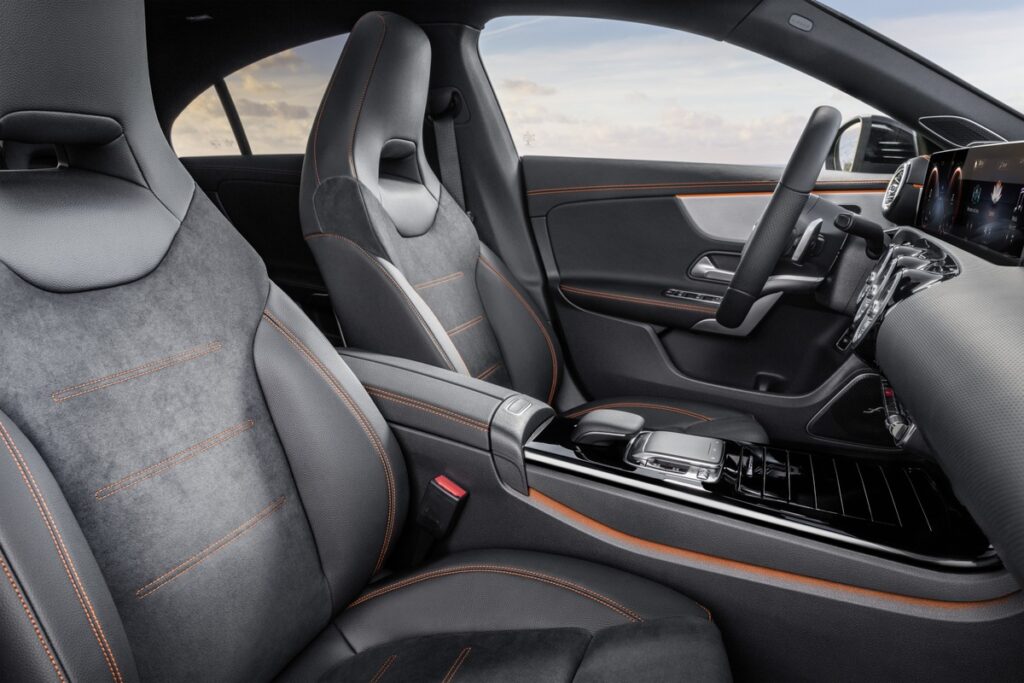
Recaro sport seats in MB-Tex and microfiber Dinamica are available in black with red contrasting stitching and red seat belts or black and digital gray in MB-Tex leatherette. (Mercedes-AMG)
Cabin features
The cabin is dressed to impress with MB-Tex leatherette and Dinamica microfiber upholstery and contemporary materials and trim. Recaro sport seats in front are power adjustable with lumbar and a manual thigh extension.
The flat-bottom, three-spoke AMG steering wheel also functions as an alternate desktop, with thumb controls for navigation, audio and phone a touch-sensitive button to scroll through various screens of information. (Mercedes-AMG)
Sightlines are open and there is enough cabin width to smartly place all controls. The functional center floor console integrates a forward e-bin for wireless or corded phone charging, a pair of deep cup holders and a touch pad to page through the various vehicle systems. It has a steady haptic touch and its use becomes relatively intuitive after a couple hundred miles into ownership. Gear engagement is by a stalk on the steering column.
The flat-bottom, three-spoke AMG steering wheel ($500) wrapped in Dinamica fits sweetly in the hand and also functions as an alternate desktop. The left arm groups cruise control and autonomous drive features. The right arm gives redundant access to navigation and phone. And both groups have a touch-sensitive thumb button to scroll through various screens of information.
Trunk entry is 10.3 inches wider now and the luggage space is large for a compact car at 11.6 cubic feet. (Mark Maynard)
Digital widescreen
The cabin is highly electrified with a widescreen-cockpit presentation to facilitate the Mercedes-Benz User Experience — MBUX. The driver faces a 10.25-inch-wide digital gauge array with a choice of configurations for a traditional layout, a supersport mode or a muted presentation. Supersport focuses the performance with a central, round rev counter and other information in graph bars to the left and right. Via the AMG menu, the driver can call up various special displays such as Warm-up, Set-up, G-Force and Engine Data.
Cabin controls are accessed by another 10.25-inch touch-screen display with voice control or even hand gestures. The “Hey Mercedes” keyword for voice control has been refined to focus on the driver and to filter out other conversations in the cabin.
There also is a tier of manual controls for often-used adjustments, such as fan speed, temp and air flow, plus a console controller for audio volume.
Cabin controls are accessed by the 10.25-inch touch-screen display with voice control or hand gestures. (Mercedes-AMG)
Drivability
AMG puts a fistful of secret sauce into that turbocharged 2.0-liter to wring out 302-hp (or the CLA 45’s 382-hp), when the base engine has a capable 221-hp.
I like that the CLA 35 experience is not all ate-up with horsepower, which can blow past the pleasures of feeling the suspension transition through cornering and how the transmission holds gears through the esses and uphills.
The structure of the car feels tight and nimble, which makes it accommodating for throttle-steering with the accelerator pedal. The roll-on of acceleration is visceral but balanced. Downshift into a corner to raise the revs and then push the nose out a bit or pull it back by subtle lifting. The refined control will make you smile.
The AMG-enhanced 2.0-liter four-cylinder has 302 horsepower that will propel the 3,505-pound CLA35 to 60 mph in 4.6 seconds. (Mercedes-AMG)
Around town, there will be a delay in forward motion as the turbo spools and the dual-clutch engages, but Sport or Sport-plus modes will cut the delay when powering up. The auto stop-start at idle function can be cancelled.
Braking, is immediate but measured for absolute control without grab or lunge. A hard response is flat and composed. The front brakes have four-piston, 13.8-inch vented rotors, backed by single piston, 13-inch vented discs rear.
Even with the bigger brake discs and AMG upgrades, the curb weight is up just 22 pounds compared with a CLA 250 4Matic. Fuel economy estimates are 23 mpg city, 29 highway and 25 mpg combined on the recommended premium fuel.
The tester was optioned with 19-inch matte black AMG wheels ($800) and Michelin Pilot Sport 4S tires (245/35) with a ZR rating. The tires are very sticky with a 300 treadwear rating and resisted squeals of complaint in my backcountry run.
The AMG Ride Control suspension, a worthy $850 upgrade, has three firmness control modes. The Comfort setting can be too firm for the non-enthusiast, but Sport and even Sport-Plus, give impressive turn-in and control.
The tester was optioned with 19-inch matte black AMG wheels ($800) and Michelin Pilot Sport 4S tires (245/35) with a ZR rating. (Mercedes-AMG)
Semi-autonomous driving
New in the redesign is the option for semi-autonomous driving. Using map and navigation data for assistance, elements of the Driver Assistance Package ($2,250) allow the CLA to steer, stop, brake and resume speed, in certain highway configurations — and with the driver’s hands on the wheel. The system functioned with precision to keep the car centered in the lane, while many systems are less precisely calibrated, which will allow the car to wander before a correction is made.
The package adds active brake assist with cross-traffic function, Active Distance Assist Distronic, active steering assist, active blind-spot assist, active lane keeping assist, active lane assist, active speed limit assist, active emergency stop assist, evasive steering assist, Pre-Safe Plus, Route Based Speed Adaptation, and extended restart in stop-and-go traffic.
Active speed limit assist is useful to automatically adapt the car’s speed to an identified speed limit. I discovered this while on the Interstate and was driving through a construction area that was to the far right in merging lanes. When I drove past the reduced speed sign of 55 mph, the cruise control immediately dropped my set speed to 55 mph from 69 mph. And we all know that speeding fines are increased in construction zones.
New in the redesign is the option for semi-autonomous driving using map and navigation data for assistance that allow the CLA to steer, stop, brake and resume speed, in certain highway configurations. (Mercedes-Benz)
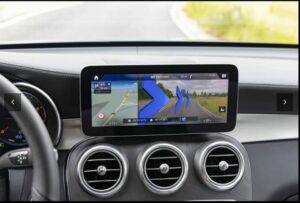
Augmented Video/Reality for Navigation is a hand-holder to guide the way, with blue arrows pointing to the destination. (Mercedes-Benz)
The effect of Route Based Speed Adaptation is the eye in the sky of GPS and the adaptive cruise control system. The system uses map data ahead to reduce speed in anticipation of curves, junctions, roundabouts, toll booths, exit roads, etc.
And for the directionally challenged — even when using a navigation system — the Augmented Video/Reality for Navigation feature is a hand-holder to guide the way. When using the navigation system, a camera in front of the rearview mirror captures a video image of the surroundings and displays arrows or house numbers onto the image in the media display screen. The helpful blue arrows point the way to a street or house number, traffic signs or street names.
And when stopped at a traffic signal, the system uses the front camera to display live video of the intersection on the center screen. It helps the driver see if anyone or anything is in the crosswalk.
Standard safety features include eight air bags, hill-start assist and brake-hold function, crosswind assist and attention assist, for driver awareness.
Why CLA35?
The CLA 35 can be as hands-on or as hands-off as the driver desires. Hands-on was my preferred mode — and none of the assist systems got in the way of a good time.
But if $60K as-tested is too rich for the budget, the same powertrain option and engineering are also available in the subcompact AMG A 35 sedan, starting at about $45,000, and it has access to all the options and upgrades of the CLA 35.
Because of its arching roofline Mercedes refers to the CLA as a four-door coupe — and it feels the part with its frameless door glass and a cockpit driver area. (Mercedes-AMG)
2020 Mercedes-AMG CLA 35 4Matic Body style: compact, five-seat, four-door coupe with variable torque AWD Engine: 302-hp, AMG-enhanced turbocharged 2.0-liter 4-cylinder with cancellable auto stop-start at idle; 295 lb.-ft. torque from 3,000-4,000 rpm Transmission: 7 speed AMG Speedshift dual-clutch automated manual 0-60 mph: 4.8 seconds, estimated Fuel economy: 23/29/25 mpg city/hwy/combined; premium fuel
SPECIFICATIONS Fuel tank: 13.5 gal. Trunk space: 11.6 cu. ft. Front head/leg room: 38.5/41.8 in. Rear head/leg room: 35.7/33.9 in. Length/wheelbase: 184.8/107.4 in. Curb weight: 3,505 lbs. Turning circle: 37 ft., estimated
FEATURES Standard equipment includes: Keyless Go locking with push-button ignition, panoramic sunroof, M-B Tex leatherette upholstery, electric parking brake, rearview camera, 10.25-inch touch-screen display, 10.25-inch digital gauge array, power front seats with lumbar and memory presets, Apple CarPlay or Android Auto Bluetooth connectivity, 40/20/40 folding back seat, LED headlights and taillights AMG 35 special features, include: Speedshift 7-Speed (dual clutch transmission with performance 4MATIC AWD, sport suspension, sport exhaust, 3-stage electronic stability program, Recaro sport seats with integrated headrests and metal-trimmed pedals
Safety features, include: 8 air bags, active brake assist, adaptive braking with hill-start assist and brake-hold function, crosswind assist, attention assist (for driver awareness)
CLA 35 competitors: Audi S3, BMW M240i xDrive; front-drive CLA models compare to the BMW 2-series and Acura ILX
PRICING Base price: $47,895, including $995 freight charge; price as tested $61,335 Options on test vehicle, included: AMG performance steering wheel in Nappa leather and Dinamica $500; 19-inch AMG matte black alloy wheels $800; Parktronic with advanced parking assist $970; AMG ride control sport suspension $850; satellite radio trial subscription $460; Burmester surround-sound audio $850; wireless charging $200; rear side air bags $420 (with a one-time $250 special order fee);
• Driver assistance package, $2,250, includes active brake assist with cross-traffic function, active distance assist Distronic, active steering assist, active blind-spot assist, active lane keeping assist, active lane assist, active speed limit assist, active emergency stop assist, evasive steering assist, Pre-Safe Plus, route based speed adaptation, extended restart in stop-and-go traffic;
• Multimedia package, $1,150, includes navigation and services, including map updates for 3 years, MBUX augmented reality for navigation and speed-limit assist;
• AMG Night package, $750, includes front splitter, grille trim and louvres in outer air intakes, AMG side panel inserts, beltline and window line trim strips in gloss black, black side mirrors and tailpipe trim;
• Performance seat package, $3,270, includes multicontour, heated Recaro seats
Where assembled: Kecskemet, Hungary Warranty: 4-years/50,000-miles bumper to bumper with roadside assistance
Young designer of Ford Bronco also contributed to concepts for a cab-forward truck, the Mustang, and the legendary GT40
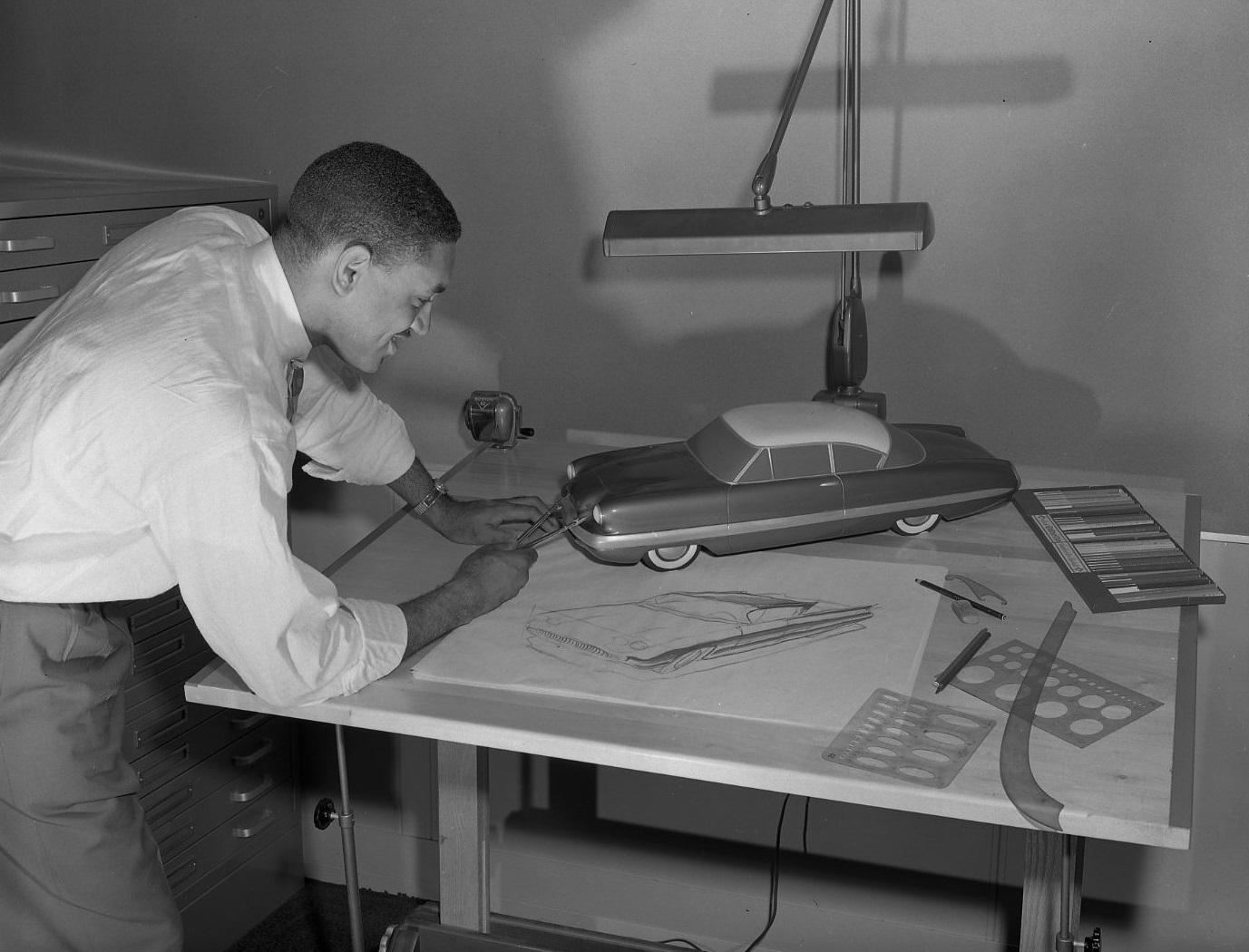
McKinley Thompson Jr., a Ford designer who helped pen the first-generation Bronco, was the first African American designer hired at Ford Motor Company (Photos courtesy of Ford Motor)
The endearing and enduring success of the Ford Bronco has roots in its earliest design by the first African American designer hired at Ford Motor Co. In 1956, McKinley Thompson Jr. had just graduated from ArtCenter College of Design in Pasadena, Calif., with a degree in transportation design.
Among Thompson’s more noteworthy projects was the Ford Bronco SUV, an open-air 4×4 concept featuring a square, short body and high ground clearance with minimal front and rear overhangs for optimum off-road capability. One of his designs, titled “Package Proposal #5 for Bronco,” rendered July 24, 1963, influenced the design language that would become iconic attributes of the first-generation Bronco.
Early Bronco sketches by Thompson Jr.
The First Generation
The original nameplate ran from 1965 to 1996, when the short-wheelbase off-roader was replaced by the much larger Expedition SUV. Now, 24 years later Ford has just unveiled its successor.
The 2021 Ford Bronco 4X4 will be available next spring in two-door and four-door body styles, laying the foundation for a family of off-road vehicles, Ford calls “Built Wild.” Like the original, the sixth-generation Bronco, based on the Ranger pickup, will have removable doors and roof for an open-air experience. A less intense and more affordable model, the Bronco Sport, will be based on the Escape SUV architecture.
A pre-production 2021 Ford Bronco two-door SUV takes its off-road design cues from the first-generation Bronco.
“We created the Bronco family to elevate every aspect of off-road adventure and equipped them with class-leading chassis hardware and exclusive technologies to raise the bar in the rugged 4×4 segment and take people further into the wild,” Jim Farley, Ford chief operating officer, said in a media statement. And at launch, there will be a range of option packages, including the Sasquatch with 35-inch tires, and more than 200 factory-backed accessories.
An early Ford Bronco clay prototype.
Ranger Pickup Roots
Based on the architecture of the midsize Ranger pickup, the Bronco will have a boxed, high-strength steel chassis that will be capable best-in-class suspension travel, Ford says, or 17 percent more front and rear over the closest competitor (the Jeep Wrangler).
There will be two engines, the standard powertrain will be a 270-horsepower, 2.3-liter EcoBoost four-cylinder with an expected 310 foot-pounds of torque. It will have a standard seven-speed manual transmission (including a crawler gear) or optional 10-speed automatic. A 325-hp, 2.7-liter twin-turbocharged EcoBoost V6 will be optional, with 400 foot-pounds of torque, paired with the automatic transmission.
Pricing will start at about $30,000 and both body styles can be reserved now at Ford.com for $100.
Reservations for the Ford Bronco First Edition — limited to 3,500 copies — filled up in less than a day, for the price of $60,800, including shipping.
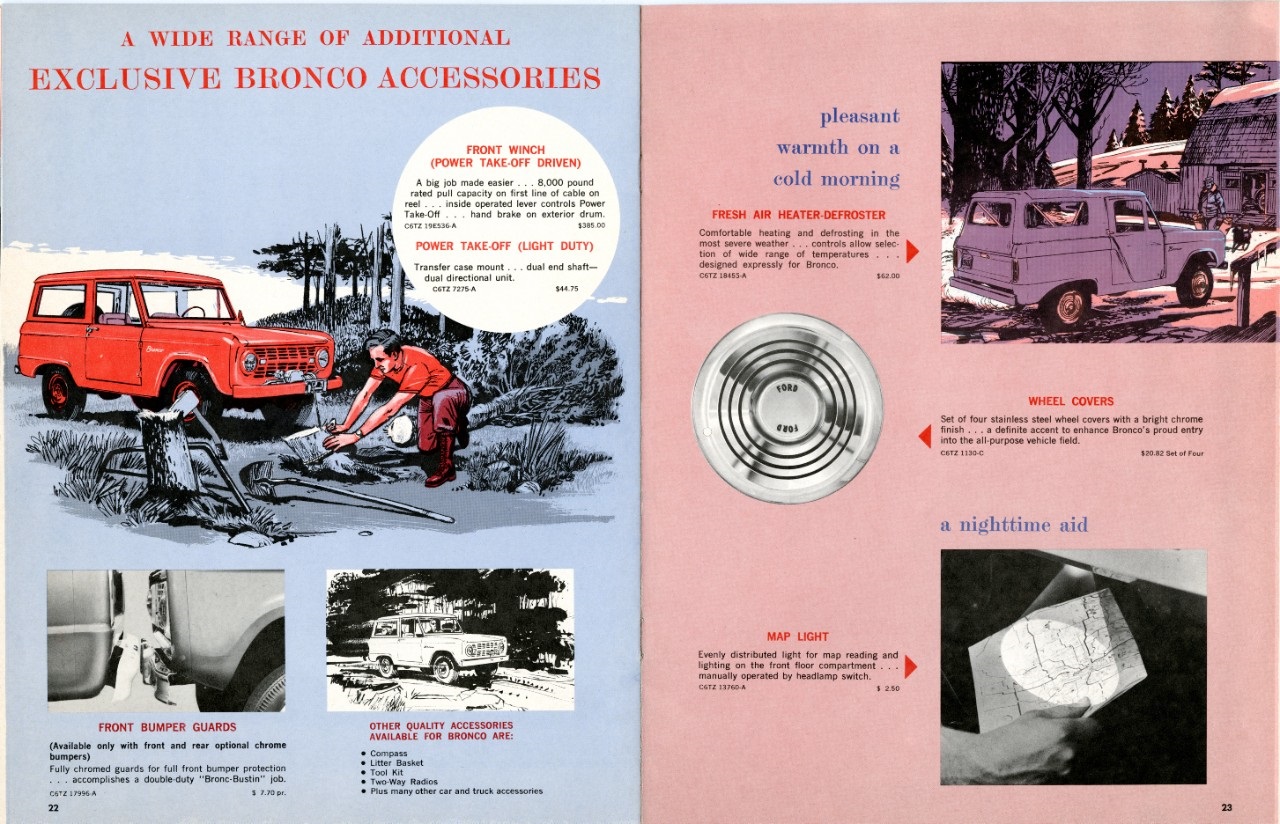
The original Bronco debuted with a range of accessories.
An Unsung Legend
Thompson Jr. is somewhat of an unsung legend, according to a media release from Ford.
His first assignment was at the company’s advanced design studio in Dearborn, working under George Walker, vice president of Ford design. Among his projects was a light-duty cab-forward truck, several concept sketches for the soon-to-be Ford Mustang and the legendary Ford GT40. Thompson also worked on the futuristic space-age Ford Gyron, a two-wheeled concept car that was on display at the Century of Progress exhibit at the Ford Rotunda in 1961.
The 1966 Ford Bronco prototype.
McKinley followed his dreams and wound up making history, said the current Ford Bronco interior designer Christopher Young, who also is Black.
“[McKinley] not only broke through the color barrier in the world of automotive design,” said Young, “he helped create some of the most iconic consumer products ever — from the Ford Mustang, Thunderbird and Bronco — designs that are not only timeless but have been studied by generations of designers.”
1966 Ford Bronco pickup.
Bronco Proposal #5
In Thompson’s proposed Ford Bronco design, the wheels were positioned at the far corners of the body for a confident and aggressive go-anywhere stance. And the curve of the smoothed out wheel arches conveyed speed.
Simple but durable features.
“I believe the hardest thing for a person like McKinley to do was working within the constraints given him to make a beautiful product,” said Young, 48. “Engineering dictates size and functionality, then manufacturing limits how it can be stamped and assembled, and finance says you have to build it for a low price.”
1966 Bronco interior with bench seat.
And with the bucket-seat option.
Thompson’s concept for an all-purpose compact two-door SUV is a theme he would return to later in life. After retiring from Ford, he worked to design and build a concept he envisioned as an affordable all-purpose vehicle named the Warrior. The small utility vehicle was based on a one-piece fiberglass body, a process Thompson dreamed of decades earlier.
The standard 150-hp. 170-cubic-inch inline-six was derived from the Ford Falcon.
The Warrior and the Dreamer
Thompson was born in 1922 and grew up in Queens, N.Y. He had a keen interest in cars from the time he was young, and later recalled seeing a silver-gray DeSoto Airflow when he was around 12.
“It just so happened that the clouds opened up for the sunshine to come through,” he said in an interview documented by The Henry Ford. “It lit that car up like a searchlight.”
Thompson recalled running toward it, but the light turned green. “I was never so impressed with anything in all my life,” he said. “I knew that’s what I wanted to do — I wanted to be an automobile designer.”
Protected spare tire storage.
Thompson served in the Army Signal Corps in World War II where he learned drafting and worked as an engineering layout coordinator.
Optional wheel covers.
After the war, that work provided for him and his growing family, but Thompson’s love of cars and his dream of being a designer persisted.
In the early 1950s, he entered a design contest in Motor Trend magazine. His submission was a turbine car with a reinforced plastic body, both concepts that were trending in the postwar era.
He won the contest, then went on to enroll in the transportation design department at ArtCenter College of Design.
A love of cars
Later in his Ford career, Thompson worked on the side to create his dream car in a rented garage in Detroit from 1969 to 1979. He enlisted the help of Wallace Triplett, who had also broken the color barrier as the first African American draftee to play for the Detroit Lions in 1949.
Together, they built a prototype and pitched the plans to burgeoning automakers in developing nations. Thompson hoped to change these countries for the better, much the same way Henry Ford envisioned with the Model T.
Eventually, Thompson pulled the plug on the project — but not on his dreams. He retired from Ford in 1984 and moved to Arizona with his wife. He passed away on March 5, 2006.
“McKinley’s influence, beyond his work on the original Bronco, helped pave the way for others like him who might not have had an opportunity to express their creative talents and live their dreams to be a part of one of America’s greatest companies,” said Young.
The Toyota Land Cruiser is an institution of overlanding authority. It has been a global expedition vehicle since its launch in Japan in 1951 as the Toyota Jeep BJ, a small 4WD military vehicle. The name was changed by 1954 to Land Cruiser to avoid legal entanglements with the Willys brand and to tread lightly around the Land Rover.
The prototype BJ was not chosen for production, according to Toyota, but it went on to become the first motor vehicle to reach the sixth station on the trail to the top of Mt. Fuji.
In 1958, the updated 20-Series was one of the first Toyota exports to the United States. The next Land Cruiser iteration, the 40-Series (FJ-40), arrived in 1960 and became an all-terrain icon (and now a collector’s item). A larger station wagon model followed in the late-1960s, putting the Land Cruiser on a path toward family adventures.
By 1991, the 80-Series Land Cruiser was becoming a full premium model. A V-8 engine and an array of advanced chassis systems and luxury amenities were added in the late-1990s.
The current Land Cruiser, known internally as the 200-Series, is the most advanced and luxurious in the model’s history, Toyota says.
The Heritage Edition interior is luxurious but durable.
Land Cruiser Credentials
The Land Cruiser is not a station-wagon SUV. It is built expedition tough to get you out and back. Its protective armor includes full-time four-wheel drive, frame-mounted tow hooks front and rear and underbody skid plates (at the front suspension, radiator, fuel tank, transfer case).
After an all-new seventh-generation model debuted in 2008, the last major “refresh” was in 2016. That update would add a new front end (for Euro pedestrian crash standards), an eight-speed automatic transmission and a full suite of advanced safety technologies, such as low-speed frontal collision avoidance, lane departure alert and dynamic radar cruise control.
The cabin is outfitted with black leather-trimmed upholstery and bronze contrast stitching.
Land Cruiser Heritage Edition
To honor the Land Cruiser’s 60-plus years as an SUV icon, Toyota created the 2020 Land Cruiser Heritage Edition. The limited-edition model has a starting price of $89,070 and is only available in a five-seat, two-row configuration to maximize cargo space. (Its MSRP is about $2,330 more than the standard eight-seat Land Cruiser). Pricing includes the $1,325 freight charge from Toyota City, Japan. The tester was $89,369 with one option for a glass-breakage sensor, $299.
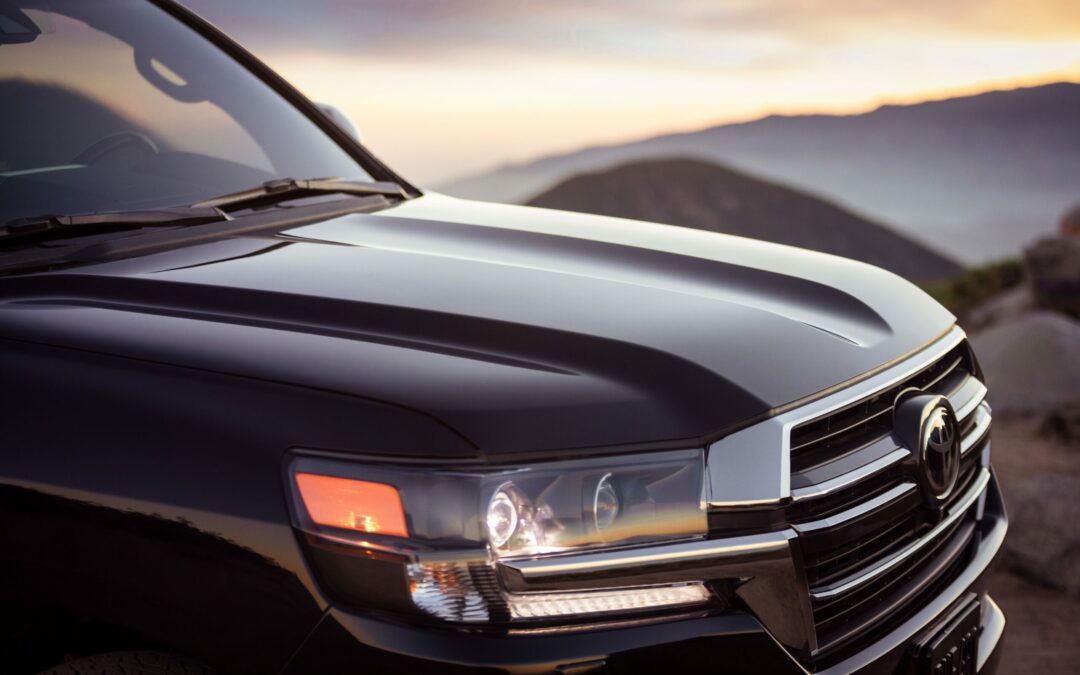
It is available in two paint colors, Midnight Black Metallic or Blizzard Pearl, both with a black-accented grille and bronze-colored BBS 18-inch forged aluminum wheels featuring a “TOYOTA” center cap. The vintage-style Land Cruiser badge is a tribute to its accomplished history.
With its mission of off-roading, the Heritage Edition has no running boards to interfere with high-centering and the usual chrome lower bodyside moldings were deleted to avoid trail rash. Other unique features include darkened headlight housings, fog lights with dark chrome surrounds, and side mirrors with darkened chrome.
The bronze stitching is carried onto the steering wheel, door trim, center stack, console, and seats.
Land Cruiser Safety Features
All Land Cruiser models come standard with 10 air bags and Toyota Safety Sense P (TSS-P), which uses radar and a camera sensor to detect a preceding pedestrian or a vehicle. The system is intended to automatically apply the brakes as needed to help mitigate or avoid collisions in certain conditions.
Integrated into the TSS-P system are Lane Departure Alert with Sway Warning, Dynamic Radar Cruise Control, and Automatic High Beams. Also standard are blind-spot monitoring and rear cross-traffic alert.
Toyota Safety Connect (with three years of free subscription service) uses onboard cellular technology, independent of the driver’s phone, to provide such services as Automatic Collision Notification, Stolen Vehicle Location, Emergency Assistance Button (SOS) and GPS-enhanced roadside assistance.
Off-roading armor includes a multiterrain camera with front, side or rear views, a full-size spare tire, roof rack, frame-mounted tow hooks front and rear with underbody skid plates at the front suspension, radiator, fuel tank and transfer case.
Special bronze-colored forged aluminum BBS wheels.
Ride and Handling
With its body-on-frame truck chassis, the Cruiser feels as tough as a railroad spike. But the ride quality is quite composed on all road surfaces I tested and without head toss in turns.
Its hydraulic Kinetic Dynamic Suspension works through the stabilizer bars to steady the on-road ride or to reduce resistance for more wheel travel off road to keep the rubber in contact with the trail. (It is not an air suspension and there is no ability to change the ride height, whether for loading people or cargo or raising it for off-road clearance.)
The full-time 4WD system has high- and low-range gearing and a Torsen limited-slip locking center differential. Active Traction Control works the brake and throttle to help control wheel spin. And the electronic multiterrain select system will fine-tune throttle and traction for a variety of surfaces, including a mogul mode.
Crawl Control takes over the accelerator and braking to wallow along at one of five low-speed settings (1 to 5 mph). It even works in reverse.
Four-wheel vented disc brakes have large 13.9-inch rotors front, 13.6-inch rear.
Endearing features include a manual hand brake and the power liftgate and manual fold-down tailgate (with storage panels) and a soft-close feature.
The 381-horsepower 5.7-liter V-8 has a trail churning 401 foot-pounds of torque.
Land Cruiser Powertrain
With a curb weight of 5,715 pounds, there is good power from the 381-horsepower 5.7-liter V-8 and a trail churning 401 foot-pounds of torque for forceful but not quick acceleration. The eight-speed automatic doles out easy shifts to stay in the powerband.
Fuel-economy ratings are 13 mpg city, 17 highway and 14 mpg combined on 87 octane. I was averaging a consistent 15.7 mpg, with much highway driving. The 24.6-gallon tank allows a decent cruising range.
The Heritage Edition is only available in a five-seat, two-row configuration to maximize cargo space.
Interior Function
The upright cabin, one of Toyota’s highest-quality interiors, is a vertical environment with a short dashboard, which simplifies sightlines over the hood. It is a traffic-calmed space that leaves the commotion outside and you comfortably seated with a clear view down the road. It is an empowering message that not all SUVs provide. My only gripe was sun glare on the touch screen.
The Heritage Edition interior is luxurious but durable. The cabin is outfitted with black leather-trimmed upholstery and bronze contrast stitching, which is carried onto the steering wheel, door trim, center stack, console and seats. With standard all-weather floor mats and cargo liner, it’s ready for the trail, or the commute to work.
Other Heritage Edition equipment includes heated and ventilated front seats, heated steering wheel, power moonroof, four-zone automatic climate control with 28 air vents throughout the cabin, and smart-key locking with push-button start. For deeper center console storage, the cool box has been deleted.
The 9-inch touch screen infotainment system has split-screen capability, advanced voice recognition and a 14-speaker JBL audio system with navigation and Bluetooth phone and music. There’s also Qi wireless phone charging.
The second row has a flat floor and adult-class support to the seats, which also recline.
Window seat occupants have overhead and pillar-mounted grab handles. The HVAC system includes a pollen and dust filter.
The full-time 4WD system has high- and low-range gearing.
Why Buy the Toyota Land Cruiser?
Big and heavy off-roading SUVs are getting more scrutiny by manufacturers seeking improved fuel economy and emissions for greenhouse-gas ratings.
The Land Cruiser typically sells fewer than 350 models a year, but the Toyota dealers want to keep it, or at least the nameplate. As of now, the Land Cruiser is slated for a redesign in 2023, which might bring a fresh new concept. Toyota isn’t saying which direction it might take, but a return to its more compact FJ roots would introduce fresh new competition for Jeep and the new Ford Bronco.
You will like the Land Cruiser if you are seeking a vehicle that feels vault-secure and safe. For those not sensitive to pricing and fuel costs, the Land Cruiser provides a feeling of calm invincibility on the road.
Standard equipment includes: smart key entry with push-button ignition, power moonroof with sunshade, multiterrain camera with front, side or rear views, 4-zone climate control with pollen-dust filter, semi-aniline perforated black leather-trimmed upholstery, 14-speaker JBL audio system with Entune app suite and 9-inch touch screen, navigation, bi-level covered center console, leather-wrapped and heated steering wheel, 10-way power driver’s seat, 8-way power front passenger seat, heated and ventilated front seats, 18-inch BBS alloy wheels with P285/60 tires, full-size spare, LED low and high-beam headlights, LED fog and running lights, folding side mirrors, power liftgate and manual tailgate with electric release, roof rack, frame-mounted tow hooks front and rear, underbody skid plates (front suspension, radiator, fuel tank, transfer case), 40/20/40 second row seating (with slide, recline, tumble), heated second-row seats, 2 12-volt power plugs, 1 120-volt household plug in cargo area, and front and rear parking alerts
Safety features include: include: 10 air bags, active traction control, multi-terrain ABS, trailer sway control, hill-start assist, crawl control with off-road turn assist
PRICING
Base price: $89,070, including $1,325 freight charge; price as tested $89,369
Options on test vehicle: Glass breakage sensor $299
Where assembled: Toyota City, Japan
Warranty: 3 years/36,000 miles bumper to bumper; 2 years/24,000 miles free scheduled maintenance; 5 years/60,000 miles powertrain
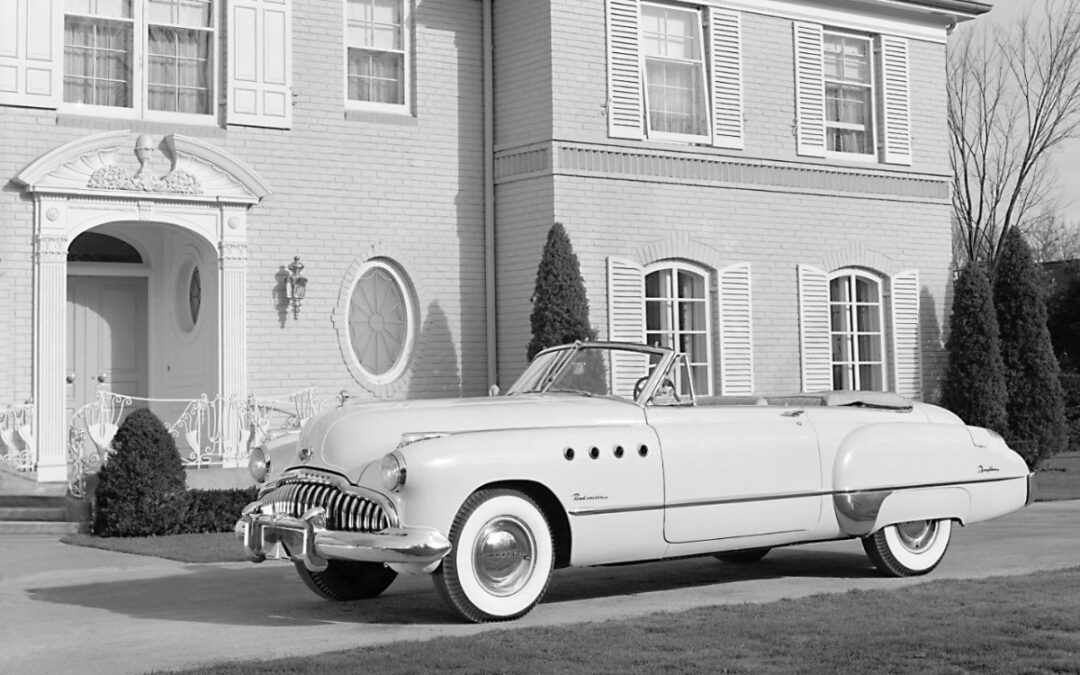
1949 was the first year for the “VentiPorts.” (GM PR archives)
The Buick Roadmaster received its first major postwar restyling in 1949, according to Wikipedia. Its wheelbase and overall length were reduced but its weight was actually marginally increased. The biggest change was a much larger two-piece, curved glass windshield that the sales brochure described as like an “observation car.”
It was also in 1949 that Buick introduced “VentiPorts.” Four were displayed on each of the Roadmaster’s front fenders, with three on the fenders of the Super, Century and Special.
The Riviera joined the body-style lineup in midyear, selling 4,314 units. Featuring power windows as standard equipment, the two-door Buick Roadmaster Riviera, along with the Cadillac Series 62 Coupe de Ville and the Oldsmobile 98 Holiday, was among the first hardtop coupes ever produced.
The Riviera was also notable for its popular optional “Sweepspear” chrome body-side molding, which would soon become a Buick trademark.
The name Riviera, Latin for coastline, was chosen to evoke the allure and affluence of the French Riviera. Its new two-door pillarless hardtop styling was described in advertising as “stunningly smart.”









 The First Generation




 Thompson’s concept for an all-purpose compact two-door SUV is a theme he would return to later in life. After retiring from Ford, he worked to design and build a concept he envisioned as an affordable all-purpose vehicle named the Warrior. The small utility vehicle was based on a one-piece fiberglass body, a process Thompson dreamed of decades earlier.