Select Page

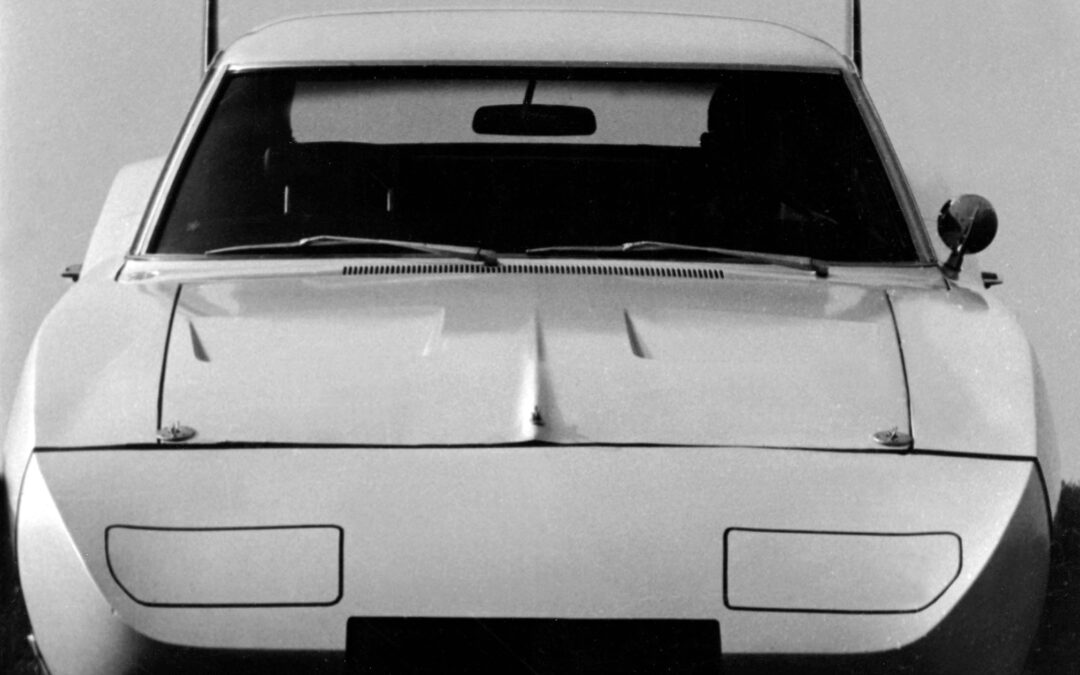
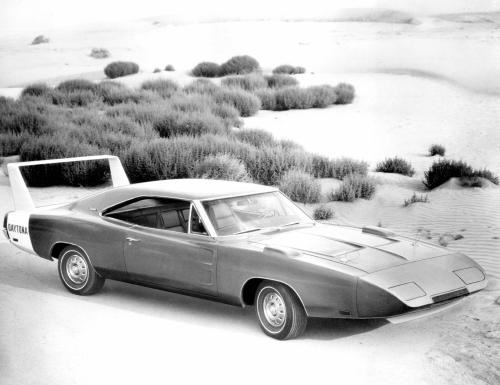
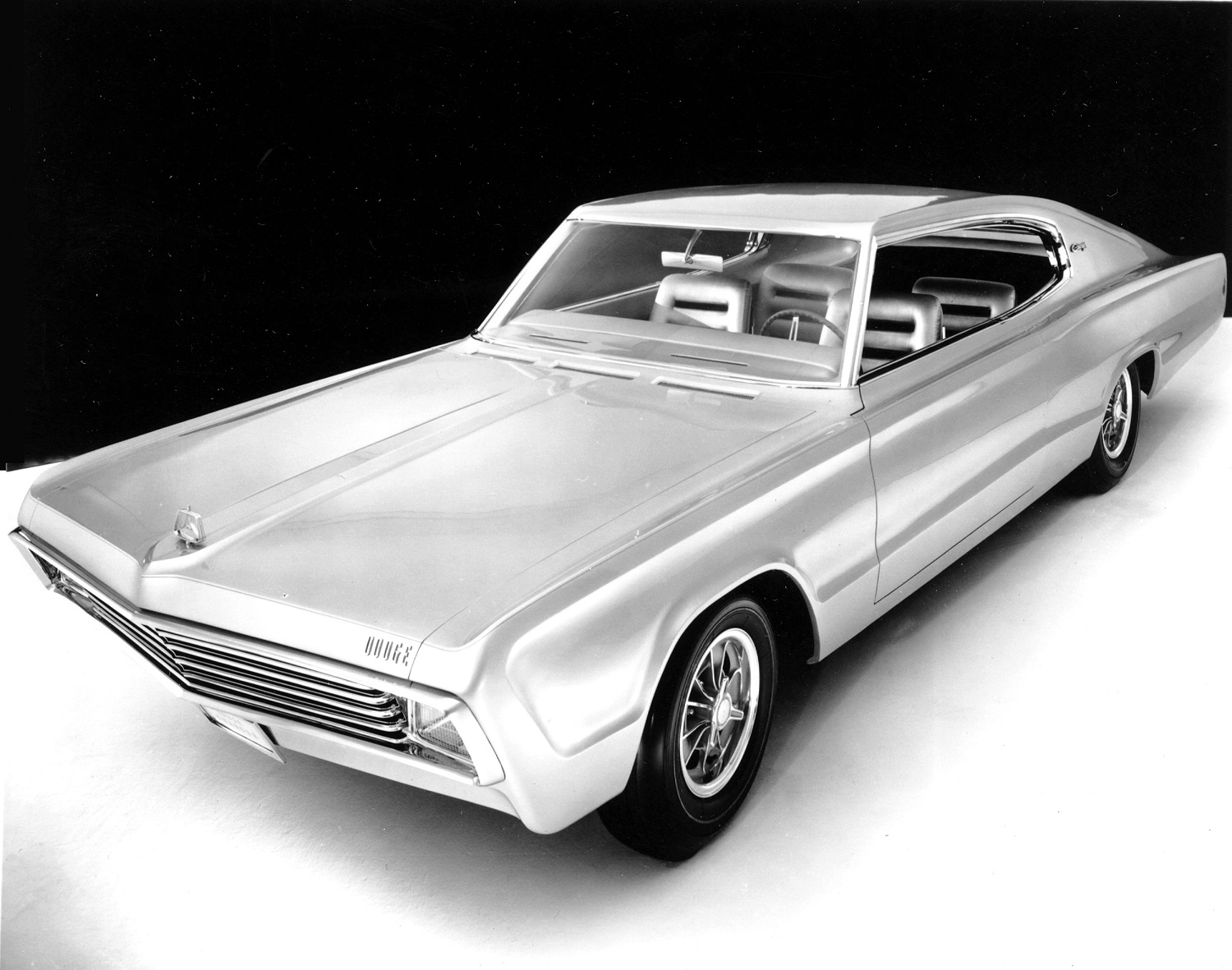
1969 Dodge Charger Daytona

1969 Dodge Charger Daytona

The most conspicuously styled Dodge of all time. (Stellantis)

BY MARK MAYNARD

The 1969 Dodge Charger was the most conspicuously styled Dodge of all times and served as the homologation model for the Dodge stock cars entered in NASCAR races. Only 505 units were built for NASCAR homologation.

U.S. pricing started at $3,860 U.S. dollars.

The road-going version of the model was powered by the 7-liter, 425-horsepower Hemi 426. The tuned race version reached speeds in excess of 200 mph on oval racetracks.

Overview

The Dodge Charger was introduced on Jan. 1, 1966. It was built off the Dodge Coronet chassis, but it had its own fastback body.  It featured many styling cues from the Charger II concept car like a fastback roof design and full-width taillamps.

The Charger was positioned to take on AMC’s conceptually similar Rambler Marlin. The Charger was better looking but somewhat more expensive. Pricing ranged from $2,850 to $3,100 —  or $22,733 to $24,727 in 2020 dollars.

Significantly, the Charger’s interior was different from all other cars, with a full-length center console and “all bucket seating” front and rear.

Also an innovation, the rear’s pseudo-buckets could be folded down to create interior space accessible via the enormous rear hatch.

The Charger wasn’t intended to compete head-to-head in performance with pony cars but was available with Chrysler’s famed 426 Hemi V8.[9]

The Charger came with a standard 5.2-liter, 318 cubic-inch V-8 engine delivering 230 horsepower. Other available engines included a 265-hp 361 cubic-inch V-8 engine, or a 325-hp 6.2-liter, 383 cubic-inch V-8.

However, it was the availability of a massive 426 cubic-inch Street HEMI engine that provided 425 horsepower and 490 foot-p;ounds of torque that forever defined the vehicle.

The 1969 Dodge Charger body style carried over from 1968 with minor exterior changes like a new grille and taillamps.

The HEMI engine was installed in less than 2 percent of ’69 Dodge Chargers, yet contributed immensely to the image and desirability of the Charger lineup.

The 1969 Charger gained fame as the tire-squealing getaway car driven by Bo and Luke Duke for seven seasons on the TV series, Dukes of Hazzard.

1965 Dodge Charger II concept

The Dodge Charger featured many styling cues from the Charger II concept car.

Dodge Charger At the Track

The 1969 Dodge Charger 500, featuring a flush rear window to improve aerodynamics, was introduced especially for NASCAR.

The Charger Daytona was introduced in September and built specifically for NASCAR competition.

The Daytona featured a large aerodynamic nose and a huge “wing” spoiler in the rear that stood 58 inches above the trunk.

All Dodge Charger Daytona models were powered by either a 440 Magnum cid or 426 HEMI engine.

Dodge Charger Daytona won its first NASCAR Grand National race at Talladega (Ala.) in September followed by a win at Texas International Speedway.

From September 14, 1969, through the next year, Charger Daytona and the Charger 500 won 45 out of the next 59 races.

The car dominated racing so much that NASCAR eventually placed restrictions on the HEMI engine by forcing the use of carburetor restrictor plates on Chrysler models featuring the HEMI engine and limiting engine displacement to a maximum of 305 cubic inches on Charger Daytona and Plymouth Superbird models.

Driver Buddy Baker, behind the wheel of a HEMI-powered Charger, became the first to top the 200 mph mark on a closed-circuit course in 1970.

Vin Car Pic: Walter P. Chrysler

Vin Car Pic: Walter P. Chrysler
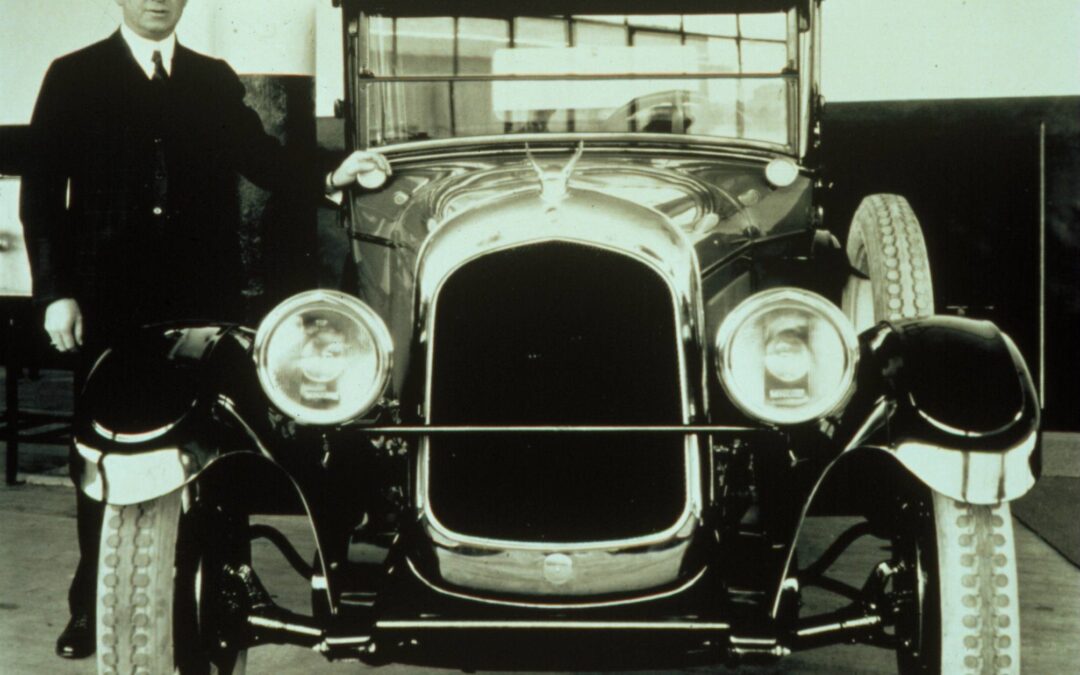
A black and white photo of Chrysler founder Walter P Chrysler standing along side a a1924 Chrysler Six

Walter P. Chrysler with his first eponymous named car in 1924. (FCA US archives)

BY MARK MAYNARD

On this day in automotive history, the founder of the Chrysler Corp., Walter Percy Chrysler, died on Aug. 18 1940 after succumbing to a cerebral hemorrhage.

According to AutomotiveHistory.org, Walter Chrysler was born in Kansas in 1875 and began his career as a machinist and mechanic in the railroad industry. His railroad career peaked as works manager of the Allegheny locomotive erecting shops of the American Locomotive Co., also known as Alco.

His introduction to the automotive business would come in 1911 when he was approached by James J. Storrow, an investment banker who was critical in the formation of General Motors just a few years prior.

Walter P. Chrysler with a 1924 Chrysler.

Walter P. Chrysler with a 1924 Chrysler. (FCA US archives)

Walter Chrysler made his final resignation from railroading to become works manager (in charge of production) at Buick in Flint, Mich., according to Wikipedia. He found many ways to reduce the costs of production, such as putting an end to finishing automobile undercarriages with the same luxurious quality of finish that the body warranted.

The Chrysler 70 debuted with a six-cylinder engine in January 1924. It was marketed as an advanced, well-engineered car at a more affordable price than the competition. (Elements of this car are traceable back to a prototype that had been under development at Willys when Chrysler was there.)

The original 1924 Chrysler included a carburetor air filter, a high-compression engine, full-pressure lubrication inside the engine, and an oil filter, at a time when most autos came without all these features.

a black white photo of a 1924 Chrysler Touring model

The 1924 Chrysler Touring. (FCA US archives)

Among the innovations in its early years would be the first practical mass-produced four-wheel hydraulic brakes, a system nearly completely engineered by Chrysler with patents assigned to Lockheed.

Chrysler pioneered rubber engine mounts to reduce vibration, Oilite bearings, and superfinishing for shafts.

Chrysler also developed a road wheel with a ridged rim, designed to prevent a deflated tire from flying off the wheel. The auto industry eventually adopted this safety wheel worldwide.

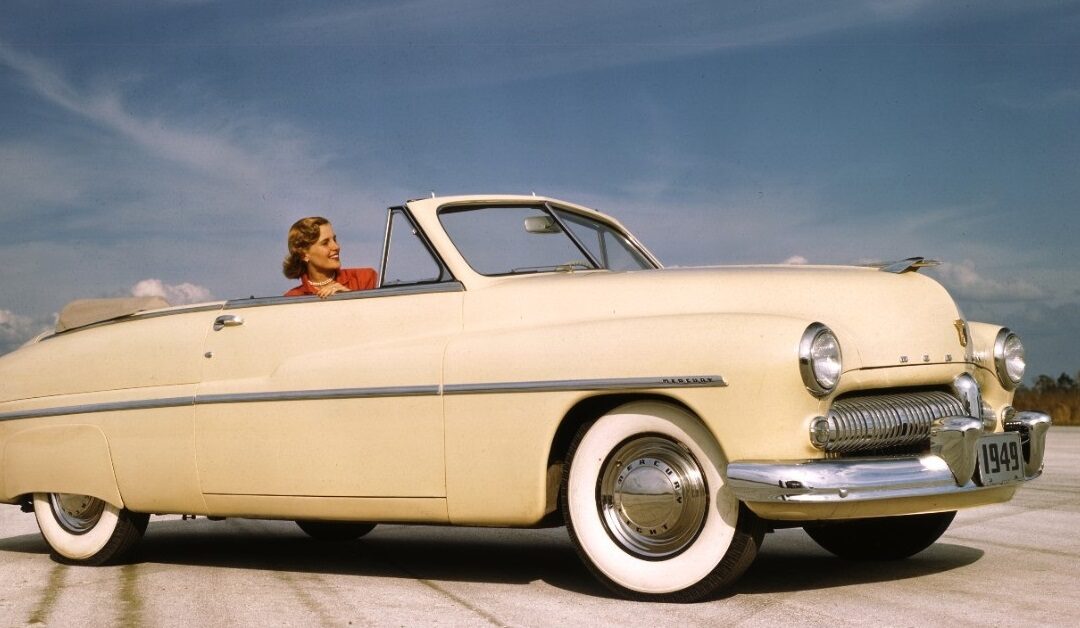
1949 Mercury Eight Convertible

1949 Mercury Eight Convertible
A color vintage cars photo of a 1949 Mercury convertible.

The post-war 1949 Mercury had breakaway styling. (Ford archives)

The third-generation 1949 Mercury was the first new design following World War II, according to Wikipedia.

The so-called “ponton” or pontoon styling helped differentiate it from its Ford cousin. The ’49 also became the definitive “lead sled” for customizers, including the Barris brothers, Sam and George.

The all-new postwar Mercurys were introduced toward the end of the 1948 model year, on April 29,1948, according to a report by the Automotive History Preservation Society. The cars did not look like fancy Fords but instead shared Lincoln styling and basic body shells.

“The engine was still a flathead V-8 now upped to 255 CID with 110 horsepower. A new and optional overdrive system was  activated by a handle under the dash.

“The Mercury Eight used full instrumentation in round dials. There were two dials on either side of the large central speedometer. An optional eight-tube radio and electric clock were centered on the dashboard.

“The transverse leaf spring suspension was gone. The front suspension was independent coil-spring with telescopic-type shock absorbers mounted inside front springs. A stabilizer bar was fitted to reduce body roll. The rear suspension had longitudinal, semi-elliptic leaf springs with telescopic shock absorbers. A semi-floating rear axle with hypoid-type ring gear and pinion was fitted.

“The ’49 Merc grille resembled a shiny coil. It was divided in the center by a large vertical chrome “Eight” stamped.

“A nearly full-length, mid-body chrome spear stretched across the sides. The 1949 Mercury also had wraparound front and rear bumpers. 

Paint Colors

There more than a dozen paint choices: Alaska Gray, Cairo Gray, Midland Maroon, Black, Alberta Blue, Royal Bronze Maroon, Dakota Gray, Lima Tan, Biscay Blue, Berwick Green, Tampico Red,  Haiti Beige, Bermuda Cream and Banff Green

“The 1949 Mercury Eight production totaled an astounding 301,307 units. It was far and away Mercury’s best ever year.”

See more vintage car photos here.

1933 Dodge Westchester Suburban

1933 Dodge Westchester Suburban
The 1930s Dodge Westchester woodie wagon.

The 1930s Dodge Westchester woodie wagons were all custom built. (Stellantis PR archives)

BY MARK MAYNARD

Not much is known about the Dodge Westchester Suburban woodies, according to an online report at SignificantCars. Research can confirm that Dodge and Plymouth offered similar models. None of the Plymouth woodies are known to have survived the ages and perhaps only one 1934 Dodge Westchester Suburban long-wheelbase woodie has survived.

Beginning in 1933 Dodge struck a relationship with U.S. Body and Forging Company in Tell City, Ind. Dodge would send commercial chassis to USBF where a custom-made wooden body would be assembled to the commercial 109-inch chassis.

Each vehicle was a custom order. Many were attractively finished and used as station wagons by the civilian population, but the versatile vehicle was found to be useful to the U.S. Army.

True production numbers are unknown as records were not kept on custom-built non-Dodge factory offerings. However, it is widely believed that the production figures are very low perhaps fewer than 40 units.

According to the Dodge Series D8 page in Wikipedia, there were 375 1938 “semi-custom ‘Westchester Suburban’ four-door woodie station wagon built. 

Discovering a Trove of Bugatti Models

Discovering a Trove of Bugatti Models

Harsh negotiations, threats and blackmail fueled obsessed collector to become the biggest Bugatti collector in the world

A 1957 Bugatti loaded onto a train flatcar

A Type 57S is loaded onto the train, with a legendary Bugatti Royale following. (Photos courtesy of Bugatti)   

BY MARK MAYNARD

The famed Schlumpf Collection of Bugatti models in France is a legendary automotive tale of obsession, wealth, and downfall for the brothers Schlumpf, Fritz, and Hans.

Breaking through a veil of secrecy in 1977, factory workers came across a secretly hoarded treasure of 427 vintage European luxury cars, most of them in showroom condition, with another 150 cars stashed away in the workshops.

Bugatti recently shared this story of an American stash of 30 cars that Fritz Schlumpf just had to have and how they were relocated in the 1960s from Illinois to France.

Fritz Schlumpf was a Bugatti enthusiast. He bought his first car, a Type 35B, at the age of 22 in 1928 and drove it on weekends and in car races. Schlumpf would stay in touch with the company, based in Alsace, France, over the coming years. But his passion for collecting didn’t really develop properly until 1961.

American collector John Shakespeare with his 30 Bugattis as they were loaded onto a train on March 30, 1964.  

American collector John Shakespeare with his 30 Bugattis as they were loaded onto a train on March 30, 1964.

The Story Background

Schlumpf initially worked as a wool broker, and in 1929 his brother Hans — two years his senior — joined the textile company. In 1935, they founded Société Anonyme pour l’Industrie Lainière (SAIL), a limited company trading in wool. After the war, the brothers bought up several factories and spinning mills in Alsace until they almost fully dominated the textile industry in eastern France.

Assessing the Bugatti collection

Assessing the collection.

In 1957, they acquired an idled wool factory in Mulhouse, Alsace, to build their own automobile museum. It would be in honor of their beloved mother and Bugatti founder Ettore Bugatti, but mainly it was for Fritz Schlumpf himself. After all, collecting Bugatti cars had long become his obsession.

From 1961 onward, he acquired numerous classic vehicles and eventually became the leading Bugatti collector in the world. And he wanted more.

To fuel his obsession, Schlumpf wrote to Bugatti owners worldwide in the early 1960s, sourcing addresses from a register kept by Hugh Conway of the British Bugatti Owners Club. Conway put him in touch with American collector John W. Shakespeare from Hoffman, Ill., in 1962.

Inside Shakespeare’s dirt-floor garage. 

Inside Shakespeare’s dirt-floor garage.

Dedicated to Bugatti

Shakespeare had dedicated himself to collecting Bugatti vehicles since the 1950s: his first car was a 1932 Bugatti Type 55, which was followed by a Type 41 Royale Park Ward, the third and last customer car. Also in his care were a dozen Type 57s, three Type 55s and Ettore Bugatti’s personal electric car, the Type 56 dating back to 1931.

All in all, Shakespeare owned the largest Bugatti collection in the world, comprising some 30 vehicles.

Schlumpf was on a mission to get these cars and made Shakespeare an offer of $70,000. But Shakespeare demanded at least $105,000, whereupon Schlumpf had the collection assessed by Bugatti connoisseur Bob Shaw from Illinois in 1963.

Ettore Bugatti’s personal electric car, Type 56. 

Ettore Bugatti’s personal electric car Type 56 dating back to 1931.

An Unflattering Conclusion

Shaw arrived at an unflattering conclusion: “Most of the cars are kept in a part of the building with a dirty floor, broken windows, leaking roof and nesting birds. Every car is in some state of disrepair and none of them have been running for at least 18 months.”

He advised against the purchase, but Schlumpf was fully committed by this time and offered Shakespeare $80,000 for the entire collection. After tough negotiations, mutual threats, and blackmail, Schlumpf and Shakespeare finally agreed on a purchase price of $85,000 the following year (equivalent to approximately $720,000 today) — including transport to France.

From today’s point of view, it was a real bargain. Today, genuine and restored Bugattis will sell at auction from around $200,000 to tens of millions of dollars.

A 1932 Type 55 is loaded onto the railcar. 

A 1932 Type 55 is loaded onto the railcar.

30 Bugattis On A Train

On March 30, 1964, the 30 Bugattis left Illinois on a Southern Railway train headed for New Orleans where they would be loaded onto a Dutch cargo ship. A photo shows the open train with the large number of rare vehicles.

A few weeks later, the freighter reached the French port of Le Havre, where Schlumpf finally received his treasure. He was now one huge step closer to achieving his goal of being the biggest Bugatti collector in the world. It wasn’t until 1965 that the Schlumpf brothers publicized their collection in a short press release — and the idea of a museum was born. But Schlumpf never officially opened it.

A Type 41 Royale Park Ward on display at the ‟Cité de l’Automobile” national museum in Mulhouse, France. 

A Type 41 Royale Park Ward on display at the ‟Cité de l’Automobile” national museum in Mulhouse, France.

The Schlumpf brothers had little opportunity to enjoy their unique car collection, and their pleasure in these cars was only to last a few years. Large-scale labor strikes occurred after they engaged in questionable business practices, and the decline of the French textile industry in the 1970s eventually meant they were forced to flee to Switzerland.

The story of the amazed workers who came across the secretly hoarded treasure in 1977 has gone down in automotive history.

What remains are the exclusive vehicles, showcased in an extraordinary and unique exhibition, the Schlumpf collection is now in the “Cité de l’Automobile” national museum in Mulhouse in the heart of Alsace — the largest automobile exhibition in the world.

Original unrestored Bugattis from the “Shakespeare Collection” on display at the Mullin Automotive Museum in Oxnard, Calif. 

Original unrestored Bugattis from the “Shakespeare Collection” on display at the Mullin Automotive Museum in Oxnard, Calif.

The 80,000-square-foot museum comprises 400 of the world’s rarest, most magnificent, and most valuable cars — including around 100 Bugatti models, such as two of just six Type 41 Royales ever built. One of them is the former Shakespeare vehicle with the Park Ward bodywork.

The Mullin Automotive Museum

Other models from the group of 30 vehicles are to be found in their original unrestored condition at the Mullin Automotive Museum in Oxnard, Calif. There and in Alsace, visitors can admire them after their almost 60-year odyssey.

Note: The Mullin Automotive Museum in Oxnard, Calif., is open by appointment only. Learn more at www.mullinautomotivemuseum.com or email info@mullinautomotivemuseum.com

Pebble Beach Concours d’Elegance 2018 — Faces On the Green

Pebble Beach Concours d’Elegance 2018 — Faces On the Green

The 2018 Best of Show trophy went to this 1937 Alfa Romeo 8C 2900B Touring Berlinetta

The 2018 Pebble Beach Concours d’Elegance Best of Show trophy went to this 1937 Alfa Romeo 8C 2900B Touring Berlinetta, owned by David and Ginny Sydorick.

BY MARK MAYNARD

The Pebble Beach Concours d’Elegance is a long walk through automotive history, all of which could be considered “cars of tomorrow.” But there were two retrospectives that embraced the term: a line of a dozen Tucker 48s and a brightly colored lineup of the Citroen DS.

The official Pebble Beach poster featured a trio of Citroen’s DS 19 by British artist Barry Rowe.

According to one Tucker owner, this grouping was the largest gathering in one place since the debut of the movie in 1988, “Tucker: The Man and his Dream.” Among the cars was a bare test chassis and the 1947 prototype model, known as the “Tin Goose.”

Citroen Retrospective

The official Pebble Beach poster featured a trio of Citroen’s DS 19 by esteemed Brit artist (and car enthusiast) Barry Rowe. The DS nameplate is from the French word for goddess, Dé-esse.

Citroen introduced the DS in the fall of 1955 and production ran through spring of 1975. It, too, was a technology innovator and featured a number of firsts. Among them are inboard disc brakes and a hydropneumatic suspension with automatic leveling and adjustable ride height.

It was marketed as an “executive’s car” and it looked the part with its aerodynamic styling, power steering, semi-automatic transmission, and fiberglass roof.

Next year’s concours will be Aug. 18. Plan your visit here.

Here is a look at the friendly faces I saw on my walk through history:

A 12-car lineup of Tucker 48s was the largest gathering in one place since the debut of the 1988 film, “Tucker: The Man and his Dream.”

1965 Citroen DS Majesty, Chapron Limousine.

1961 Citroen DS 19, Cabriolet d’Usine. It was awarded the Center for Automotive Research at Stanford.

1961 Citroen DS 19, Cabriolet d’Usine. It was awarded the Center for Automotive Research at Stanford.

1966 Citroen DS 21, Chapron Le Leman coupe. 1st place Postwar Custom Citroën.

1953 Siata 208S Motto spyder.

1955 Maserati A6GCS Frua spyder. Awarded the Briggs Cunningham Trophy.

Shopping!

An affordable (somewhat) classic to bring home.

1953 Osca MT4 Frua spider.

1970 Ferrari 512S Modulo Pininfarina coupe. Winner for Most Elegant Sports Car.

1970 Ferrari 512S Modulo Pininfarina coupe.

Ford GT40.

1958 Scarab Mk II.

1953 Hudson Italia Prototype touring coupe.

1949 Delahaye 135M Pourtout Malmaison convertible.

1st place Postwar Grand Touring.

1948 Daimler DE36 Hooper convertible.

1951 Fiat 1400 Vignale cabriolet.

1948 Talbot Lago 26 Figoni fastback coupe.

Best of Show nominee and winner of The Vitesse ~ Elegance Trophy.

1957 Imperial Crown convertible.

Glorious script of the 1957 nameplate.

1927 Lanchester 21HP convertible tourer, from India.

1938 Peugeot 402 Darl’mat Pourtout roadster.

1964 Sheraton-Thompson Lotus 34 special.

And, of course, there is caviar.

1921 Fiat 502 S Corsa.

1956 Packard Caribbean convertible.

Rakish side lines of the And rakish lines of 1930 Rolls-Royce Phantom 1, Brewster Windblown.

1930 Rolls-Royce Phantom 1, Brewster Windblown coupe.

1932 Cadillac 452 B (V-16) Fisher all-weather phaeton.

1913 Stevens Duryea C-Six 5-seat touring.

1913 Stevens Duryea C-Six 5-seat touring, survivor.

1937 Lincoln K Brunn touring cabriolet.

1937 Pierce-Arrow 1703 limousine.

The Ruxton C, part 2.

1930 Ruxton C.

1959 Chrysler 300E convertible.

1953 Presidential Cadillac Eldorado.