Select Page

VW Atlas Cross Sport Review

VW Atlas Cross Sport Review

Volkswagen applied just about everything to its rakish 2021 Atlas Cross Sport, but is it enough for it to stand out?

The VW Atlas Cross Sport

The midsize VW Atlas Cross Sport 5-seat SUV redistributes space for a wealth of back-seat and cargo space

BY MARK MAYNARD

Volkswagen’s new Atlas Cross Sport shares a rich bloodline that also underpins the Lamborghini Urus, Audi Q8 and Porsche Cayenne Coupe, if not other nameplates in the VW Group global family. Consider it the sporting alter ego to the three-row, seven-passenger Atlas SUV.

Using the footprint of the family-oriented Atlas, the Cross Sport adopts a shaved roofline with a styling slant at the rear with redistributed back seat space for a long 40.4 inches of legroom.

Compared to the full-size Atlas, the Cross Sport is 5.2 inches shorter with a roofline lowered by 2.2 inches. Front headroom is still tall at 39.4 inches with a long 41.6 inches for legs. And even the cargo space is fully functional at 40.3 cubic feet behind the back seat (stacked to the ceiling) and 77.8 cu. ft. with the 60/40 back seat folded.

An interior view out the windshield of the VW

The cabin has broad front shoulder room of 61.5 inches and tall headroom of 39.4 inches. (VW)

New for 2021

The Cross Sport was new for 2020 and received a few technology updates for 2021. The next-generation MIB3 infotainment system with wireless app-connect and multi-phone pairing is now standard on SE models and above. And VW’s newest driver-assistance features of Travel Assist and Emergency Assist were added to SEL models and above.

Travel Assist is a semi-autonomous driving system that when activated will steer, accelerate and brake the vehicle when driving on a divided highway. The system is good at lane centering, but, as with many of these semi-autonomous systems, the vehicle will drift wide along sweeping highway corners.

The electronic Digital Cockpit (gauge display) can be configured to include the navigation map. (VW)

Atlas Cross Sport Pricing

The Cross Sport is sold in eight trim levels — S, SE, SE with Technology, SE with Technology R-Line, SEL, SEL R-Line, SEL Premium, and SEL Premium R-Line — in front- or 4Motion all-wheel drive.

Starting prices range from $32,050 for the entry front-drive model to $51,220 for the top-line V6 SEL Premium R-Line 4Motion (today’s tester); pricing includes the $1,195 freight charge from Chattanooga, Tenn. The tester, in Aurora Red metallic paint ($395), was $51,615.

The bumper-to-bumper warranty (including powertrain) of 4-years/50,000-miles includes free maintenance for 2 years or 20,000 miles.

Standard equipment on all models includes power and heated side mirrors, LED headlights-taillights-running lights, 18-inch alloy wheels, six-way adjustable driver’s seat, rearview camera, 6.5-inch color touch screen and 11 cup holders.

Find Atlas and Atlas Sport lease and financing incentives here.

The seats are Euro firm and the seat bottoms will feel hard after a couple of hours on the road. (VW)

Cross Sport Safety Features

Among the standard VW Cross Sport safety features are six air bags, forward collision warning and autonomous emergency braking. In addition, there is pedestrian monitoring, a blind-spot monitor, and rear traffic alert.

The 2020 and 2021 Atlas and Atlas Cross Sport received NHTSA five-Star overall crash safety ratings.

The 276-hp, direct-injection 3.6-liter VR6 and eight-speed automatic is rated for towing up to 5,000 pounds. (VW)

Cross Sport Powertrains

Powertrain choices are either a 235-horsepower, turbocharged and direct-injected 2.0-liter four-cylinder engine or 276-hp, direct-injected 3.6-liter VR6. Both engines are paired with an eight-speed automatic transmission.

Fellow car critics say the turbocharged 2.0-liter engine will be adequate for most needs. But those who tow will want the V-6. And there’s not much incentive to go for the four.

The 2.0-liter has fuel economy ratings of 21/24/22 mpg and nearly the same with AWD at 20/24/22 mpg.

The V-6 has EPA ratings of 18/23/20 mpg front-drive or 17/23/29 mpg AWD, using premium fuel for maximum power, but 87 octane is acceptable. In highway driving, I worked up to 24.2 mpg, but around-town mileage was typically between 15-18 mpg. The 19.5-gallon tank should provide commuters around 400 or more miles before refueling.

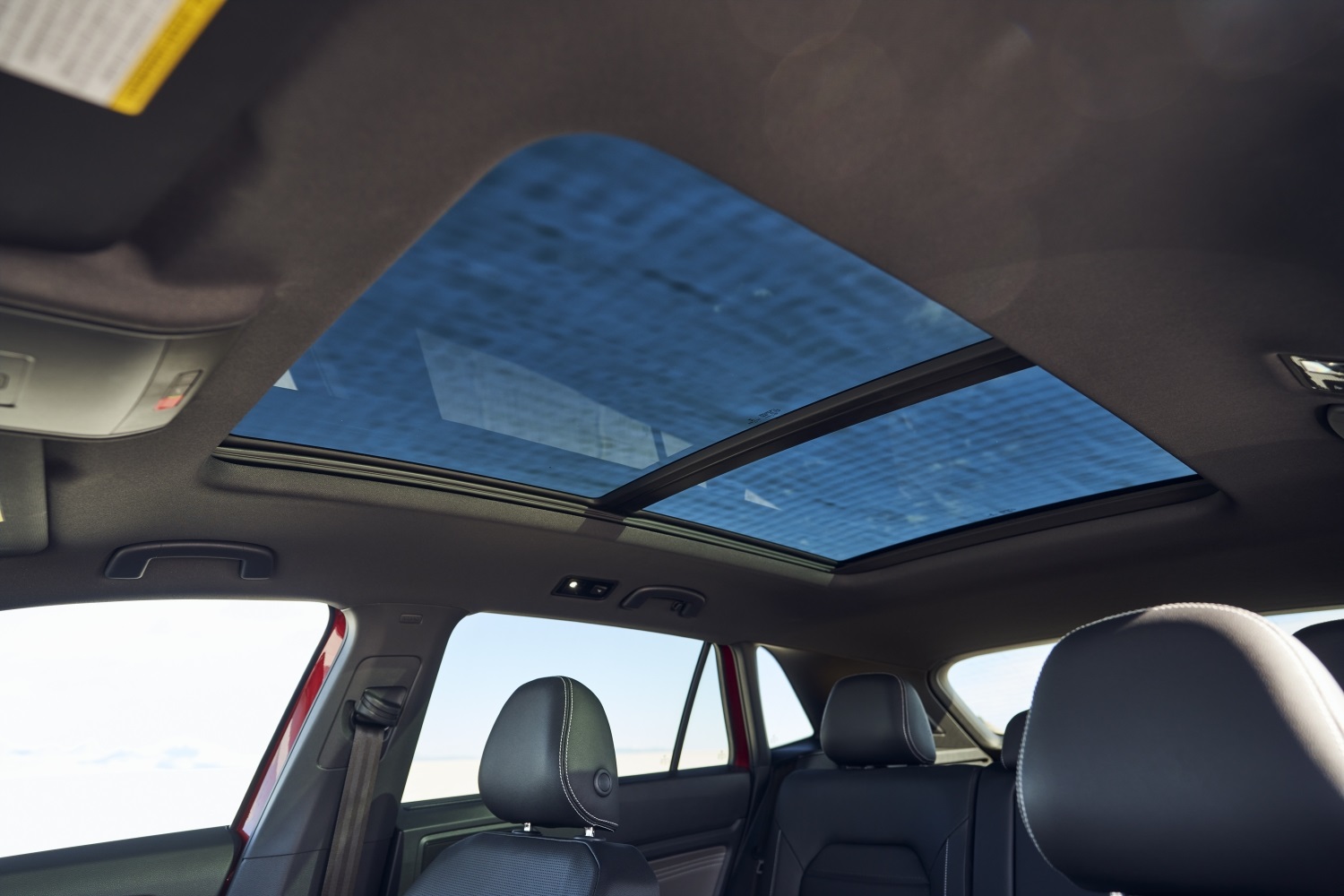
The big sunroof in the Cross Sport

There is chauffeur-class appeal to the second row. (VW)

Cross Sport Interior Function

The SEL Premium cabin is well stocked with creature comforts and useful technologies, which made it easy to forgive the liberal use of black plastic in lower areas; it’s tough looking but not with a cheap finish.

The SEL’s heated seats and steering wheel have three heat settings, which I’d not seen before on a steering wheel. The e-bin on the shift console has two charging USB ports and a wireless pad, but the pad was fussy for my iPhone 8 and wouldn’t function unless I removed its official Apple cover. The deep center armrest console hides another USB port.

I bonded with the lush rotation of the electric steering and how easily I trolled the mall parking in search of a space. The official turning circle is 40.5 feet, but it seems much tighter as the big SUV curls easily into parking slots. The wide-screen camera with an overhead view is helpful when parking, but a front view would be more helpful.

There is solid assembly and contemporary styling elements to the interior, despite the liberal use of black plastic in lower areas. (VW)

Steel-slab security

There is a strong sense of steel-slab security in the architecture. There is a generous space inset from the doors, which is functional as crush space in a side impact.

Sightlines are somewhat complicated by large side mirrors and the broad base of the windshield pillars, which are good for roof-crush standards — but the mirrors can block views of vehicles and pedestrians when turning at intersections. Over-the-shoulder views are unimpeded and I had no issue with seeing out the slimmer back glass.

The e-bin on the shift console has two charging USB ports and a wireless pad, but it was fussy for my iPhone 8. (VW)

After a couple of hours on the road, the seat bottoms will feel hard — so much so that I wanted to pull the wallet from my back pocket. The driver’s seat helps compensate with 10-way power adjustment, though I would have preferred some up-and-down adjustment to the lumbar. The passenger has an eight-way power seat.

The sliding visors have large coverage and there is equally large door-panel storage, with a large, locking glove box.

21-inch Pirelli tires on the Cross Sport

The all-season, 21-inch Pirelli Scorpion Zero tires roll quite smoothly. (VW)

Ride and Handling

There is bullish durability in how solidly the Cross Sport V-6 feels on the road and yet how deftly it managed the tester’s hefty all-wheel-drive curb weight of 4,484 pounds.

It is not quick in its handling and in standard drive mode the ride quality is soft, for a German-engineered SUV, with some bounding over intersection transitions, but it is comfortable. Switch to Sport mode and the shifts become aggressive (almost too much for in-town) and the suspension tightens significantly.

Braking is solid with four-wheel disc brakes, 13.2-inch vented rotors front and 2.2-inch solid rear rotors. The all-season, 21-inch Pirelli Scorpion Zero tires (265/45) have a wide footprint and roll quite smoothly.

Cross Sport back seat

The long doors ease access to the second row. (VW)

Cross Sport Back Seat

There is damn-nice back-seat space accommodations that are almost too nice for children. No parent has the arm length to reach back to subdue squabbles. There is a limousine-class 40.4 inches of legroom and a slightly cropped 37.8 inches of headroom with just a low hump at the transmission tunnel. The seatbacks recline and there is generous two-level stash space in the door panels. There are a pair of vents in the rear of the console, but no fan speed or temp controls.

The back seats, which recline, have 40.4 inches of leisurely legroom. (VW)

There is lots of black plastic and the leather isn’t a showpiece but the tester’s window seats were heated and have a perforated back and cushions. The pull-down armrest has cup-can holders and there are two charging USBs and a 150-watt 115-volt household plug.

Cargo Area

There is a tall lift-up to the cargo floor, which has huge cubic footage behind the second row — 40.3 to 77.8 cu. ft. with the back seat folded. The space is 47 inches wide by 46 inches deep with a height-challenged 29 inches to the headliner.

Cargo space is 47 inches wide by 46 inches deep with a height-challenged 29 inches to the headliner. (VW)

Why Buy the Atlas Cross Sport?

Way back in the 1990s, carmakers would offer two-door versions of their midsize SUVs as the sportier variant. Those short-wheelbase models didn’t fare well in evasive maneuvers or ride quality. Today, the trend is the more rakishly styled five-door SUV variant with the sloped roof to make it look sporty. Basically, it’s an ego purchase in which the buyer pays more and gets less (space) for a still-functional format.

For $51k, the topline V-6 SEL Premium R-Line, is loaded with desirable features and details, but it is not without its quirks. Elements as simple as floor mats and a cargo area roller cover are options, $105 and $180. Its fuel economy is among the lowest among the towing-capable competitors (including the Chevrolet Blazer, Jeep Grand Cherokee, Ford Explorer or Honda Pilot), but its good German engineering is an engaging separator.

But it might not be stylistically different enough from the seven-seat Atlas to be a convincing purchase.

A top-line seven-seat Atlas SEL Premium comparably equipped to the Cross Sport tester works out to be about $1,000 less. But the seven-seater also has the option for second-row captain’s chairs ($695), which are not offered for the Cross Sport.

VW might be missing out on not offering an “Executive Black” seating format and promoting the Cross Sport as the prestigious dressed-for-success SUV.

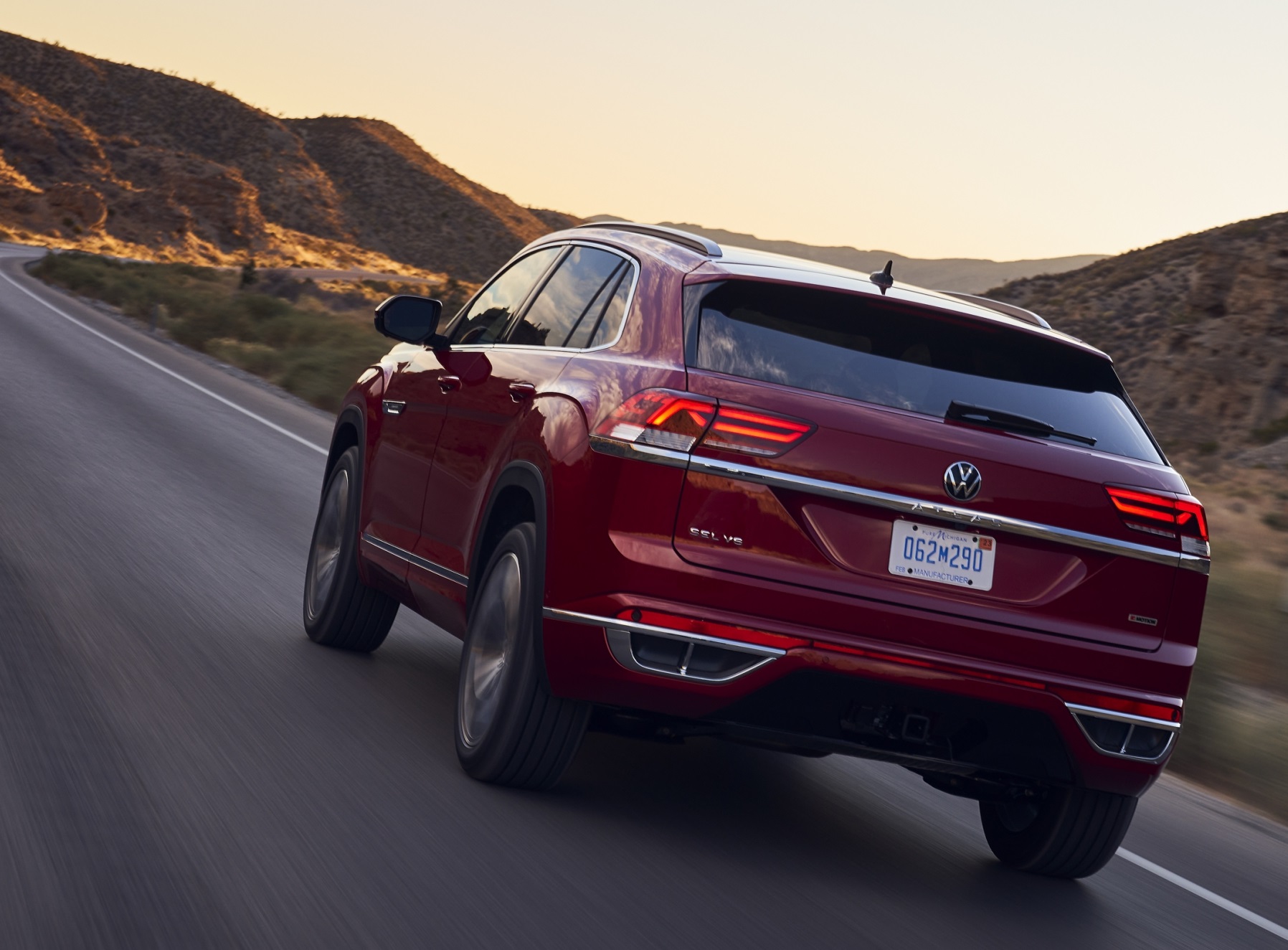
A rear view of the Atlas Cross Sport

There is bullish durability in how solidly the Cross Sport V6 feels on the road. (VW)

2021 Atlas Cross Sport V6 SEL Premium R-Line 

Body style: midsize, 5-seat, 5-door AWD SUV

Engine: 276-hp, direct-injection 3.6-liter VR6 with auto stop-start at idle; 266 lb.-ft. torque at 3,500 rpm

Transmission: 8-speed automatic with 4MOTION permanent all-wheel drive with four performance modes

Fuel economy: 17/23/19 mpg city/hwy/combined; premium preferred for peak power but 87 octane recommended

BY THE NUMBERS

Fuel tank: 19.5 gallons

Cargo space: 40.3-77.8 cu. ft.

Front head/leg room: 39.4/41.6 in.

Rear head/leg room: 37.8/40.4 in.

Length/wheelbase: 195.5/117.3 in.

Curb weight: 4,484 lbs.

Turning circle: 40.5 ft.

Tow capacity: 2,000 lbs. or 5,000-lbs. with tow package ($550)

FEATURES

Standard equipment includes: smart-key locking and push-button ignition, power tilt-and-slide panoramic sunroof, heated and ventilated front seats, 10-way power driver’s seat, 8-way power front passenger seat, 17 cup holders, heated rear (window) seats, electric parking brake, Digital Cockpit (gauge display), power (heated) side mirrors with turn signals, Park Assist with steering assistant, park-distance control front and rear with tones, rearview camera with overhead view, 8-inch touch screen display for navigation-audio-apps, 12-speaker Fender premium audio system with satellite radio, Climatronic dual-zone cabin temperature control, e-bin with 2 USB charging ports and wireless pad, manual lift-up rear window sunshades, ambient cabin lighting, lighted and covered vanity mirrors with sliding visors, stainless-steel pedal covers, 21-inch wheels with 21-inch Pirelli Scorpion Zero tires (265/45), LED headlights-taillights-fog-running lights, trailer hitch, R-Line bumpers-badging-trim, rain-sensing wipers with heated nozzles

Safety features include: 6 air bags, engine-brake assist and electronic differential lock, hill hold and hill-descent control, automatic post-collision braking

IQ.Drive features: Travel Assist (semi-autonomous driver assist), adaptive cruise control with stop-and-go, Lane Assist lane-keeping system, semi-automated Emergency Assist, forward collision warning and autonomous emergency braking and pedestrian monitoring, Active Side assist (blind-spot monitor) and rear traffic alert

PRICING

Base price: $51,220, including $1,195 freight charge; price as tested $51,615

Options on test vehicle: Aurora Red Metallic paint $395

Where assembled: Chattanooga, Tenn.

Warranty: 4-years/50,000-miles includes the powertrain and free maintenance for 2-years or 20,000 miles.

2022 Nissan Frontier Pickup Overview

2022 Nissan Frontier Pickup Overview

Third-generation 2022 Nissan Frontier is about the same size as before and with a standard V-6 powertrain

A front view of the2022 Nissan Frontier

2022 Frontier midsize pickup has been completely redesigned and re-engineered. (Photos courtesy of Nissan)

By MARK MAYNARD

Nissan just released details today on the 2022 Pathfinder SUV and Frontier midsize pickup.

As said senior VP for Global Design for Nissan Motor Co. Alfonso Albaisa in the video presentation: “The Frontier has been around for a while.”

It had become the elder of midsize pickups, with the second-gen model on sale since 2005.

The interior of the new Frontier pickup

Standard Zero-gravity front seats.

The new Nissan Frontier is about the same size as before but a complete re-engineering with some exterior styling cues from Nissan’s full-size Titan pickup. Look for its “brutally vertical face” and interlocking-style grille.

It will debut with a simplified build order. There is one powertrain choice of a V-6 engine and a nine-speed automatic transmission. As before, there will be rear- or four-wheel drive. And there will be two body-style configurations of King Cab and Crew cab, in short- or long-wheelbase lengths.

The AroundView camera system in the Nissan Frontier

The AroundView camera system includes an off-road front view.

Pricing was not announced today, but don’t expect it to be far off from the Chevrolet Colorado, Ford Ranger, or Toyota Tacoma. Find Nissan pricing here.

Frontier fundamentals

An overhead view of the Frontier bed

King or Crew Cab body styles.

The driver area

With a digital dashboard.

Nissan Frontier Powertrain

  • 310-hp, direct-injected 3.8-liter V-6; 281-lb.-ft. torque;
  • 9-speed automatic transmission with 7-position drive mode, with tow mode;
  • 4WD with high and low gearing transfer case;
  • Top payload: 1,610 pounds – 2WD

The back seat Dimensions

  • Standard wheelbase (SWB): 210.2 in.;
  • Overall length: 210.2 in. SWB; 224.2-in, LWB;
  • Width: 73 in.

Bed

  • Length: 59.5 in. for SWB Crew Cab S/SV; 58.9 inches for PRO model; 73.3 in. – LWB Crew Cab and standard King Cab
  • Width: 61.4 in. (at C-Channel);
  • Depth: 19.4 in.

Trim levels

  • King Cab: S, SV – 2WD or 4WD;
  • Crew Cab: S, SV – 2WD or 4WD;
  • PRO-X (2WD only), PRO-4X (4WD only)
  • Crew Cab long wheelbase: SV 2WD, SV 4WD

Frame and suspension

  • Heavy-duty fully boxed ladder frame;
  • Double-wishbone front suspension with twin-tube shock absorbers; overslung rear multi-leaf with a solid axle;
  • 6,720-lb. maximum tow capacity;
  • 16- or 17-inch wheel packages with tires sizes of 265/70R16, 265/65R17 or 265/70R17

Safety features

  • 8 airbags
  • Standard Intelligent Forward Collision Warning;
  • Optional Traffic Sign Recognition and Nissan Safety Shield 360 on every trim

Other details

Around view monitor with an off-road front view; an optional 9-inch display screen; 4-liter center console capacity; Zero-gravity front seats; electric power steering; digital dashboard; head-up display; Apple CarPlay and Android Auto, with optional wireless versions.

A side view of the new Frontier

The new Nissan Frontier is about the same size as before.

2021 Nissan Rogue review

2021 Nissan Rogue review

Family hustle, family hub

The “all-new” 2021 Nissan Rogue, in front or all-wheel drive, has starting prices of $26,745 to $37,925. (Photos courtesy of Nissan)

Table of Contents

Overview
Pricing
Design
Powertrain
Fuel Economy
Ride and Handling
Safety Features
Cargo and back seat space
Why buy the Nissan Rogue?
Specifications

BY MARK MAYNARD

It takes a rogue to survive in the cutthroat segment of compact SUVs, of which there at least a dozen in this arena. The Nissan Rogue had long been among the top three to six sellers, but its luster dimmed as the competitors were renewed.

The hierarchy will shuffle again with the complete redesign and re-engineering of the 2021 Nissan Rogue. Everything about it is new, Nissan says, from the platform, powertrain, rear multi-link suspension, electric steering system, safety, and driver-assist technologies, and exterior and interior styling. Also new is a top-line Platinum model.

Competitors include the Ford Escape, Chevrolet Equinox, Jeep Cherokee, GMC Terrain, Honda CR-V, Hyundai Tucson, Kia Sportage, Toyota RAV-4, Mazda CX-5, Mitsubishi Eclipse Cross, Subaru Forester, and VW Tiguan.

The interior design offers “family hub” utility with a premium presence.

Nissan Rogue Overview

The Rogue is all about the modern family, Nissan says, and refers to the new interior layout as the “Family Hub.”

Much design and engineering detail went into the family-friendly format.

  • More attentive engineering allows all doors to open to nearly 90 degrees. That extra space is especially helpful when buckling a child into a car seat.
  • Door panel bottle holders can hold a 32-ouncer;
  • Four charging USBs and a new wireless charging pad;
  • The new electronic shifter eliminates mechanical elements under the shifter, which allowed storage space under the new “floating” center console.
  • Standard safety technologies include the Nissan Safety Shield 360 and 10 airbags.

The new “floating” center console.

Nissan Rogue Pricing

The Nissan Rogue is sold in four trim levels (S, SV, SL, Platinum) in front- or all-wheel drive with one choice for engine and transmission. Front-drive starting prices range from $26,745 to $36,525. AWD pricing ranges from $28,145 to $37,925.  All MSRP pricing includes the $1,095 freight charge from Smyrna, Tenn.

The front-drive SL tester was $33,480 with one accessory for floor mats and a cargo mat ($385).

Look here for deals and incentives.

The shift console is a hub of function for charging.

Rogue Design

While still in the compact segment, Nissan considers Rogue more of a midsize.

The footprint is about the same as before but 1.5 inches shorter with a roofline lowered by 0.2 inches. The wheelbase and width are the same, at 106.5 and 72.4 inches. But headroom is a hair shorter, at 39.2 inches with the moonroof. And front legroom is 1.5 inches shorter, at 41.5 inches. The front shoulder room grew by a half-inch, to 57.1 inches, which helps the cabin feel open.

Unlike some swoopier SUVs in the segment, the Nissan Rogue has a roomy, more squared-off cabin. That format helps for unobstructed sightlines at the side mirrors and over the shoulder. Though the back glass might seem cropped, it is a rectangle that fills the rearview mirror. The around-view monitor on the SL is very enabling with an overhead view, front and rear.

All controls and switches are smartly arranged and simple to access.

The interior materials won’t be confused with a luxury vehicle, but the woven headliner and plastics have an appealing appearance and the panels fit with precision. The test vehicle was “preproduction” (an early run through the factory), for which I will blame the vibrations in the side mirror on the passenger side; the driver-side mirror was tight.

But for a $34K sticker price, I would have expected a wireless charging pad to be included. It is a $250 option for the SL.

Aerodynamics

The exterior styling, with the so-called “floating roof,” has the desirable qualities that define an SUV without the contrived angles and posture to create a “look.”

Integrated into the design are stealth aerodynamic features, such as the “3D” tire deflectors in the lower front fascia, an active grille shutter to control airflow into the engine compartment, special A-pillar shaping, underbody covers to manage airflow under the vehicle, and an “air curtain” that directs air from the front to the sides of the Rogue.

Rogue Powertrain

The 2.5-liter four-cylinder is the same displacement as before but with new engineering to add direct injection, which replaces multiport. The secret sauce of DI added another 11 horsepower, now at 181 hp. Torque is up by 6 foot-pounds, which peaks 800 rpms lower at 3,600 rpm for a quicker takeoff from a stop.

Automatic stop-start at idle is expected to be added later, but with this powertrain’s high fuel economy it will not be missed.

The Xtronic continuously variable automatic transmission was updated with paddle shifters and Eco and Sport modes (in addition to the Standard drive mode).

The 2.5-liter four-cylinder now with direct injection.

Rogue Fuel Economy

Fuel economy ratings are about the same but 1 mpg better in the highway mode: 26/34/29 mpg city/highway/combined, on 87 octane. AWD models are rated 26/34/29 mpg. (That’s comparable to the Toyota RAV4 XLE FWD at 28/35/30 mpg.) With the 14.5-gallon tank, it wouldn’t be difficult to have a range of 450 miles.

I worked up to 33.7 mpg in extended highway driving and averaged 24-28 mpg around town while driving in standard mode, not Eco.

The larger displacement four-cylinder without turbocharging provides a balanced ratio of power to fuel economy that should handily accommodate most buyers.

Rogue Ride and Handling

The new suspension design, including a new multi-link rear, might have the smoothest ride quality of the competitors. It steps across speed bumps and driveway transitions without whiplash to occupants.

The 19-inch Bridgestone Alenza tires (235/55) complement the well- soundproofed interior, but they spool up noise on concrete highways.

While most owners won’t push the limits of adhesion, soaring through a sweeping exit loop will bring a smile. And there is confident control in evasive maneuvers.

Driver Assist Features

Nissan’s proprietary ProPILOT Assist is among the more accurate for lane-centering on the interstate or divided highways. But keep both hands on the wheel because the system (like most others) will switch off briefly and randomly in certain conditions. And driving into bright sunlight can cause the Rogue to drift ever so slightly across the white lines or Botts’ dots before correcting course.

ProPILOT Assist with Nissan’s door-to-door navigation system adds another layer of watchful protection. Using map data, the system can proactively reduce speed for upcoming freeway curves or junctions and also help slow the vehicle for freeway exits.

Safety Features

Safety Shield 360 technologies include automatic emergency braking with pedestrian detection, blind-spot warning, rear cross-traffic alert, lane departure warning, and rear automatic braking.

Optional technologies include intelligent cruise control and the ProPILOT semi-automatic driver-assist system with blind-spot intervention and traffic sign recognition. It is included as part of the Premium package or standard on the Platinum.

Plan on spending another $39 a month for the data plan to use these advanced-driver-assist features. But once you’ve experienced them, you won’t wonder “What’s the speed limit here?”

Tire-wheel sizes range from 17-, 18- or 19-inches.

Cargo and Back Seat Space

The back seat is a comfortable place to spend time, particularly with the pano roof. There is another half-inch of back seat legroom (38.5 in.) and rear headroom grew by 1.2 inches.

Total cargo-area capacity grew by 4 cubic feet, now at 74 cu.ft. Space behind the back seat is slightly smaller but still haul-worthy at 36.5 cu. ft. Nissan’s nifty Divide-N-Hide cargo floor in the low position provides almost 5 inches more load space. The space is 45 inches wide by 32 inches to the ceiling and 35 inches deep. Fold the back seat for 6 feet of length. Release levers are a convenient detail.

The Divide-N-Hide cargo floor.

With all the new changes, and with an aluminum hood and doors, the Rogue’s weight grew by about 60 pounds across the trim levels/ Curb weights range from 3,411 to 3,512 pounds. The SL weighs 3,490 pounds.

A remarkable engineering feat was how 2.2 feet were sliced from the turning circle, now at 35.4 feet, which makes it a doughnut champ on a city street. The “floating roof” design.

Why buy the Nissan Rogue?

With the SL’s safety and driver-assist features, this Rogue will see children through their teen driving years and beyond.

The SV model is the value choice of trim levels ($28,435 FWD). But adding the niceties of the SV package, $2,660, brings the price to $31,095. The SV package adds family-friendly features of roof rails, a power liftgate, dual-panel panoramic moonroof, rear sunshades, leatherette upholstery, leather-wrapped steering wheel, heated front seats, and a heated steering wheel.

It is refreshing that Nissan cared enough to push the budget to do it right the first time. They won’t have to make excuses later.

 Specifications

2021 Nissan Rogue SL

Body style: compact, 5-seat SUV

Engine: 181-hp, direct-injection 2.5-liter 4-cylinder; 181 lb.-ft. torque at 3,600 rpm

Transmission: Xtronic CVT with manual shift mode, paddle shifters, and Eco and Sport modes

Fuel economy: 26/34/29 mpg city/hwy/combined; 87 octane

BY THE NUMBERS

Fuel tank: 14.5 gal.

Cargo space: 36.5-74.1 cu. ft.

Front head/leg room: 39.2*/41.5 in. *41.1 w/o moonroof

Rear head/leg room: 37.8/38.5 in.

Length/wheelbase: 183/ 106.5 in.

Curb weight: 3,490 lbs. (SL model)

Turning circle: 35.4 ft.

Tow capacity: 1,350 lbs.

FEATURES

Standard SL equipment includes: smart key locking and push-button ignition, leather-trimmed upholstery, Around View camera system, Intelligent Cruise Control with full speed stop and go, ProPILOT Assist, 8-way power (heated) driver seat, 4-way power (heated) front passenger seat, reclining and heated 60/40 back seat, power panoramic moonroof, leather-wrapped and heated steering wheel, 6-speaker audio system with 8-inch color display with NissanConnect, Apple CarPlay and Android Auto, Bluetooth phone and audio, 2 charging USBs (Type A, Type C), 2 rear charging USBs, Siri Eyes Free, electric parking brake, power (folding) mirrors, 19-inch alloy wheels

Safety features include 8 airbags, hill-start assist, brake assist, Intelligent Trace and Active Ride controls, automatic emergency braking with pedestrian and cyclist detection, Intelligent Forward Collision Warning and Lane Intervention, lane-departure warning, blind-spot warning, and rear cross-traffic alert,

PRICING

SL Base price: $33,095, including $1,095 freight charge; price as tested $33,480

Options on test vehicle: floor mats and cargo mat $385

Where assembled: Smyrna, Tenn.

Warranties: 3-years/36,000-miles bumper to bumper with roadside assistance; 5-years/60,000-miles powertrain
2021 VW Arteon 2.0T Review

2021 VW Arteon 2.0T Review

Mild redesign fills in gaps for 2021 VW Arteon in its second model year 

A front view of the 2021 VW Arteon

The 2021 VW Arteon has starting prices of $38,190- to $48,190, in front- or all-wheel drive. (Mark Maynard)

BY MARK MAYNARD

There is a unique presence to the driving characteristics of a German-engineered car. It telegraphs a message of confident control, which is present in a VW or a BMW — and it is an engaging spirit to just go out and drive. The redesigned 2021 VW Arteon is just such a purveyor of driving solidarity.

The large-midsize fastback Arteon is luxury-class but not luxuriously gilded. The VW Arteon debuted in the U.S. in 2019, but it barely caught the attention of SUV-hungry buyers.

Even I wasn’t overly excited about the first Arteon, but the speed-updating refresh for the 2021 model has made a vast improvement in subtle ways.

The European brands have improved their “large” or “executive” sedans, which are more of an American midsize but a few inches bigger all around. Consequently, there are few available choices, including the Acura TLX, Kia Cadenza, Nissan Maxima, and Toyota Avalon.

The Arteon driver area with Nappa leather upholstery

Standard SEL Premium equipment includes Nappa leather. (VW)

New for the VW Arteon

The refreshed Arteon features more refined front-end styling, Volkswagen says, with a redesigned cockpit. The interior has an updated dashboard design, décor trims, and Volkswagen’s Digital Cockpit. The all-new MIB3 infotainment system includes an updated navigation system and wireless app-Connect.

VW Arteon R-Line models were updated with a light bar in the grille and 30-color interior ambient lighting, wireless phone charging, and enhanced driver assistance technologies.

Other new technologies include:

  • Travel Assist, standard on R-Line models, for partially automated hands-on driving from 0 to 95 mph.
  •  Emergency Assist, also standard on R-Line, can bring the vehicle to a stop if the driver is incapacitated, or not keeping hands on the steering wheel.

And there are three new paint colors of Oryx White Pearl, Kings Red
Metallic and Lapiz Blue Metallic.

A look at the Arteon's contemporary interior styling

The cabin has a contemporary, coupe-like presence. (VW)

2021 VW Arteon Pricing

Sold in three trim levels in front- or 4Motion all-wheel drive, all VW Arteon models have a 268-horsepower, turbocharged and intercooled, direct-injection 2.0-liter four-cylinder engine. The transmission is an eight-speed Tiptronic automatic, with manual shifting.

Starting prices range from $38,190 for the front-drive SE, $42,790 for the SEL R-Line (plus $1,800 for 4Motion) to $48,190 for the SEL Premium R-Line with standard AWD; MSRP pricing includes the $1,195 freight charge from Emden, Germany.

All models feature 18-inch aluminum-alloy wheels, full LED headlights and an electronic adaptive suspension (DCC). Safety technologies include rear traffic alert, automatic post-collision braking system, forward-collision warning with autonomous emergency braking, side assist (blind-zone monitoring), and pedestrian monitoring.

Today’s tester is an SEL Premium R-Line 4Motion, $48,585 with one option for King’s Red paint, $395. VW’s warranty coverage of 4 years or 50,000 miles, includes the powertrain, with roadside assistance for 3 years or 36,000 miles.

Find current VW Arteon pricing here.

The Arteon's panoramic sunroof

A panoramic power sunroof is standard on SEL R-Line and SEL Premium R-Line models. (VW)

VW Arteon Architecture

The Arteon is now VW’s flagship sedan, though the company considers it a grand tourer. And as an architecture partner with Audi, there is some sharing of elements but without all the luxury content.

The R-Line cabin has a sporty coupe-like presence with contemporary design and horizontal lines to accentuate width.

Front headroom of 37.9 inches (with the sunroof) should accommodate those 6-foot-5 inches. And there is long front legroom of 41.6 inches. The R-Line front sport seats are firmly supportive with long thigh support. But the seats also have serious side and cushion bolsters for those drivers who push the limits of cornering.

Sightlines are clear at the side mirrors and down the hood, but the smallish back glass and sloped sides can be an issue. When parking, the wide-screen rearview camera with guidance lines enhances visibility.

Ergonomics and access to controls are smartly arranged with an easy-to-use 8-inch touch screen. As VW has stepped up to add more charging USBs, its wireless charging pad is a struggle to use. It occupies a shallow tray just ahead of the gearshift lever and it requires slender fingers to slip in a phone or pull it out, but it beats the tangle of a charging cord.

The 12.3-inch-wide digital gauge display (trickle down from Audi) is useful for its selectable elements, such as the navigation map as background or to highlight a digital speed readout or gear position.

Small storage areas include large door panels with space for bottles.

The Volkswagen Digital Cockpit (gauge array)

The Volkswagen Digital Cockpit (gauge array) is now standard. (VW)

VW Arteon Performance

The 268-hp spools up quickly for responsive acceleration with dependable passing power at 65 mph. Programmable driving modes can finesse the power and suspension settings. I frequently used Sport to keep the power on edge, but it can feel too edgy around town.

With 258 foot-pounds of torque at 1,950 rpm, few drivers would wish for a V-6. And with a potential driving range of more than 500 miles to a tank, a diesel option becomes unnecessary.

A look under the hood reveals elements of robust construction, including the plastic and rubber lines and rust-resistant connectors.

The Arteon 2.0-liter 4-cylinder engine

All models have a 268-hp, turbocharged 2.0-liter four-cylinder engine.  (Mark Maynard)

The eight-speed automatic has an electronic differential lock to keep AWD power flowing before wheel slip is detected. And there was no noticeable hesitation or electronic distraction in routing power four ways.

Fuel economy ratings of 20 mpg city, 31 highway and 24 mpg combined have improved an mpg or two since 2019, but premium fuel is required. I easily worked up to 33.9 mpg on an 80-mile highway run and continued at 24 to 26 mpg in combined driving. Oddly, front-drive models have an 18.2-gallon tank vs. 18.3 for AWD.

The AWD curb weight of 3,955 pounds (3,686 lbs. FWD) is husky and a little heavier than the competition.

VW insists the turning circle is 39 feet, but in my experience of making U-turns at my house, the arc seems more like 36 or 37 feet.

The Arteon’s drag coefficient of 0.29 is aerodynamically slick, which helps the long body slip through the air with little ruffling. Cabin soundproofing seems to have improved, too, at highway speeds with less wind and engine noise, and tire harshness.

The 20-inch Continental ProContact TX grand-touring tires, with a high treadwear rating of 500, can feel hard, but this application is well fitted for the Arteon.

The Arteon's gearshift console

The wireless charging pad, just ahead of the shifter. (VW)

Semi-autonomous driving

The addition of Travel Assist enables partially automated hands-on driving from 0 to 95 mph. The system works well to keep the vehicle centered in the lane, but like many systems, the guidance struggles to maintain the space when driving into direct sunlight on washed-out concrete highways (like all of them in California). And when the car crosses the line, the system blames the driver and gives a warning tone.

Arteon Ride and Handling

The chassis feels extremely rigid and secure, which helps the standard electronic damping system provide sharp, flat cornering. The ride quality is compliant but firm without jolt (or chin scraping) over lumpy intersections. The system manages the suspension rebound and compression at each wheel to adaptively adjust the damping force, Volkswagen says.

Braking is quite capable from 13.4-inch vented front discs and 12.2-inch solid rear rotors.

The tire and wheel package for the R-Line Arteon

The R-Line has 20-inch Continental ProContact TX touring tires. (VW)

Arteon Back Seat

Access to the back seat is a bend-and-drop sequence, but legroom is grand-touring comfortable at 40.2 inches — and the window seats have adult thigh support. The tall but narrow transmission tunnel helps center-seat legroom, but the window seats are far more comfortable. There is one 12-volt plug and one charging USB.

There is a fold-down armrest and ski pass-through to the cargo area, which is wide and deep (40 inches by 45 inches wide). Fold the seatback for about 6 ½ feet in length.

Back seats in the sedan

The Arteon’s long wheelbase allows generous rear legroom, at 40.2 inches. (VW)

The Sedan Dilemma

Federal fuel mandates have compromised the typical midsize sedan, once the top-selling mode of transportation. With the ever-steeper regulations to meet fuel economy and air-quality standards, the family sedan had to be made lighter, lower for improved aerodynamics and powered by mostly small-displacement, turbocharged engines.

As engine technologies improved to adequately move the basic sedan (weighing 3,200 pounds and more), it is the lower rooflines and lower stance that have taken away the user function from a midsize.

It is easy to track buyers’ migration from low and restrictive to the more upright SUV, in any size category. But SUVs are heavier than a sedan, do not get the same fuel economy and they cost several thousands more. And, of course, buyers want four-wheel drive, whether needed or not.

The opened cargo space of the liftback.

The wide and low cargo area spans 27.2 to 56.2 cubic feet. (VW)

Why Buy the VW Arteon?

While an SUV is an appliance, valued for its view from the inside outward, the Arteon has a sophisticated presence, seen from the outside in.

It is the purposeful and balanced German engineering that is the unspoken asset of the Arteon. It is a soaring grand tourer, built for 100 mph continental cruising and arriving at your destination with impeccable style.

Drivers will value its cabin size, power, and nimble footprint for the long term.

A rear side view of the sedan.

The word “Arteon” is taken from the Latin word “artem,” which means art. (VW)

2021 Volkswagen Arteon 2.0T SEL Premium R-Line 4-Motion

Body style: large midsize, 5-seat liftback sedan

Engine: 268-hp, turbocharged and direct-injection 2.0-liter 4-cylinder; 258 lb.-ft. torque at 1,950 rpm

Transmission: 8-speed automatic with 4Motion all-wheel drive with drive modes

Fuel economy: 20/31/24 mpg city/hwy/combined; premium fuel recommended

SPECIFICATIONS

Fuel tank: 18.3 gal.

Cargo space: 27.2-56.2 cu. ft.

Front head/leg room: 37.9*/41.2 in.

Rear head/leg room: 37.1/40.2 in.

Shoulder room f/r: 56.5/54.7 in.

Length/wheelbase: 191.6/111.9 in.

Curb weight: 3,955 lbs. (3,686 lbs. FWD)

Turning circle: 39 ft.

FEATURES

Standard SEL Premium equipment includes: smart key locking and push-button ignition, electronic multi-mode adaptive suspension control, Nappa leather upholstery, digital (configurable) gauge array, rearview camera with overhead view, wireless phone charging, power tilt-slide panoramic sunroof, electric parking brake, 8-inch navigation touch screen, Harman Kardon audio system, power (heated) side mirrors), adaptive (turning) headlights, fog lights, 20-inch alloy wheels, automatic high-beam dimming, 3-zone touch electronic touch climate control, lighted cargo area with an adjustable floor and power liftgate

R-Line content, includes: leather-wrapped and heated steering wheel with redundant controls, special interior features and black headliner; R-Line style grille, bumpers and exterior trim; stainless steel pedal caps and driver’s footrest, Travel Assist (enables partially automated hands-on driving from 0 to 95 mph), Emergency Assist (can bring the vehicle to a stop if the driver is incapacitated, or not keeping hands on the steering wheel)

Safety features include: 8 air bags, Automatic Post-Collision Braking, Forward Collision Warning, Autonomous Emergency Braking, Blind Spot Monitor, Rear Traffic Alert, stability and traction controls, dynamic road sign display, park assist with park-distance control (front and rear), brake-force distribution and hydraulic brake assist, electronic differential lock, semi-automatic driving assistance, adaptive cruise control with stop-and-go, lane-keeping system, emergency assist

PRICING

Base price: $46,995, including $1,195 freight charge; price as tested $48,585

Options on test vehicle: King’s Red metallic paint $395

Where assembled: Emden, Germany

Warranties: 4-years/50,000-miles bumper to bumper including powertrain; 2-years/20,000-miles free scheduled maintenance; 3-years/36,000-miles roadside assistance

VW Says Auf Wiedersehen To the Golf in U.S.

VW Says Auf Wiedersehen To the Golf in U.S.

Production in Puebla, Mexico, transitioning to new products, including the Taos small SUV

A row of VW Golf models.

Nearly 2.5 million VW Golf family models have been sold in the U.S. market. (Photos courtesy of Volkswagen USA)

BY MARK MAYNARD

Volkswagen of America announced today that its subcompact Golf hatchback ended production last week for the U.S. market. The VW Golf family name will carry on in model-year 2022 with the introduction of the all-new Mk 8 Golf GTI and Golf R, arriving this fall.

Volkswagen expects that the model year 2021 Golf models built at the Puebla, Mexico plant will sustain sales through year-end.

The Golf debuted in December 1974 as the “Rabbit” in the U.S. For more than four decades, the Golf exemplified what Volkswagen does best — melding dynamic driving characteristics with purposeful packaging and unmatched quality, said Hein Schafer, senior vice president, product marketing and strategy for Volkswagen of America, Inc.

“While the seventh-generation Golf will be the last of the base hatches sold here,” he said, “the GTI and Golf R will carry its legacy forward.”

The Golf TSI model

The 2021 VW Golf is sold in only one TSI trim level. Pricing starts at $24,190.

U.S. Golf Family

In the U.S., nearly 2.5 million Golf family models have been sold since 1974. The current-generation Mk 7 Golf was named North American Car of the Year when it debuted for the 2015 model year.

The new eighth-generation 2022 Golf R and Golf GTI will be built in Germany as the Puebla plant transitions to new products, including the Taos subcompact crossover, according to VW.

The 2022 Volkswagen Taos

2022 Volkswagen Taos.

For 2021, the Golf is available in one well-equipped trim —TSI. It features a 147 horsepower, 1.4-liter turbocharged and direct-injection four-cylinder engine with a standard six-speed manual gearbox or optional eight-speed Tiptronic automatic transmission. EPA fuel-economy estimates are 29 mpg city, 39 highway and 33 mpg combine or 29/36/32 mpg with the automatic.

Golf TSI pricing starts at $24,190; add $800 for the Tiptronic. Pricing includes the $995 freight charge from Puebla, Mexico.

Standard features include 16-inch aluminum-alloy wheels with 205/55 all-season tires, smart-key locking and push-button ignition, panoramic tilt-and-slide sunroof, leatherette upholstery, and heated front seats. Driver assistance features include Forward Collision Warning and Autonomous Emergency Braking with Pedestrian Monitoring (Front Assist), Blind Spot Monitor and Rear Traffic Alert.

Seven Generations of Golf in the U.S.


Golf I: 1975-1984

7 generations of the Gold in North America. This is Gen 1

  • First sold in December 1974 as the “Rabbit” with a 70-hp, 1.5-liter four-cylinder engine;
  • GTI was introduced in 1983 with a 90-hp, 1.8-liter engine.

Golf II: 1985-1992

The second generation Golf

  • Nameplate shift to “Golf.” Dimensions grew by nearly 7 inches in length, 3 inches in wheelbase and 2 inches in width;
  • Standard engine is revised 85-hp,1.8-liter;
  • GTI introduces 131-hp, 2.0-liter engine;
  • Catalytic converter, anti-lock braking and power steering debut.

Golf III: 1993-1999

  • Exterior design shifts to wedge shape;
  • Base powertrain increased to 115-hp, 2.0-liter; GTI available with 172-hp, 2.8-liter VR6;
  • Front and side airbags debut; advances in body construction result in improved crash safety;
  • VR6 engine and cruise control offered for the first time.

Golf IV: 1999.5-2005

The Golf IV

  • All-new design with flatter windshield; roofline carried farther back with steeper rear window;
  • Electronic stability control and side curtain airbags debut;
  • 1.8T engine introduced for GTI, bringing turbocharging to this generation of GTI;
  •  R32 introduced for 2004 with 240 hp, six-speed manual, and 4MOTION all-wheel drive.

Golf V: 2006-2009

The Golf V: 2006-2009

  • New multi-link rear suspension; rain-sensing wipers introduced; sold as “Rabbit” again;
  • DSG dual-clutch automatic transmissions debuts as an option for GTI and the standard transmission for R32; Bi-Xenon headlights introduced on both models;
  • Base engine is 150-hp, 2.5-liter; GTI moves to 200-hp 2.0-liter turbocharged direct-injection engine;
  • R32 reintroduced for 2008 with 250 hp.

Golf VI:  2010-2014

The Golf VI:  2010-2014

  • “Golf” name returns;
  • Refreshed styling with prominent character line from headlights to taillights;
  • Base powertrain is 170-hp, 2.5-liter five-cylinder engine;
  • Golf R was introduced for 2012, with the VR6 engine replaced by a 2.0-liter turbocharged direct-injection engine pushing 256 hp.

Golf VII: 2015-2021

  • Now based on Modular Transverse Matrix (MQB) architecture;
  • Golf grows in size yet drops in weight, despite many new and upscale features;
  • Facelift in MY 2018 features included revised headlight and taillight designs, redesigned bumpers, and infotainment and driver assistance updates;
  • Base 170-hp, 1.8-liter TSI engine replaces 2.5-liter to gain an EPA-estimated 6 mpg highway, later replaced by the 1.4-liter TSI engine in 2019;
  • GTI and Golf R powered by new versions of the 2.0-liter TSI engine, with up to 228 hp for GTI and up to 288 hp for Golf R (using premium fuel);
  • Available driver-assistance technology includes Automatic Post-Collision Braking System, Forward Collision Warning, Park Distance Control.

2021 Kia K5 Review

2021 Kia K5 Review

The “all-new” 2021 Kia K5 sedan represents one of the biggest leaps forward between generations in recent automotive history, the carmaker says.

The 2021 Kia K5 midsize sedan

The 2021 Kia K5 is the brand’s third generation midsize sedan, formerly known as Optima. (Photos courtesy of Kia America)


Wholistic coup d’sedan


BY MARK MAYNARD

If there is a spark of ownership urgency remaining in the mainstream midsize sedan segment, Kia hopes its renamed and re-invented K5 will get drivers fired up.

The “all-new” Kia K5 sedan represents one of the biggest leaps forward between generations in recent automotive history, Kia says. Worthy of renaming, the Korean automaker says the K5 emphasizes revolutionary design on a new safety and performance enhanced “N3” platform, turbocharged engines, optional all-wheel drive and high-impact technologies. The new platform will also be the foundation for future Kia models

Its predecessor, the Optima, debuted in 2011 and, as today, it is a corporate partner to the Hyundai Sonata. The K5 designation is simply a global name, Kia says. The K5 and K900 are the first U.S. models to use the integrated global market names. Whether the other models will be eventually renamed, “is being looked at holistically from both a market and a global level and is determined by model,” a spokesman said.

The driver area of the 2021 Kia K5 EX model

K5 EX features include leatherette upholstery and 10-way power driver’s seat.

Good Times

These are good times to buy a sedan. The big three top-sellers in the current lineup of choices — Honda Accord, Toyota Camry, Nissan Altima — have distinct identities, which might be key to connecting with drivers. And the remaining choices, of which there are several, are at the peak of their games, too.

As many drivers have migrated to an SUV as their preferred body style, manufacturers — those that still have a sedan lineup — are hoping that their revolutionary improvements will reinvent the midsize sedan into something other than what it is.

Kia cut to the chase with a regrouped business plan for the K5, calling “Give It Everything.” And it is packaged at a reasonable price.

The front passenger side of the Kia K5.

The lower roofline allows reasonably tall headroom with the large sunroof.

Kia K5 By the Numbers

Dimensionally, the Kia K5 sedan sits lower, longer, and wider than its predecessor. At 193.1 inches long it is 2 inches longer and an inch wider but 0.8-inch lower at the roofline. The wheelbase was stretched 1.8 inches, now at 112.2 inches.

Kia K5 Pricing

There are five trim levels of Kia K5 — LX, LXS, GT-Line, EX — and the performance-tuned GT. The standard trims use a 180-horsepower 1.6-liter turbocharged four-cylinder engine and eight-speed automatic transmission. The GT is spiked with a 290-hp 2.5-liter turbocharged four-cylinder (with 311 foot-pounds of torque from 1,650-4,500 rpm). Its eight-speed automatic is a “wet” dual-clutch automated manual transmission. (The wet dual-clutch, rather than dry, uses an electric oil pump for lubrication and to provide more cooling for higher torque outputs and smoother shifts.

Pricing for front-wheel-drive models with the 1.6T powertrain ranges from $24,555 for the entry LX to $29,055 for the EX 1.6T, The AWD GT-Line 1.6T starts at $30,155. The front-drive GT 2.5T GDI with an eight-speed dual-clutch automatic starts at $31,555. Pricing includes the $965 freight charge from West Point, Ga.

K5 in Front- or All-Wheel-Drive

All-wheel drive is available only on the K5 LXS or GT-Line trims. The front-drive system uses electro-hydraulics for a quicker coupling response, Kia says. The 1.6 LXS option is $2,100 and includes heated seats; the GT-Line is $3,700 and is part of the Premium package, which includes Special Edition Wolf Gray paint with red SynTex upholstery, 10.25-inch Touch-screen, navigation with smart cruise control and Highway Driving Assist.

At the time of posting this story, there were several Kia K5 sedan pricing discounts for cash, leasing or zero-percent financing for 60 months, with a $750 cash-back offer. See them here.

And there is Kia’s desirable new-vehicle warranties of 5-years/60,000-miles bumper to bumper with roadside assistance and 10-years/100,000-miles powertrain.

A view of the panoramic sunroof in the Kia K5 sedan.

Part of the K5 EX package, the panoramic sunroof has a power sunshade.

Standard Kia K5 Features

K5 base models are competitively equipped with such standard features as remote locking, 8-inch infotainment touch screen, fabric upholstery, Android Auto and Apple CarPlay with Bluetooth phone and music, six-speaker audio system, steering-wheel controls for audio and cruise control, two USB ports (one for charging), power side mirrors and windows, lighted visor vanity mirrors, six-way manually adjusted front seats, electric parking brake with auto-hold and 16-inch alloy wheels.

Standard K5 safety features and technologies are loaded, including nine air bags, forward collision avoidance assist with pedestrian detection, driver-attention warning with lead-vehicle-departure warning, lane-keep assist and lane-following assist, lane-departure warning, and high-beam (dimming) assist.

The center shift console in the K5 has useful storage and wireless charging

The K5 EX has almost as many USB ports as cup holders.

The EX upgrade

The K5 EX tester, $32,355, added such features as leatherette seat trim and leather-wrapped steering wheel, 10-way power driver’s seat with power lumbar, heated and ventilated front seats, panoramic sunroof with power sunshade, wireless phone charging, 18-inch alloy wheels, and parking-distance warning reverse.

The EX Premium package, $3,400, added desirable technology pieces, including navigation with a 10.25-inch touch screen and MapCare, Bose audio upgrade, a power front passenger seat with power lumbar, and heated steering wheel.

K5 Safety Features

Safety features include forward collision avoidance alert cyclist, forward collision avoidance-assist junction turning, smart cruise control with stop-and-go, highway driving assist, safe-exit assist with power child lock, and parking collision avoidance rear.

Highway Driving Assist (HDA) controls steering and acceleration-deceleration to keep a safe distance from the vehicle directly ahead. Using navigation input, the system can determine whether the vehicle is on a state highway or Interstate. Using the front view camera and front radar, HDA monitors the lane position and speed of the vehicle directly ahead.

A view of the infotainment touch screen and other cabin climate and audio controls

Driver controls are placed for easy access.

The integrated technologies create a semi-autonomous driving mode, but with hands remaining on the wheel. The guidance system is at its best on multi-lane expressways, but the guidance system can still allow the car to drift wide and across lane markings before correcting course, while giving the driver a warning tone.

As a safety suite, the assist systems elevate the EX trim level to a safe and efficient long-distance commuter.

Kia K5 Fuel Economy

Fuel economy and what Kia calls real-world torque have improved with the new 1.6-liter engine, which replaced a 2.4-liter.

Only the base LX model, which Kia considers its fuel efficiency trim, is equipped with automatic stop-start at idle. The LX has fuel-economy ratings of 29 mpg city, 38 highway, and 32 mpg combined, on 87 octane. Compare that to 25/35/29 for the 2.4-liter. But at 14.8 gallons, the K5 LX has a gallon smaller fuel tank than the other trims; The Optima’s tank was 18.5 gallons.

The other 1.6T models have mileage ratings of 27/37/31 mpg city/highway/combined. AWD has ratings of 26/34/29 mpg. And the GT has ratings of 24/32/27 mpg. The 15.8-gallon tank in the EX could provide more than 500 miles of range.

Driving in the transmission’s “smart” mode, I worked up to 37.4 mpg with much highway driving, which settled to an accumulated average mpg of 26.4 mpg, over 610 miles. Smart mode mimics the driver’s acceleration style to provide consistent power.

The body styling has a low, wind-cheating 0.27 coefficient of drag, which compares to 0.26 for the Altima and 0.28 for the Camry.

The Kia K5 turbocharged four-cylinder engine

The base K5 engine is a 180-hp, turbocharged four-cylinder.

K5 Ride and Handling

Kia probably erred on the side of sportiness for the K5. It has a pedigree of the Stinger sport sedan built into the presence of the K5, which can be seen first in the exterior styling and then the driving attitude.

The rigidity of Kia’s new N3 platform is a great enabler in controlled cornering and evasive maneuvers, yet ride quality is forgiving. Kia cites a 60/40 front to rear weight distribution for the 1.6T trims and 61/39 on GT.

Drivers can choose from four drive modes (or five with AWD) for Smart, Normal, Sport, and Custom, which allows a deeper dive to set distinct preferences for suspension, throttle, and steering.

I found Sport mode to be overly enthusiastic in town, but it is an asset out on the twisty roads as calibrations hold shifts when neatly clipping an apex. The car turns and rotates flatly, which also keeps the driver in a command position. And Custom

K5 Power

The eight-speed automatic in the K5 rolls easily through gear changes. And what, no paddle shifters? No problem! Acceleration is not greatly impacted by turbo spooling, which is helped by the trim curb weight of 3,228 pounds, among the lightest in the segment.

Standard K5 models have four-wheel disc brakes 12-inch vented rotors front, 11.2-inch solid rotors rear. The GT is upgraded with 13.6- rotors front and 12.8-inches rear.

The turning circle is another asset, at 36 feet or a little wider with 18- or 19-inch wheels — but still a tidy arc for U-turns in most neighborhood streets.

K5 Interior Function

Inside the Kia K5, the interior design achieves a futuristic and high-tech appearance. There is great attention to detail in the trim elements. And improved sound-deadening materials create a quieter and more premium cabin, Kia says.

The standard 8-inch infotainment supports Apple CarPlay or Android Auto, but opting for the 10.25-inch display does not allow those apps.

Settling into the front seats is quite supportive and comfortable for the long haul, but the seat-bottom squabs (bolsters) give a little goose on exit. (A female friend who bought a new Kia Sportage spent $300 to have those bolsters trimmed back to prevent the wedgie, and the results look “factory.”

A look at the premium trim elements in the Kia K5

Interior materials have a premium-quality appearance.

Some new sedans are built so low to the ground (for aerodynamics to improve fuel economy) that it compromises comfortable entry and with a heave-ho on exit. But the K5 maintains a reasonable entry height.

The doors open to almost right angles and for the driver, the designers built in a stylish ridge in piano black at the window controls. It is an ideal leverage point to comfortably close the door.

Front headroom, even with the lower roofline, is reasonably tall (38.4 inches) with the large sunroof. Cars without the sunroof gain 1.8 inches of hair space, at 40.2 inches. Legroom of 46.1 inches is accommodating for those in the big-and-tall club.

Ergonomic Controls

Interior design of the K5 cockpit places driver controls, switches, and digital displays in position for easy access. Small corner glass greatly opens sightlines at the front side mirrors and at the rear three-quarters. At first glance, it might appear the shallow arc of the back glass might be an issue, but it is not when the side mirrors are correctly positioned.

Glancing at the large rearview-camera screen is liberating in parking situations, and there is a reverse park-distance warning. Because of the long hood, a front camera would be an asset, too.

The cabin of the K5 EX has almost as many USB ports as cup holders, plus wireless charging with a broad slot for a variety of phones. And the leatherette upholstery in the EX looks and feels better than many grades of leather.

K5 Back Seat Comfort

There are comfortable dimensions in the K5 back seat and the doors open wide for colleagues or growing children. The seatback angle is relaxed and with 35.2 inches of legroom, the designer did not have to create a seat cushion with a knees-up angle to stretch leg space.

There is just a modest height intrusion from the exhaust-AWD tunnel, which eases footroom when sharing space with a center-seat occupant, which would be a child (or forgiving colleague). Amenities include the broad fold-down armrest with cup holders and two charging USBs.

The K5 back seat has comfortable dimensions for adults

The back seat has comfortable dimensions for colleagues or growing children.

K5 Trunk Capacity

The Kia K5 has a roomy,16-cubic-foot trunk that is a broad 44 inches wide and low. But the smallish loading aperture (17 inches) will limit the size of big-box items to haul home. The 60/40 folding seatback includes pulls to release the seats.

The Kia K5 trunk is wide and low with a large 16 cubic feet of space

Th K5’s 16 cubic feet of trunk space is wide and low.

Why Buy the Kia K5?

As midsize sedans have evolved, manufacturers have introduced more luxury-class features with a “premium” presentation to support the cars’ higher price points.

For Kia, the K5’s ground-up remake was as well planned and budgeted as a sedan can be in this age of anti-sedan.

The K5  has been designed for smart use of interior space. There are several small-storage areas and finger-reach controls to keep eyes on the road. The cabin has some of the best attention to detail in interior materials and switchgear. The driver area is straightforward and without unnecessary glitz or gimmicks, all of which will appeal to the contemporary driver.

But I can’t be alone in wishing the EX trim included the option for the 2.5-liter engine and the choice for AWD.

What would it take to get you into a midsize sedan today?

 MarkMaynard@cox.net

A nighttime view of the rear end of the Kia K5

Built on a new N3 platform, the Kia K5 is stronger, longer, wider, and lower.

2021 Kia K5 EX Premium Specifications

Body style: midsize 5-passenger, front-drive sedan

Engine: 180-hp, direct-injection and turbocharged 1.6-liter 4-cylinder; 195 lb.-ft. torque 1,500-4,500 rpm

Transmission: 8-speed automatic

Fuel economy: 27/37/31 mpg city/hwy/combined; 87 octane or higher

BY THE NUMBERS

Fuel tank: 15.8 gallons

Trunk space: 16 cu. ft.

Front head/leg room: 38.4*/46.1 in. *40.2 w/o sunroof

Rear head/leg room: 37.4/35.2 inches

Length/wheelbase: 193.1/112.2 inches

Curb weight: 3,228 pounds

Turning circle: 36 feet

FEATURES

Standard equipment includes: smart key locking and push-button ignition, dual-zone automatic climate control, acoustic windshield, steering wheel controls for Bluetooth-audio-cruise, tilt-telescopic steering wheel, power windows with one-touch up-down driver’s window, rear-occupant alert, 8-inch touch screen with Android Auto and Apple CarPlay, rearview camera with guidance lines, USB media and charging ports, multi-adjustable front seats, high-beam assist, LED headlights and amber running lights, power-heated side mirrors, automatic headlights, 16-inch alloy wheels and compact spare, electric parking brake with auto-hold

K5 EX Features:  leatherette seat trim and leather-wrapped steering wheel, power driver’s seat with power lumbar, heated and ventilated front seats, panoramic sunroof with power sunshade, wireless phone charging, auto up-down to front passenger window, 18-inch machined alloy wheels, UVO Link, satellite radio with free 3-month subscription, rear USB charger ports and rear air vents, parking distance warning reverse

Safety features include: 9 air bags, electronic stability control, forward collision-avoidance assist-pedestrian, blind-spot collision-avoidance assist, rear cross-traffic collision avoidance, safe exit assist, lane-keep assist and lane-following assist, driver attention warning, leading vehicle departure alert

PRICING

Base price: $28,955 including $965 freight charge; price as tested $32,355

Options on test vehicle: EX Premium package, $3,400, includes navigation with 10.25-inch touch screen and MapCare, Bose premium audio system, power front passenger seat with power lumbar, heated steering wheel, forward collision-avoidance alert cyclist, forward collision-avoidance-assist junction turning, smart cruise control with stop-and-go, highway driving assist, safe-exit assist with power child lock, parking collision avoidance rear, LED rear combination lights, memory driver’s seat and side mirrors

Where assembled: West Point, Ga.

Warranty: 5-years/60,000-miles bumper to bumper with roadside assistance; 10-years/100,000-miles powertrain
Mark Maynard