Select Page

The Battery-Electric Ford F-150 Lightning pickup

The Battery-Electric Ford F-150 Lightning pickup

The big reveal of the all-electric Ford F-150 Lightning was a massive moment for the automaker, said Ford President Jim Farley.

Ford world headquarters display

The F-150 Lightning is expected to go on sale in spring, 2022. (All photos courtesy of Ford Motor)


BY MARK MAYNARD

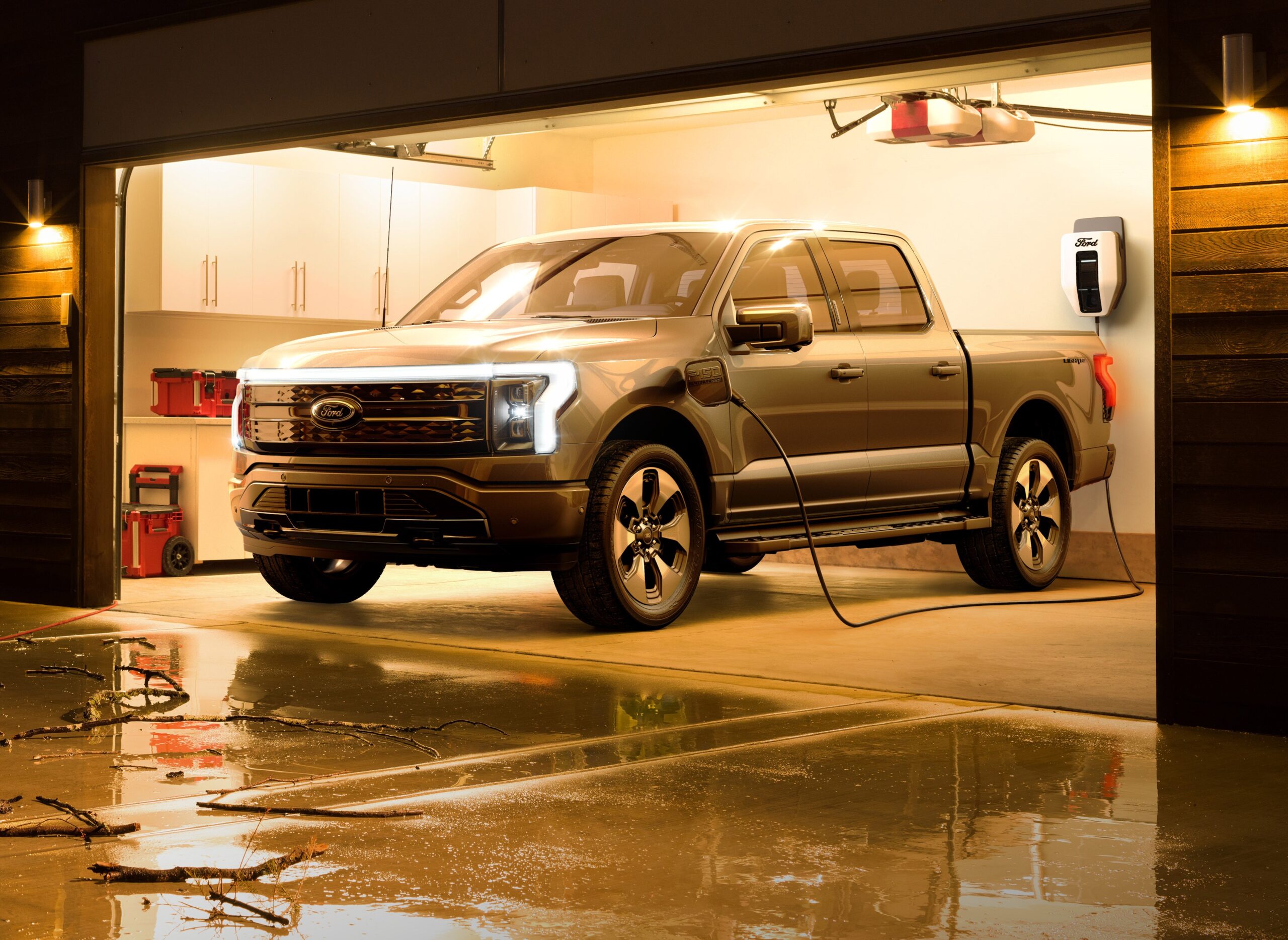
An electric pickup is one thing. An electric pickup that is also an emergency power generator for the home adds a whole new level of consumer usability in this complicated era of climate change.

Ford Motor pulled the camouflage from its striking, all-electric F-150 Lightning last night in a big reveal at its world headquarters in Dearborn, Mich. It was a massive moment for Ford, said Ford President and CEO Jim Farley.

The F-150 Lightning is expected to go on sale in spring, 2022. It will be sold in four series and two battery options.

The exterior styling looks traditional F-150, but much has been modified under the military-grade aluminum skin. The truck introduces an independent rear suspension, standard four-wheel drive, and dual in-board motors pushing 563 horsepower.

Two levels of lithium-ion battery packs will be offered. Ford has targeted a driving range of 230 miles with the standard-range battery and 300 miles with the extended-range battery.

A payload of 2,000 pounds is expected for base models with a max tow rating of 10,000 pounds. Official specifications will be released closer to the on-sale date.

“It’s quicker than a Raptor, with standard 4×4 and independent rear suspension,” said CEO Farley.

Ford F-150 Lightning pricing

3 F-150 Lightning pickups

2022 Ford F-150 Lightning Platinum, Lariat, and XLT. Available spring 2022.

The electric pickup will be sold in four series in crew-cab body styles with a 5.5-foot-long bed. The commercial-grade model starts at $39,974 before any federal or state tax credits. The mid-range XLT model starts at $52,974. Pricing was not announced for the top-line Platinum, but a spokesman said its MSRP could be around $90,000 with the extended range battery.

Pricing does not include the freight charge from the Rouge Electric Vehicle Center in Dearborn, Mich.

The 2022 F-150 Lightning can be reserved here with a $100 deposit.

Powertrain

2022 Ford F-150 Lightning schematic

The powertrain layout shows the two in-board motors and lithium-ion battery storage.

The powertrain of the F-150 Lightning targets 563-hp and 775 foot-pounds of near-instantaneous torque. That’s more than any F-150 ever, Ford says. Acceleration to 60 mph is in the mid-4-second range with the extended-range battery.

Power at home

2022 Ford F-150 Lightning powering a home in an emergency

The Intelligent Backup Power system can power a home for three days, Ford says.

The debut of the Ford Intelligent Backup Power turns the truck into a substantial source of power for a home. The system can tap into 9.6 kilowatts of power — 9600 watts. That is enough backup power to maintain household lighting during an outage. It also will be enough to power other utilities, such as home appliances and security systems. (According to online reports, an average-size home in the U.S. uses about 900 kWh per month.)

The backup power system requires the optional 80-amp Ford Charge Station Pro and home management system (for which Ford can help with installation). In an emergency, the F-150 Lightning will automatically activate to power the house. Once power is restored, the truck automatically reverts to charging its battery.

Based on the average use of 30kWh per day, the entire system with an extended-range battery can provide full home power for up to three days. With careful use, the power can last as long as 10 days, Ford says.

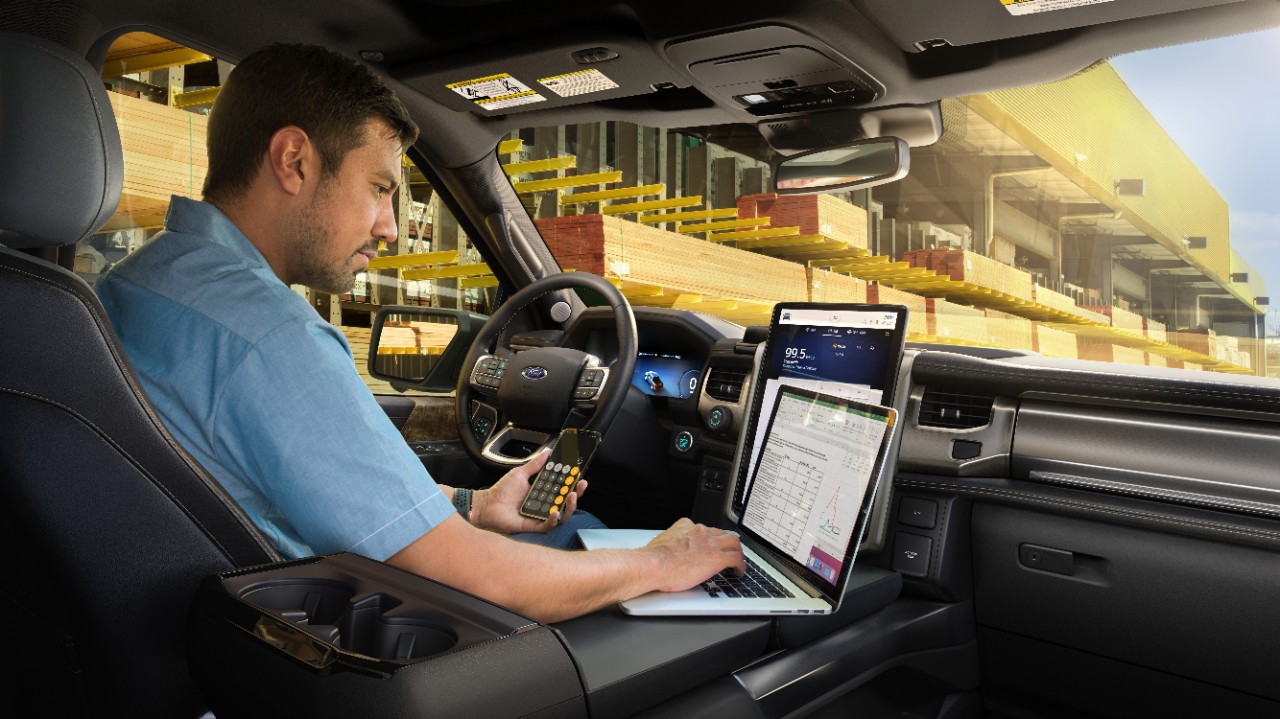
Ford F-150 Lightning optional work surface.

The optional fold-out Interior Work Surface.

For a later introduction, the Ford Intelligent Power system can use the truck to power homes during high-cost, peak-energy hours while taking advantage of low-cost overnight rates to charge the vehicle in time for the morning drive. The owner saves money on electricity while also taking pressure off the grid in peak usage times, Ford says.

Ford partnered with Sunrun, a leading solar company, to facilitate the installation of the 80-amp Ford Charge Station Pro and home integration system. Customers will also have the opportunity to install solar energy on their homes, tapping into clean, affordable energy and be able to charge their F-150 Lightning.

Battery power

Ford F-150 Lightning charge door on front left fender.

The secure charge door.

F-150 Lightning offers two levels of battery power: a standard-range battery targets 230 miles of EPA-estimated range and the extended-range battery targets 300 miles of EPA-estimated range.

Standard with the truck is an 80-amp charge station to maintain an extended-range truck at home. This system has a dual onboard charging system that can add an average range of 30 miles per charging hour. Fully charging an extended-range truck from 15 percent to 100 percent would take about eight hours, Ford says.

On the road, users have access to the ChargePoint public charging network, considered North America’s largest system. Using FordPass, drivers will have access to more than 63,000 charging plugs and growing. On a 150-kW DC fast charger, the extended-range battery is targeted to get up to 54 miles of range in 10 minutes and charge from 15 percent to 80 percent in about 41 minutes, Ford says.

The FordPass Power My Trip function identifies charging routes in advance of an extended drive. The truck’s, Intelligent Range mode calculates range while factoring in weather, traffic, payload, and towing weights, Ford says. Cloud-connected navigation on SYNC 4 also identifies public charging locations.

Truck as generator

Ford F-150 Lighting tailgate work suface.

The optional Tailgate Work Surface.

The enhanced Pro Power Onboard provides built-in electrical outlets to power a variety of tools, electronics, and appliances. Base trims have 2.4 kilowatts of power with the option for more. Lariat and Platinum models have 9.6 kilowatts of power — a combination of up to 2.4 kilowatts available through the frunk and up to 7.2 kilowatts through outlets in the cab and bed.

Customers will receive a FordPass notification if their truck’s battery falls below a third of its total range. And the truck can be programmed to stop using Pro Power Onboard if the battery level approaches the distance to the nearest charging station.

Front trunk

Ford F-150 Lightning frunk.

The front trunk, or frunk, is power opened and closed.

The newfound space under the hood allowed for a  lockable “mega power frunk” that is power opened and closed. The storage capacity has about 14 cubic feet of volume and a 400-pound payload. Ford says that’s enough space for two carry-on travel bags and one checked bag, or two sets of golf clubs.

The water-resistant space has four electrical outlets and two USB chargers. Drain holes in the floor allow the frunk to be used as a cooler. With 2.4 kilowatts of power, there’s enough electrical capacity to plug in power tools, TVs, laptops and speakers, or even a crockpot and other appliances.

Testing

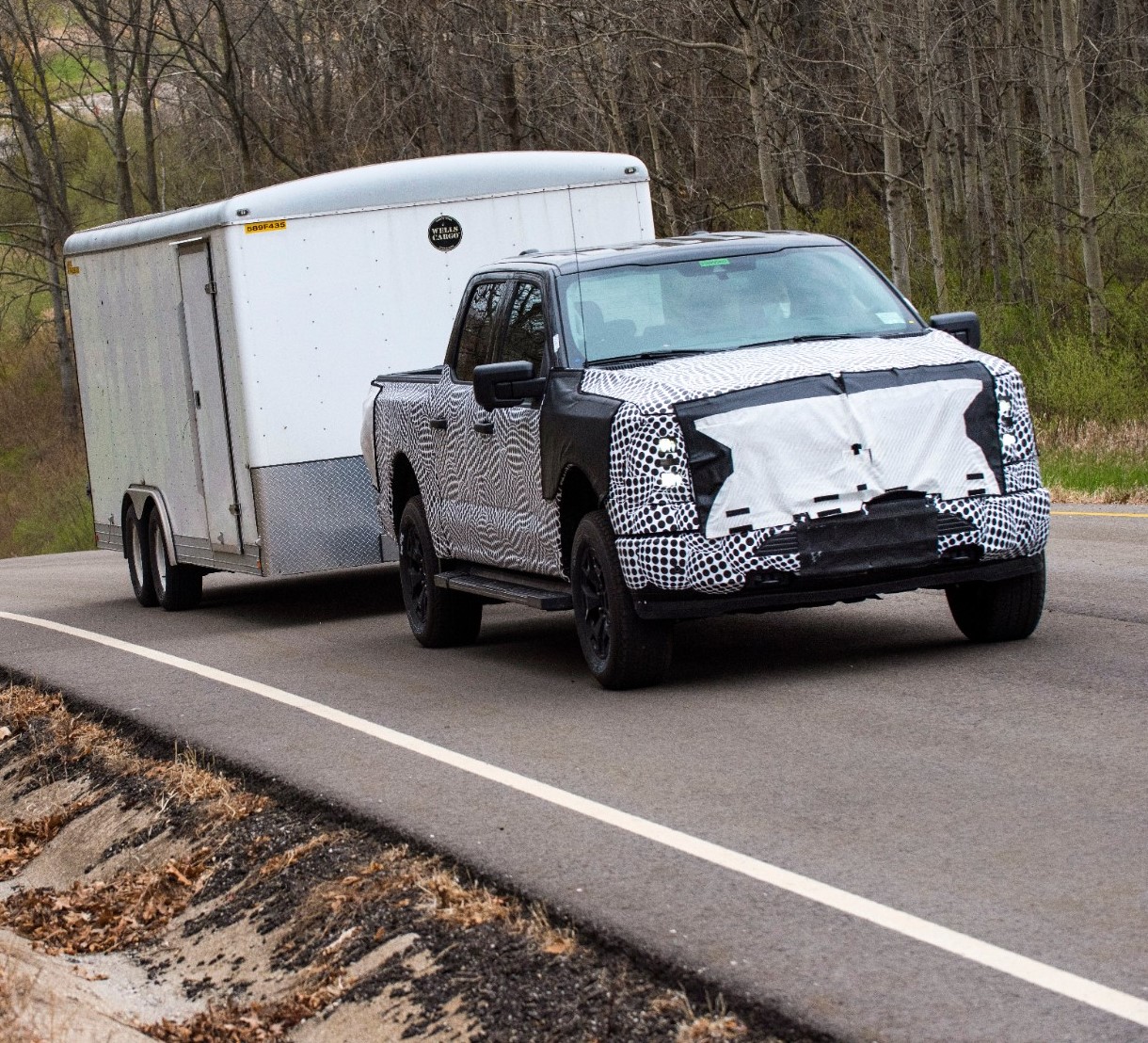
A Ford F-150 Lighting in camouflage while testing tow capacity.

Endurance testing included running the truck through Iowa Hill, Calif.

The F-150 Lightning was put through the same endurance testing as all F-Series trucks. The military-grade aluminum-alloy body and upgraded frame were engineered to support the advanced battery. The first F-Series independent rear suspension and low center of gravity help improve noise isolation from the road and provide a more stable ride.

No compromises on space or utility were made, Ford says. The cab and bed have the same dimensions as the gas models.

The truck’s four-wheel-drive system features four selectable drive modes: Normal, Sport, Off-Road, and Tow-Haul. Metal underbody skid plates protect the battery and inboard motors. The battery itself is secured inside a waterproof casing that is surrounded by crash-absorption protection. It has been tested at temperatures as extreme as minus-40 degrees.

To maintain steady thermal conditions, the F-150 Lightning was engineered with an advanced liquid cooling system and powertrain layout to manage heat distribution.

Endurance testing included running the truck through Iowa Hill, Calif. In the testing, loaded trailers were towed for long durations up and down the steep Iowa Hill Road, where there are no safety guardrails, according to Wikipedia

Ford F-150 Lightning aerodynamics

Ford F-150 Lightning payload capacity and tow ratings.

Base models are expected to have a max tow rating of 10,000 pounds.

F-150 Lightning is the most aerodynamic F-150 ever, Ford says. Styling enhancements include newly shaped running boards, a sculpted hood to reduce drag, and grilles with a smoother, textured surface.

2022 Ford F-150 Lightning specifications

Body style: full-size, 5-seat crew-cab pickup with a 5.5-foot-long bed

Electric motors: Two inboard three-phase fixed magnet AC

Battery type: Liquid-cooled lithium-ion pouch with battery management

Targeted horsepower: 426 hp standard range; 563-hp extended range

Targeted peak torque: 775 foot-pounds for both battery packs

Onboard charger power, (input/output): 11.3 kW/10.5 kW standard range; 19.2 kW/17.6 kW extended range

Targeted EPA driving range: 230 miles standard battery; 300 miles extended range battery

TARGETED CHARGING TIMES:
Level 3 fast charge: 15%-80% in 44 minutes standard range; 41 minutes extended range

Level 2 home charging: NA

80-amp Ford Charge Station Pro: 15%-100% in 10 hours standard range; 8 hours extended range

32-amp/240-watt onboard charger: 15%-100% in 14 hours standard range; 19 hours extended range

BY THE NUMBERS

Targeted maximum payload: 2,000 lbs. standard battery; 1,800 lbs. extended-range battery

Targeted maximum towing: 7,700 lbs. with the standard battery; 10,000 lbs. with the extended-range battery

Length/wheelbase: 232.7/145.5 inches

Cab height/width: 78.9/*96 inches. *w/mirrors folded 83.6 in.

Ground clearance: 8.9 inches

Open tailgate to the ground: 37.2 inches

Front trunk liftover height: 35 inches

Curb weight: NA

Turning circle: NA

WARRANTIES

Bumper to bumper: 3-years/36,000-miles

Roadside assistance: 5-years/60,000-miles;

Electric vehicle components: 8-years or 100,000-miles, including the battery that is expected to retain a minimum of 70% of its original capacity over that period

2022 Honda Civic Redesign Overview

2022 Honda Civic Redesign Overview

The 11th-generation Honda Civic sedan to go on sale summer 2021

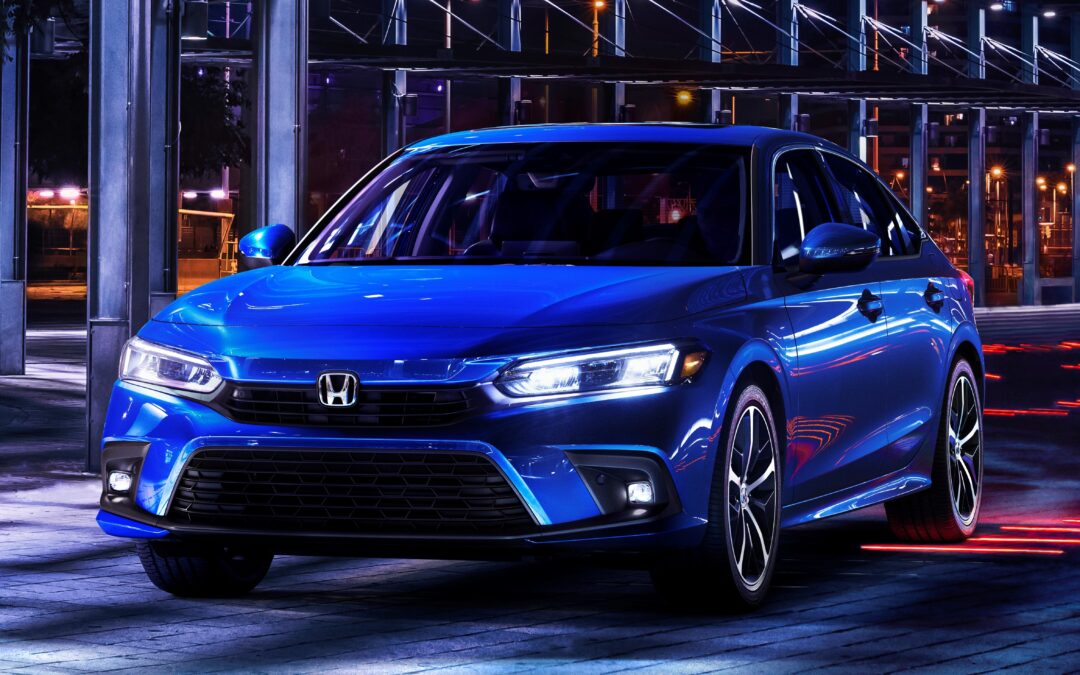
Redesigned 2022 Honda Civic sedan.

The redesigned 2022 Honda Civic sedan. (Photos courtesy of Honda)

BY MARK MAYNARD

Acompletely redesigned and re-engineered 2022 Honda Civic sedan goes on sale this summer with a “thin and light” body design. With new materials and technologies, the carmaker hopes the new model will be a “breath of fresh air” in the segment.

Civic competitors included the Hyundai Elantra, Kia Forte, Mazda 3, Subaru Impreza, and Toyota Corolla.

Four-door cars are declining in interest today, but the Honda Civic sedan is and has been a bread-winner model for Honda.

“Despite auto industry new vehicle sales being almost 80 percent light trucks (CUV, SUV, pickups) and last year being very negatively impacted by COVID-19, we still sold over 260,000 Civics in 2020,” said Honda spokesman Carl Pulley in an email.

The Honda Civic interior design emphasizes visibility, intuitive ergonomics, extraordinary passenger volume and driver-focused technology

The interior styling follows the “Man-Maximum, Machine-Minimum” approach. (Honda)

As Honda’s longest-running automotive nameplate in the United States, more than 12 million Civics have been sold since 1973. That legacy makes it one of the top three best-selling passenger cars in America, said Dave Gardner, executive vice president of National Operations, American Honda Motor Co., in a statement.

Since the launch of the 10th-gen model in 2015, Civic has been the No. 1 vehicle in America with first-time buyers, millennials, Gen Z and multicultural customers, Gardner said. It has had more than 1.7 million units over the last five years.

The 2022 Honda Civic redesigned interior with fingerprint and scratch resistant materials.h

High-touch areas feature quality materials that are fingerprint and scratch resistant. (Honda)

New Honda Civic sedan features

  • First all-digital LCD instrument display in the top-line Touring;
  • Standard 7-inch color touch screen with Apple CarPlay and Android Auto;
  • First Bose premium sound system with 12 speakers and wireless charging, for the Touring;
  • New front air bags are designed to reduce traumatic brain and neck injuries. Rear seat side air bags are a Civic first;
  • Updated Honda Sensing system with a front wide-view camera. The Touring model gets new Traffic Jam Assist and Low Speed Braking Control.

The design

In designing the 11th-generation Civic, the stylists and engineers focused on the original Honda design approach of “Man-Maximum, Machine-Minimum.”

The new styling seems to represent a coming of age and appears more mature, uncluttered and upscale than the previous styling.

Key to the exterior design was moving the bottom of the windshield pillars rearward by nearly 2 inches. The revised design elongates the hood for a premium silhouette, Honda said in the release. It is a subtle design element that emphasizes its wheels and tires for a stable, planted stance.

The 2022 Honda Civic interior features he redesigned dash incorporates a series of mesh panels to create a clean, continuous look.

The redesigned dash incorporates a series of mesh panels to create a clean, continuous look. (Honda)

The pulled-back windshield pillars, low hood, flat dashboard and hidden windshield wipers enable a windshield with clearly defined corners for a panoramic view.

Redesigned Honda Civic GT sedan

The Sport trim adds matching gloss-black side mirrors, 18-inch wheels and a chrome exhaust tip. (Honda)

Dimensions and body structure

Sizewise, the 2022 model is 1.3 inches longer (184 inches) but the same width and height, 70.9/55.7 inches, as before. Curb weights are up 106-114 pounds across the trim levels. And trunk space was trimmed by just 0.3 cubic feet, but still large at 14.8 cubic feet.

The body structure is the most rigid in Civic history, Honda says. It was improved by 8 percent in torsional rigidity and 13 percent in bending rigidity. It also reduces road and wind noise in the cabin.

The stiffer structure aids ride quality and sharpens suspension response for better handling.  A slightly wider rear track (0.5-inch) also enhances stability.

As before, the Civic continues as front-wheel drive with no plan yet for AWD.

Interior

Inside, the styling follows the “Man-Maximum, Machine-Minimum” approach, Honda says. The treatment emphasizes “exceptional visibility, intuitive ergonomics, extraordinary passenger volume and driver-focused technology,” Honda says.

High-quality materials are used throughout the interior, especially on touchpoints. Special attention was given to the operation of  switchgear and controls. And all trim levels have a new front seat design to firmly hold the body and enhance comfort on long drives.

Materials were also chosen for practicality, such as the new center console trim that is designed to hide fingerprints and smudges.

2022 Honda Civic GT gauge array turns red

In Sport mode, the 10.2-inch digital gauge array turns red. (Honda)

Digital displays

For the first time, all Civic sedan trims have either a partial or full (Touring) digital instrument display, with larger standard and available color touch screens.

LX, Sport and EX trim levels have a 7-inch color LCD instrument display. An all-digital speedometer and tachometer are on the left side of the display, with a physical speedometer dial to the right.

Touring models also get the first all-digital color instrument display for a Civic. The 10.2-inch high-def panel is customizable from the steering wheel and features several modes. The array can be configured to show traditional round gauges or bar graphs, flanking the left and right of the screen.

There also is a new multimedia 7-inch color touch screen in the LX, Sport and EX trims. It is “the largest standard screen in Civic history, Honda says.” Functionality was improved by adding a power-volume knob and a tuning-selection knob.

The top-line Civic Sedan Touring debuts a new 9-inch color touch screen. It features a physical volume knob, easy-to-recognize icons and a simplified format with fewer embedded menus.

The touch-screen systems have wireless Apple CarPlay and Android Auto integration. Only the Touring has Qi-compatible wireless charging.

The 2022 Honda Civic tire and wheels

Tire sizes range from 16- to 18-inches, with gloss-black wheels on the Sport trim (shown).  (Honda)

Honda Civic sedan Powertrains

As with the outgoing Civic sedan, two four-cylinder engines make up the powertrain. The standard engine is a naturally aspirated 158-horsepower 2.0-liter. The EX and Touring trims use a 180-hp, turbocharged 1.5-liter. Both engines run on 87 octane gasoline.

Both engines are paired with an updated continuously variable automatic transmission. The CVT now gives early downshifts during braking with revised programming to simulate gear changes under hard acceleration.

Power delivery, engine sound, overall refinement were improved. And EPA fuel economy ratings of both engines are up by 1 or 2 mpgs, Honda says.

EPA fuel-economy ratings for the 2.0-liter in the LX are 31 mpg city, 40 highway and 35 mpg combined. The Sport trim has ratings of 30/37/33 mpg.

The more powerful 1.5-liter engine (up 6 hp from last model year) has mileage ratings of 33/42/36 mpg city/highway/combined.

Honda Civic sedan safety features

The 2022 Honda Civic sedan can boast what Honda calls the world’s first application of front driver and passenger air bags. The design will better control head motions and reduce conditions associated with brain injury, Honda says.

The driver’s air bag is donut-shaped to cradle and hold the head to reduce rotation. The passenger-side air bag uses a three-chamber design for a similar result. In total, there are 10 air bags.

Side impact protection has been improved throughout. There are stiffer structures in the roof and doors, side sills and door pillars, rear wheel arches and rear window pillar.

The Civic sedan is Honda’s longest-running automotive nameplate in the U.S.

More than 12 million Civics have been sold since 1973. (Honda)

Pricing

Official pricing will not be released until just before the on-sale date. But expect the 2022 Civic sedan to cost about the same as the outgoing 2021 model. It has starting prices of $22,245-$29,295, including the current freight charge of $995 from Greensburg, Ind.

There is a financing incentive on 2021 Civics (except Type R) that will run through July 6, 2021. That is likely the cutoff date before the 2022 model goes on sale. Qualified buyers can take advantage of 1.9 percent APR for 24-60 months or 2.9 percent for 61-72 months, with a 10 percent down payment.

Honda's outgoing 2021 Honda Civic sedan.

The outgoing 2021 Civic sedan.  (Honda)

Industry sources say the new sedan will be followed by the Civic hatchback, sporty Si and high-performance Type R.

2021 Toyota Sienna XSE Review

2021 Toyota Sienna XSE Review

The 2021 Toyota Sienna is a complete redesign and exclusively powered as a gasoline-electric hybrid

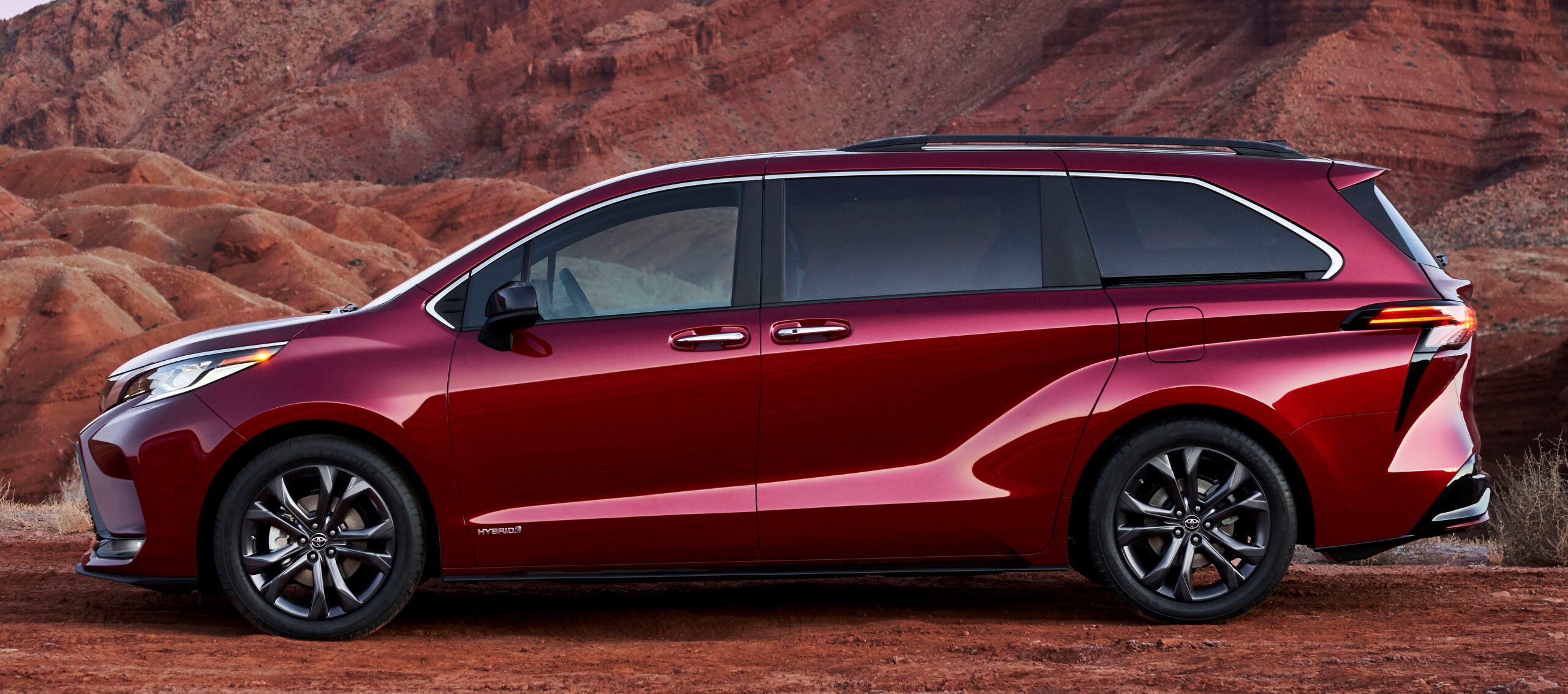
2021 Toyota Sienna XSE exterior.

The sport-themed 2021 Toyota Sienna XSE adds dark 20-inch split five-spoke wheels, more aggressive front and rear bumpers and a black headliner. (Photography by Toyota)


BY MARK MAYNARD

You can fit just about anything in a minivan — except an ego. These three-row people movers are the most efficient modes of transportation, yet ownership has been traumatized ever since the damning label of “Soccer Mom Mobile” was applied. It nearly killed the segment. Mention of the word brings polarized responses, like “hell-no never” to “make way for the welcome wagon.”

To spackle over the crazed aversion, manufacturers have long tried to offer sporty variants, which were usually received with a shrug and “Meh.” Anybody who wanted a van, didn’t need it to be cladded-up and those who didn’t want a van would not be tempted by cosmetic enhancements.

A side view of the new Sienna minivan

The 17-foot-long Sienna drives “small” with a high seating position.

So those carmakers with struggling minivans sales dumped them, including Ford and GM. Today, there are just four 2021 minivan choices: the Chrysler Pacifica, Honda Odyssey, Kia Sedona (soon to be replaced by the Carnival), and today’s tester, the Toyota Sienna.

Toyota’s sculpted redesign of its 2021 Sienna makes for a more credible sporty variant in the new XSE model. Whether for minivan-hating parents or their children, the Sienna is a big toy box of possibilities, and now a greener choice.

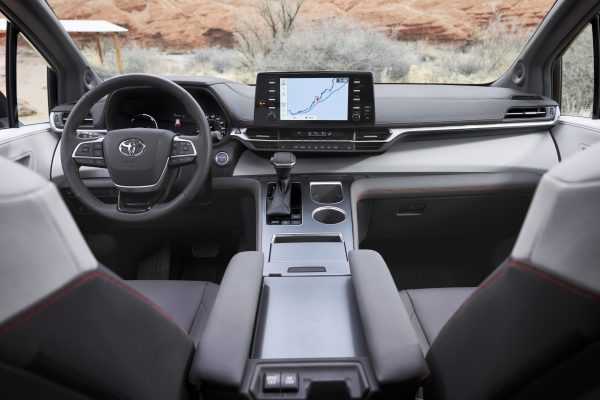
Front seats in the Sienna minivan.

The shifter and necessary functions are all within easy reach.

2021 Toyota Sienna Pricing

The first Sienna went on sale in the United States as a 1998 model and is now in its fourth generation. It has been designed, engineered, and assembled in the U.S. since it debuted.

The 2021 Toyota Sienna is a complete redesign and exclusively powered as a gasoline-electric hybrid, with optional all-wheel drive and seating for seven or eight.

A view of the Sienna's rear end

Toyota applied a few styling tricks to tone down the traditional minivan styling.

The Sienna is sold in five trim levels of LE, XLE, XSE, Limited, and Platinum. Starting prices range from $35,635 for the eight-seat, front-drive LE to $51,710 for the seven-seat Platinum AWD. Pricing includes the $1,175 freight charge from Princeton, Ind.

Some Sienna XLE models and the XSE, Limited, and Platinum are seven-seat models and feature the super-long-slide second-row captain’s chairs, and the Limited and Platinum FWD models have ottomans.

Electronic on-demand AWD is just a $760 option.

The XSE Plus package ($1,000) adds wireless phone charging, black roof rails, 12-speaker JBL audio, 9-inch touch screen, and dynamic navigation with a 3-year trial and connected services.

Pricing incentives for APR, cash, and lease.

2021 Toyota Sienna front seat features with the under-console storage area.

The broad span of the instrument panel has a step-down shelf.

Warranty Coverage

Hybrid-related components that require repairs to correct defects in materials or workmanship are covered for 8 years or 100,000 miles from the original date of first use when sold as new. The hybrid battery is covered for 10-years/150,000-miles and is transferrable across ownership.

The new-vehicle warranty includes 3-years/36,000-miles bumper to bumper; 5-years/60,000-miles powertrain; and 2-years/25,000-miles ToyotaCare, free factory scheduled services, and 24/7 roadside assistance.

Super long slide second-row seats.

Super-long-slide second-row captain’s chairs.

Styling

Here’s how Toyota tried to take the minivan out of the styling:

•A speedy pillar at the rear cabin is dynamically angled forward;
•Thin bands of LED lighting at the taillight flow from the body to the rear to create a signature impression;
•Integrated black taillight canard looks cool but also improves aerodynamics;
•Sculpted tailgate with an integrated spoiler is made possible by a molded resin process.

The minivan's gearshift console.

The shift console is cleverly integrates storage and cup holders. 

Ride and Handling

No tachometer, no wedgie-inducing front seats, no problem.

As a father now graduated from child-rearing years, I always liked testing minivans, and not just because my two charges ran to do homework in the van.

It’s the view from the inside out that mattered — not that I might be judged a “soccer dad,” though my step-daughter was a brutally effective club soccer player.

Ride quality in the XSE is slightly sport-tuned but never harsh or pitchy. There is good driver connectivity between the steering input, braking response, and acceleration.

Second-row captain's chairs.

The storage areas are a vertical ecosystem of tiers, trays, and cubbies.

20-inch Tires and Wheels

The front-drive XSE has 20-inch Michelin Primacy all-season tires, P235/50; AWD models get 18-inch tires, P235/60. Its exterior appearance is somewhat sportified by dark 20-inch split five-spoke wheels and aggressive front and rear bumpers.

Despite the Sienna’s 17-foot-length, it drives “small” with a high seating position, low step-in height, and big windows, with privacy glass behind the front row. Driver sightlines are open across the hood and over the shoulder and the turning circle is refreshingly modest at 38.2 feet, though you’ll have to swing a little wider when steering into the parking stall.

Four-wheel disc brakes work without regen-grab common to some of Toyota’s other hybrid models. Ventilated discs front and rear are towing capable (up to 3,500 pounds) with 12.9-inch discs front, 12.5 inches rear.

The XSE has dark chrome wheels and all-season tires.

The Sienna XSE has dark 20-inch split five-spoke wheels.

Sienna Safety Features

The Toyota Safety Sense (TSS 2.0) system includes a pre-collision system with daytime and low-light vehicle and pedestrian detection, plus daytime bicyclist detection. Automatic braking is activated by PCS if the driver does not react in time in certain emergency situations. The system also can detect a vehicle ahead, a bicyclist, or a pedestrian in low light situations.

Other standard equipment on all trim levels are 10 air bags, stability, and traction controls, brake-force distribution, brake assist, blind-spot monitor with rear cross-traffic alert.

Driver-Assist Systems

The standard Toyota Safety Sense 2.0 package of technologies allows Level 2 semi-autonomous driving while keeping both hands on the wheel. Keeping the Sienna on the correct track is enhanced by all-speed dynamic radar cruise control and lane change assist, lane tracing assist, front cross-traffic alert, and pedestrian alert.

The system capably keeps the car centered in the lane, but like most systems, it will randomly shut off, sometimes due to variable light and road-surface conditions. This type of safety system will be beneficial for those drivers who have daily commutes in heavy traffic. It is an extra six eyes on the road to watch for less attentive drivers.

2021 Toyota Sienna Softex trimmed seat upholstery.

Softex-trimmed seat upholstery and heated power front seats are standard on the XSE.

Sienna Hybrid Powertrain

The Sienna’s gasoline-electric hybrid system integrates a 176-horsepower, direct-injection 2.5-liter four-cylinder with two electric motors, a front-drive 134 kW (180-hp) permanent-magnet synchronous, and a 40-kW rear.

Toyota’s use of a nickel-metal hydride battery pack isn’t as technologically high-powered as a lithium-ion battery pack, but I couldn’t tell a difference, it just works. With  288-volts, the battery pack lets the Sienna roll for blocks on silent battery power at low speeds or creeping in traffic. This is the same well-tested system Toyota has used for years.

With a combined power of 245-hp, there was no lag in launch power and it will cruise comfortably at highway speeds. The electronic continuously variable transmission (eCVT) has a sequential shift mode, but I didn’t feel the need. The CVT kept the power easily controlled under my right foot.

Official fuel economy ratings are 36 mpg city, 36 highway, and 36 mpg combined for front-drive and 35/36/35 mpg AWD, using the recommended 87 octane. In a test week of 142 miles, my average fuel economy ranged from 27.5 to 29.8 mpg, and it was still building when I had to exit the freeway.

Interior Function

The entire cabin of the 2021 Toyota Sienna is well-soundproofed and quiet rolling with the Michelins.

Interior storage opportunities are a vertical ecosystem of tiers, trays, and cubbies. In all, there are seven USBs, six of them for charging, 18 cup holders, onboard Wi-Fi, and the optional Driver Easy Speak, which is essentially a built-in PA system that carries the driver’s voice through the audio system to the rear seats to the source of the disturbance.

The broad span of the instrument panel has a step-down shelf, handy for the passenger to lay a phone and the door panels have spacious bottle storage and a shallow tray. Toyota says the unique Bridge Console is key to allocating personalized space to the driver and front passenger. Positioned high between the driver and passenger, the bridge connects the instrument panel to the center armrest. Beneath the bridge is a large open area to stow out of sight larger items such as a purse or bag. But the bridge takes away the once-familiar step-through for parents to slip into the back seat for child care or discipline.

Clever Engineering

The shift console is cleverly designed to integrate storage and cup holders, of which there are four. A cutout for the two smaller cup holders nearest to the driver’s elbow is made dual purpose with a tip-back lid that leaves a 6-inch-wide by 1.24-inch slot for a phone, errand list, or note pad. One of the larger cup holders nearest the wireless charging pad and a charging USB also integrates a phone-size slot.

There is deep storage in the armrest console (12 inches to the bottom) with a pair of charging USBs. The space is handy for holding the pair of wireless headphones for the optional rear-seat entertainment system.

The Toyota Sienna's cargo area with folded third-row seats

Split & Stow third-row seats are cleverly engineered. (Mark Maynard)

Back Seats and Cargo

Kick-activated sliding doors and the back seat step-in height of 18 inches are child-reasonable. There is nearly 3 feet of NBA-class legroom provided by the super-long-slide second-row captain’s chairs, which also recline. Manual sunshades in the second row are assets as are two more charging USBs.

Power ports in the Toyota Sienna's cargo area.

The cargo area has a 1500-watt household power plug. (Mark Maynard)

And there is another pair of charging USBs in the third row, which is a Split & Stow design. It takes a hefty tug to stow or restore the seats and the flat area when the seats are stowed has no covering so dog crates or other such materials might not ride flat without bolstering.

Woodland Special Edition

Adventurers will be able to embrace their nomad lifestyle this fall with the Sienna Woodland Special Edition. Pricing has not been announced but is expected to start at around $45,000, including all-wheel drive and raised suspension.

Special features include:

•1500-watt capable power outlet (to power most household items for a day trip or an overnight camping excursion);
•Tow hitch with a 3,500-pound trailer weight;
•Roof rails with crossbars;
•Exclusive Cement paint color;
•Black sport trimmed seats with unique stitch color;
•18-inch wheels;
•Dark chrome-colored accents;
•Black badging;
•Navigation with 12-speaker JBL 1200-watt audio system.

Other standard Woodland Edition equipment includes super-long-slide second-row captain’s chairs, Split & Stow 3rd Row Seat, kick-activated sliding doors, heated front driver and passenger seats, sunshades in the second row, and seven USB ports across all three rows.

And with every sale, Toyota will make a $250 donation to the National Environmental Education Foundation. The effort will be a guaranteed minimum donation of $250,000 to support NEEF’s mission to make the environment more accessible, relatable, and connected to people’s lives.

The 2022 Toyota Sienna Woodland Edition.

The 2022 Woodland Edition features the exclusive Cement paint color.

Why Buy the 2021 Toyota Sienna?

With the substantial baggage most drivers drag along with them every day, a rational society might think that a minivan would be a top seller. But minivans are like green vegetables — we know should eat more of them, but for many, it is the sexiness of SUV fast food that wins the sale.

The Sienna is green and very inviting for an extended road trip. My average fuel economy of 28-plus-mpg was impressive, though I never transported a van full of people.

Its exterior styling is attractive and somewhat eye-catching on the road … for a minivan. But it is the inside where this minivan far exceeds any utility of an SUV or its fuel economy or ease of entry — and all that with a tow rating of 3,500 pounds.

2021 Toyota Sienna XSE FWD Specifications

Body style: Full-size 7- to 8-seat front- or AWD minivan

Engine: 176-hp, direct-injection 2.5-liter 4-cylinder; 176 lb.-ft. torque at 4,400 rpm

Electric motors: 134 kW (180 hp) permanent-magnet synchronous front; 40 kW rear

Hybrid battery pack: Nickel metal hydride; 288 volts; 40 cells, 7.2-volts per cell; 650 volts maximum

Combined net power: 245-hp

Transmission: eCVT with sequential shift mode

Fuel economy: 36/36/36 (FWD) 35/36/35 (AWD) city/hwy/combined; 87 octane

BY THE NUMBERS

Fuel tank: 18 gallons

Cargo space: 33.5-75.2 cu. ft. behind 2nd/3rd rows

Front head/leg room: 40.1/40.3 in.

2nd-row head/leg room: 39.3/39.9 in.

3rd-row head/leg room: 37.4/38.7 in.

Length/wheelbase: 204.1/120.5 in.

Curb weight: 4,675 lbs.

Turning circle: 39.2 ft. FWD (20-inch wheels); 38.3 ft. AWD (18-inch wheels)

Tow capacity: 3,500 lbs.

Coefficient of drag: 0.28

Safety features include: 10 air bags, Toyota’s Star Safety System (stability and traction controls), brake-force distribution, brake assist and smart-stop technology, blind-spot monitor with rear cross-traffic alert.

Toyota Safety Sense 2.0, includes a pre-collision system with daytime and low-light vehicle and pedestrian detection, and daytime bicyclist detection; full-speed range dynamic radar cruise control; lane departure alert with steering assist; automatic high-beam headlights; lane tracing assist; and road sign assist

PRICING

Base price: $42,000, including the $1,175 freight charge. Price as tested $46,843

Options on test vehicle: Ruby Pearl metallic paint $425; Rear seat entertainment system with 2 wireless headphones $1,415; XSE Plus package $1,000; 1,500-watt power inverter $300; Rear bumper applique $69; Floor and cargo mat package $294; wheel locks $65

Where assembled: Princeton, Ind.

Warranty: 3-years/36,000-miles basic bumper to bumper; 5-years/60,000-miles powertrain; 10-years/150,000-miles hybrid battery; 8-years/100,000-miles hybrid system; 2-years/25,000-miles ToyotaCare, free factory scheduled services and 24/7 roadside assistance

2021 Lexus LS 500 F Sport Review

2021 Lexus LS 500 F Sport Review

The updated Lexus LS 500 F Sport is almost worth its weight in carats, but in reality it is among the less-expensive choices

The 2021 Lexus LS 500 F Sport exterior.

The Lexus LS 500 F Sport is largely about added performance features without added horsepower. Pricing starts at $80,625. (Photos courtesy of Lexus)

BY MARK MAYNARD

The Lexus LS 500 F Sport is the diamond-class among full-size luxury sedans. There is brilliance in its engineering that has been its benchmark since the first generation debuted as a 1990.

Since then, trendier diamond hues have debuted, but most of these are laboratory creations and they lack the credibility and value of a natural stone. While there are true colored diamonds, the best have exotic pricing.

The driver area in the LS F Sport.

I like the cabin architecture that provides unobstructed sightlines at the windshield-pillar corners and over the shoulder. (Lexus)

Lexus LS 500 F Sport Pricing

The updated Lexus LS 500 F Sport is almost worth its weight in carats, but in reality it is among the less-expensive choices in this high-end class.

Sold in rear- or all-wheel drive with one powertrain, there are three trim choices for the 2021 Lexus LS 500 F Sport. Pricing starts at $77,025 for the entry LS. The rear-drive F-Sport, today’s tester, starts at $80,625 (add $3,250 for AWD) and the LS 500h Hybrid, the quickest LS model, at $91,525. All MSRPs include the $1,025 freight charge from Tahara, Japan.

An updated 2022 LS 500h Hybrid will go on sale this fall with a showcase of advanced technologies. All-wheel drive models will debut the new Lexus Teammate systems for Advanced Drive and Advanced Park. Pricing will be announced later.

The front seats in the F Sport.

With the optional panoramic roof, headroom is 36.8 inches, which is far more accommodating to tall drivers than would appear by the dimensions. (Lexus)

Lexus LS 500 F Sport Comparos

For pricing comparisons among the LS competitors, the entry Mercedes-Benz S-Class (with 3.0-liter biturbo V-6) starts at $95,245, including the $995 freight charge. Upgrading to the AMG-line of styling features and driver assistance systems will push the price to more than $107,000.

BMW’s 740i (with its biturbo incline six-cylinder) would cost more than $103,000 when equipped comparably to the F-Sport tester. But the BMW does include free scheduled maintenance for the duration of the warranty.

And there are option groups to further personalize or elevate, including the $12,710 Luxury package, the Executive at $17,630 or the Executive with handcrafted Kiriko glass trim elements, $23,630.

Find pricing offers here.

The F Sport steering wheel.

The heated, three-spoke F Sport wheel with red stitching. (Lexus)


F Sport Features

The Lexus LS 500 F Sport is largely about added performance features without added horsepower.

The package includes unique trim on the bumper, grille, lower door trims, and rear diffuser. 20-inch five-spoke alloy wheels have a Dark Vapor Chrome finish. Inside there is a performance-themed instrument cluster with sliding gauge bezel, F Sport perforated leather upholstery, a heated steering wheel, Ultrasuede headliner, 28-way adjustable sport seats, passenger seat power cushion adjuster and aluminum pedals.

Performance hardware upgrades include:
• 6-piston front brake calipers with 15.7-inch ventilated discs, 4-piston rear brake calipers with 14.1-inch ventilated discs;
• F Sport adaptive variable suspension;
• Dynamic Handling Package ($7,800 RWD only) adds variable gear ratio steering, active rear steering and active stabilizer bars.

The tire and wheel package for the LS 500 F Sport

Bridgestone Turanza runflat summer performance tires have staggered, 20-inch sizes.  (Lexus)

2021 LS Updates

Subtle updates for 2021 emphasize interior quietness and comfort with a smoother, more comfortable ride. There were technological refinements with the Lexus Driving Signature to set a new standard for vehicle development and refinement.

The F Sport's ultra-compact LED headlights.

Triple-projector ultra-compact LED headlamps with cornering lamps. (Lexus)

LS F Sport Suspension

The standard steel suspension has revised spring and damper rates for improved damping performance.  And the front and rear anti-roll bars were “optimized” to better control body roll in turns. Larger front and rear liquid-filled bushings help create an even plusher ride, Lexus says.

The vehicle engineers modified the Adaptive Variable Suspension ($1,400) for “suppleness” and handling while the ride-height-adjustable air suspension is quicker to respond.

F Sport Powertrain 

Revisions to the 3.5-liter, twin-turbo V-6 include a lip shape on the piston top for quicker activation to curb emissions and quiet operation when the engine is cold.

The 416-horsepower, direct-injected engine has 442 foot-pounds of torque, starting from a 1,600 rpm and rising steady to 4,800 rpm.

The 416-horsepower, V-6 engine in the LS 500 F Sport

The 416-horsepower, direct-injected V-6 is capable of 0-60 mph in 4.6 seconds.

The shift logic of the 10-speed automatic transmission was recalibrated to help keep the engine in a more responsive area of its power band.

The acceleration has V-8 thrust off the line and in Sport-plus mode is capable of 0-60 mph in 4.6 seconds.

While most LS drivers will rein in the force and feel comfortable in Normal, Comfort or Sport drive modes, there is a direct horse-and-rider communication in Sport-plus that gives almost intuitive upshifts and downshifts.

And when using Sport-plus the main gauge bezel slides right for a red-themed performance mode.

Fuel economy ratings are 18 mpg city, 29 highway and 22 mpg combined, on the required premium fuel. In my week of more than 200 miles the best combined average I achieved was 17 mpg. But with the 21.7-gallon tank, even that mileage would allow more than 368 miles of cruising range.

Interior Upgrades

The LS cabin is a statement of impeccable Takumi craftsmanship, which is all about meticulous attention to detail and hospitality, Lexus says. Among the interior upgrades is a new Palomino Leather interior with new trim materials, including Black Laser Special and Open Pore Black.

The LS 500 infotainment touch screen.

The wide touch screen is simple to use, but there also are actual buttons to make adjustments for fan speed, temperature and vents.

On Executive models, the available Kiriko Glass ornamentation and hand-folded pleats on the door trim illustrate the Japanese craftsmanship of Kiriko glassware, and unique in a production vehicle. The hand-cut glass is polished to a soft glow.

Credit the cabin air-filter recirculation for a stink-free environment. While on a long highway descent, the semi-truck next to me was sending billows of brake smoke as the lanes of traffic slowed for road construction. Usually, it is difficult to filter out that type of acrid pollutant, but I felt quite smug among the lingering aroma of Lexus leather.

The Kiriki glass interior upgrade.

An example of handcrafted Kiriko glass in the top Executive package, $23,630.

The new 12.3-inch multimedia touch screen integrates Apple CarPlay and Android Auto compatibility with iPhone or Android interface. And the new Amazon Alexa allows users to control smart home devices such as lighting, thermostat and security systems — or sync to the navigation system for on-the-go recommendations.

The wide touch screen is simple to use, but there also are actual buttons to make finger-reach adjustments for fan speed, temperature, vents.

I like the cabin architecture that provides unobstructed sightlines at the corners of the windshield pillars and over the shoulder.

The digital rearview mirror, $200, features a larger high-resolution display for improved visibility of the area behind the vehicle. It can be handy when chauffeuring passengers and heads get in the way of rearward views. But because I wear glasses, my eyes struggle to focus quicky enough, so I just flip it to manual mode.

With the optional panoramic roof, headroom is 36.8 inches, which is far more accommodating to tall drivers than would appear by the dimensions. However, the lower roofline will make the cabin seem smaller than it is, however, compensates in width, with 58.8 inches of shoulder room.

Missing from the tech features was wireless charging. And I wished for space on the shift console to lay a phone, though there are USBs and secure space in the armrest console.

Back seat space has the limo stretch of legroom, 38.9 inches, but the tall center tunnel for AWD and exhaust, makes the LS a better four-seater. And a simple jacket or coat hook on the back seat B-pillar or overhead hand grip would be considerate.

Trunk space is wide and low with nearly 17 cubic feet of space, but the entry opening is a little short for loading big-box items.

Ride and Handling

The ride is quite smooth and free of harshness transferred from varying road surfaces. And the LS includes such soundproofing enhancements as active sound control and active noise cancellation.

The back seats in the F Sport.

 Back seat space has the limo stretch of legroom, 38.9 inches, but the tall center tunnel for AWD and exhaust, makes the LS a better four-seater.

The optional air suspension ($1,400) has a new rapid rise system that also gives rapid adjustment in cornering to transfer weight without unsettling responses, though there can be an occasional jolt that gets past the system.

I expect I was also enjoying the F Sport dynamic package ($7,800), which added variable gear-ratio steering, active rear steering and active stabilizer bars. The turning circle is trimmer than most midsize sedans at 36.8 feet.

Because this generation LS has a lower roofline for aerodynamics (benefitting corporate average fuel economy) the air suspension automatically raises the vehicle to make it easier to step into or get out when the doors are unlocked.

The 20-inch Bridgestone Turanza runflats on the tester were almost surprising in their supple ride quality when Bridgestones often can feel hard and somewhat noisy.

LS Safety Features

Lexus has long been a pioneer of safety technologies and the LS has such advanced features as the Lexus Safety System+ 2.0. It is comprised of a pre-collision system with low-light pedestrian detection and daytime bicyclist detection, lane departure alert with steering assist, automatic high-beam dimming, all-speed adaptive cruise control with road-sign assist and lane tracing assist.

The optional Lexus safety system, $3,000, allows Level 2 semi-autonomous driving, while keeping both hands on the wheel. The system integrates enhanced all-speed dynamic radar cruise control and lane change assist, front cross-traffic alert and pedestrian alert.

The driver-assist system capably keeps the car centered in the lane, but like most systems it will randomly shut off. Sometimes the system gets confused by light colored road-surface conditions and highway lines that are broken up and uneven.

For those drivers who have daily commutes in heavy traffic, this safety-assist system could be a lifesaver. It is an extra six eyes on the road to watch for less-attentive drivers.

An exterior rear view of the Lexus LS.

The updated 2021 LS is almost worth its weight in carats, but it also is among the less-expensive choices in this high-end class. (Lexus)

Why Buy the Lexus LS 500 F Sport?

This big sedan is for the risk-averse buyer. It is a trusted nameplate with exemplary dealer treatment during the sale and then for service. The F Sport is the alter ego, with the grip-and-grin attitude of a charged grand tourer.

The LS raises the satisfaction level with the Lexus-Toyota business plan: Do it right the first time. And then make subtle updates for clarity and shine.

Here is my review of the 2021 Lexus IS 350 F Sport.

SPECIFICATIONS

2021 Lexus LS 500 F Sport

Body style: large, 5-seat, 4-door RWD sedan

Engine: 416-hp, twin-turbo, with electrical and D-4ST direct injected. 3.5-liter V-6; 442 lb.-ft. from 1,600-4,800 rpm

Transmission: 10-speed direct-shift automatic with paddle shifters; w/ Drive Mode Select with Sport S+ and Custom modes

Fuel economy: 18/29/22 mpg city/hwy/combined; premium fuel required

0-60 mph acceleration: 4.6 seconds

Coefficient of drag: 0.28; (*0.30 AWD)

BY THE NUMBERS

Fuel tank: 21.7 gal.

Trunk space: 16.9 cu. ft.

Front head/leg room: 36.8*/42 in. (37.3 in. w/o pane roof)

Rear head/leg room: 36.4*/38.9 in. (*37.4 in. (w/o pano roof)

Length/wheelbase: 206.1/123 in.

Curb weight: 4,740 lbs.* (4,696 lbs. with standard coil springs)

Turning circle: 36.8 ft.

FEATURES

Standard equipment includes: Smart key entry/locking with push-button ignition, rearview camera, power moonroof, quilted-stitch perforated semi-aniline leather interior trim, 16-way power-adjustable heated and ventilated front seats, 28-way power-adjustable driver’s seat with multifunction massage, power-adjustable front headrests, heated leather-trimmed steering wheel, Ultrasuede headliner and sun visors, wood- and semi-aniline leather-trimmed center console, semi-aniline leather-trimmed door armrests, heated rear seats, power rear sunshade, navigation system with 12.3-inch touchscreen and 3 years of free Lexus Enform Dynamic Navigation, Lexus 12-speaker premium audio system, Apple CarPlay or Android Auto with Alexa+Lexus compatibility, intuitive parking assist with auto-braking, active sound control and active noise cancellation, remote touch pad, triple-projector ultra-compact LED headlamps with cornering lamps, LED taillamps and turn signals, electrochromic (auto-dimming) inside and outside mirrors with puddle lamps, hands-free power open-close trunk, auto door closers, 19-inch alloy wheels

F Sport Package, includes: Unique exterior trim on the bumper, grille, lower door trims, rear diffuser; 20-inch split five-spoke alloy wheels with Dark Vapor Chrome finish;  6-piston front brake calipers with 15.7-inch ventilated discs and 4-piston rear brake calipers with 14.1-inch ventilated discs; adaptive variable suspension; performance-themed instrument with sliding bezel;; perforated leather interior (with heated steering wheel and shifter knob) with Ultrasuede headliner; 28-way adjustable sport seats; passenger seat power cushion adjuster; aluminum pedals and interior trim elements; Dynamic Handling Package (RWD only, includes F Sport Package features plus variable gear ratio steering, active rear steering, active stabilizer bars

Safety features, include: 10 air bags, Lexus Safety System+ 2.0 standard, includes Pre-Collision System with low-light pedestrian detection and daytime bicyclist detection; Lane Departure Alert with Steering Assist; Intelligent High Beam; all-speed adaptive cruise control; road sign assist, lane tracing assist

PRICING

Lexus LS 500 F Sport: $80,625, including $1,025 freight charge; price as tested $98,990
Options on test vehicle: Lexus safety system, $3,000, includes enhanced all-speed dynamic radar cruise control and lane change assist, front cross-traffic alert, pedestrian alert;
• Adaptive variable air suspension with rapid height function $1,400;
• Mark Levinson 23-speaker, 2,400-watt surround sound audio $1,940;
• Panorama glass roof $1,000;
• 24-inch head-up display $1,220;
• Panoramic view monitor $800;
• Rear bumper appliqué $95;
• Door-edge guards $155;
• Trunk mat package $305, includes key glove, cargo mat and wheel locks;
• F Sport Dynamic Handling Package, $7,800, includes variable gear ratio steering, active rear steering and active stabilizers

Where assembled: Tahara, Aichi, Japan
Warranty: 4-years/50,000 miles basic with roadside assistance, free 1st and 2nd scheduled maintenance services and lodging for emergency breakdowns 100 miles from home; 6-years/70,000-miles powertrain

MarkMaynard@cox.net

2022 Mercedes-Benz CLS Overview

2022 Mercedes-Benz CLS Overview

The third-generation Mercedes-Benz CLS goes on sale this fall — raising the red mist for irrational sales behavior

2022 Mercedes-Benz CLS coupe-sedan side view.

The new CLS 450 4Matic will go on sale in the U.S. this fall, 2021. (Photos courtesy of Mercedes-Benz)

BY MARK MAYNARD

The debut of the shapely Mercedes-Benz CLS “coupe” sedan supercharged the luxury segment in 2004. Fans and followers paid up to get one and when the rear end had those three little initials — AMG — it was a pheromone of red mist for irrational sales behavior.

The second-generation, 2012 CLS had its first major redesign, mostly meet newly mandated European pedestrian crash safety standards. The sleek slope of its nose was bobbed to blunt the seriousness of injuries to wayward people in crosswalks.

2022 Mercedes-Benz CLS coupe-sedan driver area.

The CLS was technologically updated last summer.

Its original, overarching sleekness came from the Vision CLS concept. The exterior styling now is more abrupt, but its overall fastback stance delivers a clear message of a style icon.

To date, more than 4 million Mercedes-Benz CLS models have been sold all over the world, including more than 450,000 CLS models since the first-generation launch. China was the largest sales market for the CLS Coupe in 2020, followed by South Korea, the U.S., and Germany.

Its design and sportiness were the top reasons most frequently cited by customers for buying the CLS, says Mercedes-Benz.

2022 Mercedes-Benz CLS coupe-sedan front seats.

Choices of leather seat upholstery have two new color combinations.

Third Generation

The new Mercedes-Benz CLS 450 4Matic will go on sale in the U.S. in the fall of 2021. It brings sharpened and sportier design, Mercedes-Benz says.

2022 Mercedes-Benz CLS coupe-sedan front passenger seat.

The interior will have two new trim finishes.

AMG-Line styling components are standard elements of the interior and the cabin was upgraded with more leather and trim combinations. A new-generation steering wheel has a two-zone sensor pad in the steering-wheel rim. Sensors on the front and back sides of the rim register whether the driver’s hands are on the wheel.

The optional Driver Assistance Package includes Active Distance Assist DISTRONIC and Active Steering Assist. The new-generation steering wheel uses capacitive touch to detect the driver’s hands.

the new-generation steering wheel.

The new-generation steering wheel in the ercedes-Benz CLS.

A comprehensive refresh last summer updated the MBUX (Mercedes-Benz User Experience) multimedia system and enhanced driver assistance systems.

AMG style elements include a specific front bumper with an A-wing in black, AMG sill trim on the side, a front splitter in silver chrome, sporty, air intakes with vertical bars, and aerodynamically shaped “flics” in high-gloss black.

The mild-hybrid engine.

At launch, the CLS 450 4Matic will have a mild-hybrid powertrain.

The 19-inch light-alloy wheels have two new designs: 5 twin-spoke or multi-spoke rims. The 20-inch, high-gloss AMG multi-spoke light-alloy wheels have two new bi-color choices of  Tremolite Grey or High-Gloss Black.

The new radiator grille with Mercedes star has a three-dimensional star pattern and a high-gloss black louver with chrome inlay. Starling Blue Metallic is a new paint color.

The rear end view

Starling Blue Metallic (shown) is a new paint color.

The Mercedes-Benz CLS interior will have two new trim finishes, including an optional Open Pore Brown Walnut and High-Gloss Grey Wood. New choices of leather seat upholstery are Neva Grey and Magma Grey and Sienna Brown and Black.

Mercedes-Benz CLS Powertrain

At launch, the Mercedes-Benz CLS 450 4Matic will have the mild-hybrid powertrain of a 362-horsepower, 3.0-liter inline six-cylinder gasoline engine. It integrates a second-generation starter-generator and a 48-volt electrical system. Power ratings are up by 21 hp with up to 184 foot-pounds of electric boost. Peak torque of 369 lb.-ft. spans 1,600-4,000 rpm. Engine efficiencies include energy recovery and “glide,” which allows the engine to switch off at highway speeds to save fuel and emissions.

A sleek side view.

China was the largest sales market for the CLS Coupe in 2020.

Driver-Assist Features

  • Active Brake Assist: Using autonomous braking, this standard safety feature can prevent a collision or reduce its severity in many situations. At typical city speeds, the system is able to brake for stationary vehicles and pedestrians in crosswalks and can even prevent collisions, depending on the situation. With the Cross-Traffic function (part of the Driver Assistance Package), Active Brake Assist also functions when making a turn across the oncoming lane.
  • Active Speed Limit Assist: Among the Driver Assistance Package, Active Speed Limit Assist reacts to speed limit changes using map data and input from Traffic Sign Assist. A route-based speed adjustment can reduce the vehicle speed before detected curves, roundabouts and toll booths, as well as before turning or exiting the highway. If the driver activates Active Distance Assist DISTRONIC with distance-based speed adaptation, the CLS can even respond to data from Live Traffic Information.
CLS front view.

Design is the most frequently cited reason that customers buy the CLS.

  • Active Stop-and-Go Assist: Maintains car-length distances up to approximately 37 mph, helpful in highway traffic jams when lane markings are detected. The vehicle can restart automatically up to one minute after coming to a stop. On highways, at speeds less than 37 mph, the vehicle monitors detected lane markings and applies “swarm intelligence” to take its bearings from vehicles in the surrounding area.
  • Automatic parking and exiting: A 360-degree camera makes it possible to enter and leave parking spaces automatically. When activated, the system will search for and select a parking space. And the system can now function autonomously to parallel and end-on park. The camera was enhanced to transmits a more realistic image to the media display, which includes an expanded side view.

Check current Mercedes-Benz CLS pricing and incentives here.

2021 Genesis GV80 Review

2021 Genesis GV80 Review

The Genesis GV80 is a 5- or 7-seat carlike SUV that is a defining statement of luxurious refinement

The Genesis GV80 SUV

The GV80 is sold in rear- or all-wheel drive versions with a choice of two turbocharged engines. (Genesis)

BY MARK MAYNARD

Not every SUV-intender wants to climb every mountain, spool-up rooster tails in a desert pre-run or clip apexes on a road course in high-speed pursuit to define themselves or at least who they like to think they are.

Some SUV shoppers just want the spaciousness and comfort they once had in a large family sedan, which has joined the dinosaurs in an evolving world.

The front seat space has wide shoulder room and tall front headroom of almost 40 inches. (Genesis)

For them, there is the vital newcomer by a largely unrecognized brand, the Genesis GV80. The brand, a luxury spinoff from South Korean parent company Hyundai, actually launched in the U.S. in late 2016. But its debut vehicles were the G80 and G90 midsize and large sedans, which were largely overlooked by a lack of advertising, balky customer service and this country’s obsession with tall and large vehicles.

Those who did buy into the brand became fast believers. The cars were very well turned out with refined luxury and strong performance credentials. But always in the business plan was a lineup of SUVS: large, midsize, compact, “coupes” and electrified versions.

The 12.3-inch 3D instrument cluster recognizes the driver’s eyes. (Genesis)

Covid Delays

Due to COVID-19 related delays in the U.S, the logjam broke late last year with the debut of the redesigned large G80 sedan and the GV80 SUV, today’s tester.

This five- or seven-seat carlike SUV is a defining statement of elite luxury — at pricing that will send the luxury competitors back to their calculators.

The 14.5-inch, split-screen infotainment display does not interfere with the driver’s sightline. (Genesis)

GV80 Pricing

The Genesis GV80 is sold in rear- or all-wheel-drive versions with either a 300-horsepower, 2.5-liter turbocharged four-cylinder engine or 375-hp, twin-turbocharged 3.5-liter V-6, with standard AWD.

Both engines are paired with an eight-speed automatic transmission with paddle shifters and selectable driving modes of Comfort, Smart, Eco, Sport and Custom.

The GV80 2.5T (RWD or AWD) is offered in three trim levels with starting prices that range from $49,925 to $64,425.

The 3.5T is sold in four trim levels with starting prices of $60,175 to $71,975. All MSRPs include the $1,025 freight charge from Ulsan, Korea.

The center shift console has fresh function by using a low shifter dial and a large and flat dial for infotainment and other selections. (Genesis)

The top-line 3.5T Prestige tester was $72,375 with the two factory option packages (Advance and Prestige) and $400 for the gorgeous Adriatic Blue metallic paint.

Full package contents are listed in the specifications box at the end of the story.

The electronic climate system features capacitive touch controls with tactile feedback. (Genesis)

Genesis Warranties

  • 10-years/100,000-miles powertrain with enhanced roadside assistance and concierge services;
  • 3-years/36,000-miles of scheduled maintenance;
  • 3-years/36,000-miles of complimentary Genesis Service Valet care;
  • 3 years of free Genesis connected services;
  • 3 months of free SiriusXM satellite radio all access
  • 3 years of free annual multimedia and navigation updates and lifetime complimentary traffic data via HD+ Traffic radio.

And here’s the perk for which I’d pay extra: the free Genesis Service Valet for 3 years or 36,000 miles will perform a remote diagnostic check, pick up your vehicle, send a courtesy car and return your Genesis – cleaned and washed.

Find current Genesis GV80 pricing here.

In up-level models, soft materials cover every surface, from the inside of the door handles to the quilted knee pads along the console. (Genesis)

GV80 Safety Features

Among the 10 air bags is an active safety-first innovation, Genesis says. The front center air bag, located between the driver’s seat and center console, deploys in 0.3 seconds in the event of a side collision to help prevent the two front passengers from colliding with each other or with vehicle components. The feature is standard on all GV80 models.

Power lines above each wheel emphasize stance and presence. (Genesis)

Defining Features

The GV80 is not an original idea, but it is a fresh presentation of what was and what it could be for much wider range of motorists.

There is an eye for beauty in the exterior styling. The compelling design is lean, fit and balanced. The chassis lowers the body and the center of gravity for a wider cabin and secure drivability. Its 16.2-foot-long architecture sits confidently on its wheels, which neatly fill the arches. There are no replicated kinks, gimmicky bulges or Godfather jowls. Yet it is well adorned with chrome, an American staple.

Roof cross-members, transmission tunnel, front chassis extensions and parts of the rear structure are made of ultra-high-strength steel. The cowl, floor panels, rear wheel housings and other components are high-strength steel. For light-weighting, aluminum is used for the doors, hood and rear decklid, for a 90-pound savings. The top-line, all-wheel-drive tester weighs in at 5,084 pounds.

The 375-hp, twin-turbocharged 3.5-liter V-6 is paired with an eight-speed automatic transmission. (Genesis)

Genesis Attention to Detail

“The precise proportions and attention to every detail denote that GV80 is authentic to Genesis design principles,” said Hyundai Motor design chief Luc Donckerwolke.

Under the shapely exterior is a brain trust of advanced safety and driver-assist technologies. The so-called “machine learning” technologies merge, refreshingly for the user, without a fearsome curve of learning.

By activating the Smart Cruise Control and Highway Driving Assist (and its bank of camera and sensor arrays) the GV80 will steer, brake, corner, evade, warn the driver and find its way home.

And it can park itself, as you stand outside the vehicle, in spaces too narrow to open the door on exit.

While many of the highway steering-assist systems are still somewhat rudimentary in how they watch the road and make somewhat jerky connect-the-dots steering course. The GV80 has more refined and more-fluid steering calibrations. And while some systems will let the vehicle drift wide in sweeping corners — crossing the Botts dots or white lines — the GV80 held true to the arc, in my testing. And the guidance gave no random shut-offs, such as in bright sunlight or on California’s light gray concrete interstates, which confuse many of these systems.

Still, it is still a hands-on system, so don’t think you are in the rocking-chair position and can sit back and read e-mail.

The Prestige package ($6,600) includes 22-inch alloy wheels with Michelin Primacy all-season tires. (Genesis)

GV80 Interior Function

When a new house is built by a team that works as a united front, the plans are thorough to provide the function, details and strength to sell quickly in its segment. The GV80 is that house. It has the needed electrical outlets, storage areas, ergonomic comfort and fortitude for long-term ownership.

For me, it was love at first … user experience, in the 3.5T Prestige, which is the king of that castle. Think Audi interior, but with even more finesse, or Volvo XC90, but even more ergonomic.

The GV80’s full Nappa leather upgrade, quilted and meticulously stitched, is impressive and inviting to the touch. The microsuede upgrade is used extensively from the headliner to the roof pillars and beyond.

It is a completely soft-touch environment, with progressive treatments for wood-like graining and metallic trim elements. And the cabin is well soundproofed for the 21-speaker Lexicon audio system.

Driver sightlines are open over the shoulder and at the front corners (handily provided by small corner glass at the base of the windshield pillars and side mirrors, which stand out from the body.

With front headroom at almost 40 inches (with the panoramic sunroof) and a long 41.6 inches of legroom, there is a 16-way power driver’s seat with adjustable side bolsters and cushion extension and four-way power lumbar, massaging driver’s seat. The passenger has a 12-way power seat with four-way power lumbar. Both front seats are heated and ventilated. And the Advance package adds the Ergo Motion (massaging) driver seat.

Roomy Interior

The large-midsize cabin has plenty of real estate for prime placement of controls and storage areas, including purse-size capacity under the shift console. The broad center shift console has fresh function by using a low shifter dial and a large and flat dial for infotainment, audio and navi selections, without eyes leaving the road. There’s also a handwriting sensor pad in the dial, for those competent in writing and driving (not me). A generous e-bin, with a sliding cover, includes a wireless charging pad and a pair of charging USBs.

I liked the 3D electronic presentation of the 12.3-inch digital gauge cluster and it is of ideal width for the dual blind-spot view monitors, which trigger a rearview image for right or left turns, filling either the speedometer or tach dials.

The 14.5-inch touch screen atop the center dashboard has a low profile that is not subject to sunlight glare and it does not get in the way of the driver’s view. But it also has good width for the surround-view monitor, which includes front and overhead views. I am not precise when fitting between the parking lines, so the overhead takes away the guesswork.

The second row in the GV80

The second row has full temperature control, heated-ventilated window seats, and power recline. (Genesis)

GV80 Back Seat

Seating in the second row might be slightly more compact than some of the competition. But it is a gorgeous space (in the Prestige tester). Some of the features include ceiling-integrated flip-down vanity mirrors, full temperature control, heated and ventilated window seats, and power seat recline. There’s also a chauffeur-style power fore-aft adjuster for more legroom when needed.

The third-row option will be limited to the grandkids, with knee-crunching legroom of 30.3 inches.

There is plenty of cargo room for the long road trip. Fold the second-row seatback for about 6 ½ feet of board room. (Mark Maynard)

GV80 Cargo

There is plenty of cargo room for the long road trip. Fold a section of the 40/20/40 seatbacks for about 6 ½ feet of board space. The opening is wide at 45 inches by 43 inches with the back seat in position and 30 inches to the headliner. The roller covers stows neatly in its own compartment under the cargo floor.

Ride and Handling

The steering weight is light and steady, but controlled at high speed. You might be surprised at how this SUV pulls through a big cornering maneuver with a flat and calculated effort, with no complaining from the big Michelins. The turning circle of 39.3 feet is wide but not unwieldy when tooling the shopping mall parking wars.

At 2 ½ tons, it is comfortable with its weight. The electronically controlled suspension automatically adjusts to trim body movement and harsh hits to the tires and wheel. A new feature called Road Preview, and standard on the GV80 3.5T, uses the front-facing camera to sniff the road ahead to prepare in advance of speed bumps and potholes.

The ride quality can be lush but never wallowy, and helped by the broad contact patch of the 22-inch Michelin Primacy (265/40) all-season touring tires. Head-toss is low over chunks and bumps, but because of the ride height and heft, it is not as svelte as a large luxury sedan, such as the G80.

2 New Engines

Both gasoline engines feature a dual fuel injection system that combines direction injection and multi-port injection. Combining both improves fuel efficiency, performance and reduced exhaust emissions, Genesis says.

Fuel economy, using the recommended premium fuel, for the 2.0-liter engine is 21 mpg city, 25 highway and 23 mpg for rear-drive and 21/25/22 mpg for AWD.

The 3.5T AWD has ratings of 18/23/20. I averaged 19.5 mpg in combined city and highway driving, and the onboard computer indicated a long-term 18.8 mpg overall average. With the 21.5-gallon tank, there should be a cruising range of around 380 miles.

The mileage ratings are competitive with comparable versions of the Audi Q7, BMW X5 and Mercedes-Benz GLE. But the Bimmer and Benz squeeze out two to three more mpgs per category, and they have slightly larger fuel tanks.

Driver-Assist Technologies

The Genesis GV80 is fluent in machine learning technology and is a conduit for advanced systems you did not know were necessary.

The bank of advanced driver-assistance systems includes:

  • Highway Driving Assist II: This second-gen system now gives assist during lane change maneuvers — when the turn signal is used — and when other vehicles merge in front of you.
  • Smart Cruise Control with Machine Learning: A world first, Genesis says, that helps the car learn the driving characteristics of — and assist — its driver.
  • Forward Collision-Avoidance Assist: This system is intended to automatically stop the vehicle in certain situations where there is a risk of collision with an approaching vehicle detected on the left or right side of the intersection. The system may also help detect potential collision risks in certain situations where a pedestrian is sensed in close proximity to the vehicle while in motion, for example.
  • Lane Side: LS helps prevent side collisions when merging into another lane with the ability to see two lanes over.
  • Blind-Spot Collision-Avoidance Assist: BCA is essentially a Blind Spot Monitor that can alert the driver if a vehicle is detected in the driver’s blind-spot
  • Lane Follow Assist: LFA helps maintain vehicle position in the center of its lane by recognizing both lane markers and vehicles traveling ahead.
  • Lane-Change Oncoming: The so-called LO helps prevent collisions with vehicles in opposing lanes on non-divided highways or roads.
  • Junction Turning: JT automatically applies the brakes if an oncoming vehicle is detected in the opposite lane when making a left turn at an intersection.
  • Junction Crossing: JC automatically applies the brakes if a vehicle crossing from the left or the right is detected when entering an intersection.
  • Evasive Steering Torque Assist: ESA assists in avoidance maneuvers by applying steering torque once the driver has initiated steering input.
  • Rear Cross-Traffic Collision Avoidance-Assist: RCCA warns of vehicles coming from the left or right while backing up and automatically engages braking if a collision seems imminent.

Accolades

Genesis was ranked the No. 1 premium brand in the industry for the fourth consecutive year by J.D. Power’s 2020 Initial Quality Study and No. 1 overall in the J.D. Power 2020 Vehicle Dependability Study.

Consumer Reports ranked it the No. 2 brand in its annual 2020 Report Card.

And, the Insurance Institute for Highway Safety awarded all three 2020 Genesis vehicles — G70, G80 and G90 — with their highest rating of Top Safety Pick+. With those rankings, the company claims it is the only brand in the industry with an entire lineup that is rated a Top Safety Pick+.

Building the Brand

The genesis of Genesis goes back to the Hyundai Equus, the large, V8-powered sedan intended for the ultraluxury segment, competing with such established stars as the BMW 7-series, Lexus LS and Mercedes-Benz -Class. The U.S. model was heralded in 2009 at the Pebble Beach Concours d’Elegance, and was unveiled in 2010 at the New York Auto Show.

While stylistically and technologically competitive with the competing marques, the Equus was a dark horse in the race, and not widely accepted by the mainstream U.S. motorist. The well-turned-out product was bumping against a glass ceiling of perception: that Hyundai was a value brand, without the cache of prestige.

Some reviewers considered the Equus to be cut-rate luxury and were more comfortable with the familiar and accepted stars, as if this new model could never reach its zenith.

Seasoned Industry Professionals

But Hyundai’s leaders in Korea and the U.S. were betting otherwise and would establish an independent and elevated standalone brand. And a dream team of seasoned industry professionals were hired:

Luc Donckerwolke, former design director of Volkswagen Group’s Bentley, Lamborghini and Audi, is chief creative officer.

Mark del Rosso, former president of Audi of America, is CEO of Genesis North America.

Sang-Yup Lee, former designer of the Bentley Continental GT and C-6 Chevrolet Corvette, is head of design.

Filippo Perini, former Lamborghini head of design, is chief designer.

Peter Schreyer, formerly at Volkswagen and principal designer of the VW Golf, New Beetle and the Audi TT, is a president and heads design management.

Albert Biermann, former head of the BMW M performance division, oversees tuning and performance as executive vice president of performance development and high-performance vehicles.

Fayez Rahman, former development leader at BMW, is vice-president of architecture development.

Andrea Jensen, former designer at Škoda and Volkswagen, heads color and trim.

U.S company headquarters are in Fountain Valley, Calif., in the sprawling O.C. (Orange County). Vehicles are designed in Rüsselsheim, Germany; Namyang, South Korea, and Irvine, Calif. The vehicles are built in Ulsan, South Korea.

The GV80 SUV joins the lineup of G70, G80 and G90 sedans, with the slightly smaller GV70 SUV to follow later this year. (Genesis)

Why Buy the Genesis GV80?

Luxury should not be an IQ test to learn AI — Artificial Intelligence. Some of the other highly electronic luxury SUVs are intimidating to learn. Genesis smooths those learning curves with a glossy coat of empowering polish.

All of the GV80’s sophisticated displays, assist features and drivability work to lift the driver into an elevated ownership experience.

2021 Genesis GV80 AWD 3.5T Prestige

Body style: large, 5-seat, 5-door SUV

Engine: 375-hp, turbocharged and direct-injected 3.5-liter V-6 with idle stop-start; 391 lb.-ft. torque from 1,300-4,500 rpm

Transmission: 8-speed automatic with paddle shifters

Fuel economy: 18/23/20 mpg city/hwy/combined; premium fuel recommended

BY THE NUMBERS

Fuel tank: 21.1 gallons

Cargo space: 34.9-84 cu. ft. (11.6 cu. ft. behind 3rd row)

Front head/leg room: 40.2/41.6 in.

Rear head/leg room: 38.4/38.7 in. (3rd row: 34.3/30.3 in.)

Length/wheelbase: 194.7/116.3 in.

Width/height: 77.8/67.5 in.

Curb weight: 5,038 lbs.

Turning circle: 39.3 ft.

Max. towing: 6,000 lbs.

FEATURES

Standard equipment includes: Smart key locking and push-button ignition, Nappa leather, 21-speaker Lexicon Quantum Logic surround-sound audio system with satellite radio, 16-way power driver’s seat with adjustable side bolsters and cushion extension and 4-way power lumbar, massaging driver’s seat, 12-way power front passenger’s seat with 4-way power-adjustable lumbar support, heated and ventilated front seats, electric parking brake with auto hold, electronically controlled suspension with road preview, 22-inch 265/40 Michelin Primacy all-season touring tires and alloy wheels, tire mobility kit (in place of a temporary spare tire), carpeted floor mats, power back seat sunshades

Safety features include: 10 air bags, hill-start assist, stability and traction controls, blind-spot collision-avoidance assist with rear cross-traffic collision-avoidance assist, blind-spot view monitor, lane departure warning with lane keeping assist and lane following assist, forward collision-avoidance assist with pedestrian detection, lane-change oncoming, junction turning, junction crossing, lane-change side and evasive steering torque assist, parking collision-avoidance assist rear, forward attention warning

PRICING

Base price: $60,175, including $1,025 freight charge; price as tested $72,375

Options on test vehicle: Advance package, $5,200, includes full-leather upholstery, surround-view monitor and blind-spot view monitor, remote smart-parking assist, parking collision avoidance assist (rear), 21-speaker Lexicon audio system, head-up windshield display, power driver seat bolster and cushion extension, Ergo Motion (massaging) driver seat and heated second-row window seats

Prestige package, $6,600, added 22-inch alloy wheels with Michelin Primacy all-season tires, electronic limited slip differential, Nappa leather seating surfaces, microfiber suede headliner and roof pillars, 12.3-inch digital cluster, Road Active Noise Cancellation, power second-row seat recline-slide-cushion tilt, forward attention warning, power rear side window shades, ventilated second-row window seats, second-row vanity mirrors and power door closers.

Where assembled: Ulsan, Korea