The 5 millionth BMW built in the U.S.A. rolled off the line at Plant Spartanburg, South Carolina on Thursday, June 4, 2020. (BMW)
Toronto Red X5 M Competition to stay in plant’s historic collection
BMW announced today that its Spartanburg, S.C., manufacturing facility built its 5-millionth vehicle on June 4. The milestone vehicle is a Toronto Red Metallic BMW X5 M Competition equipped with a 617-horsepower M TwinPower Turbo V-8 engine with Silverstone Full Merino Leather interior and 21/22-inch M Star-spoke bi-color wheels. Pricing starts at $115,095, including the freight charge.
But this BMW will not go to an eager owner. Instead, it will remain at the factory and become part of the BMW historic collection.
The first BMW built in the U.S., a BMW 318i, with the 5 millionth, a Toronto red metallic BMW X5 M Competition at BMW’s historic collection at Group Plant Spartanburg in South Carolina. (BMW)
“This BMW X5 M Competition is a symbol of the success of our products and the commitment and dedication of our associates and supplier network,” Knudt Flor, president and CEO of BMW Manufacturing said in a statment. “Every BMW X5 in the world comes from Plant Spartanburg. We are proud to call South Carolina home!”
More than half of all BMWs sold in U.S. are built in Spartanburg, according to Bernhard Kuhnt, president and CEO, BMW of North America. “BMW Group has long considered the United States to be our second home and we are proud to say that the U.S. is in fact home to the biggest BMW plant in the world. We congratulate our colleagues on this historic achievement.”
Production milestones at BMW manufacturing: • 1 millionth BMW – Feb. 28, 2006 – Z4 M Roadster • 1.5 millionth BMW – Sept. 8, 2009 – BMW X6 xDrive35i • 2 millionth BMW – Jan. 12, 2012 – BMW X3 xDrive35i • 2.5 millionth BMW – Sept. 17, 2013 – BMW X5 xDrive50i • 3 millionth BMW – March 24, 2015 – BMW X5 M • 3.5 millionth BMW – May 18, 2016 – BMW X4 xDrive20i • 4 millionth BMW – Sept. 8, 2017 – BMW X3 xDrive M40i • 4.5 millionth BMW – March 7, 2019 – BMW X7 xDrive40 • 5 millionth BMW – June 4, 2020 – BMW X5 M Competition
The Spartanburg, S.C., plant is BMW’s largest in the world. Last year, the plant celebrated 25 years and set a new production record of 411,620 BMW SUVs. (BMW)
The South Carolina plant also celebrated two important milestones last year: • 25 years of production and a record year of 411,620 vehicles built. • In 2019, Plant Spartanburg led the nation in automotive exports by value for the sixth consecutive year, with a total export value of approximately $9.6 billion. Nearly 70 percent of the plant’s total production was exported from 2010 – 2019.
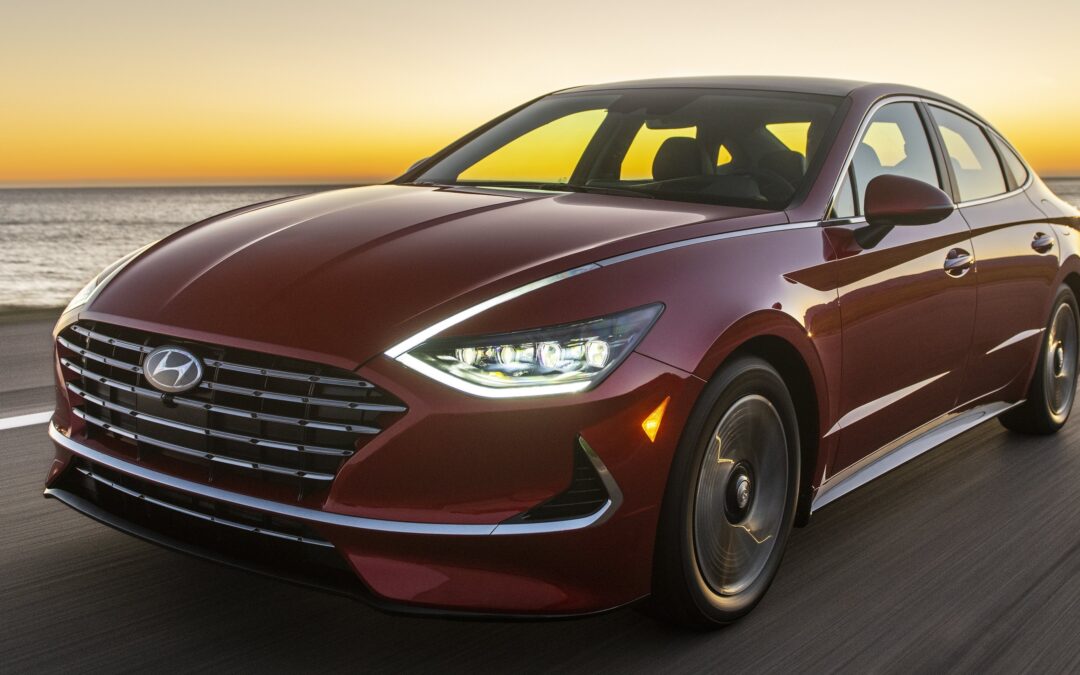
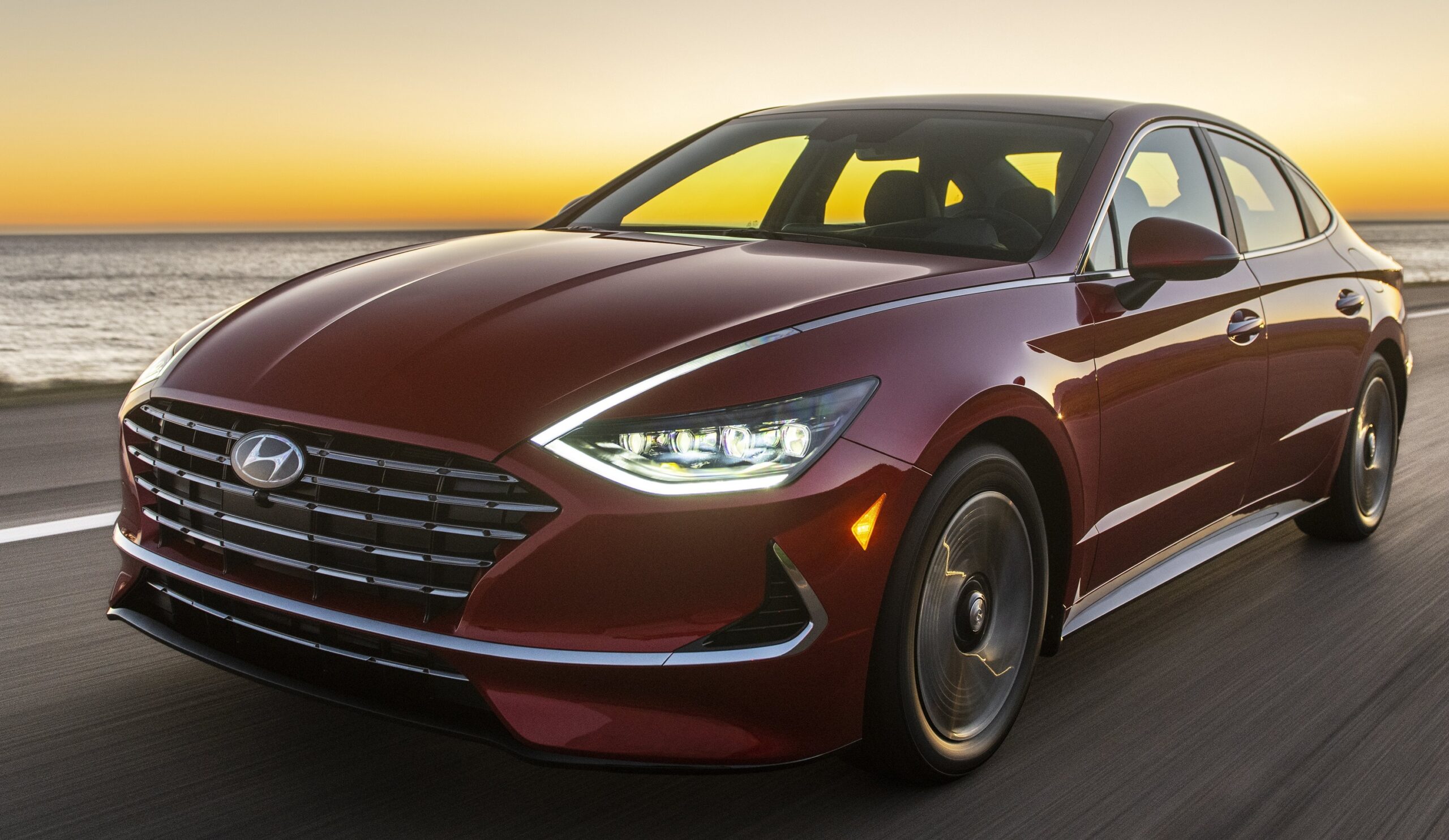
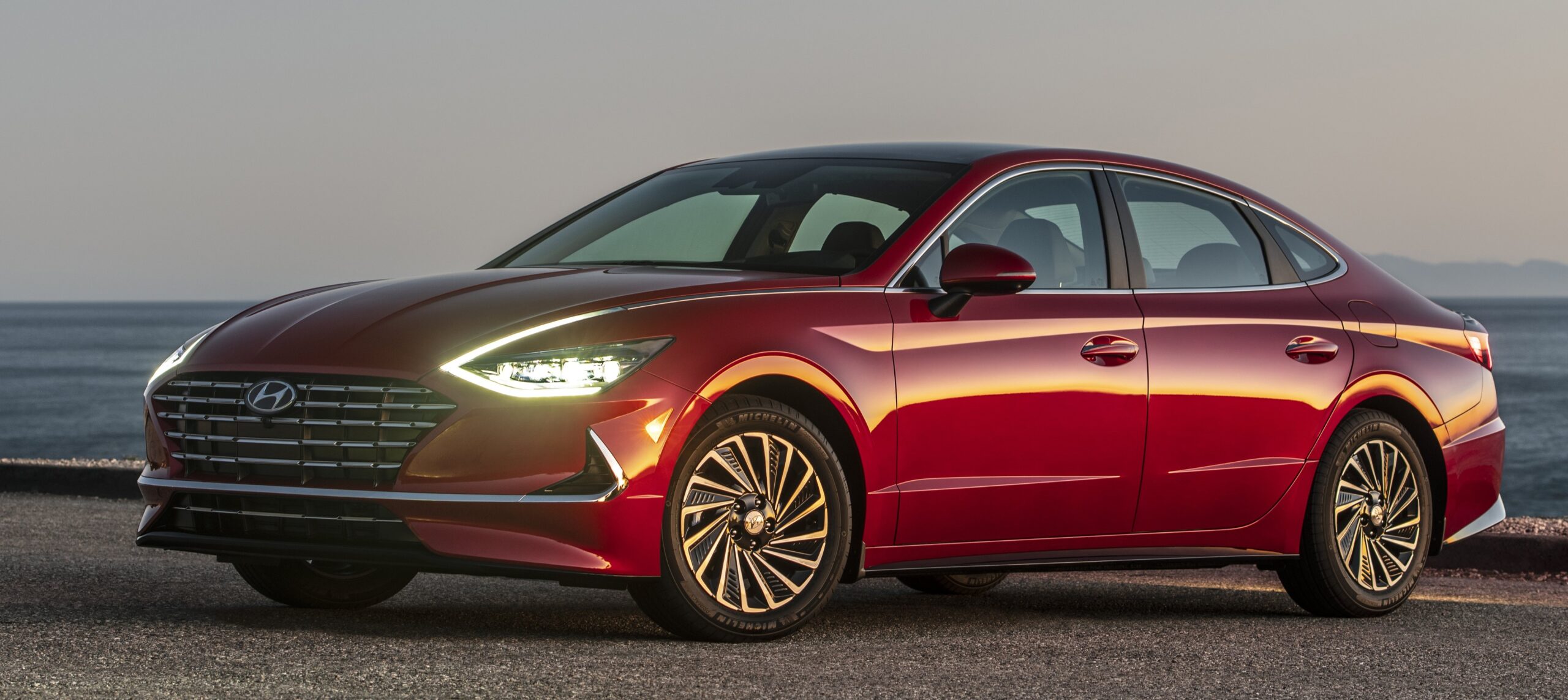
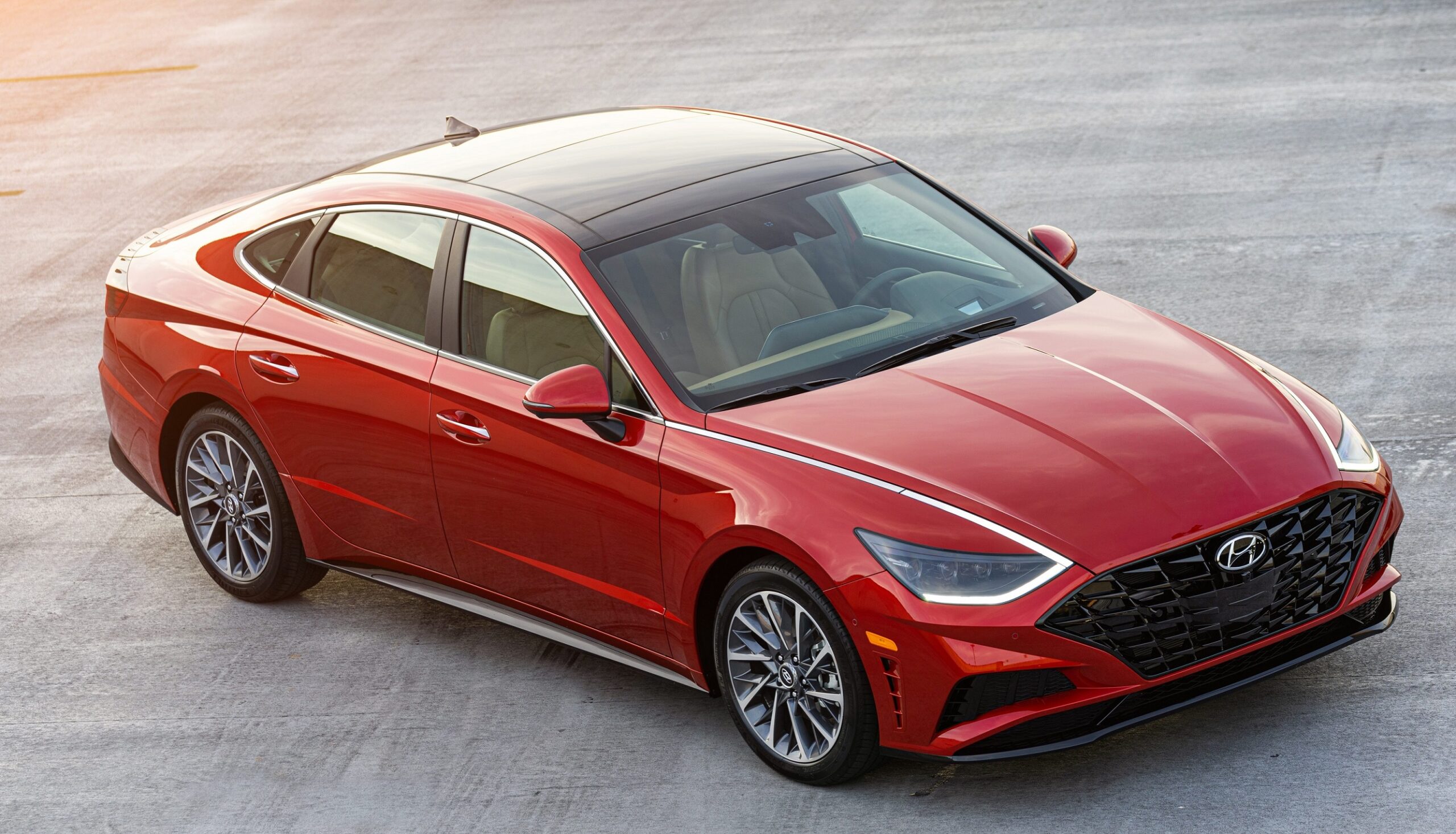
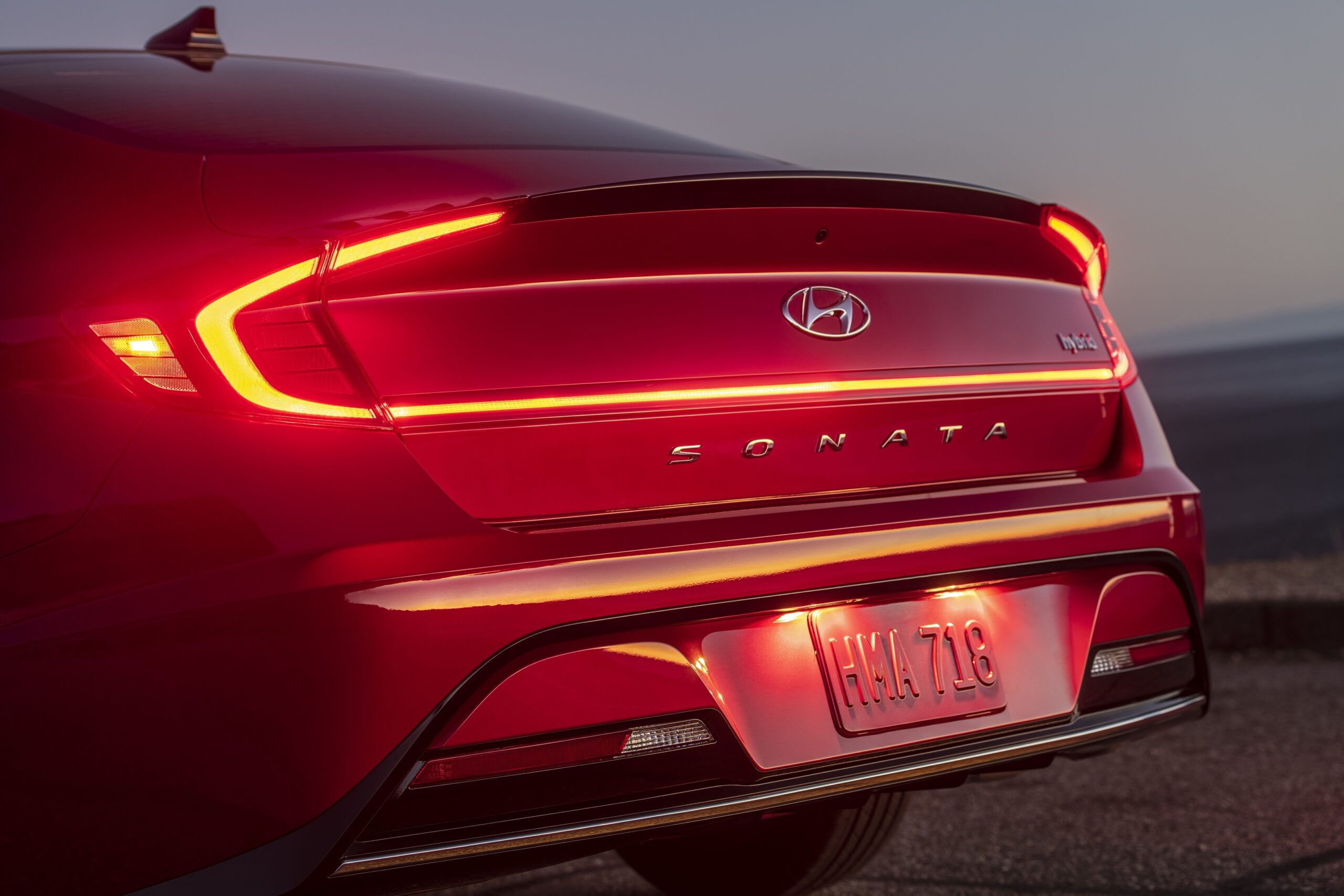
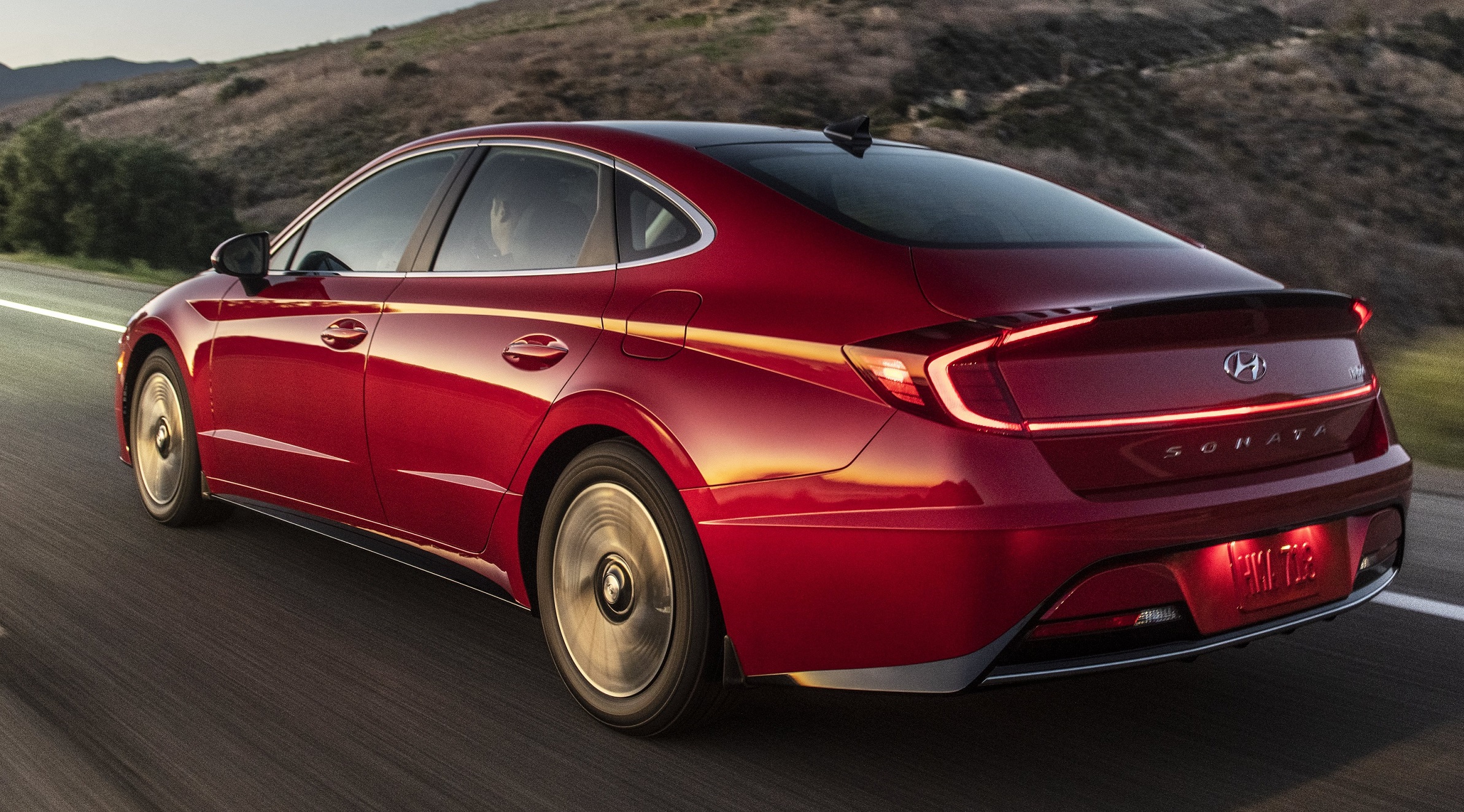
The Sonata Hybrid is sold in three trim levels with starting prices of $28,725, $30,965 and $36,275, including the $975 freight charge from Asan, South Korea. (Hyundai)
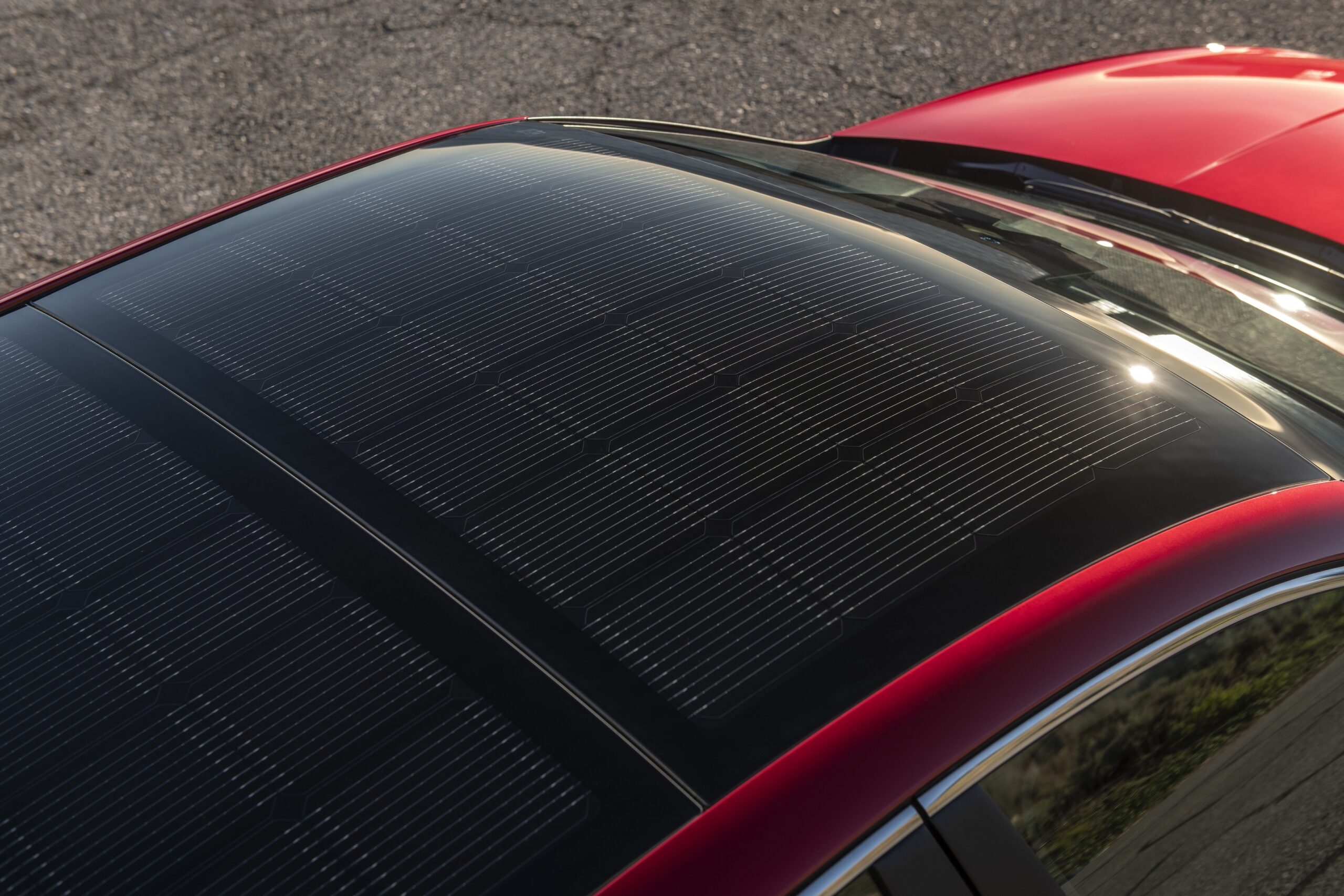
Hyundai went through the roof to maximize fuel economy for its redesigned Sonata Hybrid sedan. The completely re-engineered sedan debuts a solar roof system that recharges the engine-cranking 12-volt battery and the hybrid battery. Depending on region, the sunlight system could provide around 1,200 miles of free driving, such as in Southern California, Hyundai says, or more like 600 miles a year, or 2 miles per day on average, in less sunny parts of the country.
The goal of the solar roof is to help the car stay in EV mode longer. Starting off from a standstill, the fully charged hybrid battery allows a takeoff on electric power rather than firing up the engine, which saves fuel. And, especially useful, the system acts as a tender to the 12-volt battery so when the car sits for two to three weeks, the onboard electronics for anti-theft and sensor systems will not drain the battery — as long as the car is parked outside. That will be a relief to owners who are not driving as much now or for those who park at remote airport lots for extended travel.
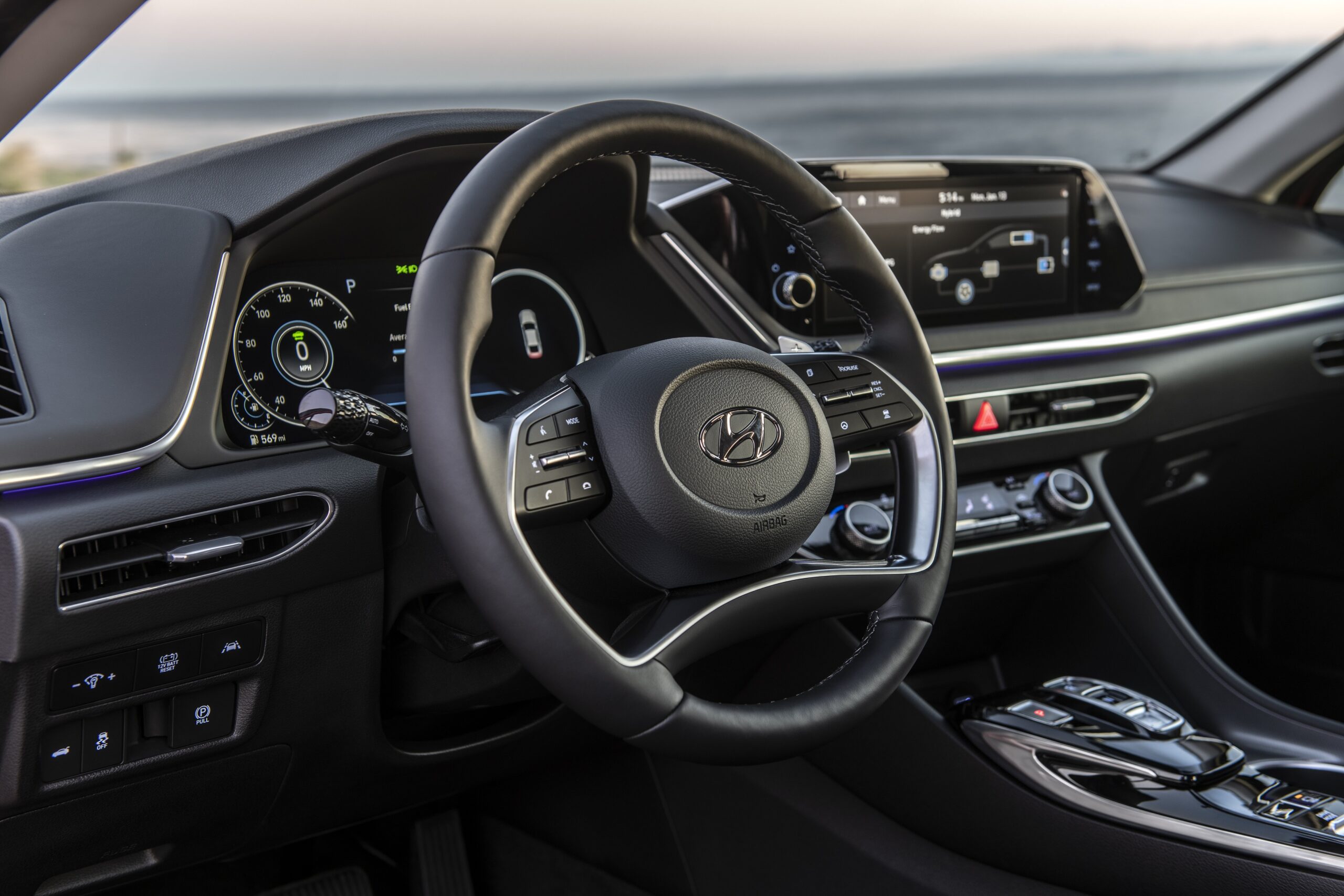
In the Limited, the driver faces a 12.3-inch digital gauge array with configurable panels. (Hyundai)
A full 13.2-gallon tank could allow a driving range of 660 miles. (Hyundai)
System Check
The system first charges the 12-volt battery (fully charged in about two hours) and then the hybrid pack. If the driver manages to kill the battery, there is a dashboard button—“12V Batt Reset”—that will give a jump of current, pulling from the hybrid battery.
Hyundai says the new hybrid model delivers up to a 24 percent increase in fuel economy over the prior generation.
The new body style, with help from a range of aerodynamic add-ons, has a sleek drag coefficient of 0.24, which compares to 0.25 for the Toyota Camry Hybrid and Honda Accord Hybrid, the two main sedan competitors. And even the standard gas-powered Sonata has a sleek drag of 0.27.
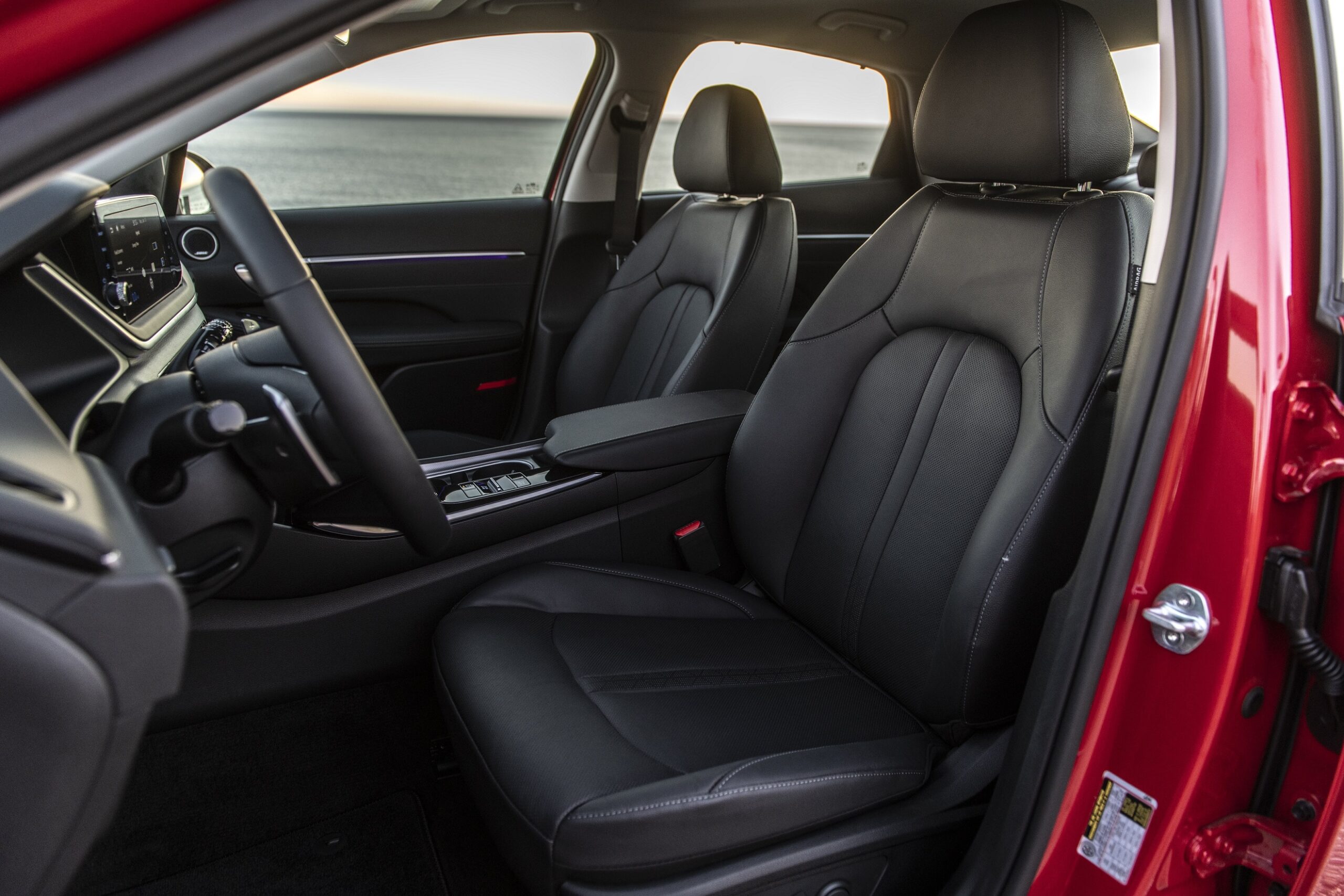
The front seats have a robust design and comfortable support for the big-and-tall driver. (Hyundai)
‘Smaht Pahk’
And for those who saw Hyundai’s Super Bowl commercial for “smaht pahk” remote parking (Smart Park), you can’t get that feature on the Sonata Hybrid. With all the electronics it’s another layer of complexity that Hyundai chose not to adapt. But since the feature debuted a glitch was discovered that did not always stop the car as programmed, despite a fail-safe function. It was a software issue that Hyundai says has been corrected.
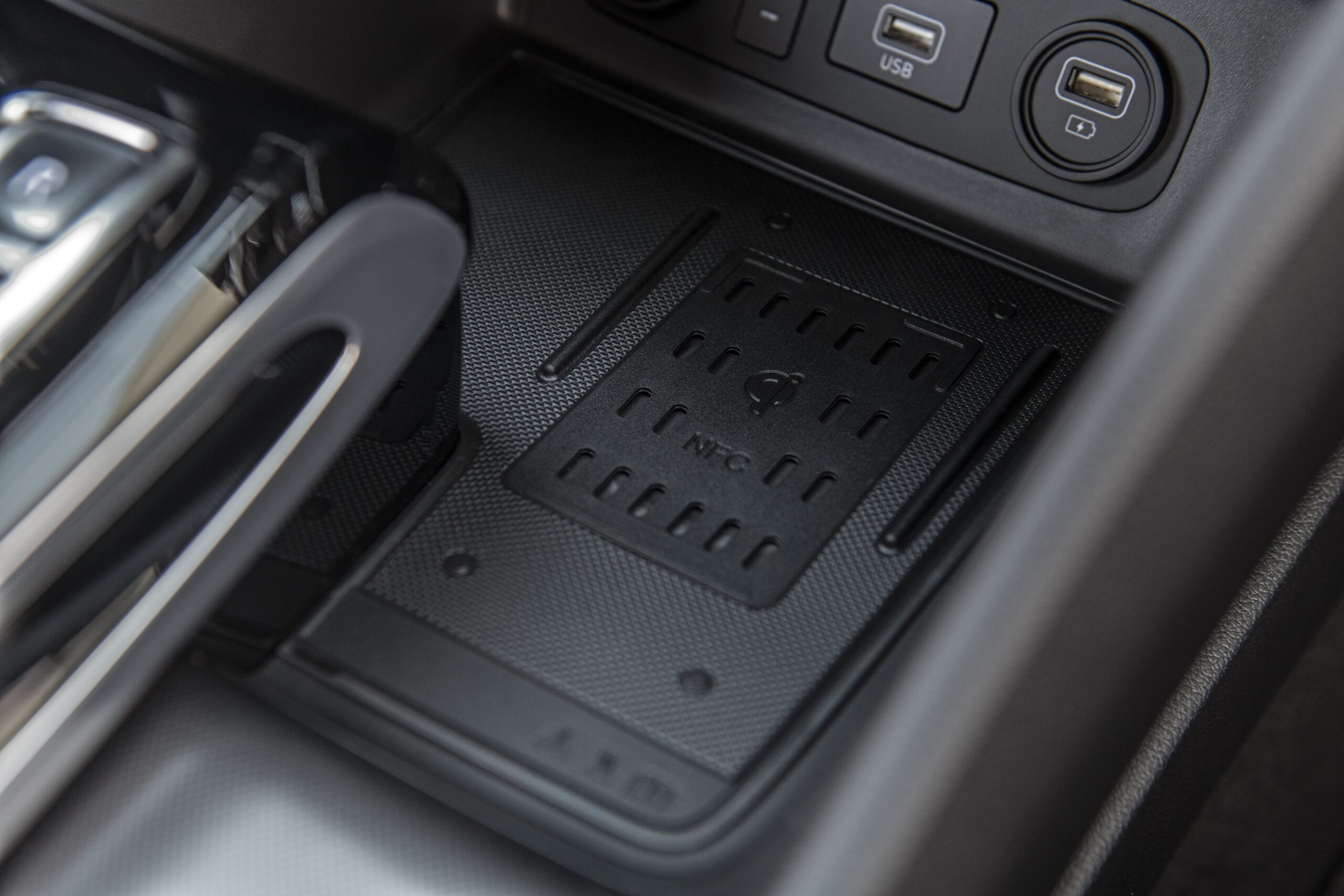
The wireless charging pad is large enough for the latest billboard-class phone. (Hyundai)
2020 Hyundai Sonata Pricing
The redesigned Sonata Hybrid is everything a contemporary driver would want in a new midsize sedan if he or she wanted a four-door car. As well done as it is, the preferred body style today is an SUV crossover. But there could be some equalization in pricing — sedans cost less than SUVs.
The six-speed automatic transmission has performance modes of Smart, Eco, Sport and Custom. (Hyundai)
The Sonata Hybrid is sold in three trim levels — Blue, SEL, and Limited — with starting prices of $28,725, $30,965, and $36,275, including the $975 freight charge from Asan, South Korea. Today’s tester is the Limited with one option for carpeted floor mats, $155.
The base model is well equipped with such features as keyless locking and push-button ignition, advanced cruise control with stop-and-go function, hands-free trunk opening, locking glove box, rearview camera, and high-speed wireless smartphone charging pad, and LED lighting for headlights, running lights, taillights and interior with six-way adjustable front seats and fabric upholstery.
Electricity generated from the solar roof could provide around 1,200 miles of free driving in Southern California or about half as much in less sunny areas. (Hyundai)
Sonata Safety Features
Standard safety features include nine air bags, forward collision‐avoidance assist with pedestrian detection, blind‐spot collision‐avoidance assist with rear cross‐traffic alert, lane-keeping assist and high-beam headlight dimming. The Limited adds a blind‐spot monitor, highway driving assist (lane centering), and parking collision-avoidance assist rear.
The new vehicle warranty includes coverage of the hybrid battery with the powertrain for 10 years or 100,000 miles. The rest of the vehicle is covered for 5 years or 60,000 miles.
All Sonata models, except the entry model, include three years of complimentary Blue Link services.
The 205-watt solar roof system trickle-charges the 12-volt and hybrid batteries. (Hyundai)
Sonata’s Hybrid Powertrain
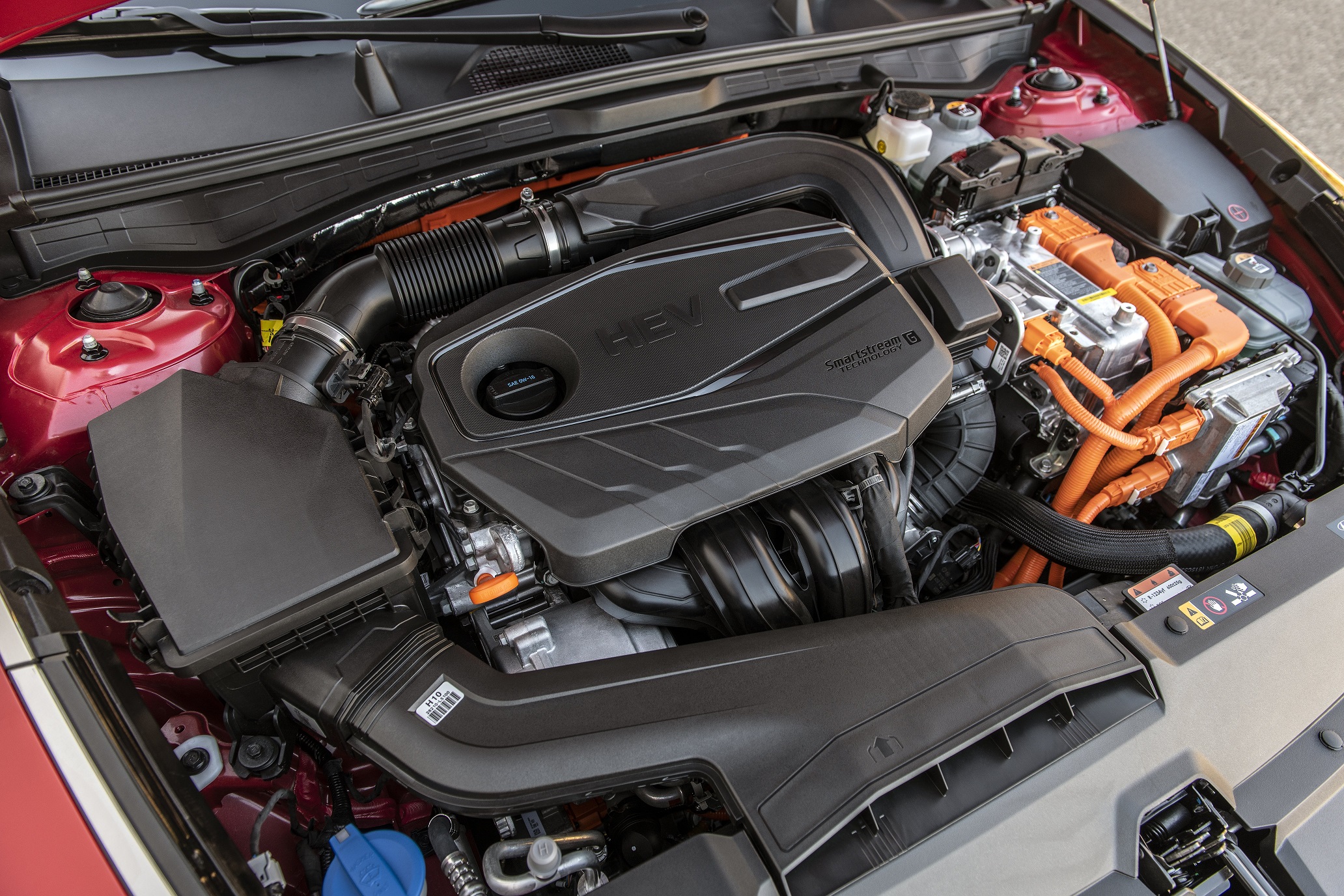
The front-wheel-drive hybrid powertrain integrates Hyundai’s Smartstream G2.0 direct-injection four-cylinder gas engine with a permanent magnet electric motor and lithium-ion polymer battery pack. Total system power adds up to 192 hp, or 150 hp from the ICE and 51 hp from the motor.
The six-speed hybrid automatic transmission (a refreshing alternative to the ubiquitous continuously variable automatic in most hybrids) has been optimized to reduce gear-shifting times by 30 percent. There are performance modes of Smart, Eco, Sport, and Custom, and while I sampled each, my preference was Smart mode for its responsive acceleration. Sport felt a little too jittery, and I was in pursuit of mpgs not performance driving.
Fuel economy estimates are 50 mpg city, 54 highway and 52 mpg combined for the Blue trim, on the recommended 87 octane fuel. The heavier SEL and Limited trims have ratings of 45/51/47 mpg. In highway driving, I noted 54 mpg, as decided by the onboard computer. With the 13.2-gallon gas tank, there will be a lot of commuting between fill-ups.
The solar roof is lighter than a panoramic glass sunroof (66 pounds versus 95), but it also means no sunroof option. At 3,350 pounds, the curb weight is just 194 pounds more than the non-hybrid Sonata.
Hyundai’s Smartstream G2.0 direct-injection four-cylinder gas engine is paired with a permanent magnet electric motor and a lithium-ion polymer battery pack. (Hyundai)
Sonata’s New Footprint
The re-engineering of the eighth-generation Sonata (first seen in the U.S. in 1988 for its second generation) is a little longer and lower on a stronger vehicle architecture. The size shift was enough to move it into the EPA’s large-car class, but it seems more of a large-midsize.
It was a ground-up opportunity to make the hybrid packaging more efficient, Hyundai says, which included moving the hybrid battery from under the trunk to under the back seat.
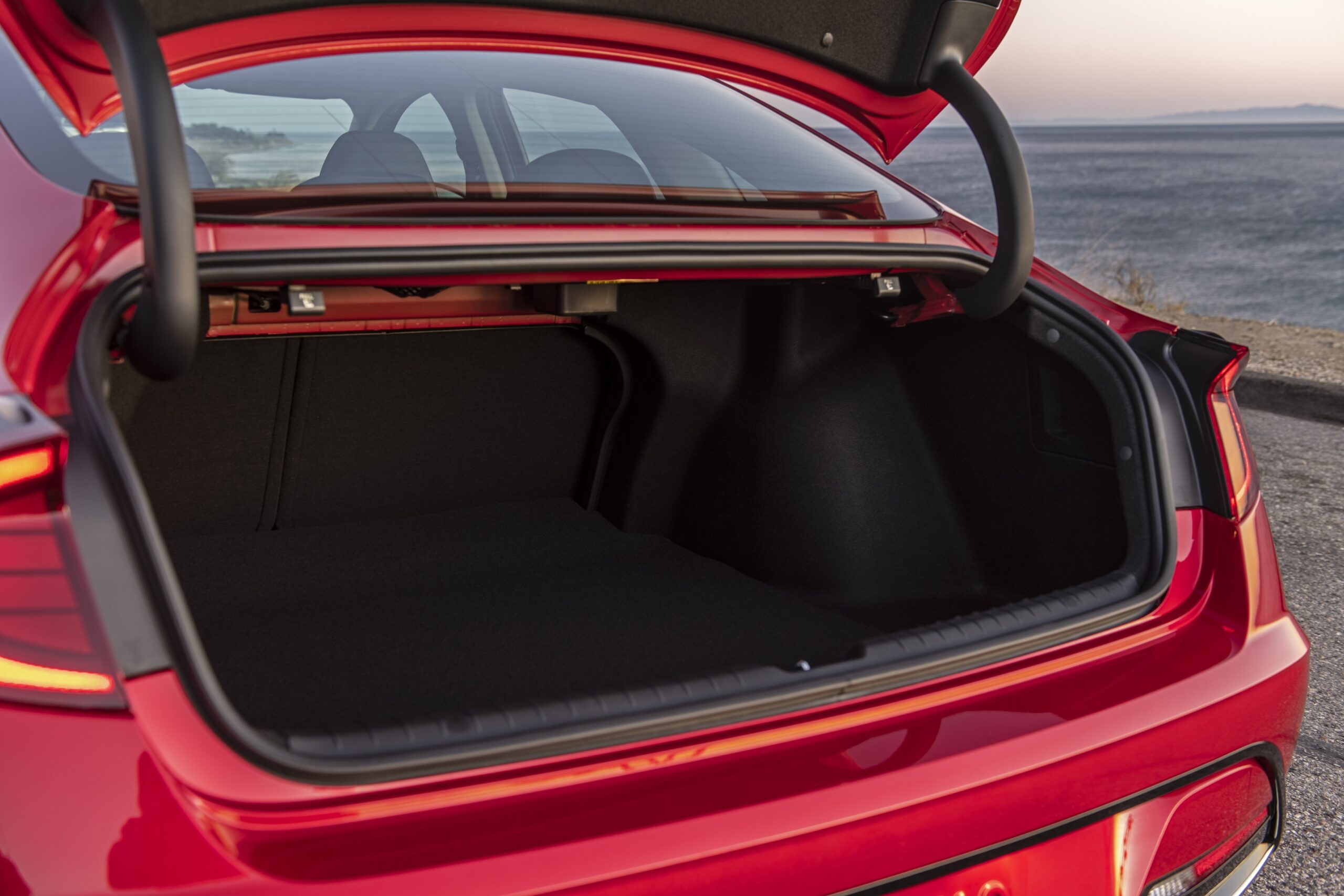
The placement allows a 60/40 folding back seat, preserves the large trunk space of 16 cubic feet and the more central location benefits vehicle balance and rotational control, Hyundai says. The battery sits at about the thigh point in the back seat and the fuel tank is under the butt zone.
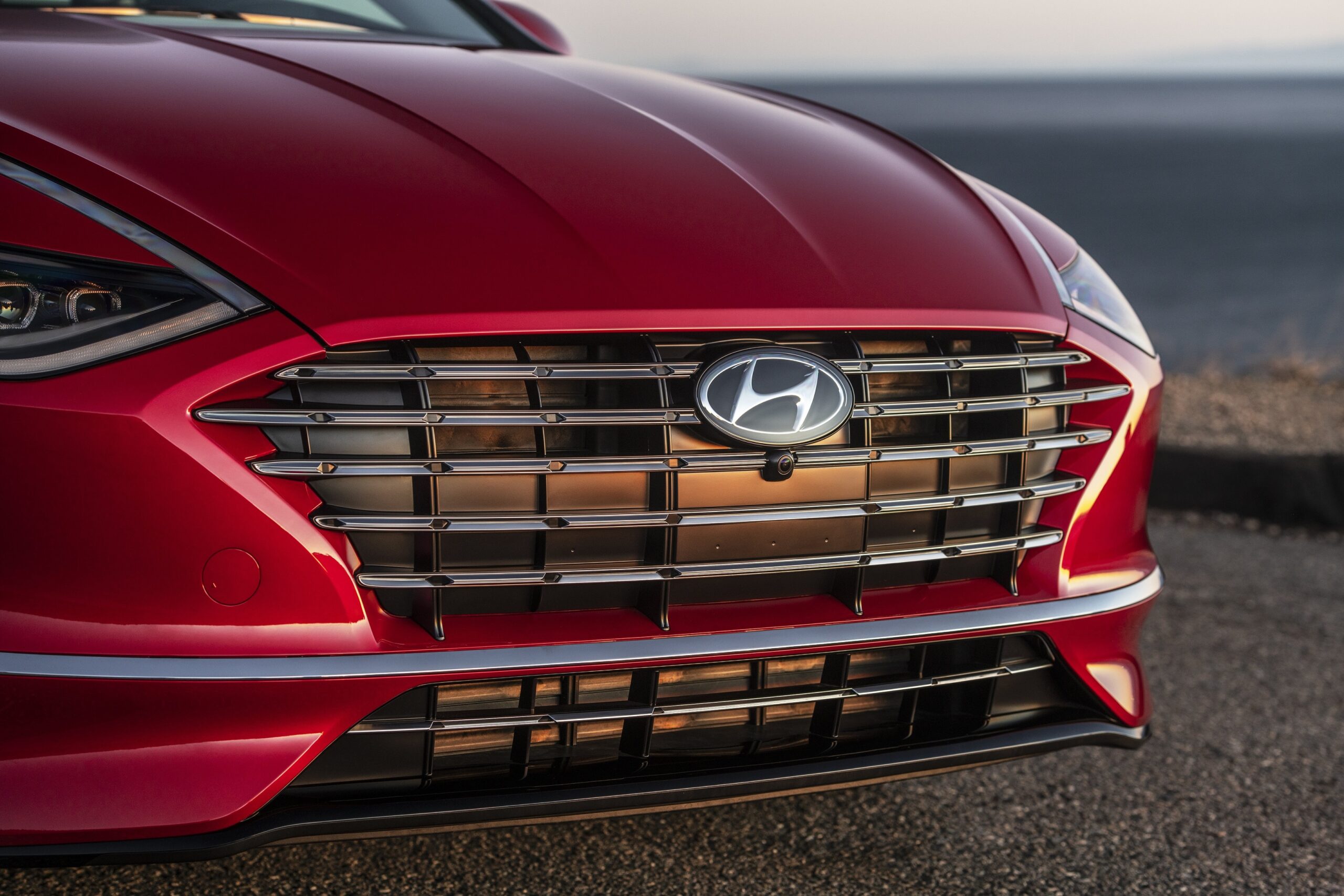
The design of the cross-hole grille works with three active air flaps in front of the radiator. (Hyundai)
Longer, Lower, Sleeker
Sizewise, the 2020 Sonata is 1.8 inches longer (192.9 inches) with a roofline lowered by 1.2 inches, now at 56.9 inches and the wheelbase is 1.4 inches longer, at 111.8 inches. The body width is nearly the same at 73.2 inches versus 73.4.
Typically, redesigned sedans are made a little lower and wider for aerodynamics to benefit fuel economy. Sometimes the lower roof cramps headroom and complicates the ease of entry and exit. But the dimensions of the Sonata preserve the tall front headroom of 40 inches and it just doesn’t feel as if you are riding close to the ground and looking up at taillights ahead. Also helpful are doors that open to nearly right angles and an innovative interior grab handle that is long and easy to grasp for optimum leverage. Often, door grabs are a hand-size grip that isn’t always at the best leverage point to control the door on opening and dinging the next car over.
Even with the longer wheelbase, the turning circle is still tight at 36.1 feet. And the regenerative braking has completely smooth engagement; some systems can have an initial on-off activation. The four-wheel disc brakes have 12-inch ventilated front rotors and 11.2-inch solid rotors rear.
Hyundai is pursuing more dramatic LED lighting displays, such as the Hidden Lighting Lamps that appear to be chrome when switched off and become dramatically lit when switched on. (Hyundai)
A wide horizontal LED strip connects each brake light. (Hyundai)
Soundproofing Maximized
Hyundai likely created the most soundproofed Sonata yet, though there is some tire hardness that is heard and felt at highway speeds. Otherwise, it rolls on carpet. Among the soundproofing tricks are improved carpet, advanced sound-absorption materials throughout the trunk and door trim and an acoustic windshield on all trims and laminated side glass on the SEL and Limited.
Cabin Function
While the Sonata Hybrid is electronically sophisticated, it does not require an advanced degree for the user to learn and enjoy. In the Limited, the driver faces a 12.3-inch digital gauge array with configurable panels, such as for fuel economy, map and more.
The front seat area has a clean design with clear access to controls. The 10.25-inch upper touch screen is to access radio and media, navigation, phone and apps. Climate controls, including for the heated and ventilated seats and the heated steering wheel, are just below on a separate tier — and just a finger-touch away.
The front seats have a robust design and comfortable support for the big-and-tall occupants. The steering wheel has meaty grip, wrapped in glove-smooth leather and neatly cross-stitched. Sliding visors have covered and lighted mirrors and the locking glove box is large enough to hold all the owner’s manuals.
Sightlines are completely open at the side mirrors and over the shoulder. The around-view camera system (overhead, front, and rear) is a welcome safeguard to avoid tapping the garage door or curbing the wheels when parallel parking.
The e-bin on the shift console is a handy hub with a 180-watt 12-volt plug, media USB, charging USB and a wireless charging pad large enough for the latest billboard-class phone.
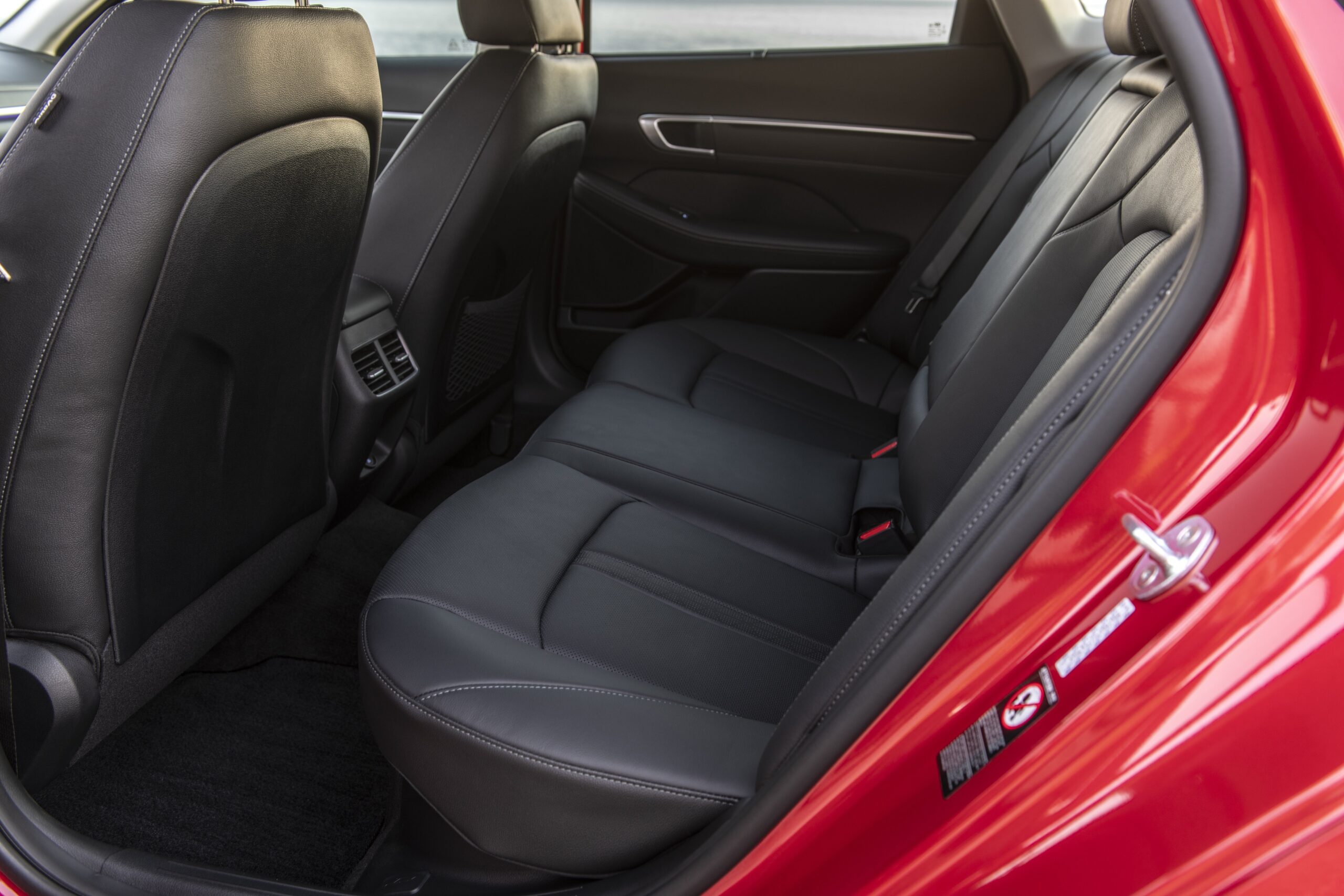
Back-seat space is adult-class for long thigh support and 34.8 inches of legroom. (Hyundai)
Improved Door Lock Sensors
Also improved were the door touch sensors for no-questions locking by touching the sensor on the outside of the door handle. This potentially solves the problem between using a chiclet-style button in the door handle, which gives an absolute response on locking, and the full sensor door handle, which sometimes must be rubbed, tapped, or smacked to get a response. And in that confusion, it’s not easy to know if the door is actually locked without pulling on the handle, which then unlocks the door. Aargh!
Owners can also opt for the smartphone-activated digital key. It uses Near Field Communication and Bluetooth technology to allow the car to be unlocked, started, and driven without a physical key.
Machine Learning
In my test week, I discovered a couple of interesting electronic messages.
While sitting in the idling car to take notes, a warning advisory popped up in the gauge display: “Vehicle will be turned off automatically” in a countdown of 30 minutes. Hyundai says this is to prevent accidental carbon monoxide deaths from people who accidentally leave a vehicle running in a closed garage.
And even better, there is a sort of a pay-attention-and-drive message. While waiting in traffic, with the adaptive cruise control engaged, the system will give an advisory message and tone to the distracted driver that reads “The car ahead is moving.” Or loosely translated, stop checking your phone and drive!
Trunk space is large at 16 cubic feet. (Hyundai)
Aerodynamics
Fuel economy is all about efficient airflow and Hyundai split hairs in the pursuit of mpgs. Among the tricks and techniques to calm the airflow:
Underbody bumper lip, front- and rear-wheel deflectors; undercovers in the front and back of the engine bay; center floor and rear undercovers.
Redesigned rear deck-lid spoiler.
The cross-hole grille design works with three active air flaps in front of the radiator. The shutters improve aerodynamics and reduce air resistance by closing on engine start-up and reopening gradually as needed for optimum airflow to cool the engine. At highway speeds, the shutters close to block too much air from entering and jamming up in the engine bay, which makes it harder to push the vehicle through the air, using more fuel.
Wheels and “green” tires have always been important in EV efficiency. The Sonata Hybrid’s wheels are actual alloy wheels, not wheel covers (aka hubcaps), that are aerodynamically designed and good—looking. The base model has 16-inch wheels, with 17s on the Limited. The tester’s Michelin Primacy all-season tires (215/55) have a fairly high (hard) treadwear rating of 540, which might explain some tire noise at highway speeds, but they have a 55,000-mile tread-life rating.
Why Buy the 2020 Hyundai Sonata Hybrid?
With an easily achieved 50 mpg on the commute, the Sonata Hybrid is a premium presentation without sacrifice of style, comfort and technologies. For $36K, this is the new benchmark for what to expect from a gasoline-electric hybrid.
The new Sonata hybrid delivers up to a 24 percent increase in fuel economy over the prior generation. (Hyundai)
2020 Hyundai Sonata Hybrid Limited Specifications
Body style: large-midsize, front-wheel drive 5-passenger sedan
Electric motor: Permanent magnet with 39 kW (51) hp from 1,800-2,300 rpm
Battery: 56 kW lithium-ion polymer, 270-volt max power
Total system power: 192 hp
Transmission: 6-speed automatic with electronic shift control
Fuel economy: 45/51/47 mpg; 87 octane
BY THE NUMBERS
Fuel tank: 13.2 gal.
Trunk space: 16 cu. ft.
Front head/leg room: 40/46.1 in.
Rear head/leg room: 37.8/34.8 in.
Length/wheelbase: 192.9/111.8 in.
Curb weight: 3,505 lbs.
Turning circle: 36.1 ft.
FEATURES
Standard Limited equipment includes: digital key locking and push-button ignition, solar roof panel, leather-trimmed upholstery, leatherette-wrapped dashboard, 10.25-inch navigation-infotainment touch screen, 12.3-inch digital instrument cluster, around-view camera system, front and rear parking sensors, electric parking brake (with automatic vehicle hold), 12-speaker Bose audio system, color head-up display, LED lighting (headlights, running lights, taillights and interior), 8-way power driver seat, 4-way power front passenger seat, power (heated) side mirrors with turn signals, heated and ventilated front seats, heated steering wheel, wireless phone and device charging, dual USB ports
Safety features on Limited include: 9 air bags, blind-spot monitor, lane-keeping assist, brake assist, stability and traction controls, high-beam headlight assist, 5 mph bumpers, highway driving assist, parking collision-avoidance assist rear
PRICING
Base price: $36,275, including the $975 freight charge. Price as tested $36,430.
Options on test vehicle: Carpeted floor mats $155
Where assembled: Asan, South Korea
Warranty: 5-years/60,000-miles bumper to bumper with roadside assistance; 10-years/100,000-miles powertrain and hybrid battery
The Nature Conservancy’s Kelp Initiative aims to establish the first-of-its-kind regenerative ocean farm on the North Coast of California. (Honda)
Honda and its Marine Science Foundation announced June 4 that it will support five U.S. research groups in their missions to preserve coastal areas threatened by climate change. The research projects, including an association with San Diego-based Scripps Institution of Oceanography, strive to promote harmonious interaction between humans and the ocean.
The Honda Marine Science Foundation annually awards up to $400,000 in grant funds to conservation organizations. The recipients for 2020 are California Sea Grant, North Carolina Coastal Federation, Oikonos Ecosystem Knowledge, Orange County Coastkeeper and the Nature Conservancy.
Living shorelines also improve water quality, provide habitat for marine species and help to protect against erosion, Honda Marine Science Foundation board member Raminta Jautokas said in a statement.
“Our 2020 grant recipients are pioneering coastal preservation techniques that are showing great promise in efforts to restore our most vulnerable marine habitats,” said Jautokas.
About the grant recipients
Dune restoration guidebook for Pillar Point living shoreline: California Sea Grant is launching a project to help communities in the state implement dune restoration to increase coastal resilience. Led by Sea Grant extension specialists at Scripps Institution of Oceanography at the University of California San Diego, the project will develop a best-practice guidebook for monitoring and maintenance of the upcoming Pillar Point West Trail Living Shoreline Project in San Mateo County. Many of the coastal dunes along California shorelines have been degraded by development and beach modifications. By restoring or enhancing these dune systems, coastal communities can reestablish natural habitat and increase protection from storm erosion and flooding — likely to be intensified with climate change.
Wanchese Village living shorelines demonstration lab: The Wanchese Seafood Industrial Park is a 53-acre hub of commercial activity for the community. To limit erosion and support the marsh complex, North Carolina Coastal Federation will build a series of five living shoreline sills — low-profile barriers made from stone or shells — to provide shoreline stabilization and protection opportunities. The 500-foot-long project is designed to combat erosion, improve water quality and provide a living laboratory experience for visitors.
Enhancement of coastal habitat at Año Nuevo Island: Año Nuevo Island near Monterey Bay, Calif., once home to an 1800s-era lighthouse station, is now habitat for an astonishing diversity of wildlife and is a critical breeding ground for seabirds and marine mammals. To protect the island’s habitat and biodiversity, Oikonos Ecosystem Knowledge will apply natural approaches to stabilize the soil, promote native plant cover, and provide safe ceramic homes for nesting seabirds.
Regional living shoreline strategies: To address the loss of nearshore wetland habitats along the California coast and explore the best restoration methods, Orange County Coastkeeper is restoring eelgrass and native Olympia oyster beds in a unique living shoreline design in Newport Beach, Calif. Utilizing ecological data and costs-to-date information, the coastkeeper and partners will determine how restoration can scale up from research projects within a bay to regional-scale restoration projects in Southern California.
The Orange County Coastkeeper is restoring eelgrass and native Olympia oyster beds in what it calls a unique living shoreline design in Newport Beach, Calif. (Honda)
Regenerative kelp farms: The Kelp Initiative by the Nature Conservancy works to establish the first-of-its-kind regenerative ocean farm along the northern coast of California. Healthy kelp forests support nearly a thousand marine species. Due to climate-driven changes, the northern coast region has lost more than 93 percent of its kelp forests in the last decade. This project will restore multiple acres of kelp forests, validate the potential of regenerative ocean farming and bring back the productivity and biodiversity of the ecosystem while providing economic opportunities for coastal communities.
To learn more about Honda Marine Science Foundation and how to apply for grant funding, visit marinescience.honda.com.
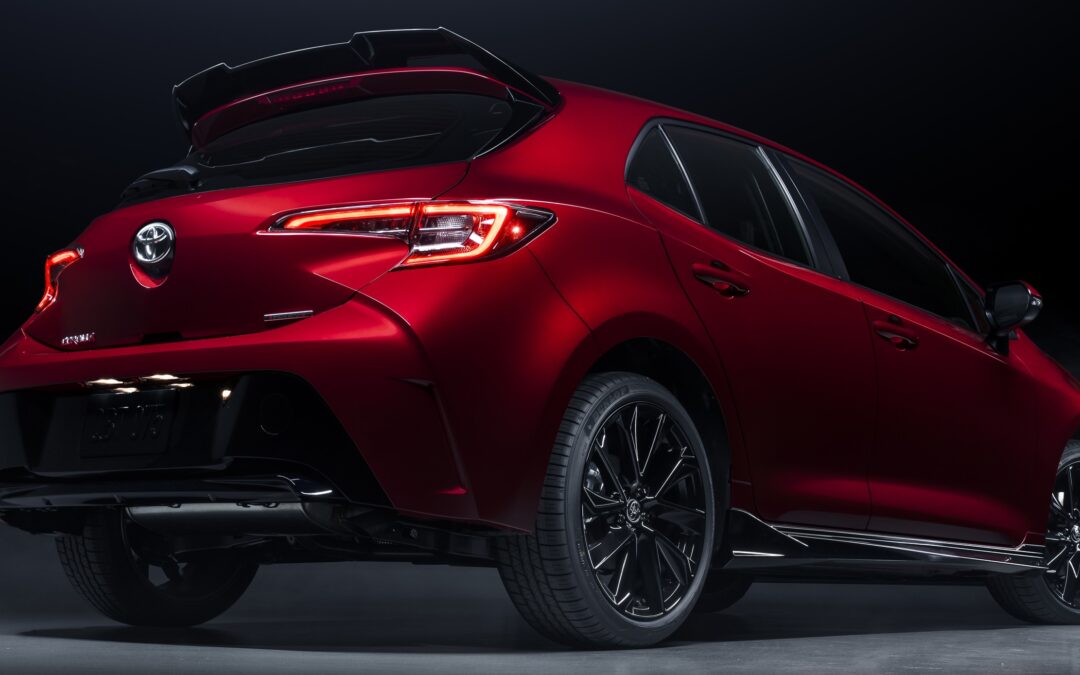
The Special Edition Toyota Corolla hatchback in Supersonic Red paint and a body kit. (Toyota)
Special Edition Toyota Corolla hatchback gets red-hot Supersonic Red paint and body kit
Fireworks displays this summer might be socially distanced or even socially unacceptable, but Toyota just lit the fuse on a Corolla hatchback special edition that should get some attention, in Supersonic Red. On sale in late summer, the special edition will be limited to 1,500 hatchbacks, all in the unique metallic paint color.
The package adds $3,100 to the $21,565 MSRP of the Corolla SE with CVT. (Toyota)
Special features include black-painted 18-inch alloy wheels and a body kit that adds a splitter in the lower front fascia, side skirts, black rear roof spoiler and Special Edition badging.
The package adds $3,100 to the $21,565 MSRP of the Corolla SE with continuously variable transmission. Find 2020 Toyota pricing here.
Black-painted 18-inch alloy wheels are among the package features.
Special Edition Corollas (and the top-line XSE model) roll with the “big” engine choice: a 168-horsepower, direct-injected 2.0-liter four-cylinder engine with 151 foot-pounds of torque 4,400 rpm. The SE comes with the Dynamic Shift CVT (continuously variable transmission), but other models are available with a six-speed manual. CVT fuel economy ratings are 31 mpg city, 40 highway and 34 mpg combined, on 87 octane.
Standard equipment for the Corolla Hatchback SE includes automatic climate control, leather-wrapped shift knob and, with the optional CVT, paddle shifters, an electronic parking brake, three-door SmartKey locking system, automatic up and down windows and two front USB ports. The six-speaker audio system includes an 8-inch touch screen with Apple CarPlay, Android Auto or Amazon Alexa infotainment.
Slim, J-shaped bi-beam LED headlamps wrap into the front fenders and all-LED taillamps have a diffusing inner lens designed to accent the car’s stout stance, Toyota says.
2021 Corolla updates All 2021 Corolla Hatchback models now have rear seat-mounted side air bags, bringing the bag count to 10. Other safety updates include Rear Cross Traffic Alert with Blind Spot Monitor standard on the XSE trim level, and optional for the SE grade with the SE Preferred package.
The black rear roof spoiler. (Toyota)
Also standard is the Toyota Safety Sense 2.0 suite of driver-assist technologies: • Pre-collision system with daytime and low-light vehicle and pedestrian detection, with daytime bicyclist detection • Full-speed-range dynamic radar cruise control (CVT only) • Lane departure alert with steering assist • Automatic high beams • Lane tracing assist (CVT only) • Road sign assist
The GLB is sold in front- or all-wheel drive with a turbocharged 2.0-liter four-cylinder engine and eight-speed dual-clutch, automated-manual transmission. (M-B)
More utilitarian in its mission, the GLB introduces a different style from what might be expected of a Mercedes-Benz
Mercedes-Benz is working its way through the alphabet for its lineup of SUVS, with nameplates of GLA, GLB, GLC, GLE, GLS and the mighty G-Class. Including the so-called “coupe” body-style variants, there are eight SUVs in the lineup, from subcompact to compact, midsize, full-size and full-size plus. Globally, one in three Mercedes-Benz cars is now an SUV, and one in four is a compact model.
The company is following the trend of SUVs as a preferred body style, particularly in the U.S., where there is growing demand for vehicles that can tote six or more passengers.
In the last year, Mercedes-Benz has refreshed its entire SUV lineup — and added its latest delivery, the compact-class GLB, today’s tester. It is sold as a five- or seven-seater, which is just an $850 option for the pair of 50/50 third-row folding seats.
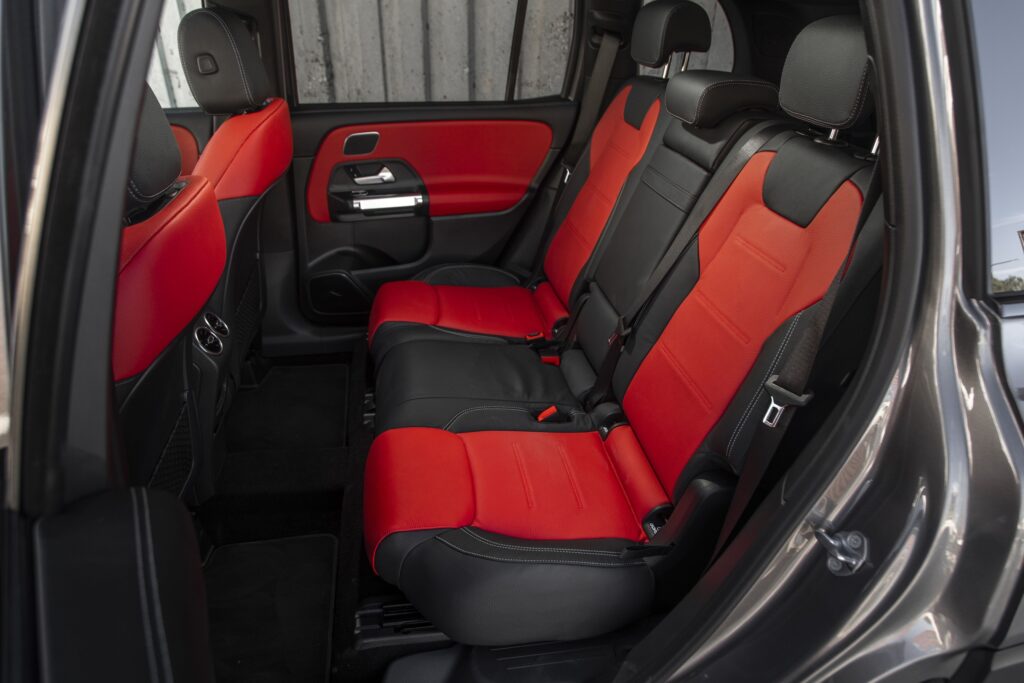
The M-B Tex upholstery looks leatherlike but without the tenderness of the real thing. The seats are European-firm and might feel hard to some after a couple hours on the road. (M-B)
Pricing
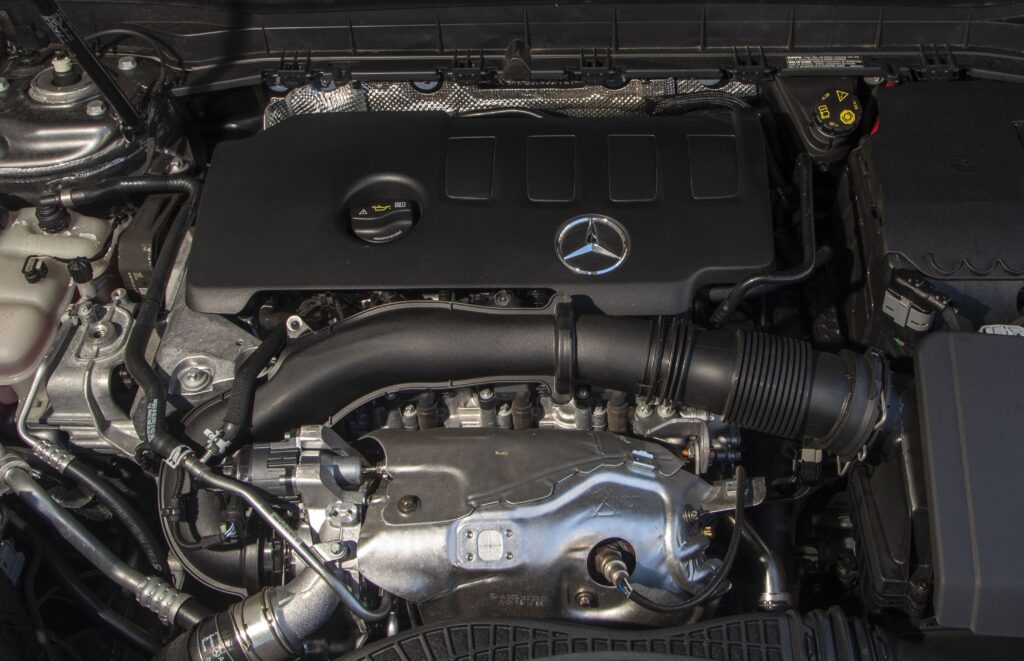
The GLB is sold in front- or all-wheel drive with a 221-horsepower, turbocharged 2.0-liter four-cylinder engine and eight-speed dual-clutch automated manual transmission.
Expected later this year will be a higher-performance Mercedes-AMG GLB 35, with 302-hp version of the turbocharged 2.0-liter engine. Follow its progress here. https://www.mbusa.com/en/future-vehicles/2021-glb-35
The front-drive GLB 250 starts at $37,595, including $995 freight charge from Aguascalientes, Mexico. The GLB 250 4Matic starts at $39,595.
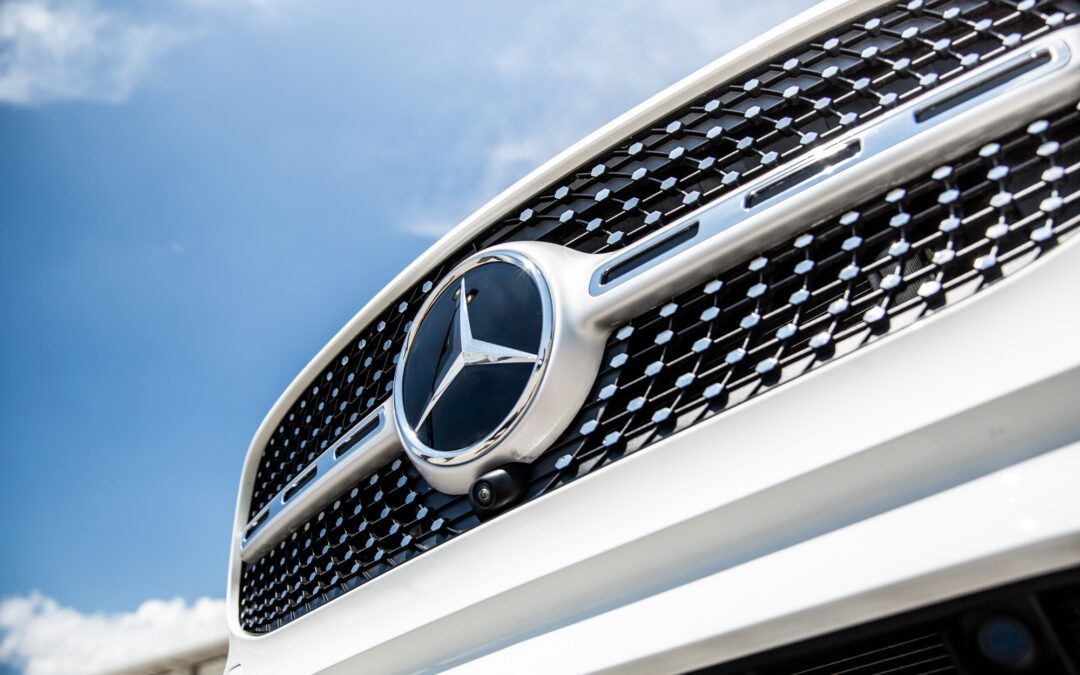
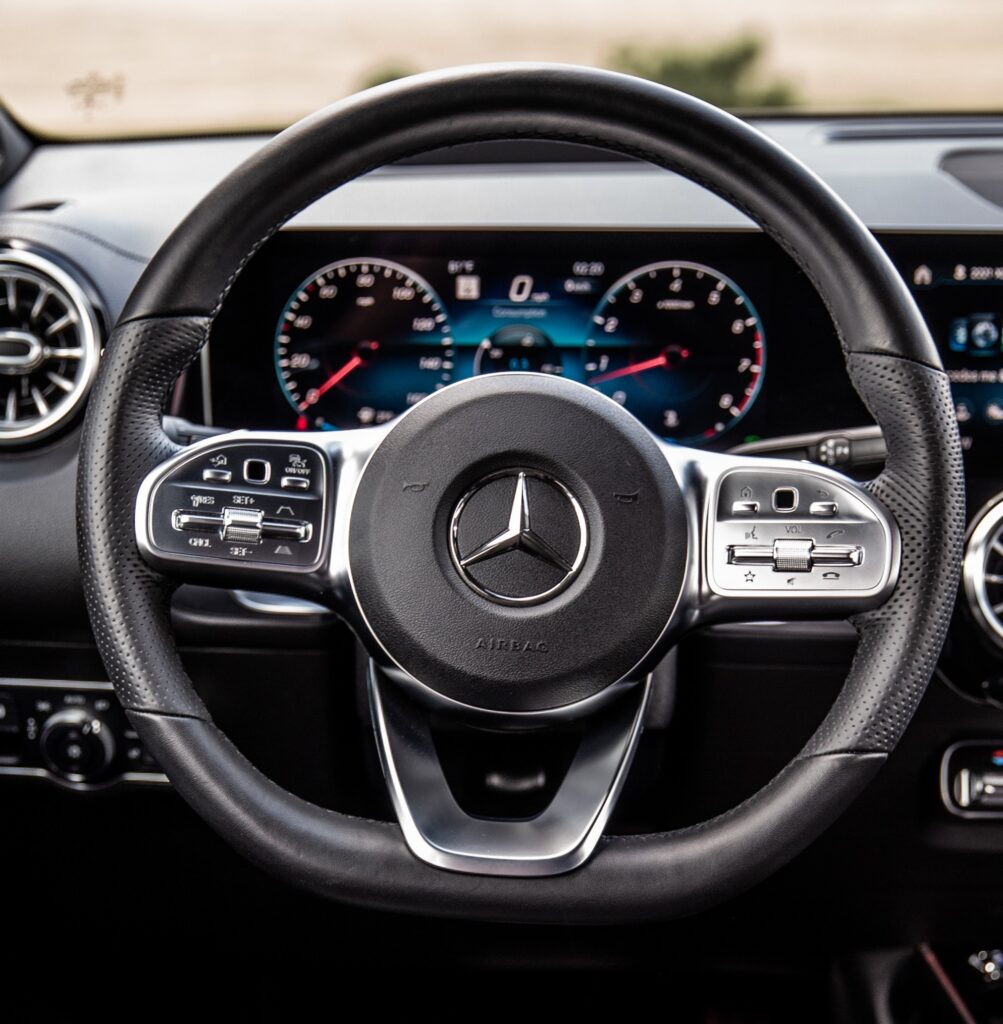
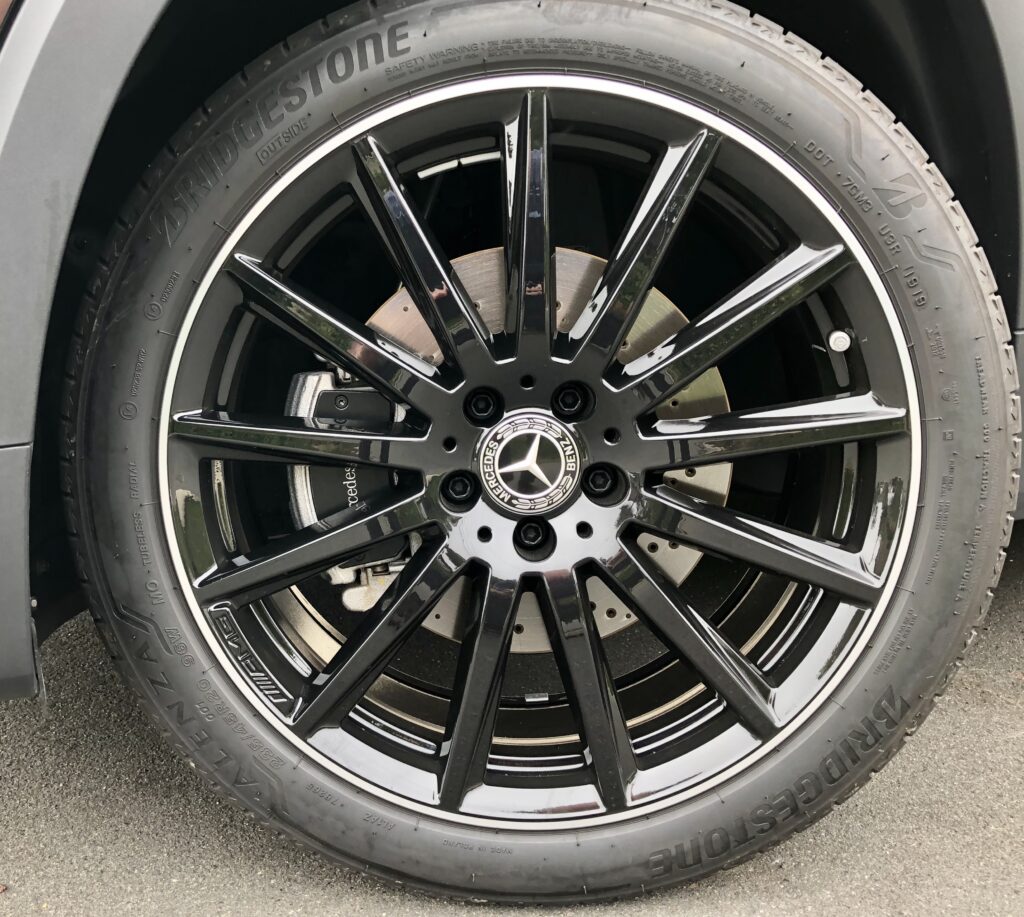
With options, the front-drive tester came to $49,050 and was equipped with several AMG-line style elements, such as the sport steering wheel ($360), 20-inch alloy wheels ($1,050) and a body kit of a front air dam, flared side sills and deep rear valance with a diamond-block grille, perforated front disc brakes with M-B lettering.
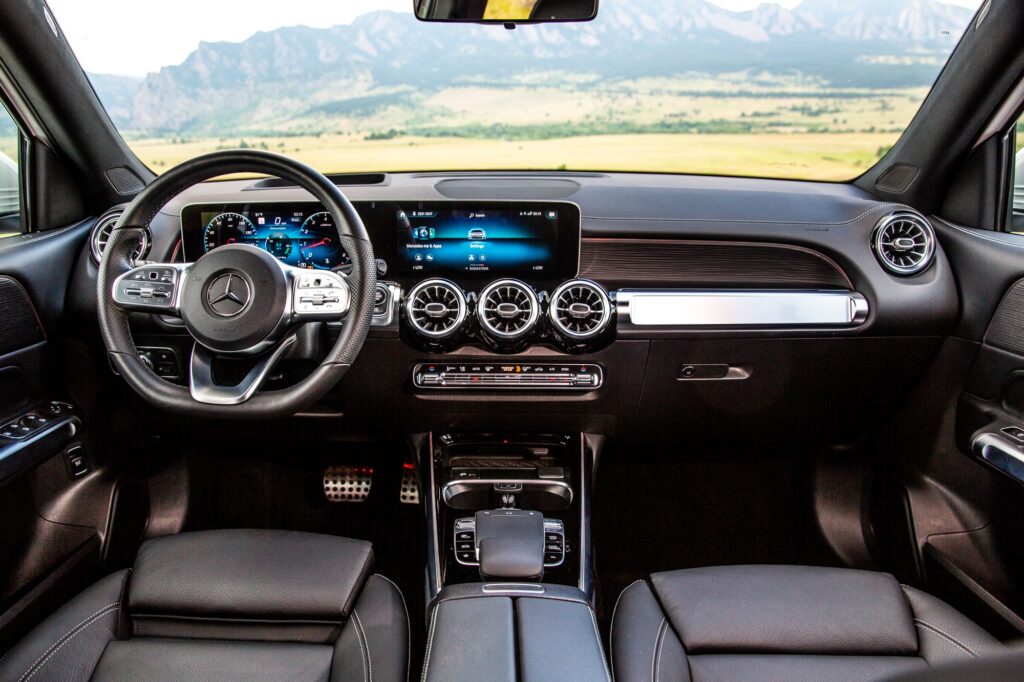
The optional dual 10.25-in high-resolution screens are an easy visual presentation of features, settings and themes. (Kristine Higgins)
Not the usual
The GLB is different from what might be expected of Mercedes-Benz as the purveyor of luxurious finery. While the GLB has the credibility of Mercedes engineering and solid quality, it is more utilitarian in its mission, which is appropriate for this class of small SUV. It is less pretentious in presence and function.
It is an upright body style, which maximizes interior room for people or cargo. But because of its more-blunt shape and roof rails, punching through the air at highway speeds isn’t as quiet in the cabin as might be expected of a Mercedes. The chassis, however, feels very solid, almost over-engineered, for potential off-road durability.
At 111.4 inches, the GLB’s wheelbase is 5.1 inches longer than the GLA and 1.7
inches shorter than the GLC. Headroom is quite tall for a compact vehicle at almost 41 inches (with the sunroof) with front-seat legroom of 41.4 inches, typical for the segment.
The AMG sport steering wheel ($360) is worth the cost for its reassuring and comfortable fit. (M-B)
As a seven-seater, the third-row provides occasional use for small people with a snug 29.1 inches of legroom and 34.8 inches of headroom (The option is likely an incentive for global customers.). But the second-row seats have an easy-entry function for access to the pair of third-row seats, which include a pair of cup holders between the seats and two storage compartments, each with a USB-C port.
The second-row seats have fore-aft slide up to 3.5 inches or up to 8.7 inches with the third row. It is useful space flexibility for more legroom or more cargo space.
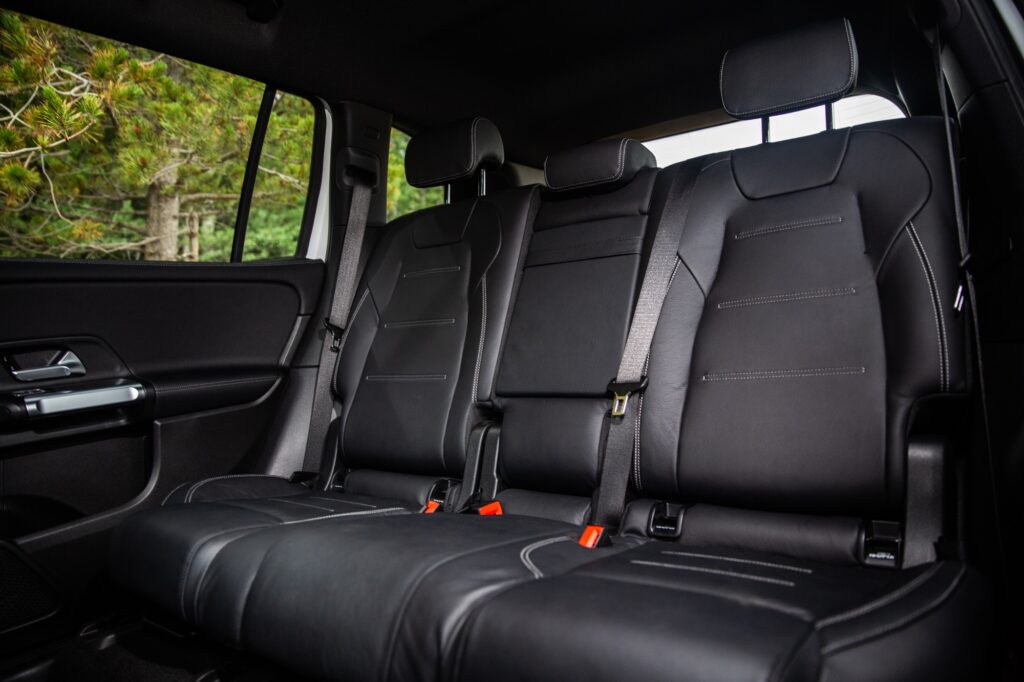
The second-row is raised with a smallish exhaust tunnel and a generous 38 inches of legroom and good footroom under the front seats. The seatbacks have nine settings of seatback recline, to help accommodate large adults or sleeping youngsters. A side window air bag protects the passengers in the third row.
20-inch wheels are set off by AMG Line perforated front discs. (Mark Maynard)
Functional style
It is a digital world inside, but not threateningly so for an analog type of driver. The optional “digital cockpit” is two 10.25-inch high-resolution screens with configurable displays and multimedia visuals. The central, horizontal touch-screen display is a finger’s reach from the steering wheel not complicated to access features, but changing settings and customizing themes should be done while parked.
The horizontal screen — rather than a deep vertical tablet — allows generous air flow from the three turbine-like vents below. The floor console (not a shift console) packages an e-bin and shelf for a wireless charging pad, cup holders and a wrist-rest to access the central controller for such functions as vehicle settings, navigation, phone and performance modes. The shift “lever” is a stalk on the steering wheel to electronically engage gears.
A side window air bag protects the passengers in the third row. (M-B)
Sightlines from the driver’s seat are open at the side mirrors and over the shoulder. The large back glass provides more visibility than some swoopier SUVs in this segment, which include the Audi Q3, BMW X1, VW Tiguan and Volvo XC40.
Shoulder room is fairly wide at 55.9 inches window to window and the entire interior space feels larger than a compact-class cabin.
The second-row is raised with a smallish exhaust tunnel and a generous 38 inches of legroom and good footroom under the front seats. (M-B)
There are number of areas for small-item storage, door-panel bottle holders and a large, locking glove box — and that’s not always easy to provide in compact space. But the visors are of modest depth, do not slide and leave gaps at the windshield pillars where morning and evening sun can glint through.
The M-B Tex upholstery looks leatherlike but without the tenderness of the real thing. The seats are European-firm and might feel hard to some after a couple hours on the road.
A smart design for the door skins extends over the door sills to prevent dirty scuffs on slacks or legs.
For almost $50,000, the tester didn’t include wireless charging, available for $200. But there are five USB-C charging and data ports.
But the adjustable suspension, $900, is worth it for the its adaptive damping, providing a truly comfortable ride, for a German-engineered car. Sport firms up the ride quality, but it is not harsh. And for $360 the flat-bottom AMG steering wheel will return years of pleasurable fit and feel.
In the last year, Mercedes-Benz has refreshed its entire SUV lineup — and added its latest delivery, the compact-class GLB. (M-B)
Powertrain
The 2.0-liter engine in the GLB 250 feels more powerful than is expected from a four cylinder. With 258 foot-pounds of torque pulling from 1,800-4,000 rpm, the engine fills big shoes. The transmission in standard mode gives mileage-calmed shifting, but sport mode removes any hesitance.
Mercedes’ engineering capably cancels the typical turbo lag and even the time-stealing launch of the dual-clutch automated manual transmission. The auto stop-start at idle function can be switched off, but the immediate response of the engine-restart makes it mostly unnecessary to do so.
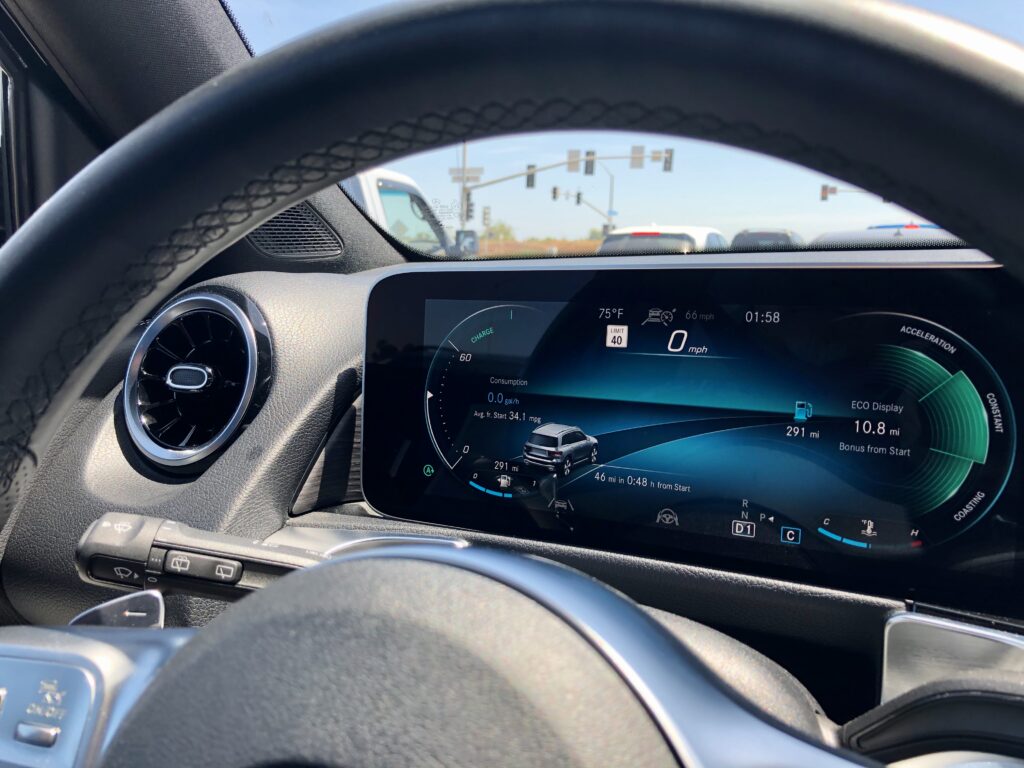
Official fuel economy estimates are 23 mpg city, 30 highway and 26 mpg combined, on the recommended premium fuel. (4Matic mileage is 23/31/26 mpg.) In the front-drive tester, I worked up to 34.1 mpg on the highway and had an overall average of 26.4 mpg, according to the onboard computer. The 15.9-gallon fuel tank gives a wide cruising radius.
Official fuel economy estimates are 23 mpg city, 30 highway and 26 mpg combined, on the recommended premium fuel. In the front-drive tester, I worked up to 34.1 mpg on the highway and had an overall average of 26.4 mpg, according to the onboard computer. (M-B)
Electronic oil-level check
It’s also interesting that the engine design has no dipstick to manually check the oil. The oil level is checked electronically through the vehicle’s onboard computer. The results are viewed in the multifunction display (in the gauges) of the digital cockpit. After the engine has warmed up for 30 minutes the system will respond with several messages including that the oil level is OK or if it is below minimum and how much oil to add or if the oil level is too full.
The large four-wheel disc brakes have 13-inch front rotors and 12.6-inch rotors rear. Towing is not recommended for the GLB.
Driver assists
The autonomous drive calibrations keep the car well centered in the lane with only occasional crossing of the Botts dots or white lines. And when it does, the system flashes a red steering-wheel warning light that somehow feels like an admonishment for me not paying attention when it was its own “hand” that crossed the line.
Overall, the support-assist is subtle and without alarming alerts but it will be made clear when driver takeover of steering is necessary.
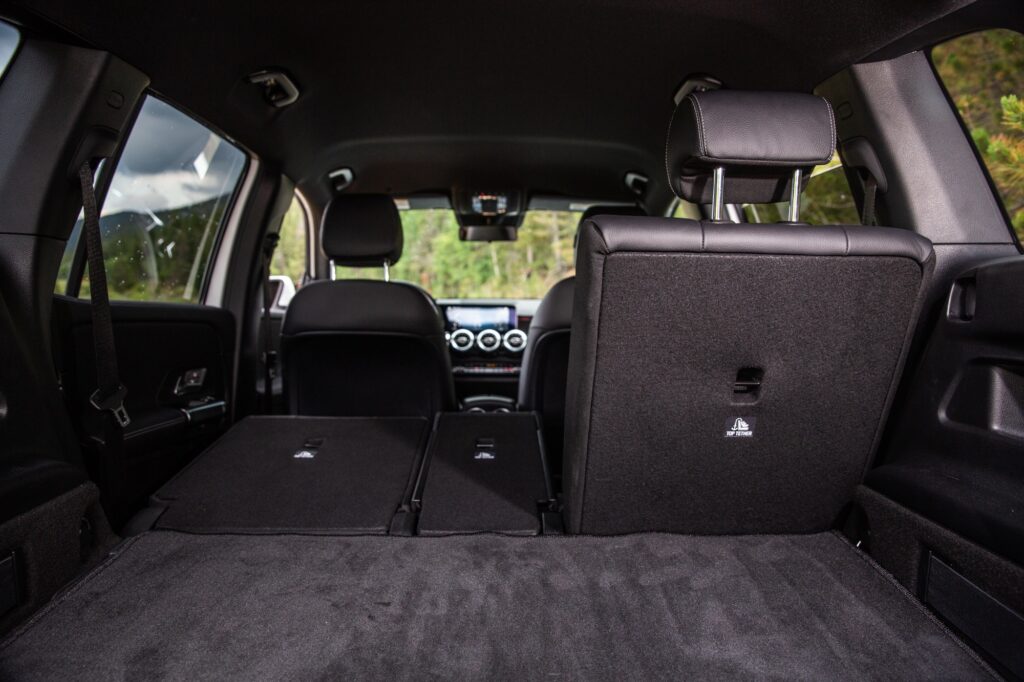
The two-level floor can be moved to the lower slot for another 4 inches of load height. (M-B)
Cargo
The rear quarters are cargo ready with a wide opening (42 ½ inches) and a low load-floor height. The two-level floor can be manually moved to the lower slot, which gives another 4 inches of load height. Or fold the back seat for about 6 feet of length.
Or in the floor’s upper position, the back seats can be folded flat fort 6 feet of length. (M-B)
Why GLB?
Compact SUVs are available from every manufacturer from mainstream to luxury. Pricing starts in the mid- to low-$30,000s for a very competent mainstream vehicle. But the difference between $50K and $25K is a lot of rewarding details. Among them, auto lock-unlock sensors for the back doors, not just the front; more meticulous engineering of door hinges for wider opening, nearly to right angles; a carpet-smooth ride; and uncompromising engine technology that transforms a 2.0-liter four-cylinder into a V-6.
The GLB shrugs off a precious luxury label and doubles up on everyday function as a fairly priced family vehicle — welcoming a new generation to the brand.
The GLB is all about versatility, Mercedes-Benz says, whether for young families or people with an active lifestyle. (M-B)
2020 Mercedes-Benz GLB 250
Body style: compact, 5- or 7-seat, five-door SUV, in front or all-wheel drive Engine: 221-hp, turbocharged 2.0-liter 4-cylinder w/auto stop-start at idle; 258 lb.-ft. torque from 1,800-4,000 rpm Transmission: 8-speed DCT (dual clutch) Fuel economy: 23/30/26 mpg city/hwy/combined; premium fuel recommended
SPECIFICATIONS Fuel tank: 15.9 gal. Cargo space: 24-62 cu. ft. (5.1 cu. ft. w/third row) Front head/leg room: 40.7/41.4 in. Rear head/leg room: 39.3/38.1 in. Length/wheelbase: 182.4/111.4 in. Curb weight: 3,638 lbs. *7-seat FWD, 3,759 lbs. Turning circle: 38.4 ft.
FEATURES Standard equipment includes: Keyless-start with push-button ignition, M-B Tex leatherette upholstery, rearview camera, power front seats w/lumbar and 3 memory presets, electric parking brake, 40/20/40 folding back seat, power liftgate, LED headlights-taillights and running lights, 5 USB-C ports, 7-inch Mercedes-Benz User Experience infotainment touch screen, touch-pad controller, Apple CarPlay or Android Auto apps, aluminum roof rails Safety features include: 7 air bags, active brake assist, adaptive braking, crosswind assist, attention assist, predictive brake priming, automatic brake drying, hill-start assist, brake hold, electronic stability and traction controls, front fog lights
PRICING Base price: $37,595, including $995 freight charge; price as tested $49,050 Options on test vehicle: Natural grain black Linden wood trim $325; AMG Line sport steering wheel $360; 20-inch AMG wheels $1,050; adaptive suspension $990; satellite radio trial $460; heated front seats $580; Driver assistance package, $2,250, includes active brake assist with cross-traffic function, active distance assist Distronic, active steering assist, active blind spot assist, active speed limit assist, active emergency stop assist, evasive steering assist, Pre-Safe Plus, route-based speed adaptation, extended restart in stop-and-go traffic; Multimedia package, $1,150, includes navigation with map updates for 3 years, MBUX augmented reality for navigation, speed-limit assist; Night package, $400, includes high gloss back grille, mirror covers and window trim; AMG Line body styling, $2,240, includes perforated front disc brakes and M-B lettering and diamond-block grille; Premium package, $1,650, 10.25-inch center touch screen display and 10.25-inch digital instrument panel, Keyless-Go package, auto-dimming rearview mirror and (folding) driver’s side mirrors Where assembled: Aguascalientes, Mexico Warranty: 4-years/50,000-miles bumper to bumper with roadside assistance; and 3 years of Mercedes Me connect services via smartphone app and over-the-air software updates and free map updates for 3 years
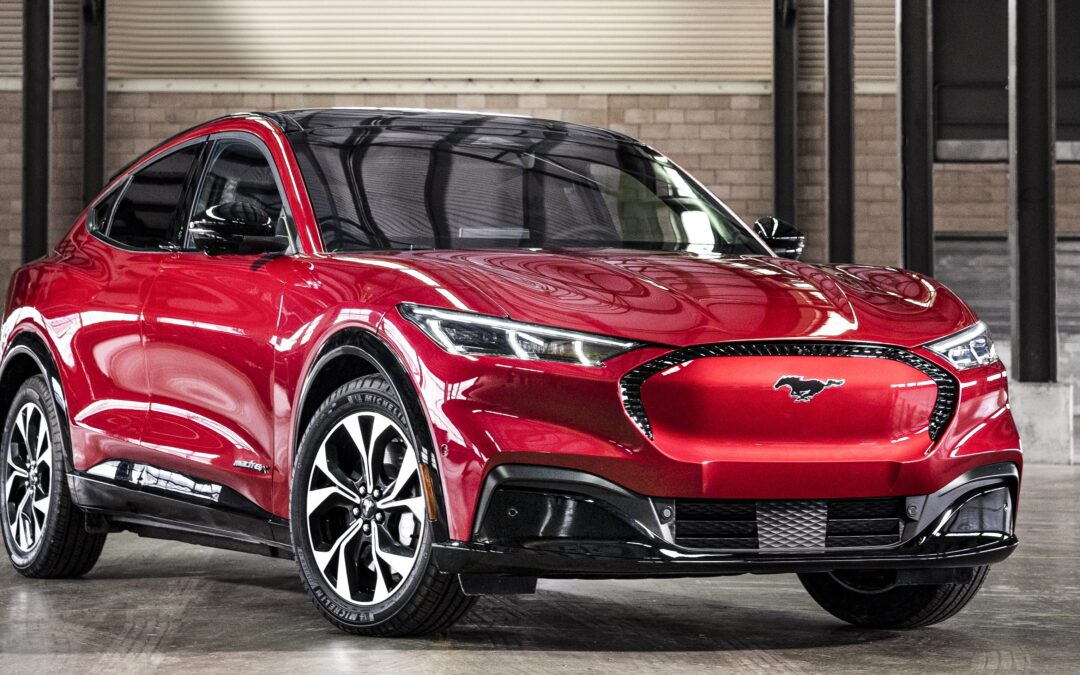
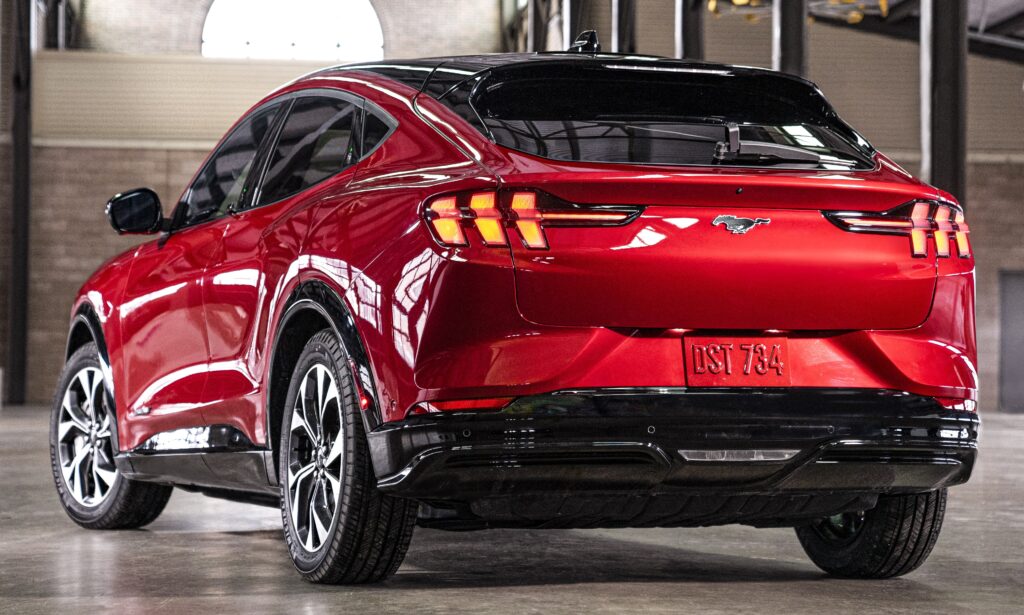
The battery-electric Mach-E will be sold in four trim levels in rear- or all-wheel drive with an option for an extended-range battery. Starting prices range from $44,895-$61,500. (Ford)
Deliveries of first model expected by year-end
Despite a global pandemic, low gasoline prices, financial instability for many consumers and production challenges in the U.S. and Mexico, Ford’s 2021 Mach-E electric coupe is still on target for sales to begin late this year, according to the automaker’s Global Director of Electrification Mark Kaufman.
East and West Coast video conferences were held May 27 to update journalists on the purpose-built electric SUV coupe and to discuss the business plan for EVs, the charging infrastructure and capabilities and some of the car’s features. It was the most information released to date, including most specifications.
Kaufman, who led the video presentation from his home, has been with Ford since 1989 in senior roles on five continents with much electrification experience.
“All the different barriers to EV adoption are beginning to come down,” Kaufman, 52, said. “Customer expectations for a 300-mile driving range are becoming more affordable and the public charging infrastructure will be easier to access, all of which will lead to more demand from consumers.”
Global Director of Electrification Mark Kaufman: “Speed is twofold, there’s 0-60 and in how quickly the human interface performs.” (Ford)
And he has no concern about the current low price of fuel that could blunt demand. “We have not backed off one second on our cycle plan. The cost of ownership could be an issue, but the other values of the car will outweigh the price of fuel.”
The Mach-E will be the first Mustang SUV crossover, the first all-wheel drive Mustang and the first Mustang with five seats rather than the traditional 2+2 format. The five-door Mach-E will pick up where the coupe leaves off with an extra seat and more cargo space, Kaufman said.
Depending on configuration, the Mach-E has driving ranges of 210-300 miles. Its basic body structure is a unitized steel frame with high strength steels (boron and welded blanks) with aluminum hood and fenders. The rear hatch is plastic.
Mach-E will be sold in four trim levels — Select, Premium, California Route 1 Edition and GT — in rear- or all-wheel drive with an option for an extended-range battery. Starting prices range from $44,895-$61,500, including the $1,000 freight charge from Cuautitlan Izcalli, Mexico. New owners will be able to deduct up to $7,500 with the federal electric-drive vehicle credit and there are additional state rebates for buying a battery-electric vehicle; California offers $2,000 through its Clean Vehicle Rebate. F And learn about federal tax incentives here.
Deliveries are on track for late this year, starting with the Premium edition. Others will follow soon after with the GT next summer. European deliveries will start in 2021, due to longer transportation time from the plant.
A Mach-E First Edition, $61,000, sold out in December, but here are some bullet points of what was learned: • Carbonized Gray is the most popular choice with 38 percent choosing it, with Grabber Blue Metallic 35 percent and Rapid Red 27 percent • More than 80 percent of U.S. customers are upgrading to the extended range battery • About 55 percent are opting for all-wheel drive • Almost 30 percent of U.S. customers are choosing the Mach-E GT • More than a quarter of all reservations are coming from California
EV adoption in California is ahead of the rest of the U.S., Kaufman said, with a 4 percent share of the EV market, compared to 1 percent elsewhere. Nearly three in four customers in the Northeast reserving a Mustang Mach-E have so far opted for an all-wheel drive model, Kaufman said. “In states such as Connecticut, Maine, Massachusetts and New Hampshire, that number climbs to more than 9 in 10.”
The Mach-E will be the first Mustang SUV crossover, the first all-wheel drive Mustang and the first Mustang with five seats rather than the traditional 2+2 format. (Ford)
Mustang DNA
The Mach-E had to live up to Mustang performance expectations but also have long-range driveability, Kaufman said. The challenge to provide range versus performance was handled by offering two battery sizes, 75.7 kWh and the 98.8 kWh extended range. Standard rear-wheel-drive models will have estimated ranges of 230 miles and up to 300 miles (or possibly more) with the extended-range battery. All-wheel drive drops the range to 210 and 270 miles, standard/extended.
The high-performance, dual-motor GT AWD will have blazing-quick acceleration to 60 mph in 3.5 seconds but with a range of 235 miles.
“We’ve really tried to lean into the Mustang DNA, Kaufman said, “by offering three performance modes, including “Whisper” and “Unbridled.”
With a tow rating of about 1,650 pounds (750kg), the car’s four-wheel disc brakes are huge: 18-inch vented discs front and solid 17-inch discs rear. And the GT gets 19-inch discs front and rear. The stopping power should be plenty for towing or to manage the curb weight, which has not been released. (The Jaguar iPace weighs about 4,800 pounds and the Audi e-tron 5,754 lbs.)
It appears to be a roomier cabin than the Mustang with 38.8 inches of headroom or 40.4 inches with the optional panoramic glass roof. Front legroom of 41.9 inches compares to 45.1 inches in the Mustang but shoulder room is 1.3 inches wider at 57.6 inches.
Back seat headroom is 38.3 inches (39.2 in. with the panoramic roof) with long legroom of 38.1 inches.
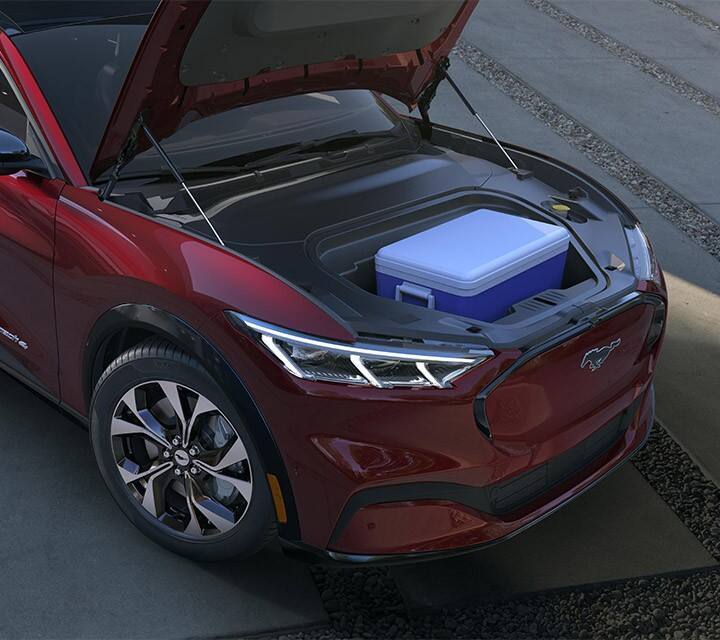
Cargo space is functional with a front trunk of 4.7 cubic feet and 29 cu.ft. behind the back seat or 59.6 cu.ft. with the back seat folded. The “frunk” is water-resistant and can be hosed out for tailgating, camping and toting muddy gear.
Mach-E front headroom is tall at 38.8 inches of headroom or 40.4 inches with the optional panoramic glass roof. (Ford)
Electrification
The liquid-cooled batteries are coming from South Korea-based LG Chem then assembled in the U.S. The standard-range battery pack has 288 cells and 376 for the extended-range pack. Electric-drive units are outsourced, but Ford writes all its own battery control and propulsion software.
The permanent magnet motor has various power ratings depending on model:
• The Select battery has 190 kW of power or 255 hp with 306 foot-pounds of torque; AWD raises torque to 417 lb.-ft.
• The Premium model with extended range battery has kilowatt power ratings of 210 and 248 for standard/extended range, with 305 lb.-ft. torque; AWD has 248 kW and 332 hp and 417 lb.-ft. torque;
• California Route 1 (rear-drive only) has ratings of 210 kW/282 hp and 306 lb.-ft. torque.
• And the GT has 342 kW of power, which translates to 459 horsepower 612 foot-pounds of torque.
A need to accelerate EV efforts
Ford saw a need to accelerate its EV efforts, citing a current sales forecast projecting that by 2025 more than 100 EVs are expected to go on sale in the U.S., 250 in Europe and 350 in China, he said. The Mach-E is part of the automaker’s $11.5 billion investment in electrified vehicles through 2022. Ford is expected to introduce 40 models over that period, including 16 battery-electric vehicles, according to industry reports.
An all-electric F-150 “is coming in a few years,” Ford says, “as well as the all-electric Transit van” under development for 2022. Ford has plans for hybrid-electrics on high-volume, profitable vehicles, including the Explorer and Escape hybrids launched last year and a new F-150 hybrid this year.
Soul of a Mustang, with tradeoffs
To build a foundation for long-term success in full-battery electrics, Ford would have to build a great product and “to play to our strengths, Kaufman said. “Exciting and capable fully electric vehicles are key to the success.”
Mustang is an iconic nameplate and has tremendous global appeal, Kaufman said, which will be an important asset to help generate interest in the car. That’s why the Mustang name was chosen with Mach-E, recalling the 1970s Mach I version of the muscle car — and which will be applied again this year to a new high-performance model of Mustang.
“Mach-E will be a great step forward for us,” he said. The electrification and body style were developed hand-in-hand to live up to Mustang performance expectations, he said. “The styling has a strong face with a long hood and sharp nose — or like a fist punching through the wall,” Kaufman said. But there were tradeoffs, he said. “The front fascia design gives up some aero, but it was actually critical to get the design DNA right.
4.8 cubic feet of space in the ‘frunk.’ (Ford)
Tesla benchmark
To leverage technology, Ford benchmarked the world’s most popular plug-in electric vehicle, the Tesla Model 3, with worldwide sales of more than 300,000 in 2019. In preparation, an industry source told me that Ford had bought 20 Tesla Model 3s to tear apart and learn. (Tesla’s upcoming Model Y compact crossover will compete directly with the Mach-E.)
With a new architecture came the opportunity to “take advantage of not having a motor and what you can do with that space,” Kaufman said. His team had to determine how to use that space in ways customers will find value and how to keep the vehicle relevant, including over-the-air updates, which were challenging to prevent cyberhacks. There had to be a high level of coordination to download software in a way that won’t screw up other systems that are functioning, Kaufman said.
Appeal for younger buyers won’t be just for propulsion and motors but connectivity and “Gotta have-it new experiences,” he said. “Speed is twofold, there’s 0-60 and in how quickly the human-interface performs.”
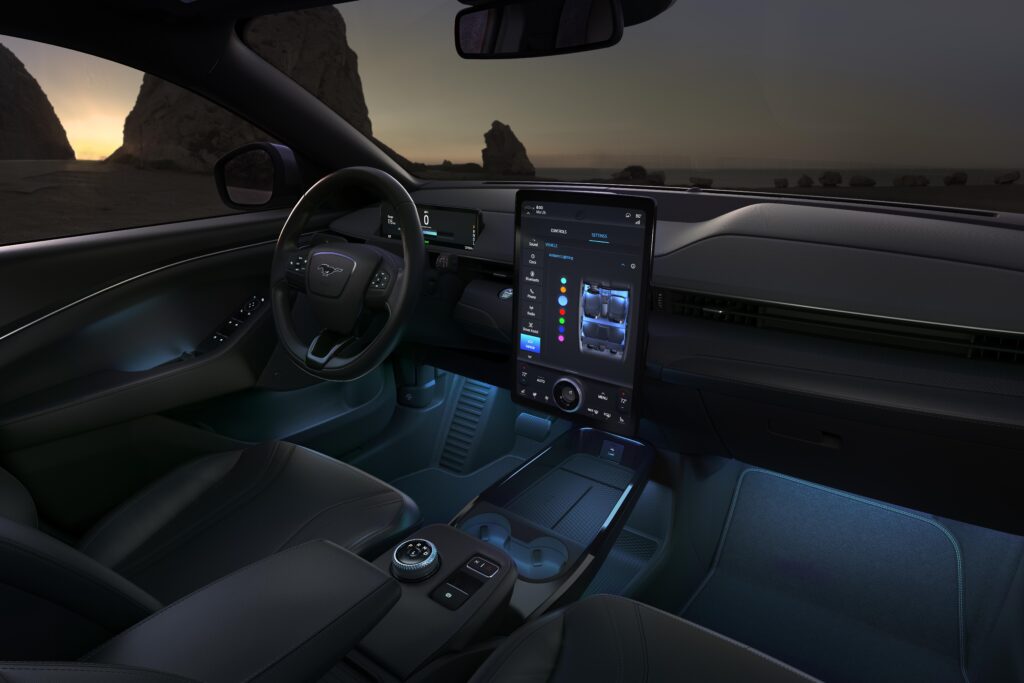
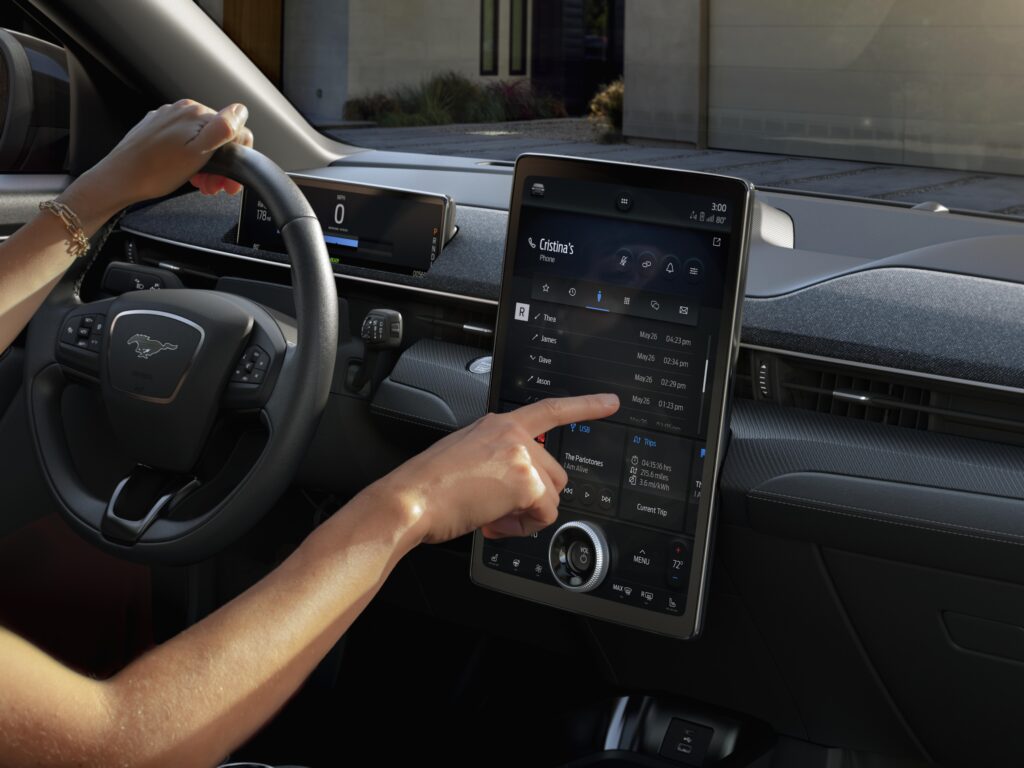
Like the Model 3, the Mach-E has a large vertical tablet display (15-inches) to access various car features and apps. But, with input from customer focus groups, Ford added a dial at the bottom for audio volume and tuning. (In planning meetings, an engineer used a Keurig cup to quickly show size and functionality, and the style stayed very similar in the production model.)
The vertical tablet display, 15.5-inches tall, will access various car features and apps. But, a dial at the bottom of the screen was added for easy audio volume and tuning. (Ford)
Standard features will include next generation SYNC infotainment with connected navigation, Phone as a Key, wireless charging pad, rearview camera, two-way manually adjusted front seats, power and heated side mirrors, 10.2-inch digital cluster and 15.5-inch touch screen, six air bags, Ford Co-Pilot360 2.0 and Co-Pilot 360 Assist 2.0, LED Lights and sequential rear turn signals and 18-inch aluminum wheels.
Standard driver-assist technologies in the Ford Co-Pilot360 2.0 include reverse brake assist and reverse sensing system, post-impact braking, blind spot information with cross traffic alert, pre-collision assist with automatic emergency braking, lane keeping system. Co-Pilot360 Assist 2.0 adds intelligent adaptive cruise control with stop and go, evasive steering assist, lane centering and speed-sign recognition.
Charging
One of the biggest gripes for Tesla owners is the availability of a plugs along its Supercharger network of 1,870 stations with 16,585 Superchargers (plugs).
Early on Ford partnered with Volkswagen AG and its Electrify America and its DC fast charging and Level 2 stations. It also works with Amazon.com for installation of smart-connected home chargers. Eighty to 90 percent of charging is at home, but longer trips will require access to an extended charging network.
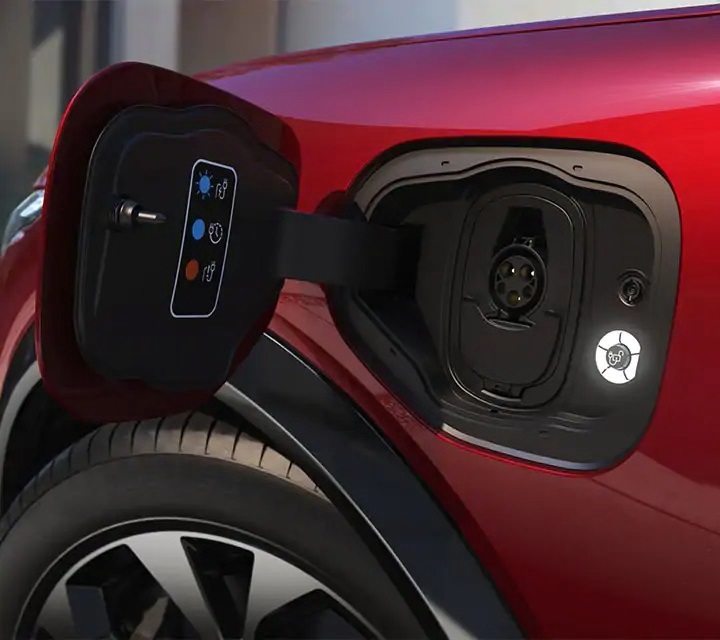
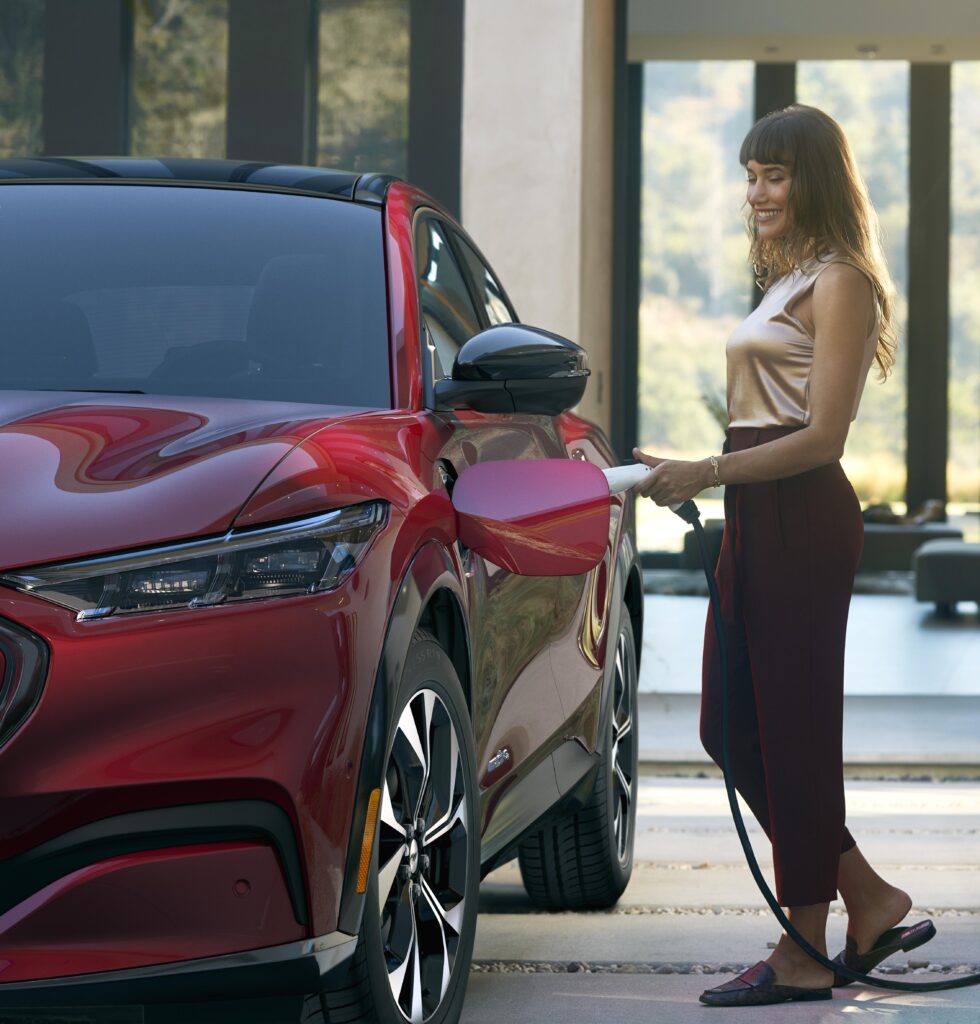
To date, the FordPass Connect charging network has 13,500 charging stations and 40,000 plugs. Ford says a depleted battery can be charged in 40 to 45 minutes at a DC fast charger with a peak charging rate of 150kW. A rear-drive model with extended battery could add about 47 miles of range in approximately 10 minutes. A standard range model could take a 10 percent to 80 percent charge in approximately 38 minutes.
Fast chargers are limited, but for home charging there is a 48-amp Ford Connected charge station that will recharge a depleted battery in 10.1 hours or 30 miles per charging hour.
And all Ford all-electric vehicles will have an onboard charger for household, 120-volt current or a higher-voltage 240-volt outlet. With the higher-power outlet, a rear-drive Mach-E with extended-range battery can be fully charged in approximately 14 hours, or about three miles of range per charging hour, Ford says.
A depleted battery can be charged in 40 to 45 minutes at a DC fast charger with a peak charging rate of 150kW. But most owners will opt for a 240-volt home-charging unit. (Ford)
Dealers
Ford has been working with dealers for three years to be able to educate customers. Buyers will be able to shop online or go to the dealership. “There are a low number of build combinations so buyers can get the Mach-E they want in a short time,” Kaufman said. And that also helps hold down pricing.
Out of Ford’s 3,000 dealers, 2,100-plus are certified to work on high-voltage systems with 9,500 technicians trained on EV service; 95 percent of service can be handled by 3,000 dealers and 95 percent of parts can be delivered the next day, Kaufman said.
The Mach-E is part of the automaker’s $11 billion investment in electrified vehicles through 2022. (Ford)