Select Page

Lexus LX 600 4WD Review

Lexus LX 600 4WD Review

The 2024 Lexus LX 600 Ultra Luxury is ready for its red-carpet role, but it is also pure off-road elite, including an underbody trail cam

Side view LX

The 2024 Lexus LX 600 Ultra Luxury is the most expensive of five LX trim levels, starting at $133,490. The tester was $135,870 with five accessories. (Photography by Lexus or as credited)

Table of Contents

Heritage and Inheritance
2024 Lexus LX Pricing
Off-Road Credentials
Ride and Handling
Twin-Turbo V-6 Performance
Interior Function
Ultra Luxury Assets and Liabilities
Why Buy the 2024 Lexus LX 600 Ultra Luxury?
Specifications

BY MARK MAYNARD

The 2024 Lexus LX 600 Ultra Luxury is big, bold, brassy, and unapologetic. This body-on-frame SUV has a 6,000-pound curb weight, an 8,000-pound towing capacity, and a 409-hp V-6 that can return fuel economy of 22 mpg on the highway.

Since its launch in 1995, the Lexus LX was the luxurious counterpart to the vaunted Toyota Land Cruiser. But while Toyota discontinued the old-spec Land Cruiser for North America in 2021, Lexus powered forward with a completely redesigned and re-engineered LX 600 for 2022. (Toyota will continue the Land Cruiser nameplate with a slightly smaller and less expensive model based on the Lexus GX; it is expected in dealerships this spring. Take a look at it here. And read my review of the 2020 Toyota Land Cruiser)

Luxury SUVs are common now, but just a few are built with off-roading credentials. The most recognizable are the Land Rover Defender 110 ($96,950) and its prettier alter ego, the Range Rover Autobiography ($142,575), Mercedes-Benz G-Class ($140,000) and Mercedes-Benz GLS ($87,000).

Garden-variety gas-powered luxo-SUVS will include the BMW X7 ($95,000), Cadillac Escalade ($98,000), and Infiniti QX80 ($87,500).

A view of the front seats and instrument panel

Rich and rewarding interior materials, with a 10-way power driver seat. (Mark Maynard)

The ‘Golden Ratio’

Separating the Lexus LX 600 from most of its competitors is what Lexus calls the “golden ratio” of a 112-inch wheelbase. This stubbier span between axles has been carried over from the 1995 first generation. The LX 600 wheelbase is 7 inches shorter than the Land Rover Defender 110 and 6 inches shorter than the Range Rover.

A shorter wheelbase is nimbler for off-road maneuverability and to avoid the awkward potential of getting high-centered on a pointy trail crest. But creating a luxurious ride on a shorter wheelbase takes special finesse — an adaptable variable suspension.

There is much to unwrap about this credentialed but old-school SUV.

Sunflare semi-aniline leather upholstery, quilted and perforated, heated and ventilated.

Sunflare semi-aniline leather upholstery, quilted and perforated. (Mark Maynard)

Heritage and Inheritance

For its fourth generation, the Lexus LX was moved to a new 20 percent more rigid GA-F platform. Lexus says it is a robust and rigid foundation for its body-on-frame build. Compared to its predecessor, the curb weight is reduced by 441 pounds due in part to aluminum doors and a lighter engine.

Lexus grew its range of LX trim levels to five, including the entry LX Standard ($92,915) for those who actually would drive their LX off-road. And there is a new F Sport model for those who will not drive off-road and prefer a taut and tuned ride quality. (Pricing is listed below.)

Where once there was a V-8 powering the LX, there is now a high-output, high-torque 409-hp, 3.4-liter V-6 twin-turbo gasoline engine. With a new Direct Shift 10-speed automatic transmission, the LX 600 has some of this segment’s best achievable fuel economy ratings.

On-road or off-road, Lexus credits refined vehicle control to the electronically controlled brake system and electric power steering. With 22-inch wheels, the LX has a turning circle of 39.4 feet, which is 2.7 feet tighter than the Land Rover Defender.

Automotive News reports that the Lexus LX will be due for a reengineering in 2027.

Heated wood and leather steering wheel

Heated wood and leather steering wheel. (Mark Maynard)

2024 Lexus LX 600 Pricing

The big Lexus SUV is sold in five trim levels with seat configurations of seven, five, or four. All trims have permanent four-wheel drive, a 409-horsepower, twin-turbocharged 3.4-liter V-6, and 10-speed automatic transmission.

Each trim level is well equipped with just limited option packages, but there is a range of accessories for pet carrying and sporting gear, and off-roading equipment by ARB.

The entry LX 600 starts at $92,915, including the $1,350 freight charge from Toyota, Aichi, Japan;

  • LX 600 Premium: $100,865;
  • LX 600 F Sport Handling: $107,125;
  • LX 600 Luxury: $108,865;
  • LX 600 Ultra Luxury: $133,490

There are seven paint colors. Three are no-cost choices (Atomic Silver, Nori Green Pearl, and Caviar); Eminent White Pearl is $500, and Manganese Luster is $595. Black Onyx and Ultra White are exclusive no-cost colors for the LX 600 F Sport Handling.

There are five interior color choices: Palomino, White/Peppercorn, Circuit Red, Black, and Sunflare.

Today’s LX 600 Ultra Luxury tester in Atomic Silver with Sunflare semi-aniline leather and Takanoha wood trim came to $135,870 with five accessories (highlighted in the specs box at the end of this review). The Ultra Luxury base MSRP is $2,735 more than in 2023, not including a $5 bump to the freight charge.

Find current pricing here. And find special offers here.

A digital screen shows climate controls and driving modes

7-inch screen for climate controls and drive-mode settings. (Mark Maynard)

LX 600 Safety Features

All LX trim levels have 10 air bags and extensive safety technologies in the Lexus Safety System 2.5. The collection of features allows level II semi-autonomous driving that is state-of-the-technology accurate. System features include:

  • All-speed dynamic cruise control,
  • Precollision system with pedestrian detection,
  • Lane-tracing assist,
  • Lane-departure alert with steering assist,

(Other safety features are listed below in the specs box.)

A left front fender view of the 22 inch tire

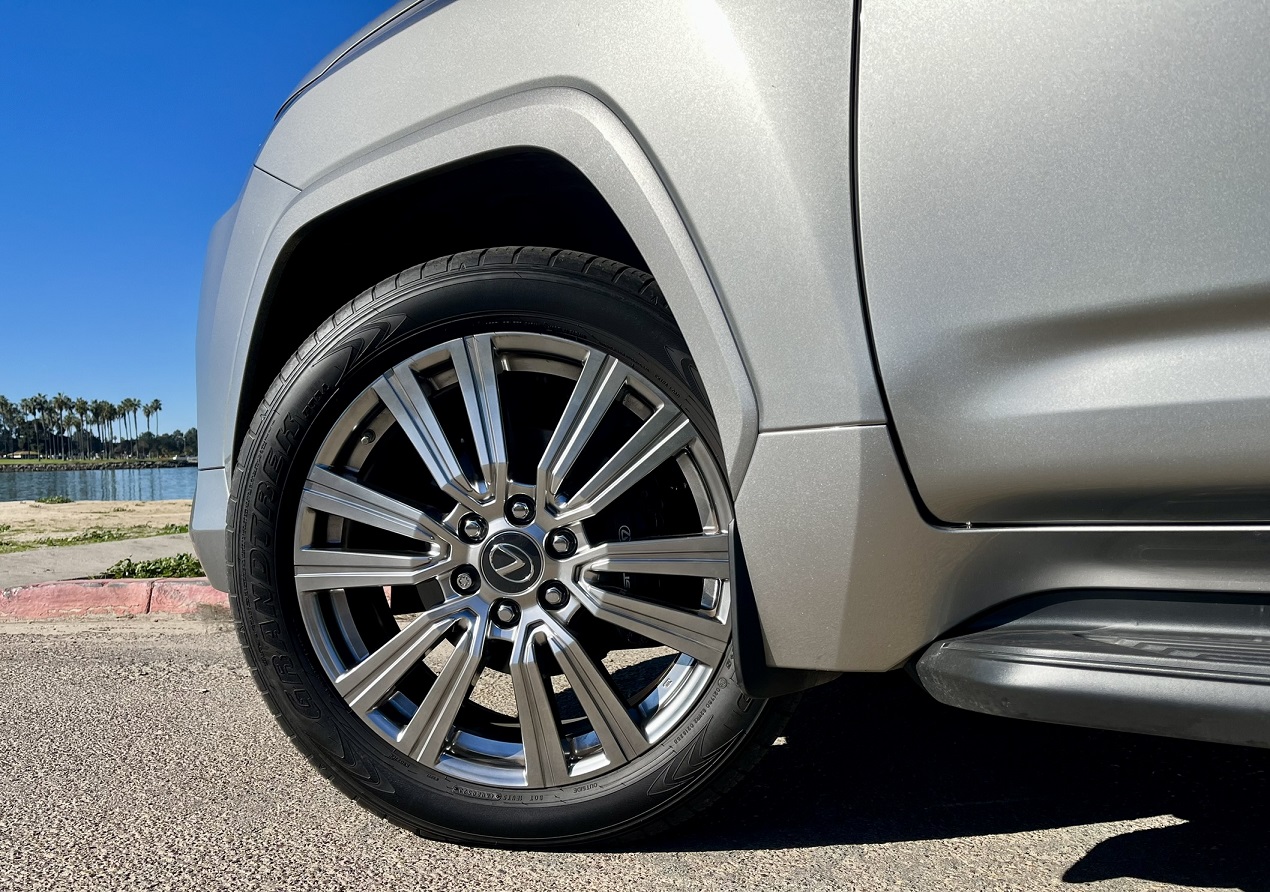
22-inch Dunlop Grandtrek PT5A 265/50 tires on forged alloy wheels. (Mark Maynard)

Off-Roading Credentials

Toyota says the LX inherits the golden ratio of a 112-inch wheelbase, carried over from the first generation in 1995. The LX has a climbing ability of 45 degrees and a maximum water crossing depth of 27.5 inches, the same level as the previous model.

Active height control can raise or lower the ride height from 1 to 3.3 inches. When parking, the ride drops another inch below the standard ride height, making the standard step rails unnecessary, except for loading gear to the roof rails (with the $450 cross bars).

LX 600 Ride and Handling

It is an engineering marvel that Lexus has created such a vaultlike and secure presence for the LX 600. The cabin is just so quiet that every drive feels like a respite from the calamity of traffic.

There doesn’t seem to be a wide difference in driving modes between Comfort and Sport-plus, except more body lean in the Comfort and Eco modes. And Eco is annoyingly resistant to throttle input for something this big and heavy.

For around-town driving, I kept the transmission in Sport or Sport-plus for its quicker acceleration uptake. Comfort mode is tuned for fuel savings and rolls out at a more relaxed pace.

It is somewhat surprising for Lexus to source the Dunlop Grandtrek PT5A tires. These 22-inch Dunlops are summer touring tires, which do not get great rave owner reviews for winter driving, and the tread face doesn’t appear traction-ready for the trail. But a full-size spare will fit under the cargo area. Replacing one of the Dunlops will run about $350 each, but alternatives are limited for a 22-inch 265/50 tire.

Backup camera showing guidance lines

The 12.3-inch top screen. (Mark Maynard)

Suspension

A lot is going on under the skin of this SUV. Much of the LX performance is focused on a high level of off-road driving performance — carried over from previous years — but also its on-road handling and stability.

The real magic is in the adaptive vehicle suspension, a sophisticated array of sensors, actuators, and advanced algorithms. These electronics monitor such elements as vehicle speed, steering input, body roll, and road conditions, then make immediate adjustments for stability and control.

Though the LX 600 is 74.6 inches tall, it absorbs speed bumps, driveway dips, and street transitions with next-to-no head toss. I’ve tested luxury sedans that are not as composed.

An open hood view of the LX 3.4 liter V-6

The 409-hp, twin-turbocharged and direct-injected four-cam 3.4-liter V-6.

Twin-Turbo V-6 Performance

The twin-turbo 3.4-liter V-6 gasoline engine (V35A-FTS) is more powerful than the outgoing naturally aspirated 5.7-liter V-8. The V-6 produces 409 hp and peak torque of 479 foot-pounds at 2,000 to 3,600 rpm.

Fuel economy ratings are 17 mpg city, 22 highway, and 19 mpg combined, using the recommended premium fuel. At 18.5 mpg, I got close to the official combined rating and would not complain in this market of $100,000 SUVs. The 21.5-gallon tank is large enough by today’s engineering, but for off-road exploring or vacation travel, I’d prefer 25 gallons or more, as you’d get in the old days. But weight savings are crucial to meeting EPA mileage standards, and the added weight of more fuel in a bigger tank is an awkward calculation. And fitting a full-size, 22-inch spare in the undercarriage takes more space where a bigger tank could go.

The Direct Shift-10AT is heavy duty for managing the curb weight, climbing power, and Sport-plus performance. Gear shifts are unnoticeably smooth, but the transmission has a low ratio first gear for steady starts on a hill, street, or trail. High gearing in 10th keeps the engine speed low at interstate speeds, benefiting mileage and a quieter ride.

Takanoha wood trim on the top door panel

The distinctive Takanoha wood trim. Can you see the hawk feather pattern? (Mark Maynard)

Interior Function

Inside the LX 600 is a leather-wrapped sanctuary with a charcoal-color headliner, muted and soft-touch accents, and Takanoha wood trim. The glossy wood treatment around the shifter console and upper doors is a wooden mosaic with a hawk feather pattern. Japanese woodworkers hone, polish, and then shave the piece three times while changing angles to bring out the feather pattern.

The instrument panel features Lexus Interface with dual display screens. A 12.3-inch navigation and infotainment screen is at the top, with a 7-inch screen just below for climate controls and drive-mode settings.

Upon first view of the driver area, there might seem to be an overwhelming array of buttons, switches, and knobs, all with graphic readouts. The access points span from the door panel window and lock controls to the digital gauge array, the steering wheel and side stalks, and the stack of center screens. Like any computer, I quickly figured out what I needed and the ones I could ignore until needed, like locking differential controls and multi-terrain switches.

Lexus sells an accessory dash cam for $375

The Lexus dash cam, $375. (Mark Maynard)

True to the LX heritage as a superior off-roader, the camera system includes an underfloor view of transparent-underfloor images showing wheel positions, front and rear. While on the trail, knowing where the differentials are is imperative to avoid that steel-busting rock in the road.

Notable Ultra Luxury features include power door closers, second-row massaging and reclining captain’s chairs, a right-rear power recliner with sliding ottoman, heated and ventilated front and rear seats, dual-screen rear entertainment system, a front center console cool box, active ride height control, and 25-speaker 2,400-watt Mark Levinson surround-sound system.

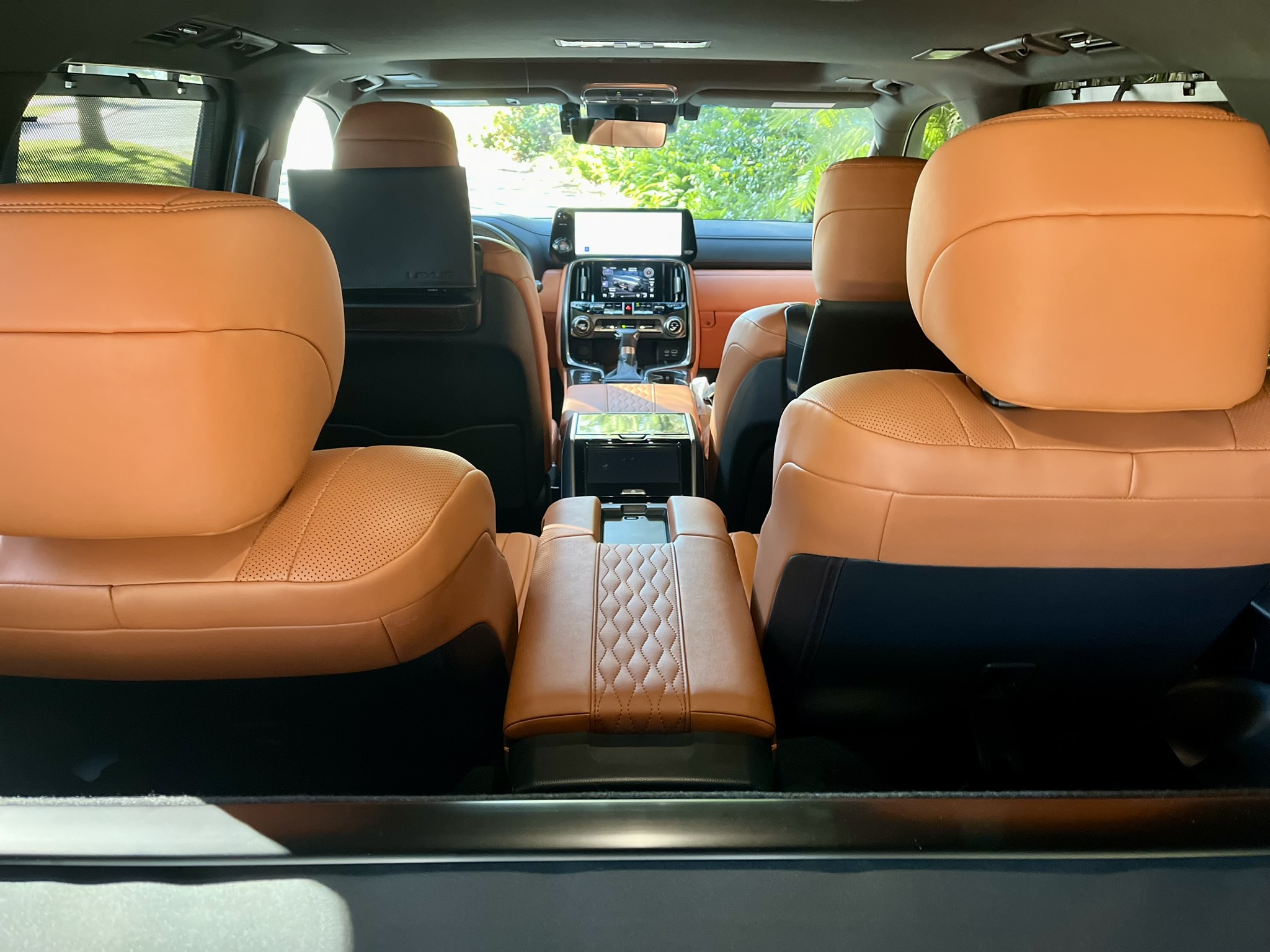
Looking from the cargo area forward from the back seats to the windshield.

VIP seating. (Mark Maynard)

Ultra Luxury Assets and Liabilities

Creating this four-seat LX 600 Ultra Luxury seems like a progressive choice for an executive-class “car.” Typically, an off-roadable SUV has a tall transmission-exhaust tunnel that compromises rear center seat footroom, so why not add a commanding console of entertaining features and a pair of massaging seats fit for a VIP?

Elements of the Ultra Lux package are all about Hollywood glam — for the two back-seat celebs. However, packing all the luxury features into this size of SUV creates a feeling of close quarters, in the front or back seat.

The second-row captain’s chairs look rich and regal, but legroom is tight at 33.8 inches. It is a chauffeur-like configuration. The front passenger seat can be moved forward for more legroom (up to 43 inches), and the seatback reclined. The curbside seat also has a footrest, but nothing for the seat behind the driver. There is also a separate air conditioning system with overhead ceiling vents.

This 2+2 configuration, however, takes away nearly all cargo versatility. The seatbacks do not fold, nor is there a ski passthrough. Cargo space is OK at 41 cubic feet stacked to the headliner.

And while there is a full 22-inch spare under the rear cargo area, the spindly jacking equipment is concerning for a three-ton lift, especially if performed on a trail.

Looking though the open doors of the LX 600 captain's chair seating.

Living not so large in the back seat space. (Mark Maynard)

Why Buy the 2024 Lexus LX 600 Ultra Luxury?

The LX 600 Ultra Luxury is a formidable choice for its luxurious refinement and tractor-like determination in snowy travel or to access the country property.

But it will be a specific buyer who seeks a four-seat, $134,000 SUV that makes molehills out of mountain trails on the way to the red carpet.

A rear view while kicking up dust on a trail

The big Lexus LX 600 SUV is sold in five trim levels with starting prices that range from $92,915 to $133,490. The top-line LX 600 Ultra Luxury tester was $135,870 with five accessories.

2024 Lexus LX 600 Specifications

Body style: Large, 4-seat, 5-door full-time 4WD body-on-frame SUV

Engine: 409-hp, twin-turbocharged and direct-injected four-cam 3.4-liter V-6 with four valves per cylinder; 479 lb.-ft. torque at 2,000 rpm

Transmission: 10-speed direct-shift automatic with paddle shifters and multi-terrain select modes; full-time 4WD with electronic locking center differential; crawl control with turn assist

Fuel economy: 17/22/19 mpg city/hwy/combined; premium fuel recommended

0-60 mph acceleration: 6.9 seconds, per Lexus

Tow rating: 8,000 pounds

BY THE NUMBERS

Fuel tank: 21.1 gallons

Cargo space: 41 cubic feet

Front head/leg room: 37.8/41.1 inches

Rear head/leg room: 38.7/33.8 inches

Length/wheelbase: 200.5/112.2 inches

Width/height: 78.3/74.6 inches

Curb weight: 5,945 pounds

Turning circle: 39.4 feet

FEATURES

LX 600 Ultra Luxury features include: 4-passenger diamond-stitch leather upholstery with embossed headrests, 2nd row massaging and reclining captain’s chairs, right-rear power recliner with sliding ottoman, heated and ventilated front and rear seats, dual-screen rear entertainment system, driver Lexus memory system, 4-zone climate control system with console cool box, heated wood and leather steering wheel, rear side sunshades, active ride height control, power door closers, 25-speaker 2,400-watt Mark Levinson surround-sound audio system, 2nd-row wireless charger, illuminated door scuff plates, thematic ambient illumination;

Exterior Ultra Luxury features include: triple-beam LED headlights and taillights, 22-inch forged alloy wheels with 22-inch Dunlop Grandtrek PT5A 265/50, roof rails, tow package and hitch;

Standard equipment includes: Smartkey entry and push-button ignition, Takanhoha wood trim, power heated side mirrors, 10-way power driver seat with cushion extender, 8-way power front passenger seat with cushion extender, digital rearview mirror, 12.3-inch digital infotainment touch screen, wireless Apple CarPlay and Android Auto, panoramic view monitor with guidance lines, power moonroof, power tailgate with kick sensor, intuitive parking assist with rear cross-traffic alert and auto-braking, rear center armrest and table, headlight washers;

Safety features include: 10 air bags, trailer sway control, stability and traction controls, hill-start assist;

Lexus Safety System 2.5 includes:

  • All-speed dynamic cruise control,
  • Precollision system with pedestrian detection,
  • Lane-tracing assist,
  • Lane-departure alert with steering assist,
  • Road sign assist (readout in gauge array),
  • Intelligent (auto-dimming) high beams;

SUSPENSION COMPONENTS

Brakes: 4-wheel vented discs, 13.1 inches front, 13.9 inches rear; w/4-sensor, 4-channel multi-terrain ABS, brakeforce distribution, brake assist, and four-piston front calipers;

Steering: electric power; 39.4-foot turning circle

Tires-wheels: 22-inch 265/50 tires; forged alloy wheels with silver finish

Suspension: adaptive variable with active height control; front wishbone, rear multilink;

PRICING

Base price: $133,490, including $1,350 freight charge; price as tested $135,870

Options on test vehicle: 3M door edge film $95; illuminated cargo sills $475; dash cam $375; wheel locks $95; cross bars $450; all-weather floor protection $340

Where assembled: Toyota, Aichi, Japan

Warranties: 4-years/50,000-miles bumper to bumper with roadside assistance, free first and second scheduled maintenance appointments, and lodging expense for emergency breakdown 100 miles from home; 6-years/70,000-miles powertrain

Genesis Electrified G80 AWD Review

Genesis Electrified G80 AWD Review

The 2024 Genesis Electrified G80 defines contemporary luxury and has a battery-electric driving range of 282 miles

A 2024 Genesis G80 EV plugged in at a public charging station

The 2024 Genesis Electrified G80 in Matira Blue paint. The all-wheel-drive sedan starts at $75,570 and has a battery range of 282 miles, with three years of free 30-minute charging sessions by Electrify America. (Photography by Genesis USA or as credited)

Table of Contents

Luxury Class Electric Sedans
Pricing
Safety Ratings
Charging
Ride and Handling
Performance
Interior Function
5 Good Things to Know
Why Buy the 2024 Genesis Electrified G80
Specifications

BY MARK MAYNARD

I have never bought a vehicle solely for its paint color, but the Matira Blue paint of the 2024 Genesis Electrified G80 sedan would be a deal closer. This striking deep green-blue hue triggered a heartbeat for my favorite deep blue-green Crayola Crayon (now retired), and as James Taylor sings on “Sweet Baby James” — “Deep greens and blues are the colors I choose.”

Genesis says its Matira Blue is a hue of sustainable luxury. The optional paint color ($650), exclusive for the Electrified G80, is named after the Matira Beach of Bora Bora. A special paint pigment creates a palette of cobalt blue, emerald blue, and turquoise, which varies depending on the angle of view. In some lights, the car looks dark green; in others, it shows bluer.

For 2024, Genesis owns this special color that stands out on the highwayscape. But the so-called sustainable greens and blues are emerging as choices on various new electric vehicles. The electric 2024 Honda Prologue, for example, has North Shore Pearl, and there is a choice of Emerald Lake on the 2024 Cadillac Lyriq.

The broad G80 cabin has 58.3 inches of front shoulder room, making it comfortable for the big and tall.

The G80’s broad cabin has 58.3 inches of front shoulder room.

Luxury Class Electric Sedans

The Genesis Electrified G80 sedan is a full battery-electric executive-class sedan with a driving range of 282 miles. It competes in a slim segment of luxury BEV cars, including the Mercedes-Benz EQE, BMW i5, Lucid Air, and Porsche Taycan with more choices on the way, including the $340,000 Cadillac Celestiq.

Genesis also has battery-electric versions for its SUVs, including the compact-class GV60 ($52,000) and the midsize GV70 ($66,450)  .

At the 2023 L.A. Auto Show, Genesis showed the 2025 GV80 Coupe and new 2025 GV80 SUV, with turbocharged 2.5-liter four-cylinder or 3.5-liter V-6 powertrains. The brand also revealed a battery-electric four-seat concept convertible called the Genesis X Convertible.

The Genesis X Convertible concept.

The Genesis X Convertible concept. Could it be a future halo vehicle for the brand?

2024 Genesis Electrified G80 Pricing

The Genesis Electrified G80 went on sale in 2021 as a 2022 model. For 2024, Genesis has added a second trim level, Advanced, which dropped last year’s starting price by $5,380 for what was the sole trim choice of Prestige.

The 2024 Electrified G80 Advance starts at $75,625 and the Prestige at $80,375; retail pricing includes the $1,250 freight charge from Ulsan, Korea. My Prestige tester had one option for Matira Blue paint, $650, for a total of $81,025.

To date, electrified Genesis vehicles are on sale in 33 states.

Genesis provides a comprehensive warranty package (highlighted in the specs box below). Among the coverages is a Concierge to arrange vehicle test drives at home and a Service Valet. For scheduled maintenance appointments, the valet service will schedule a pickup of your Genesis, leave a loaner vehicle, and return your car after servicing.

Check current Electrified G80 pricing here. And find special offers here.

Neatly stitched and heated steering wheel

Neatly stitched and heated G80 steering wheel. (Mark Maynard)

No EV Incentives

Because the Electrified G80 has a starting MSRP over $55,000 and the car is not built in the U.S., it is not eligible for the $7,500 federal tax credit under the rules of the Inflation Reduction Act. But neither are the competing BEVs.

Unlike many new electric vehicles built on a “skateboard” electric platform, the Electrified G80 uses the same architecture as the gas-powered G80.

The specs box below shows the long list of standard and Prestige features.

Genesis G80 Safety Ratings

The 2024 Genesis G80 and Electrified G80 earned the Top Safety Pick+ recognition. The G80 sedans join the Genesis SUV lineup of GV60, GV70, Electrified GV70, and GV80 with top honors in safety.

To qualify as an IIHS Top Safety Pick+ a vehicle must earn:

  • Good ratings in the driver-side small overlap front, passenger-side small overlap front, updated side, and original moderate overlap front tests;
  • Acceptable or good headlights standard across all trims;
  • Advanced or superior ratings for front crash prevention in daytime and nighttime vehicle-to-pedestrian evaluations must be available.

The National Highway Traffic Safety Administration (NHTSA) has not rated the 2023 Electrified G80. However, all gasoline-powered versions of the G80 received the top five-star rating.

12.3-inch 3D digital instrument cluster in the Genesis G80

12.3-inch 3D digital instrument cluster. (Mark Maynard)

Charging the Electrified G80

Charging on my home 240-volt Level 2 system packed in 295 miles of range, which dropped immediately to 288 when I began driving and settled at 282 miles. The range maintained a measured pace of discharge, whether interstate cruising or around town.

To help bring power to the people, the G80 has a 400V/800V rapid multi-charging system. Genesis explains that the car’s driving motor and inverter can boost the voltage from 400 to 800 volts. That is a more optimized level for the system and provides a more stable charge. This system means owners can use an 800V rapid charging system without needing an additional converter and a 400V charger.

The charging door is in the grille’s upper right corner and is invisible when closed. Inside the charging door are lights showing the state of charge.

Charging Times

Charging from 10 percent to 100 percent would take 7 hours and 22 minutes on a 240-volt Level II charger or 22 minutes when using a 350kW rapid charger. With a charger at home, I had no range anxiety, and topping off took less than 2 hours when there were a hundred miles of reserve. I also have home solar, so my charge time is less critical.

Public charging for vacation or distance travel still needs to be improved. It is common to find dirty chargers, non-functioning chargers, and the nasty time-of-day upcharge fees. Scoundrels!

The standard 10.9 kW onboard charger has ultra-fast capability.

If you are traveling to visit a friend and need to plug into an AC 110-volt outlet, a full recharge would take 80 hours. However, few EV drivers put themselves in such a situation.

An underhood view of the 365 hp EV powertrain

The 365-hp dual-motor electric powertrain. (Mark Maynard)

Free Public Charging and V2L

The Electrified G80 is also a survival tool. An electrical Vehicle to Load feature — V2L — lets owners plug into 3.6 kW of battery power, which Genesis says is higher than average household power. The unique adapter cable plugs into the charging port and lets owners use small electric appliances, device chargers, and more outside the vehicle.

Genesis Motor America has partnered with Electrify America to give owners three years of free 30-minute charging sessions from the vehicle purchase date. Utilizing Genesis Connected Services and the Electrify America mobile apps, owners of the GV60, Electrified GV70, and Electrified G80 can locate and access fast charging stations while on the road.

Owners can use Genesis Home to find a top-rated residential AC EV charger, solar panels, and energy storage systems for charging at home. Genesis Home collaborates with Electrify America to provide home charging options.

A 19 inch Micheline tire on the "turbine" style G80 wheels

19-inch Michelin Primacy Tour all season tires with staggered widths. (Mark Maynard)

G80 AWD Ride and Handling

Genesis designers refer to the exterior G80 styling as “Athletic Elegance,” and it is a thoroughly modern translation. At 16.4 feet long, the sedan has a commanding stance and sits attractively on its wheels — contemporary by any definition.

The Electrified G80 is smooth and quiet on the road and a soaring bomber at speed on the highway. The ride quality is cushioned and quiet from Michelin Primacy Tour all-season tires — and the rubber reacts quickly for controlled evasive maneuvers. The 19-inch tires have staggered widths front and rear, 245/45 front and 275/40 rear.

The turning circle of 38.1 feet is about as tight as it gets for a big sedan, and it is a shorter arc than many midsize sedans. But there isn’t much steering feel.

A curb weight of 5,038 pounds is hefty, but it does not feel ponderous. It is most noticeable when transitioning driveways, speed bumps, and side-to-side jostling. A significant portion of the curb weight is the 1,204-pound battery, but the total weight is not outrageous compared to the 4,508-pound gasoline G80 V-6.

Keeping the even keel is the four-wheel multilink suspension that is electronically controlled with a Road Preview feature. A forward-facing camera watches road irregularities and magically manipulates the active suspension for up-and-down control. This system isn’t magic, but it magically seems to counteract the jolts of potholed streets. The svelte ride quality is not common to all electronic suspensions. Here’s an explainer.

16-way power driver seat with Ergo Motion massaging, thigh extender, and 4-way lumbar.

16-way power driver seat with Ergo Motion massaging. (Mark Maynard)

Electrified G80 Performance

Cracking the whip on a cabin of four adults means never having to say you are sorry for making passengers sit up and hold on.

Acceleration in Sport mode should easily achieve 0-60 mph acceleration in 4.9 seconds, per Genesis. I typically drove in Comfort mode, which feels tuned to stretch the battery range, but I just mashed the pedal a little harder when I wanted stronger acceleration. I preferred Sport mode around town for its quicker response, and in heavy commuting traffic, Sport helps to hold my position and thwart those who might dive in front. The one-speed transmission smoothly does its job, lacking nothing in performance; I quickly forgot about stepped shifts.

Depending on the driving conditions, an all-wheel-drive Disconnector Actuator System (DAS) will switch between rear-wheel drive and AWD to reduce power loss.

I especially like the one-pedal driving provided by regenerative braking. The driver can use the accelerator to slow the G80 to a stop. Paddle shifters at the steering wheel can increase or decrease the regen force.

A front door panels shows the Dark Lagoon Green interior shade

The Dark Lagoon Green interior color. (Mark Maynard)

Driver-Assist Systems

The Genesis G80 is fully functional for Level 2, hands-on-the-wheel semi-autonomous driver assistance. In my testing, the array of advanced technologies kept the G80 accurately centered in the lane without crossing the lines or the highway Botts dots. However, driving into low sunshine can cause disruptions as the sight sensors struggle with washed-out road surface white lines, light-colored concrete, and even when alongside 18-wheel semis with white trailers.

The Highway Drive Assist system begins with the GPS-enabled smart cruise control with stop and go and layers in:

  • Blind-spot collision-avoidance assist;
  • Rear cross-traffic collision-avoidance assist;
  • Lane-keeping assist with road-edge and lane-following assist;
  • Forward collision assist;
  • Forward-attention and driver-attention alerts.

These driver-assist systems take time for the uninitiated to find their comfort level. The support is an all-seeing set of eyes that is of value in the crammed daily commuting traffic, especially in narrow construction areas. I now activate steering assist in HDA as a distraction-avoidance safeguard.

A view of the electronic back seat climate controls looking forward to the front seat instrument panel

Heated seats and full back seat climate control. (Mark Maynard)

G80 Interior Function

I have tested Euro luxury sedans so loaded with advanced technologies that I did not know if I was smart enough to figure out how to use them. The Electrified Genesis G80 has all the advanced tech in those competing luxury sedans, but the Genesis presentation of technologies does not require an advanced degree to use and activate. The electronic controls are simply presented, making it almost effortless for the novice to figure it out in minutes. Genesis elevates its drivers without confounding them.

The rest of the G80 interior is luxuriously rewarding but not precious in its presentation. Think Audi, not Lincoln.

Driver controls are well organized, and the designers resisted gimmicky electronic, dazzly features that quickly become passe. Sightlines are unhindered at the side mirrors and out the back glass.

For me, nothing says luxury like door cinchers. This classy feature is part of the Prestige package, and the closing function removes the slam. Just pull the door to the entry, and the closer does the rest.

Because this is an “executive” car class, the cabin has 2 inches more shoulder room (58.3 in.) than the midsize Genesis G70 sedan. Those 2 inches are welcome room to spread out for big and tall drivers. And the cross-cabin width makes it much easier for designers to put everything in order. Headroom is tall at 40.3 inches.

The traffic-calmed cabin is due in part to Active Noise Control-Road. This piece of technology significantly reduces the noise level by measuring and analyzing road noises and simultaneously creating sound waves of the opposite frequency.

A max of 39.5 inches of legroom with a low AWD hump in the center.

A max of 39.5 inches of legroom with a low AWD hump in the center. (Mark Maynard)

Back Seat and Trunk Space

Rear legroom of 35.9 inches is comfortable for 6-foot passengers, with good headroom of 36.6 inches.

With the G80’s armload of standard equipment, I’d also like door-lock sensors in the rear doors. It’s a one-step maneuver when unloading children or bags of groceries that doesn’t require reaching for the front door sensor to lock or unlock.

The rear seatbacks do not fold because of the battery storage slightly intrudes behind the back seat. Trunk space is cropped to 10.8 cubic feet (down 2 cu.ft. from the gas G80), but there is a ski pass-through. Overall, trunk space is still a bit more than in the G70 sedan and plenty for a couple’s getaway luggage.

Trunk space of 10.8 cubic feet

Trunk space of 10.8 cubic feet is shortened by battery storage, but the space is only about 2 cubic feet smaller than in the gas-powered G80. (Mark Maynard)

5 Good Things to Know about the Electrified G80

Regenerative brake wiping

 Using the e-pedal driving function is an asset for the driver, but continued use without much use of the brakes introduces brake-disc rust and glazing. To counteract the buildup, the regen paddles can be brought to zero force for the brakes to be prominently used, which will polish the discs. Do this process every so often to clean the brake discs.

Emergency electric charger release

 There might be a time when a public charger malfunctions and will not release the charging cable. Genesis has an emergency power disconnect under the hood as a workaround, but the switch is not clearly marked.

Tire tool

The Electrified G80 has no spare tire, just a small tire-repair inflator kit (with far too many procedural steps to use at night). Rather than lug nuts, the G80 uses wheel bolts. Reinstalling the wheel requires the Genesis-provided wheel mounting assist tool to align bolt holes with the brake disc and wheel hub.

EV ID

The Electrified G80 has no exterior EV badges, lightning bolts, or bright green brake calipers to announce its electric-ness. Instead, there are two ways to identify the G80-E. The first is its reverse G matrix grille. It is a solid treatment, not like the open grille pattern of the gas model for engine breathing. The second identifier is the unique 19-inch turbine-style wheel design.

Walk-in seat controls.

“Walk-in” feature

Because Genesis and Hyundai had long been makers of chauffeured sedans in the Korean market, a carryover feature is the “walk-in” function. For the curbside back seat passenger, a power switch on the side of the front passenger seat allows the passenger to move the seat forward or just move the seat back. Opening the rear curbside door powers forward the front seat, creating the “walk-in” effect.

Why Buy the 2024 Electrified Genesis G80?

Genesis warranties have solved many of the perceived risks common to EV ownership. Especially reassuring is the 10-year/100,000-mile coverage for the electric vehicle system. The 3 years of free charging from Electrify America will be helpful for travel or for those who do not have a home charger.

Most buyers of large sedans opt for a lease rather than purchase, and with the long legs of Genesis’s warranties, the Electrified G80 has an active lifecycle of 10 years.

If Matira Blue does not charge your battery, there are eight other paint colors. Only Alta White is a no-cost choice, Makalu Gray Matte is $1,500, and the rest are $650 each.

The Genesis brand, the luxury division of the Hyundai (Kia) Group, is still building its U.S. reputation as a purveyor of Tier One luxury. Resist the temptation to pursue the perceived prestige of European marques and instead take advantage of a growing carmaker eager to please.

Genesis had me at “Service Valet,” door closers, and a 282-mile electric range.

A rear view of the G80 EV on the gravel parking lot of a park

Buyers of the Genesis Electrified G80 get three years of free 30-minute charging sessions from the vehicle purchase date. Owners can also use Genesis Home find a top-rated residential AC EV charger, solar panels, and energy storage systems.

SPECIFICATIONS

2024 Genesis Electrified G80 AWD

Body style: large-midsize, 4-door 5-seat all-wheel-drive sedan

Transmission: single-speed reduction gear, w/drive-modes select, and steering wheel paddle shifters for regeneration control

Motors: permanent-magnet synchronous AC front and rear

Power, AWD: 365 hp/272 kW; front motor 136 kW, rear 136 kW

Battery: lithium-ion polymer, 523 volts/87.2 kWh; 307 kw output; battery weight 1,204.2 lbs.; w/battery-heating system

EPA-estimated driving range: 282 miles on 19-inch wheels

Fuel economy equivalent, MPGe: 105/89/97 mpg-e city/hwy/combined

Charging from 10% to 100%:

  • AC 110 volt: 80 hours
  • Level II 240-volt: 7 hours 22 minutes
  • Rapid Charging, 350kW: 22 minutes
  • Onboard charger, w/ultra-fast capability: 10.9 kW

BY THE NUMBERS

0-60 mph acceleration: 4.9 seconds per Genesis and 4.1 seconds per Car and Driver; using Sport mode

Coefficient of drag: 0.26

Trunk space: 10.8 cubic feet

Front head/leg room: 40.3/42.1 inches

Rear head/leg room: 36.6/35.9 inches

Length/wheelbase: 197/118.5 inches

Height/width: 57.9/75.8 inches (not including side mirrors)

Curb weight: 5,038 pounds

Turning circle: 38.1 feet

FEATURES

Standard features, include: 14.5-inch infotainment-navigation screen, active noise control, 12.3-inch digital gauge cluster, power tilt-telescopic steering wheel, rotary shift selector dial, touch-type 3-zone climate control, microsuede charcoal headliner, stainless steel door sill plates (front and rear), leatherette dash pad and door panel inserts, sliding visors with covered and lighted mirrors, floor mats (front and rear); wireless phone charging pad, 19-inch alloy wheels;

Prestige package features include: Keyless entry with push-button ignition, power door cinchers, Nappa leather-trimmed seat upholstery, stylized gray matte wood trim, 16-way Ergo Motion (massaging) driver seat with 4-way lumbar and cushion extension, 10-way power front passenger seat, charcoal microfiber suede headliner and pillars, electric parking brake with auto-hold, front seat walk-in function, heated and ventilated front seats, heated steering wheel, Lexicon Quantum Logic surround sound 21 speaker audio system with 1,400-watt digital amplifier, laminated windshield and front side glass, auto defogging windshield, 4 USB charging ports, Bluetooth phone and audio, heated back seats, LED lighting (headlights with high-beam assist, running lights, taillights, side mirror turn signals), power-folding side mirrors with Genesis logo approach lighting, locking glove compartment, front console armrest storage box, heads-up windshield display, LED interior lighting (map lights, pin lights, rear overhead, glove compartment and dual trunk lights), power rear and manual rear door sunshades;

Advanced technologies

Vehicle-To-Load charging, smart cruise control with stop and go, surround view monitor with rearview parking guidelines, active noise control, park distance warning (front and rear), blind-spot collision-avoidance assist, rear cross-traffic collision-avoidance assist, lane-keeping assist with road-edge and lane-following assist, forward collision assist, forward-attention and driver-attention alerts;

Safety features include: 10 air bags, including center side bag, ABS with brake-force distribution, 5 mph bumpers.

SUSPENSION COMPONENTS

Brakes: 4-wheel ventilated 14.2-inch discs front and rear; 4-piston calipers front, single piston rear

Steering: motor driven rack and pinion; 2.25 turns lock to lock; 38.1-foot turning circle

Tires-wheels: 19-inch Michelin Primacy Tour all season, 245/45 front, 275/40 rear; 500 treadwear rating, tire-mobility kit for flat repair

Suspension: 4-wheel multilink; electronically controlled with road preview; front and rear with high performance gas shock absorbers;

PRICING

Base Prestige price: $80,375, including $1,250 freight charge; price as tested $81,025

Options on test vehicle: Matira Blue paint $650

Where assembled: Ulsan, Korea

Warranties: 5-years/60,000-miles bumper to bumper with roadside assistance; 10-years/100,000-miles powertrain; 10-years/100,000-miles electric vehicle system; 3 years of free charging from Electrify America

Audi RS 5 Competition Coupe Review

Audi RS 5 Competition Coupe Review

 A package-price reduction with added standard equipment makes the 2024 Audi RS 5 Competition a near-value statement 

The Ascari Blue color of the RS 5

The 444-hp 2024 Audi RS 5 Competition Coupe starts at $80,790, which is $6,525 less than in 2023.  (Photography by Audi or as credited)

Table of Contents

New for the 2024 RS 5
RS 5 Competition Package
Pricing
RS 5 Performance
Competition Ride and Handling
Interior Function
Why Buy the 2024 Audi RS 5 Competition?
Specifications

BY MARK MAYNARD

There is good news for the 2024 Audi RS 5 Competition Coupe and Sportback models. First, the bad news: the base price for the 2024 model is up a trifling $700, now starting at $80,790. The good news is an overall price reduction for the Competition Package saved $6,525.

An Audi RS 5 Competition coupe that cost $100,585 in 2023 is now $94,040, with the same five options and packages. In 2023, the RS 5 Competition package cost $16,100. For 2024, the package is $10,300. The main deletion from the package is the front ceramic brakes. The 15.7-inch front ceramic brakes save weight and improve brake disc cooling for on-track performance. The default choice for 2024 are 14.8-inch steel rotors. Both rotors are ventilated with six-piston fixed calipers. Steel rear disc brakes are unchanged with 13-inch ventilated rotors.

There were availability issues with the carbon fiber brakes, Audi says, and made this decision: “Rather than allow a customer to order the carbon brakes and us not be able to build the car immediately, keeping a customer waiting, we decided to proactively remove the option for this model year. As supplier availability issues get resolved, we may re-evaluate this,” a spokesman wrote in an email.

Trimming the cost of the Competition package and adding a lot of new standard equipment makes the RS 5 Competition more of a value tease, and some of its new standard elements are optional in the competition.

The Competition

Audi RS5 Coupe prime competitors include:

505-hp Alfa Romeo Giulia Quadrifoglio, base price $83,365, includes $500 paint option.

503-hp BMW M4 Competition xDrive Coupe, base price $91,245 with 3 driving-assist technologies.

503 hp Mercedes-AMG C63 S (2023), $94,975 with six options comparable to RS 5 tester.

472-hp Cadillac CT4-V Blackwing, $73,770.

565-hp Nissan GT-R, $123,000

*Suggested retail pricing includes the freight charge.

The front seat area with alcantara upholstery and carbon fiber trim accents

The Competition package adds Pearl Nappa and Dinamica upholstery. Front sport seats have power bolster and seat-bottom adjustment.

New for 2024?

There are no exterior or powertrain changes for the 2024 RS 5 lineup, just the following features now as standard equipment:

  • Adaptive cruise control (ACC);
  • Audi active lane assist;
  • Parking system-plus;
  • Heated steering wheel with Hands on Detection (HoD);
  • Remote engine start via myAudi app.
  • The Navigation package now adds traffic sign recognition, activating Predictive adaptive cruise control (pACC).
  • All RS 5 models have a Navigation package ($1,450) that now includes a six-month trial subscription to Audi Connect PLUS with the Audi app store.
  • Progressive Red metallic paint replaces Tango Red metallic.
A cool "runway" Sport mode to the gauge array.

A “Runway” mode is exclusive to the RS Virtual Cockpit layout. (Mark Maynard)

What’s in the $10,300 Competition Package?

The 2024 Audi RS 5 Competition package, $10,300, includes:

  • 20-inch 5-Y-spoke design milled-cut wheels in bi-color phantom black finish;
  • Pirelli P Zero Corsa tires;
  • 180 mph top track speed;
  • Sport direct steering;
  • Coil-over suspension system with front and rear sport sway bars;
  • RS Sport exhaust system with matte black tailpipes;
  • Red brake calipers;
  • RS carbon matte inlays;
  • Matte carbon front splitter, rear diffuser, and exterior mirror housings;
  • High-gloss black exterior trim, black Audi rings and badges;
  • Pearl Nappa and Dinamica seat upholstery with piano black front seat side trim
  • Alcantara covered steering wheel, shift lever, and center console;
  • Seatbelts with red edging and RS logo floor mats with red edging.

2024 Audi RS 5 Pricing

The U.S. was first introduced to the midsize RS 5 for the 2013 model year. The second-gen RS 5 came out for 2018, followed in 2021 with a significant refresh. The RS 5 Competition package was added for 2023.

Sold in two-door Coupe and five-door Sportback models, both RS 5 variants have the same powertrain. RS 5 Competition Coupe pricing starts at $80,790 vs. $79,995 for the Sportback; pricing includes the $1,095 freight charge from Ingolstadt, Germany.

Of the eight paint colors, only Nardo Gray is a no-cost choice. Six hues are a $595 upgrade, including the tester’s Ascari Blue metallic. Named for Spain’s Circuito Ascari track, the deep sky blue hue has sublet flecks of purple. Sebring Black Crystal, $1,095, is exclusive to the Competition package.

Find current Audi RS 5 pricing here. And look for special offers here.

The engine with carbon fiber dress up kit

With 444 twin-turbocharged and intercooled horsepower, the 2.9-liter is Audi’s most potent V-6 in the A5 lineup. (Mark Maynard)

Competition Performance

With 444 twin-turbocharged and intercooled horsepower, the 2.9-liter is Audi’s most potent V-6 in the A5 lineup. With peak torque holding steady from 2,000-5,000 rpm, there is no delay in the spooling of power, though the standard drive mode is turned for fuel economy. Audi cites 0-60 acceleration in 3.7 seconds for the Coupe and 3.8 seconds for the Sportback. With all-wheel drive, that’s a righteous launch for a curb weight of 3,990 pounds, or around 4,300 pounds with driver and a friend.

The RS 5 engine has a determined engine note that gets better with a heavier foot. Reduced insulation between the engine compartment and interior gives a grand exhaust recital. Press the steering wheel button for RS mode and let the howling begin. The eight-speed feeds shifts with rapid-fire precision, with a lovely crackle and snort on downshifts.

Competition models boost maximum top track speed to 180 mph, up 25 mph from the non-Comp RS 5. Trimming the soundproofing also saved nearly 18 pounds, Audi says.

Fuel economy ratings of 18 mpg city, 26 highway, and 21 mpg combined on the recommended premium fuel are reasonable, especially with the 15.3-gallon tank. During my week of testing, my around-town average ranged between 14 and 18 mpg; on highway runs, it clicked along at 22.4 mpg.

Denting my mileage was liberal use of Sport mode. It’s just the way to go with this powertrain. And I so enjoy how Audi provides easy Sport-mode access with just a slap of the shifter down for Sport and another pull for standard Drive mode.

Driver Assistance

On the daily commute, the Comfort mode suspension is forgiving, though still taut. Crowded urban driving is helped by the RS driver assistance package, which is $3,000. The active lane assist gives good centering, but the reaction is skitzy in cornering, likely due to controlling the very wide Pirelli P Zero motorsport tires. And I’d also add the Side Assist package, $500, which includes matte aluminum side mirror caps.

RS 5 Competition Ride and Handling

With its slightly lower roofline, the Audi RS 5 Coupe might be more track competitive than the slightly taller and heavier Sportback on a longer wheelbase (111.3 vs. 108.9). However, the Sportback has larger cargo-trunk capacity (21.3 vs. 10.9 cu.ft.) and easier access to the back seats, with 2.4 inches more legroom.

Acceleration to 60 mph for both trim levels is a bellowing 3.8 seconds in the Sportback and 3.7 in the coupe.

Street or track, the RS 5 steers with planted precision; the steering weight is light but responsive with minimal input. The Sport Direct Steering in the Competition package has a quicker ratio of 13.1:1 vs. for the standard 15.9:1 box.

For added handling control, Audi includes a set of tools to manually lower the front and rear spring height by 10mm; that’s an overall ride height 20mm lower than the regular RS 5.

The stock Pirelli P Zero Corsa motorsport tires have “racing type compounds,” earning them a sticky treadwear rating (UTQG) of 80 with the highest AA traction rating. The compounding is rubber cement for traction, but many runs on a hot track day event would likely scrub tread to the wear bars; replacements will run around $425 each, or $469. At the Audi dealer, installing four tires would cost around $1,726, not including sales tax.

The driver area of the audi RS 5

Alcantara upholstery with Crescendo Red stitching dresses up the three-spoke heated steering wheel, shift lever, and center console.

RS 5 Interior Function

Audi interiors are handsome and refined. The Competition package amps visual energy with Pearl Nappa and Dinamica front-seat upholstery; Piano Black side-seat trim replaces the standard Fine Nappa leather seats. Matte carbon inlays reinforce a performance focus. Alcantara faux suede with crescendo red stitching dresses up the three-spoke heated steering wheel, shift lever, and center console. Safety belts and floor mats also are edged in red.

The midsize cabin proportions of the RS 5 are a comfort fit. The ride height accommodates without a drop-and-twist sequence into the seat. Even the seat bolsters’ side and bottom are unrestrictive, but they can be snugged for control in cornering switchbacks.

Cabin width allows front shoulder room of 55.3 inches vs. 55.7 in the Sportback. The broad front seat area allows enough instrument panel width to include the necessities: a wireless charging pad, cup holders, and easy access to cabin controls. However, engagement of the driver-assist function is awkwardly positioned on the end of the hard-to-see cruise-control stalk.

Headroom of 37.4 inches with the moonroof will fit tall drivers without looking through the windshield header. However, that head space might be tight when wearing a helmet.

Rear legroom is snug at 32.7 inches, but kids won’t notice, and adults will gladly pull up their knees.

A rear three quarter view

The RS 5 Competition package adds 20-inch milled-cut wheels in a bi-color phantom black finish, Pirelli P Zero Corsa tires, and a carbon trunk-lid spoiler.

Why Buy the 2024 Audi RS 5 Competition?

Some motorists will spend $85,000 for a loaded pickup — before adding accessories, special paint, or tooled leather. And then their truck might be used to haul soil from the home improvement center, the kid’s gear to college, or a Christmas tree. It doesn’t matter, it is a personal choice.

The Audi RS 5 might be a little more subtle than its competitors in its display of supersport engineering. But when paying $100,000 for the RS 5, that driver will feel and hear the engineering that makes their car special. He or she will have no regrets . . . until the redesigned 2025 Audi RS 5 coupe debuts.

2024 Audi RS 5 Competition Specifications

Body style: Midsize 2-door 4-seat 2+2 all-wheel-drive Coupe or Sportback

Engine: 444-hp, twin turbocharged and intercooled 2.9-liter V-6; 442 lb.-ft. torque from 2,000-5,000 rpm

Maximum turbo boost: 21 psi

Transmission: 8-speed Tiptronic automatic

Fuel economy: 18/26/21 mpg city/hwy/combined; premium fuel

0-60 mph acceleration: 3.7 seconds

Top track speed: 155 mph

Drag coefficient: 0.32

BY THE NUMBERS

Fuel tank: 15.3 gallons

Trunk space: 10.9 cubic feet

Front head/leg room: 37.4/41.3 inches

Rear head/leg room: 36.1/32.7 inches

Length/wheelbase: 185.9/108.9 inches

Curb weight: 3,990 pounds

Turning circle: 38.4 feet

FEATURES

Standard equipment includes: Advanced key for lock-unlock and push-button ignition, Audi virtual cockpit (with appearance modes of Sport and S Performance), electric parking brake, rearview camera, Fine Nappa leather upholstery, honeycomb stitched S sport seats with RS embossing, RS carbon inlays, power side bolsters, and massage function, power sunroof, Bang & Olufsen audio system with 3D sound, Matrix-design LED headlights with Audi laser light, LED interior lighting;

Safety features include: 8 air bags, stability control with sport mode, front and rear parking sensors, lane-departure warning;

Driver assistance features include: Audi Pre-sense basic (preventative occupant protection; Audi Pre-sence City with forward collision warning and avoidance assistance;

SUSPENSION COMPONENTS

Steering: Electromechanical progressive system

Suspension: RS sport front and rear

Brakes: 4-wheel steel discs, 14.8-inch rotors front, 13-inch rear;

Tires-Wheels: 20-inch 5-Y spoke design forged wheels in bi-color finish; Pirelli P zero Corsa motorsport tires

PRICING

Base RS 5 Competition Coupe price: $80,790, including $1,095 freight charge; price as tested $94,040

Options on test vehicle:

  • Ascari Blue metallic paint $595;
  • RS driver assistance package, $1,500, adds head-up display, Park assist (parking entry functionality), top view camera system, traffic sign recognition;
  • Navigation package with side assist $1,500;
  • Competition package with standard brakes, $10,300.

Where assembled: Ingolstadt, Germany

Warranty: 4-years/50,000-miles bumper to bumper with roadside assistance

Acura Integra Type S Review

Acura Integra Type S Review

The race-engineered 2024 Acura Integra Type S is a variant of the Honda Civic Type S, but there are notable separators, including body styles and horsepower

An Apex Blue Acura Integra Type S with an ocean mural in the background

The Acura Integra had a complete redesign for 2022, and the Integra Type S was added for 2023. There are no changes for the 2024 Type S. (Photos by Mark Maynard or as credited)

Table of Contents

The Integra Legacy
Type S Pricing
Type S vs. Type R
Powertrain
Ride and Handling
Safety Features
Why Buy the 2024 Acura Integra Type S?
Specifications

BY MARK MAYNARD

While tooling about in the 2024 Acura Integra Type S, I successfully debunked the dad adage that a manual-transmission car will get better fuel economy than one with an automatic. The best I could muster in the test car was a combined 21.4 mpg — and that was hard-earned with mostly careful acceleration. EPA fuel economy estimates are 21 mpg city, 28 highway, and 24 mpg combined. (While testing the Honda Civic Type R stablemate, I reached a highway mileage reading of 26.8 mpg.)

I’m not typically reserved while testing a hot compact with a slick six-speed, but during my test week, premium fuel was $6 a gallon, and it doesn’t take long to burn through the 12.4-gallon tank. The highest octane available is recommended for max performance from the turbocharged 320-horsepower 2.0-liter four-cylinder engine.

Of course, I would not cheap out on the fuel grade for the Integra Type S. It deserves the best. And it is just too enjoyable to grab it by the scruff of the neck and shake it out.

This five-door, four-seat wily rascal has two levels of performance. The first is of the type that even a mother, or the dedicated hang-wringer in the relationship, would give the nod of approval. The sport bucket seats have an ominous appearance, but they are surprisingly comfortable while being secure support when driving enthusiastically. Get hard on the gas, and the 2.0-liter breathes with machined precision, with just enough crackle and rasp through the triple-tip exhaust outlets. And look at the open cargo space of this compact-class liftback.

The Type S steering wheel and driver area

The driver area is designed for hands-on control.

An Engineering Masterwork

The second level of Type S go-power can get blistering through a road course or out on your favorite run where the wild things are. Its wide, 19-inch Michelin Pilot Sport 4S tires are loathe to squeal in pain when pushed hard. And the tread width is essential for stability in a high-power front-drive sports car.

And just look at its bank of safety features and technologies. Integrating race-engineered performance with a powerhouse of electronic driver-assistance functions is an engineering marvel — none of which gets in the way of a good time. (Find more safety technologies in the specs chart at the end of this article.)

The six-speed is keenly precise with electronic rev-matching downshifts. The rev-match can be automatically engaged or canceled. The electronic downshifts can be confusing for those who know how to manually heel-toe downshift. However, I got accustomed to the rev shifts around town and liked the reminder that soon I would be back in the outback for the unfettered pleasure of manual downshifts.

The Type S front seats in Orchid with black microsuede trim

The Type S Orchid interior has baseball stitching and is trimmed in perforated black microsuede.

The Acura Integra Legacy

The Acura Integra had a complete redesign for 2022, and the Integra Type S was added for 2023. The Type S is now in its fifth generation, including the first-gen car for Japan.

The legacy began in North America with the second-generation 1992-93 Integra GS-R. It was followed by the 1997-2001 Integra Type R, then the 2005-06 RSX Type S. The early performance models were coupes, and the 2023 model is the first five-door body style.

Sport Compact Competition

This segment of reasonably priced, high-performance compacts is a storied gathering that includes the Hyundai Elantra N, Subaru WRX, Toyota GR Corolla, VW Golf R, and the Civic Type R.

The Elantra N, Civic Type R, and Acura Integra Type S are front-wheel drive, while the other competing models have all-wheel drive. Some are available with an automatic transmission, but Acura preserves the integrity of hot-shoe driving with only a six-speed manual for the Integra Type S.

It is the Acura-Honda skill at race-spec engineering that transforms a premium sport compact sedan into a purpose-engineered track athlete.

2024 Acura Legacy Type S Pricing

The Acura Integra Type S is a one-spec choice for engine, manual transmission, and equipment. Manufacturer pricing for the Integra Type S starts at $51,995, including the $1,195 freight charge from Marysville, Ohio. The Apex Blue tester came to $55,971, which includes the pearl paint for $600, the carbon fiber tailgate spoiler ($950), premium carpeted floor mats ($240), and the very attractive 19-inch copper alloy wheels for a significant bump of $2,186.

Unique Type S interior features include a serial-number plate, high-bolstered front sport seats in red-and-black microsuede fabric with double red stitching, red floor mats, red ambient LED interior lighting, metal-trimmed sport pedals, aluminum shift knob, red illuminated front door panels.

On the outside, look for the Brembo four-piston aluminum front brake calipers, 19-inch Michelin Pilot Sport 4S tires, gloss black side sills and wing spoiler, center-mounted, and the car’s signature triple outlet exhaust.

There is one no-cost paint color of Lunar Silver Metallic and but six optional colors for $600 each: Apex Blue Pearl, Liquid Carbon Metallic, Majestic Black Pearl, Performance Red Pearl, Tiger Eye Pearl (gold), and Platinum White Pearl.

More Type S features are listed below in the specifications chart.

Finding a new Acura Integra Type S isn’t overly difficult, compared with the outrageous dealer markups for the Civic Type R and its limited availability.

For current Acura pricing check here.  For Acura’s special offers check here.

A front door panel in the Type S shows the bottle holder and some usable storage

Usable front door-panel storage.

Type S vs. Type R

The Integra Type S is a variant of the Honda Civic Type R, but there are notable separators, including body styles. The Integra Type S is the five-door liftback version of the Civic, while the Type R is a four-door sedan. Both have a four-seat 2-plus-2 cabin.

An Acura spokesman said both cars were developed by wholly different teams, with unique buyer and performance targets.

Credentials for the Integra Type S begin with its development by the same team that created the fifth-gen Integra. Led by chief engineer Yoshiaki Akimoto, his previous projects include the second-gen Integra GS-R motor, Honda’s first four-cylinder with VTEC; the S2000 AP1 motor; and Honda’s 2005 F1 engine program.

While both sport compacts share the basic 2.0-liter powertrain, the Integra gets a 5-hp boost. Both, however, have the same torque rating of 310 lb.-ft. from 2,600 to 4,000 rpm. Acura says the Integra Type S has a noticeably different throttle map than the Type R, specifically at half throttle, whereas Integra offers significantly more torque, the spokesman explained.

For the $7,105 price difference for the Integra, it adds such convenience extras as:

Sound deadening is removed for Type R (vs. Civic Touring), whereas Integra Type S maintains the same level of sound isolation as the standard Integra;

Added interior features include:

  • Heated front seats;
  • Power driver seat;
  • ELS 3D Studio Audio;
  • Head Up Display.
The 10.7 inch wide front tire tread

A wide footprint for full contact acceleration.

Integra Type S Assets

  • Vented aluminum hood;
  • A third interior color choice of Orchid (cream) and black is in addition to black, and black and red.
  • A much more compliant suspension tune. The most aggressive mode for Type S (Sport-plus) is comparable to the middle mode (Sport) in the Type R. Type S Sport mode is comparable to the Honda’s Comfort mode. Even in similar settings, the damping profile is quite different (street vs. track focus), the spokesman said;
  • Unique Michelin Pilot Sport 4S tire developed specifically for the Integra Type S. The tread pattern and compound are distinct from the Type R. No CUP2 is offered for Type S.
  • The 19-inch Integra Type S wheel is actually lighter than the Civic Type R wheel.
  • Integra Type S curb weight is just 31 pounds heavier at 3,219 pounds;

Type S Style

The liftback body style gives the Integra Type S a hunky stance with a “flares and chairs” treatment. The Type S is 2.8 inches wider and 0.2-inch longer than the standard Acura Integra. The front track is 3.5 inches wider (to accommodate the wide Michelins), and the rear track is 1.9 inches wider.

The big Acura grille has enhanced engine and brake cooling with a more open diamond pattern (boosting airflow by 170 percent, Acura says). The vented aluminum hood channels air pulled in at the grille to flow up and over the windshield. Large Godfather-like air intakes left and right in the lower front fascia channel airflow through three canards in the inner fender to the big Brembo discs. The smooth rear fascia is designed as a diffuser to channel air and reduce lift.

A view of the engine with a matted red cover over the injectors

A matte red engine cover. (It is in memory of the second-gen Integra Type R.)

Integra Type S Powertrain

The K20C four-cylinder engine is the stuff of dreams for Acura-Honda disciples. In the Type S, the turbocharged and direct-injected VTEC 2.0-liter 4-cylinder has 320 hp, five more than the Civic Type R.

There is an enjoyable rise and fall to the revs to neatly stitch a gear. With the engine’s wide spread of peak torque, shifts do not have to be rushed.

Ease into first gear, roll on power to second, and get ready for liftoff as the torque begins to rush at about 2,400 rpm. Powering through a second-gear turn at 4,000 rpm is inspiring as I lift and slot the shifter for third, then roll on the power — and smile at the reassuring pushback in the seat. That’s when these sport seats are in their element.

And that is also when the 19-inch Michelin Pilot Sport 4 S tires (265/30) are in their playground. These 10.7-inch-wide rollers bring an attack attitude to performance driving.

The tires have an asymmetric tread pattern and a treadwear rating (UTQG, or Uniform Tire Quality Grade)
of 300, which is sticky but not as soft as a racing tire. Acura advises that these “unique high-performance tires” are not designed for winter driving and “will wear more rapidly than normal passenger car tires.”

Replacing a tire will run about $350 — and do not cheap out when it’s time for replacements or risk a compromise to handling performance.

The back end showing the three exhaust tips.

The lower fascia is a diffuser to channel airflow.

Type S Ride and Handling

Acura has mercifully tempered the stiffness of the ride with an adaptive damper system. It takes away the daily bump and grind yet immediately stiffens under pressure.

There also is more soundproofing, but the ride is still a whirlwind at highway speeds. The Acura ELS Studio audio system (unique from the Type R) has 16 speakers, but even this system with 530 watts can’t tame the noise. The ride around town is grainy, which seems contrary to the fairly soft Michelin tires.

The 12-way power driver seat is a major improvement over the Civic’s sport seat. And both front seats seem to have less restrictive shoulder and thigh bolsters.

A consideration is the awkwardly wide 40-foot turning circle. And care must be taken to guard the low front splitter from scraping on driveway entries and road irregularities.

The 2-plus-2 back seat in the Integra Type S

The 2+2 back seat space has snug legroom of 37.4 inches.

Integra Safety Features

Type S safety features include 10 air bags and a complete set of driving-assist technologies (listed below in the specs box). Level 2 semi-autonomous driving assist felt a little skitzy and insistent at the steering wheel. Lane-centering, however, was accurate and reassuring in heavy traffic.

One of my most appreciated technologies is the Traffic Sign Recognition system. It is vital to know the speed limits in this speed-capable Type S.

Driving-Assistance Technologies

Layered into the safety electronics of all Acura Integras are:

Collision Mitigation Braking; Road Departure Mitigation; Adaptive Cruise Control; Lane Keeping Assist; Forward Collision Warning; Lane Departure Warning; Traffic Sign Recognition System; Auto High-Beam Headlights; Driver Attention Monitor; Blind Spot Information System with Cross Traffic Monitor;

Cargo space showing two bags of garden soil.

Functional cargo space for weekend tasks or gear for the autocross.

Chassis Components

Suspension: Adaptive damper system; dual-axis MacPherson front struts, rear multi-link; stabilizer bars front (tubular) and rear (solid);

Steering: Dual-pinion, variable-ratio electric power steering; 2.1 turns lock to lock;

Brakes: Power-assisted and ventilated 2-piece front discs, solid rear; 13.8-inch rotors front, 12 inches rear; Brembo 4-piston aluminum front calipers;

Tires-Wheels: 19-inch Michelin Pilot Sport 4S tires (265/30); 19-inch matte black alloy wheels; tire-repair kit.

A front end close up to show the Large air intakes aid aerodynamics by channeling air through three canards to the inner fender.

Large air intakes aid aerodynamics by channeling air through three canards to the inner fender.

Why Buy the 2024 Acura Integra Type S?

There are decades of Honda race-engineering woven into the character of the Type S, which is a badge of honor to those who know. But it comes at a significant price. I did not see value in the $950 carbon fiber tailgate spoiler or the copper alloy wheels ($2,186), saving $3,136. And there is only one no-cost paint color of Lunar Silver Metallic, so most buyers will likely choose one of the other six $600 paint colors.

Don’t waste your money if you don’t value the mechanics of driving. It’s the rev of the engine, the machined smoothness of the manual transmission, and how the suspension loads and unloads as the driver navigates a winding road. It’s a delicious sensation, too good not to be repeated.

Compared with the Honda Civic Type R, the Integra Type S is the car for grown-ups. The Type S is a little more compliant and a little more comfortable, though I wouldn’t want to commute long distances in either. But the driving rush felt the same to me.

With my recent CTR test, I couldn’t sense that much difference between the two. My choice would be the Type S. Its cargo space makes it a little more of a dual-use sports car, and mom or the significant other would undoubtedly approve.

2024 Acura Integra Type S Specifications

Body style: compact, front-wheel-drive 5-door, 4-seat high-performance sedan

Engine: 320-hp, turbocharged and direct-injected 2.0-liter 4-cylinder; 310 lb.-ft. torque from 2,600-4,000 rpm

Transmission: 6-speed manual with rev-matching downshifts

Fuel economy: 21/28/24 mpg city/hwy/combined; premium fuel recommended

0-60 mph acceleration: 5.1 seconds (per zeroto60times.com)

BY THE NUMBERS

Fuel tank: 12.4 gallons

Cargo space: 24.3 cubic feet

Front head/leg room: 38.6/42.3 inches

Rear head/leg room: 36.4/37.4 inches

Length/wheelbase: 186/107.7 inches

Height/width: 55.4/74.8 inches

Curb weight: 3,219 pounds

Turning circle: 39.7 feet

FEATURES

Standard equipment includes: Smartkey entry with push-button start, multi-angle rearview camera with dynamic guidelines, 12-way power front seats with lumbar, 10.2-inch driver info screen, 12-speaker Bose sound System with subwoofer, 9-inch color touchscreen (with volume knob, customizable feature settings and smart shortcuts), electric parking brake, Bluetooth phone and audio, Apple CarPlay and Android Auto, 2.5-amp USB smartphone-audio port (front), 2.5-amp USB charging port, 12-volt power outlet (front), wireless charging pad, sliding sun visors, LED map lights, cargo area cover;

Type S features, interior: Type S sport-appearance package, serial-number plate, high-bolstered front sport seats with black or Orchid microsuede fabric, black floor mats, ambient LED interior lighting, leather-wrapped steering wheel, metal-trimmed sport pedals, leather-wrapped shift knob, illuminated front door panels, active sound control;

Type S Exterior: Brembo 4-piston aluminum front brake calipers, 19-inch matte black alloy wheels, Michelin Pilot Sport 4S tires, aluminum hood, Type S badges front and rear, gloss black side sills, gloss black wing spoiler, center-mounted, triple outlet exhaust with active exhaust valve, gloss black side mirrors with LED turn signals;

Safety features include: 10 air bags, stability and traction controls, brake distribution, brake assist, and hill-start assist

Driving-Assist Technologies

Collision Mitigation Braking, Road Departure Mitigation; Adaptive Cruise Control;
Lane Keeping Assist; Forward Collision Warning; Lane Departure Warning;
Traffic Sign Recognition System; Auto High-Beam Headlights; Driver Attention Monitor; Blind Spot Information System with Cross Traffic Monitor;

PRICING

Base Type S price: $51,995, including $1,195 freight charge; price as tested $55,971

Options on test vehicle: Apex Blue Pearl paint $600; carbon fiber tailgate spoiler $950; premium carpet floor mats $240; 19-inch copper alloy wheels $2,186

Where assembled: Marysville, Ohio

Warranty: 4-years/50,000-miles bumper to bumper; 6-years/70,000-miles powertrain

Acura MDX Type S Review

Acura MDX Type S Review

As Acura’s flagship, the 2024 MDX Type S is race-engineered for high performance with standard Super Handling all-wheel drive

The 2024 Acura MDX Type S with a marina background

The 2023 Acura MDX Type S is sold in two trim levels, starting at $69,345 and $74,695 for the 2023 Acura MDX Type S Advance, today’s tester. (Photos by Mark Maynard or as credited)

Table of Contents

Type S Finesse
20 Years of Acura MDX
2024 Acura MDX Pricing
MDX Type S Assets
MDX Type S Powertrain
Interior Function
9 Cool Things
What’s It Like To Drive?
Back Seats and Cargo
Why Buy the 2024 Acura MDX Type S?
Specifications 

BY MARK MAYNARD

The new Acura MDX Type S is a brand shaper. For those who ponder the point of Honda’s luxury division, Acura is making a statement for technology and performance with its first Type S performance treatment for the midsize MDX SUV.

Sportiness and performance have always been the Acura mantra, but differentiation is more difficult now as many mainstream vehicles have easy supplier access to higher-performance technologies. TV ads of a car or an SUV barnstorming along city streets or sliding along an off-road trail are just so ho-hum.

It was time for a brand makeover in 2022 when Acura brought out “its most radical transformation” of the MDX since the launch of the first-generation model 20 years ago. Acura says it is a quantum leap forward with a bold exterior design and sophisticated new interior. With its role as flagship, Acura specially engineered the MDX Type S for high performance with standard Super Handling all-wheel drive.

The Type S top display screen turns red in Sport mode

The red mist of Sport mode in the top display screen.

Type S Finesse

Acura leverages engineering influence from its halo supercar, the NSX. Though the hybrid electric NSX was taken out of production last year, Acura gave it a sendoff with a limited run of 350 Type S models, each starting at about $172,000. However, according to Automotive News, the NSX might return in 2026 as an electric variant. Acura says, however, that a third-generation is not in development.

Today, the Type S performance treatment also has been applied to the Integra Type S compact hatchback ($51,000), and the TLX Type S midsize sport sedan ($57,745). The only other model in the brand’s four-vehicle lineup without the Type S option is the RDX compact SUV.

Acura will add a fifth vehicle to its lineup early next year with the battery-electric 2024 ZDX and 500-hp ZDX Type S. The ZDX is the brand’s first step as it shifts to become an all-electric brand by 2040, Acura says. ZDX Details are here.

The upcoming Acura ZDX electric crossover

2024 Acura ZDX Type S reveal during the mid-August Monterey Car Week 2023. (Acura)

And learn about Acura’s other future vehicles here.

20 Years of MDX

The fourth-generation 2024 Acura MDX follows the evolutionary footsteps of the first-gen model of 2001-2006, followed by the second-gen of 2007-2013, and the third from 2014-2022. The current model had a complete redesign and re-engineering for 2022.

The Acura MDX and the Honda Pilot share a platform, but their missions separate at birth. The Pilot is the mainstream family SUV with more off-roading credentials; the MDX is the luxury choice emphasizing tech and performance.

Acura refers to the MDX as “the best-selling, 3-row luxury SUV of all time,” though Lexus and BMW might object with their currently higher-selling SUVs, the Lexus RX and BMW X5. Other midsize luxury SUVs include the Audi Q7 and Q8, BMW X5, Genesis GV80, Infiniti QX60, and Lincoln Aviator.

But the MDX is Acura’s top-selling model, narrowly outselling the smaller RDX SUV.

The Acura MDX dual cockpit dashboard layout

The dual-cockpit dashboard is also engaging for the passenger.

2024 Acura MDX Pricing

Sold in two trim levels, the 2023 Acura MDX Type S starts at $69,345 and the 2023 Acura MDX Type S Advance, today’s tester, starts at $74,695. Retail pricing includes the $1,195 freight charge from East Liberty, Ohio, and 2 years or 24,000 miles of free scheduled maintenance.

My tester came to $75,295, including options for Liquid Carbon metallic paint ($600); Acura logo pattern LED lighting (from the side mirror) $188; and illuminated door sill trim for $459.

Standard MDX Type S features are substantial, including keyless entry with push-button ignition, panoramic moonroof with tilt and slide, acoustic laminate windshield and front side glass, 12.3-inch Acura Precision Cockpit gauge information, and a 12.3-inch HD dual-content center touchpad digital display. The long list of features is below in the specifications.

The Advance package adds Acura’s first massaging front seats; Milano leather in a curvilinear quilting pattern; an option for the new Azurite Blue interior color; and a 25-speaker ELS Studio 3D Signature Edition audio system.

New paint colors include a deep Fathom Blue Pearl and Phantom Violet Pearl, a deep purple. Both colors are just a $600 option. There also is the Type S exclusive hue of Tiger Eye Pearl (gold).

Choosing Liquid Carbon paint also adds the choice of a red interior with black and silver accents and gray stylized wood trim. The red is a gorgeous blue-red and is liberally applied throughout the cabin.

Pricing for the standard MDX with 3.5-liter V-6 ranges from about $50,000 for front-wheel drive to $65,000 with Super Handling AWD.

Check here for current Acura MDX pricing. And find special Acura pricing offers here.

The front door panel with bottle storage

Storage with style.

MDX Type S Assets

Acura’s “Precision Crafted Performance” tagline becomes more apparent with the MDX Type S treatment and the Advance package.

For the added $10,000 above the standard MDX, here are some of the Type S performance enhancements:

  • A new front fascia with a more aggressive-looking front spoiler, functional side air inlets, and an open-surface Diamond Pentagon grille, which also increases airflow to the engine bay;
  • A more aggressively styled rear fascia with four large round exhaust outlets;
  • Gloss black wheel arches and lower body trim;
  • Brembo four-piston front calipers with 14.3-inch ventilated discs. Non-Brembo rear braking is weighty with solid 13-inch discs;
  • First use of a double-wishbone front suspension.

9 Cool Things About MDX

Acura’s attention to detail reinforces pride of ownership for spending $75,000. Here are some features I liked:

  • Door-lock sensors in front and rear doors. I appreciated this simple addition every time I opened the side doors and could lock the door without using the key fob or stepping forward to the front door sensor.
  • Milano leather-trimmed upholstery. It is impressively stitched and precisely installed throughout the cabin.
  • Dual LED lights in the upper tailgate, plus an overhead cargo light;

    Convenient tailgate closer switch, a 12-volt power outlet, and a bag hook.

    Convenient tailgate closer switch, a 12-volt power outlet, and a bag hook.

  • Numerous USB charging ports. Acura gives us the new USB-C fast-charge ports with a few of the older USB-A style for those of us still with an iPhone lightning cable.
  • Large capacity side door storage, fits big and tall bottles;
  • Camera activation switch, in the end of the turn signal stalk;
  • Grab handles above each door, with jacket hooks in the second-row handles;
  • Convenient tailgate closer switch on the side of cargo area, packaged with a 12-volt power outlet, and a bag hook.
  • U.S. built, designed, and engineered.

MDX Safety Technologies

Among the MDX safety credentials are eight air bags, and Agile Handling Assist with traction and stability controls.

Also standard are the driving-assist technologies of Acura Watch. Among those technologies are:

  • Adaptive cruise control;
  • Collision mitigation braking;
  • Forward collision warning;
  • Lane-departure warning and lane-keeping assist;
  • Road-departure mitigation;
  • Traffic-jam assist;
  • Auto high-beam assist;
  • Traffic sign recognition.

Calibration of the Level 2 hands-on-the-wheel driver assistance gives good lane centering. The guidance is reasonably consistent without having alert meltdowns in low-light levels or other traffic variables that can cancel the system.

I especially rely on traffic sign recognition, which shows in the gauge array or the head-up windshield display.

The self-sealing 21-inch Continental CrossContact RX high-performance all-season tires.

Self-sealing 21-inch Continental CrossContact RX high-performance all-season tires.

MDX Type S Powertrain

Unique to the MDX S-Type is its turbocharged, 3.0-liter V-6. The Type S twin-scroll turbocharged 3.0-liter helps spool up 355 horsepower and 354 foot-pounds of torque from 1,400-5,000 rpm. (The standard issue MDX V-6 has 290 horsepower and a fuel-sparing 267 lb.ft. of torque at a high 4,700 rpm.)

Other credentials for the Type S engine include:

  • Reinforced engine block with six-bolt main caps for durability and rigidity;
  • Forged crankshaft and connecting rods;
  • A fully square 86mm bore and stroke.
  • Increased cooling. Small subradiators behind both front inner fenders flank the turbo intercooler below the main radiator.
The 355 hp twin-scroll turbocharged and direct-injected 3.0-liter V-6.

The 355 hp twin-scroll turbocharged and direct-injected 3.0-liter V-6.

Transmission, Suspension, and SH-AWD

Also beefed up is the 10-speed automatic transmission. It is tuned for quicker downshifts and faster upshifts in Sport-plus mode.

Acura’s fourth-generation Super Handling All Wheel Drive is improved with expanded torque vectoring for cornering control. In normal driving, 70 percent of engine power is sent to the rear axle, with up to a 100 percent split left to right.

Its air suspension with automatic load leveling and active dampers is unique to the MDX Type S. The electronic system will lower for passenger entry and exit. And, in Sport mode, the suspension lowers 15mm (a little more than a half inch), and for snow or off-road travel, the body rises by 50mm (almost 2 inches).

Acura gave its big SUV a significant presence with 21-inch Continental CrossContact RX high-performance all-season tires. The self-sealing ContiSeal tires are a first for Acura, which gives a better ride quality than run flats. There is enough sidewall height to the 275/40 tires that curb scrapes to the Berlina Black alloy wheels can be avoided, plus the camera system gives a curb view.

A low angle view of the rear MDX showing the undercarriage and dual exhaust system

A quad exhaust salute to Type S power.

Type S Fuel Economy

Official fuel-economy ratings are 17 mpg city, 21 highway, and 19 mpg combined, using the recommended premium fuel. Most of my week’s driving returned an average mpg of 18.6, dipping into the 17s when exercising Sport mode. The 18.5-gallon tank gives a wide cruising radius, but fill-ups can be painful with my city’s current $6-plus-a-gallon 91 octane.

The long and wide center console in the MDX

The front console has a creative design for the wireless charging pad, a quasi-phone slot, a pop-up module for the USB ports, and the “True Touchpad Interface.”

What’s It Like To Drive 

The MDX Type S is not a howling wolf, nor is it a namby-pamby. Its slightly elevated exhaust voice will be acceptable to most enthusiasts.

Big brakes, big tires, all-wheel drive, and luxurious appointments raise the MDX Type S curb weight to 4,788 pounds, the heaviest of all MDX trim levels. Yet, the Type S powertrain shrugs off the weight and delivers a fit and controllable experience. Floor the accelerator in Sport mode, and the V-6 takes a big gulp and powers to 0-60 mph acceleration in 5.5 to 6 seconds, according to online reports. But the force is more appreciable from about 45 to 65 mph when the engine is solidly in its torque band.

It is a refined driving experience all around. The brakes have absolute stopping force without grab and pitch. The steering wheel glides smoothly through the hand and never feels heavy-handed. Laminated windshield and side glass help provide a traffic-calmed interior.

At 16.5 feet long, the MDX looks big at the curb but drives smaller. Those big 21-inch Continental tires help boost the turning circle to a wide 40.5 feet. Inexplicably, however, the MDX curls easily into cramped parking spaces.

Performance modes of Normal or Comfort are capable purveyors of power — until you discover Sport mode. It cranks up the attitude, and the quad exhaust clears its throat to a nicely machined bellow.

The drive-mode system of Lift, Snow, Comfort, Normal, Sport, and Sport-plus can modify such elements as throttle response, steering weight, and suspension firmness. I used Comfort or Normal on the Interstate and Sport for everything else.

Sightlines are open across the hood and out the back glass. Broad side mirrors can get in the way while turning but don’t create major blind spots.

The second row 3 seat bench

A flat floor and 38.5 inches of max legroom.

MDX Interior Function

Take away the Acura “A” on the steering wheel, and you’d be stumped to guess this is a Honda product. The cabin has quality materials with meticulous fit, but it is not overly dressed for family duty.

The MDX feels larger than a “midsize” SUV and more of a “large-midsize,” particularly with the open cabin and 50/50 third-row seats.

I especially like the dual-cockpit layout, which gives the impression of a command center. The three-spoke, flat-bottom steering wheel has a secure leather-wrapped fit in the hands. Robust metal-trimmed pedals and driver’s footrest send a message of performance.

The front seats have broad elbow room and tall headroom of 38.5 inches — with a panoramic sunroof. Especially enjoyable are the 16-way power sport seats (heated and ventilated seats) with power lumbar. Tall adults can dial in a comfortable position with the power seat-bottom thigh extenders and adjustable side bolsters. There also is a nine-way massage function with choices of “Wave,” “Shiatsu,” and “Awake.”

Both MDX trim levels are well packaged at this price point with the expected conveniences and driver-assist technologies. However, a cargo cover is not included, but there is a luxury-priced roller cover for $321. With all the smash-and-grab stories, a roller cargo cover is almost a safety feature.

The flat bottom steering wheel

The MDX Type S command center.

Information Overload

The 12.3-inch-wide infotainment screen has a 60/40 split for dual feeds and the surround-view camera system with a rear washer. But there also is some information overload. The dashboard layout is very noisy with numbers, graphics, screens, knobs, and dials. It is the antithesis of the minimalist Tesla Model X instrument panel with its 17-inch tablet touchscreen.

A Tesla Model X driver area is a minimalist design

Compare the “noise” of the MDX Type S dashboard with the minimalist Tesla Model X treatment with just a 17-inch tablet touchscreen.

The wide driver gauge display is busy with numbers, as are the many functions on the steering wheel. Many cabin controls are tightly grouped in the center module of the instrument panel. The tight space requires smallish buttons and switches, which can take eyes from the road to adjust. There are, however, a separate audio volume knob and rocker switch to advance channels.

And while that infotainment display looks like a touchscreen, it’s not — no matter how many times I reached to tap an icon. Access instead is via a small “True Touchpad Interface” pad on the center console. It just takes finger movements to scroll among the features, but it takes time to adapt to how it works. A robust wrist brace helps the transition, but I’d rather have a touchscreen.

50/50 folding third-row seats.

50/50 folding third-row seats.

MDX Back Seats and Cargo Space

There is no shortage of back-seat features, but squeezing a third row into a five-seat SUV is a shuffle compromise of back-seat space. Passengers in the second row have a flat floor for three-across occasional seating and 38.5 inches of max legroom. There are a few inches of fore-aft slide to help with more legroom in the third row. And the seatbacks recline a few inches, but the seat bottoms are short on adult thigh support.

Electronic climate controls include temperature, fan speed, and vent direction. Below are two charging USB ports, a 12-volt plug, and a household outlet.

Use the “hidden” storage well to corral grocery bags or dump wet or muddy sports gear.

The “hidden” storage.

Access to the third row is by a manual tip-and-slide function. For kids getting out of that space, a button on the second-row seatback springs the seat forward. Third-row legroom is tight at 29.1 inches, but there are charging USBs at both seats and a cup/box holder.

Functionally, the third row folds flat for broad cargo space, and there is deep basement storage with a reversible lid with a hard plastic underside; Acura calls that “Hidden Cargo Storage.”

MDX cargo area with third row folded

The third row folds flat.

Cargo entry width is 48 inches by 29 inches in height. Fold the third row for 47 inches in length, or fold both rows for about 6 ½ feet of board and ladder length.

Why Buy the 2024 Acura MDX Type S?

Acura’s Type S engineering creates a durable and sustainable performance level. It is not of the extreme power and performance of such competitors as the Audi SQ7, BMW M60i, or the Mercedes-AMG GLE. All these models start at about $90,000 and are pushing 500- to 600-horsepower.

As enthusiasts, we all like big horsepower, but the $15,000 price difference for the MDX Type S buys a lot of gasoline and a generous family vacation. And the MDX Type S is still an accommodating road-trip cruiser without such a firm ride that it becomes monotonous after a few hours.

And when considering the long-term maintenance and repair costs of an Acura vs. a BMW or Audi, the MDX is the clear winner. Acura does provide a new-vehicle warranty of 4 years or 50,000 miles bumper to bumper, with an Acura maintenance program of 2 years or 24,000 miles.

A hot-rod SUV with seven seats is almost an oxymoron, but Acura must maintain seating for family versatility — with the Type S edge. But could Acura find success with a five-seat version? Or even a four-seat “executive” package, removing the third row to add more second-row legroom?

Acura’s interior finesse and race engineering to modify and reinforce the MDX S Type are a proud statement.

Another rear view

2024 Acura MDX Type S Advance Specifications

Body style: large-midsize, 3-row, 7-seat SUV with Super Handling AWD

Engine: 355-hp twin-scroll turbocharged and direct-injected 3.0-liter V-6; 354 lb.-ft. torque from 1,400-5,000 rpm

Transmission: 10-speed automatic with paddle shifters; Integrated Dynamics System drive modes of Normal, Comfort, Economy, Sport, and Sport-plus

Fuel economy: 17/21/19 mpg city/hwy/combined; premium unleaded fuel recommended

Max towing capacity: 5,000 pounds with AWD

0-60 mph acceleration: 5.5 seconds

BY THE NUMBERS

Fuel tank: 18.5 gallons

Cargo space: 16.3 to 39.1 cubic feet

Front head/leg room: 38.5/41.6 inches

2nd-row head/leg room: 38.1/38.5 inches

3rd-row head/leg room: 36.2/29.1 inches

Length/wheelbase: 198.4/113.8 inches

Width/height: 78.7/67.1 inches

Curb weight: 4,788 pounds

Turning circle: 40.5 feet

FEATURES

Standard equipment includes: keyless entry with push-button ignition, panoramic moonroof with tilt and slide, acoustic laminate windshield and front side glass, heated front seats, electric parking brake, 12.3-inch Acura Precision Cockpit driver information, 12.3-inch HD dual-content center touchpad digital display, wireless Apple CarPlay and Android Auto, Cabin Talk (speaker system), Cabin Control smartphone app for climate and audio control, USB-A and USB-C charging ports, 50/50 split 3rd-row bench, hidden cargo storage with reversible lid;

Type S Package: Adaptive air suspension, Acura navigation with real-time traffic routing, rear cross-traffic monitor, front and rear parking sensors, second-row side-window sunshades, leather-wrapped flat-bottom steering wheel, ventilated front seats, heated power side mirrors with reverse tilt-down, LED fog lights, ebony headliner, stainless-steel trimmed sport pedals, wireless phone charging pad, Iconic Drive ambient LED cabin lighting (27 colors) along the doors, first-row footwell, instrument panel, console, and door pocket;

Advance package includes: surround-view camera system with rear camera washer, 25-speaker ELS Studio 3D Signature Edition audio system, 16-way power front sport seats with 9-way massage, 10.5-inch head-up display, perforated Milano premium leather-trimmed sport seats with contrast stitching and piping, stylized wood trim (dark gray in the tester), heated steering wheel, power lift tailgate with hands-free access and walk-away close, roof rails, heated second-row seats;

Safety features include: 8 air bags; Agile Handling Assist with traction and stability controls; hill-start assist;

Acura Watch features: Adaptive cruise control; collision mitigation braking; forward collision warning; lane-departure warning; lane-keeping assist; road-departure mitigation; traffic-jam assist; auto high-beam assist.

SUSPENSION COMPONENTS

Suspension: Adaptive air suspension with auto-leveling; double-wishbone front, rear multilink; 30.5mm solid front stabilizer bar, 21.7mm rear bar

Steering: Belt-driven variable-ratio electric power assist; 40.5-foot turning circle

Braking: Brembo 4-piston front calipers with ventilated 14.3-inch front discs, solid 13-inch rear discs

Tires-Wheels: 275/40 R21 Continental CrossContact RX ContiSeal high-performance all-season self-sealing tires; Berlina Black alloy wheels with machined face

PRICING

Base price: $74,695, including $1,195 freight charge; price as tested $75,295

Options on test vehicle: Liquid Carbon metallic paint $600; Acura Logo pattern LED lighting (from side mirror) $188; illuminated door sill trim $459

Where assembled: East Liberty, Ohio

Warranties: 4-years/50,000-miles bumper to bumper; Acura maintenance program 2-years/24,000-miles; 6-years/50,000-miles powertrain

American Honda Collection Hall

American Honda Collection Hall

The American Honda Collection Hall showcases Honda’s history in the U.S. since 1959

The dis[play opened Sept.12, 2023, at company headquarters in Torrance, California

The American Honda Collection Hall at company headquarters in Torrance, Calif., is walk-through learning experience of milestones. (Photography courtesy of American Honda)

Table of Contents

The Power of Dreams
Cars, Bikes & Coffee Events
Honda Cars On View
Motorcycles On View
Power Equipment
Honda-Acura Race Cars

BY MARK MAYNARD

The grand opening of the American Honda Collection Hall was yet another dream realized for the first Japanese automaker to begin sales in the United States.

The expansive collection hall opened Sept. 12, 2023, at U.S. company headquarters in Torrance, Calif. Dozens of media, Honda racers, and fans gathered for the red-logo day of fanfare. There were tributes to associates and longtime and retired American Honda personnel. The Torrance mayor and pro tem mayor spoke of American Honda’s significant contributions to the community in the last 60 years.

Headlining the grand opening was Noriya Kaihara, president and CEO-director of American Honda Motor Co. He spoke of mobility for the future, sustainability in auto production, and the power of dreams, the company’s marketing tagline and corporate philosophy.

Kaihara joined Honda in 1984, spending much of his early career in the service division of Honda Motor Co. He assumed his current role at American Honda on Oct. 1, 2021.

More than six decades of American Honda Motor Co. are on view

The collection hall represents more than six decades since American Honda Motor Co. was established in 1959 at a modest storefront in Los Angeles.

Honda’s Power of Dreams

“Our new American Honda Collection Hall reflects the important connection between the dreams and passion of Honda associates and the joy experienced by customers who love their Honda products and racing fans thrilled by our checkered flag successes,” said Kaihara. “Everyone at Honda is honored to share the expressions of our history in America that are on display in the form of products and technology that have helped move people and society forward.”

American Honda Motor Co. opened in a small storefront in Los Angeles on June 11, 1959. The Japanese brand started in the U.S. selling motorbikes — the Honda Dream, Honda C92 Benly, and Honda Super Cub, known as the Honda 50, in the U.S.

It was the foothold of an upstart to disrupt American motorcycle sales, including by Harley-Davidson and European makes.

The small office at 4077 West Pico Boulevard was moved to the nearby suburb of Gardena at 100 West Alondra in 1963. In 1990, headquarters was relocated to its existing address at 1919 Torrance Boulevard in Torrance. The Honda headquarters occupies 101 acres.

A glass display case of awards

The honors wall.

Embracing the Community

Located in the main lobby of American Honda headquarters, the museum is a way to bring the (car) community to Honda, said CEO Kaihara. The American Honda Collection Hall will be open to the public during regular “Cars, Bikes & Coffee” events starting Oct. 21, 2023.

While there was a previous museum at HQ, it was not open to the public. The new collection hall is a complete redesign, an open and airy walk-through learning experience of milestones. The 20,000-square-foot hall displays more than 60 vehicles from Honda and Acura, motorcycles, power products, engines, and racing machines.

The display will be updated several times a year to highlight different products and themes. Just added in 2024 is a new display of 12 electrified vehicles, concepts, and race cars, including the new Honda Prologue EV, Acura ZDX EV, 2nd-generation NSX, and a custom 1991 Civic EV Pikes Peak racer.

The collection hall is a 20,000-square-foot showcase of Honda milestone vehicles and events.

Honda’s collection hall is a 20,000-square-foot showcase of milestone vehicles and events.

Cars, Bikes & Coffee Events

The collection hall will be open to the public from 9 a.m. to noon on third Saturdays for “Cars, Bikes & Coffee” events. All interesting automobiles and motorcycles from all manufacturers and eras are welcome for attendees to display.

The events typically include giveaways, special displays, vendors, food trucks, and music. And, of course, participants can shop the merchandise display of Honda wearables and more.

Car clubs can plan to attend any upcoming events: April 13, 2024; June 15, 2024; Aug. 17, 2024; Oct. 19, 2024; and Dec. 21, 2024.

To learn more about the Collection Hall and event information, visit hondacollectionhall.com.

Some examples of products currently on display:

Honda merchandise for sale in the museum

Honda merch.

Honda Cars On View

1970 Honda N600 Coupe – The first Honda automobile sold in the U.S. used an air-cooled 600cc two-cylinder engine and retailed for just $1,395.

1975 Honda Civic CVCC Hatchback – The first car to meet the emissions standards of the 1970 U.S. Clean Air Act without needing a catalytic converter.

1979 Honda Accord CVCC Hatchback – The first Accord debuted in 1976 as a three-door hatchback powered by Honda’s revolutionary Compound Vortex Controlled Combustion (CVCC) 4-cylinder engine.

1985 Honda CRX Si – The first performance Honda Si model sold in America, a sporty 2-seat coupe with Honda’s advanced PGM-FI fuel injection.

1986 Acura Legend – The performance luxury touring sedan that launched the Acura brand alongside the Integra.

1991 Acura NSX supercar – The revolutionary hand-built, exotic mid-engine sports car showcased Honda’s technical prowess.

1997 Honda CR-V – Honda’s first in-house SUV helped establish a new breed of compact sport utility vehicle with car-like ride and handling.

2006 Honda Insight – Introduced in 2000, Insight was the first mass-produced gasoline-electric hybrid passenger vehicle sold in the U.S.

Honda motorcycles on display

Honda’s motorcycling milestones.

Honda Motorcycles On View

1962 Honda 50/Super Cub – One of the first three models Honda sold in the U.S. The Super Cub is now the overall bestselling vehicle globally, with over 100 million sold.

1969 Honda CB750A – Widely considered the first superbike and called “the Motorcycle of the Century” by Motorcyclist magazine.

1973 Honda CR/RC250 Elsinore – Honda’s first production motocross motorcycle and the first product Honda manufactured in the U.S., named after the famous Elsinore Grand Prix.

1975 Honda GL1000 Gold Wing – Redefined long-distance touring motorcycles with a revolutionary horizontally opposed four-cylinder engine.

1981 Honda CBX1000 – Honda’s first motorcycle with more than 100 hp, powered by a 1000cc six-cylinder engine.

1983 Honda VF750F – The revolutionary VF750F used a liquid-cooled DOHC V4 engine and a stiff square-tube frame that also helped it dominate superbike racing in the mid-1980s.

1990 Honda VFR750R/RC30 – A homologation special created for competition in the “World Superbike Championship.” 

1992 Honda NR750 – The most technically advanced motorcycle at the time, iconic for its oval-piston engine design and other innovations.

2004 Honda RVT1000R/RC51 – A street version of Honda’s championship-winning V-twin superbike.

Honda power equipment and marine engines in the collection

Honda power equipment and marine engines in the collection.

Honda Power Equipment

1964 Honda CB30 Marine Outboard Engine – Honda’s first outboard marine engine featured a revolutionary four-stroke design.

1965 Honda E300 Generator – The first generator to combine 300-watt output. It was quiet, easy to use, and in a compact design that could be carried with one hand.

2023 Honda GF5 Marine Outboard Engine – A Compact and lightweight portable outboard engine provides a complete performance package for small boats and dinghies.

Honda-Acura Race Cars

1992 Acura Spice GTP-Lights – Powered by a modified Acura NSX V6 engine, carried veteran driver Parker Johnstone to the Drivers’ championship in the IMSA Camel GT Lights series.

1996 Reynard 961-031 Indy Car – Honda/Reynard driven by Indy Car Drivers’ Champion Jimmy Vasser and Rookie of the Year Alex Zanardi.

1997 Acura Integra Realtime – RealTime Racing and the Acura Integra Type R forged a race-winning record that remained unbroken after nearly two decades.

Honda race cars on display

Honda’s racing history is on display.