Select Page

Ford Wins 1966 24 Hours of Le Mans

Ford Wins 1966 24 Hours of Le Mans

The 2021 89th edition of the 24 Hours of Le Mans will take place Aug. 21-22

A Ford GT 40 racecar passes beneath the big Dunlop tire race bridge at the 1966 24 Hours of Le Mans.

A Ford GT40 Mk II at the 1966 24 Hours of Le Mans. (Ford PR archive)

BY MARK MAYNARD

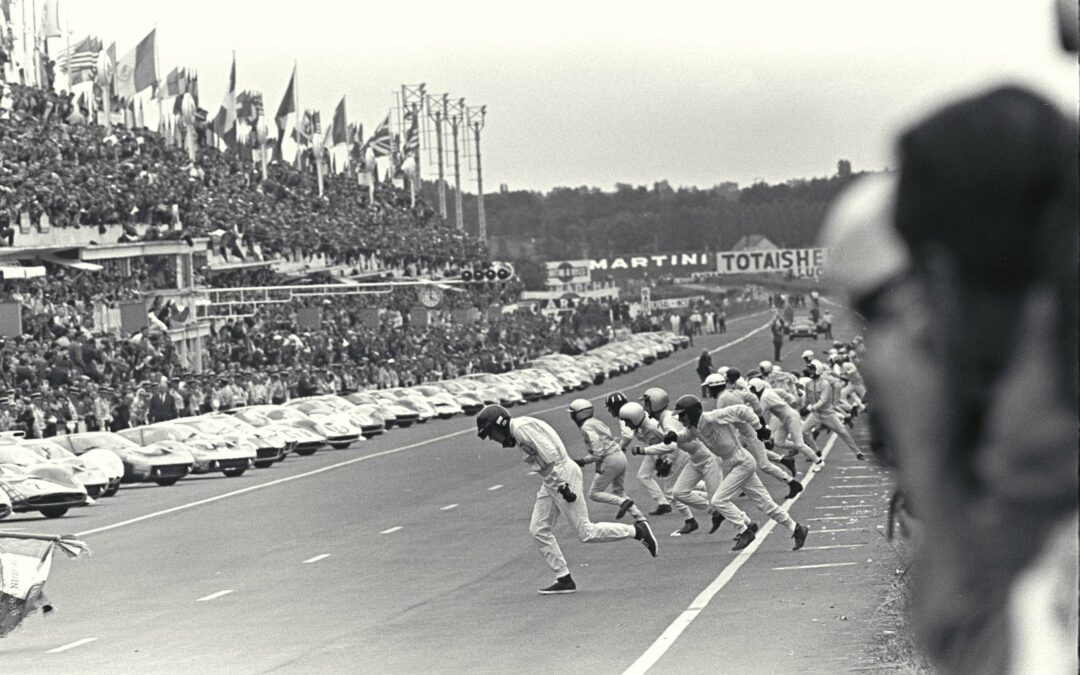
Perhaps overlooked in the Juneteenth celebrations this year was the historic win for Ford Motor at the 24 Hours of Le Mans. It was June 19, 1966, when Ford won the endurance race, placing first, second and third, according to a post at AutomotiveHistory.org.

“When the 1966 24 Hours of Le Mans came to an end on this day in 1966 it was a Ford GT40 in first, second and third place, marking the first time an American automobile won the race. With the three Mk. II Fords so far out in front.”

89th edition of the 24 Hours of Le Mans

After last year’s closed-door event, the 2021 24 Hours of Le Mans will take place Aug. 21-22 with trackside spectators. Tickets went on sale today, June 21. Learn more at the track’s website. 

2021 ticket prices

  • Race Week General Enclosure Pass: $106.05 (€89)
  • Weekend General Enclosure Pass: $94.13 (€79)
  • Practice/Qualifying Pass (valid for Wednesday and Thursday: $58.38 (€49)
  • Wednesday General Enclosure Pass: $43 (€36)
  • Thursday General Enclosure Pass: $51.23 (€43)
  • Weekend Grandstand Pass (general enclosure admission + grandstand seat): from $165.62 (€139)
  • Race Week Grandstand Pass (general enclosure admission + grandstand seat): from $177.54 (€149)

Free access

General Enclosure is free to those younger than 16, born on or after Aug. 22, 2005.

The grandstand is free to children younger than 8, born on or after Aug. 22, 2013.

Pandemic restrictions

Some COVID-19 restrictions are still in place for the race. Attendance is limited to 50,000 or 20 percent of the usual attendance.

The latest French government health pass (June 9, 2021) requires proof of one of the following:

Full vaccination (completed at least two weeks prior);

A negative PCR or antigen test result within the last 48 hours;

A person has recovered from COVID-19, attested by a positive PCR or antigen test result, at least 2 weeks and no more than 6 months old.

See more vintage car photography here

1965 Plymouth Indianapolis 500 Pace Car

1965 Plymouth Indianapolis 500 Pace Car

black and white photos the Plymouth pace car giving Ford driver Jim Clark a victory lap after winning the 1965 Indy 5..

At the 1965 Indy 500, it was ironic that race winner, Ford driver Jim Clark, took his victory lap in the Plymouth Pace Car. Colin Chapman is on the left. (Ford Archive photos)

BY MARK MAYNARD

A Plymouth has paced the Indy 500 for one year only, and it was with irony.

The 1965 Plymouth Fury Convertible Pace Car, with the Commando 383-cubic-inch V-8, was painted white with a blue top and two-tone blue interior. The Pace Car was driven at the 49th running of the race by Chrysler-Plymouth division general manager P.M. Buckminster.

The occasion was ironic because the race winner was Ford driver Jim Clark. And as the winner, he took his victory lap in the Plymouth Pace Car.

The St. Louis Car Museum recently sold a 1965 Plymouth Pace Car and included this in its report:

“Plymouth launched its new 3rd generation Fury lineup for 1965, which included the new and luxurious Sport Fury model. The Sport Fury was selected as the official Indianapolis 500 Pace Car, a first for Plymouth.

“Approximately 1,300 cars were made for dealerships throughout the country, but only 35 festival cars participated at the actual track event [like the one the museum was selling.]

black and white photo shows from 1965 race driver Jim Clark and Colin Chapman conferring with their tire engineer for the Indy 500 race.

Colin Chapman (left), Jim Clark (center), and the tire engineer confer before practice at the 1965 Indy 500. 

Commando V-8

The full-size 1965 Sport Fury was the top-line model among three other Fury trim levels that year. The Pace Car’s optional Commando V-8 had 330 horsepower and was backed by a three-speed 727 Torqueflite automatic transmission. The “727” is considered one of the most robust automatic transmissions ever built.

“Factory equipment included buckets seats, a center console with tachometer, power steering, power brakes, power top with boot cover, front and rear bumper guards, full dash instrumentation, 14-inch redline tires and full wheel covers, a glove box light, windshield washer, seatbelts, and Plymouth Transaudio AM radio.

Special features on the Plymouth Pace Car included:

  • Indy 500 dash plaque;
  • Red, white, and blue badging;
  • Hand holds on the rear fenders;
  • “Official Plymouth Pace Car” decals with the race date on each side;
  • Unique front bumper guard, rear bumper flag holders, and unique floor displays holding the various race flags of a standard race.

Special ephemera with the car included an original Indianapolis 500 race day program and a framed picture of the Plymouth Pace Car making the victory lap with winning driver Jimmy Clark.

Rev up for the 2023 Indy 500

The 107th Running of the Indianapolis 500 — “The Greatest Spectacle in Racing” — is “Back Home Again” on Sunday, May 28. Presented by Gainbridge, NBC will provide live coverage of the Indianapolis 500 beginning at 9 a.m. ET (Noon Pacific) Sunday, May 28. Coverage will include a bonus two hours of streaming before the race begins on the Peacock streaming platform.

Get the Indy 500 week’s schedule here.

1939 Buick Roadmaster Indianapolis 500 Pace Car

1939 Buick Roadmaster Indianapolis 500 Pace Car

Buick’s motorsports history includes two NASCAR titles and six Indianapolis 500 pace cars

The 1939 Buick Roadmaster Indy Pace Car painted in creamy yelllow with black Indianapolis 500 lettering outlined in black

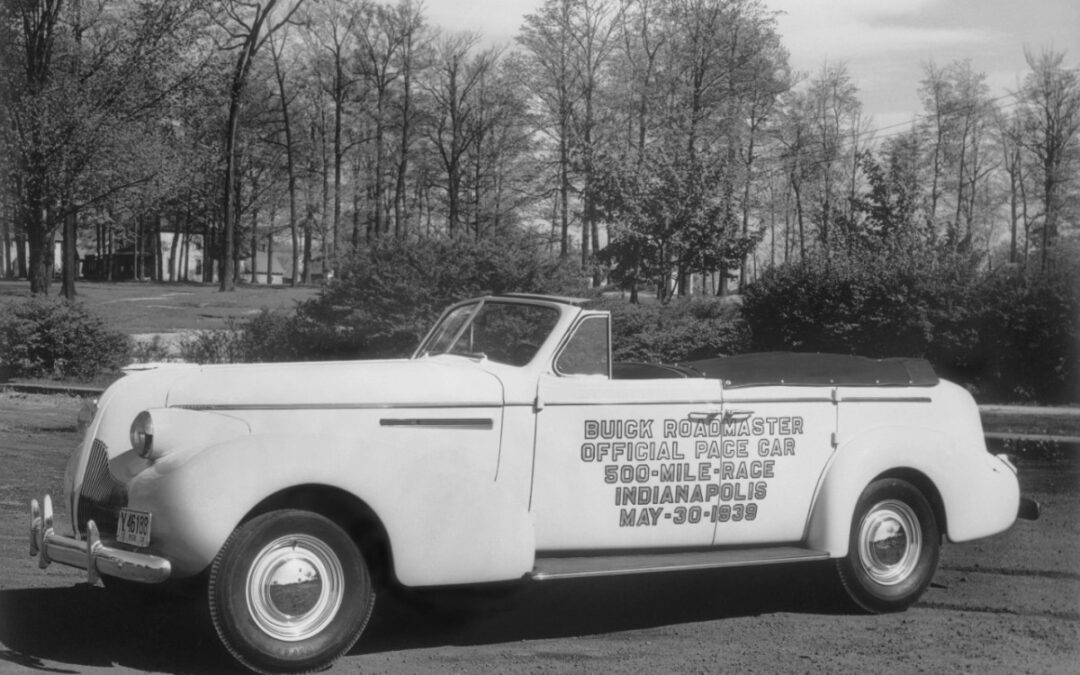
The 1939 Roadmaster Indianapolis 500 pace car was painted in creamy yellow with gold lettering outlined in black.  (GM media archives)

BY MARK MAYNARD

Just three 1939 Roadmaster Indianapolis 500 pace cars were built. The cars were based on the rare Roadmaster convertible “80C,”  according to an auction report by R.M. Sothebys.  Each car was presented in the “Indy 500 Livery” of the period-popular colors of creamy yellow with gold lettering outlined in black.

The red interior featured an elaborate, painted wood-grain dash in red and red leather upholstery. The Indy 500 treatment also included a black parade tonneau and a cloth top with boot.

Among the features in the Indy 500 package were dual side-mount spare tires and an accessory spotlight at the base of the driver-side windshield, though neither feature is shown in this marketing photo.

Buick History

Buick was on a roll in 1939 with innovative advertising and promotion.  Sales were soaring and there had been a host of product improvements, according to the 2011 auction report.

Buick boss Harlow Curtice was determined to set a new sales record. To stimulate sales, the 1939 Buick Roadmaster Indianapolis 500 pace car was created. It was based on the rare Roadmaster Convertible Sedan.

A new sales target of 200,000 cars was set and at the dealer’s kickoff meeting an airplane was displayed on stage with the number “200,000” painted on its wings. The campaign was successful as Buick sold more than 208,000 cars. The result solidified Buick’s position as No. 4 in the industry, behind only the Big Three.

R.M. Sothebys auctioned a 1939 Roadmaster Indianapolis 500 pace car at its 2011 Hershey, Pa., event. The car sold for $62,500.

Look here for more vintage car photos.

17 Historic Corvette and Camaro Pace Cars

17 Historic Corvette and Camaro Pace Cars

The 2025 Indianapolis 500 marks the 36th time for Chevrolet to pace the Indy 500, dating back to 1948, and the 22nd since 1978.

The Chevrolet Brothers entered two cars in the 1915 Indy 500.

The Chevrolet Brothers entered two cars in the 1915 Indianapolis 500. (Chevrolet)

BY MARK MAYNARD

General Motors’ Chevrolet division has a storied history at Indianapolis Motor Speedway. Chevrolet was founded in 1911, the year of the inaugural 500-mile race. Company co-founder and namesake Louis Chevrolet, along with brothers Arthur and Gaston, competed in early Indy 500s. Arthur competed in the 1911 race and Gaston won in 1920.

Since then, nine drivers with Chevrolet engines have combined to win “The Greatest Spectacle in Racing” 11 times — Rick Mears, Emerson Fittipaldi, Arie Luyendyk, Al Unser Jr., Helio Castroneves, Tony Kanaan, Juan Pablo Montoya, Will Power and, most recently, Simon Pagenaud in 2019.

A Corvette has paced “The Greatest Spectacle in Racing” more times than any car. The 2023 race marks the 34th time for Chevrolet to pace, dating back to 1948.

Visit IMS.com for more information about this year’s schedule.

A Lineup of Historic Pace Cars

1948 Chevrolet Fleetmaster Convertible Indy 500 pace car.

1948 Chevrolet Fleetmaster Convertible Indy 500 pace car. (Chevrolet)

1955 Chevrolet Bel Air convertible Indianapolis 500 Pace Car

1955 Chevrolet Bel Air convertible Indianapolis 500 Pace Car. (Chevrolet)

The 2020 Corvette pace car for the Indy 500 race.

The 2020 Corvette pace car.

The 2019 Corvette ZR1 Pace Car.

The 2019 Chevrolet Corvette ZR1 pace car.

The 2017 Chevrolet Corvette Grand Sport pace car.

The 2017 Chevrolet Corvette Grand Sport pace car. (Chris Owens/IMS for Chevy Racing)

The Corvette pace car for the 2016 Indy 500 race.

The Corvette pace car for 2016.

The 2014 Chevrolet Camaro Z/28 pace car was piloted by three-time Indy 500 winner Dario Franchitti, the 98th running of the race. It was the eighth time a Camaro had paced the race.

The 2014 Chevrolet Camaro Z/28 pace car was piloted by three-time Indy 500 winner Dario Franchitti for the 98th running of the race.

Retired General Chuck Yeager with the 1986 C4 Corvette pace car he drove for the race.

Retired General Chuck Yeager with the 1986 C4 Corvette pace car he drove for the race.

The 1978 Chevrolet Corvette Pace Car.

The 1978 Chevrolet Corvette Pace Car.

The 1969 Camaro Z28.

The 1969 Camaro Z28.

The first-year 1967 Chevrolet Camaro RS/SS paced the 51st Indianapolis 500.

The first-year 1967 Chevrolet Camaro RS/SS paced the 51st Indianapolis 500.

The 1993 Chevrolet Camaro Indy 500 Pace Car.

1993 Chevrolet Camaro Indy 500 Pace Car.

Nine generations of Camaro Indy 500 pace cars.

Nine generations of Camaro Indy 500 pace cars. (Indianapolis Motor Speedway for Chevy Racing)

A Torch Red metallic 2023 Corvette Z06 will pace the 107th Indianapolis 500 race on May 28

The 2023 Chevrolet Corvette Z06 paces the 107th running of the Indy 500. (Photo by Chris Owens)

2024 Indy 500 Corvette E-Ray pace car

The 2024 Chevrolet Corvette E-Ray 3LZ coupe paced the 108th Indianapolis 500.

The Corvette E-Ray pairs two separate propulsion systems to provide naturally aspirated V-8 power with electrified responsiveness powered by eAWD.

A 6.2L V-8 is complemented by the electric motor that channels an additional 160 horsepower and 125 lb.-ft. of torque through the front wheels for 655 combined horsepower.

The addition of the electric drive unit helps the E-Ray accelerate from zero to 60 mph in 2.5 seconds before breezing through the quarter-mile in 10.5 seconds. Stealth Mode enables the Corvette E-Ray to drive on electric power for up to 4 miles at speeds up to 45 mph.

2025 Indy 500 Corvette ZR1 pace car

The 2025 Chevrolet Corvette ZR1 will pace the field to the green flag Sunday, May 25 with pro football legend Michael Strahan behind the wheel. Chevrolet says the 2025 Corvette ZR1 is capable of 233 mph, the highest top speed of any car ever made in America by an auto manufacturer. (IMS photo)

2021 Chevrolet Corvette Stingray Convertible Pace Car

17 Historic Corvette and Camaro Pace Cars

Danica Patrick will pace the 33-car field in an Arctic White Corvette Stingray convertible

Leading the 33-car field to the green flag will be an Arctic White 2021 Corvette Stingray hardtop convertible.

The Arctic White pace car will be the first Corvette convertible since 2008 to pace the Indianapolis 500. (Photo by Joe Skibinski/IMS for Chevrolet)

BY MARK MAYNARD

Chevrolet is in its open-wheelhouse battlegrounds for the 105th running of the Indianapolis 500, presented by Gainbridge, on May 30, 2021.

Leading the 33-car field to the green flag will be an Arctic White 2021 Corvette Stingray hardtop convertible. It will be the first Corvette convertible since 2008 to pace “The Greatest Spectacle in Racing.”

The Chevrolet Brothers entered two cars in the 1915 Indy 500.

The Chevrolet Brothers entered two cars in the 1915 Indy 500. (Chevrolet)

The race will be televised live on NBC and the pre-race show will start at 11 a.m. The INDYCAR Radio Network  will cover the race for affiliates and on Sirius 211, XM 205, Indycar.com  and the INDYCAR app.
Piloting the pace car will be racing icon Danica Patrick — a veteran to the Indy 500. Leading the pack to the green flag is even more special, she said in a release, “because of the past year we have all endured, and it will be so nice to see fans back in the stands.”

Racing icon Danica Patrick.

Danica Patrick. (Chevrolet)

Patrick, who grew up in Roscoe, Ill., achieved numerous milestones during her eight Indianapolis 500 starts, which took place from 2005-11 and in 2018. According to IMS statistics, she achieved the best starting spot for a female driver, fourth, as a rookie in 2005 and went on to be the first female driver to lead laps in the race. She finished third in 2009 — the best result ever for a woman in the “500” — and holds the race record for laps led by a female, 29.

When not performing pace car duties, Patrick will serve as a studio analyst for NBC’s live race broadcast with host Mike Tirico and fellow analyst Jimmie Johnson.

“We’re happy to welcome back Danica to the place where she made motorsports history as the first female driver to lead ‘The Greatest Spectacle in Racing,’ ” IMS President J. Douglas Boles said.

1948 Chevrolet Fleetmaster Convertible Indy 500 pace car.

1948 Chevrolet Fleetmaster Convertible Indy 500 pace car. (Chevrolet)

Pace Car Design

The 2021 race marks the 32nd time Chevrolet has paced the race dating back to 1948, and the 18th time since 1978 for America’s favorite sports car. Chevrolet and Corvette have led the starting field more than any other manufacturer and nameplate, respectively.
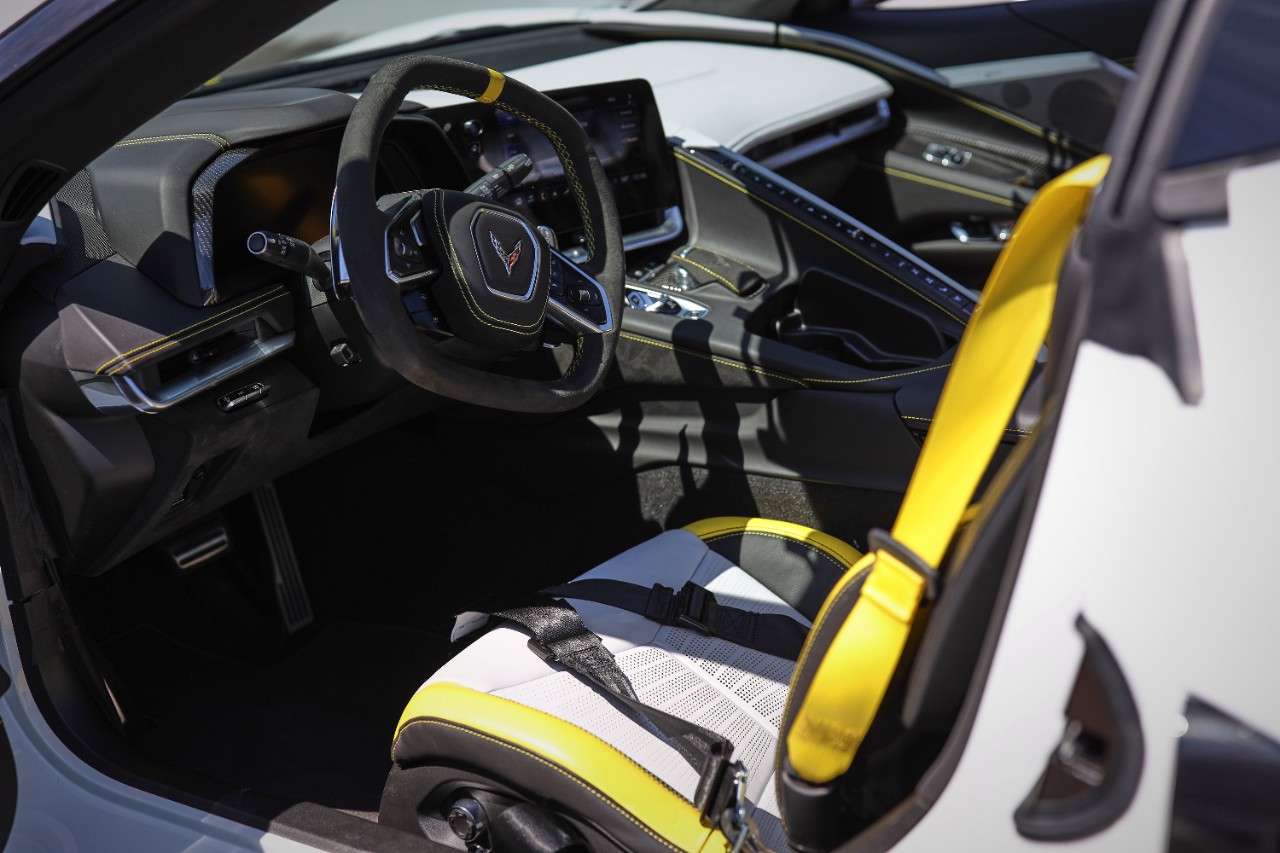
Sky Cool Gray and Strike Yellow

The pace car’s Sky Cool Gray and Strike Yellow interior. (Chevrolet)

“From the color scheme to the special race weekend decals and how the safety lighting is skillfully integrated into the nacelles of the hard-top convertible Corvette’s revolutionary appearance, we’re putting Chevrolet’s best on display for the fans,” said Steve Majoros, vice president of Chevrolet Marketing.

The pace-car interior — Sky Cool Gray and Strike Yellow upholstery — influenced the exterior appearance of the pace car, Majoros said. The car is clad in Indianapolis 500 logos, a special stripe package and Stingray decals and the highly visible safety lighting.

The 2021 Indy 500 pace car has safety strobe lights in the rear taillights and headlights.

Strobe lights are positioned in the headlights, front louvers and taillights. (Chevrolet)

Corvette designers prioritized form and function of the safety lighting by incorporating four lights into each of the tonneau cover nacelles. There also are strobe lights in the headlights, front louvers and taillights. The lighting array eliminates need for a traditional lightbar.

Inspired By Fighter Jets

The mid-engine Stingray was engineered first as a convertible, Chevrolet says. Its architecture maintains the tunnel-dominant structure and high-integrity die-cast parts found in the Stingray coupe.

The Stingray design for both body styles was inspired by fighter jets. The tonneau cover features aerodynamically shaped nacelles influenced by the housing used for jet engines. The nacelles, which were also used as inspiration on the Chevrolet Engineering Research Vehicle (CERV) I and II, and the Corvette SS and SR2 concepts, help reduce air recirculation into the cabin and provide a remarkably exotic profile with the top up or down.

The tonneau integrates a power-adjustable rear window and a vent for engine cooling. The 2021 Stingray convertible is powered by the 6.2-liter small-block V-8 LT2 engine,  naturally aspirated. The engine is rated for 495 horsepower with a peak torque of 470 foot-pounds at 5,150 rpm, when equipped with performance exhaust. In stock form, the engine has 490 hp and 465 ft.-lb. torque, also at 5,150 rpm.

The LT2 is paired with Chevrolet’s first eight-speed, dual-clutch automated-manual transmission. The double-paddle de-clutch feature allows the driver to disconnect the clutch by holding both paddles for more manual control.

1955 Chevrolet Bel Air convertible Indianapolis 500 Pace Car

1955 Chevrolet Bel Air convertible Indianapolis 500 Pace Car. (Chevrolet)

Indianapolis 500 History

General Motors’ Chevrolet division has a storied history at Indianapolis Motor Speedway. Chevrolet was founded in 1911, the year of the inaugural 500-mile race. Company co-founder and namesake Louis Chevrolet, along with brothers Arthur and Gaston, competed in early Indy 500s. Arthur competed in the 1911 race and Gaston won in 1920.
Since then, nine drivers with Chevrolet engines have combined to win “The Greatest Spectacle in Racing” 11 times — Rick Mears, Emerson Fittipaldi, Arie Luyendyk, Al Unser Jr., Helio Castroneves, Tony Kanaan, Juan Pablo Montoya, Will Power and, most recently, Simon Pagenaud in 2019.

Visit IMS.com for more information about this year’s schedule.

And see more Indy pace cars here.

Archived Pace Car Images

Following are Chevrolet archive photos of significant pace cars. Photos courtesy of Chevrolet.

The 2020 Corvette pace car for the Indy 500 race.

The 2020 Corvette pace car.

The 2019 Corvette ZR1 Pace Car.

The 2019 Chevrolet Corvette ZR1 pace car.

The 2017 Chevrolet Corvette Grand Sport pace car.

The 2017 Chevrolet Corvette Grand Sport pace car. (Chris Owens/IMS for Chevy Racing)

The Corvette pace car for the 2016 Indy 500 race.

The Corvette pace car for 2016.

The 2014 Chevrolet Camaro Z/28 pace car was piloted by three-time Indy 500 winner Dario Franchitti, the 98th running of the race. It was the eighth time a Camaro had paced the race.

The 2014 Chevrolet Camaro Z/28 pace car was piloted by three-time Indy 500 winner Dario Franchitti for the 98th running of the race.

Retired General Chuck Yeager with the 1986 C4 Corvette pace car he drove for the race.

Retired General Chuck Yeager with the 1986 C4 Corvette pace car he drove for the race.

The 1978 Chevrolet Corvette Pace Car.

The 1978 Chevrolet Corvette Pace Car.

The 1969 Camaro Z28.

The 1969 Camaro Z28.

The first-year 1967 Chevrolet Camaro RS/SS paced the 51st Indianapolis 500.

The first-year 1967 Chevrolet Camaro RS/SS paced the 51st Indianapolis 500.

The 1993 Chevrolet Camaro Indy 500 Pace Car.

1993 Chevrolet Camaro Indy 500 Pace Car.

Nine generations of Camaro Indy 500 pace cars.

Nine generations of Camaro Indy 500 pace cars. (Indianapolis Motor Speedway for Chevy Racing)

1954 Dodge Indianapolis 500 Pace Car

1954 Dodge Indianapolis 500 Pace Car

The 1954 Dodge Royal Indianapolis 500 pace car was a good example of race marketing

1954 Dodge Royal Indianapolis 500 pace car

There were 701 Indianapolis 500 pace-car replicas built and all were painted two-tone Pace Car Yellow and Jewel Black. (Stellantis media archives)

BY MARK MAYNARD

Chevrolet has a long history of offering replica Indianapolis 500 pace cars, but other makers, such as Dodge, took advantage of the marketing opportunity, too.

The Dodge Royal was introduced in 1954 as the top trim level. Many enthusiasts consider the Royal as the Dodge division’s first muscle car.

To direct attention to the new model, Dodge created the 1954 Dodge 500 Indy Pace Car. It was offered only with a 150-horsepower, 241-cubic-inc, Red Ram Hemi V-8 engine.

There were 701 pace-car replicas built and all were painted in the two-tone Pace Car Yellow and Jewel Black, according to a report at BringATrailer.com.

1954 Dodge Indianapolis Pace Car

The Royal slotted above the mid-level Dodge Coronet and the base level Meadowbrook, according to the car’s page in Wikipedia. The Royal lineup consisted of a four-door sedan, a convertible, club coupe and a two-door sport coupe hardtop.

The pace car was designated the Royal 500 and cost $2,808. Its MSRP was $201 more than the regular model, according to SignificantCars.com. “The buyer got the same equipment as the actual pace car, including a Continental-style rear spare-tire mount, Kelsey Hayes wire wheels and special trim and lettering.”

The Red Ram V-8 engine used a Stromberg two-barrel carburetor with 7.5:1 compression and solid valve lifters. It was rated at 150-hp at 4,400 rpm.  But the actual pace car was fitted with a custom Offenhauser intake manifold and Rochester four-barrel for a reported 170 bhp at 4,400 rpm,” according to SignificantCars.com.

“The Offy manifold that went on the actual pace car might have had a Rochester because Offenhauser preferred Rochester carbs in those days, the author wrote. “I believe Dodge made their own cast iron manifold for the replicas and put a 450 cfm Carter WCFB on those. This manifold and carb setup was available on pace car replicas via special order.”