Select Page

2021 Chevrolet Corvette Stingray Convertible Pace Car

2021 Chevrolet Corvette Stingray Convertible Pace Car

Danica Patrick will pace the 33-car field in an Arctic White Corvette Stingray convertible

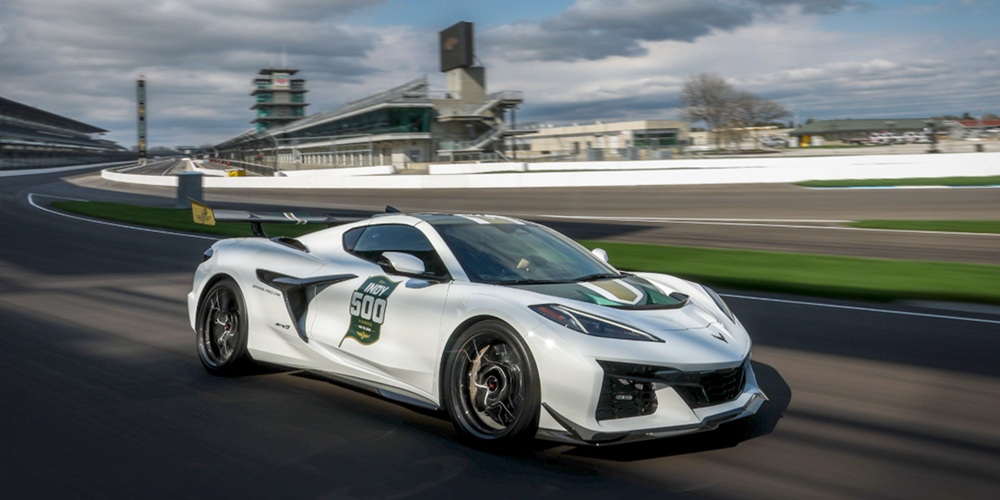
Leading the 33-car field to the green flag will be an Arctic White 2021 Corvette Stingray hardtop convertible.

The Arctic White pace car will be the first Corvette convertible since 2008 to pace the Indianapolis 500. (Photo by Joe Skibinski/IMS for Chevrolet)

BY MARK MAYNARD

Chevrolet is in its open-wheelhouse battlegrounds for the 105th running of the Indianapolis 500, presented by Gainbridge, on May 30, 2021.

Leading the 33-car field to the green flag will be an Arctic White 2021 Corvette Stingray hardtop convertible. It will be the first Corvette convertible since 2008 to pace “The Greatest Spectacle in Racing.”

The Chevrolet Brothers entered two cars in the 1915 Indy 500.

The Chevrolet Brothers entered two cars in the 1915 Indy 500. (Chevrolet)

The race will be televised live on NBC and the pre-race show will start at 11 a.m. The INDYCAR Radio Network  will cover the race for affiliates and on Sirius 211, XM 205, Indycar.com  and the INDYCAR app.
Piloting the pace car will be racing icon Danica Patrick — a veteran to the Indy 500. Leading the pack to the green flag is even more special, she said in a release, “because of the past year we have all endured, and it will be so nice to see fans back in the stands.”

Racing icon Danica Patrick.

Danica Patrick. (Chevrolet)

Patrick, who grew up in Roscoe, Ill., achieved numerous milestones during her eight Indianapolis 500 starts, which took place from 2005-11 and in 2018. According to IMS statistics, she achieved the best starting spot for a female driver, fourth, as a rookie in 2005 and went on to be the first female driver to lead laps in the race. She finished third in 2009 — the best result ever for a woman in the “500” — and holds the race record for laps led by a female, 29.

When not performing pace car duties, Patrick will serve as a studio analyst for NBC’s live race broadcast with host Mike Tirico and fellow analyst Jimmie Johnson.

“We’re happy to welcome back Danica to the place where she made motorsports history as the first female driver to lead ‘The Greatest Spectacle in Racing,’ ” IMS President J. Douglas Boles said.

1948 Chevrolet Fleetmaster Convertible Indy 500 pace car.

1948 Chevrolet Fleetmaster Convertible Indy 500 pace car. (Chevrolet)

Pace Car Design

The 2021 race marks the 32nd time Chevrolet has paced the race dating back to 1948, and the 18th time since 1978 for America’s favorite sports car. Chevrolet and Corvette have led the starting field more than any other manufacturer and nameplate, respectively.
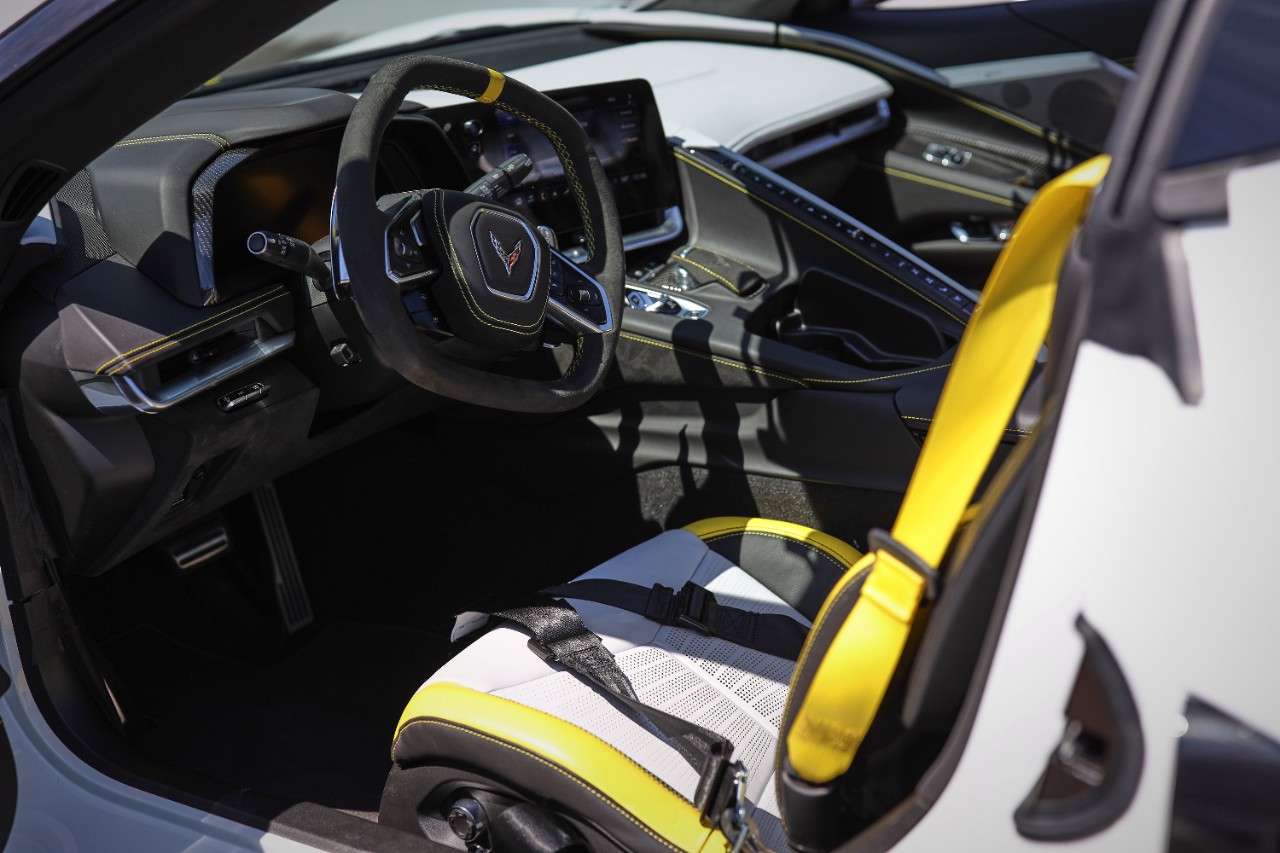
Sky Cool Gray and Strike Yellow

The pace car’s Sky Cool Gray and Strike Yellow interior. (Chevrolet)

“From the color scheme to the special race weekend decals and how the safety lighting is skillfully integrated into the nacelles of the hard-top convertible Corvette’s revolutionary appearance, we’re putting Chevrolet’s best on display for the fans,” said Steve Majoros, vice president of Chevrolet Marketing.

The pace-car interior — Sky Cool Gray and Strike Yellow upholstery — influenced the exterior appearance of the pace car, Majoros said. The car is clad in Indianapolis 500 logos, a special stripe package and Stingray decals and the highly visible safety lighting.

The 2021 Indy 500 pace car has safety strobe lights in the rear taillights and headlights.

Strobe lights are positioned in the headlights, front louvers and taillights. (Chevrolet)

Corvette designers prioritized form and function of the safety lighting by incorporating four lights into each of the tonneau cover nacelles. There also are strobe lights in the headlights, front louvers and taillights. The lighting array eliminates need for a traditional lightbar.

Inspired By Fighter Jets

The mid-engine Stingray was engineered first as a convertible, Chevrolet says. Its architecture maintains the tunnel-dominant structure and high-integrity die-cast parts found in the Stingray coupe.

The Stingray design for both body styles was inspired by fighter jets. The tonneau cover features aerodynamically shaped nacelles influenced by the housing used for jet engines. The nacelles, which were also used as inspiration on the Chevrolet Engineering Research Vehicle (CERV) I and II, and the Corvette SS and SR2 concepts, help reduce air recirculation into the cabin and provide a remarkably exotic profile with the top up or down.

The tonneau integrates a power-adjustable rear window and a vent for engine cooling. The 2021 Stingray convertible is powered by the 6.2-liter small-block V-8 LT2 engine,  naturally aspirated. The engine is rated for 495 horsepower with a peak torque of 470 foot-pounds at 5,150 rpm, when equipped with performance exhaust. In stock form, the engine has 490 hp and 465 ft.-lb. torque, also at 5,150 rpm.

The LT2 is paired with Chevrolet’s first eight-speed, dual-clutch automated-manual transmission. The double-paddle de-clutch feature allows the driver to disconnect the clutch by holding both paddles for more manual control.

1955 Chevrolet Bel Air convertible Indianapolis 500 Pace Car

1955 Chevrolet Bel Air convertible Indianapolis 500 Pace Car. (Chevrolet)

Indianapolis 500 History

General Motors’ Chevrolet division has a storied history at Indianapolis Motor Speedway. Chevrolet was founded in 1911, the year of the inaugural 500-mile race. Company co-founder and namesake Louis Chevrolet, along with brothers Arthur and Gaston, competed in early Indy 500s. Arthur competed in the 1911 race and Gaston won in 1920.
Since then, nine drivers with Chevrolet engines have combined to win “The Greatest Spectacle in Racing” 11 times — Rick Mears, Emerson Fittipaldi, Arie Luyendyk, Al Unser Jr., Helio Castroneves, Tony Kanaan, Juan Pablo Montoya, Will Power and, most recently, Simon Pagenaud in 2019.

Visit IMS.com for more information about this year’s schedule.

And see more Indy pace cars here.

Archived Pace Car Images

Following are Chevrolet archive photos of significant pace cars. Photos courtesy of Chevrolet.

The 2020 Corvette pace car for the Indy 500 race.

The 2020 Corvette pace car.

The 2019 Corvette ZR1 Pace Car.

The 2019 Chevrolet Corvette ZR1 pace car.

The 2017 Chevrolet Corvette Grand Sport pace car.

The 2017 Chevrolet Corvette Grand Sport pace car. (Chris Owens/IMS for Chevy Racing)

The Corvette pace car for the 2016 Indy 500 race.

The Corvette pace car for 2016.

The 2014 Chevrolet Camaro Z/28 pace car was piloted by three-time Indy 500 winner Dario Franchitti, the 98th running of the race. It was the eighth time a Camaro had paced the race.

The 2014 Chevrolet Camaro Z/28 pace car was piloted by three-time Indy 500 winner Dario Franchitti for the 98th running of the race.

Retired General Chuck Yeager with the 1986 C4 Corvette pace car he drove for the race.

Retired General Chuck Yeager with the 1986 C4 Corvette pace car he drove for the race.

The 1978 Chevrolet Corvette Pace Car.

The 1978 Chevrolet Corvette Pace Car.

The 1969 Camaro Z28.

The 1969 Camaro Z28.

The first-year 1967 Chevrolet Camaro RS/SS paced the 51st Indianapolis 500.

The first-year 1967 Chevrolet Camaro RS/SS paced the 51st Indianapolis 500.

The 1993 Chevrolet Camaro Indy 500 Pace Car.

1993 Chevrolet Camaro Indy 500 Pace Car.

Nine generations of Camaro Indy 500 pace cars.

Nine generations of Camaro Indy 500 pace cars. (Indianapolis Motor Speedway for Chevy Racing)

1954 Dodge Indianapolis 500 Pace Car

1954 Dodge Indianapolis 500 Pace Car

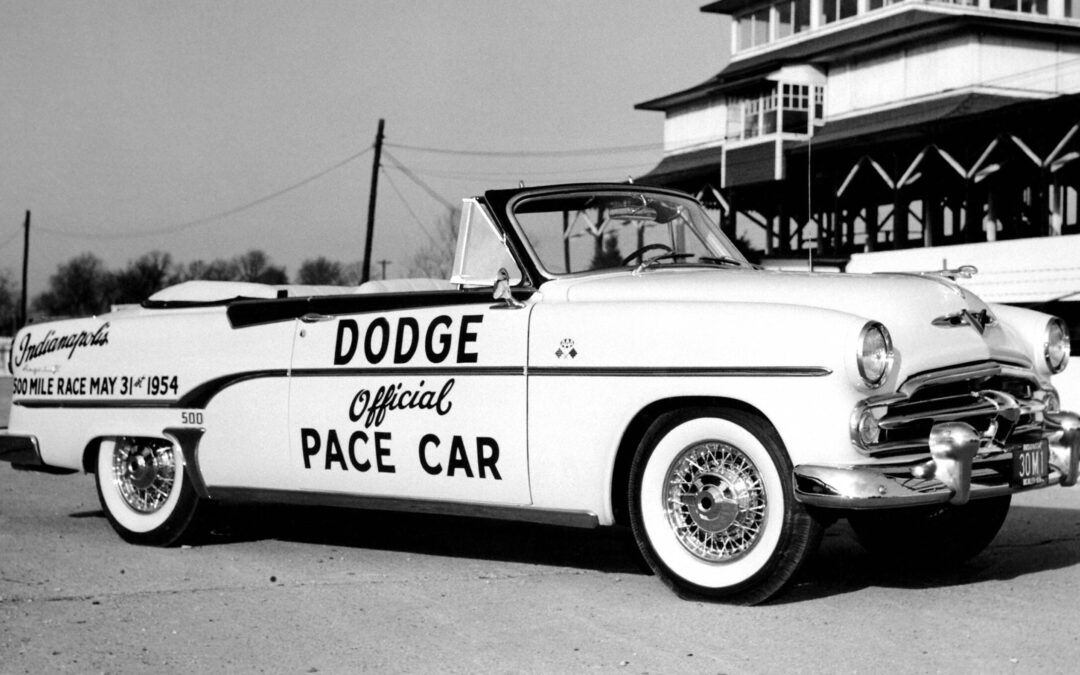
The 1954 Dodge Royal Indianapolis 500 pace car was a good example of race marketing

1954 Dodge Royal Indianapolis 500 pace car

There were 701 Indianapolis 500 pace-car replicas built and all were painted two-tone Pace Car Yellow and Jewel Black. (Stellantis media archives)

BY MARK MAYNARD

Chevrolet has a long history of offering replica Indianapolis 500 pace cars, but other makers, such as Dodge, took advantage of the marketing opportunity, too.

The Dodge Royal was introduced in 1954 as the top trim level. Many enthusiasts consider the Royal as the Dodge division’s first muscle car.

To direct attention to the new model, Dodge created the 1954 Dodge 500 Indy Pace Car. It was offered only with a 150-horsepower, 241-cubic-inc, Red Ram Hemi V-8 engine.

There were 701 pace-car replicas built and all were painted in the two-tone Pace Car Yellow and Jewel Black, according to a report at BringATrailer.com.

1954 Dodge Indianapolis Pace Car

The Royal slotted above the mid-level Dodge Coronet and the base level Meadowbrook, according to the car’s page in Wikipedia. The Royal lineup consisted of a four-door sedan, a convertible, club coupe and a two-door sport coupe hardtop.

The pace car was designated the Royal 500 and cost $2,808. Its MSRP was $201 more than the regular model, according to SignificantCars.com. “The buyer got the same equipment as the actual pace car, including a Continental-style rear spare-tire mount, Kelsey Hayes wire wheels and special trim and lettering.”

The Red Ram V-8 engine used a Stromberg two-barrel carburetor with 7.5:1 compression and solid valve lifters. It was rated at 150-hp at 4,400 rpm.  But the actual pace car was fitted with a custom Offenhauser intake manifold and Rochester four-barrel for a reported 170 bhp at 4,400 rpm,” according to SignificantCars.com.

“The Offy manifold that went on the actual pace car might have had a Rochester because Offenhauser preferred Rochester carbs in those days, the author wrote. “I believe Dodge made their own cast iron manifold for the replicas and put a 450 cfm Carter WCFB on those. This manifold and carb setup was available on pace car replicas via special order.”

1948 Chevrolet Fleetmaster Pace Car

1948 Chevrolet Fleetmaster Pace Car
A black and white photo of a young lady holding a checkered flag in front of a 1948 Chevrolet Fleetmaster Pace Car

The first Chevrolet Pace Car, a 1948 Fleetmaster convertible. (Chevrolet PR archives)

BY MARK MAYNARD

The first Chevrolet to pace the Indianapolis 500 was a 1948 Fleetmaster convertible.

American racing driver Warren Wilbur Shaw (Oct. 31, 1902 –to Oct. 30, 1954) drove the 1948 Chevrolet Pace Car. Shaw, the automotive test evaluator for Popular Science magazine, was president of the Indianapolis Motor Speedway from 1945 until his death in 1954.

According to his page in Wikipedia, Shaw won the Indianapolis 500 race three times, in 1937, 1939, and 1940. He was the second driver to win the 500 three times, and the first to win it twice in a row. In the 1941 race, Shaw was injured when his car crashed; it was later discovered that a defective wheel had been placed on his car.

During World War II, Shaw was hired by the tire manufacturer Firestone Tire and Rubber Company to test a synthetic rubber automobile tire at the Indianapolis Motor Speedway. The speedway had been closed due to the war.

Fall and Rise of the Speedway

Shaw was dismayed at the dilapidated condition of the racetrack and quickly contacted then-owner Eddie Rickenbacker, the World War I flying ace and president and founder of Eastern Air Lines. When the United States entered World War II, ending racing at Indianapolis and elsewhere for the duration, Rickenbacker padlocked the gates and let the race course slowly begin to disintegrate.

During a meeting soon after the tire test, Rickenbacker informed Shaw that what was left of the track would be demolished, and the land turned into a housing subdivision. Shaw sent letters to the major car manufacturers trying to find a backer to buy the speedway. However, all indicated that should they buy the IMS, they would turn it into a private testing facility for their own cars only.

Shaw then met Terre Haute [Indiana] businessman Tony Hulman who had inherited his family’s business.  Hulman & Company was a wholesale grocer and producer of coffee and baking powder, Clabber Girl.

Hulman was a lifelong fan of automobile racing in general and the “500” in particular. He listened with great interest to what Shaw had to say. Despite what Hulman saw among the weeds and deterioration when Shaw took him to Indianapolis, he purchased the Speedway from Rickenbacker in November 1945 for the sum of $750,000.

As a reward for his efforts to revive the Speedway, Shaw was appointed as its president, where he would have complete day-to-day control over the track. To this job, Shaw brought his extensive knowledge of the business of auto racing, something Hulman would admit that he himself did not have. And it was Shaw’s hard work that cemented the reputation of the “500” as the “Greatest Spectacle in Racing.”

Chevrolet Fleetmaster Lineup

The Fleetmaster had a model-year run from 1946-1948. The 1948 line included the Fleetline sub-series which was offered only in two-door and four-door fastback body styles.

According to an entry in Wikipedia, the Chevrolet Fleetmaster replaced the “prewar” Chevrolet Special Deluxe and was powered by a 216.5 cubic inch (3.5-liter) straight-six engine driving through a three-speed manual transmission. It was offered in two-door Town Sedan, four-door Sport Sedan, two-door Sports Coupe, two-door convertible, and four-door station wagon models.

The Chevrolet Fleetline sub-series featured fastback styling and additional triple moldings on all fenders.

Rev up for the 2023 Indy 500

The 107th Running of the Indianapolis 500 — “The Greatest Spectacle in Racing” — is “Back Home Again” on Sunday, May 28. Presented by Gainbridge, NBC will provide live coverage of the Indianapolis 500 beginning at 9 a.m. ET (Noon Pacific) Sunday, May 28. Coverage will include a bonus two hours of streaming before the race begins on the Peacock streaming platform.

Get the Indy 500 week schedule here.

1956 Volvo 122 ‘Amason’ aka Amazon

1956 Volvo 122 ‘Amason’ aka Amazon

A vintage corporate PR image showing three Volvo Amazon cars being weighed together and lifted by a crane.This corporate PR image for the Volvo Amazon has the caption: “Three models are lifted to check their total weights.” (Photos courtesy of Volvo)


BY MARK MAYNARD

The Volvo Amazon was a midsized car manufactured and marketed by Volvo Cars from 1956 to 1970, according to its page in Wikipedia. It was introduced to the United States in 1959 as the 122S during the New York International Auto Show.

When introduced, the car was named the Amason (with an ‘s’) in tribute to the fierce female warriors of Greek mythology, the Amazons. German motorcycle manufacturer Kreidler had already registered the name. After negotiations, the two companies agreed that Volvo could only use the name Amazon within Sweden. Subsequently, Volvo began its tri-digit nomenclature and the line became known as the 120 Series.

Volvo invented the three-point seat belt in 1959

In 1959, Volvo claimed to be the world’s first manufacturer to provide front seat belts as standard equipment.

Ponton Styling 

The Volvo Amazon was sold in body styles of two-door sedan, four-door sedan, and five-door wagon — all noted for their ponton styling.

“The Amazon’s “ponton” (pontoon-like) three-box styling was inspired by U.S. cars of the early 1950s, according to Wikipedia. The ponton styling strongly resembled the Chrysler New Yorker sedan and the Chrysler 300C hardtop coupe. Amazon designer Jan Wilsgaard said he was inspired by an American Kaiser he saw at the Gothenburg, Sweden, port.

At introduction, the Amazon had a choice of two four-cylinder engines. The base in-line OHV 1.6-liter had 60-horsepower and there was an uplevel 85-hp variant. Power upgrades came in 1961 with a 70- or 90-hp 1.8-liter four-cylinder, with a bump to 95-hp in 1965.

A colorful marketing image of a two-tone red and white Amazon surrounded by admiring caballeros

This group of caballeros (ranch hands) might be pondering an Amazon pickup.

The Volvo Amazon had floor-mounted manual transmissions had either three- or four-speeds, with or without overdrive. However, some cars were delivered with a steering-column shifter.

Always a safety innovator, Volvo invented the three-point seat belt. It then began to provide the front seat belts as standard equipment. The belts were added to all Amazon models, including those for export.

1954 Dodge Indy Pace Car

1954 Dodge Indy Pace Car

1954 Dodge Indianapolis 500 Pace Car.There were 701 Dodge Indy Pace Car 500 pace-car replicas built, all in Pace Car Yellow and Jewel Black. (Stellantis NV)

BY MARK MAYNARD

The 1954 Dodge Indy Pace Car was introduced for the debut of the new Royal top trim level. It was offered only with a 241-cubic-inch, 150-hp, Red Ram Hemi V-8 engine.

The Royal slotted above the mid-level Dodge Coronet and the base level Meadowbrook. The Royal lineup consisted of a four-door sedan, convertible, club coupe, and sport coupe two-door hardtop.

To direct attention to the new model, Dodge created the 1954 Dodge Indy Pace Car.

1954 Dodge print advertisement.

(Stellantis NV)

According to a report in BringATrailer.com , many enthusiasts consider the Royal the division’s first muscle car. There were 701 pace-car replicas built, “all which were painted Pace Car Yellow and Jewel Black two-tone.”

The cars were designated the Royal 500 and cost $2,808 — $201 more than the regular model, according to SignificantCars.com. “For that, the buyer got the same equipment as the actual pace car, including a Continental-style rear spare-tire mount, Kelsey Hayes wire wheels, and special trim and lettering.

A 1954 Dodge Royal two-door hardtop

The lineup consisted of a four-door sedan, convertible, club coupe and sport coupe, the latter being a two-door hardtop. (Stellantis NV)

Red Ram V-8

“Royal 500s came with the Red Ram V-8, which used a Stromberg two-barrel carburetor, had 7.5:1 compression and solid valve lifters and was rated at 150 hp at 4,400 rpm.

“The actual pace car was fitted with a custom Offenhauser intake manifold and Rochester four-barrel for a reported 170 bhp at 4,400 rpm. (‘The Offy manifold that went on the actual pace car may have had a Rochester because Offenhauser preferred Rochester carbs in those days. I believe Dodge made their own cast iron manifold for the replicas and put a 450 cfm Carter WCFB on those.’). This manifold and carb setup was available on pace car replicas via special order.”

2023 Chevrolet Corvette Z06 To Pace Indianapolis 500

2023 Chevrolet Corvette Z06 To Pace Indianapolis 500
A Torch Red metallic 2023 Corvette Z06 will pace the 107th Indianapolis 500 race on May 28

The Chevrolet Corvette has paced ‘The Greatest Spectacle in Racing’ more times than any car. The 2023 race marks the 34th time for Chevrolet to pace dating back to 1948 and the 20th time overall and since 1978. (Photo by Chris Owens)

BY MARK MAYNARD

The 107th Running of the Indianapolis 500 — “The Greatest Spectacle in Racing” — is “Back Home Again” on Sunday, May 28.

Presented by Gainbridge, NBC Sports will provide live coverage of the Indianapolis 500 beginning at 9 a.m. ET (Noon Pacific) Sunday, May 28
. Coverage will include a bonus two hours of streaming before the race begins on the Peacock streaming platform.

There will be 33 cars on the field this year by Chevrolet and Honda.

Katherine Legge, 42, is the lone female in the pack. Driving for Rahal Letterman Lanigan Racing in the No. 44 Honda, the British-born Legge will start in row 10, the 30th position.

According to a report by Scott Horner of the Indianapolis Star, Legge crashed into Stefan Wilson Monday, May 22, during Indianapolis 500 practice.

Wilson suffered a fractured vertebra in Monday’s crash, which required surgery on Wednesday night, wrote Charles Bradley of Motorsport.com. Wilson is determined to make a full recovery and return to contest the race next year with his Cusick Motorsports/Dreyer and Reinbold team, he wrote in the online report.

Legge was cleared by medical personnel to compete on Sunday. She returned to the track in her repaired Rahal Letterman Lanigan Racing car and was 29th fastest in Friday’s final practice on Carb Day, per Bradley Motorsport.com.

Wilson, a Chevrolet driver for Dreyer & Reinbold Racing, was replaced by veteran driver Graham Rahal. 

Legge is just the ninth woman ever to compete in the Indianapolis 500.

Race Day Countdown

All times are Pacific Standard, or 3 hours ahead of Indianapolis:

11:45 a.m.: Borg Warner trophy march to the Bricks; departing from the IMS Museum;

Noon-12:30: Cars to Pit Lane;

1:30 p.m.: Cars to grid on front straight;

2:47 p.m.: Driver introductions; Trackside Yard of Bricks Stage

3:18 p.m.: Invocation; trackside Yard of Bricks Stage;

3:24 p.m.: Jewel sings the national anthem;

3:36 p.m.: Jim Cornelison singing the Hoosier state’s favorite anthem, “Back Home Again In Indiana”;

3:38 p.m.: Indianapolis Motor Speedway owner Roger Penske will command drivers to start engines.

3:45 p.m.: Green flag drops.

2023 Indy 500 Corvette Z06 Pace Car

For the first time in the storied history of “America’s sports car,” a hardtop convertible Chevrolet Corvette Z06 will lead the field to the green flag.

Corvette is the longest-running car nameplate in automotive industry history, and the Corvette has paced “The Greatest Spectacle in Racing” more times than any car. The 2023 race marks the 34th time for Chevrolet to pace, dating back to 1948.

This year’s Corvette Z06 Pace Car exterior is two-tone Red Mist Metallic and Jet Black. The interior in Sky Cool Gray has Torch Red accents. Spider-design forged aluminum wheels are finished in Tech Bronze.

The 2023 Corvette Z06 is set apart from the rest of the lineup by its 670 horsepower, 5.5-liter LT6 V-8, and 8-speed dual-clutch transmission. Chevrolet says the LT6 V-8 is the highest-horsepower, naturally aspirated V-8 in any production car.

Helping to keep the Z06 pace car flying low is the Carbon Aero package. It provides 734 pounds of downforce at 186 mph, more than any other Corvette.

Expect to spend around $150,000 if you’d like to re-create a 2023 Corvette Z06 in the image of the pace car.

Get the Indy 500 schedule here.