Select Page

The Fateful “E Day” — Sept. 4, 1957

The Fateful “E Day” — Sept. 4, 1957

The Edsel brand debuted as the ‘the car of the future’ and was introduced with great fanfare as an ‘entirely new kind of car’

William Clay Ford senior, Benson Ford and Henry Ford II at the launch of the Edsel brand and car in 1957. (All photos from Ford PR archives)


BY MARK MAYNARD

Ford Motor’s initial “E Day” had nothing to do with electrification, though it was hoped to be electrifying. Sept. 4, 1957, marked the infamous launch of the Edsel brand.

The brand was named for Edsel B. Ford, scion of company founder Henry Ford. The new division was intended to be a fourth selling channel for the carmaker, along with Mercury and Lincoln. Ford spent big on the debut. A reported $250 million went into development, manufacturing, and marketing on the model line, according to its page on Wikipedia.

1958 Edsels on test track for a press event.

The expansive fleet of 1958 Edsels for a press event.

Marketed as “the car of the future,” the “mid-priced” Edsel lineup was introduced with great fanfare as an “entirely new kind of car.”

The Edsel's dome speedometerThe distinctive dome speedometer.

The Edsel would introduce multiple advanced features for the time. Among them:

•The speedometer was a rotating dome, not the traditional horizontal strip or a round dial. The dashboard adopted warning lights such for conditions as low oil level, parking brake engaged and engine overheating. The format was in line with aircraft design.

•Edsel introduced a speed warning on the speedometer if the driver exceeded a preset speed. But it was not cruise control.

The Tel-A-Touch transmission selector.

The Tel-A-Touch transmission selector.

•A column-mounted transmission shifter was standard. But Edsel offered the Tel-A-Touch push-button shifting system that was mounted in the steering wheel hub.

“The Edsel also integrated many elements of the Ford Lifeguard safety package into its design. Along with optional seatbelts, the Edsel featured a deep-dish steering wheel, double-latch doors and childproof rear door locks.

“The model line was among the first to introduce remote-operated trunk opening and self-adjusting brakes.”

The lineup of 1959 Edsels.

The brand debuted with a seven-model lineup. Shown are 1959 Edsels.

In its inaugural model year, Edsel introduced a seven-model product line, including four sedans and three station wagons.

“The lower-trim Edsel Ranger and Edsel Pacer shared bodies with Ford sedans (118-inch wheelbase) while the higher-trim Edsel Corsair and Edsel Citation shared bodies with Mercury sedans (124-inch wheelbase).

A 1959 Edsel Fordor Sedan.

A 1959 Fordor Sedan.

“Sharing its body and 116-inch wheelbase with Ford station wagons, Edsel offered the two-door Edsel Roundup and the four-door Edsel Villager and Edsel Bermuda.

According to Wikipedia, the brand was also promoted by the top-rated television special, “The Edsel Show,” on Oct. 13. But the promotional effort was not enough to counter the adverse initial public reaction to Edsel styling and unconventional build.

Three Ford executives sitting three across in the 1958 Edsel convertible.

Three across seating for the Ford executives.

A reborn LaSalle

“After the launch date, Edsel was described as a ‘reborn LaSalle,’ a General Motors brand that had disappeared in 1940. For months, Ford had been telling the industry press that it ‘knew’ (through its market research) that there would be great demand for the vehicles.

“Ford also insisted that, in the Edsels, it had built exactly the ‘entirely new kind of car’ that Ford had been leading the buying public to expect through its pre-introduction publicity campaign for the cars.

1958 Edsel's 410 cubic-inch OHV V-8 on a display stand..

1958 Edsel’s 410 cubic-inch (6.7-liter), OHV V-8. 

“In reality, however, Edsels shared their engineering and bodywork with other Ford models, and the similarities were apparent once the vehicles were viewed firsthand.

The Edsel brand was introduced in a recession that catastrophically affected sales of medium-priced cars. Edsels were considered overhyped, unattractive (distinguished by a vertical grille), and low quality.

A 1958 Edsel chassis showing the engine and drivetrain

1958 Edsel chassis.

Ford’s damage control moved quickly. In January 1958, the free-standing Edsel division was added to Lincoln-Mercury, according to the Wiki report. The re-christened Mercury-Edsel-Lincoln Division adopted Edsel sales and marketing operations.

A 1958 Edsel dealer showroom

A 1958 Edsel dealer showroom.

“As the model year progressed and sales fell below expectations, multiple Edsel-only dealers closed or expanded their brand offerings with the encouragement of Ford Motor Co. The alternate brands included Lincoln-Mercury or imported Ford of Britain and Ford of Germany franchises.

Ford design VP George Walker attends the 1958 Edsel introduction in the Styling Rotunda

Ford design VP George Walker attends the 1958 Edsel introduction in the Styling Rotunda. 

But the Edsel brand was not be saved. Ford quietly discontinued the Edsel brand before 1960.

Here are a few more Edsel photos too good to not share:

1958 Edsel and 1932 Ford Phaeton with V8 engines. 

The top-line 1958 Edsel Citation hardtop.

And the infamous horse-collar grille.

1953 Cadillac Le Mans Concept

1953 Cadillac Le Mans Concept

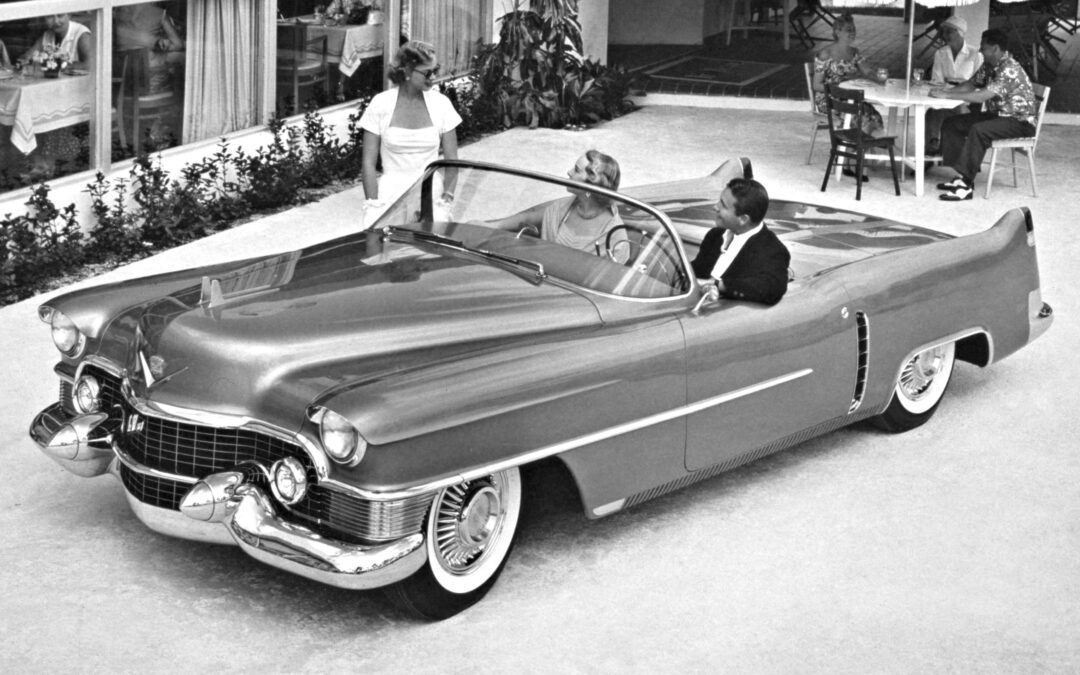
Harley Earl’s revolutionary Cadillac Le Mans concept was a look into the future of automotive design

The 1953 Cadillac Le Mans concept convertible

The 1953 Cadillac Le Mans concept, named for the 24 Hours of Le Mans endurance race in France, never went into production, but the design was an exercise using fiberglass and two-seater design. (GM Archives)

BY MARK MAYNARD

The 1953 Cadillac Le Mans was a star dream car at the 1953 General Motors Motorama. The big Caddy’s futuristic design and powerful performance impressed the public and the automotive press, and it helped to set the stage for the next generation of Cadillac cars.

Designed by GM’s legendary design chief, Harley Earl, the Le Mans concept was named for the 24 Hours of Le Mans race in France, in which Cadillac competed in 1950.

Earl uses the concept car to showcase Cadillac’s vision for the future of automotive design. The Le Mans concept was a two-seat, fiberglass-bodied roadster with a low profile and a long, sleek body. Innovative design elements included a wraparound windshield, hidden headlights, and a tailfin design that would become a signature feature of Cadillac cars in the 1950s.

The Le Mans concept’s sporty styling closely resembled the 1954 Eldorado limited production convertible, according to a report at SuperCars.net  Compared to a standard Cadillac convertible, the Le Mans was nearly eight inches lower and its fiberglass body and 115-inch wheelbase made it 400 pounds lighter.

While the 1953 Le Mans concept was never put into production, four versions of the Le Mans concept were built, of which three are accounted for today. One is in the GM Heritage Center in Detroit. But there is some mystery as to the whereabouts of the fourth car, explained in a 2013 AutoWeek story by Wallace Wyss.

1953 Cadillac Le Mans Specifications

Body style: 2-seat roadster; fiberglass body on steel ladder frame

Engine: 6.4-liter, 331-cubic-inch 250-horsepower Cadillac V-8

Transmission: 4-speed Hydramatic

Wheelbase/Length: 116/196 inches

Width/height: 74/51 inches

Curb weight: 4,405 pounds


Other story sources:

Ford Wins 1966 24 Hours of Le Mans

Ford Wins 1966 24 Hours of Le Mans

The 2021 89th edition of the 24 Hours of Le Mans will take place Aug. 21-22

A Ford GT 40 racecar passes beneath the big Dunlop tire race bridge at the 1966 24 Hours of Le Mans.

A Ford GT40 Mk II at the 1966 24 Hours of Le Mans. (Ford PR archive)

BY MARK MAYNARD

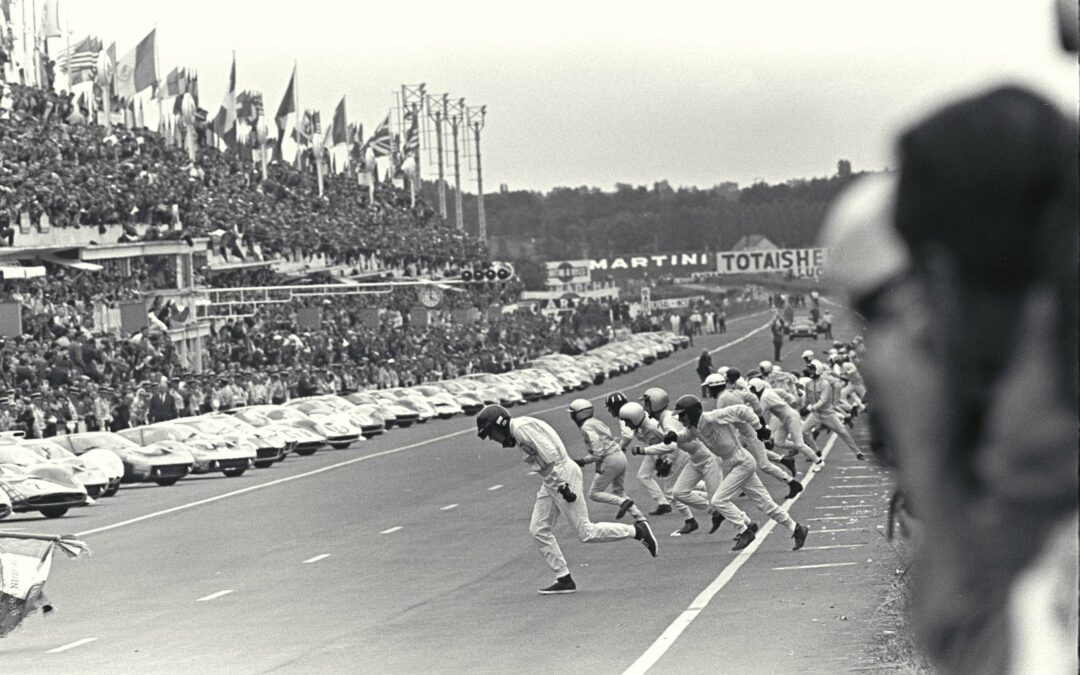
Perhaps overlooked in the Juneteenth celebrations this year was the historic win for Ford Motor at the 24 Hours of Le Mans. It was June 19, 1966, when Ford won the endurance race, placing first, second and third, according to a post at AutomotiveHistory.org.

“When the 1966 24 Hours of Le Mans came to an end on this day in 1966 it was a Ford GT40 in first, second and third place, marking the first time an American automobile won the race. With the three Mk. II Fords so far out in front.”

89th edition of the 24 Hours of Le Mans

After last year’s closed-door event, the 2021 24 Hours of Le Mans will take place Aug. 21-22 with trackside spectators. Tickets went on sale today, June 21. Learn more at the track’s website. 

2021 ticket prices

  • Race Week General Enclosure Pass: $106.05 (€89)
  • Weekend General Enclosure Pass: $94.13 (€79)
  • Practice/Qualifying Pass (valid for Wednesday and Thursday: $58.38 (€49)
  • Wednesday General Enclosure Pass: $43 (€36)
  • Thursday General Enclosure Pass: $51.23 (€43)
  • Weekend Grandstand Pass (general enclosure admission + grandstand seat): from $165.62 (€139)
  • Race Week Grandstand Pass (general enclosure admission + grandstand seat): from $177.54 (€149)

Free access

General Enclosure is free to those younger than 16, born on or after Aug. 22, 2005.

The grandstand is free to children younger than 8, born on or after Aug. 22, 2013.

Pandemic restrictions

Some COVID-19 restrictions are still in place for the race. Attendance is limited to 50,000 or 20 percent of the usual attendance.

The latest French government health pass (June 9, 2021) requires proof of one of the following:

Full vaccination (completed at least two weeks prior);

A negative PCR or antigen test result within the last 48 hours;

A person has recovered from COVID-19, attested by a positive PCR or antigen test result, at least 2 weeks and no more than 6 months old.

See more vintage car photography here

1965 Plymouth Indianapolis 500 Pace Car

1965 Plymouth Indianapolis 500 Pace Car

black and white photos the Plymouth pace car giving Ford driver Jim Clark a victory lap after winning the 1965 Indy 5..

At the 1965 Indy 500, it was ironic that race winner, Ford driver Jim Clark, took his victory lap in the Plymouth Pace Car. Colin Chapman is on the left. (Ford Archive photos)

BY MARK MAYNARD

A Plymouth has paced the Indy 500 for one year only, and it was with irony.

The 1965 Plymouth Fury Convertible Pace Car, with the Commando 383-cubic-inch V-8, was painted white with a blue top and two-tone blue interior. The Pace Car was driven at the 49th running of the race by Chrysler-Plymouth division general manager P.M. Buckminster.

The occasion was ironic because the race winner was Ford driver Jim Clark. And as the winner, he took his victory lap in the Plymouth Pace Car.

The St. Louis Car Museum recently sold a 1965 Plymouth Pace Car and included this in its report:

“Plymouth launched its new 3rd generation Fury lineup for 1965, which included the new and luxurious Sport Fury model. The Sport Fury was selected as the official Indianapolis 500 Pace Car, a first for Plymouth.

“Approximately 1,300 cars were made for dealerships throughout the country, but only 35 festival cars participated at the actual track event [like the one the museum was selling.]

black and white photo shows from 1965 race driver Jim Clark and Colin Chapman conferring with their tire engineer for the Indy 500 race.

Colin Chapman (left), Jim Clark (center), and the tire engineer confer before practice at the 1965 Indy 500. 

Commando V-8

The full-size 1965 Sport Fury was the top-line model among three other Fury trim levels that year. The Pace Car’s optional Commando V-8 had 330 horsepower and was backed by a three-speed 727 Torqueflite automatic transmission. The “727” is considered one of the most robust automatic transmissions ever built.

“Factory equipment included buckets seats, a center console with tachometer, power steering, power brakes, power top with boot cover, front and rear bumper guards, full dash instrumentation, 14-inch redline tires and full wheel covers, a glove box light, windshield washer, seatbelts, and Plymouth Transaudio AM radio.

Special features on the Plymouth Pace Car included:

  • Indy 500 dash plaque;
  • Red, white, and blue badging;
  • Hand holds on the rear fenders;
  • “Official Plymouth Pace Car” decals with the race date on each side;
  • Unique front bumper guard, rear bumper flag holders, and unique floor displays holding the various race flags of a standard race.

Special ephemera with the car included an original Indianapolis 500 race day program and a framed picture of the Plymouth Pace Car making the victory lap with winning driver Jimmy Clark.

Rev up for the 2023 Indy 500

The 107th Running of the Indianapolis 500 — “The Greatest Spectacle in Racing” — is “Back Home Again” on Sunday, May 28. Presented by Gainbridge, NBC will provide live coverage of the Indianapolis 500 beginning at 9 a.m. ET (Noon Pacific) Sunday, May 28. Coverage will include a bonus two hours of streaming before the race begins on the Peacock streaming platform.

Get the Indy 500 week’s schedule here.

1939 Buick Roadmaster Indianapolis 500 Pace Car

1939 Buick Roadmaster Indianapolis 500 Pace Car

Buick’s motorsports history includes two NASCAR titles and six Indianapolis 500 pace cars

The 1939 Buick Roadmaster Indy Pace Car painted in creamy yelllow with black Indianapolis 500 lettering outlined in black

The 1939 Roadmaster Indianapolis 500 pace car was painted in creamy yellow with gold lettering outlined in black.  (GM media archives)

BY MARK MAYNARD

Just three 1939 Roadmaster Indianapolis 500 pace cars were built. The cars were based on the rare Roadmaster convertible “80C,”  according to an auction report by R.M. Sothebys.  Each car was presented in the “Indy 500 Livery” of the period-popular colors of creamy yellow with gold lettering outlined in black.

The red interior featured an elaborate, painted wood-grain dash in red and red leather upholstery. The Indy 500 treatment also included a black parade tonneau and a cloth top with boot.

Among the features in the Indy 500 package were dual side-mount spare tires and an accessory spotlight at the base of the driver-side windshield, though neither feature is shown in this marketing photo.

Buick History

Buick was on a roll in 1939 with innovative advertising and promotion.  Sales were soaring and there had been a host of product improvements, according to the 2011 auction report.

Buick boss Harlow Curtice was determined to set a new sales record. To stimulate sales, the 1939 Buick Roadmaster Indianapolis 500 pace car was created. It was based on the rare Roadmaster Convertible Sedan.

A new sales target of 200,000 cars was set and at the dealer’s kickoff meeting an airplane was displayed on stage with the number “200,000” painted on its wings. The campaign was successful as Buick sold more than 208,000 cars. The result solidified Buick’s position as No. 4 in the industry, behind only the Big Three.

R.M. Sothebys auctioned a 1939 Roadmaster Indianapolis 500 pace car at its 2011 Hershey, Pa., event. The car sold for $62,500.

Look here for more vintage car photos.

17 Historic Corvette and Camaro Pace Cars

17 Historic Corvette and Camaro Pace Cars

The 2025 Indianapolis 500 marks the 36th time for Chevrolet to pace the Indy 500, dating back to 1948, and the 22nd since 1978.

The Chevrolet Brothers entered two cars in the 1915 Indy 500.

The Chevrolet Brothers entered two cars in the 1915 Indianapolis 500. (Chevrolet)

BY MARK MAYNARD

General Motors’ Chevrolet division has a storied history at Indianapolis Motor Speedway. Chevrolet was founded in 1911, the year of the inaugural 500-mile race. Company co-founder and namesake Louis Chevrolet, along with brothers Arthur and Gaston, competed in early Indy 500s. Arthur competed in the 1911 race and Gaston won in 1920.

Since then, nine drivers with Chevrolet engines have combined to win “The Greatest Spectacle in Racing” 11 times — Rick Mears, Emerson Fittipaldi, Arie Luyendyk, Al Unser Jr., Helio Castroneves, Tony Kanaan, Juan Pablo Montoya, Will Power and, most recently, Simon Pagenaud in 2019.

A Corvette has paced “The Greatest Spectacle in Racing” more times than any car. The 2023 race marks the 34th time for Chevrolet to pace, dating back to 1948.

Visit IMS.com for more information about this year’s schedule.

A Lineup of Historic Pace Cars

1948 Chevrolet Fleetmaster Convertible Indy 500 pace car.

1948 Chevrolet Fleetmaster Convertible Indy 500 pace car. (Chevrolet)

1955 Chevrolet Bel Air convertible Indianapolis 500 Pace Car

1955 Chevrolet Bel Air convertible Indianapolis 500 Pace Car. (Chevrolet)

The 2020 Corvette pace car for the Indy 500 race.

The 2020 Corvette pace car.

The 2019 Corvette ZR1 Pace Car.

The 2019 Chevrolet Corvette ZR1 pace car.

The 2017 Chevrolet Corvette Grand Sport pace car.

The 2017 Chevrolet Corvette Grand Sport pace car. (Chris Owens/IMS for Chevy Racing)

The Corvette pace car for the 2016 Indy 500 race.

The Corvette pace car for 2016.

The 2014 Chevrolet Camaro Z/28 pace car was piloted by three-time Indy 500 winner Dario Franchitti, the 98th running of the race. It was the eighth time a Camaro had paced the race.

The 2014 Chevrolet Camaro Z/28 pace car was piloted by three-time Indy 500 winner Dario Franchitti for the 98th running of the race.

Retired General Chuck Yeager with the 1986 C4 Corvette pace car he drove for the race.

Retired General Chuck Yeager with the 1986 C4 Corvette pace car he drove for the race.

The 1978 Chevrolet Corvette Pace Car.

The 1978 Chevrolet Corvette Pace Car.

The 1969 Camaro Z28.

The 1969 Camaro Z28.

The first-year 1967 Chevrolet Camaro RS/SS paced the 51st Indianapolis 500.

The first-year 1967 Chevrolet Camaro RS/SS paced the 51st Indianapolis 500.

The 1993 Chevrolet Camaro Indy 500 Pace Car.

1993 Chevrolet Camaro Indy 500 Pace Car.

Nine generations of Camaro Indy 500 pace cars.

Nine generations of Camaro Indy 500 pace cars. (Indianapolis Motor Speedway for Chevy Racing)

A Torch Red metallic 2023 Corvette Z06 will pace the 107th Indianapolis 500 race on May 28

The 2023 Chevrolet Corvette Z06 paces the 107th running of the Indy 500. (Photo by Chris Owens)

2024 Indy 500 Corvette E-Ray pace car

The 2024 Chevrolet Corvette E-Ray 3LZ coupe paced the 108th Indianapolis 500.

The Corvette E-Ray pairs two separate propulsion systems to provide naturally aspirated V-8 power with electrified responsiveness powered by eAWD.

A 6.2L V-8 is complemented by the electric motor that channels an additional 160 horsepower and 125 lb.-ft. of torque through the front wheels for 655 combined horsepower.

The addition of the electric drive unit helps the E-Ray accelerate from zero to 60 mph in 2.5 seconds before breezing through the quarter-mile in 10.5 seconds. Stealth Mode enables the Corvette E-Ray to drive on electric power for up to 4 miles at speeds up to 45 mph.

2025 Indy 500 Corvette ZR1 pace car

The 2025 Chevrolet Corvette ZR1 will pace the field to the green flag Sunday, May 25 with pro football legend Michael Strahan behind the wheel. Chevrolet says the 2025 Corvette ZR1 is capable of 233 mph, the highest top speed of any car ever made in America by an auto manufacturer. (IMS photo)