Select Page

Marvelous Motorama Exhibit of GM Dream Cars

Marvelous Motorama Exhibit of GM Dream Cars

A special display of six GM Motorama concept cars will be on view through March 2026 in the Petersen Automotive Museum, Los Angeles

A black and white image of a crowd to see the 1953 GM Motorama dream cars

The 1953 GM Motorama display in the Waldorf Astoria New York. (Petersen Museum/GM)

BY MARK MAYNARD

The Petersen Automotive Museum in Los Angeles will celebrate “Dream Cars” from the 1950s with its newest exhibit, “GM’s Marvelous Motorama: Dream Cars From the Joe Bortz Collection.” The unique display will open on March 16 and run through March 2026. The exhibit will feature six concept cars, displayed initially at GM Motorama shows in 1953, 1954, and 1955.

Staged in the Audrey and Martin Gruss Foundation Gallery, the exhibit will explore the history of General Motors’ traveling Motorama shows. Legendary GM stylist Harley Earl used the shows to present experimental non-production cars that featured design and technological concepts. Some of his creations were put into production, including the 1953 Corvette.

A mid 1980s photo of Joe Bortz in the Warhoops scrap yard leaning on a GM Motorama dream car in complete disrepair.

In the mid-1980s, collector Joe Bortz purchased the four cars from the Warhoops scrapyard in Sterling Heights, Mich. Here, he rescues the 1955 Chevy Biscayne. (Photo courtesy of Joe Bortz)

“These cars are the Picassos and Rembrandts of this automotive generation. To see six of them together, all from the ’50s, and all the real deal is a once-in-a-lifetime opportunity.” — Joe Bortz, collection owner

The Marvelous Motorama exhibit will feature six cars, including three rescued from near destruction at Warhoops Auto and Truck Parts in Sterling Heights, Mich. After their time in the spotlight, most “Dream Cars” were sent to scrap yards to be cut apart and crushed. Four cars were saved by Warhoops employees and squirreled away among junked car bodies. After hearing rumors about the saved “Dream Cars” in the mid-1980s, collector Joe Bortz purchased the four cars from the scrapyard.

The two tone blue and white 1955 LaSalle II Roadster concept.

The 1955 LaSalle II Roadster concept. (Petersen Automotive Museum/GM)

6 Motorama Cars On View

Museum visitors to the Marvelous Motorama display will see the 1955 LaSalle II Roadster and 1955 Chevrolet Biscayne, which Bortz painstakingly restored after both were cut in half in preparation for the crusher, as well as a 1955 LaSalle Sedan in its “junkyard fresh” condition. Additional cars featured in the exhibit are the 1953 Pontiac Parisienne, 1953 Buick Wildcat, and a wholly original and unrestored 1954 Pontiac Bonneville Special.

“These cars are the Picassos and Rembrandts of this automotive generation,” said Bortz. “To see six of them together, all from the ’50s, and all the real deal is a once-in-a-lifetime opportunity.”

An artist’s rendering of the 1954 Bonneville Special bubble top.

An artist’s rendering of the 1954 Bonneville Special bubble top. (Petersen Automotive Museum/GM)

“Joe Bortz has an incredibly unique collection of historic cars, the likes of which have never been displayed at the museum,” said Petersen Automotive Museum Executive Director Terry L. Karges. “The Motoramas were an important part of automotive history, and we are excited to share these ‘Dream Cars’ with enthusiasts from around the world.”

“GM’s Marvelous Motorama: Dream Cars From the Joe Bortz Collection” will run through March 2026. To purchase tickets or for more information about the Petersen Automotive Museum, please visit Petersen.org/exhibits.

A 1955 color image shows two La Salle concepts cars and a Cadillac, all on turntables for the GM Motorama

The 1955 GM Motorama display in the Waldorf Astoria shows La Salle II concept cars. (Petersen Museum/GM)

About the Petersen

The Petersen Automotive Museum Foundation is a non-profit 501(c)(3) charity. The museum is at 6060 Wilshire Blvd. (at Fairfax) in Los Angeles, 90036.

Admission prices: $21 for general admission adults, $19 for 62+, $13 for youth (12-17), and $13 for children ages 4 to 11. Active military with ID, personal care attendants, and children under age 4 are admitted free.

Museum hours: 10 a.m. to 5 p.m. daily.

For general information: (323) 930-CARS or visit Petersen.org.

1949 Willys Jeep Station Wagon

1949 Willys Jeep Station Wagon
A black and white image of a 1949 Willys Jeep station wagon.

The 4WD Willys Jeep Wagon is often considered the first production SUV. (Stellantis archive)

BY MARK MAYNARD

The Willys Jeep Station Wagon, Jeep Utility Wagon, and Jeep Panel Delivery were produced by Willys and Kaiser Jeep in the United States from 1946 to 1964, according to Wikipedia. Production in Argentina and Brazil continued until 1970 and 1977 respectively. They were the first mass-market all-steel station wagons designed and built as a passenger vehicle.

“After the 1949 introduction of a four-wheel drive option, the 2WD was sold as “Station Wagon,” while the 4WD was marketed as “Utility Wagon.” The 4WD Willys Jeep Wagon is often considered the first production sport utility vehicle.

“With over 300,000 wagons and their variants built in the U.S., the Willys Jeep Station Wagon was one of Willys’ most successful post-World War II models.

1947 color Jeep station wagon print advertisement

A 1947 print ad for the Jeep Station Wagon. (Stellantis archives)

“The Jeep Wagon was designed in the mid-1940s by industrial designer Brooks Stevens. Willys did not make their own bodies; car bodies were in high demand, and Willys was known to have limited finances. Brooks, therefore, designed bodies that could be built by sheet-metal fabricators who normally made parts for household appliances.

“The steel body was efficient to mass-produce, easier to maintain and safer than the real wood-bodied station wagon versions at the time.

“Within the first two years of the Jeep Wagon’s production, the only manufacturer in the United States with a station wagon that was comparable in price was Crosley, which introduced an all-steel wagon in 1947.

“The Jeep Wagon was the first Willys product with independent front suspension. Barney Roos, Willys’ chief engineer, developed a system based on a transverse seven-leaf spring. The system, called “Planadyne” by Willys, was similar in concept to the “planar” suspension Roos had developed for Studebaker in the mid-1930s.”

60-hp ‘Go-Devil’ Flathead

KaiserWillys.com reports that the Willys Station was initially fitted with the L-134 “Go-Devil” four-cylinder engine (the same engine first used in the CJ Series). The 134.2 cubic-inch flathead inline engine produced just 60 hp with a one-barrel carburetor.

Because the wagon’s seats were removable (except the driver’s seat), cargo space was optimized post-war, creating more appeal for the more suburban consumer.

1956 Mercury XM-Turnpike Cruiser Concept

1956 Mercury XM-Turnpike Cruiser Concept

The 1956 Mercury XM-Turnpike Cruiser was an experimental concept to anticipate future motoring needs

The Van-o-Rama that carried the 1956 mercury turnpike cruiser concept

“The special Van-O-Rama carrying the Turnpike Cruiser has picture windows on either side, which measure 20 feet by 6 feet 6 inches high. Drawn by a Ford C-700 truck, the special van was built by Fruehauf Trailer Company. (Photos from the Ford Heritage Vault)

BY MARK MAYNARD

FFord Motor Co. just added a trunkload of archived PR car images to its heritage vault, including nearly 380 concept vehicles. The Ford Heritage Vault now has more than 1,844 concept car images from 1896 to 2021. The site also includes brochures and news releases.

I made a run through the site and had to stop and read more about the 1956 Mercury XM-Turnpike Cruiser and its Van-O-Rama.

The nameplate, “Turnpike Cruiser,” is the enthusiast’s siren song for a road trip, at least it was for me as a kid seeing the big Merc Turnpike Cruiser.

The 1957 production version of the Cruiser was tamed down from the concept, which had such features as:

  • Twin jet pods in chrome nacelles on both sides of the lower front bumper;
  • New delayed-action headlights remain on 30 to 40 seconds after being switched off; they are also a driving and fog light combination;
  • Butterly top panels are built into the roof above each front door. The “butterfly top” opens when the door opens, facilitating passenger entry and exit.
A cutaway of the Mercury concept showing the plastic roof panels

This studio shot cutaway shows how the plastic roof panels integrated above each door.

The Van-O-Rama

Here is the news release for the 1956 Turnpike Cruiser, which Ford called “the experimental car that anticipates future motoring needs.”

“The first glass-sided, full-length trailer ever built will leave Cleveland Monday (January 30) on a 900-mile run to Omaha carrying Mercury Division’s XM-Turnpike Cruiser on a coast-to-coast tour.

“The Turnpike Cruiser is the first vehicle designed, according to Mercury’s forward-thinking stylists and engineers, to provide maximum visibility and driving ease for motorists traveling the nation’s new turnpike system.

“The special Van-O-Rama carrying the Turnpike Cruiser has picture windows on either side, which measure 20 feet by 6 feet 6 inches high. Drawn by a Ford C-700 truck, the special van was built by Fruehauf Trailer Company.

A front view of the turnpike cruiser

Design of the 1956 Turnpike Cruiser concept drew from the aerospace program by using twin jet pods in chrome nacelles on both sides of the lower front bumper.

Self-Contained Unit

“In addition to transporting the Turnpike Cruiser, the van also serves as a self-contained unit to display the car. Both sides can be lowered and the Cruiser turned cross-wise in the van by the turntable. Aluminum walkways and railings are installed on either side of the car, and visitors can walk past and inspect the model.

“F.C. Reith, general manager of the Mercury Division and vice president of Ford Motor Company, said that the XM-Turnpike Cruiser will be brought to many sections of the nation which never before have seen an advanced model car.

The rear end of the turnpike cruiser shows the red taillight lenses integrated into the roofline.

Two red plastic turn-signal indicators are recessed below the roofline on each rear corner. It could have been considered an early use of the high-mounted stoplight.

“While equipped to hook into regular 110-volt AC current, the van also carried a self-contained power-driver 10 kW generator for operating the 110-volt electrical components, including lights, public address system, recording devices, turntable, spot, and flood lights. A hot-air defrosting system with four fans keeps the windows free from fogging.

“The Turnpike Cruiser is loaded on the van through rear doors by means of sectional loading ramps. The trailer unit is 35 feet long, and the overall length of the tractor and trailer is 45 feet. Its height, including the plastic domes, is 11 feet 6 inches, and its width is 12 feet.”

April 26, 1948: Ford begins 1949 model-year production

April 26, 1948: Ford begins 1949 model-year production

Nicknamed “Shoebox Ford,” the 1949 Ford debuted the first post-WWII major redesign

A black and white photo of a new 1949 Ford club coupe

Redesigned from the ground up in many ways, the new Ford retained the drivetrain of previous Ford models. A 226 cubic inch six-cylinder came standard, while an optional 239 cubic inch flathead V-8. (Photos courtesy of Ford PR archives)

BY MARK MAYNARD

The 1949 Ford was the first all-new automobile design introduced by the Big Three after World War II, according to its page in Wikipedia 
Civilian production had been suspended during the war, and the 1946 through 1948 models from Ford, GM, and Chrysler were updates of their pre-war models.

The 1949 Ford would come to market in June, beating Chevrolet by about six months and Plymouth by about nine, according to AutomotiveHistory.org.

A 1951 Ford Country Squire woodie wagon at a construction site with a steam shovel in the background

The 1949 Ford ‘ponton’ styling would continue through the 1951 model year, with an updated design offered in 1952.

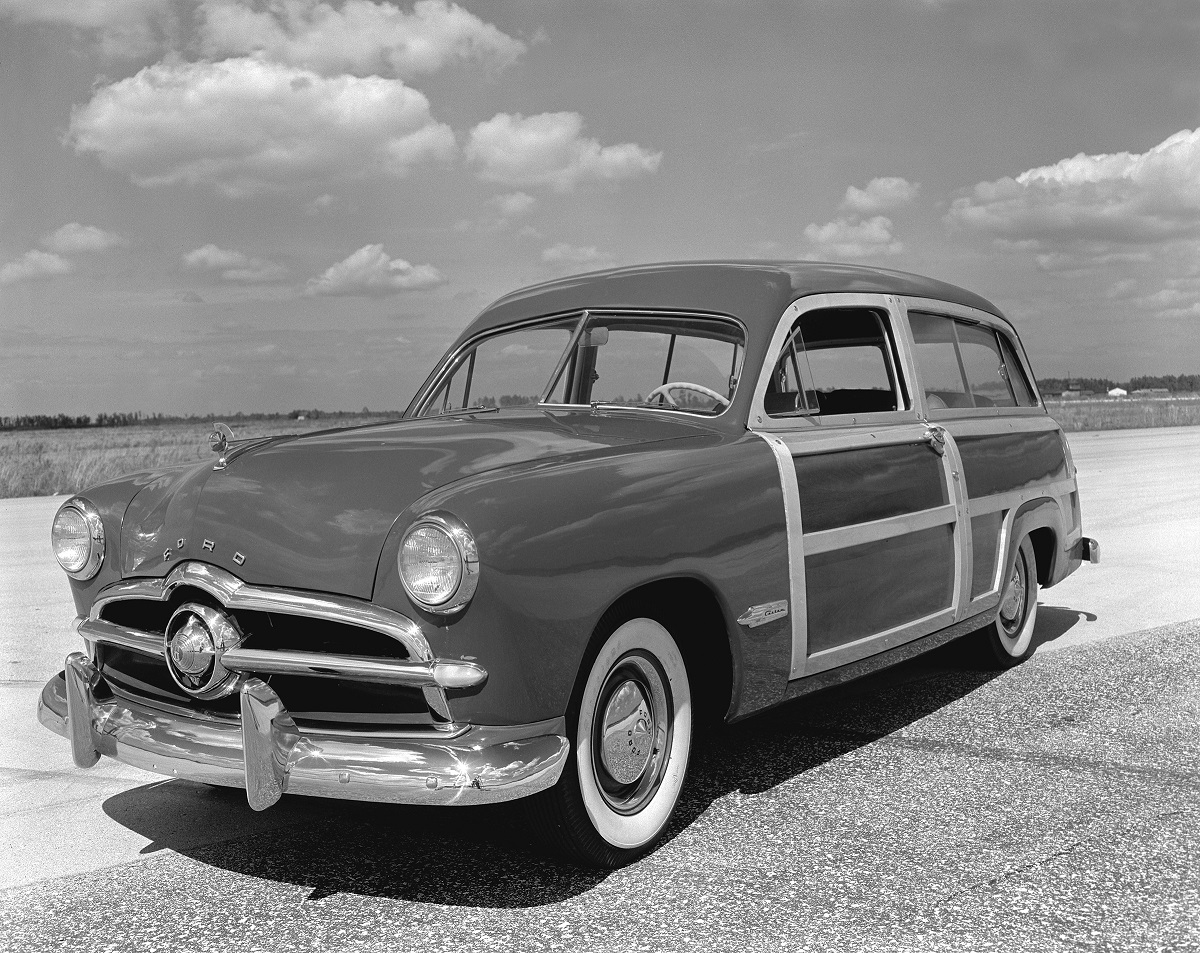
New Fords bore model names such as the Custom or Standard Tudor or Fordor, referencing the number of doors on the car. The new models came in coupe, sedan, and convertible body styles, with steel and woody wagon variations.

Redesigned from the ground up in many ways, the new Ford did retain the drivetrain of previous Ford models. A 226 cubic inch six-cylinder came standard, while an optional 239 cubic inch flathead V-8 made the car more fun.

A 1949 Ford woodie wagon

New-for-1949 models came in coupe, sedan, and convertible body styles, with steel and woody wagon variations.


The “Shoebox” Design

According to Wikipedia, the ’49 Ford body style became known as “Shoebox Ford” for its slab-sided “ponton” design. But the 1949 Ford is credited with saving Ford and ushering in modern, streamlined car design with changes such as integrated fenders.

This design would continue through the 1951 model year, with an updated design offered in 1952. Frank L. Engle designed the crest.

A color photo of a 1949 Mercury convertible

The redesigned Mercury Eight for 1949 also debuted the “ponton” styling of the new Fords. The fresh styling was a sales success for both brands.

The redesigned Mercury Eight for 1949 also debuted the “ponton” styling of the new Fords. The fresh design ended the monotony of warmed-over pre-war style, which helped differentiate Mercury from its comparable Ford cousin, a trick that spelled sales success. Sales figures for both Ford and Mercury broke records in 1949.

See more photos and stories about classic cars here

Pigeon Hole Parking System

Pigeon Hole Parking System

The self-supporting Pigeon Hole Parking structures seemed like a good idea at the time. But cars did get trapped, and the format was a short-lived endeavor

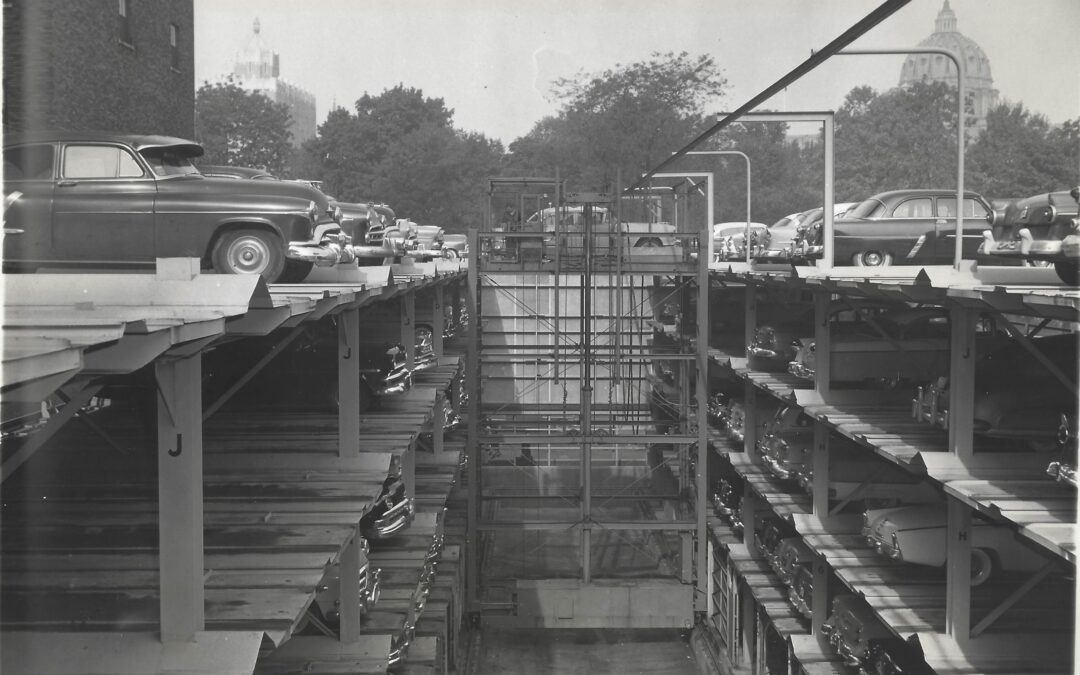
A pigeon holding parking structure from 1955 in Harrisburg pennsylvania. many cars from the 1950s can be seen in the individual parking slots

The free-standing Pigeon Hole Parking structure uses an elevator to raise the car, then slide it along the row, and insert it into a space in the steel frame.

BY MARK MAYNARD

The deadly collapse of the four-story garage in Lower Manhattan Tuesday reminded me of this 1955 photo of the so-called Pigeon Hole Parking system.

I could find no reports of motorists losing lives in this once creative format to help expand parking space in metropolitan areas, but cars did get trapped, and the format was a short-lived endeavor.

According to a report in the Spokesman-Review in Spokane, Wash., brothers Vaughn and Leo Sanders came up with the idea for a robotic parking valet. They were loggers who also ran a silver mine and a lumber mill in Northport, near the Canadian border. Leo came up with the idea of robotic parking while operating a forklift at the mill.

After serving in World War II, the brothers founded Pigeon Hole Parking in 1947, wrote Jesse Tinsley in his 2014 report for the Spokesman-Review. “They patented a machine that would lift a car, slide it down the row and poke it into a space in a steel frame. No building with an elevator is required, just the space.

Cost-Effective Parking System?

The business plan for Pigeon Hole Parking seemed cost-effective. One or two people could run the entire operation. The Sanderses claimed that spaces in a concrete structure cost $1,200 each versus $300 for a Pigeon Hole space.

The brothers began building units for Los Angeles, Phoenix, New York, Chicago, and other urban areas. Cities in Europe and South America, which had narrow streets, expressed interest in the concept. Eventually, Spokane, Wash., would have four Pigeon Hole machines.

There were other parking machines on the market, but few were as popular as the Spokane original.

A Pigeon Hole Parking structure could store three to five times as many cars as a surface lot. The company went public in 1951. Over the years, Vaughn and Leo Sanders fought off takeover attempts by their board and stockholders. The company also sued other companies, some run by former Pigeon Hole employees, for patent infringement, wrote Tinsley.

Sales slowed after several years, Vaughn Sanders said, because financing new structures was difficult. A more likely reason was that the machinery often broke down, trapping cars for days while repairs were made. And the machinery couldn’t handle rapid surges in traffic.

Pigeon Hole Parking went out of business around 1971.

The photo with this story shows a 1955 Pigeon Hole structure in Harrisburg, Pa. The open-air garage was connected to an office building, according to the caption information with the image.

How many cars in the pigeon holes can you ID? I like the Studebaker with white-walls. And is that a 1955 Packard Clipper?

Look closely in the background for the Pennsylvania State Capitol.

1963 Mercedes-Benz 230 SL ‘Pagoda’ Debut

1963 Mercedes-Benz 230 SL ‘Pagoda’ Debut

A 1963 SL in front of a bavarian hotel.

Production of the Mercedes-Benz SL “Pagoda” (W 113) ran from 1963 to 1967. (Photos courtesy of Mercedes-Benz Classic archive).

BY MARK MAYNARD

The Mercedes-Benz 230 SL, also known as the W113, debuted at the Geneva auto show on March 14, 1963.

With its aerodynamic design and a removable hardtop roof, the two-seat Mercedes -Benz 230 SL two-seater replaced the 190 SL and the 300 SL models. Of the 48,912 W113 SLs produced between 1963 and 1967, 19,440 were sold in the U.S, according to the W113 page in Wikipedia.

All 230 SL models were rear-wheel drive and equipped with an inline-six cylinder engine and a standard four-speed manual transmission or automatic four-speed, mainly for the U.S. market. The hood, trunk lid, door skins, and tonneau cover were made of aluminum to reduce weight.

A black and white pr photo Mercedes Benz display at the Geneva Motor Show, March 14-24, 1963. Standing beside the car are safety developer Béla Barényi (right) and designer Paul Bracq.

The 230 SL at its premiere at the Geneva Motor Show, March 14-24, 1963. Standing beside the car are safety developer Béla Barényi (right) and designer Paul Bracq.

The front styling of the SL showcases the upright Bosch “fishbowl” headlights. The large three-pointed star centered the simple chrome grille, which paid homage to the 300 SL roadster.

W113 SLs were typically configured as a coupe-roadster with a soft top and an optional removable hardtop. A 2+2 was introduced with the 250 SL “California Coupe,” which had a fold-down rear bench seat instead of a soft top.

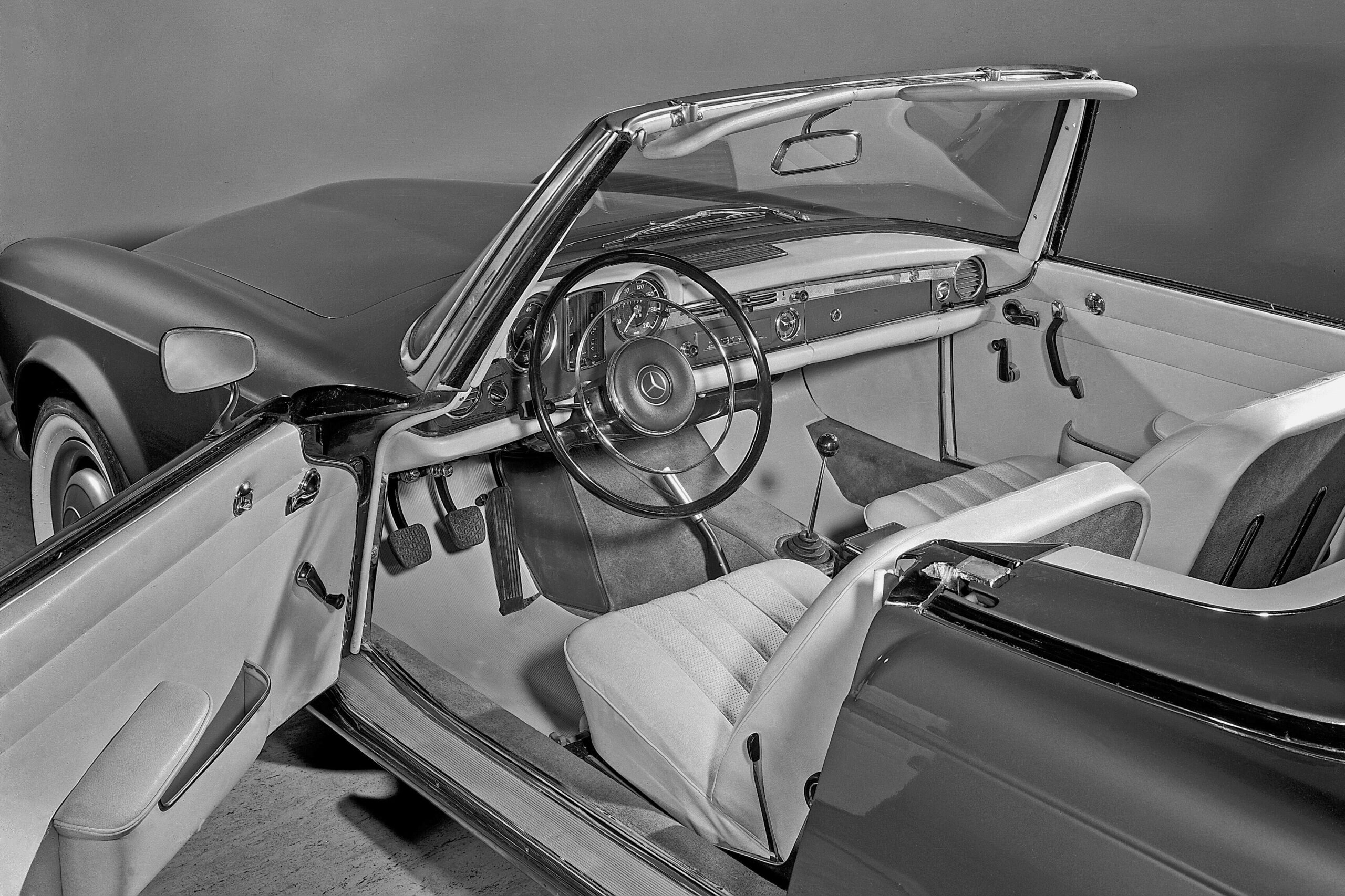
A studio image of the 230 SL interior.

A studio image of the 230 SL interior.

SL Heritage From 1955

The redesigned 230 SL traces its heritage to the first 190 SL model in 1955.

“By 1955, Mercedes-Benz Technical Director Prof. Fritz Nallinger and his team held no illusions regarding the 190 SL’s lack of performance,” according to the Wikipedia report.

The high price of the legendary 300 SL supercar kept it elusive for all but the most affluent buyers. To reach more buyers, Mercedes-Benz started evolving the 190 SL on a new platform, model code W127. It would have a fuel-injected 2.2 liter M127 inline-six engine, internally denoted as 220 SL. Encouraged by positive test results, Nallinger proposed that the 220 SL go into production in July 1957.

The 148-hp 2.3-liter straight six in the 1963 230 SL.

The 148-hp 2.3-liter straight six in the Mercedes-Benz 230 SL.

230 SL Production Delayed

Technical difficulties kept postponing the production start of the W127. The emerging new S-Class W 112 platform introduced novel body manufacturing technology. So in 1960, Nallinger proposed to develop an entirely new 220 SL design based on the “fintail” W 111 sedan platform, its wheelbase shortened by nearly a foot (11.8 inches).

The revised W 113 platform debuted an improved and fuel-injected 2.3 liter M127 inline-six engine, rated 148 horsepower with 149 foot-pounds of torque. The newly designated 230 SL also debuted the distinctive “pagoda” hardtop roof.

“It was our aim to create a very safe and fast sports car with high performance, which despite its sports characteristics, provides a very high degree of traveling comfort,” Nallinger said at the Geneva debut.

A black and white auto show display of 230 SLs.

The1963 Frankfurt International Motor Show display for the Mercedes-Benz 230 SL.

230 SL Performance

Mercedes-Benz Chief Engineer Rudolf Uhlenhaut demonstrated the capabilities of the 230 SL on the tight three-quarter mile Annemasse Vétraz-Monthoux race track in 1963. (The track was active from active 1962-1972).

Uhlenhaut clocked a best lap time of 47.5 seconds versus 47.3 seconds by Grand Prix driver Mike Parkes in his 3-liter V12 Ferrari 250 GT.

SL, or Sehr Leicht, translates as “very light.”

The original list price for a 1963 230 SL was $7,506. Today, a 1963-1967 Mercedes-Benz SL 230 in “Good” condition has a selling price of around $50,000, according to Hagerty.com.

Production of the 230 SL commenced in June 1963 and ended on Jan. 5, 1967.

The rally team in 1964.

The “Pagoda” SL was a successful rally car. This photo of the rally team is from the 34th Spa-Sofia-Liège Rally Aug. 25-29, 1964. From left to right: Martin Braungart, Dieter Glemser, Alfred Kling, Ewy Rosqvist, Manfred Schiek, Eugen Böhringer, Rolf Kreder and Klaus Kaiser.