Select Page

Pontiac Safari 1955-1957

Pontiac Safari 1955-1957

The 1955 Pontiac Star Chief Custom Safari arrived at the high-society GM Motorama, a choreographed display of “Jet Age” wealth
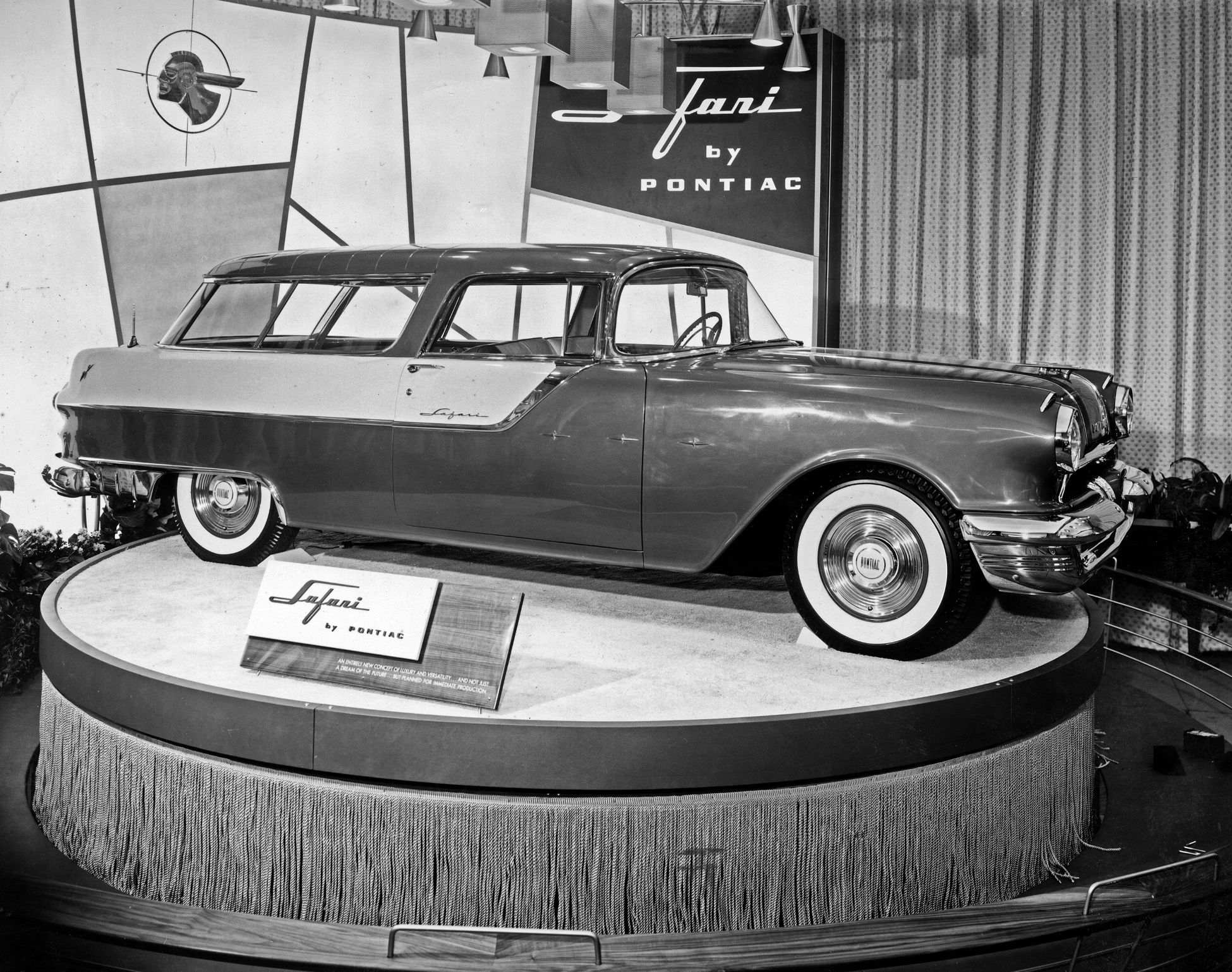
A black and white from a 1955 auto show showing the new for 1955 Pontiac Safari two door sport wagon

The story of the 1955-1957 Pontiac Safari is one of jet-age ambition, “Motorama” dream cars, and the birth of the luxury sport wagon. (Photography courtesy of GM Media Archives )

Jump To Special Features

What’s In A Name?
Birth of a Dream: the 1955 Safari
Price of Prestige
Safari-Nomad Separators
Pontiac Safari By Model Year
The Rare Safari Transcontinental
Boutique Assembly
Current Pontiac Safari Valuations
A Safari Owner’s Love

BY MARK MAYNARD

The story of the 1955 to 1957 Pontiac Safari is one of jet-age ambition. While the Chevrolet Nomad is the more famous platform partner, the Safari stands as the more exclusive, more expensive, and more powerful elite of the General Motors family. As we look at how the Safari emerged, it’s important to consider its arrival in the context of the GM Motorama, which set the stage for its opulent debut.

The two-door 1955 Pontiac Star Chief Custom Safari arrived at the high-society GM Motorama. It was a choreographed display of “Jet Age” wealth.
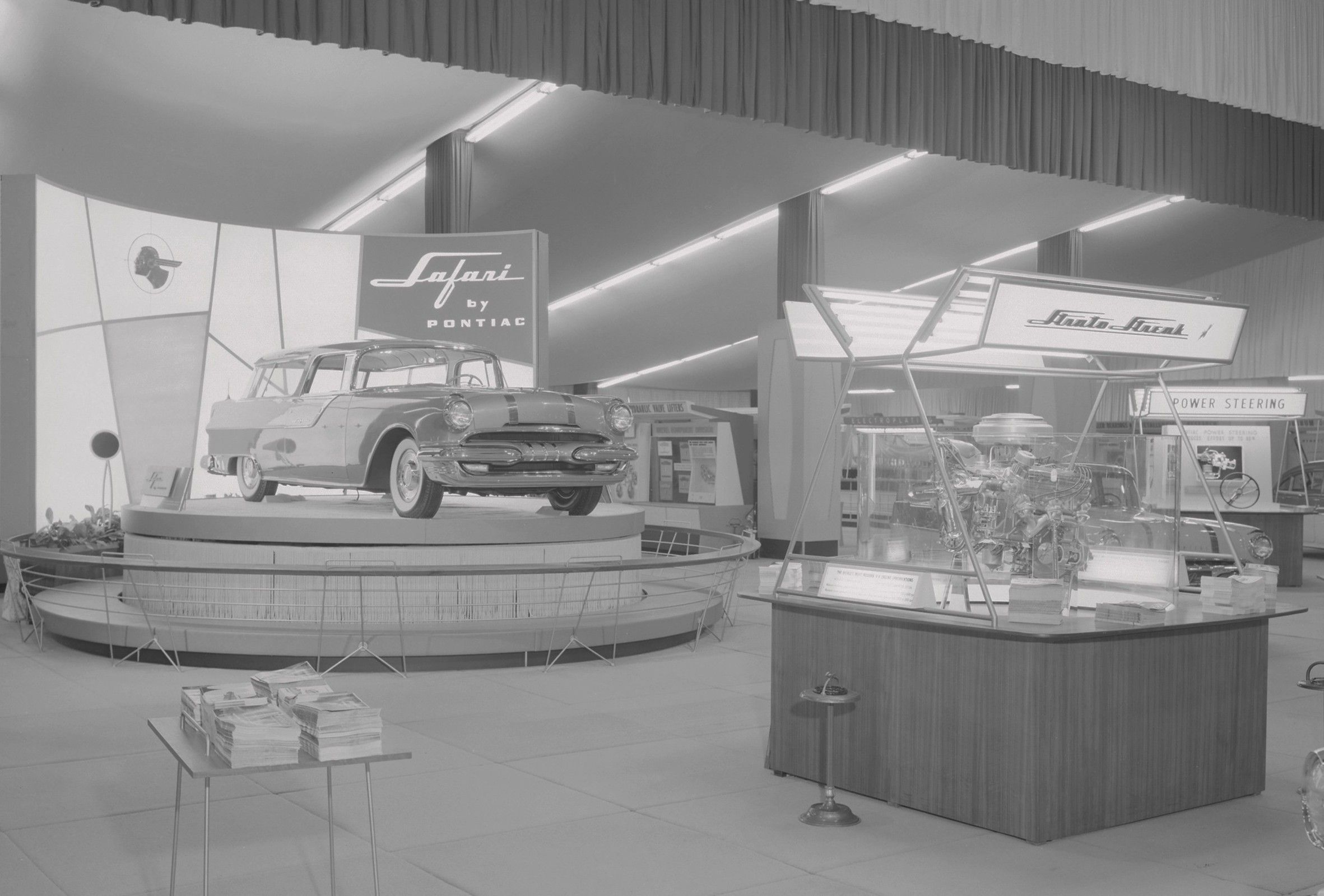
A 1955 auto display shows a Pontiac Custom Safari Station Wagon and the new Strato-Streak V-8.

A 1955 auto show display for the Custom Safari Station Wagon and the new Strato-Streak V-8.

Building on its dramatic introduction, the Safari proved that you could have the utility of a wagon without sacrificing the prestige of a Cadillac. It was the defining “stealth wealth” vehicle of the mid-1950s — a car for the person who had a country estate but still wanted to win a stoplight drag race on the way there.

Reinforcing its luxury image, General Motors’ marketing and the automotive press often referred to the Safari as the “limousine of station wagons.”
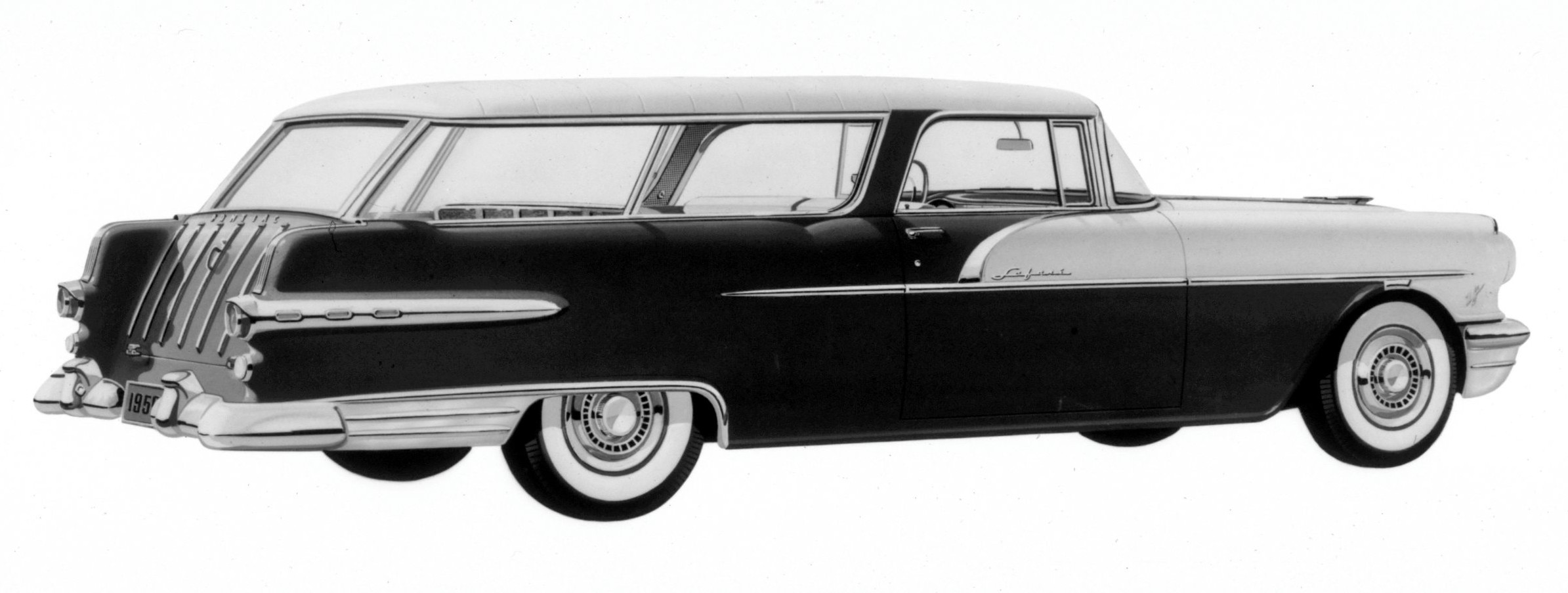
A black and white cutout of a 1955 Pontiac Star Chief Custom Safari (Series 27)

In 1955, the Safari was the most expensive vehicle in the Pontiac lineup at $2,962 (about $35,500 today).

In 1955, the Safari was the most expensive vehicle in the Pontiac lineup at $2,962 (about $35,500 today), making it about $400–$500 more than the Chevrolet Nomad, which started at $2,571. This significant price premium highlights the Safari’s exclusive appeal.

Understanding why the Safari commanded such a premium helps clarify its position in the marketplace.
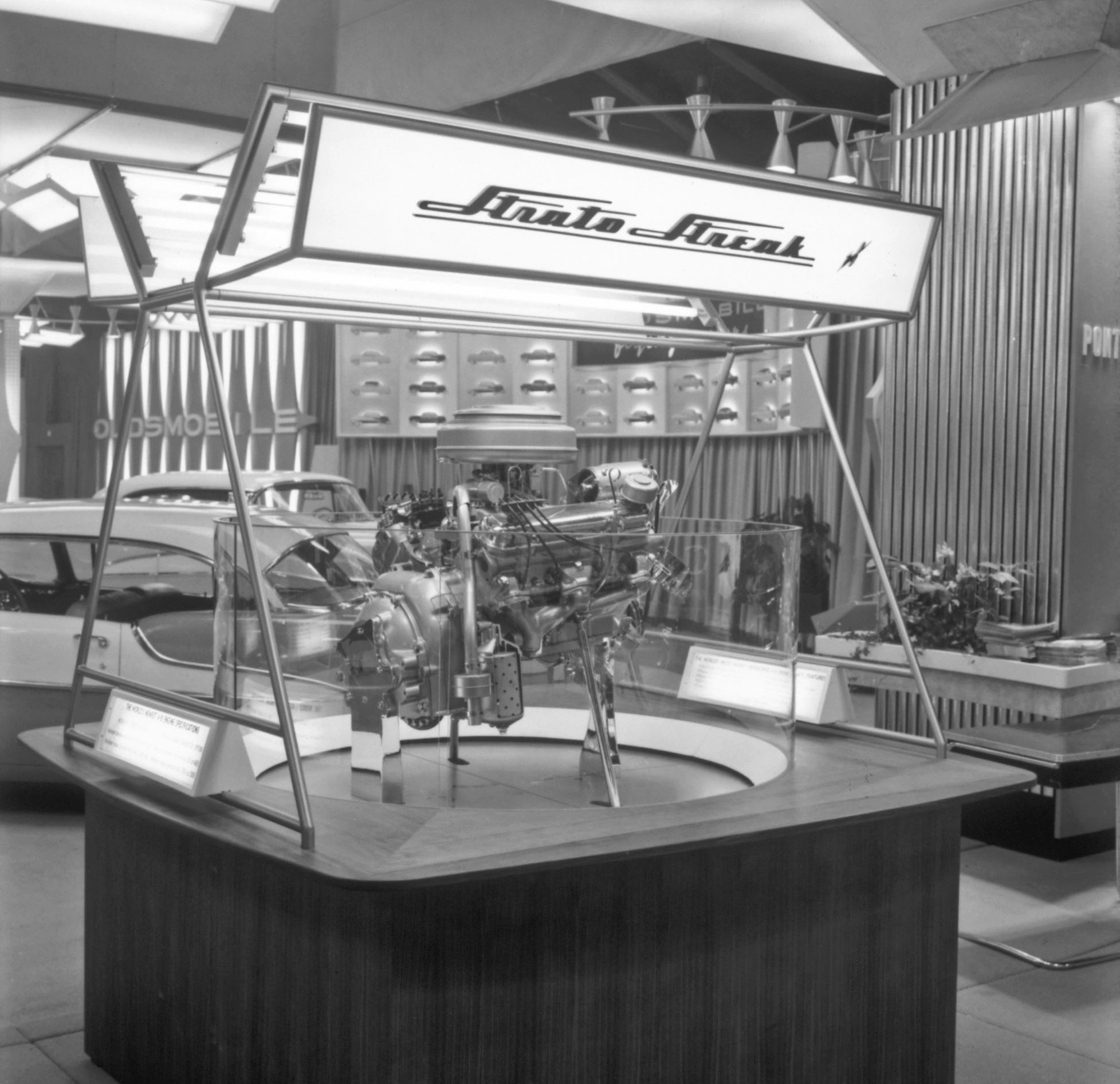
A Black and white 1955 image of a Strato Streak V-8 auto show engine display.

A Strato Streak V-8 auto show engine display.

Seeing a Pontiac Safari in 1955 was rare. In its first year, just 3,760 examples were produced, compared to around 8,386 for the Nomad. This rarity further underscored the exclusivity established by its high price.

Luxe Content

The Safari’s premium cost was justified by several high-end standard features that were often optional or unavailable on other wagons of the era. Understanding these features helps explain the Safari’s unique market position.

Standard V-8 Power: It came equipped with the 287 cubic-inch “Strato-Streak” V-8 engine, producing 180 horsepower;

Luxury Interior: Unlike most wagons that used fabric or vinyl, the Safari featured genuine leather upholstery as standard;

Larger Chassis: While the Nomad was built on a 115-inch wheelbase, the Safari utilized Pontiac’s 122-inch wheelbase, providing a smoother, more limousine-like ride.

Exclusive Trim Elements: It borrowed the heavy chrome “Silver Streak” styling and deluxe interior accents from the flagship Pontiac Star Chief sedan.

What’s In A Name?
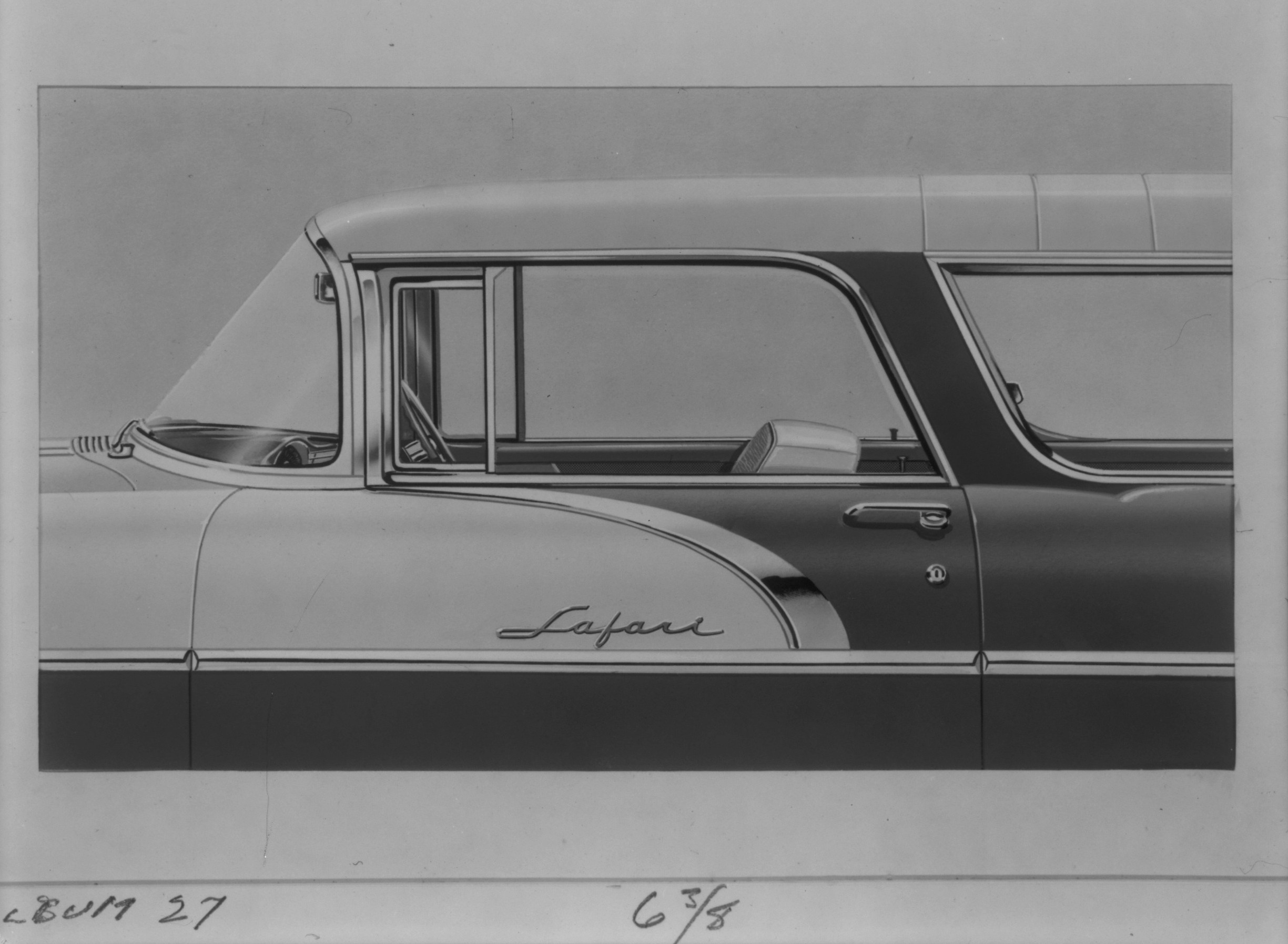
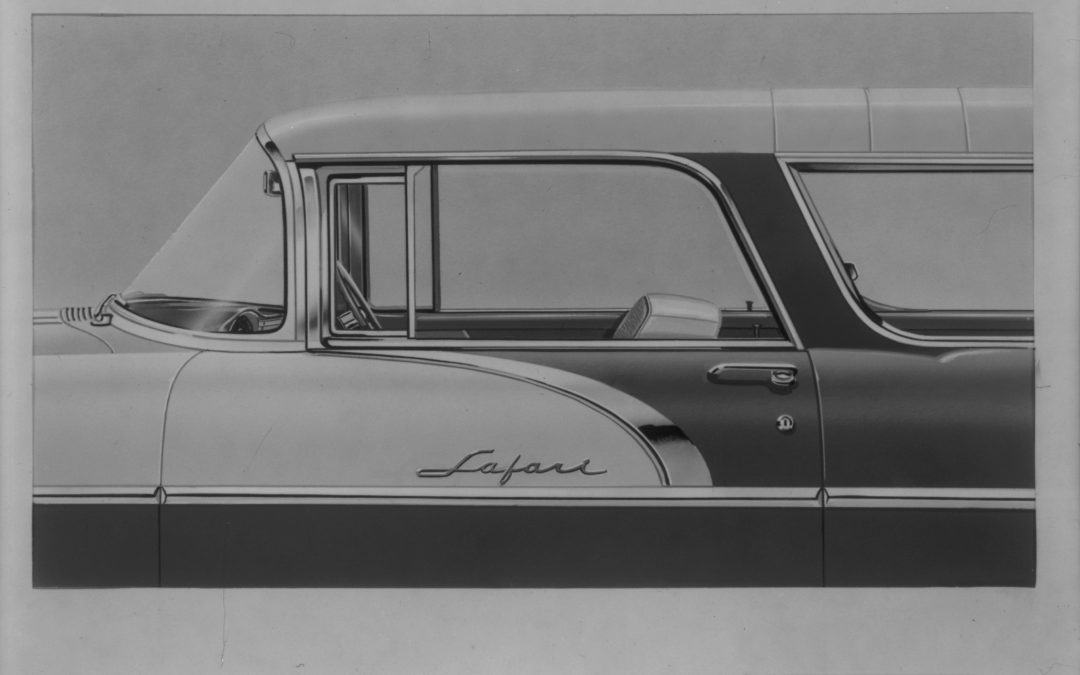
An artist’s black and white rendering of a close up of the safari front door showing the Safari nameplate.

The nameplate “safari” derives from the Swahili word safari, meaning “journey.”

Birth of a Dream: the 1955 Safari

The Pontiac Safari’s journey began on the rotating pedestals of the 1955 GM Motorama. Inspired by the Chevrolet Corvette Nomad concept, GM executives decided to bring the two-door “sport wagon” body style to production. To justify the high tooling costs for the unique roofline and wrap-around glass, the design was shared between Pontiac and Chevrolet.

Introduced on Jan. 31, 1955, the Star Chief Custom Safari (Series 27) was an immediate sensation. Unlike the “workhorse” wagons of the era, the Safari was built on a shorter 122-inch A-body chassis. Its athletic stance, forward-leaning B-pillars, and wraparound glass made it look as if it were in motion even when parked.

While there were other choices for two- (or four-door) Pontiac wagons, the Star Chief Custom Safari was the halo.
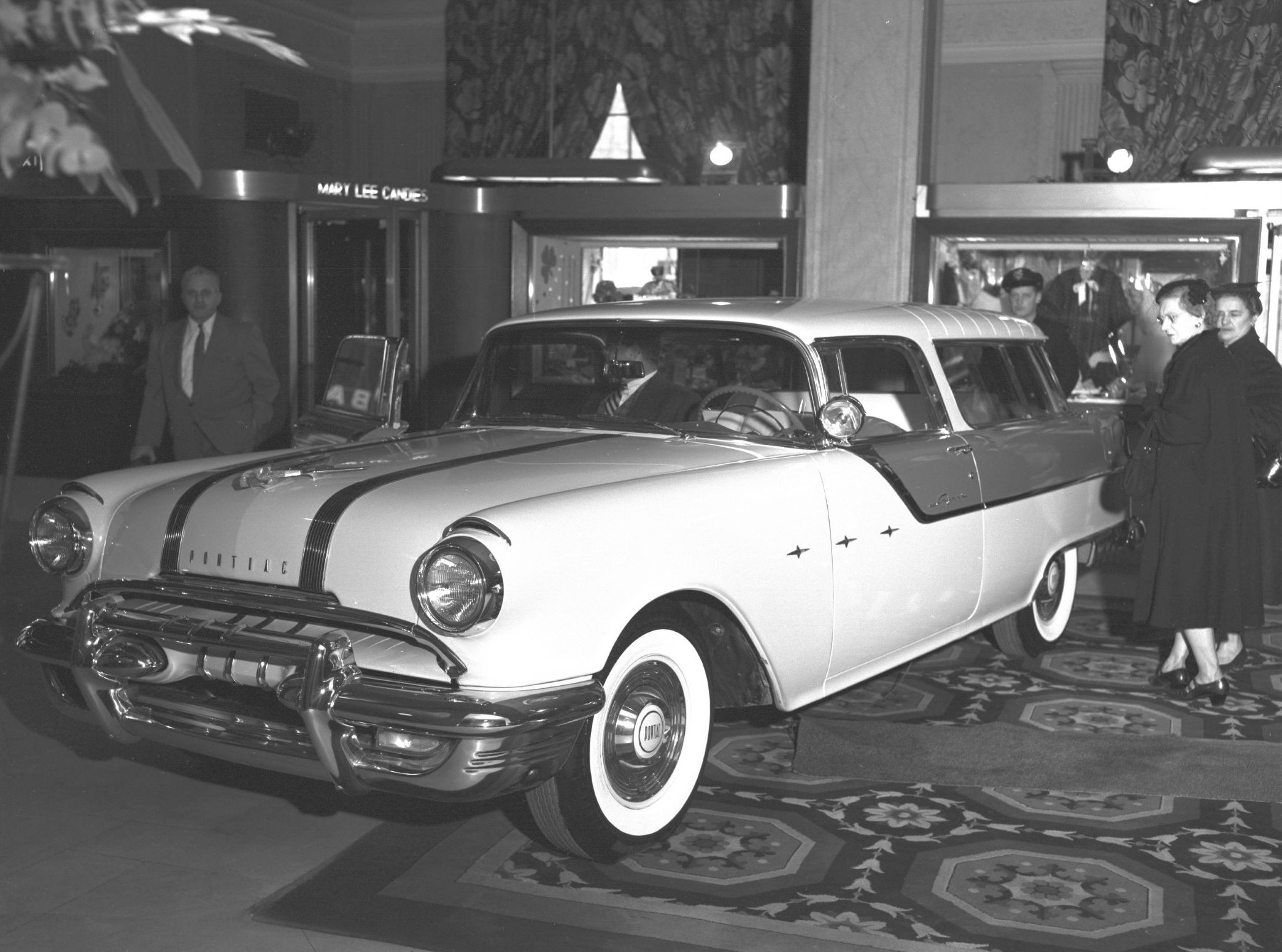
A black and white image of a salon auto show showing the first 1955 Pontiac Safari two door wagon

Introduced on Jan. 31, 1955, the Star Chief Custom Safari was an immediate sensation.

Price of Prestige

The Pontiac Safari and Chevrolet Nomad shared the same sport wagon body, but they were marketed for very different audiences. While the Nomad was the flagship Chevrolet, the Safari was the more exclusive luxury version of the concept. A high level of interior craftsmanship contributed to the Safari’s significantly higher price tag.

This premium positioning made the Safari a true “gentleman’s wagon.” It was advertised for its wagon utility paired with executive-level luxury, reflecting the status of a top-tier sedan.
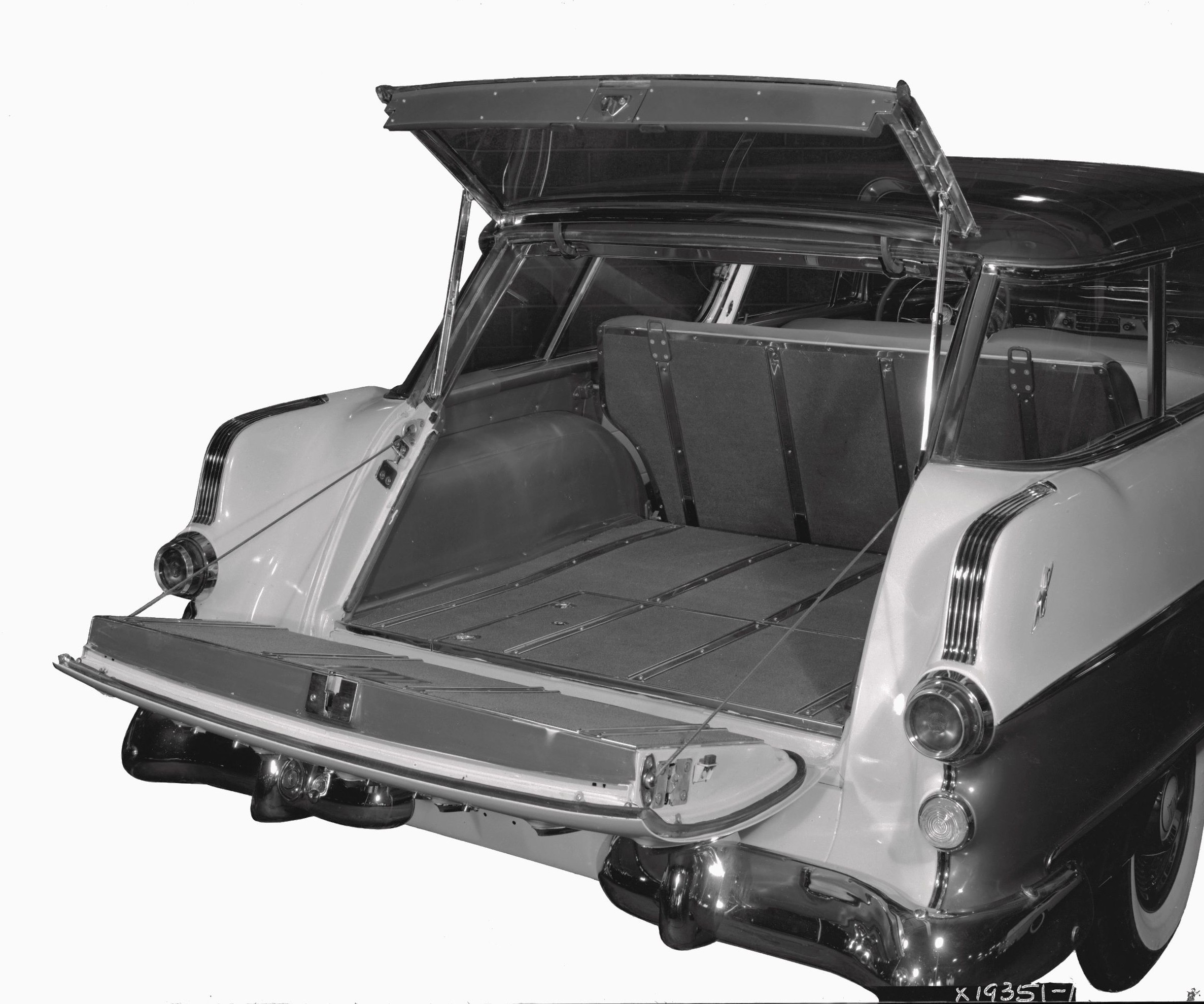
A black and white image showing the open split tailgate

Premium features of the Pontiac Star Chief Custom Safari included deep-pile carpeting that extended into the cargo area and onto the lower door panels.

Purchasing a Safari in 1955 was a discretionary luxury for buyers with incomes well above the median. On average, the cost accounted for approximately 67 percent of a typical family’s annual income.

In 1955, the median annual family income in the U.S. was $4,418. The average price of a new house was $18,400, and a gallon of gasoline cost 23 cents.

(Source: census.gov)
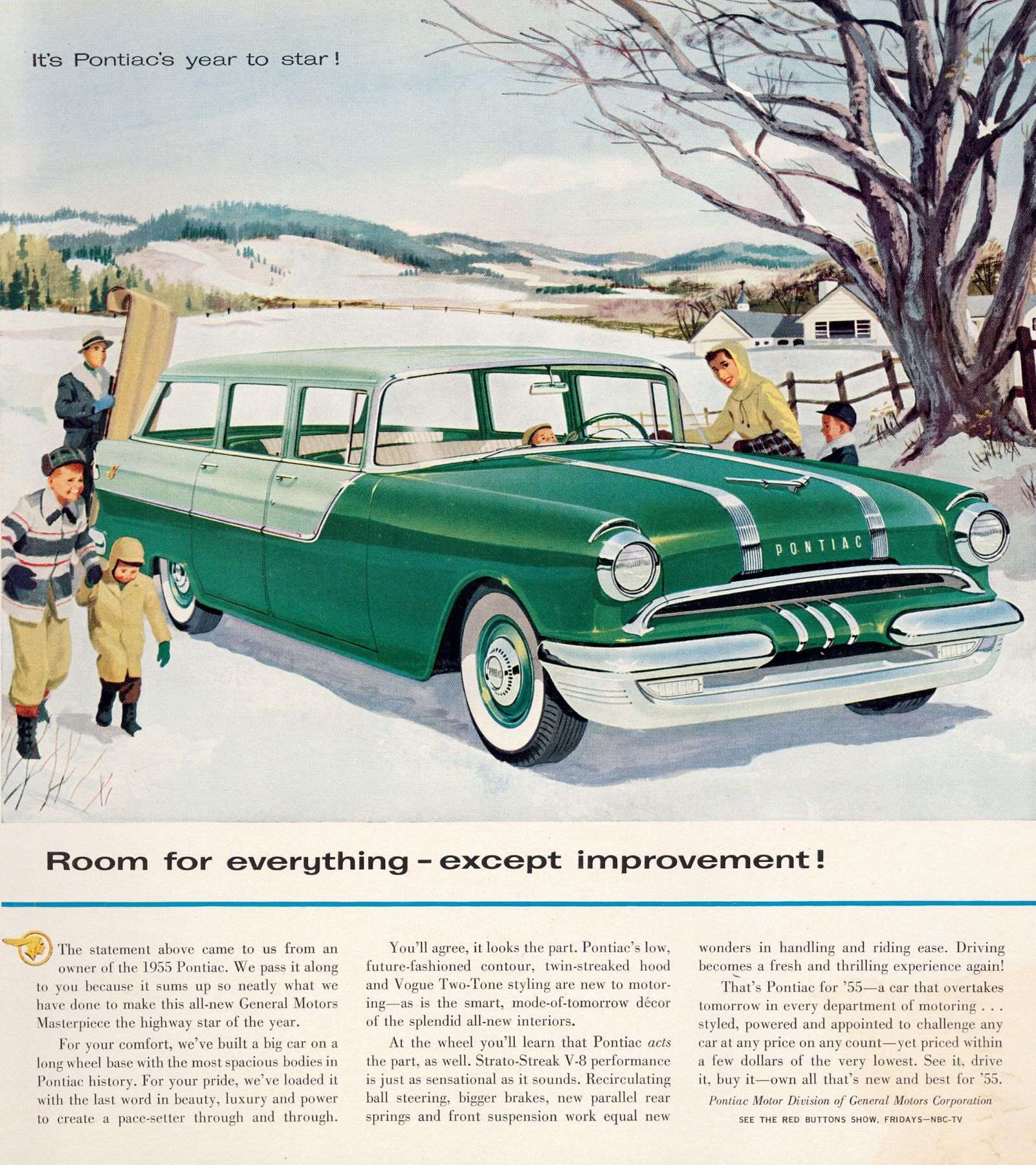
A color 1955 print ad for the new four-door Pontiac Safari in two tone green and light green: “Room for Everything Except Improvement.”

A 1955 print ad for the new four-door Pontiac Safari: “Room for Everything Except Improvement.”

Safari-Nomad Separators

While they shared the same roofline and glass, the Pontiac Safari and Chevrolet Nomad were not “badge engineered.” The cars’ “face” and “tail” were brand-specific to distinguish the A-body siblings.

Exterior Safari Styling

Front Fascia: The Safari used the Pontiac Chieftain front end, characterized by the famous “Silver Streak” dual chrome bands running along the hood.

Tailgate Ribs: The Nomad features seven vertical chrome ribs on the tailgate; the Safari has seven, which are wider and more robust.

Rear Lighting: The Nomad utilized Chevrolet’s standard taillight housings, whereas the Safari featured model-specific rear taillamps.

Trim and Brightwork: The Safari Star Chief Custom was treated to the highest amount of chrome trim Pontiac offered. Its brightwork included unique side moldings that differed from the Nomad’s Bel Air-style trim.

Paint: While the Chevrolet Nomad was often seen in solid colors, the 1956 and 1957 Safari listed two-tone paint as a standard feature for the model line.
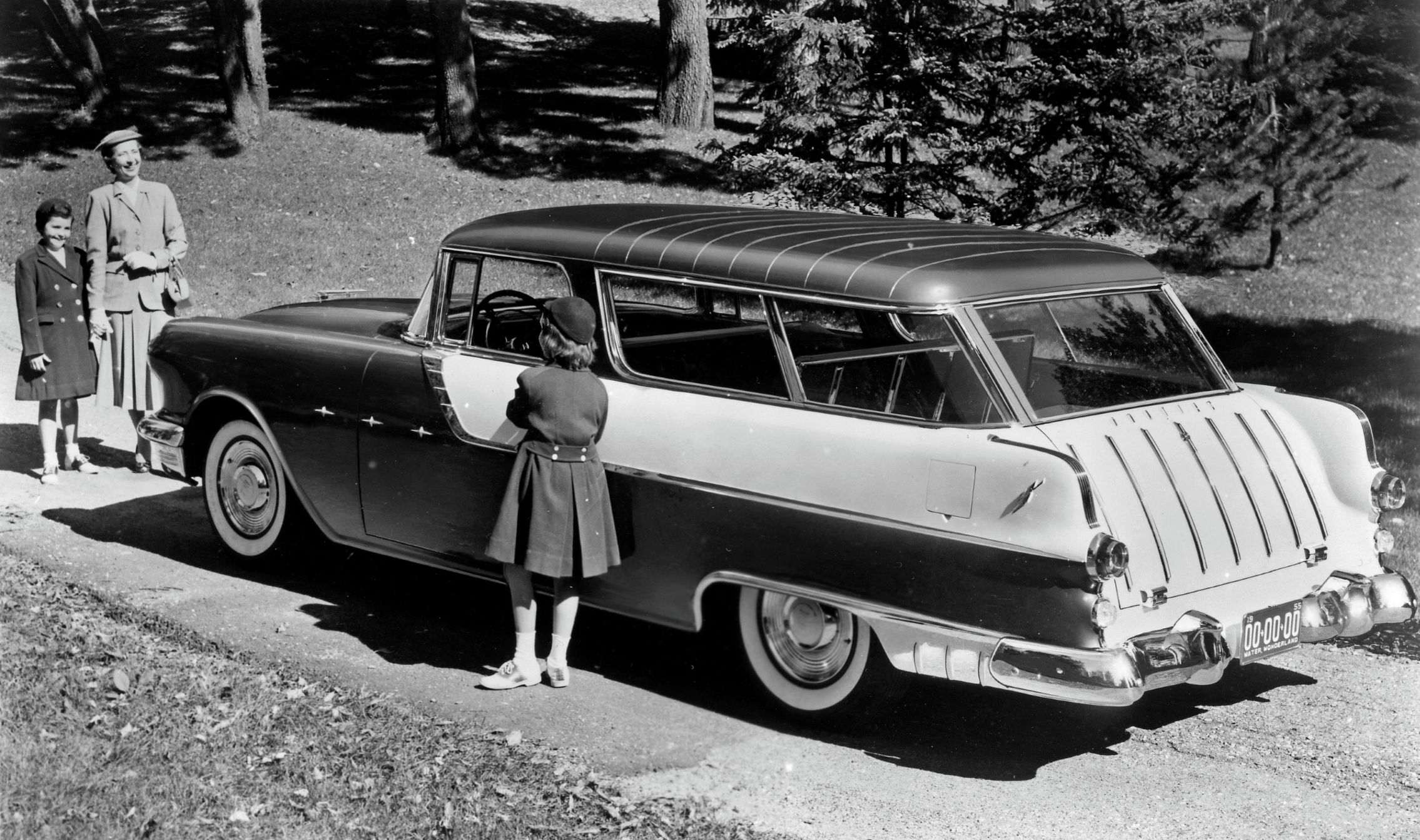
A black and white image of the 1955 Pontiac Safari Chief Custom two door in a home setting with a young girl standing by the driver's closed door

The 1955 Pontiac Safari Chief Custom two-door.

Interior Luxury

The Materials: The Safari came standard with two-tone genuine leather upholstery. While customers could order nylon-faced fabrics, the leather interior was the model’s hallmark.
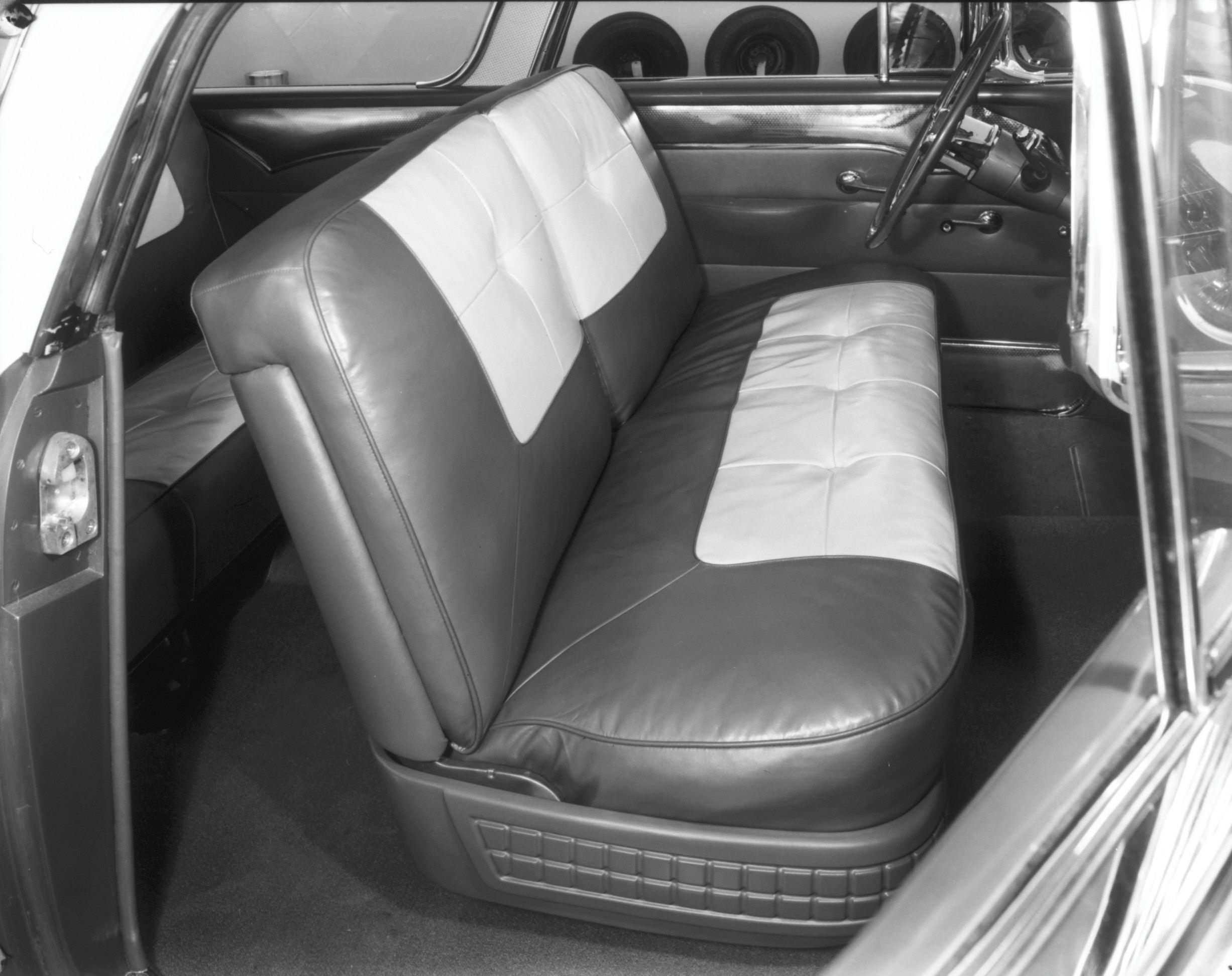
A black and white image showing the two tone leather upholstery in a 1955 Pontiac Star Chief Custom Safari leather upholstery.

A 1955 Pontiac Star Chief Custom Safari with leather upholstery.

The “Star Chief” Connection: Because the Safari was part of the high-end Star Chief line, it inherited the most premium appointments Pontiac offered. This included deep-pile carpeting that extended even into the cargo area and onto the lower door panels.

“Morrokide” Blend: Pontiac’s proprietary Morrokide vinyl was often used for the headliner, side panels, and seat bolsters for durability in high-wear areas. Other General Motors divisions had unique names for this material — Buick called it Cordaveen and Oldsmobile called it Morocceen. It was essentially premium Naugahyde, a synthetic leather-like material made of a PVC coating over a knit fabric backing.
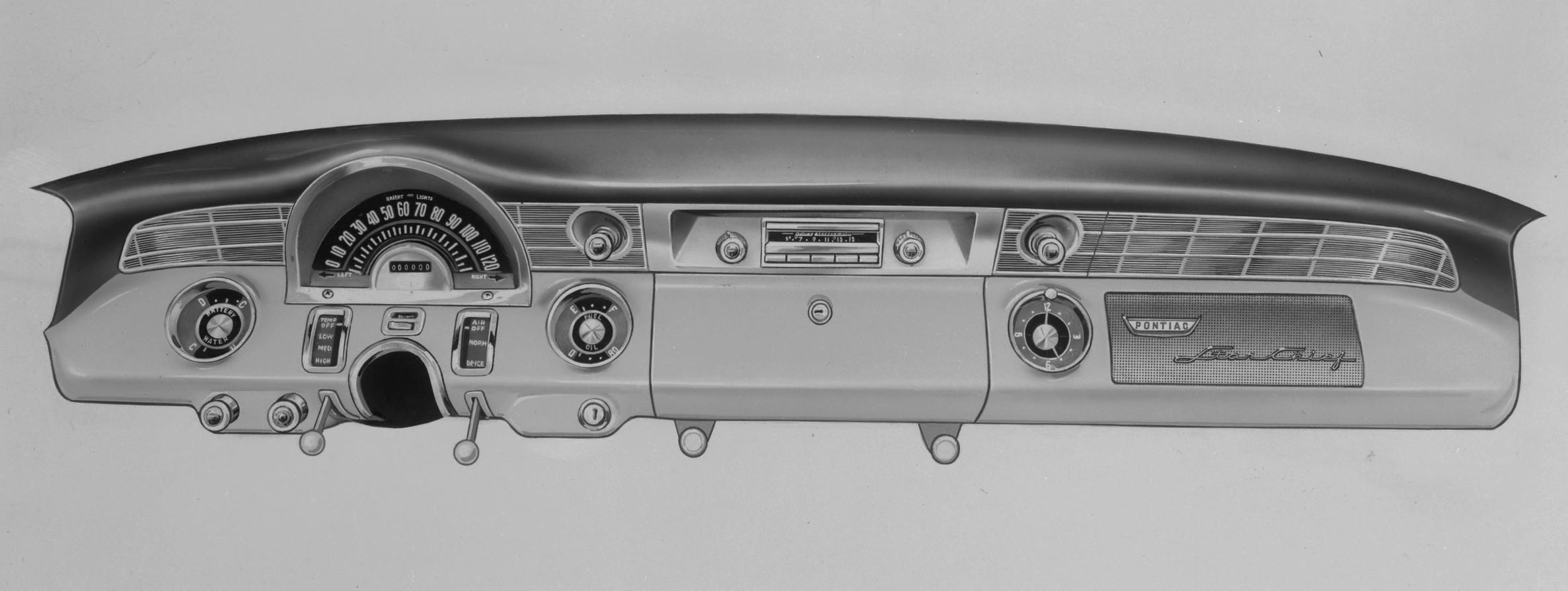
a black and white engineering rendering of a Safari dashboard

The 1956 Pontiac Star Chief Custom Safari dashboard.

Dashboard and instrument panel (IP): The 1955 Pontiac Safari was a masterpiece of “Jet Age” design. Its dashboard was significantly more ornate than the standard Chieftain or the Chevrolet Nomad. The Pontiac styling was intended to make the driver feel as if they were piloting a high-end aircraft.

Padded dash: While most cars of the era had bare metal dashboards, the Safari could be ordered with a padded dash. It was an uncommon safety feature for 1955.
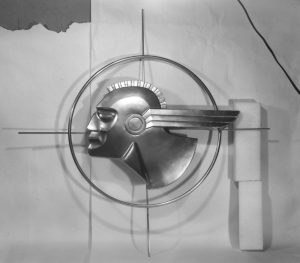
A black and white studio view of Pontiac’s Indian head emblem.

A studio view of Pontiac’s Indian head emblem.

Wonder Bar radio: The optional Wonder Bar AM radio was centered atop the dashboard. Its signal-seeking bar automatically “found” the next clear station—the height of mid-’50s tech.

“Chief” emblem: A stunning red and gold Indian Head “Chief” emblem was often inset into the center of the steering wheel hub, to remind of the car’s elite status.

Headliner: Safari and Nomad featured chrome-plated roof bows, but the Pontiac’s headliner materials were generally more premium.

Command Center Driver Area

The gauge cluster: The driver faced a wide, sweeping instrument cluster housed in a chrome-heavy bezel. The speedometer was a prominent, easy-to-read horizontal scale, often accompanied by secondary gauges for fuel, temperature, oil pressure, and amperes. (The Nomad’s IP was a “twin-hump” design.)

“Silver Streak” Influence: Just as the exterior featured “Silver Streaks” on the hood, the dashboard echoed this theme. Linear stainless steel or chrome trim spanned the width of the cockpit.

 Color-keyed design: The top of the dash was typically painted to match the car’s primary exterior color (such as Firegold or Turquoise Blue), while the lower half might be finished in a contrasting tone or polished metal.
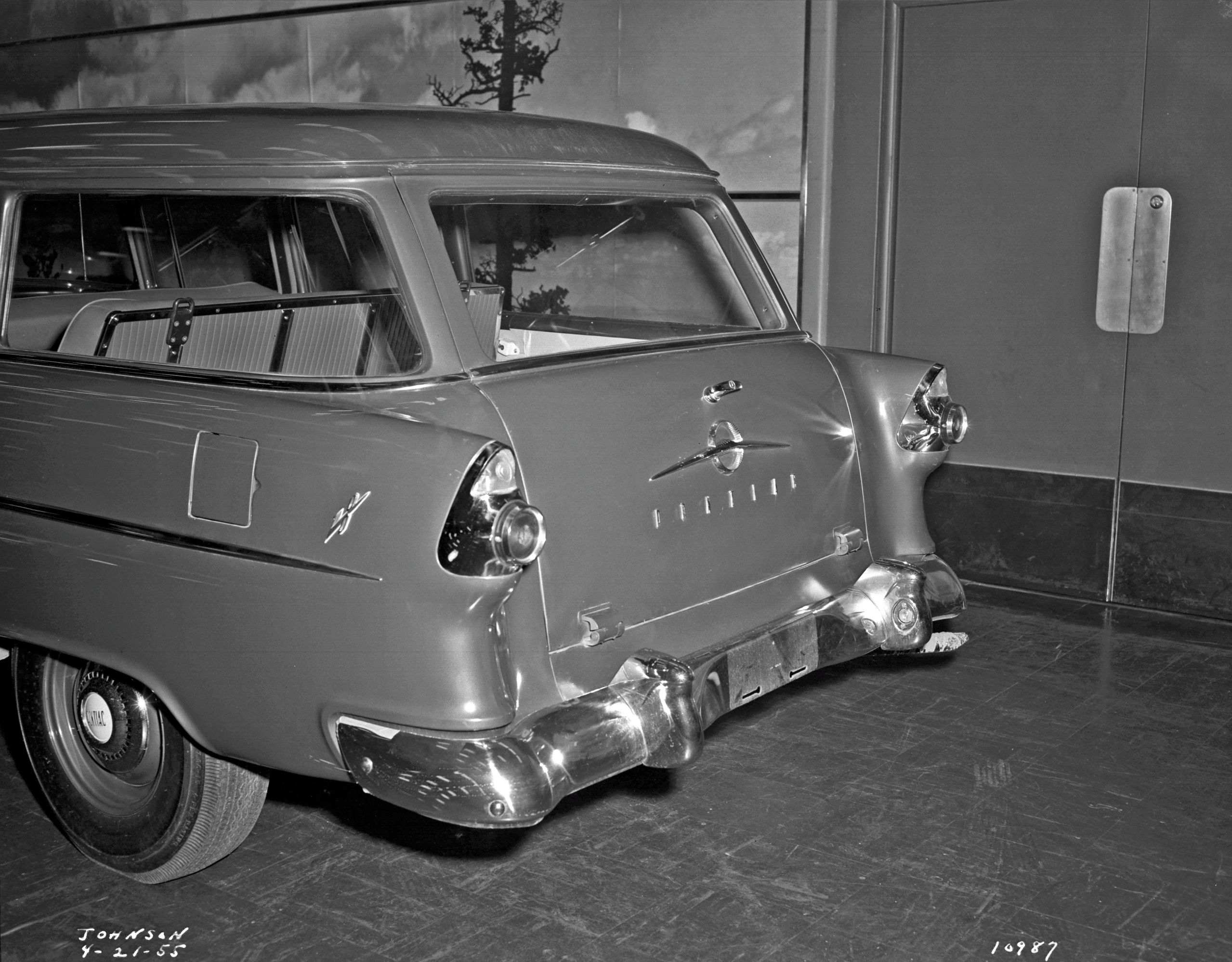
The 1955 Pontiac Chieftain four door wagon with the standard tailgate design.

The 1955 Pontiac Chieftain four-door wagon with the standard tailgate design.

Key Features and Controls

Ivory-look knobs: The control knobs for the lights, wipers, and heater were often made of a high-quality ivory-colored or translucent plastic, giving the IP a sophisticated, jewel-like appearance.

Hydra-matic selector: If equipped with the Dual-Range Hydra-Matic transmission, the gear selector was located on the steering column. Early models featured a unique shift pattern of N Δ Dr Δ Lo R, without a “Park” position. Instead, drivers engaged a parking pawl by shifting into Reverse after turning off the engine. The P position was added later.

Cane-handle parking brake: Tucked under the left side of the dash was a distinctive “T-handle” or cane-handle parking brake. It was a tactile throwback that owners used religiously because there was no “Park” gear.

Other extras included: illuminated glove box, Autronic Eye automatic headlight dimmer, power windows, power steering, and air conditioning.
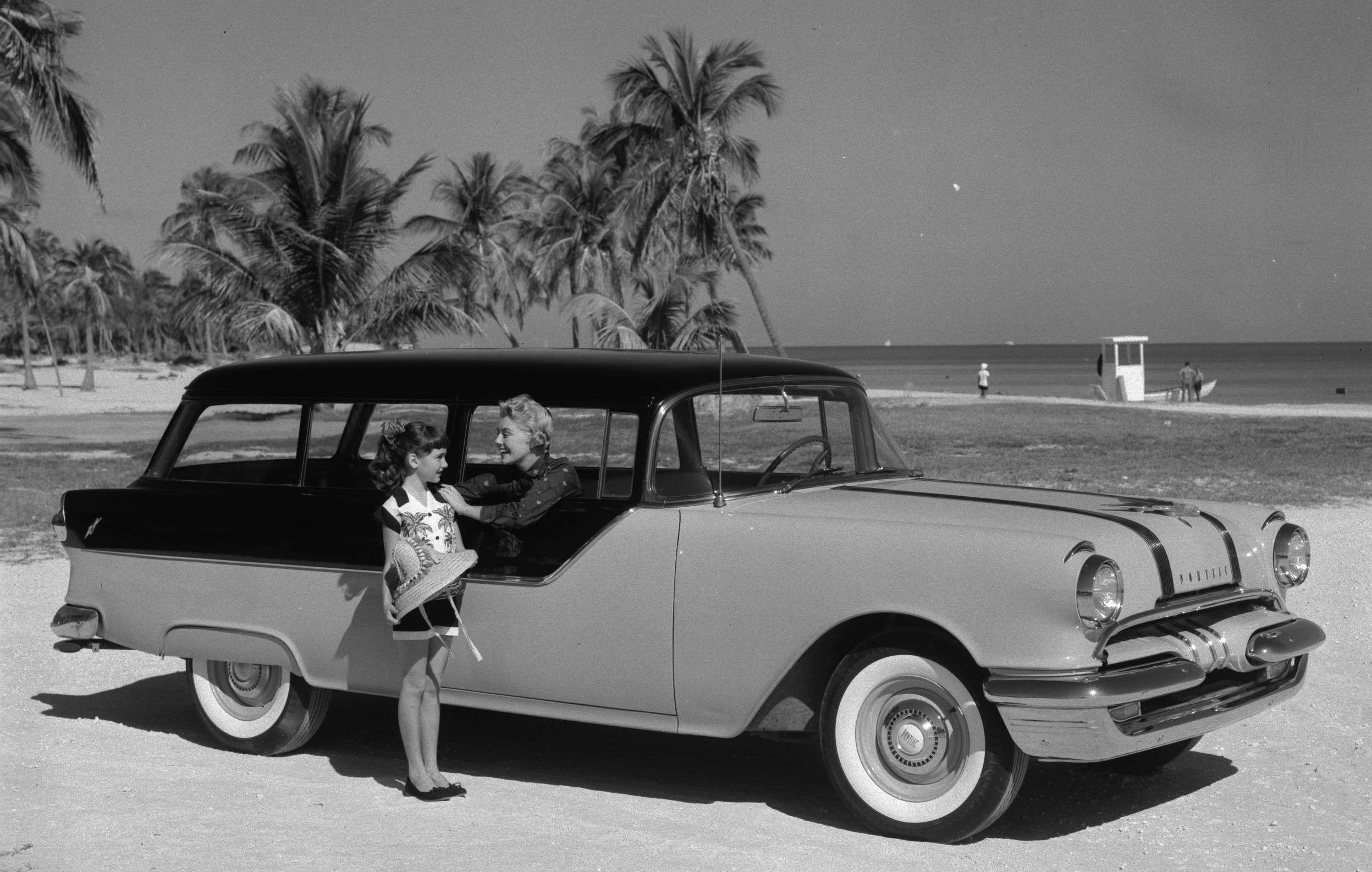
A black and white image of a two tone 1955 Safari with a black roof and with a little girl standing by the front passenger door in a beach setting with palm trees in the background and an ocean view

The 1955 Safari as beach cruiser.

The Two-Tone Safari Standard

1955: Two-tone was an extremely popular option, but solid colors like Firegold (copper) or Turquoise Blue were still available.

1956: Two-tone paint became standard for the Safari. This year introduced a specific styling shift, with the roof painted in the accent color to contrast the rest of the body. A popular color scheme was Sun Beige and Sandstone White.
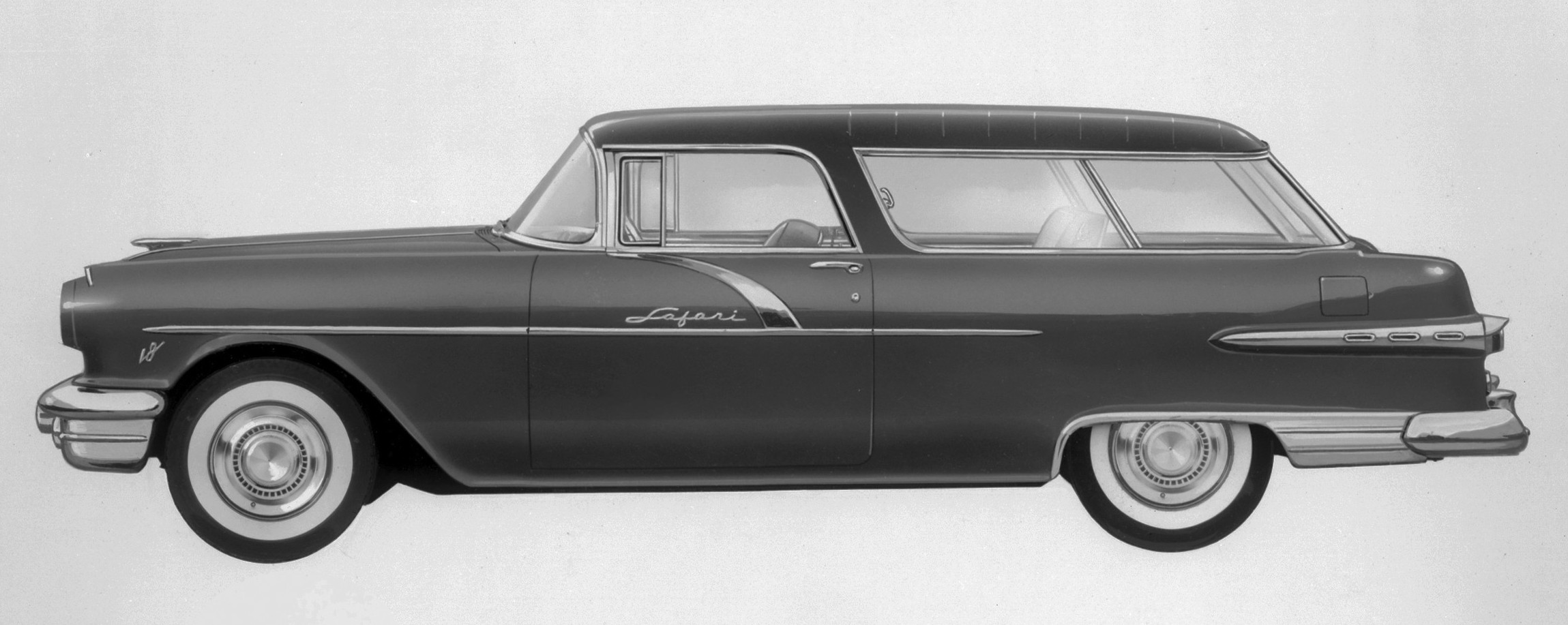
A black and white 1956 Pontiac Safari rendering. A facelift included a more elaborate bumper-grille and the new “Strato-Flight” Hydra-Matic transmission.

A 1956 Pontiac Safari rendering. A facelift included a more elaborate bumper-grille and the new “Strato-Flight” Hydra-Matic transmission.

1957: The two-tone look remained the standard configuration. Even rare models were typically delivered in combinations such as Charcoal Grey with a Silver Beige roof and side “insert.” Cordova Red and Kenya Ivory showed a deep metallic red with a creamy white roof and side insert.

In the Spring of 1957, Pontiac released a set of “Spring Colors” (such as Carib Coral or Limefire Green). These were often paired with Kenya Ivory.
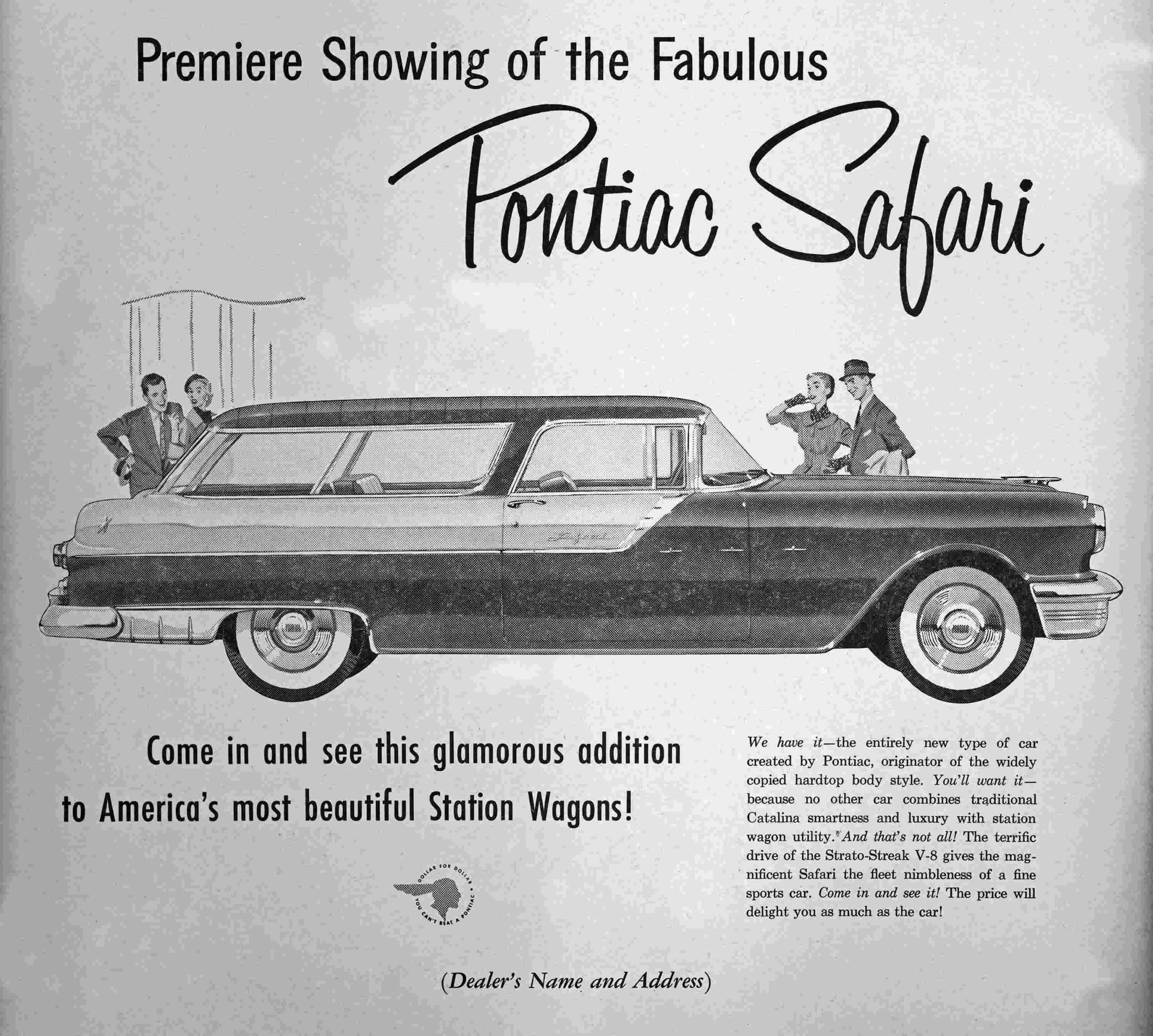
A black and white dealer-specific newspaper print ad promoting “A Premiere Showing. “We have it …”You’ll Want It.”

A dealer-specific newspaper print ad promoting “A Premiere Showing. “We have it …”You’ll Want It.”

Pontiac Safari By Model Year

1955: The Star Chief Custom Safari was launched midyear. It featured the high-end trim of the Star Chief line but was built on the shorter 122-inch Chieftain chassis. Pricing started at $2,962, including the standard “Strato-Streak” V-8.
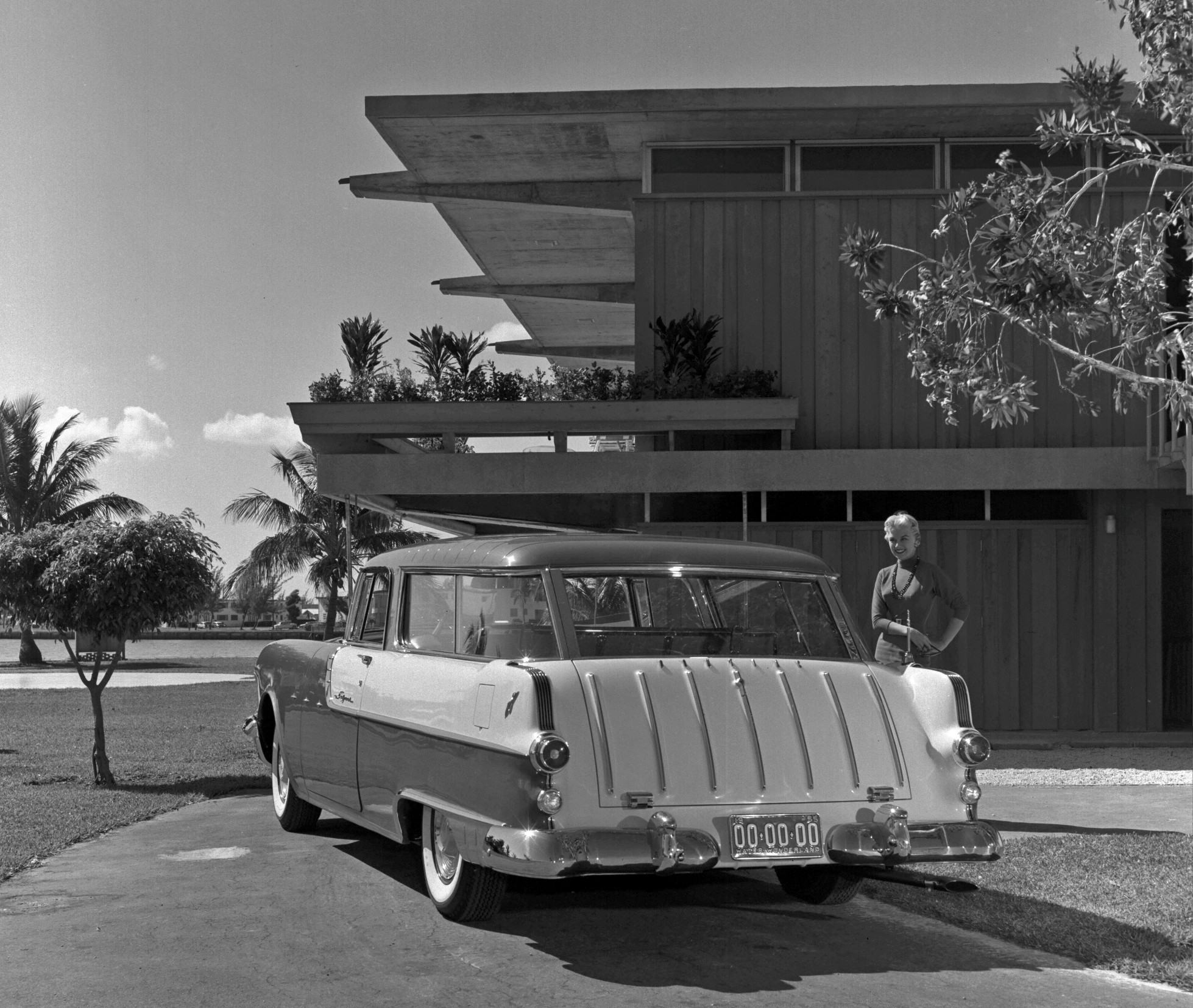
A black and white image showing a rear view of a 1955 Safari parked in front of a midcentury modern home

1955 Pontiac Star Chief Custom: Midcentury modern.

1956: A facelift included a more elaborate bumper-grille and the new “Strato-Flight” Hydra-Matic transmission. By 1956, the Safari was cementing its status as the “limousine of station wagons.” This year saw a major engine upgrade to the 316.6 cubic-inch V-8. Horsepower jumped as high as 285 hp in the dual four-barrel carburetor configuration.

  • Styling became even bolder with the introduction of new two-tone paint schemes, in which the accent color was carried over the roof.
  • Pricing started at $3,124. Despite being the brand’s flagship, the 1955 Safari remained a boutique item, with only 4,042 units produced.
A color 1956 print ad for the four-door model in two tone red and white: “Reset Your Sight-seeing Sights.”

A 1956 print ad for the four-door model: “Reset Your Sight-seeing Sights.”

1957: The final year of the specialized two-door body. Pontiac began using the “Safari” name for all its wagons this year. The two-door was renamed the Custom Safari to distinguish it from the standard four-door Chieftain and Super Chief Safaris.

The 1957 Star Chief Custom Safari represents the pinnacle of the original two-door design. It featured the 347 cubic-inch V-8, capable of up to 290 hp. However, 1957 was also a year of transition. Pontiac began expanding the “Safari” name to other wagons in the lineup, including the four-door Safari Transcontinental. This dilution of the name, combined with changing consumer tastes, led to the original two-door sport wagon’s departure.

Pricing for the 1957 Safari started at $3,481. Only about 1,294 two-door Custom Safaris were built in 1957, making them among the most sought-after collector cars today.

The 1957 model year was the last of the three-year production run for this specific two-door Safari body style. It had a total production of 9,094 units over its lifespan.
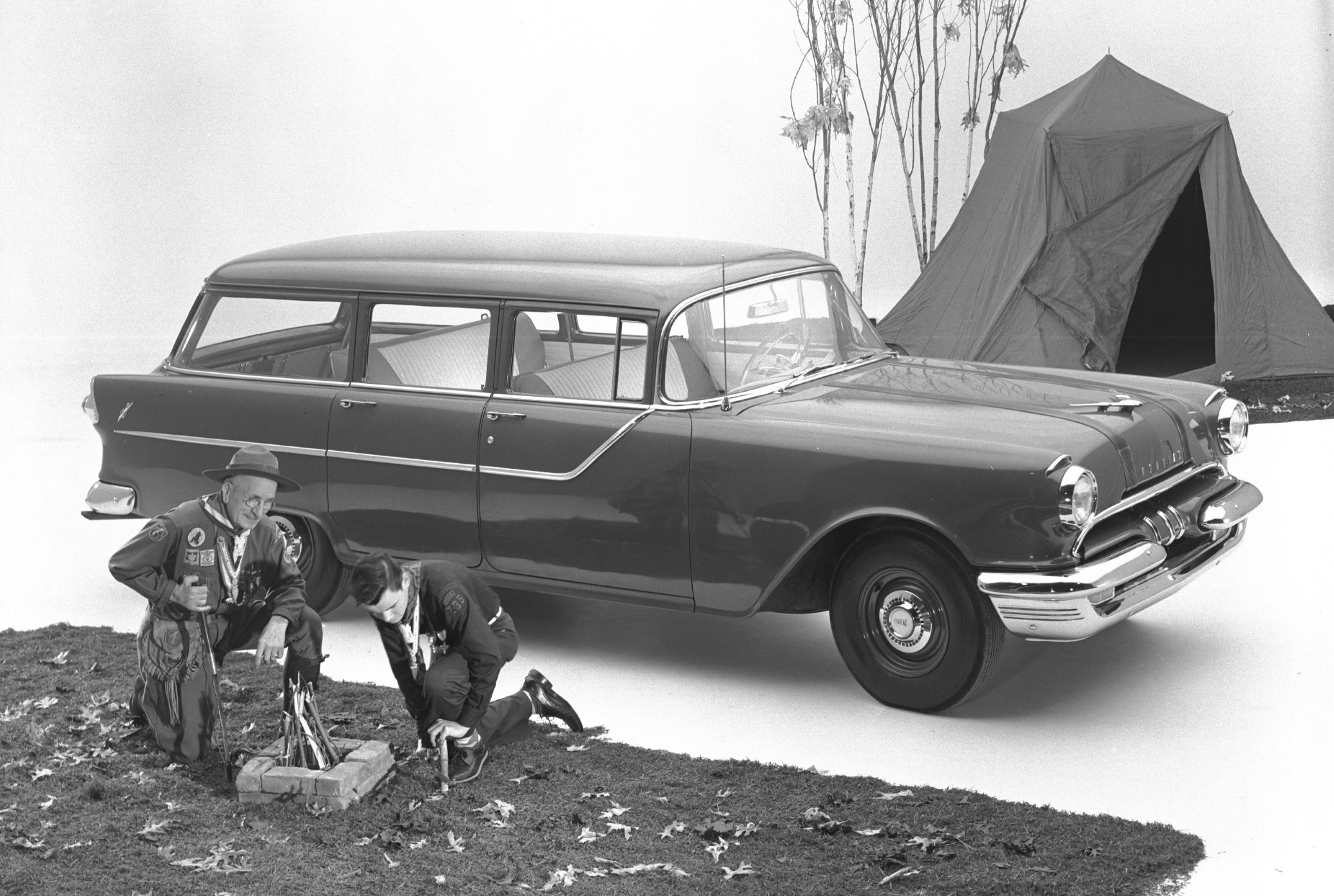
Before the SUV, the Pontiac Safari was touted for backcountry travel.

The Rare 1957 Safari Transcontinental
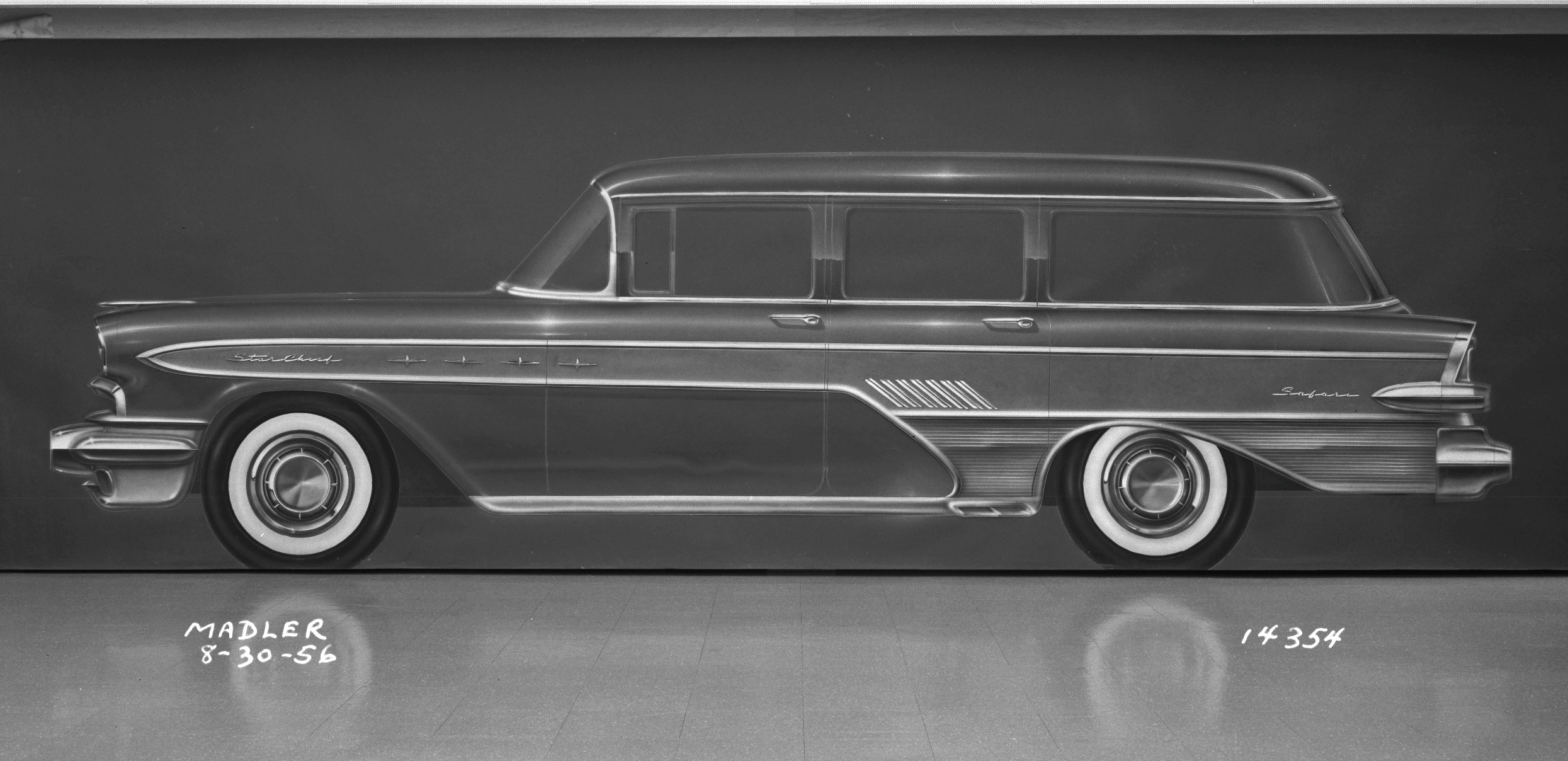
A blackboard rendering of a prototype 1957 Safari Transcontinental four-door wagon.

A blackboard rendering of a prototype 1957 Safari Transcontinental four-door wagon.

The 1957 Pontiac Transcontinental Safari was a one-year wonder. It was a much rarer, mid-year entry added to the Star Chief Custom line. The four-door, six-passenger luxury wagon was the four-door sibling to the high-end Bonneville.

While all 1957 Pontiac wagons were branded as “Safaris,” the Transcontinental was the ultimate expression of the nameplate. It was designed to bridge the gap between a family hauler and a luxury cruiser.
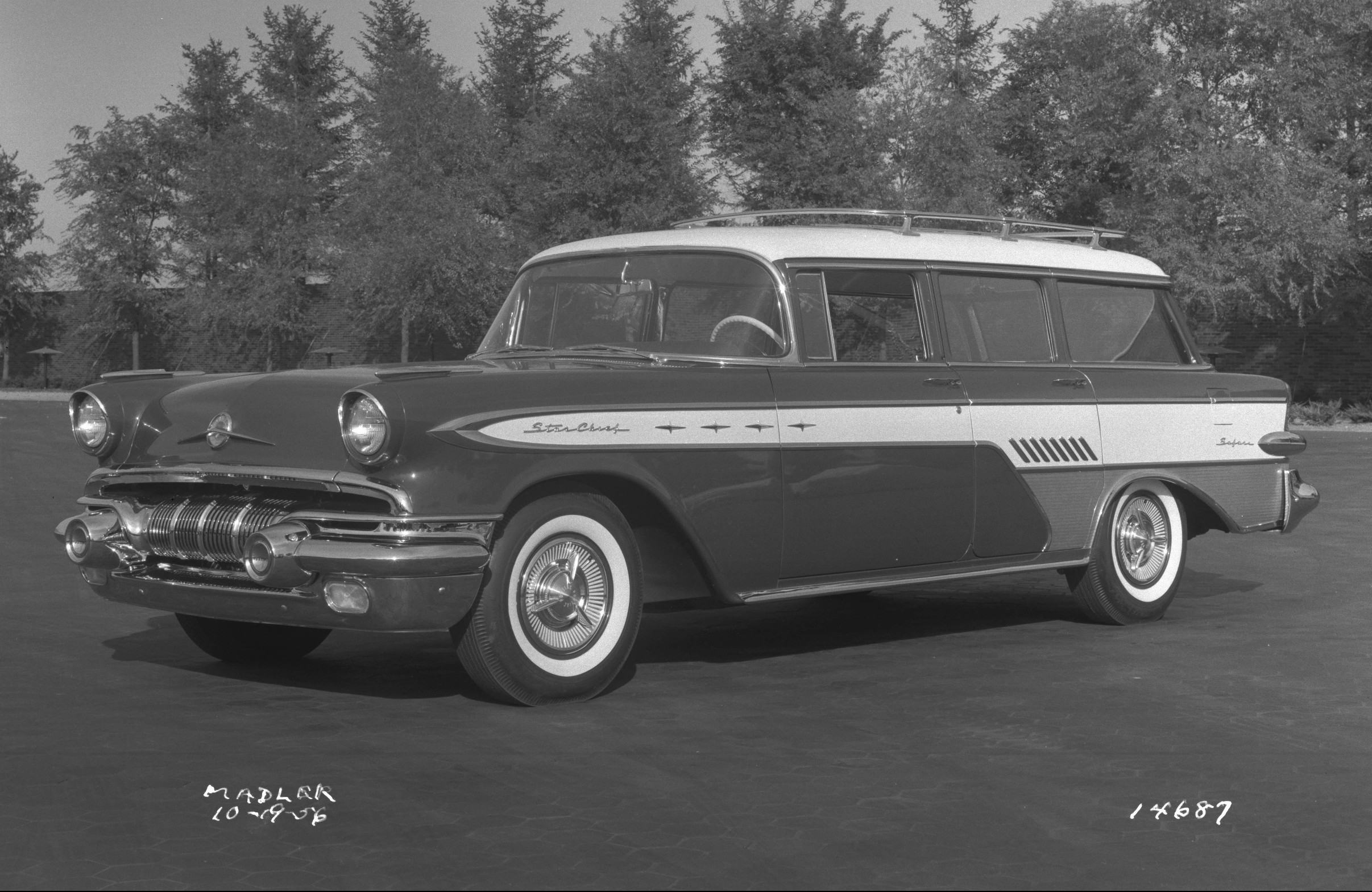
n mid-1957, Pontiac introduced the four-door Safari Transcontinental. It featured unique side trim and a standard roof luggage rack.

In mid-1957, Pontiac introduced the four-door Safari Transcontinental. It featured unique side trim and a standard roof luggage rack.

It was distinguished by several high-end visual cues:

Four-Star Side Spear: While Star Chief models featured three chrome stars on the rear fender, the Transcontinental added a fourth star.

Anodized Aluminum Panels: The anodized aluminum trim panel below the side spear is a feature exclusive to the ultra-exclusive 1957 Bonneville convertible.

Standard Roof Rack: Every Transcontinental came factory-equipped with a chrome roof luggage rack, a rarity for the time.

Luxury Interior: The cabin was outfitted in genuine leather with a unique 70/30 split front seat. The passenger side is wider and often features a headrest—a very forward-thinking comfort feature.
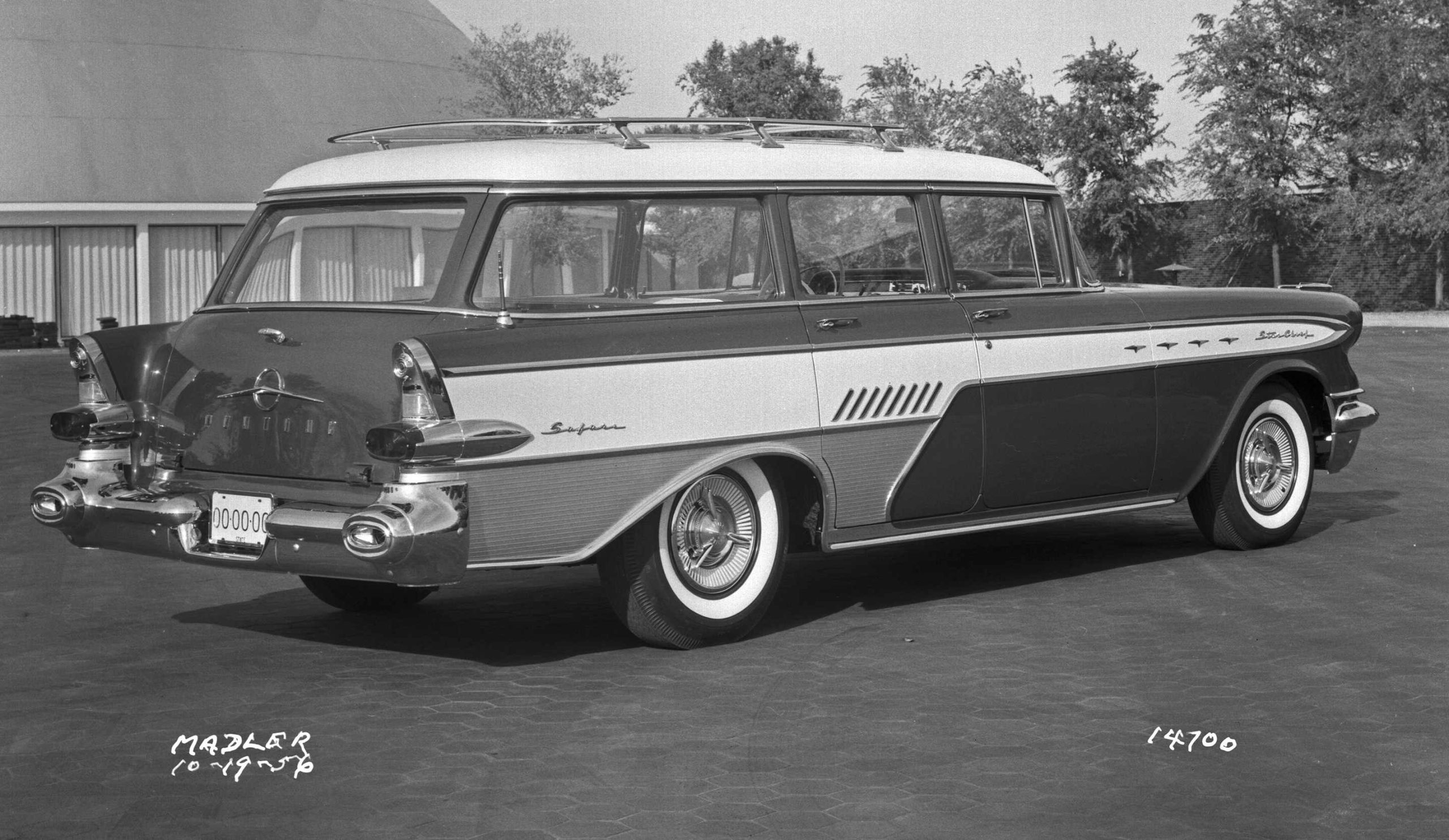
The 1957 model is easily identified by its massive “Star Flight” kontur-styled rear fins. Above, note the iconic Pontiac front fascia designed by Paul Gillan, head of the Pontiac Design Studio from 1951 to 1958.

The 1957 model is easily identified by its massive “Star Flight” kontur-styled rear fins.

Transcontinental Powertrains

Under the hood of the Transcontinental was a 347-cubic-inch Strato-Streak V-8, which had been enlarged from the previous year’s 316.

The engine had three performance levels:

Standard 4-barrel 270-hp, standard for Star Chief Custom models.

Optional 290-hp Tri-Power (3×2-barrel), featuring three Rochester carburetors.

315-hp Rochester Fuel Injection V-8. The 315-hp “fuelie” option was the pinnacle of Pontiac performance in 1957 and was standard on the 1957 Bonneville convertible. The uprated engine was technically a “special order” option (around $500) for the Transcontinental Safari and other Star Chief models.

The fuel-injected engine achieved its impressive output by replacing traditional carburetors with a continuous-flow mechanical fuel injection system. It was developed by GM’s Rochester division.

  • Horsepower: 315 hp at 4,800 rpm
  • Torque: 400 foot-pounds at 3,200 rpm
  • Compression Ratio: 10.25:1
  • Induction: Rochester mechanical fuel injection with a high-lift camshaft.

Most Transcontinentals were equipped with the optional Strato-Flight Hydra-Matic automatic transmission ($231). Few buyers opted for the three-speed synchromesh manual with column shift.

Size Matters

With a wheelbase of 122 inches, the four-door Transcontinental is more than 7 inches longer than the two-door Custom Safari. The standard Safari was built on the shorter 115-inch Chieftain and Super Chief wheelbase. With the Strato-Flight Hydra-Matic transmission, the Transcontinental weighed a substantial 3,955 pounds.

The Transcontinental came with a high price tag of $3,636, making it more expensive than any other Pontiac except the Bonneville. Because it was a mid-year release with such a high cost, production was limited. Only 1,894 units were built.

Because the Transcontinental did not share the “pillarless” two-door Safari’s sport body, it is often overlooked by enthusiasts. Consequently, the Transcontinental is one of the rarest and most sought-after wagons for Pontiac enthusiasts today.

The two-door Safari is rarer by the numbers; the Transcontinental is often harder to find in original condition. Many were used as family wagons, whereas the two-door models were more frequently preserved as halo cars. If you are seeking a survivor, you can verify its authenticity via the cowl tag. The style number for a Transcontinental Safari is 2762SDF.

Neither the two-door Safari nor the Transcontinental returned for 1958. Pontiac had shifted its focus toward the wider, lower styling of the upcoming “Wide Track” era.

Sources: “Standard Catalog of American Cars, 1946-1975”; OldCarsWeekly; PontiacSafari.com

Boutique Assembly
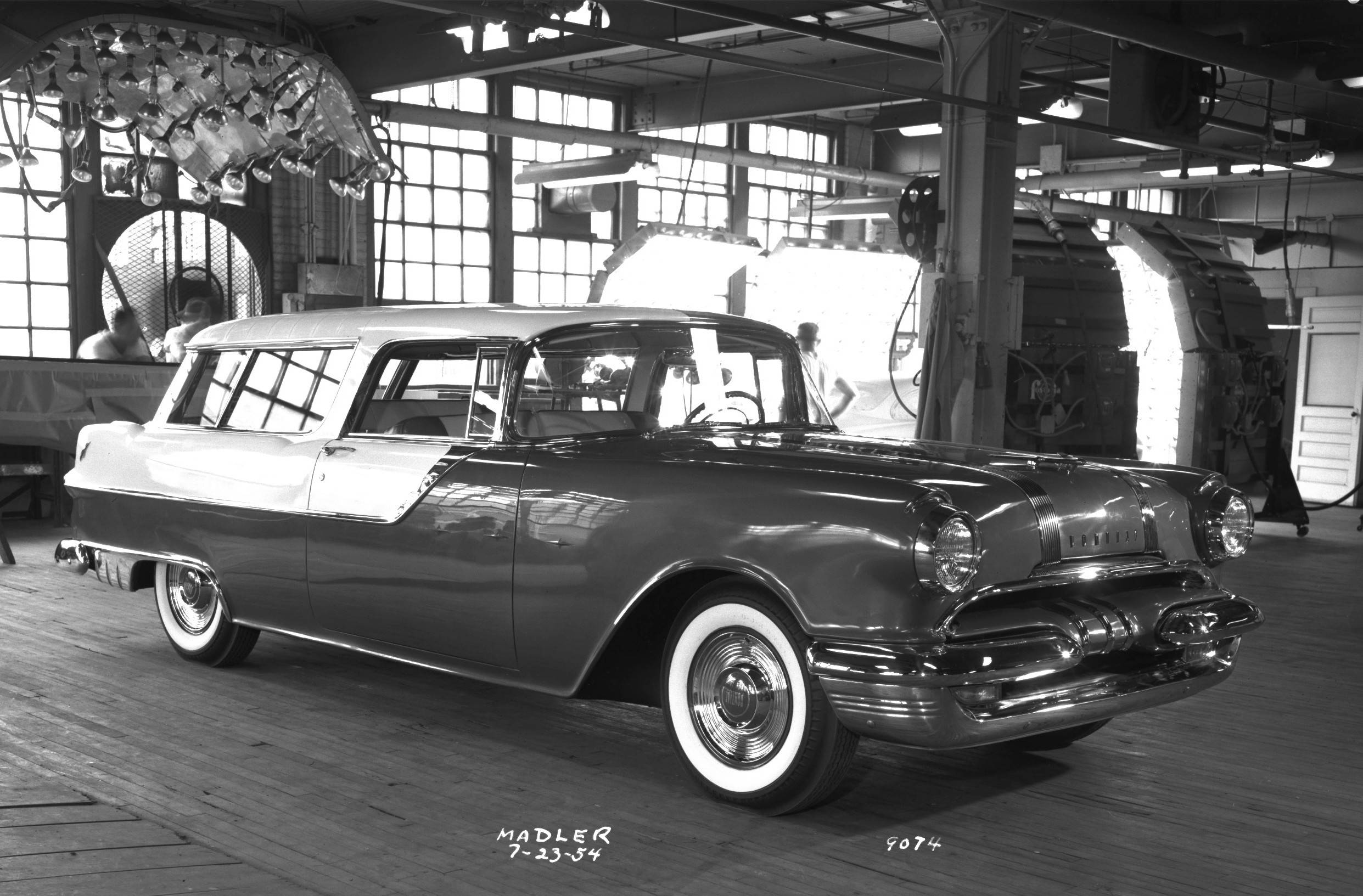
A black and white image in a paint curing booth of a two tone Safari

The Pontiac Safari and Nomad bodies were built in the same Fisher Body plant in Euclid, Ohio.

To split tooling costs, the Pontiac Safari and Nomad bodies were built in the same Fisher Body plant in Euclid, Ohio. Both models are the same above the beltline — roof, windshield, windows, and liftgate. They use the same doors, tailgate, and seats.

Production for both models was a multi-stage process. Their low-production body style required specialized work that the standard high-volume Pontiac lines were not equipped to handle.
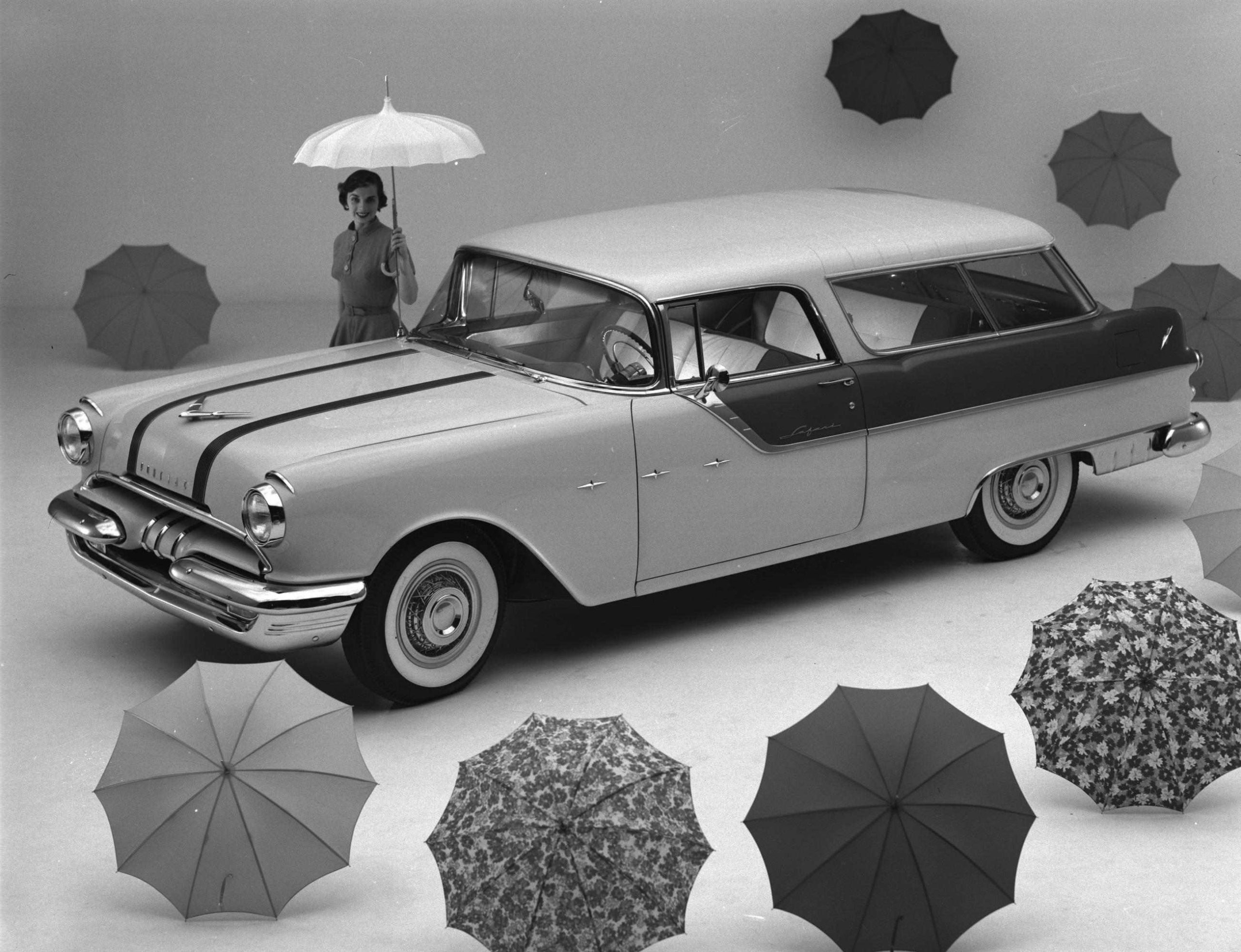
A black and white studio PR image with a 1955 Safari with a border of umbrellas and a female model holding an open white umbrella on the opposite side of the car.

A studio PR image with cutesy umbrellas.

Once the Safari bodies were completed, they were shipped by rail to various General Motors assembly plants. There, they would be mated with their Pontiac chassis, engines, and trim. The primary assembly locations included:

  • Pontiac, Mich.: The main Pontiac assembly plant;
  • South Gate, Calif. (Los Angeles): For the West Coast market;
  • Kansas City, Kan.: Fairfax Assembly;
  • Atlanta, Ga.: Lakewood Assembly;
  • Linden, N.J.: Linden Assembly;
  • Wilmington, Del.: Wilmington Assembly;
  • Arlington, Texas: Arlington Assembly;
  • Framingham, Mass.: Framingham Assembly.
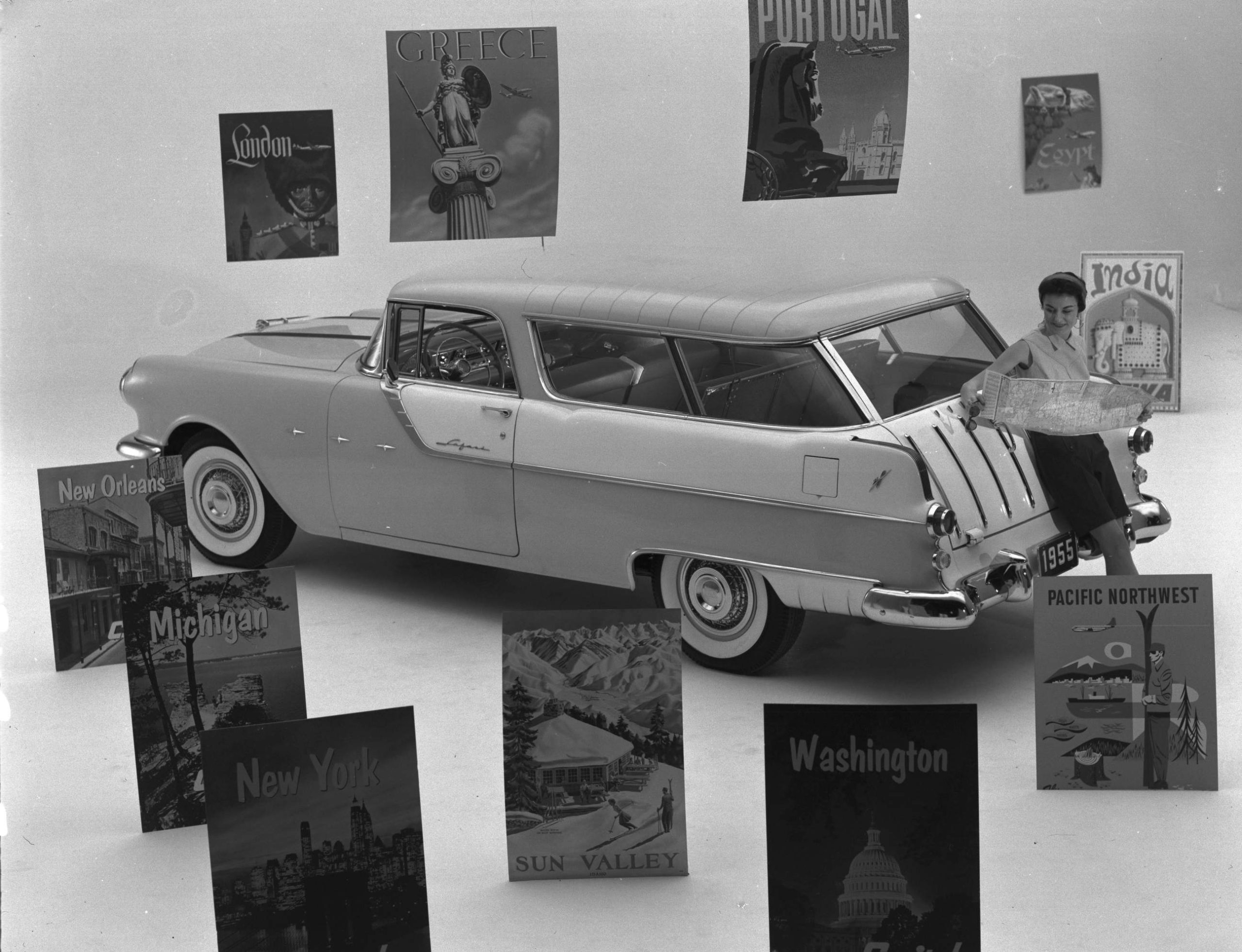
A black and white Safari PR image with large travel posters below and above the car.

Or the Safari as savvy traveler.

The Canadian ‘Unicorn’

Interestingly, a small number of Safaris were also built in Canada specifically for the Canadian market. These were unique because they were often built on GMC truck frames and used different powertrains than their American counterparts.

SourcesWikipedia,  PontiacSafari.com

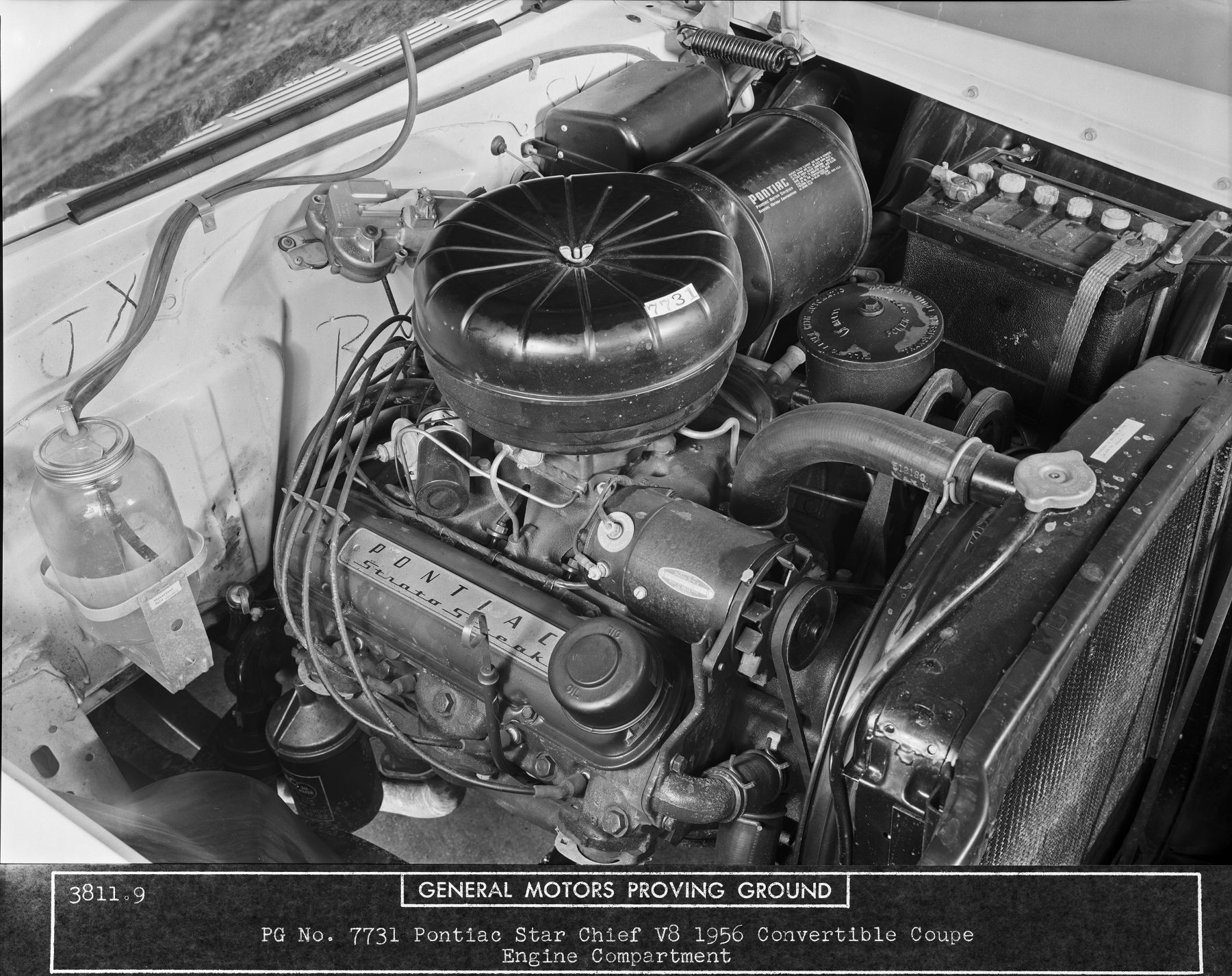
An under-hood view of the 1956 Pontiac Star Chief 317 cubic inch Strato Streak V-8 engine

The 1956 Pontiac Star Chief 317 cubic inch Strato Streak V-8 engine

Current Pontiac Safari Valuations

The collector market for the two-door Pontiac Star Chief Custom Safari remains strong. It is often positioned as a more exclusive alternative to the ubiquitous Chevrolet Nomad. While the Safari is significantly rarer than the Nomad, it typically trades at a slight discount, making it a highly sought-after halo wagon for Pontiac enthusiasts.

Recent auction data and valuation guides show a wide range of pricing for classic Safaris. It all depends on the specific year and engine configuration (such as the coveted “Tri-Power” setup):

#1 Concours (Pristine): $120,000-$190,000+

#2 Excellent (Show Quality): $75,000-$115,000

#3 Good (Driver Quality): $35,000-$65,000

#4 Fair (Restorable/Project): $15,000-$30,000

A Safari Owner’s Love
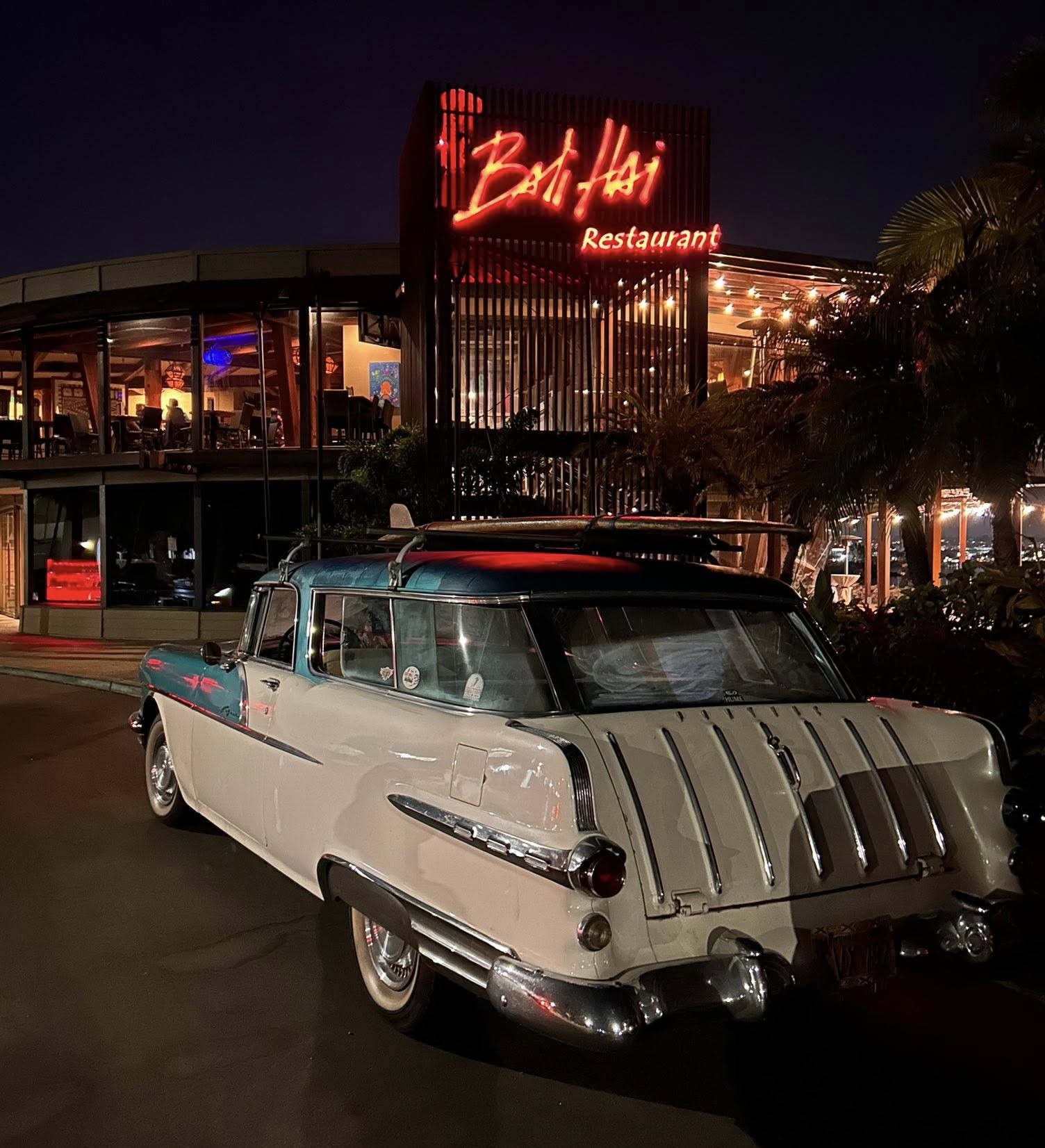
A color nighttime image of Norm Daniels' 1956 Safari in Vista Turquoise and Nimbus White. He calls his wagon the “Safari Tiki Wagon O Fun.”

Norm Daniels calls his 1956 Vista Turquoise and Nimbus White wagon the “Safari Tiki Wagon O Fun.” (Norm Daniels photo)

San Diego, Calif., car enthusiast Norm Daniels has owned his 1956 Pontiac Safari for about 12 years. He calls his Vista Turquoise and Nimbus White wagon the “Safari Tiki Wagon O Fun.”

This passion for cars started early in his life.

“My first car was a ’57 Bel Air hardtop, yellow and white. Sold her to buy a 1967 VW bus. Loved that slowpoke,” he wrote via Facebook Messenger.

He owned many VWs off and on. Later, he wanted a V-8 again, and then “along came my Safari Tiki Wagon O Fun.”

It was a matter of the “Car Distribution System.”

“She chose me,” he wrote. “Actually, I’d been looking for a Nomad, but they were too expensive. My buddy, Scott, owned this Safari, and he knew I liked it, so he made me a fair offer. That was about 12 years ago. So glad to have her instead of the Chevy, but parts are not as easy to locate.”

Some of his favorite features of his Safari include the lighted hood ornament, curved windshield glass, the stylish trim, and, most of all, the cool people he meets every time he goes out.

“I’m an enthusiast of beauty,” Daniels wrote. “And she’s a beauty!”

Collector market sources:
www.autoevolution.com;

Reddit.com

Macs Motor City Garage 

Antique Automobile Club of America

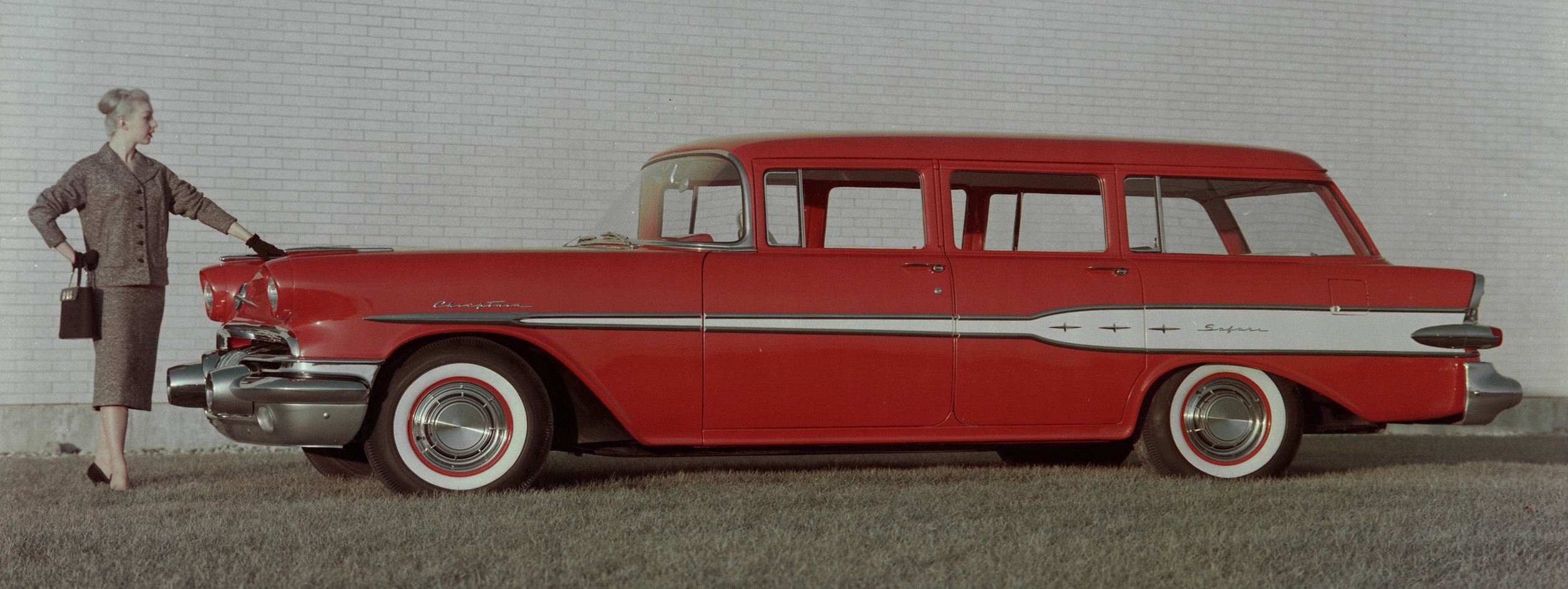
A red 1957 Safari Chieftain 4 door with a stylishly dressed woman standing at the front of the car with her left hand on the hood

The 1957 Pontiac Safari Chieftain four-door, six-passenger. 1957 was the year Pontiac expanded the name to include all of its station wagons across different trim levels.

Hyundai Sonata N Line Review

Hyundai Sonata N Line Review

The 2024 Hyundai Sonata N Line sport sedan is a subtle display of elevated, if not wicked, performance for a well-equipped $36,310

A front three quarter view of a silver N Line sedan

Hyundai has made significant updates to the midsize 2024 Sonata, with sharpened performance to the Sonata N Line. (Photography courtesy of Hyundai or as credited)

Jump To Special Features

What’s New for the 2024 Sonata?
2024 Hyundai Sonata Pricing
Extensive Safety Features
N Line Performance
Under the Hood
Ride and Handling
Why Buy the 2024 Hyundai Sonata N Line?
Specifications

BY MARK MAYNARD

Quick, before Hyundai finance managers realize that the powertrain engineering team ignored all cost restrictions for its Sonata N Line.

This popular midsize sedan has gone through a major midcycle freshening for 2024. The updates are more than the usual nips and tucks inside and out. For the first time, there is an all-wheel-drive option for one trim level. And the new Sonata N Line is a subtle display of elevated performance. For a well-equipped $36,310, I did not expect the pleasure of such punch in my week’s test drive.

The Sonata N Line is an outlier sport sedan in the midsize segment. It has no real competition except its company cousin, the Kia K5 GT, which uses the same N Line powertrain. Why is it so isolated? It might be the price point or a perception that the mainstream midsize segment is a grownups’ family car.

Sport compact sedans, however, are numerous, including Hyundai’s Elantra N Line. Among competing four-door sportsters are the Honda Civic Si, Subaru WRX, Toyota GR Corolla, and VW Jetta GLI. And there are higher performance versions for each compact, at a cost. Pricing on average for these mere sporty sedans starts in the low to mid $30,000s. Opting for one of their more notorious trim levels can add $10,000-$15,000 to the MSRP.

The incredibly well-equipped 2024 Hyundai Sonata N Line is a larger car with impressive engineering, priced at $36,310.

By EPA interior space standards, the Sonata is a “large” car.

The cabin has tech-contemporary style, centered by a new curved display screen.

The N Line cabin has tech-contemporary style, centered by a new curved display screen.

What’s New for the 2024 Sonata?

The 2024 exterior redesign leans into Hyundai’s styling language of “sensuous sportiness.” Among the influences are Sonata’s horizontal layout, signature “Seamless Horizon Lamp,” and wide-set hidden headlights. A full-width LED light strip at the hood shutline runs just above the main headlights, hidden above the air intakes.

Hyundai says a new grille and larger air intakes create a more dynamic and aggressive appearance. At the rear, stylized H-lights emphasize the wide stance. LED lighting adds a contemporary tech style. A black spoiler-shaped trunk lid and a rear lower fascia molded around dual exhaust tips set a performance tone.

The N Line’s 19-inch tire and wheel package gives a strong stance, with capability from Pirelli P Zero all-season tires. Standard Sonata wheels are 16, 17, or 18 inches.
Thanks go to the N Line model for new body reinforcements. There were also more general improvements in noise, vibration, and harshness.

Special N Line cabin details include red trim across the dashboard and air vents, with red stitching throughout. The steering wheel material was changed, and the upper seatbacks of the front seats have an embroidered N logo.

On the N Line and upper trims, there is a new curved display screen. The digital presentation links two separate 12.3-inch displays under a single pane of glass.

Other updates include:

  • Wireless Apple CarPlay and Android Auto have been expanded to all 2024 Sonata models;
  • Continuous over-the-air software updates;
  • Improved sound quality from the 12-speaker Bose Premium Sound System with new CenterPoint 360 technology.
Front sport seats with microfiber suede inserts have higher grip leatherette side bolsters.

N-Line sport seats with microfiber suede inserts and higher grip leatherette side bolsters.

2024 Hyundai Sonata Lineup

The refreshed 2004 Hyundai Sonata is available in gasoline or gas-electric hybrid models, in front- or all-wheel drive.

  • Gas-powered Sonatas have a 191-hp 2.5-liter direct-injection four-cylinder engine. On 87-octane fuel, it has fuel economy ratings of 25/36/29 mpg city/highway/combined. The transmission is an eight-speed Smartstream automatic with an overdrive lock-up torque converter.
  • Hybrid-powered Sonatas have a 192-hp 2.0-liter four-cylinder engine, 39 kW (51 hp) motor, and 270-volt lithium battery pack. The transmission is a six-speed automatic.
  •  Sonata N Line has a specially developed 290-hp turbocharged 2.5-liter engine and an eight-speed wet dual-clutch automatic with steering wheel paddle shifters.

All-Wheel Drive

Hyundai TRACtion (H-TRAC) all-wheel-drive system is now available on the entry SEL model with 2.5-liter engine. The electronically “intelligent” system reroutes power between the front and rear axles. The system will also apply subtle brake pressure to the left and right wheels to help maintain cornering control.

2024 Hyundai Sonata Pricing*

  • SEL $28,860 with carpeted floor mats ($210); add $1,500 for all-wheel drive. Standard SEL features include keyless entry with push-button ignition, fabric upholstery, heated front seats, an eight-way power driver seat, a six-way manual front passenger seat, a 12.3-inch infotainment touch screen, and a wireless phone charging pad.
  • SEL Hybrid (FWD) $31,950. The gasoline-electric powertrain achieves fuel economy ratings of 44/51/47 mpg city/highway/combined.
  • SEL Limited Hybrid $38,350. Special features include leather-trimmed upholstery, heated and ventilated front seats, and 17-inch alloy wheels with an eco-spoke design.
  • N-Line $36,310, including carpeted floor mats.

*Retail starting prices include the $1,150 freight charge from Asan, Korea.

Check current Hyundai pricing and special offers here.

Paint Colors

Hyundai says the Sonata’s exterior colors have a state-of-the-art aircraft look. The Sonata N Line’s Aero Matte Silver ($1,000) changes color from warm to cool depending on the light.

Additional exterior colors include Onyx Black Pearl, Serenity White Pearl ($470), Atlas White, Portofino Gray (matte-metallic), Transmission Blue Pearl, Carbon Blue Pearl, Ultimate Red Metallic, Cream Beige, and Aero Silver Metallic.

Interiors are trimmed in black, dark gray, and greige two-tone, or dark gray and camel two-tone. Dark gray with red stitching and N Line red paint is exclusive to the Sonata N Line model.

The open trunk of 15.6 cubic feet

This sedan has useful utility in its 15.6 cu.ft. trunk, and fold the 60/40 back seat for up to 6 feet in length.

Warranty Coverages

Hyundai has become known for its vaunted warranty coverages: 5 years or 60,000 miles bumper to bumper with roadside assistance. And new vehicles also have free maintenance for 3 years or 36,000 miles.

Hyundai repaired its early powertrain reliability with major engineering improvements and by offering a 10-year, 100,000-mile powertrain warranty. However, getting satisfaction in the event of an engine problem can be elusive, according to Consumer Reports. In a recent report ranking dealership satisfaction scores of 22 makes, Hyundai ranked third from the bottom. Kia was last, and just above is Jeep. Ouch.

The new steering wheel mounted shift lever looks odd, works well.

The new steering wheel-mounted shift lever looks odd but works well.

Interior Function

Size matters when putting controls and switches in logical order. The wide digital screen is not prone to glare or odd reflections. And there is no confusion to knobs, dials, or switches to control cabin comfort or audio.

There is enough stretch to the body that sightlines are open over the shoulder, across the hood, and at the side mirrors.

Headroom of 37.8 inches with the panoramic sunroof should fit most drivers. Taller drivers might prefer to skip the panoramic roof to get 40 inches of headroom. The front legroom is incredibly long, at 46.1 inches. With door-to-door shoulder room of 57.9 inches, the front seat area does not feel cramped.

The Sonata N Line sport seats have good comfort and thigh support due to their breathable and grippy microfiber suede centers. Higher grip leatherette side bolsters were not intrusive to entry and exit. But I would like a more pronounced D-shaped steering wheel, which helps with thigh room.

The redesign also introduces a new gearshift stalk at the steering wheel. It might look weird initially, but it functions easily with a twist up or down to engage gears. The shifter is a smart way to move a lever from the center seat console for more useful space. A switch on the console changes drive modes from Normal to Smart, Sport, and My Mode.

An e-bin at the forward console has C-Type charging USBs, a 12-volt and 180-watt power plug, and a wide charging pad.

Back Seat and Cargo Space

With just 34.8 inches of max legroom, the window seats still have a comfortable stretch with good footroom. The center seat has the typical perched position, making it more useful for its broad fold-down armrest. Conveniences include two C-type USBs, grab handles with coat hooks above each door, and slim door-panel storage.

There is good utility to this sedan with is 15.6 cubic feet of trunk space, and golf-bag capable. Or fold the 60/40 back seat for up to 6 feet in length, easily negotiated through the wide trunk opening. Trunk assets include dual seatback-release pulls and an interior light. There is no N Line spare, just a “mobility kit” of tire sealer and inflator pump.

The Sonata back seat with adequate 35.8 inches of legroom

With just 34.8 inches of max legroom, the window seats still have a comfortable stretch with good footroom.

Sonata’s Extensive Safety Features

The Hyundai Sonata has comprehensive safety technologies and features, including 5 mph bumpers. The industry bumper standard is 2.5 mph for passenger cars (not trucks, SUVs, or minivans). The federal law is intended to prevent damage to the car body and safety-related equipment at barrier impact speeds of 2.5 mph across the full width and 1.5 mph on the corners. But 2.5 seems to have little benefit.

An umbrella of circuitry also protects the Sonata and its occupants. The various systems are comprised of three radar systems, five cameras, and 13 ultrasonic sensors. All linked, the systems allow for semi-autonomous driver-assist features of standard adaptive cruise control, forward-collision braking, and lane-following assist.

The individual technologies are:

FCA 1.5: Forward Collision-Avoidance Assist 1.5;

RCCA: Rear Cross-traffic Collision-avoidance Assist;

BCA: Blind-spot Collision Assist;

SEW: Safe Exit Warning;

SEA: Safe Exit Assist;

LKA: Lane Keeping Assist;

LFA: Lane Following Assist;

SCC with S&G: Smart Cruise Control with Stop & Go;

RSPA: Remote Smart Parking Assist (enables the user to park the vehicle and exit parking spots by remotely reversing and forwarding with the smart key from outside the car;

NSCC: Navigation-based Smart Cruise Control (optional);

HDA: Highway Driving Assist to help relieve driver stress (optional).

N Line Performance

The Sonata N Line is a sleeper sport sedan — and a lot more than paint and tape. Its 290-horsepower, 2.5-liter turbocharged engine was developed specially for the N Line, and its eight-speed dual-clutch (automated manual transmission) thrives in high-rev performance.

While turbocharged 290 hp is great, the N-Line’s torque stands out. The 311 foot-pounds run steady from 1,650-4,000 rpm. In its testing, Motor Trend clocked zero to 60 mph in 5.6 seconds.

When the red mist whispers, there is Sport-Plus, just a couple of pages away in the vehicle settings. Sport-Plus mode is in the “My Mode” category. Use the slider buttons to maximize the performance of shift points and steering weight. Neither setting makes for a harsh or uncomfortable ride, but mercy, the performance is amplified to the predator level. Flicking off steering wheel paddle shifts gives instantaneous upshifts and rev-matching downshifts.

N Line Sport-Plus mode also includes launch control and rev-matching downshifts. Active Sound Design makes the engine sound more virile inside the cabin, but it still sounds ratchety.

Yet, there are those times of enthusiast driving when the N-Line could use a locking differential when the front tires lose grip and torque steer takes over.

N-Line has a console switch to toggle between comfort, Sport, and My Mode. Sport modes sharpen acceleration response and steering weight.

The eight-speed wet dual-clutch automatic gave hesitant shifts while driving around town. That action was the gears engaging in the automated manual transmission. It annoyed me, but I discovered that Sport mode eliminated the clutching action. That is how I enjoyed the rest of my drive week, regardless of fuel economy.

A view of the N Line’s 290-hp 2.5 liter four-cylinder engine.

The N Line’s 290-hp 2.5 liter four-cylinder engine.

Under the Hood

Pop the N Line hood, and Hyundai’s detailed engineering for serviceability and DIY maintenance becomes apparent. First, there are two robust hydraulic hood struts, not a spindly prop rod. Never mind that those struts (and tailgate struts) will wear out and need to be replaced. It is the budget for hydraulic struts that matters.

Sonata's easy to change air filter

Air filter can be changed in less than a minute!

Next, check out the huge air pipe feeding the turbocharger. It is securely routed to avoid chafing on the also-large air intake tube next to it. Then, follow the air intake feed to the air filter box. The strong black plastic box has a user-considerate design with small flipper tabs. Opening, removing, and slipping in a new filter should take less than a minute.

Thermal-sandwiched metallic pads are behind and above the hood for turbocharger heat protection.

The 12-volt battery has dual lifting handles. Both battery terminals have a cover to protect positive and negative posts, and the positive terminal has its own high-current fuse.

Look closer for the corrosion-protected engine-transmission grounding strap. The robust strap is fully covered.

The user friendly fuse panel under the hood of the Sonata.

The simple fuse-box schematic. (Peter Badore photos)

Now, eyes right to the vehicle fuse box near the right-side shock tower, clearly identified. Remove the lid, and the underside has a detailed schematic chart showing each fuse amperage and what it protects. There are also six spare fuses and a useable plastic tweezer-like tool to pull a blown fuse.

Finally, for the owner and service tech, many of the screw heads are rounded to protect knuckles.

All these added design features add cost and weight. Many carmakers in the Sonata’s price segment cut such extras from their budgets.

Fuel Economy Numbers

At 3,534 pounds, the Hyundai Sonata N Line is the second heaviest Sonata in the lineup. It slots behind the Limited at 3,687 pounds or the SEL AWD model at 3,466.

Sonata N Line has fuel economy ratings of 23 mpg city, 32 highway, and 27 mpg combined on the recommended 87 octane fuel. In my 200-mile week of driving, I saw mileage averages of 29.4 around town to 35 mpg on the highway.

However, those mileage ratings are several mpgs off those of the four-cylinder 2024 Honda Accord turbo (29/37/32 mpg) and 2024 Toyota Camry (28/39/32 mpg).

Sonata N Line Ride and Handling

The suspension stands out for its agile finesse in transferring weight. The refined engineering of suspension components is felt in the low-friction glide quality.

Modern family sedans have been made lower and wider in the hope of improving fuel economy and meeting federal mileage standards. Consequently, some new sedans ride so low that comfortable entry and exit are compromised.

Not so the Hyundai Sonata. Its ride height allows excellent forward sightlines and comfortable entry and exit. Drivers can confidently transition driveways without a chin scrape. There is no tiptoeing across lumpy intersections in concern of bottoming out. It is hard to avoid that awful “graunch” in most other sedans and some small SUVs today.

Hyundai has applied various aerodynamic designs, winglets, and air-breaking widgets to lower the drag coefficient to 0.28. The Toyota Prius, by comparison, has a Cd of 0.27. Despite more soundproofing, there is much ambient noise in the cabin at highway speeds. It did not seem to come from tire harshness or suspension points.

Complementing ride and steering control are the 19-inch 245/40 Pirelli P Zero all-season tires, on the test car. Their rubber chemistry is compliant with an upper-midrange 500 treadwear rating (UTQG). Replacements will run around $300 each (not installed), per TireRack.com.

The N Line’s 19-inch tire and wheel package with Pirelli P Zero all-season tires.

The N Line’s 19-inch tire and wheel package with Pirelli P Zero all-season tires.

Why Buy the 2024 Hyundai Sonata N Line?

Hyundai believes there is renewed interest in sedans. The Sonata offers accommodating utility and a generous budget for many useful features.

There is more to the Sonata N Line than what is typically perceived as a family sedan. Enjoying this stealthy sport sedan requires no physical sacrifice.

Now, switch off the drive assistance, take the wheel, and just enjoy driving.

A slightly overhead view of a silver Sonata N Line

The Sonata N Line is an outlier sport sedan with no real competition, except its company cousin the Kia K5 GT.

2024 Hyundai Sonata N Line Specifications

Body style: midsize, 5-seat, 4-door front-wheel-drive sedan; unibody high-strength steel

Engine: 290 hp, Smartstream 2.5-liter turbocharged and direct-injected DOHC 16-valve inline 4-cylinder; 311 lb.-ft. torque from 1,650-4,000 rpm

Transmission: 8-speed N automatic wet dual-clutch

Fuel economy: 23/32/27 mpg city/hwy/combined;

Coefficient of drag: 0.27 Cd

BY THE NUMBERS

Fuel tank: 15.9 gallons

Trunk space: 15.6 cubic feet

Front head/leg room: 37.8*/46.1 inches *40 inches w/o sunroof

Rear head/leg room: 37.4*/34.8 inches *38.4 w/o sunroof

Shoulder room, front/rear: 57.9/56.1 inches

Hip room, front/rear: 54/.6/54.4 inches

Length/wheelbase: 193.3/111.8 inches

Height/width: 56.9/73.2 (not including mirrors) inches

Curb weight: 3,534 pounds

Turning circle: 35.9 feet

FEATURES

Sonata N Line standard equipment includes: Proximity key with push-button ignition, 12.3-inch color gauge array, 12.3-inch touchscreen for navigation-audio, panoramic sunroof, surround view monitor, dual automatic temperature control, wireless Apple CarPlay and Android Auto, 12-speaker Bose audio system with satellite radio, 8-way power driver’ seat, 6-way front passenger seat, heated front seats, electric parking brake, 60/40 folding back seat, hands-free trunk, lighted vanity mirrors and visor extensions, locking and lighted glove box.

N-Line features: larger front bumper grille area, exclusive 19-inch wheels, rear spoiler, dual twin-tip exhaust, front sport seats with microfiber suede inserts and higher-grip side bolsters, leather-wrapped steering wheel, metal and rubber brake and accelerator pedals, LED map lights, red-accented stitching and cross-metal patterned trim, Active Sound Design, Launch Control, N Powershift, and rev-matching downshifts.

Sonata N-Line standard safety features include: 9 air bags, 5 mph bumpers, stability and traction controls, safe exit warning;

Safety technologies include: blind-spot collision warning with rear cross-traffic collision avoidance assist; blind-spot view monitor; forward collision-avoidance assist with pedestrian, cyclist detection and junction turning; parking collision-avoidance assist rear; high-beam assist; lane keeping assist, lane follow assist, and driver attention warning.

CHASSIS COMPONENTS

Brakes: 4-wheel disc brakes; 13.6-inch ventilated front rotors, 12.8-inch rear solid discs; 4-wheel ABS with electronic brake-force distribution with brake assist; electric parking brake

Steering: column-mounted rack and pinion; motor-driven power assist with engine rpm-sensing; turning circle 35.9 feet

Tires-wheels (on test car): 19-inch 245/40 Pirelli P Zero all-season on 5 dual-spoke wheels; tire mobility kit (no temporary spare)

Suspension: front MacPherson struts with a stabilizer bar; rear multilink with a stabilizer bar; gas shock absorbers front and rear

PRICING

Base price: $36,100, including $1,150 freight charge; price as tested $36,310

Options on test vehicle: Carpeted floor mats $210

Where assembled: Asan, Korea

Warranties: 5-years/60,000-miles bumper to bumper with roadside assistance; 3-years/36,000-miles complimentary maintenance; 10-years/100,000-miles powertrain

Kia K4 Review

Kia K4 Review

The 2025 Kia K4 is a decisive stab into the heart of the compact-sedan segment

The 2025 Kia Kr sedan in an attractive sage green being driven on a city street

The 2025 Kia K4 compact sedan has starting prices of $23,165 to $29,265 for the GT-Line Turbo, the sportiest K4 to date. (Photography courtesy of Kia or as credited)

Jump To Special Features

Disruptor Design
2025 Kia K4 Pricing
Turbo Performance
Observations and Considerations
Interior Tech
Why Buy the 2025 Kia K4?
Specifications

BY MARK MAYNARD

The 2025 Kia K4 compact is a new nameplate backed by four generations of family ties. The ancestry of this small sedan goes back to its great, great, great grandparent, the Kia Sephia. It was the brand’s first automotive export to the U.S. from South Korea.

The fledgling Sephia was cheap — and not just inexpensive. The 1994 Kia Sephia was a $10,000 econobox advertised to be used, abused, and thrown out after the warranty expired. Back then, Kia’s new-vehicle warranty was 3-year/36,000-mile. Today, the warranty is 5 years/60,000 miles and 10 years/100,000 miles for powertrain coverage.

Four years later, Sephia — derived from the Greek “sapphire” — was redesigned for a short-lived second generation. It was replaced in 2000 and renamed Spectra, which would be redesigned and renamed Kia Forte.

Fourteen years and three generations later, the Forte was retired in 2024 and replaced by the K4. The alphanumeric nameplate now aligns with Kia’s passenger car nomenclature.

It’s such a long and winding road for such a small but significant car for Kia. Each generation builds upon the predecessor for the most dynamically styled and equipped fourth-generation 2025 K4. And a five-door hatchback is coming in late 2025.

Looking at the K4 front seat area from the back seat

The K4 has comfortable shoulder room and an open-air environment.

The K4’s Disruptor Design

Among the K4 competitors are the Honda Civic, Mazda3, Toyota Corolla, and VW Jetta. It is evident that Kia benchmarked the Civic and went just a bit farther in developing the K4. The Honda Civic was the bestselling compact car in 2024, with around 242,000 cars sold. Annual sales of the 2024 Kia Forte totaled 106,050.

Kia says the K4 is the widest in the compact sedan segment and has the largest footprint. Its overall body design is distinct, with sleek aerodynamics. It is a breakaway design from the typical sedan body style. It shares its styling influence with the upcoming Kia EV4 battery-electric.

The K4 sedan has an overall length of 185.4 inches and is 72.8 inches wide. Front headroom is SUV tall at 39 inches without a sunroof or 37.3 inches with. Rear passengers have a class-leading 38 inches of legroom. Trunk space of 14.6 cubic feet is surpassed only by the Honda Civic at 14.8 cu.ft.

“By juxtaposing the K4’s fastback roofline and wide stance, we split the difference visually between the compact and midsize segments,” said Tom Kearns, chief designer, Kia Design Center America.

Exterior design elements include:

Vertically oriented LED headlights and taillights. The treatment is taken from the flagship EV9, re-creating sharp edges and bold lighting designs front and rear.

Hidden rear door handles in the C-pillar. The stealth handle placement is intended to emphasize the K4’s fastback proportions and its swept-back stance.

Rear sail panel. The K4’s rear quarter panel rises above the beltline to create a flying buttress (sail panel) treatment at the roofline. The sail panel’s angle meets the roof’s fastback slope for a contiguous style statement.

The K4 has a hidden rear door handle in the C-pillar.

The hidden rear door handle in the C-pillar.

2025 Kia K4 Pricing

The 2025 Kia K4 compact sedan is sold in five trim levels, with two four-cylinder engine choices and two transmissions. All trim levels are front-wheel drive, with no all-wheel-drive option. The suggested retail pricing below includes the $1,175 freight charge from Pesqueria, Mexico.

The K4 LX, LXS, EX, and GT-Line, with a base powertrain of a 147-horsepower 2.0-liter four-cylinder engine and CVT, start at $23,165 to $26,365. The GT-Line Turbo starts at $29,265.

Find current Kia K4 pricing here.

And check for special offers and incentives here.

The base K4 LX is well equipped with such features as:

  • 12.3-inch touchscreen infotainment screen with Kia Connect and satellite radio
  • Wireless Apple CarPlay and Android Auto
  • Smart Key with push-button start
  • 4 USB-C charging ports
  • Cloth seat upholstery
  • Bluetooth wireless phone and music with multi-device connectivity
  • Electric parking brake with auto-hold
  • Heated side mirrors
  • Rearview monitor
The K4 has Vertically oriented Cube Projection LED headlights.

Vertically oriented Cube Projection LED headlights.

K4 GT-Line

Moving up to the K4 GT-line ($26,365) gives the look of the GT-line Turbo without the power. GT-Line features include:

  • GT-Line sport steering wheel with paddle shifters
  • Multilink rear suspension
  • Unique exterior and interior design
  • Black treatment to side mirrors, window surround, wheel moldings
  • 1-inch larger rear disc brake rotors
  • 18-inch alloy wheels with black machined finish
  • GT-Line interior features include:
  • SynTex and cloth seat upholstery
  • Heated front seats
  • 10-Way power driver’s seat with two-way power lumbar
  • Wireless Phone Charger

Kia K4 GT-Line Turbo

The Kia K4 GT-Line Turbo ($29,265) is the sportiest K4 to date. It ups performance with a 190-hp, turbocharged 1.6-liter four-cylinder engine and eight-speed automatic transmission. Other K4 GT-Line Turbo upgrades include:

  • 1-inch larger front and rear disc brakes. (16-inch ventilated front rotors, 15-inch solid rear rotors)
  • Multilink rear suspension
  • LED Cube Projection Headlights, LED Tail Lights, and LED Fog Lights
  • Wide sunroof with power sunshade
  • SynTex upholstery with heated front seats
  • Alloy sport pedals
  • 8-speaker Harman Kardon audio system

Today’s Kia K4 GT-Line Turbo tester costs $32,155, with options for Snow White Pearl paint, $395, and red interior package, $295. That’s a head-turning option for the handsome red on seats, portions of the steering wheel, and door panels.
Another worthwhile option on the tester is the GT-Line Turbo Technology Package, $2,200. It completes the driver-assist technologies for Level 2 semi-autonomous driving. The package includes:

  • FCA Fusion+ for Forward Collision-Avoidance Assist
  • Parking Distance Warning — front, rear, and side
  • Blind-spot view monitor (shown in the garage array in the dials for speed and rpms when signaling left or right)
  • Two memory presets for driver seat and side mirrors
  • Ventilated front seats
  • Multicolor ambient lighting
  • Smartphone Digital Key 2.0
The K4 gauge display has large graphics that aid at-a-glance views.

Large graphics help with at-a-glance views.

K4 Safety Features and Technologies

All K4 models have eight airbags, including standard rear side airbags. Standard driver-assist technologies include:

  • Auto Emergency Braking Technology w/ Pedestrian & Cyclist Detection
  • Intelligent Speed Limit Assist
  • Smart Cruise Control with stop-and-go
  • Lane keeping and following technologies
  • High beam assist
The GT-Line Turbo’s 190-hp, turbocharged 1.6-liter 4-cylinder.

The GT-Line Turbo’s 190-hp, turbocharged 1.6-liter 4-cylinder.

2024 Kia K4 Powertrains

Base K4 models have a 147-horsepower Atkinson-cycle 2.0-liter four-cylinder engine with multi-point injection. The transmission is an Intelligent Variable Transmission (CVT) that simulates eight speeds.

The entry LX’s fuel-sipping mileage estimates are 30/40/34 mpg, dropping a blink to 29/39/33 mpg for the better-equipped EX and GT-Line.

The GT-Line Turbo has a 190-hp turbocharged 1.6-liter four-cylinder engine with a conventional (stepped) eight-speed automatic transmission.

GT-Line Turbo mileage estimates are 29/36/29 mpg using the recommended 87 octane fuel. In my 200-mile test week, I saw city fuel economy in the high 20s. I worked up to 38.7 mpg on the highway, which might have crept higher on longer commutes. Some owners have reported highway mileage of 48.3 mpg.

At 36 mpg highway, the daily commuter could expect a range of nearly 500 miles from the 12.4-gallon tank.

The 18-inch K4 tire and black wheels

18-inch Kumho Majesty grand touring tires with black machined finish wheels.
GT-Line Turbo Performance

The Turbo motor purrs at idle and never sounds harsh at highway speeds.
Driving in Normal power mode is focused on fuel economy with dutiful acceleration. Once I figured out that driving in Sport mode did not greatly impact my fuel economy, I never looked back. Sport sharpens throttle uptake for quicker starts from a stop.
At 70 mph, the Turbo engine spins at a reasonable 2,000 rpm. Cruising at 65 mph, the rpms are at a lanky 1,800 rpm, benefiting fuel economy.

The GT-Line Turbo performance does not provoke red-mist hooliganism. However, the car is well set up for enthusiastic driving. It puts its nose to the road to pull capably through fun cornering.

While there are paddle shifters, I did not feel the need to play Ricky Racer. But when I was out clipping corners, I did wish for a higher calling of Sport-plus mode. I wanted to use those paddle shifters to grab a lower gear with a hearty throttle blip to carry me through the turn.

The performance mode switch in the base of the steering wheel

A convenient performance-mode switch to toggle between Normal and Sport.

GT-Line Turbo Ride and Handling

The side mirrors, which are offset from the body, offer open cornering views. The Turbo’s 18-inch wheels make the turning circle maneuverable at 36 to 37 feet. With the base 16-inch wheels, the span drops to 35.1 feet.

A notable asset of the GT-Line Turbo is its rear multilink suspension. It is more responsive in cornering than the dutiful torsion-beam axle in the non-turbo models. All K4 models have hydraulic twin-tube, gas-charged shock absorbers.

Highway cruising is settled and comfortable, but the multilink has the mettle for enthusiastic driving. It blends well-damped ride control with fluid weight transfers when diving into and out of corners. At times, the front suspension gave agile responses, but wow, hitting a pothole head-on returns a shocking jolt. More than once, I glanced at the gauge display for a possible blown tire. There was none.

While tearing up a backroad, there was no squawky complaining from the 18-inch Kumho Majesty grand touring tires. There is no distracting tire noise or harshness transferred to the cabin. These are all-season grand touring tires with a treadwear warranty of 6 years or 45,000 miles. Replacements will cost around $220 per tire.

K4 curb weights range from 2,956 pounds for the lower trims to 3,283 pounds for the loaded GT-Line Turbo. Bigger brakes, wheels, and an independent rear suspension add weight to the Turbo model.

The wide view of the 360 degree back up camera

The 360-degree rearview camera. (Mark Maynard photo)

Highway Driving Assist 2

Kia’s Highway Driving Assist 2 provides reliable and trustworthy Level 2 semi-autonomous driving. Lane centering is accurate and steers confidently through highway turns, with few transgressions over the white lines.

HDA2 is enabled with the GT-Line Turbo Technology Package, $2,200. It includes a worthwhile grouping of Smartphone Digital Key, two driver’s seat memory presets, ventilated front seats, a surround view monitor, a blind spot view monitor, and multicolor ambient lighting.

A proper shift lever and some of the largest adjustable cup holders in a small car.

A proper shift lever and some of the largest adjustable cup holders in a small car.

Interior Function

The Kia K4 is a compact that packs midsize substance. It has comfortable shoulder room and an open-air environment. Front headroom is 39 inches, or 37.1, with a sunroof. Front legroom is long, too, at 42.3 inches.

Settle into the driver’s seat for hours-long support without aggressive and confounding side and bottom bolsters. Among the 10-way power adjustments is seat-bottom tilt, not typically applied to small cars.

The rearview camera has 360-degree views, including overhead.

The GT-Line steering wheel has heft and padding where needed for a comfortable grip. The flat top opens sightlines at the base of the windshield, and the flat bottom gives thigh room.

Kia layered on the soundproofing. The treatment helps calm the cabin with dual-layer carpet and acoustic tires on the GT-Line models. An acoustic windshield is also available on the GT-Line Turbo and in the GT-Line Premium package.

Over-the-air updates are possible using the Kia Access app or through the Kia owner’s portal.

The tester came with the optional $175 floor mats, which are of good quality.

Looking at the wireless charging pad at the front of the shifter console

The wireless charging pad and wireless Apple CarPlay and Android Auto.

Observations and Considerations

There are old-school mechanical release levers for the trunk and fuel door. However, I do not like Kia’s Smart Trunk, the hands-free opener. Just stand at the trunk with key in pocket or purse, and the trunk gives a three-second chime before opening. Apparently, I walk too slowly because the very responsive trunk calibrations triggered an opening every time I walked past. However, the Smart Trunk has its moments, such as when walking up with multiple grocery bags in the rain. Fortunately, the Smart Trunk, a standard feature, can be canceled in the user settings.

When it rains, water droplets collect on the fast slope of the back window, complicating views through the dappled glass. Understandably, there is no rear wiper-washer, but the upcoming hatchback model will sweep away that situation.

With the bounty of features in the GT-Line Turbo, there is no heated steering wheel.

Rear AC outlets only on the GT-Line Turbo. Kia says the GT-Line Turbo was designed to appeal to midsize sedan shoppers who are OK with a slightly smaller vehicle. So the feature set aligns more with the midsize sedan segment. “None of our compact sedan competitors offer rear A/C vents on any trim,” Kia says.

The GT-Line Turbo has SynTex upholstery with heated front seats. And GT-Line embossing, below.

The GT-Line Turbo has SynTex upholstery with heated front seats. And GT-Line embossing, below.

Interior Tech

Upper trim levels of the K4 get the impressive Connected Car Navigation Cockpit (ccNC). The multi-segment display cockpit spans nearly 30 inches of digital display, another trickle-down from the EV9. A Quick Controls function for frequently used features works with a swipe on the screen.The GT-Line embossing on the upper front seatbacks

The broad screenage makes a bold statement, divided into three unequal sections. However, it would be helpful if the sections could be moved around. The steering wheel obscures the left-side segment for heat-temp-AC control. The placement is of no consequence for right-hand-drive models. In this country, however, having to peer around the wheel to make adjustments gets old quickly.

Wireless Apple CarPlay and Android Auto are standard on all K4 models.

Use the Kia Connect voice assistant and say “Hey Kia” to access functions such as climate control and audio.

The K4 has a Connected Car Navigation Cockpit spans nearly 30 inches of digital display.

The Connected Car Navigation Cockpit spans nearly 30 inches of digital display.

Back Seat and Trunk Space

For ride-share drivers, the rear legroom is a long 38 inches, which eases entry and exit. The seatback has a comfortable angle, but there is no seatback recline.

The GT-Line Turbo is unique in that it has rear AC vents, which are not provided on any other trim. Passengers will appreciate that feature and the dual charging USBs just below the vents.

Rear leg room is a long 38 inches, easing entry and exit.

Rear leg room is a long 38 inches, easing entry and exit.

There is a lot of trunk space at 14.6 cubic feet, but the trunk lid opens to just 16 inches. Fortunately, most luggage roller bags can be shoved in, but bigger bags will go to the back seat. Fold the 60/40 seatback for about 6 1/2 feet in length.

Looking into the K4 trunk

Luggage capacity of 14.6 cubic feet is limited by the trunk’s narrow opening of 16 inches. A temporary spare fits below the trunk floor. (Mark Maynard photo)

Why Buy the 2025 Kia K4?

Kia has created a segment disruptor with its K4. Compact sedans are a value purchase, but the K4 injects creative zhuzh — at a value price.

The 2025 Kia K4 will chew into Civic sales, but dethroning the segment champ will take time. The only things the K4 needs to challenge the Civic capably are a hatchback body style, a hybrid powertrain, and a hot version of the GT-Line Turbo.

Tap into the K4 owners’ group, k4owners.com.

A rear three quarter view of the K4

The K4 exterior styling has aerodynamic smoothness that hints at hybrid-tech. The Kia K4 is a resounding stab into the heart of the compact sedan segment.

2025 Kia K4 GT-Line Turbo Specifications

Body style: 4-door, 5-seat front-wheel-drive compact sedan

Engine: 190-hp 1.6-liter gasoline direct injection 4-cylinder; 195 lb.-ft. torque at 1,700-4,500 rpm

Transmission: 8-speed automatic with paddle shifters

Top speed: 130 mph

Fuel economy: 26/36/29 city/hwy/combined; 87 octane recommended

Coefficient of drag: 0.27 Cd

BY THE NUMBERS

Fuel tank: 12.4 gallons

Trunk space: 14.6 cubic feet

Front head/leg room: 37.1*/42.3 inches *w/sunroof

Rear head/leg room: 37/38 inches

Length/wheelbase: 185.4/107.1 inches

Curb weight: 3,283 pounds

Turning circle: 35.1 feet

FEATURES

Standard K4 GT-Line Turbo equipment includes: power sunroof with sunshade, LED Headlights-fog lights-combination taillights, SynTex upholstery, Harmon Kardon audio system, alloy sport pedals, rear air vents

Safety features include: Eight air bags (including standard rear side bags), auto emergency braking pedestrian and cyclist detection, smart cruise control with stop and go, Lane keeping and following, high beam assist

CHASSIS COMPONENTS

Brakes: Hydraulic, vacuum power-assisted 4-wheel discs; front, 16-inch ventilated rotors; rear, 15-inch solid rotors

Steering: Column-mounted, motor driven power assist (C-MDPS)

Tires-wheels: 18-inch all-season grand touring Kumho Majesty 9 Solus TA91, 235/40R; black alloy wheels

Suspension: front MacPherson struts; rear, multilink; hydraulic twin-tube, gas-charged shock absorbers (all trim levels)

PRICING

Base price: $29,265, including $1,175 freight charge; price as tested $32,155

Options on test vehicle: Snow White Pearl paint $395; GT-Line red interior color package $295; GT-Line Turbo Technology Package $2,200

Where assembled: Pesqueria, Mexico

Warranties: 5-years/60,000-miles bumper to bumper with roadside assistance; 10-years/100,000-miles powertrain

VW ID Buzz 4Motion Review

VW ID Buzz 4Motion Review

The battery-electric 2025 Volkswagen ID Buzz owns a unique niche. Its loaf shape is unapologetic and true to the original Bulli.

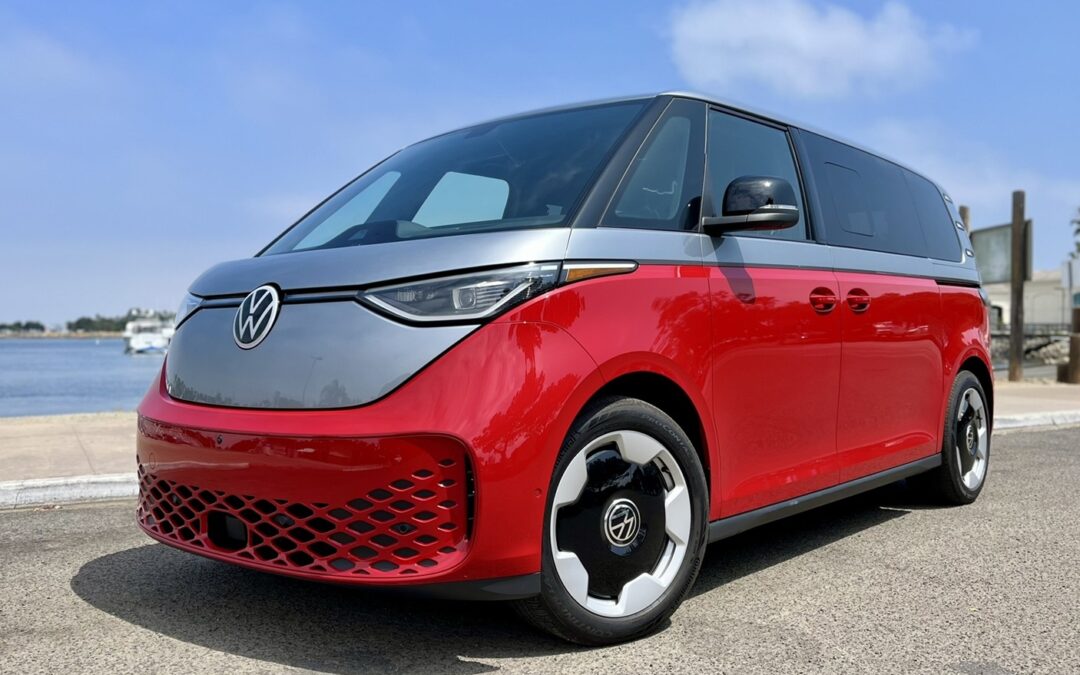
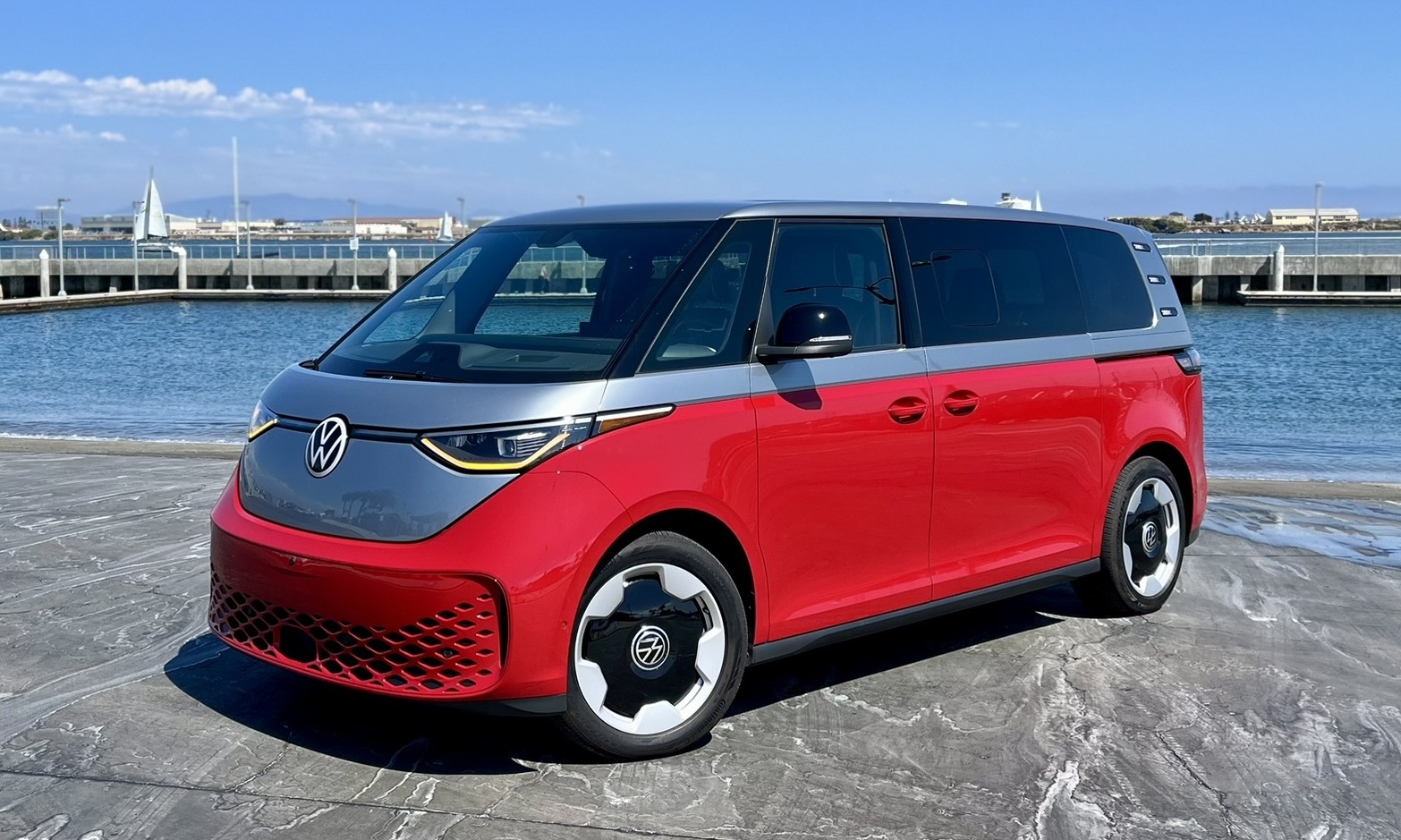
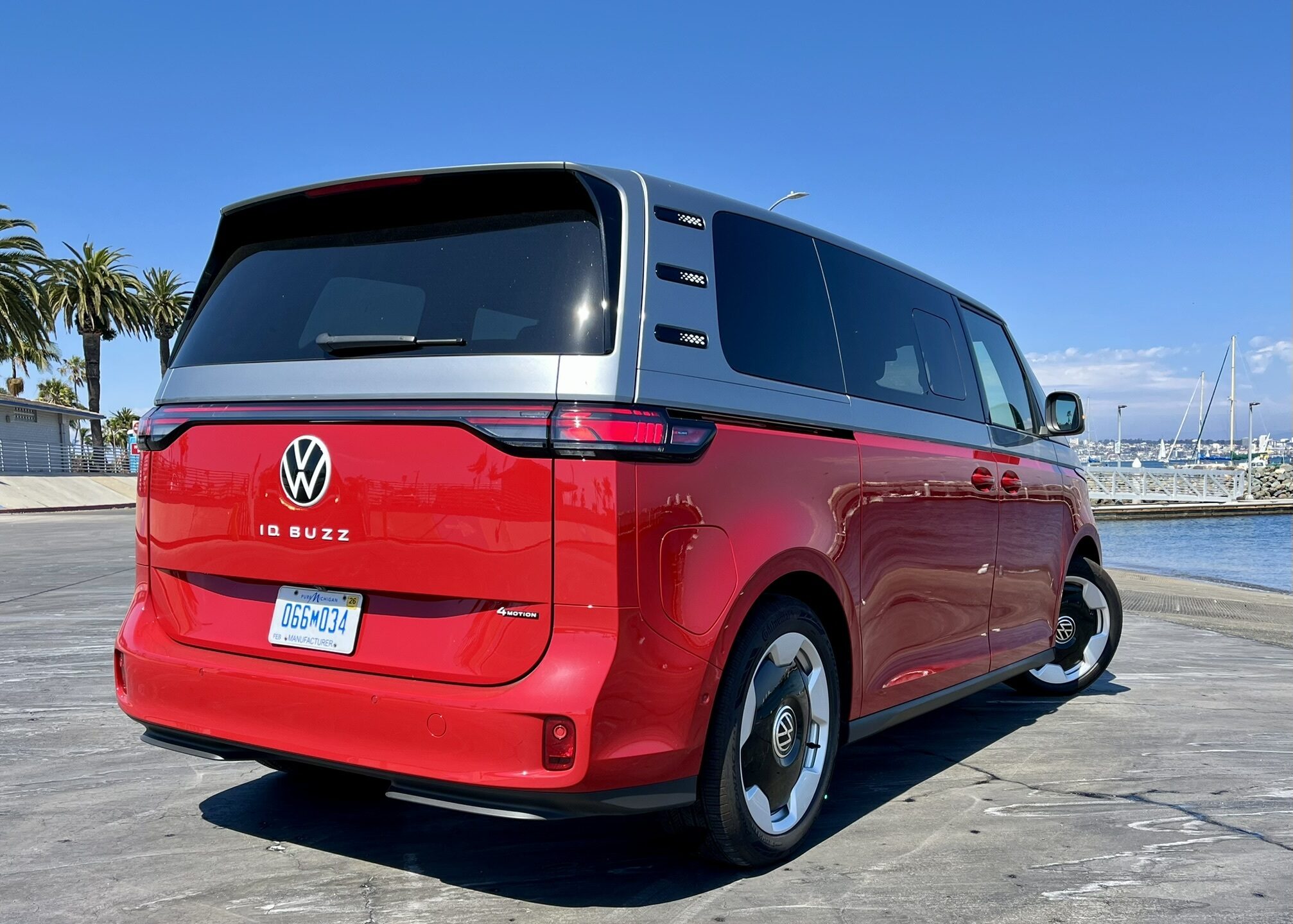
A two tone silver upper and red lower VW ID Buzz along a shelter island boat launch in San Diego

The 2025 VW ID Buzz is a battery-electric minivan with standard rear-wheel drive or the optional front-motor 4Motion AWD. Starting prices range from approximately $60,000 to $71,000. (Photography by Volkswagen of America or Mark Maynard)

Jump To Special Features

“What’s It Like?”
2025 VW ID Buzz Pricing
Clever Features
Buzz Kills
Safety Tech
Buzz Powertrain
500 kWh of Free Charging
2 Early Recalls Addressed
Why Buy the 2025 VW ID Buzz?
Specifications

 BY MARK MAYNARD

It is not easy being a brought-back icon with such an international fan base as the VW ID Buzz. It is a three-ton example of expectations meeting reality. A LOT of shade has been slung at the ID Buzz, mostly for its shortish battery range and high price.

Most critics, however, focus on what the ID Buzz is not, rather than what it is. And it is impressive for its performance, ride comfort, and quiet interior.

Slipping into the shoe space of the original VW Bulli or Type 2 Transporter, the ID Buzz ain’t nuthin’ like the original. That is not to imply that the Buzz is not a well-done vehicle. It is, but it will be an enigma to the uninitiated.

As a battery-electric minivan, the Buzz owns a unique niche. Its loaf shape is unapologetic and true to the original Bulli. And with no comparable electric minivans, the Buzz gets compared to the growing segment of electric three-row SUV crossovers, such as the Hyundai Ioniq9.

The ID Buzz is not the first electric microbus. Fifty years ago, Volkswagen showcased a battery-electric T2 bus at the Hanover (Germany) Trade Fair. The electric T2 was powered by a rear-mounted electric motor and lead-acid batteries, offering a maximum range of 52.8 miles.

Today, the 2025 ID Buzz has driving ranges of 264 miles with rear-wheel drive and 231 miles with 4Motion AWD.

Long or short, the ID Buzz is a brand halo that VW hopes — expects — will draw the curious to showrooms.

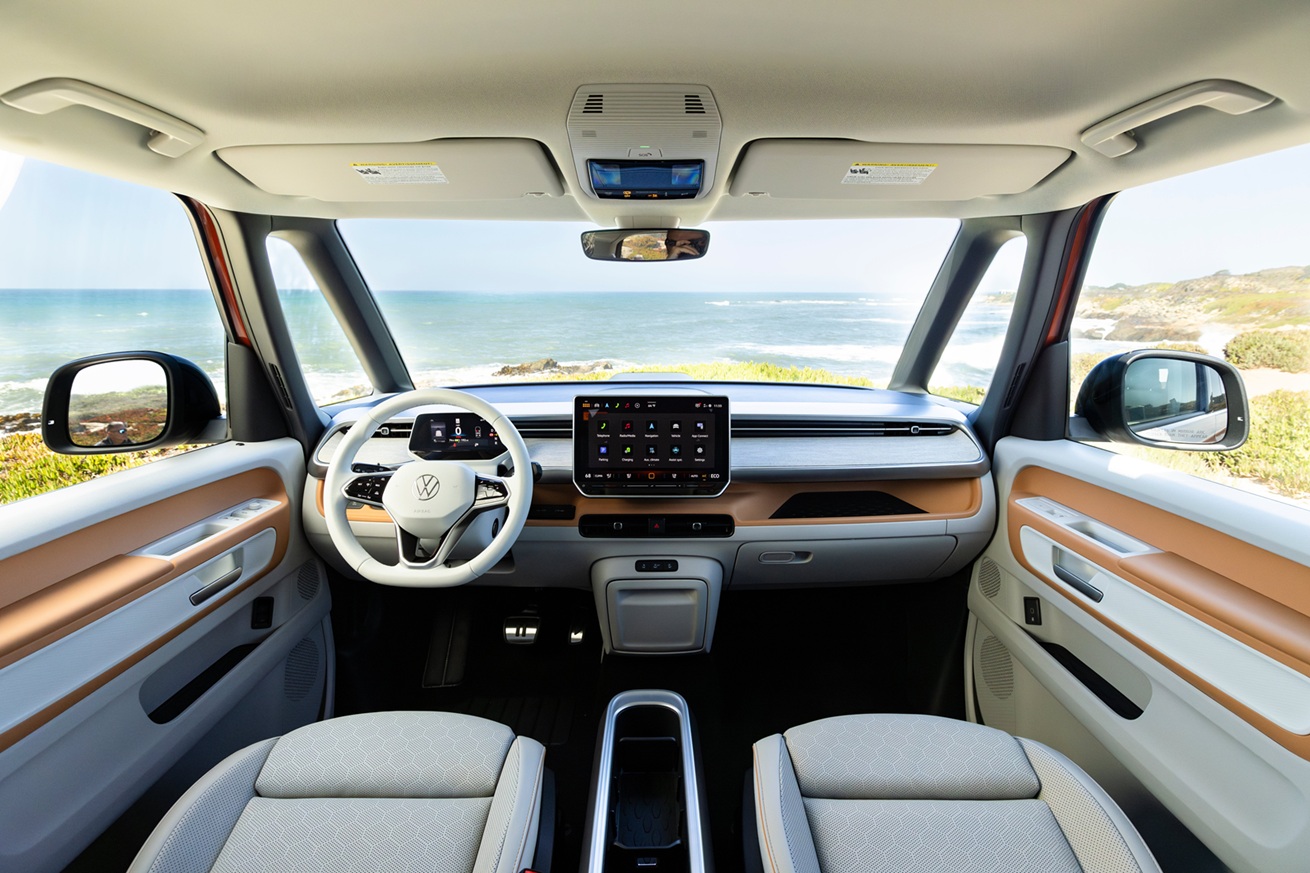
looking out the windshield with a full view of the dashboard and an ocean view beyond

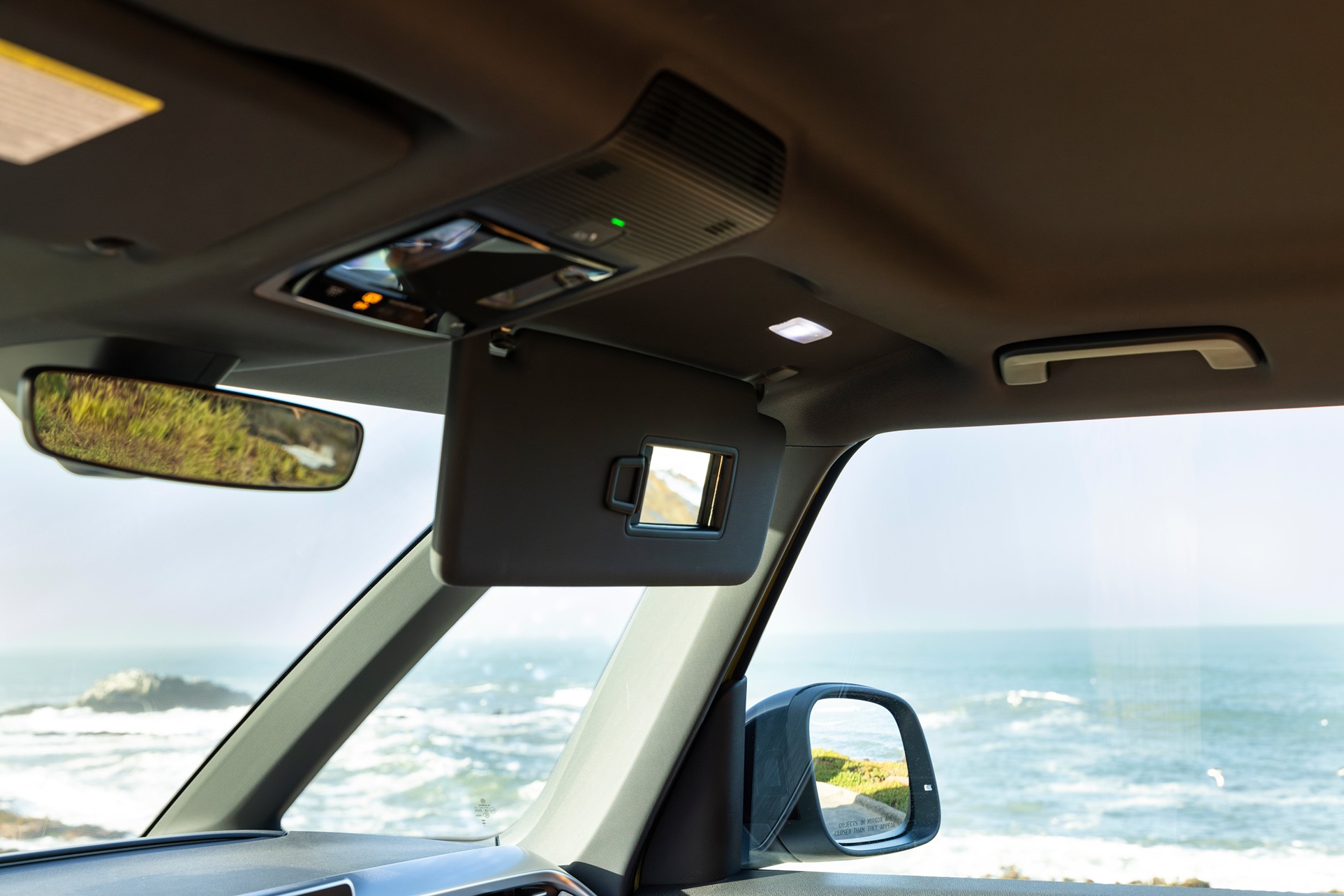
Despite the forked windshield pillars, driver sightlines are 180 degrees open.

ID Buzz Overview

The ID Buzz for North America features a single long-wheelbase configuration, available in rear- or all-wheel drive. Europe also offers a shorter wheelbase Buzz, approximately a foot shorter, as well as a cargo van. The Buzz has been on sale in Europe since 2022.

In an Automotive News report, Volkswagen of America CEO Pablo Di Si hinted at a family of ID Buzz models. One version might be a camper version with a pop-up roof.

For America, the short-wheelbase, five-seat Buzz — if and when it arrives — will have more appeal. It will be lighter and likely have a longer driving range, and cost a little less. And it will be a customizer’s canvas.

Volkswagen is also conducting an autonomous ID Buzz test fleet in Austin, Texas. Volkswagen’s Autonomous Driving Mobility & Transport (ADMT) plans to offer commercial service by the end of 2026.

Dimensionally, the ID Buzz is big, about the same length and width as the two-row VW Atlas Cross Sport SUV. Yet the ID Buzz has more interior room than the three-row Atlas SUV.

The Buzz has a long wheelbase of 127.5 inches, an overall length of 195.4 inches, and a width of 6 1/2 feet (78.1 inches).

Because the electric powertrain uses a skateboard architecture (wide and low), the ID Buzz sits about 5 inches taller than the Atlas SUV at 76.2 inches. The raised ride height, like a full-size pickup, is a big step up for shorter drivers and passengers, particularly children.

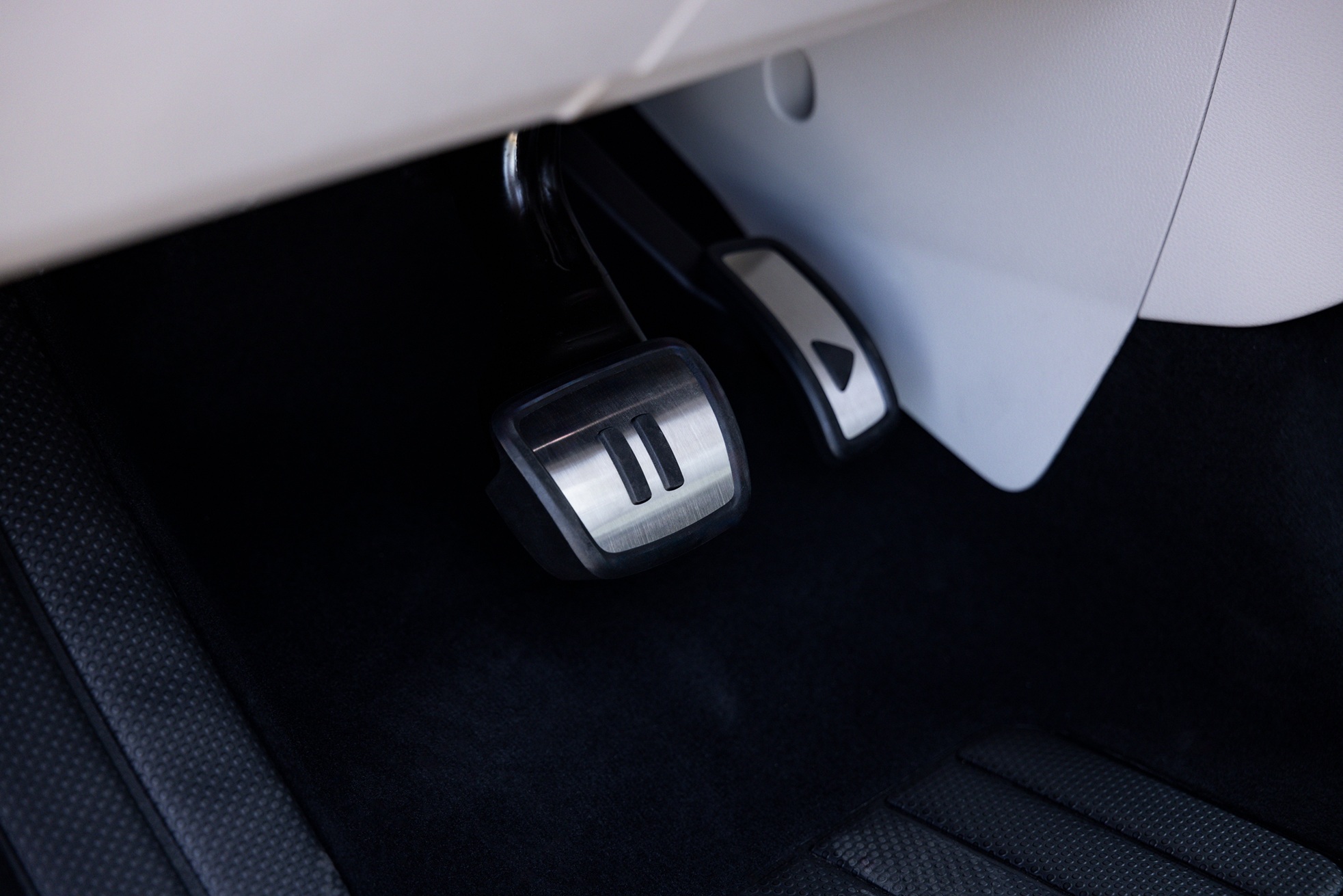
The ID Buzz has Pause and Play brake and accelerator pedals.

Pause and Play brake and accelerator pedals.

“What’s It Like?”

I met some of the nicest people during my test week of the ID Buzz. Each person asked, “What’s It Like?,” “Do You Like It?,” and “How Much Is It?”

My answers typically began with “Um, well …” All the ID Buzz shares with its microbus predecessor are a few throwback touches and a rear motor powertrain layout.

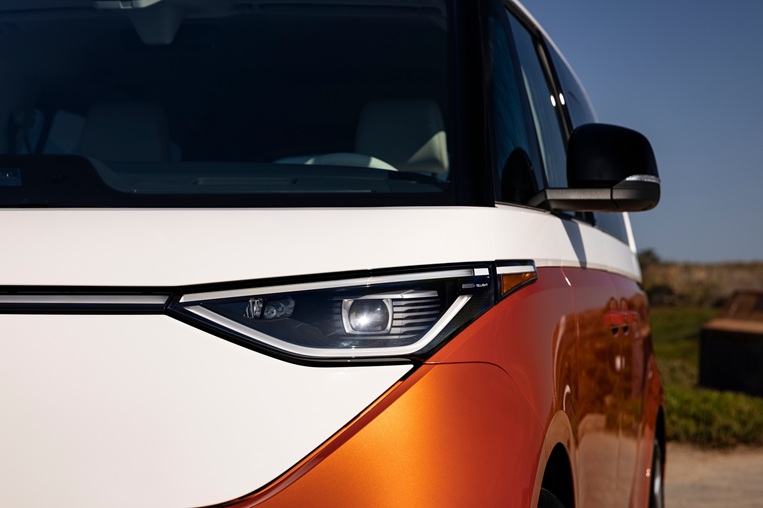
The Buzz light signature.

The Buzz lighting signature.

It is big but not imposing. The Buzz drives “smaller” than I expected. It doesn’t have that VW verve for driving, but the Buzz is quite accommodating, comfortable, and quiet on the road. It is not perfect, however, even to the Bulli pulpit.

I’m a Bulli insider. I owned a “bay window” 1968 VW Westfalia camper van. For $800, it was a charming beater. After the purchase, I shoveled $3,000 into it to make it start consistently, run (faster), stop, and steer. I loved its bus-like driver position and the big flat steering wheel. Sightlines were wide open. It had three-point seatbelts and an independent rear suspension, uncommon for American cars of that era. Throw open the one side door, and there was entry space to, maybe, shoehorn in a refrigerator. Raise the roof, and it was a cozy, wood-paneled camper. But, mercy, its clattering flat four cylinder could clear a picnic with its plume of exhaust and eye-watering exhaust emissions.

The Buzz, too, has an expansive cab-forward dashboard area, bracketed by forked windshield pillars. At first, it felt as if I was climbing aboard a space shuttle. That perception quickly transitioned into just a wonderful, open cabin space. As soon as I started driving, the broad glass greenhouse was more like a turret, providing 180-degree views.

When the question was about pricing — $60,000 to $71,000 — onlookers’ enthusiasm cooled. Expectations meeting reality.

Despite the forked windshield pillars, driver sightlines are 180 degrees open.

Despite the forked windshield pillars, driver sightlines are 180 degrees open.

2025 VW ID Buzz Pricing

There are two trim levels for the 2025 ID Buzz — Pro S and Pro S Plus — available in rear-wheel drive or 4Motion all-wheel drive. Rear-wheel drive models have 282 horsepower and a driving range of 264 miles. 4Motion all-wheel-drive models add a front motor, generating a total of 335 hp and a driving range of 231 miles. However, charging at home (240V) yielded 258 miles.

A launch 1st Edition features a unique wheel design with special badging and additional benefits. Among the extras are heritage floor mats and a panoramic electrochromic glass roof. 1st Edition models are available in five two-tone paint colors. Pricing for the 282-hp Buzz 1St Edition starts at $67,045. A 1st Edition with 4Motion (335 hp) starts at $71,545.

Suggested retail pricing includes the $1,550 freight charge from Hanover, Germany.

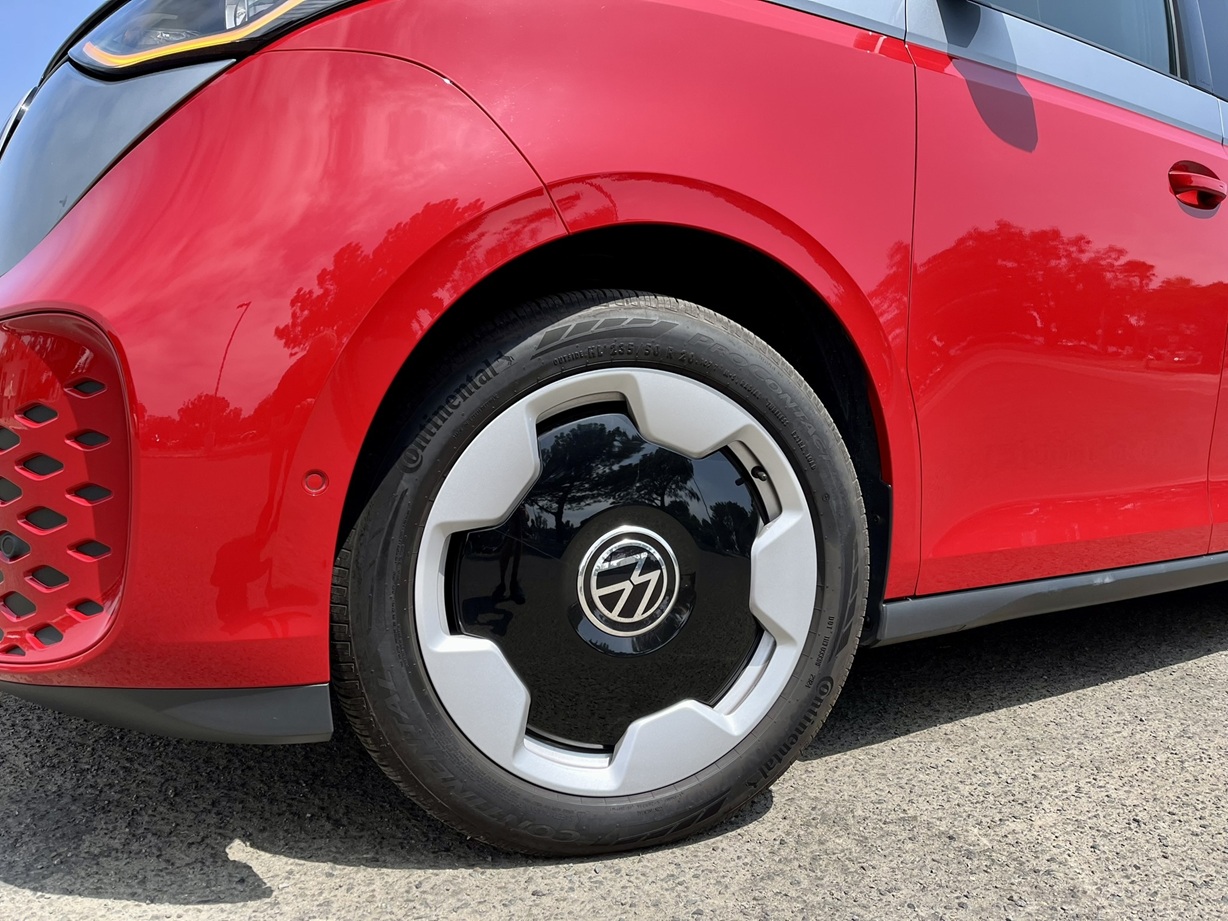
All ID Buzz models have 20-inch aluminum-alloy wheels in a retro-inspired disc. The disc-style wheels optimize airflow for minimal drag losses, VW says.

Dual power-sliding rear doors have a wide opening of 42 inches. And the doors’ side glass incorporates a power sliding window. Though small, the window is similar to some versions of the original bus.

The ID Buzz has eight eye-catching two-tone color choices, each priced at $995. Pick your preference for a Candy White upper with lowers in Energetic Orange, Pomelo Yellow, Blue Charcoal, or Cabana Blue. There’s also the Metro Silver upper with Cherry Red below, such as on today’s Buzz tester. And there are three no-cost single-tone colors: Metro Silver, Candy White, and Deep Black Pearl.

The ID Buzz has full LED lighting, including a slim lateral bar between the headlights.

The ID Buzz has full LED lighting, including a slim lateral bar between the headlights.

The Pricing Walk

  • Pro S: $61,545, single motor rear-wheel drive in solid paint color of black or white. (The popular two-tone paint scheme adds $995.)
  • Pro S Plus RWD: $65,045, single motor with monotone black paint;
  • Pro S Plus 4Motion: $69,545 dual motors with monotone black paint. (Its only factory options are for two-tone paint ($995) and the Electrochromic Smart Glass Roof for $1,495.

With the two-tone Cherry Red and Metro Silver paint scheme and three rows of floor mats, the tester came to $70,760.

Shop genuine ID Buzz accessories here.

Check current VW ID Buzz pricing here.

At the time of posting my story, there were two special offers for a 2025 ID Buzz:

Financing: 4.9 percent APR for 60 months, or a $2,500 customer bonus.

Lease: $699 per month for 36 months, with a down payment of $5,499 due at signing. At lease end, the owner is to pay a $395 disposition fee and a mileage range of 30,000 miles, and 20 cents a mile over 30,000 miles.

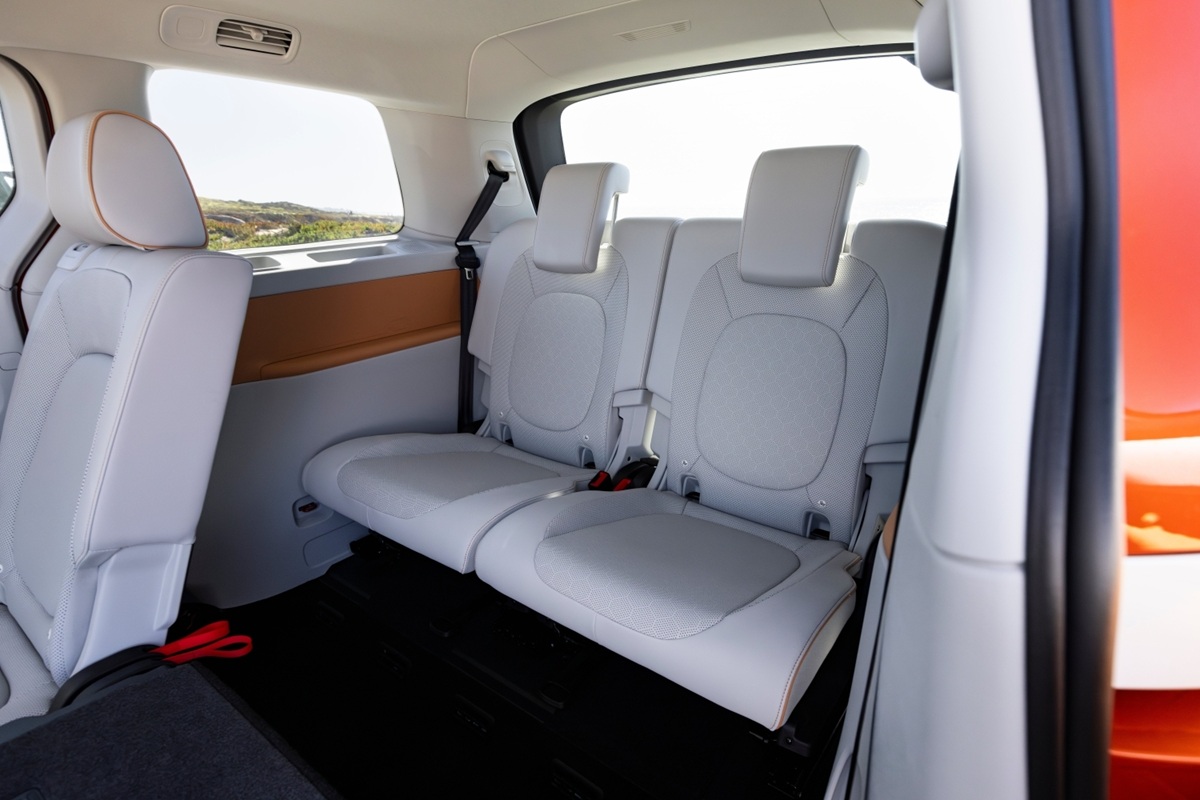
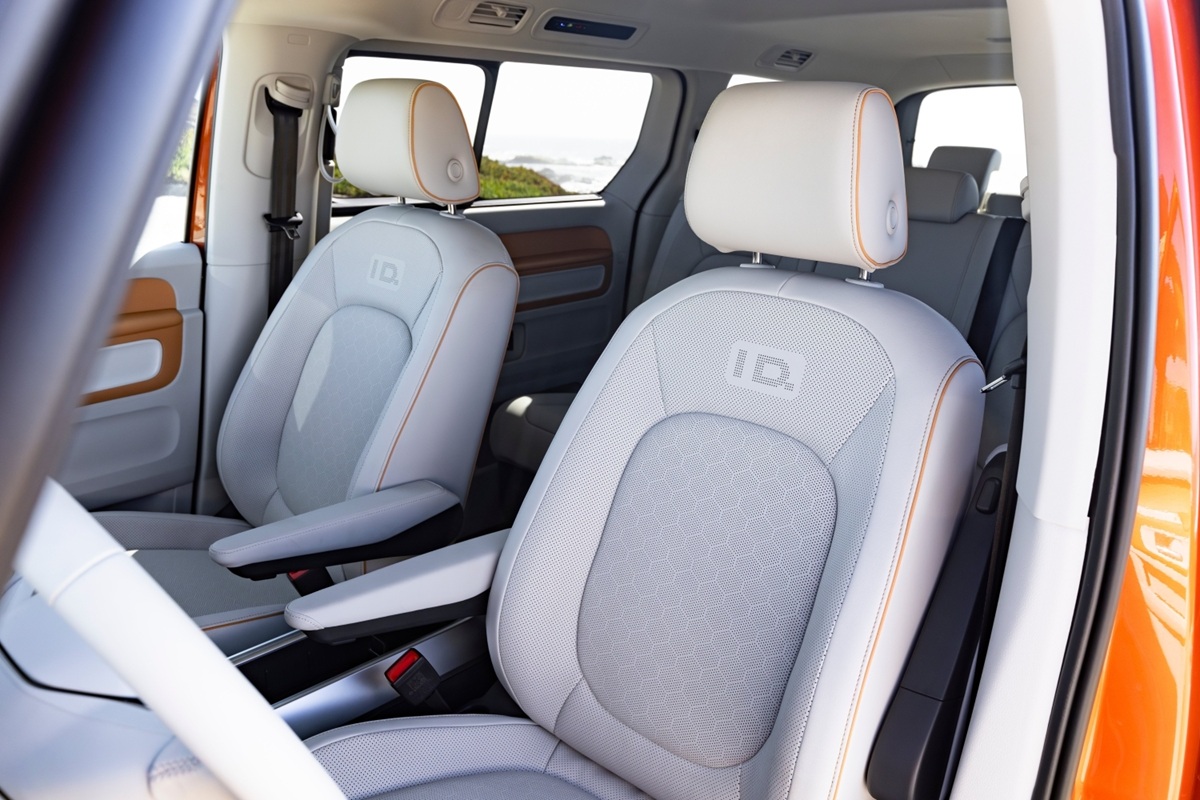
The ID Buzz Pro S Plus has 12-way power-adjustable and massaging front seats.

The ID Buzz Pro S Plus has 12-way power-adjustable and massaging front seats.

Buzz Interior Themes

There are three interior schemes for Buzz:

Moonlight: VW calls the “Moonlight” choice “Moody.” Dark brown leatherette seats feature white piping, blue door inserts, a dark wood-look dash, and a black headliner.

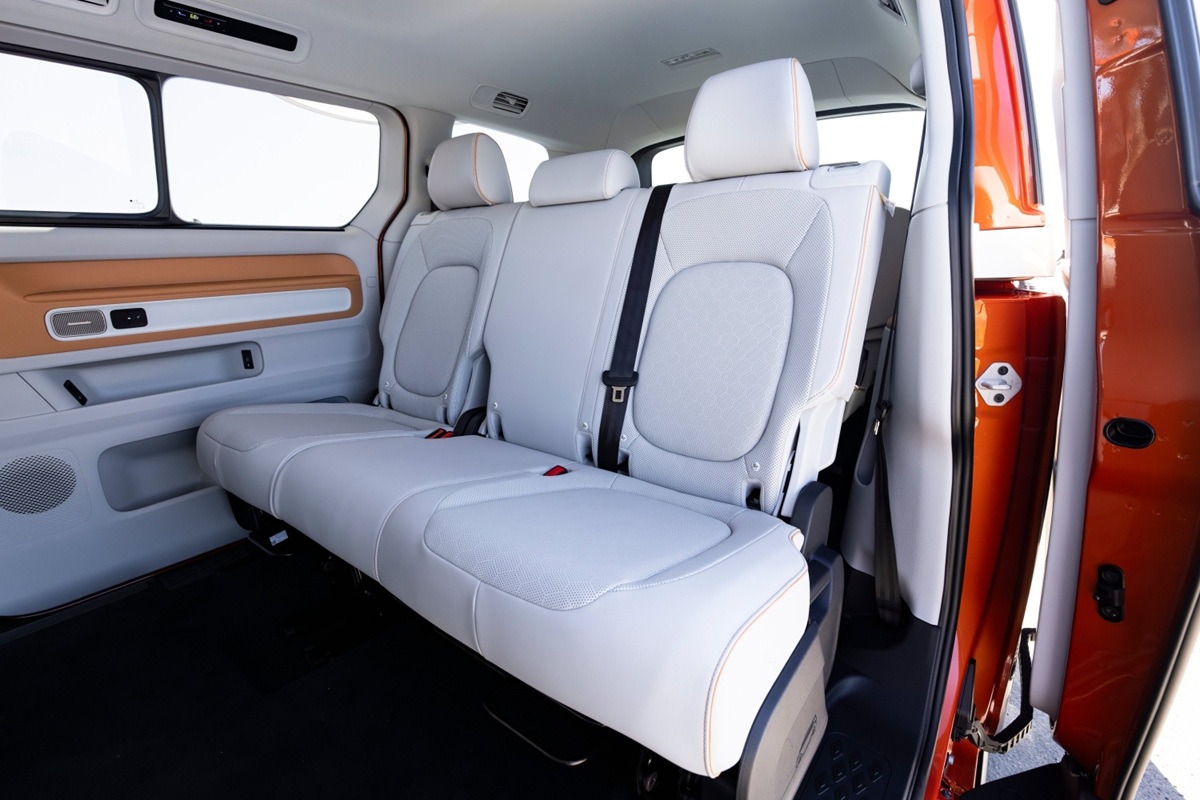
Dune: Intended as an airy, coastal-inspired interior. It pairs light gray leatherette seats with clay-colored piping, clay door inserts, and a light wood-look dash.

Copper: Mid-century modern with brown leatherette seat upholstery with yellow piping, brown door inserts, and a washed wood-look dash.

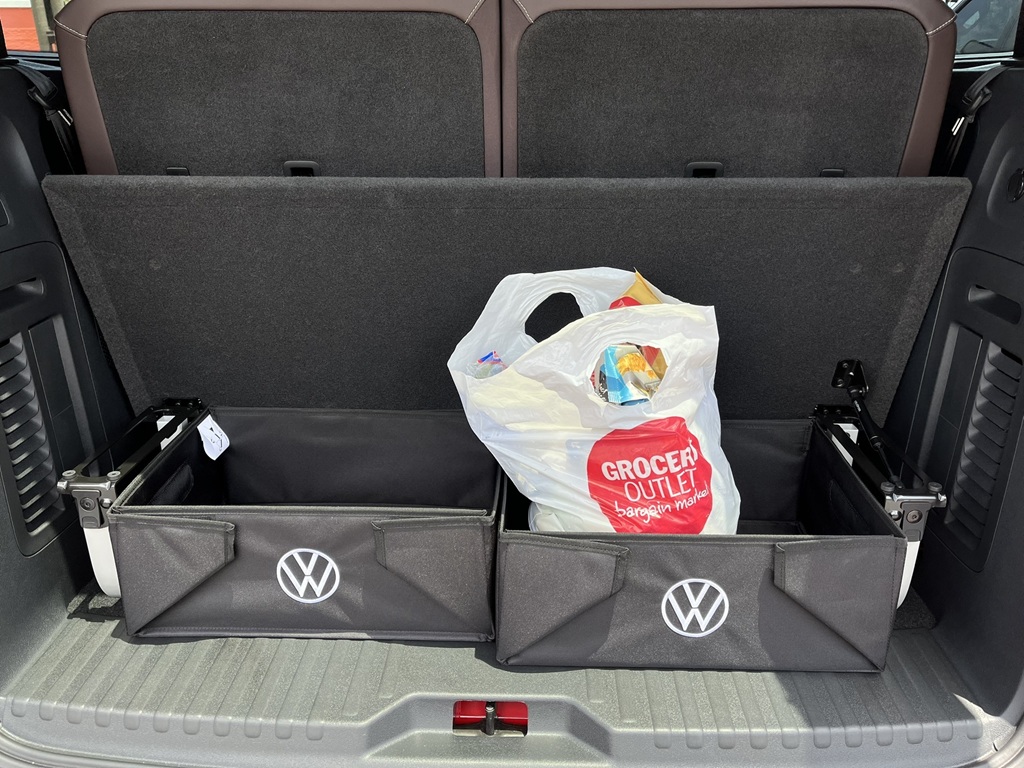
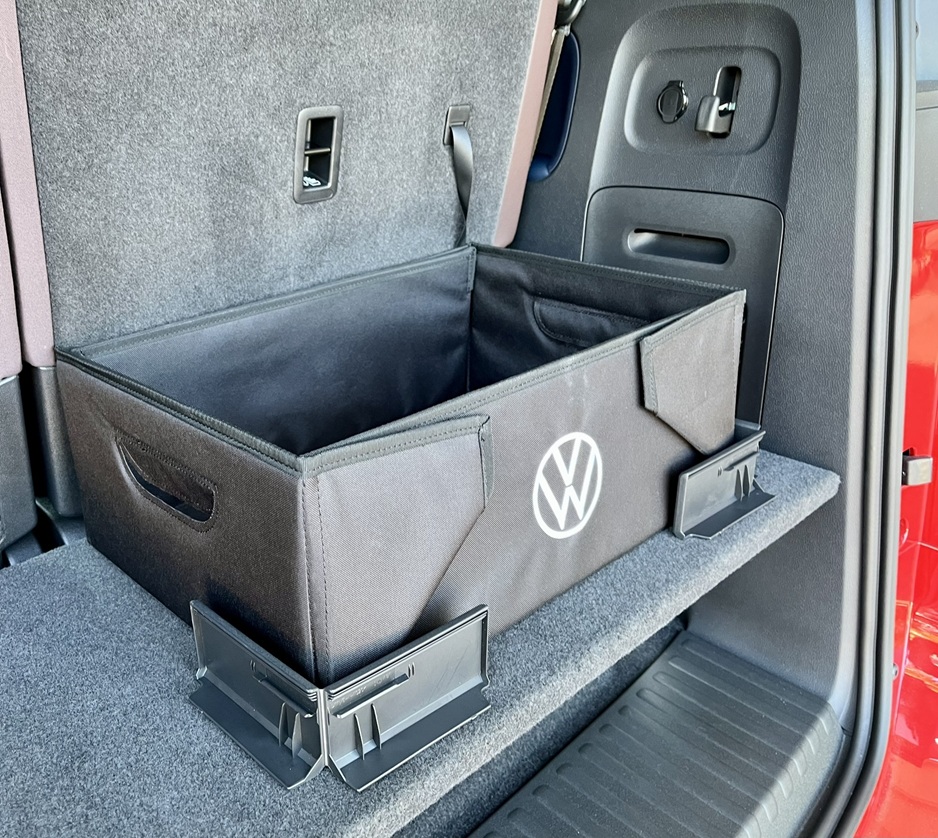
Showing the nifty foldable grippers that secure boxes on the rear flexboard

Removable corner grippers steady the bin. (Mark Maynard)

Clever Buzz Features

The ID Buzz has many cool features that are also quite accommodating:

Sit and Go Starting: Just take a seat, “smart” electronics recognize the key and activate the driving sequence. To shift into gear, place a foot on the brake pedal and twist the gear lever on the steering column. When exiting, the Buzz notes the empty driver seat and powers down the system.

Pause and Play Pedals: Stainless-steel pedal inserts mimic a media player “Pause” for the brake pedal and “Play” on the accelerator.

Removable plastic cargo grippers: On the rear side panels, foldable grippers are located that fold to 90 degrees to reinforce boxes or other gear.

Three D-pillar bar trim pieces: A reminder of the engine cooling vents of the vintage Type 2.

Loop grab handles: Look for the vintage-style grab loops at the side doors and tailgate pulldown.

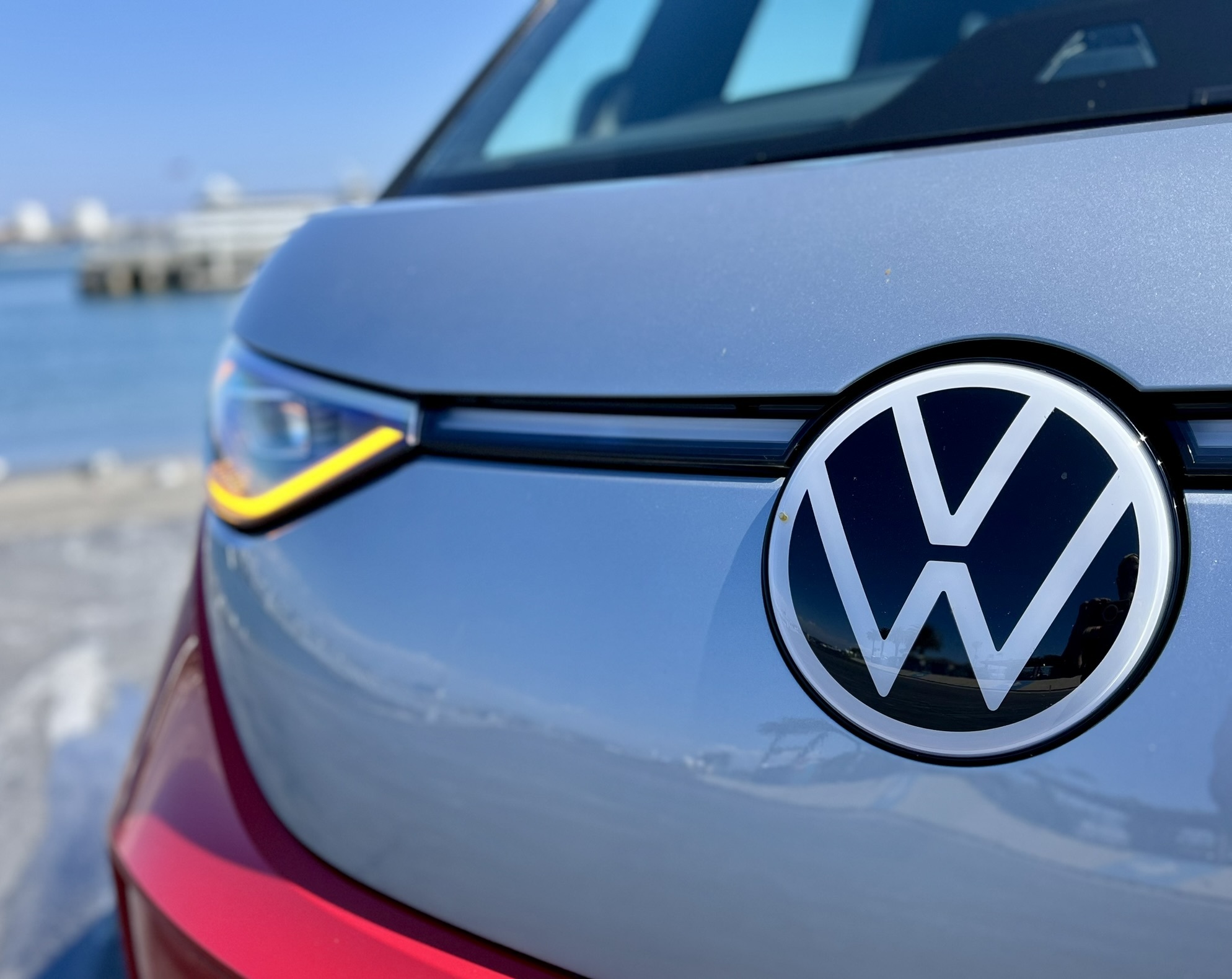
Looking at the oversized VW logo on the hood.

The Buzz has an oversized VW badge. (Mark Maynard)

Oversized front VW logo: The Buzz puts on a front light show when the driver approaches. The headlights, running lights, slim light bar, and VW logo give a welcoming light show.

ID Light system: A light strip located below the windshield utilizes various light pulses to signal the vehicle’s status. The pulses indicate readiness to drive, navigation turn instructions, brake prompts from driver-assistance systems, and incoming phone calls. When the Buzz is charging, the ID Light indicates the current charge level.

Buzz Box: The center floor console Buzz Box is a multitasker. It has open storage on top with two special, removable dividers. One doubles as a bottle opener, and the other can be used as an ice scraper. Below are two additional compartments, including a bottle holder. When configured with captain’s chairs, the removable center console can be relocated rearward for second-row passengers.

Buzz Kills

  1. For no apparent reason, the ID Buzz is not sold with a charging cable; however, an accessory charging kit is available for $350. The 2-in-1 Mobile EV Charge Cable is compatible with 240V and 120V charging.
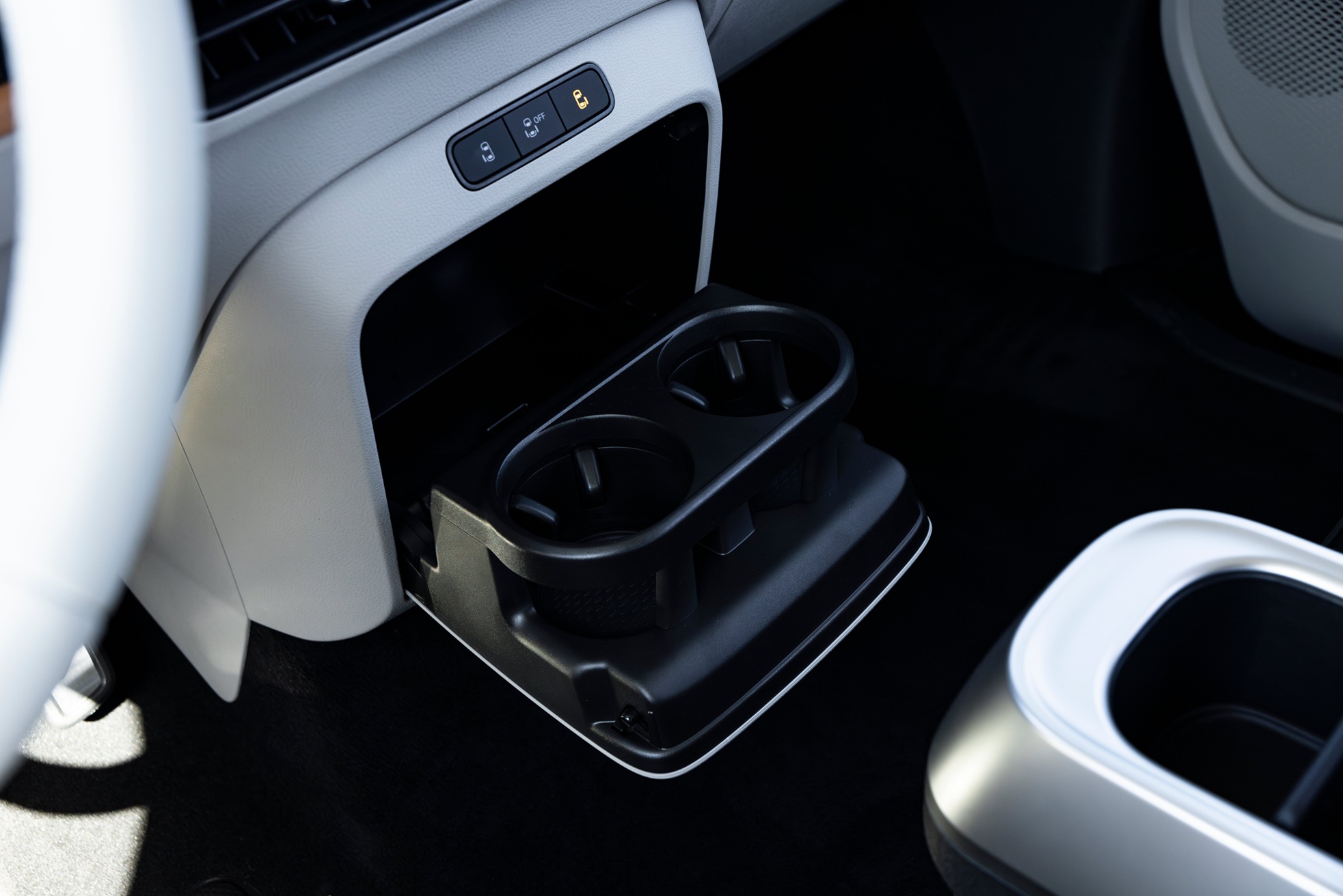
  2. The ID Buzz has more USB charging ports (eight) than cup holders. There are no cup holders in the second row. However, there is a $98 accessory for a pair of single-cup holders with a phone slot. They work with the bench seat or captain’s chairs.
  3. Floor mats are not standard, and the accessory cost for three-row mats is $220. VW calls them Heritage mats, made of a premium woven material. There are color choices of Moonlight, Dune, or Copper to match the interiors.
  4. The tester’s Moonlight interior has brown V-Tec leatherette upholstery with the odd contrasting color of X-Blue on the dashboard. Brown and blue with a bold red exterior? Please give me the choice of a red interior.
  5. Grab handles! The elevated ride height deserves the leverage of robust grab handles at all doors. A robust bar integrated into the windshield pillars would be helpful. In the back seat, there are just two plastic loops at the second row doors. However, they do not appear strong enough to last through the warranty period.
Dual drop-down front cup holders.

Dual drop-down front cup holders.

Interior Function

The cabin features an open design with clean lines and colors, showcasing a distinct European influence.

Front legroom of 37.5 inches might be a little short for the very tall. But the Buzz has the best second and third row legroom of any minivan or SUV: 39.9 inches in the second row and 42.4 inches in the third row.

All Buzz models have 12-way power driver and passenger seats. Each seat features dual armrests, thigh extensions, ventilation, massage, and memory functions. Second-row window seats are heated.

VW uses a unique driver armrest window switch to operate four windows. A “Rear” switch toggles between front and rear window controls. Once you figure it out, it is efficient.

VW’s ID Cockpit is a digital driver info display, replacing the traditional instrument cluster. The screen is attached to the steering column, ensuring it is always within line of sight. The display shows state of charge, range, and driving data. When mapping navigation is used, the route is displayed.

Wireless App-Connect and wireless charging are standard. The 15-watt ventilated Qi charging slot is just to the right of the steering wheel. In the nook, there are two charging USBs.

There is also a 110-volt/150-watt outlet under the passenger seat and a 12-volt power port in the cargo area.

A pair of large cup holders folds out from the lower dashboard area.

A nine-speaker audio system is standard. However, Pro S Plus and 1st Edition models upgrade to a 14-speaker, 700-watt Harman Kardon system.

The semi-floating 12.9-inch infotainment display is an iPad-like screen that controls entertainment, driver-assistance systems, and vehicle settings. Illuminated touch sliders that adjust volume and temperature are a departure from individual volume or tuning buttons; however, the sliders work well. To keep eyes on the road, the voice-recognition system is responsive to adjust the climate or audio volume. It functions well even when windows are open or the fan is blowing.

Second row captain’s chairs or the three-person bench seatback can be folded flat or split 40/60.

Second row captain’s chairs or the three-person bench seatback can be folded flat or split 40/60.

7 seats or 6?

Rear-wheel-drive models feature a second-row bench seat that accommodates up to seven passengers. The second-row bench can be folded flat in a 60/40 split, and the seatbacks can be reclined by 16 degrees. The bench can also be moved fore and aft by up to 7.9 inches. For third-row access, the bench window seats tilt and slide forward 4.7 inches.

Pro S Plus rear-wheel-drive models can be optioned with a second-row captain’s chair. The six-seat configuration is standard with 4Motion AWD.

Buzz models have standard child-seat (LATCH) anchors and tethers on second- and third-row seats.

Third-row seats slide fore and aft, recline, fold flat, and are individually removable. However, the seats are heavy and somewhat awkward to put back in place.

Pro S Plus and 1st Edition models include a cargo area “Flexboard” to create flat floor space when seatbacks are folded. Especially nice are two fabric storage bins that slot beneath it. Folding both rows of seatbacks, however, does not create contiguous sleeping space. There is a gap between the rows.

The third row is passenger accommodating with overhead air vents! And the pair of seats has fore-aft slide adjustment.

Cargo volume is 18.6 cubic feet behind the third row, 75.5 cubic feet behind the second row, and a massive 145.5 cubic feet with the second row seats folded and the third row removed.

Pro S Plus models feature a manually retractable tow hitch, which is completely hidden behind the rear bumper when retracted. With a braked trailer, the towing capacity is a maximum of 2,600 pounds on RWD or 3,500 pounds on 4Motion.

Looking at the pair of third row seats.

The Buzz has more third-row legroom than any SUV or traditional minivan, 42.4 inches

Buzz Safety Tech

Along with six airbags, there is a trove of safety and driver-assistance technologies. Among them:

  • Adaptive Cruise Control with stop and go;
  • IQ Drive with Travel Assist engages hands-on semi-automated driving assistance;
  • Park Assist Plus with Memory Parking;
  • Park Assist Plus with Memory Parking and Park Distance Control, front and rear;
  • Rear View Camera System with an overhead view and guidelines;
  • Active Blind Spot Monitor with rear traffic alert and exit warning;
  • Adaptive Front Lighting System with cornering lights;
  • Road Sign Recognition Display;
  • Front Assist Automatic Emergency Braking with pedestrian and cyclist monitoring;
  • Light Assist (high beam headlight control.
20-inch Continental ProContact tires are optimized for low rolling resistance. Silver wheels with a gloss black disc recall the original VW Microbus.

20-inch Continental ProContact tires are optimized for low rolling resistance. (Mark Maynard)

Buzz Battery Electric Powertrain

Just as the original Type 2 Bus was rear-wheel drive, the Buzz has a standard rear-mounted motor. The new APP550 rear-mounted motor is a PMS (permanent magnet synchronous) design producing 282 horsepower and 413 foot-pounds of torque. It is a VW-engineered module integrated into the rear axle, featuring a dual-stage one-speed gearbox and a pulse inverter. (The inverter converts direct current (DC) from the battery into alternating current (AC) to drive the electric motor.)

Volkswagen says the efficiency of its permanent magnet synchronous motor is “well above 90 percent in almost all driving situations.” During the manufacturing process, Volkswagen uses so-called hairpin winding. The stator’s coils are made from square copper wires, which, after bending, are visually similar to hairpins. This hairpin winding technique enables the wires to be packed more tightly. And by adding more copper to the stator, VW claims, power and torque are increased, while cooling efficiency is improved.

All-wheel-drive models add a front asynchronous motor (AKA150). It produces 107 hp and 99 lb.-ft. of torque. The combined system power of 335 hp and total torque of 512 lb.ft. provides astonishing launch force.

Top speed of the ID Buzz is electronically limited to 99 mph.

Showing the open charge door on the right rear. The ID Buzz charging port has a CCS plug connector for use at DC fast-charging stations.

The ID Buzz charging port has a CCS plug connector for use at DC fast-charging stations.

Unlike a traditional all-wheel-drive system, there are no mechanical links between the axles. Each motor connects to the wheels through a differential and a single-speed gearbox.

The variable 4Motion all-wheel-drive system engages the rear motor for most driving situations. The system will engage the front motor only as needed, such as to control wheelspin at any corner. The motors can react within a few hundredths of a second before the driver can notice the change.

Buzz Performance Modes

The ID Buzz features four driving performance modes that adjust steering weight, throttle response, and electric drive motor settings.

Eco mode tempers throttle response.

Comfort mode is the traditional Normal performance.

Sport mode sharpens steering and throttle response. On all-wheel-drive models, the front motor stays engaged for maximum power.

Custom mode allows a driver to blend between Comfort and Sport.

All-wheel-drive models also offer Traction mode, which engages when driving on loose or slippery surfaces and also activates permanent all-wheel drive up to approximately 12 mph.

The Sport mode driving screen with red graphics

The ID Buzz has four performance modes, including Sport. (Mark Maynard)

Battery Technologies and Range

All current ID Buzz models utilize the same 91 kWh lithium-ion battery pack, comprising 208 prismatic cells. The battery pack weighs 1,230 pounds. The pack is mounted in a “skateboard” style on the Buzz floor.

Rear-drive Buzz models have an EPA-estimated range of 234 miles on a full charge. That range translates to fuel economy of 90 MPGe city, 75 MPGe highway, and 83 MPGe combined city/highway driving.

ID Buzz 4Motion models have a driving range of 231 miles and estimated fuel economy ratings of 87/74/80 MPGe (city, highway, and combined).

Volkswagen cites 0-60 mph acceleration in 7.4 seconds for rear-drive models and 6 seconds with 4Motion. Many reviewers, however, have reported achieving 60 mph in 5.7 seconds.

The loop grab handle at the side doors recall those in the vintage buses.

The loop grab handle at the side doors recall those in the vintage buses. (Mark Maynard)

Battery Charging

At DC fast-charging stations, the battery can be charged at a rate of up to 200 kW. VW says the Buzz will recharge from 10 percent to 80 percent in about 26 minutes.

A preconditioning function helps ensure the battery is prepared for the next charging stop. The battery is heated to the optimum temperature before charging stops, allowing it to accept energy at the maximum rate. VW says this function can reduce charging time by several minutes, particularly in winter.

When using the Electric Vehicle Route Planner, pre-conditioning is started automatically on the way to the next quick-charging station. Routes with up to 10 charging stops and 10 stopovers can be planned on a smartphone or the web portal and then transferred to the ID Buzz infotainment system.

The ID Buzz charging port features a CCS plug connector for use at DC fast-charging stations.

VW does not yet have access to the NACS charge port for use along the Tesla supercharger network. The NACS port will be available as an accessory, cost TBD.

The Buzz features an onboard 11 kW (AC) charging system, which is adequate for home and other Level 2 charging systems.

500 kWh of Free Charging

The 2025 ID Buzz includes 500 kWh of free juice at Electrify America stations, redeemable through the EA app. The plan includes three years of Electrify America’s Pass+ membership. Pass+ members use the EA app to find charging stations, receive notifications when a charger becomes available, and pay contact-free.

There are more than 900 Electrify America charging stations with around 4,000 chargers in North America. EA also provides “Plug&Charge”  technology to capable vehicles. By activating this feature in the Electrify America app, owners will be able to plug in the ID Buzz, and once the connection is established, it will start charging.

Regenerative Braking

The regenerative braking system in the ID Buzz has two modes. The D (Drive) position is the default mode, automatically activates upon start-up. In this position, the car can coast whenever the driver’s foot is off the accelerator or brake pedal. As soon as the driver applies the brakes, energy recuperation is engaged, and the electric drive motor feeds power back into the battery.

The B (Brake) position on the gear shift enables the driver to increase the amount of regeneration. Drivers can use the rocker switch to change from the D position to B at any time. This function almost always recovers energy during lifting off the accelerator pedal.

However, regenerative braking will not bring the Buzz to a complete stop when lifting off the accelerator, which is a key feature for so-called one-pedal driving. Volkswagen believes the driver should always be in control.

Small power side windows are reminiscent of some used in a vintage Type 2 bus.

Small power side windows are reminiscent of some used in a vintage Type 2 bus. (Mark Maynard)

Buzz 4Motion Ride and Handling

The ID Buzz drives with the finesse of a gentle juggernaut. The ride on concrete interstate surfaces can be jiggly, although it is common in other big EVs. However, the suspension is impressive for how well it manages transitions of the three-ton curb weight without wallow and dive.

The well-engineered steel-spring suspension features struts at the front, coil springs, telescopic dampers, and an anti-roll bar. At the rear, a compact multi-link suspension features coil springs, telescopic dampers, and an anti-roll bar.

A combination of front disc brakes and rear drums is a departure from four-wheel discs. VW says there are friction advantages in using rear drums. Because an electric vehicle relies on regenerative braking, the rear brakes get comparatively little use. The front discs are a substantial 15 inches in diameter; the rear drums are 13 inches in diameter.

All ID Buzz models are equipped with 20-inch aluminum-alloy wheels. Aerodynamically designed disc-style wheels minimize drag losses. Smooth body sides keep the tires flush, aiding aerodynamics and resulting in a sleek drag coefficient of 0.29 Cd. That compares to the Hyundai Ioniq 9 at 0.26 or the Toyota Prius at 0.27.

Towing capacities are 1,650 pounds with unbraked trailers. Braked trailers have capacities of 2,600 pounds RWD or 3,500 pounds 4Motion.

A hidden tow hitch is tucked under the rear bumper fascia and can be released by a lever within easy reach. When finished towing, the hitch can be pushed into its hideaway position. An exposed tow hitch can add aerodynamic drag, diminishing driving range in a minuscule amount.

Small storage areas are notched throughout the interior, like this one on the passenger side of the dashboard

Small storage areas are notched throughout the interior.

2 Early Recalls Addressed

Volkswagen of America has fixes for a pair of unrelated recalls, according to a report in Automotive News. One recall is for third-row seating that is too wide for two passengers.

The recall halted sales of the ID Buzz in spring 2025. Sales of the electric minivan in North America began in November 2024. The stop-sale orders applied to new, unsold ID Buzz models and preowned inventory.

Under the first recall, dated April 10, 2025, the brake system warning light on the instrument panel may display an incorrect symbol and color.

VW said dealerships will perform a data container update along with a vehicle software update. The fix will take around one day to complete. The repair became available on June 6, according to a dealer communication document posted on NHTSA’s website.

Under the second recall, NHTSA stated the two-seat third-row bench is wide enough for three passengers. However, the calculated width of the seating surface exceeds the maximum specified for two passengers, according to NHTSA documents. That makes the seat noncompliant with Federal Motor Vehicle Safety Standard requirements.

VW dealerships will install fixed, unpadded trim parts to limit the width of the seating surface to two passengers.

The Flexboard adjustable storage system, with two flexible bins.

The Flexboard adjustable storage system, with two flexible bins. (Mark Maynard)

Why Buy the 2025 VW ID Buzz?

Minivans are typically family fare, but the ID Buzz seems more of a grown-up’s reward. Minivan owners who are out of the child-rearing years often keep the old, kid-worn van. It is handy for hauling junk and stuff, it’s paid for, and minivans are the ideal people mover. There might also be some emotional attachment.

The ID Buzz will be the adult ride for a night out with a bestie couple or a couple’s weekend getaway. Plus, a new Buzz will be clean, and children will always jump for a ride in the new “cool” minivan. Just keep your feet off the seats, and no eating or drinking!

Before dismissing the ID Buzz due to pundits’ criticisms, give it a fair evaluation.

Yes, it is expensive, but it is also a large vehicle, and for those with a home battery charger, the range is a non-issue. I’d rather drive the electric Buzz on a long, daily commute than a $35,000 fuel-miser econobox. The Buzz feels safe and secure, and its size matters when hustling along among semi-trucks and other large vehicles.

When seeking a dealership test drive, ask for an overnight experience. Give yourself time to get comfortable with the Buzz, and you might convince yourself that $70,000 is the new $50,000.

Read here what VW ID owners say about their experience with the Buzz and other VW battery electrics

The rear of the ID Buzz has horizontally arranged LED taillights connected by a full-width light strip.

the ID Buzz has horizontally arranged LED taillights connected by a full-width light strip. (Mark Maynard)

2025 VW ID Buzz Pro S Plus 4Motion Specifications

Body style: 5-door, 6- or 7-seat AWD minivan; stamped steel panels; plastic and composite bumpers and some components

Motor: permanent magnet synchronous

Power, AWD: 335 hp, 413 lb.ft torque rear motor, 99 lb.ft. front motor; total 512 lb.-ft.

0-60 mph acceleration: 6 seconds

Battery: 91 kWh lithium ion; 208 prismatic cells

Battery weight: 1,230 pounds

Transmission: 1-speed automatic

EPA-estimated driving range: 231 miles

Fuel economy equivalent, MPGe: 87/74/80 city/hwy/combined

Onboard charger: 11 kW

CHARGING TIMES

Public DC fast charger: Recharged range in 10 minutes 79 miles

15 hours 7.2 kW AC, 0-100 percent, home or public station.

11 hours 9.6 kW, 0-100 percent, home or public station

9 hours: 11 kW charging, 0-100 percent, home or public station,

BY THE NUMBERS

Cargo space: 18.6 to 75.5 feet (behind third row and with second row folded)

Front head/leg room: 42*/37.5 inches; *40.6 in. w/o sunroof

2nd row head/leg room: 42.3*/39.9 inches; *41 inches w/o sunroof

3rd row head/leg room: 38.7/42.4 inches

Length/wheelbase: 195.4/127.5 inches

Width/height: 87*/76.2 inches; *78.1 inches w/mirrors folded

Curb weight: 6,197 pounds

Turning circle: 43 feet (37 feet with RWD)

Towing capacities: 1,650 pounds unbraked trailer; 3,500 lbs. braked

Drag coefficient: 0.29 Cd

FEATURES

Standard Buzz Pro S Plus interior equipment includes: 2nd-row manual “Captain’s Chair” bucket seats (folds flat with armrests and tip and slide 3rd-row access), 30-color ambient interior lighting, fold-down front-seat armrests, Flexboard cargo area adjustable storage system, footwell lights in front and 2nd rows, 12-way power adjustable front seats with 4-way lumbar and position memory, heated and ventilated front seats with massage function, heated multi-function steering wheel with hands-on detection and touch controls, illuminated vanity mirrors, LED reading lights, leatherette door trim inserts, perforated V-Tex leatherette upholstery, power sliding side doors, power sliding 2nd row windows, removable center console with storage.

Exterior features include: heated windshield, illuminated light lines (including front emblem and door handles), LED taillights and LED rear license plate lighting, LED Projector headlights with signature LED daytime running lights, spare tire mobility kit.

CHASSIS COMPONENTS

Brakes: Power assisted, dual circuit; 15-inch vented front rotors; rear drums, 13 inches

Steering: Electric rack-and-pinion; 36.4-foot turning circle, RWD; 42.7 feet 4Motion

Tires-wheels: 20-inch, all-season Continental ProContact; front HL 235/50 R20, rear HL 265/45

Suspension: front MacPherson strut-type with lower control arm, coil springs, telescopic dampers, anti-roll bar; rear, multi-link axle with coil springs, telescopic dampers, anti-roll bar

PRICING

Base Pro S Plus 4Motion price: $69,545, including $1,550 freight charge; price as tested $70,760

Options on test vehicle: Two-tone paint $995; three rows of floor mats $220

Where assembled: Hanover, Germany

WARRANTIES

  • 4-years/50,000-miles bumper to bumper including high voltage system; 8-years/100,000-miles high-voltage battery
  • Roadside assistance: 3-years/36,000-miles
  • Scheduled Carefree Maintenance: first two years, at 10,000 and 20,000 miles.
  • Connected-vehicle service coverage:
  • Vehicle Insights 7-year plan, includes: high-voltage battery charge settings, maintenance alerts;
  • Remote Access 3-year plan, includes: start-stop charging and find charging stations
  • Safe & Secure 5-year plan, includes: automatic crash notifications, emergency call;
  • Plus Speech with AI 3-year plan, includes: voice control of certain features using more natural language with the help of Generative AI;
  • Plus Nav 3-year plan, includes: continuously updated route and traffic information. Details at vw.com/connected.

1939 Buick Roadmaster Indianapolis 500 Pace Car

1939 Buick Roadmaster Indianapolis 500 Pace Car

Buick’s motorsports history includes two NASCAR titles and six Indianapolis 500 pace cars

The 1939 Buick Roadmaster Indy Pace Car painted in creamy yelllow with black Indianapolis 500 lettering outlined in black

The 1939 Roadmaster Indianapolis 500 pace car was painted in creamy yellow with gold lettering outlined in black.  (GM media archives)

BY MARK MAYNARD

Just three 1939 Roadmaster Indianapolis 500 pace cars were built. The cars were based on the rare Roadmaster convertible “80C,”  according to an auction report by R.M. Sothebys.  Each car was presented in the “Indy 500 Livery” of the period-popular colors of creamy yellow with gold lettering outlined in black.

The red interior featured an elaborate, painted wood-grain dash in red and red leather upholstery. The Indy 500 treatment also included a black parade tonneau and a cloth top with boot.

Among the features in the Indy 500 package were dual side-mount spare tires and an accessory spotlight at the base of the driver-side windshield, though neither feature is shown in this marketing photo.

Buick History

Buick was on a roll in 1939 with innovative advertising and promotion.  Sales were soaring and there had been a host of product improvements, according to the 2011 auction report.

Buick boss Harlow Curtice was determined to set a new sales record. To stimulate sales, the 1939 Buick Roadmaster Indianapolis 500 pace car was created. It was based on the rare Roadmaster Convertible Sedan.

A new sales target of 200,000 cars was set and at the dealer’s kickoff meeting an airplane was displayed on stage with the number “200,000” painted on its wings. The campaign was successful as Buick sold more than 208,000 cars. The result solidified Buick’s position as No. 4 in the industry, behind only the Big Three.

R.M. Sothebys auctioned a 1939 Roadmaster Indianapolis 500 pace car at its 2011 Hershey, Pa., event. The car sold for $62,500.

Look here for more vintage car photos.