Select Page

Jeep Grand Wagoneer Review

Jeep Grand Wagoneer Review

 The 2022 Wagoneer will become a portfolio of vehicles that redefines ‘American premium,’ Jeep says

The Grand Wagoneer in Midnight Blue paint.

The Jeep Grand Wagoneer is sold in four trim levels with all-wheel drive. Starting prices range from $89,995 to $109,995, including the $2,000 freight charge from the Warren (Michigan) Truck Assembly Plant. (Photos courtesy of Stellantis)

Table of Contents

Wagoneer History
The Modern Wagoneer
2023 Hurricane Engine and L models
Pricing
Putting the Grand in Wagoneer
10 Cool Features
Performance and Ride and Handling
Wagoneer Client Services
10 Customer Promises
Why Buy the Grand Wagoneer?
Specifications

BY MARK MAYNARD

Jeep ballsied its way into the fray of large, body-on-frame SUVs with its 2022 Wagoneer and Grand Wagoneer. This segment of full-size, seven- to eight-passenger truck-based utes are friendly titans, and throwbacks to what were once just big family wagons.

For years the segment was a three-way competition, dominated by the Chevrolet Suburban (and Tahoe), Ford Expedition, and Nissan Armada. And their luxury variants.

According to GoodCarBadCar.net Second quarter U.S. sales of big SUVs, including the Suburban-based GMC Yukon, totaled 63,061.

And there is big money in big SUVs. So far in 2022, transaction prices on average have ranged from the mid-$60,000s to around $105,000, including the Lincoln Navigator and Cadillac Escalade ESV.

Dinosaur or Dynamic?

The full-size SUV market has remained strong despite headwinds in the form of rising prices, scarce supply, and high fuel prices, said Ed Kim, president and chief analyst at AutoPacific, Inc. The automotive marketing research and product-consulting firm has offices in Long Beach, Calif., Michigan, Wisconsin, and North Carolina.

“Outside of families who need the space and towing capacity of a full-size body-on-frame SUV, full-size SUVs are increasingly popular among livery customers,” Kim said. “As full-size premium sedans like the Lincoln Town Car and Cadillac XTS have disappeared from their respective brands’ portfolios, livery customers have had to look elsewhere.

Kim said that the Wagoneer and Grand Wagoneer are very well executed full-size SUVs that are extremely competitive and, in some ways, better than the incumbents. “With their classy and very well-finished interiors, they will certainly impress any livery customers fortunate enough to ride in one.

“The Jeep brand has been pushing itself further upscale, so there certainly would be no brand deficit to using a Wagoneer or Grand Wagoneer as a livery vehicle,” Kim said in email correspondence. “Livery firms now have another very appealing choice in the Wagoneer and Grand Wagoneer, so there’s no doubt they will find an audience in the livery market.”

The standard and long wheel base models of Wagoneer back to back

2022 Grand Wagoneer (left) and 2023 Grand Wagoneer L (right)

Wagoneer History

The brought-back Wagoneer nameplate continues in the original model’s uplevel presentation. The first-generation Jeep Wagoneer debuted in 1962 for the 1963 model year. Jeep says it the Wagoneer was the first four-wheel-drive vehicle mated to an automatic transmission.

Compared with the more utilitarian Jeep Cherokee, the first-generation Wagoneer was engineered for better ride quality, a more stylish appearance, and a luxurious interior. An independent front suspension was optional. Quadra-Trac, the first automatic full-time four-wheel-drive system, was introduced in 1973.

The Grand Wagoneer debuted in 1984 and marked the beginning of the luxury SUV. Jeep called it “the gold standard of the SUV market.” It was made special by leather upholstery, air conditioning, AM-FM-CB stereo radios, additional sound insulation, and wood-grain exterior trim. Jeep said the Grand Wagoneer’s 175-horsepower 360-cubic-inch V-8 engine had the segment’s highest towing rating.

A 1975 Jeep Wagoneer with simulated wood-panel sides.

A 1975 Jeep Wagoneer.

The Modern Wagoneer

The Jeep division of parent-company Stellantis took its sweet time to re-enter the fray, but it plays by its own rules. Jeep has elevated the format with comprehensive advanced technologies and premium materials.

The posh interior treatment of the Grand Wagoneer reminds of midcentury modern Chrysler. Everything about the interior and styling is over-the-top. The design and engineering have the weighty feel of quality. And its engineering teems with advanced technologies that are not fearsome to learn or use.

Stellantis Design Chief Ralph Gilles says the Grand Wagoneer was done the American way. “The first impression is that everything is so beautifully done,” he said in a video overview.

Jeep says the Wagoneer will become a portfolio of vehicles that redefines “American premium” while delivering a unique customer experience. The customer experience will include 10 promises and Wagoneer Client Services.

A front right 22 inch Goodyear Eagle tire on the Grand Wagoneer

Significant tire patch from the 22-inch Goodyear Eagle grand touring tires (285/45).

Wagoneer Foundation

The Wagoneer foundation is sourced from the Ram 1500 pickup, but any comparisons stop there. There are no shared body panels or other common parts that can be seen and touched. The Wagoneer format is a separator from the competition, which starts with a finished pickup truck engineered for hard work first and luxury second.

The current sales plan features two models, Wagoneer and Grand Wagoneer that fill mainstream and luxury categories. Both models have a third row and seating for up to eight. For 2022, both models are V8-powered, but that changes for 2023:

2022 Wagoneer uses a 392 horsepower, 5.7-liter V-8 engine. It has the next generation of eTorque 48-volt hybrid with fuel-saving technologies of cylinder deactivation and variable cam timing. Rear-wheel drive is standard rear-wheel drive or there are three options of 4WD systems. The rear-drive Wagoneer has fuel-economy ratings of 16/22/18 mpg city/highway/combined; and 15/20/17 mpg for 4WD. Midgrade fuel is recommended.

2022 Grand Wagoneer features a 471-hp, 6.4-liter V-8 also with cylinder deactivation and variable cam timing. Four-wheel-drive fuel-economy ratings are 13/18/15 mpg using the recommended premium fuel.

Each engine mates to a TorqueFlite eight-speed automatic transmission.
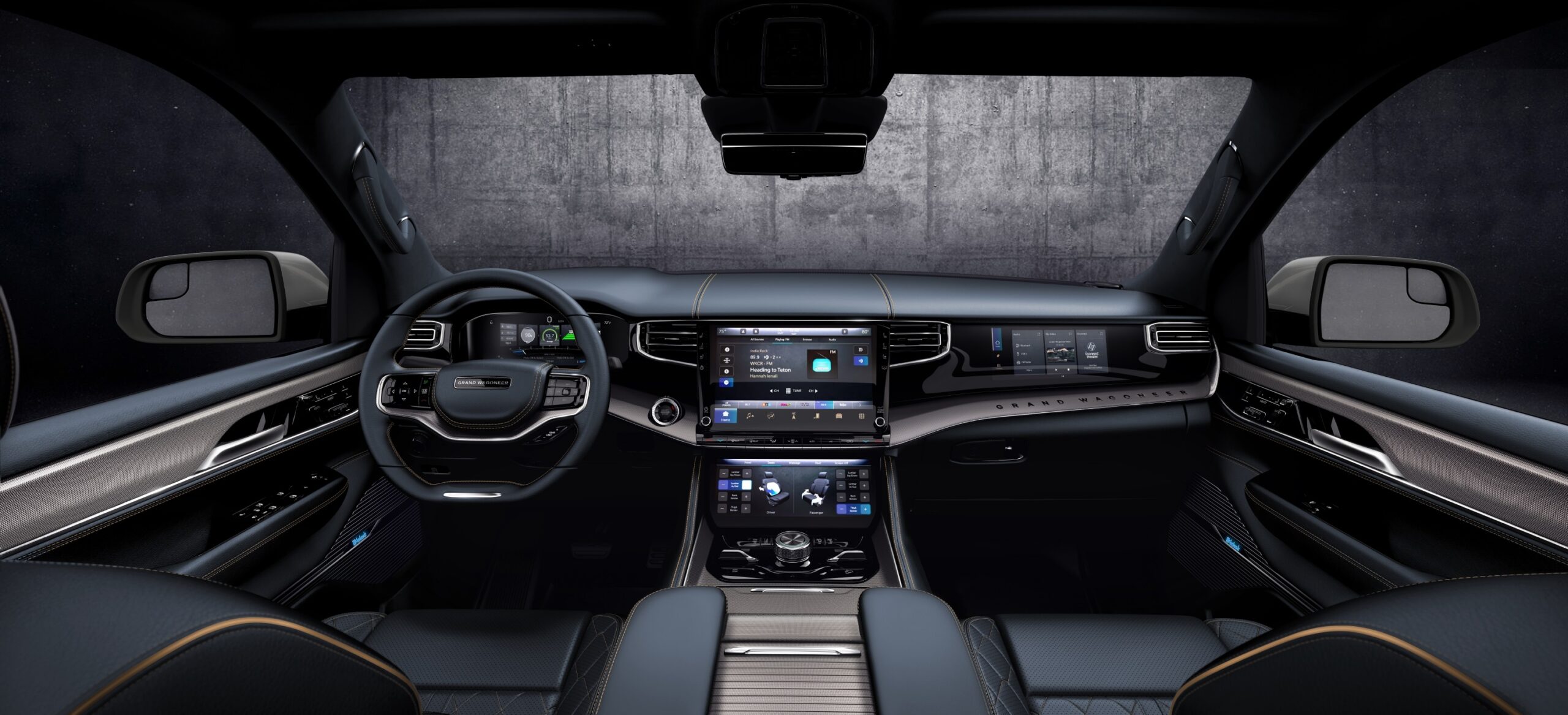
The Agave blue interior of the Grand Wagoneer

The Blue Agave interior with quilted Palermo leather.

2023 Hurricane Engine and L Models

Long-wheelbase models for both series of Wagoneer will be introduced for the 2023 model year. The additional 12 inches in overall length went to more rear-seat legroom and cargo capacity. With both rows of seats folded, there is room to slide in a few sheets of 4-by-8-foot plywood, Jeep says.

A new family of Hurricane inline six-cylinder engines will trim fuel use and maintain horsepower. The 3.0-liter twin-turbocharged inline-six-cylinder engines have two power levels:

The 420-hp Hurricane in the Wagoneer L has 468 foot-pounds of torque. The heavier Grand Wagoneer gets the high-output Hurricane twin-turbo 510, with 510-hp and 500 lb.-ft. of torque.

Jeep says a run of the Hurricane twin-turbo 510 engine will be available on the 2022 Grand Wagoneer. Ordering is now open for the $2,000 engine option. Rear-drive models have mileage ratings of 15/21/17 mpg on the recommended premium fuel.

Also new for 2023 is the Wagoneer L Carbide with a black theme. Special features include gloss black wheels, black grille, gloss black mirror, and headlamp trim. The interior has a technical hydrographic instrument panel trim and door panels with gloss black seats.

A Wagonner Carbide emphasizing black elements

A 2023 Wagoneer L Carbide. Turn-key for limo service.

2022 Wagoneer Pricing

The 2022 Wagoneer is sold in six trim levels of Series I, Series II, Series III and three series of the Carbide model. Starting prices for the standard rear-drive Wagoneer range from about $61,000 to $76,000. Carbide models range in price from $66,490 to $80,190; add $3,000 for 4WD.

The 2022 Grand Wagoneer is sold in four trim levels, all with four-wheel drive: Series I, Series II, Obsidian, and Series III.

Series I starts at $89,995, Series II at $99,995, Obsidian at $105,490, and Series III at $109,995. All MSRPs include the $2,000 freight charge from the Warren (Michigan) Truck Assembly Plant.

The Grand Wagoneer Series III tester was $116,720. It was nearly fully loaded with factory options and included: Midnight Sky metallic paint $645; Customer preferred package 23W $995; rear-seat entertainment group $2,195; 22-inch machined aluminum wheels with black noise pockets $1,595; and embossed metal interior accents $1,295.

There was a $1,500 bonus cash allowance for both Wagoneer models. See current Grand Wagoneer pricing here.
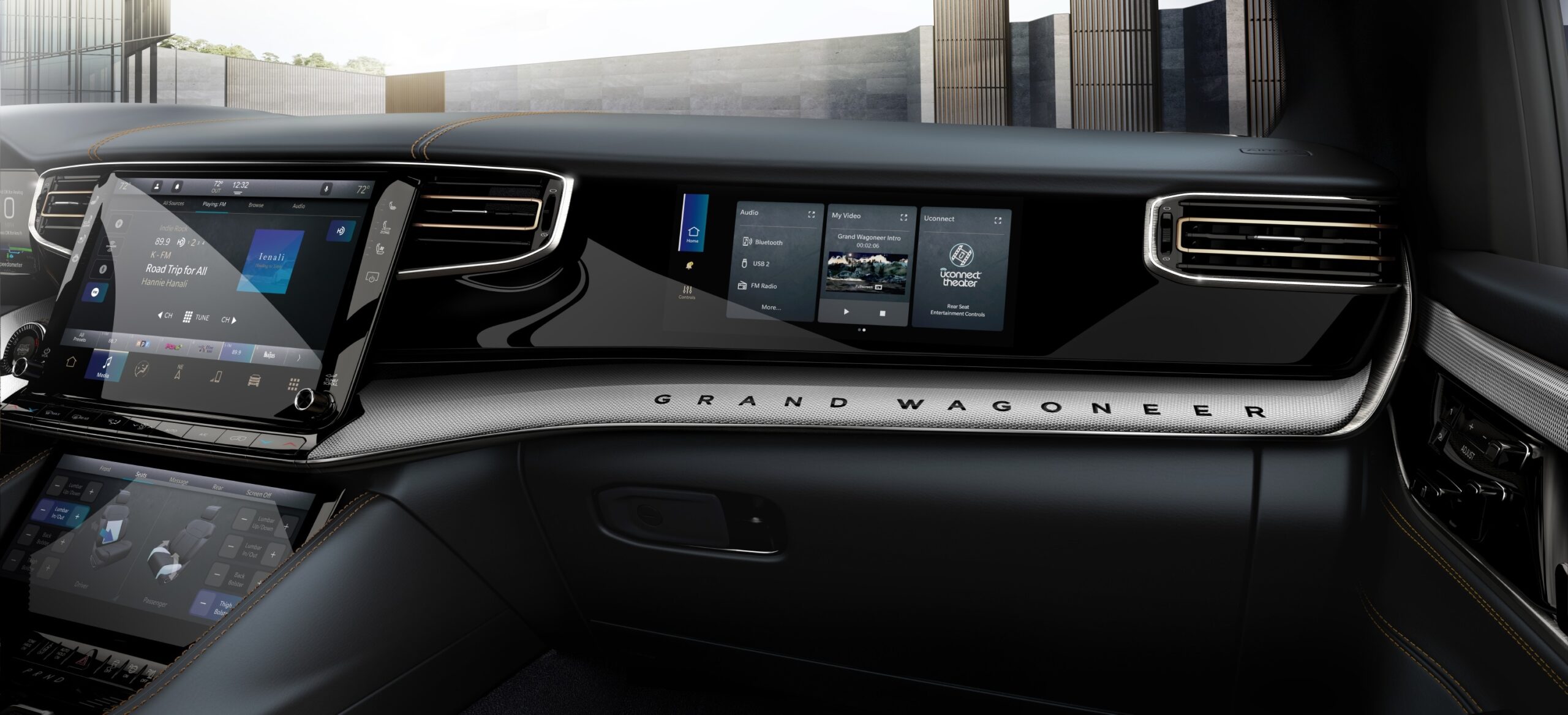
The passenger side 10.25 inch wide touch screen of controls

The passenger-side 10.25-inch touchscreen.

Safety Features

Standard safety features include eight air bags, automatic emergency braking with pedestrian and cyclist detection, active lane management, blind-spot monitoring, rear cross-path detection, and intersection collision assist.
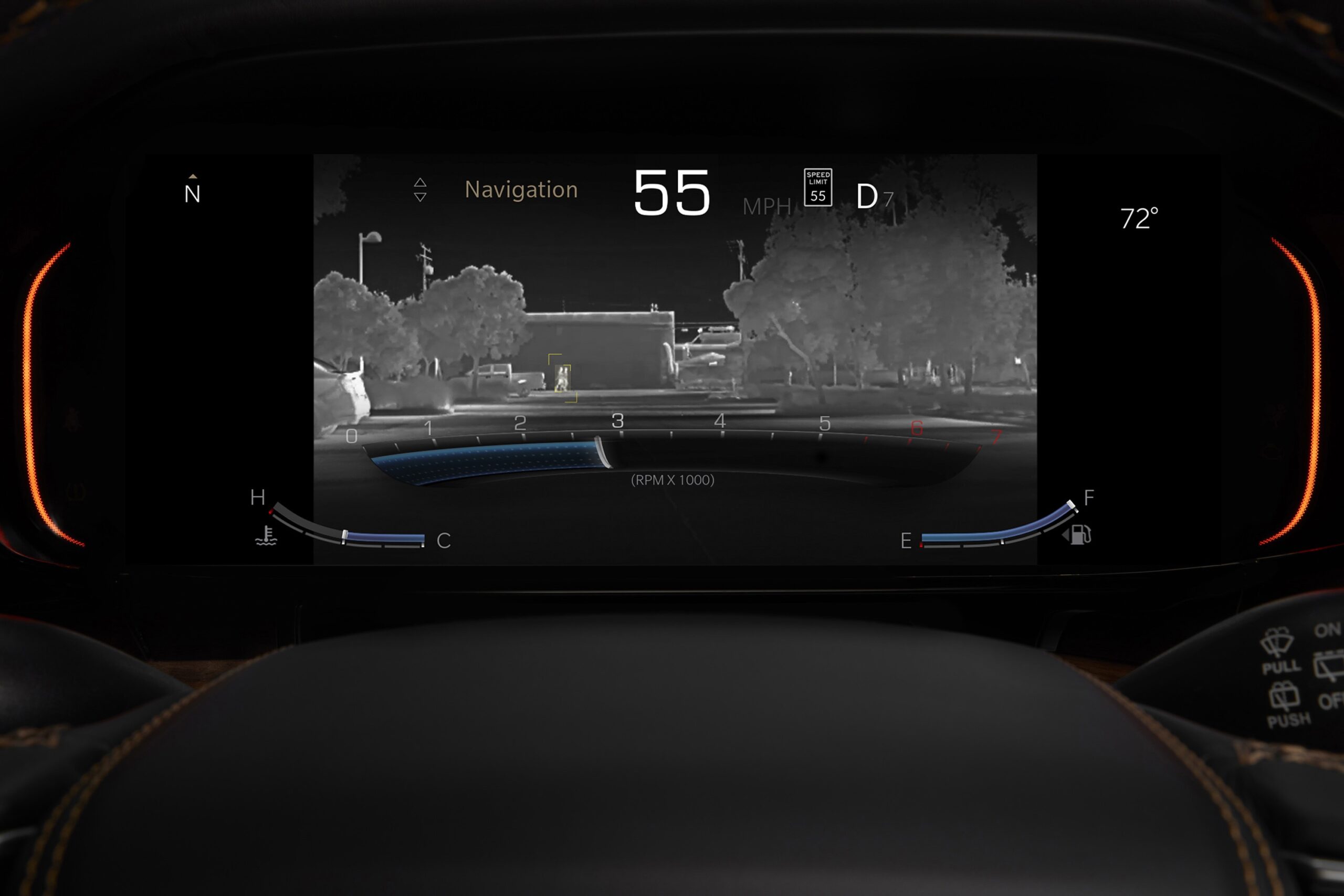
A black and white image of the night vision camera

The Night Vision Camera is especially useful where there are no street lights.

Putting the Grand in Wagoneer

The Grand Wagoneer will stand tall — and long — among the luxury-class competitors. The standard wheelbase models of Wagoneer are about 4 inches longer than their closest competitors. Among the competing luxury SUVs are the BMW X7, Cadillac Escalade, Infiniti QX80, Land Rover Range Rover, Lincoln Navigator, and Mercedes-Benz GLS.

The Grand Wagoneer cabin is rich in comfort, with grandstand views. Jeep tried to ensure a quiet cabin with an acoustic laminated windshield, front door glass, laminated rear glass, and active noise canceling through the audio system. It is an engineering marvel for this towering beast to power along the highway in such traffic-calmed style.

From the suede headliner to the full-weave carpeting, The Grand Wagoneer’s list of standard equipment might be the longest I’ve had to itemize for any vehicle I’ve tested. Power door-closers and heated armrests might be the only missing luxe perks.

The entire list is in the specifications at the end of this review, but here are a few of the standout luxury basics:

Quilted Palermo leather-trimmed massaging seats, 20-way power adjustable front seats, suede headliner, natural walnut interior trim, second-row captain’s chairs with power tilt and slide, heated and ventilated front and second-row seats, luxury front and rear floor mats, reversible cargo mat, foldable cargo shade. There also is a new Uconnect 5 Navigation and infotainment system with voice command, a 360-degree surround-view camera system, and a 23-speaker McIntosh entertainment system.

A digital rearview camera mirror is standard, but I can’t use it with my eyeglasses. When I look at the digital mirror, it takes a second or two for my eyes to focus. But the mirror can be switched to the low-tech original.
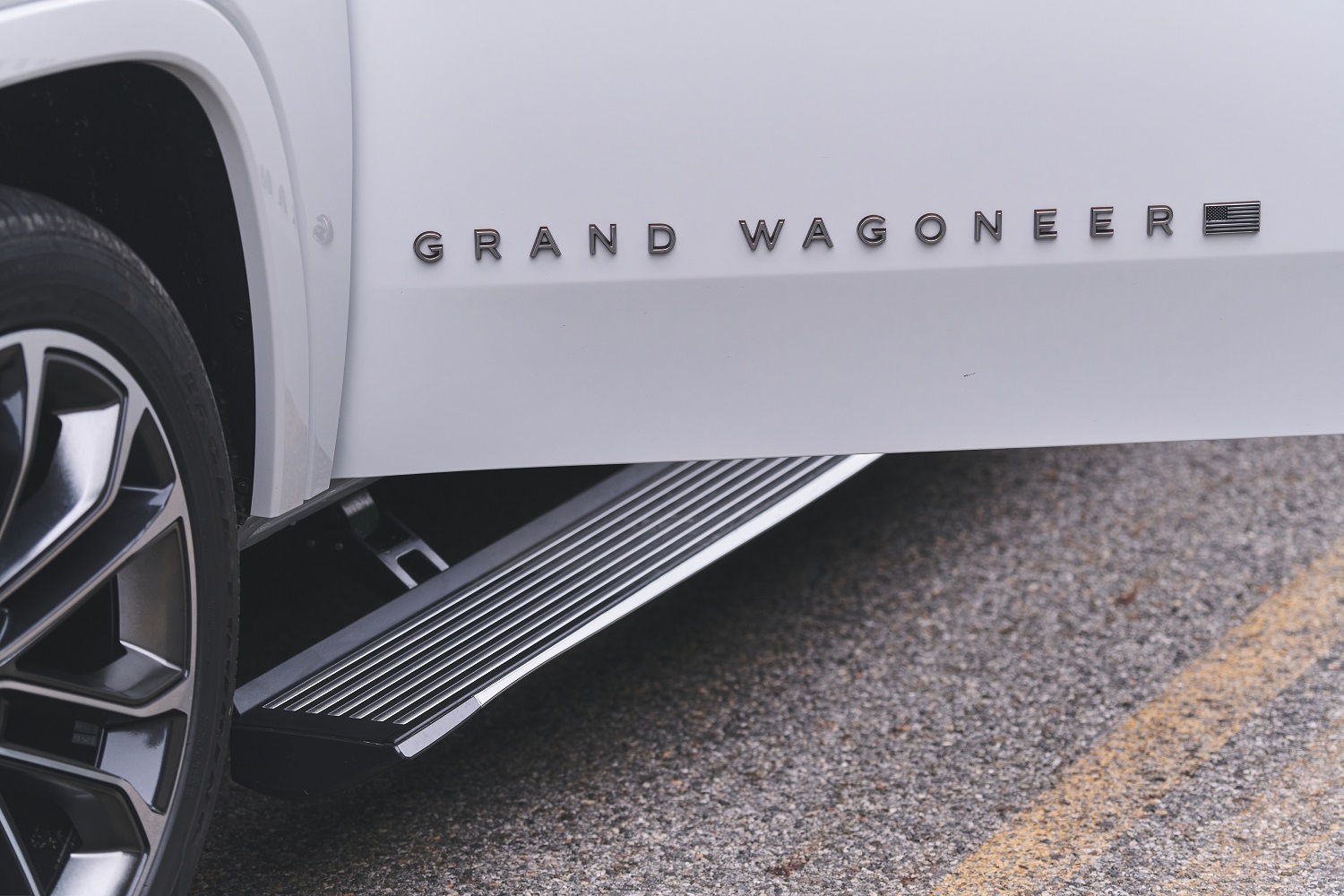
Power running boards lower to a convenient step-aboard height.

Power running boards lower to a convenient step-aboard height.

10 Cool Grand Wagoneer Features

Some of my favorite Grand Wagoneer features:

Power running boards. These lower to a convenient step-aboard height, particularly with the air suspension’s lowered ride height when parked. Too often, running boards create too much of a step and are awkward to use. The design of the boards forms the rocker panel, so legs do not rub on dirty metal.

Power-adjustable pedals (with memory sets). Adjustable pedals are a safety feature to help dial in a secure seating position for drivers of all sizes. The pedals are assets with the power tilt-and-telescoping steering wheel.

Rear seat monitoring camera. The overhead split-screen view of the second row is mainly to keep an eye on a child’s seat, or two — or a pet.

Power folding and reclining second- and third-row seats. How convenient to have this function for loading kids or cargo. And with power switches in the cargo area to fold the second row or fold and raise the third row.

Tri-pane panoramic sunroof and sunshade. The span of glass is dramatic, particularly for those in the second and third rows.

Roof rack with crossbars. Roof-rack crossbars are typically an added cost, but these are standard and store neatly below the cargo floor. Storing the crossbars when not needed helps trim wind noise.

11 USB ports. Let’s hope the USB port does not soon become obsolete. The Wagoneer and Grand Wagoner have eight USB ports, of the dual C-type and standard style. The count goes to 11 with the rear entertainment system.

Night Vision camera with pedestrian and animal detection. This type of system is an asset in areas without street lights. But it is a little odd visually to see the smallish X-ray-like presentation in the driver-info display.
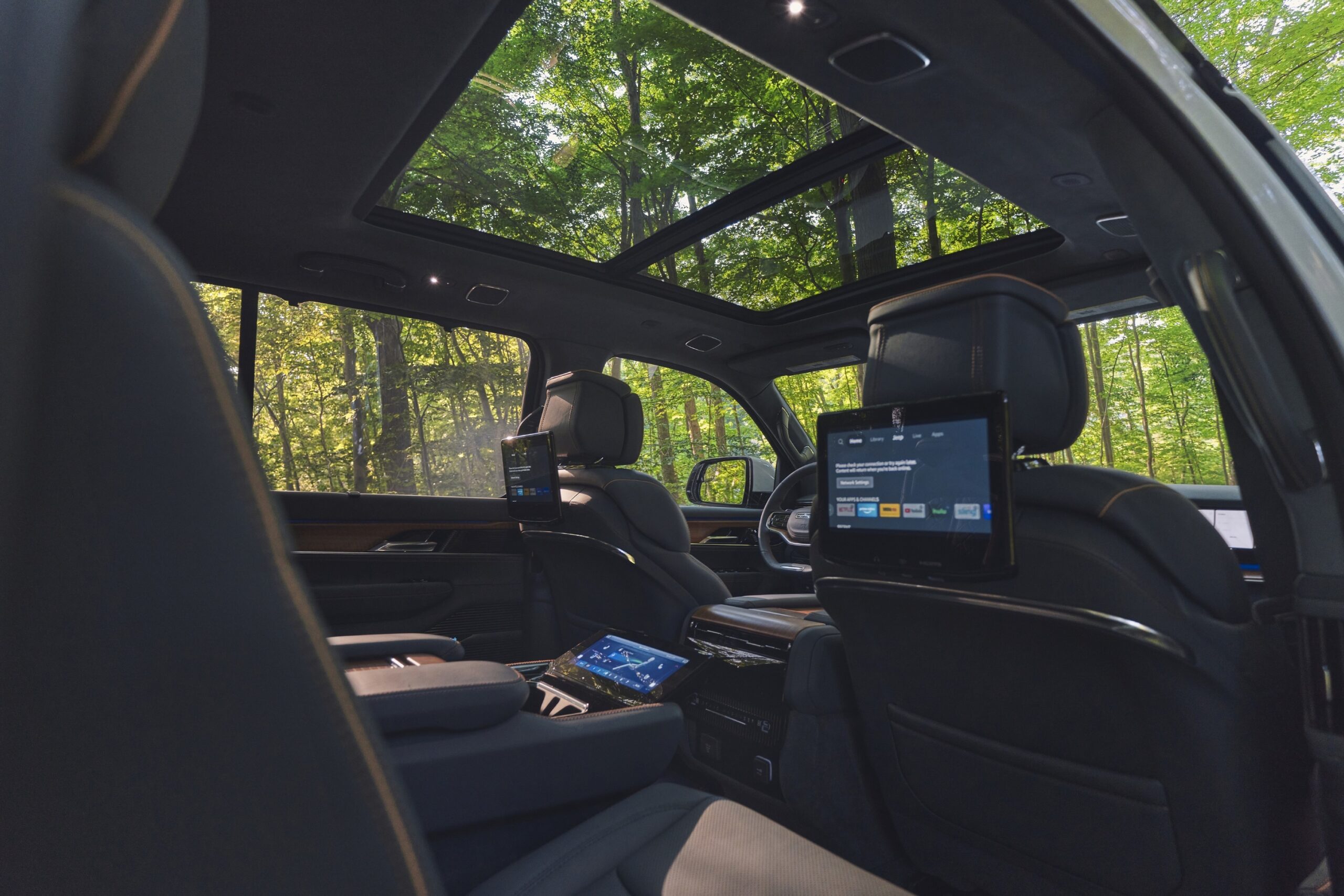
Back seat passengers can view streaming TV and movies on the optional Rear Seat Entertainment system

The Rear Seat Entertainment system, $1,295, features two 10.1-inch touchscreens for streaming movies, apps, and Fire TV for Auto.

Wagoneer Screen Envy

There are nearly 45 inches of display screens along the front instrument panel. Among the inch count are the 12.3-inch-wide instrument cluster, and a 12-inch horizontal touchscreen to access audio, navigation, apps, and views from the 360-degree camera. Just below is a 10.25-inch horizontal display for cabin controls. Then push a button, and the screen rotates to reveal the media hub with two dual USB ports, aux-in, and the wireless charging pad.

To empower the front passenger, the Grand Wagoneer includes a 10.25-inch-wide passenger screen. The access has four primary functions:

  • Co-Pilot (navigation and device management);
  •  Entertainment (via HDMI or rear seat entertainment control);
  •  The ability to view the exterior vehicle cameras;
  •  Fire TV for Auto.  It is possible to start a movie at home and finish it in the Grand Wagoneer.

And there is a 10.25-inch rear screen in the second row to adjust temp, fan, airflow, and seat heating and ventilating controls.

The Rear Seat Entertainment system, $2,195, features Amazon Fire TV built-in. Second-row passengers can stream TV, movies, and apps on two 10.1-inch touch screens on the seatbacks.

In total, there are 75 inches of display screens.

Performance and Ride and Handling

The big 6.4-liter V-8 hits its power stride with a peak of 455 lb.-ft. of torque at 4,400 rpm. The eight-speed automatic rolls smoothly through gear changes while showing respect to stretching fuel economy. Sport mode steps up off-the-line force but not aggressively.

Fuel economy is challenged. The best I could get was 13.3 mpg on a long highway run. Owners will not enjoy filling the 26.5-gallon tank, but they will enjoy every mile it provides.

A hood-up view of the 6.4-lter V-8 engine.

Grand Wagoneer’s 471-hp, 6.4-liter V-8. (Mark Maynard photo)

Ride and Handling

Road tripping in a Grand Wagoneer Series III is a first-class cruiseliner experience. There is headroom and legroom for 6-foot-6 tall adults in the first and second rows. And the second-row captain’s recline and are heated and ventilated.

The ride quality is supple, and some might consider it too soft in road undulations. But there is very little wind or tire noise at highway speeds. And the tire patch is significant from 22-inch Goodyear Eagle grand touring tires (285/45).

Four-wheel-disc stopping power is absolute and necessary when controlling three-plus tons. The front brakes have 14.88-inch vented rotors, and the solid rear rotors are 14.76 inches.

At 6,420 pounds, the Grand Wagoneer is at least 300 to 800 pounds heavier than its mainstream competition. But its turning circle of 38 feet is up to 3 feet tighter.

The Grand Wagoneer’s max tow capacity is a benchmark at 9,850 pounds. A Class IV receiver hitch and 7- and 4-pin wiring harness are included.

Grand Wagoneer’s Air Ride

The GW’s Quadra-lift air suspension gives the feel of a carpeted ride. Head toss is well controlled over speed bumps or when pulling into driveways. The sophisticated system includes electronic semi-active damping to match changing road conditions and stabilizer bars.

Quadra-Lift adds up to 3.6 inches of lift, supported by four-corner air springs. The air-cushioned ride operates automatically, or it can be manually controlled at the shift console. It has five height settings:

Normal Ride Height (NRH): 8 inches of clearance offers improved fuel economy, as well as improved aerodynamics during on-road driving;

Off-road 1: Lifts the vehicle an additional inch from NRH for added height in clearing obstacles (9 inches);

Off-road 2: Adds 2 more inches of ride height, for 10 inches of ground clearance;

Park Mode: Lowers the vehicle 1.6 inches from NRH. NRH and Park Mode are driver-selectable, allowing the driver full control over vehicle ride height;

Aero Mode: Lowers the vehicle 0.6 inches from normal ride height. Aero Mode is controlled by vehicle speed and adjusts for optimal performance and fuel economy. The vehicle will also lower to Aero Mode when in Sport Mode

The spacious second row captains chairs

There is headroom and legroom for 6-foot-6 passengers in the second row.

Wagoneer 4WD Systems

The Grand Wagoneer gets the top two-speed on-demand four-wheel-drive system. Its Selec-Terrain traction control has five modes: Automatic (functional for on- or off-road driving), Sport, Snow, Sand/Mud.

Rock mode works with the Quadra-Lift for a maximum height of 10 inches.

Selec-Speed Control integrates hill-ascent and hill-descent controls. The Electronic Range Select system, engaged at the steering wheel, allows drivers to control vehicle speed up and down trail grades without using the accelerator or brake pedals.

Wagoneer Client Services

Wagoneer will become a portfolio of vehicles that defines “American premium” and delivers a unique customer experience, the company says.

Customers interested in purchasing a Wagoneer or Grand Wagoneer can go to Wagoneer.com, select a dealer and place a $500 deposit. A Wagoneer concierge will make contact to initiate the order process, provide vehicle updates, and assist with any dealer interactions.

After a customer receives their vehicle, support will continue through a VIP helpline via Wagoneer Client Services. Those services include:

  • Five years of free dealership maintenance, including oil changes and tire rotations;
  • 24/7 concierge support and roadside assistance via phone or online chat;
  • No-charge equivalent service loaner;
  • Trip interruption coverage;
  • VIP access to exclusive events;
  • Interior and exterior vehicle cleaning and a full tank of fuel when serviced;
  • Vehicle pickup/delivery for service;
  • Free Wi-Fi and phone charging at the dealership.
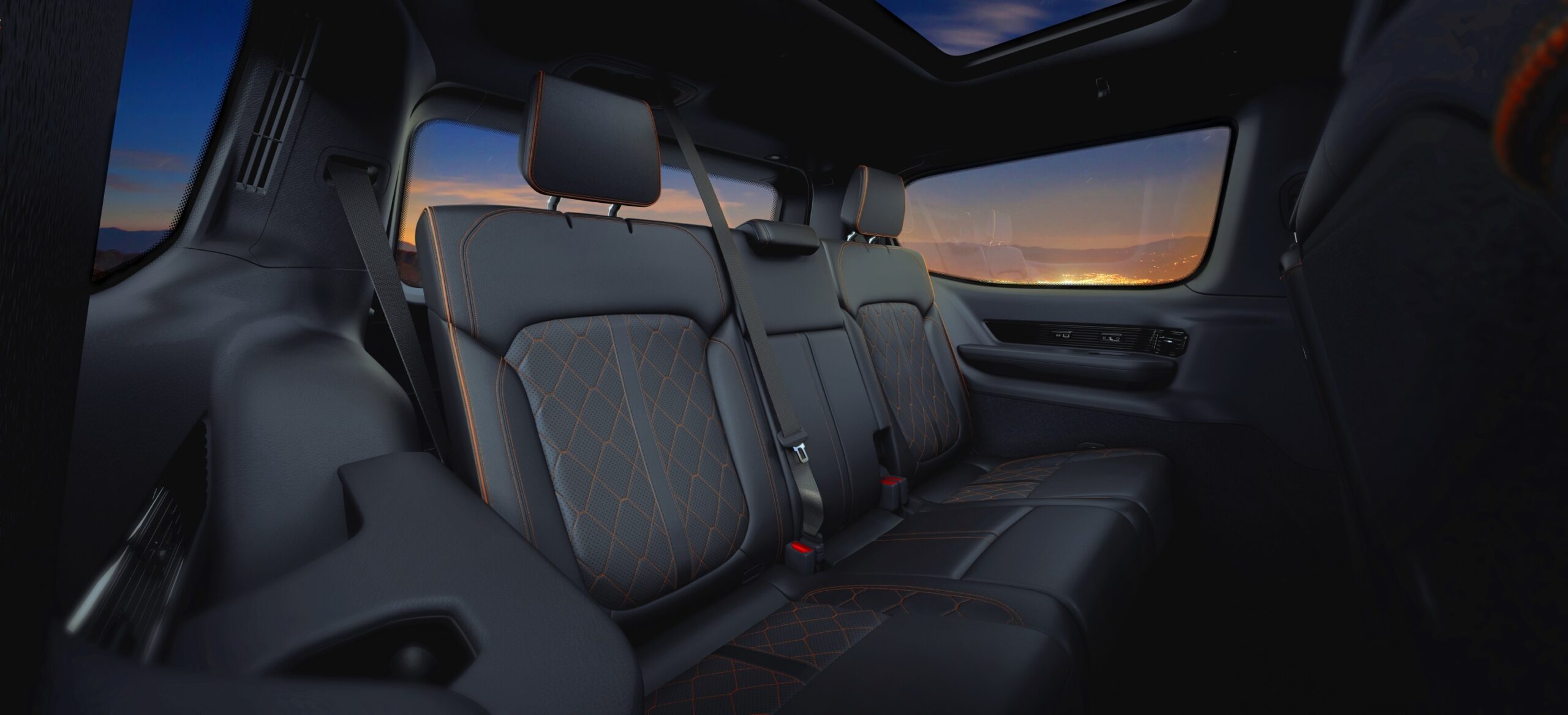
The third row seats

With more than 3 feet of legroom, the third row can recline or fold flat.

10 Customer Promises

1. Only dealers that earn a “Customer First” award for excellence by J.D. Power will be allowed to sell the Wagoneer.

2. The sales process will be efficient. Sales reps will use tablets and full integration to digital communication.

3. Certified Wagoneer Ambassadors. To become certified, a sales or service associate must complete more than 90 hours of training and pass exams to ensure that he or she truly understands the brand, the cars, how they can be used, and how they can be equipped.

4. Every Wagoneer and Grand Wagoneer will be sold with a full gas tank.

5. The vehicle will be thoroughly cleaned at delivery and after servicing and will be returned with radio, seating, climate, and other settings left as the customer had them.

6. Tech access to remote showrooms and to schedule test drives and delivery services.

7. An appropriate loan vehicle will be provided when a Wagoneer must be left at the dealership.

8. Remote services and diagnostics to schedule services and updates, including over-the-air updates and remote diagnostics.

9. Free Wi-Fi and phone charging in the showroom or service lounge, with “high-quality beverages and snacks.”

10. Wagoneer Client Services will provide 24/7 customer support and five years of maintenance. Concierge support and roadside assistance will always be available.

Both back rows of seats folded to show the open cargo area

All-new 2022 Grand Wagoneer rear interior cargo space (94.2 cu. ft. with second and third rows folded flat).

Why Buy the Grand Wagoneer?

It’s not a Jeep, it’s a Wagoneer — the only Jeep ID on the vehicle is in the headlight lenses. The Grand Wagoneer is grand luxury, not a Rubicon Trail-tested SUV. The elite dealership support and promises should be reassuring to new customers and conquests to the brand.

Despite the considerable sticker prices for these big vehicles, customers generally have incomes that make high fuel prices more of an inconvenience than a reason to reject such vehicles, auto-analyst Kim said. “The segment should remain strong in the coming years as lots of product action in that space will keep consumers interested and engaged.”

A rear view of the Grand Wagoneer

The Wagoneer customer experience includes 10 promises and dedicated client services.

2022 Grand Wagoneer Series III Specifications

Body style: large, 5-door, 7-seat body-on-frame SUV with two-speed electronically controlled 4WD

Engine: 471-hp 6.4-liter V-8 with fuel-saver mode and active grille shutters; 455 lb.-ft. torque at 4,400 rpm

Transmission: 8-speed Torqueflite 8HP75 automatic

4WD system: 2-speed electronically shifted transfer case; variable (50/50 or 100 front/rear) with traction modes of Automatic, Tow, Snow, Mud, Sand, Rock, and Sport

Fuel economy: 13/18/15 mpg city/hwy/combined; premium fuel recommended

Towing capacity: 9,850 pounds, with included Class IV receiver hitch and 7- and 4-pin wiring harness

BY THE NUMBERS

Fuel tank: 26.5 gallons

Cargo space: 27.4/70.9/116.7 cubic feet, behind 3rd row/2nd row/front seats

Front head/leg room: 41.3/40.9 inches

2nd-row head/leg room: 40/42.7 inches

3rd-row head/leg room: 39/36.6 inches

Length/wheelbase: 214.7/123 inches

Width/height: 94*/76.6 inches *at the mirrors

Curb weight: 6,420 pounds

Turning circle: 38 feet

FEATURES

Standard equipment includes: Keyless entry and push-button ignition, quilted Palermo leather-trimmed massaging seats, power running boards, 20-way power adjustable front seats, 2nd-row captain’s chairs with power tilt and slide, power folding and heated side mirrors, 60/40 power folding and reclining 3rd-row seats,  hands-free power liftgate, heated and ventilated front and 2nd-row seats, 12.3-inch cluster display, suede headliner, natural walnut interior trim, Uconnect 5 Nav with 12-inch touch screen display, integrated voice command with Bluetooth, 23-speaker McIntosh entertainment system, satellite radio with 6-month subscription, media hub with 2 USB ports and aux-in,tri-pane panoramic sunroof,  locking and lighted glove box, 4-zone automatic climate control, luxury front and rear floor mats, reversible floor mat, foldable cargo shade, roof rack with adjustable roof-rail crossbars, rear back-up-camera washer.

Driving features and technologies: head-up display, automatic headlights and high-beam control, map-in-cluster display, off-road info pages, adaptive cruise control with stop and go, ParkSense automated parking system, ParkSense front and rear park- assist with stop, night vision with pedestrian and animal detection, remote-start system, side distance warning, traffic sign recognition, 4G LTE Wi-Fi hot spot (trial included), automatic crash-notification service, connected travel and traffic services, Apple CarPlay and Google Android Auto, power-adjustable pedals (with memory sets), wireless charging pad, electric parking brake, digital rearview camera mirror, observation mirror, rear seat monitoring camera, acoustic-laminated windshield and front side glass, active noise-control system, LED exterior lighting with 3-optic fog lamps with cornering, 360-degree surround-view camera system.

Safety features include: 8 air bags, automatic emergency braking with pedestrian and cyclist detection, active lane management, blind-spot monitoring, rear cross path detection, intersection collision assist, rear park assist sensors with stop, all-speed traction control, electronic stability control, brake assist, hill-start assist.

PRICING

Series III base price: $109,995, including $2,000 freight charge; price as tested $116,720

Options on test vehicle:

  • Midnight Sky paint $645;
  • Heavy-duty trailer-tow package, $995, adds a trailer-brake control, chrome tow hooks, trailer-hitch lineup assist, trailer-hitch zoom, removable rear tow hook, heavy-duty engine cooling;
  • Rear-seat entertainment group, $2,195, includes Amazon Fire TV built-in;
  • 22-inch machined aluminum wheels with black noise pockets $1,595;
  • Embossed-metal interior accents $1,295

Where assembled: Warren (Michigan) Truck Assembly Plant

Warranties: 3-years/36,000-miles bumper to bumper; 5-years/60,000-miles powertrain; roadside assistance 5-years/60,000-miles

The New Dodge Challenger Convertible

The New Dodge Challenger Convertible

The Drop Top Customs third-party Challenger convertible-top option will have a retail price of $25,999, though final pricing will be negotiated and confirmed with the dealer

A front three-quarter view of the new Challenger convertible made by Drop Top Customs

Dodge dealerships will provide an expedited ordering process for the 2022 Dodge Challenger through Drop Top Customs. (Photos courtesy of Stellantis)

BY MARK MAYNARD

Dodge peeled back the roof on a new third-party Challenger convertible during its three-day Dodge Speed Week event. The three-day event features three nights of Dodge product reveals on Aug. 15, 16, and 17, 2022. The series wraps up on Aug. 20 with a big Dodge brand display in conjunction with the Modern Street Hemi Shootout group
on Aug. 20 during the Dream Cruise Weekend.
.
The 2022 Dodge Challenger convertible will be the first convertible Challenger since the 1970 and 1971 model years for the original muscle car.

“Last Call” for ICE Muscle

Parent company Stellantis is using the event to signal a “Last Call” to its Dodge Challenger and Charger, which will be phased out of production at the end of 2023. Among the debuts at Dodge Speed Week was the 710-hp, 2023 Dodge Durango SRT Hellcat.

A 710 horsepower 2023 Dodge Durango SRT Hellcat

The 2023 Dodge Durango SRT Hellcat in the newly available color of Frostbite.

“While we hit the throttle toward our new performance path, Dodge is also having fun on this victory lap by celebrating decades of muscle car power,” said Tim Kuniskis, Dodge brand chief executive officer, Stellantis. The future of performance for Dodge will be electrified, Kuniskis has said.

“What better way to commemorate how far we’ve come than to make it easier for Dodge Challenger customers to create a throwback convertible look,” Kuniskis said in a release.

Each 2023 Charger and Challenger will have a “Last Call” under-hood plaque with the vehicle name and silhouette showing their origin as “Designed in Auburn Hills” and “Assembled in Brampton.”

A side view of the Challenger convertible with the top down

The conversion will feature a padded roof and a heated glass rear window.

Challenger Convertible Ordering Process

Dodge dealerships will offer an expedited ordering process for third-party convertible modifications for the 2022 Dodge Challenger through Drop Top Customs. It is considered the oldest convertible coachbuilder in the U.S. and is based in Florida.

The new, integrated transportation ordering process allows customers to place third-party orders and pick up finished vehicles through participating Dodge dealers.

Dodge dealerships in the U.S. will begin taking retail convertible transportation orders on Aug. 16, 2022. Convertible third-party modifications through Drop Top Customs will also be available for the 2023 Dodge Challenger when orders open for the new model year.

Customers will work closely with Drop Top Customs and their Dodge dealership to order the vehicle to their specifications. Dodge dealerships will schedule unmodified customer vehicles to ship directly from Stellantis’ Brampton (Ontario, Canada) Assembly Plant to Drop Top Customs. Dodge says that the process will provide a more efficient build time, and allows owners to take the keys after completion.

Expedited shipment option to Drop Top Customs will be available for 2022 and 2023 Dodge Challenger R/T, R/T Scat Pack, and all Challenger SRT models.

A view of the open trunk space

Trunk space, to boot.

Challenger Convertible Pricing

The Drop Top Customs third-party Challenger convertible-top option will have a retail price of $25,999. However, final pricing will be negotiated and confirmed with the dealer.

Additional ordering information, including warranty information, is available through Drop Top Customs.

A convertible with the top up

The convertible conversions feature a fully hydraulic power top.

Drop Top Customs

Drop Top Customs has 46 years of modification experience, creating convertibles, including modern-era Dodge Challenger convertibles. The convertible conversions feature a fully hydraulic power top. Structural reinforcements will reduce body flex while retaining interior space. A padded roof and heated glass rear window provide sound and temperature insulation.

Learn more at Drop Top Customs www.droptopchallenger.com.

Dodge Challenger SRT Hellcat Jailbreak Review

Dodge Challenger SRT Hellcat Jailbreak Review

The 797-horsepower Dodge Challenger SRT Hellcat Jailbreak is a throwback union of old school and new school

The red Challenger with a Navy recruit training ship in the background

The 2022 Dodge Challenger SRT Hellcat Jailbreak starts at $87,120. Today’s tester was $97,077 with 12 options and the $2,100 gas-guzzler tax. (Photography by Mark Maynard)

Table of Contents

Overview
Challenger Then and Now
Pricing
Dodge Challenger Build Order
SRT Hellcat V-8s
Jailbreak Performance
Why Buy the Dodge Challenger SRT Jailbreak?
Specifications

BY MARK MAYNARD

I heard the car pull up before I saw it, and when I saw it, I muttered the enthusiast’s silent prayer, which goes something like: “Jeeziz, keep me from my own undoing.” I was looking at a 797-horsepower 2022 Dodge Challenger SRT Hellcat Jailbreak Widebody.

Driving this week’s test car, in its TorRed paint and a straight-through exhaust hustle, I’d be guilty until proven innocent.

The supercharged 6.2-liter V-8 engine tinked and tokked as it cooled. With its 12-inch-wide Pirelli P Zero gumshoe-sticky tires and body widened 3.5 inches by pronounced fender flares, the Challenger Jailbreak has the stance of a predator. Yet, the bright red paint and Warp-Speed satin carbon chrome wheels made it appear less of a hooligan and just gloriously badass.

First impressions might be to hate this musclebound coupe for its gas-guzzling ways. It’s a throwback, but there just ain’t nothing wrong with being all ate up with motor, even as it inhales premium-unleaded fuel.

As a five-seat sport coupe, the Challenger has some utility. The wife of a vintage-racing friend told her husband, who was considering a Hellcat: “Go ahead and get it, honey. It has a back seat, a big trunk, and the back seat folds.”

The Challenger is a big two-door with distinct American features. It has big front headroom of 39.3 inches and long legroom of 42 inches. Sightlines are unimpeded for cornering, and the 38.7-foot turning circle is quite manageable.

The ride quality can be comfortable, and the standard equipment list is mostly competitive. But the aging architecture is apparent in the lack of small-item storage, wireless charging, or even a dedicated place to lay a phone.

But when it comes to performance hardware and engineering, the Challenger SRT Hellcats are fully functional.

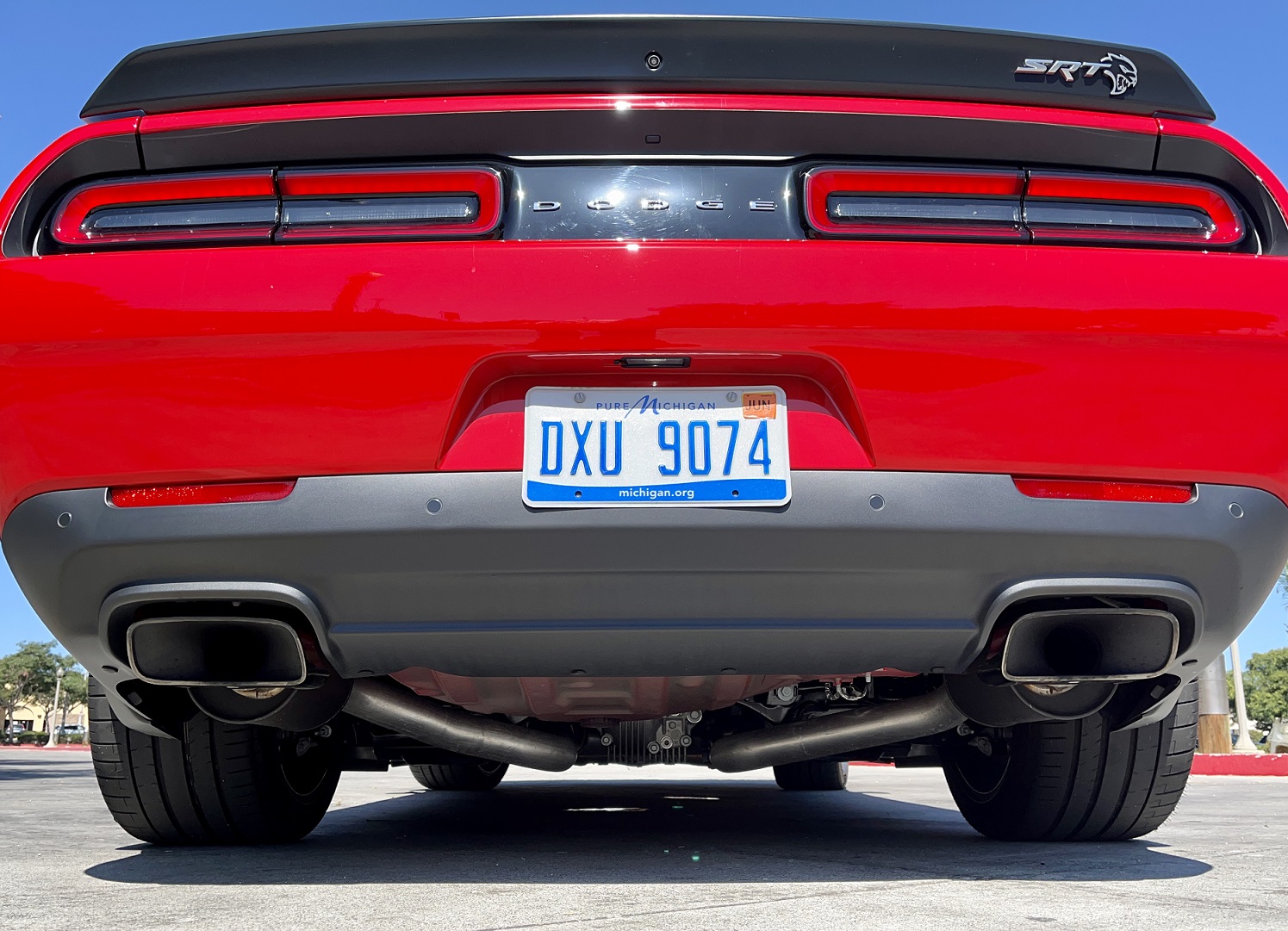
A underbody view of the Challenger exhaust system

The 2.75-inch electronically controlled, straight-through active exhaust system.

2022 Dodge Challenger Overview

The Dodge Challenger is old school and new school — and the same goes for those who embrace this champion of the Mopar Nation.

This big pony car has been in production so long — 14 years — that whatever wasn’t right has been made right. J.D. Power — a juggernaut among automotive research firms — named the Dodge Challenger the “Best Midsize Sporty Car of 2022.”

With detailed survey feedback from verified car owners, J.D. Power gives the Challenger an 85 out of 100 rating. The ratings include an overall rating and sub-ratings for quality and reliability (40 percent), driving experience (20 percent), resale value (20 percent), and dealership experience (20 percent).

The flat-bottom SRT steering wheel

The leather-wrapped flat-bottom and heated SRT steering wheel.

Dodge Challenger Then and Now

The Dodge Challenger is among the more elevated and choice-optimized sport coupes in modern history. It goes way beyond its spiritual predecessor of the 1970-1974 Dodge Challenger pony car. And even it had eight engine choices, which ranged from the Slant 6 (aka, “Leaning Tower of Power”) to the legendary 426-cubic-inch Hemi V-8 and the even more powerful 7.2-liter 440 V-8.

There were less illustrious “Challenger” models, too. The 1978-1983 “badge engineered” Mitsubishi Galant coupe was hopeful but hollow of performance. It was a dreadful offering during the 1980s “malaise” years in American cars, performance or otherwise.

And here’s a note of trivia. Dodge first applied the Challenger nameplate in 1959 for the “value version” of its full-sized Coronet Silver Challenger.

The modern-era Dodge Challenger has been the golden Hellcat of sales. It was early 2008 when the current generation made its U.S. debut. And the Challenger has rode out its 14 years with the same basic chassis architecture but with a few face-lifts, dozens of fresh option packages, and iconic paint colors. The current-gen Challenger was introduced in 2014 for the 2015 model year.

Through 2021, the Dodge Challenger has racked up 645,509 U.S. sales since 2008, backed up by 19,856 in Canada, 4,603 in Mexico, and 3,077 from Europe. The grand total comes to 673,045, according to the Challenger page on Wikipedia. Last year there were 54,314 Challengers sold in the U.S. . So far in 2022, the Challenger has brought in 25,682 sales, down just 3 percent from the second quarter of 2021.

And all that while weathering a pandemic, gasoline crisis, and the pangs of a threatening recession.

An open view inthe driver's side of the Challenger with the two-tone black-and-gray Laguna leather option

The Challenger has a tall 39.3 inches of front headroom.

The End Is Near, or might be

Alas, all good things come to an end, at least for Hellcat models.

According to a report in Automotive News,  Dodge CEO Tim Kuniskis is quoted in a report that the supercharged models are in their last days. Redesigned versions of the Charger and Challenger muscle cars are expected to move to Stellantis’ electrified STLA Large platform, which is capable of up to 500 miles of range.

“I will have this car, this platform, this powertrain as we know it, through the end of ‘23,” Kuniskis said in an interview during the 2021 Los Angeles Auto Show. “There’s two more years to buy a Hellcat, then it’s history.”

Dodge has said it plans to unveil an electric concept car that will give enthusiasts a taste of what’s to come when it debuts an electric muscle car in 2024. There is speculation that the upcoming vehicles could be an electric speedster and a plug-in hybrid.

The long gearshift console in the Jailbreak

All of the usual accommodations, except wireless charging.

Dodge Challenger Build Order

There are nine trim levels to the 2022 Dodge Challenger, with:

  • 6 choices for horsepower: One V-6 and five V-8 engines;
  • 2 choices of transmissions: six-speed manual (on certain trim levels) or eight-speed AutoStick automatic, with specific beefiness for each V-8, and;
  • Rear- or all-wheel drive (available on some models).

Paint colors

You have to love the marketing creativity of paint-color names for the 2022 Challenger:

  • Frostbite
  • F8 Green
  • Go Mango
  • Granite
  • Hellraisin
  • Indigo Blue
  • Octane Red
  • Pitch Black
  • Sinamon Stick
  • Smoke Show
  • TorRed
  • Triple Nickel
  • White Knuckle
The SRT performance page in the color infotainment touchscreen

The Dodge Challenger SRT Hellcat SRT Performance Dashboard showing Sport mode.

SRT Hellcat V-8s

Decisions, decisions when it comes to power, but most Mopar disciples will buy the most their budget allows. There are five V-8s from which to choose:

375-hp 5.7-liter Hemi V-8 with fuel-saver (cylinder shutoff) technology

485-hp 392 Hemi V-8 SRT

717-hp supercharged 6.2-liter Hemi Hellcat V-8

797-hp supercharged 6.2-liter Hemi Hellcat high-output V-8

807-hp supercharged 6.2-liter Hemi Hellcat high-output V-8
Challenger SRT Super Stock.

The 797 horsepower supercharged 6.2-liter V-8 in the Challenger

797-hp, supercharged 6.2-liter Hemi Hellcat high-output V-8.

2022 Dodge Challenger Pricing

Starting prices range from $32,025 for the entry Challenger SXT with 303-hp 3.6-liter V-6 to $89,125 for the Challenger SRT Super Stock. Pricing includes the $2,100 gas-guzzler tax and the $1,595 freight charge from Brampton, Ontario, Canada.

Today’s 2022 Dodge Challenger SRT Hellcat Jailbreak starts at $87,120 and was $97,077 with 12 options and the $2,100 gas-guzzler tax.

The $18,595 Jailbreak 27D package includes: a 220-mph speedometer, widebody fender flares, high-performance engine controller, widebody competition suspension, instrument panel Jailbreak badge, and SRT power chiller, which uses air conditioning refrigerant to further cool the air fed to the supercharged engine.
And that is just the tip of the options list. Buyers of the Challenger SRT Hellcat Jailbreak can order unrestricted option combinations.

Among the more than 20 categories of upgrades are:

  • 7 choices for seats, body stripes, and wheels;
  • 6 brake caliper colors;
  • 5 exterior badging finishes;
  • 4 choices of steering wheels, seat belt colors, and floor mats, and;
  • 13 paint colors. 3 are no-cost, the others range in cost from $95 to $395;
The driver side interior door panel has a bottle holder and a small stash space

Carved-out elbow room at the door panels.

Buyer Be Aware

Challenger (and Charger) Hellcat buyers should know that the Monroney price is merely a suggestion. Dealers are routinely charging $20,000 and more above the sticker. Check the MoparInsider website for more details.

For current Dodge Challenger pricing and incentives, check the factory website here. . And Dodge is currently offering a National Retail Consumer Cash (22CN1) discount of $1,000.

Looking into the front passenger side of the Jailbreak

The front passenger has just manual adjustment.

Challenger Jailbreak Performance

The Dodge Challenger SRT Hellcat Jailbreak runs with the 797-hp high-output V-8. Car and Driver says the Jailbreak can accelerate to 60 mph in 3.9 seconds and has a top speed of 203 mph.

Everybody loves a whiner when it’s the sound made by the Hellcat’s 2.7-liter supercharger, which spools up 14.5 pounds of boost. On hard acceleration, the supercharger’s industrial whine harmonizes with the gutty bellow of the Hellcat V-8 for a near-religious experience: “Sweet Jesus, take me home.”

As comfortable as a grand-tourer can be, the Challenger Jailbreak is not my choice for a road trip. There is significant drone in the cabin at highway speeds. And then there is the fuel-economy consideration.

Fuel economy ratings are a hopeful 13 mpg city, 21 highway, and 15 mpg combined using the required premium fuel. I might have been averaging 15 mpg, and the 18.5-gallon tank provides the range of a decent electric vehicle.

One of the 12-inch-wide Pirelli P Zero high-performance tires on the Jailbreakance grip, front and rear.

12 inches of 20-inch Pirelli P Zero 305/35ZR 20 all-season performance grip, front and rear.

Challenger Transmissions

Some models of Challenger models have the choice of a six-speed manual transmission — R/T, Scat Pack, and SRT Hellcat. The Tremec TR-6060 features a twin-disc clutch and has the much-hated first-to-fourth-gear skip shift.

Hellcats with the high-output V-8 are uprated with a heavy-duty Torqueflite 8HP90 eight-speed automatic. It rolls through the gears with fuel-saving precision in the standard drive mode. Punch up Sport on the touchscreen, and steering, suspension, and shift points sharpen but are not overly aggressive. The Torqueflite also allows manual control. Gear changes can be made at the gear shift or steering-wheel paddle shifters with three SRT selectable performance modes of Street, Sport, and Track.

The AutoStick is probably easier on tires than the manual. But hit the gas and concentrate on steering as the Pirellis light up. The 20-inch rollers (305/35ZR) are of such a grippy recipe that some owners run through a set in four months. With restraint, the tires can last a year. Replacements for the Pirelli P Zero summer performance tires cost around $400 a pop.

The Pirellis contribute to a cushioned ride quality and extreme adhesion, whether in cornering at speed or in launch control. Tires are essential to suspension and car control, so don’t cheap out.

With a curb weight of 4,481 pounds, the Hellcat is more of a barrel-chested straight-line blacktop pounder than a road-course interceptor.

Unfortunately, the Active Exhaust lustily rumbles out the call to let ’er rip. Standard on all Hemi V-8 models, the dual 2.75-inch straight-through exhaust pipes have twin electronic exhaust valves. Black Vapor-chromed tips finish the appearance.

The pair of back seats in the Challenger

Get in, shut up and just hold on.

Why Buy the Dodge Challenger SRT Jailbreak?

Buy it now because you’ve always wanted a Hellcat. An 800-horsepower coupe is not a need, but neither is a four-carat diamond ring, which, if it is of high quality, can cost as much as a stock Hellcat.

Damn the price of gas, full speed ahead.

Stellantis CEO Carlos Tavares said, “The muscle cars are a very nice niche business that is now being prepared for full electrification with some amazing innovations that will bring even more passion from the fans of this brand in the near future.”

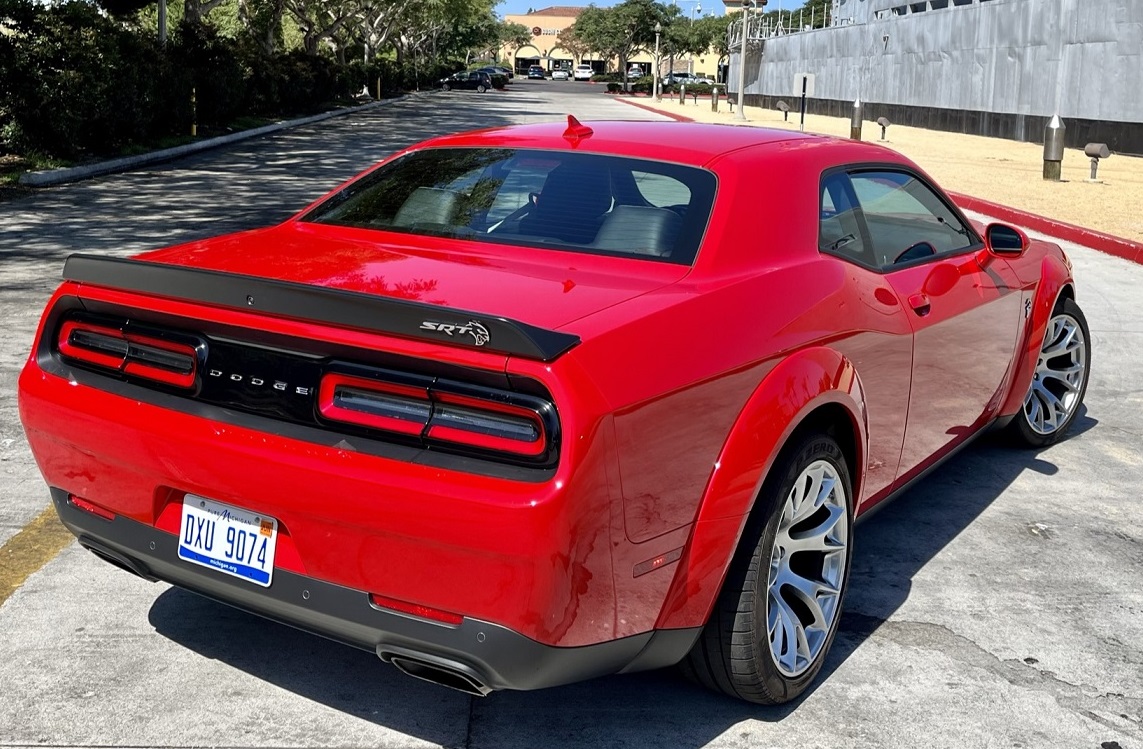
A rear three-quarter view of the red Challenger Jailbreak

The widebody treatment adds 3.5 inches at the fenders for an overall width of 78.3 inches.

Dodge Challenger SRT Jailbreak

Specifications

Body style: midsize, 5-seat 2-door rear-wheel-drive coupe

Engine: supercharged 6.2-liter Hemi Hellcat high-output V-8; 797-hp at 6,300 rpm; 707 lb.-ft. torque at 4,500 rpm

Transmission: Torqueflite 8HP90 8-speed AutoStick automatic; adaptive electronic control with full manual control via gear selector or paddle shifters with 3 SRT-unique selectable modes: Street, Sport, and Track (features performance shifting and gear holding)

Fuel economy: 13/21/15 mpg city/hwy/combined; premium 91 octane fuel required

Top speed: 203 mph (per Car and Driver)

0-60 mph acceleration: 3.7 seconds (per Car and Driver)

BY THE NUMBERS

Fuel tank: 18.5 gallons

Trunk space: 16.2 cubic feet

Front head/leg room: 39.3/42 inches

Rear head/leg room: 37.1/33.1 inches

Length/wheelbase: 197.5/116 inches

Curb weight: 4,481 pounds

Turning circle: 38.7 feet

FEATURES

Standard Hellcat equipment includes: smart-key locking and push-button ignition, LED interior lighting, six-way power driver’s seat with lumbar, manual front passenger seat, heated front seats, power side mirrors, split-folding back seat, floor mats, leather-wrapped flat-bottom (heated) SRT steering wheel, leather-wrapped shift handle, tilt-telescoping steering column, Uconnect 4C infotainment with 8.4-inch color display (music, climate controls, and vehicle
Information), Apple CarPlay and Android Auto, 6-speaker Alpine audio system, satellite radio (trial subscription), integrated voice command, Bluetooth, phone and streaming audio, a media hub with audio input jack and two USB ports

SRT performance equipment: 2 ignition keys (one red and one black, which holds power at 500 hp), SRT Track Experience (DodgeGarage.com/SRT), competition suspension, Brembo 6-piston front calipers, line lock, anti-spin differential rear axle, launch control with launch assist, dual scoop hood, conical cold air intake, after-run chiller, active exhaust, SRT configurable drive modes, SRT performance pages, performance shift indicator;

Safety features include: 6 air bags, electronic roll mitigation, stability and all-speed traction controls, hill-start assist, ParkView rearview camera with guidance lines, ParkSense rear park-assist system, rain-brake support, and ready-alert braking;

PRICING

SRT Jailbreak base price: $87,120, including $1,595 freight charge and $2,100 gas-guzzler; price as tested $97,077

Options on test vehicle: Hammerhead-gray seat belts $395; Hammerhead Gray floor mat binding $99; Black and Hammerhead-Gray seats $295; satin chrome exterior badges; 305/35ZR Pirelli P Zero summer performance tires $695; Uconnect 4C Navigation with 8.4-inch color touchscreen display, $995, with 5-year subscriptions for SiriusXM Travel Link and Travel Plus; 20-inch-by-11-inch Warp Speed satin carbon wheels $1,295; chrome fuel-filler door $9;

SRT Jailbreak package, $18,595, includes: widebody fender flares, widebody competition suspension, SRT Power Chiller, 220 mph speedometer, high-performance engine controller, and Jailbreak dashboard badge

TorqueFlite 8-speed AutoStick transmission (standard) with steering wheel shift control and remote start;

Laguna leather front seats with SRT Hellcat logo, $3,890, package includes ventilated front seats, Laguna leather door trim, stitched dash top, memory presets for driver-radio-mirrors, power tilt-telescoping steering column;

Driver convenience group, $1,295, power side mirrors with manual fold function, HID headlights, blind-spot and rear cross-path detection;

Harmon Kardon 18-speaker, surround-sound audio system with subwoofer and GreenEdge amplifier $1,995;

Where assembled: Brampton Assembly Plant, Ontario, Canada

Warranty: 3-years/36,000-miles bumper to bumper; 5-years/60,000-miles powertrain
Volkswagen Atlas VR6 4Motion Review

Volkswagen Atlas VR6 4Motion Review

 2022 Volkswagen Atlas is all about family function and interior space with voluminous cargo capacity

A front three quarter view of the 2022 Volkswagen Atlas in Aurora Red metallic paint

2022 Volkswagen Atlas starting prices range from $35,630 for the front-drive SE with 2.0-liter four-cylinder to $52,800 for the SEL Premium R-Line with 4Motion and 3.6-liter VR6. (Photos by Mark Maynard)

Table of Contents

What’s new for 2022
Pricing
Powertrains
Safety Features
Ride and Handling
Interior Function
What’s New for 2023
Why Buy the VW Atlas VR6?
2022 VW Atlas V6 Specifications

BY MARK MAYNARD

The Volkswagen Atlas SUV has a split personality and two body styles to express itself. The midsize Atlas is Volkswagen’s largest SUV. It debuted for U.S. sales in 2017, and VW has made evolutionary updates ever since. In 2020, VW unveiled the Atlas Cross Sport, a fastback version of the full-bodied Atlas. And last year, the Atlas was given a style freshening that added a new front end (based on the Atlas Cross Sport), redesigned wheels, new rear lights, and a new steering wheel.

Either body style has a choice of two powertrains: a 235-hp, turbocharged 2.0-liter four-cylinder or a non-turbo 276-hp 3.6-liter VR6. All models are available with standard front-wheel drive or optional 4Motion all-wheel drive. Both engines transfer power via an eight-speed Tiptronic automatic transmission.

The Volkswagen Atlas is among at least 11 competing SUVs with three rows and all-wheel drive: Chevrolet Traverse, Ford Explorer, Honda Pilot, Jeep Grand Cherokee, Kia Telluride (and corporate partner Hyundai Palisade), Mazda CX-9, Nissan Pathfinder, Subaru Ascent, and Toyota Highlander.

The steering wheel of the Atlas

Standard SEL features include keyless entry and push-button ignition, leather-trimmed upholstery, wireless phone charger, overhead view camera, and Fender audio.

Two Bodies, Two Styles

The Volkswagen Atlas Cross Sport is affordable executive transport and a fastback style statement. The optional back seat captain’s chairs have limo-like comfort with long-reach legroom of 40.4 inches.

The full-body Atlas is all about family function and interior space with voluminous cargo capacity.

Looking into the driver's door of the Atlas

The driver seat has 10-way power adjustment.

What’s New About Atlas for 2022

The VW Atlas lineup was streamlined to six trims for the 2022 model year — SE, SE Technology, SEL, SEL R-Line, the new SEL R-Line Black, and SEL Premium R-Line.

The SE model now has an 8-inch Digital Cockpit gauge array. The SE with Technology models add USB-C ports for the third row and a standard trailer hitch for models equipped with the VR6 engine, and there is an option package for 20-inch black wheels.

4Motion is now standard on SEL models, as are machined 20-inch wheels. The R-Line Black package features black 20-inch wheels and black R-Line badging. R-Line is standard on the SEL Premium and adds 21-inch wheels.

The back up camera in the Atlas has guidance lines

A wide, viewable backup camera with guidance lines.

2022 VW Atlas Pricing

VW Atlas starting prices range from $35,630 for the front-drive SE with 2.0-liter four-cylinder to $52,800 for the SEL Premium R-Line with 4Motion and 3.6-liter VR6. Pricing includes the $1,295 freight charge from Chattanooga, Tenn.

Today’s tester is an SEL Premium R-Line 4Motion for $53,890. It had just two options of Aurora Red metallic paint ($395) and second-row captain’s chairs ($695).

Find current VW Atlas pricing here.

And check on available special offers here.

Looking into the front passenger door of the Atlas

The front passenger seat has eight-way power adjustment.

Atlas Powertrains

The Atlas VR6 is a balance of power and fuel-economy ratings. The direct-injected 3.6-liter has a peak 266 foot-pounds of torque at 3,600 rpm. The power picks up quickly from a start, and then the Tiptronic transmission upshifts quickly to get into fuel-saving gear ratios.

Sport mode sharpens acceleration and shift points, and I used it frequently. Tooling around in Sport mode didn’t seem to affect my average fuel economy all that much. And the force of power was worth sacrificing a few mpgs.

Fellow car critics say the turbocharged 2.0-liter engine will be adequate for most needs. But those who tow will want the V-6.

And there’s not much mileage incentive to go for the four.

The turbocharged 2.0-liter has fuel economy ratings of 21/25/23 mpg city/highway/combined, and the ratings are nearly the same with AWD at 20/24/22 mpg. (Mileage ratings are the same for the Atlas Cross Sport.)

The VR6 has EPA ratings of 18/24/20 mpg front-drive or 17/23/19 mpg AWD. The good news is that both engines use the recommended 87 octane fuel.

I worked up to an average of 17.2 mpg in highway driving, with liberal use of Sport mode.

The VW Atlas V6 engine

The 276-hp 3.6-liter VR6 can tow up to 5,000 pounds.

4Motion Active Control

In everyday driving, the 4Motion all-wheel-drive system uses an electronic clutch on the rear axle that lets the rear wheels rotate while the front wheels power the Atlas.

Even when not engaged, the 4Motion system measures the wheel speed multiple times a second, looking for signs of wheel slip. The software responds so quickly that AWD will engage before the front wheels lose traction. The system can direct up to 50 percent of the engine’s power to the rear axle. If an individual wheel begins to slip, electronic stability control can slow it down, sending more power to the wheel on the opposite side with traction.

The Active Control system (available with either engine) has four modes for different surfaces: Onroad for daily driving, Snow, Offroad, and Offroad Custom, which varies engine power, transmission shifts, and other parameters, VW says.

The Atlas steering wheel with digital gauge array

The Digital Cockpit Pro has driver-changeable screen displays.

Atlas Safety Features

Volkswagen loaded up the Atlas with standard safety features, not the least of which are six air bags and engine braking assist. EBA is a safeguard in the event of a hard downshift, which could cause a skid due to the reduced gear ratio and engine compression. Volkswagen’s system uses wheel-speed sensors to monitor the drive wheels for slippage and modulates engine-braking torque to prevent skidding.

Standard on SEL trims, the IQ.DRIVE system is the foundation for Travel Assist, semi-automated driving assistance. The system uses front and rear radar, a front camera, and ultrasound sensors to collect data from the surrounding area.

Semi-autonomous Travel Assist allows hands-on driving assistance from 0 to 95 mph. The system uses adaptive cruise control and lane assist to help to steer, center the vehicle within lane markings, accelerate and brake the vehicle in response to traffic. The steering wheel is embedded with touch-sensitive technology (capacitive) to supervise that the driver’s hands are on the wheel. If not, the system gives an alert and a warning message in the driver-info screen.

Travel Assist gives good lane centering on the interstate. And I appreciated that warnings were few and without a blaring alert. The semi-autonomous function is at its best in heavy commuting traffic, particularly along stretches of construction with narrow lanes. The all-seeing support is reassuring, but always keep both hands on the steering wheel.

Advanced technologies layered into IQ.DRIVE include:

Front Assist (Forward Collision Warning and autonomous emergency braking with pedestrian monitoring);

Active Side Assist (blind-spot monitor);

Rear Traffic Alert;

Adaptive Cruise Control with stop and go;

Lane Assist (lane-keeping system);

Emergency Assist (semi-automated vehicle assistance in a medical emergency).

LED headlights of the Atlas

900-lumen LED headlights turn a few degrees with the steering wheel.

Atlas VR6 4Motion Ride and Handling

There is bullish durability in how solidly the Atlas V-6 feels on the road and yet how deftly it manages the tester’s hefty all-wheel-drive curb weight of 4,605 pounds.

I bonded with the lush rotation of the electric steering and how easily I trolled for mall parking. The official turning circle is 40.5 feet, but it seems much tighter as the big SUV curls easily into parking slots. The wide-screen camera with an overhead view is helpful when parking, but a front view would be beneficial, too.

The Atlas is not quick in its handling, but the steering and suspension allow the Atlas to power through highway exit loops with steady control. The ride quality is comfortable, for a German-engineered SUV, with some bounding over intersection transitions.

Pirelli Scorpion Zero all-season tires have a wide footprint (265/45) and roll quite smoothly. Braking is solid and without grab or nosedive from four-wheel discs; 13.2-inch vented rotors front and 12.2-inch solid rear rotors.

21 inches Pirelli Pirelli Scorpion Zero all-season tires

The test vehicle’s 21-inch Pirelli Scorpion Zero all-season tires.

Interior Function

As Volkswagen’s largest SUV, “large” seems to be a design theme for Atlas. Its cabin is a little wider than 5.1 feet, and in between is prime space for generous elbow room and ergonomic placement of controls and conveniences.

There are levels of storage areas, such as nooks, trays, multifunctioning door panels, and a large locking glovebox. An e-bin on the shift console has two charging USB ports and a wireless charging pad. The deep center armrest console hides another USB port.

The SEL Premium cabin is well soundproofed and well stocked with creature comforts and useful electronics. But plain-looking black plastic in lower areas of the cabin detracts from the presence of a $50,000 vehicle.

SEL models include a 10-way power driver seat with lumbar and an eight-way power front passenger seat. And both seats are heated and ventilated. After a couple of hours on the road, the seat bottoms might feel too firm for some.

Front headroom without the sunroof is 41.3 inches or still tall at 40.3 with the big sunroof.

Sightlines are somewhat complicated by large side mirrors and the broad base of the windshield pillars, which are good for roof-crush standards. But the mirrors can block views of vehicles and pedestrians when turning at intersections. Over-the-shoulder views are unimpeded.

An open view of the panoramic sunroof in the VW Atlas.

The standard panoramic moonroof provides a back seat cinematic experience.

Back Seats and Cargo

A view of the second row seats with both doors open

Second-row captain’s chairs are a worthwhile $695 upgrade. The third row can be accessed even with child seats in the second row.

Second-row captain’s chairs are a worthwhile $695 upgrade; few will miss that skinny center position on the standard bench. The captain’s chairs recline a few inches and have adjustable-height armrests, which fold when folding the seats. And the seats have an easy tip function for access to the third row.

Legroom in the second row is adult class at 37.6 inches. And there still is accommodating length when the front passenger seat is powered rearward.

  • The third row is a kid hangout but well-appointed to keep youngsters quiet and occupied. Legroom of 33.7 inches is an inch or two more than in the three-row competitors. Extras include:
  •  Overhead lights;
  • Cup-can-munchie holders;
  • A 12-volt plug;
  • Two C-type USBs ports with a phone nook (on the left side).

When not needed, the pair of seats fold flat for cargo capacity of 20.6 cubic feet, stacked to the headliner. Fold both rows of seats for a little more than 7 feet in length.

The cargo opening is wide at 47 inches with an entry height of 33 1/2 inches. The area includes cargo-net hooks, four tie-downs, and side lights. Under the cargo floor is the big Fender speaker and a nifty slot to stow the optional roller cover ($189) when not needed.

The open cargo area with seats folded

Fold both rows of seats for more than 7 feet in cargo length.

What’s New for the 2023 VW Atlas

The 2023 Volkswagen Atlas and Atlas Cross Sport will be in dealerships soon, with just a few changes from 2022. Both body styles will be available in five trims of SE, SE Technology, SEL, SEL R-Line Black, and SEL Premium R-Line. SE Technology models add the 10.25-inch fully configurable Volkswagen Digital Cockpit Pro.

Starting prices were raised modestly for both body styles. The 2023 Atlas SE 2.0-liter starts at $35,895 with front-wheel drive and $37,795 for the SE with 4Motion. The VR6 engine is available on the Atlas SE Technology and above, starting at $41,815 with front-drive and $43,715 with 4Motion AWD. MSRPs include the $1,295 freight charge.

2023 Atlas Cross Sport

Starting prices for the 2023 Atlas Cross Sport 2.0-liter will start at $35,205 for the SE with front-wheel drive and $37,105 for the SE 4Motion. The VR6 engine is available on the Atlas Cross Sport SE Technology models and above; pricing starts at $41,125 for front-drive models and $43,025 with 4Motion. Pricing includes the freight charge of $1,295.

Why Buy the Volkswagen Atlas VR6?

The VW Atlas is an M-word alternative. This durable SUV has almost all the family function of a minivan without the sliding doors, or raised eyebrows from friends.

Volkswagen is transitioning to electric powertrains, but it will take time before a mainstream SUV has the battery performance to haul a 5,000-pound trailer for a road trip.

For those challenged to find available vehicles on dealer lots, a quick check at VW.com showed plenty of Atlas SE models available, whether on the West or East Coast.

A typical disclaimer at nearly all carmaker consumer sites is an advisory such as this at VW.com:

“We’re sorry, availability of some equipment, options or features may be limited due to global supply issues affecting the auto industry. Please continue to build your vehicle and request a quote, but be sure to verify that the vehicle you purchase includes all expected features and equipment.”

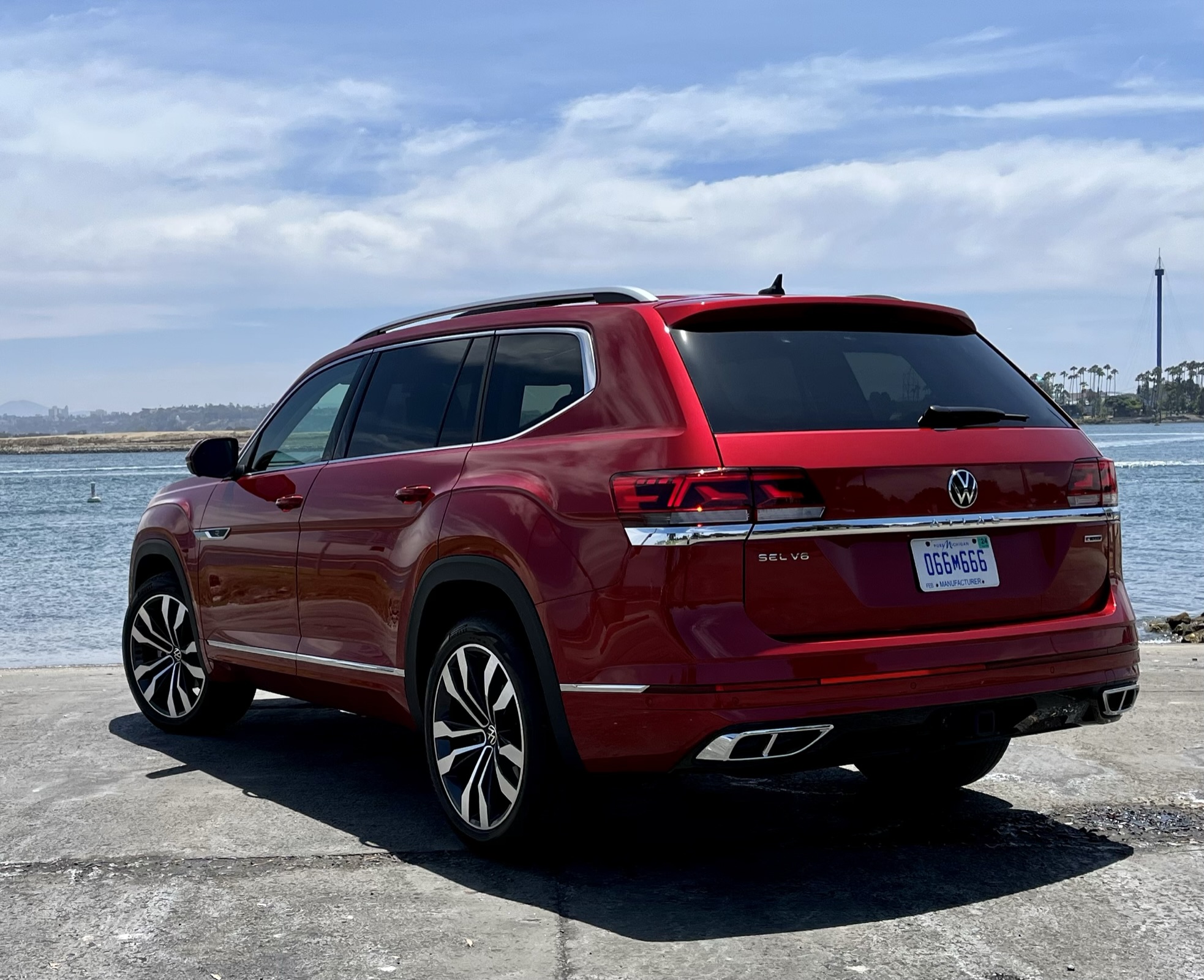
A rear three quarter view of the Atlas at a San Diego boat launch

Exterior features of the SEL Premium include a hands-free easy-open liftgate with remote opening and closing, LED taillights, silver roof rails, and a trailer hitch.

2022 Volkswagen Atlas VR6 SEL Premium R-Line Specifications

Body style: midsize, 6- or 7-seat SUV with 4Motion AWD

Engine: 276-hp, DOHC, 24-valve and direct-injected 3.6-liter VR6 with idle stop-start; 266 lb.-ft. torque at 3,600 rpm

Transmission: 8-speed Tiptronic automatic with Sport mode;

4Motion Fuel economy: 17/23/19 mpg city/hwy/combined; 87 octane recommended

BY THE NUMBERS

Towing capacity: 5,000 pounds with braked trailer

Fuel tank: 18.6 gallons

Cargo space: 20.6 to 55.5 cubic feet behind 3rd and 2nd rows

Front head/leg room: 41.3/41.7 inches

2nd-row head/leg room: 40.4/37.6 inches

3rd-row head/leg room: 38.3/33.7 inches

Length/wheelbase: 200.7/117.3 inches

Curb weight: 4,605 pounds

Turning circle: 40.5 feet

FEATURES

Standard SEL Premium exterior equipment includes: all-weather lights with low-speed corner illumination, automatic headlights with arriving/leaving feature, hands-free easy open liftgate with remote opening and closing, heated windshield washer nozzles, 2 front USB-C data ports, 1 center USB-C charging port, 2 rear USB-C charging ports, LED performance headlights with LED daytime running lights and LED taillights, power tilt-slide panoramic sunroof, power heated and power-folding side mirrors with memory, rain-sensing windshield wipers, silver roof rails, trailer hitch with 5,000-pound towing capacity;

Standard SEL Premium interior equipment includes: Keyless entry and push-button ignition, digital cockpit pro (gauge display), wireless phone charger, Bluetooth connectivity for phone and audio streaming, adaptive cruise control, overhead view camera, Discover Media touch-screen navigation system with 8-inch color display (with radio and voice control and travel assist), Fender premium audio system, satellite radio with 3-month trial subscription, App-Connect with wireless capability, leather-trimmed upholstery for 1st and 2nd rows, heated front seats and 2nd-row window seats, ventilated front seats, 10-way power-adjustable driver’s seat with power lumbar and memory preset, auto-dimming rearview mirror, Climatronic 3-zone automatic climate control, ambient lighting and LED interior lighting, a 115-volt power outlet, and remote start;

R-Line equipment includes: R-Line side skirts, front and rear bumper treatments with stylized air intakes at the front and a diffusor in glossy black paint at the rear, 21-inch two-tone matte dark-graphite alloy wheels with 265/45 all-season tires;

Safety features include: 6 air bags, dynamic road sign display, electronic brake force distribution, engine brake assist, adaptive front lighting system, blind-spot monitor, rear traffic alert, forward collision warning and autonomous emergency braking (front assist), park assist, park distance control with maneuver braking, pedestrian monitoring (included in front assist), lane assist, emergency assist, electronic stability control, anti-slip control, electronic differential lock;

PRICING

SEL Premium 4Motion base price: $52,800, including $1,295 freight charge; price as tested $53,890

Options on test vehicle: Aurora Red metallic paint $395 and second-row captain’s chairs $695

Where assembled: Chattanooga, Tenn.

Warranty: 4-years/50,000-miles bumper to bumper and powertrain; free scheduled maintenance for 2 years or 20,000 miles; 3-years/36,000-miles 24-hour roadside assistance

Aston Martin Reveals New Wings Logo

Aston Martin Reveals New Wings Logo

New logo and strategic repositioning build on Aston Martin’s growing appeal to a broader, affluent global audience

aston Martin's F1 race car in a deep emerald green

The Aston Martin Aramco Cognizant F1 Team will fly the new wings on its livery for this weekend’s French Grand Prix. It is a tribute to the 100th anniversary of the brand’s first Grand Prix entry.

BY MARK MAYNARD

Aston Martin launched a new logo and a new creative brand strategy to reposition the British ultra-luxury marque.

The global marketing campaign of “Intensity. Driven.” is intended to accelerate its growth among new audiences, Renato Bisignani, Head of Global Marketing and Communications at Aston Martin, said in a statement. The campaign was launched July 20.

The new Aston Martin logo

The subtle redesign of the wings.

The strategic repositioning builds on Aston Martin’s growing appeal to a broader, affluent global audience.

In addition to the new visual and verbal expression, the redesign includes a contemporary update to the iconic wings. The refreshed design of the wings logo is subtle. Comparing old and new, there are bolder lines and no half arc around the brand name.

The handcrafted badge was created with Peter Saville, an acclaimed British art director and graphic designer. Artisans handcraft the new logo in the Aston Martin jewelry quarter in Birmingham, England.

The new wings will fly for the first time on Aston Martin’s next generation of sports cars, elevated for ultra-luxury, performance, and driving intensity, Bisignani said in the release.

A timeline of Aston Martin logos

Aston Martin will symbolically race with its original button logo on the nose of its cars, mirroring the marque featured on its first Grand Prix entries in 1922.

‘Logotypes of provenance’

It is the first significant update to the marque since 2003 and only the eighth time in Aston Martin’s 109-year history that the logo has evolved.

The Aston Martin Aramco Cognizant F1 Team will have the new wings on its emerald-green livery for the French Grand Prix this weekend. It is a tribute to the 100th anniversary of the brand’s first Grand Prix entry. Aston Martin will symbolically race with its original button logo on the nose of its cars, mirroring the marque featured on its first Grand Prix entries in 1922.

The story behind the Intensity. Driven. campaign is highlighted in a short film featuring all five of Aston Martin’s current high-performance production models: DBS, DB11, DBX, V12 Vantage, and Valkyrie hypercar.

“Subtle but necessary enhancements not only keep forms fresh but allow for new technologies, situations, and applications to be accommodated in the future,” said designer Peter Saville. “The process was one of clarifying and emphasizing the key feature of the Aston Martin marque.

“The Aston Martin wings update is a classic example of the necessary evolution of logotypes of provenance,” he said.

View the film about Intensity.Driven. here.