Select Page

Audi A3 40 Quattro Review

Audi A3 40 Quattro Review

A test drive of the 2023 Audi A3 without activating Sport mode, just doesn’t tell the story of Audi’s smallest sedan

An exterior side view of an Atoll Blue Audi A3 sedan

For 2023, the Audi A3 continues with choices for front- or quattro all-wheel drive in trim levels of Premium or Premium Plus. (Photos courtesy of Audi USA)

Table of Contents

A History of A3 Firsts
2023 A3 Updates
A3 Model Line Pricing
A3 40 Performance
Driver-Assist Driving
Ride and Handling
Audi A3 40 Fuel Economy
Interior Function
Back Seats and Trunk Space
Why Buy the Audi A3?
Specifications

BY MARK MAYNARD

The Audi A3 shows its true colors — Red — in the performance modes of its 201-horsepower turbocharged four-cylinder engine and seven-speed S tronic transmission.

A test drive without activating Sport mode, or even the Dynamic performance setting, just doesn’t tell the story of this smallest Audi sedan. It can be a sleeper until prodded by the amped-up attitude of red in the gauge display.

By opting for this entry-level A3, the owner straps into a legitimate subcompact sport sedan without glam or gimmickry. It is the first touch point for this storied A3 family, which might be overlooked by the 306-hp Audi S3 or the 401-hp Audi RS 3.

Among the A3 standout features are the smartly designed interior, Audi’s shrewd engineering, a mild-hybrid engine, and the fact that this small sedan still has a spare tire! It’s a temporary spare with the jacking equipment, but with the broad electrification of vehicles, a spare tire is being deleted to make room for the battery pack and to save weight. The exception is larger vehicles and those intended for off-road travel.
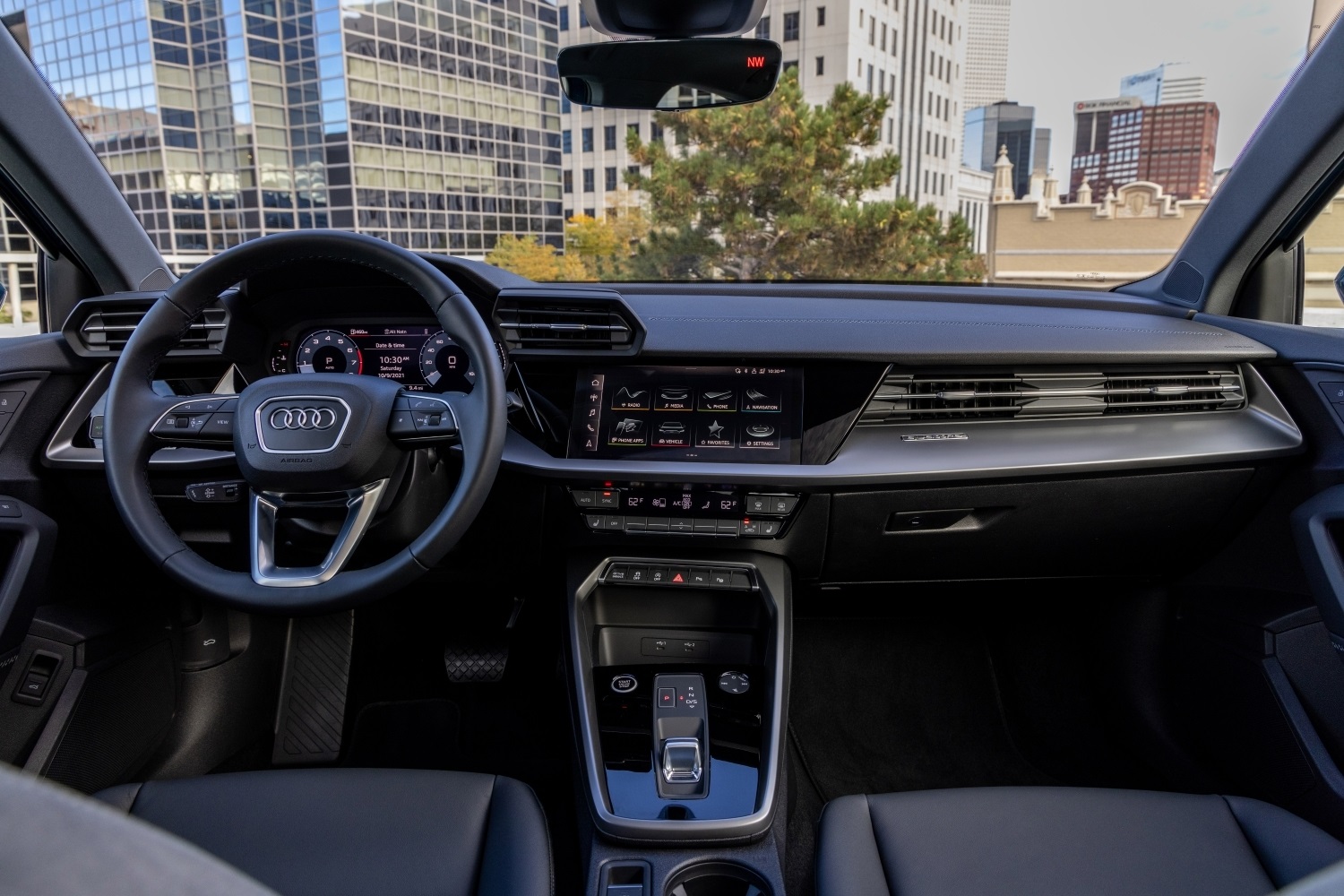
Looking through windshield from inside the driver seat of the A3

The A3 cabin seems to have been designed as a driver’s car — with a true coupe feel.

A History of Audi A3 Firsts

The Audi A3 made its U.S. debut in 2005 as a 2006 model. It was one of the first modern luxury-class subcompact sedans.

Redesigned for the 2015 model year, the A3 was one of Audi’s biggest marketing launches. Much of the fanfare was about its advanced technologies, which Audi calls industry “firsts.” Among its enhancements were:

  • First in-vehicle LTE connectivity (Long Term Evolution) with Wi-Fi;
  • The first Audi model to use the modular infotainment platform, MIB;
  • First integrated social networking applications and Picture Book Navigation;
  • And in 2014, the A3 won the award for World Car of the Year.
Looking through the 3 spoke steering wheel at the digital gauge array

The 10.25-inch digital gauge array.

2023 Audi A3 Updates

After its complete redesign and re-engineering for the 2022 model year, the 2023 A3 and S3 models have just a few packaging adjustments.

Full LED headlights and stitched door armrests in leatherette are now standard for the 2023 A3 40.

The A3’s Premium Plus trim adds LED interior lighting-plus package and an Agate gray fine grain birch wood inlay. Adaptive cruise control is available through Function on Demand for the base Premium trim.

For the A3 40, the 18-inch 5-spoke Y design wheels with a bi-color finish and all-season tires are now included in the Black optic sport package. And wireless phone charging has been added to the Convenience package for the A3 and S3.
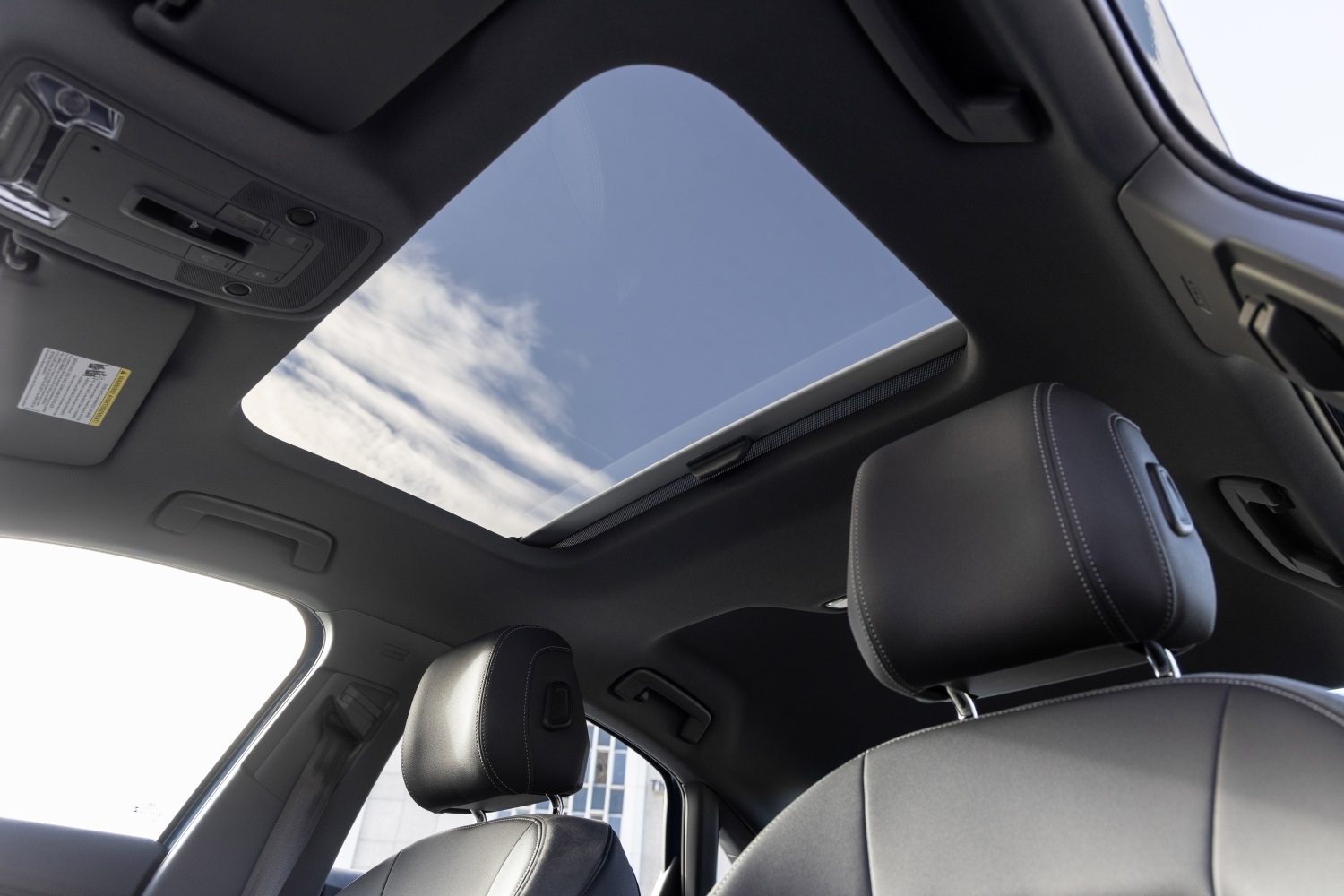
Looking up through the A3 panoramic sunroof

The Premium Plus features include a panoramic sunroof.

Audi A3 Model Line Pricing

The entry 2023 Audi A3 40 is available in front-wheel drive or quattro all-wheel drive. All A3 models have a seven-speed S tronic dual-clutch automated-manual transmission with performance modes. A3 starting prices range from about $36,000 for the front drive Premium trim to $43,145 for the Prestige Plus quattro, today’s tester. Including Atoll Blue paint ($595) and the Black Optic sport package, $1,550, the tester came to $43,740. All MSRPs include the $1,095 freight charge from Ingolstadt, Germany.

The main subcompact sedan competitors in size and price to the Audi A3 are the 2023 BMW 2-Series Gran Coupe four-door ($36,600) and the 2023 Mercedes-Benz A-Class ($36,095). Other potential competitors are the 2023 Acura Integra  ($32,000) and 2023 Cadillac CT4 ($35,790).

The infotainment screen in the A3

A 10.1-inch touch screen for rearview camera views and infotainment.

Audi A3 Premium Plus Features

Standard A3 Premium Plus technologies include:

  • Advanced key with push-button ignition;
  • Adaptive cruise assist with lane guidance;
  • Side assist with rear cross-traffic assist;
  • Active lane assist with emergency assist;
  • Parking system with park assist.

Convenience features on the A3 Premium Plus include leather-trimmed upholstery, panoramic sunroof, wireless phone charging, eight-way power (heated) front seats, driver’s seat memory presets, power folding and heated side mirrors, full HED headlights, garage-door opener. (See the longer list in the specs box at the end of the story.)

The A3 Black optic sport package adds:

  • 18-inch 5-spoke Y design wheels with a bi-color finish;
  • Pirelli all-season tires;
  • Black exterior trim;
  • Sport suspension lowers the ride height by a little more than half an inch, or 15mm.

Audi S3 and RS 3 Pricing

The Audi S3 starts at almost $47,000, with standard quattro AWD. With a few options, the price settles in at $56,000.

The RS 3 Quattro starts at almost $60,000. With desirable options, including the Black optic plus package ($750), Dynamic plus package ($5,000), RS sport exhaust system with black tips ($1,000), and Design selection interior ($1,500), the sticker grows to $69,000.

The Audi warranty of four years or 50,000 miles is for bumper-to-bumper coverage, with roadside assistance. The free first-scheduled maintenance is no longer offered. But Audi offers more comprehensive Care Select packages, starting at $999 for the A3.

Find current Audi A3 pricing here and special offers here.

A yellow Audi RS 3

The 401-hp, 5-cylinder Audi RS 3. Acceleration from 0 to 100 mph in 3.8 seconds.

Audi A3 Styling

Small can be spectacular in the A3 — but it might not appear so in its exterior styling. Its bold face instantly identifies the A3 as an Audi, and the unprovoking exterior design will transcend style trends for years to come. But it’s not a treatment that will lure motorists to follow the car hauler to the dealership.

The exterior design is balanced with a strong stance on the larger 18-inch wheels, though 17s are standard. The low front end can be a chin-scraper on driveways and when bounding through cross-street intersections.

The basic black interior doesn’t call out luxury, either. The engaging use of brushed metallic trim is youthful, but the assets of the A3 make themselves known after strapping in.

The A3 has LED headlights

The A3 has full LED lighting.

Audi A3 40 Performance

In the base drive mode of Comfort, A3 performance is mild and tuned for maximum fuel economy. At 3,494 pounds, which is a bit heavier than the BMW or Mercedes competitors, the official A3 40 fuel-economy ratings with AWD are 31 mpg city, 28 highway, and 36 mpg combined — using the recommended 87 octane fuel. Those ratings are a few mpgs better than the BMW and the Mercedes, which prefer premium fuel.

The A3’s 13.2-gallon tank could provide more than 400 miles of driving. I wouldn’t know because I was enjoying the Sport modes. My around-town mpgs were acceptable, but even then, I set the performance mode to “Comfort-Sport.”

The 201-hp 2.0-liter has 221 foot-pounds of torque, which peaks at a relatively high 4,000 rpm. That’s why performance in Comfort mode is comfortable. Activating Sport gives a bit more engine rev on take-off from a stop, which gets everything moving quicker into the upper rpms.

The seven-speed dual-clutch has the sensation of engaging first gear. That spooling and clutching can delay launch force as the turbo builds pressure and the transmission hooks up. But shift response at speed is quick and supportive of enthusiastic driving.

Especially appreciated is an honest exhaust and engine tone. There is no artificial engine-sound generator to give a hot-shoe impression. I’m quite capable of making noise on my own.

The A3 turbocharged four cylinder engine

The A3 has one powertrain choice of a 201-hp, turbocharged and direct-injected 2.0-liter four-cylinder and 7-speed dual-clutch transmission.

Driver-Assist Driving

The A3 Premium Plus packages the network of driver-assist technologies. It is a Level 2 hands-on system that will be an asset for those in the slog of highway commuting.

I found the system to be precise in its lane centering and a faithful roundhouse of eyes for protection from drivers who are less aware while driving.

The advanced-tech package includes:

  • Adaptive cruise assist with lane guidance;
  • Audi side assist with rear cross-traffic assist;
  • Adaptive cruise assist;
  • Active lane assist with emergency assist.

Mild Hybrid Technology

The direct-injected TFSI engine — Turbo Fuel Stratified Injection — has sophisticated engineering for power and economy from a 48-volt mild-hybrid (MHEV) system. It’s another first for the A3, allowing it to coast while the engine temporarily shuts off in certain driving situations. The system also applies energy recuperation on throttle-lift and braking.

Audi says the A3 40 TFSI quattro has a 24 percent improvement in combined efficiency compared with the previous quattro model; it had official mileage ratings of 28/36/31 mpg city/highway/combined.

What’s the 40 mean?

In Audi engine terms, the A3 40 somehow refers to the 2.0-liter engine’s horsepower, which globally ranges from 165 to 198 hp. But the current U.S. -spec Audi A3 40 has 201 hp. The higher the number, such as 45, the higher the horsepower. The Audi A8 large sedan has an engine ranking of 55 for its
335-hp, turbocharged 3.0-liter V-6.

The higher-horsepower Audi A3 S and R.S. models don’t use an engine code; they stand on their own.

Audi A3 40 Ride and Handling

Despite a low 0.27 coefficient of drag, there was more road and ambient cabin noise than expected from such a small car. The likely culprit is the Pirelli P Zero all-season tires, though all-season Pirellis are not known to be noisy. The 225/40 tires have good cornering grip and a treadwear rating of 500, which is in the midrange for hardness; the tire’s warranty is for 50,000 miles.

The steel-spring suspension has MacPherson struts at the front and a four-link rear. The setup nimbly handles weight transitions and has a tight turning circle of 36.4 feet (or maybe a little wider with the 18-inch tires). The highway ride quality is more compliant than expected from the 103.5-inch wheelbase, which is a few inches shorter than its competitors.

Braking is absolute, but not grabby, from 12-inch ventilated front discs and 10.7-inch solid rear discs. The four-wheel ABS integrates brake-force distribution, hydraulic brake assist, and the expected stability and traction controls.

The 18-inch alloy wheel and Pirelli P Zero tire

Pirelli P Zero all-season tires, 225/40.

A3 Interior Function

The A3 cabin seems to have been designed as a driver’s car — with an authentic coupe feel. There are wide-open sightlines at the side mirrors without complications of frames at the corner glass. Over-the-shoulder views are also open, and the rearview camera with guidance lines also gives a silhouette view of nearness to objects front or rear.

Small cars often have cluttered interiors for placement of all the switches and controls, but not in the A3. A designer took care to arrange the front door panels to have an easy reach to the door grab with ideal leverage, opening or closing. Window switches, mirror adjusters, seat-memory presets, door locks, and the trunk opener are all within finger reach. The storage area just below has plenty of stash space and a bottle slot.

The center stack of controls anchors the upper infotainment screen, which is clearly visible in all light conditions. A tier below it are the climate controls with simple switches. The stack continues into a wide and low shift console with a secure finger grip for gear selection, the ignition button, and the audio volume dial.

Audi builds its seats for the long drive. These are eight-way adjustable with seat-bottom tilt. And the seats are without extreme side or bottom bolsters, which avoid that unwelcome wedgie on entry or exit.

Front headroom of 36.8 inches, with the sunroof, might not fit the big-and-tall driver.

A3 back seat has short legroom of 35.2 inches

Back seat space is subcompact with max legroom of 35.2 inches.

A3 Back Seat and Trunk Space

Back seat space is subcompact with max legroom of 35.2 inches, when those in the front scooch forward. A tall exhaust-transmission tunnel interferes with five-seat capacity.

Trunk space of 10.9 cubic feet is also subcompact but spacious enough for travel and getaways. And the back seat folds in a three-way split, 40/20/40, with a ski passthrough.

Trunk space is small but expandable by the folding back seat

Trunk cubic footage is small, but the space is expandable by the 40/20/40 back seat. (Mark Maynard trunk photos)

The temporary spare in the A3

And the temporary spare tire, almost rare in new cars.

Why Buy the Audi A3?

In the late 1990s when the major European carmakers were competing to sell more cars in the U.S., the subcompact sedan was eyed warily. Could a subcompact sedan be profitable? Would it be perceived as luxury? Could it dilute the brand?

Ultimately, money won out. Audi and Mercedes-Benz took the first leaps, followed by BMW.

Reinforcing the brand’s status are the high-performance divisions for each of those brands — Audi RS, BMW M, or Mercedes-Benz AMG. Every entry-lux version of those subcompacts carries the halo of high performance, or, at least, the perception of it.

Audi’s A3/S3 subcompacts typically sell around 8,000 to 15,000 in a non-covid-impacted year. Add up base prices of about $40,000, and that’s not a bad return for the segment. And then factor the RS 3 sales of $60,000 to $75,000 each.

The Audi A3 40 represents the obsessive detail of Audi engineering and performance. The casual styling of the A3 40 belies the technologies beneath the exterior sheet metal. It is not overt performance but skilled refinement.

Don’t muscle the A3. Let the layers of its engineering envelop you to make a better driver.

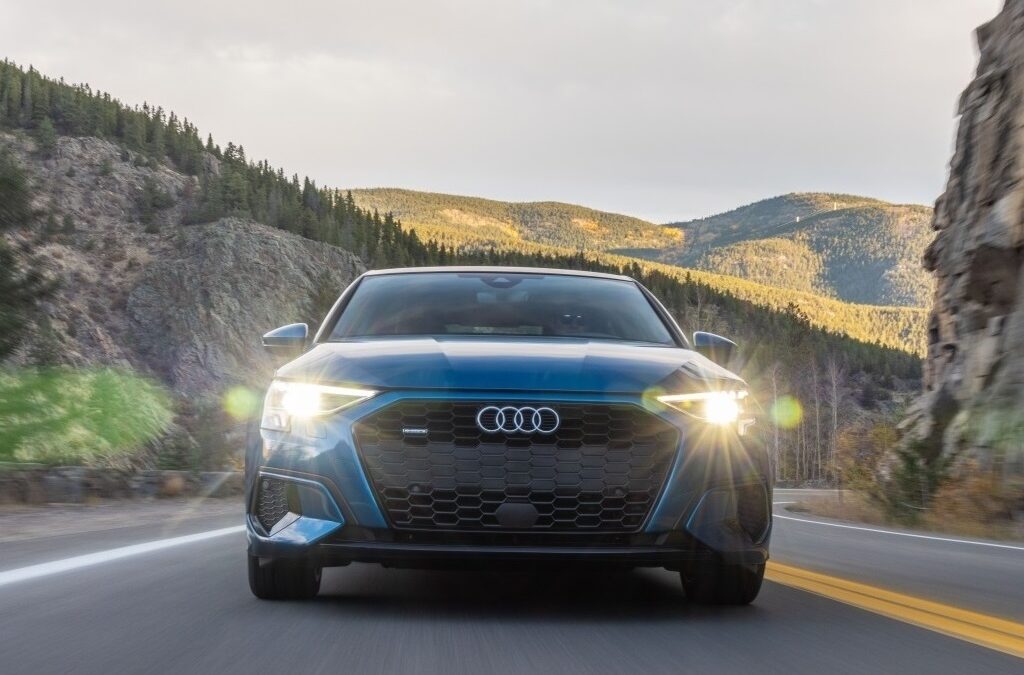
A rear view of the small sedan on a back country black top highway

2023 A3 starting prices range from $36,000 for the front drive Premium trim to $43,145 for the Prestige Plus quattro.

 2023 Audi A3 40 Specifications

Body style: subcompact, 5-seat, 4-door all-wheel-drive sedan

Engine: Mild hybrid 201-hp, turbocharged and direct-injected 2.0-liter 4-cylinder with auto stop-start; 221 lb.-ft. torque at 4,000 rpm

Transmission: 7-speed S tronic dual-clutch automatic

Fuel economy: 28/38/32 mpg city/hwy/combined; 87 octane

0-60 mph acceleration: 6.3 seconds (Audi)

Top speed: 130 mph

BY THE NUMBERS

Fuel tank: 13.2 gallons

Trunk space: 10.9 cubic feet

Front head/leg room: 36.8/41.2 inches

Rear head/leg room: 36.6/35.2 inches

Length/wheelbase: 176.9/ 103.5inches

Curb weight: 3,494 pounds

Turning circle: 36.4 feet

FEATURES

Premium Plus standard equipment includes: Audi advanced key with push-button ignition, leather-trimmed upholstery, panoramic sunroof, adaptive cruise assist with lane guidance, driver’s seat memory presets, wireless phone charging pad, 8-way power front seats, power folding and heated side mirrors, full HED headlights, garage-door opener, driver’s seat memory, leatherette-covered door armrests, wireless phone charging pad, 40/20/40 folding seatback;

Premium Plus Safety features include: 7 air bags, Audi side assist with rear cross traffic assist, adaptive cruise assist, alarm system with motion sensor, active lane assist with emergency assist, parking system with park assist,

PRICING

Base price: $43,145, including $1,095 freight charge; price as tested $43,145

Options on test vehicle: Atoll Blue metallic paint $595; Black Optic package $1,550

Where assembled: Ingolstadt, Germany

Warranty: 4-years/50,000-miles bumper to bumper with powertrain and roadside assistance (unlimited miles)

Kia Sorento PHEV SX-Prestige AWD Review

Kia Sorento PHEV SX-Prestige AWD Review

A road trip in a 2023 Kia Sorento plug-in yields 35.2 mpg over 1,225 miles after using 34 miles of battery driving

A forward view of the Kia Sorento PHEV along a marina with sailboats

For 2023, the Kia Sorento PHEV is sold in just one all-wheel-drive trim level with a starting price of $50,185. (Photos courtesy of Kia America)

Table of Contents

Overview
Competing PHEV SUVs
Pricing
Performance
Hybrid Battery Charging
Driver-Assistance Systems
Ride and Handling
Interior Function
Back Seats and Cargo Space
Why Buy the Kia Sorento PHEV?
Specifications

BY MARK MAYNARD

Ijust completed a 1,225-mile road trip in the Kia Sorento PHEV and logged an average of 35.2 miles per gallon. Much of the round-trip from San Diego to Sonoma, Calif., was driven at 70 mph with cruise control. I was pleased with the mileage and expect most owners of this all-wheel-drive, midsize SUV with three rows of seating would be, too.

A plug-in hybrid isn’t necessarily the optimum choice for a road trip, but the Sorento is ideal for its comfort and a sense of reinforced safety. With 31- to 34- miles of battery-electric driving, many owners could drive the workweek with minimal emissions, engine firing, and using pricey fuel.

The six-seat Sorento PHEV is rich in premium interior materials and contemporary design. The midsize cabin provides ample space for shoulder width, tall headroom, and a third row that folds flat to the floor. There is plenty of room for luggage and treasures picked up along the way.

The front seats in the Sorento PHEV

The midsize cabin provides ample space for shoulder width and tall headroom.

For daylong driving, the suite of advanced driver-assist systems took away much of the stress in guarding my line. I grew to trust the system, which kept the Sorento well-centered in the lane, including the curves. Steering assist was reassuring and not invasive. And I drove the entire round trip with no dashboard warnings or loud safety alerts: the Sorento and its network of electronics performed flawlessly.

Besides its suite of advanced safety technologies, the Sorento PHEV has solid NHTSA safety ratings:
• 4 out of 5 stars overall
• 4 stars for frontal and rollover crashes
• 5 stars for side-impact protection
• 4.5 stars for rollover protection

Kia Sorento Overview

Redesigned last year, the fourth-generation Kia Sorento is nearly 1.4 inches longer than the previous model, adding to interior space. The body structure was made stronger, which Kia says improved ride, handling, noise, vibration, and harshness.

The body structure is designed with a multi-load path to distribute the impact forces of kinetic energy through the body. Seven air bags are standard with an array of standard and optional safety technologies and advanced driver-assist systems.

As a midsize SUV crossover, the Sorento is part of Kia’s “Plan S” electrification strategy. The lineup of Sorento trim levels is a triple play of four-cylinder powertrains: gasoline, gasoline-electric hybrid, and the plug-in-hybrid.

The base gas-powered Sorento ($31,000) has a choice of a 191-hp, non-turbocharged 2.5 liter or a 281-hp turbocharged version ($37,000); both with an eight-speed automatic transmission.

The Sorento Hybrid ($38,000) has a turbocharged 227-hp, 1.6-liter engine, and six-speed automatic. And the top-line Sorento PHEV has a 261-hp version of the 1.6-liter engine and six-speed automatic.

A driving gauge shows available miles of electric driving

The plug-in Sorento has an electric driving range of 31 to 34 miles.

Competing Midsize SUV Plug-in Hybrids

  • Hyundai Santa Fe, 31-mile EV range; $41,000-$47,000;
  • Jeep Grand Cherokee 4xe, 25-mile battery range; $61,000-$69,000;
  • Volvo XC60 Recharge, 19-mile EV range; $59,000-$69,000;
  • Volvo XC90 Recharge, 18-mile EV range; $73,000-$80,000;
  • Lincoln Aviator Grand Touring, 21-mile EV range; $71,000;
  • BMW X5 xDrive45e, 31-mile range; $66,000;
  • Porsche Cayenne E-Hybrid, 17-mile range; $88,000; and Porsche Cayenne Turbo S E-Hybrid, 15-mile range; $173,000.

*Above MSRPs include AWD and the freight charge.

2023 Kia Sorento Pricing

For 2023, there is just one well-stocked trim level of Sorento PHEV, the SX-Prestige with all-wheel drive. And it has a one size fits all starting price of $50,185, including the $1,295 freight charge from Korea. With two options for Snow White Pearl paint ($445) and carpeted floor mats ($210), the as-tested price was a reasonable $50,840 (though there likely will be pricing surcharges at the dealership and a possible “protection” package that could add more to the sticker price).

A cargo cover, $190, would be a smart addition, as would a cargo-area mat, $115, which might help with soundproofing in an open cargo area.

Kia Sorento warranties include 10-years/100,000-miles of coverage for the powertrain and hybrid battery. Bumper-to-bumper coverage is for 5-years/60,000-miles with roadside assistance.

Find current pricing and available lease or purchase offers here.

The Sorento's panoramic roof

The panoramic roof as skylight.

Sorento SX-P Upgrades

Kia loaded the 2023 Sorento PHEV SX-P with desirable standard features. Among them:

  • 3-row seating with second-row captain’s chairs;
  • Perforated leather seat upholstery;
  • All-wheel-drive with torque vectoring;
  • 19-inch alloy wheels;
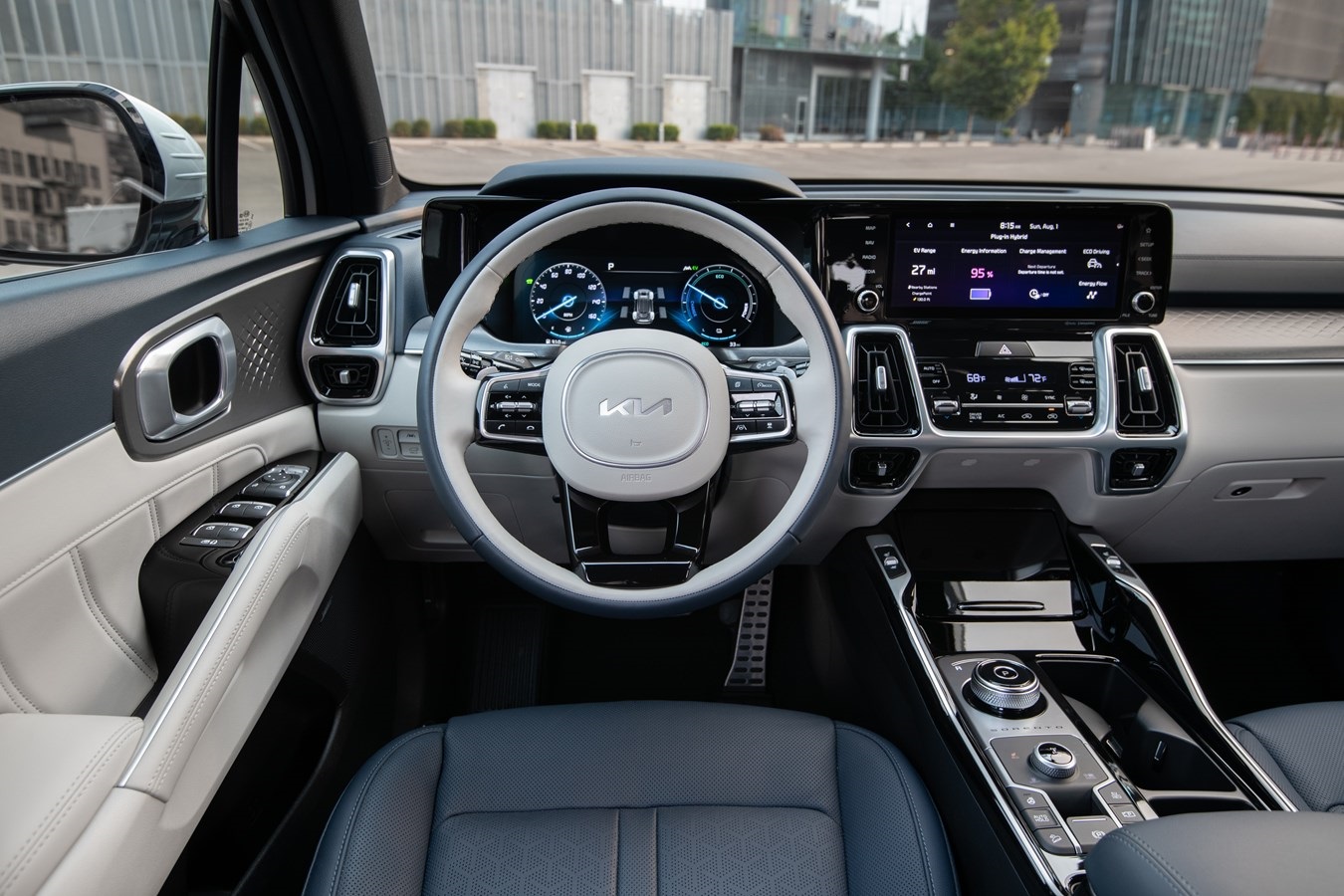
  • 12.3-inch digital gauge cluster (a first for any Kia SUV);
  • Surround View Monitor, using four cameras to create a 360-degree perspective around the vehicle;
  • Blind View Monitor projects live video view of adjacent lanes in the instrument cluster, activated via the turn signal;
  • Electrochromic rearview mirror.

Other standard Sorento PHEV features include:
•Smart key with push-button start and remote start (from key fob).
•Eight USB charging ports.
•10.25-inch high-resolution color touchscreen display with navigation and Kia’s UVO telematics link.
•Satellite radio.
•Wireless smartphone charging pad.
•12-speaker Bose Centerpoint sound system.

The Sorento shift console is a multifunction desktop of organization.

A multifunction desktop of organization.

Sorento PHEV Performance

According to the EPA, the Sorento PHEV’s combined gasoline-electric driving range can be as high as 460 miles. But in my experience, the most driving range I achieved, according to the onboard computer, was 390 miles. That factored the 31 miles of a fully charged battery and 359 miles from the gas engine.

After switching from battery power to engine, the EPA mileage ratings, using 87 octane fuel, are 35 mpg city, 33 highway, and 34 mpg combined, or a combined 79 MPGe rating.

Filling the fuel tank of 12.4 gallons with 87 octane wasn’t overly painful. Gas prices ranged from $5.99 per gallon at the start of my trip to $6.59 and almost $7 by week’s end. The price of unleaded 87 octane had jumped by $1 since I’d filled up for the trip.

Finessing the Fuel

Kia’s plug-in hybrid system switches from battery power to engine intervention for more aggressive driving. And even with a depleted battery, the hybrid system functions as any other hybrid system, giving some short-range and low-speed acceleration, regenerative braking, and auto stop-start at idle.

Because Kia uses a traditional, stepped six-speed automatic transmission, there is no delay in forward motion.

Driving with battery power lifts the performance noticeably. Acceleration is more absolute off the line and continues quickly up to highway speeds. After the transition to gasoline, the turbocharged four-cylinder is quite capable at hefting the Sorento PHEV’s curb weight of 4,537 pounds, which includes 309 pounds for the hybrid battery.

Torque-vectoring all-wheel drive (cornering control) includes a locking center differential. If the system detects wheel slippage, it reroutes power between the front and rear axles and applies subtle braking pressure to the left and right wheels to help maintain traction.

A view of the open engine and hybrid features in the Sorento engine bay

The Sorento PHEV has a 66.9 kW electric motor and a 1.6-liter turbocharged engine that combine for 261 horsepower.

Charging the Hybrid Battery

The 14 kWh lithium-ion polymer battery can be recharged in two to three hours or more, Kia says. And all of my charging sessions for a depleted battery took four hours. That is too long for a stop during a road trip, so most of my driving was on gasoline with some input from the hybrid system. I tried to charge in Sonoma, but the public charging station I visited had four charge stations, three of which were “unavailable.” Two other EV drivers had pulled in, and we shared gripes about the poor maintenance of public charging in general. The one functioning charger was occupied by a fully charged car, but no owner was in sight.

For those over-the-river trips to friends and family, Kia includes a heavy-duty charging cable that can be plugged into a household outlet. Plan on nine hours for a full charge.

Driver-Assistance Systems

I am a hands-on driver when using driver-assist systems. It takes time to develop trust in these electronics. Still, Kia’s assistance calibrations were accurate and prevented the Sorento from drifting across lane lines, and it even tracked well when the lane lines were disrupted or decayed.

The Sorento PHEV has an expansive network of Kia Drive Wise Advanced Driver-Assistance Systems, including:

Blind Spot Collision Avoidance Assist — Rear with parallel exit: Under certain conditions, the system can detect vehicles traveling in the next lane. When a vehicle is “seen” in the blind spot, it brakes the outer wheel to help return the vehicle to its lane.

Forward Collision Warning: Designed to detect a vehicle ahead and to calculate distance and closing speed. The system will fire off an alert if it senses a potential frontal collision.

Forward Collision-Avoidance Assist — Junction Turning: As the driver brakes to prevent a collision, the system can lessen the effects when turning left and an oncoming vehicle is approaching.

Highway Driving Assist: Uses federal highway speed limit information from the navigation system and, under certain conditions, will automatically adjust speed to be within the posted speed limit.

Intelligent Speed Limit Assist: Automatically changes the set speed of Smart Cruise Control by using the speed limit information detected through the front camera or GPS navigation information.

Lane Following Assist: Follows lane markings with steering inputs to help maintain lane-centering.

Navigation-Based Smart Cruise Control — Curve: The system can reduce vehicle speed proactively before upcoming curves.

Rear Cross-Traffic Collision-Avoidance Assist: When approaching cross traffic is detected, the system alerts the driver and can apply the brakes.

A shot of the 19-inch tire and wheel package for the Sorento plug in hybrid

Alloy wheels and 19-inch all-season Continental CrossContact LX Sport tires are standard.

Sorento PHEV Ride and Handling

Sorento’s steel-spring suspension (front MacPherson struts with a multilink rear) capably handles the hefty curb weight. Straight-line ride quality is quite smooth, and I could sense the engineering for low friction and extended glide. However, there is noticeable head toss when turning into driveways or navigating speed bumps.

The 19-inch Continental CrossContact LX Sport 235/55 tires are very compliant with a comfortable treadwear rating of 480, which translates to a 50,000-mile warranty.

Four-wheel ventilated disc brakes have 12.8-inch rotors front and rear. Pedal response is refined and regeneration is well modulated without unexpected grabbiness.

Kia Sorento Interior Function

There appears to have been a generous budget to make the Sorento PHEV more luxurious than some entry-luxury vehicles. The cabin is rich in premium materials, neatly stitched leather, and soft surfaces for elbows. The black woven headliner is calming without making the cabin feel closed in.

Driver sightlines are open at the side mirrors by the small corner glass. Over-the-shoulder glances are compromised by the second-row headrests of the captain’s chairs. But the restricted view was of no consequence with the around-view camera system and Kia’s nifty turn-signal camera views, left or right.

Front headroom is tall at 40.3 inches with long legroom of 41.4 inches.

Fourteen-way power front seats are comfortably bolstered and well-stuffed to handle a tankful of road-trip driving. The seats include a newly added thigh extender, so tall drivers should be able to find an optimum position.

The center shift console is a multi-use desktop. The shift module anchors the rotary shift dial and performance-control selections (Eco, Sport, Smart). The wireless charging pad, two charging USBs, and a data-media USB are just ahead on the console.

Driver information is easily viewed on the 12-inch-wide screen, which can be configured to show a range of functions. But there is a lot of information to fit in the smallish gauge dials.

Infotainment selections are separated from the 10.25-inch touchscreen with AC and vent controls below.

Especially appreciated are the second-tier air vents, four of them across the dashboard. A female friend once told me that she bought her SUV because it had crotch-cooling vents, and the Sorento’s venting should have the same effect.

A door panel in the Sorento PHEV shows contemporary design and materials.

Sorento PHEV is rich in premium interior materials and contemporary design.

Kia Sorento Back Seats and Cargo Space

Legroom in the second row is impressively long at 40.3 inches with headroom of 39.1 inches. And the expansive pano roof creates an enjoyable space. But the seat bottoms of the captain’s chairs might feel downsized to upsized adults.

A flat second-row floor adds to a sense of openness. And the seats have several inches of fore-aft slide with seatback recline.

Second row legroom is long at 40.3 inches but seat bottoms are short.

Legroom is long at 40.3 inches but seat bottoms are short.

Third-row space is kid-class, but with easy access.

Third-row space is kid-class, but with easy access.

Access to the pair of third-row seats is by an easy-to-operate tilt and slide second row. Legroom is kid-class at 29.6 inches (or less if the second-row seats are not moved forward). However, the space is accommodating with a USB charge port on each side, and a cup-mug holder and a burger-snack slot.

Large corner glass is a humane child-tending addition for ambient light.

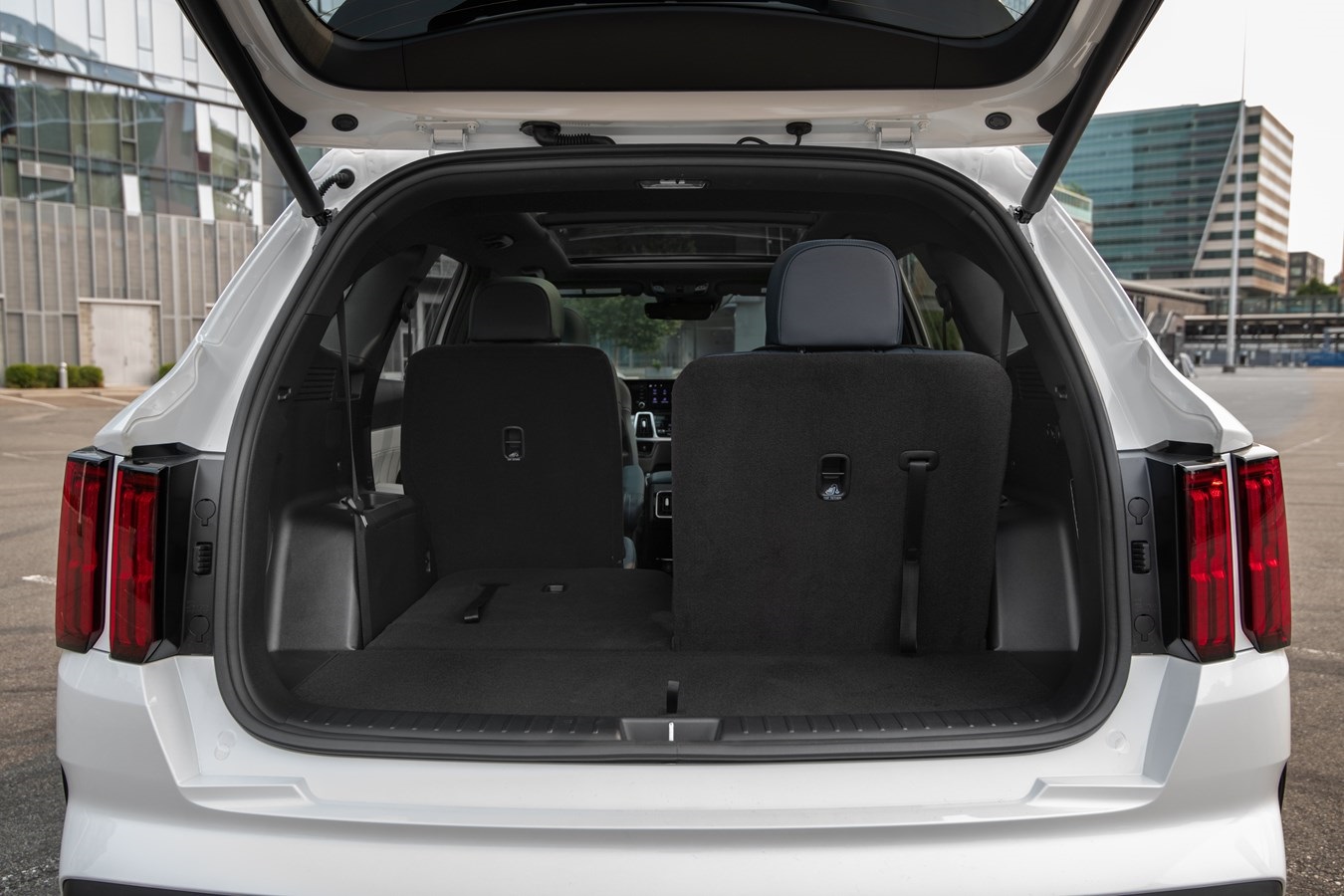
The cargo area has wide access of 44 inches with 30 ½ inches of entry height. Fold the third-row seats for 41 inches of square and flat cargo space. Handy straps on the back of the seats make them easy to pull back into position.

Or fold both rows of seats for almost 7 feet in length (if the front passenger seat is moved forward).

There is some subfloor storage, but it’s not large enough to stow the charging cable.

The Sorento’s third row that folds flat to the floor.

The Sorento’s third row that folds flat to the floor.

Why Buy the Kia Sorento PHEV?

A plug-in hybrid is a half-step to total battery-electric driving. For many drivers, a plug-in will be a smart choice until battery technology advances to provide more than 300 miles of cost-effective range.

The Kia Sorento Hybrid is also a good family choice. It is less expensive with fuel economy ratings of 39/35/37 mpg in front drive or 36/33/36 mpg AWD. But it does not have the value-added asset of fuel-price protection.

A range of 31 to 34 miles is almost like getting a free gallon of gas every day from the Kia Sorento PHEV. And for those owners with a home charger, there is the reassurance of always having a full “tank.”

the rear quarter panel for the charging port.

The Sorento PHEV plug port is at the rear quarter panel.

2023 Kia Sorento PHEV SX-AWD Specifications

Body style: midsize 6-seat, 5-door SUV with active on-demand 4WD

Engine: 177.2-hp turbocharged 1.6-liter 4-cylinder; 195.4 lb.-ft. torque from 1,500-4,500 rpm

Hybrid System: 89.8 hp permanent magnet motor with 360-volt, 14 kWh lithium-ion polymer battery

Total system power: 261 hp and 258 lb.-ft. torque

Transmission: 6-speed automatic

Battery-electric driving range: 31-34 miles

Total driving range: 460 miles, maximum (390 miles observed)

MPGe fuel economy equivalent: 54/48/52 mpge city/hwy/combined; regular unleaded fuel

Engine-only fuel economy: 35/33/34 mpg; 87 octane recommended

Top speed: 74.6mph in EV mode; 120 mph for ICE

0-62 mph acceleration: 8.7 seconds

Towing capacity: 1,654 pounds with an unbraked trailer

BY THE NUMBERS

Fuel tank: 12.4 gallons

Cargo space: 12.6 to 38.5 cubic feet

Front head/leg room: 40.3/41.4 inches

2nd-row head/leg room: 39.1/40.3 inches

3rd-row head/leg room: 36.8/29.6 inches

Length/wheelbase: 189.4/110.8 inches

Curb weight: 4,537 pounds (including 309 lbs. for the hybrid battery)

Turning circle: 37.9 feet

FEATURES

Standard Sorento equipment includes: smart-key entry with push-button ignition and remote start, power and heated front seats, 2nd-row captain’s chairs, one-touch slide and fold 2nd-row seats10.25-inch touchscreen with navigation and MapCare, Android Auto and Apple CarPlay apps; UVO link with a free trial; satellite radio 3-month free trial; 4.2-inch supervision cluster, USB charging in all 3 rows

Standard Sorento exterior equipment: 19-inch wheels; hands-free liftgate; roof rails; LED projector headlights, fog, and taillights; heated side mirrors with turn-signal indicators .

Sorento SX-P AWD features include: surround-view monitor, blind-spot view monitor, Bose premium audio, 12.3-inch digital instrument cluster, perforated leather upholstery, ventilated front seats, heated 2nd-row seats, auto-dimming rearview mirror, power-folding side mirrors, parking collision-avoidance assist-reverse, multi power adjustable driver’s seat with memory.

Safety features include: 7 air bags (including driver’s knee bag), rear occupant alert with ultrasonic sensors, stability and traction controls

Driver-assist technologies: forward collision avoidance (cyclist and junction turning), blind-spot collision avoidance assist-rear; rear cross-traffic collision avoidance assist, intelligent cruise control with stop and go; lane-keeping assist and lane-following assist, parking distance warning, forward and reverse

PRICING

Base Kia Sorento PHEV price: $50,185, including $1,295 freight charge; price as tested $50,840.

Options on test vehicle: Snow White Pearl paint $445; carpeted floor mats $210.

Where assembled: Hwasung, Korea

Warranties: 10-years/100,000-miles powertrain; 5-years/60,000-miles bumper-to-bumper coverage with roadside assistance.

Bentley Debuts 3 Hollywood-Inspired Continental GTCs

Bentley Debuts 3 Hollywood-Inspired Continental GTCs

The curated, pastel-colored Continental convertibles were created for Bentley Beverly Hills to showcase bespoke design and craftsmanship

The 3 pastel-colored Bentley Continental convertibles

The three special-edition hues and finishes recall the golden age of Hollywood. Sage Green is in the lede. (Photos courtesy of Bentley Motors)

BY MARK MAYNARD

Bentley Motors, with its exclusive Mulliner division, has just released three new, curated, and pastel-colored 2023 Continental GTCs for the Bentley Beverley Hills dealership  . The hues and finishes recall the golden age of Hollywood, Bentley says.

The special-edition models are available in colors of Jetstream Blue, Sage Green and Hollywood Blush Pink.

Pricing for such a prized Bentley is difficult to determine and was not included in the press release. However, the starting price for a 2022 Bentley Continental GTC is around $222,000. But the BH models are unique with a V-12 engine and all-wheel drive and the prestige of having a special-edition model.

TheBlush Pink paint of the special edition Bentley Mulliner GTC

The Blush Pink GTC.

The Blush Pink interior

The Blush Pink interior.

The 650-horsepower W12 engine can launch the four-seat, 5,644-pound Bentley Continental GTC to 60 mph in 3.6 seconds with a top speed of 208 mph.

Special body features include color-coordinated 22-inch 10-spoke wheels with pinstripes to the wheel edge. Highlights of the interior include Linen main hide and contrast stitching with secondary leather in shades of the exterior color.

All models feature the Styling, Touring, and City specifications. The words “The Beverly Hills” in a 1930s typeface on the illuminated sill plate are a nod to Hollywood’s golden era.

Bentley Mulliner

Mulliner is Bentley’s in-house commission division. The relationship has endured for 99 years and continues to represent the ultimate in Bentley design and craftsmanship.

Bentley says that Mulliner plays a key role in defining the company’s future design DNA. Among the recent limited-edition design concepts are the Bentley Mulliner Bacalar, a series of 12 two-seat barchettas (open top), and the Bentley Mulliner Batur coupe, a run of 18 hand-built cars.

The Bentley Mulliner Batur, Bentley Mulliner Batur coupe, a run of 18 hand-built cars.

The Bentley Mulliner Batur, a run of 18 hand-built cars.

Bentley Bacalar, a series of 12 two-seat barchettas.

The Bentley Bacalar.

Bentley says that customers are showing an increasing appreciation of the individuality that a Mulliner feature can bring to their vehicle. That luxe treatment includes special features and finishes for unique and limited-edition coach-built vehicles.

Since 2020, the percentage of Bentleys with bespoke features has grown. The demand for Mulliner special paint finishes has more than doubled, and the number of personal commissions has tripled, Bentley says.

The exterior of the Jet Stream Blue Bentley

The Bentley Mulliner GTC in Jetstream Blue.

The Jet Stream Blue interior

The Jetstream Blue interior

Mulliner Legacy

Mulliner was founded in 1760 with a contract to provide coaches for the Royal Mail. The Northampton-based firm of F. Mulliner still made horse-drawn carriages into the 20th century. That direction changed when pioneer motorist Henry Jervis Mulliner steered the company into the automotive age.

His coachbuilding business of H.J. Mulliner established ties with Bentley Motors, starting with the coachwork for a Bentley 3 Litre at the 1923 Olympia Motor Show. That unique treatment began a family tree of Mulliner Bentleys, defined by lightweight materials and aerodynamic design, as seen in the 1952 R Type Continental.

The Sage Green interior

The Sage Green interior

Bentley Motors Headquarters

All Bentley Motors operations are in Crewe, England, including design, R&D, engineering, Mulliner, and vehicle production. Under the Bentley brand are five model lines: Continental GT, Continental GT Convertible, Flying Spur, Bentayga SUV, and Bentayga EWB. Bentley employs around 4,000 people at Crewe.

Follow Bentley Motors here.

Lamborghini Debuts New Dealership Design Aesthetic In San Diego

Lamborghini Debuts New Dealership Design Aesthetic In San Diego

Lamborghini Americas CEO Andrea Baldi attends Sept. 7 and 8 ribbon cutting for the redesigned Lamborghini San Diego showroom 

An exterior view of the Lamborghini San Diego dealership

Lamborghini debuted the new corporate identity and brand environment at Lamborghini San Diego, at 7440 La Jolla Blvd., La Jolla, Calif. (Lamborghini photo) 

VIP event follows record half-year sales for 2022

BY MARK MAYNARD

Lamborghini Americas CEO Andrea Baldi was in San Diego on Sept. 7 and 8 for the ribbon cutting of the redesigned Lamborghini San Diego showroom (O’Gara Coach) in La Jolla, Calif.

The new design aesthetic “affirms the brand’s commitment to its customers and new design direction for the future,” Lamborghini said in a statement.

The 4,430 square-foot retail space is more boutique than a typical automotive showroom, but Lamborghini’s presence is unmistakable. Like all Lamborghini models, the architectural treatment is thoroughly modern with polygonal geometric shapes, sharp forms, and diffused light and color.

Guests enjoying the dealership grand opening

The 4,430-square-foot retail space has a 360-degree client experience. (Mark Maynard photo)

Corporate Identity

The design treatment is in accordance with Lamborghini’s corporate identity, said San Diego Lamborghini General Manager Joe DeSantis. “All the U.S. dealers will have a similar look with consistent styling aspects.”

The exclusive event by VIP invitation drew around 120 potential intenders and showcased several special models. The new Urus Performante was displayed following its global debut last month at Monterey Car Week. Also showcased was the Pikes Peak record-breaking Urus in orange-and-black camo paint, still in its as-raced condition since the 100th mountain run in late June. Also on view were a Huracán Tecnica, in the electric green paint of Verde Selvan, and a Huracan STO (Super Trofeo Omologata), a street-drivable race car in a lighter shade of Verde Aries. Details below.

A display of fashion items and Lamborghini lifestyle accessories

The showroom includes an array of lifestyle accessories. (Mark Maynard photo)

Also open for perusing was the Ad Personam customization room. The space features bespoke options for paint colors, leathers, wheels, and carbon fiber accents. The idea is to have car buyers physically touch and play with combinations of colors and materials.

In the main show space are Lamborghini’s Collezione and Accessori Originali fashion offerings. Anyone can shop for clothing, lifestyle accessories, luggage, and collectibles like diecast Lamborghini models.

Introducing CEO Andrea Baldi

Andrea Baldi, 46, almost 47, was appointed last August as CEO of Automobili Lamborghini Americas. He is responsible for the company’s commercial operations in the U.S., Canada, and Latin America. Among the region, there are 48 Lamborghini dealers.

He lives in Maryland within distance of the VW Group headquarters in Herndon, Va., and Washington, D.C. He is married with two daughters, ages 17 and 9. Baldi grew up in Bologna, Italy, near Lamborghini and Ducati manufacturing in Sant’Agata Bolognese.

Lamborghini Americas CEO Andrea Baldi at Lamborghini San Diego

Lamborghini Americas CEO Andrea Baldi. (Mark Maynard photo)

He began his career with Ducati (a VW Group subsidiary) and has had work stints in New York and at Ducati’s U.S. headquarters in Cupertino, Calif., per an interview in Robb Report

He moved with his family to Shanghai, China, in 2008, where he was responsible for sales in the Asia Pacific market.

Baldi joined Lamborghini in 2010 and relocated to Singapore and then Beijing as the general manager for mainland China and, soon, all of Asia Pacific. In 2018, his career with Lamborghini advanced, managing a second region, Europe, the Middle East, and Africa.

Supply Chain Shortages

“I’ve been extremely lucky,” Baldi said. “Demand is above supply, and it is demand we have never seen.”

His biggest challenge today is keeping customers engaged until new Lamborghinis become available.

The United States continues as Lamborghini’s No. 1 market globally, with 1,521 vehicles delivered in the first half of 2022. Within the brand’s top region, California is the best performing market, representing 23 percent of total U.S. sales, followed by Florida at 15 percent.

But will the momentum continue? At this time, there are no new Lamborghinis for sale in any dealership in the U.S., Baldi said in an interview at the San Diego dealership opening. And worse, the shortage of new Lamborghinis is expected to last for the next 1 ½ to 2 years. Dealerships are buying up preowned vehicles to resell.

The lack of available new models has less to do with the microchip shortage and has more to due with the demand being so high, said dealership GM DeSantis in an email. “The Lamborghini models are in such high demand that our current waitlist for new vehicles is anywhere from 1-2 years, depending on the model.”

An image with Lamborghini San Diego General Manager Joe DeSantis receives a grand-opening silhouette model from Lamborghini CEO Americas Andrea Baldi and signed by Lamborghini CEO Stephan Winkelmann.

Lamborghini San Diego General Manager Joe DeSantis receives a grand-opening silhouette model from Lamborghini CEO Americas Andrea Baldi and signed by Lamborghini CEO Stephan Winkelmann. (Mark Maynard photo)

Lamborghini Electrification

The Italian manufacturer of supercars is at a shift point of change. Baldi said that the company is in its last year of selling only pure combustion engines in its sports cars. According to Automotive News, Lamborghini has allocated $1.7 billion for the shift to plug-in hybrids.

The iconic brand of super sports cars will launch its first hybrid model, possibly a plug-in, in 2023 as it moves to electrify its entire lineup by 2025. And with that electrification, Baldi said there would be a full battery-electric Urus SUV by 2028.

While Lamborghini is hybridizing its lineup, the company is celebrating the combustion engine to its end, Baldi said: “For a Lamborghini buyer, it is less about the price and more about value.”

New Lamborghini Models

Huracán Tecnica

The Huracan Tecnica, in Verde Aries paint.

The Huracan Tecnica, in Verde Aries paint. (Mark Maynard photo)

The Tecnica is the latest evolution of the V10-powered Huracan since the nameplate debuted in 2014. The 640-hp, rear-wheel drive car with rear-wheel steering can accelerate to 62 mph in 3.2 seconds. Pricing starts at $239,000.

Huracan STO

a Huracan STO (Super Trofeo Omologata), a street-drivable race car in a lighter shade of Verde Aries

a Huracan STO (Super Trofeo Omologata), a street-drivable race car in a lighter shade of Verde Aries. (Mark Maynard photo)

Beneath its somewhat familiar exterior is an all-new street-homologated race car. The Lamborghini Huracán STO — Super Trofeo Omologata — is a collaboration with Lamborghini Squadra Corse’s one-make race series with Huracán Super Trofeo EVO. It has technical features of rear-wheel drive, rear-wheel steering, a wider wheel track, and Lamborghini’s MagneRide 2.0 suspension.

Its 5.2-liter V-10 engine produces 640 horsepower and 417 foot-pounds of peak torque at 6,500 rpm. Lamborghini says that the Huracan STO will accelerate to 62 mph in 3 seconds.

With an aluminum and carbon fiber body, the Huracan STO has a dry curb weight of 2,951 pounds. (Carbon fiber is used in more than 75 percent of its exterior panels, Lamborghini says.) Pricing starts at $327,838.

Urus Performante

The Lamborghini urus that raced Pikes Peak

The Pikes Peak record-breaking Lamborghini Urus, still in its as-raced condition since the 100th mountain run in late June. (Mark Maynard photo)

Lamborghini’s big SUV recently tackled the 156 bends of Pikes Peak in 10:32.064, beating the previous 2018 record set by the Bentley Bentayga (10:49.902) by 17.838 seconds. The Urus Performante is wider, lower, and almost 104 pounds lighter for competition. Some light-weighting comes from using a sophisticated steel suspension rather than the standard air suspension. And with a body comprised of aluminum and composite materials, including a lot of carbon fiber, the Performante has a dry weight of 4,739 pounds.

The Performante’s uprated, twin-turbocharged 4.0-liter V8 engine has 627 hp and 627 lb.-ft. torque from 2,300-4,500 rpm. With all-wheel drive and an eight-speed automatic transmission, Lamborghini cites 0-62 mph acceleration in 3 seconds. Pricing for the 2023 Lamborghini Urus Performante starts in the U.S. at $260,676, excluding the shipping fee and gas guzzler tax. However, Baldi said there is a 1 ½-year wait for Urus Performante, and its limited production will be sold in just a few weeks.

Learn more about Lamborghini here. Contact Lamborghini San Diego here. And read more Lamborghini reports in Maynard’s Garage.

Chevrolet Bolt EUV Review

Chevrolet Bolt EUV Review

There is much to like about the simple usability of the 2023 Chevrolet Bolt EUV, especially its high-value pricing

A horizontal side view of the Bolt EUV somewhere on a beach

The 2023 Chevrolet Bolt EUV is sold in four front-wheel-drive trim levels. Starting prices range from about $28,000 to $33,190, including the $995 freight charge from Lake Orion, Mich. (Photos courtesy of Chevrolet or as noted)

Table of Contents

Overview
Range and Charging
Bolt Recalls
Pricing
Information About Bolt Tax Credits
Interior Function
Performance and One-Pedal Driving
Ride and Handling
Super Cruise Technology, Confusion
Why Buy the Chevrolet Bolt EUV?
Specifications

BY MARK MAYNARD

Six inches can be pretty satisfying when trying to make the best impression — especially when it’s in the back seat of a Chevrolet Bolt EUV.

The extended-length Bolt “Electric Utility Vehicle” was added for the 2022 model year, following the original Bolt’s debut in 2017. Both models share a battery-electric front-motor and front-wheel drive layout. The small SUV crossover has five seats, four doors, and a rear liftgate. The design of both models features a high-strength-steel frame and aluminum front fenders, hood, door, and liftgate.

Both versions of Chevrolet Bolt use the same powertrain:

• A 65-kWh nickel-lithium-ion high-voltage battery

• Variable-speed automatic transmission

• A permanent magnet 150-kWh drive motor

The shorter Bolt EV has an EPA-estimated driving range of 259 miles. The Bolt EUV, heavier by 90 pounds, has a range estimate of 247 miles.

Among the Bolt competitors for size, electric driving range, and pricing are the Kia Niro EV and Hyundai Kona EV.

The Bolt has roomy front seat area has tall headroom of 40 inches.

The roomy front seat area has tall headroom of 40 inches.

Chevrolet Bolt EUV Overview

Designing the Bolt EUV freshened the front-end styling which was also applied to the standard Bolt. But no exterior sheet metal parts are shared between the two vehicles.

The new body style is about 6 inches longer than the standard model on a wheelbase stretched by 2.9 inches. And back seat legroom grew by 3.1 inches, now at 39.2.

The new interior includes a flat-bottom steering wheel that incorporates the Regen on Demand paddle.

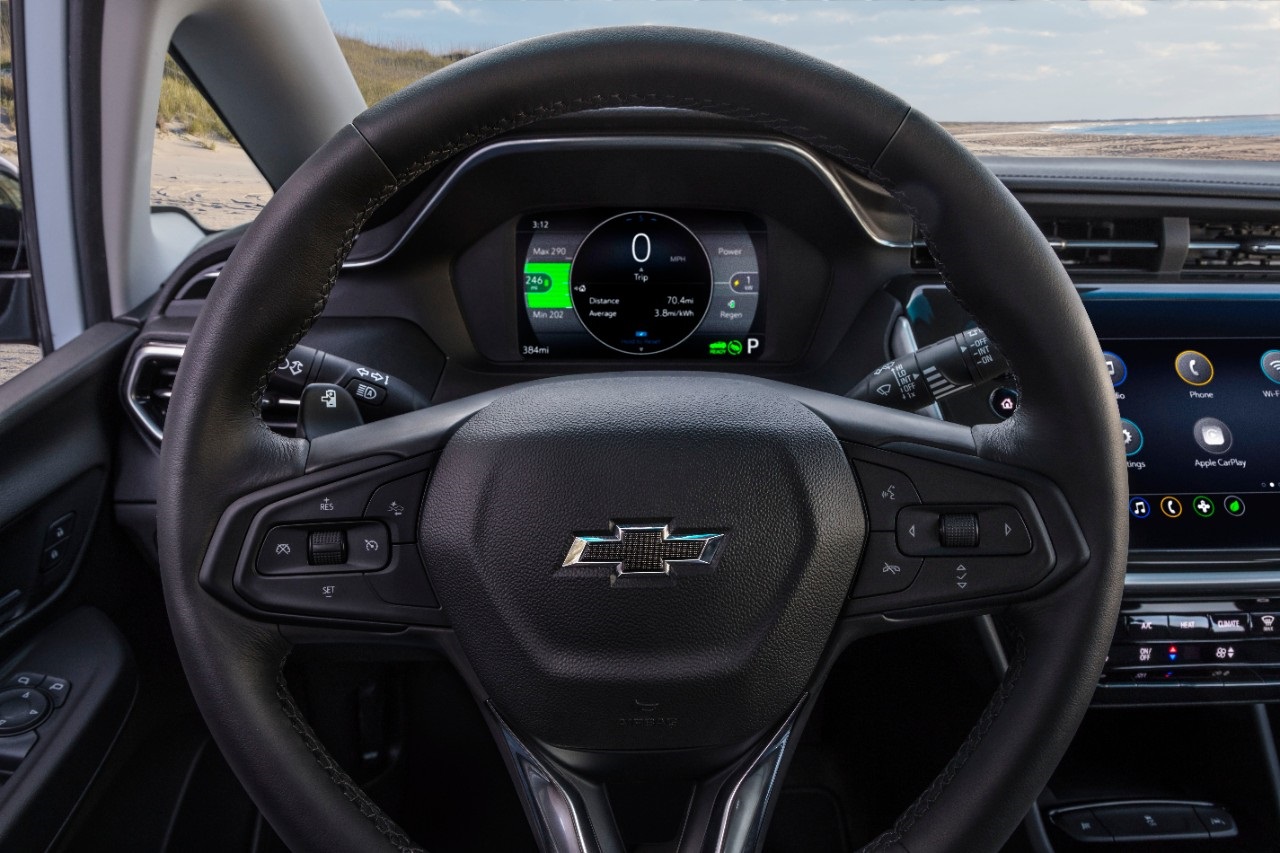
A view of the 8-inch color driver information center.

A view of the 8-inch color driver information center.

 Bolt Range and Charging

With every new Bolt EUV, Chevrolet includes a dual-level charge cord. It has a changeable plug that can be used with a household 120-volt three-prong outlet for Level 1 charging. Or change ends to plug into a 240-volt NEMA 14-50 amp outlet for 7.7kW Level 2 charging (the charge rate of many home EV chargers). For many Bolt owners, however, the dual cable function could eliminate the need to buy and install a home charger.

For maximum Level 2 charging speed, both Bolt models are capable of 11kW Level 2 charging, but only with a higher-capacity charger.

  • Level 1 120-volt charging will add about 4 miles of range per hour of charge.
  • Level 2 240-volt charging (with the dual-level charge cord) will add about 25 miles of range per hour of charge, with a full charge in about 10 hours.

Chevrolet will cover standard installation through Qmerit for Level 2 home charging. The offer is good whether leasing or purchasing a Bolt model.

And Chevrolet EV owners also have access to more than 80,000 chargers in North America through the Energy feature in the myChevrolet app. There are several other access points to the app, including:

  • Route planning and locations of available charging stations along the way.
  • Real-time alerts about range.
  • Click-to-charge payment for public charging.

Chevrolet Bolt Recalls

There is much to like about the simple usability of the Chevrolet Bolt or Bolt EUV, including their high-value pricing. Unfortunately, it was smacked down last year with a significant recall by the National Highway Traffic Safety Administration. GM had to recall all 143,000 Bolt and Bolt EUV models because of a battery manufacturing defect that increased fire risk. Korea-based LG Energy Solutions makes the lithium-ion batteries.

GM quickly found two manufacturing defects in the battery cells: a torn anode tab and folded separator. GM said that in some rare circumstances, the defects could lead to a battery fire.

The remedy is to replace entire battery packs or selected battery modules. Progress has been slow, and other occasional electrical glitches have been noted, according to comments on the many Bolt-owner websites. Among my sources were ChevyBolt.org and the Chevy Bolt Owners Facebook page.

Says General Motors: “We continue to prioritize battery module replacements for customers and are making progress every day. Customers who have completed the most recent software update can charge their [Bolt] battery to 100 percent capacity.”

Federal law requires automakers to provide hybrid battery warranty coverage of 8 years or 100,000 miles. But California requires a warranty length of 10 years or 150,000 miles.

Check here for Chevrolet information on the Bolt recall.

Owners may also contact the National Highway Traffic Safety Administration Vehicle Safety Hotline at 1-888-327-4236 or go to NHTSA.gov.

Chevrolet Bolt Pricing

For 2023, the 2023 Bolt EV is available in two trim levels: 1LT and 2LT, with starting prices of $26,595 and $29,795.

The 2023 Bolt EUV is available in four trim levels: LT, LT Redline, Premier, and Premier Redline. New for 2023, the Redline treatment includes black wheels with red accents, black leather-trimmed upholstery with red stitching, and a horizontal red line on exterior mirror caps. The Redline is available with no-cost paint colors of Mosaic Black Metallic, Silver Flare Metallic, or Summit White.

2023 Bolt EUV starting prices are $28,195 for the LT; $28,690 for the LT Redline; $32,695 for Premier, and $33,190 for Premier Redline. All Bolt MSRPs include the $995 freight charge from Lake Orion, Mich.

 Chevrolet Bolt Tax Incentives

Congress recently passed new legislation in the Inflation Reduction Act of 2022. The law changes credit amounts and requirements for clean energy vehicles, according to FuelEconomy.gov. Among the new requirements to qualify for a federal EV tax incentive, the vehicle’s final assembly has to be completed in North America.

In regard to the federal EV tax credit for the Chevrolet Bolt, General Motors is waiting on full Treasury guidance to determine vehicle eligibility. However, the IRA requirements make an important modification to the EV tax credit: It lifts the 200,000-vehicle-volume cap, which GM had already hit as an early mover on EVs.

According to GM’s latest statement on the federal EV tax credit provisions in the Inflation Reduction Act: “We think the legislation aligns very well with GM’s long-term plans, and over the life of the credit, we intend to offer a number of vehicles that should be eligible.

“While some of the provisions are challenging and cannot be achieved overnight, we are confident we can rise to the challenge because of the domestic manufacturing investments we are making to secure a supply chain for batteries and critical minerals,” GM said in the statement. “We will have more updates after the implementing guidance is finalized.”

For updates, check with your Chevrolet dealership or FuelEconomy.gov

Chevy Bolt Standard Equipment

There is no shortage of standard equipment on the base LT model. Among its safety features are 10 air bags, an electric parking brake, and Lane Keep Assist with Lane Departure Warning.

LT convenience features include keyless entry and starting with remote start, six-way manually adjusted front seats, wireless phone charging, USB type A and C charge ports, six-speaker audio system, HD rearview camera with guidance lines, and wireless capability for Apple CarPlay or Android Auto.

The 8-inch color driver-information center (gauges) has a choice of visual themes for Modern or Enhanced. And there is a screen that includes displays of vehicle efficiency with programmable charge times.

The Premier tester was $37,390 with the two major factory option packages of Sun and Sound ($2,495) and Super Cruise, $2,200. Details are below in the specifications chart.

Bolt EUV Premier adds such extras as perforated leather-trimmed upholstery, an eight-way power driver seat with two-way power lumbar, heated and ventilated front seats, heated steering wheel, and heated rear seats. Safety technologies include rear park assist, rear cross-traffic alert, rear camera mirror (digital), HD surround-view camera system, and lane change alert with side blind zone alert.

Find current pricing and special offers for the 2022 and 2023 Bolt EUV here.

A view of the Bolt shift console and upper infotainment system screen

Bolt electronics are not intimidating but facilitating.

Bolt EUV Interior Function

The Bolt EUV has big-and-tall head and leg room for a subcompact-class SUV.

Front headroom is large-vehicle tall at 40 inches as a hardtop or 39.1 inches with the dual-panel panoramic power sunroof, part of the $2,495 Sun and Sand package.

Legroom in the front seats is a lengthy 44.3 inches. There is comfortable seating for a 6-foot-6 passenger who has uncropped visibility out the windshield or having to steeply recline the seatback.

Back seat roominess benefits from a completely flat floor. While the rear legroom is long, the bench seat bottom is short for adult thigh support. But it works well for the school carpool or ride-hailing.

Cargo space is just a few tenths smaller than the standard Bolt. The space measures 16.3 cubic feet behind the back seat or 56.9 cu. ft. with the 60/40 back folded. The cargo entry opening is wide at 41 inches with multi-level capacity. Subfloor storage beneath the second level neatly stores the charging cables. Fold the back seat for 5 feet in length. And the roof rack is low enough to load bikes or other awkward-shaped gear that won’t fit inside.

Interior Design

Chevrolet interiors have a premium mix of plastics and other textured materials, all of which are in the Bolt.

The driver area is simply designed and straightforward to use. The technologies, such as the Chevrolet Infotainment 3 Plus touchscreen, are not intimidating but facilitating. Its 10.2-inch-wide screen is easily viewed, and there should be no frustration for tech beginners to page through the choices.

Especially welcome are physical switches for many cabin functions, such as fan speed, temp control, and seat heating and ventilation.

Driver sightlines are unencumbered at the side mirrors or over the shoulder. And in between, the Premier’s surround-view camera system gives overhead and front or rear views. It is salvation when inching out of tight parking to see when it is time to crank the steering wheel.

The Bolt EUV back seat

Short bench but long legroom of 39.2 inches in the Bolt EUV.

Performance and One-Pedal Driving

There is enjoyable kick to the Bolt EUV performance with its 200 horsepower and 266 foot-pounds of torque. For most of my test week, I nursed the battery reserve by driving in Normal mode. And then I found Sport mode, which changed my perspective. Sport mode adds a line-drive response to acceleration. It is not blunt-force fun, but Chevy cites an estimated acceleration to 60 mph in 7 seconds and 6.9 for the slightly shorter Bolt EV.

With a Level 2 charger at home and the freedom to charge at will, I felt empowered to enjoy the quickness of Sport mode. And, in my experience, it was not a significant drain on the battery. The quick zip is enjoyable around town and essential to guard your line in commuter traffic.

The 200-hp Bolt powertrain

The 200-hp Bolt powertrain. (Mark Maynard)

One-Pedal Driving

I especially enjoy the feature of one-pedal driving, the so-called e-Pedal. The driver can slow or stop the Bolt using only the accelerator pedal under most conditions. And at the same time, the system recaptures energy for the battery.

In time, drivers can anticipate their stopping distance and lift off the accelerator to stop precisely at the intersection. The function does not eliminate the need to use the brake pedal altogether, especially in emergencies. But using one-pedal driving reduces the switching back and forth between pedals, which can take away from the electric driving range.

The one-pedal function can be switched off at the shift-console button. Sometimes when inching along in heavy traffic or when parking, the e-Pedal operation can be jerky.

When one-pedal is not engaged, the driver can get manually applied regeneration by using the Regen on Demand paddle at the back of the steering wheel. Pulling the regen paddle activates the regeneration process, piping kinetic energy to the battery.

Bolt EUV Ride and Handling

For a tall and small SUV, the Bolt EUV rolls with uncommon smoothness and no choppiness on the interstate. The suspension is simple but well-engineered of front MacPherson struts with a solid stabilizer bar and a rear torsion beam with coil springs.

The driver might notice the heft of the curb weight, 3,715 pounds, with the 947-pound battery. But I experienced no bottoming-out in dips are sensitivity to chin scrapes at driveways.

The suspension has a comfort-ride composure, but the Bolt EUV is steady in evasive maneuvers or hard braking. Its turning circle of 38.3 feet is nimble enough in cramped parking or making a U-turn on a side street.

Regenerative four-wheel-disc braking has vented 11-inch front rotors and 10-inch solid rotors rear. There is good steering response and little noise or road harshness transmitted by the 17-inch Michelin Energy Saver Selfseal (215/50).

And the Bolts are dolly towable behind a motorhome.

Super Cruise Technology

The 2022 Bolt EUV is the first Chevrolet offered with Super Cruise, a so-called hands-free driver assistance technology for enabled roads. The assist system can be used on more than 200,000 miles of enabled roads in the U.S. and Canada.

Super Cruise employs many advanced technology features, including a Driver Attention System and precision LiDAR map data. The Driver Attention System uses a small camera on the top of the steering column. It works with infrared lights to determine where the driver is looking whenever Super Cruise is in operation.

If the Driver Attention System detects the driver’s gaze has turned away from the road ahead for too long, the steering wheel light bar will prompt the driver to return their attention to the road. If the system determines continued inattentiveness, it will use visible and audible alerts to notify the driver to take back control of the wheel.

I don’t like surprises while driving, and semi-autonomous or fully autonomous systems always inject a little surprise into the driving experience. In my experiences with Super Cruise, I consider it a good hands-on driver-assist system — and I always drive with my hands poised near the steering wheel.

Super Cruise Confusion

Like many driver-assist systems, Super Cruise is not precise in lane centering. At times, the system would issue alerts when the Bolt EUV crossed into the white lines of lane delineation — but it did not cross over completely.

It was a prior testing experience that really put me on guard. While testing a GMC Sierra with the hands-free system, Super Cruise misread the road ahead.

Along a section of Interstate 5 north of downtown San Diego near the state Route 52 exit toward La Jolla, the interstate runs beneath SR52 as it merges with the interstate. The divided highway of SR52 cast two bold shadows across I-5. Approaching the underpass at 65 mph, Super Cruise must have thought the dark shadows were solid objects. The system applied full braking force at the first shadow crossing the interstate. It could not have stopped the truck, as the Sierra crossed the first shadow, it resumed heavy acceleration. Then, just a few yards beyond it came upon the second shadow, and Super Cruise again slammed on the brakes.

Fortunately, in both incidents the highway behind was clear for several car lengths.

I took over steering as my pounding heart rate settled down. The Super Cruise system also shut down and gave a message that the dealership should examine the vehicle.

While testing Super Cruise in the Bolt EUV, I covered the same interstate route to see what would happen. It was a cloudy day, but the system still applied braking but less firmly at the lighter shadows.

If I were buying a Bolt EUV, I’d pass on the $2,200 Super Cruise option and enjoy the standard adaptive cruise control with stop-and-go.

Fold the Bolt's 60/40 folding back seat for about 5 feet in length.

Fold the 60/40 folding back seat for about 5 feet in length. (Mark Maynard)

Why Buy the Chevrolet Bolt EUV?

The Chevrolet Bolt EUV is not a lifestyle statement. It is a life choice — and a smart one. It has the familiar operation of a traditional car but elevated by electric power.

There are many compact SUV EVs that are theaters of dazzling electronic tech. And most of those can cost $50,000 and a lot more.

The Bolts are an uncompromising first step into the future of battery-electric vehicles.

The second level of Bolt subfloor storage.

The Bolt EUV’s second level of subfloor storage. (Mark Maynard)

The third level of Bolt subfloor storage for storing the charge cable

Charging cables and Super Cruise brain in the lowest cargo subfloor. (Mark Maynard)

Chevrolet Bolt EUV Specifications

Body style: subcompact, 5-door, 5-seat, front-wheel drive battery-electric SUV crossover

Transmission: 1-speed automatic with one-pedal drive and Sport mode

BATTERY SYSTEM

Battery: 65 kWh lithium-ion of 288 cells

Weight: 947 pounds

ELECTRIC DRIVE

Type: Single motor and gearset

Motor: 200-hp permanent magnetic drive motor; 266 lb.-ft. torque

Driving range: EPA-estimated 247 miles on a full charge

0-60 mph acceleration: 7 seconds, using Sport mode

CHARGING TIMES

120 volt: 4 miles of range per hour

240 volt, 32 amps (dual charge cord): 25 miles of range per hour; full charge in about 10 hours

240 volt, 48 amps: 37 miles of range per hour; full charge in about 7 hours

DC fast charge: up to 95 miles in 30 minutes

EPA fuel economy equivalent: 125/104 city/hwy MPGe

BY THE NUMBERS

Cargo space: 16.3-56.9 cubic feet

Front head/leg room: 39.1*/44.3 inches *40 inches w/o sunroof

Rear head/leg room: 37.8/39.2 inches

Length/wheelbase: 169.7/105.3 inches

Curb weight: 3,715 pounds

Turning circle: 38.3 feet

FEATURES

Standard equipment includes: smart key locking and push-button ignition, remote start, Chevrolet Infotainment 3 Plus with 10.2-inch wide HD color touch screen with voice recognition, electric parking brake, Bluetooth phone and audio, wireless Apple CarPlay and Android Auto capable, in-vehicle apps, wireless charging, efficiency display screens with programable charge times, perforated leather-trimmed upholstery, leather-wrapped steering wheel, 8-inch driver-information display, sliding visors with lighted vanity mirrors, 8-way power driver seat with 2-way lumbar, 6-way manual front passenger seat, heated and ventilated front seats, heated rear seats, adaptive cruise control, HD surround-view camera system, solar-absorbing glass, LED headlights-taillights-daytime running lights, 17-inch alloy wheels with carbon flash painted pockets, heated and power adjusted side mirrors with turn-signal indicators, rear wiper-washer.

Safety features include: 8 air bags; stability and traction controls; lane change alert with side blind zone alert, rear cross-traffic alert, and rear park assist (standard on Premier and available on LT).

Chevy Safety Assist includes automatic emergency braking, front pedestrian braking, lane keep assist with lane departure warning, following-distance indicator, forward collision alert, and IntelliBeam auto high beams.

PRICING

Bolt EUV Premier base price: $32,695 including $995 freight charge; price as tested $43,690

Options on test vehicle: Sun and Sound package, $2,495, includes 7-speaker Bose audio system, power dual-panel sunroof with power sunshade, Chevrolet Infotainment 3 Plus with navigation;

Super Cruise, $2,200, includes 3-years of Super Cruise connectivity and enhanced automatic emergency braking.

Where assembled: Lake Orion, Mich.

Warranties: 3-years/36,000-miles basic bumper to bumper; free first scheduled maintenance service; 8-years/100,000-miles electric propulsion components (but 10-years/150,000-miles in California); 5 years/60,000 miles roadside assistance and courtesy vehicle when serviced