Select Page

Mazda CX-30 Review — The Young Sophisticate

Mazda CX-30 Review — The Young Sophisticate

The 2021 Mazda CX-30 Turbo crossover doesn’t seem as small as a subcompact and is more premium in its interior presence than some in this segment

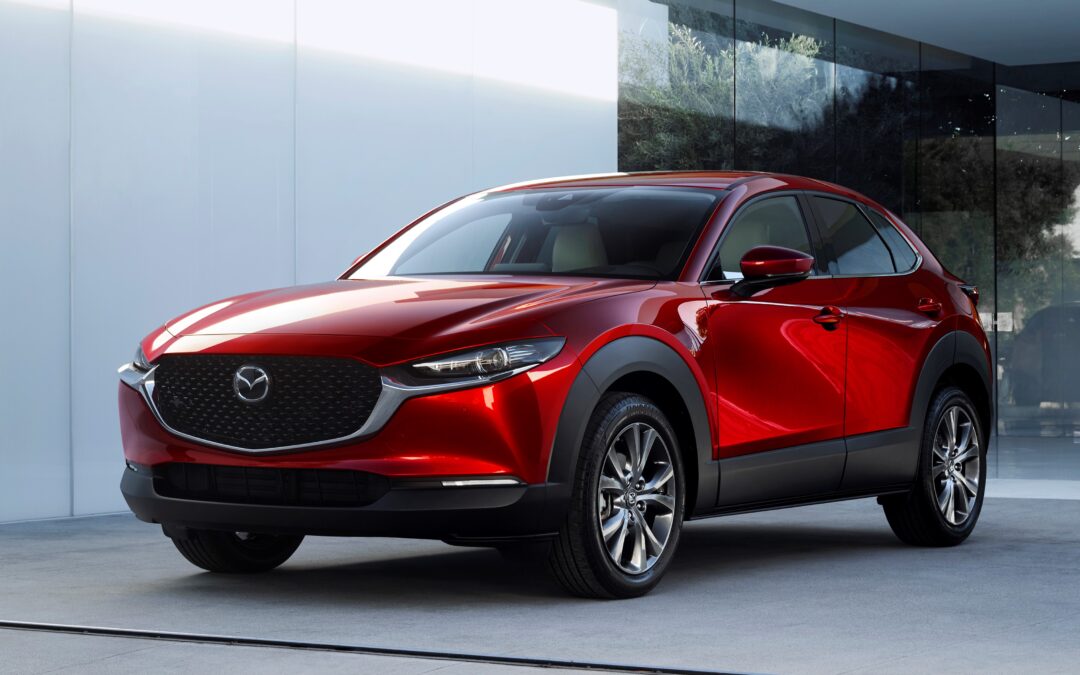
The front side view of the CX-30 Turbo

There is sophisticated simplicity to the Mazda CX-30 2.5 Turbo. (Photos courtesy of Mazda)

BY MARK MAYNARD

Horsepower isn’t everything at Mazda, but it makes a defining statement in the 2021 CX-30 Turbo subcompact crossover. This very likable SUV crossover debuted just a year ago as a callout to the brand’s drive toward premium — premium vehicles and premium dealership experiences.

The campaign focused on the refined touch points of vehicle interiors and fine-edge engineering under the skin. With, of course, the Mazda-infused love of driving.

For 2021, the 2.5-liter turbocharged four-cylinder builds on the standard 186-hp, 2.5-liter non-turbo engine. Mazda says the turbo engine has a peak 250 horsepower when feeding the engine premium fuel or 227-hp with 87-octane junk food. Peak torque comes on strong with 320 foot-pounds at 2,500 rpm with premium fuel or 310 lb.-ft. torque at 2,000 rpm on 87 octane.

Industry sources say to expect a CX-30 midcycle freshening in 2023.

Interior of the Mazda CX-30

Inside, the CX-30 environment is lean, dark, and determined.

Sizewise, the CX-30 slots between the subcompact CX-3 — which goes away after this year — and the compact CX-5. The CX-30 is marketed toward young drivers and couples starting a family. But its quiet and smartly designed interior will appeal to all ages.

Competitors include the Honda HR-V, Hyundai Venue, Jeep Compass, Mitsubishi Eclipse Cross and Nissan Rogue Sport.

Mazda CX-30 Pricing

Sold in four trim levels for the standard 2.5-liter model and three choices for the 2.5 Turbo, all with a six-speed automatic transmission. The non-turbo models are front- or optional all-wheel drive. The Turbo models include AWD.

Starting prices for non-turbo models range from $23,335 to $29,875, including the $1,175 freight charge from Salamanca, Mexico. Add $1,400 for AWD.

For those who enjoy the zoom of driving a Mazda, the move up to the Turbo from a 2.5 Premium is just $1,350. The 2.5T has starting prices of $31,225, $33,625 and $35,225 for base, Premium and Premium Plus, today’s tester.

With four options, the top-line CX-30 2.5 Turbo Premium Plus AWD tester was $36,220, which seemed fully priced for a subcompact vehicle. But it is a showcase of advanced technologies in a crossover that doesn’t seem as small as a subcompact and is more premium in its interior presence than some in this segment.

Options on the tester included Soul Red crystal metallic paint, $595; all-weather floor mats, $125; cargo cover $150; and stainless-steel rear bumper guard. But I would have happily added another $295 for wireless phone charging. For any new vehicle costing more than $35K that simple electronic aid should be included in the standard equipment.

The Premium Plus elements include content of the Premium model, such as the heads-up windshield driving display, adaptive (turning) headlights, 12-speaker Bose audio, LED headlights and taillights, heated steering wheel, leather-trimmed upholstery, Mazda Navigation (with 3-year Traffic and Travel Link Trial), paddle shifters, a power liftgate and satellite radio.

Premium Plus adds an auto-dimming driver’s side mirror, Traffic Jam Assist, parking sensors front and rear, 360-deree view monitor, Smart City Brake Support-Reverse and rear cross-traffic braking.

Find special pricing offers here.


Interior detail in the door panel of the Mazda CX-30

The interior has layers of depth in the interior design.

CX-30 Turbo Fuel Economy

I’d opt for the thoroughbred (premium) fuel, even though fuel economy isn’t what you might expect of a subcompact SUV, though the turbo CX-30 has standard all-wheel drive. The official ratings are 22 mpg city, 30 highway and 25 mpg combined. In a week’s test, my driving brought an average of 19 to 22 mpg around town and up to 34.6 mpg for highway driving, which might have risen a bit higher on a longer commute.

Commuters could expect nearly 400 miles of driving range from the 12-gallon fuel tank.

Gearshift console in the CX-30

The six-speed automatic gives quick shifts and keeps the engine in the power band.

Mazda CX-30 Turbo Performance

With a curb weight of 3,505 pounds, the CX-30 Turbo has good power to weight. And it brings the eagerness expected of a turbocharged Mazda. Sport mode fills the acceleration gap between fuel economy and fun.

True to Mazda’s philosophy, the CX-30’s keen drivability shows the harmony of the hardware. With a well-engineered steel-spring suspension, the CX-30 has an appetite for apex cornering, despite a torsion-beam rear axle. A torsion beam axle is often used in small utes because it is flat and doesn’t cut into cargo space. But in nearly all other applications, the torsion-beam setup feels unforgiving and clunky. Mazda engineering vaporized such concerns and the result is a sport sedan in little-ute pajamas.

Dive into a corner and there is no upsetting heave-ho as the suspension transitions the weight. The first time you experience this unexpected performance, you’ll want to do it again. The organically smooth electric steering and reassuring grip of four-wheel-disc braking have luxury-class refinement not expected of a mainstream subcompact.

Mazda Driver-Assist Technologies

Mazda’s i-Activsense safety package almost allows Level 2 semi-autonomous driving. The grouping of technologies includes radar cruise control with stop-and-go function (0 to 90 mph), lane departure warning with lane-keep assist and blind spot monitoring with rear cross-traffic alert.

The calibrations of lane-keeping assist will not prevent the car from crossing the highways lines or Botts dots. But it does alert the driver and will guide the car back into the lane when needed. Just don’t drive without hands on the wheel.

CX-30 Safety Features

The stars shine brightly for the CX-30 in NHTSA’s crash-test ratings: It earned the government agency’s highest five-star overall rating for driver and front passenger; five stars in the side crash test for front and rear seats; and four stars for low rollover risk. Learn more at SaferCar.gov.

Standard safety features include eight air bags, electronic brake-force distribution with brake-assist, driver attention alert and blind spot monitoring with rear cross-traffic alert.

Handcrafted Finesse

There is nothing disruptive in the exterior styling, which is pleasing and balanced, though the body looks large for its wheels. The separator is inside and how Mazda expanded roominess to almost compact-class accommodations.

There is handcrafted appeal in the Premium models. The leather-trimmed upholstery is tender to the touch and beautifully stitched for a patina that will age handsomely.

CX-30 Interior Function

Inside, the environment is lean, dark and determined with slender finesse. There is subtle use of brushed chrome, soft-touch manmade materials and gloss-black or carbon trim elements. Even the plastics appear to be of the same caliber throughout — without a ragged edge.

There is an openness to the front-seat area. There are 37.8 inches of headroom, with the sunroof, but it might not be suited to all members of the big and tall club. Sightlines are good at the side mirrors. They stand on their own and aren’t attached at base of the windshield pillars, which often creates a long blockage. But the smallish back glass and wrap of the pillar are limiting to rear-corner views.

Driver controls are refreshingly simple. The slim shelf of controls for heat-AC-fan works well for aim-and-touch adjustments while keeping eyes on the road. The 8.8-inch-wide top screen gives a broad view for navigation and vehicle info. But the rearview camera image uses a smaller portion of the screen when wider would be better. And even a front view would be helpful, or at least parking alerts, to avoid poking the shark nose into whatever is ahead.

The glove-soft leather of the three-spoke steering wheel made me want to keep both hands on the wheel, which is heated in the Premium Plus.

Back Seat and Cargo Area

The subcompactness of the CX-30  is felt in the back seat, but the doors open wide to aid access or to reach a child seat. The raised bench is comfortable — for smaller adults — with lots of footroom. There is a respectable 36.3 inches of max legroom, but the tall exhaust-transmission tunnel limits three-across comfort. There are no charging ports, though a cable stretched from the USB in the front armrest box could suffice.

There’s a usable square of cargo space, 20.2 cubic feet, but fold the 60/40 seats for about 5.3 feet of length.

CX-30 cargo area

There is a functional cargo space of 20.2 cubic feet. Fold the 60/40 seats for about 5.3 feet of length.

Why Buy the Mazda CX-30 Turbo?

There is a sophisticated simplicity to the CX-30 2.5 Turbo. It is a discriminating entry that demonstrates the Mazda mantra of “why, how and what a vehicle should be.” For drivers who enjoy driving, there are intangible rewards to ownership.

A rear view of the Mazda CX-30

The Soul Red Premium Plus AWD tester was $36,220.

2021 Mazda CX-30 2.5 Turbo Premium Plus AWD Specifications

Body style: subcompact, 5-seat, 5-door SUV crossover

Engine: Skyactiv-G direct-injected and turbocharged 2.5-liter 4-cylinder

Power: 250-hp using premium fuel or 227-hp with 87 octane); 320 lb.-ft. torque at 2,500 rpm on premium fuel or 310 lb.-ft. torque at 2,000 rpm with 87 octane

Transmission: 6-speed automatic

Fuel economy: 22/30/25 mpg city/hwy/combined; premium recommended

FEATURES

Standard equipment includes: smart-key locking with push-button ignition, power sliding-glass moonroof, rearview camera, radar cruise control with stop and go, 8-way power driver seat with power lumbar  and memory presets, heated front seats, electric parking brake,  60/40 split fold-down back seat, rear privacy glass, leather-wrapped steering wheel and shift knob

Safety features include: 8 air bags, electronic brake-force distribution and brake-assist, driver attention alert and blind spot monitoring with rear cross-traffic alert

PRICING

Base CX-30 Turbo price: $35,225, including $1,175 freight charge. Price as tested $36,220

Options on test vehicle: cargo cover $150; all-weather floor mats $125; Soul Red metallic paint $595; and stainless-steel rear bumper cover $150

Warranty: 3 years/36,000 miles bumper to bumper with roadside assistance and 5 years/60,000 miles powertrain

Mark Maynard

Spring brings Yokohama Tire’s annual rebate promo

Spring brings Yokohama Tire’s annual rebate promo

Yokohama Tire’s annual rebate promotion

2 offers will run through May 2, 2021, for $60 or $80 prepaid cards or virtual accounts


BY MARK MAYNARD

Yokohama Tire’s annual spring rebate promotion will run through May 2, 2021, and provides tire shoppers with a $60 or $80 Yokohama Visa Prepaid card or a Visa Virtual Account after purchasing a set of four select Yokohama tires.

The list of available tires for the rebate promotion include (Pricing estimates are from TireRack.com:

For the $80 Visa prepaid card or Visa Virtual Account:

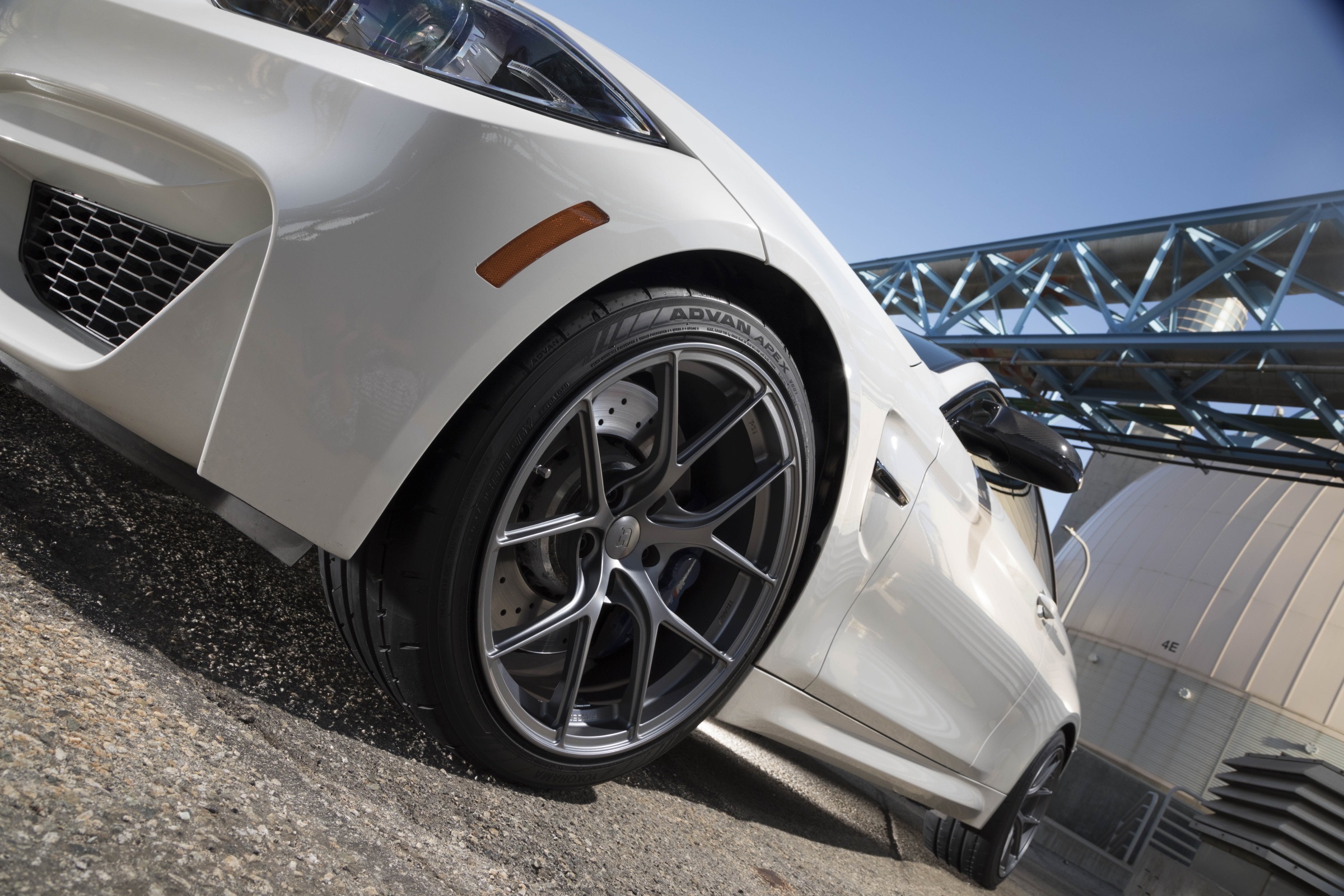
ADVAN Apex V601: Yokohama’s ultra-high performance street tire with a Y-rating for speeds up to 186 mph. The grippy rubber formula has a low 280 treadwear rating (UTQG) and it is warranted for up to 25,000 miles or 12,500 miles on staggered fitments. Available in wheel sizes of 17-20 inches. Depending on size and other dimensions, pricing ranges from about $150 to $350 per tire. Yokohama also has a 30-day trial satisfaction guarantee.

GEOLANDAR X-CV: An all-season performance tire for luxury sport crossovers and SUVs. It has a reasonably firm treadwear rating of 520 with a limited treadwear rating up to 50,000 miles. The rubber is formulated for a balance of good handling and ride comfort, with all-season capability, even in light snow. Depending on size and other dimensions, pricing ranges from about $200- to $300 per tire.

For the $60 Visa prepaid card or Visa Virtual Account:

ADVAN Sport A/S+: An ultra-high-performance all-season tire for sports cars, sporty coupes and luxury sedans. Depending on size and other dimensions, pricing ranges from about $150 to $300 per tire.

AVID Ascend GT: A grand touring all-season tire for passenger cars, crossovers and minivans. The rubber recipe is formulated for refined ride and noise comfort with long life and all-season traction, even in light snow. These tires are part of Yokohama’s BluEarth branding, to provide environmentally, human and socially friendly solutions. Depending on size and other dimensions, pricing ranges from about $90 to $215 per tire.

AVID Ascend LX: Another choice in Yokohama’s BluEarth line for a standard touring all-season tire, intended for passenger cars, crossovers and minivans. This tire has a very high (hard) 800 treadwear rating (UTQG) and has a warrantee for up to 5 years or 85,000 miles. Depending on size and other dimensions, pricing ranges from about $93 to $170 per tire.

GEOLANDAR CV G058: An all-season touring tire for small- and medium-sized crossover SUVs and minivans. Also in the eco-friendly BluEarth line, these tires have a high 740 treadwear rating and a warrantee of for 5 years or up to 65,000 miles. Depending on size and other dimensions, pricing ranges from about $133 to $210 per tire.

GEOLANDAR H/T G056: This is an all-season highway tire for trucks, SUVs and full-size vans. It is formulated for on-road, year-round use with all-weather handling and all-season traction, even in light snow. It has a warranty of 5 years or 70,000 miles for P-metric sizes or 5-years/50,000-miles for LT sizes; Half mileage for rear if different size than front. Depending on size and other dimensions, pricing ranges from about $120 to $280 per tire.

The rebates are available at participating Yokohama dealers nationwide and select authorized online dealers. Details of the promotion can be found here.

VW Atlas Cross Sport Review

VW Atlas Cross Sport Review

Volkswagen applied just about everything to its rakish 2021 Atlas Cross Sport, but is it enough for it to stand out?

The VW Atlas Cross Sport

The midsize VW Atlas Cross Sport 5-seat SUV redistributes space for a wealth of back-seat and cargo space

BY MARK MAYNARD

Volkswagen’s new Atlas Cross Sport shares a rich bloodline that also underpins the Lamborghini Urus, Audi Q8 and Porsche Cayenne Coupe, if not other nameplates in the VW Group global family. Consider it the sporting alter ego to the three-row, seven-passenger Atlas SUV.

Using the footprint of the family-oriented Atlas, the Cross Sport adopts a shaved roofline with a styling slant at the rear with redistributed back seat space for a long 40.4 inches of legroom.

Compared to the full-size Atlas, the Cross Sport is 5.2 inches shorter with a roofline lowered by 2.2 inches. Front headroom is still tall at 39.4 inches with a long 41.6 inches for legs. And even the cargo space is fully functional at 40.3 cubic feet behind the back seat (stacked to the ceiling) and 77.8 cu. ft. with the 60/40 back seat folded.

An interior view out the windshield of the VW

The cabin has broad front shoulder room of 61.5 inches and tall headroom of 39.4 inches. (VW)

New for 2021

The Cross Sport was new for 2020 and received a few technology updates for 2021. The next-generation MIB3 infotainment system with wireless app-connect and multi-phone pairing is now standard on SE models and above. And VW’s newest driver-assistance features of Travel Assist and Emergency Assist were added to SEL models and above.

Travel Assist is a semi-autonomous driving system that when activated will steer, accelerate and brake the vehicle when driving on a divided highway. The system is good at lane centering, but, as with many of these semi-autonomous systems, the vehicle will drift wide along sweeping highway corners.

The electronic Digital Cockpit (gauge display) can be configured to include the navigation map. (VW)

Atlas Cross Sport Pricing

The Cross Sport is sold in eight trim levels — S, SE, SE with Technology, SE with Technology R-Line, SEL, SEL R-Line, SEL Premium, and SEL Premium R-Line — in front- or 4Motion all-wheel drive.

Starting prices range from $32,050 for the entry front-drive model to $51,220 for the top-line V6 SEL Premium R-Line 4Motion (today’s tester); pricing includes the $1,195 freight charge from Chattanooga, Tenn. The tester, in Aurora Red metallic paint ($395), was $51,615.

The bumper-to-bumper warranty (including powertrain) of 4-years/50,000-miles includes free maintenance for 2 years or 20,000 miles.

Standard equipment on all models includes power and heated side mirrors, LED headlights-taillights-running lights, 18-inch alloy wheels, six-way adjustable driver’s seat, rearview camera, 6.5-inch color touch screen and 11 cup holders.

Find Atlas and Atlas Sport lease and financing incentives here.

The seats are Euro firm and the seat bottoms will feel hard after a couple of hours on the road. (VW)

Cross Sport Safety Features

Among the standard VW Cross Sport safety features are six air bags, forward collision warning and autonomous emergency braking. In addition, there is pedestrian monitoring, a blind-spot monitor, and rear traffic alert.

The 2020 and 2021 Atlas and Atlas Cross Sport received NHTSA five-Star overall crash safety ratings.

The 276-hp, direct-injection 3.6-liter VR6 and eight-speed automatic is rated for towing up to 5,000 pounds. (VW)

Cross Sport Powertrains

Powertrain choices are either a 235-horsepower, turbocharged and direct-injected 2.0-liter four-cylinder engine or 276-hp, direct-injected 3.6-liter VR6. Both engines are paired with an eight-speed automatic transmission.

Fellow car critics say the turbocharged 2.0-liter engine will be adequate for most needs. But those who tow will want the V-6. And there’s not much incentive to go for the four.

The 2.0-liter has fuel economy ratings of 21/24/22 mpg and nearly the same with AWD at 20/24/22 mpg.

The V-6 has EPA ratings of 18/23/20 mpg front-drive or 17/23/29 mpg AWD, using premium fuel for maximum power, but 87 octane is acceptable. In highway driving, I worked up to 24.2 mpg, but around-town mileage was typically between 15-18 mpg. The 19.5-gallon tank should provide commuters around 400 or more miles before refueling.

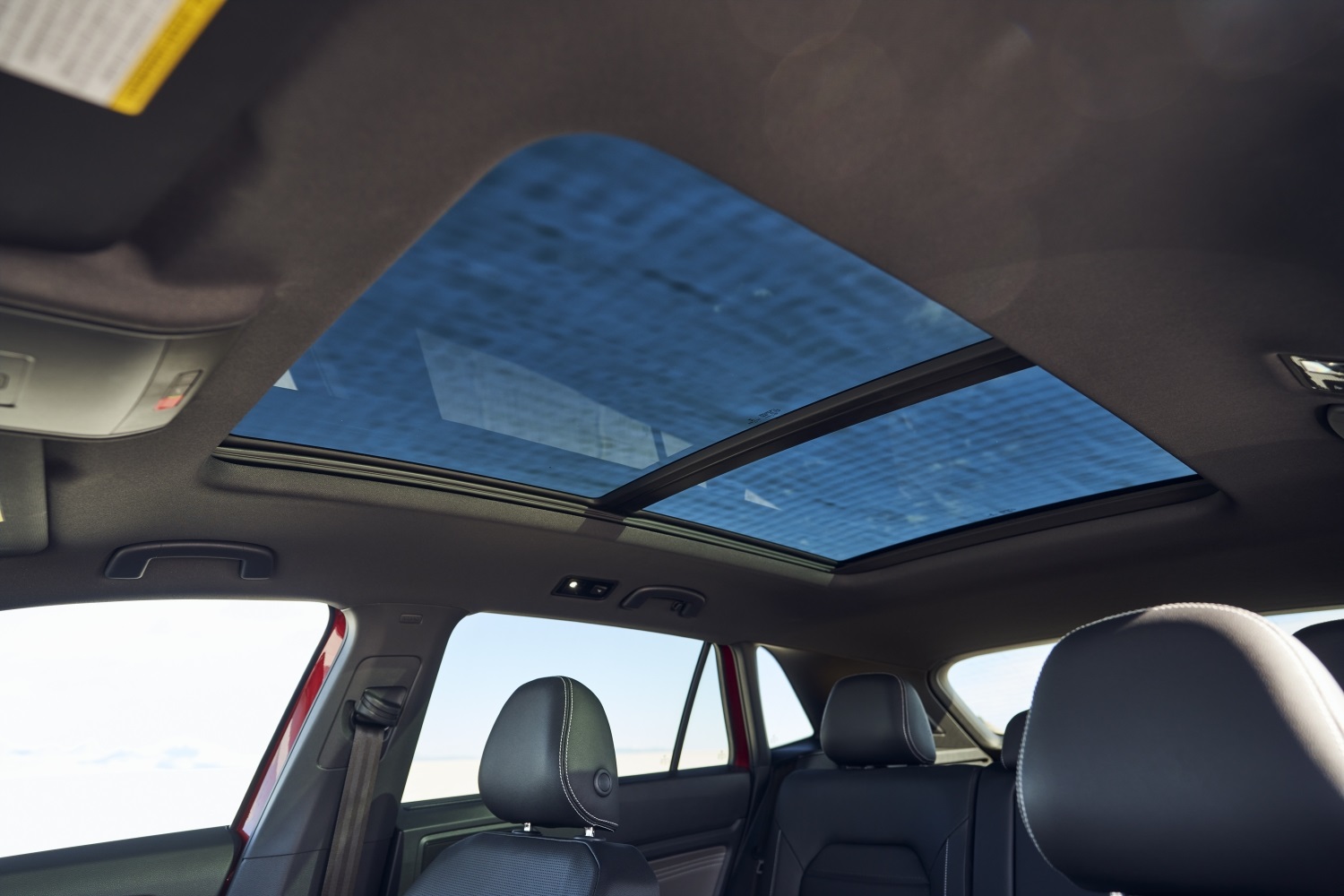
The big sunroof in the Cross Sport

There is chauffeur-class appeal to the second row. (VW)

Cross Sport Interior Function

The SEL Premium cabin is well stocked with creature comforts and useful technologies, which made it easy to forgive the liberal use of black plastic in lower areas; it’s tough looking but not with a cheap finish.

The SEL’s heated seats and steering wheel have three heat settings, which I’d not seen before on a steering wheel. The e-bin on the shift console has two charging USB ports and a wireless pad, but the pad was fussy for my iPhone 8 and wouldn’t function unless I removed its official Apple cover. The deep center armrest console hides another USB port.

I bonded with the lush rotation of the electric steering and how easily I trolled the mall parking in search of a space. The official turning circle is 40.5 feet, but it seems much tighter as the big SUV curls easily into parking slots. The wide-screen camera with an overhead view is helpful when parking, but a front view would be more helpful.

There is solid assembly and contemporary styling elements to the interior, despite the liberal use of black plastic in lower areas. (VW)

Steel-slab security

There is a strong sense of steel-slab security in the architecture. There is a generous space inset from the doors, which is functional as crush space in a side impact.

Sightlines are somewhat complicated by large side mirrors and the broad base of the windshield pillars, which are good for roof-crush standards — but the mirrors can block views of vehicles and pedestrians when turning at intersections. Over-the-shoulder views are unimpeded and I had no issue with seeing out the slimmer back glass.

The e-bin on the shift console has two charging USB ports and a wireless pad, but it was fussy for my iPhone 8. (VW)

After a couple of hours on the road, the seat bottoms will feel hard — so much so that I wanted to pull the wallet from my back pocket. The driver’s seat helps compensate with 10-way power adjustment, though I would have preferred some up-and-down adjustment to the lumbar. The passenger has an eight-way power seat.

The sliding visors have large coverage and there is equally large door-panel storage, with a large, locking glove box.

21-inch Pirelli tires on the Cross Sport

The all-season, 21-inch Pirelli Scorpion Zero tires roll quite smoothly. (VW)

Ride and Handling

There is bullish durability in how solidly the Cross Sport V-6 feels on the road and yet how deftly it managed the tester’s hefty all-wheel-drive curb weight of 4,484 pounds.

It is not quick in its handling and in standard drive mode the ride quality is soft, for a German-engineered SUV, with some bounding over intersection transitions, but it is comfortable. Switch to Sport mode and the shifts become aggressive (almost too much for in-town) and the suspension tightens significantly.

Braking is solid with four-wheel disc brakes, 13.2-inch vented rotors front and 2.2-inch solid rear rotors. The all-season, 21-inch Pirelli Scorpion Zero tires (265/45) have a wide footprint and roll quite smoothly.

Cross Sport back seat

The long doors ease access to the second row. (VW)

Cross Sport Back Seat

There is damn-nice back-seat space accommodations that are almost too nice for children. No parent has the arm length to reach back to subdue squabbles. There is a limousine-class 40.4 inches of legroom and a slightly cropped 37.8 inches of headroom with just a low hump at the transmission tunnel. The seatbacks recline and there is generous two-level stash space in the door panels. There are a pair of vents in the rear of the console, but no fan speed or temp controls.

The back seats, which recline, have 40.4 inches of leisurely legroom. (VW)

There is lots of black plastic and the leather isn’t a showpiece but the tester’s window seats were heated and have a perforated back and cushions. The pull-down armrest has cup-can holders and there are two charging USBs and a 150-watt 115-volt household plug.

Cargo Area

There is a tall lift-up to the cargo floor, which has huge cubic footage behind the second row — 40.3 to 77.8 cu. ft. with the back seat folded. The space is 47 inches wide by 46 inches deep with a height-challenged 29 inches to the headliner.

Cargo space is 47 inches wide by 46 inches deep with a height-challenged 29 inches to the headliner. (VW)

Why Buy the Atlas Cross Sport?

Way back in the 1990s, carmakers would offer two-door versions of their midsize SUVs as the sportier variant. Those short-wheelbase models didn’t fare well in evasive maneuvers or ride quality. Today, the trend is the more rakishly styled five-door SUV variant with the sloped roof to make it look sporty. Basically, it’s an ego purchase in which the buyer pays more and gets less (space) for a still-functional format.

For $51k, the topline V-6 SEL Premium R-Line, is loaded with desirable features and details, but it is not without its quirks. Elements as simple as floor mats and a cargo area roller cover are options, $105 and $180. Its fuel economy is among the lowest among the towing-capable competitors (including the Chevrolet Blazer, Jeep Grand Cherokee, Ford Explorer or Honda Pilot), but its good German engineering is an engaging separator.

But it might not be stylistically different enough from the seven-seat Atlas to be a convincing purchase.

A top-line seven-seat Atlas SEL Premium comparably equipped to the Cross Sport tester works out to be about $1,000 less. But the seven-seater also has the option for second-row captain’s chairs ($695), which are not offered for the Cross Sport.

VW might be missing out on not offering an “Executive Black” seating format and promoting the Cross Sport as the prestigious dressed-for-success SUV.

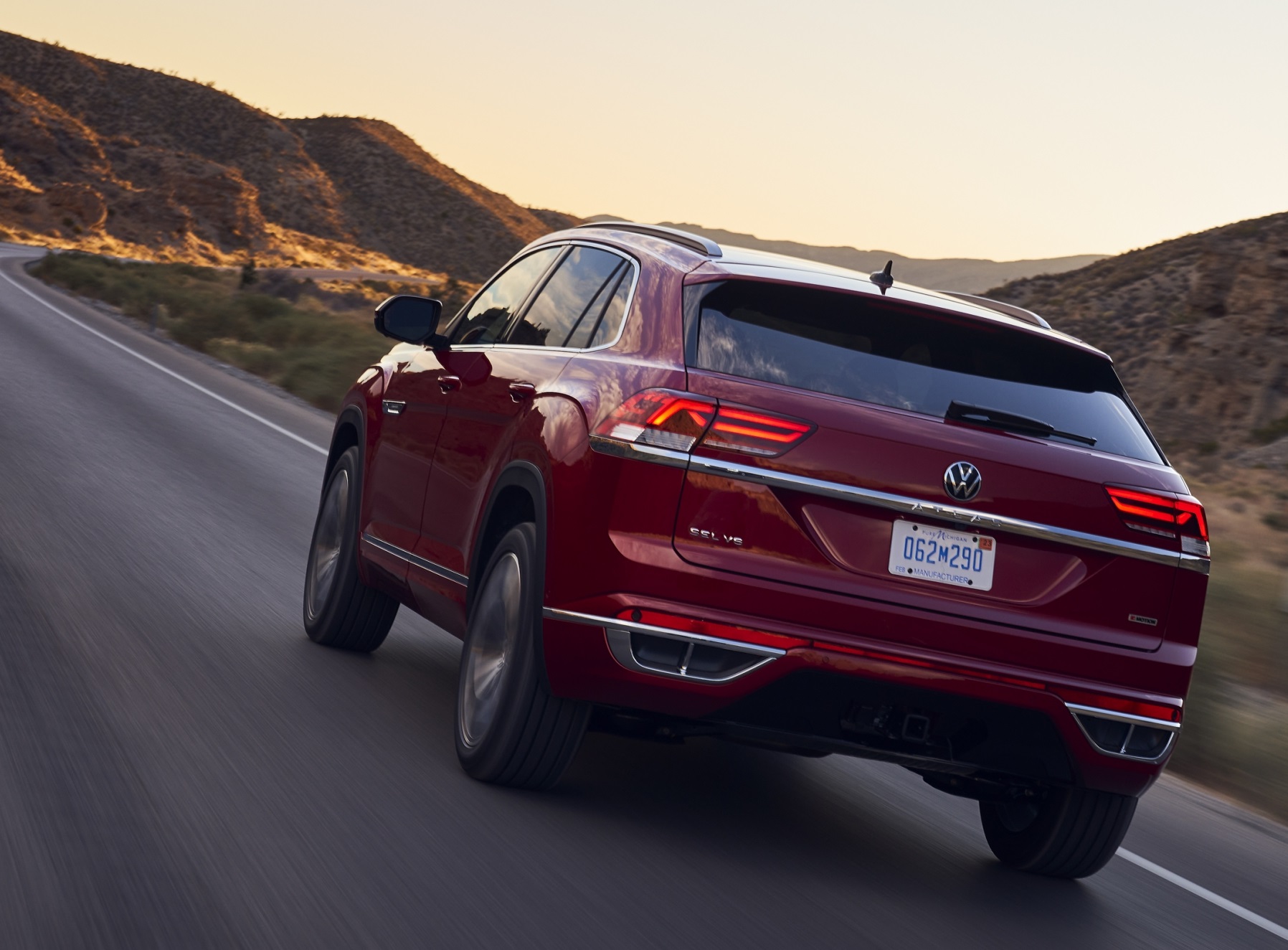
A rear view of the Atlas Cross Sport

There is bullish durability in how solidly the Cross Sport V6 feels on the road. (VW)

2021 Atlas Cross Sport V6 SEL Premium R-Line 

Body style: midsize, 5-seat, 5-door AWD SUV

Engine: 276-hp, direct-injection 3.6-liter VR6 with auto stop-start at idle; 266 lb.-ft. torque at 3,500 rpm

Transmission: 8-speed automatic with 4MOTION permanent all-wheel drive with four performance modes

Fuel economy: 17/23/19 mpg city/hwy/combined; premium preferred for peak power but 87 octane recommended

BY THE NUMBERS

Fuel tank: 19.5 gallons

Cargo space: 40.3-77.8 cu. ft.

Front head/leg room: 39.4/41.6 in.

Rear head/leg room: 37.8/40.4 in.

Length/wheelbase: 195.5/117.3 in.

Curb weight: 4,484 lbs.

Turning circle: 40.5 ft.

Tow capacity: 2,000 lbs. or 5,000-lbs. with tow package ($550)

FEATURES

Standard equipment includes: smart-key locking and push-button ignition, power tilt-and-slide panoramic sunroof, heated and ventilated front seats, 10-way power driver’s seat, 8-way power front passenger seat, 17 cup holders, heated rear (window) seats, electric parking brake, Digital Cockpit (gauge display), power (heated) side mirrors with turn signals, Park Assist with steering assistant, park-distance control front and rear with tones, rearview camera with overhead view, 8-inch touch screen display for navigation-audio-apps, 12-speaker Fender premium audio system with satellite radio, Climatronic dual-zone cabin temperature control, e-bin with 2 USB charging ports and wireless pad, manual lift-up rear window sunshades, ambient cabin lighting, lighted and covered vanity mirrors with sliding visors, stainless-steel pedal covers, 21-inch wheels with 21-inch Pirelli Scorpion Zero tires (265/45), LED headlights-taillights-fog-running lights, trailer hitch, R-Line bumpers-badging-trim, rain-sensing wipers with heated nozzles

Safety features include: 6 air bags, engine-brake assist and electronic differential lock, hill hold and hill-descent control, automatic post-collision braking

IQ.Drive features: Travel Assist (semi-autonomous driver assist), adaptive cruise control with stop-and-go, Lane Assist lane-keeping system, semi-automated Emergency Assist, forward collision warning and autonomous emergency braking and pedestrian monitoring, Active Side assist (blind-spot monitor) and rear traffic alert

PRICING

Base price: $51,220, including $1,195 freight charge; price as tested $51,615

Options on test vehicle: Aurora Red Metallic paint $395

Where assembled: Chattanooga, Tenn.

Warranty: 4-years/50,000-miles includes the powertrain and free maintenance for 2-years or 20,000 miles.

Hyundai Venue SEL Review

Hyundai Venue SEL Review

The subcompact Hyundai Venue SUV crossover is a fun ride loaded with features and priced for youthful buyers

An exterior view of the 2020 Hyundai Venue

The Hyundai Venue is sold in three trim levels with starting prices of $19,000-$23,000.(Photography by Hyundai and Mark Maynard)

Table of Contents

Pricing
Performance
Ride and Handling
Interior Function
Back Seat and Cargo Space
Why buy the Hyundai Venue?
Specifications

BY MARK MAYNARD

Hyundai’s newest and smallest SUV crossover, the Venue, makes the most of difficult choices.

Based on the Hyundai’s subcompact Accent sedan, the Venue is the boxy equivalent, but it’s not a penalty box. It’s a fun ride, aimed at buyers with youthful bank accounts and loaded for their necessities, such as rapid connectivity for music, phone, apps, and other connected services. It has no-brainer drivability, seating for friends, and manageable maintenance costs.

Subcompact SUV crossovers represent the new reality of doing more in a smaller but well-equipped “car.” The choices continue to evolve with competition from the (new) Chevrolet Trailblazer, Buick Encore, Fiat 500X, Ford EcoSport, Honda HR-V, Jeep Renegade, Kia Seltos, Mazda CX3, Nissan Kicks and Toyota’s C-HR.

Hyundai Venue front seats and driver area

The Venue driver area has intuitive placement of switches and dials.

But as sweetly packaged as it is, the Venue also provides a rich experience for mature drivers. Among the Venue’s assets are heated seats, no-nonsense placement of controls, comfortable entry and exit, and quick convertibility for cargo. And there are driver-assist technologies on the more expensive models.

With a tidy turning circle of 33.2 feet, the Venue is small enough to park anywhere. Consider this a selling point for urban dwellers who might have limited or no on-site vehicle parking.

The infotainment touch screen

The wide touch screen has a wide rearview camera.

Hyundai Venue Pricing

The Venue is sold in three trim levels of SE, SEL or Denim. All models are front-wheel drive with a 121-horsepower, 1.6-liter four-cylinder engine. There is a standard six-speed manual transmission or optional continuously variable automatic.

Starting prices range from $18,490 with manual transmission to $20,390 for the SEL; add $1,200 for the CVT. The Denim starts at $23,190 and features Denim blue paint with a white roof, Denim-influenced interior, 17-inch alloy wheels, and leatherette-and-fabric seats. All MSRP pricing includes the $1,140 freight charge from Ulsan, Korea.

Check current Hyundai Venue pricing here.

All new Hyundais include free scheduled maintenance for 3 years or 36,000 miles. And that is in addition to the bumper-to-bumper warranty of 5 years or 60,000 miles (with roadside assistance) and powertrain coverage of 10 years or 100,000 miles.

The Venue SEL tester with CVT was $23,445 with the two main factory packages. The convenience package ($1,150) adds a power sunroof, smart-key locking and push-button ignition, sliding armrest storage box (a desirable extra on these cheap cars), leather-wrapped steering wheel and shift knob, blind-spot collision, and rear cross-traffic collision warnings.

The Venue shift console

The shifter console is multifunctional.

The Premium package ($1,750) includes heated front seats and side mirrors, LED headlights-taillights-running lights, 17-inch alloy wheels, smart key locking and push-button ignition, 8-inch navigation touch screen display with Android Auto and Apple CarPlay. Carpeted floor mats added $155.

Even base models have six air bags and a full suite of advanced safety tech, including forward collision warning and pedestrian detection, and lane-keeping assist.

Hyundai Venue Performance

The performance of the 121-horsepower 1.6-liter isn’t overwhelming but shows its grit for right-now power. Sport mode will sharpen the response, but I found it too jittery and was content to manipulate acceleration through a heavier foot. The manual transmission might give more direct performance, but hurry, it is going away for the 2021 SE model.

Hyundai’s “intelligent” variable transmission — IVT rather than CVT — can match a gear ratio with the optimum engine speed, the engineers say. But to me, it still feels like a CVT, sometimes vague and tuned for fuel economy.

The EPA mileage ratings (CVT) are achievable: 30 mpg city, 34 highway and 32 mpg combined, on 87 octane. My driving returned an average of 32.3 mpg and up to 37.6 with more highway driving. 

Hyundai Venue Ride and Handling

The highway ride is surprisingly comfortable for a small SUV with a stubby 99.2-inch wheelbase. Often, these small and tall vehicles can be prone to choppiness on concrete freeway surfaces. The torsion beam rear axle isn’t sophisticated for sporty driving, but its flat design allows greater cargo capacity. The SEL adds rear disc brakes while the lower-trim models are fitted with the less-expensive drums.

On the highway commute, there was no objectionable wind noise or tire harshness from the 17-inch Nexen N’Priz all-season touring tires.

The Venue's engine

The 121-hp 4-cylinder engine has fuel economy ratings of 30 mpg city, 34 highway and 32 mpg combined. (Mark Maynard)

Interior Function

There is nothing “cheap car” about the interior materials of the Hyundai Venue. Though there is plenty of plastics, they have pleasing grains and finishes. 

It’s roomy inside with a tall 39.4 inches of headroom, which trims a bit with the sunroof. Legroom is large-car long at 41.3 inches. But the one-size-fits-most seat-belt anchor positioned the belt higher across my neck than was comfortable. And some will wish for some seat-bottom tilt, but that is uncommon in these less-expensive cars.

The tires on the Venue

Tire sizes range from 15- to 17-inches. (Mark Maynard)

Driver sightlines are open and the rearview camera provides wide coverage with guidance lines. There is an intuitive placement of switches and dials. The shifter console is multifunctional with a parking hand brake, cup-bottle holders, and charging bin with two USBs and a 180-watt 12-volt plug. Sliding visors have large, lighted vanity mirrors.

There is plenty of small-item storage, particularly with the optional armrest box. There’s a short shelf on the passenger side above the glove box, which makes a handy place to park a phone.

Back Seat and Cargo Space

The back seat is compact but with a low exhaust hump for occasional three-across seating.  Rear leg room of 34.3 inches will be snug for adults.

There is a generous two-level cargo space that has a wide opening of 37 ½ inches. Fold the 60/40 back seat for almost 5 feet of length.

The back seat in Venue

The back seat has a low exhaust hump for occasional three-across seating.

Why buy the Hyundai Venue?

As the Coronavirus sucks the spontaneity out of our daily routines, having to replace anything, especially a vehicle, gets new scrutiny. How much or how little is required? Do we make ourselves happy? Or do we settle?

The Hyundai Venue is an opportunity to downsize without settling. It will expand expectations for its interior roominess and quality of accommodations — with the peace of mind from free maintenance and long warranty protection.

A rear view of the Hyundai Venue

All new Hyundais include free scheduled maintenance for 3 years or 36,000 miles.

2020 Hyundai Venue SEL Specifications

Body style: compact, 5-passenger, 5-door front-wheel-drive SUV crossover

Engine: 121-hp, dual-port fuel injection 1.6-liter four-cylinder; 113 lb.-ft. torque at 4,500 rpm

Transmission: CVT w/sport, normal and snow modes

Fuel economy: 30/34/31 mpg city/hwy/combined; 87 octane

BY THE NUMBERS

Fuel tank: 11.9 gallons

Cargo space: 18.7-31.9 cu. ft.

Front head/leg room: 39.4*/41.3 in. *w/o sunroof

Rear head/leg room: 38.6/34.3 in.

Length/wheelbase: 158.9/99.2 in.

Curb weight: 2,738 lbs.

Turning circle: 33.2 ft.

FEATURES

Standard equipment includes: smart key locking with push-button ignition, 6-way adjustable driver’s seat, rearview camera, heated front seats and side mirrors, automatic temperature control, 8-inch color touch screen audio system with Android Auto and Apple CarPlay, 60/40 folding back seat, 2-stage cargo floor

Safety features include: 6 air bags, forward collision avoidance assist with pedestrian detection, lane-keeping assist, driver attention warning, stability and traction controls, hill-start assist

PRICING

SEL Base price: $20,390, including $1,140 freight charge; price as tested $23,445

Options on test vehicle: Convenience package, $1,150, adds a power sunroof, sliding armrest storage console, leather-wrapped steering wheel and shift knob, blind-spot collision and rear cross-traffic warnings;

Premium package, $1,750, adds heated front seats and side mirrors, LED headlights-taillights-running lights, 17-inch alloy wheels, proximity key with push-button ignition, 8-inch navigation touch screen with Apple CarPlay or Android Auto and Blue Link connected services for three years;

Carpeted floor mats $155

Where assembled: Ulsan, Korea

Warranties: free scheduled maintenance for 3 years or 36,000 miles; bumper-to-bumper 5-years/60,000-miles with roadside assistance; powertrain 10-years/100,000-miles

Yokohama Tire rewards sweat equity with Spartan Race Series promotion, through Sept. 30

Yokohama Tire rewards sweat equity with Spartan Race Series promotion, through Sept. 30
Spartan is a global experiential sport and wellness brand with a 10 million-plus community. (Yokohama photo)

Through Sept. 30, the promotion features free 2021 race entry, worth up to a $190 value with the purchase of four eligible tires

BY MARK MAYNARD

As the official tire sponsor for the U.S. Spartan Race Series, Yokohama is offering a summer promotion that highlights the brand’s tough tires and world’s largest obstacle race and endurance brand.

Though the coronavirus has scuttled the 2020 Spartan race season, organizers are focused on 2021. And now through Sept. 30, 2020, Yokohama Tire is giving out free Spartan Race entries to consumers who purchase four eligible tires. The entries — up to a $190 value — are for one Elite, Age Group, morning or afternoon Sprint, Super or Beast races during the 2021 season.

Among the more than 25 tires available in the special promotion are the GEOLANDAR CV G058, the GEOLANDAR X-AT and ADVAN Apex. Details, terms and conditions of the promotion can be found at Sparta promotion.

Spartan is a global experiential sport and wellness brand with a 10 million-plus community. The group’s mission is to create “transformational experiences, products and content to help people, companies and teams to tear down boundaries and expand what they believe to be possible.” In a non-pandemic year, the group stages more than 250 large-scale events across more than 40 countries on six continents. Learn more at spartan.com.

“Spartan’s strong, passionate fan base is the ideal audience for our tires,” Alan Holtschneider, Yokohama’s director of marketing, said in a release.

About Yokohama Tire Corp.

Yokohama Tire Corp. is the North American manufacturing and marketing arm of Tokyo, Japan-based The Yokohama Rubber Co., Ltd., a global manufacturing and sales company of premium tires since 1917. The company’s complete product line includes tires for high-performance, light truck, passenger car, commercial truck and bus, and off-the-road mining and construction applications. For more information, visit Yokohamatire.com, Yokohamatruck.com or Yokohamaotr.com.

MarkMaynard@cox.net