Select Page

Lexus TX 500h F Sport Review

Lexus TX 500h F Sport Review

I loved testing the 2024 Lexus TX 500h F Sport, until it stopped loving me.

The 2024 Lexus TX is a roomy family-class, three-row SUV crossover with sophisticated styling and three powertrains, two of which are hybrid.

The Lexus TX is a roomy family-class, three-row SUV crossover with sophisticated styling and three powertrains, two of which are hybrid. (Photography courtesy of Lexus or as credited)

Jump To Special Features

An Electrical Gremlin?
The Amateur Diagnosis
Lexus Responds
About the 2024 Lexus TX
2024 Lexus TX Pricing
Safety Features
Interior Function
Why Buy the 2024 Lexus TX 500h?
Specifications

BY MARK MAYNARD

The 2024 Lexus TX 500h is a big, roomy, family-class, three-row SUV crossover with sophisticated styling and innovative features. The 366-hp turbocharged, four-cylinder gasoline-electric powertrain exceeds performance expectations for its 5,000-pound curb weight with all-wheel drive. Standard rear-wheel steering is an urban dweller’s godsend, chopping a foot or more from the turning circle. At 38 feet curb to curb, the TX empowers drivers to go where large vehicles usually fear to tread.

Inside, the cabin has tall headroom of 40 inches amid luxury class materials and leather-trimmed upholstery. Lexus loaded the TX 500h F Sport model with a full complement of powered and pampering conveniences. The pair of second-row captain’s chairs have impressive legroom of 39.5 inches. Even the power-folding third-row seats are not a penalty pad with decent legroom (33.5 inches). And those in the waaay back have full-service treatment with air vents, reclining seatback, ports for phone charging, cup holders, and lighting.

I gladly went out to run errands in this nearly 17-foot-long F Sport people mover, which has a Trail Mode. Lexus doubled down on soundproofing and body reinforcements. The exterior styling is handsome with only the broad and louvered F Sport grille as the lone gimmick. Its bold statement will be marred with a license plate.

The weeklong evaluation was thoroughly enjoyable, until it wasn’t. My pleasurable job of testing this TX 500h F Sport hit a short circuit that nearly left me stranded.

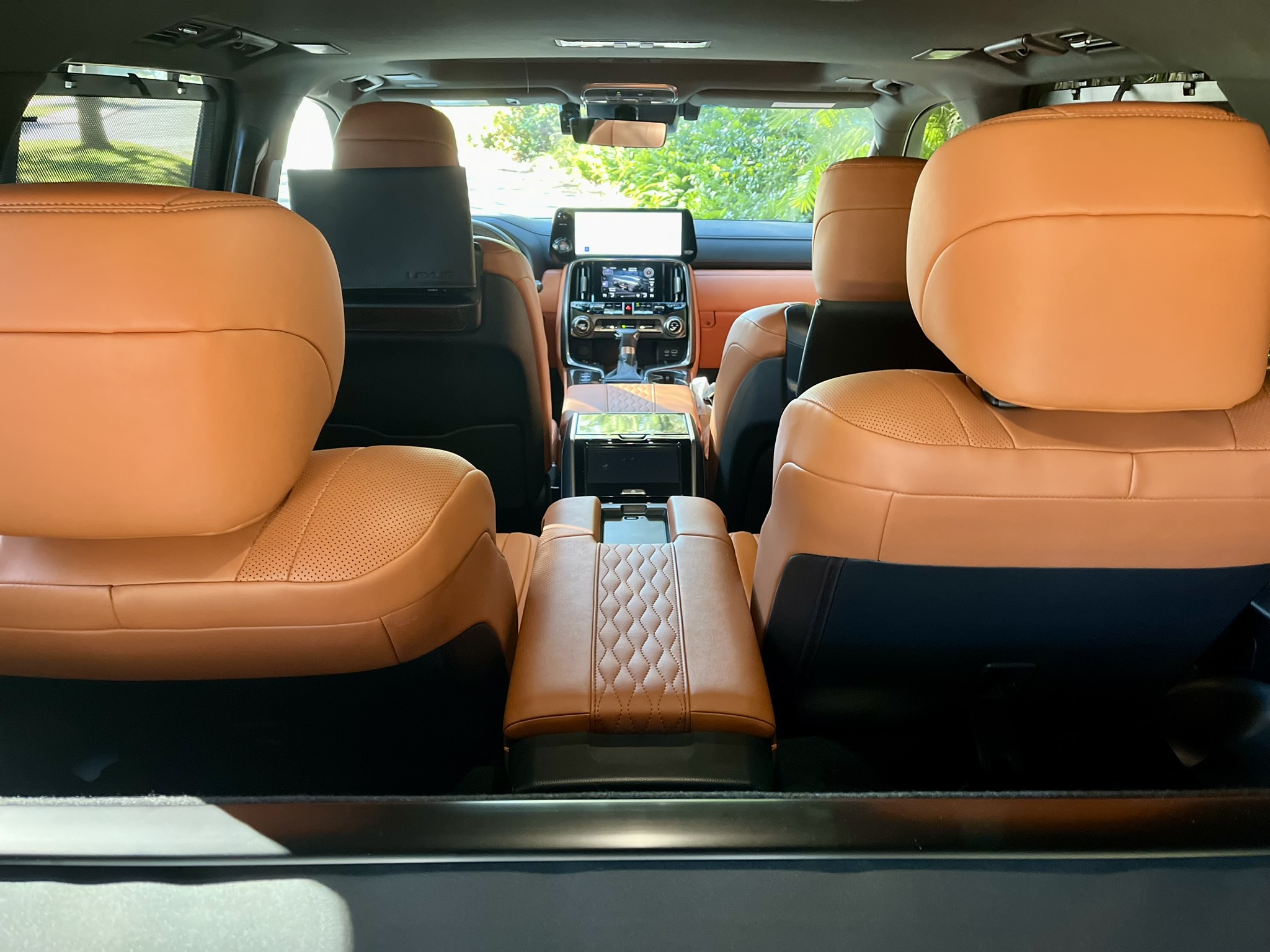
Looking from the second row seats at the TX front seat area

The Lexus TX has front headroom of 40 inches with a panorama glass roof.

An Electrical Gremlin?

I had been out on a long note-taking drive on a Friday morning and then parked the TX at home. I did not drive the TX on Saturday but demonstrated its charms to a Lexus-owning neighbor couple. I showed them the power tailgate, the power-folding third-row, and the power push-pull electric door releases. On Sunday, I made a Home Depot run for garden soil, a distance no farther than six miles round-trip.

Upon my return home, I backed the TX into our driveway and unloaded the bags of soil. With the tailgate raised, I took the opportunity to measure the cargo space for liftover, width, depth, and height. When I went around to the rear side door to lower the seatback, the door would not open. Hmm, what am I doing wrong?

This TX model has door-release sensors on all side doors. I touched the lock sensor again, and again, but nothing. I pulled out the key fob and hit the unlock button. Nothing.

I then moved to the front doors, which were also locked.

Earlier in the week, I noticed that the driver’s door handle end cap to access the key port was loose. It was held in place by a thin strip of Velcro. Odd, I thought, and surely not factory. I wondered if a previous driver had a similar experience to mine, needing entry by the valet key.

It was then that the girlfriend-wife came out to the TX, and I explained the situation. She volunteered to climb through the open tailgate, across and around the second-row seats, to reach the driver door release lever. Success. The driver’s door opened, but no other doors would unlock.

Versatile seating and a dramatic panorama glass roof with an opening forward section.

Versatile seating and a dramatic panorama glass roof with an opening forward section.

The Amateur Diagnosis

And there was no response when I hit the start button.

Was the problem a dead or dying battery in the remote key fob? If the 12-volt battery were dead, why could I open and close the tailgate, several times?

I consider myself a semiprofessional auto journalist with 33 years of experience. But it was time to use my lifeline and call a friend. My neighbor Peter Badore is a retired Chrysler International Operations vice president and former military engineer. He is always up for an automotive problem. (Peter is also a Porsche collector who buys and repairs German cars. He also owns two hybrid cars and an electric Ford Mach-E.)

He answered my call, and we reviewed the processes I had just completed. He came over with his digital voltmeter and a hefty jumper box.

The underhood decal graphic showing battery placement

The under-hood battery decal.

We raised the TX hood in search of a positive battery post but found none. Peter happened to notice a 2-by-1-inch decal under the hood. It is a tiny graphic showing the locations of the hybrid battery (under the second-row seats) and an image of a 12-volt battery identified as Pb. Some of us might remember from high school chemistry that Pb is the metallic element of lead. (Peter did, I did not.)

The decal showed the 12-volt battery in the right quarter panel of the cargo area. There was no identifier on the side panel to indicate a battery, but we popped it off, and there it was. Peter used the voltmeter to check the battery health, which was indeed low, down to 9 volts. It should have been closer to 11 or 12 volts for cranking power.

Start-Up Stumbles

It was time now to charge the battery for an hour or two. But the battery is tucked so low into the side compartment that getting the positive charger clamp to stay on the post was a struggle. Peter persevered and wrestled the clamp into position.

A red jump cable connected to the positive battery post on the battery in the cargo side corner.

A tight location to jump-start the 12-volt battery.

With power flowing from the jumper box, I tried to start the TX. But instead of engine cranking, a dialog box appeared in the center gauge display. I was instructed to touch the remote fob on the stater button so the system could recognize the key. It made an immediate connection, and I could start the TX.

At last, it appeared we were exiting the electrical resistance — but would the charge hold? Or was there a parasitic drain? Indeed, the charge held for the next two days before the TX went back to its L.A. press fleet.

If this happened to an owner and family who had just spent a fun day at Disneyland, the TX would need to be towed to a dealership. Trust would be lost in the vehicle, if only temporarily.

Toyota can and should do better under the hood and in the cargo area to clarify and illustrate jump-starting procedures.

Lexus Responds

My contact in Lexus PR responded to my email query: “Thanks so much for bringing this to my attention and I’m so sorry to hear that! This was a prototype vehicle, rather than production and we have not experienced this issue on our other prototypes. I am keeping track of all prototype issues, and again, I appreciate you sharing this.”

Lexus got back to me in a week with this reply: “We have identified that it was a one-off battery issue and we have addressed this with our quality team.”

F Sport leather-trimmed heated and ventilated front seats.

F Sport leather-trimmed heated and ventilated front seats.

About the 2024 Lexus TX

There are seven SUVs in the Lexus lineup, but only two models — the midsize GX and large LX — have seats for six to seven. Neither, however, is ideal for a growing family. However, Lexus has filled its people-mover gap with the TX three-row SUV crossover.

Lexus benefits from several upcycled vehicles from its parent company, Toyota. Its latest addition, the 2024 Lexus TX, is based on the Toyota Grand Highlander, introduced last year.

The TX is now the brand’s most efficient vehicle for a growing family. It could become the choice for drivers who cringe at the M-word — minivan. The second and third rows are easily entered with tip-and-slide seats, and the cargo space is broad, square, and functional.

Three-row competitors include the Acura MDX, Audi Q7, Infiniti QX60, and Volvo XC90.

The 2024 Lexus TX is available in five trim levels with three powertrains of gasoline, gasoline-electric hybrid, or gasoline-electric plug-in hybrid. The hybrids use two battery chemistries: nickel-metal hydride for the TX 500h F Sport and lithium-ion for the TX 500h+ F Sport plug-in hybrid. Both hybrid models include F Sport Performance features, rear-wheel steering, and all-wheel drive.

Five paint colors have no additional cost on F Sport models, but Cloud Burst Gray is a $500 hue on the TX 350.

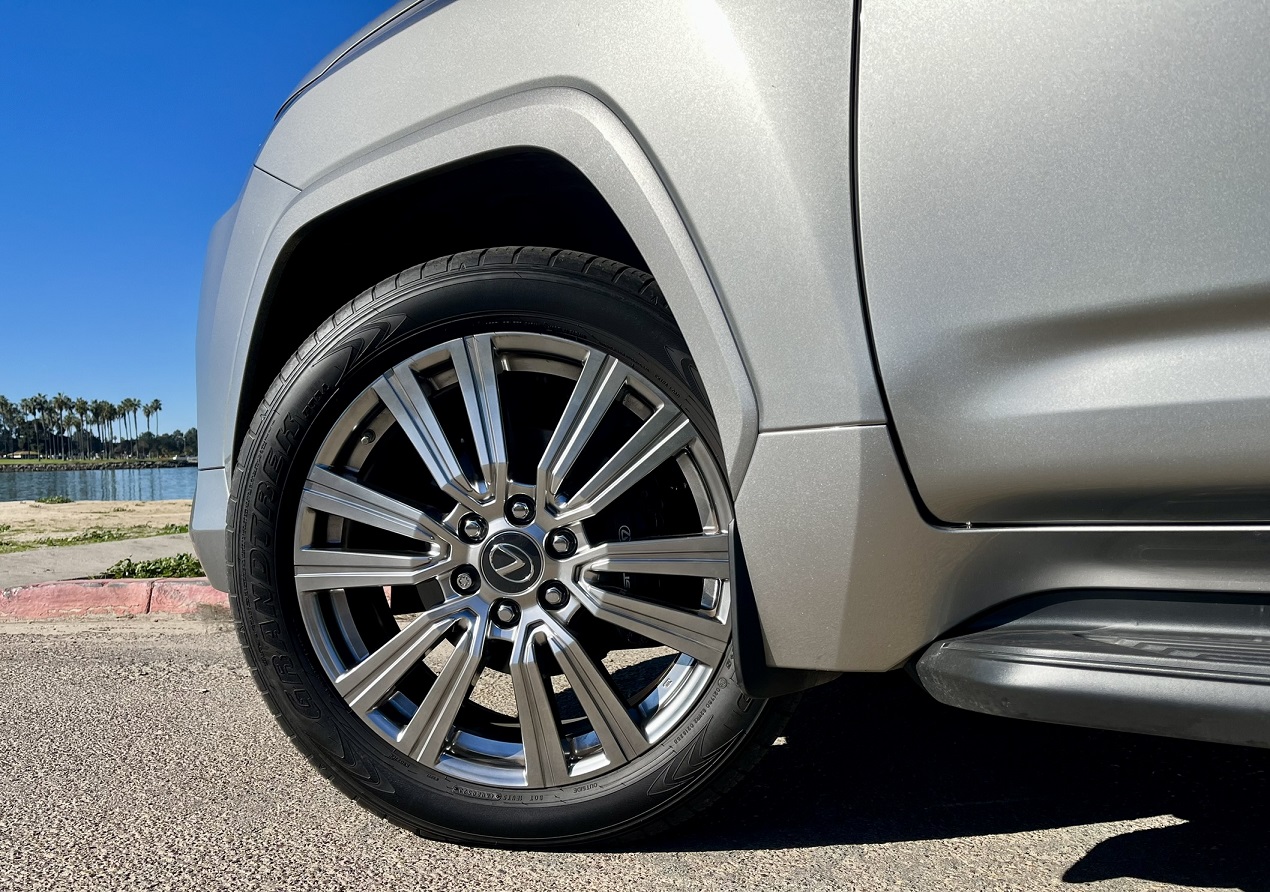
Tire and wheel sizes are 20 inches on non-F Sport models and 22 inches for F Sport.

The 12.3-inch-wide digital gauge array.

The 12.3-inch-wide digital gauge array.

Lexus TX Pricing

Today’s review is of the 2024 TX 500h F Sport Performance Luxury, which has an as-tested price of $77,235.

Here is the price walk of the three trims:

275-hp TX 350: 2.4-liter turbocharged inline four-cylinder with eight-speed Direct Shift automatic transmission. Front-wheel-drive fuel economy ratings are 21/27/23 mpg city/highway/combined and 20/26/23 mpg AWD. Lexus recommends premium fuel for all TX powertrains. Toyota, however, recommends 87 octane or higher for its Grand Highlander Hybrids. The TX 350 is available in three trim levels with starting prices of $55,050 (front-wheel drive) to $62,550 AWD.

366-hp TX 500h F Sport Performance Premium AWD, $69,350: 2.4-liter turbocharged gas-electric hybrid with DIRECT4 AWD and six-speed automatic transmission. The parallel hybrid system integrates a front 64-kW motor and a rear 76-kW eAxle. Lexus says this system provides near-instantaneous power to the rear wheels. The TX 500h combines DIRECT4 and Dynamic Rear Steering. The 288-volt nickel-metal hydride battery of 240 cells has a 5 amp-hour charge and 1.4 kW of total power.

A open hood view of the 273 hp TX 500h F Sport’s gasoline-electric engine.

The TX 500h F Sport’s gasoline-electric engine generates 273 hp.

TX 500h F Sport Performance Luxury AWD, $72,650. This trim uses the same gas-electric hybrid powertrain as the TX 500h F Sport Performance.

404-hp TX 550h+ Luxury AWD, $78,050:  3.5-liter V-6 plug-in hybrid and e-CVT transmission. The plug-in system provides fuel economy of 28/29/28 mpg city/highway/combined, with 33 miles of battery driving. TX550h+ Luxury has a fuel tank of 14.5 gallons, which is 3.3 gallons smaller than the standard TX 500h. The lithium-ion battery adds 408 pounds above the 500h for a curb weight of 5,357 pounds. However, the TX PHEV cannot recharge the battery while driving. Mazda provided this game-changing technology for its CX-90 PHEV, which costs around $60,000 fully loaded.

Price Check

For a pricing comparison, a top-trim level Toyota Grand Highlander Hybrid will cost $60,000.

Check current Lexus and TX pricing here.

Find special offers here.

A front tire showing the 22 inch TX F Sport tires

The 500h F Sport rolls on 22-inch Continental tires on smoked gray and black alloy wheels.

Lexus TX Enhancements

Transitioning from a Toyota model, Lexus engineers reinforced the TX body rigidity, including robot-applied automotive glue (adhesive) in optimal locations. Other stiffening enhancements include: Spot welding; rear multilink suspension design; widened front and rear tracks.

To help control weight gain, Lexus says the outer panel thickness has been “fine-tuned” on the side members, front door assembly, and rear door assembly. The hood and front fenders are aluminum, and the back door is steel, optimized for front-to-rear weight distribution.

The 550h F Sport has auto-leveling Bi-LED headlights and LED fog lights.

The 550h F Sport has auto-leveling Bi-LED headlights and LED fog lights.

TX Suspensions

Entry-level TX models have a MacPherson strut-type front suspension and a rear five-arm multilink. F Sport models have standard rear-wheel steering and an adaptive variable suspension. AVS uses solenoid-type actuators to modify the shock absorbers’ damping force on all four wheels. Near-instant damping adjustments are based on driving and road conditions. When driving on a rough road surface, the damping force keeps a lower rating for a comfortable ride. When entering a turn, the damping force sharpens responsiveness and control.

All TX models have four-wheel ventilated disc brakes. The front-drive TX 350 has front disc rotors of 13.3 inches. TX 500h hybrid models have 15.7-inch rotors, and all models have 13.3-inch rear rotors. And all TX trim levels can tow up to 5,000 pounds.

*More chassis components are in the specifications at the end of this story.

The shift console for the 8 speed automatic transmission in the TX also has modular cupholders and an e-charging bin

Modular, multifunction cup holders, an e-bin charging area, and electronic eight-speed shifter.

TX Safety Features and Technologies

There are eight air bags in the Lexus TX, including a driver knee bag and front passenger-seat-cushion air bag. Under the skin of the TX, there is NASA launch capability for the sensors and computer calculations.

Among the safety technologies is the Lexus safety system 3.0. It protects occupants and the TX with level II semi-autonomous driver assist. It is a reliable lane-centering system without drifting across the white lines or Botts dots, as do some systems. If you manage to activate the rear cross-traffic alert, know the braking response is set to “Slam stop.” It is rewarding, and frightening.

Elements of Safety System 3.0 include:

  • Lane-tracing assist;
  • Road sign assist;
  • Pre-collision system with pedestrian detection;
  • Dynamic radar cruise control with curve speed management;
  • Lane departure alert with steering assist;
  • Intelligent high beam headlights (dimming).

Worth noting is the infrared driver eyesight monitoring camera on top of the steering column. The camera detects driver distraction and will give a chime for too much rubbernecking. I got a message saying to “Sit Up” on the center gauge display. My remedy was to lower the power steering wheel a bit.

The wide louvers in the F Sport grille

Among the F Sport features is a stylized grille.

Interior Function

With 60 inches of door-to-door room, there is plenty of space for ergonomic and intuitive control and switch placement. Sightlines are unobstructed across the fenders, at the side mirrors, and over the shoulder.

The F Sport seats, however, have “sporty” wedgie-inducting seat-bottom bolsters. And I felt some seat-bottom sag after an hour on the road. The second-row captain’s chairs are short on thigh support, likely to benefit legroom.

A 14-inch color touchscreen display centers the instrument panel for navigation, cameras, and CarPlay apps. Below are temperature dials and a volume button. The display works well even when making adjustments while driving.

Below the center stack is the charging e-bin with a wireless pad and three USB ports. The short electronic shifter provides solid and unconfusing gear engagement. The center armrest console has a split-style padded top, which allows the passenger to flip a lid to dig into the storage space. Cup holders are modular and removable and can accommodate a favorite mug.

Because the big infotainment screen takes up so much space, the air vents are placed below and at both ends of the dashboard. The placement could be better; they tend to blow air on elbows or hands.

Somewhat unique in the TX specifications chart are measurements for “Couple Distances.” I’d not seen that before for any make or model. The Lexus TX has second-row couple-space of 39.3 inches shoulder to shoulder.  But I’m not sure how that is relevant with the captain’s chairs.

Second-row captain’s chairs with recline and tip-and-slide for third-row entry.

Second-row captain’s chairs with recline and tip-and-slide for third-row entry.

Cargo Space

There is as much emphasis on utility as creature comforts in the TX. There is 20.2 cubic feet of grocery and gear space behind the third row. Bags of groceries won’t roll around, and there should be enough depth for a big golf bag.

Fold the third row for 57.4 cubic feet, stacked to the headliner. Power folding the third row, however, is painfully slow. I would rather have a manual release. But with both seat rows folded, there is 7 feet in length. Load-in entry is wide at 49 inches. And there are 33 inches of entry height to load tricycles, bikes, and boards.

An open cargo area of the Lexus crossover

Cargo space is generous and configurable. Fold both rows of seats for 7 feet in length.

Ride and Handling

The Lexus TX F Sport is not particularly sporty to drive, though it is quite capable of rapid cornering. Braking is absolute and balanced with tender engagement and no nose dive.

However, the adaptable suspension allowed a bouncy, jostling, but comfortable ride. The F Sport’s 22-inch tires and nearly 5,000-pound curb weight might be part of the sway.

Sharpening the suspension in Custom mode didn’t help, but it did make the ride feel harder. And in any suspension setting, the front end could take a hard jolt on the chin.

After bounding along some interstate undulations, the girlfriend-wife started to feel queasy. That tendency would be worse in the back rows.

Despite just slim roof rails (with optional cross bars), there was noticeable wind noise at highway speeds. Insulated side glass (despite a weight gain) might help reduce ambient interior noise.

The F Sport Luxury AWD tester was fitted with 22-inch Continental CrossContact LX 20 EcoPlus tires, 255/45. These are tough all-season tires with a fairly hard treadwear rating of 680 for a 70,000-mile limited warranty, per Continental. Continental says its EcoPlus Technology helps the tires stop shorter on wet roads and extends tread life. The tires’ flanged lower sidewall helps reduce the possibility of curb damage to wheels. Replacement tires will run around $350 each (before installation), per TireRack.com.

The pair of power-folding third-row seats have legroom of 33.5 inches.

The pair of power-folding third-row seats have legroom of 33.5 inches.

Why Buy the 2024 Lexus TX 500h?

I was unaware I was evaluating a prototype rather than a production vehicle until I communicated with Lexus. (The tester had the quality construction of a production vehicle.) Had I known, my story would have been more of an overview of the TX, with a Lexus follow-up on the battery drain.

Journalists are usually advised in advance when manufacturers hold media drives that include prototype or preproduction vehicles. If a problem arises, the response is: “If you like it, it’s production. If not, it’s preproduction (prototype).”

The electrical issue I experienced could be dismissed as a growing pain and easily resolved. But it was worth the discussion and awareness.

Electric glitches are the bane of the modern automobile. Considering the thousands of neural synapses all talking simultaneously, it is surprising that I haven’t encountered such gremlins in testing other vehicles. Could a 48-volt battery be necessary to monitor all these systems in the TX F Sport models?

There is much I like about the F Sport styling and content, but not the front seats or adaptive suspension. My preference would be a Lexus TX 500h without F Sport glam, but an absolute yes for rear-wheel steering. For now, however, Lexus won’t say if such a choice is in the future.

A rear three quarter view of a TX painted Incognito gray

Among the five TX paint colors is the tester’s Incognito gray.

2024 Lexus TX 500h F Sport Specifications

Body style: 6-7 seat, 3-row gasoline-electric hybrid SUV Crossover with Direct4 all-wheel drive

Engine: 271-hp 2.4-liter 4-cylinder with D4-S direct and port injection; 339 lb.ft. torque from 2,000-3,000-rpm

Motor generators: permanent magnet synchronous, front and rear

Total system power: 273 hp (64 hp front motor, 75.9 hp rear motor)

Total max torque: front motor, 215 lb.-ft. from 2,000-3,000 rpm; rear motor 124 lb.-ft. from 2,000-3,000 rpm

Battery: Nickel-metal hydride; 288 volts; 240 cells; 5 amp hour capacity

Transmission: 6-speed automatic

0-60 mph acceleration: 6.1 seconds

Fuel economy: 27/28/27 mpg city/hwy/combined; premium fuel recommended

Drag coefficient: 0.34 Cd

Towing capacity: 5,000 pounds

BY THE NUMBERS

Fuel tank: 17.7 gallons

Cargo space: 20.2 to 57.4 cubic feet

Front head/leg room: 40/41.6 inches

2nd-row head/leg room: 38.5/39.5 inches

3rd-row head/leg room: 37.2/33.5 inches

Shoulder room front/rear: 60/60 inches

Hip room, front/rear: 56.5/56.8 inches

Length/wheelbase: 203.1/116.4 inches

Curb weight: 4,949 pounds

Turning circle: 36.5 feet, estimated with rear-wheel steering

FEATURES

Standard equipment includes: Lexus interface with 14-inch touchscreen display; panorama glass roof; Mark Levinson audio system; wireless phone charger; thematic ambient lighting; heated and ventilated second-row captain’s chairs; power-folding third row;

F Sport content: suspension tuning; dynamic rear steering; performance dampers; exterior front fascia and rear valance black roof rails; dark chrome window trim surrounds; power-folding black side mirrors; 22-inch wheels; leather-trimmed and heated steering wheel; aluminum pedals and scuff plates; leather-trimmed heated and ventilated power front seats with driver-seat memory presets;

Connected Technologies: Drive Connect with cloud navigation; Intelligent Assistant, Destination Assist (3-year trial, 4G dependent); Safety Connect and Service Connect with up to 10-year trials, remote connect 3-year trial (4G dependent); Wi-fi connect (AT&T hotspot) up to 30-day 3GM trial (4G dependent); satellite radio (3-month trial); wireless Apple CarPlay and Android Auto capability.

Safety features include: Blind spot monitor with rear cross-traffic alert; intuitive parking assist with auto braking, digital latch with safe-exit alert;

Safety technologies include: Lexus safety system 3.0: lane-tracing assist; road sign assist; pre-collision system with pedestrian detection; dynamic radar cruise control with curve speed management; lane departure alert with steering assist; intelligent high beam headlights (dimming).

CHASSIS COMPONENTS

Brakes: 4-wheel ventilated discs; 6-piston opposed aluminum monoblock front; rear floating-type single piston; 15.7 inches front, 13.3 inches rear

Steering: electric rack and pinion; 38-foot turning circle; electric parking brake; F Sport dynamic rear steering

Tires-wheels: 22-inch Continental CrossContact LX 20 EcoPlus, 255/45; UTQG 680

Suspension: F sport electrically adaptive with performance tuning

PRICING

Base TX 500h F Sport price: $72,650, including $1,350 freight charge; price as tested $77,235

Options on test vehicle: 120-volt/1,500-watt power outlet $560; logo side puddle lamps $175; wheel locks $85; USB fast phone charging cables $85; carpet cargo mat $150; door-edge guards $155;

Convenience package $895, includes front cross-traffic alert, traffic-jam assist (with Drive Connect subscription; 3-year trial included), digital key (with remote connect subscription)

Technology package $2,380, includes: Advanced Park with remote park, digital rearview mirror, and head-up display

Cold area package $100, adds windshield wiper de-icer

Where assembled: Princeton, Ind.

Warranties: 4-years/50,000-miles bumper to bumper with roadside assistance;
Free first and second maintenance services at 6-months/5,000 miles and 1-year/10,000-miles;

Wheel alignment and balancing: 1-year/12,000-miles;

Powertrain: 6-years/70,000-miles;

Hybrid system: 8-years/100,000-miles (covers hybrid control module, hybrid battery, and inverter with converter).


Mercedes-Benz EQE SUV Review

Mercedes-Benz EQE SUV Review

With 300 miles of range, the 2023 Mercedes-Benz EQE SUV is a formidable battery-electric, but it gets even better with a list of improvements for the 2024 models.

An exterior view of the EQE SUV with a red painted expansion bridge in the background

The Mercedes-Benz EQE battery-electric SUV is sold in four trim levels of Premium, Exclusive, and Pinnacle in rear- or dual-motor 4MATIC all-wheel drive. Pricing starts at about $80,000. (Photography courtesy of Mercedes-Benz or as credited)

Table of Contents

What is EQ?
Pricing and Warranties
What’s New for 2024?
Powertrain and Performance
Charging Times
Ride and Handling
Human-Machine Interface
Safety Features and Ratings
Oddities and Observations
Why Buy the Mercedes-Benz EQE SUV?
Specifications

BY MARK MAYNARD

If the Mercedes-Benz EQE SUV was a love interest, it might best be explained as “Complicated.” It is beautiful to look at, dreamy to drive, and the interior is a gallery of gorgeous. This big, voluptuous SUV is a definite swipe right to get the details and to winnow the traits you like and those you could not live with — and there are a few.

For those who remember the vault-like Benzes of old, this new Mercedes-Benz EQE SUV is a direct descendant. Among its outstanding features is the traffic-calmed cabin created by a team of “aeroacousticians.” They applied a lot of soundproofing and aerodynamic tuning to reduce wind resistance and noise. Mercedes-Benz says that the aero engineering resulted in an extremely low drag coefficient of 0.251. (And that Cd is slipperier than the Toyota Prius.)

The EQE SUV went on sale in spring 2023 as the platform-mate to the EQE executive sedan, which has been on sale since fall 2021. However, the EQE SUV is more compact than the EQE sedan, with a wheelbase (119.3 inches) 3.5 inches shorter than the sedan.

With its 90.6 kWh lithium-ion battery, the EQE 350+ SUV has an official EPA estimated range of 279 miles. When I charged at home, a 100 percent charge went to 320 miles. However, most EV makers recommend charging to 100 percent only for highway-distance driving.

Buckle up for this ride. It is more than mere electric transportation, the Mercedes-Benz EQ brand goes boldly into an alternate existence of augmented reality. The EQ vehicles are an immersive experience enhanced with computer-generated visual elements amid OLED portrait displays, interactive aural soundscapes, and the luxurious stimuli of materials to suit an affluent buyer.

With a smartphone and the Mercedes Me app, the adventure begins.

The front seat area with 10-way power front seats and natural grain linden wood in vertical strips along the dashboard.

The EQE SUV is a gallery of gorgeous.

What is EQ?

EQ stands for “Electric Intelligence,” the new all-electric brand for Mercedes-Benz vehicles. It is an all-in global approach as the carmaker plans to become fully electric by 2030 “wherever market conditions allow.” The ambitious plan includes becoming CO2-neutral by 2039 — while connecting luxury with sustainability.

Production of the EQE SUV began at the Mercedes-Benz plant in Tuscaloosa, Ala., in Dec. 2022. The battery factory in nearby Bibb County supplies the batteries for this model and the EQS SUV. Since 2022, all of Mercedes-Benz’s own passenger car and van plants worldwide have achieved net carbon-neutral production as part of their eco-balance — including the two Mercedes-Benz plants in Alabama.

All vehicles in the Mercedes-EQ brand are on a single platform — EVA2 — developed specifically for electric drivetrains. The model line is extensive, with several vehicles targeted for European production, such as the small EQA crossover, EQB compact SUV (also available in the US), an EQV minivan, and a commercial van.

Most models in the U.S. Mercedes-EQ line are rear-wheel drive with optional 4Matic all-wheel drive. Here is the EQ lineup to date:

  • EQB small SUV with seats for 5-7, starting at $53,900;
  • EQE sedan, $76,000;
  • EQE SUV, $80,000;
  • EQS sedan, $105,000;
  • EQS SUV, $105,000;
  • EQS SUV Maybach, $180,00 and up.

Check this link for current Mercedes-EQ pricing.

The Mercedes-Maybach EQS SUV parked along a lake.

The Mercedes-Maybach EQS 680 SUV.

EQ Global Charging Network

Last year, Mercedes-Benz announced a far-reaching plan to launch a global high-power charging network across North America, Europe, China, and other key markets. By 2027, the company plans for a network of more than 400 hubs across North America, including more than 2,500 high-power chargers.

The three spoke steering wheel in the Mercedes EQE SUV

A heated steering wheel adds $250

EQE SUV Pricing and Warranties

The current Mercedes-Benz EQE SUV is sold in four trim levels of Premium, Exclusive, and Pinnacle in rear- or dual-motor 4MATIC all-wheel drive. Manufacturer retail pricing includes the $1,150 freight charge from Vance, Ala. US buyers of the EQE SUV will receive two years of free 30-minute DC Fast Charging sessions at Electrify America public charging stations.

EQE 350+ RWD $79,050-$84,800; 90.6 kWh battery, 288-hp, 418 lb.-ft. torque, 279 miles of range, 6.3 seconds 0-60 mph. (Plus stands for the highest range version in that class.)

EQE 350 4MATIC AWD $79,050-$84,800; 89 kWh battery, 288 hp, 564 lb.-ft. torque, 253 miles of range (with all-season tires), 6.2 seconds 0-60 mph.

EQE 500 4MATIC $90,650-$96,400; 90.6 kWh battery, 402 hp, 633 lb.-ft. torque, 269 miles of range, 4.6 seconds 0-60 mph.

AMG EQE 4MATIC $111,950; 90.6 kWh battery, 617 hp (677 hp with Race Start mode), 701 lb.-ft. torque (738 when using Race Start), 3.4 seconds 0-60 mph, 235 miles of range.

Today’s tester is a 2023 EQE 350+ Premium that was $86,290 with 10 packages. Among the optional equipment is 10-degree rear axle steering ($1,300), the driver-assistance package ($1,250), and the Acoustic Comfort package ($1,100). (Fresh from its spring debut, the EQE SUV will not have a freshening until 2027, according to a report in Automotive News.
There are no current federal incentives or rebates, but MBUSA.com is advertising a $7,500 lease bonus cash, which is the top tax rebate once offered by the government. Check here for special  EQ offers.

A view of the front seat area showing the white MB tex upholstery

10-way power front seats. (Mark Maynard)

What’s New for the 2024 EQE SUV?

For the 2024 EQE model year, Mercedes-Benz has significantly added to standard equipment for the exterior, interior, and powertrain. The 2024 EQE models are expected in dealerships in the first quarter; retail pricing will initially stay the same as for 2023.

Powertrain Updates

New battery for improved range: 96.0 kWh on EQE 350+ and EQE 500 4M, 90.56 kWH on EQE 350 4Matic.

The large battery will also extend the electric range:

  • EQE 350+: 307 miles, a 28-mile increase;
  • EQE 350 4MATIC: 265 miles, a 12-mile increase;
  • EQE 500 4MATIC: 287 miles, an 18-mile increase;
  • New Standard Equipment for all EQE SUVs:

Mechanical and Digital Changes

  • All-new braking system for improved brake feel;
  • Flex charging cable for Level 1 and Level 2 charging;
  • Power opening and closing charging port door. The charging door can be opened via the user experience screen. When the cable is removed, the door closes automatically. Opening and losing can still be done manually by pressing the charger port door.
  • Communications module upgrade to 5G service;
  • 2nd-row occupant reminder and seatbelt detection system;
  • New “Serene Breeze” soundscape tone;
  • 20-inch wheels (an $850 option in 2023);
  • MBUX Hyperscreen, 56-inch curved glass instrument panel; EQE 500 4MATIC only.
  • New paint choice of Sonoran Brown Metallic;
  • MANUFAKTUR Moonlight White Metallic replaces MANUFAKTUR Diamond White Metallic;
The MBUX hyperscreen spans the instrument panel

The MBUX hyperscreen.

Miscellaneous Changes and Updates

  • New interior trim choice of Natural Grain Yacht-Design Norway Maple replaces Yacht-Design Walnut;
  • Head-up display is optional with the Exclusive model, and included with the Pinnacle model;
  • Beginner and Valet driver mode discontinued, and now only via Mercedes Me Store;
  • Sable Brown and Neva Grey Nappa leather upholstery discontinued;
  • 4-zone climate control now only on Pinnacle

EQE Warranties

All Mercedes-EQ models have bumper-to-bumper warranty coverage of 4 years or 50,000 miles. The hybrid battery is covered for 10 years or 150,000 miles. The MSRP includes free scheduled maintenance for 2 years or 20,000 miles.

High repair costs and finicky electronics make a Mercedes extended warranty worth considering. Extended Limited Warranty activates after the factory warranty expires. The plans are expensive and are available in increments of 1, 2, or 3 years, but the potential peace of mind could be worth it. Start your research here.

EQE Powertrain

All models of EQE use permanently excited synchronous electric motors. An advanced cooling system helps maintain consistent motor performance in forceful driving and through various climates.

“Permanently excited” motors use less power and have a smaller motor case. The permanent magnet rotor also has a higher torque capacity, which is essential for a vehicle that weighs 5,412 pounds. Rear-drive EQE models have one motor on the rear axle, while 4Matic AWD adds another motor at the front axle. To help stretch driving range, the front motor can decouple when not needed; it will re-engage in 100 milliseconds, Mercedes says.

The EQE SUV's huge tow pin.

The EQE SUV monster tow pin. (Mark Maynard)

A single-speed automatic transmission capably controls the acceleration force without delay in uptake. Performance in Comfort mode is not quick or sharp, but it will keep the driver out of harm’s way. Switch to Sport mode for quicker and more consistent power flow.

Paddles on the steering wheel allow the driver to vary the intensity of energy recuperated by deceleration and braking during everyday driving. There are three levels of recuperation:

  • Normal, which can allow one-pedal driving to bring the EQE to a stop;
  • None, effectively coasting when the driver lifts off the pedal.
  • D Auto, which activates intelligent ECO Assist. The system uses radar, a stereo camera, and GPS map data, including topography, traffic, and nearby vehicles. With those parameters, ECO Assist can optimize energy recovery and allow one-pedal driving in some situations.
EQE Goodyear Eagle F1 tire and five spoke alloy wheel

The Goodyear Eagle F1 summer tire, showing wear, below. (Mark Maynard photos)

Goodyear F1 Eagle tire showing premature wear.

Wear is showing on the Goodyear Eagle F1 summer tires.

EQE 350+ Performance

Maximum total power outputs range from 215 kW for the Mercedes-Benz EQE 350+ rear-wheel drive to 300 kW for the EQE 500 4Matic. The EQE AMG packs 350 kW of power and can accelerate from 0-62 mph in 4.3 seconds. The EQE 350+ has 288 horsepower and 417 foot-pounds of torque, channeled through a single-speed automatic transmission for 0-60 mph in 6.3 seconds. 4Matic AWD models also have 288 hp but 564 lb.-ft. of torque; battery driving range drops to 253 miles.

Towing capacity: The EQE 350+ RWD is not recommended for towing, but 4Matic models have a towing capacity of 3,500 pounds.

EQE Charging Times

LEVEL 1 household 110-volt outlet: 2-4 miles of range per hour of charging. It has the slowest charging power available and is only recommended if no other option is available. Use a Level 1 cable to plug into a standard 120V household outlet for up to 1.9 kW power.

LEVEL 2, 240-volt (home or public charging): 20-30 miles of range per hour of charging. Charge up to 9.6kW on 40 amps for a full charge overnight.

LEVEL 3 DC Fast Charging, from 10 percent to 80 percent in about 30 minutes: Public station output can range from 50kW to 350kW. Some EQ models can support charging power of up to 200kW; the EQE can manage charging power of up to 170kW.

Onboard charger: 9.6 kW, with the optional cable, $250. (For 2024, this cable was made standard equipment.) This 9.6 kW cable is for use in 110-volt or 240-volt household outlets. Like a spare tire, the cable is better than nothing to pull in a few miles when visiting family or a friend. Hyundai includes a 10.9-kW onboard charger as standard equipment for its EVs.

Most owners of EQ vehicles will have a wall-box charger in the garage. If not, the Mercedes-Benz dealership can help with sales, installation, and accessing the Electrify America free charging via the Mercedes Me app.

The charge door shows colorful graphics to show proper charging procedures.

Universal advisory graphics on the charge door. (Mark Maynard)

Vacation Prep for Charging

Special charging care is required when a Mercedes-Benz EQE owner goes on extended travel and leaves their vehicle in the garage. After two weeks or longer, the all-important 12-volt battery likely will be weakened or dead, making it impossible to open the EQ or even get it started.

Mercedes provides no external 12-volt battery charge points, so the car must be towed to the dealer when the battery dies.

Here is what Mercedes-Benz recommends when leaving their EQ vehicle for extended periods:

  • Park the vehicle with the high-voltage battery charged between 30 percent to 50 percent.
  • Do not leave the vehicle plugged into a wall box or household outlet during the extended parking period.
  • Every six weeks, at least, the owner should check the status of the high-voltage battery charge (in-vehicle or through the Mercedes Me app). If the traction battery dips below 30 percent, it must be charged. During times of extended non-use, do not disconnect the 12-volt battery.
  • The high voltage system also charges the 12V battery.
The bridge console with large storage below

The bridge console with large storage below.

EQE SUV Ride and Handling

The 5,400-pound EQE SUV rolls as if on memory foam, but there is some bound and heave when braking and making evasive maneuvers. The tester had the standard four-link suspension at the front and an independent multilink suspension at the rear. The components gave lush control over speed bumps and dips in the road without aggressive head-toss.

An optional AIRMATIC suspension ($1,900) substitutes electronically controlled air springs. The system can adjust to road conditions, compensate for cargo or passengers, and vary the ride height. The air springs will lower the EQE at higher speeds for improved aerodynamics or raise it up to an inch for added ground clearance.

There is not much communication of road feel through the steering, but does that matter to owners of this elevated electric SUV.

I was impressed by how nimble this big rig pivoted into tight parking with the 10-degree rear axle steering ($1,300). It shortens the turning circle from 40.4 feet to 34.4, which compares to 35.4 feet for the Subaru BRZ sports car. At speed, ear-axle steering helps tuck the EQE neatly back into place after passing a vehicle. This function is so worth the cost.

The Goodyear Eagle F1 asymmetric summer tires contribute to the comfortable and quiet ride. The tester’s 20-inch Goodyears (255/45) have a 10-inch-wide footprint and a very soft 300AAA treadwear rating (UTQG).

Electric vehicles are heavy and wear out tires faster than other vehicles. The Goodyear tires wrap the ride like a plush bathrobe, but these soft tires will be ground down before their expected 30,000-mile life cycle. These are “Mercedes Only (MO)” tires sourced through the dealership.

EQE Driving Assistance Systems

The optional Driver Assistance package ($1,250) allows Level 2 semi-autonomous driving with hands on the steering wheel. Other technologies in the package include active distance assist Distronic, active evasive steering assist, active lane change assist, active blind spot assist, active speed limit assist, and traffic sign assist.

Lane-Change Assist. As part of the optional Driver Assistance Package, and when Driver Assist is engaged, the EQE SUV can automatically initiate a lane change and pass slower vehicles without driver intervention. In my experience, the auto lane change was sometimes confused when highway lines converged or led off to an exit ramp. Because I am an active driver, the lane change action was distracting, though it might become a handy tool with more drive time to become accustomed to its inputs.

Route planning. Using “electric intelligence,” the navigation system can plan the fastest and most convenient route, including charging stops and traffic jam rerouting. The system also calculates the expected charging costs for a charging stop (and these fees can be widely variable, such as time-of-day use.) Of course, the driver can edit the planned route to add preferred charging stations and exclude other charging stations.

A front door panel shows the tightly stitched and appealing Saddle Brown MB-Tex upholstery.

Tightly stitched and appealing Saddle Brown MB-Tex upholstery. (Mark Maynard)

Interior Function

Get settled behind the flat-bottom steering wheel and take in the breadth of an interior with the creativity of a concept design in real-time. Natural grain linden wood shows pristine craftwork in thin vertical strips across the instrument panel. The EQE 350+ tester is smartly dressed in MB-Tex upholstery, a manufactured vinyl. It feels richly supple, as if it were inch-thick leather. Both front seats are 10-way power adjustable and heated; ventilated seats are a $450 extra. And do not expect a heated steering wheel as standard on this $86,000 Mercedes, as I did. For 2023, a heated steering wheel is $250.

All cabin functions are accessed by digital screens, which were easy enough to figure out. The touch sensors are well-calibrated for a light and accurate selection.

The cabin is inset from the exterior by about 8 inches, which is good for side-impact crush space, but the inset and cab-forward design make forward views seem enclosed. The view looked awkward on my first drive, but there was no compromise to sightlines over the hood and fenders.

Small storage space is limited in the front seat area, and the phone charging pad is hard to access in the forward console space. But the center console storage is a canyon, about 11 inches deep by 6 ½ inches wide. The “bridge” space below the console is also huge, such as for stowing a handbag.

I like the exterior appearance of the optional and lighted running boards integrated with the lower body. But put that $650 option toward rear-axle steering. The running boards create an awkward half-step and a foot-wide step-in dilemma, causing dirty scuffs on pant legs or stockings. There are no roof rails, so the lift of a running board is unnecessary.

The EQE SUV back seat space is a little cramped.

Entry to the EQE back seat is complicated by a narrow door opening, the 12-inch span of the optional running board, and no grab handles. (Mark Maynard)

Back Seat and Cargo Space

Despite generous headroom of 39.3 inches and maximum legroom of 40.5 inches, the EQE SUV back seat space feels compact. The raised bench seat has a short bottom, and legroom depends on long legs in front. There are no cup or can holders, but bottle storage is in the doors. The fold-down padded armrest has a short slide-out to tuck a phone and run a charging cable to one of the dual charging USBs in the back of the front console, which protrudes into center-seat footroom.

Between the narrow rear door aperture and the obstacle of the wide running board, it can be a struggle to enter the back seat. Oddly, there are NO grab handles to give an assist. The wide boards and narrow entry will also be challenging for parents when securing children into car seats.

Cargo space of 14 cubic feet (stacked to the headliner) is broad and square, 41 inches wide and 36 inches to the seatback with 28 inches to the headliner. Fold the 40/20/40 back seat for up to 55 cubic feet. (The black carpet mat in my photo is a $90 accessory.)

There is no spare tire, only an inflator kit stored under the cargo floor where there is space for the optional charging cable. If the EQE SUV takes a header into a snowbank, there is the largest recovery tow pin I have ever seen in any vehicle. Mercedes spared no weight in providing it.

The open cargo area with a portion of the 40/20/40 back seat folded.

Cargo space of 14 cubic feet is broad and square. The black carpet mat is a $90 accessory. (Mark Maynard)

Human-Machine Interface

Electric vehicles are rolling computers with distinct characteristics not always available to a combustion engine vehicle. Among the Mercedes-EQ features are:

Soundscapes. Without the noise (sounds) from a combustion engine, Mercedes-Benz adds “holistic sound staging.” Several sound choices can be piped into the cabin.: Serene Breeze (relaxed and unagitated), Silver Waves, Vivid Flux, or Roaring Pulse (sonorous and extroverted). Interior speakers play the sounds, such as on entry, a different sound when exiting, and a driving sound that changes with accelerator position, speed, or energy recovery. The sounds can be switched off if desired.

Pre-entry climate control. A climate control algorithm uses machine learning to predict driver behavior around departure times. The system can detect a pattern if the vehicle regularly sets off from a particular place at a specific time. In that case, the activity is automatically entered into the departure time menu to provide pre-entry climate control. Another asset of this tech feature is that it allows for gentler (slower) battery charging to the required level in time for departure. This function is activated in the Mercedes Me app.

Heat pump, not radiant. Waste heat from the electric drive (inverter and electric motor) and the high-voltage battery can be used to heat the interior. Using a heat pump rather than traditional radiant cabin heating drastically reduces the draw on battery power for the heating system, which increases the range, Mercedes says.

EQE Safety Features and Ratings

There are no official safety ratings for the Mercedes-Benz EQE models from the NHTSA  or IIHS. According to online reports, it is not uncommon for luxury cars, supercars, and hypercars that sell in small numbers to not undergo government crash testing.

The European NCAP (New Car Assessment Programme) has tested the EQE and awarded it a five-star rating. But Consumer Reports advises car shoppers against relying on ratings from safety agencies in other countries because protocols and safety standards can differ from country to country. Vehicles sold in other markets might also have design differences that affect their performance in crash tests, even if those variations are not visible.

Standard safety technologies on all Mercedes-EQ models include active lane-keeping assist, active parking assist with a surround-view camera system, active brake assist, and a Pre-Safe predictive occupant protection system. The status and activity of the systems can be viewed in the driver’s gauge display.

Of particular interest is the Guard 360 vehicle protection with parking damage detection. Guard 360 is a relatively new anti-theft technology provided by Mercedes-Benz. It is an “intelligent” system comprised of an anti-theft alarm system, a tow-away protection system with visuals and alarms, and various sensors and monitors for parking collision detection.

When there is an incident, the driver receives detailed information via the Mercedes Me App. The system also records images of damage, which can be viewed on the MBUX screen or in the app. If the vehicle is stolen, damaged, or towed, the owner will get notifications on their smartphone, including photos, dates, and time stamps. The system also presents a local contact number for police. There is a good explainer YouTube video by the MBZ Master here.

EQE SUV Oddities and Observations

The external washer-fluid door on the EQE SUV left front fender.

External washer-fluid door on the EQE SUV left front fender. (Mark Maynard photos)

External wiper-washer-fluid access. The first thing I noticed on the front left fender of the EQE SUV 350+ tester was a slim cutout panel. It is the access point to add windshield washer fluid. I thought odd, but the reason for it is in the next paragraph.

Factory-secured hood. I learned that the external washer-fluid access is because the owner cannot or should not open the hood. Per the owner’s manual, a certified Mercedes-Benz technician or qualified specialist service facility must perform any under-hood maintenance. That includes charging the 12-volt battery when needed; the 12-volt battery powers features such as door locking and unlocking, audio, and the blinking light of theft monitoring.

No Vehicle to Load (V2L) capability. This EV technology uses “reverse compatibility,” or bidirectional, to allow an EV battery to be used as an alternate power source. Hyundai, for example, provides a special cable with its electric vehicles to tap the traction battery in the event of a significant power outage. I consider this function a simple survival asset. V2L is handy for operating small appliances, recharging electronic devices, or giving a boost to another EV.

Back to the Dealership. Mercedes-EQ vehicle owners depend on just about every aspect of maintenance for their vehicle, from factory-specific tires to a simple charge of a dead 12-volt battery.

A rearview of the EQE SUV along a shoreline with a red lighthouse in the distance

There are no current federal incentives or rebates for the EQ line, but MBUSA.com is advertising a $7,500 lease bonus cash, the top tax rebate once offered by the government.

Why Buy the Mercedes-Benz EQE SUV?

Mercedes-Benz knows its customer base and builds the EQ lineup to their satisfaction. Many EQ owners are long-time Benz owners and have a combustion-engine Mercedes in their garage. Take a look at MBWorld.com  or Benzworld.com.

Mercedes is not fazed by what other brands do for their EVs except to meet or surpass engineering standards and the driving range. There are many well-done battery-electric competitors to the EQ, but Mercedes’ presentation of luxury makes it unique. Other marques in this luxury queue include the Audi Q6 e-tron, BMW i5, Genesis Electrified G80, Polestar 2, Lucid Air, and Volvo EX90.

There have been growing pains with this new Mercedes-EQ platform, primarily in electronic glitches, which EQ owners well document in online forums, including this one. The owners are not happy having to go back to the dealership, and sometimes, it can take days to solve a problem. However, owner comments make it appear that M-B takes care of customers when issues arise, and the owners praise how their vehicle drives and handles.

Electric vehicle technologies are still in their nebula stage, and electronic glitches will continue as we drive into the future.

The electrification plan for Mercedes-Benz EQ, including the manufacturing process, is at the forefront of innovation, shaping a greener, more efficient future. And Mercedes EQ owners want to be on the point of that spear.

Mercedes-Benz EQE SUV Specifications

Body style: midsize 5-seat battery-electric SUV with rear-wheel drive

Motor: rear axle, 215 kW permanently excited synchronous

Power, RWD: 288 hp / 417 lb.-ft. torque

Battery: lithium-ion, 90.6 kWh, 330 volts, 180 cells in 10 modules

Transmission: single speed, with adjustable regenerative braking via steering wheel paddles

EPA-estimated driving range: 279 miles

Fuel economy equivalent, MPGe: 94/87/91 mpg city/hwy/combined

0-60 mph acceleration: 6.4 seconds

Charging

  • Level II standard 120-volt: 9.5 hours
  • DC fast charge, 170 kW: 32 minutes, 10% to 80%;
  • Onboard charger: 9.6 kW

BY THE NUMBERS

Cargo space: 14-55 cubic feet

Front head/leg room: 39.4*/40.6 inches *w/sunroof

Rear head/leg room: 39.3/40.5 inches

Length/wheelbase: 191.5/119.2 inches

Width/height: 84.3*/66.3 inches *76.4 inches w/o side mirrors

Curb weight: 5,412.3 pounds

Turning circle: 40.4 feet, or 34.4 with rear axle steering

FEATURES

2023 EQE SUV standard equipment includes: Keyless-Go entry with push-button start, MBUX multimedia system with 12.8-inch OLED portrait display, 12.3-inch digital instrument cluster, navigation with EQ optimized routing, wireless smartphone charging pad, Apple CarPlay and Android Auto integration, Mercedes Me connect services trial period, Burmester 3D surround sound audio system, power tilt-sliding panorama roof, 10-way power (heated) front seats, 64-color ambient lighting, power closing tailgate with kick opening, LED headlights with adaptive high-beam assist.

Safety features include: 7 air bags, active lane-keeping assist, active parking assist with surround-view camera system, active brake assist, Pre-Safe predictive occupant protection system, and Guard 360 vehicle protection with parking damage detection.

CHASSIS COMPONENTS

Brakes: Regenerative 4-wheel ventilated discs, 15.3 inches front, 14.9 inches rear; with brake assist, hill hold control, and electric parking brake

Steering: Electric power-assist speed-sensitive; 40.4 turning circle of 34.4 feet with the optional 10-degree rear axle steering

Tires-wheels: Optional, 20-inch Goodyear Eagle F1 asymmetric summer tires, 255/45 (Mercedes Only);

Suspension: standard four-link at the front and an independent multilink suspension at the rear. Optional air springs.

PRICING

Base EQE SUV price: $79,050, including $1,150 freight charge; price as tested $86,290

Options on test vehicle: 10-degree rear axle steering $1,300, Driver-Assistance package $1,250, Acoustic Comfort package $1,100, home charging cable $250, ventilated front seats $450, black carpeted trunk mat $90, illuminated running boards $650, DE1 exclusive trim level package $850 (as active ambient lighting, MBUX augmented reality for navigation), 20-inch 5-spoke wheels with black accents and summer tires, Energizing Air Control Plus with HEPA filter $450

Where assembled: Vance, Ala.

Warranties: 4-years/50,000-miles bumper to bumper; 10-years/150,000-miles hybrid battery

Lexus ES 300h Ultra Luxury Review

Lexus ES 300h Ultra Luxury Review

The 2024 Lexus ES 300h Ultra Luxury is luxurious, but its true beauty is outstanding fuel economy: 43 mpg city

A Moonbeam Beige 2024 Lexus ES 300h is parked in front of an old barn

The 2024 Lexus ES 300h Ultra Luxury is the most expensive of the five hybrid trim levels, starting at $53,480. (Photography by Lexus or as credited)

Table of Contents

Sedan vs. SUV
Lexus ES In the U.S.
2024 Lexus ES Pricing
Powertrain and Performance
Ride and Handling
Driver Assistance Finesse
Interior Function
Why Buy the 2024 Lexus ES 300h?
Specifications

BY MARK MAYNARD

Iconsider myself a card-carrying, sport-tuned car enthusiast, but a test week in an Ultra Luxury Lexus ES hybrid reminds me of a kinder and gentler driving experience.

As America has fled to sport-utility vehicles, many motorists have forgotten the simple pleasures of a well-done, four-door sedan. Automotive marketers believe their buyers are young and athletic trendsetters who want everything all at once. They disdain wagons and prefer SUVs to fit their lifestyle, even if they only use them as a station wagon. Buyers are teased with speed-line images of sporty-ish SUVS or adventure-tempting trail runners. Blacked-out trim, low-profile tires on black wheels, and dual exhaust tips deliver an outward message that this driver just rolled out of a pricey cologne advertisement.

Toyota’s luxury division Lexus has made the SUV transition, too. It now offers just three sedan body styles (IS, ES, and LS) — and 14 choices of sport utility vehicles, from subcompact to full size, with powertrains of gasoline, gasoline-electric hybrid, or plug-in hybrid.

There is still a heartbeat in the sedan segment, and the midsize Lexus ES has been the brand’s best-selling sedan for 15 years. Toyota has filled the ES lineup with 14 trim levels! Buyers can choose gasoline-electric hybrid powertrains, four-cylinder, or V-6 with starting prices from about $44,000 to $53,000, with some offering all-wheel drive.

Some popularity of the Lexus ES is its size-to-luxury factor. And any sedan will cost thousands less than a comparably sized SUV and get better fuel economy.

Front headroom of 37.4 inches with the moonroof should be acceptable to most 6-foot-plus drivers.

Front headroom of 37.4 inches with the moonroof should be acceptable to most 6-foot-plus drivers. (Mark Maynard)

Sedan vs. SUV

Motorists favor the raised ride height in an SUV but not so much the leg up to climb aboard. And then there’s the stiffer suspension to balance the weight and, with it, the jiggle, jarring, and head waggle of awkward road dips and transitions. Marketers refer to the rougher ride quality as “sporty,” and who doesn’t want to be considered sporty?

There is a confident swagger to sedans that has been bypassed in the rush to an SUV. However, not all midsize sedans are created equal. The Lexus ES is especially enjoyable because it is not extremely low riding and has unobscured sightlines for the driver. Other makers lowered their sedans to help nurse aerodynamics for fuel economy ratings but, in so doing, lost interest from buyers who complained of restricted headroom.

The big incentive for the 2024 Lexus ES 300h is its fuel economy: 43 mpg city, 44 highway, and 44 mpg combined on 87 octane. Fill its 13.2-gallon tank and hit the road for a possible 580 miles. Using Eco mode, I saw 44.5 mpg consistently while driving on the highway at 65 to 70 mph. Careful drivers might eke out a few more mpgs. Compare your vehicle at FuelEconomy.gov.

With that mileage, the ES 300h is a comfortable half-step into the electrified vehicle space.

The steering wheel and driver area of the Lexus ES

Open sightlines and hands-on control, with a 14-way power driver seat. (Mark Maynard)

Lexus ES In the U.S.

Now in its seventh generation, the Lexus ES had its U.S. debut in 1989. It is the second vehicle in the Lexus lineup and is based on the Toyota Camry. The second-generation ES ran from 1991 to 1994, with updates for 1995 and 1996. The third generation came out in 1996 for the 1997 model year, with a refresh for model year 2000. The fourth generation ran from 2001 to 2006, followed by the fifth generation for the 2007 model year, with a midcycle facelift in 2010. The sixth generation, 2012 through 2018, was moved to the architecture of the full-size Toyota Avalon, which had a roomier cabin. Also added was the hybrid ES 300h.

The seventh generation of the midsize sedan will be redesigned in 2025. It will then transition to the Lexus Interactive infotainment system and new driver-assistance and safety technology. The F Sport trim and all-wheel drive were also added for the seventh-gen model.

2024 Lexus ES Pricing

Powertrain choices for the 2024 Lexus ES are:

  • 203-horsepower 2.5-liter four cylinder;
  • 302-hp 3.5-liter V-6;
  • 215-hp gasoline-electric hybrid.

Four-cylinder Lexus ES 250 gas models have starting prices that range from $43,190 to $47,775, including all-wheel drive.

Lexus ES 350 gas models range from $43,190 (same as the entry ES 250) to $49,650 for the ES 350 F Sport Handling.

There are five trims of the ES 300h (hybrid), all front-wheel drive and ranging in price from $44,590 to $50,885 for the ES 300h F Sport Handling. The 300h F Sport is fully youth-enized with such style features as 19-inch gloss-black wheels, black grille, thumping 17-speaker Mark Levinson audio, and more advanced technologies, such as Intuitive Parking Assist and an option for Adaptive Variable Suspension. (Toyota does excellent engineering for smoothness in its AVS).

Today’s tester, a Lexus ES 300h Ultra Luxury, is the most expensive of the three Ultra Luxury hybrid trim levels. Its pricing starts at $53,480, including the $1,150 freight charge from Georgetown, Ky. This trim level has just three factory option packages: the 17-speaker, 1,800-watt Mark Levinson audio system ($1,080), triple-beam LED headlights ($1.215), and SmartAccess card key ($100). But there are many accessory choices, ranging from trunk and floor liners ($130-$190) to a dash cam ($375-$550), and around 20 Kurgo pet accessories.

Lexus warranty coverages are extensive, including 8 years or 100,000 miles for the hybrid system. Coverage includes the hybrid control module, hybrid battery control module, and inverter with converter. The hybrid battery has coverage of 10 years or 150,000 miles.

Check current Lexus pricing here. And check here for purchase or lease offers.

The 215-hp gasoline-electric powertrain in the Lexus ES 300h, good for 0-60 acceleration in 8.1 seconds.

The 215-hp gasoline-electric powertrain in the Lexus ES 300h.

Powertrain and Performance

The gasoline-electric powertrain in the Lexus ES 300h integrates a 2.5-liter Atkinson cycle, D-4S direct-injected four-cylinder engine with a 259-volt lithium-ion battery pack of 70 cells and a high-output, permanent-magnet, electric-drive motor. (D-4S uses direct and port fuel injection for a more complete and clean fuel burn. Here’s a D-4S explainer.)

Lexus says that total horsepower of 215 hp and maximum torque of 163 foot-pounds at 3,600 rpm is sufficient to launch the ES 300h to 60 mph in 8.1 seconds. There might be quicker midsize sedans, but the ES 300h does not feel power starved — except in Eco mode around town — and the acceleration uptake between 45 to 55 mph is sharp for freeway merging.

With a curb weight of 4,740 pounds, or closer to 5,000 pounds with a passenger or two, most owners will not object to 8.1 seconds, especially with 44 mpg.

An electronically controlled continuously variable transmission, e-CVT, simulates six gear shifts with complete smoothness.

a right front wheel and the grand touring tire

Bridgestone Turanza EL 440 grand touring tires.

ES 300h Ride and Handling

Close the door, shut out the noise of life, and just enjoy the drive.

The steel-spring suspension and the tester’s Adaptive Variable Suspension heft the curb weight without dive or wallow. Performance through sweeping exit arcs is controlled and confident — refreshing for a hybrid sedan. Four-wheel power discs have generously sized 12-inch ventilated rotors at the front and 11.1-inch solid rear rotors.

The tester’s 18-inch Bridgestone Turanza EL 440 grand touring all-season tires were not as quiet as I would have expected of a Lexus. The tires felt hard across seams in the road and uneven pavement. When replacing these Bridgestones, consider the Michelin Primacy Tour A/S or Pirelli P Zero All Season Plus Elect. Bridgestone Turanza replacements run about $300 a piece, while the Michelin Primacy Tour and Pirelli P Zero are around $250. Check Tire Rack.com for details.

Driver Assistance Finesse

Toyota and Lexus are leaders in their technologies for semi-autonomous driver assistance systems.

The package of technologies in the Lexus ES 300h — Lexus Safety System-plus 2.5 — gives consistent lane centering and holds true in cornering. However, when driving into sunlight, the system gets confused when the highway markings are obscured by glare or washout. In such situations, the car might follow dark lines on the concrete surface or struggle to determine the lane. These situations are common to all such semi-autonomous systems by all makers, so driving in assist mode must always be with both hands on the wheel. And the Toyota-Lexus system will only tolerate one-handed driving for a short period before firing off a warning.

10-way power adjustable front passenger seat in the ES Ultra Luxury

10-way power adjustable front passenger seat. (Mark Maynard)

ES Interior Function

There are large car proportions to the interior of the Lexus ES. The entry height is comfortable without a duck-and-drop maneuver. Headroom of 37.4 inches, with the sunroof, should be acceptable for tall but not overly tall drivers.

Sightlines are uncompromised over the shoulder and at the side mirrors, which are offset from the body (not attached to the windshield pillar), providing a snip more visibility and reduced wind noise.

And there is no fussy joystick controller to access cabin controls. Instead, a broad dash-top touchscreen is easily viewed in all light conditions.

Ultra luxury in the ES 300h is defined more by the long list of conveniences and technologies than a pampering experience. But the cabin has all the amenities for long-term rewards, such as heated and ventilated front seats, a heated steering wheel, a wireless charging pad, and semi-aniline perforated leather upholstery. The materials used in the cabin are modern and contemporary with appealing textures, such as the stylized gray wood trim, though some Toyota-grade plastics with rough edges can be seen in lower areas, such as door panel pockets.

The front seats have hours-long support, with a 14-way power driver seat with a seat-cushion extender. The passenger seat is 10-way power adjustable with lumbar support.

Back-seat legroom is long at 39.3 inches, and it is not cramped when tall people are up front. Rear seatbacks are at a comfortable angle, which also helps with headroom, 37.4 inches.

Trunk space of 13.9 cubic feet is typical of a midsize sedan, but the seatback does not fold to expand capacity. However, there is a ski passthrough.

The 13.9 cubic feet trunk

Trunk space of 13.9 cubic feet is typical of a midsize sedan, but the back seat does not fold to expand capacity, but there is a ski passthrough. Tire-changing tools are neatly held under the trunk floor, with the temporary spare below. (Mark Maynard photos)

Tire changing tools are neatly packed below the trunk floor liner

Why Buy the 2024 Lexus ES 300h?

I like chrome trim on a car, and I cannot lie. But I like high fuel economy and luxury.

My Ultra Luxury ES 300h tester came in the elegant paint hue of Moonbeam Beige, but I call it gold. Vapor Chrome wheels pulled all the styling elements together for a classy-looking experience.

Hybrid warranty coverage provides long-term security. After 8 years, this owner will be ready for the next new Lexus ES hybrid.

If the 2024 pricing is too steep, the same model from 2020-2023 is a good alternative. Shop dealership websites for the Certified Preowned Lexus ES 300h.

A review of the Lexus ES

The Lexus ES has been the best-selling Lexus sedan for more than 15 years.

2024 Lexus ES 300h Specifications

Body style: midsize, 4-door, 5-seat, front-wheel drive sedan; welded-steel unibody

Engine: 2.5-liter Atkinson Cycle, D-4S direct-injected 4 cylinder; 16-valve DOHC with VVT-iE; 163 lb.ft. torque at 3,600 rpm

Hybrid drive: high-output, permanent-magnet, electric-drive motor with EV mode

Total system power: 215 hp

Hybrid battery: 259-volt lithium ion with 70 cells

Battery power: 29.1/39 kW/hp

Transmission: e-CVT with paddle shifters

Fuel economy: 43/44/44 mpg city/hwy/combined

0-60 mph acceleration: 8.1 seconds

BY THE NUMBERS

Fuel tank: 13.2 gallons

Trunk space: 13.9 cubic feet

Front head/leg room: 37.4*/42.4 inches *37.5 w/o moonroof

Rear head/leg room: 37.4/39.3 inches

Front hip/shoulder room: 55/55.9 inches

Length/wheelbase: 195.9/113 inches

Curb weight: 4,740 pounds

Turning circle: 38.8 feet

FEATURES

Standard equipment includes: SmartAccess locking with push-button ignition, power moonroof, 14-way power driver seat with seat-cushion extender, wireless Apple CarPlay or Android Auto infotainment, Bluetooth and USB smartphone connectivity, Wi-Fi Connect hot spot (AT&T trial service), Lexus 10-speaker audio system, bi-led headlights, LED taillights;

Ultra Luxury features: Intuitive Parking Assist, panoramic view monitor, head-up windshield display, DriveConnect with cloud navigation (with Intelligent assist and Destination assist (3-year trial with 4G network), 12.3-inch touchscreen display, semi-aniline quilted and perforated leather-trimmed upholstery, heated and ventilated front seats, leather-and-wood trimmed steering wheel (with memory), wood trim with ambient lighting, wireless phone charging pad, power rear sunshade, manual rear side sunshades, Vapor Chrome 18-inch alloy wheels, power folding side mirrors (with memory), power trunk with kick sensor;

Safety features and technologies: 10 air bags, ABS, electronic
Brakeforce distribution, Brake Assist, traction and stability controls;

Lexus Safety System+ 2.5 includes a pre-collision system with pedestrian detection, dynamic radar cruise control, lane-tracing assist, road sign assist, pre-collision system with pedestrian detection, lane departure alert with steering assist, blind spot monitor, auto-dimming high-beam headlights.

SUSPENSION COMPONENTS

Brakes: 4-wheel power discs with ABS, brake force distribution, brake assist, and stability and traction controls. Front 12-inch ventilated rotors; rear 11.1-inch solid rotors

Steering: electric power assist, 38.8-foot turning circle

Tires-wheels: 18-inch split-five-spoke alloy noise-reduction wheels with Vapor Chrome finish; 235/45 18-inch grand-touring Bridgestone Turanza EL440 all-season tires;

Suspension: 4-wheel independent; front MacPherson struts; rear trailing wishbone.

PRICING

Base price: $53,480, including $1,150 freight charge; price as tested $53,480

Options on test vehicle: none

Where assembled: Georgetown, Ky.

Warranties: 4-years/50,000-miles bumper to bumper (all components other than normal wear and maintenance items); wheel alignment and balancing are covered for 12 months or 12,000 miles; powertrain 6-years/70,000-miles, whichever occurs first (engine, transmission/transaxle, front-wheel-drive system and rear-wheel drive); Hybrid Vehicle System: 8-years/100,000-miles, includes hybrid control module, hybrid battery control module, hybrid battery and inverter with converter

Lexus LX 600 4WD Review

Lexus LX 600 4WD Review

The 2024 Lexus LX 600 Ultra Luxury is ready for its red-carpet role, but it is also pure off-road elite, including an underbody trail cam

Side view LX

The 2024 Lexus LX 600 Ultra Luxury is the most expensive of five LX trim levels, starting at $133,490. The tester was $135,870 with five accessories. (Photography by Lexus or as credited)

Table of Contents

Heritage and Inheritance
2024 Lexus LX Pricing
Off-Road Credentials
Ride and Handling
Twin-Turbo V-6 Performance
Interior Function
Ultra Luxury Assets and Liabilities
Why Buy the 2024 Lexus LX 600 Ultra Luxury?
Specifications

BY MARK MAYNARD

The 2024 Lexus LX 600 Ultra Luxury is big, bold, brassy, and unapologetic. This body-on-frame SUV has a 6,000-pound curb weight, an 8,000-pound towing capacity, and a 409-hp V-6 that can return fuel economy of 22 mpg on the highway.

Since its launch in 1995, the Lexus LX was the luxurious counterpart to the vaunted Toyota Land Cruiser. But while Toyota discontinued the old-spec Land Cruiser for North America in 2021, Lexus powered forward with a completely redesigned and re-engineered LX 600 for 2022. (Toyota will continue the Land Cruiser nameplate with a slightly smaller and less expensive model based on the Lexus GX; it is expected in dealerships this spring. Take a look at it here. And read my review of the 2020 Toyota Land Cruiser)

Luxury SUVs are common now, but just a few are built with off-roading credentials. The most recognizable are the Land Rover Defender 110 ($96,950) and its prettier alter ego, the Range Rover Autobiography ($142,575), Mercedes-Benz G-Class ($140,000) and Mercedes-Benz GLS ($87,000).

Garden-variety gas-powered luxo-SUVS will include the BMW X7 ($95,000), Cadillac Escalade ($98,000), and Infiniti QX80 ($87,500).

A view of the front seats and instrument panel

Rich and rewarding interior materials, with a 10-way power driver seat. (Mark Maynard)

The ‘Golden Ratio’

Separating the Lexus LX 600 from most of its competitors is what Lexus calls the “golden ratio” of a 112-inch wheelbase. This stubbier span between axles has been carried over from the 1995 first generation. The LX 600 wheelbase is 7 inches shorter than the Land Rover Defender 110 and 6 inches shorter than the Range Rover.

A shorter wheelbase is nimbler for off-road maneuverability and to avoid the awkward potential of getting high-centered on a pointy trail crest. But creating a luxurious ride on a shorter wheelbase takes special finesse — an adaptable variable suspension.

There is much to unwrap about this credentialed but old-school SUV.

Sunflare semi-aniline leather upholstery, quilted and perforated, heated and ventilated.

Sunflare semi-aniline leather upholstery, quilted and perforated. (Mark Maynard)

Heritage and Inheritance

For its fourth generation, the Lexus LX was moved to a new 20 percent more rigid GA-F platform. Lexus says it is a robust and rigid foundation for its body-on-frame build. Compared to its predecessor, the curb weight is reduced by 441 pounds due in part to aluminum doors and a lighter engine.

Lexus grew its range of LX trim levels to five, including the entry LX Standard ($92,915) for those who actually would drive their LX off-road. And there is a new F Sport model for those who will not drive off-road and prefer a taut and tuned ride quality. (Pricing is listed below.)

Where once there was a V-8 powering the LX, there is now a high-output, high-torque 409-hp, 3.4-liter V-6 twin-turbo gasoline engine. With a new Direct Shift 10-speed automatic transmission, the LX 600 has some of this segment’s best achievable fuel economy ratings.

On-road or off-road, Lexus credits refined vehicle control to the electronically controlled brake system and electric power steering. With 22-inch wheels, the LX has a turning circle of 39.4 feet, which is 2.7 feet tighter than the Land Rover Defender.

Automotive News reports that the Lexus LX will be due for a reengineering in 2027.

Heated wood and leather steering wheel

Heated wood and leather steering wheel. (Mark Maynard)

2024 Lexus LX 600 Pricing

The big Lexus SUV is sold in five trim levels with seat configurations of seven, five, or four. All trims have permanent four-wheel drive, a 409-horsepower, twin-turbocharged 3.4-liter V-6, and 10-speed automatic transmission.

Each trim level is well equipped with just limited option packages, but there is a range of accessories for pet carrying and sporting gear, and off-roading equipment by ARB.

The entry LX 600 starts at $92,915, including the $1,350 freight charge from Toyota, Aichi, Japan;

  • LX 600 Premium: $100,865;
  • LX 600 F Sport Handling: $107,125;
  • LX 600 Luxury: $108,865;
  • LX 600 Ultra Luxury: $133,490

There are seven paint colors. Three are no-cost choices (Atomic Silver, Nori Green Pearl, and Caviar); Eminent White Pearl is $500, and Manganese Luster is $595. Black Onyx and Ultra White are exclusive no-cost colors for the LX 600 F Sport Handling.

There are five interior color choices: Palomino, White/Peppercorn, Circuit Red, Black, and Sunflare.

Today’s LX 600 Ultra Luxury tester in Atomic Silver with Sunflare semi-aniline leather and Takanoha wood trim came to $135,870 with five accessories (highlighted in the specs box at the end of this review). The Ultra Luxury base MSRP is $2,735 more than in 2023, not including a $5 bump to the freight charge.

Find current pricing here. And find special offers here.

A digital screen shows climate controls and driving modes

7-inch screen for climate controls and drive-mode settings. (Mark Maynard)

LX 600 Safety Features

All LX trim levels have 10 air bags and extensive safety technologies in the Lexus Safety System 2.5. The collection of features allows level II semi-autonomous driving that is state-of-the-technology accurate. System features include:

  • All-speed dynamic cruise control,
  • Precollision system with pedestrian detection,
  • Lane-tracing assist,
  • Lane-departure alert with steering assist,

(Other safety features are listed below in the specs box.)

A left front fender view of the 22 inch tire

22-inch Dunlop Grandtrek PT5A 265/50 tires on forged alloy wheels. (Mark Maynard)

Off-Roading Credentials

Toyota says the LX inherits the golden ratio of a 112-inch wheelbase, carried over from the first generation in 1995. The LX has a climbing ability of 45 degrees and a maximum water crossing depth of 27.5 inches, the same level as the previous model.

Active height control can raise or lower the ride height from 1 to 3.3 inches. When parking, the ride drops another inch below the standard ride height, making the standard step rails unnecessary, except for loading gear to the roof rails (with the $450 cross bars).

LX 600 Ride and Handling

It is an engineering marvel that Lexus has created such a vaultlike and secure presence for the LX 600. The cabin is just so quiet that every drive feels like a respite from the calamity of traffic.

There doesn’t seem to be a wide difference in driving modes between Comfort and Sport-plus, except more body lean in the Comfort and Eco modes. And Eco is annoyingly resistant to throttle input for something this big and heavy.

For around-town driving, I kept the transmission in Sport or Sport-plus for its quicker acceleration uptake. Comfort mode is tuned for fuel savings and rolls out at a more relaxed pace.

It is somewhat surprising for Lexus to source the Dunlop Grandtrek PT5A tires. These 22-inch Dunlops are summer touring tires, which do not get great rave owner reviews for winter driving, and the tread face doesn’t appear traction-ready for the trail. But a full-size spare will fit under the cargo area. Replacing one of the Dunlops will run about $350 each, but alternatives are limited for a 22-inch 265/50 tire.

Backup camera showing guidance lines

The 12.3-inch top screen. (Mark Maynard)

Suspension

A lot is going on under the skin of this SUV. Much of the LX performance is focused on a high level of off-road driving performance — carried over from previous years — but also its on-road handling and stability.

The real magic is in the adaptive vehicle suspension, a sophisticated array of sensors, actuators, and advanced algorithms. These electronics monitor such elements as vehicle speed, steering input, body roll, and road conditions, then make immediate adjustments for stability and control.

Though the LX 600 is 74.6 inches tall, it absorbs speed bumps, driveway dips, and street transitions with next-to-no head toss. I’ve tested luxury sedans that are not as composed.

An open hood view of the LX 3.4 liter V-6

The 409-hp, twin-turbocharged and direct-injected four-cam 3.4-liter V-6.

Twin-Turbo V-6 Performance

The twin-turbo 3.4-liter V-6 gasoline engine (V35A-FTS) is more powerful than the outgoing naturally aspirated 5.7-liter V-8. The V-6 produces 409 hp and peak torque of 479 foot-pounds at 2,000 to 3,600 rpm.

Fuel economy ratings are 17 mpg city, 22 highway, and 19 mpg combined, using the recommended premium fuel. At 18.5 mpg, I got close to the official combined rating and would not complain in this market of $100,000 SUVs. The 21.5-gallon tank is large enough by today’s engineering, but for off-road exploring or vacation travel, I’d prefer 25 gallons or more, as you’d get in the old days. But weight savings are crucial to meeting EPA mileage standards, and the added weight of more fuel in a bigger tank is an awkward calculation. And fitting a full-size, 22-inch spare in the undercarriage takes more space where a bigger tank could go.

The Direct Shift-10AT is heavy duty for managing the curb weight, climbing power, and Sport-plus performance. Gear shifts are unnoticeably smooth, but the transmission has a low ratio first gear for steady starts on a hill, street, or trail. High gearing in 10th keeps the engine speed low at interstate speeds, benefiting mileage and a quieter ride.

Takanoha wood trim on the top door panel

The distinctive Takanoha wood trim. Can you see the hawk feather pattern? (Mark Maynard)

Interior Function

Inside the LX 600 is a leather-wrapped sanctuary with a charcoal-color headliner, muted and soft-touch accents, and Takanoha wood trim. The glossy wood treatment around the shifter console and upper doors is a wooden mosaic with a hawk feather pattern. Japanese woodworkers hone, polish, and then shave the piece three times while changing angles to bring out the feather pattern.

The instrument panel features Lexus Interface with dual display screens. A 12.3-inch navigation and infotainment screen is at the top, with a 7-inch screen just below for climate controls and drive-mode settings.

Upon first view of the driver area, there might seem to be an overwhelming array of buttons, switches, and knobs, all with graphic readouts. The access points span from the door panel window and lock controls to the digital gauge array, the steering wheel and side stalks, and the stack of center screens. Like any computer, I quickly figured out what I needed and the ones I could ignore until needed, like locking differential controls and multi-terrain switches.

Lexus sells an accessory dash cam for $375

The Lexus dash cam, $375. (Mark Maynard)

True to the LX heritage as a superior off-roader, the camera system includes an underfloor view of transparent-underfloor images showing wheel positions, front and rear. While on the trail, knowing where the differentials are is imperative to avoid that steel-busting rock in the road.

Notable Ultra Luxury features include power door closers, second-row massaging and reclining captain’s chairs, a right-rear power recliner with sliding ottoman, heated and ventilated front and rear seats, dual-screen rear entertainment system, a front center console cool box, active ride height control, and 25-speaker 2,400-watt Mark Levinson surround-sound system.

Looking from the cargo area forward from the back seats to the windshield.

VIP seating. (Mark Maynard)

Ultra Luxury Assets and Liabilities

Creating this four-seat LX 600 Ultra Luxury seems like a progressive choice for an executive-class “car.” Typically, an off-roadable SUV has a tall transmission-exhaust tunnel that compromises rear center seat footroom, so why not add a commanding console of entertaining features and a pair of massaging seats fit for a VIP?

Elements of the Ultra Lux package are all about Hollywood glam — for the two back-seat celebs. However, packing all the luxury features into this size of SUV creates a feeling of close quarters, in the front or back seat.

The second-row captain’s chairs look rich and regal, but legroom is tight at 33.8 inches. It is a chauffeur-like configuration. The front passenger seat can be moved forward for more legroom (up to 43 inches), and the seatback reclined. The curbside seat also has a footrest, but nothing for the seat behind the driver. There is also a separate air conditioning system with overhead ceiling vents.

This 2+2 configuration, however, takes away nearly all cargo versatility. The seatbacks do not fold, nor is there a ski passthrough. Cargo space is OK at 41 cubic feet stacked to the headliner.

And while there is a full 22-inch spare under the rear cargo area, the spindly jacking equipment is concerning for a three-ton lift, especially if performed on a trail.

Looking though the open doors of the LX 600 captain's chair seating.

Living not so large in the back seat space. (Mark Maynard)

Why Buy the 2024 Lexus LX 600 Ultra Luxury?

The LX 600 Ultra Luxury is a formidable choice for its luxurious refinement and tractor-like determination in snowy travel or to access the country property.

But it will be a specific buyer who seeks a four-seat, $134,000 SUV that makes molehills out of mountain trails on the way to the red carpet.

A rear view while kicking up dust on a trail

The big Lexus LX 600 SUV is sold in five trim levels with starting prices that range from $92,915 to $133,490. The top-line LX 600 Ultra Luxury tester was $135,870 with five accessories.

2024 Lexus LX 600 Specifications

Body style: Large, 4-seat, 5-door full-time 4WD body-on-frame SUV

Engine: 409-hp, twin-turbocharged and direct-injected four-cam 3.4-liter V-6 with four valves per cylinder; 479 lb.-ft. torque at 2,000 rpm

Transmission: 10-speed direct-shift automatic with paddle shifters and multi-terrain select modes; full-time 4WD with electronic locking center differential; crawl control with turn assist

Fuel economy: 17/22/19 mpg city/hwy/combined; premium fuel recommended

0-60 mph acceleration: 6.9 seconds, per Lexus

Tow rating: 8,000 pounds

BY THE NUMBERS

Fuel tank: 21.1 gallons

Cargo space: 41 cubic feet

Front head/leg room: 37.8/41.1 inches

Rear head/leg room: 38.7/33.8 inches

Length/wheelbase: 200.5/112.2 inches

Width/height: 78.3/74.6 inches

Curb weight: 5,945 pounds

Turning circle: 39.4 feet

FEATURES

LX 600 Ultra Luxury features include: 4-passenger diamond-stitch leather upholstery with embossed headrests, 2nd row massaging and reclining captain’s chairs, right-rear power recliner with sliding ottoman, heated and ventilated front and rear seats, dual-screen rear entertainment system, driver Lexus memory system, 4-zone climate control system with console cool box, heated wood and leather steering wheel, rear side sunshades, active ride height control, power door closers, 25-speaker 2,400-watt Mark Levinson surround-sound audio system, 2nd-row wireless charger, illuminated door scuff plates, thematic ambient illumination;

Exterior Ultra Luxury features include: triple-beam LED headlights and taillights, 22-inch forged alloy wheels with 22-inch Dunlop Grandtrek PT5A 265/50, roof rails, tow package and hitch;

Standard equipment includes: Smartkey entry and push-button ignition, Takanhoha wood trim, power heated side mirrors, 10-way power driver seat with cushion extender, 8-way power front passenger seat with cushion extender, digital rearview mirror, 12.3-inch digital infotainment touch screen, wireless Apple CarPlay and Android Auto, panoramic view monitor with guidance lines, power moonroof, power tailgate with kick sensor, intuitive parking assist with rear cross-traffic alert and auto-braking, rear center armrest and table, headlight washers;

Safety features include: 10 air bags, trailer sway control, stability and traction controls, hill-start assist;

Lexus Safety System 2.5 includes:

  • All-speed dynamic cruise control,
  • Precollision system with pedestrian detection,
  • Lane-tracing assist,
  • Lane-departure alert with steering assist,
  • Road sign assist (readout in gauge array),
  • Intelligent (auto-dimming) high beams;

SUSPENSION COMPONENTS

Brakes: 4-wheel vented discs, 13.1 inches front, 13.9 inches rear; w/4-sensor, 4-channel multi-terrain ABS, brakeforce distribution, brake assist, and four-piston front calipers;

Steering: electric power; 39.4-foot turning circle

Tires-wheels: 22-inch 265/50 tires; forged alloy wheels with silver finish

Suspension: adaptive variable with active height control; front wishbone, rear multilink;

PRICING

Base price: $133,490, including $1,350 freight charge; price as tested $135,870

Options on test vehicle: 3M door edge film $95; illuminated cargo sills $475; dash cam $375; wheel locks $95; cross bars $450; all-weather floor protection $340

Where assembled: Toyota, Aichi, Japan

Warranties: 4-years/50,000-miles bumper to bumper with roadside assistance, free first and second scheduled maintenance appointments, and lodging expense for emergency breakdown 100 miles from home; 6-years/70,000-miles powertrain

Audi RS 5 Competition Coupe Review

Audi RS 5 Competition Coupe Review

 A package-price reduction with added standard equipment makes the 2024 Audi RS 5 Competition a near-value statement 

The Ascari Blue color of the RS 5

The 444-hp 2024 Audi RS 5 Competition Coupe starts at $80,790, which is $6,525 less than in 2023.  (Photography by Audi or as credited)

Table of Contents

New for the 2024 RS 5
RS 5 Competition Package
Pricing
RS 5 Performance
Competition Ride and Handling
Interior Function
Why Buy the 2024 Audi RS 5 Competition?
Specifications

BY MARK MAYNARD

There is good news for the 2024 Audi RS 5 Competition Coupe and Sportback models. First, the bad news: the base price for the 2024 model is up a trifling $700, now starting at $80,790. The good news is an overall price reduction for the Competition Package saved $6,525.

An Audi RS 5 Competition coupe that cost $100,585 in 2023 is now $94,040, with the same five options and packages. In 2023, the RS 5 Competition package cost $16,100. For 2024, the package is $10,300. The main deletion from the package is the front ceramic brakes. The 15.7-inch front ceramic brakes save weight and improve brake disc cooling for on-track performance. The default choice for 2024 are 14.8-inch steel rotors. Both rotors are ventilated with six-piston fixed calipers. Steel rear disc brakes are unchanged with 13-inch ventilated rotors.

There were availability issues with the carbon fiber brakes, Audi says, and made this decision: “Rather than allow a customer to order the carbon brakes and us not be able to build the car immediately, keeping a customer waiting, we decided to proactively remove the option for this model year. As supplier availability issues get resolved, we may re-evaluate this,” a spokesman wrote in an email.

Trimming the cost of the Competition package and adding a lot of new standard equipment makes the RS 5 Competition more of a value tease, and some of its new standard elements are optional in the competition.

The Competition

Audi RS5 Coupe prime competitors include:

505-hp Alfa Romeo Giulia Quadrifoglio, base price $83,365, includes $500 paint option.

503-hp BMW M4 Competition xDrive Coupe, base price $91,245 with 3 driving-assist technologies.

503 hp Mercedes-AMG C63 S (2023), $94,975 with six options comparable to RS 5 tester.

472-hp Cadillac CT4-V Blackwing, $73,770.

565-hp Nissan GT-R, $123,000

*Suggested retail pricing includes the freight charge.

The front seat area with alcantara upholstery and carbon fiber trim accents

The Competition package adds Pearl Nappa and Dinamica upholstery. Front sport seats have power bolster and seat-bottom adjustment.

New for 2024?

There are no exterior or powertrain changes for the 2024 RS 5 lineup, just the following features now as standard equipment:

  • Adaptive cruise control (ACC);
  • Audi active lane assist;
  • Parking system-plus;
  • Heated steering wheel with Hands on Detection (HoD);
  • Remote engine start via myAudi app.
  • The Navigation package now adds traffic sign recognition, activating Predictive adaptive cruise control (pACC).
  • All RS 5 models have a Navigation package ($1,450) that now includes a six-month trial subscription to Audi Connect PLUS with the Audi app store.
  • Progressive Red metallic paint replaces Tango Red metallic.
A cool "runway" Sport mode to the gauge array.

A “Runway” mode is exclusive to the RS Virtual Cockpit layout. (Mark Maynard)

What’s in the $10,300 Competition Package?

The 2024 Audi RS 5 Competition package, $10,300, includes:

  • 20-inch 5-Y-spoke design milled-cut wheels in bi-color phantom black finish;
  • Pirelli P Zero Corsa tires;
  • 180 mph top track speed;
  • Sport direct steering;
  • Coil-over suspension system with front and rear sport sway bars;
  • RS Sport exhaust system with matte black tailpipes;
  • Red brake calipers;
  • RS carbon matte inlays;
  • Matte carbon front splitter, rear diffuser, and exterior mirror housings;
  • High-gloss black exterior trim, black Audi rings and badges;
  • Pearl Nappa and Dinamica seat upholstery with piano black front seat side trim
  • Alcantara covered steering wheel, shift lever, and center console;
  • Seatbelts with red edging and RS logo floor mats with red edging.

2024 Audi RS 5 Pricing

The U.S. was first introduced to the midsize RS 5 for the 2013 model year. The second-gen RS 5 came out for 2018, followed in 2021 with a significant refresh. The RS 5 Competition package was added for 2023.

Sold in two-door Coupe and five-door Sportback models, both RS 5 variants have the same powertrain. RS 5 Competition Coupe pricing starts at $80,790 vs. $79,995 for the Sportback; pricing includes the $1,095 freight charge from Ingolstadt, Germany.

Of the eight paint colors, only Nardo Gray is a no-cost choice. Six hues are a $595 upgrade, including the tester’s Ascari Blue metallic. Named for Spain’s Circuito Ascari track, the deep sky blue hue has sublet flecks of purple. Sebring Black Crystal, $1,095, is exclusive to the Competition package.

Find current Audi RS 5 pricing here. And look for special offers here.

The engine with carbon fiber dress up kit

With 444 twin-turbocharged and intercooled horsepower, the 2.9-liter is Audi’s most potent V-6 in the A5 lineup. (Mark Maynard)

Competition Performance

With 444 twin-turbocharged and intercooled horsepower, the 2.9-liter is Audi’s most potent V-6 in the A5 lineup. With peak torque holding steady from 2,000-5,000 rpm, there is no delay in the spooling of power, though the standard drive mode is turned for fuel economy. Audi cites 0-60 acceleration in 3.7 seconds for the Coupe and 3.8 seconds for the Sportback. With all-wheel drive, that’s a righteous launch for a curb weight of 3,990 pounds, or around 4,300 pounds with driver and a friend.

The RS 5 engine has a determined engine note that gets better with a heavier foot. Reduced insulation between the engine compartment and interior gives a grand exhaust recital. Press the steering wheel button for RS mode and let the howling begin. The eight-speed feeds shifts with rapid-fire precision, with a lovely crackle and snort on downshifts.

Competition models boost maximum top track speed to 180 mph, up 25 mph from the non-Comp RS 5. Trimming the soundproofing also saved nearly 18 pounds, Audi says.

Fuel economy ratings of 18 mpg city, 26 highway, and 21 mpg combined on the recommended premium fuel are reasonable, especially with the 15.3-gallon tank. During my week of testing, my around-town average ranged between 14 and 18 mpg; on highway runs, it clicked along at 22.4 mpg.

Denting my mileage was liberal use of Sport mode. It’s just the way to go with this powertrain. And I so enjoy how Audi provides easy Sport-mode access with just a slap of the shifter down for Sport and another pull for standard Drive mode.

Driver Assistance

On the daily commute, the Comfort mode suspension is forgiving, though still taut. Crowded urban driving is helped by the RS driver assistance package, which is $3,000. The active lane assist gives good centering, but the reaction is skitzy in cornering, likely due to controlling the very wide Pirelli P Zero motorsport tires. And I’d also add the Side Assist package, $500, which includes matte aluminum side mirror caps.

RS 5 Competition Ride and Handling

With its slightly lower roofline, the Audi RS 5 Coupe might be more track competitive than the slightly taller and heavier Sportback on a longer wheelbase (111.3 vs. 108.9). However, the Sportback has larger cargo-trunk capacity (21.3 vs. 10.9 cu.ft.) and easier access to the back seats, with 2.4 inches more legroom.

Acceleration to 60 mph for both trim levels is a bellowing 3.8 seconds in the Sportback and 3.7 in the coupe.

Street or track, the RS 5 steers with planted precision; the steering weight is light but responsive with minimal input. The Sport Direct Steering in the Competition package has a quicker ratio of 13.1:1 vs. for the standard 15.9:1 box.

For added handling control, Audi includes a set of tools to manually lower the front and rear spring height by 10mm; that’s an overall ride height 20mm lower than the regular RS 5.

The stock Pirelli P Zero Corsa motorsport tires have “racing type compounds,” earning them a sticky treadwear rating (UTQG) of 80 with the highest AA traction rating. The compounding is rubber cement for traction, but many runs on a hot track day event would likely scrub tread to the wear bars; replacements will run around $425 each, or $469. At the Audi dealer, installing four tires would cost around $1,726, not including sales tax.

The driver area of the audi RS 5

Alcantara upholstery with Crescendo Red stitching dresses up the three-spoke heated steering wheel, shift lever, and center console.

RS 5 Interior Function

Audi interiors are handsome and refined. The Competition package amps visual energy with Pearl Nappa and Dinamica front-seat upholstery; Piano Black side-seat trim replaces the standard Fine Nappa leather seats. Matte carbon inlays reinforce a performance focus. Alcantara faux suede with crescendo red stitching dresses up the three-spoke heated steering wheel, shift lever, and center console. Safety belts and floor mats also are edged in red.

The midsize cabin proportions of the RS 5 are a comfort fit. The ride height accommodates without a drop-and-twist sequence into the seat. Even the seat bolsters’ side and bottom are unrestrictive, but they can be snugged for control in cornering switchbacks.

Cabin width allows front shoulder room of 55.3 inches vs. 55.7 in the Sportback. The broad front seat area allows enough instrument panel width to include the necessities: a wireless charging pad, cup holders, and easy access to cabin controls. However, engagement of the driver-assist function is awkwardly positioned on the end of the hard-to-see cruise-control stalk.

Headroom of 37.4 inches with the moonroof will fit tall drivers without looking through the windshield header. However, that head space might be tight when wearing a helmet.

Rear legroom is snug at 32.7 inches, but kids won’t notice, and adults will gladly pull up their knees.

A rear three quarter view

The RS 5 Competition package adds 20-inch milled-cut wheels in a bi-color phantom black finish, Pirelli P Zero Corsa tires, and a carbon trunk-lid spoiler.

Why Buy the 2024 Audi RS 5 Competition?

Some motorists will spend $85,000 for a loaded pickup — before adding accessories, special paint, or tooled leather. And then their truck might be used to haul soil from the home improvement center, the kid’s gear to college, or a Christmas tree. It doesn’t matter, it is a personal choice.

The Audi RS 5 might be a little more subtle than its competitors in its display of supersport engineering. But when paying $100,000 for the RS 5, that driver will feel and hear the engineering that makes their car special. He or she will have no regrets . . . until the redesigned 2025 Audi RS 5 coupe debuts.

2024 Audi RS 5 Competition Specifications

Body style: Midsize 2-door 4-seat 2+2 all-wheel-drive Coupe or Sportback

Engine: 444-hp, twin turbocharged and intercooled 2.9-liter V-6; 442 lb.-ft. torque from 2,000-5,000 rpm

Maximum turbo boost: 21 psi

Transmission: 8-speed Tiptronic automatic

Fuel economy: 18/26/21 mpg city/hwy/combined; premium fuel

0-60 mph acceleration: 3.7 seconds

Top track speed: 155 mph

Drag coefficient: 0.32

BY THE NUMBERS

Fuel tank: 15.3 gallons

Trunk space: 10.9 cubic feet

Front head/leg room: 37.4/41.3 inches

Rear head/leg room: 36.1/32.7 inches

Length/wheelbase: 185.9/108.9 inches

Curb weight: 3,990 pounds

Turning circle: 38.4 feet

FEATURES

Standard equipment includes: Advanced key for lock-unlock and push-button ignition, Audi virtual cockpit (with appearance modes of Sport and S Performance), electric parking brake, rearview camera, Fine Nappa leather upholstery, honeycomb stitched S sport seats with RS embossing, RS carbon inlays, power side bolsters, and massage function, power sunroof, Bang & Olufsen audio system with 3D sound, Matrix-design LED headlights with Audi laser light, LED interior lighting;

Safety features include: 8 air bags, stability control with sport mode, front and rear parking sensors, lane-departure warning;

Driver assistance features include: Audi Pre-sense basic (preventative occupant protection; Audi Pre-sence City with forward collision warning and avoidance assistance;

SUSPENSION COMPONENTS

Steering: Electromechanical progressive system

Suspension: RS sport front and rear

Brakes: 4-wheel steel discs, 14.8-inch rotors front, 13-inch rear;

Tires-Wheels: 20-inch 5-Y spoke design forged wheels in bi-color finish; Pirelli P zero Corsa motorsport tires

PRICING

Base RS 5 Competition Coupe price: $80,790, including $1,095 freight charge; price as tested $94,040

Options on test vehicle:

  • Ascari Blue metallic paint $595;
  • RS driver assistance package, $1,500, adds head-up display, Park assist (parking entry functionality), top view camera system, traffic sign recognition;
  • Navigation package with side assist $1,500;
  • Competition package with standard brakes, $10,300.

Where assembled: Ingolstadt, Germany

Warranty: 4-years/50,000-miles bumper to bumper with roadside assistance