Select Page

Jeep Grand Wagoneer Review

Jeep Grand Wagoneer Review

 The 2022 Wagoneer will become a portfolio of vehicles that redefines ‘American premium,’ Jeep says

The Grand Wagoneer in Midnight Blue paint.

The Jeep Grand Wagoneer is sold in four trim levels with all-wheel drive. Starting prices range from $89,995 to $109,995, including the $2,000 freight charge from the Warren (Michigan) Truck Assembly Plant. (Photos courtesy of Stellantis)

Table of Contents

Wagoneer History
The Modern Wagoneer
2023 Hurricane Engine and L models
Pricing
Putting the Grand in Wagoneer
10 Cool Features
Performance and Ride and Handling
Wagoneer Client Services
10 Customer Promises
Why Buy the Grand Wagoneer?
Specifications

BY MARK MAYNARD

Jeep ballsied its way into the fray of large, body-on-frame SUVs with its 2022 Wagoneer and Grand Wagoneer. This segment of full-size, seven- to eight-passenger truck-based utes are friendly titans, and throwbacks to what were once just big family wagons.

For years the segment was a three-way competition, dominated by the Chevrolet Suburban (and Tahoe), Ford Expedition, and Nissan Armada. And their luxury variants.

According to GoodCarBadCar.net Second quarter U.S. sales of big SUVs, including the Suburban-based GMC Yukon, totaled 63,061.

And there is big money in big SUVs. So far in 2022, transaction prices on average have ranged from the mid-$60,000s to around $105,000, including the Lincoln Navigator and Cadillac Escalade ESV.

Dinosaur or Dynamic?

The full-size SUV market has remained strong despite headwinds in the form of rising prices, scarce supply, and high fuel prices, said Ed Kim, president and chief analyst at AutoPacific, Inc. The automotive marketing research and product-consulting firm has offices in Long Beach, Calif., Michigan, Wisconsin, and North Carolina.

“Outside of families who need the space and towing capacity of a full-size body-on-frame SUV, full-size SUVs are increasingly popular among livery customers,” Kim said. “As full-size premium sedans like the Lincoln Town Car and Cadillac XTS have disappeared from their respective brands’ portfolios, livery customers have had to look elsewhere.

Kim said that the Wagoneer and Grand Wagoneer are very well executed full-size SUVs that are extremely competitive and, in some ways, better than the incumbents. “With their classy and very well-finished interiors, they will certainly impress any livery customers fortunate enough to ride in one.

“The Jeep brand has been pushing itself further upscale, so there certainly would be no brand deficit to using a Wagoneer or Grand Wagoneer as a livery vehicle,” Kim said in email correspondence. “Livery firms now have another very appealing choice in the Wagoneer and Grand Wagoneer, so there’s no doubt they will find an audience in the livery market.”

The standard and long wheel base models of Wagoneer back to back

2022 Grand Wagoneer (left) and 2023 Grand Wagoneer L (right)

Wagoneer History

The brought-back Wagoneer nameplate continues in the original model’s uplevel presentation. The first-generation Jeep Wagoneer debuted in 1962 for the 1963 model year. Jeep says it the Wagoneer was the first four-wheel-drive vehicle mated to an automatic transmission.

Compared with the more utilitarian Jeep Cherokee, the first-generation Wagoneer was engineered for better ride quality, a more stylish appearance, and a luxurious interior. An independent front suspension was optional. Quadra-Trac, the first automatic full-time four-wheel-drive system, was introduced in 1973.

The Grand Wagoneer debuted in 1984 and marked the beginning of the luxury SUV. Jeep called it “the gold standard of the SUV market.” It was made special by leather upholstery, air conditioning, AM-FM-CB stereo radios, additional sound insulation, and wood-grain exterior trim. Jeep said the Grand Wagoneer’s 175-horsepower 360-cubic-inch V-8 engine had the segment’s highest towing rating.

A 1975 Jeep Wagoneer with simulated wood-panel sides.

A 1975 Jeep Wagoneer.

The Modern Wagoneer

The Jeep division of parent-company Stellantis took its sweet time to re-enter the fray, but it plays by its own rules. Jeep has elevated the format with comprehensive advanced technologies and premium materials.

The posh interior treatment of the Grand Wagoneer reminds of midcentury modern Chrysler. Everything about the interior and styling is over-the-top. The design and engineering have the weighty feel of quality. And its engineering teems with advanced technologies that are not fearsome to learn or use.

Stellantis Design Chief Ralph Gilles says the Grand Wagoneer was done the American way. “The first impression is that everything is so beautifully done,” he said in a video overview.

Jeep says the Wagoneer will become a portfolio of vehicles that redefines “American premium” while delivering a unique customer experience. The customer experience will include 10 promises and Wagoneer Client Services.

A front right 22 inch Goodyear Eagle tire on the Grand Wagoneer

Significant tire patch from the 22-inch Goodyear Eagle grand touring tires (285/45).

Wagoneer Foundation

The Wagoneer foundation is sourced from the Ram 1500 pickup, but any comparisons stop there. There are no shared body panels or other common parts that can be seen and touched. The Wagoneer format is a separator from the competition, which starts with a finished pickup truck engineered for hard work first and luxury second.

The current sales plan features two models, Wagoneer and Grand Wagoneer that fill mainstream and luxury categories. Both models have a third row and seating for up to eight. For 2022, both models are V8-powered, but that changes for 2023:

2022 Wagoneer uses a 392 horsepower, 5.7-liter V-8 engine. It has the next generation of eTorque 48-volt hybrid with fuel-saving technologies of cylinder deactivation and variable cam timing. Rear-wheel drive is standard rear-wheel drive or there are three options of 4WD systems. The rear-drive Wagoneer has fuel-economy ratings of 16/22/18 mpg city/highway/combined; and 15/20/17 mpg for 4WD. Midgrade fuel is recommended.

2022 Grand Wagoneer features a 471-hp, 6.4-liter V-8 also with cylinder deactivation and variable cam timing. Four-wheel-drive fuel-economy ratings are 13/18/15 mpg using the recommended premium fuel.

Each engine mates to a TorqueFlite eight-speed automatic transmission.
The Agave blue interior of the Grand Wagoneer

The Blue Agave interior with quilted Palermo leather.

2023 Hurricane Engine and L Models

Long-wheelbase models for both series of Wagoneer will be introduced for the 2023 model year. The additional 12 inches in overall length went to more rear-seat legroom and cargo capacity. With both rows of seats folded, there is room to slide in a few sheets of 4-by-8-foot plywood, Jeep says.

A new family of Hurricane inline six-cylinder engines will trim fuel use and maintain horsepower. The 3.0-liter twin-turbocharged inline-six-cylinder engines have two power levels:

The 420-hp Hurricane in the Wagoneer L has 468 foot-pounds of torque. The heavier Grand Wagoneer gets the high-output Hurricane twin-turbo 510, with 510-hp and 500 lb.-ft. of torque.

Jeep says a run of the Hurricane twin-turbo 510 engine will be available on the 2022 Grand Wagoneer. Ordering is now open for the $2,000 engine option. Rear-drive models have mileage ratings of 15/21/17 mpg on the recommended premium fuel.

Also new for 2023 is the Wagoneer L Carbide with a black theme. Special features include gloss black wheels, black grille, gloss black mirror, and headlamp trim. The interior has a technical hydrographic instrument panel trim and door panels with gloss black seats.

A Wagonner Carbide emphasizing black elements

A 2023 Wagoneer L Carbide. Turn-key for limo service.

2022 Wagoneer Pricing

The 2022 Wagoneer is sold in six trim levels of Series I, Series II, Series III and three series of the Carbide model. Starting prices for the standard rear-drive Wagoneer range from about $61,000 to $76,000. Carbide models range in price from $66,490 to $80,190; add $3,000 for 4WD.

The 2022 Grand Wagoneer is sold in four trim levels, all with four-wheel drive: Series I, Series II, Obsidian, and Series III.

Series I starts at $89,995, Series II at $99,995, Obsidian at $105,490, and Series III at $109,995. All MSRPs include the $2,000 freight charge from the Warren (Michigan) Truck Assembly Plant.

The Grand Wagoneer Series III tester was $116,720. It was nearly fully loaded with factory options and included: Midnight Sky metallic paint $645; Customer preferred package 23W $995; rear-seat entertainment group $2,195; 22-inch machined aluminum wheels with black noise pockets $1,595; and embossed metal interior accents $1,295.

There was a $1,500 bonus cash allowance for both Wagoneer models. See current Grand Wagoneer pricing here.
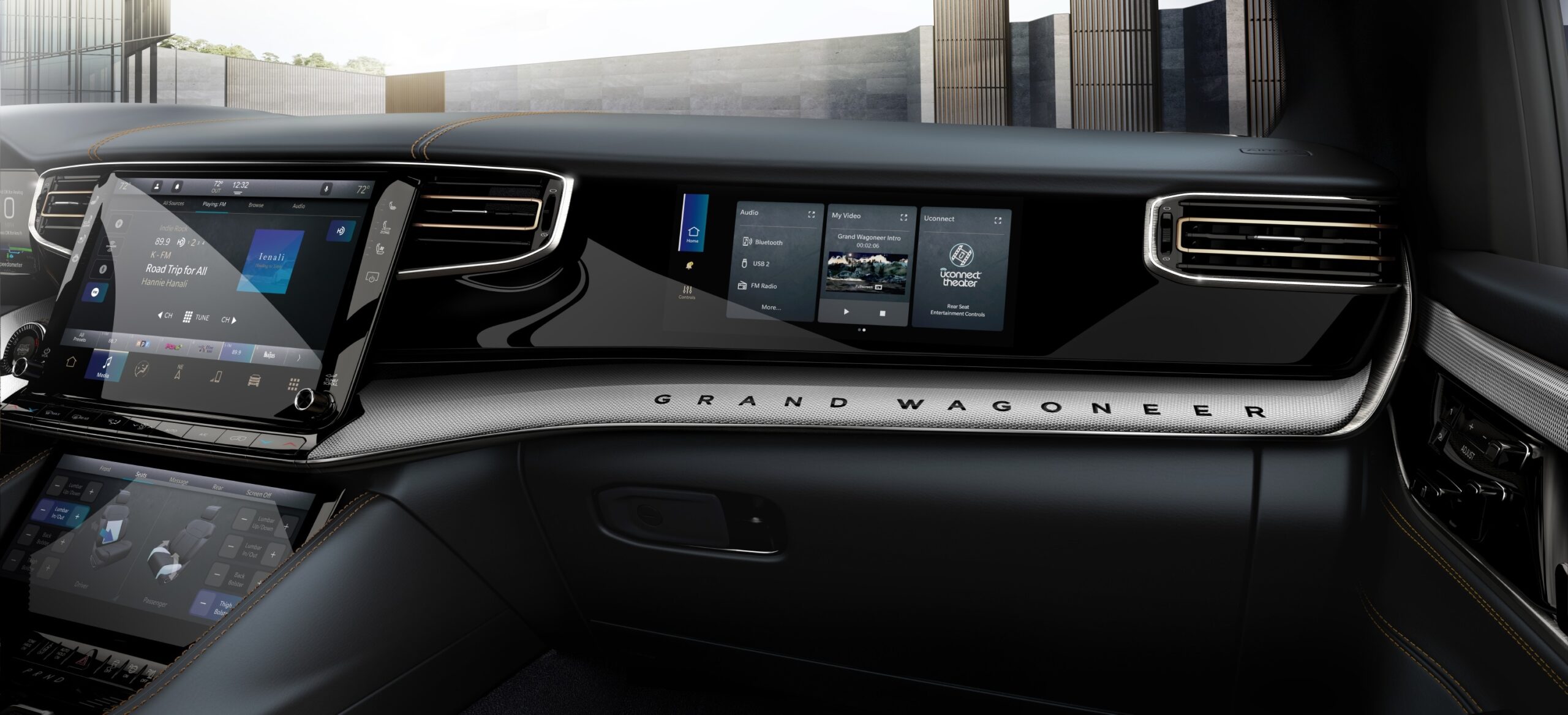
The passenger side 10.25 inch wide touch screen of controls

The passenger-side 10.25-inch touchscreen.

Safety Features

Standard safety features include eight air bags, automatic emergency braking with pedestrian and cyclist detection, active lane management, blind-spot monitoring, rear cross-path detection, and intersection collision assist.
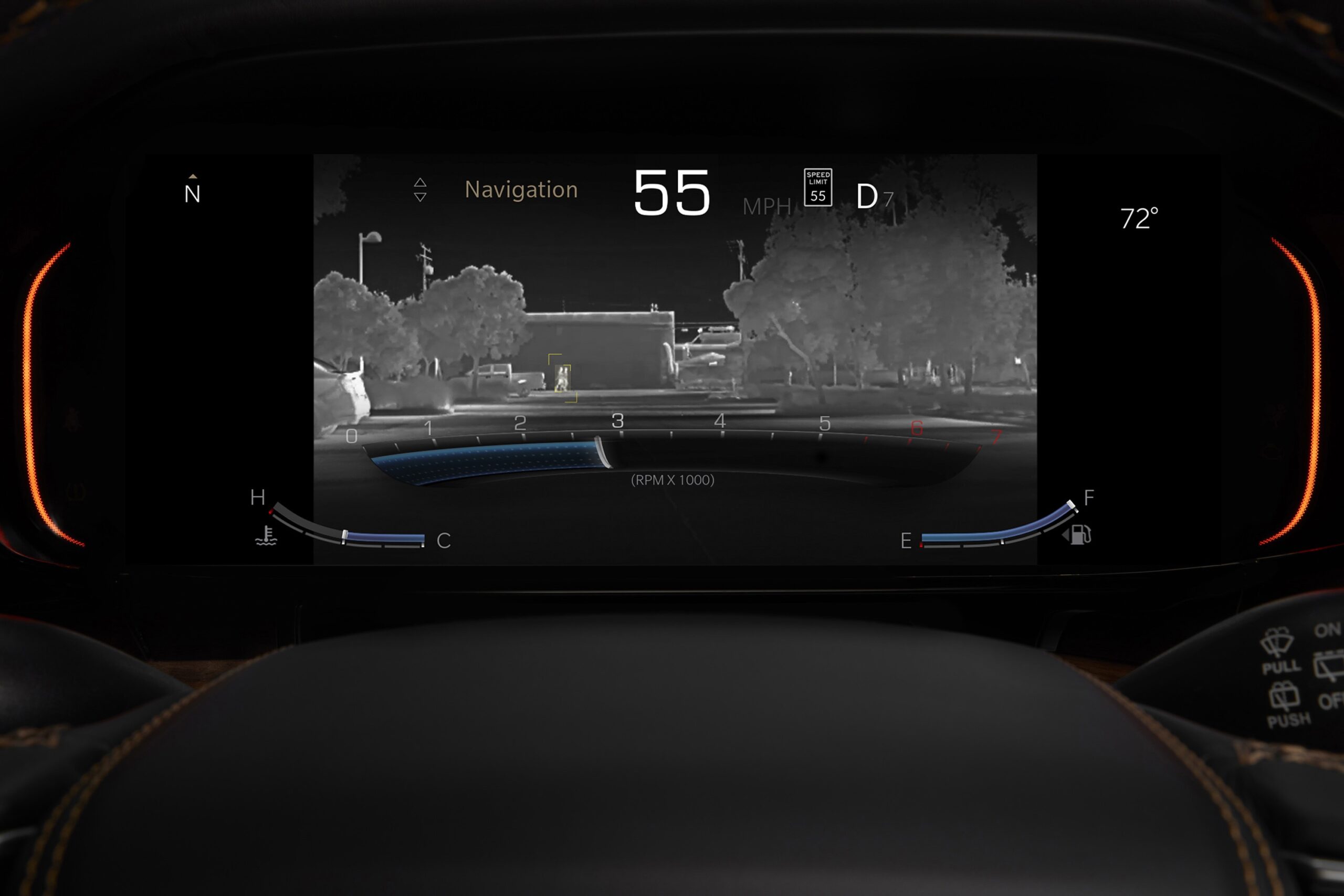
A black and white image of the night vision camera

The Night Vision Camera is especially useful where there are no street lights.

Putting the Grand in Wagoneer

The Grand Wagoneer will stand tall — and long — among the luxury-class competitors. The standard wheelbase models of Wagoneer are about 4 inches longer than their closest competitors. Among the competing luxury SUVs are the BMW X7, Cadillac Escalade, Infiniti QX80, Land Rover Range Rover, Lincoln Navigator, and Mercedes-Benz GLS.

The Grand Wagoneer cabin is rich in comfort, with grandstand views. Jeep tried to ensure a quiet cabin with an acoustic laminated windshield, front door glass, laminated rear glass, and active noise canceling through the audio system. It is an engineering marvel for this towering beast to power along the highway in such traffic-calmed style.

From the suede headliner to the full-weave carpeting, The Grand Wagoneer’s list of standard equipment might be the longest I’ve had to itemize for any vehicle I’ve tested. Power door-closers and heated armrests might be the only missing luxe perks.

The entire list is in the specifications at the end of this review, but here are a few of the standout luxury basics:

Quilted Palermo leather-trimmed massaging seats, 20-way power adjustable front seats, suede headliner, natural walnut interior trim, second-row captain’s chairs with power tilt and slide, heated and ventilated front and second-row seats, luxury front and rear floor mats, reversible cargo mat, foldable cargo shade. There also is a new Uconnect 5 Navigation and infotainment system with voice command, a 360-degree surround-view camera system, and a 23-speaker McIntosh entertainment system.

A digital rearview camera mirror is standard, but I can’t use it with my eyeglasses. When I look at the digital mirror, it takes a second or two for my eyes to focus. But the mirror can be switched to the low-tech original.
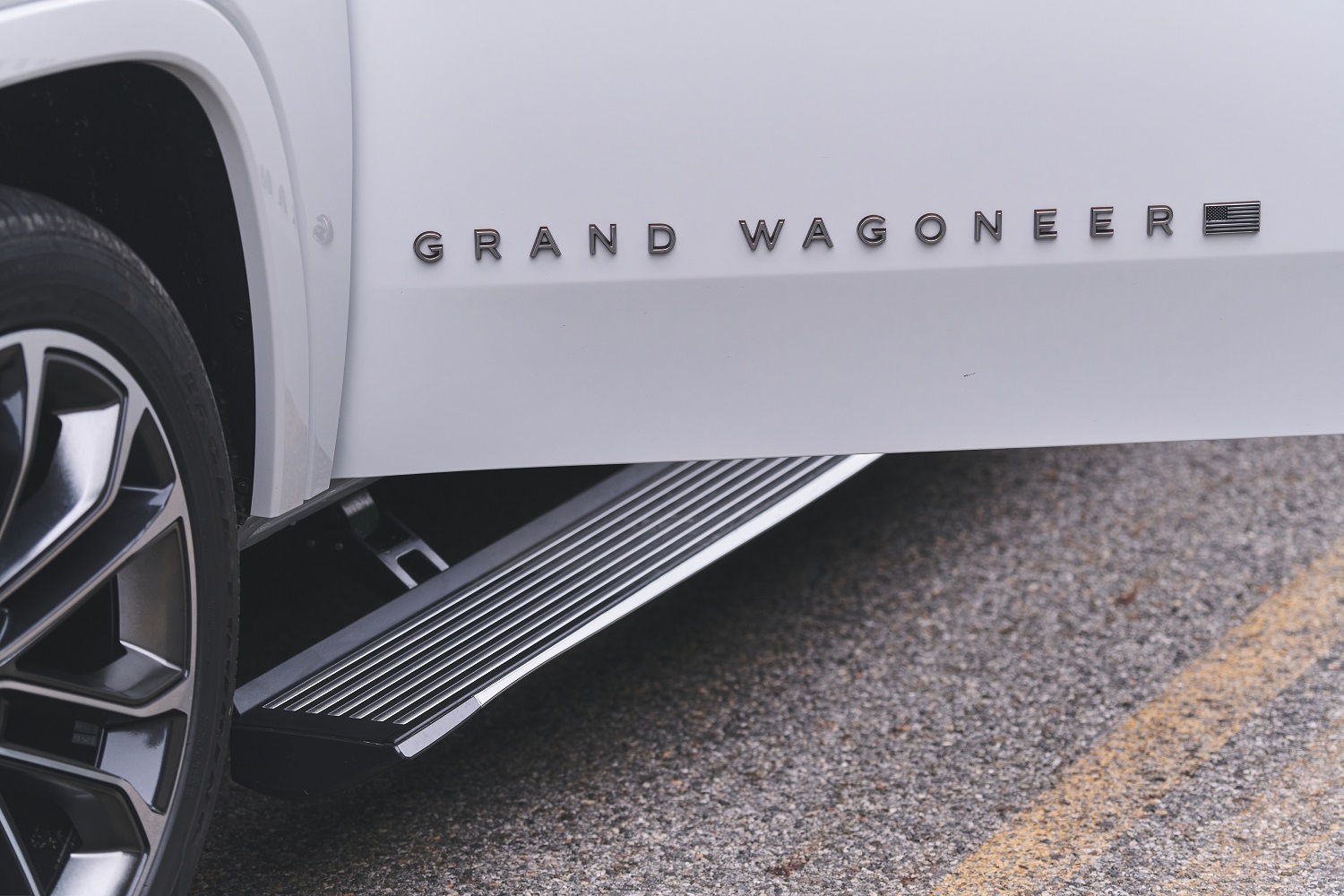
Power running boards lower to a convenient step-aboard height.

Power running boards lower to a convenient step-aboard height.

10 Cool Grand Wagoneer Features

Some of my favorite Grand Wagoneer features:

Power running boards. These lower to a convenient step-aboard height, particularly with the air suspension’s lowered ride height when parked. Too often, running boards create too much of a step and are awkward to use. The design of the boards forms the rocker panel, so legs do not rub on dirty metal.

Power-adjustable pedals (with memory sets). Adjustable pedals are a safety feature to help dial in a secure seating position for drivers of all sizes. The pedals are assets with the power tilt-and-telescoping steering wheel.

Rear seat monitoring camera. The overhead split-screen view of the second row is mainly to keep an eye on a child’s seat, or two — or a pet.

Power folding and reclining second- and third-row seats. How convenient to have this function for loading kids or cargo. And with power switches in the cargo area to fold the second row or fold and raise the third row.

Tri-pane panoramic sunroof and sunshade. The span of glass is dramatic, particularly for those in the second and third rows.

Roof rack with crossbars. Roof-rack crossbars are typically an added cost, but these are standard and store neatly below the cargo floor. Storing the crossbars when not needed helps trim wind noise.

11 USB ports. Let’s hope the USB port does not soon become obsolete. The Wagoneer and Grand Wagoner have eight USB ports, of the dual C-type and standard style. The count goes to 11 with the rear entertainment system.

Night Vision camera with pedestrian and animal detection. This type of system is an asset in areas without street lights. But it is a little odd visually to see the smallish X-ray-like presentation in the driver-info display.
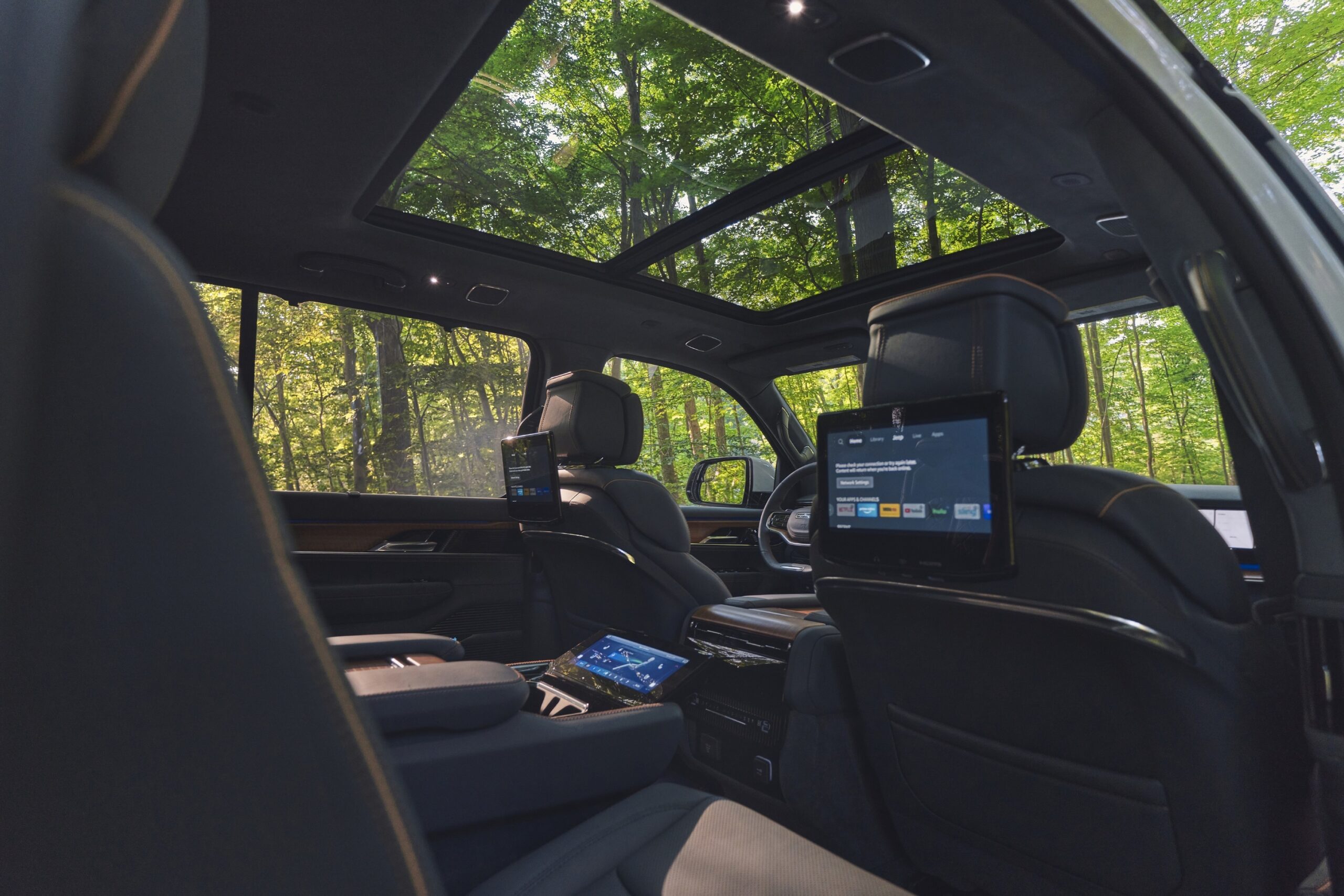
Back seat passengers can view streaming TV and movies on the optional Rear Seat Entertainment system

The Rear Seat Entertainment system, $1,295, features two 10.1-inch touchscreens for streaming movies, apps, and Fire TV for Auto.

Wagoneer Screen Envy

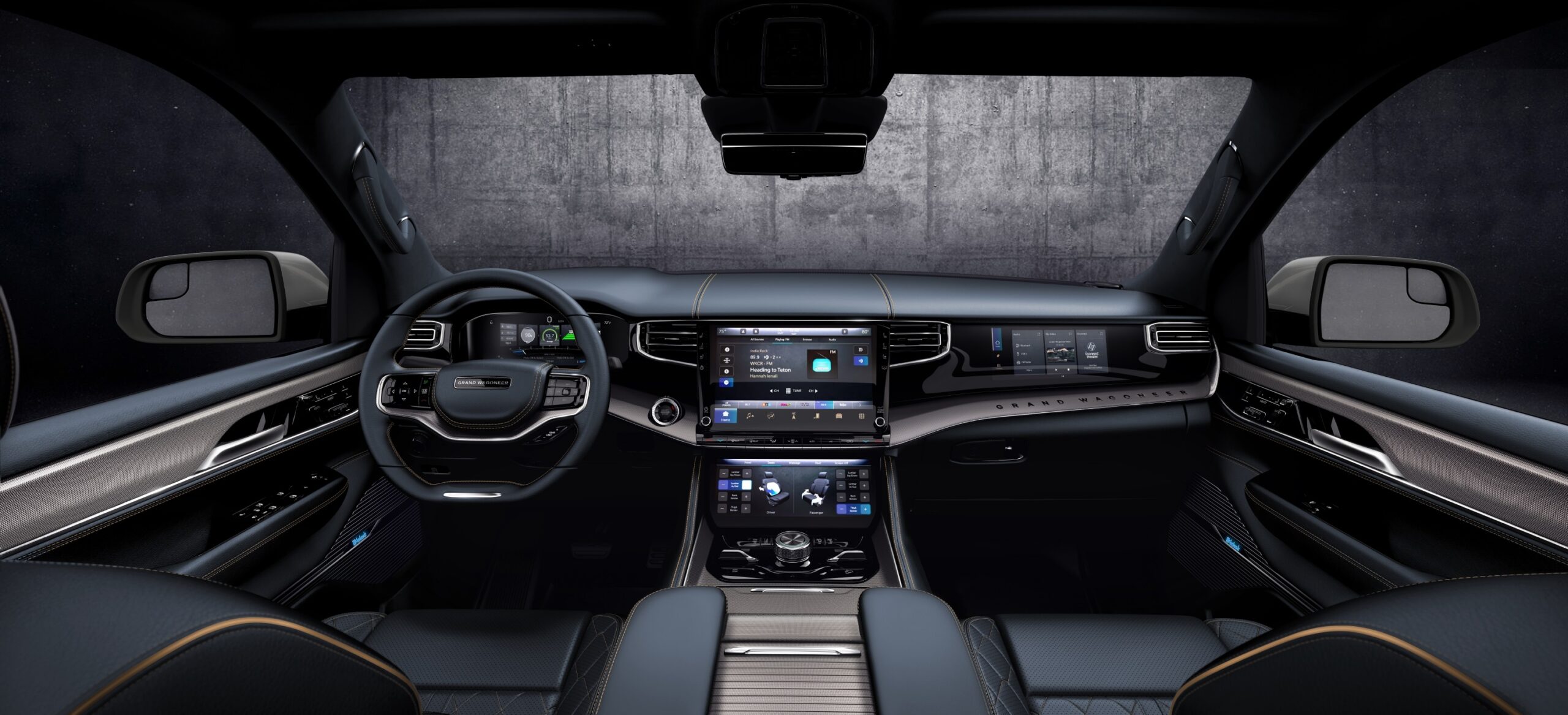
There are nearly 45 inches of display screens along the front instrument panel. Among the inch count are the 12.3-inch-wide instrument cluster, and a 12-inch horizontal touchscreen to access audio, navigation, apps, and views from the 360-degree camera. Just below is a 10.25-inch horizontal display for cabin controls. Then push a button, and the screen rotates to reveal the media hub with two dual USB ports, aux-in, and the wireless charging pad.

To empower the front passenger, the Grand Wagoneer includes a 10.25-inch-wide passenger screen. The access has four primary functions:

  • Co-Pilot (navigation and device management);
  •  Entertainment (via HDMI or rear seat entertainment control);
  •  The ability to view the exterior vehicle cameras;
  •  Fire TV for Auto.  It is possible to start a movie at home and finish it in the Grand Wagoneer.

And there is a 10.25-inch rear screen in the second row to adjust temp, fan, airflow, and seat heating and ventilating controls.

The Rear Seat Entertainment system, $2,195, features Amazon Fire TV built-in. Second-row passengers can stream TV, movies, and apps on two 10.1-inch touch screens on the seatbacks.

In total, there are 75 inches of display screens.

Performance and Ride and Handling

The big 6.4-liter V-8 hits its power stride with a peak of 455 lb.-ft. of torque at 4,400 rpm. The eight-speed automatic rolls smoothly through gear changes while showing respect to stretching fuel economy. Sport mode steps up off-the-line force but not aggressively.

Fuel economy is challenged. The best I could get was 13.3 mpg on a long highway run. Owners will not enjoy filling the 26.5-gallon tank, but they will enjoy every mile it provides.

A hood-up view of the 6.4-lter V-8 engine.

Grand Wagoneer’s 471-hp, 6.4-liter V-8. (Mark Maynard photo)

Ride and Handling

Road tripping in a Grand Wagoneer Series III is a first-class cruiseliner experience. There is headroom and legroom for 6-foot-6 tall adults in the first and second rows. And the second-row captain’s recline and are heated and ventilated.

The ride quality is supple, and some might consider it too soft in road undulations. But there is very little wind or tire noise at highway speeds. And the tire patch is significant from 22-inch Goodyear Eagle grand touring tires (285/45).

Four-wheel-disc stopping power is absolute and necessary when controlling three-plus tons. The front brakes have 14.88-inch vented rotors, and the solid rear rotors are 14.76 inches.

At 6,420 pounds, the Grand Wagoneer is at least 300 to 800 pounds heavier than its mainstream competition. But its turning circle of 38 feet is up to 3 feet tighter.

The Grand Wagoneer’s max tow capacity is a benchmark at 9,850 pounds. A Class IV receiver hitch and 7- and 4-pin wiring harness are included.

Grand Wagoneer’s Air Ride

The GW’s Quadra-lift air suspension gives the feel of a carpeted ride. Head toss is well controlled over speed bumps or when pulling into driveways. The sophisticated system includes electronic semi-active damping to match changing road conditions and stabilizer bars.

Quadra-Lift adds up to 3.6 inches of lift, supported by four-corner air springs. The air-cushioned ride operates automatically, or it can be manually controlled at the shift console. It has five height settings:

Normal Ride Height (NRH): 8 inches of clearance offers improved fuel economy, as well as improved aerodynamics during on-road driving;

Off-road 1: Lifts the vehicle an additional inch from NRH for added height in clearing obstacles (9 inches);

Off-road 2: Adds 2 more inches of ride height, for 10 inches of ground clearance;

Park Mode: Lowers the vehicle 1.6 inches from NRH. NRH and Park Mode are driver-selectable, allowing the driver full control over vehicle ride height;

Aero Mode: Lowers the vehicle 0.6 inches from normal ride height. Aero Mode is controlled by vehicle speed and adjusts for optimal performance and fuel economy. The vehicle will also lower to Aero Mode when in Sport Mode

The spacious second row captains chairs

There is headroom and legroom for 6-foot-6 passengers in the second row.

Wagoneer 4WD Systems

The Grand Wagoneer gets the top two-speed on-demand four-wheel-drive system. Its Selec-Terrain traction control has five modes: Automatic (functional for on- or off-road driving), Sport, Snow, Sand/Mud.

Rock mode works with the Quadra-Lift for a maximum height of 10 inches.

Selec-Speed Control integrates hill-ascent and hill-descent controls. The Electronic Range Select system, engaged at the steering wheel, allows drivers to control vehicle speed up and down trail grades without using the accelerator or brake pedals.

Wagoneer Client Services

Wagoneer will become a portfolio of vehicles that defines “American premium” and delivers a unique customer experience, the company says.

Customers interested in purchasing a Wagoneer or Grand Wagoneer can go to Wagoneer.com, select a dealer and place a $500 deposit. A Wagoneer concierge will make contact to initiate the order process, provide vehicle updates, and assist with any dealer interactions.

After a customer receives their vehicle, support will continue through a VIP helpline via Wagoneer Client Services. Those services include:

  • Five years of free dealership maintenance, including oil changes and tire rotations;
  • 24/7 concierge support and roadside assistance via phone or online chat;
  • No-charge equivalent service loaner;
  • Trip interruption coverage;
  • VIP access to exclusive events;
  • Interior and exterior vehicle cleaning and a full tank of fuel when serviced;
  • Vehicle pickup/delivery for service;
  • Free Wi-Fi and phone charging at the dealership.
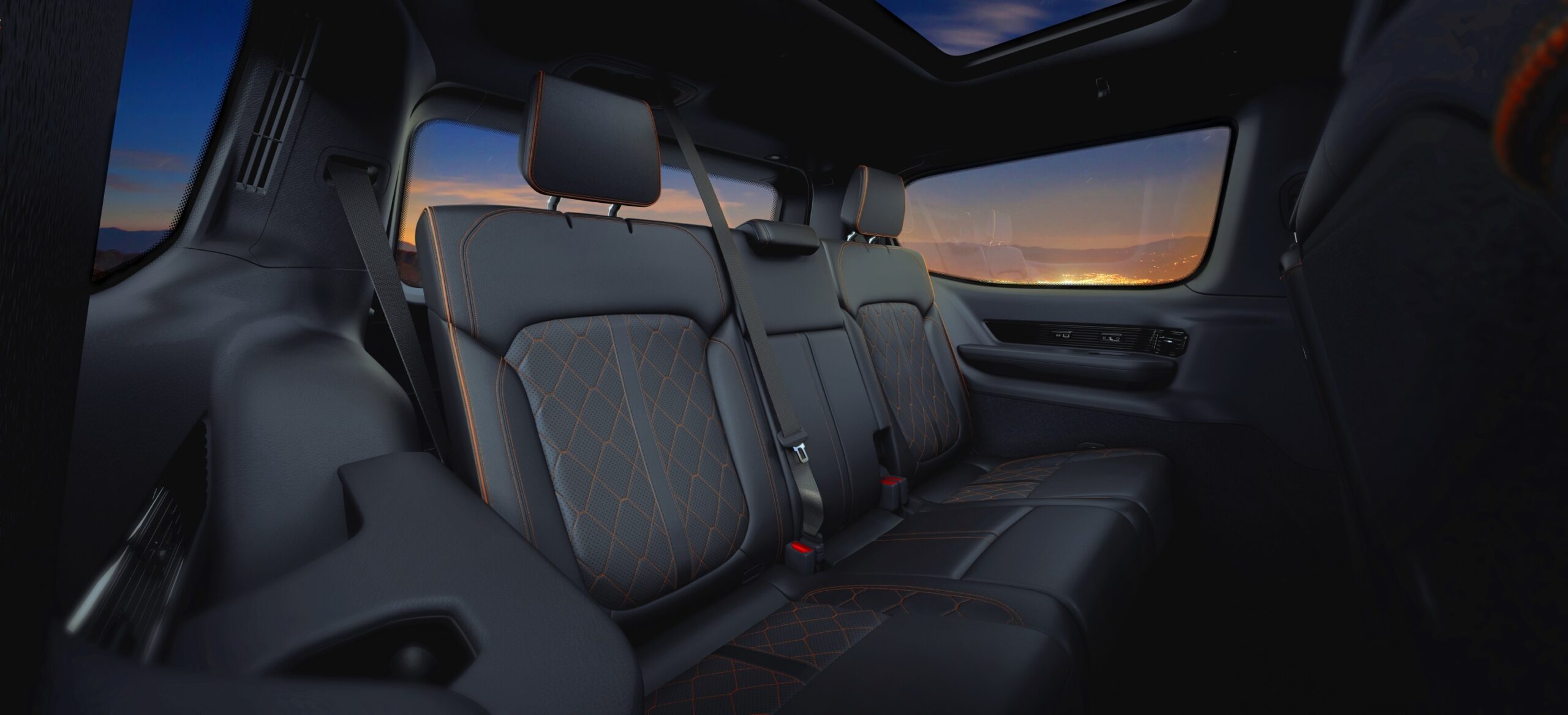
The third row seats

With more than 3 feet of legroom, the third row can recline or fold flat.

10 Customer Promises

1. Only dealers that earn a “Customer First” award for excellence by J.D. Power will be allowed to sell the Wagoneer.

2. The sales process will be efficient. Sales reps will use tablets and full integration to digital communication.

3. Certified Wagoneer Ambassadors. To become certified, a sales or service associate must complete more than 90 hours of training and pass exams to ensure that he or she truly understands the brand, the cars, how they can be used, and how they can be equipped.

4. Every Wagoneer and Grand Wagoneer will be sold with a full gas tank.

5. The vehicle will be thoroughly cleaned at delivery and after servicing and will be returned with radio, seating, climate, and other settings left as the customer had them.

6. Tech access to remote showrooms and to schedule test drives and delivery services.

7. An appropriate loan vehicle will be provided when a Wagoneer must be left at the dealership.

8. Remote services and diagnostics to schedule services and updates, including over-the-air updates and remote diagnostics.

9. Free Wi-Fi and phone charging in the showroom or service lounge, with “high-quality beverages and snacks.”

10. Wagoneer Client Services will provide 24/7 customer support and five years of maintenance. Concierge support and roadside assistance will always be available.

Both back rows of seats folded to show the open cargo area

All-new 2022 Grand Wagoneer rear interior cargo space (94.2 cu. ft. with second and third rows folded flat).

Why Buy the Grand Wagoneer?

It’s not a Jeep, it’s a Wagoneer — the only Jeep ID on the vehicle is in the headlight lenses. The Grand Wagoneer is grand luxury, not a Rubicon Trail-tested SUV. The elite dealership support and promises should be reassuring to new customers and conquests to the brand.

Despite the considerable sticker prices for these big vehicles, customers generally have incomes that make high fuel prices more of an inconvenience than a reason to reject such vehicles, auto-analyst Kim said. “The segment should remain strong in the coming years as lots of product action in that space will keep consumers interested and engaged.”

A rear view of the Grand Wagoneer

The Wagoneer customer experience includes 10 promises and dedicated client services.

2022 Grand Wagoneer Series III Specifications

Body style: large, 5-door, 7-seat body-on-frame SUV with two-speed electronically controlled 4WD

Engine: 471-hp 6.4-liter V-8 with fuel-saver mode and active grille shutters; 455 lb.-ft. torque at 4,400 rpm

Transmission: 8-speed Torqueflite 8HP75 automatic

4WD system: 2-speed electronically shifted transfer case; variable (50/50 or 100 front/rear) with traction modes of Automatic, Tow, Snow, Mud, Sand, Rock, and Sport

Fuel economy: 13/18/15 mpg city/hwy/combined; premium fuel recommended

Towing capacity: 9,850 pounds, with included Class IV receiver hitch and 7- and 4-pin wiring harness

BY THE NUMBERS

Fuel tank: 26.5 gallons

Cargo space: 27.4/70.9/116.7 cubic feet, behind 3rd row/2nd row/front seats

Front head/leg room: 41.3/40.9 inches

2nd-row head/leg room: 40/42.7 inches

3rd-row head/leg room: 39/36.6 inches

Length/wheelbase: 214.7/123 inches

Width/height: 94*/76.6 inches *at the mirrors

Curb weight: 6,420 pounds

Turning circle: 38 feet

FEATURES

Standard equipment includes: Keyless entry and push-button ignition, quilted Palermo leather-trimmed massaging seats, power running boards, 20-way power adjustable front seats, 2nd-row captain’s chairs with power tilt and slide, power folding and heated side mirrors, 60/40 power folding and reclining 3rd-row seats,  hands-free power liftgate, heated and ventilated front and 2nd-row seats, 12.3-inch cluster display, suede headliner, natural walnut interior trim, Uconnect 5 Nav with 12-inch touch screen display, integrated voice command with Bluetooth, 23-speaker McIntosh entertainment system, satellite radio with 6-month subscription, media hub with 2 USB ports and aux-in,tri-pane panoramic sunroof,  locking and lighted glove box, 4-zone automatic climate control, luxury front and rear floor mats, reversible floor mat, foldable cargo shade, roof rack with adjustable roof-rail crossbars, rear back-up-camera washer.

Driving features and technologies: head-up display, automatic headlights and high-beam control, map-in-cluster display, off-road info pages, adaptive cruise control with stop and go, ParkSense automated parking system, ParkSense front and rear park- assist with stop, night vision with pedestrian and animal detection, remote-start system, side distance warning, traffic sign recognition, 4G LTE Wi-Fi hot spot (trial included), automatic crash-notification service, connected travel and traffic services, Apple CarPlay and Google Android Auto, power-adjustable pedals (with memory sets), wireless charging pad, electric parking brake, digital rearview camera mirror, observation mirror, rear seat monitoring camera, acoustic-laminated windshield and front side glass, active noise-control system, LED exterior lighting with 3-optic fog lamps with cornering, 360-degree surround-view camera system.

Safety features include: 8 air bags, automatic emergency braking with pedestrian and cyclist detection, active lane management, blind-spot monitoring, rear cross path detection, intersection collision assist, rear park assist sensors with stop, all-speed traction control, electronic stability control, brake assist, hill-start assist.

PRICING

Series III base price: $109,995, including $2,000 freight charge; price as tested $116,720

Options on test vehicle:

  • Midnight Sky paint $645;
  • Heavy-duty trailer-tow package, $995, adds a trailer-brake control, chrome tow hooks, trailer-hitch lineup assist, trailer-hitch zoom, removable rear tow hook, heavy-duty engine cooling;
  • Rear-seat entertainment group, $2,195, includes Amazon Fire TV built-in;
  • 22-inch machined aluminum wheels with black noise pockets $1,595;
  • Embossed-metal interior accents $1,295

Where assembled: Warren (Michigan) Truck Assembly Plant

Warranties: 3-years/36,000-miles bumper to bumper; 5-years/60,000-miles powertrain; roadside assistance 5-years/60,000-miles

The New Dodge Challenger Convertible

The New Dodge Challenger Convertible

The Drop Top Customs third-party Challenger convertible-top option will have a retail price of $25,999, though final pricing will be negotiated and confirmed with the dealer

A front three-quarter view of the new Challenger convertible made by Drop Top Customs

Dodge dealerships will provide an expedited ordering process for the 2022 Dodge Challenger through Drop Top Customs. (Photos courtesy of Stellantis)

BY MARK MAYNARD

Dodge peeled back the roof on a new third-party Challenger convertible during its three-day Dodge Speed Week event. The three-day event features three nights of Dodge product reveals on Aug. 15, 16, and 17, 2022. The series wraps up on Aug. 20 with a big Dodge brand display in conjunction with the Modern Street Hemi Shootout group
on Aug. 20 during the Dream Cruise Weekend.
.
The 2022 Dodge Challenger convertible will be the first convertible Challenger since the 1970 and 1971 model years for the original muscle car.

“Last Call” for ICE Muscle

Parent company Stellantis is using the event to signal a “Last Call” to its Dodge Challenger and Charger, which will be phased out of production at the end of 2023. Among the debuts at Dodge Speed Week was the 710-hp, 2023 Dodge Durango SRT Hellcat.

A 710 horsepower 2023 Dodge Durango SRT Hellcat

The 2023 Dodge Durango SRT Hellcat in the newly available color of Frostbite.

“While we hit the throttle toward our new performance path, Dodge is also having fun on this victory lap by celebrating decades of muscle car power,” said Tim Kuniskis, Dodge brand chief executive officer, Stellantis. The future of performance for Dodge will be electrified, Kuniskis has said.

“What better way to commemorate how far we’ve come than to make it easier for Dodge Challenger customers to create a throwback convertible look,” Kuniskis said in a release.

Each 2023 Charger and Challenger will have a “Last Call” under-hood plaque with the vehicle name and silhouette showing their origin as “Designed in Auburn Hills” and “Assembled in Brampton.”

A side view of the Challenger convertible with the top down

The conversion will feature a padded roof and a heated glass rear window.

Challenger Convertible Ordering Process

Dodge dealerships will offer an expedited ordering process for third-party convertible modifications for the 2022 Dodge Challenger through Drop Top Customs. It is considered the oldest convertible coachbuilder in the U.S. and is based in Florida.

The new, integrated transportation ordering process allows customers to place third-party orders and pick up finished vehicles through participating Dodge dealers.

Dodge dealerships in the U.S. will begin taking retail convertible transportation orders on Aug. 16, 2022. Convertible third-party modifications through Drop Top Customs will also be available for the 2023 Dodge Challenger when orders open for the new model year.

Customers will work closely with Drop Top Customs and their Dodge dealership to order the vehicle to their specifications. Dodge dealerships will schedule unmodified customer vehicles to ship directly from Stellantis’ Brampton (Ontario, Canada) Assembly Plant to Drop Top Customs. Dodge says that the process will provide a more efficient build time, and allows owners to take the keys after completion.

Expedited shipment option to Drop Top Customs will be available for 2022 and 2023 Dodge Challenger R/T, R/T Scat Pack, and all Challenger SRT models.

A view of the open trunk space

Trunk space, to boot.

Challenger Convertible Pricing

The Drop Top Customs third-party Challenger convertible-top option will have a retail price of $25,999. However, final pricing will be negotiated and confirmed with the dealer.

Additional ordering information, including warranty information, is available through Drop Top Customs.

A convertible with the top up

The convertible conversions feature a fully hydraulic power top.

Drop Top Customs

Drop Top Customs has 46 years of modification experience, creating convertibles, including modern-era Dodge Challenger convertibles. The convertible conversions feature a fully hydraulic power top. Structural reinforcements will reduce body flex while retaining interior space. A padded roof and heated glass rear window provide sound and temperature insulation.

Learn more at Drop Top Customs www.droptopchallenger.com.

Hyundai Tucson Plug-In Hybrid Review

Hyundai Tucson Plug-In Hybrid Review

With 30-35 miles of battery-electric range, driving the 2022 Tucson plug-in is like getting a free gallon of gas every morning

An exterior view of the Hyundai Tucson plug-in SUV

The 2022 Hyundai Tucson Plug-in hybrid is sold in two all-wheel-drive trim levels. The starting prices are $40,745 and $43,945. (Photos courtesy of Hyundai USA or the author)

Table of Contents

Overview
Pricing
Hybrid Vehicle Incentives and Rebates
Performance
Ride and Handling
Interior Function
Back Seats and Cargo
Why Buy the Hyundai Tucson PHEV?
Specifications

BY MARK MAYNARD

The 2022 Hyundai Tucson plug-in hybrid is an effective shield from surging gas prices. It is not as effective as a full battery-electric vehicle, but the latest PHEVs have a valid real-world driving range without the high cost for drivers not quite ready to cut the gasoline hose.

Among the mainstream choices for a plug-in hybrid:*

Ford Escape PHEV, $35,185, with 38 miles of EV driving range and 600 miles total combined gas and electric range. Sold in front-wheel drive only.

Toyota RAV4 Prime, $41,015, with 42 miles of EV driving range, in front- or all-wheel drive.

Mitsubishi Outlander PHEV (2023), $37,000, estimated: The new Outlander PHEV, with standard all-wheel drive, will debut in the U.S. in the second half of 2022. Industry reports estimate it will be capable of 35-plus miles of all-electric driving.

*Starting MSRPs include the freight charge but no federal, state, or local incentives. See below for those details.

An interior view of the Tucson front seat area

The elegant dual-cockpit presentation.

Hyundai Tucson PHEV Overview

The compact-class Tucson SUV is Hyundai’s top seller among its 13 models. A year ago, Hyundai debuted a completely redesigned Tucson SUV, which was followed this year by the sporty Tucson N Line and Tucson Plug-in Hybrid models.

So far, the Hyundai Tucson Plug-in is sold only in California and 10 other states with increased emissions standards — Colorado, Connecticut, Maine, Maryland, Massachusetts, New Jersey, New York, Oregon, Rhode Island, and Vermont.

The hybrid powertrain in the 2022 Tucson plug-in is comprised of a 180-horsepower, 1.6-liter turbocharged and direct-injected four-cylinder engine that is integrated with a 90-hp, 66.9kW electric drive motor. Total system power is 261-hp.

The lithium-ion hybrid battery has 13.8 kWh of power, which provides an all-electric range of 30-35 miles. But careful driving can yield more miles on battery power.

The combined city/highway fuel economy rating of 35 mpg is impressive because it factors all-wheel drive and curb weights of 4,081 to 4,235 pounds. And Hyundai did not cheat on the level of engineering and the quality and appearance of interior materials or engineering.

A side view of the Tucson front seats

Seat comfort is supportive without aggressive bolstering.

Tucson PHEV Pricing

The 2022 Hyundai Tucson plug-in is sold in two all-wheel-drive trim levels of SEL Convenience and Limited. The starting prices are $36,645 and $43,200, including the $1,245 freight charge from Ulsan, Korea.

Today’s Limited tester was $45,040, which included $400 for metallic Deep Sea (blue) paint and $195 for two rows of carpeted floor mats.

Standard equipment for the Limited includes:

  • Smart-key locking and push-button ignition.
  • Rearview monitor with guidance lines.
  • Bose audio system.
  • Heated rear seats.
  • Leather-trimmed upholstery.
  • Panoramic sunroof.

See the standard and optional equipment list in the specs box at the end of this story.

The elegantly designed door panel

Slim, dual metallic lines, separated by a band of piano black, span the dashboard and carry into the upper door panels. (Mark Maynard)

Hyundai Special Purchase Offers

Currently, there is a $500 Dealer Choice Cash offer for both 2022 Hyundai Tucson plug-in models through May 31. But the vehicle must be purchased from dealer stock, and it must be financed through Hyundai Motor Finance.

The bigger catch is the availability of either Tucson PHEV. As of this writing, dealer deliveries of Tucson PHEVs were a month or farther out. If you visit a dealership, the sales rep will add your name to a list of potential buyers. A San Diego dealer told me that it is not possible (in most cases) to order a vehicle with your preferences. Hyundai specs out the vehicles and ships them to the dealership, a few at a time. When vehicles arrive, the dealer will call with details on what is available with the trim level, paint color, and options. Take it, leave it, or wait a while.

Get current Hyundai Tucson pricing here.

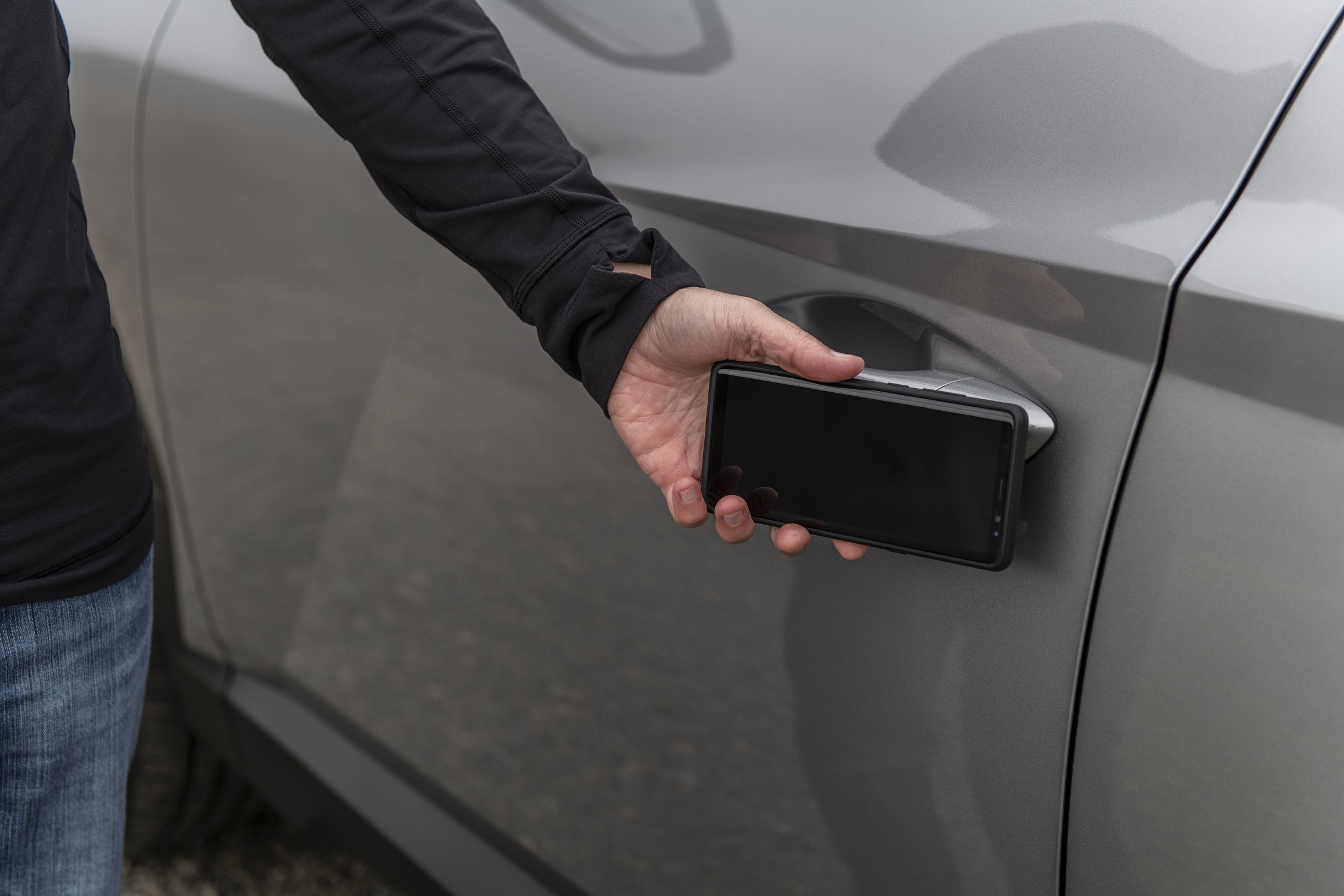
Smartphone app for accessing the vehicle

Use the Hyundai Digital Key to unlock doors, start the engine, and precondition the cabin.

Hybrid Vehicle Incentives and Rebates

Plug-in hybrid, and fuel cell electric vehicles purchased new in 2023 or after may be eligible for a federal income tax credit of up to $7,500. However, the availability of the credit will depend on several factors. Among the criteria are:

  • The vehicle’s MSRP;
  • Its final assembly location;
  • Battery component and/or critical minerals sourcing;
  • And the buyer’s modified adjusted gross income.

Learn more about the new federal tax credits at FuelEconomy.gov.

And the Tucson PHEV qualifies for High-Occupancy-Vehicle freeway access with the green DMV decal ($22).
Find federal and state laws or incentives here.

Tucson PHEV Performance

Unlike most plug-in hybrid models that use a continuously variable automatic transmission, the Tucson plug-in hybrid delivers smooth and consistent power through its stepped six-speed automatic transmission. Hyundai says the transmission is tuned to support the greater performance demands of a hybrid SUV.

There are three driving modes of Automatic, Electric, and Hybrid. Electric mode prioritizes EV usage. It functions, essentially, as an EV except in heavy acceleration or when driving above 70 mph or so. Otherwise, the operation of the PHEV system is fully automatic and applies the most efficient mode, whether gasoline, electric or hybrid.

In my driving experience, it is a sad moment when the battery power drains and the engine fires. The transition is hardly noticeable, but acceleration with electric boost feels more responsive. But with a full tank, there is still another 330 to potentially 400 miles of gasoline driving range.

The battery pack can be fully charged in less than two hours using a home Level 2 240-volt charger.

Tucson PHEV engine and motor

The 261-hp hybrid powertrain in the 2022 Tucson plug-in.

Tucson PHEV Ride and Handling

Suspension engineering is not always simple for the heavier curb weights of an electrified compact SUV. But the Tucson PHEV suspension uses Hyundai’s sophisticated e-handling technology.

When a driver steerw into a corner, the motor system applies incremental braking to the front wheels, which increases the tire contact patch for enhanced traction and steering. Then, as the vehicle exits the corner, the electric motor applies torque to the rear axle, which increases the rear tire grip for control accelerating out of the corner.

The ride is comfortably steady without the objectionable jostle of head toss over street transitions and speed bumps. Evasive or emergency maneuvers are well controlled by the front MacPherson struts with coil springs, the rear multilink, and gas-pressurized shock absorbers front and rear.

Regenerative braking functions without lag or nosedive. The four-wheel discs have 12.8-inch ventilated discs at the front and 12-inch solid discs rear. Whether braking, coasting on the highway or going downhill, the battery gets an incremental recharge.

Both Tucson PHEV models have aero-attractive 19-inch wheels and 235/55 Michelin Primacy all-season tires.

The Tucson (and Santa Fe SUV) hybrids have standard, mechanical HTRAC AWD. Hyundai says the fully automatic HTRAC system monitors 50 vehicle inputs over 100 times per second to calculate the torque needed for each wheel. If it detects slippage, power is rerouted between the front and rear axles and applies subtle braking pressure to the left and right wheels to help maintain traction.

The 19-inch front tire and wheel

Both Tucson PHEV models have 19-inch aero wheels.

Tucson PHEV Interior Function

Hyundai’s design treatment of the Tucson PHEV Limited has an almost elegant dual-cockpit influence. Slim, dual metallic lines, separated by a band of piano black, span the dashboard and carry into the upper door panels. Just below is a swath of fabric that adds another dimension of up-class detail. It is a level of refinement with precise fit that your friends will notice.

A diffusing mode to the ventilation system wafts air flow and reduces the direct blast to the face and hands on the steering wheel. Unfortunately, the fan is very noisy.

It takes just a finger’s reach from the center armrest to make adjustments on the 10-inch touchscreen. The shift console integrates a wireless charging pad with USB charging and data ports and a 12-volt, 180-watt household plug.

There also is a slip space of storage along the sides of the shift console and a deep center storage box.

Sliding visors have large and lighted mirrors. The glove box is large but not lockable. And the panoramic sunroof is the speediest to open and close of any I’ve tested.

Seat comfort is supportive without aggressive side or cushion bolstering. The Limited has an eight-way power driver’s seat — including seat-bottom tilt — and a six-way power front passenger seat. The seats are heated and ventilated, and there’s a heated steering wheel.

Driver sightlines are accommodating at the side mirrors, across the hood, and over the shoulder. Headroom of 38.1 inches, with the panoramic sunroof, will accommodate most taller drivers. (Tucsons without the pano roof have taller headroom of 41.1 inches.)

Except for the noisy fan, the cabin is luxury-class and traffic calmed.

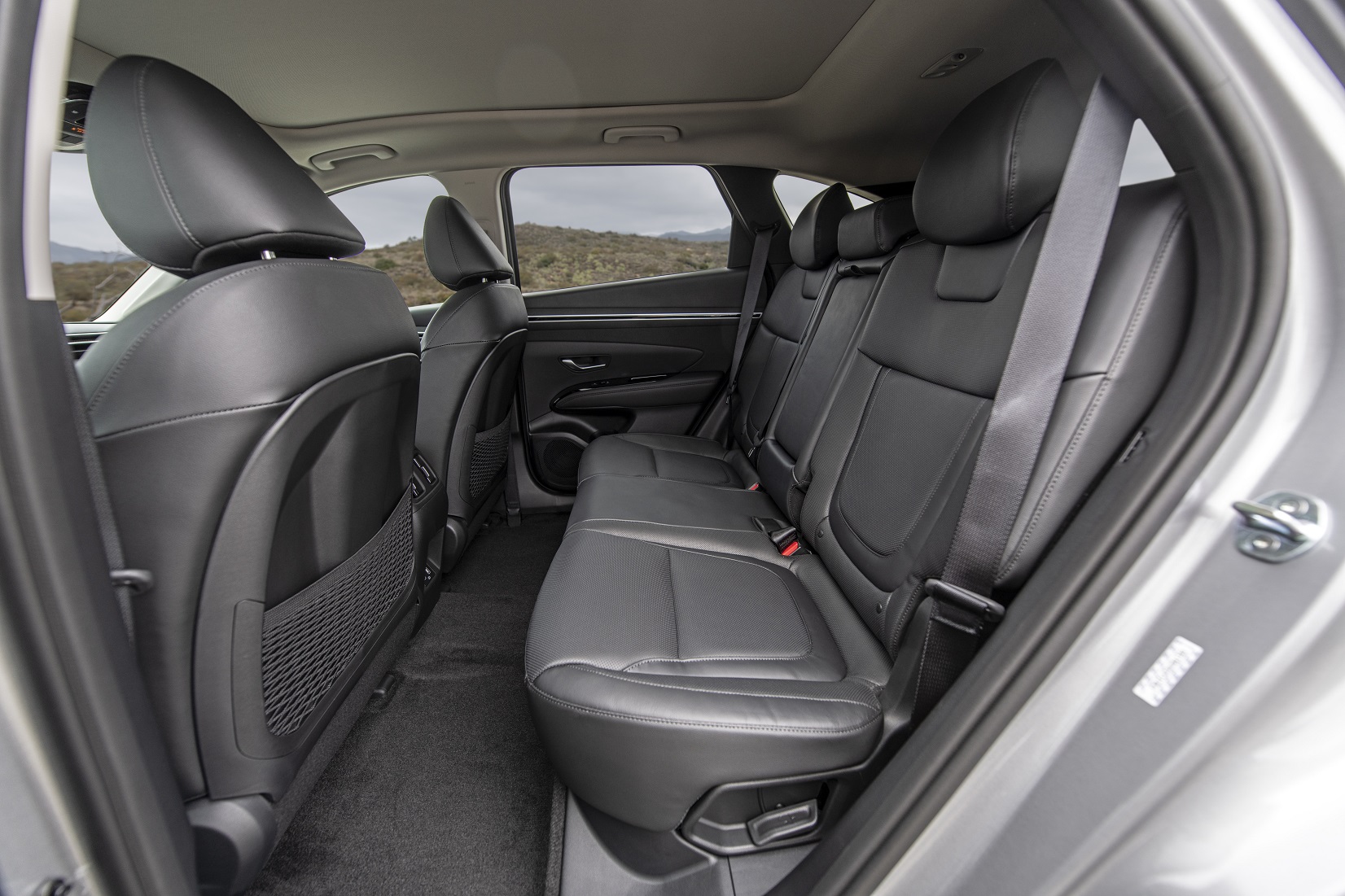
The roomy back seat area

The Tucson has one of the more comfortable back seats of a compact SUV.

Tucson Back Seat and Cargo Space

The Hyundai Tucson has one of the more comfortable back-seat areas of a compact SUV. And the panoramic sunroof creates an inviting space to watch the sky roll by. However, the sunshade cannot be fully opened without also opening the sunroof.

Back seat occupants have a long 39.5 inches of legroom and good footroom even when the front seats are in a low position. A low transmission hump aids three-across footroom, and there are several inches of recline to the seatback, with a 60/40 split.

The doors open to nearly 90 degrees for simplified adult entry and exit. And shoulder room of 56 inches (door to door) is also adult class. Amenities (on the Limited) include two-stage heated window seats, a nicely padded fold-down center armrest with can holders, plus bottle storage in the doors.

The open cargo area with seats folded

Fold the seatback for 5.5 to 6 feet in length. (Mark Maynard)

Cargo space in the Hyundai Tucson plug-in is slightly less than in the non-PHEV Tucson because of the underfloor battery placement. Consequently, the cargo entry opening is 29.5 inches. The cargo opening is wide at 43 inches by 38 inches to the back seat. Fold the seatback for 5.5 to 6 feet in length.

There is subfloor storage for the flat tire inflator kit (there is no spare) and a section for the coiled charging cable. Other extras include left and right seatback releases and a 12-volt, 180-watt plug.

A roller cover is not included, even on the Limited, but is available for $190. Floor mats are extra, too, adding $195 for both rows.

A Tucson PHEV plugged in to charge

Using a home Level 2 240-volt charger, the battery pack can be fully charged in less than two hours.

Why Buy the Hyundai Tucson PHEV?

None of the currently available mainstream plug-in hybrid SUVs is as luxuriously appointed as the Tucson Limited PHEV.

The frugal buyer might prefer a few more miles of electric driving, but it seems irrelevant if you drive less than 30 miles a day and have a home charger. Your Tucson plug-in will always be topped off in the morning after charging overnight at the lowest rates.

But do not expect to negotiate a selling price. Vehicles are in tight supply and most dealers are tacking on a premium, sometimes as much as $3,000. And if not a price overage, the dealer is adding an upsell package, such as an alarm system and paint protection, for a flat $1,000.

If the Hyundai Tucson plug-in you want is not at the dealership, just wait. Hyundai will make more.

Underfloor storage in the cargo area

The Tucson cargo area has subfloor storage for the flat tire inflator kit, wth a section for the coiled charging cable. (Mark Maynard)

Hyundai Tucson Limited PHEV Specifications

Body style: compact, 5-seat, 5-door unibody SUV crossover with AWD; primary body materials of advanced high strength steels and high tensile steel

Engine: 180-hp, 1.6-liter turbocharged and direct-injection 4-cylinder; 195 lb.-ft. torque from 1,500-4,500 rpm

Motor: 66.9kW (90 hp) permanent magnet synchronous with 224 lb.-ft. torque

Battery type: 13.8kWh lithium-Ion polymer

Battery output: 88kW

Total system output: 261 hp and 258 lb.-ft. torque

On-board charger: 7.2kW; 2-hour charge time on Level 2, 240-volt charger

Transmission: 6-speed automatic with paddle shifters

Fuel economy: 35 mpg combined city/hwy; 80 MPGe

Electric driving range: 32 miles; 420 miles total range, gas with battery

BY THE NUMBERS

Fuel tank: 11.1 gallons

Cargo space: 31.9-66.3 cubic feet

Front head/leg room: 38.1*/41.1 inches *40.1 inches without panoramic sunroof

Rear head/leg room: 38.7/39.5 inches

Shoulder room, front/rear: 57.6/56 inches

Length/wheelbase: 182.3/108.5 inches

Curb weight: 4,235 pounds (Limited model)

Turning circle: 38.6 feet

Tow capacity: 2,000 pounds for trailers with brakes; 1,650 lbs. without trailer brakes

FEATURES

Standard equipment includes: smart-key locking and push-button ignition, rearview monitor with guidance lines, 8-way power driver’s seat with seat-bottom tilt, power passenger seat, heated and ventilated front seats, Bose audio system, satellite radio with a 3-month subscription, heated rear seats, heated side mirrors with turn signals, leather-trimmed upholstery with driver’s memory presets, leather-wrapped and heated steering wheel, ambient interior lighting, electric parking brake, panoramic sunroof, 60/40 split-folding back seat with recline, dual front and rear charging USB ports and 2 12-volt (180-watt) outlets

Electronic convenience features: smart cruise control with stop-and-go, Hyundai digital key, surround-view monitor and blind-view monitor, 10.25-inch digital instrument cluster, 10.25-inch navigation screen with Android Auto and Apple CarPlay, wireless device charging, remote smart park assist, Blue Link connected services for 3-years, Blue Link remote start for 3-year subscription

Exterior features: 19-inch alloy wheels, automatic LED taillights and headlights with high-beam assist, body-color rear spoiler with LED brake light, LED running lights, premium grille finish

Safety features include: 6 air bags, forward collision avoidance assist, lane-keeping and lane-following assists, blind spot collision avoidance assist, rear cross-traffic collision-avoidance assist, downhill brake control, hill-start assist, brake assist, stability, and traction controls

PRICING

Base price: $43,945, including $1,245 freight charge; price as tested $44,540

Options on test vehicle: Carpeted floor mats $195; metallic Deep Sea (blue) paint $400

Where assembled: Ulsan, Korea

WARRANTIES

  • Powertrain, 10-years/100,000-miles
  • Hybrid system components, 10-years/100,000-miles ;
  • Hybrid electric battery, 10-years/100,000-miles ;
  • New vehicle limited warranty, 5-years/60,000-miles
  • Free scheduled maintenance for 3-years/36-000 miles for oil changes and tire rotations;
  • Anti-perforation warranty, 7-years

Genesis GV70 AWD 3.5T Review

Genesis GV70 AWD 3.5T Review

Genesis thought outside the instrument panel to create the refined and sophisticated GV70

Starting prices for the 2022 Genesis GV70 range from about $43,000 to $55,000.

Starting prices for the 2022 Genesis GV70, including all-wheel drive, range from about $43,000 to $55,000. (Mark Maynard photos)

Table of Contents

Overview
Pricing
Performance
Ride and Handling
Driver Assist Technologies
Safety Features
Interior
Back Seats and Cargo
Why Buy the Genesis GV70?
Specifications

BY MARK MAYNARD

I had been eager to test the Genesis GV70 since the company announced the arrival of its new small SUV back in early December 2020. The images presented a compelling design, but a couple of other luxury elements stood out:

• Its elite styling resisted an SUV image with unnecessary humps and bulges to reinforce an off-roading image.
• In addition to its long new-vehicle warranty, Genesis leapfrogs ultra-luxury warranties with these no-cost coverages:

1. Free scheduled maintenance and Genesis Service Valet care for 3-years/36,000-miles;
2. Free Genesis Connected Services for 3 years;
3. 3 years of free annual multimedia and navigation updates and lifetime traffic data via HD+ Traffic radio.

And this frosting of largesse can be heaped onto the new vehicle warranty of 5-years/60,000-miles bumper to bumper, and 10-years/100,000-miles for the powertrain.

The stand-out perk, however, might be the free service valet care. Genesis says, “Let us pick up and service your vehicle for you.” Genesis will perform a remote diagnostic check, then retrieve your vehicle for service and leave a loaner vehicle, then return your Genesis washed and cleaned.

Now that’s how a carmaker reassures its customers. Such a time-saver in this class could make a $60,000 compact SUV a no-regrets purchase. And there is little to regret about owning the Genesis GV70.

Steering wheel of the GV70

Sightlines are open across the fenders, helped by the small corner glass.

Genesis GV70 Overview

The compact-class GV70 is the second Genesis SUV, joining the midsize GV80 and the brand’s fifth model overall. The GV70 shares an architecture with the G70 sport sedan (and the Kia Stinger) making it more of a sport SUV, though Genesis has no true sport division … yet.

Every luxury-class manufacturer has at least one small SUV crossover in its lineup. Most have traditional styling treatments to remind of a rugged SUV for that great escape, which automotive marketers think is so desired by U.S. drivers.

Mercedes-Benz and the Porsche Macan are on similar trajectories for an SUV crossover that has carlike manners. Genesis thought outside the instrument panel to create the refined and sophisticated GV70.

No apology is needed for its cargo-crimping, coupe-like roofline. And the GV70 has what might be the best-looking rear-end in the business today. And the rest of the GV70 walkaround is balanced and comment-provoking, too.

The fist-forward “Athletic Elegance” design theme has a sweeping parabolic arch that slashes rearward from the headlights and descends to the center of the taillight. It is a muscular treatment without contrived bulges.

Genesis design and engineering is a progressive presentation of everything drivers have become familiar with — but smartly re-created.

The front seats in the GV70

The Genesis GV70 shuts out the world with acoustic laminated glass.

Genesis GV70 Pricing

Globally, the GV70 drivetrain is rear-wheel drive with optional AWD. But in North America, the GV70 has standard all-wheel drive. There are two choices of turbocharged and direct-injected powertrains with eight-speed automatic transmissions. The electronic transmissions include steering wheel paddle shifters and selectable performance modes of Snow, Comfort, Eco, Sport, Sport-plus, and Custom, which allows individual preferences for steering weight, suspension firmness, etc.

GV70 2.5T AWD starts at $42,595. The 300-hp, single turbocharged 2.5-liter four-cylinder has 311 foot-pounds of peak torque from 1,650 to 4,000 rpm. Fuel-economy ratings are 22 mpg city, 28 highway, and 24 mpg combined, using the recommended premium fuel for peak performance.
GV70 3.5T starts at $54,195 and includes the standard Sport package of 19-inch alloy wheels, panoramic sunroof, and Highway Driving Assist II. The 375-hp, twin-turbocharged 3.5-liter V-6 has peak torque of 391 lb.-ft. from 1,300 to 4,500 rpm. Fuel-economy ratings are 19 mpg city, 25 highway, and 21 mpg combined, also using the recommended premium.

Today’s GV70 3.5T tester was $64,045. Options included the Melbourne Gray matte paint for $1,500, the Sport Advanced package, $5,000, and the Sport Prestige package, $4,900.

Of the 12 paint colors offered, only Alta White is a no-cost choice. The other hues are either $500 or $1,500. Interior color themes are black, red, or blue, depending on paint color.

Find current pricing and incentives for the GV70 here.

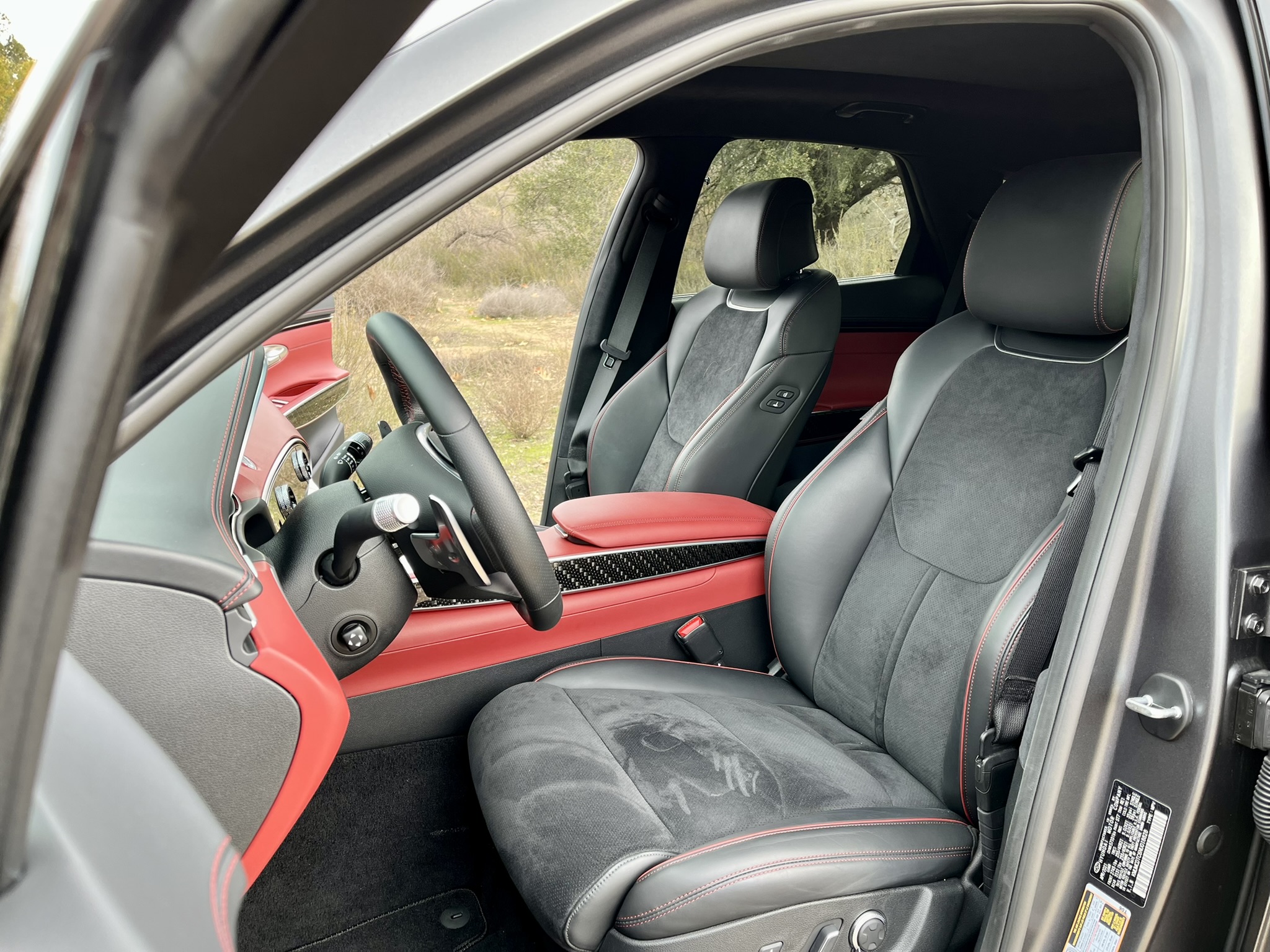
The red door panel of the GV70

There is satisfying quality to the artfully presented interior design.

GV70 3.5T Performance

I was not expecting the Genesis GV70 3.5T to be such a sleeper sport sedan, rich in visceral velocity. Dial up the performance mode of Sport-plus, pin the accelerator and the GV70 rears its beautiful head. This 4,451-pound SUV shows its German-inspired performance engineering with acceleration from 0 to 62 mph in 5.09 seconds, according to testing by Genesis Korea.

For the hot-shoe driver, there is a launch-control feature that when activated raises the engine speed to 2,000 rpm for the hole-shot.

Both GV70 engines have a manufactured “active engine sound,” but it is quite realistic. For good effect, the dual exhaust tips have downspout-sized proportions.

I did not like the V-6 engine’s auto stop-start at idle. It took just a split second too long to restart and it can be hesitant in stop-and-go traffic. In those situations, I switched off the system, but I do respect the potential for emissions and fuel savings.

Fuel Economy

Real world fuel-economy ratings are not far off the official ratings. In a week of testing, my driving averaged 16 mpg around town and I worked up to 21 mpg on the highway. Not good when crude oil is $130 a barrel. But the GV70 hauls ass when you need a defining validation for choosing the V-6.

The eight-speed automatic is almost intuitive at providing just the right gear at the right time. When driving for fun in Sport or Sport-plus, the transmission clicks off downshifts with just a brush of the brake pedal. Then the electronics hold the gear until you exit the corner and roll on power for the next twist. The transmission is so adept at being sporty that I seldom felt the need to use the steering-column shift paddles.

The 375-hp, twin-turbocharged 3.5-liter V-6 in the GV70 3.5T

The 375-hp, twin-turbocharged 3.5-liter V-6 in the GV70 3.5T.

GV70 3.5T Ride and Handling

Enjoy the traffic-calmed cabin, which is a good reason to buy a luxury vehicle. The Genesis GV70 shuts out the clamor with acoustic laminated glass at the windshield, front side, and rear side windows.

The body structure is as stiff as a full metal jacket, which reduces body flex and the resulting creaks and itchy sounds. Aerodynamic elements include the rear spoiler that helps smooth airflow at the top of the body and the front bumper air curtain that reduces airflow resistance around the sides and at the front wheels.

Road harshness is controlled by the tester’s 21-inch Michelin Primacy Touring tires, 255/40. The optional five-spoke sport alloy wheels — with sort of a twisted, waffled imprint — looked street wily with the Melbourne Gray paint.

E-Suspension

Genesis uses an electronically controlled suspension to minimize the vehicle’s body lean when cornering. And with electronic limited-slip differentials (part of the $4,900 Sport Prestige package), cornering levels are increased by distributing power left and right to the rear wheels, according to the road surface and driving conditions.

The e-suspension uses adaptive dampers with a road-preview feature. The system scans the road ahead and the sensors process that information in milliseconds to balance ride quality.

In my driving experience, the e-suspension gave precise turn-in responses, but it is not as magically smooth as a magnetorheological damper, such as is used in some performance vehicles. I experienced a few unexpected jolts along rough patches and noticeable head-toss across speed bumps.

With its towing capacity of 3,500 pounds and a full-bodied curb weight of 4,451 pounds, good brakes are essential. And the GV70 3.5T is prepared with ventilated four-wheel discs with 14.2-inch rotors at the front and 13.6-inch rotors rear. (2.5T models also have vented discs, with rotors that are 13.6 inches front, and 12.8 inches rear.

21-inch GV70 tire and wheel

Road harshness is well controlled by the Michelin Primacy Touring tires.

Driver Assist Technologies

Using a Level 2 driver-assist function is always helpful in heavy highway commuting. These systems keep watch when the driver doesn’t.

The Genesis system is reasonably consistent, but it will allow the vehicle to drift wide in a highway curve, crossing the white highway lines or Botts dots. The mapping for steering adjustments isn’t quite smooth and seems like an action of connecting the dots.

But I did appreciate the heads-up display (part of the Sport Prestige package). When using the driver-assist system, the HUD shows red alerts for side traffic. It is more visible during the day than warning lights in the side mirrors. And the heads-up display also shows gray profiles of nearby vehicles ahead and on either side.

Driver assist screen in the GV70

The Level 2 driver-assist system shows red alerts for side traffic.

GV70 Safety Features

The Insurance Institute for Highway Safety rated the Genesis GV70 a Top Safety Pick+ for 2021. The IIHS also gives Top Safety Pick+ ratings for the GV80 SUV, G80 executive sedan, and G90 flagship sedan.

The 2022 awards mark the third year in a row that the entire Genesis lineup of eligible vehicles has earned top honors.

All Genesis models are equipped with a comprehensive suite of state-of-the-art driver assistance and safety technologies including Forward Collision-Avoidance Assist with Pedestrian Detection, Lane Keeping Assist, and Blind-Spot Collision-Avoidance Assist.

Among eight air bags (including a front center air bag), other standard GV70 safety features include:

  • Forward Collision-Avoidance Assist with Junction Crossing and Turning. The system is intended to mitigate the risk of impacts when turning or crossing through an intersection;
  • Blind-Spot Collision-Avoidance Assist. This feature helps reduce the chance of potential impact with a moving vehicle when departing a parallel parking spot.
  • Advanced Rear Occupant Alert technology. Genesis says the GV70 is the first vehicle to feature radar-based detection of passengers in the rear seat, Genesis says. To alert drivers when a child or sleeping infant has been left in their seat, cabin sensors can detect when back-seat passengers move, and they can also detect small respiratory movements.
Double-line quad LED headlights on the GV70

Double-line quad LED headlights are intended to add a sense of speed.

GV70 Interior Function

There is a sweet spot of roominess in the GV70 cabin. Headroom with the panoramic sunroof is about 38 inches and should accommodate 95 percent of drivers; especially with legroom of 41.3 inches.

Sightlines are open across the fenders, with help from small corner glass at the windshield pillars. Over-the-shoulder views are somewhat slim but no worries when parking — the surround-view camera system with guidance lines has billboard proportions from the 14.5-inch high-definition infotainment screen at the top of the instrument panel.

The standard 16-way power driver seat can be electronically positioned by the optional Smart posture control. The feature will set an optimal position based on the driver’s height and weight. It also sets positions for the steering wheel, side mirrors, and head-up display. See the function here.

The front passenger has eight-away power adjustment — and both front seats are heated and ventilated. The passenger seat includes a “walk-in device,” which is merely a power switch for a back-seat occupant to move the seat forward for more legroom; it is a trickle-down feature from chauffeur-driven sedans.

The 3D electronic gauge array is unique with large dials for the speedometer and tachometer. The tach might have merit for the V-6 engine, but it is also is wasted space for most drivers.

There are two large flat dials on the shift console: one for the transmission and the other to access cabin functions, audio, and infotainment. The dials are similar in size, and in the first four days of driving my hand naturally fell to the dial for cabin function. In time, owners will gain the muscle memory to go straight for the shift dial.

GV70 back seat.

Rear legroom is adequate at 37.2 inches.

Back Seat and Cargo Space

Genesis provides a full luxury treatment to the back seat when some brands back off on the details and even soundproofing. Legroom is adequate at 37.2 inches — but hope for short people in the front seats. However, the doors open to near-90 degrees for easy entry, and the seats are comfortably supportive.

Cargo area of the GV70

Fold the back seat for 6 feet of length.

Cargo capacity is slightly compromised by the sloping roofline, but there is nearly 29 cubic feet of space behind the back seat, stacked to the headliner. The cargo opening is wide at 41 inches, and fold the 60/40 back seat for about 6 feet in length.

The area is finished in quality carpeting, with a pair of large side lights, and a slim storage area under the cargo floor.

Despite the $64K price, a cargo roller cover is not included but is available for $200. However, carpeted floor mats are included.

Sidelights in the cargo area of the GV70

Thick pile carpeting, large side lights (2), and robust seatback releases.

Why Buy the Genesis GV70 3.5T?

The Genesis brand is still an outlier among luxury auto buyers who might be more comfortable committing to an Audi, BMW, Lexus, or Mercedes-Benz. But, in 2020, J.D. Power named Genesis the most dependable automotive brand, and in 2021 the brand was lauded as the most technologically innovative in North America.

Time is money and the extensive warranty package is a time-saving answer to the GV70 $64,000 question.

A rear view of the Genesis GV70

Aerodynamic elements include the rear spoiler that helps smooth airflow.

Genesis GV70 3.5T Specifications

Body style: Compact, 5-seat 5-door SUV crossover in rear- or all-wheel drive

Engine: 375-hp, twin-turbocharged and direct-injected 3.5-liter V-6 with auto stop-start at idle; 391 lb.-ft. torque from 1,300-4,500 rpm

Transmission: 8-speed automatic with paddle shifters and 5 drive modes

Fuel economy: 19/25/21 mpg city/hwy/combined; premium fuel recommended for peak power

Max. towing capacity: 3,500 lbs. with trailer brakes

BY THE NUMBERS

Fuel tank: 17.43 gallons

Cargo space: 28.9 to 56.9 cubic feet

Front head/leg room: 39.6*/41.3 in. *without moonroof

Rear head/leg room: 39.1/37.2 in.

Length/wheelbase: 185.6/113.2 in.

Curb weight: 4,451 lbs.

Turning circle: 37.7 ft.

FEATURES

3.5T Standard equipment includes: Smartkey entry and locking with push-button ignition, with Nappa leather-trimmed upholstery, 16-way power driver seat (with power side bolsters and seat cushion), 14.5-inch high-definition infotainment screen, 12.3-inch 3D digital gauge array, 8-way power front passenger seat (with walk-in device), heated and ventilated front seats, 2 front USBs (data and charge) and 2 rear charging USBs, 9-speaker audio system with Android Auto and Apple CarPlay, electric parking brake with automatic hold, full LED lighting (headlights, taillights, running lights, and side mirror turn signals), power folding and heated (with a timer) side mirrors, outside approach lights with Genesis logo (at side mirrors), power one-touch panoramic sunroof, solar control tinted side and rear glass, acoustic laminated glass (windshield, front side and rear side windows), carpeted floor mats, power tilt-telescoping steering wheel, smart cruise control with stop-and-go, wireless charging, locking glove box, surround-view camera system with guidance lines

Packages on tester

Sport Advanced package, $5,000: Nappa Leather Seating Surfaces with Sport Pattern Quilting; Layered Edge Backlit Trim; Leatherette Upper Instrument and Door Panels; Suede Headliner; Heated Steering Wheel; Genesis Digital Key; Surround View Monitor; Blind-Spot View Monitor; Remote Smart Parking Assist
Parking Distance Warning – Front; Parking Collision-Avoidance Assist – Rear; Lexicon Premium Audio with 16-Speakers

Sport Prestige package, $4,900: 21-inch Sport Alloy Wheels; Electronic Limited Slip Differential; Nappa Leather Seating Surfaces with Suede Insert; Carbon Fiber Trim; Heated 2nd Row Seats; Manual Rear Side Sunshades; Acoustic Rear Door Glass; 3-Zone Climate control; 12.3-inch 3D Digital Cluster
Heads-Up Display

Safety features include: 8 air bags, Forward Collision Avoidance-Assist with Pedestrian and Cyclist Detection, Lane-Change Oncoming, and Junction Turning Highway Driving Assist; Driver Attention Warning; Lane Keeping Assist and Lane Following Assist; Blind-Spot Collision-Avoidance Assist; Rear Cross-Traffic Collision-Avoidance Assist; Safe Exit Assist; Intelligent Speed Limit Assist; Park Distance Warning – Rear; Launch Control and Hill Start Assist Control Vehicle Stability Management with stability and traction controls

PRICING

Base price: $53,645, including $1,045 freight charge; price as tested $64,045

Options on test vehicle: Melbourne Gray matte paint $500; Sport Advanced package, $5,000; Sport Prestige package, $4,900;

Where assembled: Ulsan, Korea

Warranties: 5-years/60,000-miles bumper to bumper; 10-years/100,000-miles powertrain; Genesis Service Valet for 3 years or 36,000 miles provides a remote diagnostic check, vehicle pick up, and a loaner vehicle and return of the vehicle

2022 Audi Q5 Review

2022 Audi Q5 Review

There is a lot to unwrap for the 2022 Audi Q5. This compact SUV is sold in two body styles with choices of gasoline engines or a plug-in hybrid

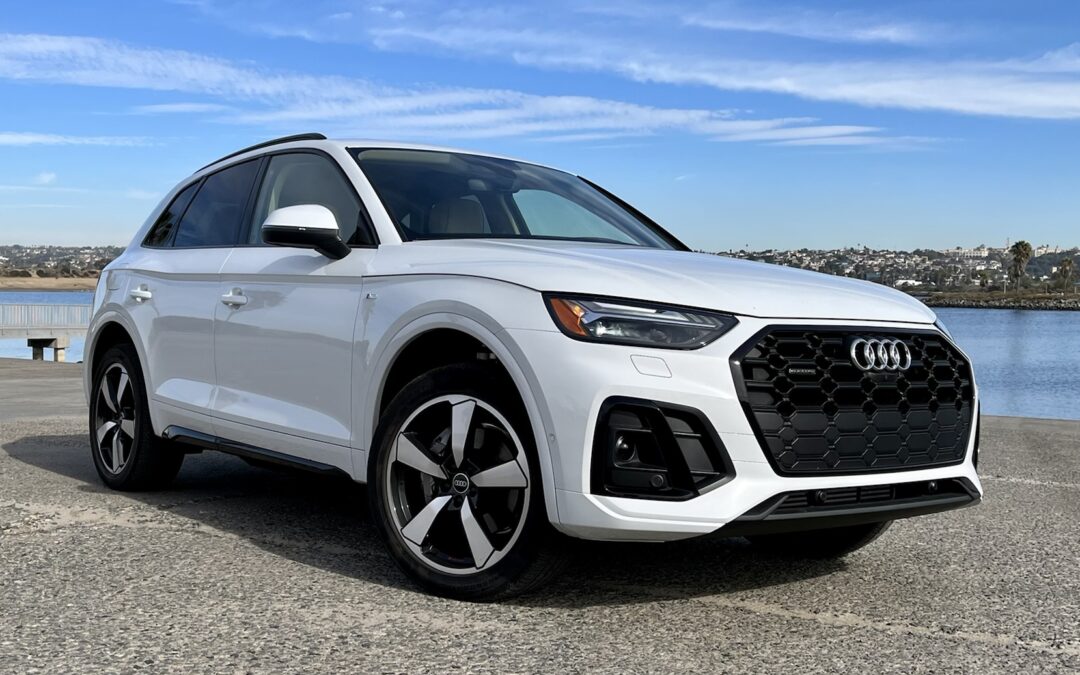
The Audi Q5 is sold with a choice of three models: the Q5 45 TFSI 4-cylinder (today’s tester), Q5 55 TFSI e plug-in hybrid, and the SQ5 turbocharged V-6.The Audi Q5 is sold with a choice of three models: the Q5 45 4-cylinder (today’s tester), Q5 55 e plug-in hybrid, and the SQ5 turbo V-6. (Photography by Mark Maynard)     

Table of Contents

What’s new for 2022?
Pricing
Performance and Fuel Economy
Safety Features
Ride and Handling
Quattro AWD
Interior Function
Back Seats and Cargo
Why Buy the Audi Q5?
Specifications

BY MARK MAYNARD

There is a lot to unwrap about the 2022 Audi Q5, and not just that it shares a celebrity lineage with the Porsche Macan — and has heated and cooled cup holders. This compact SUV crossover is Audi’s top-seller and packs an abundance of five-star NHTSA safety ratings. And it is sold in two body styles, including the rakish Sportback, and with choices of gasoline engines or a plug-in hybrid.

What’s New for the 2022 Audi Q5?

The Q5 has powertrain choices of a gasoline-powered 45 TFSI and the 55 TFSI e plug-in hybrid. Both have standard quattro all-wheel drive. (TFSI stands for the turbocharged and direct-injected engine.) Next, choose from three trim choices: Premium, Premium Plus, and Prestige.

Following a styling, decor, and infotainment update in 2021, the 2022 Q5 45 TFSI was upgraded to a standard S line exterior. The treatment includes aluminum front door-sill inlays with an illuminated S logo. There is also a new 18-inch wheel design for the Premium trim.

Additionally, a power-adjusted steering column is now standard in the Premium Plus trim. And the performance-oriented SQ5 and SQ5 Sportback get real Atlas Carbon fiber inlays as standard.

A new Black optic package ($1,300) is available for all models, including black exterior trim and 20-inch wheels with all-season tires.

The plug-in Q5 55 e gets standard sport seats to create an SQ5-lite variant. The plug-in hybrid model also receives a battery upgrade to a 17.9 kWh battery, which adds 3.8 kWh. Q5 55 e has an electric driving range of around 19 miles.

The driver area of the Q5

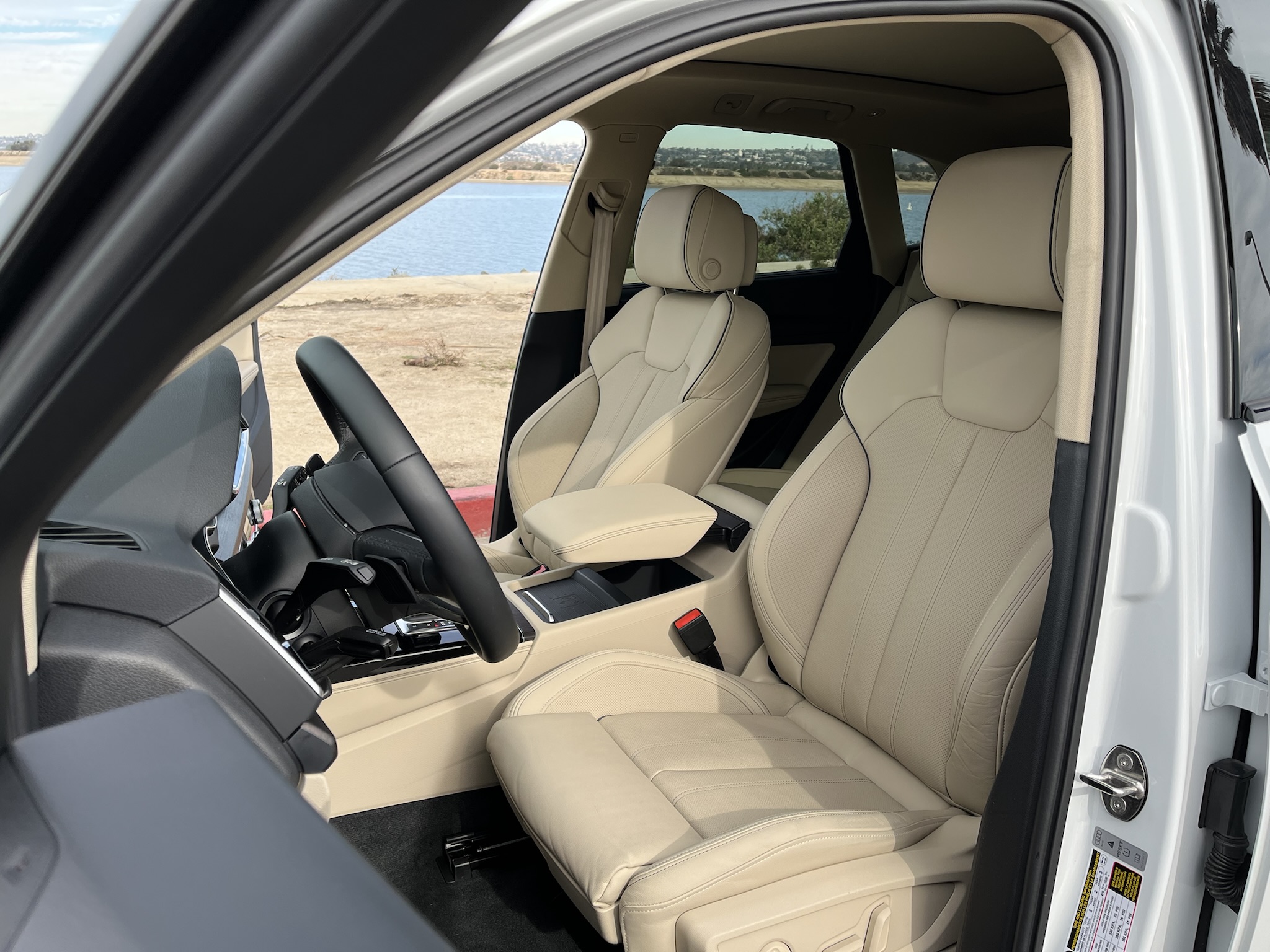
Front headroom is a tall 39.6 inches even with the moonroof.

Audi Q5 Pricing

Starting prices for the Q5 45 range from $46,695 to $51,695 to $57,395. The powertrain is the 261-horsepower, 2.0-liter turbocharged and direct-injected four-cylinder with a seven-speed direct-shift (automated manual) automatic transmission. Audi cites 0-60 mph acceleration in 5.7 seconds. All MSRPs include the $1,095 freight charge from San Jose Chiapa, Mexico.

The 55 e plug-in hybrid uses the 2.0-liter engine with an electric motor and 17.9 kWh lithium-ion battery. With power ratings of 362 hp and 369 foot-pounds of torque, Audi cites 0-60 mph acceleration in 5 seconds. Starting prices range from $55,695 to $65,145.

The high-performance SQ5 quattro has a 349-hp 3.0-liter V-6 with 369 lb.-ft. of torque. Audi cites 0-60 acceleration in 4.7 seconds with its eight-speed Tiptronic automatic. The SQ5 also has three trim choices with starting prices ranging from $56,695 to $66,095.

The fastback Sportback models, with cropped cargo space, are available only with the 45 TFSI powertrain and the same basic content as the full SUV model. The Sportback price premium ranges from $2,300 to $4,300, depending on trim choice.

The Audi Q5 S Line 45 quattro Prestige tester was $59,290 with options including the $595 Glacier White metallic paint and the Black optic package, $1,300.

Ibis white paint is the only non-premium color. Another six hues are offered for $595 each, and there are exclusive colors for $3,900.

Check here for current pricing and incentives.

The handsome tricolor theme with the tester’s Atlas Beige leather-trimmed and perforated upholstery

The handsome tricolor theme with the tester’s Atlas Beige leather.

Performance and Fuel Economy

The Q5’s turbocharged and direct-injection 2.0-liter four-cylinder has an impressive 261-horsepower and 273 foot-pounds of torque from 1,500-4,200 rpm.

All Q5 engines feature a 12-volt “mild hybrid” system that engages auto stop-start at idle. The MHEV system also can recover energy under braking or coasting. A lithium-ion battery powers auxiliaries when coasting with the combustion engine shut off. The 12-volt belt-alternator starter system adds 13 horsepower.

Going pedal-down for full launch force creates quite the road show, factoring an all-wheel-drive curb weight of 4,079 pounds. But initial acceleration can be delayed as the turbo spools power and the dual-clutch (an automated manual) engages a gear.

In normal drive mode, the fuzzy logic calibrations to the transmission dole out shifts according to how the driver has been working the accelerator. Easy, around-town driving has a conservative response. But when get-me-outta-here force is needed, the sensors fire off imminent-danger alerts and then there is liftoff. I learned to finesse the “logic” by being a little more aggressive on the accelerator or just driving in Sport mode.

Official fuel-economy ratings are 23 mpg city, 28 highway, and 25 mpg combined on the recommended premium fuel. The good news is that I worked up to a combined 30.3 mpg in a 180-mile highway run. And with the 18.5-gallon fuel tank, the cruising range can be more than 500 miles.

The Audi engine.

The turbocharged and direct-injection (TFSI) 2.0-liter has an impressive 261-horsepower and 273 foot-pounds of torque.

Audi Q5 Safety Features

The safety stars shine for the Audi Q5 in either body style. According to the National Highway Traffic Safety Administration, the Q5 earns the top five stars in the overall category with five stars for frontal and side crashes and four stars for rollover protection.

Standard Q5 safety features include:
•Six air bags.
•Forward collision warning and avoidance assistance.
•Lane-departure warning.
•Blind-spot warning.
•Rear cross-traffic warning.

The Prestige package links the standard driver-assist technologies with adaptive cruise control with traffic-jam assist, Navigation Plus, and active lane assist.

The top-view camera system on the 10.1-inch touchscreen.

The top-view camera system on the 10.1-inch touchscreen.

Q5 45 Ride and Handling

As with any good German-engineered vehicle, the Q5 has born-with drivability. It is felt in how well the suspension compensates for road conditions and how the tires transmit feedback through the steering wheel and seat.

The Q5’s five-link front and rear independent suspension is never harsh and neatly dips a shoulder into cornering maneuvers. Of course, that engineering is more important for the higher-performance and Sportback models, but the Q5 45 reaps the reward.

Stopping power is substantial from four-wheel ventilated disc brakes, 13.3-inch rotors at the front wheels and 13-inch rotors rear.

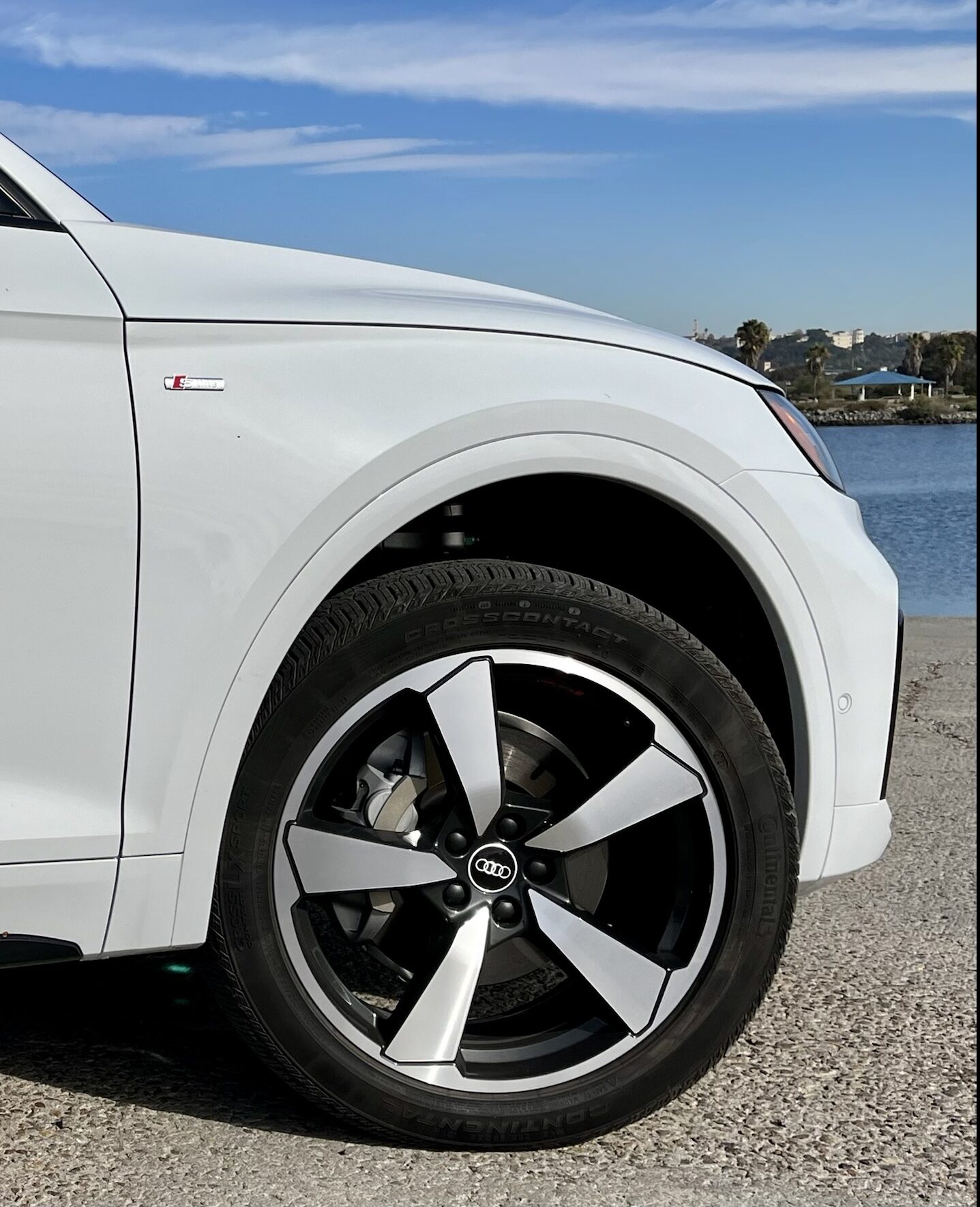
The cabin is well soundproofed and the chassis seems to filter out road harshness. The Prestige upgrade includes 20-inch Continental CrossContact XL Sport (255/45) all-season tires.

Continentals can be noisy with a grainy sizzle at highway speeds, but this tire’s compliance and low rolling noise are notable, especially at 20 inches. The comfort factor is the moderate treadwear rating of 480, which is a softer formula than the harder 600 or 700. The higher ratings have a longer tread life and are common on small SUVs.

There is a “space-saving” spare with an inflation system rather than a temporary spare (for such a large wheel).

The Black optic package added 20-inch tri-color finish wheels with Continental CrossContact XL Sport all-season tires.

The Black optic package added 20-inch tri-color finish wheels with Continental CrossContact XL Sport (255/45) all-season tires.

Quattro AWD System

Audi’s sophisticated AWD system decouples the driveshaft to the rear wheels when all-wheel drive is not needed. Essentially the vehicle becomes front-wheel drive when cruising or in other driving situations where the vehicle’s computers determine all-wheel traction is not required.

Audi claims the system can re-engage power to the rear wheels within milliseconds of the system detecting or predicting slip or when the driver accelerates aggressively.

Audi Q5 Interior Function

Clean lines, tidy organization, and rich materials describe Audi’s cabin design. There are no gimmicky electronic displays. Instead, it’s all about the business of driving — and those heated and cooled cup holders.

The tester’s tricolor interior theme is handsome and contrasts nicely with the tester’s Atlas Beige leather-trimmed and perforated upholstery with granite-gray stitching. The front sport seats are firm but comfortably bolstered and 10-way power-adjustable, including seat-bottom tilt.

While the Q5 is compact class, the cabin doesn’t feel small. The SUV body style has the benefit of squared-off proportions, not the raked rear roofline of the Sportback.

Entry and exit are comfortable and uncomplicated by design swoops. Front headroom is a tall 39.6 inches, even with the moonroof. Sightlines are open across the fenders and made better by some open space between the side mirror and windshield pillar.

The Q5 is among about nine new vehicles that offer heated and cooled front cup holders. Add that perk to the other humanizing features of heated back seats, heated steering wheel, heated and ventilated seats, and heated side mirrors.

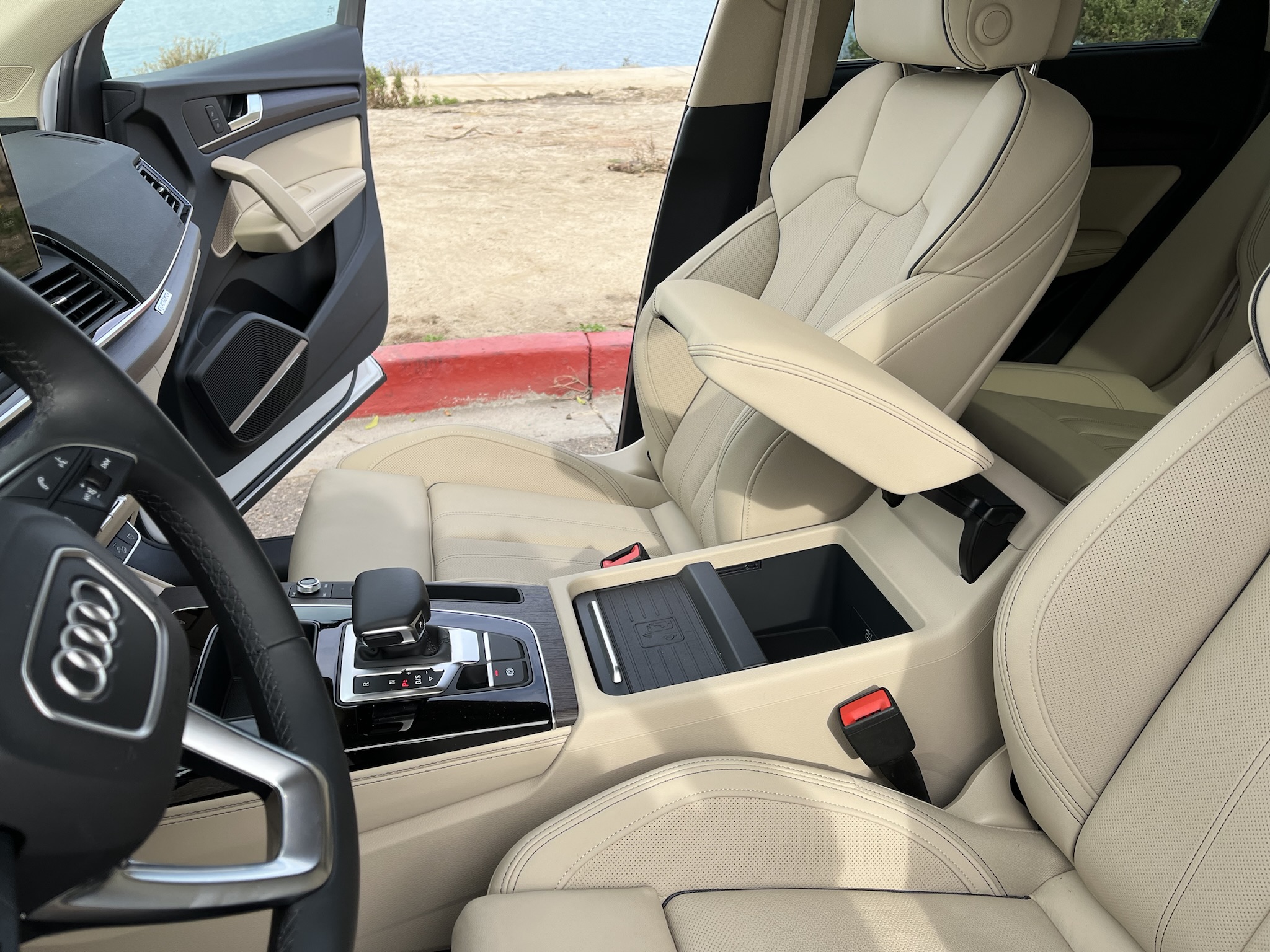
A wireless phone charging pad is just below the center armrest with a USB port. And there is another charging USB and 12-volt plug at the head of the shift console.

Cabin controls are easily viewed in three levels of graduating sizes. At the top is the 10.1-inch color touchscreen. Climate controls are below, followed by a tier of less-often adjusted elements; these include the drive-select performance modes, hill-descent control, parking assist, and the cancel switch for the engine’s stop-start.

There are several areas for small-item storage with bottle-holding capacity in the door panels and a lockable glove box of usable dimensions.

The wireless phone charging pad on a shelf below the center armrest.

The wireless phone charging pad on a shelf below the center armrest.

Audi Q5 Back Seat and Cargo

There is no shortage of accommodations for the Prestige trim.

Headroom is tall at 39.3 inches with a long 38 inches of legroom unless there are tall people in the front seats. The 40/20/40 folding back seat is short on thigh support, and the tall transmission-exhaust tunnel takes from the center seat foot room. But the seatbacks have a couple of inches of recline and the beautiful leather upholstery is a sweet distraction.

Among the accommodations are side-window sunshades, two charging USBs, a 12-volt plug, and a fold-down armrest with can holders. Window seats have overhead grab handles and a dry-cleaning hook, plus sport-coat hooks on both B pillars.

Cargo space is the big separator between the Sportback and SUV body styles. The square space is 44 inches wide with 33 inches from floor to ceiling. Fold the seatback for a max length of 6 feet for a bike or boards.

The cargo area is 44 inches wide with 33 inches from floor to ceiling. Fold the seatback for a max length of 6 feet for a bike or boards.

The cargo area is 44 inches wide with 33 inches from floor to ceiling.

Why Buy the Audi Q5?

As the luxury division of Volkswagen and under the umbrella of Volkswagen Group, the Audi brand is in good corporate company with subsidiaries Bentley, Bugatti, and Lamborghini, among other European marques. That the Porsche Macan uses the Q5 architecture as a foundation is validation for its structural integrity and powertrain technologies.

The Audi Q5 is a smart choice for its stylish simplicity and robust engineering. Its interior design is artful, well assembled, and its level of luxury is rewarding without being precious.

The future is electric for Audi. And with the Q5’s redesign for 2021, the next and likely final redesign is expected for 2025. The Q5 is a complete package now, but expect an evolution revolution as Audi tends to its next-generation best-seller.

Follow the journey here.

A rear three-quarter view of the Q5

The 2022 Q5 now has a standard S line exterior, which includes aluminum front door-sill inlays with an illuminated S logo.

2022 Audi Q5 45 TFSI Specifications

Body style: compact, 5-seat, 5-door AWD SUV crossover

Engine: 261-hp, turbocharged and direct-injected 2.0-liter 4-cylinder; 273 lb.-ft. torque from 1,500-4,200 rpm

Transmission: 7-speed S tronic dual-clutch automatic with paddle shifters

0-60 mph acceleration: 5.7 seconds

Fuel economy: 23/28/25 mpg city/hwy/combined; premium fuel recommended

BY THE NUMBERS

Fuel tank: 18.5 gallons

Cargo space: 26-54 cubic feet, with moonroof

Front head/leg room: 39.6*/40.9 in. *w/moonroof

Rear head/leg room: 39.3/38 inches

Length/wheelbase: 184.3/111 inches

Curb weight: 4,079 pounds

Turning circle: 39.4 feet

Tow capacity: 4,400 pounds

FEATURES

Standard equipment includes: heated front seats, power (heated) side mirrors, high-beam assist, 8-way power front seats, 7-inch driver gauge display, a garage-door opener, brown walnut wood inlays, smartphone interface and Audi audio system, 10-inch MMI touch display, Audi Drive Select (performance modes), aluminum roof rails with crossbars, space-saving spare tire with sealer and inflation system

Prestige package, $10,700, includes smart-key entry with push-button ignition, top-view camera system, ventilated front sport seats with power lumbar, panoramic sunroof, heated and cooled front cup holders, heated steering wheel, heated rear seats, leatherette covered center console and door armrests, adaptive cruise control with traffic-jam assist, Navigation Plus, active lane assist, LED interior lighting, head-up display with sign recognition, Audi virtual cockpit, park assist, matrix design LED headlights with headlight washers, driver-seat memory settings, satellite radio with a 3-month trial subscription, auto-dimming and power-folding side mirrors, Bang & Olufsen audio with 3D sound, 19-inch all-season tires and bi-color finish alloy wheels

Safety features include: 6 air bags, front and rear parking sensors, forward collision warning and avoidance assistance, lane-departure warning, blind-spot warning, rear cross-traffic warning

PRICING

Base price: $46,695, including $1,095 freight charge; price as tested $59,290

Options on test vehicle:

  • Glacier White metallic paint $595;
  • Prestige package, $10,700 (see content above);
  • Black optic package, $1,300;
  • Audi Guard protection kit $315;
  • Cargo roller cover $275;
  • Audi Beam rings (projected from side mirrors) $275

Where assembled: San Jose Chiapa, Mexico

Warranty: 4-years/50,000-miles bumper to bumper including powertrain with roadside assistance