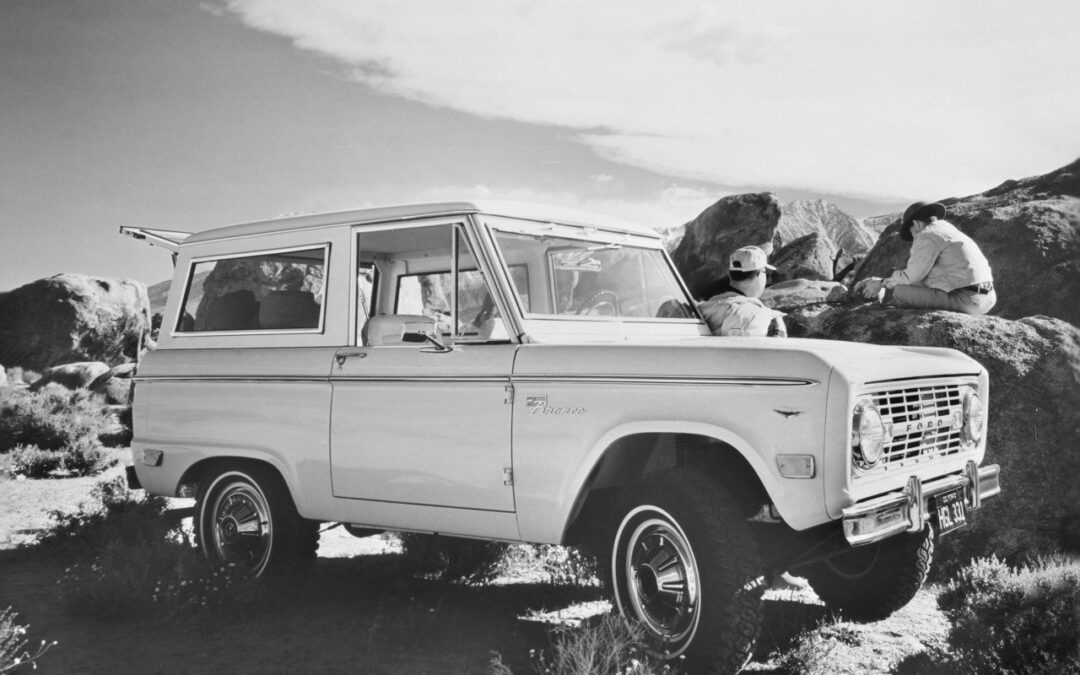
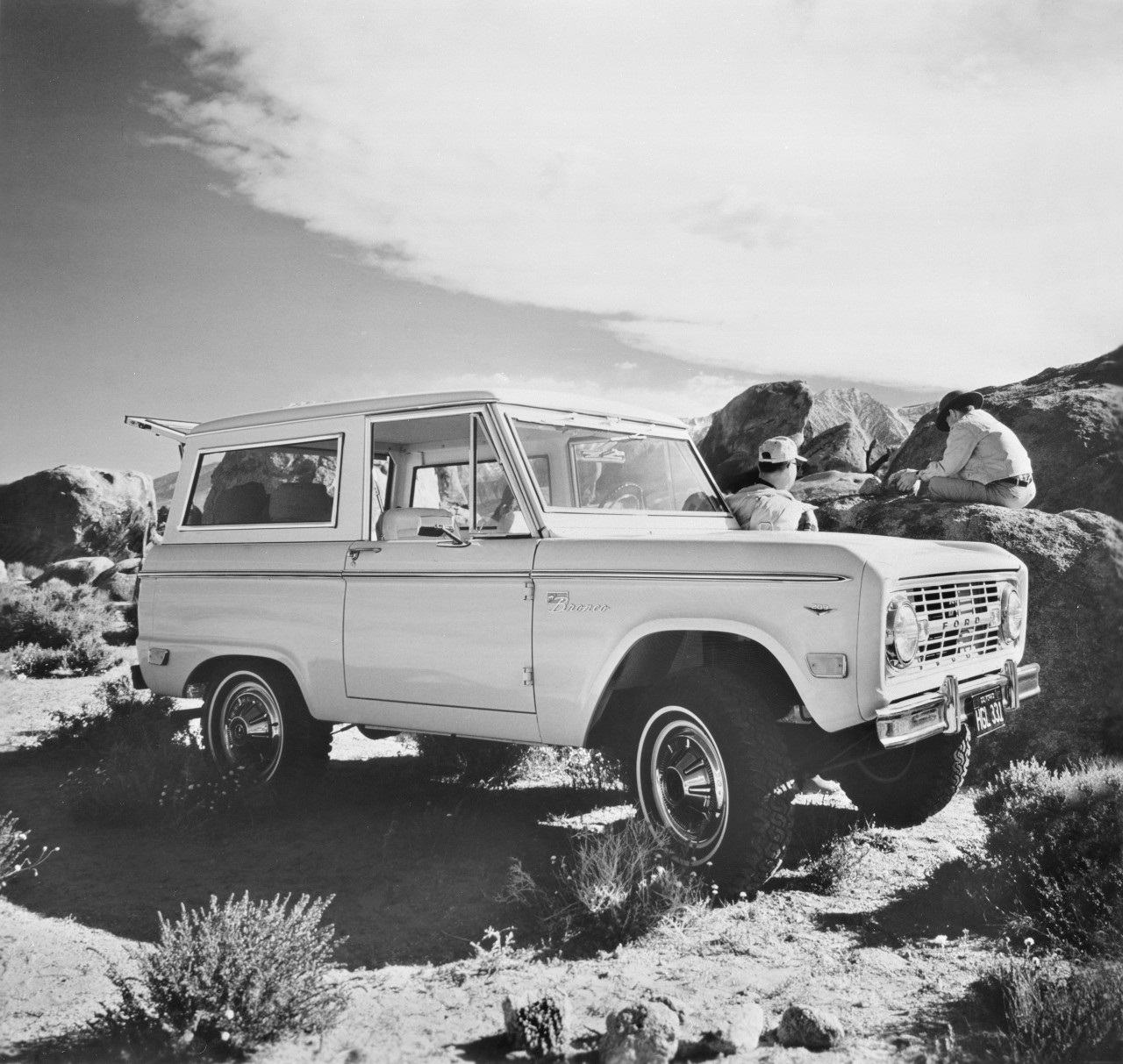
The first generation of Broncos ran from 1966 to 1977. A 1968 model is shown. (Photos courtesy of Ford Motor)
BY MARK MAYNARDSince Ford vowed in 2017 to bring back the Bronco, fans have eagerly awaited its return. Based on a foundation from the current-generation Ford Ranger, the reveal of the new midsize Ford Bronco is expected this July.
There were five generations of Ford Bronco, built from 1966 to mid-1996 when Ford announced the discontinuation of the Bronco to make way for the Expedition. The second generation was moved to a larger F-150 chassis to better compete with the Chevrolet K5 Blazer, Dodge Ramcharger, and Jeep Cherokee.
The first-generation of Broncos, from 1966 to 1977, had their own box-section, body-on-frame chassis, according to Wikipedia. Built on a 92-inch wheelbase it was sized between the Jeep CJ-5 and International Scout, the major competitors of its day.
To simplify production, all examples were sold with four-wheel drive, a shift-on-the-fly Dana 20 transfer case, and locking hubs. The rear axle was a Ford 9-inch axle with Hotchkiss drive and leaf springs. The front axle was a Dana 30, replaced by a Dana 44 in 1971.
All generations of Bronco to date have been built at Ford’s Michigan Truck Plant in Wayne, Mich. And the 2021 Ford Bronco, offered in two- and four-door body styles, also will be built at the nameplate’s birthplace, alongside the Ranger.
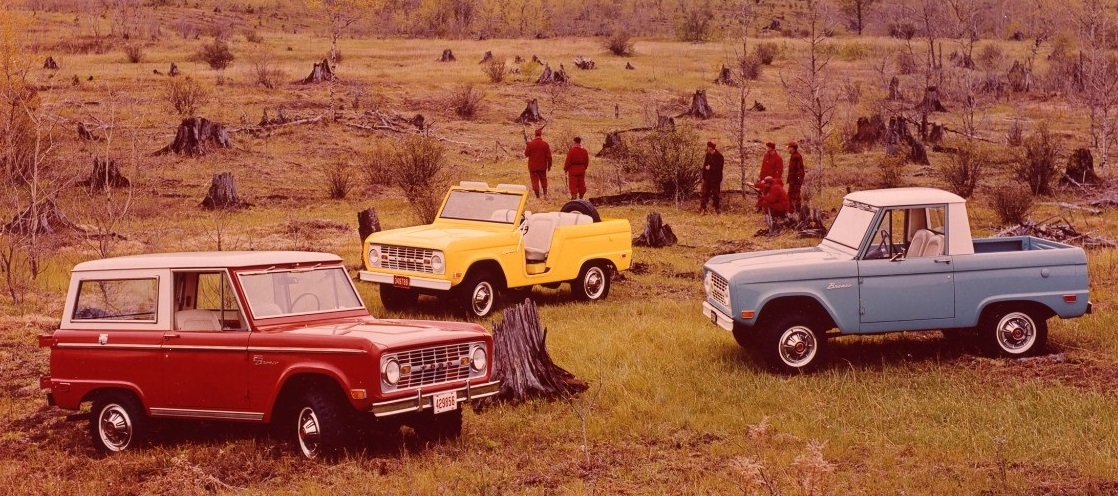
The first-generation Bronco was sold in three body styles: two-door wagon, half-cab pickup, and open-body roadster.
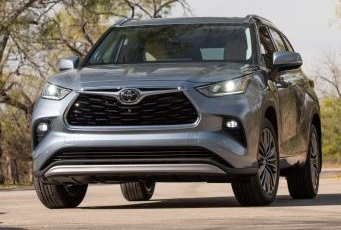
The fourth-generation 2020 Toyota Highlander is a revitalized expression of family care, wrapped in an armor of advanced safety systems. The redesigned midsize SUV — now built on the Toyota New Global Architecture — represents hundreds of thousands of Highlanders that have been sold since its 2001 debut in the U.S.
It is currently Toyota’s second-best-selling SUV. It follows the compact-class RAV4 but is ahead of the 4Runner, subcompact C-HR, Sequoia and Land Cruiser.
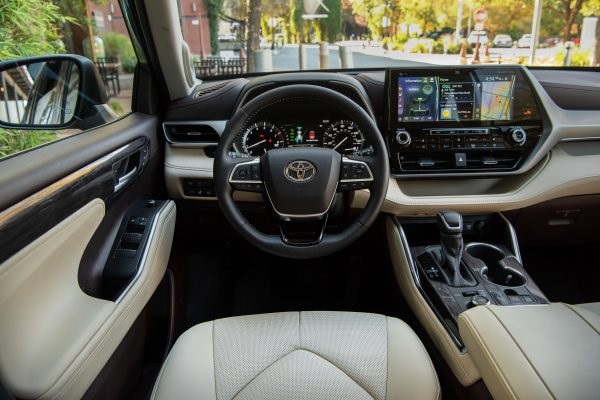
The driver area is smartly arranged with eyes-on-the-road ergonomics.
Exterior design
Much care went into redesigning the 2020 Toyota Highlander. It is an all-new construction, except for the carryover V-6 engine. The “bold and chiseled” design language is evolutionary but with substantial presence. It is defined by an aggressive face, boomerang angles and character bulges.
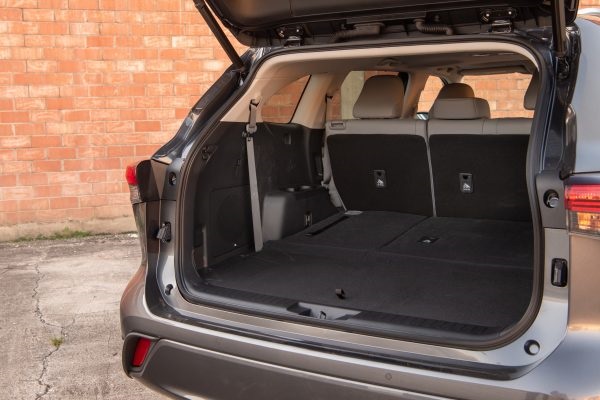
The new model is about the same size as before but 2.36 inches longer. The length went to the cargo area, which was requested by owners. The expanded capacity is also more competitive with other three-row SUV crossovers, such as the Kia Telluride. The second row now slides an extra 1.2 inches farther to give more legroom to the third row or to stretch cargo space.
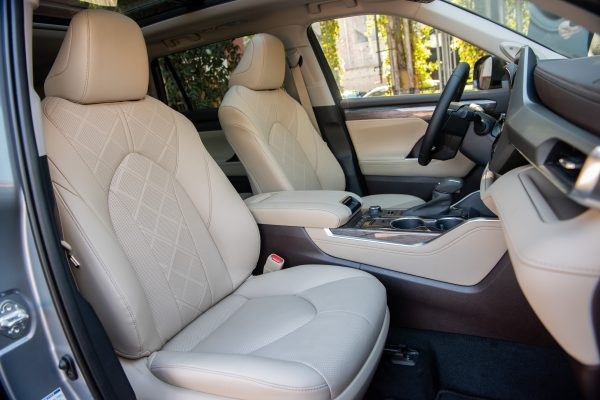
But the Highlander’s more premium presentation inside will be most appreciated to the loyalists.
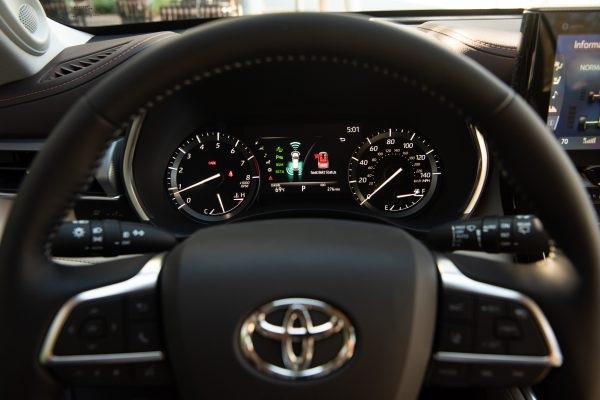
The center 7-inch driver information display.
Pricing
Highlander is again available in gasoline or gasoline-electric hybrid models in front or all-wheel drive. Three rows of seating can be configured for seven or eight. Second-row captain’s chairs or a three-position bench are no-cost options.
Sold in five trim levels, including the new base L, starting prices range from $35,720 with front-drive to $49,920 AWD. Pricing includes the $1,120 freight charge from Princeton, Ind.
The Toyota Highlander Hybrid is just $1,400 more than the gas version (depending on the model). The Hybrid is sold in four trim levels of front- or AWD with starting prices of $39,745-$51,745.
All trim levels are socially connected with Apple CarPlay, Android Auto, Amazon’s Alexa, Waze (driving directions), satellite radio and a Wi-Fi hot spot.
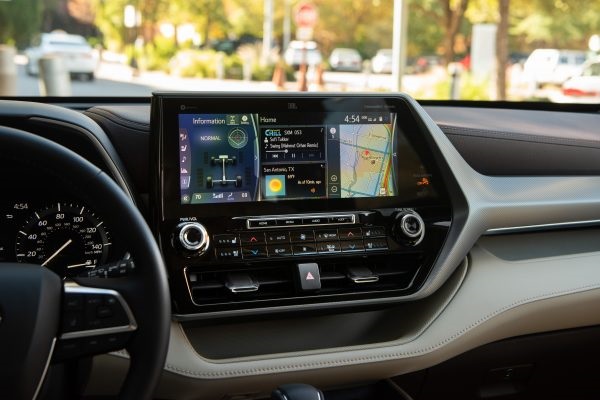
The Highlander Platinum’s 12.3-inch-wide infotainment screen is easy to read in all lighting conditions.
This is a big cabin with elbow and shoulder room.
Today’s tester is a Platinum AWD with second-row captain’s chairs that was $51,112 with three options: the new Moon Dust (ice blue) metallic paint ($415), carpeted floor mats and cargo mat ($318) and roof rack crossbars ($350) and universal table holder ($99).
Powertrains
Gasoline Highlanders use a 295-horsepower 3.5-liter V-6 with eight-speed automatic transmission.
The hybrid model is powered by a 2.5-liter direct-injection Atkinson-cycle four-cylinder. It has a total power rating of 243-hp combined with the electric motors and engine. Peak torque is 175 foot-pounds at 4,400 rpm.
The Platinum will be the empty-nesters’ escape with its elevated luxury treatment in presence and technologies. It is a best-of collection with the new 12.3-inch touch-screen infotainment display (8-inches on the other models), a 1,200-watt, 11-speaker JBL sound system and laminated front side window glass for soundproofing. The leather upholstery, perforated and neatly stitched, appears to be sourced from Lexus (Toyota’s luxury brand).
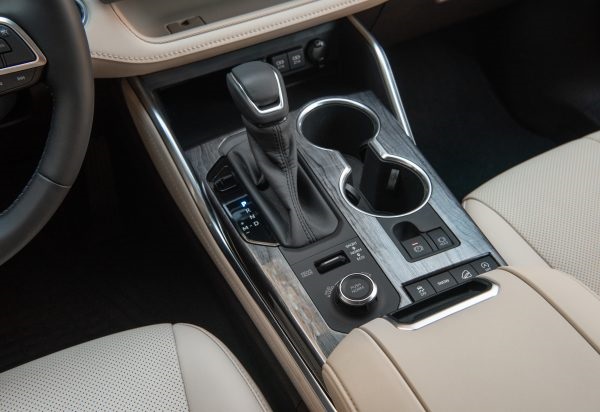
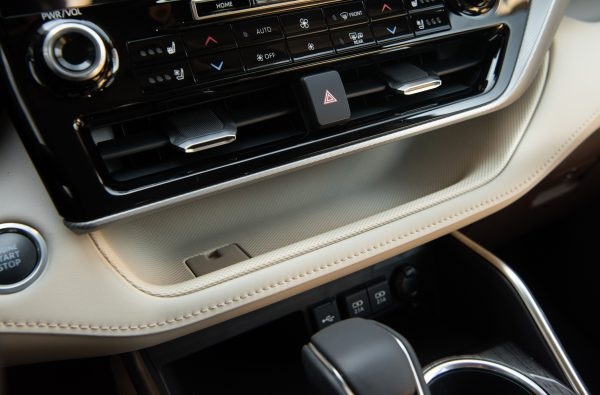
The shifter console packages an e-bin with two 2.1-amp charging USBs and there’s a tray above to lay a phone, with a small cutout (seen below) to route a charging cable.
While $51,000 is not unreasonable for what Toyota delivers, the midrange XLE is $10K less. With one package for premium audio, $1,400 and carpeted floor mats, the MSRP would be $42,078 and the hybrid equivalent would be $45,078.
Unfortunately, the front passenger has just four-way power adjustment, leaving some occupants feeling low in the hole.
2021 XSE model
And later this year Toyota will debut the sportier XSE. It injects some life into the drive with higher-rate springs and a rear stabilizer bar, and the shock absorbers and electric power steering have been tuned for quicker response.
The upcoming 2021 Highlander XSE will be priced between the XLE ($39,600) and Limited ($43,650) models.
The front fascia, grille and lower spoiler are exclusive to the XSE to give it a more aggressive stance. The headlamps have black accents and light-strip DRLs. And inside, are black Softex (synthetic leather) seats with fabric inserts, but a two-tone red and black leather-trimmed interior with red-stitched instrument panel is optional.
A sexy two-tone red and black leather-trimmed interior with red-stitched instrument panel will be available for the XSE.
Safety features
All models now include Toyota Safety Sense 2.0 system with:
•Pre-collision system with pedestrian detection; •Full-speed-range dynamic radar cruise control; •Lane-departure alert with steering assist; •Automatic high beam control; •Lane-tracing assist; •Road sign assist and cyclist detection.
Other standard safety features include eight air bags, blind-spot monitor with rear cross-traffic alert, hill-start assist and downhill assist.
The 295-hp 3.5-liter V-6 has AWD fuel-mileage ratings of 20/27/23 mpg on the recommended 87 octane fuel.
Performance
I appreciated the V-6 in the 4,450-pound Platinum, but its peak pulling power (torque) of 263 foot-pounds is high in the power band at 4,700 rpm. Its force will be out of reach to most drivers on the daily commute. The eight-speed automatic is dutiful in performance, but Sport mode sharpens the response time. The power is measured but it’s there when needed.
Fuel economy is the bigger benefactor. The AWD model has mileage ratings of 20/27/23 mpg or just a tick better with front-drive at 21/29/24, on the recommended 87 octane. My best was 23.4 mpg combined city/highway.
The hybrid has impressive mileage ratings of 36/35/36 mpg for front-drive or 35/35/35 mpg with AWD. The range dips to 35/34/35 for the heavier Limited and Platinum models, also on 87 octane. I have not tested the hybrid, but performance through the eCVT (continuously variable) transmission should have the benefit of more immediate thrust from the electric motor.
20-inch Bridgestone Alenza all-season tires.
Ride and handling
The Highlander drives more as a car than an SUV crossover. Its comfortable step-in height has no obstruction from sporty seat bolsters. Driver sightlines are unobstructed and the turning circle is a parking savior at 37.4 feet, the same as the base-model Camry.
Power-assisted four-wheel discs brakes are ready for towing with 13.3-inch vented rotors front and solid 13.3-inch rotors rear.
Captain’s chairs or a second-row bench are no-cost options.
It is a comfortable ride, tuned for mainstream-America comfort, capably blunting the impact of potholes and busted pavement. When pushed hard, it responds as a big, comfy sedan.
The enhanced soundproofing (with the Platinum’s laminated front and side glass) creates a quiet cabin. The 20-inch Bridgestone Alenza all-season tires have a tall sidewall for a cushioned ride quality and protection from curb rash to the wheels when parking. The Alenza’s were quieter on the highway than I anticipated for a somewhat hard tire with a 65,000-mile warranty and a 500 treadwear rating.
Driver-assist system
Dynamic radar cruise control with driver-assist steering and braking technologies does a good job of centering the vehicle in the lane. But it let the Highlander drift over the white lines or Botts dots and then gave me a warning for the transgression.
These systems seem to be easily confused with varying light and road-surface conditions. Always use these driver-assist systems with both hands on the wheel.
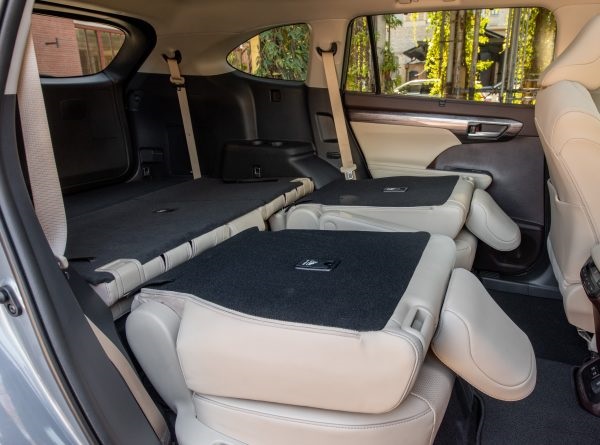
Fold both rows for up to 7 feet of length.
Fold both rows for up to 7 feet of length.
Interior
This is a big cabin with elbow and shoulder room. There is plenty of space to ergonomically place screens, switches and areas for small-item storage.
The driver area is smartly arranged for multitasking. The Platinum’s 12.3-inch-wide infotainment screen is a billboard of information but not prone to glare. The big screen has two to three panels for such information as car settings, music or navigation. And there are knobs for audio volume and tuning. There also is a tier of switches for temperature, fan speed, vents and seat heaters.
The shift console packages an e-bin with two 2.1-amp charging USBs. A tray above in the dashboard face is wide enough to lay a phone and the tray includes a small cutout to route a charging cable. For newer phones, the wireless charging pad is in the center armrest console. The three-level armrest box is deep with a removable second-level tray.
2nd- and 3rd-row features
The back seat in the Highlander has a flat floor with a center floor console with cup holders. It integrates controls for temperature, fan speed and seat heaters. There also are two 2.1-amp USBs and a 12-volt household plug, but it is light duty at 100 watts.
The raised second-row benefits from manual sunshades. The chairs will tip and slide for third-row access or the seatbacks will fold flat for cargo.
The added length translates to 2.36 cubic feet more space behind the third row.
The waaay back three-seat bench is best for children. Legroom is tight at 27.7 inches. There are dual cup holders, but no ports or plugs for device charging. The 60/40 split seatbacks (with three head restraints) have several inches of recline.
Cargo capacity
The longer body translates to 2.36 cubic feet more space behind the third row, now at 16 cu. ft. Fold the third row for 48.4 cu. ft. of flat and square space that is 3 ½-feet deep. Drop both rows for up to 7 feet of length.
Why buy the Toyota Highlander
There are at least 10 other three-row SUV crossovers in the segment this year. Toyota was careful to craft its new Highlander for quality and nimble stability.
Some SUVs will feel stiff and clumsy in the name of “sporty,” but the Highlander is built for comfort and long-term ownership.
The fourth-generation Toyota Highlander is 2.36 inches longer, all in the cargo area.
2020 Toyota Highlander Platinum
Body style: Midsize, 7-8 seat, three-row SUV crossover with front- or all-wheel drive
Engine: 295-hp, direct-injection 3.5-liter V-6 with auto stop-start at idle; 263 lb.-ft. torque at 4,700 rpm
Fuel economy: 21/29/24 mpg city/hwy/combined; 87 octane or higher
Tow capacity: 5,000 lbs.
SPECIFICATIONS
Fuel tank: 17.9 gal.
Cargo space: 16-48.4 cu. ft.
Front head/leg room: 38.4*/ in. *39.9 w/o moonroof
2nd-row head/leg room: 39.4/41 in.
3rd-row head/leg room: 36.1/27.7 in.
Length/wheelbase: 194.9/112.2 in.
Curb weight: 4,450 lbs.
Turning circle: 37.4 ft.
FEATURES
Standard Platinum equipment includes: smart-key entry with push-button ignition, bird’s-eye view camera with guidance lines and overhead 360-degree view, leather-trimmed upholstery in front- and second-row seats, 11-speaker JBL Clari-Fi premium audio system with driver easy speak microphone, heated and ventilated front seats, heated steering wheel, 10-way power-adjustable driver’s seat with power lumbar, panoramic view moonroof with sunshade, wireless phone charging, hands-free power liftgate, electric parking brake, heated side mirrors with turn signal and blind-spot indicators and Highlander-logo puddle lights, 2nd-row fold-down captain’s chairs with armrests, 60/40 folding and reclining 3rd-row seats, back-up camera washer, 20-inch alloy wheels with 235/55 all-season tires, heated 2nd row seats with sunshades, cargo area tonneau cover
Driver-assist features
Front and rear parking assist with automatic braking, 12.3-inch touch screen, dynamic navigation and media port, digital rearview mirror, 10-inch color head-up display with speedometer and road sign assist and navigation, auto-leveling and turning LED headlights, LED running lights and taillights and LED fog lights
Safety features include: 8 air bags, precollision system with pedestrian detection, lane departure alert with steering assist, lane tracing assist, automatic high beams, full-speed-range dynamic radar cruise control, road sign assist and cyclist detection, blind-spot monitor with rear cross-traffic alert, hill-start assist and downhill assist
PRICING
Base price: $49,920, including $1,120 freight charge; price as tested $51,112
Options on test vehicle: Moon Dust paint $425; carpeted floor mats and cargo mat $318; cargo roof-rack cross bars $350; and universal tablet holder $99
Where assembled: Princeton, Ind.
Warranty: 3-years/36,000-miles bumper to bumper with free scheduled maintenance for 2-years/25,000-miles; 5-years/60,000-miles powertrain
There have always been good reasons to buy a Subaru Forester, but its exterior styling was never among them — until the redesigned 2019 model. The new Forester is a complete remake and roomier with more power and loaded with safety technologies, including the watchful DriverFocus camera to monitor for distracted or drowsy driving.
The exterior styling is familiar but more appealing, especially at the rear. But it is Subaru’s attentive engineering that is the real beauty in Forester.
Sold in five trim levels, starting prices range from $25,270-$35,270, including the $975 freight charge from Gunma, Japan. Today’s tester is the top-line Touring that was loaded with luxury-class features for a reasonable price. All models except base include a power panoramic moonroof, but Subaru’s EyeSight driver-assist safety suite is now standard on all trim levels.
Check current Subaru Forester pricing and incentives here.
Forester’s driver controls are intelligently placed for access and heads-up control.
All models have Subaru’s symmetrical all-wheel drive and an updated 182-hp, 2.5-liter flat four-cylinder engine and CVT transmission with seven-speed manual shift mode with steering wheel shifters.
Subaru Forester Safety Features
Subaru has been an e-pioneer in protecting its owners, first with a robust body and then with its EyeSight driver-assist technology. The suite of technologies includes adaptive cruise control, pre-collision braking, lane departure warning, lead vehicle start alert (vehicle in front) and lane-keep assist.
The DriverFocus feature uses facial recognition software to identify signs of driver fatigue or distraction and gives a quick and subtle three-tone beep to alert the driver. Of course, I tried to fake it out by deliberately turning my head left then right, while trying to keep an eye on the road. But it was smarter than that. It did ding me a couple of times when it caught me in distracted glances at some roadside phenomenon I just had to check out.
All of the EyeSight monitoring, however, does so without intrusion or constant tones of alarms. It’s in the background, but a certified lifeguard when needed.
The cargo area has a little more cubic footage, but the space is more squared off and the load floor lies flatter when the back seats are folded.
And the Forester has long been an overachiever in official crash-test rankings. It has been named an Insurance Institute for Highway Safety Top Safety Pick for 12 years running (2007–2018) and earns the institute’s highest rating of “Superior” for front crash prevention from when equipped with EyeSight. And the National Highway Traffic Safety Administration gave the 2018 model its top score of five stars overall. The 2019 testing had not been completed as of press time.
Subaru expects equally strong or better results for the 2019 Forester, which it says has a stiffer and stronger chassis and with the EyeSight system and LED low and high beam headlights as standard equipment, with seven air bags.
Subaru Forester Overview
The slightly larger, compact Forester seems more midsize inside. And it could be the new leader on the SUV mountain with at least nine competitors. Among them, the Chevrolet Equinox, Ford Escape, Honda CR-V, Hyundai Tucson (refreshed for 2019), Jeep Cherokee, Mazda CX-5, Mitsubishi Outlander, Nissan Rogue and Toyota RAV4 (also redesigned for 2019).
The open cargo space has 6 feet of length with the seatbacks folded.
The body is only an inch longer and a half-inch wider and the same height at 68 inches (including roof rack), but cabin space improved by stretching the wheelbase 1.2 inches, to 105.1 inches. The back-seat area benefitted with max legroom of 39.4 inches, or an inch and quarter more than before. But also significant is front headroom of 40 inches with the big sunroof or 41.2 inches without.
The cargo area, too, has a little more cubic footage, but the space is more squared off and the load floor lies flatter when the back seats are folded. The cargo opening is wider, 51.2 inches, and there is six feet of length with the 60/40 seatbacks folded, which will be handy for camp-out sleeping or bike, board or big-box transport.
Interior Function
Inside, there is a heaping helping of no-nonsense Subaru utility and function, but with more style than ever. The tall glass and upright cabin provide unrestricted views over the hood and fenders or over the shoulder. Driver controls are intelligently placed for access and heads-up control.
There are many clever design and engineering elements that add utility and function. The shift console is large with plenty of room for a charging bin with USB charge ports and a place to rest a phone. There’s another 12-volt plug in the two-level armrest storage box and a ledge on the outside for a phone.
The large visors (a Subaru specialty) have covered mirrors and a pull-out extender with covered and lighted mirrors. Door panels have deep bottle holders and stash space.
The front seats — leather-trimmed and heated with perforated centers — are comfortably firm with side bolsters that support without restricting. The driver’s seat adjusts 10 ways and the passenger has eight-way adjustment.
Back Seat
Back seat space is limo long and open with good footroom. The seatbacks recline and the angle is comfortable. The driveshaft tunnel is a low hump and the center seat is reasonably wide and supportive without the occupant feeling perched on a skinny pad. The doors open to almost 90 degrees and to further help feet through the opening the designer shaved a scallop of plastic from the lower door pillar. Very smart.
Conveniences include a pair of charging USBs and seat heaters, on this model. The seatback pockets are smartly divided with a lower outside pocket and the usual deep pocket behind it. Another smart idea, which should be copied by others.
Amenities include overhead lights, grab handles above the doors, bottle storage in the doors, and a pull-down center armrest with cup holders.
Subaru Forester Powertrain
The sole engine choice now is the 182-horsepower, 2.5-liter four-cylinder with horizontally opposed pistons, the so-called “boxer.” It was the base engine last year — with the step-up turbo 250-hp, 2.0-liter flat-four. The 2019 Forester engine is updated with direct injection, which added another 12 hp. Torque increased by 2 foot-pounds of torque, now at 176 lb.-ft. at 4,000 rpm.
The power flow is better and while I’m not fond of the sometimes-vague performance of CVTs, Subaru’s Lineartronic is quick to hook up power without noisy motorboating of the engine. There is a seven-speed manual mode, but I never felt the need. Subaru’s SI-Drive sport mode sharpens performance enough to fill the gap at low speeds, which is a help for commuters to hold their line on the daily commute. SI-Drive adjusts only throttle response, which, at times, can seem abrupt.
Fuel economy estimates are 26 mpg city, 33 highway and 29 combined on 87 octane. I was averaging 24.7-27.4 mpg. With those numbers, there is a cruising range of around 400 miles with the 16.6-gallon tank.
The tall glass and upright cabin provide unrestricted views over Forester’s hood and over the shoulder.
Ride and Handling
The Touring tester was not particularly sporty to drive, but it has confident handling. The 18-inch Falken Ziex ZE001 all-season tires were quiet rolling and were dutiful in sporty maneuvers. (The Sport model has a Sport Sharp performance mode, but no other performance enhancements.)
The suspension is quite accommodating with barely any head toss when tromping across speed bumps and steep driveways. The cabin, too, is well soundproofed with little wind noise at the mirrors.
You don’t have to be an outdoor adventurer to appreciate this fifth-generation Subaru Forester. It is a smart remodel that preserves its traditional SUV ability and shines as a new North Star to guide through the cluster of competitors.
2019 Subaru Forester Touring
Body style: midsize, 5-passenger AWD SUV
Engine: 182-hp, direct-injection 2.5-liter horizontally opposed “boxer” 4-cylinder; 176 lb.-ft. torque at 4,400 rpm; active grille shutters and auto stop-start at idle
Transmission: CVT with 7-speed manual mode; with symmetrical all-wheel drive
Cargo space: 33-71* cu. ft. w/moonroof; *35.4-76.1 w/o moonroof
Front head/leg room: 40.2*/43.3 in. *41.2 w/o moonroof
Rear head/leg room: 37.7/39.4 in.
Length/wheelbase: 182.1/105.1 in.
Width/height: 71.5 in. w/o mirrors; 81 in. w/mirrors
Curb weight: 3,588 lbs. *Touring
Turning circle: 35.4 ft.
Tow capacity: 1,500 pounds, with trailer sway assist
FEATURES
Standard equipment includes: smartkey entry and push-button ignition, power panoramic moonroof, sound-insulated windshield, height adjustable driver seat, 7 air bags, electric parking brake, LED headlights (low and high beam), Starlink multimedia infotainment with 6.5-inch touch screen for Apple CarPlay or Android Auto smartphone integration, carpeted floor mats, power (folding) side mirrors, 60/40 folding back seat