Select Page

Veterans Day Military Appreciation

Veterans Day Military Appreciation
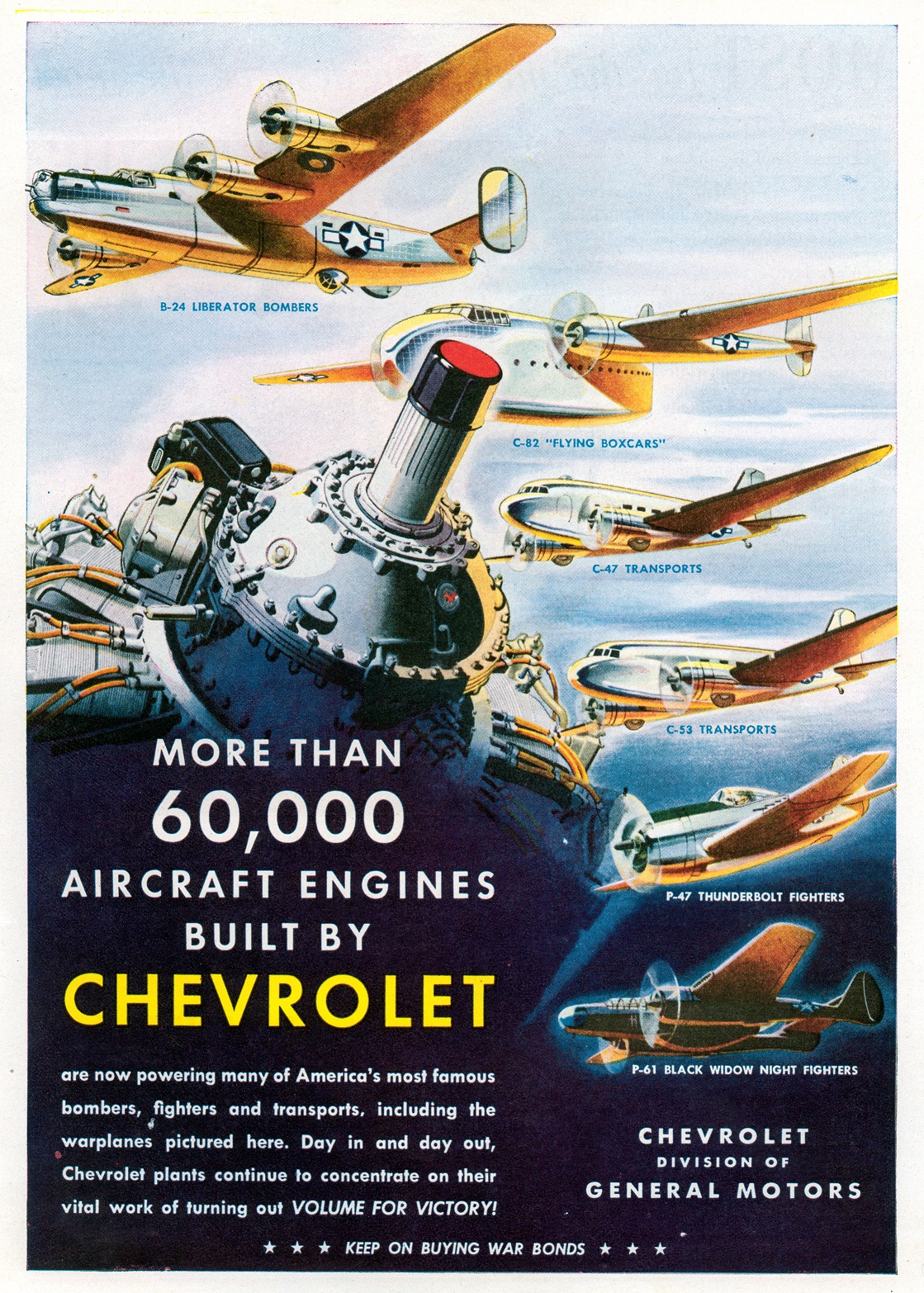
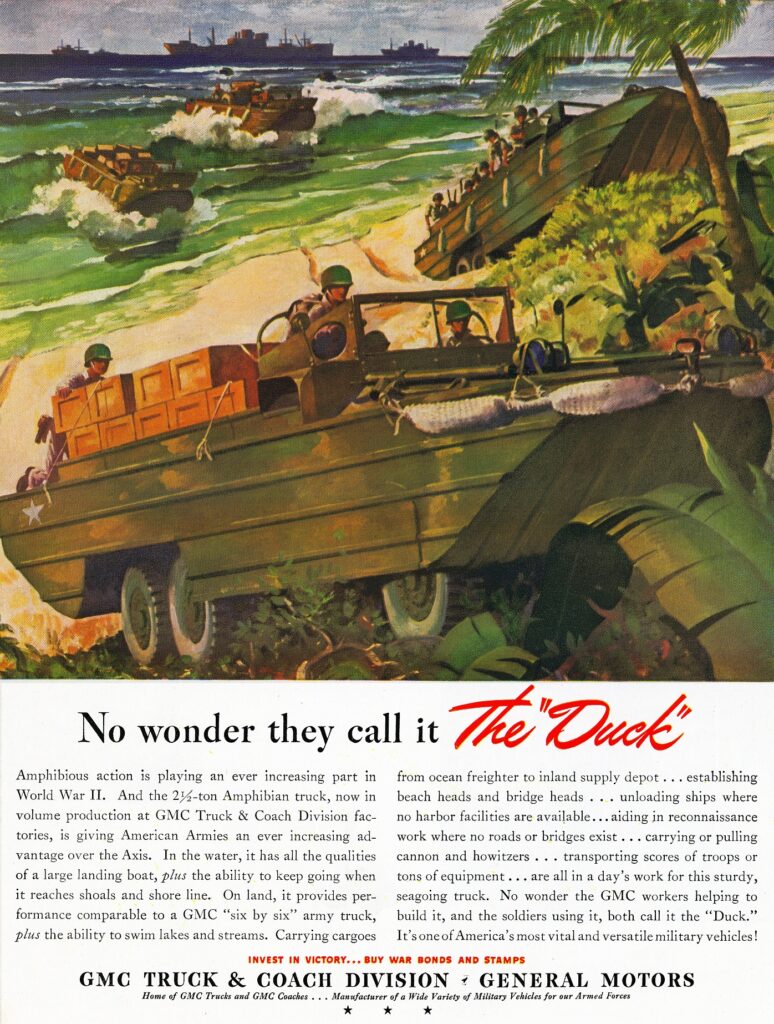
Print advertisement of GM's contributions to
“An Arsenal of Democracy.” Between 1942 and 1945.

Print advertisement of GM’s contributions to “An Arsenal of Democracy.” Between 1942 and 1945. (GM PR image)

BY MARK MAYNARD

As World War II began in 1939, Chevrolet and General Motors answered President Roosevelt’s call to build “An Arsenal of Democracy.”

Between 1942 and 1945, Chevrolet manufactured 60,000 Pratt & Whitney bomber and cargo plane engines; 500,000 trucks; 8 million artillery shells; 3,000 90mm cannon barrels; 1 million tons of aluminum forgings; 1 million tons of grey iron castings; 2,850 tons of magnesium forgings; and 3,800 T-17 Staghound armored scout cars.

During the war, GMC showcased its amphibious military “Ducks” in popular magazines of the day, and encouraged patriotic readers to “invest in victory” and buy war bonds and stamps.

From 1942 to 1945, sales of vehicles to civilians all but ended as manufacturing resources were redirected toward the war effort.

The Fateful “E Day” — Sept. 4, 1957

The Fateful “E Day” — Sept. 4, 1957

The Edsel brand debuted as the ‘the car of the future’ and was introduced with great fanfare as an ‘entirely new kind of car’

William Clay Ford senior, Benson Ford and Henry Ford II at the launch of the Edsel brand and car in 1957. (All photos from Ford PR archives)


BY MARK MAYNARD

Ford Motor’s initial “E Day” had nothing to do with electrification, though it was hoped to be electrifying. Sept. 4, 1957, marked the infamous launch of the Edsel brand.

The brand was named for Edsel B. Ford, scion of company founder Henry Ford. The new division was intended to be a fourth selling channel for the carmaker, along with Mercury and Lincoln. Ford spent big on the debut. A reported $250 million went into development, manufacturing, and marketing on the model line, according to its page on Wikipedia.

1958 Edsels on test track for a press event.

The expansive fleet of 1958 Edsels for a press event.

Marketed as “the car of the future,” the “mid-priced” Edsel lineup was introduced with great fanfare as an “entirely new kind of car.”

The Edsel's dome speedometerThe distinctive dome speedometer.

The Edsel would introduce multiple advanced features for the time. Among them:

•The speedometer was a rotating dome, not the traditional horizontal strip or a round dial. The dashboard adopted warning lights such for conditions as low oil level, parking brake engaged and engine overheating. The format was in line with aircraft design.

•Edsel introduced a speed warning on the speedometer if the driver exceeded a preset speed. But it was not cruise control.

The Tel-A-Touch transmission selector.

The Tel-A-Touch transmission selector.

•A column-mounted transmission shifter was standard. But Edsel offered the Tel-A-Touch push-button shifting system that was mounted in the steering wheel hub.

“The Edsel also integrated many elements of the Ford Lifeguard safety package into its design. Along with optional seatbelts, the Edsel featured a deep-dish steering wheel, double-latch doors and childproof rear door locks.

“The model line was among the first to introduce remote-operated trunk opening and self-adjusting brakes.”

The lineup of 1959 Edsels.

The brand debuted with a seven-model lineup. Shown are 1959 Edsels.

In its inaugural model year, Edsel introduced a seven-model product line, including four sedans and three station wagons.

“The lower-trim Edsel Ranger and Edsel Pacer shared bodies with Ford sedans (118-inch wheelbase) while the higher-trim Edsel Corsair and Edsel Citation shared bodies with Mercury sedans (124-inch wheelbase).

A 1959 Edsel Fordor Sedan.

A 1959 Fordor Sedan.

“Sharing its body and 116-inch wheelbase with Ford station wagons, Edsel offered the two-door Edsel Roundup and the four-door Edsel Villager and Edsel Bermuda.

According to Wikipedia, the brand was also promoted by the top-rated television special, “The Edsel Show,” on Oct. 13. But the promotional effort was not enough to counter the adverse initial public reaction to Edsel styling and unconventional build.

Three Ford executives sitting three across in the 1958 Edsel convertible.

Three across seating for the Ford executives.

A reborn LaSalle

“After the launch date, Edsel was described as a ‘reborn LaSalle,’ a General Motors brand that had disappeared in 1940. For months, Ford had been telling the industry press that it ‘knew’ (through its market research) that there would be great demand for the vehicles.

“Ford also insisted that, in the Edsels, it had built exactly the ‘entirely new kind of car’ that Ford had been leading the buying public to expect through its pre-introduction publicity campaign for the cars.

1958 Edsel's 410 cubic-inch OHV V-8 on a display stand..

1958 Edsel’s 410 cubic-inch (6.7-liter), OHV V-8. 

“In reality, however, Edsels shared their engineering and bodywork with other Ford models, and the similarities were apparent once the vehicles were viewed firsthand.

The Edsel brand was introduced in a recession that catastrophically affected sales of medium-priced cars. Edsels were considered overhyped, unattractive (distinguished by a vertical grille), and low quality.

A 1958 Edsel chassis showing the engine and drivetrain

1958 Edsel chassis.

Ford’s damage control moved quickly. In January 1958, the free-standing Edsel division was added to Lincoln-Mercury, according to the Wiki report. The re-christened Mercury-Edsel-Lincoln Division adopted Edsel sales and marketing operations.

A 1958 Edsel dealer showroom

A 1958 Edsel dealer showroom.

“As the model year progressed and sales fell below expectations, multiple Edsel-only dealers closed or expanded their brand offerings with the encouragement of Ford Motor Co. The alternate brands included Lincoln-Mercury or imported Ford of Britain and Ford of Germany franchises.

Ford design VP George Walker attends the 1958 Edsel introduction in the Styling Rotunda

Ford design VP George Walker attends the 1958 Edsel introduction in the Styling Rotunda. 

But the Edsel brand was not be saved. Ford quietly discontinued the Edsel brand before 1960.

Here are a few more Edsel photos too good to not share:

1958 Edsel and 1932 Ford Phaeton with V8 engines. 

The top-line 1958 Edsel Citation hardtop.

And the infamous horse-collar grille.

1956 Volvo 122 ‘Amason’ aka Amazon

1956 Volvo 122 ‘Amason’ aka Amazon

A vintage corporate PR image showing three Volvo Amazon cars being weighed together and lifted by a crane.This corporate PR image for the Volvo Amazon has the caption: “Three models are lifted to check their total weights.” (Photos courtesy of Volvo)


BY MARK MAYNARD

The Volvo Amazon was a midsized car manufactured and marketed by Volvo Cars from 1956 to 1970, according to its page in Wikipedia. It was introduced to the United States in 1959 as the 122S during the New York International Auto Show.

When introduced, the car was named the Amason (with an ‘s’) in tribute to the fierce female warriors of Greek mythology, the Amazons. German motorcycle manufacturer Kreidler had already registered the name. After negotiations, the two companies agreed that Volvo could only use the name Amazon within Sweden. Subsequently, Volvo began its tri-digit nomenclature and the line became known as the 120 Series.

Volvo invented the three-point seat belt in 1959

In 1959, Volvo claimed to be the world’s first manufacturer to provide front seat belts as standard equipment.

Ponton Styling 

The Volvo Amazon was sold in body styles of two-door sedan, four-door sedan, and five-door wagon — all noted for their ponton styling.

“The Amazon’s “ponton” (pontoon-like) three-box styling was inspired by U.S. cars of the early 1950s, according to Wikipedia. The ponton styling strongly resembled the Chrysler New Yorker sedan and the Chrysler 300C hardtop coupe. Amazon designer Jan Wilsgaard said he was inspired by an American Kaiser he saw at the Gothenburg, Sweden, port.

At introduction, the Amazon had a choice of two four-cylinder engines. The base in-line OHV 1.6-liter had 60-horsepower and there was an uplevel 85-hp variant. Power upgrades came in 1961 with a 70- or 90-hp 1.8-liter four-cylinder, with a bump to 95-hp in 1965.

A colorful marketing image of a two-tone red and white Amazon surrounded by admiring caballeros

This group of caballeros (ranch hands) might be pondering an Amazon pickup.

The Volvo Amazon had floor-mounted manual transmissions had either three- or four-speeds, with or without overdrive. However, some cars were delivered with a steering-column shifter.

Always a safety innovator, Volvo invented the three-point seat belt. It then began to provide the front seat belts as standard equipment. The belts were added to all Amazon models, including those for export.

2025 Toyota 4Runner Overview

2025 Toyota 4Runner Overview

The 6th generation 2025 Toyota 4Runner is a window to bigger worlds, pushing limits in luxury and extreme off-roading

Trailhunter, TRD Pro, and the Limited 4Runners staged at the Vogt Ranch in San Diego County’s eastern backcountry. :

Trailhunter, TRD Pro, and the Limited 4Runners staged at the Vogt Ranch in San Diego County’s eastern backcountry.  (Photography courtesy of Toyota USA or as credited)

Jump To Special Features

Passion for the Nameplate
4Runner Media Drive
Is Bigger Better?
Powertrains and Fuel Economy
5 Favorite 4Runner Features
5 Observations and Considerations
2025 4Runner Pricing
Which 2025 Toyota 4Runner to Buy?
Specifications

BY MARK MAYNARD

The Toyota 4Runner is a stalwart SUV for the ages — literally. It has been 15 years since there was a full redesign of the 4Runner. Though it has worn well, 15 years is a lifetime in this age of redesigns every four to six years. Yet, the 4Runner’s lifespan is not so unusual for Toyota. This carmaker is known to build it right the first time so that it can ride for years, with timely updates.

Now in its sixth generation, the 4Runner is a throwback to the early days when SUVs took a rib from pickup trucks. And the completely reworked 2025 4Runner is reborn as a rugged ladder-frame SUV based largely on the Tacoma pickup.

Toyota used this redesign to push 4Runner farther into luxury and more extreme off-roading, with a new Trailhunter for “overlanding.” Like “Platinum” levels of pickups, the 4Runner Platinum ($64,310) is at home in the backcountry or the country club.

Overlanding to more remote destinations became popular as an escape clause from restrictions during the COVID-19 pandemic.

As before, the 4Runner is available in rear-wheel drive, part-time four-wheel drive, and full-time 4WD.

The 2025 4Runner went on sale Jan. 28, 2025, but all nine of the trim-level choices might be in short supply. Starting prices range from $41,000 to $70,000, including the $1,450 freight charge from Tahara, Japan. Many options are available to push the price, including quality accessories for camping and travel with pets.

Check for current pricing here.

And check all the 4Runner accessories here.

The TRD Pro in the new color of Mudbath tan.

The TRD Pro in the new color of Mudbath tan.

Passion for the Nameplate

The 2025 4Runner shows how far it has evolved since the first 4Runner debuted in 1984. It was built from the Toyota Hilux pickup and was a simple two-door compact with a fiberglass shell over the bed.

Since its U.S. debut, 3 million 4Runners have been sold. It is a beloved nameplate, ranking with the Ford Mustang, VW Beetle, Nissan Z, and even the old Toyota Land Cruiser. The new 4Runner competes with competent competitors such as the Ford Bronco, Jeep Wrangler, and Jeep Grand Cherokee.

As with any product that has succeeded for 40 years, it seems everybody has a 4Runner story. I spoke with an automotive industry professional, now with a major EV charging network, who owns a 23-year-old 4Runner. He said he loves it “so much I’ll be buried in it.”

4Runner’s last full redesign was in 2009 as a 2010 model year, but Toyota continued to make timely updates.

The 2014 model received a facelift with interior improvements. The TRD Pro trim was added, and in 2017, it was renamed TRD Off-Road and TRD Off-Road Premium. In between, Toyota added more safety and advanced digital technologies and more choices for bigger wheels, audio systems, and paint colors.

The TRD Pro has SofTex-trimmed heated and ventilated front seats, 8-way power-adjustable with 4-way power lumbar support.

The TRD Pro has SofTex-trimmed heated and ventilated front seats, 8-way power-adjustable.

2025 4Runner Media Drive

Toyota was in San Diego in late January for a North American media drive of the 2025 4Runner. Journalists could have seat time in several of the nine trim levels, including a base SR5 to the new Platinum and Trailhunter. There was on-road driving and off-roading on the dirt tracks of Vogt Ranch, about 40 miles east of San Diego.

Owen Peacock, Toyota’s marketing GM, called the 4Runner a window to bigger worlds.

For fans of 4Runner, yes, the 2025 4Runner is good, but like many 40-year-olds, it is now bigger and heavier. Its exterior styling looks about the same as the 2024 4Runner but with more distinctions between trim levels.

The 4Runner has Limited has premium leather-trimmed tan upholstery.

The 4Runner Limited has premium leather-trimmed upholstery.

Toyota’s extensive Safety Sense 3.0 is standard on all trims. Active safety and advanced driving technologies now include Proactive Driving Assist.

Of interest to past and current 4Runner owners is fuel economy. Yes, the turbo 2.4-liter four-cylinder engines get slightly better mileage than the previous V-6.

Journalists were able to have generous seat time, yet the vehicles were “preproduction.” That means they were very close to being production level, but there might be some variations in content or features.

My story is not a review but an overview of various trim levels of the 2025 Toyota 4Runner. I hope to have a test week at home soon with any of the trim levels. I was impressed by the base SR5 as the most affordable model with its voluminous cargo capacity. Details are below.

The 12.3-inch digital gauge cluster in all trims except SR5.

The 12.3-inch digital gauge cluster in all trims except SR5.

Is Bigger Better?

The new 4Runner feels robust and stable on the road or trail. It is built on a wheelbase that is 2.4 inches longer with a body almost 4 inches longer. The body is also 2.1 inches wider and taller by 1.1 inches, without a roof rack.

Curb weights are also up, ranging from 4,455 pounds for the rear-wheel-drive SR5 to 5,500 pounds for the Trailhunter. That poundage is 50 to 695 pounds heavier than the 2024 model.

Trailhunter is traction-capable with 33-inch Toyo all-terrain tires on 18-inch bronze-finished wheels.

Trailhunter is traction-capable with 33-inch Toyo all-terrain tires on 18-inch bronze-finished wheels.

Other thumbnail stats include:

  • Towing capacity is now up to 6,000 pounds, a thousand more than before.
  • Gone is the 4.0-liter V-6 engine, replaced by a choice of two i-Force turbocharged four-cylinder powertrains, one of which is a gasoline-electric hybrid.
  • Gone is the five-speed automatic transmission, replaced by a new eight-speed automatic gearbox.
  • Gone is the tidy 37.4-foot turning circle, replaced by a span 2 feet wider.
  • Gone is the 23-gallon fuel tank, now four gallons smaller.
  • Gone are the standard 17-inch wheels, updated to 18-inch or optional 20-inch alloy wheels.
  • Off-road ground clearance is less and more for 2025. The 2024 4Runner has ground clearances of 9 or 9.6 inches, 2WD to 4WD. The new 4Runner has ground clearances of 8.1 2WD to 10.1 inches for the more extreme off-roading models, including a 1-inch lift.

The standard 278-hp T24A-FTS i-Force engine.

The standard 278-hp T24A-FTS i-Force engine.

4Runner Powertrains and Fuel Economy

Two turbocharged 2.4-liter four-cylinder engines are new for the 2025 4Runner. Both have Toyota’s D-4ST direct fuel injection and double overhead camshafts.

  • Entry T24A-FTS i-Force engine has 278 horsepower and peak torque of 317 foot-pounds at 1,700 rpm. Fuel economy estimates for rear-wheel-drive models are 20/26/22 mpg city/highway/combined, but the 4Runner Limited drops to 24 mpg highway. Four-wheel drive mileage ratings are 19/25/21 mpg.
  • 2.4-liter i-Force Max hybrid engine produces 326 hp and peak torque of 465 lb.-ft., also at 1,700 rpm. With standard part-time 4WD, the i-Force Max has fuel economy ratings of 24/23/23 mpg. The hybrid engine is standard on the TRD Pro, Trailhunter, and Platinum trims and optional for the TRD Off-Road, TRD Off-Road Premium, and Limited.

Both engines run on 87-octane fuel.

The nifty side-storage port can be optioned with palm-size flashlight ($160) or a multi-tool ($50).

The nifty side-storage port can be optioned with a palm-size flashlight ($160) or a multi-tool ($50).

5 Favorite 4Runner Features

Side LED lantern or multitool. The nifty palm-size flashlight, a $160 accessory, has several lighting modes, including a red warning light. It clicks into the end of the driver-side instrument panel and is accessible only when the door is open. Alternatively, you can opt for the Side Storage Multi-Tool, $50, which fits in the same round cutout as the lantern.

Mult-Terrain View Monitor. An indispensable asset when trail driving. The 14-inch panoramic camera monitor is the driver’s “spotter,” showing video moving forward, the front tires, rear, and underside. With cameras aimed at both front tires, it is reassuring information to avoid jagged rocks.

The 14-inch panoramic camera monitor is the driver’s “spotter,” showing video moving forward, the front tires, rear, and underside.

The 14-inch camera monitor shows video moving forward, the front tires, and the underside.

Power rear tailgate window. Back by popular demand, the power rear tailgate gives quick access to the cargo area with exterior window switches.

Locking rear differential. Off-roaders should not head to the trails without this piece of technology.

Disconnecting front stabilizer bar. This useful tech helps increase the range of motion to keep traction to the tire. It is standard on TRD Pro and Trailhunter. When will this trick move down the line as an option?

The fold-and-tumble back seats.

The tumble forward back seats.

5 Observations and Considerations

4Runner vs. Land Cruiser. It doesn’t seem very clear to offer a 4Runner when Toyota also positions its Land Cruiser as a superior overlanding vehicle. Both are built on the same TNGA-F global body-on-frame architecture. Both use the same hybrid powertrain, and both have full-time 4WD. And both cost around $70,000 with some desirable options and accessories.

Cargo complications. 4Runner cargo space for the gas model is a huge 44.8 cubic feet. However, cargo space in the hybrid models loses 7.6 cu.ft., compromised by the placement of the battery beneath the floor. The battery-tray packaging protrudes about 6 inches above the floor, causing a high load floor. (And that is why the hybrid has no third-row option.)

Tumble-forward back seats. Though a well-engineered design, the folded seats do not provide a contiguous flat space that overlanders could use for sleeping.

Turning circle. The off-roading mantra of tread lightly gets complicated with the 4Runner’s turning circle, which is almost 40 feet with 20-inch tires. The larger 4Runner’s front and rear tread tracks are 65.6 inches from wheel to wheel, which is 3.2 inches wider than before.

Aesthetic hood scoop. Why add a nonfunctioning hood scoop that interferes with sightlines across the hood?

Levels of stash space in the front door panels.

Levels of stash space in the front door panels. (Mark Maynard)

2025 Toyota 4Runner Trim Levels and Pricing

All i-Force Max hybrid trim levels come standard with part-time 4WD with 2WD, 4WD-High, and 4WD-Low traction modes.

Limited and Platinum trims have full-time 4WD, an electronic locking center differential, and an adaptive variable suspension.

*Manufacturer-suggested retail pricing includes the $1,450 freight charge.

SR5 2WD: $42,220, with base engine
SR5 4WD: $44,220

Standard features include: Smart Key entry and start, 7-inch color gauge display, 8-inch multimedia screen, LED headlights and fog lights, and power liftgate window. Add a third row for $770.

TRD Sport 2WD: $48,700, with base engine
TRD Sport 4WD: $50,700

Standard features include: an 8-inch gauge display, a 12.3-inch multimedia display, wireless charging, and fabric upholstery with heated front seats. There is no choice for a third row.

Special features include: 20-inch TRD wheels, TRD sport-tuned shocks, a TRD grille, nonfunctional hood scoop, LED fog lights, and smart key system,

TRD Sport Premium 2WD: $54,060, with base engine
TRD Sport Premium 4WD: $56,060

Standard features include: kick-sensor liftgate, SofTex front-seat upholstery, eight-way power front seats heated and ventilated, driver seat memory presets, heated steering wheel, 14-inch multimedia display and panoramic camera monitor, 10-speaker JBL audio system with a removable JBL Flex Bluetooth speaker. Optional Tow Tech package, $400.

TRD Off-Road Premium: $56,420, with base engine and part-time 4WD

Standard features include: SofTex-trimmed heated and ventilated front seats, 8-way power-adjustable with 2-way power lumbar support, and driver position memory function.

TRD Off-Road Premium i-Force Max: $59,220, with part-time 4WD.

Standard features include: Power liftgate with kick sensor, Homelink garage-gate opener, eight-way power front seats with driver seat memory settings, heated steering wheel, 14-inch multimedia display, 14-speaker JBL audio with removable Bluetooth speaker, SofTex front upholstery, multi-terrain rearview camera system.

The 10-speaker JBL audio system has a removable JBL Flex Bluetooth speaker.

The 10-speaker JBL audio system has a removable JBL Flex Bluetooth speaker.

Limited 2WD: $56,850
Limited 4WD: $58,850
Limited i-Force Max 4WD: $61,650, with full-time 4WD

Standard features include: Leather-trimmed upholstery with heated and ventilated front seats, moonroof, Homelink garage-gate opener, 12.3-inch gauge display, 14-inch multimedia and camera screen. The 14-speaker JBL audio includes a portable Bluetooth speaker.

Special features include: adaptive variable suspension, 20-inch wheels, chrome exterior accents, and running-boards. Optional third-row available on gas models.

The 4Runner Platinum ($64,310) with standard i-Force Max engine and standard full-time 4WD.

The 4Runner Platinum ($64,310) with standard i-Force Max engine and standard full-time 4WD.

Platinum i-FORCE MAX: $64,310 with standard full-time 4WD.

Special features include: digital key, automatic folding running boards, 20-inch wheels, black chrome exterior accents, and a standard tow-tech package. Interior features include premium, quilted pattern leather upholstery, front and rear heated seats, a digital rear-view mirror, and a head-up display.

TRD Off-Road i-Force Max: $53,440, with part-time 4WD

Standard features include: fabric seats, a 12.3-inch gauge display, and 8-inch multimedia and camera display.

Special features include: Bilstein monotube remote reservoir shocks, crawl control, multi-terrain select, electronically controlled locking rear differential, electric disconnecting stabilizer system, 18-inch alloy wheels with all-terrain tires, black TRD grille, door handles, side mirrors, and fender override moldings.

Models with the I-Force Max engine include a 2,400-watt AC power inverter to power an inflater or blender.

The 4Runner Trailhunter in the special color of Everest Green (aquamrine).

The 4Runner Trailhunter in the special color of Everest Green.

Trailhunter i-Force Max: $68,350, with part-time 4WD.

Standard features include: SofTex trimmed upholstery, heated and ventilated front seats, a 14-inch multimedia and camera display, and a 12-inch gauge display. The 14-speaker JBL audio includes a Bluetooth speaker. Exclusive paint colors of Mudbath (tan) and Everest (aquamarine)

Unique Trailhunter features include:

  • Old Man Emu 2.5-inch monotube shocks with “piggyback” reservoirs;
  • Electric stabilizer bar disconnect;
  • Crawl control and multi-terrain select;
  • Multi-terrain monitor
  • Low-profile high-mount air intake;
  • 33-inch Toyo all-terrain tires with 18-inch bronze-finished wheels;
  • 1-inch lift
  • On-board air compressor;
  • High-mount “snorkel” air intake (makes it easy to listen to the whine of the turbocharger).
  • RIGID Industries color selectable LED fog lamps;
  • ARB roof rack;
  • Bronze-colored “TOYOTA” heritage-inspired grille with an integrated LED Light Bar.

All trim levels have LED headlights with daytime running lights.

All trim levels have LED headlights with daytime running lights.

TRD Pro i-Force Max: $68,350, with part-time 4WD.

Standard features include: SofTex-trimmed heated and ventilated front seats, 8-way power adjustable with 4-way power lumbar support.

Special features include:

  • Black Toyota Heritage Grille with light bar
  • Fender overriders;
  • Nonfunctional hood scoop;
  • 18-inch TRD Pro wheels.
  • 1-inch lift;
  • Fox QS3 adjustable shocks with rear remote reservoirs and TRD IFP (Internal Floating Piston) bump stops;
  • TRD performance air intake;
  • 33-inch Toyo all-terrain tires with 18-inch TRD Pro black alloy wheels.

4Runner cargo space for the gas model is a huge 44.8 cubic feet behind the second row. Fold the seats for 90.2 cu.ft.

4Runner cargo space for the gas model is a huge 44.8 cubic feet behind the second row.

The 4Runner cargo space showng how the hybrid battery raises the load floor.

Hybrid models have compromised cargo space because of the placement of the hybrid battery. The 6-inch deep battery hump shrinks space by 7.6 cu.ft., creating a high load floor. (Mark Maynard)

Which 2025 Toyota 4Runner to Buy?

I spent thousands of dollars and hours updating a heavy-duty 1987 Suburban to become an overlanding rig. In the long run, buying a new, fully equipped off-roader might be less expensive.

My choice today is the TRD Off-Road Premium in Everest green paint. The base engine seems to have plenty of power on the road or off, and I can live with the fuel economy estimates. Plus, I would rather have the bigger and more functional cargo area.

I’d also add all-weather floor liners ($248), a carpeted cargo mat ($130), and a cargo cover ($135). I would consider the rock rails for $990, the side-LED lantern for $160, and the Sirius satellite radio for $350 with 33 months prepaid.

All in, my TRD Off-Road Premium would cost $56,933, about what I spent buying and upfitting my Suburban over 10 years.

Automatic folding running boards help maintain ground clearance.

Automatic folding running boards help maintain ground clearance.

2025 Toyota 4Runner TRD Pro Specifications

Body style: midsize 5- to 7-seat SUV with high-strength boxed, steel-ladder frame; rear- or 4-wheel-drive

Engine: 278-hp T24A-FTS i-Force turbocharged 4-cylinder with direct and port fuel injection; 317 lb.-ft. torque at 1,700 rpm.

Transmission: 8-speed automatic with sequential shift mode and uphill/downhill shift logic

Fuel economy estimates: 20/26/22 mpg city/highway/combined 2WD; 19/25/21 mpg 4WD

Parallel hybrid system: 84-hp permanent magnet synchronous motor-generator; adds 184 lb.-ft. torque

Battery: 288-volt sealed nickel-metal hydride

Tow rating: 6,000 pounds

BY THE NUMBERS

Fuel tank: 19 gallons

Cargo space: 42.6* cubic feet *i-Force Max

Front head/leg room: 39.7*/41.8 inches *w/moonroof

2nd-row head/leg room: 37.8/34.8 inches

3rd-row head/leg room: 35.3/31.8 inches

Length/wheelbase: 194.9/112.2 inches (all trims)

Width/height: 77.9*/72.6 to 75.5 inches *79.9 inches Pro and Trailhunter

Track, front/rear: 65.6/65.6 inches

Curb weight: 4,850 pounds

Turning circle: 39.4 feet

CHASSIS and BODY COMPONENTS

Brakes: 4-wheel discs, front rotors 13.4 inches; rear, 13.2 inches; electric parking brake

Steering: electronic power-assisted rack-and-pinion; turning circle 39.4 feet

Tires-wheels: TRD PRO, 18-inch matte-black TRD alloy wheels with 265/70R 18 Toyo Open Country A/T III all-terrain tires

Suspension: Front, independent double-wishbone with stabilizer bar and twin-tube shock absorbers; rear, multi-link with coil springs and outboard-mounted twin-tube shock absorbers

2025 Hyundai Santa Fe Hybrid Review

2025 Hyundai Santa Fe Hybrid Review

Cue the road trip for 578 miles on a tankful in the 2025 Hyundai Santa Fe Hybrid

A dark bronze colored Hyundai Santa Fe Calligraphy with black wheels.

The 2025 Santa Fe Hybrid is sold in three trim levels in front- or all-wheel drive. Starting prices range from around $40,000 to $50,000. (Photography courtesy of Hyundai USA and as credited.)

Jump To Special Features

Commando-Ready Stance
7 Special Features
2025 Santa Fe Pricing
Safety Features
2 Powertrains and Fuel Economy
Interior Comfort and Conveniences
Ride and Handling
Santa Fe Recalls
Why Buy the 2025 Hyundai Santa Fe Hybrid?
Specifications

BY MARK MAYNARD

If the devil is in the details, the 2025 Hyundai Santa Fe Hybrid is a mileage leader on a crusade for long-term ownership. The dramatically restyled Santa Fe is packed with innovations and smart conveniences. Now, cue the road trip for 578 miles on a tankful — with no stops to recharge.

Redesigned for 2024, the Santa Fe was given a thorough shakeout for a determined way forward. This midsize family-class SUV crossover is built on a longer wheelbase to add a third row of seats. The body is just 1.8 inches longer but the same width as before (74.8 inches).

Of special interest is increased cargo capacity. The roof was raised by 2.4 inches, providing a vertical space of 69.7 inches. Hyundai says the reconfigured space can fit three road bikes with the front wheels removed. The cargo entry is wider, too, now at 4 feet. For campers, there is wide space to roll out a sleeping bag. Large dog crates can be strapped down behind the second row, and there is a rear fan speed control.

The interior is sleek and refined with subtle “H” accents among meticulous fit and finish of trim materials. The modern cabin also was updated with more premium features. Among the additions are relaxation seats with leg rests, a UV-C sterilization compartment, and dual charging pads. Upper trim levels have a 2-foot-wide curved panoramic infotainment display.

Also new for 2024 was the choice of front-wheel drive.

A broad view of the Calligraphy front seats and instrument panel

The Calligraphy cabin is well-dressed with Nappa leather-trimmed upholstery.

Commando-Ready Stance

Developed under the “Open for More” concept, the Santa Fe is city-friendly but adventure-ready, Hyundai says. The styling intends to connect “urban customer activities with natural environments.”

Boldly blunt exterior styling has an industrial tech design ethos, providing a photo-op for several passersby. Oversized and squared-off wheel arches give a fist punch of ruggedness. A second tier of gloss black plastic is form-fitted to the arch undersides, connecting with a wide margin to span the lower body. The treatment diminishes the perception of bulk and heaviness. Black wheels add to a stance of invincibility for a stance that looks commando-ready.

There are many three-row Santa Fe competitors, including the GMC Acadia, Honda Pilot, Jeep Grand Cherokee L, and VW Atlas. However, there are just two other non-luxury SUV crossovers that offer a gasoline-electric powertrain: the Toyota Grand Highlander and the Mazda CX-90.

Looking into the front seats from the passenger door

The passenger seat is 6-way adjustable with the relaxation leg rest.

7 Special Features

UV-C sanitizer compartment. A light in the wide and narrow compartment claims to sanitize such items as a phone, a face mask, or a baby’s pacifier. This unusual feature is pandemic-ready;

With its origins in the pandemic, the sanitizing compartment can be used for such items as a phone, a face mask, or a baby’s pacifier.

The UV sanitizing compartment.

Relaxation seats. Power leg rests on both front seats raise “to optimize body pressure distribution for a feeling of weightlessness,” Hyundai says;

Dual pad wireless phone charging. It is open and accessible on the front center console with three more USB charge ports;

Dual charging pads on the wide center console.

Dual charging pads with an e-bin of charge ports.

Power fold and dive second-row captain’s chairs that recline and have seat-bottom tilt;

Exterior C-pillar assist handle. The lockable grab handle above the rear tire gives a hand up to load things on the roof rails;

Bi-directional front center console lid opens at the front or rear for 2nd row passenger access. A deep drawer on the back side gives storage.

Hyundai Pay for in-vehicle e-commerce purchases. Drivers can now pay for parking, charging, and fuel on the app screen. More than 5,800 filling stations are available, Hyundai says.

A partially raised leg rest of the driver's relaxation seat

“Relaxation” driver and passenger seats are elevated leg rests.

Hyundai Santa Fe Blood Line

Now in its fifth generation, the first Santa Fe had its U.S. debut for the 2001 model year. It would become Hyundai’s top-selling model for many years, with updates every four to five years.

Hyundai’s most recent full redesign of the Santa Fe was in 2019. It adopted a bolder design language and new safety, comfort, and convenience technologies. More cabin storage space was added, and driver sightlines were improved. With the larger Palisade SUV on the way, the Santa Fe Sport name was dropped.

Hyundai added more features for the 2020 Santa Fe. Among the upgrades were the safety features of a rear occupant alert and blind view monitor. Wireless device charging was made standard on more trims.

In just its third year on sale, Hyundai gave a major refresh design to the 2021 Santa Fe SUV. A new hybrid powertrain with all-wheel drive was the first application in the Hyundai SUV lineup. Santa Fe went upscale with the new Calligraphy trim. A Santa Fe Plug-in Hybrid would debut later in 2021.

The 2022 Santa Fe was a carryover, except for a new outdoor lifestyle XRT trim. It has a dark tone treatment of lower fascias, skid plates, 18-inch all-terrain tires, side steps, and roof cross rails.

No changes were made for the 2023 Santa Fe as the radically restyled 2024 model was on the way.

As a redesigned model for 2024, there is just one change for model year 2025: Atlantis Blue paint, no cost.

A rear mugshot of the Santa Fe showing the H style rear lights

H marks the spots in Hyundai’s design “language.”

2025 Santa Fe Hybrid Pricing

Hyundai’s 2025 Santa Fe Hybrid is sold in three trim levels. All manufacturer suggested retail pricing includes the $1,415 freight charge from Ulsan, Korea. HTRAC AWD adds $1,800.

  • Santa Fe Hybrid SEL FWD $39,085; SEL Hybrid AWD $40,415;
  • Santa Fe Hybrid Limited FWD $45,515; Limited Hybrid AWD $47,315;
  • Santa Fe Hybrid Calligraphy FWD $48,665; Hybrid Calligraphy AWD $50,465.

The 2025 Calligraphy Hybrid AWD tester came to $50,675 with one option for carpeted floormats ($210).

A Santa Fe plug-in hybrid was available in 2022 and 2023, but a 2024-25 PHEV has yet to be offered. And Hyundai says, “We have nothing to announce about a future plug-in.” But just wait.

The lighted front grille with H themes.

The lighted front grille with more H themes.

2025 Hyundai Santa Fe ICE Pricing

Hyundai offers gas powered Santa Fe models in four front-wheel drive trim levels and five trims with AWD. The Santa Fe ICE has a 277-hp 2.5-liter turbocharged four-cylinder and eight-speed wet dual-clutch automated manual transmission.

Santa Fe ICE front-wheel-drive starting prices range from $35,615 to $48,165. AWD Santa Fe models range in price from $37,415 to $49,965. Santa Fe internal combustion models are produced at Hyundai Motor Manufacturing Alabama.

Depending on the trim level, the 2025 Santa Fe Hybrid has a choice of eight to 11 colors. The Limited and Calligraphy are available in 11 hues, four of which are added cost. Serenity White and Ultimate Red are $470 each; Earthy Brass Matte and Ecotronic Gray Matte are $1,000 each.

Check current Hyundai Santa Fe pricing here.

At publication, Hyundai offered 4.49 percent financing for up to 60 months (to well-qualified buyers). Or a $500 Dealer Choice Bonus Cash was available on new 2025 Santa Fe Hybrid Calligraphy purchases.

Find Hyundai’s special offers here.

Get a leg up with the lockable grab handle above the rear tire.

Get a leg up with the lockable grab handle above the rear tire.

Santa Fe Safety Systems

Even the entry Santa Fe has the essential safety features and technologies. All models have nine air bags and hefty four-wheel-disc brakes with 12.8-inch front rotors and solid 12.8-inch rotors rear.

Standard safety technologies include:

  • Blind-Spot Collision-Avoidance Warning;
  • Rear Cross-Traffic Collision-Avoidance Assist;
  • Park Distance Warning, Forward and Reverse;
  • Forward Collision-Avoidance Assist with Pedestrian, Cyclist, and Junction Turning Detection;
  • Lane Keeping Assist;
  • Lane Following Assist;

Trim levels from the SRT and upward include semi-autonomous, hands-on-the-wheel driving assist, known as HDA1. The Calligraphy trims pack the top Highway Driving Assist 2. HDA2 includes adaptive cruise control with stop-and-go capability, leading-vehicle distance, and a lane-centering assistance system. The HDA2 brains also have lane-change assistance and machine learning capability. I am not keen on lane-change assistance, which initiates a lane change when the turn signal is used. And I’ve never experienced machine learning that was better than my human learning.

The SQ7 4.0 liter v8 engine

The improved hybrid powertrain has front-drive mileage estimates of 36/35/36 mpg and 35/34/34 mpg AWD. (Mark Maynard photo)

2 Powertrains and Fuel Economy

As before, the new Santa Fe has two turbocharged four-cylinder engines for front- or all-wheel drive. Gas-powered models have a 277-horsepower 2.5-liter direct-injected engine and an eight-speed dual-clutch transmission.

Hybrids have a 1.6-liter direct-injected engine with a six-speed automatic. The 178-hp Smartstream 1.6-liter has 195 foot-pounds of torque from 1,500-4,500 rpm. A permanent magnet synchronous motor of 44.2 kW adds an estimated 60 hp from 1,600-2,100 rpm. The lithium-ion hybrid traction battery of 1.49 kWh has a max of 270 volts.

Total combined hybrid power is 231 hp (gas engine and electric motor), with a total combined torque of 271 lb.-ft. from 1,000-4,100 rpm.

The 2024-25 Santa Fe Hybrid uses an improved powertrain from the 2021 redesign. There is a “new cooling design and a high-efficiency permanent magnet to improve the performance of the hybrid starter generator.” Shift-regen paddles at the steering wheel can adjust brake-force energy recuperation. In Sport mode, the electronic paddles revert to manual shifts.

A digital reading of 578 miles to empty

Fill the 17.7-gallon tank for 578 miles of road trip cruising.

Fuel Economy

Curb weights for the 2024-25 Santa Fe are up by 371 pounds with AWD. Gas-powered models have curb weights of 4,343 pounds for front-wheel drive and 4,486 pounds for AWD. Hybrids have curb weights of 4,431/4,575 pounds FWD/AWD. Also, in 2024, the 17.7-gallon fuel tank will be the same for gas or hybrid models.

The heavier model challenged fuel economy ratings. The 2025 gas-powered, front-drive Santa Fe has fuel economy ratings of 20/29/24 mpg city/highway/combined. (That compares to 22/28/25 mpg in 2023.) AWD models have mileage ratings of 20/28/23 mpg, compared to 21/28/24 mpg for 2023.

The Santa Fe Hybrid is the mileage all-star. FWD models have mileage estimates of 36/35/36 mpg, and AWD models return mileage of 35/34/34 mpg. The 2023 Santa Fe Hybrid AWD has mileage ratings of 33/30/32 mpg.

All Santa Fe models use 87-octane fuel. Fill the 17.7-gallon tank for about 578 miles of range.

Even with the new square-jaw mug, the new Santa Fe has sleeker aerodynamics for a 0.294 drag coefficient vs. 0.33 cd in previous hybrid models. Active air flaps in the grille close for aerodynamics or open for engine cooling.

A view of the front 20 inch tire and black wheel. The tire is 10 inches wide!~

Santa Fe Hybrid models have 20-inch all-season tires with a 10-inch wide footprint.

Hybrid Performance

There is enough fuel-saving functionality in Hyundai’s hybrid system to dissuade some buyers from the added cost of a plug-in system.

Depending on driving conditions, the hybrid system will operate between the engine and the electric motor or both at the same time. The high-voltage hybrid battery drives the motor and air conditioner. The hybrid battery with the 12-volt battery (under the cargo floor) operate the ignition, lights, wipers, and audio system.

I drove with normal acceleration force, always in Eco mode, and at highway speeds of 68 to 70 mph. I did not baby the system to coax miles. The standard Eco mode performance was potent when needed and was always responsive to light pedal inputs. Sport mode gave abrupt force that seemed unnecessary in daily driving.

In-town or creeping along on the commute allows a significant range on battery power. When the test vehicle was delivered from Los Angeles, it had an average mpg readout of 28.2. After a few days of in-town driving, the average progressed to 29 mpg. After two 80-mile interstate runs, the average mpg rose to 30.7. And I might have been able to push it higher had I not had to turn in the vehicle.

Calibrations for semi-autonomous driving provide consistent monitoring without sensitivity to blasting alerts. Lane centering is exact, keeping the Santa Fe between the white lines and never veered wide in my experience.

Interior Comfort and Conveniences

Major improvements to the fifth-generation Santa Fe are in seat comfort, suspension response, and soundproofing.

Front headroom is tall at 40.2 inches or 41.1 without the sunroof, and legroom is very long at 44.4 inches. A tall shoulder line at the sides creates the impression of a closed cabin. Sightlines, however, are quite functional. Side mirrors are offset from the body and a small triangle corner glass gives helpful snippets of cornering views.

The more I drove, the more comfortable I became with the side views. And when parking or backing, the 360-degree camera gives an overhead view. The turning circle is tight at 37.9 feet, especially for a vehicle that is nearly 16 feet long. I could make a U-turn on my residential street without fear of scraping the right front wheel. (A tight turning circle is a high priority in any vehicle I buy. I abhor making three- or four-point turnarounds.)

An impressive curved panoramic display links two 12.3-inch screens. One display gives driver info, speed, and mileage. The other screen groups navigation displays and connections for phones, music, and apps. Climate controls are just below on a 6.6-inch screen.

Entry to the Santa Fe is a comfortable step-in height. And the gorgeous Calligraphy seats provide full-body support without unnecessary bolstering to complicate entry and exit. The driver seat is eight-way power adjustable, with lumbar. The front passenger seat has six-way power adjustment. “Relaxation” driver and passenger seats, standard on Calligraphy, are a power-raised leg rest that might seem unnecessary until experienced. It adds thigh support, and the elevated rest is relaxing on a long drive.

Power folding second row captain's chairs have seatback recline and seat-bottom tilt.

Power folding second-row captain’s chairs have seatback recline and seat-bottom tilt.

EV Trickle-Down Design

Santa Fe’s interior spaciousness is influenced by electric vehicle cabins. For example, the center “bridge” style console has a large open space below.

The cabin design treatment is lean and light in coloration with creative metallic trim and etching treatments. There is no faux wood here. A bead of ambient lighting is masterfully integrated along the lower instrument panel. The bead kicks up at the ends to bracket the panel with more “H” elements.

A Hyundai design genius instituted the dual phone charging pads on the broad center console. The space also integrates three USB charge ports.

The two-seat third row of seats

The third row has the uncommon feature of AC fan controls with a side vent.

2nd and 3rd Row Seats

Captain’s chairs in the six-seat Calligraphy are heated and power-adjustable, including seat bottom tilt. It’s a useful function to help long legs find a comfort spot. B-pillar vents — not common to all SUVs — are helpful for air flow to those sensitive to motion.

The third row might be short on legroom (30 inches), but it is no penalty box. Passengers in the two-seat space can access rear AC fan controls with a special side vent, a charging USB, and a 115-volt, 150-watt household outlet. Side armrests have multi-use square cupholders that will fit a mug or a box of French fries.

The Santa Fe cargo area with both rows folded for about 6 ¾ feet in length

Fold both rows for about 6 ¾ feet in length.

Liftgate entry is now 50.2 inches wide, or 5.7 inches wider than before. Fold both rows of seats for about 6.75 feet long with a 32-inch entry height. In seven-passenger configurations, the contiguous flat space could be used for sleeping.

Fold the third row for flat and square space of 40.5 cubic feet (stacked to the headliner).

However, the dang power liftgate opens when walking slowly behind the vehicle. Once it begins opening, you’ll have to wait until it opens far enough to hit the close switch. Oddly, the liftgate can be opened, but the system does not unlock the side doors at the same time.

Rear AC fan controls in the third row area.

Rear AC controls are a smart and uncommon addition for humans or pet transport.

Hybrid’s Ride and Handling

Santa Fe Calligraphy models are attractively dressed in 20- or 21-inch tires. Gas models roll with 21-inch 245/45 tires. Hyundai says hybrids are on 20-inch 255/45 tires for efficiency.

Pirelli Scorpion touring tires on the tester have a substantial footprint of just over 10 inches wide. Powering hot into an exit loop can bring a smile when the driver might be expecting lean and heave. The Hybrid tracked confidently through the turn.

The tires are “electric vehicle tuned” and designed for “Severe Snow Service.” Replacements will run around $400 per tire, not including stems, installation, etc. The good, however, is that the tires have a treadwear rating of 500 and a warranty of 50,000 miles. However, the tires’ tough formulation for extended range is not hard or harsh on the Santa Fe Hybrid.

Combined with Hyundai’s E-Ride suspension, the Santa Fe Hybrid has a carpet-comfortable ride. Struts and shock absorbers electronically adjust damping to the vehicle’s pitch and angle. The immediate action soften impacts and provides support in cornering. E-Ride is less complex than an air suspension and gives more consistent damping and control.

"Chauffeur" seat control on the front passenger seatback.

Helpful back seat features include bag hooks, “chauffeur” seat controls, and seatback USB ports.

Observations and Considerations

Unnecessary cost items:

  • Carpeted floor mats $210;
  • Roller cargo cover $190;
  • Roof rack cross bars $349. Hyundai provides standard roof side rails but leaves the owner to pay for cross bars. Not all owners plan to use the rails and crossbars, which generate wind noise in the cabin. But for a $50,000 vehicle, shouldn’t cross bars, floor mats, and a roller cover be included?

For the $50K Calligraphy, there should also be door lock-unlock sensors on the rear side doors.

Santa Fe NHTSA Recalls

Thousands of Hyundai owners registered complaints about excessive oil consumption in the 2.5 L Theta and Gamma engine families. Those years cover at least from 2015 to 2023 in various models, including Santa Fe. However, thousands of owners had no engine issues.

According to Miles Johnson, senior product relations manager, Hyundai had an entire team working on the Theta II engine issues. One remedy was to offer new engines to some owners. However, he said there was a “bandwagon effect” of people trying to get new engines. There were instances of abuse, such as engine oil that had not been changed in 30,000 miles.

The second-generation Theta II and Gamma II engines have been updated to their third generation, III.

The root cause of the engine problem, he said, was determined to be “flash” in the manifold during production, which been corrected. Santa Fe online forums also cite valve ports that were not drilled out all the way. Follow up at SantaFeForums.

Fortunately, Johnson said, “We haven’t seen anything [problems] on the new Santa Fe. Theta II issues are behind us, but that’s not to say that there aren’t some out there that need to be replaced,” Johnson said.

Bag hooks on the front seatbacks.

Bag hooks on the front seatbacks.

2024 Santa Fe Recalls

There are two recalls (so far) for the 2024 Hyundai Santa Fe.

No. 1: Air bag deployment issues. Hyundai has recalled 49,719 2024 Hyundai Santa Fe and Santa Fe Hybrid SUVs due to potential air-bag issues. The main floor wiring harness might be damaged, causing the air bags to deploy unexpectedly or fail to deploy in a crash. Owner notification letters were mailed Aug. 22, 2024. Dealers will inspect and repair the wiring harness for free.

No. 2: Transmission control unit software error. A software error in the transmission control unit may cause the vehicle to roll away when in Park.

To check if your vehicle has outstanding recalls, use the VIN search at NHTSA.gov/recalls.

A rear three-quarter view of a bronze colored Calligraphy

Redesigned for 2024, Santa Fe has just one update for 2025: no-cost Atlantis Blue paint.

Why Buy the 2025 Hyundai Santa Fe Hybrid?

Styling, interior refinement, and fuel economy will be the big sellers for the Santa Fe Hybrid. The price difference between gas and hybrid models is less than $1,000. The eye-opening hybrid difference in fuel economy is 13 mpg more than ICE.

With care and regular maintenance, the Santa Fe Hybrid could outlive its factory warranties.

2025 Hyundai Santa Fe Hybrid Specifications

Body style: midsize 3-row SUV with seats for 6 or 7; unibody construction
of high-strength steel (primary)

Engine: 178-hp Smartstream 1.6-liter turbocharged and direct-injected DOHC 16-valve inline 4-cylinder; 195 lb.-ft. torque from 1,500-4,500 rpm

Motor: Permanent magnet synchronous; 44.2 kW (est. 60 hp) from 1,600-2,100 rpm

Total combined power: 231 hp (gas engine and electric motor)

Total combined torque: 271 lb.-ft. from 1,000-4,100 rpm

Battery: 1.49 kWh lithium-ion; 270 volts, max;

Transmission: 6-speed automatic; shift by wire with manual shift paddles; manually selected downhill brake control

Fuel economy: FWD, 36/35/36 mpg city/hwy/combined; 35/34/34 AWD; 87 octane recommended

BY THE NUMBERS

Maximum trailer weight: 2,000 pounds w/trailer brakes; 1,650 lbs. w/o trailer brakes

Fuel tank: 17.7 gallons (hybrid or ICE)

Cargo space: 14.6 to 40.5 cubic feet behind third/second rows

Front head/leg room: 40.2*/44.4 inches *41.1 w/o sunroof;

2nd-row head/leg room: 39.6*/41.5** inches *40.6 w/o sunroof ** 42.3 for ICE

3rd-row head/leg room: 37.7/30 inches

Shoulder/hip room: front, 59.5/56.5 inches

Length/wheelbase: 190.2/110.8 inches

Width/height: 74.8/67.7* inches, *69.7 with roof side rails

Curb weight FWD/AWD: 4,431/4,575 pounds

Turning circle: 37.9 feet

Coefficient of drag: 0.294 cd

FEATURES

Calligraphy standard equipment includes: Digital key and push-button ignition, Nappa leather-trimmed upholstery, 8-way power driver seat with 4-way power lumbar and memory presets, driver relaxation seat, 6-way power passenger seat, EcoSuede headliner, head-up display, 12.3-inch digital instrument cluster, 12.3-inch navigation-audio-infotainment systems, surround-view monitor, UV-C sanitizer compartment, Bluelink all-inclusive connected services (with enrollment), Bluelink map and multimedia over-the-air updates, satellite radio 90-day subscription, digital rearview mirror, Bose premium audio system, wireless Android Auto and Apple CarPlay, interior ambient lighting (64 colors), dual wireless phone charger, high-power USB charging ports 2 front, 2 second row), 3rd row USB charging ports, in all three rows, electric parking brake with auto vehicle hold, heated steering wheel, heated front and second-row seats, ventilated front seats, 50/50 split-folding third row;

Exterior features: dual-pane sunroof, 20-inch Calligraphy-exclusive wheels, LED headlights-taillights-running lights, power-folding side mirrors with turn-signal indicators, roof side rails, power liftgate with extra-wide opening

Safety features include: 9 air bags, hill-start assist, electric parking brake with auto vehicle hold; electric stability and traction controls with brake assist.

CALLIGRAPHY SAFETY TECHNOLOGIES

  • BCW: Blind-Spot Collision-Avoidance Warning;
  • BCA: Blind-Spot Collision-Avoidance Assist
  • Rear Cross-Traffic Collision-Avoidance Assist;
  • Parking Collision-Avoidance Assist – Reverse;
  • PDW: F/R: Park Distance Warning – Forward / Reverse;
  • PDW: F/S/R: Park Distance Warning – Forward / Side / Reverse;
  • RSPA: Remote Smart Parking Assist Entry / Fore and Aft;
  • Advanced Rear Occupant Alert (with ultrasonic sensor and Bluelink integration);
  • Forward Collision-Avoidance Assist with Pedestrian, Cyclist, and Junction Turning Detection;
  • Lane Keeping Assist;
  • Driver Attention Warning;
  • Safe Exit Assist;
  • Highway Driving Assist 2;
  • Lane Following Assist.

CHASSIS COMPONENTS

Brakes: 4-wheel disc; vented 12.8-inch rotors front; 12.8-inch solid rotors rear; with 4-channel 4-sensor ABS with electronic brake-force distribution

Steering: Motor driven rack-and-pinion power steering; column mounted; 37.9-foot turning circle

Tires-wheels: Hybrid Calligraphy Pirelli Scorpion MS 255/45 20-inch; tire-repair kit

Suspension: front, MacPherson struts with coil springs, stabilizer bar, and gas-pressurized shock absorbers, with advanced valving; Rear, multi-link Independent with separated springs and gas-pressurized shock absorbers, advanced valving.

PRICING

Hybrid Calligraphy base price: $50,465, including $1,415 freight charge; price as tested $50,675.

Options on test vehicle: Carpeted floor mats $210

Where assembled: Ulsan, Korea

Warranties: 3-years/36,000-miles free scheduled maintenance; 5-years/60,000-miles bumper to bumper; 5-years/unlimited mileage roadside assistance; 10-years/100,000-miles powertrain; 10-years/100,000-miles hybrid system components.