Select Page

Hyundai Sonata N Line Review

Hyundai Sonata N Line Review

The 2024 Hyundai Sonata N Line sport sedan is a subtle display of elevated, if not wicked, performance for a well-equipped $36,310

A front three quarter view of a silver N Line sedan

Hyundai has made significant updates to the midsize 2024 Sonata, with sharpened performance to the Sonata N Line. (Photography courtesy of Hyundai or as credited)

Jump To Special Features

What’s New for the 2024 Sonata?
2024 Hyundai Sonata Pricing
Extensive Safety Features
N Line Performance
Under the Hood
Ride and Handling
Why Buy the 2024 Hyundai Sonata N Line?
Specifications

BY MARK MAYNARD

Quick, before Hyundai finance managers realize that the powertrain engineering team ignored all cost restrictions for its Sonata N Line.

This popular midsize sedan has gone through a major midcycle freshening for 2024. The updates are more than the usual nips and tucks inside and out. For the first time, there is an all-wheel-drive option for one trim level. And the new Sonata N Line is a subtle display of elevated performance. For a well-equipped $36,310, I did not expect the pleasure of such punch in my week’s test drive.

The Sonata N Line is an outlier sport sedan in the midsize segment. It has no real competition except its company cousin, the Kia K5 GT, which uses the same N Line powertrain. Why is it so isolated? It might be the price point or a perception that the mainstream midsize segment is a grownups’ family car.

Sport compact sedans, however, are numerous, including Hyundai’s Elantra N Line. Among competing four-door sportsters are the Honda Civic Si, Subaru WRX, Toyota GR Corolla, and VW Jetta GLI. And there are higher performance versions for each compact, at a cost. Pricing on average for these mere sporty sedans starts in the low to mid $30,000s. Opting for one of their more notorious trim levels can add $10,000-$15,000 to the MSRP.

The incredibly well-equipped 2024 Hyundai Sonata N Line is a larger car with impressive engineering, priced at $36,310.

By EPA interior space standards, the Sonata is a “large” car.

The cabin has tech-contemporary style, centered by a new curved display screen.

The N Line cabin has tech-contemporary style, centered by a new curved display screen.

What’s New for the 2024 Sonata?

The 2024 exterior redesign leans into Hyundai’s styling language of “sensuous sportiness.” Among the influences are Sonata’s horizontal layout, signature “Seamless Horizon Lamp,” and wide-set hidden headlights. A full-width LED light strip at the hood shutline runs just above the main headlights, hidden above the air intakes.

Hyundai says a new grille and larger air intakes create a more dynamic and aggressive appearance. At the rear, stylized H-lights emphasize the wide stance. LED lighting adds a contemporary tech style. A black spoiler-shaped trunk lid and a rear lower fascia molded around dual exhaust tips set a performance tone.

The N Line’s 19-inch tire and wheel package gives a strong stance, with capability from Pirelli P Zero all-season tires. Standard Sonata wheels are 16, 17, or 18 inches.
Thanks go to the N Line model for new body reinforcements. There were also more general improvements in noise, vibration, and harshness.

Special N Line cabin details include red trim across the dashboard and air vents, with red stitching throughout. The steering wheel material was changed, and the upper seatbacks of the front seats have an embroidered N logo.

On the N Line and upper trims, there is a new curved display screen. The digital presentation links two separate 12.3-inch displays under a single pane of glass.

Other updates include:

  • Wireless Apple CarPlay and Android Auto have been expanded to all 2024 Sonata models;
  • Continuous over-the-air software updates;
  • Improved sound quality from the 12-speaker Bose Premium Sound System with new CenterPoint 360 technology.
Front sport seats with microfiber suede inserts have higher grip leatherette side bolsters.

N-Line sport seats with microfiber suede inserts and higher grip leatherette side bolsters.

2024 Hyundai Sonata Lineup

The refreshed 2004 Hyundai Sonata is available in gasoline or gas-electric hybrid models, in front- or all-wheel drive.

  • Gas-powered Sonatas have a 191-hp 2.5-liter direct-injection four-cylinder engine. On 87-octane fuel, it has fuel economy ratings of 25/36/29 mpg city/highway/combined. The transmission is an eight-speed Smartstream automatic with an overdrive lock-up torque converter.
  • Hybrid-powered Sonatas have a 192-hp 2.0-liter four-cylinder engine, 39 kW (51 hp) motor, and 270-volt lithium battery pack. The transmission is a six-speed automatic.
  •  Sonata N Line has a specially developed 290-hp turbocharged 2.5-liter engine and an eight-speed wet dual-clutch automatic with steering wheel paddle shifters.

All-Wheel Drive

Hyundai TRACtion (H-TRAC) all-wheel-drive system is now available on the entry SEL model with 2.5-liter engine. The electronically “intelligent” system reroutes power between the front and rear axles. The system will also apply subtle brake pressure to the left and right wheels to help maintain cornering control.

2024 Hyundai Sonata Pricing*

  • SEL $28,860 with carpeted floor mats ($210); add $1,500 for all-wheel drive. Standard SEL features include keyless entry with push-button ignition, fabric upholstery, heated front seats, an eight-way power driver seat, a six-way manual front passenger seat, a 12.3-inch infotainment touch screen, and a wireless phone charging pad.
  • SEL Hybrid (FWD) $31,950. The gasoline-electric powertrain achieves fuel economy ratings of 44/51/47 mpg city/highway/combined.
  • SEL Limited Hybrid $38,350. Special features include leather-trimmed upholstery, heated and ventilated front seats, and 17-inch alloy wheels with an eco-spoke design.
  • N-Line $36,310, including carpeted floor mats.

*Retail starting prices include the $1,150 freight charge from Asan, Korea.

Check current Hyundai pricing and special offers here.

Paint Colors

Hyundai says the Sonata’s exterior colors have a state-of-the-art aircraft look. The Sonata N Line’s Aero Matte Silver ($1,000) changes color from warm to cool depending on the light.

Additional exterior colors include Onyx Black Pearl, Serenity White Pearl ($470), Atlas White, Portofino Gray (matte-metallic), Transmission Blue Pearl, Carbon Blue Pearl, Ultimate Red Metallic, Cream Beige, and Aero Silver Metallic.

Interiors are trimmed in black, dark gray, and greige two-tone, or dark gray and camel two-tone. Dark gray with red stitching and N Line red paint is exclusive to the Sonata N Line model.

The open trunk of 15.6 cubic feet

This sedan has useful utility in its 15.6 cu.ft. trunk, and fold the 60/40 back seat for up to 6 feet in length.

Warranty Coverages

Hyundai has become known for its vaunted warranty coverages: 5 years or 60,000 miles bumper to bumper with roadside assistance. And new vehicles also have free maintenance for 3 years or 36,000 miles.

Hyundai repaired its early powertrain reliability with major engineering improvements and by offering a 10-year, 100,000-mile powertrain warranty. However, getting satisfaction in the event of an engine problem can be elusive, according to Consumer Reports. In a recent report ranking dealership satisfaction scores of 22 makes, Hyundai ranked third from the bottom. Kia was last, and just above is Jeep. Ouch.

The new steering wheel mounted shift lever looks odd, works well.

The new steering wheel-mounted shift lever looks odd but works well.

Interior Function

Size matters when putting controls and switches in logical order. The wide digital screen is not prone to glare or odd reflections. And there is no confusion to knobs, dials, or switches to control cabin comfort or audio.

There is enough stretch to the body that sightlines are open over the shoulder, across the hood, and at the side mirrors.

Headroom of 37.8 inches with the panoramic sunroof should fit most drivers. Taller drivers might prefer to skip the panoramic roof to get 40 inches of headroom. The front legroom is incredibly long, at 46.1 inches. With door-to-door shoulder room of 57.9 inches, the front seat area does not feel cramped.

The Sonata N Line sport seats have good comfort and thigh support due to their breathable and grippy microfiber suede centers. Higher grip leatherette side bolsters were not intrusive to entry and exit. But I would like a more pronounced D-shaped steering wheel, which helps with thigh room.

The redesign also introduces a new gearshift stalk at the steering wheel. It might look weird initially, but it functions easily with a twist up or down to engage gears. The shifter is a smart way to move a lever from the center seat console for more useful space. A switch on the console changes drive modes from Normal to Smart, Sport, and My Mode.

An e-bin at the forward console has C-Type charging USBs, a 12-volt and 180-watt power plug, and a wide charging pad.

Back Seat and Cargo Space

With just 34.8 inches of max legroom, the window seats still have a comfortable stretch with good footroom. The center seat has the typical perched position, making it more useful for its broad fold-down armrest. Conveniences include two C-type USBs, grab handles with coat hooks above each door, and slim door-panel storage.

There is good utility to this sedan with is 15.6 cubic feet of trunk space, and golf-bag capable. Or fold the 60/40 back seat for up to 6 feet in length, easily negotiated through the wide trunk opening. Trunk assets include dual seatback-release pulls and an interior light. There is no N Line spare, just a “mobility kit” of tire sealer and inflator pump.

The Sonata back seat with adequate 35.8 inches of legroom

With just 34.8 inches of max legroom, the window seats still have a comfortable stretch with good footroom.

Sonata’s Extensive Safety Features

The Hyundai Sonata has comprehensive safety technologies and features, including 5 mph bumpers. The industry bumper standard is 2.5 mph for passenger cars (not trucks, SUVs, or minivans). The federal law is intended to prevent damage to the car body and safety-related equipment at barrier impact speeds of 2.5 mph across the full width and 1.5 mph on the corners. But 2.5 seems to have little benefit.

An umbrella of circuitry also protects the Sonata and its occupants. The various systems are comprised of three radar systems, five cameras, and 13 ultrasonic sensors. All linked, the systems allow for semi-autonomous driver-assist features of standard adaptive cruise control, forward-collision braking, and lane-following assist.

The individual technologies are:

FCA 1.5: Forward Collision-Avoidance Assist 1.5;

RCCA: Rear Cross-traffic Collision-avoidance Assist;

BCA: Blind-spot Collision Assist;

SEW: Safe Exit Warning;

SEA: Safe Exit Assist;

LKA: Lane Keeping Assist;

LFA: Lane Following Assist;

SCC with S&G: Smart Cruise Control with Stop & Go;

RSPA: Remote Smart Parking Assist (enables the user to park the vehicle and exit parking spots by remotely reversing and forwarding with the smart key from outside the car;

NSCC: Navigation-based Smart Cruise Control (optional);

HDA: Highway Driving Assist to help relieve driver stress (optional).

N Line Performance

The Sonata N Line is a sleeper sport sedan — and a lot more than paint and tape. Its 290-horsepower, 2.5-liter turbocharged engine was developed specially for the N Line, and its eight-speed dual-clutch (automated manual transmission) thrives in high-rev performance.

While turbocharged 290 hp is great, the N-Line’s torque stands out. The 311 foot-pounds run steady from 1,650-4,000 rpm. In its testing, Motor Trend clocked zero to 60 mph in 5.6 seconds.

When the red mist whispers, there is Sport-Plus, just a couple of pages away in the vehicle settings. Sport-Plus mode is in the “My Mode” category. Use the slider buttons to maximize the performance of shift points and steering weight. Neither setting makes for a harsh or uncomfortable ride, but mercy, the performance is amplified to the predator level. Flicking off steering wheel paddle shifts gives instantaneous upshifts and rev-matching downshifts.

N Line Sport-Plus mode also includes launch control and rev-matching downshifts. Active Sound Design makes the engine sound more virile inside the cabin, but it still sounds ratchety.

Yet, there are those times of enthusiast driving when the N-Line could use a locking differential when the front tires lose grip and torque steer takes over.

N-Line has a console switch to toggle between comfort, Sport, and My Mode. Sport modes sharpen acceleration response and steering weight.

The eight-speed wet dual-clutch automatic gave hesitant shifts while driving around town. That action was the gears engaging in the automated manual transmission. It annoyed me, but I discovered that Sport mode eliminated the clutching action. That is how I enjoyed the rest of my drive week, regardless of fuel economy.

A view of the N Line’s 290-hp 2.5 liter four-cylinder engine.

The N Line’s 290-hp 2.5 liter four-cylinder engine.

Under the Hood

Pop the N Line hood, and Hyundai’s detailed engineering for serviceability and DIY maintenance becomes apparent. First, there are two robust hydraulic hood struts, not a spindly prop rod. Never mind that those struts (and tailgate struts) will wear out and need to be replaced. It is the budget for hydraulic struts that matters.

Sonata's easy to change air filter

Air filter can be changed in less than a minute!

Next, check out the huge air pipe feeding the turbocharger. It is securely routed to avoid chafing on the also-large air intake tube next to it. Then, follow the air intake feed to the air filter box. The strong black plastic box has a user-considerate design with small flipper tabs. Opening, removing, and slipping in a new filter should take less than a minute.

Thermal-sandwiched metallic pads are behind and above the hood for turbocharger heat protection.

The 12-volt battery has dual lifting handles. Both battery terminals have a cover to protect positive and negative posts, and the positive terminal has its own high-current fuse.

Look closer for the corrosion-protected engine-transmission grounding strap. The robust strap is fully covered.

The user friendly fuse panel under the hood of the Sonata.

The simple fuse-box schematic. (Peter Badore photos)

Now, eyes right to the vehicle fuse box near the right-side shock tower, clearly identified. Remove the lid, and the underside has a detailed schematic chart showing each fuse amperage and what it protects. There are also six spare fuses and a useable plastic tweezer-like tool to pull a blown fuse.

Finally, for the owner and service tech, many of the screw heads are rounded to protect knuckles.

All these added design features add cost and weight. Many carmakers in the Sonata’s price segment cut such extras from their budgets.

Fuel Economy Numbers

At 3,534 pounds, the Hyundai Sonata N Line is the second heaviest Sonata in the lineup. It slots behind the Limited at 3,687 pounds or the SEL AWD model at 3,466.

Sonata N Line has fuel economy ratings of 23 mpg city, 32 highway, and 27 mpg combined on the recommended 87 octane fuel. In my 200-mile week of driving, I saw mileage averages of 29.4 around town to 35 mpg on the highway.

However, those mileage ratings are several mpgs off those of the four-cylinder 2024 Honda Accord turbo (29/37/32 mpg) and 2024 Toyota Camry (28/39/32 mpg).

Sonata N Line Ride and Handling

The suspension stands out for its agile finesse in transferring weight. The refined engineering of suspension components is felt in the low-friction glide quality.

Modern family sedans have been made lower and wider in the hope of improving fuel economy and meeting federal mileage standards. Consequently, some new sedans ride so low that comfortable entry and exit are compromised.

Not so the Hyundai Sonata. Its ride height allows excellent forward sightlines and comfortable entry and exit. Drivers can confidently transition driveways without a chin scrape. There is no tiptoeing across lumpy intersections in concern of bottoming out. It is hard to avoid that awful “graunch” in most other sedans and some small SUVs today.

Hyundai has applied various aerodynamic designs, winglets, and air-breaking widgets to lower the drag coefficient to 0.28. The Toyota Prius, by comparison, has a Cd of 0.27. Despite more soundproofing, there is much ambient noise in the cabin at highway speeds. It did not seem to come from tire harshness or suspension points.

Complementing ride and steering control are the 19-inch 245/40 Pirelli P Zero all-season tires, on the test car. Their rubber chemistry is compliant with an upper-midrange 500 treadwear rating (UTQG). Replacements will run around $300 each (not installed), per TireRack.com.

The N Line’s 19-inch tire and wheel package with Pirelli P Zero all-season tires.

The N Line’s 19-inch tire and wheel package with Pirelli P Zero all-season tires.

Why Buy the 2024 Hyundai Sonata N Line?

Hyundai believes there is renewed interest in sedans. The Sonata offers accommodating utility and a generous budget for many useful features.

There is more to the Sonata N Line than what is typically perceived as a family sedan. Enjoying this stealthy sport sedan requires no physical sacrifice.

Now, switch off the drive assistance, take the wheel, and just enjoy driving.

A slightly overhead view of a silver Sonata N Line

The Sonata N Line is an outlier sport sedan with no real competition, except its company cousin the Kia K5 GT.

2024 Hyundai Sonata N Line Specifications

Body style: midsize, 5-seat, 4-door front-wheel-drive sedan; unibody high-strength steel

Engine: 290 hp, Smartstream 2.5-liter turbocharged and direct-injected DOHC 16-valve inline 4-cylinder; 311 lb.-ft. torque from 1,650-4,000 rpm

Transmission: 8-speed N automatic wet dual-clutch

Fuel economy: 23/32/27 mpg city/hwy/combined;

Coefficient of drag: 0.27 Cd

BY THE NUMBERS

Fuel tank: 15.9 gallons

Trunk space: 15.6 cubic feet

Front head/leg room: 37.8*/46.1 inches *40 inches w/o sunroof

Rear head/leg room: 37.4*/34.8 inches *38.4 w/o sunroof

Shoulder room, front/rear: 57.9/56.1 inches

Hip room, front/rear: 54/.6/54.4 inches

Length/wheelbase: 193.3/111.8 inches

Height/width: 56.9/73.2 (not including mirrors) inches

Curb weight: 3,534 pounds

Turning circle: 35.9 feet

FEATURES

Sonata N Line standard equipment includes: Proximity key with push-button ignition, 12.3-inch color gauge array, 12.3-inch touchscreen for navigation-audio, panoramic sunroof, surround view monitor, dual automatic temperature control, wireless Apple CarPlay and Android Auto, 12-speaker Bose audio system with satellite radio, 8-way power driver’ seat, 6-way front passenger seat, heated front seats, electric parking brake, 60/40 folding back seat, hands-free trunk, lighted vanity mirrors and visor extensions, locking and lighted glove box.

N-Line features: larger front bumper grille area, exclusive 19-inch wheels, rear spoiler, dual twin-tip exhaust, front sport seats with microfiber suede inserts and higher-grip side bolsters, leather-wrapped steering wheel, metal and rubber brake and accelerator pedals, LED map lights, red-accented stitching and cross-metal patterned trim, Active Sound Design, Launch Control, N Powershift, and rev-matching downshifts.

Sonata N-Line standard safety features include: 9 air bags, 5 mph bumpers, stability and traction controls, safe exit warning;

Safety technologies include: blind-spot collision warning with rear cross-traffic collision avoidance assist; blind-spot view monitor; forward collision-avoidance assist with pedestrian, cyclist detection and junction turning; parking collision-avoidance assist rear; high-beam assist; lane keeping assist, lane follow assist, and driver attention warning.

CHASSIS COMPONENTS

Brakes: 4-wheel disc brakes; 13.6-inch ventilated front rotors, 12.8-inch rear solid discs; 4-wheel ABS with electronic brake-force distribution with brake assist; electric parking brake

Steering: column-mounted rack and pinion; motor-driven power assist with engine rpm-sensing; turning circle 35.9 feet

Tires-wheels (on test car): 19-inch 245/40 Pirelli P Zero all-season on 5 dual-spoke wheels; tire mobility kit (no temporary spare)

Suspension: front MacPherson struts with a stabilizer bar; rear multilink with a stabilizer bar; gas shock absorbers front and rear

PRICING

Base price: $36,100, including $1,150 freight charge; price as tested $36,310

Options on test vehicle: Carpeted floor mats $210

Where assembled: Asan, Korea

Warranties: 5-years/60,000-miles bumper to bumper with roadside assistance; 3-years/36,000-miles complimentary maintenance; 10-years/100,000-miles powertrain

Honda Civic Type R Review

Honda Civic Type R Review

If looks could kill. The 315-hp 2023 Honda Civic Type R is a purpose-engineered track star with manners

a championship white Honda Civic Type photographed on a corner of the Sonoma raceway

With 315 turbocharged horsepower, the 2023 Honda Civic Type R is the most powerful model in Type R’s 30-year history. (Photography courtesy of American Honda)

Table of Contents

Engineered Durability
Pricing
Performance
Roll on the Power
Datalogger
Ride and Handling
A Couple of Considerations
Interior Function
Why Buy the Honda Civic Type R?
Specifications

BY MARK MAYNARD

The 2023 Honda Civic Type R is exciting to look at and just as exciting to drive when its 315-horsepower turbo four is whipped for more, more, more. In between those runs of fury, the Type R settles into its Civic roots as a polite and squeaky-clean compact hatchback.

This segment of high-performance compacts is a storied gathering that includes the Hyundai Elantra N, Subaru WRX, Toyota GR Corolla, VW Golf R, and the Civic Type R.

The Elantra N and the Civic Type R are front-wheel drive, while the other competing models have all-wheel drive. Some are available with an automatic transmission, but the Type R has a six-speed manual only.

Honda’s skill at race-spec engineering transforms one of the top-selling compacts in the U.S. into a purpose-engineered track athlete. And Honda has been at it for 26 years. The Civic Type R has evolved through five different variants globally since it debuted as a 1997 model in Japan and Europe. North America got its first Civic Type R as the fifth-gen model from 2017 to 2021.

Red sport seats and floor mats

Type R interior features include a serial-number plate, high-bolstered front sport seats in red-and-black microsuede fabric, and red floor mats.

The Type R’s Engineered Durability

Built on Honda’s new 11th-generation Civic Hatchback, the sixth-gen 2023 Type R is basically an all-new model from its predecessor. The new hatchback, Honda says, uses 3.8 times more structural adhesive than the previous generation model. Gluing the spot welds doubles the strength and stiffness of the joint. All the better from which to hang the suspension to set performance standards, from the tires to the steering.

To fit the wide Michelin Pilot Sport tires, the new Type R has a 1-inch wider front track and 0.75-inch wider rear track (64/63.5 inches front/rear). There also are significant reinforcements for durability under pressure. For one, the Type R’s transmission has a more rigid exterior case, a high-strength bearing system, and high-strength gears.

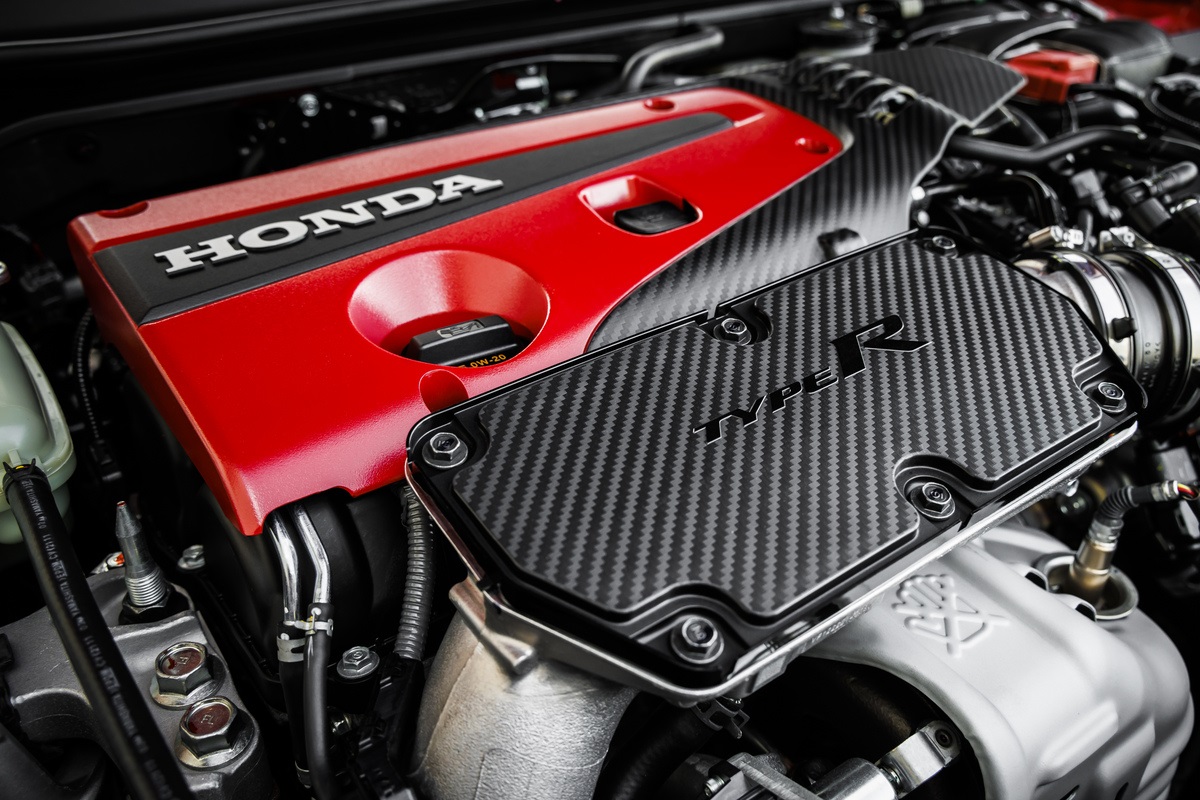
Pop the hood, and you’ll find a minimalist red Honda dress-up shroud and a carbon fiber plate over the air induction unit. Look closely for the downspout-sized air intake duct. It takes a lot of fresh air to supply combustion for 315 horsepower.

Honda pushed for speed and control in developing the new 2023 Civic Type R. It set a new production-car, front-wheel drive track record at the Suzuka Circuit in Japan . Home to the Formula 1 Japanese Grand Prix, the new Civic Type R lapped the Suzuka’s 3.6-mile figure-8 in 2 minutes 23.120 seconds. That blistering attack secured its legacy as the best-performing Civic Type R — ever.

According to ZeroTo60Times.com, the 2023 Type R will launch to 60 mph in 5.1 seconds. The fifth generation Type R is a click quicker at 5 seconds.

2023 Honda Civic Type R Pricing

The Honda Civic Type R is a one-spec choice for engine, manual transmission, and equipment. The 2023 model went on sale in the U.S. about a year ago (Oct. 7, 2022), and already there has been a $900 price bump; the Championship white paint option went up $60, from $395 to $455.

The Type R has a six-speed manual transmission.

A six-speed stick only for the Type R.

Manufacturer pricing for the Civic Type R starts at $44,890, including the $1,095 freight charge from Yorii-Machi, Zaitama, Japan. (However, the Type R engine is built in Honda’s Anna Engine Plant in Sidney, Ohio, and shipped to Japan.) Check here for current Honda and Type R pricing.

My tester was $45,345 with one option for Championship White paint, $455.

Unique Type R interior features include a serial-number plate, high-bolstered front sport seats in red-and-black microsuede fabric with double red stitching, red floor mats, red ambient LED interior lighting, metal-trimmed sport pedals, aluminum shift knob, red illuminated front door panels.

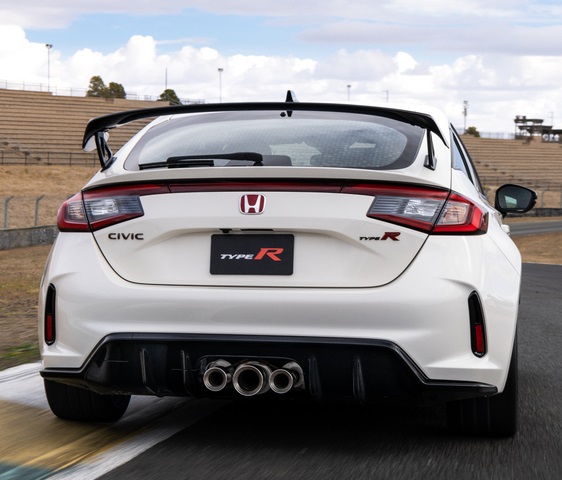
On the outside, look for the Brembo four-piston aluminum front brake calipers, 19-inch matte black alloy wheels, Michelin Pilot Sport 4S tires, gloss black side sills and wing spoiler, center-mounted, and the car’s signature triple outlet exhaust.

More Type R features are listed below in the specifications chart.

But Try To Find One …

Finding a new Civic Type R takes resolve, and fans at a car show told me that some dealers are asking $20,000 over sticker. A recent online search for a Civic Type R returned just four cars within 100 miles of my address in San Diego and just one Type R at a San Diego dealership (Pacific Honda). The other four Honda dealers in San Diego County included with their post, “We can still help you find it.”

Almost-new 2023 Type Rs, with very low miles, are being sold at dealerships for $50,000 to $56,000, according to Carfax.com. Because there are few factory options, just several accessories, these new-used Type R listings appear to include a dealer add-on “market value.”

The Type R engine has a red "Honda"

315 turbocharged horsepower from the K20C 2.0-liter 4-cylinder engine.

Type R Performance

Honda’s legion of Type R enthusiasts can be fanatical about their brand loyalty. Speak with any of these followers and they can recite stats for the Type R’s K20C engine. The VTEC turbocharged and direct-injected 2.0-liter four-cylinder has 315 hp at 6,500 rpm, and a redline of 7,000 rpm. Peak torque of 310 foot-pounds runs from 2,600 to 4,000 rpm.

A new turbocharger has an increased air intake flow rate, and boost pressure is up to 25 psi.

There are four drive modes: Comfort, Sport, +R, and Individual. I used Comfort mode for daily driving, and it gave excellent performance without a jarring ride. Sport mode is exponentially stiffer and becomes quite monotonous at interstate speeds. Individual mode, however, allows specific dial-ins for engine response, steering assist, suspension damping, engine sound, rev-match speed, and the red design of the gauge cluster.

The six-speed stick separates the pretenders from the proficient. Each gear slots with absolute engagement, which is the charm of a six-speed box vs. a crowded seven-speed. There’s little chance of accidental jamming when making fast shifts. And hill-start assist gives added relief as it brakes the car for a couple of seconds when starting on an incline.

Another electronic aid is rev-matching downshifts, which, fortunately, is a driver-selectable choice. To those who can heel-toe shift, this electronic enabler is more of an intrusion. It seems sissy when there are so many how-to heel-toe YouTube videos.

The 9-inch driver gauge screen in red Sport mode.

The 9-inch driver gauge screen in Sport mode.

Fuel Economy Ratings

Official EPA fuel economy ratings for the 2023 Type R are 22 mpg city, 28 highway, and 24 mpg combined. Using premium fuel provides the most power, but engine electronics will adjust to run on 87 octane.

I saw a highway mileage reading of 26.8 mpg, beating the EPA estimates. But I’m sure my around-town mileage was sacrificed by too much revving fun.

And keep an eye on the fuel gauge. It does not take long to use up the 12.4-gallon capacity. But a fill-up doesn’t hurt much when gas costs nearly $6 a gallon.

Safety Features

Type R safety features include 10 air bags and a complete set of driving-assist technologies (listed below in the specs box). The Level 2 semi-autonomous driving assist felt a little skitzy — insistent — at the steering wheel. Lane-centering, however, was accurate and reassuring in heavy traffic.

One of my most appreciated technologies is the Traffic Sign Recognition system. It is essential to know the speed limits in this speed-capable Type R.

Honda’s LogR Datalogger

Any sports car with tires this wide, a wing this big, and race seats demands a Performance Datalogger. And Honda complied with an enhanced version of its LogR Performance Datalogger. The datalogger helps drivers monitor and record various performance parameters, whether in real-time on the road, track, or other closed courses. Users can also share their lap times and other data with other Type R owners.

Key Honda LogR features include:

  • Stopwatch to record lap times;
  • Tire friction circle. The 3D motion indicator displays the tire force the vehicle achieves;
  • Scoring function, to help drivers improve their track driving.
19-inch Michelin Pilot Sport 4S tires have a “contact patch” that is 10.7 inches wide.

19-inch Michelin Pilot Sport 4S tires have a “contact patch” that is 10.7 inches wide. (Mark Maynard photo)

Power-To-Weight Ratio

The Type R is among the lightest of the current pocket rockets, weighing just 3,188 pounds, two pounds more than the front-drive Elantra N (also front-drive). Lightweighting measures include a vented aluminum hood (same as before) and a new lightweight resin hatch and a resin front bulkhead.

But saving weight also means paring back the budget for soundproofing, and the Type R’s interior noise level is at “Maelstrom” at highway speeds. At 65 mph, the engine revs at 2,500 rpm in sixth gear, and the wind and road harshness only increase with speed.

Type R Ride and Handling

Laying down 310 foot-pounds of torque to the front wheels can be a fury of dreaded “torque steer.” Hard acceleration in an FWD setup can make the tires pull from side to side as they seek traction. That is one reason some of these hot hatches are all-wheel drive, which helps displace torque steer by routing the force to all tires.

Honda has neatly solved the torque steer matter with a couple of engineering enhancements. One is what Honda calls a “dual axis suspension system with adaptive dampers.” The setup “greatly reduces torque steer, primarily through a 0.75-inch reduction in steering axis offset.”

The second piece of magic is the helical-type limited-slip differential, which minimizes wheel spin and puts more power to the pavement. The LSD enables harder acceleration on surfaces with uneven traction and reduces wheel spin when exiting corners.

By the way, Honda says a helical-type LSD describes how the differential’s gear teeth are cut at an angle to the gear shaft. Helical gears are quieter and can channel more torque than straight-cut (or spur) gears.

Roll On the Power

The revs have a sweet rise and fall as gears are neatly engaged. With the engine’s wide-spread of peak torque, shifts do not have to be rushed. Hustling along at 4,000 rpm through a second-gear turn is inspiring. Exit the apex and slot the shifter for third, and roll on the power — then smile at the reassuring pushback in the seat. That’s when these sport seats are in their element.

And that is also when the 19-inch Michelin Pilot Sport 4 S tires (265/30) are in their playground. These 10.7-inch-wide rollers bring an attack attitude to performance driving.

The tires have an asymmetric tread pattern and a treadwear rating (UTQG, or Uniform Tire Quality Grade) of 300. Honda advises that these three-season “summer” tires have a life that “may be less than 10,000 miles, depending on how you drive.”

Replacing a tire will run close to $400 — and do not cheap out when it’s time for replacements, or risk a compromise to handling performance.

The Type R’s signature triple round exhaust outlets are centered by the larger boom tube. In Sport mode, the exhaust note is one of determined grit under brisk acceleration, but the tone falls off quickly for quiet cruising.

Honda should have released the booming beast at all levels to remind owners why they paid $50,000 or $60,000 for a compact hatchback. Pull out a couple of baffles and let loose the snap, crackle, and pop.

A Couple of Considerations

With the hatchback’s 1.7-inch longer wheelbase(107.7 inches) and the wide Michelins, the Type R turning circle is an unwieldy 40 feet (39.9 inches). The low ride height is also a chin scraper, requiring some caution at dips in the street and some driveways.

The 9-inch color infotainment touchscreen adds a volume knob, customizable feature settings, and smart shortcuts

The 9-inch color infotainment touchscreen adds a volume knob, customizable feature settings, and smart shortcuts

Interior Function

This generation of Civic Hatchback is a solid base for performance. It has thinner windshield pillars, a lower hood, and the side mirrors mounted on the doors — not the pillar — creating a wide look-around.

Sightlines are open across the hood and out the back, even with that big wing on the decklid. The designers cleverly shaped the wing with an arc that matches the surround of the back glass.

The cabin ergonomics are Honda simple and direct. There’s nothing wrong with the leather-wrapped three-point steering wheel that a flat bottom wouldn’t improve for thigh space. Honda offers an Alcantara-wrapped upgrade with red baseball stitching for $408, but it does not have a flat bottom.

The big, winged race seats, ready for a three-point harness, are a one-size-fits-most.

A short throw shifter with a red shift knob is a $230 accessory, and it might be a worthwhile addition. The aluminum shift knob gets hot when the car has been sitting in the sun; the smooth finish of the knob can mean a missed shift if it slips in the hand. The accessory shifter has a metallic disc top with the lower portion wrapped in red leather.

The open cargo hatch of the Type R

The hatchback Type R has a 60/40 folding back seat and 24.5 cubic feet of trunk space.

Why Buy the Honda Civic Type R?

The Civic Type R is a street-able track car that looks like trouble. It is actually quite harmless but best enjoyed at high volume in competitive driving. The suspension gives stunning control, but as a Monday-Friday commuter, Comfort mode will be the way to go; Sport is just too rough.

As one enthusiast said of the Type R: “Hey, it has four doors; the spouse would approve.”

You can’t miss the Type R’s big wing, decklid spoiler, and triple exhaust tips.

You can’t miss the Type R’s big wing, decklid spoiler, and triple exhaust tips.

2023 Honda Civic Type R Specifications

Body style: Compact 4-seat, 5-door front-wheel-drive high-performance hatchback

Engine: K20C 315 hp, VTEC turbocharged and direct-injected 2.0-liter 4-cylinder; 310 lb.-ft. of torque from 2,600 to 4,000 rpm; 7,000 rpm redline

Boost pressure: 25psi

Transmission: 6-speed manual transmission with automatic rev-matching, and hill-start assist

Fuel economy: 22/28/24 mpg city/hwy/combined; premium fuel recommended for max performance

BY THE NUMBERS

Fuel tank: 12.4 gallons

Cargo space: 24.5 cubic feet

Front head/leg room: 39.3/42.3 inches

Rear head/leg room: 37.1/37.4 inches

Length/wheelbase: 180.9/107.7 inches

Height/width: 55.4/74.4 inches

Curb weight: 3,188 pounds; 62/38 weight distribution

Turning circle: 39.9 feet

FEATURES

Standard equipment includes: Smartkey entry with push-button start, multi-angle rearview camera with dynamic guidelines, 10.2-inch driver info screen, 12-speaker Bose sound System with subwoofer, 9-inch color touchscreen (with volume knob, customizable feature settings, and smart shortcuts), electric parking brake, Bluetooth phone and audio, Apple CarPlay and Android Auto, 2.5-amp USB smartphone-audio port (front), 2.5-amp USB charging port, 12-volt power outlet (front), wireless charging pad, sliding sun visors, LED map lights, cargo area cover,

Type R features, interior: Type R serial-number plate, high-Bolstered front sport seats with red-black microsuede fabric with double red stitching, red floor mats, red ambient LED interior lighting, leather-wrapped steering wheel, metal-trimmed sport pedals, aluminum shift knob, red illuminated front door panels, active sound control

Type R features, exterior: Brembo 4-piston aluminum front brake calipers, 19-inch matte black alloy wheels, Michelin Pilot Sport 4S tires, aluminum hood, red Honda badges, Type R badges front and rear, gloss black side sills, gloss black wing spoiler, center-mounted, triple outlet exhaust with active exhaust valve, gloss black side mirrors with LED turn signals

Safety features include: 10 air bags, stability and traction controls, brake distribution, brake assist, and hill-start assist.

Driving-Assistance Technologies

Collision Mitigation Braking; Road Departure Mitigation; Adaptive Cruise Control; Lane Keeping Assist; Forward Collision Warning; Lane Departure Warning; Traffic Sign Recognition System; Auto High-Beam Headlights; Driver Attention Monitor; Blind Spot Information System with Cross Traffic Monitor;

CHASSIS COMPONENTS

Suspension: Adaptive damper system; dual-axis MacPherson front struts, rear multi-link; stabilizer bars front (tubular) and rear (solid);

Steering: Dual-pinion, variable-ratio electric power steering; 2.1 turns lock to lock;

Brakes: Power-assisted and ventilated 2-piece front discs, solid rear; 13.8-inch rotors front, 12 inches rear; Brembo 4-piston aluminum front calipers;

Tires-Wheels: 19-inch Michelin Pilot Sport 4S tires (265/30); 19-inch matte black alloy wheels; tire-repair kit.

PRICING

Base price: $44,890, including $1,095 freight charge; price as tested $45,345

Options on test vehicle: Championship White paint $455

Where assembled: Yorii-Machii, Saitama, Japan

Warranties: 3-years/36,000-miles bumper to bumper with 24-hour roadside assistance; 5-years/60,000-miles powertrain

Audi A3 40 Quattro Review

Audi A3 40 Quattro Review

A test drive of the 2023 Audi A3 without activating Sport mode, just doesn’t tell the story of Audi’s smallest sedan

An exterior side view of an Atoll Blue Audi A3 sedan

For 2023, the Audi A3 continues with choices for front- or quattro all-wheel drive in trim levels of Premium or Premium Plus. (Photos courtesy of Audi USA)

Table of Contents

A History of A3 Firsts
2023 A3 Updates
A3 Model Line Pricing
A3 40 Performance
Driver-Assist Driving
Ride and Handling
Audi A3 40 Fuel Economy
Interior Function
Back Seats and Trunk Space
Why Buy the Audi A3?
Specifications

BY MARK MAYNARD

The Audi A3 shows its true colors — Red — in the performance modes of its 201-horsepower turbocharged four-cylinder engine and seven-speed S tronic transmission.

A test drive without activating Sport mode, or even the Dynamic performance setting, just doesn’t tell the story of this smallest Audi sedan. It can be a sleeper until prodded by the amped-up attitude of red in the gauge display.

By opting for this entry-level A3, the owner straps into a legitimate subcompact sport sedan without glam or gimmickry. It is the first touch point for this storied A3 family, which might be overlooked by the 306-hp Audi S3 or the 401-hp Audi RS 3.

Among the A3 standout features are the smartly designed interior, Audi’s shrewd engineering, a mild-hybrid engine, and the fact that this small sedan still has a spare tire! It’s a temporary spare with the jacking equipment, but with the broad electrification of vehicles, a spare tire is being deleted to make room for the battery pack and to save weight. The exception is larger vehicles and those intended for off-road travel.

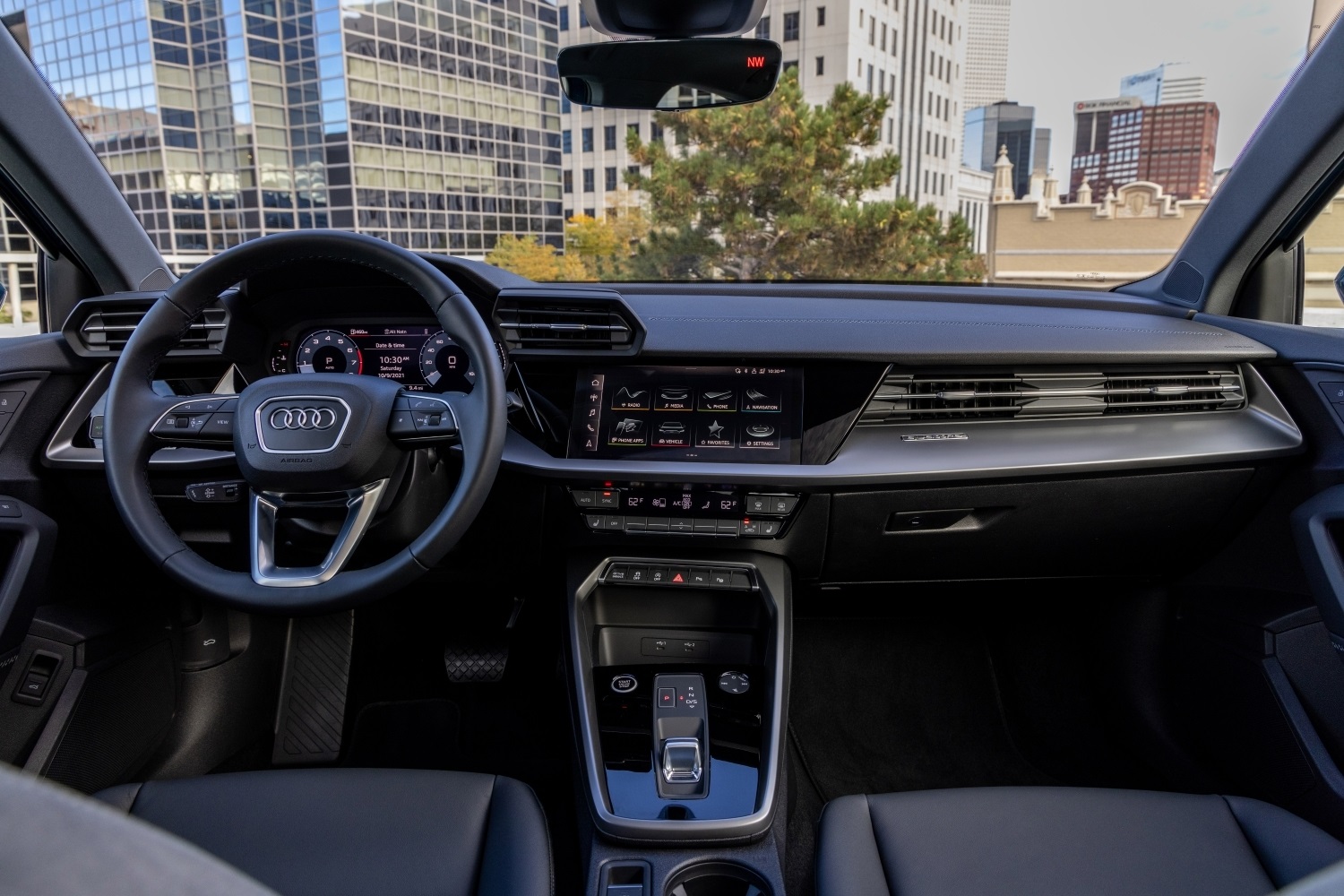
Looking through windshield from inside the driver seat of the A3

The A3 cabin seems to have been designed as a driver’s car — with a true coupe feel.

A History of Audi A3 Firsts

The Audi A3 made its U.S. debut in 2005 as a 2006 model. It was one of the first modern luxury-class subcompact sedans.

Redesigned for the 2015 model year, the A3 was one of Audi’s biggest marketing launches. Much of the fanfare was about its advanced technologies, which Audi calls industry “firsts.” Among its enhancements were:

  • First in-vehicle LTE connectivity (Long Term Evolution) with Wi-Fi;
  • The first Audi model to use the modular infotainment platform, MIB;
  • First integrated social networking applications and Picture Book Navigation;
  • And in 2014, the A3 won the award for World Car of the Year.
Looking through the 3 spoke steering wheel at the digital gauge array

The 10.25-inch digital gauge array.

2023 Audi A3 Updates

After its complete redesign and re-engineering for the 2022 model year, the 2023 A3 and S3 models have just a few packaging adjustments.

Full LED headlights and stitched door armrests in leatherette are now standard for the 2023 A3 40.

The A3’s Premium Plus trim adds LED interior lighting-plus package and an Agate gray fine grain birch wood inlay. Adaptive cruise control is available through Function on Demand for the base Premium trim.

For the A3 40, the 18-inch 5-spoke Y design wheels with a bi-color finish and all-season tires are now included in the Black optic sport package. And wireless phone charging has been added to the Convenience package for the A3 and S3.

Looking up through the A3 panoramic sunroof

The Premium Plus features include a panoramic sunroof.

Audi A3 Model Line Pricing

The entry 2023 Audi A3 40 is available in front-wheel drive or quattro all-wheel drive. All A3 models have a seven-speed S tronic dual-clutch automated-manual transmission with performance modes. A3 starting prices range from about $36,000 for the front drive Premium trim to $43,145 for the Prestige Plus quattro, today’s tester. Including Atoll Blue paint ($595) and the Black Optic sport package, $1,550, the tester came to $43,740. All MSRPs include the $1,095 freight charge from Ingolstadt, Germany.

The main subcompact sedan competitors in size and price to the Audi A3 are the 2023 BMW 2-Series Gran Coupe four-door ($36,600) and the 2023 Mercedes-Benz A-Class ($36,095). Other potential competitors are the 2023 Acura Integra  ($32,000) and 2023 Cadillac CT4 ($35,790).

The infotainment screen in the A3

A 10.1-inch touch screen for rearview camera views and infotainment.

Audi A3 Premium Plus Features

Standard A3 Premium Plus technologies include:

  • Advanced key with push-button ignition;
  • Adaptive cruise assist with lane guidance;
  • Side assist with rear cross-traffic assist;
  • Active lane assist with emergency assist;
  • Parking system with park assist.

Convenience features on the A3 Premium Plus include leather-trimmed upholstery, panoramic sunroof, wireless phone charging, eight-way power (heated) front seats, driver’s seat memory presets, power folding and heated side mirrors, full HED headlights, garage-door opener. (See the longer list in the specs box at the end of the story.)

The A3 Black optic sport package adds:

  • 18-inch 5-spoke Y design wheels with a bi-color finish;
  • Pirelli all-season tires;
  • Black exterior trim;
  • Sport suspension lowers the ride height by a little more than half an inch, or 15mm.

Audi S3 and RS 3 Pricing

The Audi S3 starts at almost $47,000, with standard quattro AWD. With a few options, the price settles in at $56,000.

The RS 3 Quattro starts at almost $60,000. With desirable options, including the Black optic plus package ($750), Dynamic plus package ($5,000), RS sport exhaust system with black tips ($1,000), and Design selection interior ($1,500), the sticker grows to $69,000.

The Audi warranty of four years or 50,000 miles is for bumper-to-bumper coverage, with roadside assistance. The free first-scheduled maintenance is no longer offered. But Audi offers more comprehensive Care Select packages, starting at $999 for the A3.

Find current Audi A3 pricing here and special offers here.

A yellow Audi RS 3

The 401-hp, 5-cylinder Audi RS 3. Acceleration from 0 to 100 mph in 3.8 seconds.

Audi A3 Styling

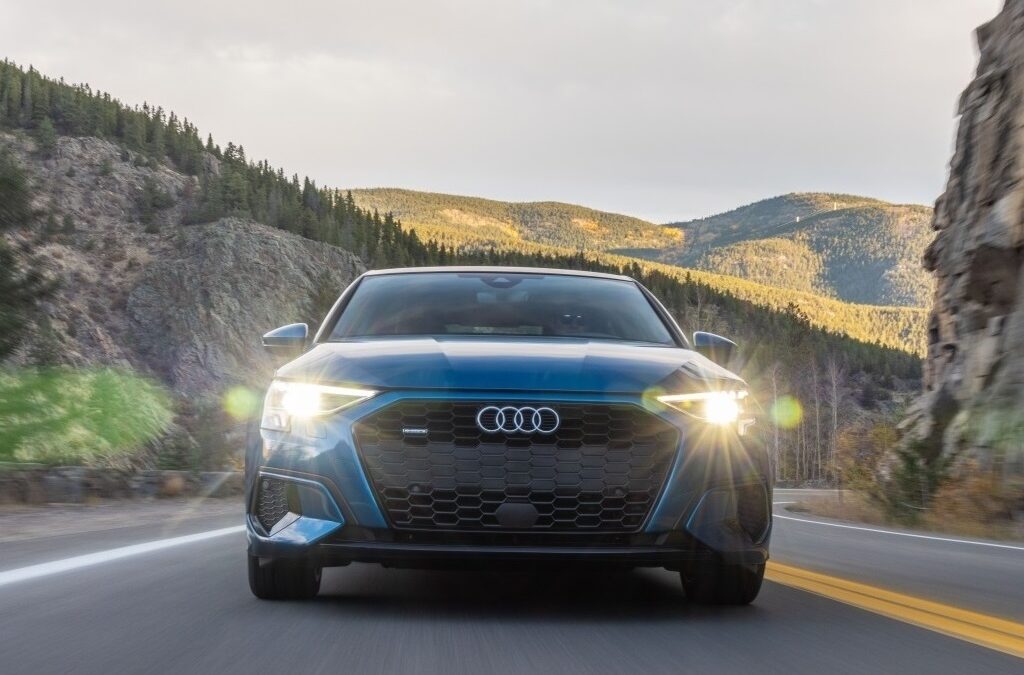
Small can be spectacular in the A3 — but it might not appear so in its exterior styling. Its bold face instantly identifies the A3 as an Audi, and the unprovoking exterior design will transcend style trends for years to come. But it’s not a treatment that will lure motorists to follow the car hauler to the dealership.

The exterior design is balanced with a strong stance on the larger 18-inch wheels, though 17s are standard. The low front end can be a chin-scraper on driveways and when bounding through cross-street intersections.

The basic black interior doesn’t call out luxury, either. The engaging use of brushed metallic trim is youthful, but the assets of the A3 make themselves known after strapping in.

The A3 has LED headlights

The A3 has full LED lighting.

Audi A3 40 Performance

In the base drive mode of Comfort, A3 performance is mild and tuned for maximum fuel economy. At 3,494 pounds, which is a bit heavier than the BMW or Mercedes competitors, the official A3 40 fuel-economy ratings with AWD are 31 mpg city, 28 highway, and 36 mpg combined — using the recommended 87 octane fuel. Those ratings are a few mpgs better than the BMW and the Mercedes, which prefer premium fuel.

The A3’s 13.2-gallon tank could provide more than 400 miles of driving. I wouldn’t know because I was enjoying the Sport modes. My around-town mpgs were acceptable, but even then, I set the performance mode to “Comfort-Sport.”

The 201-hp 2.0-liter has 221 foot-pounds of torque, which peaks at a relatively high 4,000 rpm. That’s why performance in Comfort mode is comfortable. Activating Sport gives a bit more engine rev on take-off from a stop, which gets everything moving quicker into the upper rpms.

The seven-speed dual-clutch has the sensation of engaging first gear. That spooling and clutching can delay launch force as the turbo builds pressure and the transmission hooks up. But shift response at speed is quick and supportive of enthusiastic driving.

Especially appreciated is an honest exhaust and engine tone. There is no artificial engine-sound generator to give a hot-shoe impression. I’m quite capable of making noise on my own.

The A3 turbocharged four cylinder engine

The A3 has one powertrain choice of a 201-hp, turbocharged and direct-injected 2.0-liter four-cylinder and 7-speed dual-clutch transmission.

Driver-Assist Driving

The A3 Premium Plus packages the network of driver-assist technologies. It is a Level 2 hands-on system that will be an asset for those in the slog of highway commuting.

I found the system to be precise in its lane centering and a faithful roundhouse of eyes for protection from drivers who are less aware while driving.

The advanced-tech package includes:

  • Adaptive cruise assist with lane guidance;
  • Audi side assist with rear cross-traffic assist;
  • Adaptive cruise assist;
  • Active lane assist with emergency assist.

Mild Hybrid Technology

The direct-injected TFSI engine — Turbo Fuel Stratified Injection — has sophisticated engineering for power and economy from a 48-volt mild-hybrid (MHEV) system. It’s another first for the A3, allowing it to coast while the engine temporarily shuts off in certain driving situations. The system also applies energy recuperation on throttle-lift and braking.

Audi says the A3 40 TFSI quattro has a 24 percent improvement in combined efficiency compared with the previous quattro model; it had official mileage ratings of 28/36/31 mpg city/highway/combined.

What’s the 40 mean?

In Audi engine terms, the A3 40 somehow refers to the 2.0-liter engine’s horsepower, which globally ranges from 165 to 198 hp. But the current U.S. -spec Audi A3 40 has 201 hp. The higher the number, such as 45, the higher the horsepower. The Audi A8 large sedan has an engine ranking of 55 for its
335-hp, turbocharged 3.0-liter V-6.

The higher-horsepower Audi A3 S and R.S. models don’t use an engine code; they stand on their own.

Audi A3 40 Ride and Handling

Despite a low 0.27 coefficient of drag, there was more road and ambient cabin noise than expected from such a small car. The likely culprit is the Pirelli P Zero all-season tires, though all-season Pirellis are not known to be noisy. The 225/40 tires have good cornering grip and a treadwear rating of 500, which is in the midrange for hardness; the tire’s warranty is for 50,000 miles.

The steel-spring suspension has MacPherson struts at the front and a four-link rear. The setup nimbly handles weight transitions and has a tight turning circle of 36.4 feet (or maybe a little wider with the 18-inch tires). The highway ride quality is more compliant than expected from the 103.5-inch wheelbase, which is a few inches shorter than its competitors.

Braking is absolute, but not grabby, from 12-inch ventilated front discs and 10.7-inch solid rear discs. The four-wheel ABS integrates brake-force distribution, hydraulic brake assist, and the expected stability and traction controls.

The 18-inch alloy wheel and Pirelli P Zero tire

Pirelli P Zero all-season tires, 225/40.

A3 Interior Function

The A3 cabin seems to have been designed as a driver’s car — with an authentic coupe feel. There are wide-open sightlines at the side mirrors without complications of frames at the corner glass. Over-the-shoulder views are also open, and the rearview camera with guidance lines also gives a silhouette view of nearness to objects front or rear.

Small cars often have cluttered interiors for placement of all the switches and controls, but not in the A3. A designer took care to arrange the front door panels to have an easy reach to the door grab with ideal leverage, opening or closing. Window switches, mirror adjusters, seat-memory presets, door locks, and the trunk opener are all within finger reach. The storage area just below has plenty of stash space and a bottle slot.

The center stack of controls anchors the upper infotainment screen, which is clearly visible in all light conditions. A tier below it are the climate controls with simple switches. The stack continues into a wide and low shift console with a secure finger grip for gear selection, the ignition button, and the audio volume dial.

Audi builds its seats for the long drive. These are eight-way adjustable with seat-bottom tilt. And the seats are without extreme side or bottom bolsters, which avoid that unwelcome wedgie on entry or exit.

Front headroom of 36.8 inches, with the sunroof, might not fit the big-and-tall driver.

A3 back seat has short legroom of 35.2 inches

Back seat space is subcompact with max legroom of 35.2 inches.

A3 Back Seat and Trunk Space

Back seat space is subcompact with max legroom of 35.2 inches, when those in the front scooch forward. A tall exhaust-transmission tunnel interferes with five-seat capacity.

Trunk space of 10.9 cubic feet is also subcompact but spacious enough for travel and getaways. And the back seat folds in a three-way split, 40/20/40, with a ski passthrough.

Trunk space is small but expandable by the folding back seat

Trunk cubic footage is small, but the space is expandable by the 40/20/40 back seat. (Mark Maynard trunk photos)

The temporary spare in the A3

And the temporary spare tire, almost rare in new cars.

Why Buy the Audi A3?

In the late 1990s when the major European carmakers were competing to sell more cars in the U.S., the subcompact sedan was eyed warily. Could a subcompact sedan be profitable? Would it be perceived as luxury? Could it dilute the brand?

Ultimately, money won out. Audi and Mercedes-Benz took the first leaps, followed by BMW.

Reinforcing the brand’s status are the high-performance divisions for each of those brands — Audi RS, BMW M, or Mercedes-Benz AMG. Every entry-lux version of those subcompacts carries the halo of high performance, or, at least, the perception of it.

Audi’s A3/S3 subcompacts typically sell around 8,000 to 15,000 in a non-covid-impacted year. Add up base prices of about $40,000, and that’s not a bad return for the segment. And then factor the RS 3 sales of $60,000 to $75,000 each.

The Audi A3 40 represents the obsessive detail of Audi engineering and performance. The casual styling of the A3 40 belies the technologies beneath the exterior sheet metal. It is not overt performance but skilled refinement.

Don’t muscle the A3. Let the layers of its engineering envelop you to make a better driver.

A rear view of the small sedan on a back country black top highway

2023 A3 starting prices range from $36,000 for the front drive Premium trim to $43,145 for the Prestige Plus quattro.

 2023 Audi A3 40 Specifications

Body style: subcompact, 5-seat, 4-door all-wheel-drive sedan

Engine: Mild hybrid 201-hp, turbocharged and direct-injected 2.0-liter 4-cylinder with auto stop-start; 221 lb.-ft. torque at 4,000 rpm

Transmission: 7-speed S tronic dual-clutch automatic

Fuel economy: 28/38/32 mpg city/hwy/combined; 87 octane

0-60 mph acceleration: 6.3 seconds (Audi)

Top speed: 130 mph

BY THE NUMBERS

Fuel tank: 13.2 gallons

Trunk space: 10.9 cubic feet

Front head/leg room: 36.8/41.2 inches

Rear head/leg room: 36.6/35.2 inches

Length/wheelbase: 176.9/ 103.5inches

Curb weight: 3,494 pounds

Turning circle: 36.4 feet

FEATURES

Premium Plus standard equipment includes: Audi advanced key with push-button ignition, leather-trimmed upholstery, panoramic sunroof, adaptive cruise assist with lane guidance, driver’s seat memory presets, wireless phone charging pad, 8-way power front seats, power folding and heated side mirrors, full HED headlights, garage-door opener, driver’s seat memory, leatherette-covered door armrests, wireless phone charging pad, 40/20/40 folding seatback;

Premium Plus Safety features include: 7 air bags, Audi side assist with rear cross traffic assist, adaptive cruise assist, alarm system with motion sensor, active lane assist with emergency assist, parking system with park assist,

PRICING

Base price: $43,145, including $1,095 freight charge; price as tested $43,145

Options on test vehicle: Atoll Blue metallic paint $595; Black Optic package $1,550

Where assembled: Ingolstadt, Germany

Warranty: 4-years/50,000-miles bumper to bumper with powertrain and roadside assistance (unlimited miles)

Subaru WRX Review

Subaru WRX Review

Let’s get back to the basics of love, the love of driving: the new 2022 Subaru WRX

An exterior front three quarter view of a white 2022 Subaru WRX

The new 2022 Subaru WRX compact sport sedan is the fifth generation of this rally-bred icon. (Photos courtesy of Subaru or as credited)

Table of Contents

2022 Subaru WRX Overview
Pricing
Weight-Saving Designs
Powertrain and Fuel Economy
Ride and Handling
Interior Function
Why Buy the 2022 Subaru WRX Premium?
Specifications

BY MARK MAYNARD

There is a simple mantra to driving the 2022 Subaru WRX six-speed manual: Rev, Engage, Shift, Smile, Repeat. Let those horizontally opposed pistons thrum.

And when the cornering gets tight, stab a heel-toe downshift, steady the wheel, look through the turn, power on, smile, grab a gear. And repeat.

The 2022 Subaru WRX is an all-wheel-drive, turbocharged four-cylinder compact-class sport sedan. It is a stealth S-snake hunter with impressive car control, sport-tuned transmission, and modest fuel economy.

This rowdy little “World Rally eXperimental” car was battle-tested in the World Rally Championships of the 1990s and early 2000s. I liked this unassuming all-wheel-drive performer from its first generation in the U.S., 1992-2000. It was distinctive in its Rally Blue hue and gold-painted wheels. The WRX has always been built tough and could be pumped up for 400 horsepower, and more.

Mainstream competitors of the Subaru WRX include the Honda Civic Si, Hyundai Elantra N, and the VW Golf GTI and Jetta GLI.

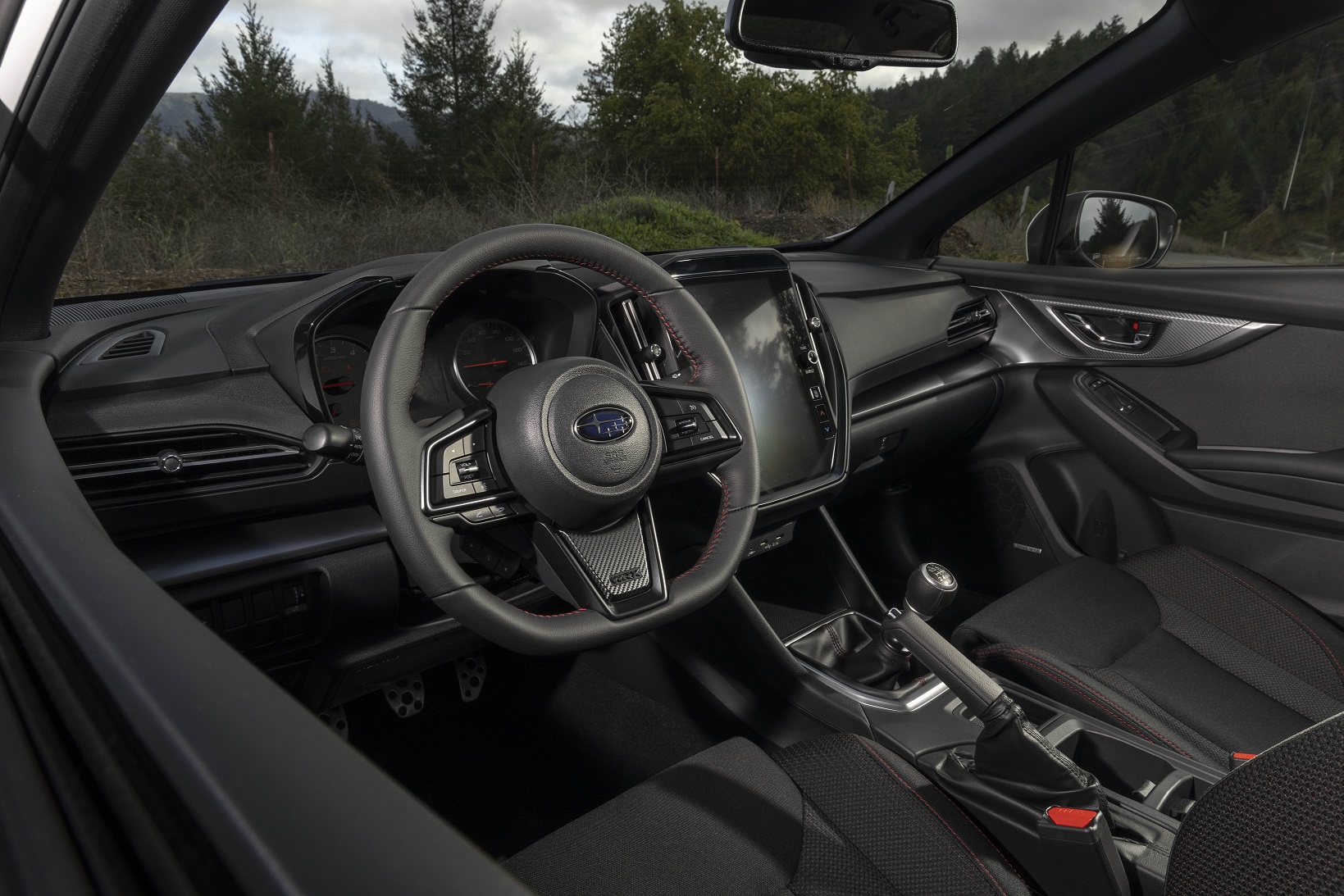
The driver area of the 2022 WRX

The driver area is simple and succinct.

2022 Subaru WRX Overview

For the first time, the 2022 WRX is built on the Subaru Global Platform. Subaru says it is a solid architecture for improved dynamics and reductions in noise, vibration, and harshness.

It also was given a new powertrain. The FA24F 2.4-liter turbocharged and direct-injected four-cylinder engine continues with “boxer” horizontally opposed pistons. The engine spools up 271 hp and 258 foot-pounds of torque from 2,000 to 5,200 rpm. Engine updates this year included larger pistons, an electronically controlled wastegate, and air bypass valves.

WRX transmission choices are a new CVT, called the Subaru Performance Transmission, or a six-speed manual. The SPT all-wheel-drive system has variable torque distribution, while the manual transmission uses a center differential and viscous coupling.

The best news for the manual transmission is that there is no more rev-hang between shifts.

Large metal-and-rubber trimmed pedals

Big-foot metal-and-rubber trimmed pedals.

Models with the “Drive Mode Select System” get electronically controlled adaptive dampers, a first for the WRX.

Because of ever-increasing emissions regulations, Subaru says it will not offer a second-generation WRX STI high-performance model. At least not yet, and not with an internal-combustion engine.

But there is still STI attitude in the new 2022 WRX GT, the top trim level.

2022 Subaru WRX Pricing

For 2022, the Subaru WRX is sold in four trims of Base, Premium, Limited and GT.

Starting prices range from $30,600 for the Base model to $43,390 for the GT. MSRPs include the $995 freight charge from Gunma, Japan.

Add $1,850 to $2,050 (depending on trim level) for the Subaru Performance Transmission, a continuously variable transmission. The option also adds EyeSight Driver Assist Technology with advanced adaptive cruise control, auto vehicle hold, steering wheel paddle shifters, SI-Drive, and an electronic parking brake.

Standard Base model features include power windows, door locks, and side mirrors; dual USB input ports in the front center console; welcome lighting; remote keyless entry; combination gauge array with color display; roof rack mounting brackets; and 60/40 split fold-down rear seats.

Also included are 17-inch alloy wheels with summer performance tires, multi-mode vehicle dynamics control with track mode, and incline start assist.

Standard on WRX is a new center information display with dual 7-inch high-resolution touch screens. The top screen controls smartphone integration with Apple CarPlay or Android Auto, Bluetooth phone and audio, a rearview camera, and satellite radio and Travel Link. The bottom screen manages HVAC and vehicle settings.

No factory upgrade option packages are available for the Base model. But there are lots of accessories (for all trim levels). Among them are:

  • STI Duracon (manual) shift knob, $99.95
  • STI performance mufflers, $1,200
  • Stainless steel exhaust tips, $299.95
  • And a cool-looking cherry-red STI starter button, $249.95

Find current pricing and available incentives here.

The fabric seats in the WRX premium are grippy but not overly bolstered

The fabric seats are grippy without extreme bolstering.

Pricing Sweet Spot

Many WRX enthusiasts will find all the grip and grin they need in the Base model. But the WRX Premium, $31,605, is the sweet spot for added conveniences at a modest price.

Today’s tester is the WRX Premium, starting at $33,100. The tester included the Harman Kardon audio system (11 speakers) and power moonroof, $1,875. As tested, it cost $34,975.

Standard WRX Premium features include an upgrade to 18-inch alloy wheels in a dark gray finish, LED fog lights, a low-profile rear spoiler in body color, and automatic headlights with on and off when using the windshield wipers.

The Premium model also has standard keyless locking and push-button ignition. The premium black seat fabric is trimmed in red stitching. Other conveniences include dual automatic climate control with voice activation and dual USB charging ports in the rear center console. The standard All Weather Package adds heated front seats, side mirrors, and a windshield wiper deicer.

Also new for upper trim levels is a tablet-style high-definition center information display. The 11.6-inch Starlink Multimedia Plus system has direct-touch controls for multimedia, heat and AC, and vehicle settings. As with a smartphone, app icons on the touchscreen can be moved and configured based on personal preference. The new multimedia system also offers a split-screen display that can simultaneously show two types of information such as navigation and audio.

Weight-Saving Designs

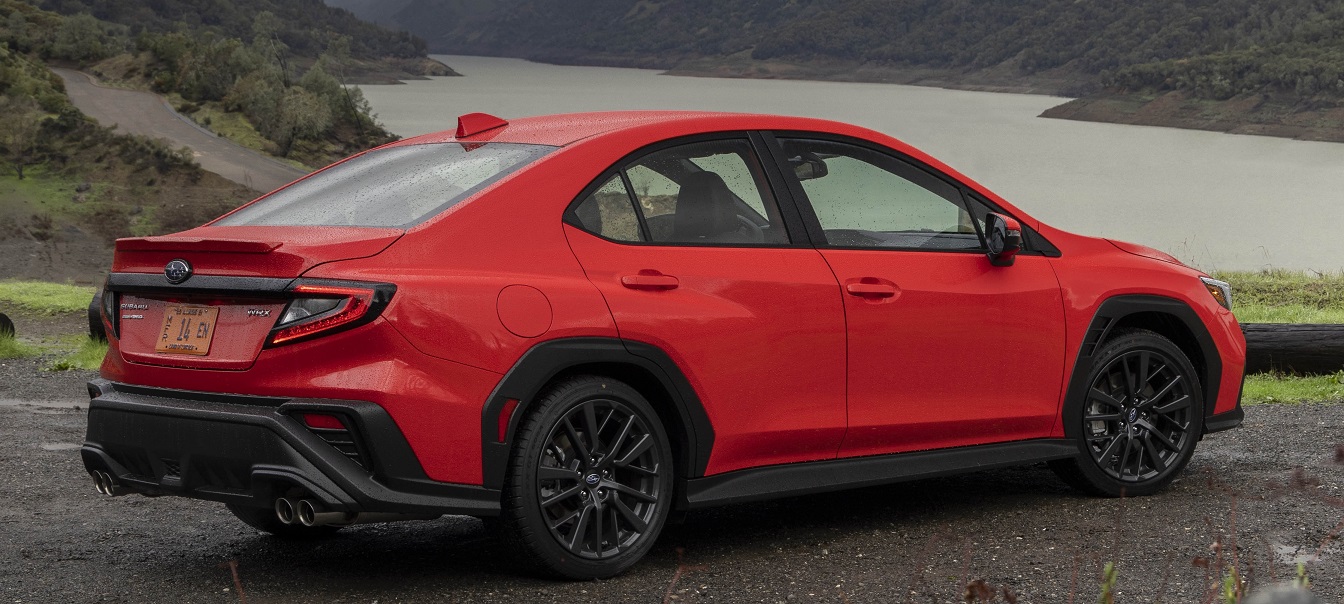
The new wide-body WRX design strikes a powerful stance without being overhyped by a big rear wing or other fan-racer add-ons.

Aerodynamic improvements include an air outlet at the trailing edge of the front wheel opening. The outlet allows air to exit from the wheel well more freely, which reduces lift on the front tires for more grip and stability.

A white example of the aluminum WRX hood

The aluminum hood with integrated scoop.

Aluminum front fenders reduce the overall vehicle weight by 5 pounds, Subaru says. The hood, too, is aluminum, which helps lower the center of gravity.

With a curb weight of 3,320 pounds, the WRX manual is a relative lightweight when factoring its all-wheel drive. (Opting for the CVT adds just 137 pounds.) The usual sport-compact competitors of the WRX are front-wheel drive. For example, the Honda Civic Si weighs 2,952 lbs., the Hyundai Elantra N weighs 3,186 lbs., and the VW Jetta GLI is 3,272 lbs.

Other aero tricks include:

  • Another air outlet at each side of the rear bumper to reduce body sway due to air trapped behind the bumper;
  • Molded wheel arches and lower body trim have an aerodynamic texture to reduce air resistance;
  • An engine undercover also has an aerodynamic texture to help channel airflow and increase downforce at the front of the car.
The gauge array has bold features for optimum presentation under horsepower pressure

The gauge array has bold features for optimum presentation.

WRX Powertrain and Fuel Economy

The Subaru WRX is a visceral performer but not muscle-bound. The FA24F 2.4-liter turbocharged and direct-injected four-cylinder engine has a clenched-teeth resolve to achieve the driver’s intent.

WRX performance can be lap-dog friendly or turn vicious with a big rev and downshift. And even the stock exhaust has a well-muscled and deep tone.

With peak torque of 258 lb.-ft., Car and Driver cite 0-60 mph acceleration in 5.5 seconds and the quarter-mile in 13.9 seconds at 101 mph.

The manual gearbox has a rewarding, rifle-bolt engagement with a comfortably sprung clutch. And Subaru’s hill-start assist brakes the WRX for a few seconds while the driver engages a gear. If all stick-shift cars had this simple tech, there would be many more manual-transmission users today.

Fuel economy ratings are 19 mpg city, 26 highway, and 22 mpg combined. Premium fuel is recommended for peak performance. My test week’s average mileage ranged from 18.1 to 22.5 mpg. But for a small car, it has a big gas tank of 16.6-gallons.

For my modest mileage numbers, I blame — and praise — the manual transmission.

There is so much low-end pull that there is no need to rush the shifts. It’s a great second- and third-gear speedster. Roll on the power at 15 to 20 mph in second gear, and the engine will get up to speed quickly.

The 271 horsepower turbocharged 2.4-liter 4 cylinder WRX engine

The FA24F 2.4-liter turbocharged and direct-injected four-cylinder ‘boxer’ engine.

WRX Ride and Handling

The sport-tuned four-wheel independent suspension is engineered for total car control. There is no front-end push and no rear rotational inertia. The car just sticks where the driver points it, within the bounds of physics.

At speed, the WRX runs flat and steady, but the ride quality of its stiff dampers can become monotonous on a long daily commute. And at 65 mph, the engine is spinning loudly at about 2,500 rpm.

The 18-inch Dunlop Sport Maxx GT 600 A (245/40) tires are a razor’s-edge match to the suspension. But enjoy these soft black erasers because they have a very low treadwear rating (UTQG) of 200. Low means better road adhesion. But these tires might not last a year of driving for the win — and replacements run $350 a pop.

Four-wheel disc braking gives an absolute response without nosedive. The front rotors have 12.4-inch ventilated discs and dual-piston calipers. At the rear are 11.4-inch ventilated discs with a single-piston caliper.

Quick-ratio electric power-assisted steering has light weight but precise resolve, with 2.5 turns lock-to-lock. The turning circle is a trim 36.7 feet, which compares to, or is better than, the front-drive competitors.

18-inch Dunlop Sport Maxx GT 600 A (245/40) tires

18-inch Dunlop Sport Maxx GT 600 A (245/40) tires. (Mark Maynard photo)

WRX Interior Function

The driver area is simple and succinct. The gauge array has bold and functional features for optimum presentation when pushing the redline.

The cabin is handsomely dressed in black with contrast red stitching and legitimate-looking carbon-fiber-pattern trim. The fabric front buckets are grippy in cornering, without extreme side bolstering. The driver’s seat is six-way manually adjustable and heated.

I especially enjoyed the flat-bottom steering wheel, the handbrake at driver’s right, and the big-foot metal-and-rubber trimmed pedals.

The Premium model’s 11.6-inch touchscreen infotainment system is big and bold but has limitations. While the tablet does have some physical controls for the climate system and stereo, selecting other functions is a two-touch process that sometimes takes eyes from the road. The tablet measures 9 inches across, but the viewable screen is just 6 inches wide, which makes for a narrow rear camera view.

The back seat is roomy enough for the kids, with max legroom of 36.5 inches.

The WRX back seats

With max legroom of 36.5 inches, the back seat is roomy enough for the kids.

Why Buy the 2022 Subaru WRX Premium?

There is a naked honesty to the stick-shift Subaru WRX Premium. There is plenty of power to feel the weight transitions and to coax a little more. There is no semi-autonomous drive mode, wireless charging, or advanced cruise control. But it has all the essentials for driving.

Let’s get back to the basics of love, the love of driving, in the 2022 Subaru WRX.

The new 2022 Subaru WRX is built on the Subaru Global Platform

The new 2022 Subaru WRX is built on the Subaru Global Platform.

2022 Subaru WRX Specifications

Body style: compact, 5-seat, 4-door AWD sedan with aluminum
hood and front fenders

Engine: 271-hp, turbocharged and direct injected 2.4-liter 4-cylinder; 258 lb.-ft. torque from 2,000-5,200 rpm

Maximum turbo boost: 12 psi

Transmission: 6-speed manual, with hill-start assist and SI-DRIVE
performance management

AWD system: Continuous all-wheel drive with viscous-coupling locking center differential and 50:50 torque split (transfers more torque to wheels with the best traction)

Fuel economy: 19/26/22 mpg; premium fuel recommended for peak performance

Suspension: sport-tuned 4-wheel independent; front, MacPherson-type struts with coil springs and stabilizer bar; rear, double wishbone with coil springs and stabilizer bar

Braking: 4-wheel discs; dual diagonal system with electronic brake-force distribution, 4-channel 4-sensor ABS, brake assist and brake override; front, 12.4-inch ventilated discs dual-piston calipers; rear, 11.4-inch ventilated discs, single-piston calipers (11.8-inch discs with EyeSight option)

Steering: Quick-ratio electric power-assisted rack and dual pinion

0-60 mph acceleration: 5.5 seconds; quarter-mile in 13.9 seconds at 101 mph (Car and Driver)

BY THE NUMBERS

Fuel tank: 16.6 gallons

Trunk space: 12.5 cubic feet

Front head/leg room: 38.8*/43.1 inches *39.8 w/o sunroof

Rear head/leg room: 36.7/36.5 inches

Length/wheelbase: 183.3/105.2 inches

Curb weight: 3,320 pounds

Turning circle: 36.7 feet

FEATURES

Standard Premium model equipment includes: Keyless entry with push-button start and PIN-code vehicle access, Starlink 11.6-inch Multimedia Plus, rearview camera, 6-way manually adjustable driver’s seat, heated front seats, leather-wrapped flat-bottomed steering wheel with red stitching, leather-wrapped shifter handle, aluminum-alloy pedal covers, analog speedometer, tachometer, coolant temperature and fuel gauges, 6-speaker audio system, auto on/off headlights, power windows with auto up/down, electronic cruise control, steering wheel controls, dual front USB input ports, dual rear USB charge ports, tilt-telescoping steering column, dual cup holders in center console, single bottle holder in each door panel, rear center armrest with dual can holders, sun visors with dual-illuminated vanity mirrors, center console with LED-illuminated storage tray and 12-volt power outlet, dual-zone automatic climate control system, 60/40-split flat-folding rear seatback, LED headlights and fog lights, heated side mirrors, windshield wiper deicer

WRX performance equipment: 18-by-8.5-inch aluminum-alloy wheels with a dark gray finish, 245/40 97Y summer-performance tires, performance-design front seats, fabric upholstery with red trim, sport-design electroluminescent gauges, front and rear underspoilers, rear bumper with integrated diffuser, trunk spoiler, exhaust system with quad stainless-steel outlets

Safety features include: 7 air bags, Vehicle Dynamics Control with active torque vectoring, disc brakes, hill-start assist, and brake assist

PRICING

WRX Premium base price: $33,100, including $995 freight charge; price as tested $34,975

Options on test vehicle: Harman Kardon audio system (with 11 speakers) and power moonroof, $1,875

Where assembled: Gunma, Japan.

Warranty: 3-years/36,000-miles bumper to bumper; 5-years/60,000-miles powertrain

Genesis GV70 AWD 3.5T Review

Genesis GV70 AWD 3.5T Review

Genesis thought outside the instrument panel to create the refined and sophisticated GV70

Starting prices for the 2022 Genesis GV70 range from about $43,000 to $55,000.

Starting prices for the 2022 Genesis GV70, including all-wheel drive, range from about $43,000 to $55,000. (Mark Maynard photos)

Table of Contents

Overview
Pricing
Performance
Ride and Handling
Driver Assist Technologies
Safety Features
Interior
Back Seats and Cargo
Why Buy the Genesis GV70?
Specifications

BY MARK MAYNARD

I had been eager to test the Genesis GV70 since the company announced the arrival of its new small SUV back in early December 2020. The images presented a compelling design, but a couple of other luxury elements stood out:

• Its elite styling resisted an SUV image with unnecessary humps and bulges to reinforce an off-roading image.
• In addition to its long new-vehicle warranty, Genesis leapfrogs ultra-luxury warranties with these no-cost coverages:

1. Free scheduled maintenance and Genesis Service Valet care for 3-years/36,000-miles;
2. Free Genesis Connected Services for 3 years;
3. 3 years of free annual multimedia and navigation updates and lifetime traffic data via HD+ Traffic radio.

And this frosting of largesse can be heaped onto the new vehicle warranty of 5-years/60,000-miles bumper to bumper, and 10-years/100,000-miles for the powertrain.

The stand-out perk, however, might be the free service valet care. Genesis says, “Let us pick up and service your vehicle for you.” Genesis will perform a remote diagnostic check, then retrieve your vehicle for service and leave a loaner vehicle, then return your Genesis washed and cleaned.

Now that’s how a carmaker reassures its customers. Such a time-saver in this class could make a $60,000 compact SUV a no-regrets purchase. And there is little to regret about owning the Genesis GV70.

Steering wheel of the GV70

Sightlines are open across the fenders, helped by the small corner glass.

Genesis GV70 Overview

The compact-class GV70 is the second Genesis SUV, joining the midsize GV80 and the brand’s fifth model overall. The GV70 shares an architecture with the G70 sport sedan (and the Kia Stinger) making it more of a sport SUV, though Genesis has no true sport division … yet.

Every luxury-class manufacturer has at least one small SUV crossover in its lineup. Most have traditional styling treatments to remind of a rugged SUV for that great escape, which automotive marketers think is so desired by U.S. drivers.

Mercedes-Benz and the Porsche Macan are on similar trajectories for an SUV crossover that has carlike manners. Genesis thought outside the instrument panel to create the refined and sophisticated GV70.

No apology is needed for its cargo-crimping, coupe-like roofline. And the GV70 has what might be the best-looking rear-end in the business today. And the rest of the GV70 walkaround is balanced and comment-provoking, too.

The fist-forward “Athletic Elegance” design theme has a sweeping parabolic arch that slashes rearward from the headlights and descends to the center of the taillight. It is a muscular treatment without contrived bulges.

Genesis design and engineering is a progressive presentation of everything drivers have become familiar with — but smartly re-created.

The front seats in the GV70

The Genesis GV70 shuts out the world with acoustic laminated glass.

Genesis GV70 Pricing

Globally, the GV70 drivetrain is rear-wheel drive with optional AWD. But in North America, the GV70 has standard all-wheel drive. There are two choices of turbocharged and direct-injected powertrains with eight-speed automatic transmissions. The electronic transmissions include steering wheel paddle shifters and selectable performance modes of Snow, Comfort, Eco, Sport, Sport-plus, and Custom, which allows individual preferences for steering weight, suspension firmness, etc.
GV70 2.5T AWD starts at $42,595. The 300-hp, single turbocharged 2.5-liter four-cylinder has 311 foot-pounds of peak torque from 1,650 to 4,000 rpm. Fuel-economy ratings are 22 mpg city, 28 highway, and 24 mpg combined, using the recommended premium fuel for peak performance.
GV70 3.5T starts at $54,195 and includes the standard Sport package of 19-inch alloy wheels, panoramic sunroof, and Highway Driving Assist II. The 375-hp, twin-turbocharged 3.5-liter V-6 has peak torque of 391 lb.-ft. from 1,300 to 4,500 rpm. Fuel-economy ratings are 19 mpg city, 25 highway, and 21 mpg combined, also using the recommended premium.

Today’s GV70 3.5T tester was $64,045. Options included the Melbourne Gray matte paint for $1,500, the Sport Advanced package, $5,000, and the Sport Prestige package, $4,900.

Of the 12 paint colors offered, only Alta White is a no-cost choice. The other hues are either $500 or $1,500. Interior color themes are black, red, or blue, depending on paint color.

Find current pricing and incentives for the GV70 here.

The red door panel of the GV70

There is satisfying quality to the artfully presented interior design.

GV70 3.5T Performance

I was not expecting the Genesis GV70 3.5T to be such a sleeper sport sedan, rich in visceral velocity. Dial up the performance mode of Sport-plus, pin the accelerator and the GV70 rears its beautiful head. This 4,451-pound SUV shows its German-inspired performance engineering with acceleration from 0 to 62 mph in 5.09 seconds, according to testing by Genesis Korea.

For the hot-shoe driver, there is a launch-control feature that when activated raises the engine speed to 2,000 rpm for the hole-shot.

Both GV70 engines have a manufactured “active engine sound,” but it is quite realistic. For good effect, the dual exhaust tips have downspout-sized proportions.

I did not like the V-6 engine’s auto stop-start at idle. It took just a split second too long to restart and it can be hesitant in stop-and-go traffic. In those situations, I switched off the system, but I do respect the potential for emissions and fuel savings.

Fuel Economy

Real world fuel-economy ratings are not far off the official ratings. In a week of testing, my driving averaged 16 mpg around town and I worked up to 21 mpg on the highway. Not good when crude oil is $130 a barrel. But the GV70 hauls ass when you need a defining validation for choosing the V-6.

The eight-speed automatic is almost intuitive at providing just the right gear at the right time. When driving for fun in Sport or Sport-plus, the transmission clicks off downshifts with just a brush of the brake pedal. Then the electronics hold the gear until you exit the corner and roll on power for the next twist. The transmission is so adept at being sporty that I seldom felt the need to use the steering-column shift paddles.

The 375-hp, twin-turbocharged 3.5-liter V-6 in the GV70 3.5T

The 375-hp, twin-turbocharged 3.5-liter V-6 in the GV70 3.5T.

GV70 3.5T Ride and Handling

Enjoy the traffic-calmed cabin, which is a good reason to buy a luxury vehicle. The Genesis GV70 shuts out the clamor with acoustic laminated glass at the windshield, front side, and rear side windows.

The body structure is as stiff as a full metal jacket, which reduces body flex and the resulting creaks and itchy sounds. Aerodynamic elements include the rear spoiler that helps smooth airflow at the top of the body and the front bumper air curtain that reduces airflow resistance around the sides and at the front wheels.

Road harshness is controlled by the tester’s 21-inch Michelin Primacy Touring tires, 255/40. The optional five-spoke sport alloy wheels — with sort of a twisted, waffled imprint — looked street wily with the Melbourne Gray paint.

E-Suspension
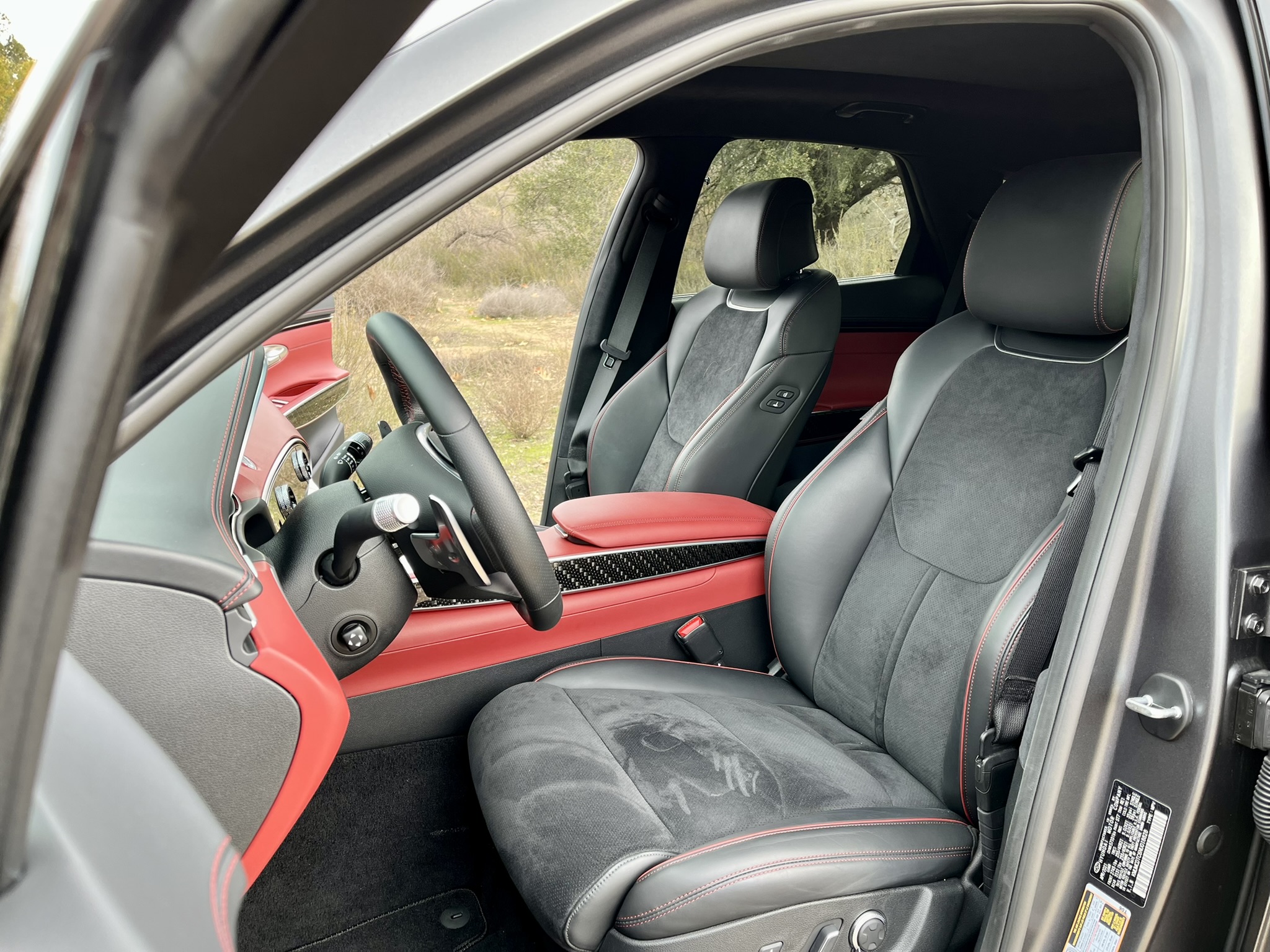
Genesis uses an electronically controlled suspension to minimize the vehicle’s body lean when cornering. And with electronic limited-slip differentials (part of the $4,900 Sport Prestige package), cornering levels are increased by distributing power left and right to the rear wheels, according to the road surface and driving conditions.

The e-suspension uses adaptive dampers with a road-preview feature. The system scans the road ahead and the sensors process that information in milliseconds to balance ride quality.

In my driving experience, the e-suspension gave precise turn-in responses, but it is not as magically smooth as a magnetorheological damper, such as is used in some performance vehicles. I experienced a few unexpected jolts along rough patches and noticeable head-toss across speed bumps.

With its towing capacity of 3,500 pounds and a full-bodied curb weight of 4,451 pounds, good brakes are essential. And the GV70 3.5T is prepared with ventilated four-wheel discs with 14.2-inch rotors at the front and 13.6-inch rotors rear. (2.5T models also have vented discs, with rotors that are 13.6 inches front, and 12.8 inches rear.

21-inch GV70 tire and wheel

Road harshness is well controlled by the Michelin Primacy Touring tires.

Driver Assist Technologies

Using a Level 2 driver-assist function is always helpful in heavy highway commuting. These systems keep watch when the driver doesn’t.

The Genesis system is reasonably consistent, but it will allow the vehicle to drift wide in a highway curve, crossing the white highway lines or Botts dots. The mapping for steering adjustments isn’t quite smooth and seems like an action of connecting the dots.

But I did appreciate the heads-up display (part of the Sport Prestige package). When using the driver-assist system, the HUD shows red alerts for side traffic. It is more visible during the day than warning lights in the side mirrors. And the heads-up display also shows gray profiles of nearby vehicles ahead and on either side.

Driver assist screen in the GV70

The Level 2 driver-assist system shows red alerts for side traffic.

GV70 Safety Features

The Insurance Institute for Highway Safety rated the Genesis GV70 a Top Safety Pick+ for 2021. The IIHS also gives Top Safety Pick+ ratings for the GV80 SUV, G80 executive sedan, and G90 flagship sedan.

The 2022 awards mark the third year in a row that the entire Genesis lineup of eligible vehicles has earned top honors.

All Genesis models are equipped with a comprehensive suite of state-of-the-art driver assistance and safety technologies including Forward Collision-Avoidance Assist with Pedestrian Detection, Lane Keeping Assist, and Blind-Spot Collision-Avoidance Assist.

Among eight air bags (including a front center air bag), other standard GV70 safety features include:

  • Forward Collision-Avoidance Assist with Junction Crossing and Turning. The system is intended to mitigate the risk of impacts when turning or crossing through an intersection;
  • Blind-Spot Collision-Avoidance Assist. This feature helps reduce the chance of potential impact with a moving vehicle when departing a parallel parking spot.
  • Advanced Rear Occupant Alert technology. Genesis says the GV70 is the first vehicle to feature radar-based detection of passengers in the rear seat, Genesis says. To alert drivers when a child or sleeping infant has been left in their seat, cabin sensors can detect when back-seat passengers move, and they can also detect small respiratory movements.
Double-line quad LED headlights on the GV70

Double-line quad LED headlights are intended to add a sense of speed.

GV70 Interior Function

There is a sweet spot of roominess in the GV70 cabin. Headroom with the panoramic sunroof is about 38 inches and should accommodate 95 percent of drivers; especially with legroom of 41.3 inches.

Sightlines are open across the fenders, with help from small corner glass at the windshield pillars. Over-the-shoulder views are somewhat slim but no worries when parking — the surround-view camera system with guidance lines has billboard proportions from the 14.5-inch high-definition infotainment screen at the top of the instrument panel.

The standard 16-way power driver seat can be electronically positioned by the optional Smart posture control. The feature will set an optimal position based on the driver’s height and weight. It also sets positions for the steering wheel, side mirrors, and head-up display. See the function here.

The front passenger has eight-away power adjustment — and both front seats are heated and ventilated. The passenger seat includes a “walk-in device,” which is merely a power switch for a back-seat occupant to move the seat forward for more legroom; it is a trickle-down feature from chauffeur-driven sedans.

The 3D electronic gauge array is unique with large dials for the speedometer and tachometer. The tach might have merit for the V-6 engine, but it is also is wasted space for most drivers.

There are two large flat dials on the shift console: one for the transmission and the other to access cabin functions, audio, and infotainment. The dials are similar in size, and in the first four days of driving my hand naturally fell to the dial for cabin function. In time, owners will gain the muscle memory to go straight for the shift dial.

GV70 back seat.

Rear legroom is adequate at 37.2 inches.

Back Seat and Cargo Space

Genesis provides a full luxury treatment to the back seat when some brands back off on the details and even soundproofing. Legroom is adequate at 37.2 inches — but hope for short people in the front seats. However, the doors open to near-90 degrees for easy entry, and the seats are comfortably supportive.

Cargo area of the GV70

Fold the back seat for 6 feet of length.

Cargo capacity is slightly compromised by the sloping roofline, but there is nearly 29 cubic feet of space behind the back seat, stacked to the headliner. The cargo opening is wide at 41 inches, and fold the 60/40 back seat for about 6 feet in length.

The area is finished in quality carpeting, with a pair of large side lights, and a slim storage area under the cargo floor.

Despite the $64K price, a cargo roller cover is not included but is available for $200. However, carpeted floor mats are included.

Sidelights in the cargo area of the GV70

Thick pile carpeting, large side lights (2), and robust seatback releases.

Why Buy the Genesis GV70 3.5T?

The Genesis brand is still an outlier among luxury auto buyers who might be more comfortable committing to an Audi, BMW, Lexus, or Mercedes-Benz. But, in 2020, J.D. Power named Genesis the most dependable automotive brand, and in 2021 the brand was lauded as the most technologically innovative in North America.

Time is money and the extensive warranty package is a time-saving answer to the GV70 $64,000 question.

A rear view of the Genesis GV70

Aerodynamic elements include the rear spoiler that helps smooth airflow.

Genesis GV70 3.5T Specifications

Body style: Compact, 5-seat 5-door SUV crossover in rear- or all-wheel drive

Engine: 375-hp, twin-turbocharged and direct-injected 3.5-liter V-6 with auto stop-start at idle; 391 lb.-ft. torque from 1,300-4,500 rpm

Transmission: 8-speed automatic with paddle shifters and 5 drive modes

Fuel economy: 19/25/21 mpg city/hwy/combined; premium fuel recommended for peak power

Max. towing capacity: 3,500 lbs. with trailer brakes

BY THE NUMBERS

Fuel tank: 17.43 gallons

Cargo space: 28.9 to 56.9 cubic feet

Front head/leg room: 39.6*/41.3 in. *without moonroof

Rear head/leg room: 39.1/37.2 in.

Length/wheelbase: 185.6/113.2 in.

Curb weight: 4,451 lbs.

Turning circle: 37.7 ft.

FEATURES

3.5T Standard equipment includes: Smartkey entry and locking with push-button ignition, with Nappa leather-trimmed upholstery, 16-way power driver seat (with power side bolsters and seat cushion), 14.5-inch high-definition infotainment screen, 12.3-inch 3D digital gauge array, 8-way power front passenger seat (with walk-in device), heated and ventilated front seats, 2 front USBs (data and charge) and 2 rear charging USBs, 9-speaker audio system with Android Auto and Apple CarPlay, electric parking brake with automatic hold, full LED lighting (headlights, taillights, running lights, and side mirror turn signals), power folding and heated (with a timer) side mirrors, outside approach lights with Genesis logo (at side mirrors), power one-touch panoramic sunroof, solar control tinted side and rear glass, acoustic laminated glass (windshield, front side and rear side windows), carpeted floor mats, power tilt-telescoping steering wheel, smart cruise control with stop-and-go, wireless charging, locking glove box, surround-view camera system with guidance lines

Packages on tester

Sport Advanced package, $5,000: Nappa Leather Seating Surfaces with Sport Pattern Quilting; Layered Edge Backlit Trim; Leatherette Upper Instrument and Door Panels; Suede Headliner; Heated Steering Wheel; Genesis Digital Key; Surround View Monitor; Blind-Spot View Monitor; Remote Smart Parking Assist
Parking Distance Warning – Front; Parking Collision-Avoidance Assist – Rear; Lexicon Premium Audio with 16-Speakers

Sport Prestige package, $4,900: 21-inch Sport Alloy Wheels; Electronic Limited Slip Differential; Nappa Leather Seating Surfaces with Suede Insert; Carbon Fiber Trim; Heated 2nd Row Seats; Manual Rear Side Sunshades; Acoustic Rear Door Glass; 3-Zone Climate control; 12.3-inch 3D Digital Cluster
Heads-Up Display

Safety features include: 8 air bags, Forward Collision Avoidance-Assist with Pedestrian and Cyclist Detection, Lane-Change Oncoming, and Junction Turning Highway Driving Assist; Driver Attention Warning; Lane Keeping Assist and Lane Following Assist; Blind-Spot Collision-Avoidance Assist; Rear Cross-Traffic Collision-Avoidance Assist; Safe Exit Assist; Intelligent Speed Limit Assist; Park Distance Warning – Rear; Launch Control and Hill Start Assist Control Vehicle Stability Management with stability and traction controls

PRICING

Base price: $53,645, including $1,045 freight charge; price as tested $64,045

Options on test vehicle: Melbourne Gray matte paint $500; Sport Advanced package, $5,000; Sport Prestige package, $4,900;

Where assembled: Ulsan, Korea

Warranties: 5-years/60,000-miles bumper to bumper; 10-years/100,000-miles powertrain; Genesis Service Valet for 3 years or 36,000 miles provides a remote diagnostic check, vehicle pick up, and a loaner vehicle and return of the vehicle