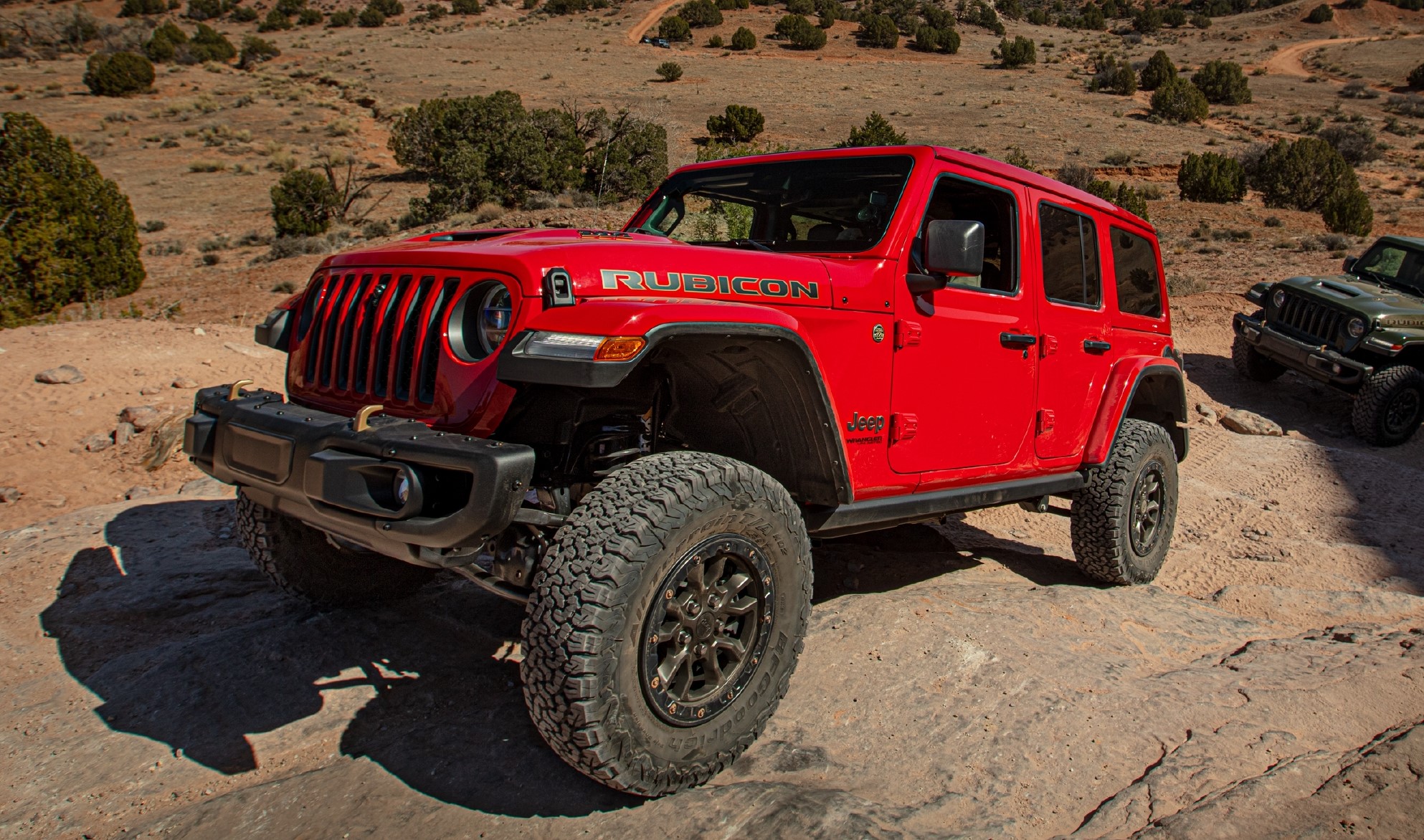
Stylized Penmanship Promotes Range-Topping Hyundai Santa Fe Calligraphy SUV to the Luxury Class

The 2021 Hyundai Santa Fe Calligraphy starts at $43,285, including AWD. (Photos courtesy of Hyundai)
Table of Contents
Overview
New features
What was redesigned?
Pricing
Safety features
Powertrains
Ride and handling
Interior function
Back seat and cargo space
Why buy the Santa Fe Calligraphy?
Specifications
BY MARK MAYNARD
Hyundai has tended well to its midsize Santa Fe SUV moneymaker. This unibody SUV was introduced in 2001 and it would become the top-selling SUV in the brand’s 32-year history in America.
Over its lifecycle, the five-seat Santa Fe has been updated at least every two years. And major redesigns were applied every four years. And for a time, it was offered as a seven-seat Unlimited trim level.
Hyundai says it is aggressive in its updates for all vehicle lines. However, the company puts its updated models on sale sooner than most people update their smartphones.
“For mainstream high-volume priority vehicles, we never let these rest,” a spokesman said. “The second we put out a vehicle, the engineers are working on the next generation or upcoming adjustments.”

Calligraphy details include Nappa leather and a 10.25-inch touch-screen.
Santa Fe Overview
Today, Hyundai has six SUV models, including electrified choices. The Santa Fe ranks No. 2 in sales, behind the compact Tucson.
The fourth-gen Santa Fe SUV debuted in 2018 and there was yet another significant refresh in 2020 for the 2021 model year.
Hyundai means “modern,” as translated, and the current Santa Fe is thoroughly equipped with advanced technologies for safety and driver assistance. And there appears to have been special care taken to create a calming and intuitive human-machine interface to access all of those electronically sophisticated systems.
While Hyundai has maintained the value choice in the entry models, it also has pushed a more “luxurious character.” The top-line models have more premium materials such as quilted Nappa leather and unique wheel designs.

LED ambient lighting.
What’s New for 2021
The Hyundai Santa Fe had freshened exterior and interior designs for 2021. The updated added LED front and rear lighting, a new hybrid powertrain with all-wheel drive, and new driver safety and convenience features.
The new range-topping Calligraphy model builds upon the Santa Fe Limited. Its features include the more powerful 2.5-liter turbocharged engine with HTRAC AWD ($1,700) and exclusive-design 20-inch alloy wheels.
The Calligraphy treatment includes quilted Nappa leather, premium door and seat accent trim, eco-suede headliner, ambient lighting themes, and auto up-down rear windows. Power-folding side mirrors have puddle lamps and turn signals. Driver technologies include downhill brake control and a full-color heads-up display.
There will be no changes for the 2022 model year. But a more rugged appearance Santa Fe XRT trim was just added. Pricing starts at $32,300 for front-drive and $34,000f with AWD; pricing does not include the freight charge.

The high-position “floating” center console.
What Was Redesigned
The freshened styling has subtle exterior changes. There is a broader, three-dimensional grille and T-shaped LED lighting and daytime running lights.
The silhouette has a more horizontal cabin profile with scalloped lower door panels and a long hood with character lines. Sharp shoulder lines connect front and rear LED lights. Rear reflector accents visually link the LED rear taillights.
The interior was reworked for a more “luxurious character.” The interior space feels more open and with more natural light. In addition, a high-position “floating” center console has stealth lower shelf storage.
A multi-layered, three-dimensional instrument panel and contrasting seat stitching lend a premium presence, Hyundai says.
Santa Fe Pricing
Sold in four trim levels, starting prices for the entry SE and SEL gas-powered models range from $28,185 to $29,985 for the SEL, both with front-drive. Add $1,700 for AWD.
Moving up to the Limited, with the turbocharged engine packaged with AWD, starts at $41,635. And the new top-line Calligraphy with the turbo engine, AWD and 19-inch wheels starts at $43,435. All MSRPs include the $1,185 freight charge from Montgomery, Ala.
Today’s Calligraphy tester was $43,590, including one option for carpeted floor mats, $155.
Look for Hyundai pricing incentives and special programs here.

Calligraphy details are seen and felt throughout the cabin.
Santa Fe Safety Features
The Santa Fe Calligraphy SUV has the full suite of Hyundai safety technologies. The list will compare with those features offered by top luxury brands.
I especially value Hyundai’s blind-spot view monitor. Cameras in the side mirrors switch on when using the turn signal. The image gives a clear view of what might be alongside the vehicle. On the right side, it might be a bicyclist. On the left, it could be a motorcyclist.
Hyundai’s SmartSense advanced driver assistance systems provide Level 2 semi-autonomous driving. When activated, the network of multiple radar sensors, ultrasonic sensors, and cameras do a good job of keeping the Santa Fe centered between the white lines.
But all Level 2 assist systems require two hands on the wheel and driver vigilance. The system sensors can be confused by certain daylight and road conditions that can trigger a random shutoff and then a restart. I’ve also experienced system shutoff when driving alongside white- or light-colored semitruck trailers.
Even with those few variables, the system provides guardianship protection in the event of driver distraction.
Standard Safety Features Include:
- Blind-spot collision-avoidance assist,
- Rear cross-traffic collision-avoidance assist,
- Forward collision-avoidance assist with pedestrian-cyclist-junction turning detection,
- Lane-keeping assist, highway driving assist, and lane following assist.
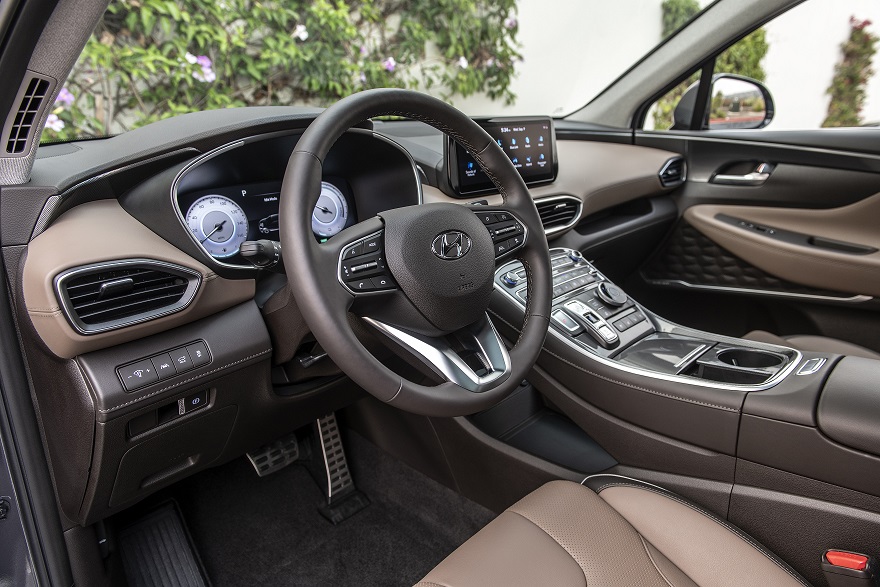
There is easy functionality to the driver area.
Santa Fe Powertrains
The 2021 Santa Fe SUV is sold in gasoline and gasoline-electric hybrid models. All in front- or all-wheel-drive.
The gas models of Santa Fe have a choice of two Smartstream 2.5-liter four-cylinder engines, one of which is turbocharged. Both have direct- and multi-point fuel injection, idle stop and go, and eight-speed automatic transmissions. The base engine replaces the former 2.4-liter direct-injected engine.
The uplevel turbocharged engine replaces a 2.0-liter turbocharged engine and brings an 18 percent boost in power, now at 281-hp. This engine is paired with the more technologically advanced eight-speed “wet” dual-clutch automated manual transmission.
The 4,017-pound Calligraphy AWD has fuel economy ratings of 21/28/24 mpg city/hwy/combined; 87 octane recommended. In highway driving, I easily hit the 28-32 mpg range and about 27 mpg overall. The 18.8-gallon tank will provide a wide cruising radius.
Hybrid Models
Hyundai Santa Fe Hybrid SUV models are sold in three trim levels with starting prices ranging from $34,835 to $41,135. (Hybrid models are built in Ulsan, Korea.)
The gasoline-electric hybrid models have a new Smartstream 226-hp 1.6-liter turbocharged hybrid electric powertrain with six-speed automatic transmission and HTRAC all-wheel drive.
The base Blue fuel economy ratings are 36/31/34 mpg city/highway/combined on 87 octane. The Hybrid SEL Premium and Limited have mileage ratings of 33/30/32.
A Santa Fe plug-in hybrid is expected to be in dealerships later this summer. It has 260-hp and an electric driving range of around 30 miles. Pricing has not yet been announced but watch for updates here. https://www.hyundaiusa.com/us/en

The back-seat legroom is adult class at 41.7 inches.
Santa Fe Ride and Handling
Acceleration from a start can seem hesitant as the turbo spools and the dual-clutch engages, but once rolling, the force is fluid and easily maintained. However, after a week of driving, the new owner will have adapted to the correct amount of pedal pressure to get past the initial hesitance.
The ride quality is very smooth-rolling, a testament to Hyundai engineering to eliminate friction and boost fuel economy. Much attention was given to cabin soundproofing, but the interior noise was more than I expected for a near-luxury vehicle despite the laminated windshield and side glass.
There was noticeable road noise at highway speeds that can be felt from the floor into the seat bottoms. The 19-inch Hankook Dynapro HP2 tires (235/55) might be contributors. These are all-season, low-rolling-resistance touring tires that felt hard, especially on concrete.
Braking is confident without grab from four-wheel discs. The front vented rotors are 13.6 inches and the solid rear rotors are 12 inches. Downhill brake control is included on AWD models.
Interior Function
There is an easy familiarity with just getting in and driving. The Calligraphy interior is handsome with a black microsuede headliner. Even in the tester’s basic black, the varying textures, contrast stitching, and matte-sheen of lower plastics looked more luxurious than basic. And there are no old-school wooden “accents.”
Mastering the swipe, tap, and turn of the touch-screen features does not require advanced training. Most users should be able to figure it out on the fly. The raised and angled center console is functional for knobs and switches that are just a glance away from the road.
There are numerous small-item storage areas, including the deep box in the center armrest console. The large sun visors slide and have large, covered mirrors. The wireless charging pad is cleverly positioned in a vertical slot adjacent to the cup holders. Door storage is generous and includes space for tall bottles. The front passenger has a slim shelf along the instrument panel to lay a phone and it is within reach of a charging USB.
There is a rather tall step-in height (ground clearance grew by about an inch to 8.2 inches) to the front and back seats. The front headroom is tall at 39.5 inches with the panoramic sunroof or 44.1 inches without.
The front seats are full-figured with eight-way power adjustment for the driver that includes lumbar and seat-bottom tilt for ideal positioning. Sightlines are unobstructed across the front fenders and over the shoulder. The 360-view camera gives birds-eye perspective when parking and the 37.5-foot turning circle is more compact than midsize.
Hyundai’s Smart Park Assist is a handy perk. Using the key fob, the Santa Fe driver can park and back out the vehicle from the tightest of spaces from outside the vehicle.
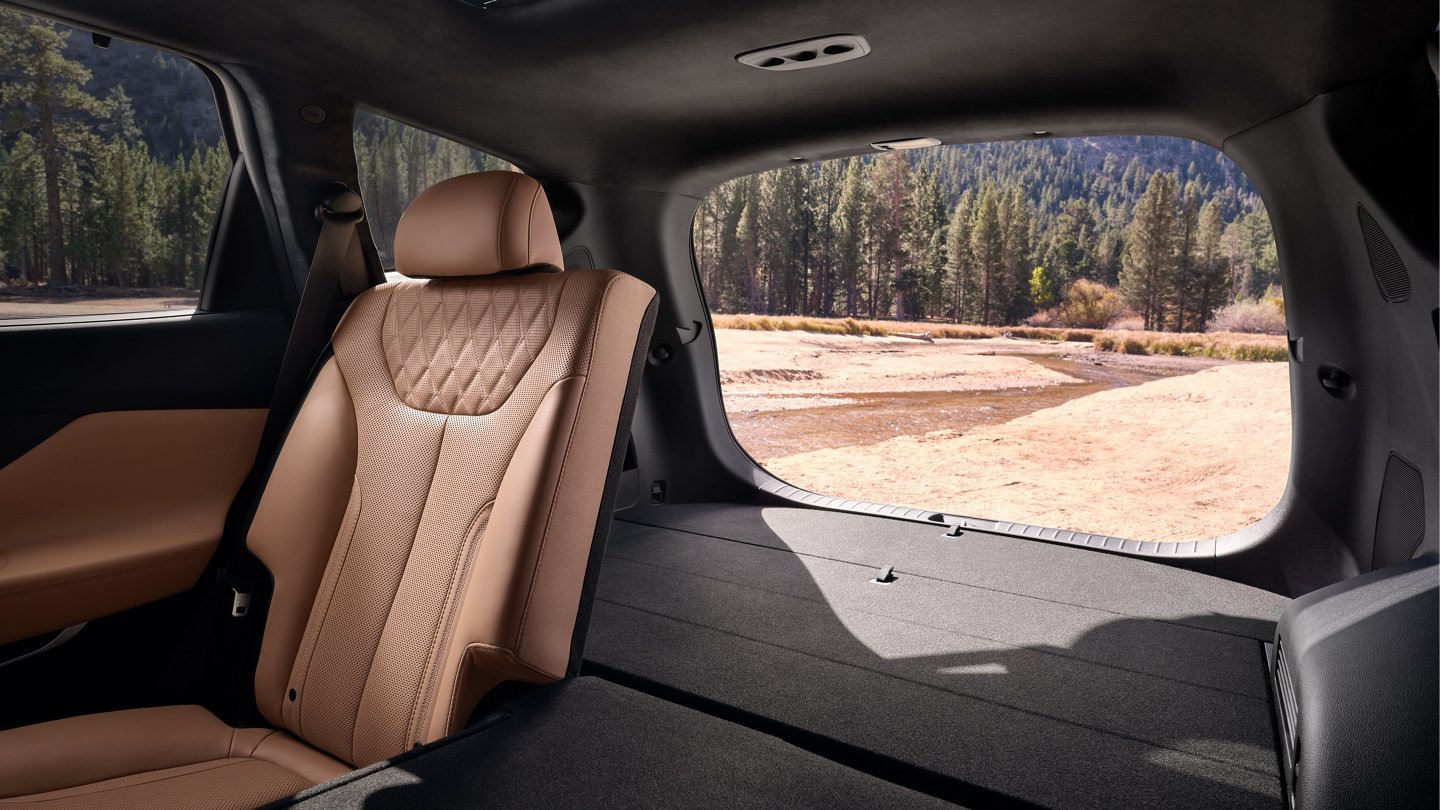
The cargo area has generous space of 36.4 cubic feet behind the second row.
Back Seat and Cargo
The back seat area rides high but also benefits from a low hump to the transmission-exhaust tunnel. The commonly compromised legroom at the center seat should comfortably fit a growing teenager. Legroom is adult class at 41.7 inches, but the raised “theater” seating, with 37.8 inches of headroom, might be a tad short for taller adults.
The area is well equipped with a broad fold-down armrest, nicely padded, with cup holders and bottle storage in the door panels. Overhead grab handles include coat hooks, and there are two charging USBs and a 115-volt, 150-watt household plug.
The cargo area has a generous space of 36.4 cubic feet behind the second row, and there is usable “basement” storage.
The cargo space is wide at 45 inches and deep at 43 inches. But there is a tall lift-up to the floor of 33 inches. Fold the 60/40 back seat for 6 ½ feet in length. The seats fold flat for 5 ¾ feet of sleeping space.

Hyundai means “modern,” as translated.
Why buy the Santa Fe Calligraphy?
The Santa Fe Calligraphy SUV has luxurious appeal and layers of attention to its design and engineering detail.
Among the Tier 1 luxury competitors, the Calligraphy is a bargain with the longest warranty for long-term ownership.
Santa Fe owners or lessors will have an attractive new choice when it’s time to renew.
Specifications
2021 Hyundai Santa Fe Calligraphy
- Body style: midsize, 5-seat, 5-door AWD unibody SUV
- Engine: Smartstream 281-hp, turbocharged and direct- and multi-port injection 2.5-liter 4-cylinder; 311 lb.-ft. torque at 3,500 rpm
- Transmission: 8-speed dual-clutch (wet-type) automated manual
- Fuel economy: 21/28/24 mpg city/hwy/combined; 87 octane recommended
By The Numbers
- Fuel tank: 18.8 gal.
- Cargo space: 36.4 cu. ft.
- Front head/leg room: 39.5*/44.1 in. *41.2 w/o sunroof
- Rear head/leg room: 37.8*/41.7 in. *39 w/o sunroof
- Length/wheelbase: 188.4/108.9 in.
- Curb weight: 4,017 lbs.
- Turning circle: 37.5 ft.
- Tow capacity: 3,500 lbs.
- Coefficient of drag: 0.34
FEATURES
Standard equipment includes: digital key and push-button ignition, panoramic sunroof, 10.25-inch touch-screen navigation with traffic routing, smart cruise control with stop-and-go remote, 12-speaker Harman Kardon audio with Clari-Fi music restoration, Android Auto and Apple CarPlay, wireless device charging, 8-way power driver seat with 4-way lumbar, 6-way power front passenger seat, heated and ventilated front seats, blind-spot view monitor, surround-view camera with overhead and guidance lines, automatic LED headlights with LED accents and high-beam assist, LED running lights, power-folding side mirrors with puddle lights, LED cabin lights, 60/40 folding back seats with recline, heated back seats, power-folding 2nd row, and 7 air bags
PRICING
Base price: $43,435, including $1,185 freight charge; price as tested $43,590
Options on test vehicle: carpeted floor mats $155
Where assembled: Montgomery, Ala.
Warranty: 5-years/60,000-miles bumper to bumper with 24/7 roadside assistance; 10-years/100,000-miles powertrain




 No nonsense: 1931 Ford Model A roadster.
 “Ruth W”: The gang’s all here to break in what appears to be a new Model A Sport Coupe. Written in script with pen on the back is this caption info: “This is ‘Ruth W.’ That’s what we call the car. Ruth is in front and Eric and Edith are in the rumble seat. These pictures were taken in Prospect Park, Nov. 23 1930.”
 We’ve arrived: A couple with their 1930 Model A touring sedan.
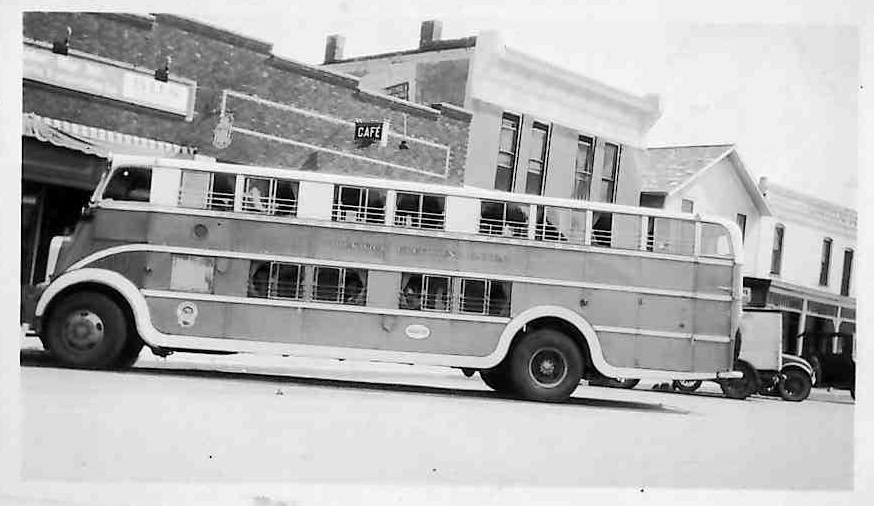
 Leisure travel: Written on the back of one of the photos, with a dull pencil in uppercase letters, was this note: “This dubbel [sic] deck buss [sic] took us from Denver Col. to Salt Lake City Utah. My place was lower compartmen [sic] the open window next to the back whele [sic]. It rides just fine.”