Select Page

2016 Lamborghini Huracan Review

2016 Lamborghini Huracan Review

The rear-wheel-drive Lamborghini Huracan LP 580-2 is new for 2016 and has a shared but unique architecture with the Audi R8

The Rosso Red Lamborghini Huracan

The 2016 Lamborghini Huracan 580-2 starts at $204,595. (Photography by Mark Maynard)

Table of Contents

Pricing
Powertrain
Ride and Handling
Interior Function
Why buy the Lamborghini Huracan?
Specifications

 BY MARK MAYNARD

The Lamborghini Huracan has a reputation as a social rave, but in truth, it is a masterpiece of engineering and a daily-driver supercar.

The Huracan is Lamborghini’s smaller sports car. The exotic two-seater replaced the Gallardo in mid-2014, and the new model is a righteous successor.

New for 2016 is the rear-wheel-drive Lamborghini Huracan LP 580-2. There’s also the all-wheel-drive Huracan LP 610-4 with about 602 horsepower.

There are coupe and convertible versions of the AWD model, but only a hardtop for the 2016 RWD model. A new setup for springs and stabilizer bars on a double-wishbone suspension improves torsional rigidity by 50 percent over its predecessor, the Gallardo LP 550-2.

With positive support from parent company Volkswagen Group, the Lamborghini Huracan is a shared architecture with the Audi R8. Comparable exotics include the Ferrari 458 and McLaren 650S. But there also are new and less expensive supercars, such as the Acura NSX, Aston Martin Vantage, and even the Corvette Z06.

The Huracan driver area

The leather-lined buckets are comfortably bolstered for performance driving.

Lamborghini Huracan Pricing

The starting price of $204,595 for the Huracan LP 580-2 is a reasonable entry point for a V-10 supercar. That pricing includes the $3,495 freight charge from Modena, Italy, and the $1,300 gas-guzzler tax.

The tester was $238,795 with just two options, including the transparent engine-bay cover, $7,000. One admiring look at this car in the bright Rosso Red paint ($2,500)  and the driver is immediately guilty until proved innocent.

Despite that V-10, the Huracan’s fuel economy is not terrible. The EPA cites 17 mpg city, 21 highway and 17 mpg combined on the recommended premium fuel. On a daylong drive, I managed 19.9 mpg. But the mileage drops precipitously when the right foot goes down. The 22-gallon tank allows around 366 miles of driving with restraint.

View the current lineup of Lamborghini models here.

Front passenger seat

The seats are surprisingly comfortable for an all-day drive.

Huracan LP 580-2 Powertrain

For the starting price, the owner gets a hybrid chassis of aluminum and carbon fiber. The naturally aspirated, 572-horsepower 5.2-liter V-10 has direct injection and cylinder deactivation. And with peak torque of 398 foot-pounds at 6,500 rpm, 75 percent of the torque is available at 1,000 rpm, Lamborghini says.

The seven-speed dual-clutch transmission gives such quick shifts in Sport mode that its speed would embarrass a lightning strike. There are automatic and manual driving options and performance choices of Strada (normal), Sport, and Corsa (track).

Lamborghini cites zero to 62 mph acceleration in 3.2 seconds and a top speed of 199 mph. The 14.6-foot-long, midengine car has a dry weight of 3,062 pounds. Lamborghini does not cite “wet” curb weight, such as when loaded with fuel, but figure another 122 pounds with a tankful.

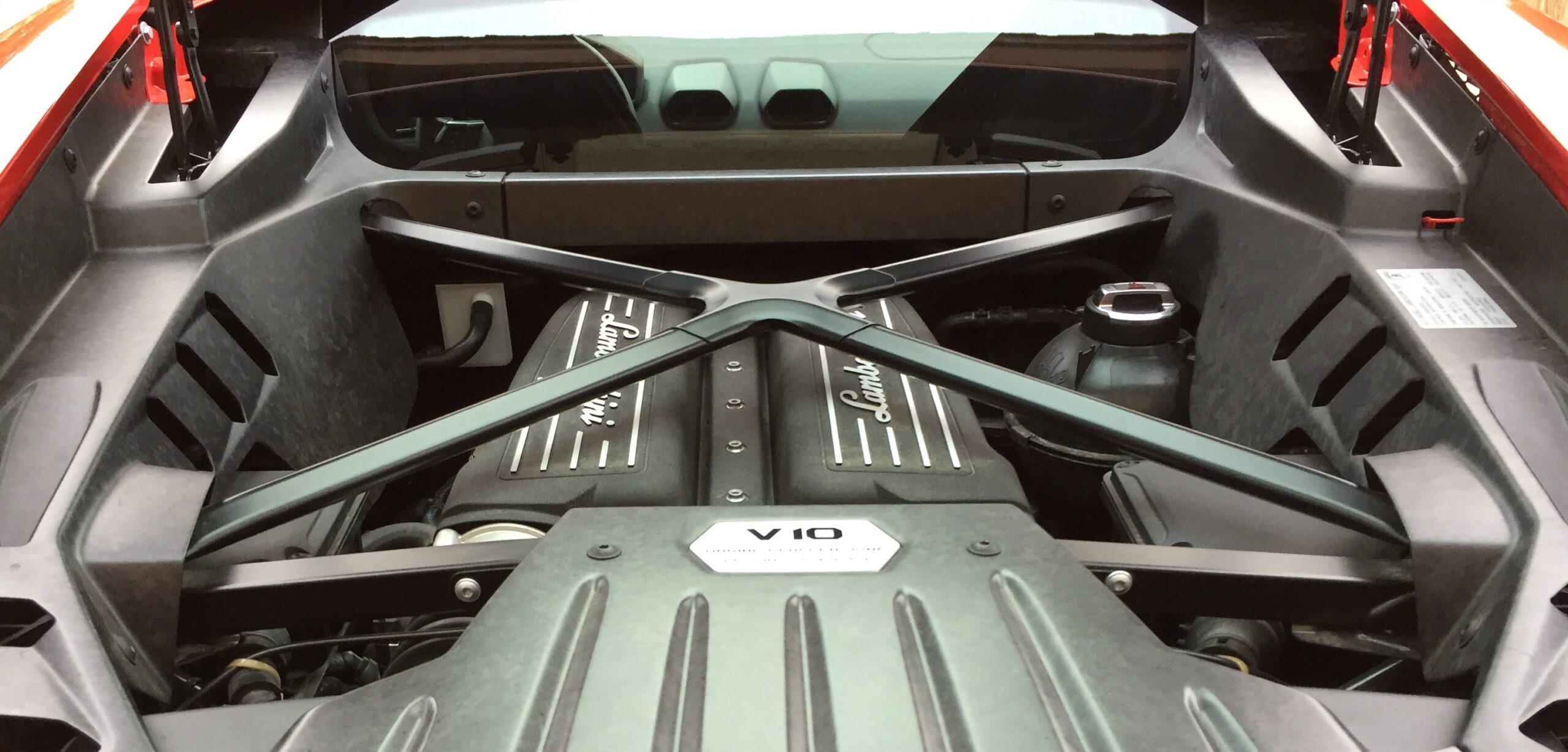
The 572-hp V-10 engine

The 572-hp, naturally aspirated 5.2-liter V-10.

Huracan LP 580-2 Ride and Handling

Sport mode opens the pipes, sharpens the shift points, and gives hefty throttle blips on downshifts. In addition, the system loosens the reins of stability and traction controls for some slide through the corners.

A hard launch brings a howitzer blast of force without torque pull left or right. The experience is straight-ahead traction in a blazing chorus of cylinders.

19 inch Pirelli tires

Low profile, high grip 19-inchPirelli tires.

There is an absolute engagement of gears from the start off to flat out. Flooring the pedal at about 30 mph is a hold-on event as the Huracan lunges like a predator in pursuit.

The magnetic ride suspension shows its superiority with sensitive adjustments in milliseconds. After six hours on the road, there was no fanny fatigue or torqued necks. The steering is light, direct, and requires just minimal inputs to clip the apex.

The standard steel brakes have supercar dimensions. The ventilated and cross-drilled rotors are 14.37 inches at the front and 14 inches rear. The aluminum monoblock calipers have eight pistons at the front and four pistons rear. From 62 mph, the stopping distance takes just 104.7 feet, which is 3.6 feet shorter than the rear-drive Gallardo predecessor.

The steering wheel as command center

The driver’s command center.

Huracan Interior Function

Breathe deep the rich cabin aroma of leather and microsuede. The interior layout is efficient and easy to access, with some console controls by Audi. The foot-wide gauge array can be electronically changed into a full video screen with a large RPM gauge and other essentials.

The Huracan interior is cockpit-compact, but this is a wide car and there is wide shoulder room of almost 55 inches door to door. There is long legroom and headroom for a 6-foot-3 driver, and maybe even taller, which is also surprising for the car’s low 46-inch roof height. But the doors are not hugely broad (unlike a Corvette) and the tight turning circle makes maneuvering easy in close quarters.

The leather-lined buckets are bolstered for performance driving but surprisingly comfortable for an all-day drive. However, the seats are heatable there is no lumbar adjustment or seat ventilation.

The LP 580-2 has a weight distribution of 40 percent front and 60 percent rear.

Why buy the Lamborghini Huracan?

I’m not sure why this car costs nearly a quarter of a million dollars. But there will be few complaints about owning this daily-driving supercar.

Whatever the Lamborghini Huracan does not have or does not do, you do not need or will find a way to do without — and like it.

The red starter button

The red push-button ignition.

Huracan LP 580-2 Specifications

Body style: 2-seat, rear-wheel-drive coupe

Chassis: Hybrid aluminum and carbon fiber

Bodyshell: Aluminum and composite material outer skin

Suspension: Aluminum double-wishbone

Springs and dampers: Steel springs and hydraulic dampers. “MagneRide”
electromagnetic damper control available as an option

Engine: 572-hp, naturally aspirated 5.2-liter V-10 with direct injection and cylinder deactivation; 398 lb.-ft. of torque at 6,500 rpm

Transmission: 7-speed dual-clutch

Fuel economy: 17/21/17 mpg city/highway/combined; premium required

Fuel tank: 22 gallons

BY THE NUMBERS

Top speed: 198.8 mph

0-62 mph acceleration: 3.2 seconds

0-200 kmh (124.27 mph) acceleration: 10.1 seconds

Brakes: Specially contoured steel discs ventilated and cross-drilled; 14.3-inch front rotors with 8-piston calipers; rear,14-inch rotors with 4-piston calipers

Steering: Electromechanical; optional variable-ratio LDS (Lamborghini Dynamic Steering)

Tires: Pirelli 245/35 19-inch front, 305/35 R19 rear

Wheels: 8.5J x 19-inches front, 11J x 19 inches rear

Length/wheelbase: 175.5/103. in.

Width/height: 88*/45.9 in. *including side mirrors

Dry weight: 3,062.2 lbs.

Turning circle: 37.7 ft.

PRICING

Base price: $204,595, including $3,495 freight charge and $1,300 gas-guzzler tax; price as tested $238,795

Options on test vehicle: transparent engine-bay cover $7,000; Rosso Red paint $2,500

Where assembled: Modena, Italy

Warranty: 36-months/unlimited mileage covering everything from the powertrain to the seats

2019 Lamborghini Urus Review

2019 Lamborghini Urus Review

With 650 horsepower, the Lamborghini Urus super-SUV is all beef and pure bull

A side view of the Urus

The 2019 Lamborghini Urus starts at $203,995 and the tester was $259,284 with 25 packages or accessories. (Photography by Mark Maynard)

Table of Contents

Overview
Pricing
Performance
Ride and Handling
Interior Function
Why buy the Lamborghini Urus?
Specifications


BY MARK MAYNARD

Go bullish or get ignored is the driving force in the so-called super SUV segment. For the Lamborghini Urus it is all about the power and presence with equal parts prestige, pampering and privilege.

There are serious players in this group:

  • Bentley’s 626-horsepower Bentayga Speed ($235,000-plus);
  • Range Rover’s 557-hp SV Coupe (two-door; $295,000);
  • The 577-hp Mercedes-AMG G63 G-wagen ($148,000);
  • The 590-hp Maserati Levante Trofeo AWD ($170,000);
  • The 541-hp Porsche Cayenne Turbo Coupe, a $131,000 four-door.

And then there’s today’s tester, the Lamborghini Urus with 650-hp and a starting price of $203,995. As tested, the price came to almost $260,000.

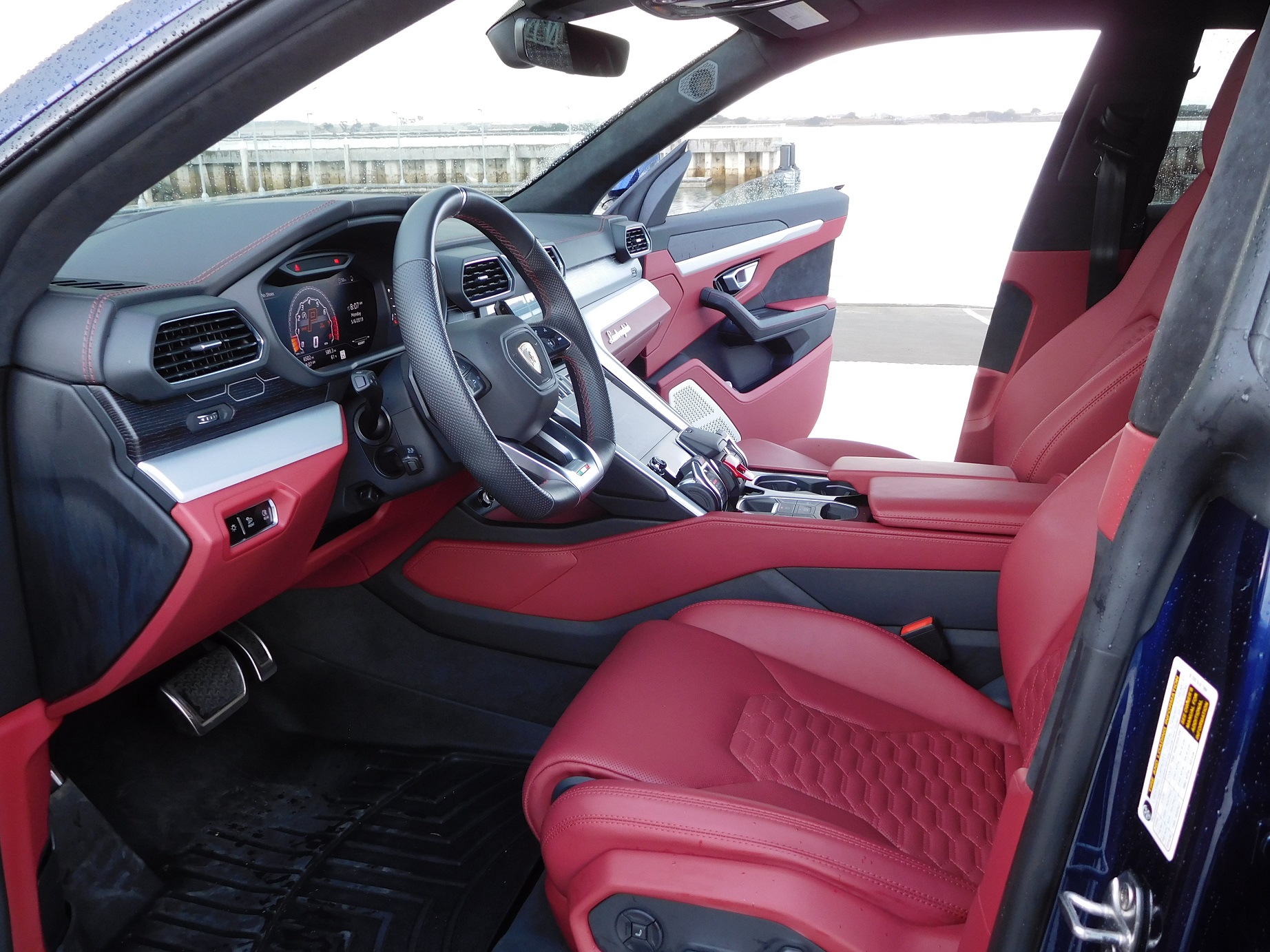
The red leather upholstery

Serious support in the sport seats.

Serious bolstering in the front seats.

Lamborghini Urus Overview

For Lamborghini, it is about having one of its Urus SUVs in the garage with one of the brand’s sports cars, and not parked next to an SUV by any other maker.

The Urus is Lamborghini’s second run at an SUV. Its first was the V-12 powered LM002 short-box pickup, aka “Rambo Lambo,” sold in the U.S. between 1986 and 1993.

The Lamborghini Urus shares nothing material with that truck. As a division of the global Volkswagen Group (including Bentley, Bugatti, Audi, Porsche, and Ducati motorcycles), the Urus takes a rib from the Audi Q7 SUV. It is an exemplary starting point well fortified with an advanced 4.0-liter V-8, eight-speed automatic, all-wheel drive, and a calm and functional cabin. And from there, the Lamborghini DNA takes hold to create a hooved beast for the track, trail, or town.

The driver area in the Urus

The driver area presents as a space-wars themed cockpit

2019 Lamborghini Urus Pricing

The tester’s sticker of $259,284 includes 25 packages or accessories, including the $3,995 freight charge from Sant’Agata Bolognese, Italy.

The add-ons ranged from a trailer hitch ($1,168) to ambient interior lighting ($3,036) to full leather upholstery ($3,157) with heated and cooled front seats ($631). The advanced driver assist system and Bang & Olufsen sound system were each $6,313.

Standard equipment includes permanent four-wheel drive with limited-slip rear differential and active torque vectoring, air suspension, full LED adaptive headlights and taillights, smart key locking and push-button ignition.

Choose your Urus here.

The steering wheel

A hands-on driving experience.

Urus Performance

Flip up the red bracket over the start-stop button on the center console and the engine fires with an open-pipe report then settles into a rumbling idle. But that gutsy V8 belts fire and brimstone with little provocation. And there are drive modes of Strada, Sport, Corsa, Sabbia, Terra and Neve (street, sport, track, sand, dirt and snow).

The twin-turbocharged, 650-horsepower V-8 with 627 foot-pounds of torque at 2,250 rpm will launch the Urus to 62 mph in a blaring 3.6 seconds. And that’s with a shaggy curb weight of 4,850 pounds.

It isn’t so much about how fast it will go, but how fast it gets to 30 mph, 60 mph, 90 mph. Be ready for the head-jerking jolt when the driver nails the throttle, even a little bit. The Urus jumps and kicks like a shock-rod to the flank of a rodeo bull. And unlike its rider trying to hold on, the controllability of the Urus makes its rider want to do it again — with respect, of course.

Fuel economy is not embarrassing at 12 mpg city, 17 highway and 14 mpg combined on the required premium fuel. I worked up to 20 mpg on a highway run while resisting Sport mode. But with a 19.8-gallon tank, there is much full-on Sport mode to be enjoyed.

 The twin-turbocharged, 650-horsepower V-8

The twin-turbocharged, 650-horsepower V-8.

Urus Ride and Handling

To handle stopping power from a top speed of 190 mph, Lamborghini says it built the world’s largest set of ventilated carbon-ceramic disc brakes for the Urus: 10-piston front calipers grip 17.3-inch rotors at the front and single-piston calipers for the rear 14.5-inch rotors.

Rear-wheel steering helps crimp the turning circle to 38.7 feet, making the Urus very urban friendly. The 360-degree camera system overcomes rear visibility issues at the small window.

The air suspension system can provide up to 9.8 inches of ground clearance for off-road use or drop the height for passenger loading. But this is the only Lambo that you will never have to remember to raise the nose when crossing a speed bump.

The 22-inch ZR-rated (street and competition) Pirelli P Zero tires are staggered, in sizes of 285/40 front and 325/35 rear. The rear rubber is nearly 13 inches wide, which benefits braking from 62 mph to zero in about 111 feet. That’s about 11 feet farther than Lamborghini’s Aventador coupe.

The big disc brakes on the Urus

The carbon-ceramic four-wheel-disc brakes are about the largest used on any car.

Urus Interior Function

Despite the competition-grade hardware, the Lamborghini Urus is a streamliner on the highway with no nervous twitching and it soars through cornering maneuvers. The cabin is well soundproofed, the steering is quick with good communication through the wheel.

The only driver element that I would change would be for steering-column-mounted shifters, rather than mounted on the steering wheel. As with other Lamborghinis, Drive is engaged by flipping the right-side paddle shifter. And when the wheel is turned, as when backing out of a driveway, the paddle is upside down on the wrong side.

The driver area presents as a space-wars themed cockpit with full electronic displays that are reasonably configured for touch-screen adjustment. The optional 18-way power-adjustable and massaging front seats are heated and cooled.

The back seat space is quite comfortable with long legroom and full climate controls. But the huge center tunnel detracts from the center-seat footroom. A two-seat “executive” option would be smart, but it’s easier to sell an SUV on the utility of five seats for a car that costs as much as a guest house.

Lamborghini doesn’t give interior dimensions but says there is front seat room to accommodate someone up to 6-feet-8 inches and someone 6-feet-2 inches should be comfortable in the back seat.

The open cargo area of the urus suv

Plenty of room for pro-league golf bags.

Why Buy the Lamborghini Urus?

The Lamborghini Urus might not be much of a rock climber. And I would cringe to throw bags of landscape materials in the back. But the Urus is the only five-seat Lamborghini with cargo room for luxury-class golf bags.

In this super-SUV segment, it isn’t so much a matter of cost but of value. And the Urus brings an easy quarter-million in value for its exclusivity, heritage, and prestige.

A rear view of the Lambo urus

The fuel economy is not embarrassing at 12 mpg city, 17 highway and 14 mpg combined .

2019 Lamborghini Urus Specifications

Body style: Full-size 5-seat, AWD SUV

Engine: 650-hp, twin-turbocharged 4.0-liter V-8; 627 lb.-ft. torque at 2,250 rpm

Transmission: 8-speed automatic with six drive modes

Fuel economy: 12/17/14 mpg city/hwy/combined; premium fuel

0-62 mph: 3.6 seconds

BY THE NUMBERS

Fuel tank: 19.8 gal.

Cargo space: 21.7 cu. ft. *behind back seat

Length/wheelbase: 201.2/118.2 in.

Width/height: 85.8/64.5 in. *width includes mirrors

Curb weight: 4,850 lbs.

Turning circle: 38.7 ft.

PRICING

Base price: $203,995, including $3,995 freight charge; price as tested $259,184

Where assembled: Sant’Agata Bolognese, Italy

Warranty: 3-years/36,000-miles including powertrain and roadside assistance

2022 Hyundai Tucson Hybrid Review

2022 Hyundai Tucson Hybrid Review

Tech-knowledgeable Tucson Hybrid is a low profile, high spark compact SUV

An exterior view of the redesigned Hyundai Tucson SV

A comprehensive redesign of the 2022 Hyundai Tucson made it longer, wider, and taller. (Photos courtesy of Hyundai)

Table of Contents

Overview
Pricing
Hybrid models
Exterior styling
Safety Features
Hybrid Powertrains
Fuel Economy
Interior Function
Ride and Handling
Driver Assist Features
Back Seats and Cargo
Why buy the Hyundai Tucson Hybrid?
Specifications

BY MARK MAYNARD

Hyundai has found the sweet spot for size and versatility in its redesigned and re-engineered 2022 Tucson compact SUV crossover. The two-row SUV is now more of a super-compact in size with enough elbow and head room for growing teenagers.

The upper-trim models are stitched with such fine materials that the visual impression reminds of Lexus or Audi. The cabin soundproofing, with some acoustic glass, is luxury-class quiet. And the seats are some of the most comfortable in this mainstream segment.

The Tucson's interior design is uncluttered and ergonomically arranged

Tucson’s interior, or ‘Interspace’, is uncluttered and contemporary in design.

Hyundai Tucson Overview

Now in its fourth generation, Tucson is Hyundai’s best-selling model globally. The U.S. model is the long-wheelbase version of the global platform.

The 2022 Hyundai Tucson is longer, wider, taller, and has a longer wheelbase than the previous generation. The new model is 6.1 inches longer (182.3 inches) and a half-inch wider and taller.

The added length greatly benefited back-seat legroom, now at a leggy 41.3 inches. And cargo space increased by 7.7 cubic feet for more functional space behind the second row.

The new more rigid, high-strength steel architecture improves handling response and crash protection, Hyundai says.

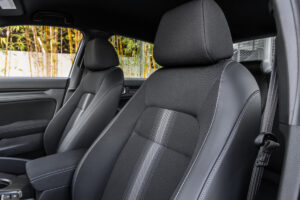
The hybrid model has heated and ventilated front seats

The Limited’s leather-trimmed front seats are heated and ventilated.

 2022 Tucson Pricing

As a prime moneymaker, Hyundai has groomed the 2022 Tucson to be an SUV for all. It is sold in front or all-wheel-drive trim levels with a choice of gasoline, hybrid or plug-in hybrid powertrains.

Gas-engine models have a 187-horsepower, 2.5-liter direct-injected four-cylinder engine that is paired with an eight-speed automatic transmission.

Starting prices for the 2.5 models range from $26,135 for the entry SE to $35,855 for the top-line Limited. Add $1,500 for HTRAC electronic all-wheel drive. All MSRP pricing includes the $1,185 freight charge from Ulsan, Korea.

There also is a higher-performance N Line model that is built on the 2.5-liter powertrain. It has starting prices of $31,785 for front-drive or $33,285 with AWD.

Hybrid models

There are three trim levels of gasoline-electric hybrid models. All have standard all-wheel drive and a six-speed automatic transmission. Starting prices range from $30,235 for the entry Blue Hybrid to $38,535 for the top-line Limited.

The midrange SEL Convenience Hybrid pares back on options for a starting price of $32,835.

Today’s Limited Hybrid tester was $38,704 as tested. Its only option was for a set of four carpeted floor mats for $169.

Ambient lighting around the center console

The center console has side storage and a bead of ambient LED lighting.

Tucson Plug-In

The Tucson Plug-in Hybrid model goes on sale later this summer, but pricing had not been announced at the time of this posting. Check here for updates.

The plug-in Tucson has an impressive all-electric range of around 32 miles and an estimated combined fuel economy of 70 MPGe. The plug-in powertrain has an estimated 261-hp from the 1.6-liter turbocharged and direct-injected engine with a six-speed automatic transmission.

Level-II charging capability is well under two hours to recharge the system using the 7.2kW onboard charger, Hyundai says.

Hyundai Warranties

Hyundai has long provided what it calls “America’s Best Warranty.” New this year is the addition of free scheduled maintenance for 3 years or 36,000 miles. The service will be mostly for oil changes and tire rotation. Roadside assistance is provided for 5 years and unlimited mileage.

The basic coverage is for 5 years or 60,000 miles bumper to bumper and the powertrain is covered for 10 years or 100,000 miles.

Hybrid components and the battery are covered for 10 years or 100,000 miles.

A commonly overlooked cost when buying a tech-forward new vehicle is the data plan. The typical data plan to use all those electronic features, such as speed limit posting and smart cruise control, is an additional $30 a month. But Hyundai has three years of free data for the Blue Link Connected Services.

The 19-inch tire-and-wheel package for the Tucson Hybrid

19-inch Michelin Primacy all-season 235/55 tires.

 Tucson Exterior Styling

Tucson’s new exterior styling continues with Hyundai’s evolving Sensuous Sportiness design. Tucson embodies what the designers call ‘Parametric Dynamics.’ It is defined as “kinetic, jewel-like surface detailing” — but I am still not clear on what that is. Except that it has a commanding presence and an appealing stance.

I especially liked the tester’s Phantom Black paint that compliments the black plastic fender overriders. The right color for a body shape can really have a positive effect. And sometimes the lighter paint colors and black fender protectors look too utilitarian.

Another clever design is at the top of the rear liftgate. The rear wiper tucks under the tailgate spoiler to help aerodynamics and also to help protect the wiper blade from sun damage.

Tucson Hybrid Standard Equipment

The SE is well equipped as an entry model. Among its interior features are remote keyless locking, rearview monitor with parking guidance, electric parking brake, and six-way adjustable driver seat with height adjustment. The six-speaker audio system with an 8-inch color touch screen includes wireless Apple CarPlay and Android Auto, two charging USB outlets.

Exterior features include 17-inch alloy wheels, automatic on-off LED headlights with high beam assist, solar glass (windshield and front windows), and body-color rear spoiler with LED brake light.

The Limited is elevated to a near-luxury treatment. Its features include attractive leather upholstery, panoramic sunroof, 19-inch alloy wheels, heated and ventilated front seats, surround-view monitor with guidance lines, and wireless charging.

The Tucson back seats

Back seat space is now quite comfortable with a long 41.3 inches of legroom.

Tucson Safety Features

The Tucson Hybrid has a full safety suite of features and advanced technologies. Among them are Forward Collision Warning with Pedestrian Detection, Lane Following Assist and Lane Keeping Assist, and Leading Vehicle Departure Alert.

I especially valued the LDVA, which alerts the driver to stop texting or spacing out when the vehicle ahead moves forward. The drivers behind might appreciate the feature even more.

The Insurance Institute for Highway Safety gave Tucson a TOP SAFETY PICK+  designation for the 2022 model year. Tucson was recognized for its structural crashworthiness, LED headlights, and standard SmartSense crash prevention features.

Tucson Hybrid Powertrains

The gasoline-electric hybrid powertrain is comprised of a 1.6-liter turbocharged gasoline engine and a 44.2 kW electric motor with a 1.49 kWh battery pack. The transmission is a six-speed automatic.

Total system power is an estimated 226-hp with 258 foot-pounds of torque.

Between the immediate launch by the motor and the quick uptake from the transmission.

Hyundai says this hybrid powertrain is 30 percent more fuel-efficient than the standard gasoline engine, with 20 percent more torque for effortless daily driving.

Tucson Hybrid Fuel Economy

Tucson Hybrid models have fuel economy ratings of 38 mpg city, 38 highway and 38 mpg combined with front-wheel drive. All-wheel-drive models are rated for 37/36/37 mpg city/highway/combined, using the recommended 87-octane fuel. The 13.7-gallon tank will allow a cruising range of more than 500 miles.

When driven frugally between 60-80 mph, the hybrid tester returned mileage of 38.8 mpg. When driven aggressively at speeds of 75-80 mph the range was 29.8 to 30.1 mpg.

Gas Tucson models have mileage ratings of 26/33/29 mpg with front drive and 24/29/26 mpg AWD.

Looking into the cargo area of the Tucson

Square cargo space has about 6 feet in length with the back seat folded.

HTRAC AWD

The multimode HTRAC AWD is an all-weather system. There are driver-selectable modes for off-road traction but also calibrations for straight-line acceleration, medium- and high-speed cornering and hill starts. The Sport setting sends more torque to the rear wheels for a seat-of-the-pants push.

Tucson Interior Function

Tucson’s interior, or the so-called “Interspace,” is smartly designed with a low-profile dashboard. There are no touch screens that rise upward to complicate forward views over the hood. Sightlines over the shoulder are unrestricted and benefit from the tall side and rear glass.

The front headroom with the panoramic sunroof is 38.3 inches, which allows headspace for a 6-foot-6-inch male. The seats are comfortably supportive without stiff, wedgie-inducing side or bottom bolsters.

Unique in this segment is multi-air ventilation. The temperature-adjusting system provides a sweep of diffused airflow to the front passengers. Crank the fan speed and there is plenty of force with very low noise.

The bigger interior space allows more and functional small-item storage, such as along the sides of the center console.

Other new features include a 10.25-inch full-touch navigation screen. Hyundai notes that it has no hard buttons, but it is not a bad thing to have buttons for audio volume and fan.

The driver faces a 10.25-inch hoodless digital gauge cluster. It is practical because the elements are visible in all light conditions, but I do have concerns when a sensor or two might fail over time.

It also is considerate that there are many lighted buttons and switches, such as for the window lifts on the front door armrests.

Tucson Ride and Handling

Tucson is now one of the more comfortable and quiet compact SUVs on the market. The longer wheelbase benefits highway cruising without any chop or wheel vibration, even on California’s rain-grooved concrete highways. Around town, the ride is traffic-calmed and rewarding.

Tucson hybrid models feature e-handling technology. Hyundai claims the system precisely applies electric motor torque control to improve cornering performance. As the Tucson hybrid turns into a corner, the electric motor system applies incremental braking force to the front wheels. That braking increases the tire contact patch on the road surface for enhanced traction and steering response. Then, as the vehicle exits the corner, the electric motor sends torque to the rear axle to fatten rear tire contact patches for a grip and grin response.

The Limited was equipped with 19-inch Michelin Primacy all-season 235/55 tires. They are so-called “green” tires for reduced friction and they also contribute to a more supple ride.

Braking on all Tucson models is by four-wheel discs. There are ventilated 12.8-inch discs at the front and solid 12-inch discs rear.

Tucson Driver Assist Features

I especially value Hyundai’s blind-spot view monitor. Cameras in the side mirrors switch on when using the turn signal. The image gives a clear view of what might be alongside the vehicle. On the right side, it might be a bicyclist. On the left, it could be a motorcyclist.

Hyundai’s SmartSense advanced driver assistance systems provide Level 2 semi-autonomous driving. When activated, the network of radar sensors, ultrasonic sensors, and cameras does a good job of keeping the Tucson centered between the white lines.

But all Level 2 assist systems require two hands on the wheel and driver vigilance. The system sensors can be confused by certain daylight and road conditions, which can trigger a random shutoff and then a restart. I’ve also experienced system shutoff when driving alongside white- or light-colored semitruck trailers.

Even with those few variables, the system provides guardianship in the event of driver distraction.

A rear view

The 2022 Hyundai Tucson is now one of the more comfortable and quiet compact SUVs.

Tucson Back Seat and Cargo

The back seat space is now quite comfortable with a long 41.3 inches of legroom. There is such a stretch of space that a 6-foot passenger can sit behind a 6-foot driver. Headroom is not compromised at 39.5 inches.

The doors open to nearly 90 degrees, which is an asset for reaching a child seat. A low transmission-exhaust tunnel allows comfortable three-across footroom. The back seats are heated with reclining seatbacks that have fold-and-dive functionality to expand cargo space.

The expanded cargo space has a square load floor and a wide opening of 40 inches. Fold the second row for 6 feet of length. The area also has seatback release handles, underfloor storage, and a 12-volt 180-watt household plug.

Why buy the Hyundai Tucson Hybrid?

The tech-knowledgeable Tucson Limited Hybrid is a low-profile, high spark compact SUV. The tester’s $39,000 price has a high-quality presence that will impress for its layers of refined materials and smart designs.

I’ve been shopping for compact hybrid SUVs, but none has seemed the right fit for me. The roofline of the Toyota Venza is too aerodynamically low and over-the-shoulder sightlines are compromised. The Toyota RAV4 Hybrid was my fallback choice, but there is a little too much outdoorsy-SUV in the styling. The gas-electric Ford Escape is too budget-compromised. And while I like the efficiency of the Honda CR-V, it is the safe, mom-and-dad choice and I really don’t want fake wood trim in the cabin.

My 2008 Ford Escape is running well at 126,000 miles and has required little service other than routine maintenance. But if I had to buy a compact SUV this week, the Tucson Hybrid or maybe the Tucson Plug-In Hybrid would be my choice. Here are my likes:

  • The performance and stepped transmission (not a CVT).
  • The contemporary interior space and expansive cargo capacity.
  • The detailed engineering, reasonable turning circle, and unobstructed sightlines throughout.
  • And I valued the contemporary interior design, helpful technologies, and ergonomic order to the most-used features.

For $39,000, I’d be living large in a small space.

2022 Hyundai Tucson Limited Hybrid AWD Specifications

Body style: compact, 5-seat, 5-door all-wheel-drive SUV crossover

Engine: 180-hp, turbocharged and direct-injected 1.6-liter Inline 4-cylinder; 195 lb.-ft. torque from 1,500-4,500 rpm

Permanent magnet synchronous motor: 44.2 kW (59-hp) from 1,600-2,000 rpm

Total system power: 226-hp; 195 lb.-ft. from 0-1,600 rpm

Battery type: 64 kW lithium-ion polymer, 1.49 kWh capacity and 270-volts maximum

Transmission: 6-speed automatic

Fuel economy: 37/36/37 mpg city/hwy/combined; 87 octane recommended

Coefficient of drag: 0.33 cd

BY THE NUMBERS

Fuel tank: 13.7 gals.

Cargo space: 38.8-74.5 cu. ft.

Front head/leg room: 38.3*/41.1 in. *40.1 w/o pano roof

Rear head/leg room: 39.5/41.3 in.

Length/wheelbase: 182.3/108.5 in.

Width/height: 73.4/65.6 in.

Curb weight: 3,752 lbs.

Turning circle: 38.6 ft.

PRICING

Base price: $38,535, including $1,185 freight charge; price as tested $38,704

Options on test vehicle: carpeted floor mats (4) $135

Where assembled: Ulsan, Korea

Warranties: 5-years/60,000-miles bumper to bumper with free scheduled maintenance for 3-years/36,000-miles (oil changes and tire rotation) and roadside assistance for 5 years and unlimited mileage; 10-years/100,000-miles powertrain

Hybrid components and hybrid battery: 10-years/100,000-miles

2019 Jaguar F-Pace SVR Review

2019 Jaguar F-Pace SVR Review

All claws, fangs, and growl in a velvet coat, the Jaguar F-Pace SVR is the 550-hp black cat of the brand’s SUV family

An exterior view of the F-Pace SVR

Everything about the 550-hp, Jaguar F-Pace SVR has been pumped up or widened. The tester was $89,900. (Photography by Mark Maynard)

Table of Contents

Overview
Pricing
The SVR Package
Performance Upgrades
Powertrain
Ride and Handling
Interior
Back seats and cargo
Why buy the F-Pace SVR?
Specifications

BY MARK MAYNARD

In the right place at the right time, the versatile 2019 Jaguar F-Pace is rich in the brand’s “beautiful” design directive. But three years ago, Jaguar had no SUV in its lineup. Today, however, the British manufacturer of road-going beauty is making tea while the pot is hot. It now has three SUV crossovers, including the electric iPace. The lineup has evolved the face and perception of the brand, the company says.

The driver's space in the F-Pace

The driver area is functional with a variety of small storage areas.

Jaguar F-Pace Overview

It might surprise that the F-Pace is not a clone from the SUV stable of corporate partner Land Rover. The closest it gets is the architecture of the carlike Range Rover Velar, which just doesn’t have the visceral appeal of the F-Pace.

The five-seat Jaguar F-Pace SUV is sold in a dozen, all-wheel-drive trim levels with five powertrain choices: two turbocharged four-cylinders, a turbocharged diesel four-cylinder, a supercharged V-6 and the SVR-exclusive 550-hp supercharged V-8.

Today’s tester, the F-Pace SVR, is a new model for 2019. On a scale of one to 10, the SVR is an 11, without going over the top, said Rob Filipovic, Jaguar’s director of customer experience, who was interviewed on a recent media drive.

Looking into the F-Pace driver area.

Filipovic called the SVR the “ultimate Jaguar experience, and it’s probably going to be better than you think it will be.”

There are several F-Pace competitors, including the Acura RDX, Audi Q5, BMW X3, Cadillac XT5, Infiniti QX60 and Mercedes-Benz GLC. But there are few to compare with the F-Pace SVR. Among them are the Porsche Macan S (348-hp, turbocharged 3.0-liter V-6; $60,000), BMW X4 M40i (355-hp, inline 6-cylinder; $62,000) and Mercedes-AMG GLC 63 (496-hp or 503-hp 4.0-liter twin-turbocharged V-8; $71,000).

Filipovic, 39, isn’t just blowing tire smoke at his admiration for the SVR. After spending almost 1,000 miles in highway and city driving (but no track time), I found it to be a bi-modal sports car. It has the attitude of the Jaguar F-Type SVR coupe but with added back seat room and luggage space.

The steering wheel in the F-Pace

Despite all the advanced tech, the F-Pace SVR is a hands-on experience.

Jaguar F-Pace Pricing

Pricing for the 2019 F-Pace lineup starts at $46,225 for the entry 25t and ranges to $80,925 for the high-performance F-Pace SVR, today’s tester; pricing includes the $1,025 freight charge from Solihull, England.

At $89,900 as tested, the F-Pace SVR pricing is competitive with the others in the segment. And there is the added owner perk of improved warranty coverage: five years or 60,000 miles of bumper-to-bumper protection with 24-hour roadside assistance and free scheduled maintenance.
Look here for current F-Pace pricing and incentives.

The SVR Package

Because the F-Pace does not have to be a superior off-roading SUV, its drivability is balanced: A nonenthusiast can drive it without getting into trouble. And a car enthusiast can drive it hard and, with common sense, not get into trouble. The SVR is one of the few performance SUVs with an ideal 50/50 weight balance.

Everything about it has been pumped up or widened, from the brake-cooling vents in the front fenders to the 15.6-inch vented Brembo disc brakes all around. The forged wheels are lightweight and the sport seats front and rear are track-ready.

Slimline front sport seats in the F-Pace

The slimline seats look racing-harness ready, but they are actually quite livable.

Jaguar F-Pace SVR Upgrades

  • Aerodynamic body kit with unique front and rear bumpers. The wide-mouth grille, lower body sides and a rear spoiler enhance cooling, reduce lift and drag and add to high-speed stability.
  • SVR-tuned chassis with upgraded shocks front and rear spring rates increased by 30 percent and 10 percent.
  • Lightweight wheels. 21- or optional 22-inch forged wheels with staggered widths front to rear. The forged wheels saved 5 pounds at the front and 3 pounds rear.
  • Rear electronic active differential, to balance power delivery
  • Specially tuned variable valve active exhaust for a more vocal soundtrack. But the system is also 14.5 pounds lighter and reduces back pressure for more airflow exiting the engine.
  • Slimline performance seats in the front and rear feature Jaguar signature “lozenge” quilting and embossed SVR logo. The seats saved 5 pounds each.
  • SportShift Gear Selector (from the F-Type) replaces the rotary gear selector.
  • SVR steering wheel with aluminum paddle shifters.
The Jaguar F-Pace V-8

The 550-hp, supercharged and direct-injection 5.0-liter V-8 with 8-speed automatic is capable of 0-60 mph in 4.1 seconds, Jaguar says.

Jaguar F-Pace Powertrain

The second showpiece of this SVR package is the 550-hp, supercharged and direct-injection 5.0-liter V-8 (the basic architecture is still built by Ford) and an eight-speed automatic with paddle shifters.

Hit the red ignition button and the engine fires with a deep growl and then settles into a nasty purrr. There are several performance modes to sharpen acceleration and suspension, but the standard setting brings raucous pleasure without having the ride quality of a buckboard paint-shaker.

Fuel-economy ratings are challenged at 16 mpg city, 21 highway and 18 mpg combined, on the recommended premium fuel. I worked up to 23.4 mpg combined in seven hours of highway driving. In addition, the 21.7-gallon tank of premium fuel went the 440 miles with 74 remaining when I pulled into my driveway.

The high-performance tires on the F-Pace SVR

22-inch wheels have room for big Brembo brakes.

Jaguar F-Pace Ride and Handling

The Jaguar F-Pace SVR has such easy drivability. There is eager pull from the engine and the transmission was always ready to keep the power in the rpm band. With such catlike finesse, the 16 mpg will be forgiven.

Some sport-tuned SUVs can have a tortuous ride quality, with suspensions more intended for racing than street driving. But the F-Pace SVR is masterfully engineered for compliance without disruption. The 113.1-inch wheelbase and steel-spring suspension — double-wishbone front and integral link rear — work to settle the F-Pace SVR’s 4,395-pound curb weight.

The cabin is very well sound-proofed and the 38-foot turning circle seemed smaller and is no-stress when negotiating the parking garage.

Among the tester’s options was the Driver Assist package, $3,600, which adds Adaptive Cruise Control. Activating the semi-autonomous system requires at least one hand on the wheel for the system to steer, brake and maintain speed. And it works well in stop-and-go commuting traffic.

I valued the system’s attentiveness when going through highway work zones with five lanes crammed into four. Commercial trucks and passenger cars are seemingly just inches away. In those close quarters, all it takes is a sneeze or a long glance at a roadside caution and the driver could be making new friends while exchanging insurance information. But not on this trip.

A look into the front passenger side of the F-Pace

Standard features include “lozenge” quilted Windsor leather seat upholstery.

Jaguar F-Pace Interior

The slimline seats look racing-harness ready, but they are actually quite livable. The seats will feel quite firm (hard) on initial seating — so much so that I almost removed my wallet from the back pocket. But after 7.5 hours on the road, I stepped out with no stiffness. However, the lumbar inflation bladder must have had a leak because I had to refill it every hour or two. Even the seat-cushion bolsters are low enough to not give an annoying wedgie on entry or exit.

The back-seat console with temp controls

Back-seat hookups.

The cabin is immaculately detailed with much leather and white stitching. It is a masculine space with handsome charcoal black microfiber headliner, enhanced by the (optional) aluminum-weave carbon-fiber trim.

Front headroom of 38.5 inches will fit most, and two inches more than in the F-Type coupe. However, a 6-foot-4 auto journalist on the drive commented that the tall seatback with head restraint pushed his head farther forward than he normally preferred. To compensate, he had to recline the seatback a little farther.

The driver area is functional with a variety of small-storage areas and two charging USBs in the center armrest box and a convenient place to lay a phone on the shifter console.

Cornering views are slightly compromised at the large side mirrors, but not so much that an owner will not adapt. And the 360-degree camera gives wide views for narrow parking.

The back seat in the Jag F-Pace

Back seat legroom is adult class at 37.2 inches.

F-Pace Back Seat and Cargo

The rear slimline seats are also quite firm with integrated head restraints, but legroom has adult comfort at 37.2 inches. There is no seatback recline, but the window seats are heated and passengers have access to two 5-amp charging USBs and a 12-volt plug. The center position is kid class.

Accommodations include a wide pull-down center armrest with can-cup holders, bottle storage in the doors, reading lights and grab handles with coat hooks.

Running boards are not needed to reach the roof to secure a bike or board. And fold the back seats for about six feet of length through the cargo area. The 33.5 cubic feet of cargo space behind the back seat is wide but with a tall liftover (30 inches).

The open cargo space in the F-Pace

The 33.5 cubic feet of cargo space behind the back seat is wide but with a tall liftover.

Why buy the Jaguar F-Pace SVR?

Jaguar’s engineering of the F-Pace SVR is all claws, fangs and growl in a velvet coat. It will almost drive itself and it will park itself, but it is still a hands-on experience that transcends technology.

A rear view of the F-Pace

The SVR’s aerodynamic body kit adds unique front and rear bumpers,  lower body sides, and a rear spoiler

Jaguar F-Pace Specifications

Body style: 5-seat, midsize AWD SUV crossover

Engine: 550-hp, supercharged and direct-injection V-8 engine; 502 lb.-ft. torque from 2,500-5,000 rpm

Transmission: 8-speed automatic with paddle shifters

Fuel economy: 16/21/18 mpg city/hwy/combined; premium fuel

BY THE NUMBERS

Fuel tank: 21.7 gal.

Cargo space: 33.5 cu. ft. *behind second row

Front head/leg room: 38.5/40.3 in.

Rear head/leg room: 37.5/37.2 in.

Length/wheelbase: 186.5/113.1 in.

Curb weight: 4,395 lbs.

Turning circle: 38 ft.

0-60 mph: 4.1 seconds

FEATURES

Standard equipment includes: smart key locking and push-button ignition, multiview rearview camera, “lozenge” quilted Windsor leather seat upholstery, heated and cooled front seats, heated and leather-wrapped sport steering wheel, ambient interior lighting, 10-inch touch screen with navigation, 380-watt Meridian sound system, electronic multi-mode gauge display, 360 parking aid, adaptive LED headlights, power tailgate, panoramic roof with opening front section, heated and power-folding side mirrors (auto-dimming),

Safety features include: 6 air bags, dynamic stability and traction controls, emergency braking, brake assist, lane-keep assist, driver-condition (drowsiness) alert, traffic-sign recognition

PRICING

Base price: $80,925, including $1,025 freight charge; price as tested $89,900

Options on test vehicle: Driver-assist package, $3,600, includes blind-spot assist, 360-degree surround camera, adaptive cruise control with steering assist, high-speed emergency braking, park assist, rear traffic monitor; 22-inch 5-spoke alloy wheels $1,530; aluminum weave carbon fiber trim finisher $1,300; head-up display $1,010; 17-speaker Meridian surround-sound 825-watt audio system $450; Activity key $410; heated windshield $385; cargo area back-seat release levers $200

Where assembled: Solihull, England

Warranty: 5 years/60,000 miles bumper to bumper with 24-hour roadside assistance and free scheduled maintenance
Volvo XC90 Recharge T8 Review

Volvo XC90 Recharge T8 Review

There are roomier 3-row SUVS, but $4 a gallon gasoline will keep the Volvo XC90 plug-in hybrid a sustainable choice

An exterior view of Volvo's XC90 plug-in hybrid

The Volvo XC90 T8 Recharge eAWD has starting prices of $64,545 to $71,345. (Volvo)

Table of Contents

Overview
2021 XC90 Updates
Future Volvo
Pricing
Safety Features
Performance
Fuel Economy
Charging
Ride and Handling
Hybrid modes
Pilot Assist System
Interior
Room to Improve
Back Seats and Cargo Space
Why Buy the Volvo XC 90 Recharge?
Specifications

BY MARK MAYNARD

There is something special about tooling along in a 5,300-pound Volvo XC90 SUV on battery power. Of course, it would be more special if the driving range was farther than just 17 to 21 miles, but that still leaves a lot of daily driving that can be done without gasoline or exhaust. The energy assets of the plug-in Volvo XC90 Recharge T8 will be even more relevant as the price of gas in California crests $4 a gallon.

Volvo packs a lot into this large-midsize SUV. The two-box body has three rows of seats for six or seven occupants. The vehicle feels solid, and the tester had no squeaks or itchy vibration noises.

The refined interior of the Inscription trim level.

The Swedish design ethos is upscale and manicured. (Volvo)

Volvo XC90 Overview

The second-generation Volvo XC90 was introduced in 2016 and had a major refresh in 2020. The update restyled the front and rear fascias and added a new waterfall grille design. The six-seat configuration was also added, along with a slightly larger hybrid battery and other tech updates.

The body shell seems fairly generic “SUV” (like a Ford Explorer), but with well-applied Volvo features. Luxury competitors include the Lincoln Aviator Grand Touring, Range Rover P400e, BMW X5 xDrive45e.

Volvo's 9-inch Sensus Connect touch screen

The 9-inch Sensus Connect touch screen. (Mark Maynard)

2021 XC90 updates

Volvo added minor updates for 2021, including two USB-C ports in the back seat, wireless phone charging on the shift console, and front parking assist. And the Digital Care Key was added, which can be used to set a speed limit, such as for young drivers in the family.

The crowded shifter console

Updates for 2021 included the addition of wireless phone charging on the shift console. (Mark Maynard)

Future Volvo

Volvo is on the threshold of delivering a wave of emissions-free models. The company hopes to have battery-powered vehicles account for half of its global sales by 2025.

In the second half of this year, Volvo has plans to launch a small coupe-style crossover. In addition, Automotive News reports that the XC90 will be redesigned sometime in 2022 for the 2023 model year. And other industry rumors talk of a longer XC100 SUV on the way.

Volvo XC90 Pricing

The XC90 is available in many trim levels with seats for six or seven, in front- or all-wheel-drive models. The powertrains for gasoline or gas-electric plug-in hybrid models are “charged” direct-injected, 2.0-liter four-cylinder engines. Depending on the model, the engines are either turbocharged or turbocharged and supercharged. All powertrains are paired with an eight-speed Geartronic transmission.

The entry XC90 T5, with a 250-horsepower turbocharged engine, has starting prices that range from $50,095 to $52,595. All MSRP pricing includes the $1,095 freight charge from Gothenburg, Sweden.

The midrange XC90 T6 AWD has a 316-hp turbocharged and supercharged engine and a starting price of $58,045.

And the XC90 T8 Recharge eAWD plug-in models have a 400-hp turbo and supercharged engine with an 87-hp electric motor. Starting prices range from $64,545 to $71,345.

Today’s tester, an XC90 Recharge T8 Inscription, had a starting price of $70,845 and was $79,560, as tested.

Check on current XC90 pricing here.

Volvo's panoramic roof in the XC90

The front headroom is tall with the panoramic roof. (Mark Maynard)

Volvo XC90 Safety Features

Volvo has long been a safety innovator. It is well known for inventing the three-point seat belt in 1959. The carmaker also was among the first to add rear-facing child seats and side-impact air bags. Today, the Insurance Institute for Highway Safety has designated every Volvo model a Top Safety Pick Plus.

The XC90’s safety features and advanced technologies are extensive. Among them:

Volvo’s City Safety System focuses cameras and sensors on accident avoidance or mitigation. The system integrates intersection autobrake, blind-spot monitoring, cross-traffic alert with autobrake, and cyclist and large animal detection with automatic braking.

Forward Collision Warning. Drivers are alerted by a pulse of the brakes, an audible tone, and an illuminated warning in the driver display and head-up display.

See the Specifications chart below for more features.

A hood-up view of Volvo's T8 hybrid powertrain

The T8 Twin Engine Plug-In Hybrid powertrain. (Mark Maynard)

Volvo XC 90 Recharge Performance

The Volvo XC90 Recharge T8 applies a sophisticated handoff of supercharging and turbocharging. The supercharger engages first for immediate off-the-line power and then shuts down as the engine revs increase. Then the turbo takes over for power in the higher rpm range. There is some engine noise on hard acceleration, but the force feels brisk and the gear changes are fluid.

Total system power defies the concept of a four-cylinder with power ratings of 400-hp and 427 foot-pounds of torque for near-instant pulling

The 21-inch tires on the Volvo XC90

The Inscription tester came with 21-inch Pirelli Scorpion Verde all-season tires and alloy wheels. (Mark Maynard)

power.

The powertrain integrates an 87-hp electric motor at the rear axle (for all-wheel drive) and a smallish 11.6 kWh battery pack. Packaging of the hybrid battery does not compromise interior space, Volvo says. And cargo cubic footage is the same as other XC90s.

Volvo XC 90 Recharge Fuel Economy

Fuel economy ratings on premium fuel — with all-wheel drive — are 27 mpg combined city and highway driving; premium fuel is recommended. Those ratings translate to a combined 55 mpg-e with electric and engine power.

The 18.5-gallon take should provide nearly 600 miles of range. My driving returned 25-26 mpg around town and up to 30.8 with highway driving, which might have gone higher on longer commutes.

A hold-and-charge function allows the driver to bank the current battery charge for later use. The charge function uses the gas engine to charge the battery to a certain level.

Back seats in the 2021 XC90

This is a spacious five-seat SUV, but there is a crunch of space when trying to put passengers in the second and third rows. (Mark Maynard)

Volvo XC 90 Flex Charging

Volvo works with ChargePoint to offer the Home Flex charging system. The 240-volt Level 2 home charger can provide up to 50 amps of power, depending on the capacity of the home’s electrical panel. Pricing for the unit starts at about $700, not including installation or other electrical work.

  • Volvo includes a Level 2 120- or 240-volt cable (22.9 feet long) for charging at home.
  • Plugging into a 110-volt household connection will take 6 to 8 hours.;
  • Using the 3.6kW AC fast charger (240-volt) will take 3 to 4 hours;
  • Plugging into a public DC fast charger (50-150kW) will take about 40 minutes to 2 hours.

Volvo XC 90 Recharge Ride and Handling

The ride is carpet-quiet around town, but there was more ambient noise on the highway than I expected. The air suspension provided a comfortable ride around town, but it felt less confident and a little busy at 70 mph and in sporty maneuvers.

The all-wheel-drive system launches with traction to all four tires and then adjusts to mostly front-drive until more pull is needed.

Shift points from the eight-speed Geartronic transmission are well-timed for power on demand. There are drive modes of Comfort, Dynamic, Eco, Individual and Off-Road, but the power was strong enough that I drove in Comfort most of the time.

According to Volvo, the 5,100-pound XC90 Recharge T8 can hustle to 60 mph in 5.3 seconds.

Braking has refined stopping force and is free of an on-off action when engaging the brake pedal; that gap in grip is a common side effect of some regenerative brake systems. The disc brakes are up to the 5,000-pound towing task and above-average stopping distance. With the XC90’s 14.4-inch discs front and 13.4 inches rear, Volvo cites a stopping distance from 62 mph to zero in 36 meters or 118.1 feet. According to a recent Consumer Reports analysis, that distance puts it well below the average of 134 feet for comparable midsize luxury SUVs.

Cargo space in the XC90

The third-row seats fold flat into the cargo floor. (Mark Maynard)

Volvo XC 90 Recharge Hybrid Modes

There are layers of usability to the hybrid system. I like that when the battery runs out, there is no difference in the driving attitude as the system switches to the gas engine. It functions as a standard gasoline-electric powertrain.

In the default Hybrid mode, the system uses the electric motor and gas engine individually or in parallel, depending on the need for power.

The Pure mode maximizes driving on the hybrid battery and is functional to 78 mph. But performance is reduced and the air conditioning is partly disengaged, though it can be activated manually.

In Power mode, the gas engine and electric motor work together to drive the front and rear wheels. Steering and braking are set to Dynamic performance, and the gauge display changes to a red Sport mode.

The off-Road mode can be used at speeds below 12 mph and not above 25 mph. The split of power front to rear is locked at 50/50.

Volvo XC 90 Pilot Assist System

Pilot Assist is a hands-on-the-wheel driving assistance system to assist with steering, acceleration, and braking. It is designed for use on highways and at speeds up to 80 mph. I find the system is most helpful in stop-and-go commuter traffic.

It is a trustworthy system that has been improved since I first tested it in 2016. Pilot Assist will keep the vehicle centered in the lane and, in my experience, did not let it drift across the white highway lines or Botts dots.

But do not become complacent. A variety of situations can cause random but brief shutdowns. For example, I experienced system shutoff in such conditions as direct sunlight into the sensors, faded and light-colored or faded concrete highways, and white semi-trucks and trailers alongside the XC90 in traffic.

Volvo XC90 Recharge Interior

There is a Swedish design ethos to the interior that is upscale and manicured. But it is not too precious for children to scuff up. The cabin is broad enough to provide a range of storage areas and logical placement of controls and switches, what few of them there are.

There are many technologies layered into the electronics, but I struggled with the 9-inch touch screen. Volvo uses a vertical screen for less scrolling, but it still takes eyes from the road. Also, finding the touchpoints takes time to master, and the camera screen is narrower than a horizontal format.

Touch screens might be sexy to designers — and to product planners for their reduced hardware costs. But a few more buttons would be helpful to make simple adjustments without having to reach over and tap twice to make one change.

The front headroom is tall at 38.9 inches with the panoramic roof (standard on the Recharge). Driver sightlines are completely open across the hood, over the shoulder, and out the rear glass. The steering weight is light for tooling the mall parking lot or it can be adjusted to be made firmer. The turning circle of 38.7 feet is tighter than some midsize sedans.

The seats are power-adjustable with lumbar and thigh extension of the cushion. In addition, the XC90 Recharge T8 offers an attractive wool blend upholstery as a no-cost option to Nappa leather.

Volvo does excellent leather — it’s the full leather treatment, not “leather-trimmed.” But the fabric upholstery is a refreshing choice and seems somewhat “sustainable” for those who care. Fabric is not sweaty in hot weather or chilling in the cold; however, front-seat ventilation is not available with cloth. The T8 Inscription includes heated front seats, and the Climate package, $750, adds heated wiper blades, heated rear seats and heated steering wheel.

Room to Improve

The sun visors give inadequate coverage at the windshield pillars and do not slide or have extension panels, but they have covered and lighted mirrors.

The shift console is crowded with the crystal gearshift handle, ignition stub, brake release, cup holders, and the newly added wireless charging pad. There also is a 12-volt plug for a cigarette lighter and a nearby tiny ashtray.

Back Seat and Cargo

The XC90 is a spacious five-seat SUV. Three rows with seven seats is the standard configuration, but for $500, it can be configured as a six-seater. Add an integrated center seat booster cushion for $300.

By the numbers, second-row legroom is generous at 37 inches, but there is a crunch of legroom with passengers in the second and third rows, no matter their sizes. Scooting the second-row forward to accommodate those in the third row (with a short 31.9 inches of legroom) feels claustrophobic with the seat is so close to the front seatbacks.

But the space has good foot room and the seatbacks recline a few inches, but the bench is short for adult thigh support.

Folding the tip-and-slide second row to gain access to the way-back takes manual muscle that will not be easy for some.

Cargo space is wide at 46 inches and tall at 32 inches. With the optional four-corner air suspension ($1,800), the loading height can be lowered several inches to a comfortable 29 ½ inches.

The second row folds and drops the head restraints in one easy maneuver, but there is no power folding option, nor is there a strap or leverage device to raise the third-row seats from the cargo area.

A rear view of the 2021 model.

The XC90 was completely refreshed for the 2020 model year when a six-seater variant was added. (Volvo)

Why buy the Volvo XC90 Recharge?

Volvo expects and extracts much from its plug-in XC90. It has compelling luxury features and engaging Swedish influences, but there isn’t much that hasn’t already been applied to most evolved SUVs.

Young, upward evolving families will value its safety reputation and the many around-town trips in complete electric mode.

Volvo has evolved this generation XC90 Recharge T8 as far as possible, and a redesign will be welcome. But the ever-rising price of gasoline will keep this plug-in a sustainable choice.

Volvo XC90 Recharge Specifications

Body style: full-size, 6- or 7-seat AWD SUV

Engine: 313-hp, 2.0-liter supercharged and turbocharged, direct-injected 4-cylinder

Motor: 87-hp

Battery pack: 11.6 kWh

Total system power: 400-hp and 427 lb.-ft. torque

Transmission: 8-speed Geartronic with drive modes

Fuel economy: 27 mpg combined gasoline-engine only; 55 MPGe with electricity and gas engine

BY THE NUMBERS

Fuel tank: 18.5 gal.

Cargo space: 11.2-34.1 cu. ft. (loaded to the ceiling)

Front head/leg room: 38.9*/40.9 in. *w/moonroof

2nd-row head/leg room: 38.5/37 in.

3rd-row head/leg room: 36.3/31.9 in.

Length/wheelbase: 195/117.5 in.

Width/height: 79.1*/69.6 *84.2 mirrors not folded

Tow capacity: 5,000 lbs.

Curb weight: 5,355 lbs.

Turning circle: 38.7 ft.

FEATURES

Standard Inscription equipment includes: keyless entry with pushbutton ignition, panoramic moonroof with power sunshade, wood-blend seat upholstery, wireless charging, power front seats with lumbar and cushion extension, hands-free power tailgate, 2 USB ports front, 2 USB-C ports rear, Bluetooth phone and audio streaming, Harman Kardon audio system, 12.3-inch driver gauge display, 9-inch Sensus Connect infotainment touch screen, Wi-Fi hot spot, 20-inch alloy wheels with all-season tires

Safety features include: 8 air bags, Pilot Assist system; roll stability and electronic stability controls; lane-keeping assist; drowsy or distracted driver alert control; oncoming lane mitigation; automatic braking after collision; run-off road mitigation and run-off road protection

PRICING

Base price: $64,545, including $1,095 freight charge; price as tested $79,560

Options on test vehicle: Inscription package $6,300; Air quality package with advanced air cleaner $250; Denim Blue Metallic paint $695; Climate package, $750 (heated wiper blades, heated rear seats and heated steering wheel); Advanced package, $1,700, adds head-up windshield display, high-level interior ambient lighting, and 360-degree surround-view camera; Integrated center seat booster cushion, $300

Where assembled: Gothenburg, Sweden

Warranty: 4-years/50,000-miles with roadside service and free scheduled maintenance for first three services (10,000 miles, 20,000 miles and 30,000 miles) for 3 years or up to 36,000 miles

2021 Hyundai Santa Fe Calligraphy Review

2021 Hyundai Santa Fe Calligraphy Review

Stylized Penmanship Promotes Range-Topping Hyundai Santa Fe Calligraphy SUV to the Luxury Class

A front view of the 2021 Hyundai Santa Fe Calligraphy

The 2021 Hyundai Santa Fe Calligraphy starts at $43,285, including AWD. (Photos courtesy of Hyundai)

Table of Contents

Overview
New features
What was redesigned?
Pricing
Safety features
Powertrains
Ride and handling
Interior function
Back seat and cargo space
Why buy the Santa Fe Calligraphy?
Specifications


BY MARK MAYNARD

Hyundai has tended well to its midsize Santa Fe SUV moneymaker. This unibody SUV was introduced in 2001 and it would become the top-selling SUV in the brand’s 32-year history in America.

Over its lifecycle, the five-seat Santa Fe has been updated at least every two years. And major redesigns were applied every four years. And for a time, it was offered as a seven-seat Unlimited trim level.

Hyundai says it is aggressive in its updates for all vehicle lines. However, the company puts its updated models on sale sooner than most people update their smartphones.

“For mainstream high-volume priority vehicles, we never let these rest,” a spokesman said.  “The second we put out a vehicle, the engineers are working on the next generation or upcoming adjustments.”

The interior of the Santa Fe Calligraphy

Calligraphy details include Nappa leather and a 10.25-inch touch-screen.

Santa Fe Overview

Today, Hyundai has six SUV models, including electrified choices. The Santa Fe ranks No. 2 in sales, behind the compact Tucson.

The fourth-gen Santa Fe SUV debuted in 2018 and there was yet another significant refresh in 2020 for the 2021 model year.

Hyundai means “modern,” as translated, and the current Santa Fe is thoroughly equipped with advanced technologies for safety and driver assistance. And there appears to have been special care taken to create a calming and intuitive human-machine interface to access all of those electronically sophisticated systems.

While Hyundai has maintained the value choice in the entry models, it also has pushed a more “luxurious character.” The top-line models have more premium materials such as quilted Nappa leather and unique wheel designs.

Ambient lighting along the Calligraphy shift console

LED ambient lighting.

What’s New for 2021

The Hyundai Santa Fe had freshened exterior and interior designs for 2021. The updated added LED front and rear lighting, a new hybrid powertrain with all-wheel drive, and new driver safety and convenience features.

The new range-topping Calligraphy model builds upon the Santa Fe Limited. Its features include the more powerful 2.5-liter turbocharged engine with HTRAC AWD ($1,700) and exclusive-design 20-inch alloy wheels.

The Calligraphy treatment includes quilted Nappa leather, premium door and seat accent trim, eco-suede headliner, ambient lighting themes, and auto up-down rear windows. Power-folding side mirrors have puddle lamps and turn signals. Driver technologies include downhill brake control and a full-color heads-up display.

There will be no changes for the 2022 model year. But a more rugged appearance Santa Fe XRT trim was just added. Pricing starts at $32,300 for front-drive and $34,000f with AWD; pricing does not include the freight charge.

Floating center console in the Santa Fe Calligraphy

The high-position “floating” center console.

What Was Redesigned

The freshened styling has subtle exterior changes. There is a broader, three-dimensional grille and T-shaped LED lighting and daytime running lights.

The silhouette has a more horizontal cabin profile with scalloped lower door panels and a long hood with character lines. Sharp shoulder lines connect front and rear LED lights. Rear reflector accents visually link the LED rear taillights.

The interior was reworked for a more “luxurious character.” The interior space feels more open and with more natural light. In addition, a high-position “floating” center console has stealth lower shelf storage.

A multi-layered, three-dimensional instrument panel and contrasting seat stitching lend a premium presence, Hyundai says.

Santa Fe Pricing

Sold in four trim levels, starting prices for the entry SE and SEL gas-powered models range from $28,185 to $29,985 for the SEL, both with front-drive. Add $1,700 for AWD.

Moving up to the Limited, with the turbocharged engine packaged with AWD, starts at $41,635. And the new top-line Calligraphy with the turbo engine, AWD and 19-inch wheels starts at $43,435. All MSRPs include the $1,185 freight charge from Montgomery, Ala.

Today’s Calligraphy tester was $43,590, including one option for carpeted floor mats, $155.

Look for Hyundai pricing incentives and special programs here.

A door panel in the Santa Fe Calligraphy

Calligraphy details are seen and felt throughout the cabin.

Santa Fe Safety Features

The Santa Fe Calligraphy SUV has the full suite of Hyundai safety technologies. The list will compare with those features offered by top luxury brands.

I especially value Hyundai’s blind-spot view monitor. Cameras in the side mirrors switch on when using the turn signal. The image gives a clear view of what might be alongside the vehicle. On the right side, it might be a bicyclist. On the left, it could be a motorcyclist.

Hyundai’s SmartSense advanced driver assistance systems provide Level 2 semi-autonomous driving. When activated, the network of multiple radar sensors, ultrasonic sensors, and cameras do a good job of keeping the Santa Fe centered between the white lines.

But all Level 2 assist systems require two hands on the wheel and driver vigilance. The system sensors can be confused by certain daylight and road conditions that can trigger a random shutoff and then a restart. I’ve also experienced system shutoff when driving alongside white- or light-colored semitruck trailers.

Even with those few variables, the system provides guardianship protection in the event of driver distraction.

Standard Safety Features Include:

  • Blind-spot collision-avoidance assist,
  • Rear cross-traffic collision-avoidance assist,
  • Forward collision-avoidance assist with pedestrian-cyclist-junction turning detection,
  • Lane-keeping assist, highway driving assist, and lane following assist.
Santa Fe driver seat

There is easy functionality to the driver area.

Santa Fe Powertrains

The 2021 Santa Fe SUV is sold in gasoline and gasoline-electric hybrid models. All in front- or all-wheel-drive.

The gas models of Santa Fe have a choice of two Smartstream 2.5-liter four-cylinder engines, one of which is turbocharged. Both have direct- and multi-point fuel injection, idle stop and go, and eight-speed automatic transmissions. The base engine replaces the former 2.4-liter direct-injected engine.

The uplevel turbocharged engine replaces a 2.0-liter turbocharged engine and brings an 18 percent boost in power, now at 281-hp. This engine is paired with the more technologically advanced eight-speed “wet” dual-clutch automated manual transmission.

The 4,017-pound Calligraphy AWD has fuel economy ratings of 21/28/24 mpg city/hwy/combined; 87 octane recommended. In highway driving, I easily hit the 28-32 mpg range and about 27 mpg overall. The 18.8-gallon tank will provide a wide cruising radius.

Hybrid Models

Hyundai Santa Fe Hybrid SUV models are sold in three trim levels with starting prices ranging from $34,835 to $41,135. (Hybrid models are built in Ulsan, Korea.)

The gasoline-electric hybrid models have a new Smartstream 226-hp 1.6-liter turbocharged hybrid electric powertrain with six-speed automatic transmission and HTRAC all-wheel drive.

The base Blue fuel economy ratings are 36/31/34 mpg city/highway/combined on 87 octane. The Hybrid SEL Premium and Limited have mileage ratings of 33/30/32.

A Santa Fe plug-in hybrid is expected to be in dealerships later this summer. It has 260-hp and an electric driving range of around 30 miles. Pricing has not yet been announced but watch for updates here. https://www.hyundaiusa.com/us/en

The Calligraphy back seat

The back-seat legroom is adult class at 41.7 inches.

Santa Fe Ride and Handling

Acceleration from a start can seem hesitant as the turbo spools and the dual-clutch engages, but once rolling, the force is fluid and easily maintained. However, after a week of driving, the new owner will have adapted to the correct amount of pedal pressure to get past the initial hesitance.

The ride quality is very smooth-rolling, a testament to Hyundai engineering to eliminate friction and boost fuel economy. Much attention was given to cabin soundproofing, but the interior noise was more than I expected for a near-luxury vehicle despite the laminated windshield and side glass.

There was noticeable road noise at highway speeds that can be felt from the floor into the seat bottoms. The 19-inch Hankook Dynapro HP2 tires (235/55) might be contributors. These are all-season, low-rolling-resistance touring tires that felt hard, especially on concrete.

Braking is confident without grab from four-wheel discs. The front vented rotors are 13.6 inches and the solid rear rotors are 12 inches. Downhill brake control is included on AWD models.

Interior Function

There is an easy familiarity with just getting in and driving. The Calligraphy interior is handsome with a black microsuede headliner. Even in the tester’s basic black, the varying textures, contrast stitching, and matte-sheen of lower plastics looked more luxurious than basic. And there are no old-school wooden “accents.”

Mastering the swipe, tap, and turn of the touch-screen features does not require advanced training. Most users should be able to figure it out on the fly. The raised and angled center console is functional for knobs and switches that are just a glance away from the road.

There are numerous small-item storage areas, including the deep box in the center armrest console. The large sun visors slide and have large, covered mirrors. The wireless charging pad is cleverly positioned in a vertical slot adjacent to the cup holders. Door storage is generous and includes space for tall bottles. The front passenger has a slim shelf along the instrument panel to lay a phone and it is within reach of a charging USB.

There is a rather tall step-in height (ground clearance grew by about an inch to 8.2 inches) to the front and back seats. The front headroom is tall at 39.5 inches with the panoramic sunroof or 44.1 inches without.

The front seats are full-figured with eight-way power adjustment for the driver that includes lumbar and seat-bottom tilt for ideal positioning. Sightlines are unobstructed across the front fenders and over the shoulder. The 360-view camera gives birds-eye perspective when parking and the 37.5-foot turning circle is more compact than midsize.

Hyundai’s Smart Park Assist is a handy perk. Using the key fob, the Santa Fe driver can park and back out the vehicle from the tightest of spaces from outside the vehicle.

The cargo area in the Santa Fe.

The cargo area has generous space of 36.4 cubic feet behind the second row.

Back Seat and Cargo

The back seat area rides high but also benefits from a low hump to the transmission-exhaust tunnel. The commonly compromised legroom at the center seat should comfortably fit a growing teenager. Legroom is adult class at 41.7 inches, but the raised “theater” seating, with 37.8 inches of headroom, might be a tad short for taller adults.

The area is well equipped with a broad fold-down armrest, nicely padded, with cup holders and bottle storage in the door panels. Overhead grab handles include coat hooks, and there are two charging USBs and a 115-volt, 150-watt household plug.

The cargo area has a generous space of 36.4 cubic feet behind the second row, and there is usable “basement” storage.

The cargo space is wide at 45 inches and deep at 43 inches. But there is a tall lift-up to the floor of 33 inches. Fold the 60/40 back seat for 6 ½ feet in length. The seats fold flat for 5 ¾ feet of sleeping space.

A rear view of the Calligraphy

Hyundai means “modern,” as translated.

Why buy the Santa Fe Calligraphy?

The Santa Fe Calligraphy SUV has luxurious appeal and layers of attention to its design and engineering detail.

Among the Tier 1 luxury competitors, the Calligraphy is a bargain with the longest warranty for long-term ownership.

Santa Fe owners or lessors will have an attractive new choice when it’s time to renew.

Specifications

2021 Hyundai Santa Fe Calligraphy

  • Body style: midsize, 5-seat, 5-door AWD unibody SUV
  • Engine: Smartstream 281-hp, turbocharged and direct- and multi-port injection 2.5-liter 4-cylinder; 311 lb.-ft. torque at 3,500 rpm
  • Transmission: 8-speed dual-clutch (wet-type) automated manual
  • Fuel economy: 21/28/24 mpg city/hwy/combined; 87 octane recommended

By The Numbers

  • Fuel tank: 18.8 gal.
  • Cargo space: 36.4 cu. ft.
  • Front head/leg room: 39.5*/44.1 in. *41.2 w/o sunroof
  • Rear head/leg room: 37.8*/41.7 in. *39 w/o sunroof
  • Length/wheelbase: 188.4/108.9 in.
  • Curb weight: 4,017 lbs.
  • Turning circle: 37.5 ft.
  • Tow capacity: 3,500 lbs.
  • Coefficient of drag: 0.34

FEATURES

Standard equipment includes: digital key and push-button ignition, panoramic sunroof, 10.25-inch touch-screen navigation with traffic routing, smart cruise control with stop-and-go remote, 12-speaker Harman Kardon audio with Clari-Fi music restoration, Android Auto and Apple CarPlay, wireless device charging,  8-way power driver seat with 4-way lumbar, 6-way power front passenger seat, heated and ventilated front seats, blind-spot view monitor, surround-view camera with overhead and guidance lines, automatic LED headlights with LED accents and high-beam assist, LED running lights, power-folding side mirrors with puddle lights, LED cabin lights, 60/40 folding back seats with recline, heated back seats, power-folding 2nd row, and 7 air bags

PRICING

Base price: $43,435, including $1,185 freight charge; price as tested $43,590

Options on test vehicle: carpeted floor mats $155

Where assembled: Montgomery, Ala.

Warranty: 5-years/60,000-miles bumper to bumper with 24/7 roadside assistance; 10-years/100,000-miles powertrain