Select Page

2022 VW Tiguan Review

2022 VW Tiguan Review

Redesign of the 2022 Volkswagen Tiguan sharpens exterior styling and adds standard heated seats, safety technologies, and seats for 7

The redesigned Tiguan for 2022

The 2022 VW Tiguan’s front-end styling was sharpened to make it look more like the larger VW Atlas SUV. (Photography by Mark Maynard)

Table of Contents

Tiguan Overview
What’s New For 2022
Better Than Base Standard Features
Pricing
Performance and Fuel Economy
Ride and Handling
Safety Features
Interior Function
Back Seats and Cargo
Why Buy the VW Tiguan?
Specifications

BY MARK MAYNARD

I don’t often get to test an entry-level new car or truck. But a week in a base 2022 VW Tiguan was proof of the good bones that underpin this small SUV.

From the first drive-away, the Tiguan telegraphs the German engineering of a car to be enjoyed for its drivability. It is felt in the smooth roll of the steering and the quiet function of the compliant suspension. The cabin is well sound-isolated from road harshness or wind noise at speed, yet there was no significant effort for weighty soundproofing materials or laminated glass.

Tiguan driver's area

The driver’s position is secure with unhindered sightlines.

Manufacturers typically provide a well-equipped vehicle for media evaluations to showcase technologies and refining features. Generally, a base model has a reasonable amount of features, but limitations of technologies, option packages, and paint colors will cramp personal style. And the interior can be a plastic hell to meet a low price point for advertising.

Volkswagen, too, keeps the formula simple for the entry Tiguan S with limited options and paint colors. But so much is built into the Tiguan that the term “base” does not translate as cheap.

A wide angle view of the front seat area

There is a quality appearance to interior plastics and other materials.

VW Tiguan Overview

The VW Tiguan is part of a long line of VW Group vehicles, including the Audi Q5 and Porsche Macan. And like those luxury-class SUVs, the Tiguan embodies that shared German ethos for keen drivability.

The Tiguan nameplate is a mashup of German words for Tiger and Leguan (iguana). Volkswagen says Tiguan is its best-selling model in the U.S. and worldwide.

The second-generation Tiguan debuted in 2018, which makes the 2022 model a midcycle update. Sold globally, the U.S. model is the long-wheelbase version, which provides seating for seven. For the U.S., the Tiguan is built in Puebla, Mexico.

The Tiguan slots in the VW lineup as a compact-class SUV. But because of its long wheelbase, the cabin is more of a super-compact, even midsize by some measurements. The Tiguan is also somewhat unique among its competitors for a pair of standard third-row seats on front-wheel-drive models. All-wheel-drive models only have seats for five.

There are four trim levels of Tiguan, all powered by a 184-horsepower, 2.0-liter turbocharged and direct-injected four-cylinder engine. Front-wheel drive is standard and 4Motion all-wheel drive is available on the first three trims, while the top-of-range model includes AWD. All Tiguan models have an eight-speed automatic transmission.

Competing small SUVs include the Ford Escape, Honda CR-V, Hyundai Tucson, Jeep Cherokee, Mazda CX-5, Subaru Forester, and Toyota RAV4.

What’s New On the 2022 Tiguan?

For 2022, the Tiguan’s front-end styling was sharpened a bit to make it look more like the larger VW Atlas SUV. LED daytime running lights are new and complement LED lighting front and rear. In addition, there are four new wheel designs for the standard 17-inch aluminum alloys to 18-, 19-, and 20-inch wheels.

There are two new paint colors of Kings Red Metallic and Oryx White, both $395 each but not available on the base model. And for upper-trim models, there are two new interior colors of Cinnamon leatherette and Noisette (hazelnut color) leather.

Options include an illuminated line of lighting that flanks the VW logo. And there are updated R-Line design elements.

Volkswagen’s Digital Cockpit instrument cluster is now standard with an 8-inch display (or an optional 10-inch Digital Cockpit Pro).

Also standard is the Volkswagen Car-Net infotainment system (for apps). There is Wi-Fi but only with a data-plan subscription. From the second trim level, MIB3 infotainment is standard, along with wireless charging and wireless App-Connect for compatible devices.

Heated front seats are now standard, with a heated steering wheel and ventilated front seats as options.

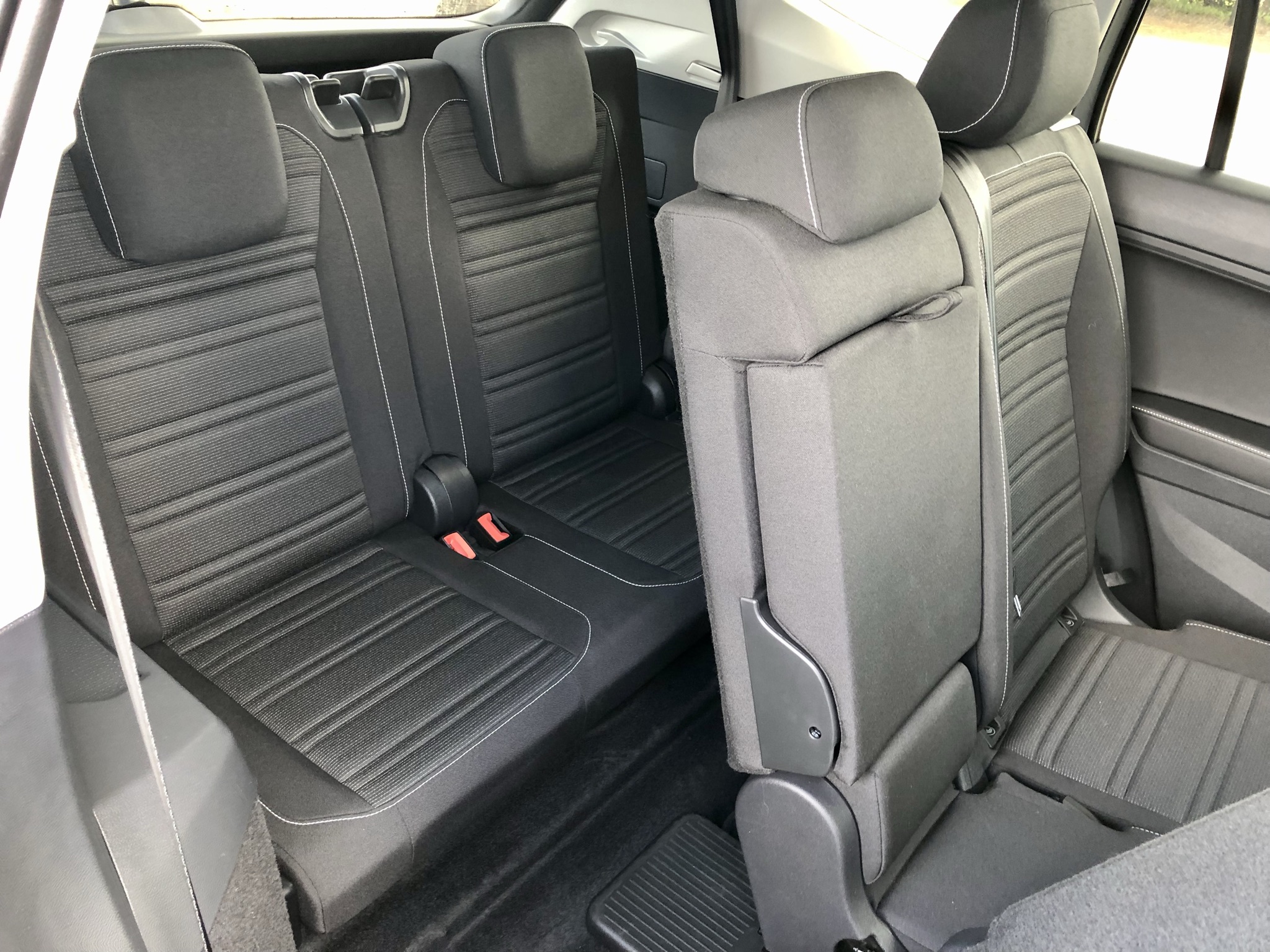
The third row of seats in the Tiguan

The third row is for kids only, but it will be handy for the school carpool.

Optional Tiguan Upgrades

Models from the second trim level up include a power tailgate and a next-generation Climatronic Touch interface for climate control.

R-Line models get a leather-wrapped steering wheel with touch “islands” and sliders.

Additional options include leatherette or leather seating surfaces, power driver and passenger seats, panoramic sunroof, Fender Premium Audio, and 15-color ambient lighting.

New interior colors include Cinnamon leatherette and Noisette leather.

Volkswagen’s Digital Cockpit instrument cluster is now standard and has an 8-inch display (or optional 10-inch Digital Cockpit Pro).

From the second trim in the revised lineup, MIB3 infotainment is standard, along with wireless charging and wireless App-Connect for compatible devices.

Heated front seats are now standard, with options for a heated steering wheel and ventilated front seats.

Additional options include leatherette or leather seating surfaces, power driver and passenger seats, panoramic sunroof, Fender Premium Audio, and 15-color ambient lighting.

Better Than Base Features

The number of standard details is almost untouchable by competing entry-level offerings.

  • New standard tech includes the Digital Cockpit configurable gauge array and keyless entry with push-button ignition.
  • Automatic up and down lifts for all windows, not just the driver’s. Some brands seem to dole out the auto-for-all function as if it were gold.
  • Grab handles above all doors. Some makers save a few dollars and leave out the driver’s handle.
  • VW interiors are almost spartan for their disdain of flash-bang gimmicks. The interior design is reserved, but the Tiguan plastics have a premium appearance and graining. A few brushed-aluminum accents add contemporary style along the face of the instrument panel, door panels, and switchgear.
  • Door panel storage is flocked for sound-dampening.
  • I also like the dual overhead reading lights in the second row. And the separate jacket hooks at the B-pillars are often a budget-killing feature on other SUVs.
  • The second row reclines or folds flat.
A view of the fabric front seats.

Fabric seats in the Tiguan S are durable, supportive, and heated.

VW Tiguan Pricing

The front-wheel-drive Tiguan is sold in four trim levels, all with the same powertrain. 4Motion all-wheel drive is available on the first three trims and standard on the top model.

Tiguan starting prices range from $27,190 to $37,790 for the top-line SEL R-Line with AWD. Otherwise, add $1,500 for all-wheel drive. A sunroof would add $1,200.

The Tiguan S tester was $28,085 with one option for the combined IQ.DRIVE Package and S Convenience Package, $895. The IQ.DRIVE package adds adaptive cruise control for hands-on semi-autonomous driving, with Travel Assist, Lane Assist, and Emergency Assist. Among the convenience elements are a leatherette-wrapped and stitched multi-function steering wheel. Also included are an auto-dimming interior rearview mirror and rain-sensing windshield wipers.

See the complete Tiguan S standard equipment list in the specifications list at the end of this review.

Find current pricing and incentives here.

 VW Tiguan S Performance

While the engine is the same as before, VW tinkered with the peak horsepower and torque power ratings. And because of its long wheelbase and third row, the Tiguan is heavier than most competitors by about 200 to 400 pounds. As a result, the curb weight of 3,765 pounds is reflected in the Tiguan’s performance and fuel economy.

Horsepower now peaks at 6,000 rpm, up from 4,360 rpm last year. And peak torque of 221 lb.-ft. at 1,900 rpm is now substantially higher than the previous peak at 1,600 rpm.

The re-calibrations might have been aimed at fuel economy, which is 1 mpg improved in the highway and combined ratings. But the 2022 ratings of 23 mpg city, 30 highway, and 26 mpg combined were unachievable in the front-drive tester. My driving averaged 14-15 mpg around town, and I was able to work up to just 24 mpg combined on highway driving. Longer daily commutes likely would stretch the mileage.

There’s not much compromise to fuel economy from front- to all-wheel drive. The 4Motion is rated 22/29/25 mpg, and mileage for the Tiguan R-Line drops to 21/28/24 mpg.

The engine runs on 87 octane for all models, and there’s a 15.3-gallon tank for front-drive models and a 15.9-gallon tank for AWD models.

In daily driving, there is a slight delay in acceleration until the turbo is fully charged. At times, pulling away from the light can bring a squeal of the front tires. And sometimes, the acceleration requires a heavier foot. On the highway at 70-75 mph there is strong pull for passing or emergency maneuvers.

Sport mode sharpens the response, but it can feel unsteady and with some abrupt gear changes.

The Tiguan's turbocharged four-cylinder engine

The 184-horsepower, 2.0-liter turbocharged four-cylinder engine.

Tiguan S Ride and Handling

The simplicity of the Tiguan suspension has secret-sauce engineering that is true to the Volkswagen DNA for driving. There are no hydraulics or electronics, just front struts with lower control arms, steel coil springs, telescopic dampers, and an anti-roll bar. The rear multilink also has coil springs, telescopic dampers, and an anti-roll bar.

The ride is uncommonly supple for an SUV of any size. The ride quality is firm but never harsh, and the cabin is remarkably quiet at highway speeds. Tiguan can handle enthusiastic cornering without falling all over itself.

Braking has a reassuring and flat grip from power-assisted, 13.4-inch vented front discs and 11.8-inch solid rear discs.

17-inch alloy wheels on the entry level Tiguann

17-inch alloy wheels are standard on the Tiguan S.

VW Tiguan Safety Features

All Tiguan models have such safety features as six air bags, automatic post-collision braking, forward collision warning, autonomous emergency braking, blind-spot monitor, and rear traffic alert.

New this year is standard Automatic Post-Collision Braking. The system will apply the brakes in certain crash types when the air-bag sensors detect a primary collision. Automatic braking is intended to reduce the chance of additional damage.

Tiguan also includes the Intelligent Crash Response System. The feature shuts off the fuel pump, unlocks the doors, and switches on the hazard lights if the car is involved in a severe collision.

 VW Tiguan Interior Function

The Tiguan S tester had a basic black interior with durable and attractive fabric upholstery. Cabin décor is contemporary with reserved use of satin aluminum accents. There is much black plastic, but it has a premium appearance and all panels were well aligned. However, the loud ping-pong tone of the turn signal could be toned down.

The doors open wide for easy entry and exit, which shows more engineering attention to finesse another degree or two on opening. The driver’s position is secure, with clear sightlines over the front fenders and over the shoulder. Headroom is tall at 39.6 inches with shoulder room. And there is a robust driver’s footrest.

The digital gauge array.

The digital gauge array. (VW)

I like the configurable gauge array to highlight a “classic” view or to add such categories as “gear and speed,” fuel economy, and range.

The front seats have manual height adjustment and are firmly stuffed for support on long drives. However, I would have liked some seat-cushion tilt and adjustable lower-back support (lumbar), which is not available on the Tiguan S. Door-side armrests and the steering wheel are neatly stitched as part of the IQ Drive package.

The standard 6.5-inch color display touch screen seems small, particularly when viewing the rearview camera. Upper trim models have an 8-inch display.

There are large and convenient storage areas, including a small box on driver’s left on the lower instrument panel. Bottle holders in the door panels have large capacity. Even the hood release lever is of stout design.

There is a charging area on the shift console with two USB-C ports and space to lay a large phone.

A front inside door panel with a large bottle holder

The door panel has large bottle storage and a neatly stitched armrest.

Tiguan Back Seats and Cargo Space

The second row is road-trip relaxed with 36.5 inches of maximum legroom with good footroom, even with Big Daddy in the front seat.

The bench seat has a 40-20-40 split with reclining seatbacks. The seats have fore-aft travel and tip-and-slide for access to the third row, but the manual function is stiff to use and could be refined for easier operation.

Second-row bench in the Tiguan

The second row has long legroom of 36.5 inches.

Amenities include airplane-style lights in the headliner, a fold-down center armrest, grab handles and four coat hooks.

Third-row space is best for a pair of youngsters. Headroom is 5.3 inches lower than in the second row (33.8 inches) and legroom is short at 27.9 inches. But the pair of seats are handy just in case, and the seats lie flat when folded.

Cargo space in the Tiguan

The Tiguan cargo space is flexible, with 12 cubic feet behind the third row.

Cargo space behind the third row is great for corralling grocery bags in the 12-cubic-foot space.

With the third row folded, there is 33 cubic feet of capacity, stacked to the headliner. Fold both rows or one section of the second row, and there is about 6 feet of length. The entry is wide at 45 inches.

There is underfloor storage for the roller-cover when the seats are in use. Other extras include a 12-volt plug and second-row seatback release levers.

Underfloor storage in the Tiguan cargo floor

The cargo roller cover can be stored in underfloor storage.

Why Buy the 2022 VW Tiguan?

So much is built into the 2022 VW Tiguan that the term “base” does not translate as cheap.

Seldom is a base model from any maker an acceptable purchase without a couple of option packages, at least. The entry Tiguan S is an exception. But even the test car had one package for $895, which added safety in its semi-autonomous driving elements and a couple of welcome convenience features.

At $28,085, the tester is fully priced, but it made for a value-plus purchase as a very enjoyable vehicle.

I am enthusiastic about the qualities of the Tiguan S, but it has limits for personalization. The S model has just four choices of paint colors: Platinum Gray Metallic, Pyrite Silver Metallic, Deep Black Pearl, and Pure White.

Moving up to the SE, $30,690, adds color choices of red (a $395 cost) or blue metallic, and pearlescent black or white.

And the SE also adds an eight-way power driver’s seat with manual lumbar, V-Tex leatherette upholstery, adaptive cruise control, Travel Assist, Lane Assist, Emergency Assist, wireless phone charging, Bluetooth phone connection, and audio streaming, and 18-inch wheels.

Depending on the purchaser, spending another $2,605 for the SE might build a better family SUV.

The rear angle of the Tiguan

VW Tiguan S pricing starts at $27,190. AWD adds $1,500

 2022 VW Tiguan S Specifications

Body style: compact, 7-seat, 5-door compact-class SUV in front- or optional all-wheel drive

Engine: 184-hp, turbocharged and intercooled direct-injected 2.0-liter 4-cylinder with auto stop-start at idle; 221 lb.-ft. peak torque at 1,900 rpm

Transmission: 8-speed automatic with sport and manual modes

Fuel economy: 23/30/26 mpg city/hwy/combined; 87 octane recommended

Towing capacity: 1,500 lbs., braked

BY THE NUMBERS

Fuel tank: 15.3 gallons

Cargo space: 12 to 33 cu. ft.

Front head/leg room: 39.6/40.2 in.

2nd-row head/leg room: 39.1/36.6 in.

3rd-row head/leg room: 33.8/27.9 in.

Length/wheelbase: 186.4/109.9 in.

Curb weight: 3,765 lbs.

Turning circle: 37.7 ft.

FEATURES

  • Standard Tiguan S equipment includes: Keyless entry and locking with push-button ignition, rearview camera, electric parking brake, digital cockpit gauge array with 8-inch display, cloth seating, heated front seats, multi-function steering wheel, 6-speaker audio system with Bluetooth connectivity, two USB-C ports, LED headlights and taillights (with LED Daytime Running Lights), black roof rails, body-colored heated side mirrors with turn signal indicators, Car-Net infotainment and apps with 6.5-inch touch screen and six-speaker sound system, Wi-Fi capability with subscription, sliding and folding 40-20-40 second-row seat, third-row 50/50 seating, and 17-inch aluminum-alloy wheels
  • Safety features include: 6 air bags, automatic post-collision braking, forward collision warning, autonomous emergency braking, blind-spot monitor, rear traffic alert

PRICING

Tiguan S Base price: $27,190, including $1,195 freight charge; price as tested $28,085

Options on test vehicle: IQ.DRIVE Package & S Convenience Package, $895, includes adaptive cruise control, auto-dimming interior rearview mirror, leatherette-wrapped, multi-function leatherette steering wheel, rain-sensing windshield wipers, travel assist, lane assist, emergency assist

Where assembled: Puebla, Mexico

Warranty: 4-years/50,000-miles bumper to bumper, transferred to a subsequent owner throughout the remainder of coverage; 3-years/36,000-miles roadside assistance; free scheduled maintenance for 2 years or 20,000 miles

Hyundai Palisade Calligraphy Review

Hyundai Palisade Calligraphy Review

The almost-palatial 2021-22 Hyundai Palisade Calligraphy SUV is elegantly spacious with luxurious accommodations, smart technologies, and unexpected but appreciated amenities

An exterior view of the 2022 Hyundai Palisade

For family trips or towing, the Palisade is generously sized and powered with a 291-horsepower V-6 engine and an eight-speed automatic transmission. (Photos courtesy of Hyundai)

Table of Contents

Overview
Palisade Updates for 2021
Pricing
Warranties
Safety Features
Palisade Performance
Ride and Handling
Interior Function
Back Seats and Cargo
Why Buy the Hyundai Palisade?
Specifications

BY MARK MAYNARD

The 2021 Hyundai Palisade is a big easy of SUVs. It is friendly to drive with its nimble turning circle of 38.7 feet. Its 291-hp V-6 engine has strong power and mindful fuel economy from the eight-speed automatic transmission. And the pricing will convince skeptics to take a closer look.

The Hyundai Palisade compares with the Chevrolet Traverse, Ford Explorer, Honda Pilot, three-row 2022 Jeep Grand Cherokee, Mazda CX-9, Nissan Pathfinder, Subaru Ascent, VW Atlas, and platform partner Kia Telluride.

Hyundai Palisade Overview

The Hyundai Palisade debuted in 2019 as the brand’s new flagship SUV. The nameplate is a reference to the coastal cliffs of the Pacific Palisades neighborhood in Los Angeles.

As the Santa Fe XL replacement, Palisade was built on a new SUV chassis with three rows of seating for seven or eight occupants. The large-midsize SUV crossover has standard front-wheel drive or optional all-wheel drive.

Among Hyundai’s five SUV models, the Palisade ranked third for sales in September 2021. With 7,961 sales, the Palisade followed the compact Tucson at 9,896 sales, the midsize Santa Fe at 6,573, the subcompact Venue at 2,877, and the subcompact Kona 5,774.

While some of the SUV sales were down in September, the Venue was up 88 percent over September 2020, and the Palisade was up by 3 percent over September 2020.

The Calligraphy interior

Special Calligraphy features include Nappa leather upholstery, quilted leather door panels, and a microfiber-suede headliner.

Palisade Updates for 2021

The only change for the 2021 model year is the addition of the Calligraphy, the new top-of-the-line trim level.

Other changes for the 2021 Palisade include content repackaging to add comfort and convenience to all trim levels.

LED headlamps are now standard, while sunroof and LED map-interior lights have been added to the SEL model and above.

Palisade trailer pre-wiring connectors were upgraded from a four-pin connector to an enhanced seven-pin connector.

The 2022 Palisade is now on sale with no physical or content changes, but pricing was increased by $475 to $490 across the lineup.

Palisade driver area

The driver area is an accommodating command center with at-a-glance access to all controls.

Hyundai Palisade Pricing

Palisade is sold in four trim levels of SE, SEL, Limited, and Calligraphy. Starting prices range from $33,860 to $47,900 for the Calligraphy AWD; pricing includes the $1,185 freight charge from Ulsan, Korea.

The front-drive Palisade Calligraphy tester was $47,600 with one option for three rows of carpeted floor mats, $215.

Special Calligraphy features include:

  • Quilted-leather door panels
  • Microfiber-suede headliner
  • Premium cargo sill protection plate
  • Perforated-leather steering wheel

A longer list of standard equipment is in the specifications chart at the end of this review.

Find current pricing and inventive offers here.

A dual pane sunroof

The front sunroof tilts and slides and the rear pane is fixed with a shade.

Hyundai Warranties

All Hyundai vehicles have extensive warranty coverage. The basic coverage is for 5 years or 60,000 miles bumper to bumper. The limited powertrain warranty is for 10 years or 100,000 miles.

New this year is free scheduled maintenance for three years or 36,000 miles. The maintenance program includes oil and filter changes and tire rotation.

Hyundai Palisade Safety Features

The 2021 Hyundai Palisade SUV received a 2020 Top Safety Pick-Plus from the Insurance Institute for Highway Safety. In addition, the government’s National Highway Safety Administration awarded the Palisade the top five-star ratings for overall protection, frontal and side crashes, and four stars for rollover.

Palisade’s standard safety features include:

  • 7 air bags,
  • Lane-following assist and lane-keeping assist,
  • Blind-spot collision-avoidance assist,
  • Forward collision-avoidance assist with pedestrian detection,
  • Highway Drive Assist, and
  • Rear cross-traffic collision-avoidance assist.
The 20-inch tires and special wheel design

The Calligraphy has a special wheel design with 20-inch Hankook Ventus S1 Noble 2 all-season tires.

Hyundai Palisade Performance

The 2021 Palisade is sold in front- or all-wheel drive (HTRAC) models. All have a 291-hp 3.8-liter, Atkinson-cycle, direct-injection V-6 and eight-speed automatic transmission.

EPA fuel-economy ratings for front-drive models are 19 mpg city, 26 highway and 22 mpg combined or 19/24/21 mpg with HTRAC.

While testing the 4,231-pound Palisade Calligraphy, I drove the majority of the week in Eco mode. I was surprised by the performance because that fuel-saving mode for engine and transmission performance usually has a maddeningly spongy throttle response.

For those who keep an eye on the fuel gauge, the Palisade’s Eco calibration is actually usable for most driving. Immediate launch power is somewhat reserved, as is close-the-gap acceleration on the highway. Still, in between, it worked to convince me I was saving fuel and emissions in a 16.3-foot-long family vehicle.

In the front-drive tester, my driving averaged 17 to 21 mpg around town, and I worked up to 22.5 mpg combined with highway driving. The highway mileage likely would have risen with more time using cruise control at the speed limit.

The Palisade V6 engine

All Palisade trim levels have the 291-hp V-6 and 8-speed automatic.

Ride and Handling

Palisade’s ride quality is comfortable but not soft. It is well-supported with a rigid chassis for vibration-free driving. The cabin is quiet, and the rear auto-leveling suspension nearly eliminates “head toss” at driveways and speed bumps.

The HTRAC all-wheel-drive system has six traction modes for Eco, Sport, Comfort, Snow, Smart (which adapts to your driving style) and AWD lock. Snow mode has more predictive calibrations, Hyundai says, to prevent loss of traction.

The transmission rolls through the gears so smoothly that you might not notice the transitions. Tire sizes are 18 inches standard or 20 inches on the Calligraphy with a unique wheel pattern.

The tester’s 20-inch all-season tires, Hankook Ventus S1 Noble 2, are generously sized (245/50) and roll smoothly and without road harshness.

Four-wheel disc braking is confident with no grab from 13.9-inch ventilated front rotors and rear 12-inch solid rotors.

A rear angle of the SUV

The Calligraphy has rear auto-leveling suspension that nearly eliminates ‘head toss’ at driveways and speed bumps.

Highway Drive Assist

Hyundai’s Highway Drive Assist allows Level 2 semi-autonomous driving. The assist system uses a forward-facing radar unit and camera and GPS technology through the navigation system’s map database.

The suite of driver-assist technologies includes smart cruise control with stop-and-go, lane-following assist and lane-keeping assist, blind-spot collision-avoidance assist, forward collision-avoidance assist with pedestrian detection, and rear cross-traffic collision-avoidance assist.

The HDA steering calibrations are more refined than some systems I’ve tested. It seems the camera might look farther ahead to make less-jerky steering movements in cornering.

The driver-assist system is intended for use on a divided highway and it will not engage when not traveling on an approved road. The driver must keep both hands on the steering wheel, and Highway Driving Assist is available only at speeds under 95 mph.

In my experience, the system was mostly efficient at keeping the Palisade centered between the lines. Once or twice, however, the system allowed the SUV to drift wide in a sweeping corner and then fired off a sharp warning alert as if I were at fault.

Interior Function

The Calligraphy is a social lounge with a USB port for every seat and 16 cup holders.

Front headroom is tall at 39.3 inches with the dual-pane sunroof. And shoulder room is wide-body at 61.2 inches (and 60.8 inches in the second row.) The step-in height is low with no need for running boards, and the door skins extend below the sill to prevent dirt scuffs on legs and shoes.

The Palisade has USB ports in the seatback

Of the seven USB ports, two are cleverly placed in the seatbacks.

The driver area is an accommodating command center with a multilevel environment of storage areas, including below the center console, with open space for wireless phone charging and a deep armrest box.

There is at-a-glance access to all controls, and the 10.25-inch infotainment screen is not prone to glare in sunlight.

The seats are full-bodied with eight-way power adjustment for the driver and front passenger. Sightlines are no problem, especially with the multiview camera that also gives front and overhead views.

It is a quiet Calligraphy cabin, helped by an acoustic laminated windshield and front side glass.

Unique in this segment is Hyundai’s Blind View Monitors. The side mirrors have rearward-aimed cameras that switch on when using the turn signal. The behind-view video appears in the gauge array, in the corresponding left or right dials. These electronic eyes are instrumental in town when navigating the randomly weaving electric scooters, bikes, and pedestrians.

The roomy back seat area

No compromise to second-row seating with 42.7 inches of legroom.

A Driver Talk in-car intercom system allows communication with the second or third rows via a conversation mode in the audio system. A Rear Sleep Mode also cancels music from being transmitted to the second- and third-row speakers.

Back Seats and Cargo Area

The second row has a maximum of 42.4 inches of legroom, adjustable by the sliding captain’s chairs, which also recline. There is a separate climate control system for heat and AC, fan speed and temp — and heated and cooled seats. The large glass roof panel (with sunshade) is a big-sky treatment. And ceiling air vents help to fend off motion sickness.

The back seats have a one-handed tilt-and-slide action for third-row entry. In addition, the third-row bench has more support than some competitors in this group, and the Palisade seats have a fold-flat power recline.

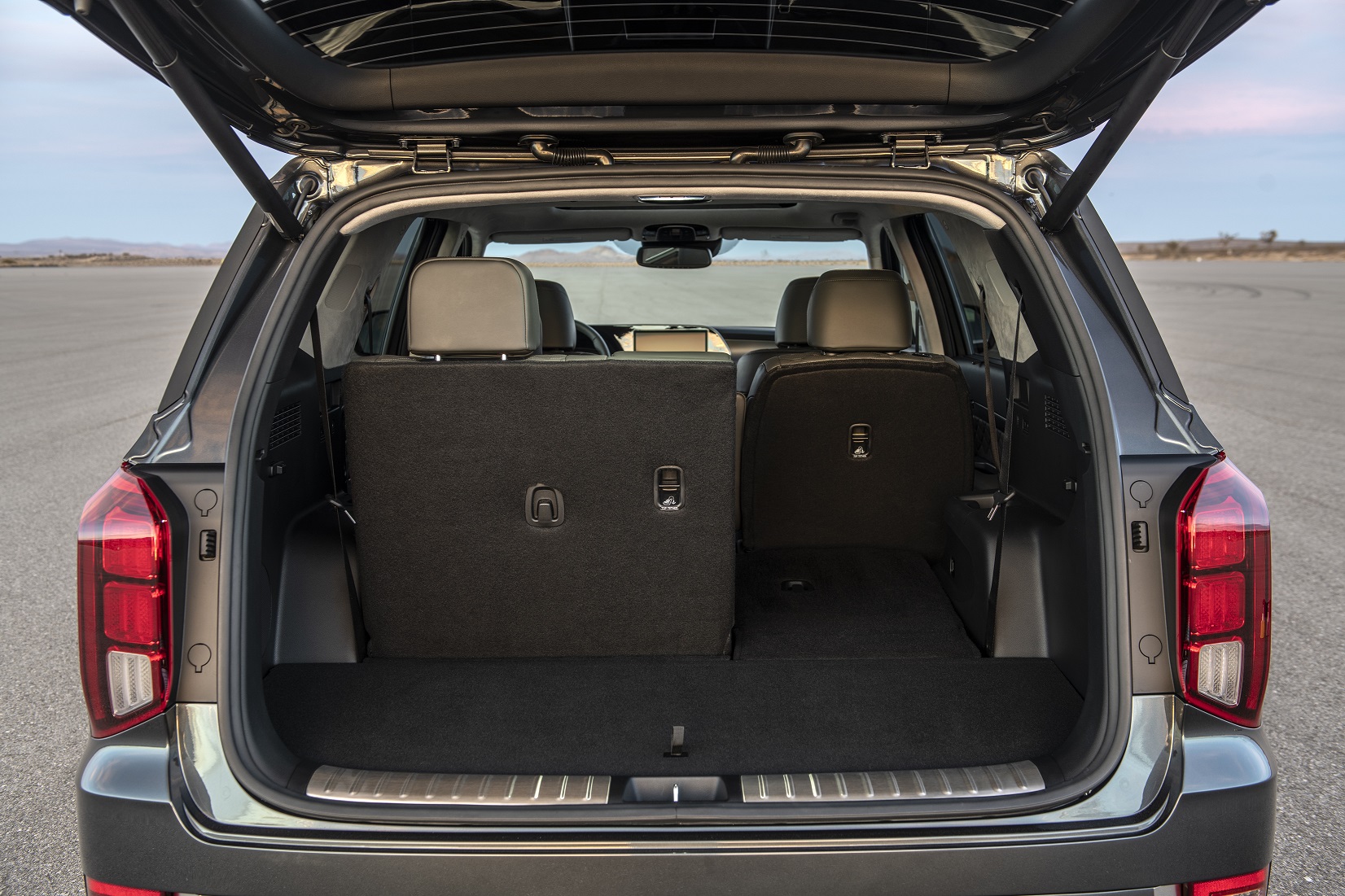
The cargo area is big-box square with a usable 18 cubic feet of space behind the third row, with functional basement storage. There are switches for the power-folding and raising of the third-row seats and power releases to fold the second row.

The lift-in height is tall at 30 inches, but there is about 7 feet of length with both rows folded. The entry is 48 inches wide by 32 inches tall.

The cargo area in the Palisade

There are 18 cubic feet of cargo space behind the third row or fold the second and third rows for about 7 feet of length.

Why Buy the Hyundai Palisade?

The Palisade is a little like moving the family to a new two-story home in a master-planned suburban community. The cabin is roomy with a long list of advanced technologies, premium-quality materials, and many unexpected but appreciated amenities.

Opting for the Calligraphy model provides an elevated luxury experience. And its presentation is without the glare of glitzy technology overload, so common in the Tier 1 luxury segment. It is an enjoyable learning curve to explore Hyundai’s technologies, which is not always so with some luxury brands.

Moving to the three-row suburbs isn’t for every family, but for less than $50,000, a palatial-feeling Palisade is move-in ready.

Hyundai Palisade Calligraphy Specifications

Body style: large-midsize, 3-row 7- to 8-seat SUV in front- or all-wheel drive

Engine: 291-hp, Atkinson cycle, direct-injection 3.8-liter V-6 with idle stop-and-go; 262 lb.-ft. torque at 5,200 rpm

Transmission: 8-speed automatic with HTRAC AWD mode selector

Fuel economy: 19/26/22 mpg city/hwy/combined; 87 octane

Tow capacity: 1,650 lbs. without trailer brakes; 5,000 lbs. with trailer brakes

BY THE NUMBERS

Fuel tank: 18.8 gallons

Cargo space: 18-45.8 cu. ft.

Front head/leg room: 39.3*/41. in. *w/sunroof

2nd row head/leg room: 38.8*/42.4 in.

3rd row head/leg room: 37.2*/31.4 in.

Length/wheelbase: 196.1/114.2 in.

Width/height: 77.8/68.9 in.

Curb weight: 4,231 lbs.

Turning circle: 38.7 ft.

FEATURES

Standard Calligraphy equipment includes: smart-key locking with push-button ignition, Nappa leather-trimmed upholstery, microsuede headliner, surround-view monitor, electric parking brake, blind-view monitor (turn-signal activated), 7 USBs, heated steering wheel, heated and ventilated front and rear seats, wireless phone charger, 12.3-inch digital instrument cluster, 10.25-inch infotainment and navigation touch screen with Android Auto or Apple CarPlay, Harman Kardon audio system, LED headlights-taillights-running lights, auto-leveling rear suspension, trailering package, dual sunroofs with sunshades, high-beam assist, back seat quiet mode, power-folding third row with power recline, hands-free liftgate

Safety features include: 7 air bags, intelligent cruise control with stop-and-go, lane following assist and lane-keeping assist, blind-spot collision-avoidance assist park-distance warning, forward collision-avoidance assist with pedestrian detection, highway drive assist, downhill brake control, rear occupant alert, rear cross-traffic collision-avoidance assist

PRICING

Base price: $47,385, including $1,185 freight charge; price as tested $47,600

Options on test vehicle: carpeted floor mats $160

Where assembled: Ulsan, Korea

Warranties: 5 years/60,000 miles bumper to bumper with roadside assistance; 3-years/36,000-miles free scheduled maintenance (of oil change and tire rotation); 10 years/100,000 miles powertrain

Mercedes-AMG A35 4Matic Review

Mercedes-AMG A35 4Matic Review

The 2021 Mercedes-AMG A35 4Matic spools up 302-hp from a turbocharged 2.0-liter 4-cylinder engine

The exterior view of the Mercedes

Pricing for the Mercedes-AMG A35 4Matic compact sedan starts at $46,900. (Photos courtesy of Mercedes-Benz)

Table of Contents

AMG History
Pricing
Powertrain
Ride and Handling
AMG Reinforcements
Braking
Steering
Interior Function
Back Seats and Trunk Space
Why Buy the Mercedes-AMG A35?
Specifications

BY MARK MAYNARD

It was late September on a drizzly Sunday morning when I steered the Mercedes-AMG A35 toward the backcountry. It was a seasonally cool 70 degrees in San Diego, but in the foothills where I was headed the sun would be peeking out and the roads would be dry. The conditions were ideal to go out, get it and get home in this 302-horsepower AMG sly-scrapper of a small sedan.

The Mercedes-AMG A35 is a righteous upgrade of factory-finessed performance.

AMG History

The three letters that define AMG date to 1967. The abbreviation is associated with two former Mercedes-Benz engineers: Hans Werner Aufrecht and Erhard Melcher. The G is for Großaspach, the German village where they set up shop as race-engine developers. Today, Mercedes-AMG is a wholly owned subsidiary of Daimler AG.

Mercedes-AMG enhancements begin with a big boost to horsepower and high-speed control. The hardware improvements include the AMG Speedshift transmission, the AMG suspension, and the variable AMG Performance 4MATIC all-wheel drive.

There is an AMG model for nearly all M-B vehicles, whether for the big G63 SUV, the Mercedes-AMG ONE hypercar concept, and down to the A35.

Mercedes-AMG engines are the baseline to the AMG experience. Many of the engines are hand-built by meticulous technicians. Their names are engraved on a small plaque and affixed to the engine shroud.

The engine in the A35 is not hand-built to that degree, but it has all of the other AMG attributes.

The front seats in the Mercedes-AMG

Both front seats are power-adjustable with manual thigh extension.

From A220 to A35

The compact-class A35 is based on the Mercedes-Benz A 220. It is the brand’s smallest and most affordable sedan. The A-Class was completely redesigned for 2019 with handsome exterior styling, more back seat room and trunk space, and a more refined interior.

Pricing for the A220 starts at about $34,700. The A220 is sold with standard front-wheel drive or optional 4Matic all-wheel drive. The A220 powertrain is a 188-hp, turbocharged, 2.0-liter four-cylinder engine mated to a seven-speed dual-clutch automated manual transmission.

From this foundation, Mercedes-AMG transforms an entry-level family sedan into an aspirational object of artful engineering. Compare the A35 with the Audi S3 and BMW 235i.

Driver area of the AMG A35

The driver faces a 10.25-inch-wide digital dashboard.

Mercedes-AMG A35 Pricing

Pricing for the Mercedes-AMG A35 starts at $46,900, including the $1,050 freight charge from Rastatt, Germany. My tester was $56,875. The nearly $10,000 in options and accessories were primarily cosmetic. Most buyers would select the upgrades, which are highlighted in the specifications box at the end of this story.

But I would have added three more options, totaling $2,990:

  • Wireless phone charging, $200;
  • Driver Assistance Package, $1,700, adds the electronic elements for Level II assisted driving. Among those technologies are Active Distance Assist, Active Steering Assist, Evasive Steering Assist, Active Brake Assist with Cross-Traffic Function, Active Emergency Stop Assist, Active Speed Limit Assist and Active Lane Keeping Assist and Active Lane Change Assist’
  • Parking Assistance Package, $1,090, is valuable for its surround-view camera system and Parktronic with Active Parking Assist. Park assist is especially helpful to protect the car’s low chin spoiler from being poked into a wall or other parked vehicle.

Build your Mercedes-AMG A35 here.

19-inch tire and wheel

19-inch, twin-spoke light-alloy wheels and side sills of AMG design.

Mercedes-AMG A35 Powertrain

Mercedes-Benz engine development is masterful at providing gratuitous power with absolute accelerator response.

The 2.0-liter four-cylinder engine in the A35 has a stunning 302-hp. The twin-scroll turbocharger catches its breath quickly with just a moment’s delay as the seven-speed dual-clutch transmission engages first gear. In Sport or Sport-plus, there is no hesitation to jump off the line.

Fuel economy ratings are forgiving at 22 mpg city, 29 highway and 25 mpg combined on the recommended premium fuel. My mileage in combined driving was a consistent 25 to 29 mpg. But hoonyism will drop the range precipitously.

If 302-hp seems outrageous for a four-cylinder, Mercedes-AMG also builds a 2.0-liter with 416-hp and peak torque of 369 lb.-ft. from 5,000-5,250 rpm. The company says this 2.0-liter M 139 engine is the world’s most powerful turbocharged four-cylinder engine in series production.

The A35 engine

The twin-scroll turbocharged 2.0-liter engine will launch the A35 to 60 mph in 4.6 seconds.

A35 Ride and Handling

The AMG A35 is very likable for its levels of drivability. The car is a study in higher power. Choose performance attitudes of Slippery, Comfort, Sport, Sport-plus, or Individual to electronically set preferred qualities for steering response, suspension stiffness, and other fine tuning.

Comfort mode is reasonably assertive and boisterous when the gas pedal is floored, such as in an evasive maneuver. My preferences were Sport when making the commute or Sport-plus when headed out for a good time.

Like a steely street-fighter, the AMG35 punches above its weight. Its control fits in the hand like a roll of nickels (if anybody still rolls coin). The calibrations know to let the driver have that AMG experience when possible.

Flick off a double downshift and the engine blips and fires off a hearty report. The tone is sound-generated but rich and satisfying.

A steel-spring suspension with MacPherson front struts provides excellent road adhesion, at least in my less-than-blistering test. But even the Comfort setting is sports-car firm.

If that is not enough control, there is the optional AMG Ride Control suspension, $990. The adaptive adjustable damping allows the driver to switch between three stages of control.

4Matic All-Wheel Drive

The 4Matic all-wheel-drive in this car is more about performance adhesion than all-weather surefootedness.

The power split is front-drive biased, moving seamlessly to AWD as needed or when the computer sensors say it is necessary. The power delivery runs from front-drive only to a 50:50 percent split front to rear.

When committing to a corner at speed, the driver can push out the nose with the accelerator pedal or pull it back by a careful lift of the right foot.

Optional 19-inch, 235/35 Pirelli P Zero tires have a grippy (but low) treadwear rating of 280. That wear rating is expected of ultra-high-performance tires, but there was noticeable droning at highway speeds.

Tight parking situations are very manageable with a turning circle of 37.9 feet. But do be careful of that larger front splitter in the AMG Aerodynamics Package, $1,550. A driveway entry that looks harmless can inflict a painful scrape.

Mercedes A35 exhaust tips

The exhaust system has an automatically controlled exhaust flap.

A35 Body Reinforcements

To handle the stress of the AMG-enhanced powertrain, the front section of the bodyshell is reinforced. Turn-in precision was sharpened and the toe and camber alignment was modified a few degrees for handling dynamics, especially at speed. In addition, an aluminum “shearing plate” under the engine increases torsional rigidity at the front. And two other diagonal braces at the front also increase stiffness.

A35 Braking

The high-performance braking system brings the A35 sedan to an absolutely flat stop in an impressively short distance. The front axle is fitted with four-piston monoblock fixed calipers and 13.78-inch brake discs. At the rear is a single-piston caliper with 12.99-inch discs that are internally ventilated and perforated to dissipate heat and prevent brake fading. The silver-painted brake calipers have black AMG lettering.

A35 Steering

The speed-sensitive, electro-mechanical power steering has a unique rack with a variable transmission ratio and two characteristic curves. Depending on which drive program has been selected, the calibration provides taut and sporty or more comfortable steering feedback.

AMG Track Pace

For those drivers who will run their A35 through a slalom, there is an optional data logger. The AMG Track Pace ($250) is a virtual race engineer that permanently records more than 80 vehicle-specific data. Among the displayed results are speed, acceleration, and lap times.

Specific display elements are shown in green or red. The color variations show at a glance whether the driver’s times are faster or slower than their best time.

Well-known race tracks, such as the Nürburgring or Spa Francorchamps, are already stored. Furthermore, it is also possible to record your own circuits. The map display can be switched from 2D to 3D and can also be updated online.

The MBUX Augmented Reality function also allows the ideal driving line of a stored racetrack to be displayed on the multimedia display or optional head-up display. It is like having a virtual instructor in the passenger seat helping the driver to improve lap times.

Back seat legroom is snug for adults.

Back seat legroom of 33.9 inches is snug for adults.

A35 Interior Function

The A220 is one of the more convincing entry-level small sedans. Technically, the car’s footprint is subcompact, but the interior space is more compact-class in roominess.

Driver sightlines are unhindered over the shoulder or across the hood. Entry and exit are low but not a struggle for taller adults.

Front headroom with the sunroof is tall at almost 40 inches with long legroom of 41.8 inches.

The driver faces a digital dashboard with a 10.25-inch digital instrument array and a 10.25-inch touch-screen display for infotainment and other cabin controls. The electronics are non-threatening to use, and there are alternate buttons for audio, fan speeds, and AC.

There are several spaces for small-item storage and door panels that will accommodate tall bottles.

Back Seats and Trunk Space

The back seat legroom of 33.9 inches is snug but with comfortable shoulder room for two adults. The space does not feel cramped.

Trunk space might seem small at just 8.6 cubic feet, but the space is wide and square with a wide entry of 37.4 inches. And the back seat has a 60/40 split and folds flat for longer items.

A side view of the A35

The Mercedes-Benz A-Class was completely redesigned for 2019.

Why Buy the Mercedes-AMG A35?

AMG is the art of engineering. It is a stealth display of performance, which many owners prefer over the alternatives.

Building a model-line halo from a base model can have disappointing results. But the A220 now embodies the measures expected of a luxury car, even if it is the least expensive in the lineup.

The plastics have appealing texture and color. I saw no unfinished corners or misaligned panels in the test car. The trunk, too, had neatly installed carpeting, a pair of sturdy seatback-release handles, and even a red warning light, NOT just a reflector, when the trunk lid is raised.

The A35 starting price of $46,900 is a baseline of AMG credentials. From there, it will take driving enthusiasts another $10,000 to hand-pick their preferred conveniences or technologies.

From its economy-car foundation, the pleasure provided by a $57,000 A35 becomes a value statement.

Mercedes-AMG A35 4Matic Specifications

Body style: compact, 5-seat, 4-door sedan with AWD

Engine: 302-hp, AMG-enhanced twin-scroll turbocharged 2.0-liter 4-cylinder ; 295 lb.-ft. torque at 3,000 rpm

Transmission: AMG SPEEDSHIFT DCT 7-speed dual-clutch transmission with manual mode and race-start function

0-60 mph: 4.6 seconds (est.); top speed, 155 mph

Fuel economy: 22/29/25 mpg city/hwy/combined; premium fuel recommended for peak performance

BY THE NUMBERS

Fuel tank: 13.5 gallons

Trunk space: 8.6 cu. ft.

Front head/leg room: 40.3/41.8 in.

Rear head/leg room: 37.2/33.9 in.

Length/wheelbase: 179.4/107.4 in.

Curb weight: 3,525 lbs.

Turning circle: 37.9 ft.

FEATURES

Standard equipment includes: Keyless locking and push-button ignition, panoramic sunroof, 10.25-inch touch screen display and 10.25-inch digital instrument array, rearview camera, Apple CarPlay (wired) or Android Auto infotainment apps, Bluetooth phone and streaming music, power (heated) front seats with lumbar support, LED headlights and taillights,

Safety features include: 7 air bags, active brake assist, blind-spot assist, crosswind assist and adaptive braking, Hill Start Assist and HOLD function

PRICING

Base price: $46,900, including $1,050 freight charge; price as tested $56,875

Options on test vehicle: Patagonia Red metallic paint $720; black leather upholstery $1,450; satellite radio $460; Burmester surround-sound audio system $850; heated front seats $500; USB-C adapter cable (in armrest console) $25;

Multimedia package, $1,295, includes navigation, map updates, MBUX augmented reality for navigation and traffic sign assist;

Premium package, $800, includes Keyless Go, hands-free trunk access, auto-dimming side and folding rearview mirrors;

AMG Features

  • Performance steering wheel in Nappa leather, $400;
  • 19-inch AMG multi-spoke wheels in matte black, $800;
  • AMG steering wheel buttons, $400;
  • AMG Ride Control Sport suspension, $990;

Night Package, $750, includes front splitter, grille trim and louvers in the side air intakes, AMG side panel inserts, gloss black beltline and window trim, black side mirror covers, and exhaust tips;

Aerodynamics Package, $1,550, includes larger front splitter and diffusers, larger rear spoiler lip, rear apron, and black diffuser blade

Where assembled: Rastatt, Germany

Warranty: 4-years/50,000-miles with roadside assistance

2022 Infiniti Q50 Sedan Overview

2022 Infiniti Q50 Sedan Overview

The 2022 Infiniti Q50 adds wireless tech and a higher standard of luxury

The 2022 Infiniti Q50

The 2022 Infiniti Q50 is sold in rear- or all-wheel-drive powertrains. U.S. pricing starts at $43,125. (Photos courtesy of Infiniti)

Table of Contents

New for 2022
Standard Equipment
Safety Features
2022 Infiniti Q50 Pricing
Powertrain
Infiniti Q50 Red Sport 400
Why Buy the Infiniti Q50?
Specifications

BY MARK MAYNARD

Infiniti has begun the 2022 model year with a triple play. Dealerships have a wholly redesigned QX60 SUV, a refreshed QX80 large SUV and a more tech-relevant Q50 large-compact sedan. And these are in addition to the redesigned 2022 Infiniti QX55 coupe crossover — the sportback variant of the QX50 crossover — that went on sale earlier this year. Finally, and still relevant, is the Q60 coupe, based on the Q50.

The Infiniti Q50 is a so-called “executive” class sedan. It is a super-compact and almost midsize by size, but the EPA classifies it as a midsize for fuel-economy ratings. The current generation Q50 made its U.S. debut in late summer of 2013. It shares a foundation with the Japanese market V37 Nissan Skyline.

Infiniti's zero-gravity seats

Zero-gravity spinal support seats minimize pressure on back muscles.

What’s New for 2022

The 2022 Q50 is not a redesign but an update for two features that will appeal to younger buyers:

The standard 16-speaker Bose Performance Series Audio. It features Bose Centerpoint simulated surround.

Wireless Apple CarPlay cuts the cord for uncluttered use. Android phone users are supported by two standard USB ports, a Type-A and Type-C.

Dual, high-definition displays feature smartphone compatibility software and Infiniti InTouch Services.

Wireless CarPlay

High-definition displays feature smartphone compatibility software.

Infiniti Q50 Standard Equipment

Every 2022 Infiniti Q50 includes standard leather-trimmed upholstery and eight-way power-adjustable front seats, with power lumbar for the driver. There is a power tilt and telescoping steering wheel and power-folding side mirrors with reverse tilt-down. The dual-occupant memory system for the driver’s seat remembers steering wheel, seat, and outside mirror position and is linked to individual Intelligent Keys.

The Q50 Red Sport 400 is now available with power-fold side mirrors, revised genuine carbon-fiber interior trim, and new black exterior trim.

There are two new premium paint colors of Grand Blue ($695) and Slate Gray, available only on the Red Sport 400. Other premium colors (a $695 choice) include Majestic White and Midnight Back. Dynamic Sunstone Red, $900, is considered an exclusive color.

Other standard Q50 features include:

  • Backup Collision Intervention
  • Around View Monitor with Moving Object Detection
  • Lane Departure Warning (now with haptic steering)
  • Intelligent Cruise Control
  • Distance Control Assist
  • High Beam Assist
The Infiniti shift console

The seven-speed automatic transmission has downshift rev-matching.

Safety Features

Standard safety features on all Q50 models include:

  • Six air bags,
  • Blind-spot warning,
  • Predictive forward collision warning,
  • Backup collision intervention,
  • Forward emergency braking,
  • Lane departure warning (with haptic steering),
  • Around View Monitor with moving object detection.
“Human-eye” LED headlights

“Human-eye” LED headlights are standard.

Infiniti Q50 Pricing

For 2022, the entry Pure model was eliminated and in its place is the Luxe, followed by Sensory and the top-line Red Sport 400.

Available later in the model year will be the Infiniti Q50 Signature Edition, which has dark chrome exterior trim, 19-inch bright aluminum alloy wheels, and saddle brown leather-trimmed sports seats. Pricing will be announced later.

At $43,125, the Luxe is about $5,400 more than the Pure. Add $2,000 for AWD for any trim level.

The Q50 Sensory starts at $50,825 and the Q50 Red Sport 400 at $56,975. All MSRPs include the $1,025 freight charge from Tochigi, Japan.

Check here for more Infiniti pricing and incentive information.

The high performance tires and wheels on the Infiniti Q50 Red Sport 400

The Q50 Red Sport 400 has four-piston front brake calipers painted red.

Q50 Powertrain

The Infiniti Q50 is somewhat unique for its standard rear-wheel drive or optional all-wheel drive. That format makes it more of a competitor with the BMW 3-Series, Mercedes-Benz C-Class, or Genesis G70.

The only Q50 powertrain is a 3.0-liter twin-turbo V-6. In standard models, the direct-injected engine has 300 horsepower and 295 foot-pounds of peak torque from 1,500-5,200 rpm.

The V-6 engine in the Q50

The only Q50 powertrain is a 3.0-liter twin-turbo V-6.

 Q50 Red Sport 400

The higher-performance Q50 Red Sport 400 has 400 hp and 350 lb.-ft. torque from 1,600-5,200 rpm. This engine is beefed up with an extra water pump for more cooling and an optical turbine speed sensor. The speed sensor allows the twin-turbochargers to perform at up to 240,000 rpm, which is higher than ever before for a V-6 engine, Infiniti says.

Premium fuel is recommended for both engines.

Both engines are paired to an advanced seven-speed automatic transmission with manual shift mode and downshift rev-matching.

The Q50 Red Sport 400 has such performance upgrades as four-piston front brake calipers and two-piston rear calipers, painted red. Its Dynamic Digital Suspension constantly adjusts the shock absorber valves to control body motion when cornering. Other hardware features include exclusive 19-inch aluminum-alloy wheels and dual exhaust tips with a brushed satin finish.

Interior upgrades include black exterior accents, aluminum pedals, and semi-aniline leather-appointed surfaces.

A carbon-fiber trim package available only for the Red Sport 400 would add $1,520.

Back seats in white leather

The thin front seatback design adds a bit more knee room in the back seat.

Why Buy the Infiniti Q50?

In this era of the SUV, consistency is an asset for this attractively styled four-door car.

The Q50 has existed in its current makeup for several years with only modest updates. As a result, some buyers will look elsewhere for the latest and greatest in prestige or brand awareness. But returning Q50 lessors and intenders new to the brand will value Infiniti’s interior refinement and attention to detail.

And now, there is wireless connectivity for that high-power audio system.

Cars are being delivered now.

A rear view

The Q50 is unique in the segment for its rear- or all-wheel drive and a standard V-6 engine and seven-speed automatic.

Infiniti Q50 Specifications

Body style: large-compact four-door, five-passenger sedan in rear- or all-wheel drive

Engine: twin-turbocharged, direct-injection, 3.0-liter V-6

Transmission: 7-speed automatic

Fuel economy: 20/29/22 mpg city/hwy/combined for rear-wheel drive; 19/27/22 mpg with AWD

BY THE NUMBERS

Fuel tank: 20 gallons

Trunk space: 13.5 cu. ft.

Front head/leg room: 39.5*/44.5 in. *w/moonroof

Rear head/leg room: 36.8/35.1 in.

Length/wheelbase: 189.6/112.2 in.

Curb weights: 3,781 to 4,019 lbs.

Turning circle: 36.7 ft. RWD; 37.4 ft. AWD

PRICING

Base MSRP: $43,125 to $56,975; add $2,000 for AWD; pricing includes the $1,025 freight charge

Where assembled: Tochigi, Japan

Warranty: 4-years/60,000-miles basic coverage; 6-years/70,000-miles powertrain coverage

2022 Infiniti QX80 Overview

2022 Infiniti QX80 Overview

The “significantly refined” 2022 Infiniti QX80 SUV emphasizes a more luxurious interior and more technologies

An exterior view of the 2022 Infiniti QX80 SUV

The three-row, body-on-frame Infiniti QX80 SUV goes on sale later this summer. Pricing starts at almost $72,000. (Photos courtesy of Infiniti)

Table of Contents

Pricing
Drivetrain
Standard Equipment
Options
Specifications

BY MARK MAYNARD

The “significantly refined” 2022 Infiniti QX80 SUV emphasizes a more luxurious interior and more technologies. Prominent in the update is a wide-screen, high-definition 12.3-inch Infiniti InTouch display that includes wireless Apple CarPlay and USB-based Android Auto compatibility.

The InTouch infotainment system

The wide-screen InTouch display updates the previous two screens that were stacked in the center of the instrument panel.

2022 Infiniti QX80 Pricing

The three-row, body-on-frame Infiniti QX80 SUV goes on sale later this summer. Sold in three trim levels of Luxe, Premium Select, and Sensory, starting MSRPs range from $71,995 to $ 76,780 to $83,630.

Rear-wheel drive is standard or add all-mode four-wheel drive to any trim level for $3,100. All MSRPs include the $1,395 freight charge from Kyushu, Japan.

Check Infiniti pricing and incentives here.

And please read my review of the 2020 Infiniti QX80 here.

The front-seat area of the QX80

All trim levels of the QX80 have Nappa leather-appointed seats in all three rows.

QX80 Drivetrain

The 5,678-pound QX80 has a 400-horsepower, direct-injected 5.6-liter V-8 paired with a seven-speed automatic transmission. With a maximum of 413 foot-pounds of torque at 4,000 rpm, the tow capacity is up to 8,500 pounds.

Fuel economy ratings from 2021 are 14 mpg city and 20 mpg highway, using the recommended premium fuel. The 26-gallon should provide around 400 miles of driving.

All QX80 models have a four-wheel independent, double-wishbone suspension with rear automatic self-leveling. The hydraulic Body Motion Control System is available.

The second-row captain's chairs.

Second-row captain’s chairs tip up for easier access to the third row.

QX80 Standard Equipment

The wide-screen InTouch display updates the previous two screens that were stacked in the center of the instrument panel. The navigation system includes five years of free access to premium traffic and MapCare. A Wi-Fi hotspot to connect multiple devices is included, but a subscription is sold separately after the 30-day trial.

  • Smart Rearview Mirror. The digital mirror provides an unobstructed view when cargo or passengers obstruct rearward vision;
  • Around View Monitor with Moving Object Detection and Front and Rear Sonar. The system helps when navigating tight parking spaces;
  • Intelligent Cruise Control, Backup Collision Intervention, Lane Departure Warning, Blind Spot Intervention, and Lane Departure Prevention. The driver-assistance technologies provide Level 2 semi-autonomous highway driving;
  • Nappa leather-appointed seats in all three rows and second-row captain’s chairs that tip up for easier access to the third row;
  • Heated front seats.
The third row of the QX80

The third-row space is kid-class with short legroom of 28.8 inches.

QX80 Optional Features

  • Semi-aniline leather-appointed and climate-controlled front seats;
  • Advanced Climate Control System with Plasmacluster technology and Grape Polyphenol filter;
  • Bose Performance Series Audio with 17 speakers;
  • 22-inch alloy wheels with dark chrome accents;
  • Body Motion Control System;
  • Rear Seat Entertainment system, with twin, 8-inch screens.
The wide open cargo area of the QX80

Power 60/40-split fold-flat and reclining third-row seats.

Infiniti QX80 Specifications

Body style: full-size 7-passenger body-on-frame SUV; rear-wheel or 4WD

Engine: 400-hp, direct-injected 5.6-liter V-8 with 413 foot-pounds of torque at 4,000 rpm.

Transmission: 7-speed automatic transmission with snow and tow modes

Tow capacity: up to 8,500 lbs. with standard trailer sway control

Fuel economy: 14/20 mpg city/highway; premium fuel recommended

BY THE NUMBERS

Fuel tank: 26 gallons

Cargo space: 16.6 to 49.6 to 95.1 cu. ft.

Front head/leg room: 39.9/39.6 in.

2nd-row head/leg room: 40/41 in.

3rd-row head/leg room: 36.8/28.8 in.

Length/wheelbase: 210.2/121.1 in.

Height/width: 75.8*/79.9 in. *with roof rails

Curb weight: 5,678 lbs.

Turning circle: 41.3 ft.

PRICING

QX80 Luxe, $71,995, includes 20-inch alloy wheels, Charcoal Burl trim, Bose 13-speaker premium audio system and a power liftgate.

QX80 Premium Select, $76,780, includes 22-inch dark chrome alloy wheels and unique Matte Mocha Burl interior trim.

The QX80 Sensory, $83,630, includes 22-inch dark chrome alloy wheels, chrome exterior accents, semi-aniline leather-appointed seats, 17-speaker Bose Performance Audio, Hydraulic Body Motion Control, and climate-controlled front seats.

Where assembled: Kyushu, Japan

Warranty: 4-years/50,000-miles basic coverage with 24-hour roadside assistance; 6-years/70,000-miles powertrain

A rear view of the QX80

Rear-wheel drive is standard on the QX80 or add all-mode four-wheel drive for $3,100.

2022 Honda Civic Sedan Review

2022 Honda Civic Sedan Review

The 11th generation 2022 Honda Civic Sedan is redesigned with a “thin and light” body design, new materials, and technologies

A front view of a red 2022 Honda Civic Sport

The redesigned 2022 Honda Civic has more mature styling and a more premium appearance to the interior. (Photography courtesy of Honda)

Table of Contents

Overview
What’s New In the Redesign?
Pricing
Powertrains and Fuel Economy
Safety Features
Driver-Assist System
Interior Function
Back seats and cargo
Ride and Handling
Why Buy the 2022 Honda Civic?
Specifications

BY MARK MAYNARD

The Honda Civic marks its 11th generation in North America with the complete redesign of the 2020 model. This stalwart economy car made its U.S. debut in 1973 amid the first oil embargo by OPEC. According to Honda, 49 years later, the Civic is the longest-running automotive nameplate in the United States.

The 2020 redesign created the most technologically advanced Civic sedan in the model’s history.

The exterior redesign is less provocative, more mature, and enduring. Inside, there is a more premium presence to the interior with smart ergonomic access to controls and switches, despite a standard 7-inch color touch screen that includes Apple CarPlay and Android Auto.
Safety technologies include new front air bags designed to reduce traumatic brain and neck injuries. Rear-seat side air bags are a Civic first.

The driver-assist system, known as Honda Sensing, was updated for a front wide-view camera. And the top Touring model gets new Traffic Jam Assist and Low Speed Braking Control.

The two engine choices are carryover but with improvements to increase performance, fuel efficiency, and refinement.

Driver area of the new Civic

The redesigned dash incorporates a series of mesh panels for a clean, continuous look.

Honda Civic Overview

Four-door cars are declining in interest today, but the Honda Civic sedan has been a bread-winner model for Honda.

“Despite auto industry new vehicle sales being almost 80 percent light trucks (CUV, SUV, pickups) and last year being very negatively impacted by COVID-19, we still sold over 260,000 Civics in 2020,” said Honda spokesman Carl Pulley in an email.

More than 12 million Civics have been sold since 1973. That legacy makes it one of the top three best-selling passenger cars in America, Honda says.

Civic remains the No. 1 vehicle in the industry with Millennials, Gen Z, first-time and multicultural buyers, Pulley said. “It serves as one of the primary gateways to the Honda brand.”

As before, the Civic continues as front-wheel drive with no plan yet for all-wheel drive.

The 2020 Civic Hatchback will be built in the U.S. for the first time, with production to begin later this year at Honda’s Greensburg, Ind. auto plant. The sedan is built in Allison, Ontario, Canada.

Industry sources say the new sedan and hatchback will be followed by the sporty Si and high-performance Type R.

Sedans competing with the Honda Civic include the Hyundai Elantra, Kia Forte, Mazda 3, Subaru Impreza, and Toyota Corolla.

The front seats in the new Civic

The interior styling follows the “Man-Maximum, Machine-Minimum” approach.

Honda Civic Redesign

In designing the 11th-generation Civic, the stylists and engineers focused on the original Honda design approach of “Man-Maximum, Machine-Minimum.”

The pulled-back windshield pillars, low hood, flat dashboard, and hidden windshield wipers enable a windshield with clearly defined corners for a panoramic view.

Key to the Civic’s exterior redesign was moving the bottom of the windshield pillars rearward by nearly 2 inches. The revision elongates the hood for a premium silhouette. Honda says it is a subtle design element that emphasizes the wheels and tires for a stable, planted stance.

Civic's fabric front seatbacks

The fabric-vinyl upholstery is neatly stitched and the seats are supportive.

Dimensions and body structure

By size, the 2022 model is 1.3 inches longer (184 inches) but the same width and height as before, 70.9/55.7 inches.

Curb weights are up by 106 to 114 pounds across the trim levels. And trunk space was trimmed by just 0.3 cubic feet, but it is still significant at 14.8 cubic feet.

The body structure is the most rigid in Civic history, Honda says. The stiffer structure aids ride quality, reduces interior noise, and sharpens suspension response for better handling. In addition, a slightly wider rear track (0.5-inch) enhances stability.

The color touch screen

All Civics have a 7-inch (shown) or 9-inch touch screen.

Honda Civic Pricing

The Honda Civic has a choice of two four-cylinder engines in four front-wheel-drive trim levels of LX, Sport, EX 1.5, and Touring 1.5. All models have a continuously variable automatic transmission. All-wheel drive is not offered.

Starting prices range from $22,695 for the base LX with the 2.0-liter engine to $29,295 for the Touring 1.5. All MSRP pricing includes the $995 freight charge from Allison, Ontario, Canada.

Civic Sport 2.0L

The Sport model has a more aggressive exterior and interior styling and a Sport mode with paddle shifters.

The Sport is well equipped. Highlights of its standard equipment include smart-entry locking with push-button ignition, electric parking brake, eight-speaker audio system, Apple CarPlay or Android Auto infotainment, sport pedals, automatic high beams, LED headlights and taillights, and 18-inch alloy wheels with 235/40 all-season tires

My Civic Sport tester was $25,657.21, which included two accessories by Honda Performance Development:

  • HPD Kit of front, side, and rear underbody spoilers, decklid spoiler, and HPD emblem $1,417.80;
  • Honda Genuine Accessories of a gloss black H-mark, Civic, and Sport emblems $144.41.
  • The tester’s Platinum White Pearl paint added $395.

Check here for Honda Civic pricing and incentives.

A rear view of the new Civi

The Sport trim adds gloss-black side mirrors, 18-inch wheels, and chrome exhaust tips.

Powertrains and Fuel Economy

The standard engine is a 158-horsepower, 2.0-liter. The uplevel engine is a 180-hp, turbocharged and direct-injected 1.5-liter. Both engines run on 87 octane fuel and all models have a 12.4-gallon tank.

All Civic sedans use a continuously variable transmission, with paddle shifters for the Sport and Touring trim levels. There is no six-speed manual for the sedan, but a stick shift will be available for the upcoming hatchback model.

The EX 1.5 Turbo model is the mileage champ. It has EPA fuel-economy ratings of 33 mpg city, 42 highway and 36 mpg combined.

Next in line is the entry LX model at 31/40/35 mpg followed by the Touring 1.5 Turbo at 31/38/34 mpg and then the Sport 2.0L at 30/37/33 mpg.

In my week of testing a Sport 2.0L, the best average fuel economy I could manage was 30.1 to 30.6 mpg, but it was consistent from town to highway.

The 2.0-liter Civic engine

The base engine is a 158-horsepower, 2.0-liter.

Honda Civic Safety Features

The 2022 Honda Civic sedan can boast what Honda calls the world’s first application of front driver and passenger air bags designed to reduce traumatic brain and neck injuries.
The new design better controls head motions, Honda says. The driver’s air bag is donut-shaped to cradle and hold the head to reduce rotation. The passenger-side air bag uses a three-chamber design for a similar result.

Side impact protection was improved throughout. There are stiffer structures in the roof and doors, side sills and door pillars, rear wheel arches and rear window pillars.

There are a total of 10 air bags.

Driver-Assist System

The Sport model is technologically equipped for Level 2 semi-autonomous driving. The Honda Sensing system integrates Adaptive Cruise Control, Collision Mitigating Braking, Lane-Keeping Assist, Road Departure Mitigation, Traffic Jam Assist, Vehicle Stability Assist.

When activated, the system consistently keeps the car centered between the white lines. And, in my experience, there were no random shutoffs or alarming audible alerts.

Honda Civic Interior Function

Honda applies the “Man-Maximum, Machine-Minimum” approach to interior design. The focus is on “exceptional visibility, intuitive ergonomics, extraordinary passenger volume, and driver-focused technology.”

The approach works quite well and provides open sightlines over the shoulder and across the hood. New owners will discover the smart ergonomics in several areas, including the comfortably angled door-side armrests and window controls. Large visors slide, and there is a deep center armrest box.

High-quality materials are visible throughout the interior, especially on touch points. Special attention was given to the refined operation of switchgear and controls. And all trim levels have a new front seat design that holds firmly without extreme side and bottom bolstering.

There are numerous areas for small-item storage, including the door panels that can accommodate large bottles. The 7-inch touch-screen display includes buttons for volume and radio tuning.

The AC and vent controls also include dials to easily adjust temp, fan speed, and vent directions. Also rewarding is the wide span of vent flow along the face of the dashboard; prominent finger controls make it easy to readjust the airflow.

The shift console is slim but functional with large cup holders and an e-bin with a charging USB and 180-watt 12-volt plug. But despite all of the Civic Sport’s advanced technologies, wireless charging is only available with the top-line Touring model. And with multiple tries, I was unable to sync my iPhone for hands-free talking.

The top-line Civic Sedan Touring debuts a new 9-inch color touch screen and digital color instrument display. The 10.2-inch high-def panel is customizable and can be configured to show traditional round gauges or bar graphs.

The refined door panel of the new Civic

There is room in the door panel for large bottles.

Back Seat and Trunk Space

The Civic redesign attempts to make the most of back-seat roominess, but it is still a compact space.

The rear legroom of 37.4 inches is long for a small car. But the headroom of 37.1 inches will be restrictive to growing teenagers or business colleagues.

Trunk space of nearly 15 cubic feet has plenty of reach to the back seat. The trunk entry point is wide at 37 inches, but the 18-inch access opening will restrict big-box items. Fold the seatback to carry items up to about 6 feet in length.

The Civic's back seat

Back seat legroom is long at 37.4 inches. Fold the back seat for up to 6 feet in length.

Folded back seat

Civic Sport Ride and Handling

The Civic Sport ride quality is taut but not harsh. It handles well enough, but its sportiness is more in styling than performance.

The continuously variable transmission is dutiful and primed for fuel economy. Unfortunately, it also provokes engine noise on hard acceleration. Sport mode cranks up the shift response to simulate shift points, but it was almost too much enthusiasm for around-town driving.

The car rides low and the chin scrapes on driveways. In the hope of avoiding the cringeworthy occurrence, I’d make wide-angled turns into my driveway. But that only caused a scrape to the right-front alloy wheel — which was another cringeworthy moment. In my weak defense, the 18-inch Goodyear Eagle Sport all-season tires fit right to the edge of the wheel.

The Goodyears, too, have a hard treadwear rating of 560, which I blame for the maelstrom of tire noise inside the cabin at Interstate speeds.

The 18-inch tire-and-wheel package pushed the turning circle to a wide 38.1 feet versus 36.1 feet with the 16- or 17-inch wheels.

Four-wheel-disc braking is by 11.1-inch vented rotors at the front with solid 10.2-inch rotors at the rear.

2022 Civic trunk

The trunk has 14.8 cubic feet of capacity.

Why Buy the Honda Civic?

The Honda Civic’s 2020 redesign is a remarkable improvement for refinement and premium presentation. The interior is as accommodating as it can get for a compact sedan, and the exterior’s clean lines will be a big purchase motivator.

However, the Civic has no hybrid model and some of the competitors offer all-wheel-drive.

American Honda is fortunate that it has weathered the industrywide parts supply issues and has cars to sell. With the Sept. 1 sales report, Honda said that demand has been off the charts for all-new Civic sedan and dealers are selling cars as quickly as they are trucked in.

Honda Civic 2.0L Sport Specifications

Body style: compact, front-drive, 5-passenger 4-door sedan

Engine: 158-hp, 2.0-liter 4-cylinder with 16-valve DOHC i-VTEC with multiport injection and idle stop-start; 138 lb.-ft. at 4,200 rpm

Transmission: CVT with paddle shifters

Fuel economy: 30/37/33 mpg city/hwy/combined; 87 octane

BY THE NUMBERS

Fuel tank: 12.4 gallons

Trunk space: 14.8 cu. ft.

Front head/leg room: 39.3/42.3 in.

Rear head/leg room: 37.1/37.4 in.

Length/wheelbase: 184/107.7 in.

Curb weight: 2,935 lbs. (Sport)

Turning circle: 38.1 ft. (Sport)

PRICING

Base price: $24,095, including $995 freight charge; price as tested $25,657.21

Options on test vehicle: Platinum White Pearl paint $395; HPD Kit of front, side, and rear underbody spoilers, decklid spoiler and HPD emblem $1,417.80; Honda Genuine Accessories of a gloss black H-mark, Civic, and Sport emblems $144.41

Where assembled: Allison, Ontario, Canada