Ihave often thought it would be fun to own a Porsche tractor. Fortunately, my lust for the little red tractor was renewed with the debut of free Porsche coloring pages. The four coloring pages will help children and their parents be obedient lockdown participants.
The Porsche mascots, Tom Targa and Tina Turbo, are intended to influence young people to have fun coloring a Panamera sedan, a 911 police car, the tractor, and a vintage 356 model.
The Porsche-Diesel Super was manufactured by Porsche between 1956 and 1963, according to Wikipedia. It is powered by an air-cooled, four-stroke, 2466 cc, three-cylinder diesel.
Porsche From Home
And there also is a new website, PorscheFromHome.com, that is focused more on North America with an emphasis on social and digital media.
According to the website: “At a time when we need to stay apart, we have the opportunity to get closer together. Check out some ways to stay entertained and connected. #DreamsAreMadeAtHome.
The site has downloadable Porsche coloring pages for the Panamera, Taycan, 718 spyder, Targa, Cayenne, and 911 GT3. And also relevant these days for video conferencing are backgrounds with some of your favorite Porsches.
So, as the website suggests, share some Porsche from home while you are staying safe at home.
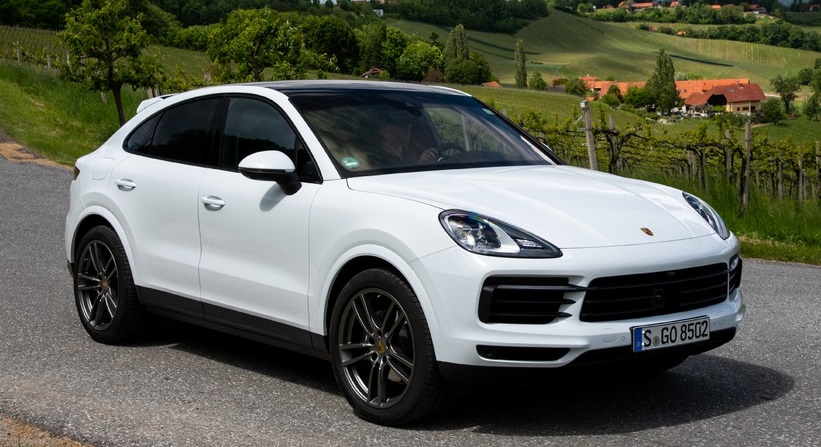
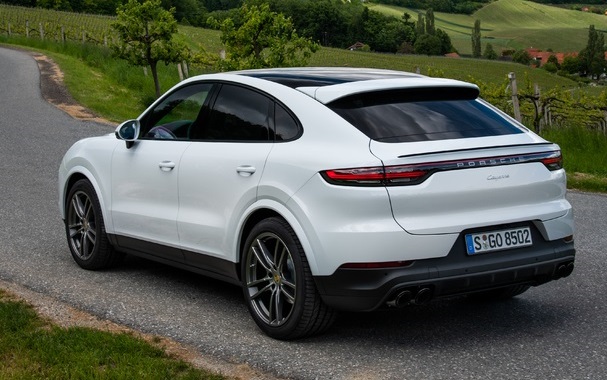
The Porsche Cayenne SUV is now the brand’s top seller in the U.S. Fortifying sales this year is the four-door, fastback Coupe model. Sharing a foundation and mechanicals with the squared-off Cayenne, the hunky stance of the Coupe is a fusion of style and skill.
And so what if this variant costs about $8,500 more than its donor for a few fewer cubic feet of cargo capacity?
It is the Cayenne Coupe’s muscular 911 lines for which the buyer will gladly pay to participate for the prestige of owning a Porsche. It’s not all about vanity, though — the Coupe will take corners with sports-car finesse and it can bring home a load of firewood.
This third-generation Cayenne is a Volkswagen Group architecture that has been repurposed, reformatted, and restyled as the Audi Q7 and Q8 Sportback, Lamborghini Urus and Bentley Bentayga, if not other nameplates in the global VW family.
To create the Coupe body, the windshield and A-pillars are shallower and the roofline is 0.78 inches lower with a fixed rear spoiler. For its more muscular stance, the rear track was widened by 0.70 inches and redesigned rear doors and quarter panels broaden the shoulders by 0.7 inch. To compensate for the lower roofline, the second-row 2+2 seats sit lower in the vehicle, but headroom is still accommodating at 37.4 inches.
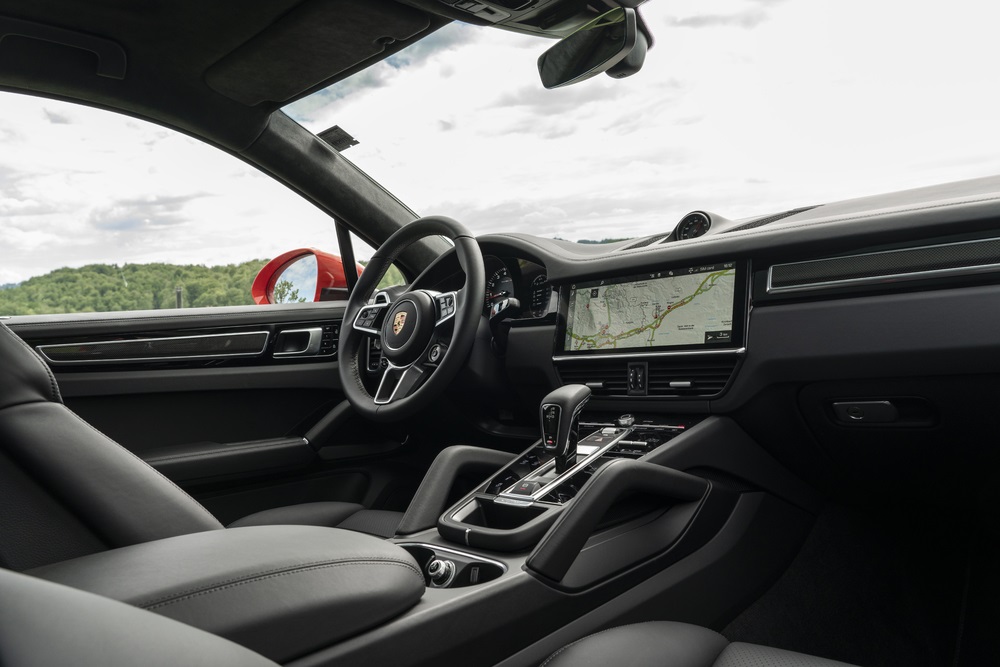
The midsize cabin is broad enough to ergonomically place controls and digital screens.
Cayenne Coupe Pricing
The Cayenne Coupe is a versatile variant sold in turbocharged V-6 and V-8 gasoline-powered models. And there are two gasoline-electric plug-in hybrid models that leverage power over fuel savings.
All models are all-wheel drive with an eight-speed automatic transmission. Starting prices for the gas models range from about $76,000 to $131,000 to the topline Turbo Coupe.
Today’s Cayenne S Coupe tester starts at $89,950, including the $1,350 freight charge from Bratislava, Slovakia. With options totaling $12,260 the as-tested price was $102,110. And I still would have wanted a few more convenience features.
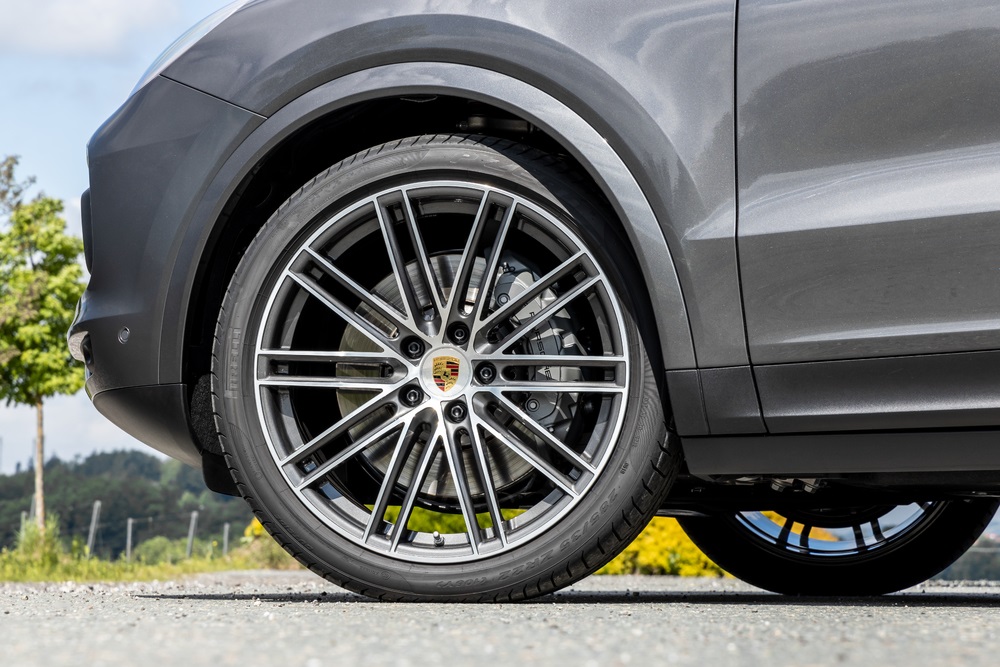
Standard S Coupe features include the Sport Chrono performance package, eight-way sport seats, an adaptive roof spoiler, panoramic fixed glass roof, park assist tones (front and rear), and Porsche Active Suspension Management. Twenty-inch alloy wheels are standard with options for 21- and 22-inch tires and wheels.
The hands-on relationship of the Coupe S is immediately sensed in the steering, braking, and suspension.
Cayenne Hybrid Models
There are two Porsche Cayenne E-Hybrid models. Both use a 14.1 kWh lithium-ion battery and have estimated driving ranges of 20-22 miles and up to 41 mpg-e average fuel economy.
The E-Hybrid Coupe, $87,750, uses a single turbocharged 3.0-liter V-6 with a combined 455-hp. It can accelerate from 0-60 mph acceleration in 4.7 seconds — and that is with a curb weight of 5,265 pounds.
The Turbo S E-Hybrid Coupe, $165,750, launches to 60 mph in 3.6 seconds with its twin-turbocharged, 4.0-liter V-8. Its combined engine-motor horsepower is 670 with 567 lb.-ft. torque from 1,960-4,500 rpm. And it weighs 5,673 lbs.
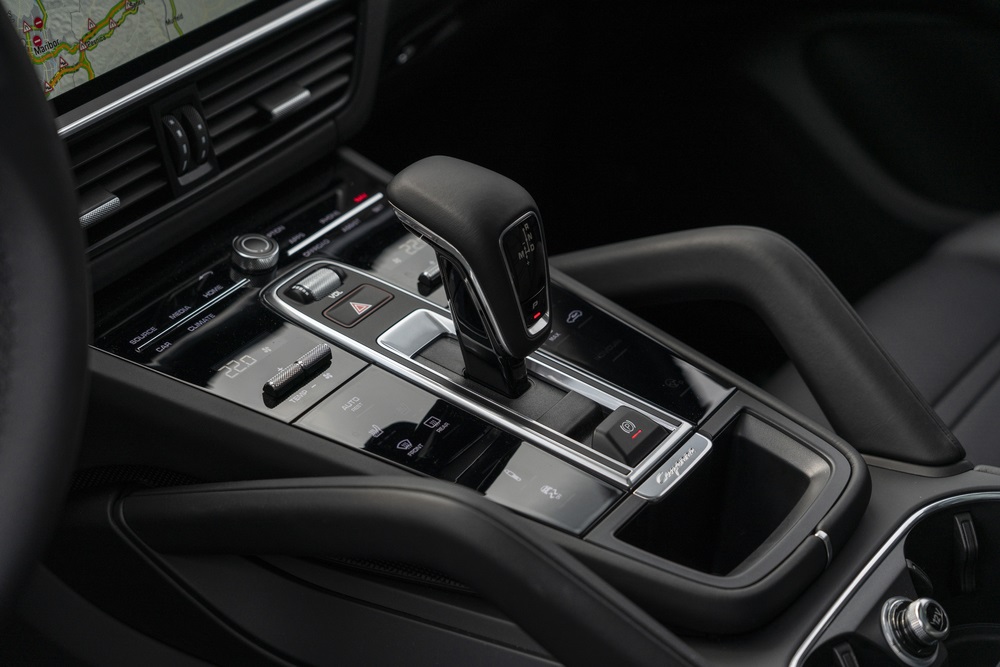
The shift console is an electronic array with touch-sensitive buttons with a haptic response to show activation.
Porsche Cayenne Coupe Powertrains
Buying a Porsche is a numbers exercise: How quick to 60? How fast from 60 to zero mph? And how much?
The base Coupe is the welcome wagon for those who don’t care about performance numbers but want the brand prestige and sexy styling. The S Coupe is the enthusiast’s number for the purity of Porsche performance. And the Turbo is for those who don’t have to ask “How much?”
The base model is powered by a 335-horsepower, single turbo 3.0-liter V-6 with 332 foot-pounds of torque from 1,340 to 5,300 rpm. Porsche cites 0-60 mph in 5.7 seconds.
For another $13,300, the S model is a full second quicker to 60 with its 434-hp 2.9-liter twin-turbo V-6 and 405 lb.-ft. torque from 1,800 to 5,500 rpm.
And the mighty Turbo Coupe, with its 541-hp twin-turbo 4.0-liter V-8, is yet another second quicker, propelled by 567 lb.-ft. torque from 1,960 to 4,500 rpm — for $41,500 above the S Coupe.
The S model has an impressive 434-hp from its twin-turbocharged 2.9-liter V-6.
Cayenne Coupe Performance
The hands-on relationship of the S Coupe is immediately sensed in the steering, braking and suspension. It is a buffet of fine-driving skills neatly served with a platter of power.
Acceleration in standard driving mode is focused on meeting fuel economy, which isn’t egregious at 18 mpg city, 22 highway and 19 mpg combined on the required premium fuel. I was averaging 19-21 mpg in daily driving and up to 24.2 on extended highway driving. The hefty 23.7-gallon tank will allow a generous cruising range, even at 18 mpg.
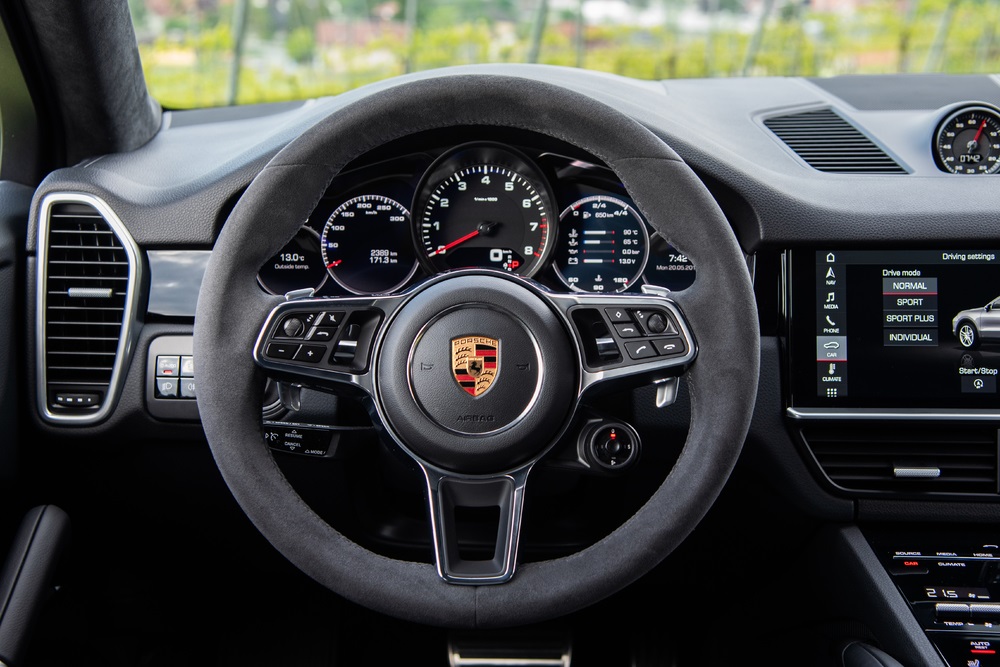
But fuel efficiency depends on the performance mode: Normal, Individual, Sport and Sport-plus. My preference was Sport, which quickened throttle response and got me away from the light with no hesitation, but my go-to was Sport-plus for its overall tighter suspension, steering, and launch control. Engine stop-start at idle is also deactivated in the Sport modes.
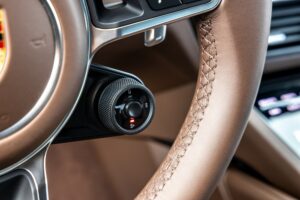
The performance modes are engaged via a small dial at the lower right spoke of the steering wheel. It seems like an odd placement, but it works well and takes away another switch on the shift console.
Sport Exhaust upgrade
To let others know of your arrival, there is a sport exhaust upgrade with more relaxed silencers for $3,220. But I felt the standard exhaust was communicative enough.
And while you are adding features, the performance package, $4,900, adds rear-axle steering, adaptive air suspension, and a sport exhaust system with tailpipes in black or silver. My driving style would not require such advanced levels and the tester was optioned with the adaptive air suspension, $2,170.
The S model rolls with 21-inch Pirelli P Zero tires, 285/40 ZR at the front and 315/35 ZR rear.
Ride and Handling
The Porsche Cayenne Coupe air suspension was never harsh, never soft but always ready to clip an apex and find a new way home. The driver can feel the steadiness of the chassis through the steering wheel. And there is barely any turn-in transition as the suspension prepares for cornering maneuvers or rolling across speed bumps.
Curb weights are substantial, even with the aluminum hood, tailgate, doors, fenders, roof and suspension pieces. Weights range from 4,663 pounds for the base model to 4,725 for the S model and on to 5,024 lbs. for the Turbo. Consequently, four-wheel disc braking is a three-bear choice:
The base model gets internally vented 13.8-inch rotors front, 13 inches rear with four-piston calipers front and two-pistons rear.
The S stopping power is enhanced with internally vented 15.3-inch rotors with six-piston calipers 13-inch rotors rear with four-piston calipers.
The Turbo gets 16.3-inch internally vented rotors front, 14.3 inches rear with 10-piston front, and four-piston rear calipers.
Cayenne Coupe Turbo Coupe Options
Turbo owners also can opt for a carbon-fiber roof option, $11,570, to save about 48 pounds. The big package includes a suite of upgrades:
Sport Design Package in exterior color
Carbon interior package
Carbon fiber rear diffuser
Heated multifunction steering wheel in Alcantara
22-inch GT Design wheels in satin platinum
Standard Interior in black with silver houndstooth
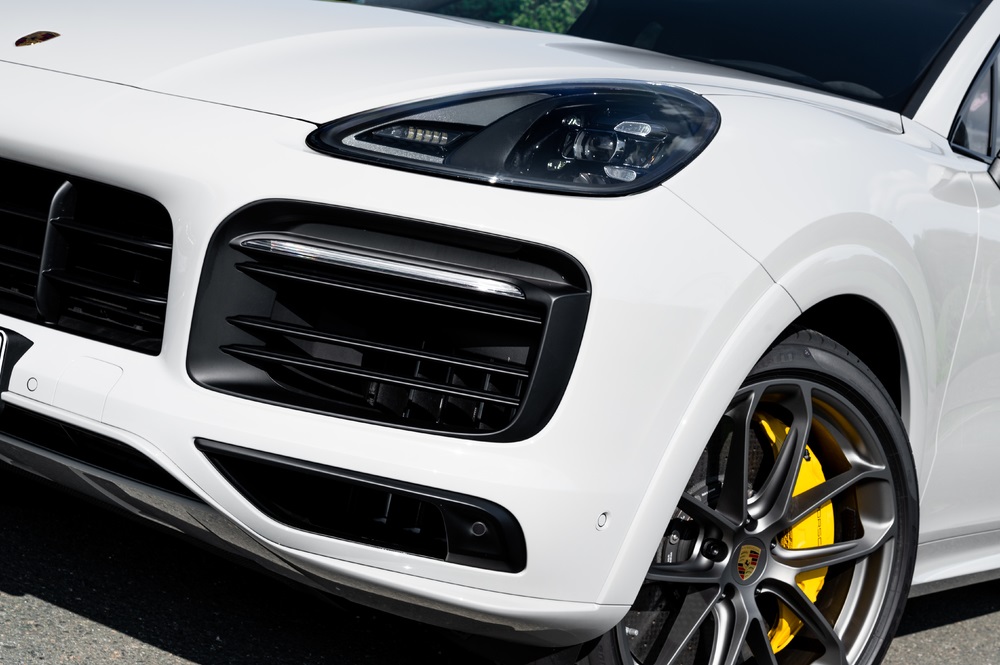
Matte black air-intake grilles and matte black airblades
Alcantara headliner
Sport exhaust system
To compensate for the lower roofline, the second-row 2+2 seats sit lower in the vehicle, but headroom is still accommodating at 37.4 inches.
Disc Brake Upgrades
For stable braking under extreme use, Porsche has added a new brake upgrade. The Porsche Surface Coated Brake system, $3,490 (but standard on Turbo Coupe), has an exceptionally hard tungsten-carbide coating, Porsche says, that is combined with fade-resistant brake pads. Compared to conventional gray cast-iron brakes, the new discs generate up to 90 percent less brake dust, Porsche says. A side effect of the disc treatment will be a polished surface after several hundred miles of driving. It is also intended to prevent the flash rust that appears on brake rotors when the vehicle sits after driving in the rain. The option includes white calipers to show off the brightness.
And when the cost is no matter, the $9,080 ceramic composite brake upgrade (with carbon fiber-reinforced discs) adds 17.3-inch internally vented and cross-drilled rotors at the front and 16.1-inch discs rear, with bright yellow 10-piston calipers front and four-piston rear. (Big steel disc brakes are very heavy and the ceramic option would cut the weight by around 50 percent, Porsche says. For those who participate in slalom racing, the cost to weight savings might be important. But for a daily driver, my choice would be the Surface Coated Brake system.)
Off-Roading, if you dare
Porsche offers an overkill for an off-road suspension package, $2,170, for those brave enough to risk an $800 metallic paint upgrade or a $3,150 special paint color (Cashmere Beige Metallic, Chalk or Lava Orange). The only no-cost colors are white and black.
The adaptive three-chamber air suspension (standard on Turbo Coupe), also adds forged aluminum suspension links at the rear. And there are five ride heights ranging from a load-level of 5.9 inches to 9.6 inches for trail driving, and up to about 20.6 inches of water-fording depth.
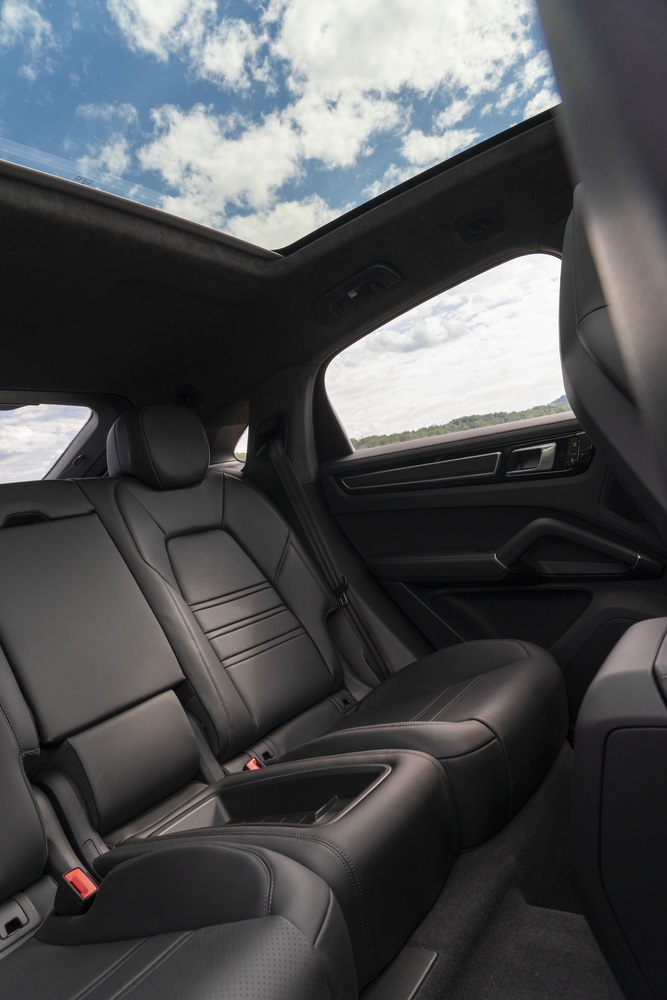
The standard panoramic fixed glass roof (with sunshade) is especially enjoyable for back-seat passengers.
Cayenne Safety Features
Standard safety features include 10 air bags, a forward collision warning with automated emergency braking, pedestrian and cyclist alerts. Other advanced and optional features include lane-keep assist and adaptive cruise control with stop-and-go function.
Porsche’s electronic co-pilot InnoDrive uses navigation data to calculate rates of optimum acceleration and deceleration for the next 1.8 miles. Controls are activated via the engine, transmission, and braking. The system factors corners, gradients, and maximum speeds and monitors current traffic conditions using radar and video sensors. Porsche says this exclusively developed system can even recognize roundabouts and will adjust vehicle speed to negotiate the circle.
The tester had none of the advanced technologies for assisted driving and instead relied on the driver to steer, stop, brake, and pay attention to the road. And that was just fine by me; there were no intrusive warning alerts or subtle steering assistance.
For commuters who want the electronic backup, the $6,240 assistance package adds a surround-view camera, head-up windshield display, InnoDrive co-pilot, adaptive cruise control and traffic jam assist, lane keep assist, traffic sign recognition and night vision assist.
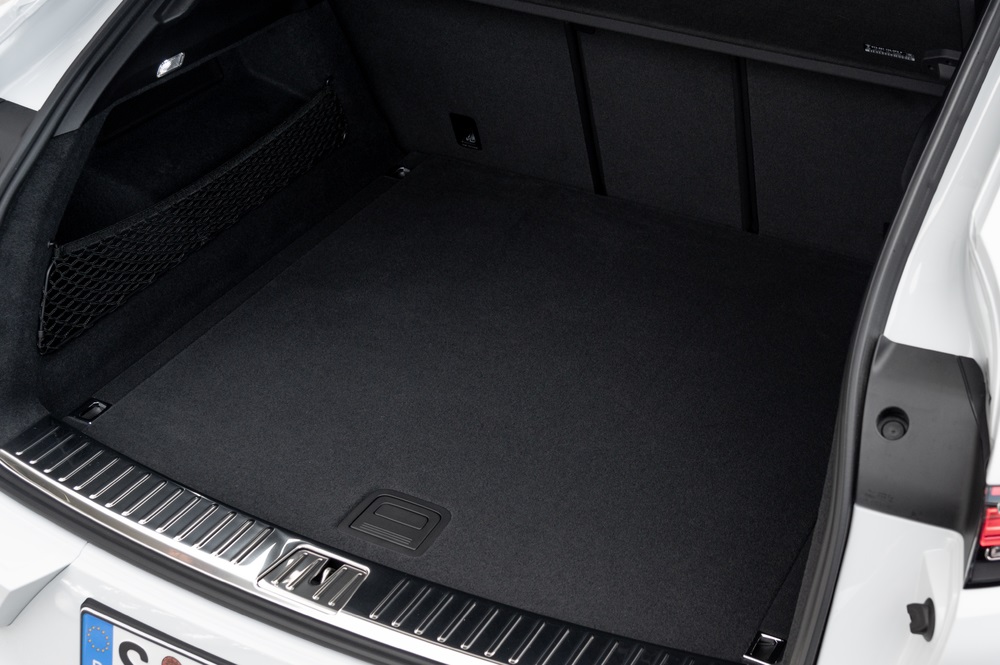
The Cayenne Cargo space has a low liftover, with ride-height switches.
Interior Function
The Porsche Cayenne Coupe is easy to live with and accommodating as your version of the 911 coupe but with legitimate back seats and usable cargo space. The turning circle is broad but manageable at 39.8 feet, but the rear-axle steering option ($1,620) will trim that span by almost 2 feet, to 37.8 ft.
The cabin and cockpit are driver and passenger-friendly. Sightlines are open at the side mirror and across the hood, but the rearview is cropped by the slim rear glass and wrap of the rear roof pillars.
The 12.3-inch wide infotainment screen isn’t prone to wash out in sunlight and is simple enough to use. The rearview camera image is large and while there are front and rear parking assist tones, a more helpful 360-degree camera system is a $1,200 option.
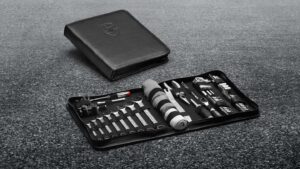
Porsche offers a 55-piece tool set accessory in a leather case ($403).
The eight-way power-adjustable front sport seats are firm but still comfortable after a three-hour run. But for those who appreciate more lower back support, lumbar adjustment is added in the 14-way power seat upgrade, $1,290. And there is an 18-way power seat upgrade for $1,710.
With the tester’s leather upholstery upgrade ($3,750), I’d recommend the ventilated seat upgrade, $850, for those in warm climates. Seat heaters are $530 and a heated steering wheel is $280.
The midsize cabin is broad enough to ergonomically place controls and digital screens. The shift console is an electronic array with touch-sensitive buttons with a haptic response to show activation.
The console isn’t big on small-item storage, but there is a new phone slot and charging ports in the armrest console box. Wireless charging is an option. The visors do not slide and driver’s left coverage is poor with a gap between windshield and visor where morning or evening sun presents a problem.
The performance modes are engaged via a small dial at the lower right spoke of the steering wheel.
Comfort Access
The Comfort Access option, $940, gives a complete keyless unlocking setup and a foot-activated tailgate. Without it, the driver must use the key fob to unlock the doors, then put the fob back in pocket or purse and start the car using the ignition stub, to the left of the steering wheel, of course, in the Le Mans style.
The other notchy thing was the electric activation of the gear shift. After a week of driving, I was still fumbling to press the engagement button on the front of the shift lever. But at least there is a gear-shift console and not a shifter “stalk” on the steering column.
Back Seats and Cargo
The standard panoramic fixed glass roof (with sunshade) is especially enjoyable for back-seat passengers. Seat comfort is quite firm with adult-class thigh support and seatback recline. Conveniences with the S Coupe are spartan with no electronic temperature or fan-speed controls, but there are two charging USBs. The 2+2 seating configuration has a no-cost option for a 2+1 “comfort” back seat with a third seat belt for the narrow center position.
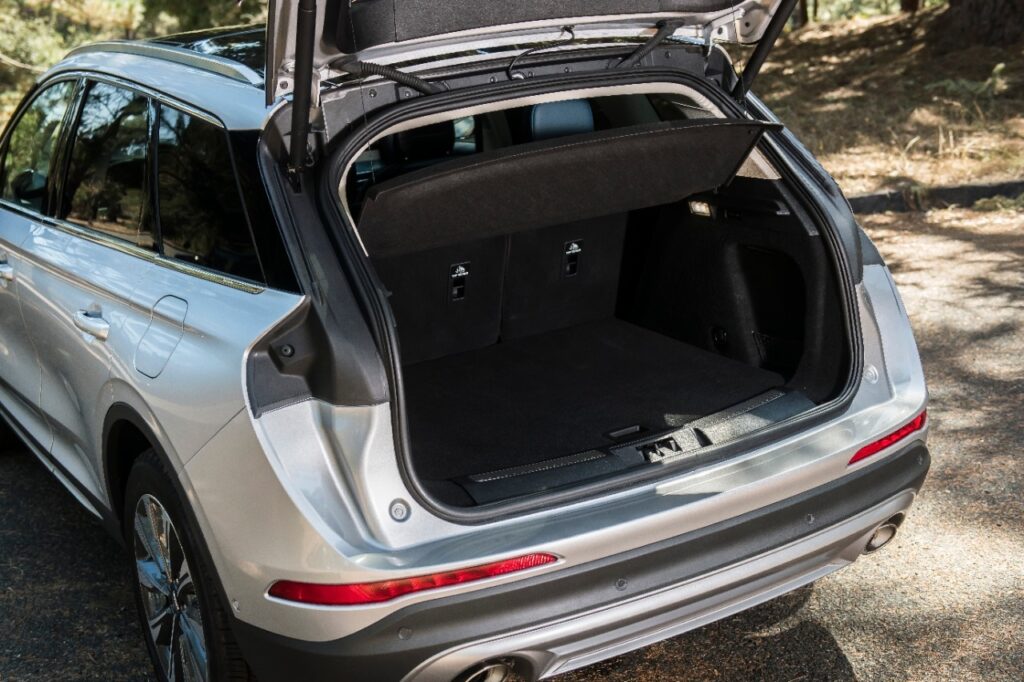
The back end has a square space of 22 cubic feet behind the second row or up to 54.3 cu. ft. with the seatbacks folded for about 6.3 feet of length. Access to the space is particularly smart because of the low liftover (with ride-height raising or lowering switches) and the wide 43-inch-wide opening offers comfortable tailgating potential because there is no protruding rear fascia. It’s a good space to sit and pull on shoes, boots, or wetsuits.
New owners can take advantage of the Porsche Experience Center Delivery in Los Angeles for $535 or $465 in Atlanta.
Why Buy the Porsche Cayenne Coupe?
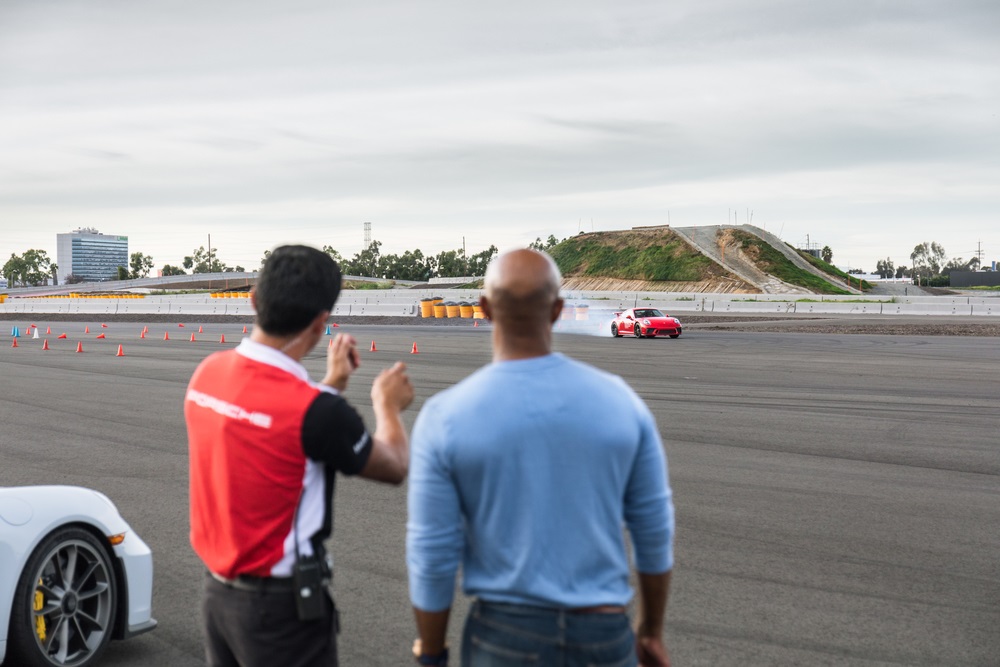
Buying a new Porsche is always special and new owners can christen their purchase with delivery and track time at a Porsche Experience Center, either in Los Angeles for $535 or $465 in Atlanta. The option includes special delivery of your new Coupe (or another model), a tour of the facility, lunch at Restaurant 356 overlooking the track, and a 90-minute instructed track session in an equivalent car.
The Cayenne Coupe has the purity of Porsche performance in an SUV with nothing to prove, except that there is almost no end to the customization options. Once a buyer chokes down the price, it tastes like “more” and there will be many rewards in ownership — with little remorse.
The Porsche Cayenne Coupe is easy to live with and accommodating as your version of the 911 coupe but with legitimate back seats and usable cargo space.
2020 Porsche Cayenne S Coupe AWD
Body style: midsize, 2+2 4- or 5-seat sportback SUV; w/aluminum hood, tailgate, doors, fenders and roof
Engine: 434-hp, direct-injection and twin-turbocharged 2.9-liter V-6 with auto stop-start at idle and coasting function; 405 lb.-ft. torque from 1,800-5,500 rpm
Transmission: 8-speed Tiptronic; active all-wheel drive with electronic and map-controlled multi-plate clutch with automatic brake differential and anti-slip regulation
Standard equipment includes: remote locking, 8-way power adjusted front sport seats, fixed panoramic roof, 10-speaker audio system, electric parking brake, electric folding and heated side mirrors, LED lighting (headlights, cornering lights, brake and running lights), stainless steel pedals, tinted and thermally insulated glass all around, park assist front and rear with reversing camera, analog dashboard clock and floor mats
Safety features include: 10 air bags, forward collision warning with automated emergency braking, pedestrian and cyclist alerts
PRICING
Base price: $89,950, including $1,350 freight charge; price as tested $102,110
Options on test vehicle: Carrera White metallic paint $800; slate gray leather interior $3,750; adaptive air suspension with PASM (stability management) $2,170; heated steering wheel $280; 21-inch RS Spyder design wheels and painted wheel arches $2,710; heated front seats $630; torque vectoring plus PTV+ $1,500; auto-dimming mirrors $420
Where assembled: Bratislava, Slovakia
Warranty: 4-years/50,000-miles bumper to bumper with 24-hour roadside assistance; 1-year/10,000-miles free first scheduled service
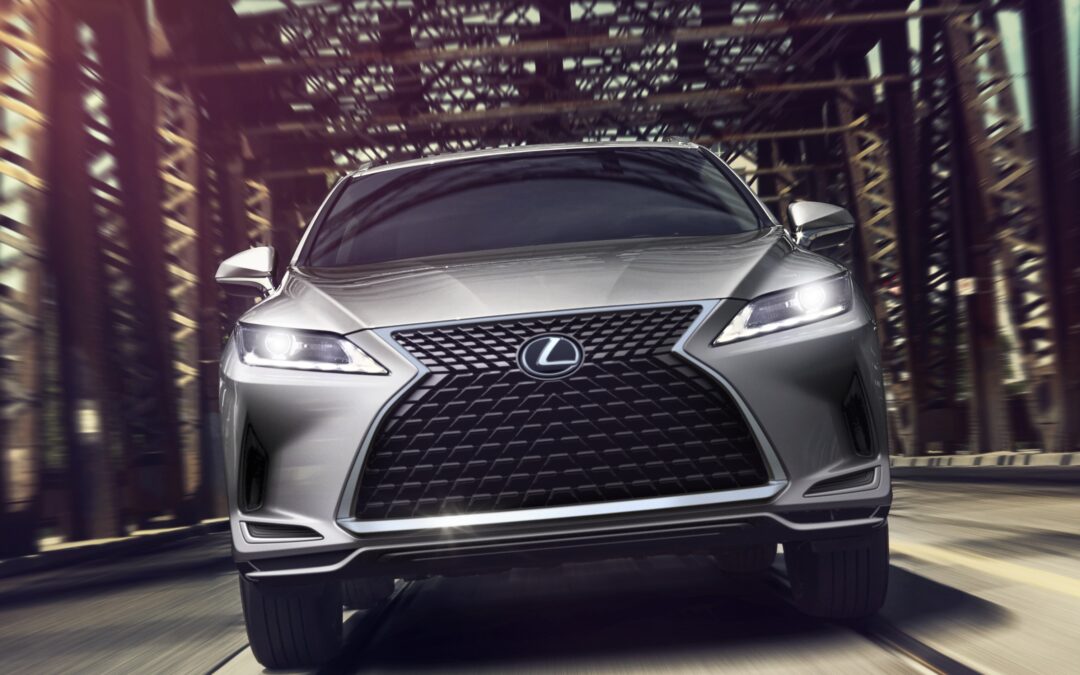
The RX is still a gold standard for luxury with all the VIP prestige and pleasures of Lexus ownership. (Lexus)
With some key improvements, the 2020 RX is a calm choice in the storm and fairly priced
The mouse is out and a touch pad is in among the changes for the 2020 Lexus RX, the founding member of the luxury SUV crossover league. When the RX debuted in 1998 it was the first of its kind with carlike comfort and SUV presence. It was a disruptor in what a car could be — and a benchmark that started the segment for luxury midsize car-based SUV crossovers.
Today, every maker has one and the segment is crowded with quality choices as the preferred body style over large sedans.
The Luxury package, $6,000, adds key features, including dynamic radar cruise control, power moonroof, heated and ventilated front seats, heated wood and leather steering wheel, Sapele laser cut wood with satin aluminum trim and semi-aniline leather upholstery. (Lexus)
The RX is now in its fourth generation, which debuted in 2015 as a 2016 model. With some key improvements, the 2020 RX is a calm choice in the storm and fairly priced.
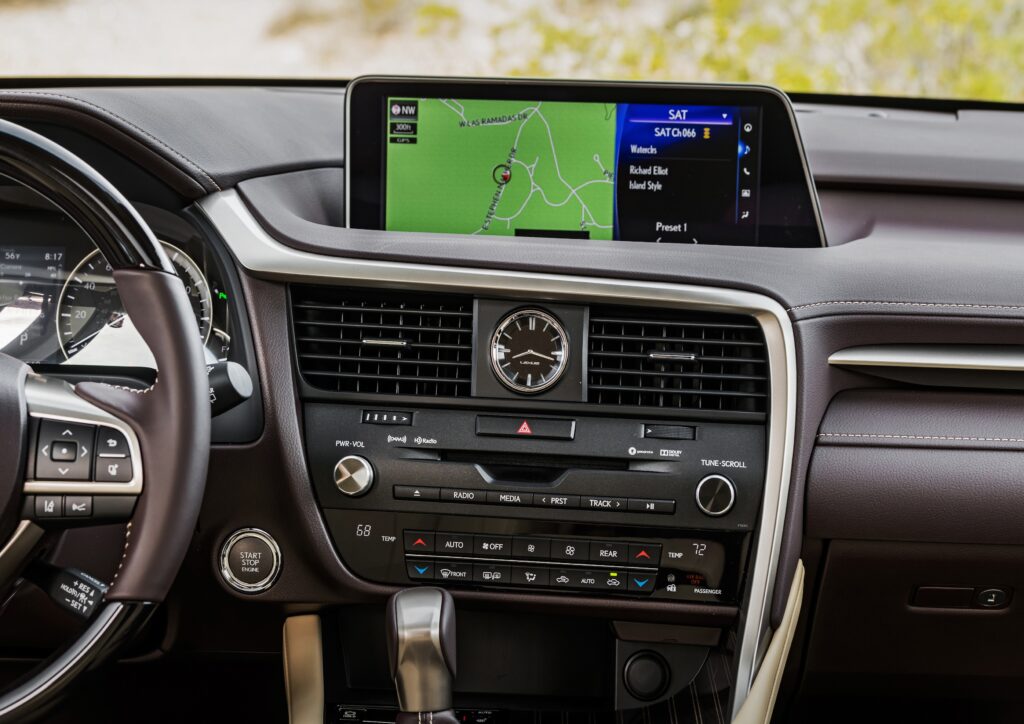
2020 UPDATES There were a few hardware and software enhancements for 2020, not the least of which were two more charging USB ports, now at six, and a new infotainment touch pad that replaces an overly sensitive joystick.
The 12.3-inch navigation screen with 15-speaker Mark Levinson audio system, $3,365, is well worth the cost. (Lexus)
More notable is the addition of the Lexus Safety System+ 2.0 as standard equipment. The advanced tech package, including a pre-collision system that adds daytime bicyclist detection and low-light pedestrian detection along with Road Sign Assist and Lane Tracing Assist.
Road Sign Assist displays certain road sign information in the instrument panel. Lane Tracing Assist works with the dynamic radar cruise control to read lane markings to steer the vehicle in the center of the lane. And when road markings are obscured or not detected, LTA can, in certain conditions, follow the vehicle ahead.
Replacing a darty joystick control device, the new touch pad is a much-simplified tool to access the various functions and features of the new 12.3-inch display. (Lexus)
Active corner braking was added to help prevent understeering with more front tire grip and handling stability.
Ride quality was addressed with new hollow front and rear stabilizer bars that are lighter but also thicker with reinforced bushings to trim body roll and improve steering response. The shock absorbers, too, were retuned for the stiffer roll bars and a new friction-control device helps reduce high-frequency vibrations.
The stiffer suspension reduces the noise and vibration from the road, the engineers say. The body was made stiffer by additional spot welds and industrial adhesive to join panels and sections.
Most appreciable to RX owners coming back for a new lease will be the new touch pad to much more easily access the big screen of cabin and infotainment controls. It replaces what was a touchy joystick and also makes the shift console less crowded. It just takes a fingertip on the pad to move from category to category.
The front seats are full-bodied and 12-way adjustable but some will find the seat bottom hard after a while on the road. (Mark Maynard)
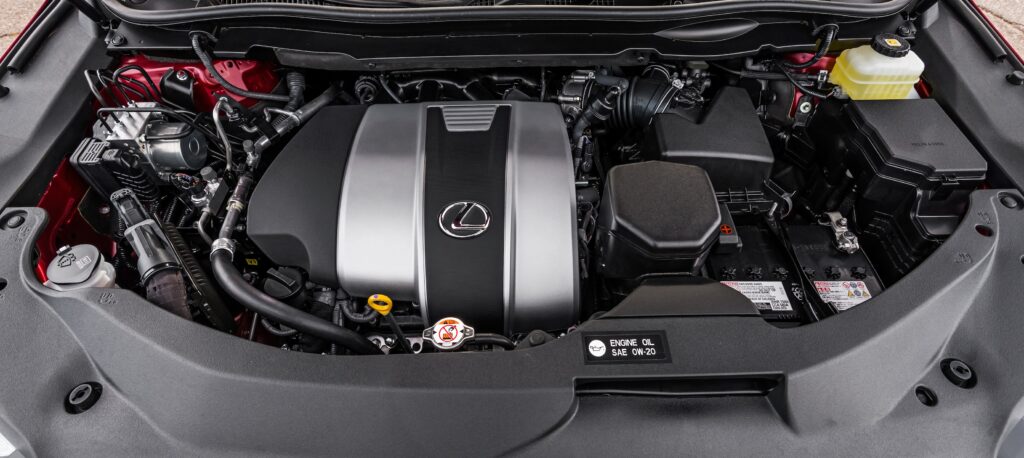
PRICING The RX is sold in gasoline and gasoline-electric powertrains in standard and long-wheelbase RXL body styles, in front- or all-wheel drive. Gas versions use a 290-horsepower port- and direct-injection 3.5-liter V-6 and eight-speed automatic transmission. The hybrid model is powered by a 3.5-liter V-6 with an electronically controlled continuously variable transmission working with two electric drive motor-generators, for a total 308 horsepower.
Standard models start at about $45,000 and long-wheelbase models at about $48,000. Hybrid pricing starts at about $48,000. F-Sport models, with an appearance package and performance suspension, start at $49,000 for gas or $51,000 for hybrid.
The 290-hp 3.5-liter V-6 is tuned for max mileage, until the foot goes down and the V-6 roars. Sport mode fills the gap between dutiful and screaming. (Lexus)
Today’s front-wheel-drive long-wheelbase RX 350L Luxury was $62,715 as tested, including the $6,000 Luxury package and the $1,025 freight charge from Fukuoka, Japan. Other options included the blind-spot monitor with intuitive parking assist, panoramic view monitor and rear-cross traffic braking for $1,865. The head-up display added $600 and triple-beam LED headlights with cornering lights, front turn signals and fog lights was $1,775. The 12.3-inch navigation system with Mark Levinson 15-speaker audio system, $3,365, is well worth the cost. And there was $90 for door-edge film (to guard against nicks), a cargo net and cargo mat, wheel locks and key glove for $315 and $380 for roof rack cross bars.
HYBRID The all-wheel-drive RX 450hL can be driven at low speeds for short distances on battery power from the 37-kWh nickel metal hydride hybrid battery. The on-demand all-wheel-drive system functions as front-drive until there is slippage, then the sensors direct power to the rear wheels. The battery system adds more than 450 pounds to the curb weight, but mileage ratings are strong at 29/28/29 mpg city/highway/combined.
Of Lexus’ five SUV models (ranging from the subcompact UX, compact NX, and truck-based GX and LX) the RX is the top seller, in the sweet spot of pricing, style and family function. (Lexus)
SAFE SELLING With concerns regarding the pandemic and lockdown, Lexus has various programs and procedures in place at the dealerships and in vehicle delivery. More information can be found at Lexus.com/PeopleFirst. And here is a brief story with some specific dealer examples, Support.
“We are continuing to share updates directly to guests as restrictions vary by state and city,” a Lexus representative wrote in an email. “Please check back to the Lexus consumer website linked above as it will continue to serve as a main hub for this type of information.”
DRIVABILITY I have driven several generations of RX over the years and the 2020 model is the quietest and feels the most solid and robust. But remove the roof-rack crossbars for an even quieter highway ride.
The suspension is softer now and more comfortable, rolling quietly as if on carpet. The laminated windshield adds to cabin calmness and the 20-inch, all-season Michelin Premier LTX tires (235/55) were quiet rolling, or it was the suspension and cabin soundproofing that shut out any road harshness.
The 6- or 7-seat RXL was stretched 4.3 inches to create space for a third row. (Lexus)
Braking is confident from four-wheel ventilated discs, 12.9 inches front, 13.3 inches rear. The turning circle of 38.7 feet is about a half-foot wider than the standard RX, but more manageable than some crossovers and sedans.
With a curb weight of 4,442 pounds, the 290-hp 3.5-liter V-6 engine is necessary, but it is down 5 hp from the standard RX due to a difference in exhaust routing. The performance is tuned for max mileage, until the foot goes down and the V-6 roars. Sport mode fills the gap between sluggish and screaming.
Fuel-economy ratings are 19 mpg city, 26 highway and 22 mpg combined. Premium fuel is recommended for peak performance, but 87 octane is acceptable. I was averaging 21.1 mpg in a week of driving, and the large, 19.2-gallon tank gives a wide cruising range.
The second row has a flat floor and seats with fore-aft slide and recline. (Mark Maynard)
CABIN The interior design is tastefully luxurious with Lexus-ized overlays of soft materials, satin metal trim and tender leather. The tester’s semi-aniline black leather, neatly stitched with perforated center sections, is as impressive as a hand-crafted attaché briefcase.
The front seat area is roomy, with good headroom of 38.7 inches, with the moonroof. Driver sightlines are not compromised at the windshield pillars.
The shifter console is a bank of controls, including a drive-mode dial, modules for seat heating and ventilation, an electric parking brake and a pair of cup holders, which have an ingenious two-step mode for taller bottles. There is a new slot to prop a phone, a pair of 2.1-amp charging USBS and a 12-volt plug. Wireless charging is a $75 option.
Inside the console is another 12-volt plug and a second set of charging USBs.
There is a large, locking glove box, sliding visors with lighted mirrors, and door storage with a bottle holder.
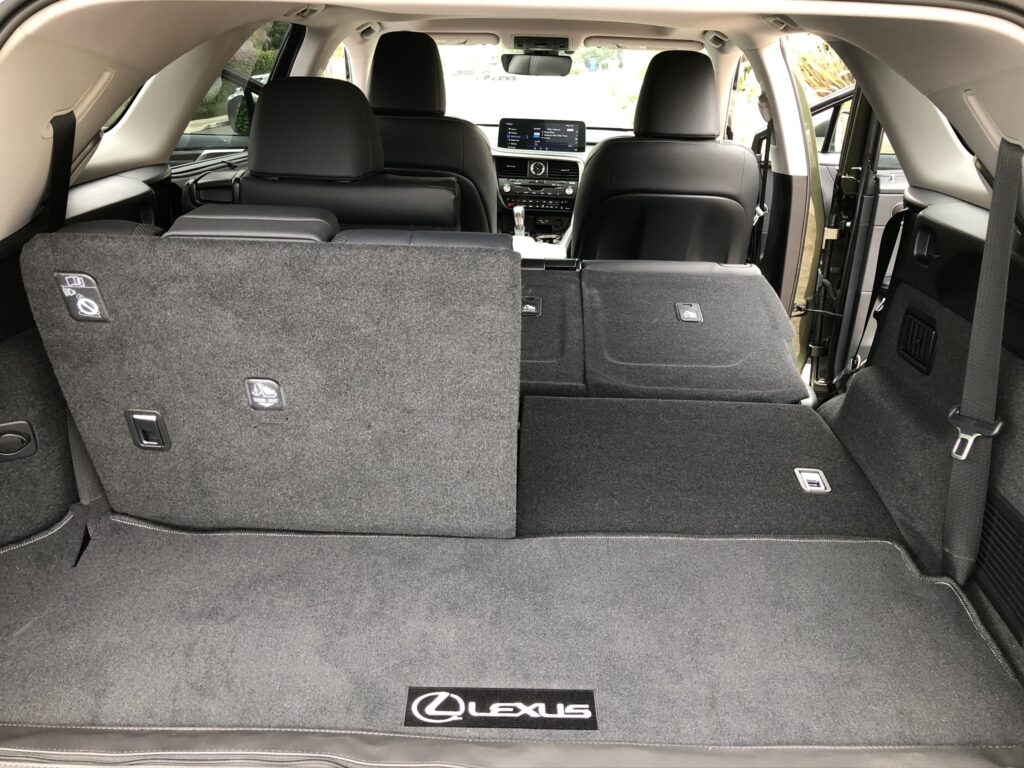
Cargo space has a wide opening of 45 inches but space behind the third row is limited at about 6 cubic feet, but it is ideal for corralling grocery bags. The roller cover can be stored in its own underfloor space when using the third row. (Mark Maynard)
BACK SEATS The second row has a flat floor and captain’s chairs with fore-aft slide and recline. The seats (or a 60/40 bench) will tip and slide for third-row entry or fold to extend cargo length. But moving back the seat can obliterate third-row legroom and moving it forward will cramp second-row comfort. The seats are short on adult thigh support but supportive — and the leather and stitching look fantastic, but there are no electronic controls for temperature or fan speed. The fold-down armrest houses two 2.1-amp charging USBs and two can holders.
The third row has a scant 23.5 inches of legroom, but the space has fan and vent controls. The power folding pair of seats is a slow-motion engineering masterpiece to watch as the seats (one at a time) fold, articulate and ease into a flat load floor.
Cargo space has a wide opening of 45 inches but space behind the third row is limited at about 6.2 cubic feet, which is ideal for corralling grocery bags, and there also is basement storage for the roller cover. Fold the third row and the hauling space is much more functional at 23 cu. ft. and about 42½ inches deep. Or fold both rows for about 6 ½ feet of board-hauling length.
While newer competitors have loaded their big guns to blast their place in the segment, Lexus has made incremental improvements consistently to the RX since its launch. But change happens slowly at Toyota Motor, the parent of the Lexus division. The company’s engineering philosophy is to “do it right the first time,” and let it ride for five to seven years.
From its first generation, the RX has stood out for its polarizing exterior design. Love it or hate it, the RX is still a gold standard for luxury with all the VIP prestige and pleasures of Lexus ownership.
The front-wheel-drive RX 350L tester was $62,715, including the $6,000 Luxury package and the $1,025 freight charge from Fukuoka, Japan. (Lexus)
2020 Lexus RX 350L FWD Body style: midsize, 6-7 seat SUV crossover in front- or all-wheel drive; aluminum hood and tailgate Engine: 290-hp, port and direct injection 3.5-liter V-6; 263 lb.-ft. torque at 4,700 rpm Transmission: 8-speed automatic 0-60 mph: 7.9 seconds Fuel economy: 19/26/22 mpg city/hwy/combined; premium fuel recommended for peak power
SPECIFICATIONS Fuel tank: 19.2 gal. Cargo space (floor to roof): 6.2 to 23 cu. ft. Front head/leg room: 38.7*/41.4 in. *39.8 without moonroof 2nd row head/leg room: 37.9*/30.9 in. *38.5 3rd row head/leg room: 34.8/23.5 in. Length/wheelbase: 196.9/109.8 in. Curb weight: 4,442 lbs. Turning circle: 38.8 ft.
FEATURES Luxury package equipment includes: keyless entry with push-button ignition, dynamic radar cruise control, power moonroof, heated-ventilated front seats, heated wood and leather steering wheel, Sapele laser cut wood with satin aluminum trim, semi-aniline leather upholstery and interior trim, LED lighted front door sills, manual rear-door sunshades, and power fold third-row seats, reclining-sliding second-row seats, 20-inch alloy wheels, automatic high-beam control Safety features include: 10 air bags, brake assist, Safety System 2.0 features of lane-tracing assist, road-sign assist, pre-collision system with pedestrian detection, lane-departure alert with steering assist
PRICING Base price: $54,325, including $1,025 freight charge; price as tested $62,715 Options on test vehicle: blind-spot monitor with intuitive parking assist, panoramic view monitor and rear-cross traffic braking $1,865; color head-up display $600; triple-beam LED headlights, cornering lights, front turn signals and fog lights $1,775; 12.3-inch navigation system with Mark Levinson 15-speaker audio system $3,365. door-edge film $90; cargo net, cargo mat, wheel locks and key glove $315; roof rack cross bars $380 Where assembled: Fukuoka, Japan Warranty: 4-years/60,000-miles bumper to bump with roadside assistance, free first and second scheduled maintenance services and a lodging for emergency breakdowns 100 miles from home; 5-years/70,000-miles powertrain
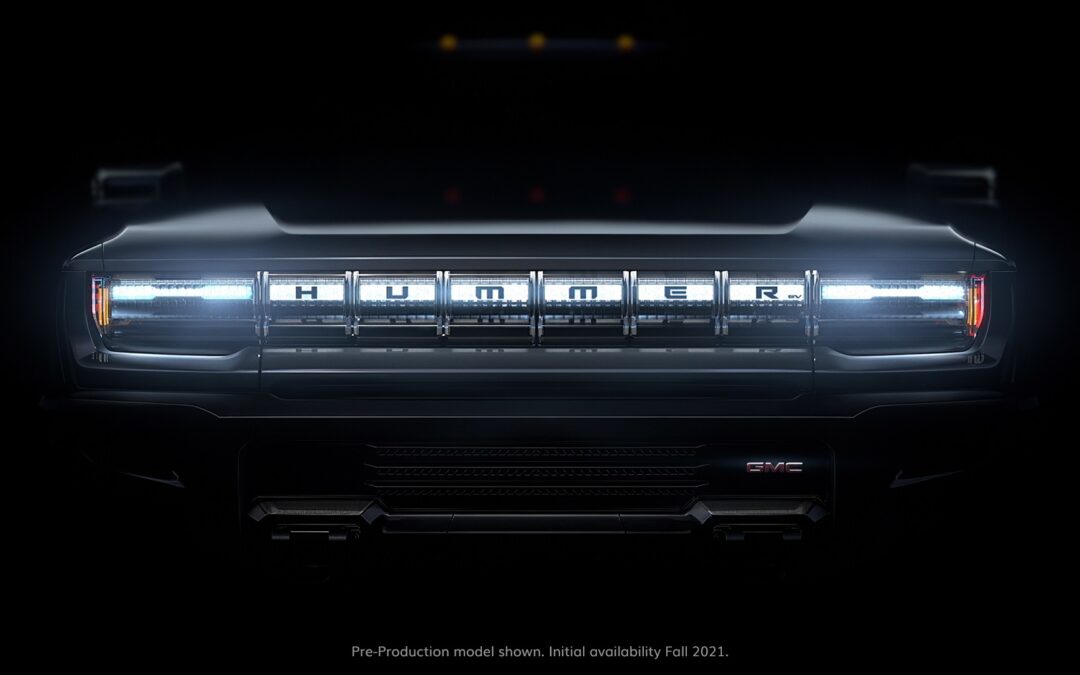
While many new-vehicle introductions are being delayed amid COVID-19 restrictions (including Corvette and Mustang Mach-E), GMC postponed the debut of its electric Hummer and Lincoln pulled the plug on a partnership with Rivian to develop a luxury electric pickup.
GMC announced today (April 29) that its Hummer EV reveal will be postponed from a May 20 dealer meeting in Las Vegas. In a release, GMC wrote: “While we cannot wait to show the GMC HUMMER EV to the world, we will reschedule the May 20 reveal date. In the meantime, the team’s development work continues on track and undeterred. We invite all to stay tuned for more stories on this super truck’s incredible capability leading up to its official debut. More information is available at www.gmc.com/HummerEV.
According to a report by Richard Truett in Automotive News, a spokesman said GM will look at all options, including a virtual event, when it reschedules the reveal “as the pandemic continues to affect all parts of business.”
“GM plans to build the Hummer at its Detroit-Hamtramck Assembly plant, which was being retooled to become GM’s EV manufacturing hub. Construction has been put on hold to comply with Michigan’s stay-at-home order. It’s unclear when the project will resume, but Michigan’s governor is planning to allow construction activities to resume in the state May 7.
“With GM’s designers and engineers unable to go to work at GM’s Tech Center in Warren, Mich., most development work has stopped. But GM says the Hummer pickup will go on sale in late 2021 as planned.”
Lincoln cancels Rivian EV partnership
And worse, Lincoln sent out a release on Tuesday, April 28 that it has shelved plans to develop an electric pickup with Rivian.
In the release, Lincoln said: “Given the current environment, Lincoln and Rivian have decided not to pursue the development of a fully electric vehicle based on Rivian’s skateboard platform. Ford Motor Company’s strategic commitment to Lincoln, Rivian and electrification remains unchanged and Lincoln’s future plans will include an all-electric vehicle consistent with its Quiet Flight DNA.”
According to a report by Michael Martinez in Automotive News: “Lincoln said it was still committed to its partnership with Rivian and would continue to work with the EV startup ‘on an alternative vehicle based on Rivian’s skateboard platform.’
“Ford Motor invested $500 million in Rivian last year.”
It was Jan. 29, 2020, when Lincoln shared news of the Rivian partnership to develop an all-new electric vehicle previously announced as part of Ford Motor Co.’s original investment in Rivian.
“Lincoln’s first fully electric vehicle will join the Aviator and Corsair Grand Touring plug-in hybrid vehicles, further solidifying Lincoln’s commitment to electrification,” Joy Falotico, president, The Lincoln Motor Co., said in the statement. “The zero-emissions vehicle will feature connected and intuitive technologies designed to create an effortless experience for Lincoln clients.
“Working with Rivian marks a pivotal point for Lincoln as we move toward a future that includes fully electric vehicles,” said Falotico. “This vehicle will take Quiet Flight to a new place – zero emissions, effortless performance and connected and intuitive technology. It’s going to be stunning.”
The Lincoln battery electric vehicle was to be built off of Rivian’s flexible skateboard platform. It was part of Ford’s previously announced investment of more than $11.5 billion into electrification, which includes the Mustang Mach-E and a fully electric version of the best-selling F-150 pickup.
“Our vehicle development partnership with Ford is an exciting opportunity to pair our technology with Lincoln’s vision for innovation and refinement. We are proud to collaborate on Lincoln’s first fully electric vehicle,” said Rivian CEO RJ Scaringe.
The compact-class Corsair is sold in Standard and Reserve models with starting prices of $37,000-$50,000. (Lincoln)
There cannot be two fraternal twin compact SUV crossovers that are so dramatically different than the Ford Escape and Lincoln Corsair, today’s tester. Both models
have been redesigned for 2020 and both are far more competitive than their predecessors.
But while the more utilitarian Ford doesn’t stretch any expectations, the Lincoln
does.
The Corsair has
the power, the presence and the appearance of a hand-crafted interior to slice
into the luxury competition. But its biggest nick in the blade is a high price.
As Lincoln’s
smallest SUV, the Corsair replaces the MKC and joins the midsize Nautilus,
three-row Aviator and big Navigator, all recently redesigned and renamed.
There is engaging and restrained use of chrome, piano black and metallic trim elements — and no burl walnut. (Lincoln)
The luxury competitors are many, including the Acura RDX, Alfa Romeo Stelvio, Audi Q5, BMW X3, Cadillac XT4, Lexus NX and Mercedes-Benz GLC.
The Corsair is sold
in Standard and Reserve models with a choice two turbocharged and direct
injected four-cylinder engines and an eight-speed automatic transmission. (A Grand Touring plug-in hybrid, with an estimated
25 miles of battery driving, goes on sale this summer.)
Headroom is functional at 38.7 inches with the panoramic vista roof and maximum legroom is long at 42.3 inches. (Lincoln)
The Standard front-wheel
drive model is only offered with the 250-horsepower, 2.0-liter engine and can
be optioned with automatic all-wheel drive for $2,200. Pricing starts at $36,940,
including the $995 freight charge from Louisville, Ky.
The Reserve, standard with AWD and the 2.0-liter engine, can upgraded to the 295-hp, 2.3-liter four-cylinder. Pricing starts at $43,625 with 2.0-liter engine or $50,365 with the 2.3-liter, which includes the Reserve 1 technology package of Co-Pilot360 Plus package and the Elements package (including ventilated front seats, heated back seats, heated steering wheel). Co-Pilot360 Plus package includes adaptive cruise control with traffic-jam assist (and lane centering, speed sign recognition and stop-and-go), 360-degree camera (with front camera washer), front sensing system, evasive steering assist, reverse brake assist and active park assist plus.
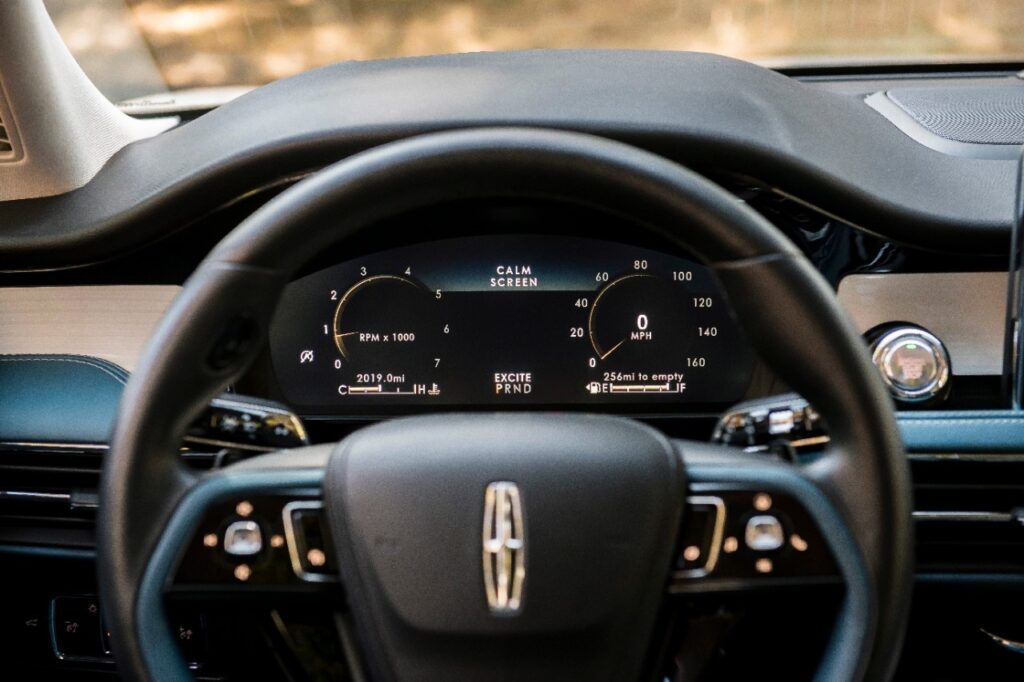
Five performance modes are named with Lincoln’s euphemistic enthusiasm of Normal, Excite, Slippery, Deep Conditions and Conserve. (Lincoln)
A sweet perk is
4 years and 50,000 miles of warranty coverage with pickup and delivery
for service.
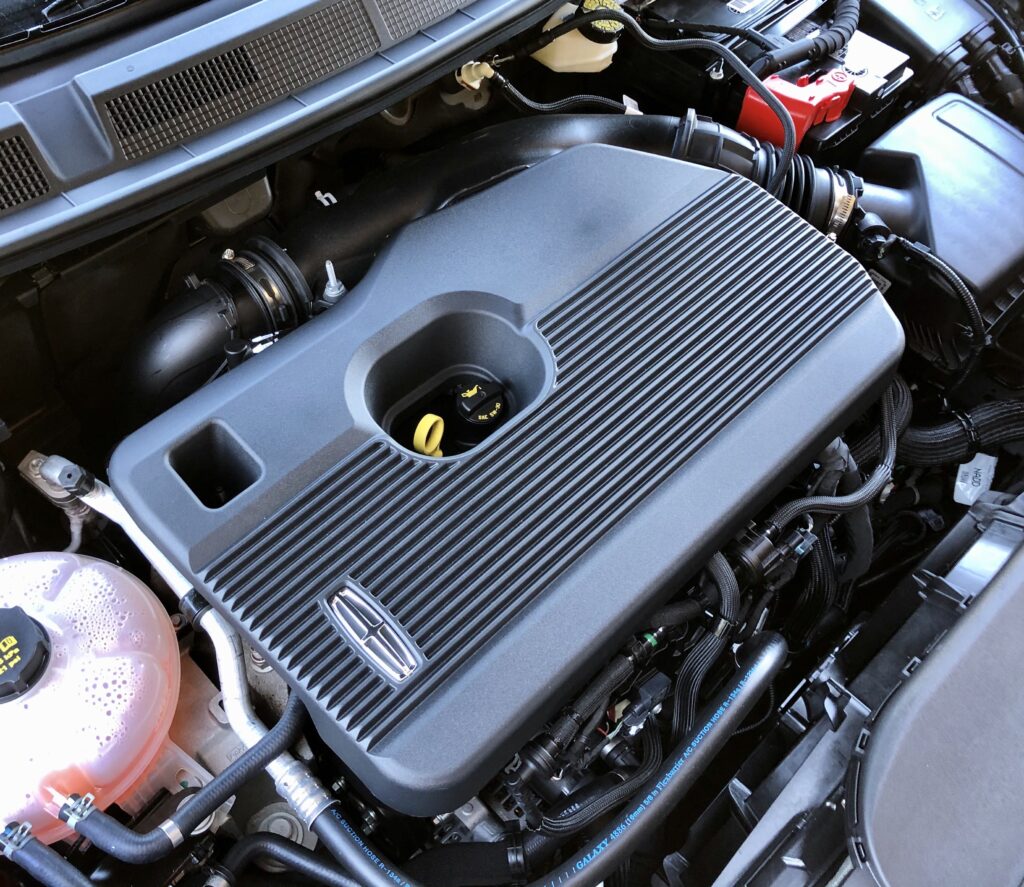
POWER I appreciated the ready power of the 2.3-liter four-cylinder. It easily motivates the curb weight of 3,851 pounds, from takeoff to guarding your space in the commute.
Fuel economy might
be hopeful at 21 mpg city, 28 highway and 24 mpg combined, on 87 octane. I
could only achieve the low- to mid-20s in a week of testing, but I don’t expect
owners will have regrets because the Corsair makes up for mileage in other
areas.
The 2.0 engine doesn’t offer much mileage incentive, with front-drive ratings of 22/29/25 mpg combined with AWD at 21/29/24 mpg.
The 2.3-liter turbocharged four-cylinder easily motivates the curb weight of 3,851 pounds, from takeoff to guarding your space in the commute. (Mark Maynard)
The eight-speed
automatic can at times feel unsteady in rolling out shifts, mostly at light or moderate
acceleration. And some of that might be in providing the varied performance in the
five drive modes, named with Lincoln’s euphemistic enthusiasm of Normal,
Excite, Slippery, Deep Conditions and Conserve.
I preferred the Normal setting because Excite was just a little too jerky unless driving hard; it increases pedal response and stiffens the suspension for handling and control.
The adaptive
air suspension provides competitive cornering. And city driving is quite civil,
without much head toss as the air springs dip to comfortably transition speed
bumps and steep driveways.
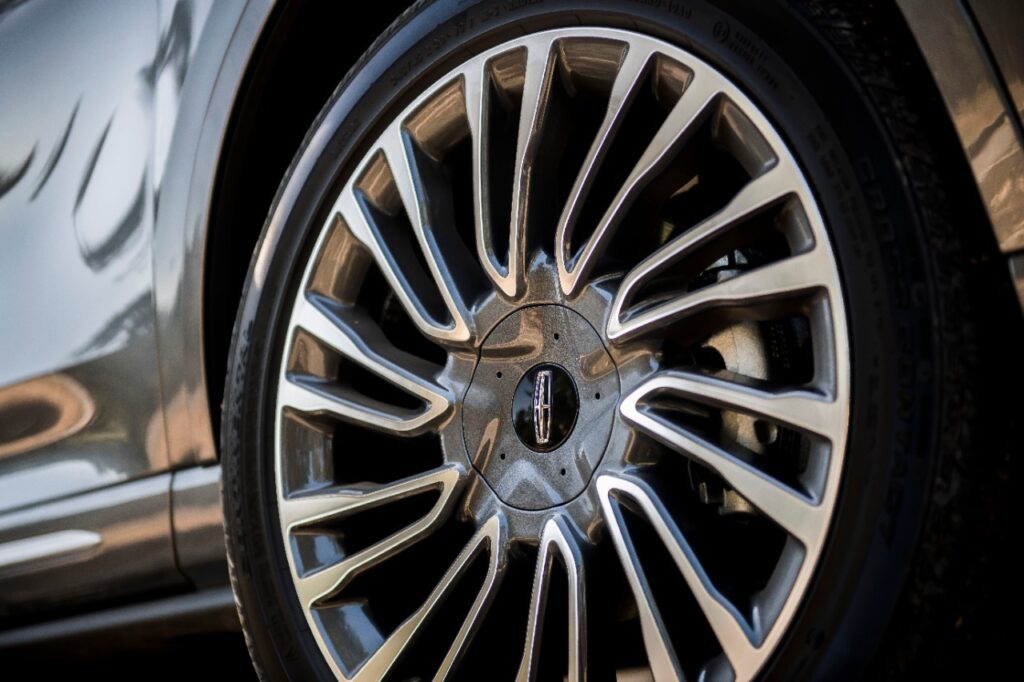
20-inch ultra-bright machined aluminum wheels are $1,150 upgrade. (Lincoln)
The CoPilot360 Plus system for semi-autonomous driving provides precision lane centering and was not prone to random cancelling due to sunlight glare or road-marking conditions. The other driver-assist and warning systems worked subtly and without frightening alerts to potential danger.
Braking is confident from 12.1-inch vented front discs and 11.9-inch solid rear discs.
TThe automatic all-wheel-drive system requires no driver input and with a disconnect feature, switches automatically from front- to all-wheel drive in response to road, speed, temperature and other conditions.
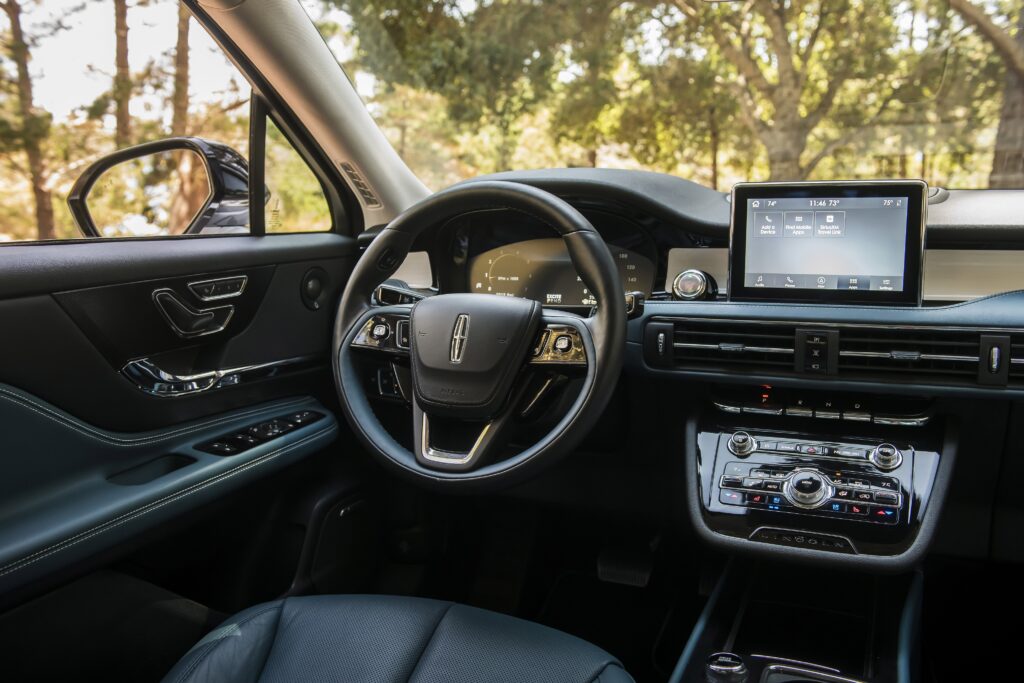
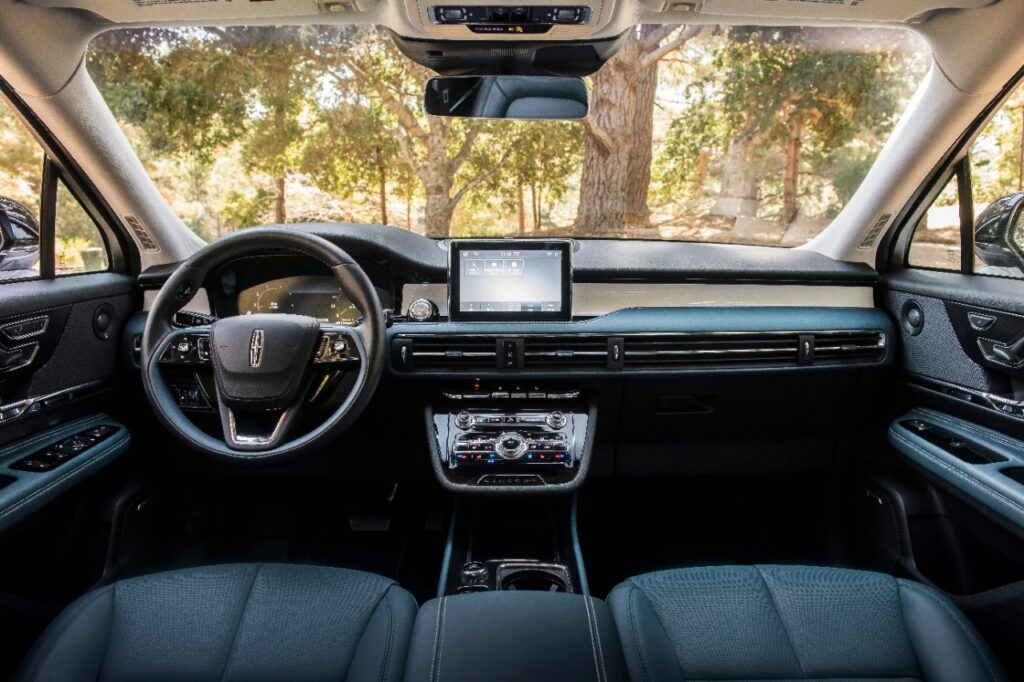
CABIN Lincoln tried to build a sanctuary in the cabin, and succeeded. There is engaging and restrained use of chrome, piano black and metallic trim elements — and no burl walnut. There is a reassuring feel of quality to the action of switches, door closings and the Bridge of Weir leather-trimmed upholstery.
With laminated windshield and side glass, dual-wall dashboard, acoustic underbody panels, wheel-arch liners and a noise-cancelling audio function, the cabin is not vault-like quiet, but the decibel count is luxury class whether driving 35 or 65 mph. Even tire noise or harshness from the 20-inch Continental Cross Contact tires was not objectionable.
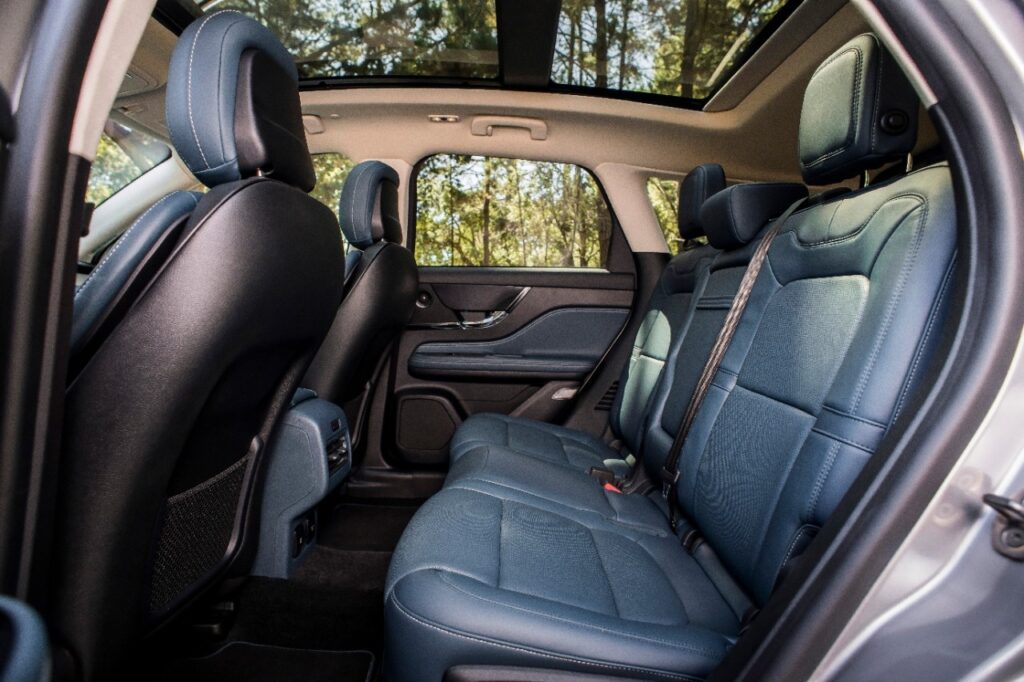
The back seat is reasonably comfortable for adults, but with the benefit of about 6 inches of fore-aft slide and seatback recline. (Lincoln)
As a compact-class vehicle, Lincoln has carved out comfortable interior space. Headroom is functional at 38.7 inches with the panoramic vista roof and maximum legroom is long at 42.3 inches. Sightlines are not compromised, though the rear glass is narrow. The tester’s optional 360-degree view camera is helpful in being able to see how badly centered you are in a parking slot or how close you parked to the garage door.
The array of driver
controls and an 8-inch touch screen display are not as difficult to master as
might seem at first view. And the 24-way Perfect Position seats should adjust for
most sizes, but the upper side bolsters might cramp large bodies.
The cargo space is squared off with a wide opening of 43 inches and 33 inches to the seatback. Fold the 60/40 seats for about 5 1/2 feet of length. (Lincoln)
There seem to be no overlooked conveniences, including headlights that turn with the steering wheel, wireless charging, four USBs, keyless locking and push-button ignition, 14-speaker Revel audio system, 4G Wi-Fi, infotainment apps and approach and departure lighting (including the Lincoln logo beamed downward at the side mirrors).
Safety features
include eight air bags, blind-spot detection and precollision assist with
automatic emergency braking.
Another Lincoln signature (gimmick) are six symphonic chimes — replacing standard electronic alerts — for everything from an open fuel door to an unbuckled seat belt. The chimes, recorded by the Detroit Symphony Orchestra, add another layer to the calming soundscape of the cabin, Lincoln says.
BACK SEAT AND CARGO The back seat is reasonably comfortable for adults, but with the benefit of about 6 inches of fore-aft slide and seatback recline. The window seats are heated and he lowish transmission tunnel helps center position footroom. There are two USBs for charging and a 110-volt plug with wimpy 100-watt power.
The cargo space is squared off with a wide opening of 43 inches and 33 inches to the seatback. Fold the 60/40 seats for about 5 1/2 feet of length. Total space ranges from 27.6 cubic feet (packed to the ceiling) to 57.6 cu. ft. with seats folded.
The Corsair is
surprisingly well done throughout — and it needed to be. As a bellwether for
the brand, it will attract a new level of buyers seeking midprice luxury.
At $60,000
as-tested, buyers won’t like the price, but they will like their Corsair.
A sweet perk of ownership is 4 years and 50,000 miles of warranty coverage with pickup and delivery for service. (Lincoln)
2020 Lincoln Corsair AWD Reserve Body style: compact, 5-seat, 5-door SUV crossover with AWD Engine: 295-hp, turbocharged and direct-injection 2.3-liter 4-cylinder; 310 lb.-ft. torque at 3,000 rpm Transmission: 8-speed automatic Fuel economy: 21/28/24 mpg city/hwy/combined; 87 octane
SPECIFICATIONS Fuel tank: 16.2 gal. Cargo space: 27.6 to 57.6 cu. ft. Front head/leg room: 38.7*/43.2 in. *w/panoramic roof Rear head/leg room: 38.7/38.6 in. Length/wheelbase: 180.6/106.7 in. Curb weight: 3,851 lbs. Turning circle: 37.1 ft.
FEATURES Standard equipment includes: smart-key entry and push-button ignition, Lincoln Co-Pilot360 driver-assist technologies, Bridge of Weir leather-trimmed upholstery, 24-way power adjustable front seats, electric parking brake, rearview camera, panoramic vista roof, heated and foldable side mirrors, LED headlights-taillights-fog-running lights, 8-inch touch screen for infotainment and navigation, heated front seats, active noise control with laminated windshield and side door glass, front and rear floor mats, Lincoln Connect and Lincoln Way App, illuminated door-sill plates, power steering column, hands-free liftgate, 19-inch wheels and all-season Continental tires, approach and exit lighting
Safety features include: 8 air bags, blind-spot detection, precollision assist with automatic emergency braking, roll-stability control
PRICING Base price: $50,365, including $995 freight charge; price as tested $59,660 Options on test vehicle: Flight Blue paint $695; 20-inch wheels and 245/45 all-season tires $1,150; head-up display $1,700; Equipment group Reserve II $11,540 (including Co-Pilot360 Plus, Perfect Position 24-way power seats, adaptive suspension Where assembled: Louisville, Ky. Warranty: 4-years/50,000-miles bumper to bumper including pickup and delivery for service; 6-years/70,000-miles powertrain
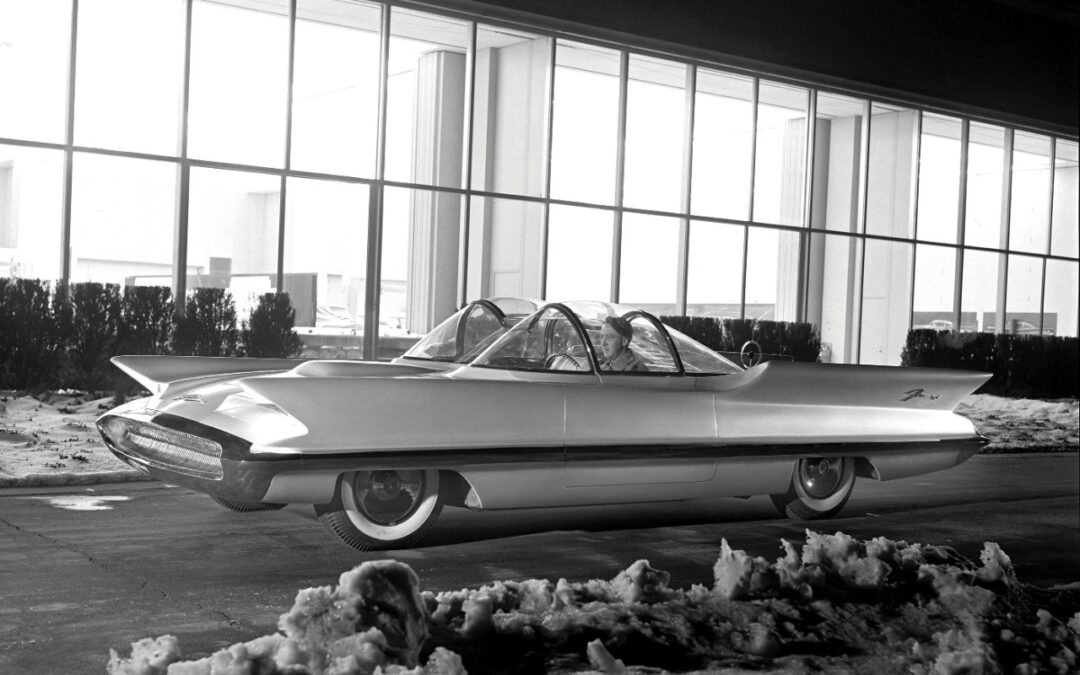
Ford gained a whole new sheen in 1955 when the company coated the Futura concept car with pearlescent paint. Ford was among the first to show off this new paint technique, which consisted of adding crushed pearls to paint.


 Porsche mascots Tom Targa and Tina Turbo urge fans to share some Porsche from home. (Images courtesy of Porsche)