Select Page

Triumph Speed Twin First Look

Triumph Speed Twin First Look

The 2022 Triumph Speed Twin is a  1960s Bonneville modern classic

An static view of the 2022 Triumph Speed Twin sport roadster motorcycle

The Triumph Speed Twin set the benchmark for how a modern classic sport roadster should ride and feel. (Photos courtesy of Triumph)

Table of Contents

Performance
Ride and Handling
Styling
Pricing, Accessories
Why Buy the 2022 Triumph Speed Twin?
Specifications

BY JOE MICHAUD,
Special to Maynard’s Garage

The original Triumph Speed Twin 5T was designed in 1937 by the prolific British visionary Edward Turner. When the 5T made its debut, the 500cc parallel-twin design proved innovative in a performance world previously dominated by large displacement single-cylinder motorcycles. The 5T provided significantly more horsepower, torque, and, more importantly, less vibration than era-available performance singles.

Turner was complicated, sources say, and his inability to compromise was often an impediment to design progress. However, no one can doubt the success of his Speed Twin design. Turner’s design would set the tone — as well as the basic parallel-twin engine design — that would sustain the British motorcycle industry for nearly four decades. Even today, most Triumph devotees credit the 5T and its offspring, the 5TA, for the post-war recovery of Triumph. Its popularity would allow the model to soldier on until 1966.

Triumph cannily resurrected the famous “Speed Twin” nameplate in 2018. It marked the introduction of a line of 1200cc twin-cylinder bikes the factory called “modern classic performance roadsters.”

Four years later, the newest Speed Twin continues the panache of the sport roadster.

Metzeler Racetec RR tires on lighter 12-spoke 17-inch cast wheels.

Metzeler Racetec RR tires on lighter 12-spoke 17-inch cast wheels.

2022 Speed Twin Performance

Triumph has updated the High Power Bonneville twin engine with more midrange power and torque. The fresh enhancements boost the fun for me with the 83 foot-pounds of peak torque moved lower to 4,250 rpm. The power band is more available for real-world riding. And torque is where my motorcycle fun lives.

Rider feel has been enhanced by a reduction in rotating engine inertia. A lightened crankshaft and alternator allow the motor to rev quicker. The combined modifications raise the redline by 500 rpm to 7,250 where the horsepower peaks at 100. A revvy motor coupled with a new profile camshaft (more lift and longer duration) and fresh porting add to the fun factor. It’s all good stuff.

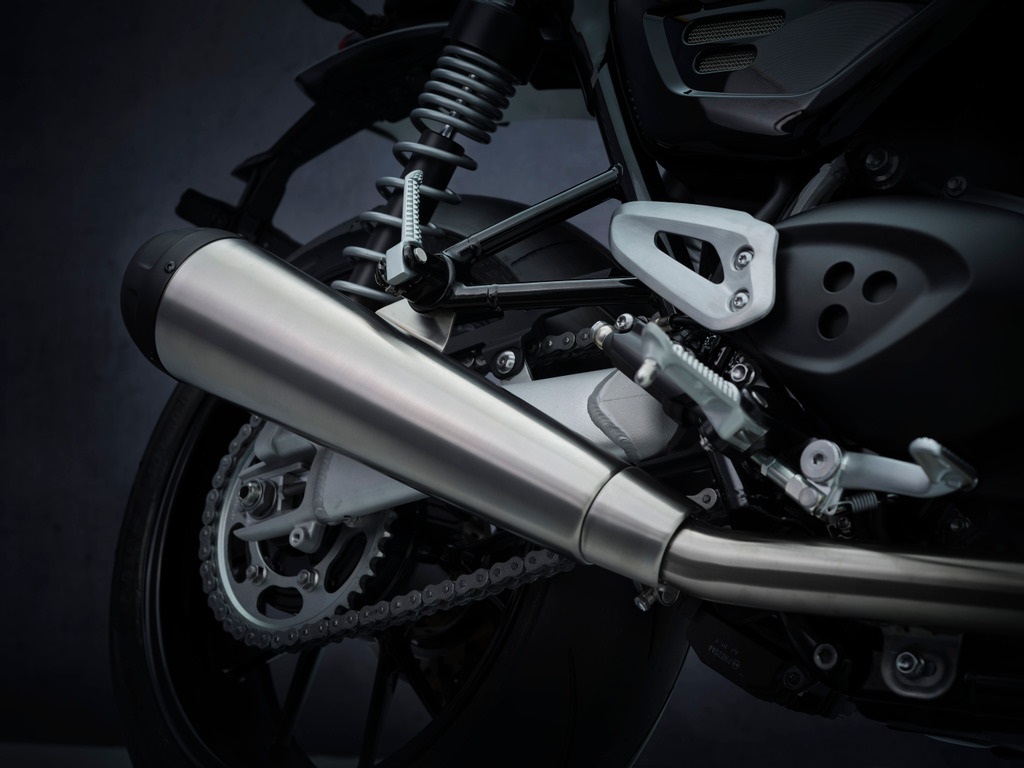
Brushed stainless-steel twin upswept exhaust silencers

Brushed stainless-steel twin upswept exhaust silencers are new.

Improved Handling

Triumph improved the 2022 Speed Twin handling with fresh higher-spec Marzocchi cartridge-damped forks up front. The Marzocchis are a non-adjustable, upside-down 43mm design with 120mm travel.

Twin rear shocks are pre-load adjustable only, and also give 120mm travel. Suspension mods always improve riding feel. These non-adjustable items certainly fit the moderate price point, but enthusiastic riders may tire of them.

Metzeler Racetec RR  tires wrapped on lighter 12-spoke 17-inch cast wheels make turn-in smooth and predictable.

Front brakes are by Brembo with four-piston M50 radial monobloc calipers.

Front brakes are by Brembo with four-piston M50 radial monobloc calipers.

Front brakes are Brembo four-piston M50 radial monobloc calipers squeezing twin 320mm discs. The rear stopper is a single Nissin two-caliper 220mm disc. ABS is standard. Initial bite is strong with much good feel for the bike.

The cable-pull clutch is torque-assisted, coupled through a six-speed gearbox. The shifts are as slick as a bolt-action rifle.

 Speed Twin Ride and Handling

The narrow-waisted saddle with a 31.5-inch seat height provides a slim stand-over width. The reach to the midposition pegs and tapered bars deliver an easy upright position to the rider. It sits easy-peasy and comfy in urban use. Dealing with a stretched sport-bike crouch designed for the track can often be an ergonomic distraction for urban commuting. For most of my bike business, I’ll take some upright situational awareness over sport-bike ergonomics.

There is no multi-axis lean angle sensing (IMU), no quick shifter, and no cruise control. ABS is non-cancellable and electronic controls are limited to basic ride modes — rain, road, and sport. There are no wide distinctions between the basic ride modes. After a few days of playing with the modes, I suspect most riders will simply leave in it Sport and modify their right fist as needed.

The bright headlight

All Speed Twin lighting is LED, except the headlight.

Electronics

The lack of cruise control might feel like an oversight to some riders; inclusion during production would be a pushover for a ride-by-wire bike. Triumph already includes cruise control on other models, so perhaps it’s an additional cost saver. However, I’m not sure I would miss it. Electronic cruise control can be a boon on long commutes over open interstate roads, but I enjoy having personal control of my motorcycles.

All lighting is LED, except the headlight, oddly enough. An under-seat USB charger can keep your phone at the ready.

The claimed weight is 476 pounds, wet and ready. And the first major service is slated for 10,000 miles. That’s a nice cost saving.

Fuel capacity is a moderate 3.8 gallons with a claimed combined fuel economy of 43 mpg. I’m not a fan of the exposed bottom seams currently unavoidable on many new bike tanks. It’s less expensive to manufacture, but I always see the seams.

The bike's ergonomics are ideally proportioned.

The Speed Twin ergonomics are ideally proportioned.

Speed Twin Styling

I like that the Speed Twin looks as a Triumph should.

The modern Speed Twin has kept the open, airy silhouette of a vintage twin-shock 1960s T120. The Speed Twin would not look out of place parked in formation with my 1966 T120 and ’68 TR6R. Light, nimble, and sporty. To my eye, it simply looks right. As much as American V-Twins cling to their classic look, the Bonneville line from Triumph also stays the course. Retro sells, and I enjoy it.

The brushed stainless-steel pipes with black-capped exhaust cans look the part. Together they cleverly hide the emission-control catalyst that makes the bike Euro-5 compliant.

Brushed alloy fenders fore and aft lend a sporty detail. A bar-mounted scroll button controls the discrete multi-function LCD display. The gauges — tach and speedo — are analog and needle-swept. I love them.

Instrumentation is by twin dial analog speedometer and tachometer with LCD multi-functional displays.

Instrumentation is by twin dial analog speedometer and tachometer.

Triumph Speed Twin Pricing

Sharper-minded race folks might decide the Thruxton RS better suits their jam. But the Speed Twin at $12,500 MSRP, has the same basic horsepower and torque as the RS — albeit with a few less zooty parts, suspension, etc. — for $5,000 less.

Paint choices are three, Jet Black is standard, Red Hopper and Matt Storm Grey are $300 options. Finish and detail are superb throughout the Triumph line.

Accessories I would select include knee grips ($70), round bar-end mirrors ($199), and the quilted black seat ($430). See the list of accessories here.

A well accessorized speed twin

More than 50 Speed Twin accessories are available.

Why Buy the 2022 Triumph Speed Twin?

My dictionary defines a roadster as a “two-seat performance vehicle” so it’s not a stretch when Triumph calls the Speed Twin “a modern Classic, performance roadster.”

I’ve never bought a motorcycle simply for transportation. For me, emotion is a powerful persuader. So, I’d like to see a Speed Twin with polished alloy engine cases and wire-spoked wheels. Otherwise, this bike ticks all my boxes for a thoroughly modern 1960s Bonneville.

Joe Michaud is a San Diego-based motorcycle rider and restorer. Send him an email at jmichaud@san.rr.com.

2022 Triumph Speed Twin Specifications

Style: Sport roadster with tubular steel frame and steel cradles

POWERTRAIN

Engine: liquid-cooled, 8-valve, SOHC 1200cc High Power Bonneville parallel-twin, 270-degree crank angle

Power: 98.6 bhp at 7,250 rpm; 83 lb.-ft. torque at 4,250 rpm

Fuel injection: electronic multipoint sequential

Fuel economy: 43 mpg, estimated; combined city and highway

Exhaust: brushed stainless steel 2 into 2 system with twin silencers

Transmission: 6-speed manual

Clutch: wet, multiplate torque-assist clutch

TIRES-WHEELS

Front: 12-spoke cast aluminum alloy, 17 inches by 3.5 inches; 120/70 ZR17

Rear: cast aluminum alloy, 17 inches by 5 inches; 160/60 ZR17

SUSPENSION

Front: 43mm USD Marzocchi forks, 120mm travel

Rear: twin RSUs with adjustable preload, 120mm rear wheel travel

BRAKING

Front: Twin 320mm discs, Brembo M50 4-piston radial monobloc calipers, ABS

Rear: Single 220mm disc, Nissin 2-piston floating caliper, ABS

BY THE NUMBERS

Wet weight: 476.2 pounds (216kg)

Fuel tank: 3.8 gallons

Seat height: 31.85 inches

Length/wheelbase: 82.6 inches (2099mm)/ 55.6 inches (1413mm)

PRICING

Speed Twin base price: $12,500 MSRP

Warranty: two-years unlimited mileage

Where assembled: Hinckley, Leicestershire, England

Kia EV6 Review

Kia EV6 Review

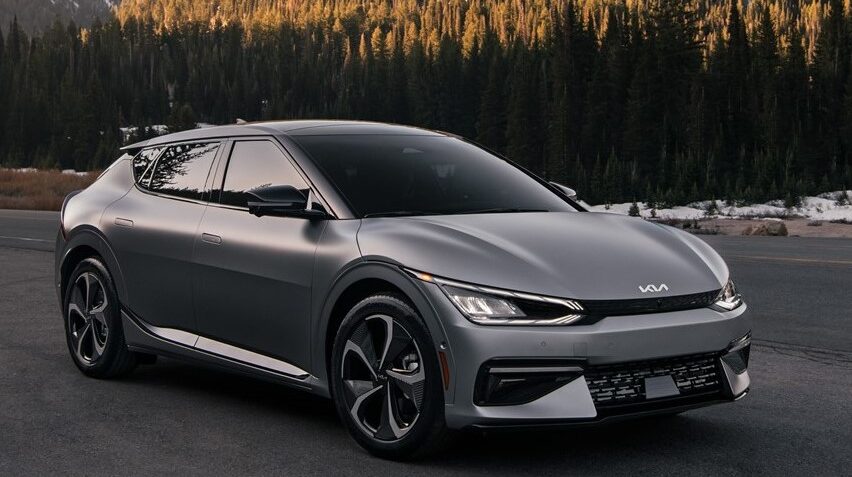
The 2022 Kia EV6 battery-electric is a visual blitz of aerodynamic origami for the electrified era

An exterior view of the EV6

Buyers of the battery-electric 2022 Kia EV6 will receive a charging credit of 1,000 kWh, useable over 3 years. (Photos courtesy of Kia America)

Table of Contents

Developing the Kia EV6
EV6 Exterior Design
5 Cool Things
Kia EV6 Pricing
Incentives and Rebates
Powertrain and Charging
Onboard Generator
EV6 Performance
Ride and Handling
Interior Function
Why Buy the Kia EV6?
2022 Kia EV6 Wind Specifications

BY MARK MAYNARD

The speedline styling of the 2022 Kia EV6 gives it a car-of-the-future mystique. But beneath its steel exterior and neural network of electrification, is the familiar function of a “normal” car. If you are comfortable navigating a smartphone, this car will be a quick study — but not all is simple with some of the electronic controls.

Developing the EV6

The battery-powered Kia EV6 crossover SUV signals the beginning of the brand’s transformative “Plan S” electrification strategy. Kia says it will deliver 11 new electrified models across the world by 2026.

Starting with the EV6, Kia’s EV lineup will have the “EV” designation followed by a number that indicates the car’s position in the lineup.

The E-GMP modular platform will allow multiple vehicle segments — sedans, CUVs, SUVs — with dual-motor options for all-wheel drive.

It is an adaptable foundation with a long wheelbase and wide stance, Kia says. The EV6 has the same 114.2-inch wheelbase as the full-size Kia Telluride SUV. And the liftback EV6 compares with the width of a Ford Mustang Mach E and the wheelbase and ground clearance of a Tesla Model Y.

The EV6 shares powertrain elements and some technologies with corporate partner Hyundai and its just-released IONIQ5, but the two EVs are distinct in styling and footprint. The EV6 is 1.8 inches longer than IONIQ5 and narrower by just .04 inch. The EV6 wheelbase is shorter by 3.9 inches, and the roofline is lower by 2.2 inches.

An overhead view of the Kia EV6

Features of the EV6 GT-Line include a sunroof and monochromatic paint.

EV6 Exterior Design

Exterior design of the EV6 was a collaborative effort between all three of Kia’s global studios: Namyang, Korea; Frankfurt, Germany; and Irvine, Calif.

The appearance is a visual blitz of aerodynamic origami for the electrified era.

  • A series of slash lines above and below the headlights are the daytime running lights. Kia says the treatment defines the car’s “Digital Tiger Face,” which carries over from Kia’s “Tiger Nose Grille.”
  • The smooth rise of the hood with fender-top bulges flows up and over the swept-back windshield to the slant of the rear tailgate.
  • Crossover-inspired side profile . A character line runs along the bottom of the doors and curves upward toward the rear wheel arches to visually elongate the profile of the car.
The 'Digital Tiger Face' of the Kia EV6

The ‘Digital Tiger Face.’

5 Cool Things About the EV6

  • Dual 12.3-inch-wide digital display screens for driver information and navigation-media.
  • 800-volt multicharging architecture allows ultra-fast DC charging from 10 percent to 80 percent charge (up to 210 miles range) in less than 18 minutes.
  • An upcoming high-performance EV6 GT will have 576 horsepower and is capable of 0-60 mph acceleration in less than 3.5 seconds, Kia says.
  • 21 standard active advanced driver assistance systems. Semi-autonomous driver capabilities include Highway Driving Assist 2.
  • Onboard power generator, known as Vehicle-to-load (V2L) functionality. Owners can use the EV6 battery as an emergency power source.
The power-opening charge door of the EV6.

The power-opening charge door.

 2022 Kia EV6 Pricing

The Kia EV6 is sold in three rear-wheel-drive trim levels of Light, Wind, and GT-Line; all-wheel drive is available for the Wind and GT-Line. The transmission is a single-speed reduction gear with drive modes of Eco, Normal, Sport, and Snow.

Starting prices range from $42,155 for Light, $48,750 for Wind RWD (add $3,900 for all-wheel drive), and $52,455 for the GT-Line RWD or $57,155 with AWD. Pricing includes the $1,255 freight charge from Hwasung, Korea.

Standard equipment on all EV6 trim levels is substantial to support the pricing. Among the features is smart-key entry with push-button ignition (and remote start). Navigation-based smart cruise control has stop-and-go function. And dual 12.3-inch-wide digital display screens (one screen is for driver information, the other for navigation-media) have a panoramic presence. There also are five USB ports (four USB-C charging ports and 1 USB-A media port) and a wireless phone charging pad. The front seats are heated and the driver has an eight-way power-adjustable seat with lumbar.

Also standard is Kia Connect smartphone connection via app. Users have access to lock or unlock the car, remote climate control for preheating or precooling, vehicle charging, Find My Car, and stolen vehicle recovery.

Check here for current Kia EV6 pricing.

The Kia EV6 GT-Line driver area

The EV6 GT-Line driver area with non-animal leather upholstery.

EV6 Trim-Level Details

The EV6 Light trim level has a smaller battery and a shorter driving distance. Inside, the black interior is dressed in recycled fabric and vegan leather (or pleather). Paint colors are limited to just two no-cost choices (Interstellar Gray and Gravity Blue) with a $495 option for Snow White Pearl.

EV6 Wind

For another $6,595, the Wind brings a significant boost of features. The big assets are a bigger battery, a bigger motor, and a 310-mile all-electric driving range, 78 miles farther than the base model.

The Wind also adds the onboard power generator (V2L), gloss-black exterior accents, ventilated front seats, vegan-leather upholstery, an eight-way power front passenger seat with lumbar support, 14-speaker Meridian audio system, smart power tailgate, park-distance warning forward and reverse, and tow-package wiring.

The rear-drive Wind tester was $48,750 with one option for Glacier paint (sort of a faint gray), $495.

EV6 GT-Line

As the top-line model, the GT-Line includes all the features of the Wind, plus exterior and interior upgrades for the price difference of $3,705.

Inside are such extras as a wide sunroof, non-animal leather, and suede seat upholstery, an eight-way power front passenger seat with two-way power lumbar. The “Chauffeur Seat” fore-aft adjustment switch (more of a limousine feature) allows rear passengers to move the front passenger seat forward for more footroom or easier exit).

The EV6 Augmented Reality (AR) Head-Up Display system is engaging for its large three-dimensional image that appears to hover over the hood of the car. Graphics are projected from the base of the windshield and include such functions as speed and driver assistance system alerts, lane guidance, and turn-by-turn navigation instructions.

The augmented head-up display in the EV6

The Augmented Reality Head-Up Display system, only on the EV6 GT-Line.

Unique to the GT-Line exterior are monochromatic paint with gloss black accents, 20-inch wheels, and the very desirable automatic extending door handles.

The GT-Line AWD adds 20-inch wheels (a 1-inch upgrade), heated rear seats, and a heat pump, which is more range-preserving than radiant cabin heating.

Kia EV6 Incentives and Rebates

In California and some other states, the 2022 Kia EV6 qualifies for up to $10,250 in federal and state rebates or incentives.

Federal Electric Vehicle Tax Credit: $7,500.  IRS tax forms are here.

California Clean Fuel Reward: $750. Available toward the purchase or lease of a new electric vehicle with a battery capacity greater than 5. The customer must register the vehicle in California and the customer must reside in California.

California Clean Vehicle Rebate: $2,000.  Participants are eligible based on gross annual income, as stated on their federal tax return.

Find federal and state laws or incentives here.

And the Kia EV6 qualifies for California’s High-Occupancy-Vehicle freeway access, $22, with the green DMV decal

EV6 tire and wheel sizes are 19 or 20 inches with a substantial footprint of 235/55.

Tire and wheel sizes are 19 or 20 inches with a substantial footprint of 235/55.

EV6 Powertrain and Charging

The lithium-ion polymer battery is packaged “skateboard” style under the floor. There are two sizes of high-voltage batteries: 58 kWh (only on the Light trim level) and 77.4 kWh, standard for Wind and GT-Line.

Rear Wheel Drive, Light: 58 kWh battery with a 125kW 167 horsepower rear motor. Estimated zero-to-60 performance in 8 seconds with 232 miles of driving range;

RWD, Wind and GT-Line: 77.4 kWh battery with a 168kW 225-hp rear motor. Estimated zero-to-60 performance in 7.2 seconds with 310 miles of driving range;

AWD, Wind and GT-Line: 77.4 kWh battery with a 70kW front motor and 239kW rear motor for 320-hp total. Estimated zero-to-60 performance in 5.1 seconds with 274 miles of driving range;

Ultra-Fast Charging

Kia says its “world’s first” patented multicharging system supports 400-volt and 800-volt DC charging. The system works on DC chargers with speeds ranging from 50kW to 350kW.

  • 50kW DC fast charging will take 73 minutes to charge from 10 percent to 80 percent.
  • 350-kW DC fast charging adds nearly 70 miles in less than 5 minutes. From a 10 percent to 80 percent charge, it takes fewer than 18 minutes to add up to 210-miles.
  • 11kW onboard charger for Level 2 home or public charging. It can boost the charge from 10 percent to 100 percent in 7 hours, 10 minutes (240-volt AC at 40-amps) for the 77.4 kWh battery.

Onboard Generator

The so-called Vehicle-to-Load (V2L) functionality, or onboard power generator, allows the EV6 to be a power-outage savior. A special adapter connects at the rear charging port to tap power from the high-energy battery.

The generator provides 1900 watts to power electrical appliances, devices, tools, and recreational gear. Or tap into it for tailgating and beach parties.

From a full charge, EV6 power can be drawn for 36 or more consecutive hours, Kia says. And the EV6 can charge vehicle-to-vehicle at 1.1 kW, equivalent to a 110-volt charger. (Charging will be verrry slow but it’s better than nothing in an emergency.)

The system also includes a household 110-volt power outlet at the second-row seat base. Owners could use it to recharge tools and devices or plug-in for video entertainment on the go.

The Kia EV6 has an onboard generator to use in emergency situations or to power appliances and more

Be the life of the outdoor party with the onboard generator.

EV6 Performance

I did the majority of my driving in Normal mode, but if I had a Level 2 home charger, I’d let it rip in Sport mode all the time. It’s not that performance in Normal is lacking. Acceleration from a start feels reserved as the curb weight gets rolling. But there is a fire hose of force with a heavier foot on the accelerator pedal.

Driving in Normal mode seemed miserly in how it conservatively, or efficiently, used the battery reserve. Depending on temp and terrain, a 5-mile jaunt can register 3 miles on the battery charge.

Flip the steering wheel drive mode tab to Sport and the EV6 sees red — the digital driver’s screen glows red. Plunge the accelerator and the performance feels blistering fast, but always controllable. There is no lag in moving away from the light.

A Quick Charge

For a 90-mile roundtrip to visit friends, I topped off the battery, which had a charge of 71 percent. At an EVgo public fast-charge station, it took just under 31 minutes for the charging to stop at 100 percent for 299 miles of range. I used 24.270 kWh of energy for a cost of $14.12. And that is without member discounts on charging. Charging at home on a Level 2 charger gives a greater member discount and a lower power company time-of-use cost to charge in off-hours.

The equivalent fuel cost for adding just over a quarter tank of 87 octane to a 15-gallon fuel tank would have been almost $20 at $5 a gallon.

When asked why my charge didn’t reach the expected 310 miles, the Kia rep explained that total range depends on a variety of factors, including driving style and past efficiency. “Your battery percentage and indicated range will not always be linear per charge, he wrote in an email. “That explains a significant portion of the variance, as you’ve probably experienced with other EVs.”

As with an ICE vehicle, “your mileage may vary.”

The front motor of the Kia EV6 AWD

AWD models add a front motor for a total of 320 hp and 274 miles of range.

EV6 Ride and Handling

The EV6 rides like a big luxury sedan. And the suspension is not elaborate, a steel multilink setup with MacPherson struts at the front and a rear five multilink. Shock absorbers front and rear have selective damping control.

With a curb weight of 4,017 pounds, the EV6 Wind is not a heavyweight among EVs, but the driver can sense the heft of motivating the tonnage.  Transitioning speed bumps and driveways will generate a waggle of head toss. And there will be occasional clunks and jolts as the suspension manages the weight over heaves in the road and busted pavement.

On the highway, the EV6 is a superliner of smoothness. The ride is sound-isolated from road or tire harshness and the cabin is a relaxed atmosphere from the clamor of the commute.

Driving in Sport mode noticeably boosts acceleration response and, somehow, makes the EV6 feel less weighty. With a home Level 2 charger, I’d drive in Sport mode all the time.

Dual 12.3-inch-wide digital display screens show driver information and navigation-media.

A dramatic presentation of dual 12.3-inch-wide digital display screens.

Interior Function

The EV6 cabin has the appearance of a crisply dry-cleaned and neatly pressed dress shirt. It is thoroughly modern and lined with eco-friendly materials. Recycled plastic is used extensively with non-animal leather surfaces on some trims. There is full LED lighting inside and out.

The joined 12-inch digital infotainment screens form a curved display extending 2 feet across the instrument panel. The combined span of screens has a dramatic presence and is easily viewed with filtered blue light.

There are just a few key physical buttons along the instrument panel.

The slim dashboard extends from the steering wheel across to the center of the car. Below the navigation screen are controls for heat, ventilation, and AC that have electronic haptic-touch buttons. There is a bi-modal function to access either the heat-AC-vent controls or the media-radio settings. At either end of the slim control panel is a small dial. One is for manually adjusting volume or fan speed, the other is for channel tuning or temp. But the touchpoints to switch modes is a small contact point that can sometimes be hit-and-miss while driving. Several times I cranked the fan speed when I want to blast the tunes. In time, a driver will adjust.

The center armrest is treated almost as a design statement. Its peninsula style anchors the start button, gear engagement selector, wireless charging pad, and switches for seat heating and ventilation. And there’s also a deep storage box.

The peninsula-style console in the Kia EV6 has open storage below.

The peninsula-style console has open storage below.

Below the console is open storage large enough for a purse or to-go bag. Door panels have generous bottle storage slots and the space is lined with some type of recycled fabric-like material.

The center shift console in the EV6

The multifunction center console makes a design statement.

EV6 Driver Sightlines

Sightlines for the driver are open across the hood. But over-the-shoulder views are somewhat complicated by the narrow back glass and upswept rear quarter. However, the standard surround-view monitor gives total parking views through four cameras.

My biggest complaint was the exterior door handles that do not automatically extend when walking up to the car with the key fob in pocket. Instead, opening the door is almost a two-handed exercise to push open the flush handle and pivot your hand to grab the lever. To get an automatically extending door handle, you’ll have to step up to the EV6 GT-Line.

Unfortunately, there is not a standalone option for automatic door handles on the Wind. And for that simple convenience, I’d opt for the GT-Line.

Back Seat and Cargo Area

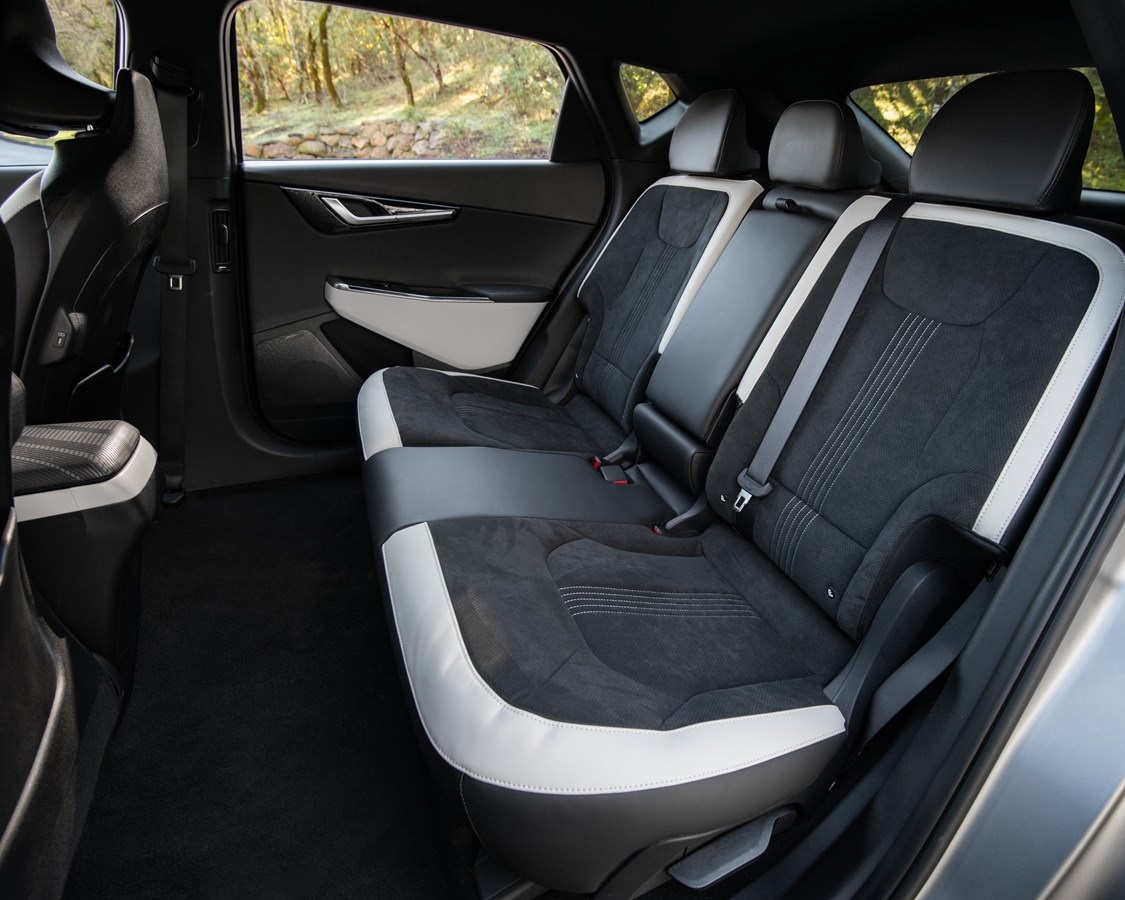
All of the back-seat dimensions for the EV6 indicate executive-class transport: 38 inches of headroom, a flat floor, and thin front-seat frames that help maximize rear knee room. But there are complications. Passengers with large shoe sizes might comment on the narrow foot space for entry and exit. The 39 inches of max legroom is adult-class long unless there are tall people up front who don’t wish to move their seats forward a bit. And the seating position feels low because of the upswept rear-quarter panels. And the Wind has no option for a sunroof to help visually open the space.

Once seated, however, there are many assets. Among them are B-pillar vents that add welcome airflow, which is especially beneficial for those who are sensitive to motion. The seat bottoms have adult thigh support and there are a few clicks of seatback recline. And the handy USB port in the side of the front seatback is such a smart idea that it should be copied by others. The fold-down center armrest has a pair of can holders, and there is bottle storage in the doors.

The EV6 has 39 inches of max legroom and a flat floor.

39 inches of max legroom and a flat floor.

Cargo Space

The slant of the EV6 tailgate crops cargo space (24.4 cubic feet) behind the seatback for taller, boxy items. But fold the 60/40 seatback for about 6 1/2 feet in length. The tall floor height (because of the battery below) lowers the cargo entry height to 27 inches. Conveniences include seatback releases (left and right), a 12-volt plug, and a roller cover.

Cargo area of the Kia EV6

Space behind the back seat (24.4 cubic feet) limits taller, boxy items.

The folded seatback for more cargo space in the Kia EV6

But fold the 60/40 seatback for about 6 1/2 feet in length.

Why Buy the Kia EV6?

The Kia EV6 is the car of tomorrow for today. It is a proud statement of Kia’s attention to detail and engineering.

An on-road rear view of the Kia EV6

In California and some other states, the 2022 Kia EV6 qualifies for up to $10,250 in federal and state rebates or incentives.

 2022 Kia EV6 Wind Specifications

Body style: Compact-class 5-door crossover SUV; unibody construction of advanced high-strength and high tensile steels

Motors: AC Permanent-Magnet Synchronous

Battery: 77.4 kWh lithium-ion polymer, 697 volts; 253 kW output

Battery weight: 1,052 lbs.

Power: 168 kW 225 hp rear motor; 258 lb.-ft. torque

Transmission: Single-speed reduction gear with drive modes of Eco, Normal, Sport, and Snow); steering-wheel-button selectable

Top speed: 115 mph (117 mph AWD)

0-60 mph acceleration: 7.2 seconds, in Sport mode; (5.1 seconds AWD)

Driving range: 310 miles

MPGe: 136/100/117 mpg city/hwy/combined

CHARGING TIMES

400V Rapid DC 150kW: 73 minutes, estimated, to 100 percent charge

800V Rapid DC 250kW: 18 minutes, to 100 percent charge

Level 2 240-volt: 7 hours, 10 minutes

Onboard charger: 10.9kW

BY THE NUMBERS

Cargo space: 24.4-50.2 cubic feet

Front head/leg room: 39/42.4 inches *36.8 in. w/sunroof

Rear head/leg room: 38/39 inches

Length/wheelbase: 184.3/114.2 inches

Height/width: 60.8/74 inches

Curb weight: 4,299 pounds; AWD, 4,539

Turning circle: 38.2 feet

Max towing capacity: 2,300 pounds w/braked trailer

FEATURES

Standard equipment includes: smart-key entry with push-button ignition (and remote start), navigation-based smart cruise control with stop-and-go, dual panoramic 12.3-inch digital display screens with navigation-media combination, recycled fabric and vegan-leather seat materials, 5 USB ports (4 USB-C Charge Ports, 1 USB-A media port), Android Auto and Apple CarPlay infotainment, Kia Connect, wireless phone charging pad, Wi-Fi hot spot, heated front seats, 8-way power-adjustable driver’s seat with power lumbar, 19-inch wheels

Wind RWD features: Onboard power generator (V2L), gloss-black exterior accents, ventilated front seats, vegan-leather upholstery, an 8-way power front passenger seat with lumbar support, Meridian premium audio system, smart power tailgate, park-distance warning forward and reverse, and tow package wiring

Safety features include: 7 air bags, forward collision avoidance assist and cyclist-junction turning assist; blind-spot collision avoidance; rear cross-traffic collision-avoidance assist; lane-keeping assist and lane-following assist; parking distance warning-reverse; highway-driving assist

PRICING

Wind base price: $48,255 including $1,255 freight charge; price as tested $48,750

Options on test vehicle: Glacier paint $495

Where assembled: Hwasung, Korea

Warranties: 10-years/100,000-miles electric-vehicle system (150,000 miles in California); 10-years/100,000-miles powertrain limited warranty; 5-years/60,000-miles new vehicle limited warranty and 7-year anti-perforation warranty

Toyota bZ4X EV Review

Toyota bZ4X EV Review

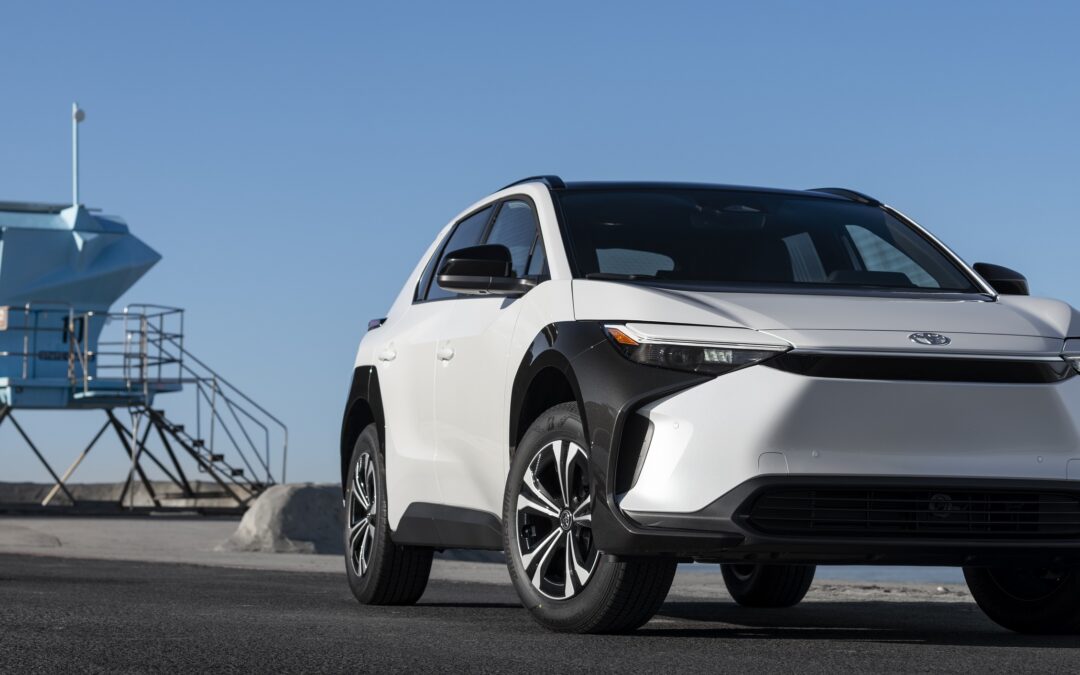
The 2023 Toyota bZ4X is the best family-budget battery-electric choice today, and much more is on the way

The 2023 Toyota bZ4X is sold in two trim levels with starting retail prices of headed to dealerships now, but vehicles will be in limited supply.ty of the Toyota bZ4X will

The 2023 Toyota bZ4X is sold in front- or all-wheel drive with starting prices ranging from about $43,000-$50,000. Vehicles are headed to dealerships now, but vehicles will be in limited supply. (Photos courtesy of Toyota)

Table of Contents

Development of bZ4X
Powertrain
Charging Times
5 Cool Things
bXZ4X Pricing
Incentives and Rebates
Safety Systems
Styling
Ride and Handling
Why Buy the bZ4X?
2023 bZ4X Specifications


BY MARK MAYNARD

The 2023 Toyota bZ4X is the company’s first dedicated lightning strike in the mainstream EV segment. Launched under the global “Toyota bZ” brand umbrella, the bZ4X is the first model in the series. “BZ” stands for “beyond Zero;” the number 4 is its class-size designation, and X is for SUV.

Toyota’s electrified lineup of vehicles, in total, accounts for more than 40 percent of all alternative powertrain vehicles sold in the U.S. Toyota sells almost a dozen electrified models, including the hydrogen fuel-cell Mirai sedan, hybrids (including the 2022 Tundra full-size pickup), plug-in hybrids and now the bZ4X. In addition, Lexus, the luxury division of Toyota, currently markets six hybrid models. And the brand will get a version of the bZ4X called “RZ.”

Globally, Toyota says it will debut around 70 electrified models by 2025. The corporate plan is to achieve carbon neutrality by 2050. And also by 2050, Toyota plans to introduce 15 battery-electric vehicles in North America, including seven new Toyota bZ EV models by 2025.

Through the rest of 2022, Toyota expects to sell 7,000 bZ4X models and is anticipating that 60 percent will be all-wheel-drive.

To feed the expected demand for its electrified vehicles, Toyota announced in late 2021 its plan to build a $1.3 billion automotive battery manufacturing plant in North Carolina. When it comes online in 2025, the plant will have four production lines, each capable of delivering enough lithium-ion batteries for 200,000 vehicles, Toyota said in a release. Plans include expanding production to at least six lines for a combined total of up to 1.2 million batteries a year.

Developing the bZ4X

The bZ4X is built on Toyota’s e-TNGA BEV-dedicated platform and was a joint development project with Subaru. The partnership leverages Toyota’s vehicle electrification while Subaru contributes its expertise in all-wheel-drive technologies.

The upcoming Subaru Solterra.

The upcoming Subaru Solterra.

Subaru’s version is called Solterra, Latin words for “sun” and “earth.” With minor exterior changes, the Solterra is expected to go on sale this summer.

The bZ4X is close in size and styling to the Toyota Venza hybrid but on a longer wheelbase. The 112.2-inch wheelbase provides length for the skateboard-style battery and other electrical components.

Toyota went with a standard front-wheel-drive format because the driving characteristics are more familiar to most drivers.

bZ4X Powertrain

With an AC synchronous electric generator mounted at the front axle, the front-drive powerplant has 201 horsepower. Front-drive models have a maximum output of 150 kW, and 160 kW with AWD.

The drive battery has 355 total voltage and total power of 71.4 kWh, increasing to 72.8 kWh for AWD. The liquid-cooled lithium-ion battery pack is stored flat under the floor, which gives the vehicle a low center of gravity. Cross-bracing of the battery-pack housing is designed to withstand a collision from any angle.

Toyota cites a driving range of up to 252 miles for front-drive models and 228 miles with AWD. The driving range is somewhat short of some competitors, Toyota admits, but the battery pack and drivetrain were engineered for reliable range and durability. Toyota has targeted battery-capacity retention of 90 percent after 10 years of ownership.

The front motor for all-wheel drive

Front-drive models have a power output of 150 kW, and 160 kW with AWD.

X-Mode All-Wheel Drive

Subaru’s most notable contribution to the bZ4X is the all-wheel-drive system with X-Mode. The system is suited for everything from daily driving to light off-roading, Toyota says. A standout feature of the AWD system is Grip-Control.

The five-stage software program works in addition to the all-wheel-drive system.

Among its capabilities is to use lower gear ratios to generate extra power at the wheels that have grip. In addition, the X-Mode system makes the traction control system extra sensitive so that it intervenes earlier during wheel slippage. And the system works with Hill Descent Control for added braking on steep slopes.

The unique instrument panel design and infotainment screen expand the cabin’s feeling of space, Toyota says.

The unique instrument panel design and infotainment screen expand the cabin’s feeling of space, Toyota says.

bZ4X Charging Times

Charging at a public high-output charger can restore an 80 percent charge in about an hour, Toyota says. (That is a longer charge time than either the Hyundai IONIQ 5 or VW ID4, which can charge to 80 percent in 35 to 40 minutes.)

A Level 2 home or public charger can add up to 25 miles of range an hour and fully charge the battery when plugged in overnight.

The charge door on the front left fender.

The charging port with sockets for Level 1 and Level 2 AC charging, and the CCS1 socket for DC Fast charging.

ChargePoint Home Flex Charger

New bZ4X owners can include a ChargePoint home charger  ($699) into the vehicle purchase or lease. And Toyota works with Qmerit, for buyers to locate a licensed electrician to install the home unit.

ChargePoint Home Flex is Energy Star certified and Wi-Fi enabled. It can be installed indoors or out and includes a 23-foot charging cable. Toyota says the Level 2 system can charge electric vehicles up to nine times faster than a standard household outlet.

The ChargePoint Home Flex Level 2 charger also can be bought at the dealership or online from ChargePoint.

5 Cool Things about bZ4X

1 year of free charging. New owners will get a year of free, unlimited charging at EVgo public charging stations nationwide. Using the Toyota App, owners can locate EVgo stations and initiate charging for the vehicle.

Front-seat radiant foot-and-leg heater. The option, a first for Toyota, along with a heat-pump system for interior warmth, heated seats, and steering wheel, helps reduce energy drain in cold weather.

Center hub console. The broad console has the functionality of a table. The setup includes storage for a smartphone, wireless charging (optional), and a transparent lid. There are a pair of USB ports (A and C), and a total of five throughout the cabin. There is a spacious open area under the center shift console.

Drive Connect. With a subscription, the bZ4X navigation system reaches into the cloud to get traffic information and parking space availability in real-time. And a digital key function allows owners to lock, unlock, and start the vehicle with a smartphone. Digital keys can also be handed over between smartphones for family and friends to borrow and lend vehicles remotely.

Over-the-air wireless software updates. Various improvements for performance, safety systems, and multimedia will be made via app.

The extended steering column and digital 7-inch multi-information display.

bXZ4X Retail Pricing

The 2023 Toyota bZ4X will be arriving in dealerships later this month, but Toyota says there will be “extremely limited to no inventory available.” Updates on the new EV can be found here.

Toyota plans to produce the Toyota bZ4X in Japan and China. Suggested retail pricing, includes the $1,215 freight charge from Aichi, Japan.

  • $43,215 XLE FWD; XLE AWD $45,295;
  • $47,915 Limited FWD; Limited AWD, $49,995

bXZ4X Incentives and Rebates

Early adopters could qualify for up to $10,250 in federal and state rebates or incentives.

The bZ4X will qualify for the full $7,500 Federal Electric Vehicle Tax Credit at launch, but it is expected to begin ramping down through next year, a Toyota spokesman said. “We are expecting to hit the 200,000 vehicle threshold soon.”

According to EVadoption.com, the federal tax credit is phased out over time beginning the second quarter after the quarter in which a manufacturer reaches a total of 200,000 BEV or PHEV vehicles sold since 2010.

Federal Electric Vehicle Tax Credit: $7,500.  IRS tax forms are here.

California Clean Fuel Reward: $750. Available toward the purchase or lease of a new electric vehicle with a battery capacity greater than 5 kWh. The vehicle must be registered in California and the customer must reside in California.

California Clean Vehicle Rebate: $2,000.  Participants are eligible based on gross annual income, as stated on their federal tax return.

Find federal and state laws or incentives here.

And in California, the bZ4X qualifies for High-Occupancy-Vehicle freeway access, with the green DMV decal.

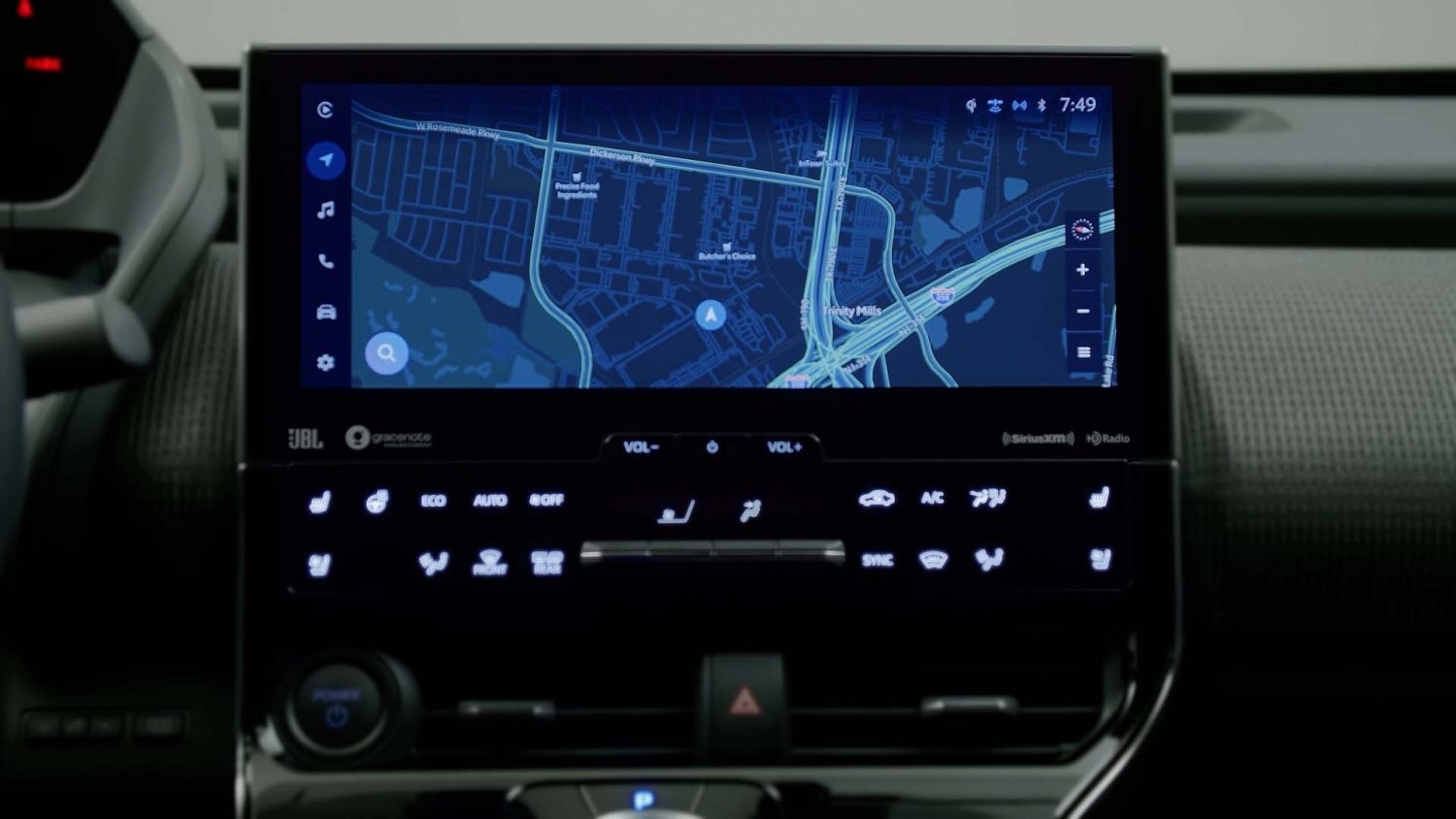
A digital screen shows navigation routes.

With Drive Connect, the bZ4X uses map information for traffic and parking space availability.

bZ4X Safety Systems

bZ4X will be the first to feature the latest Toyota Safety Sense safety package, called TSS 3.0. This system has an expanded detection range of the millimeter-wave radar and monocular camera.

The pre-collision system now provides low-light cyclist detection, daytime motorcyclist detection, and guardrail detection. Also, lane recognition was improved while in the lane-tracing-assist mode.

Standard bZ4X safety equipment

Toyota Safety Sense: features include: a pre-collision system with pedestrian detection, lane departure alert with steering assist, Lane Tracing Assist, full-speed range dynamic radar cruise control, and road sign assist

Star Safety System includes: 8 air bags, blind-spot monitor with rear cross-traffic alert, front and rear parking assist with automatic braking, stability and traction control, brake-force distribution, brake assist, and Smart Stop Technology

The extended center console has a storage space below.

The extended center console has a storage space below.

bZ4X Styling — Inside and Out

Toyota calls the bZ4X design theme “hi-tech and emotional.” The exterior and interior are also statements of shock-and-oh! to help reaffirm its status as an electric vehicle.

The body has pronounced wheel flares of an SUV, a “hammerhead” front fascia (referencing the shark species), and the rear is busy with trapezoidal angles and dramatic lighting, split mini roof spoilers, a decklid spoiler, and a sculpted lower fascia to release air drag.

The door handles are a specialized shape designed to be more ergonomic, to grip.

Multi-LED projector headlights on the Limited.

Multi-LED projector headlights on the Limited.

Inside the bZ4X cabin

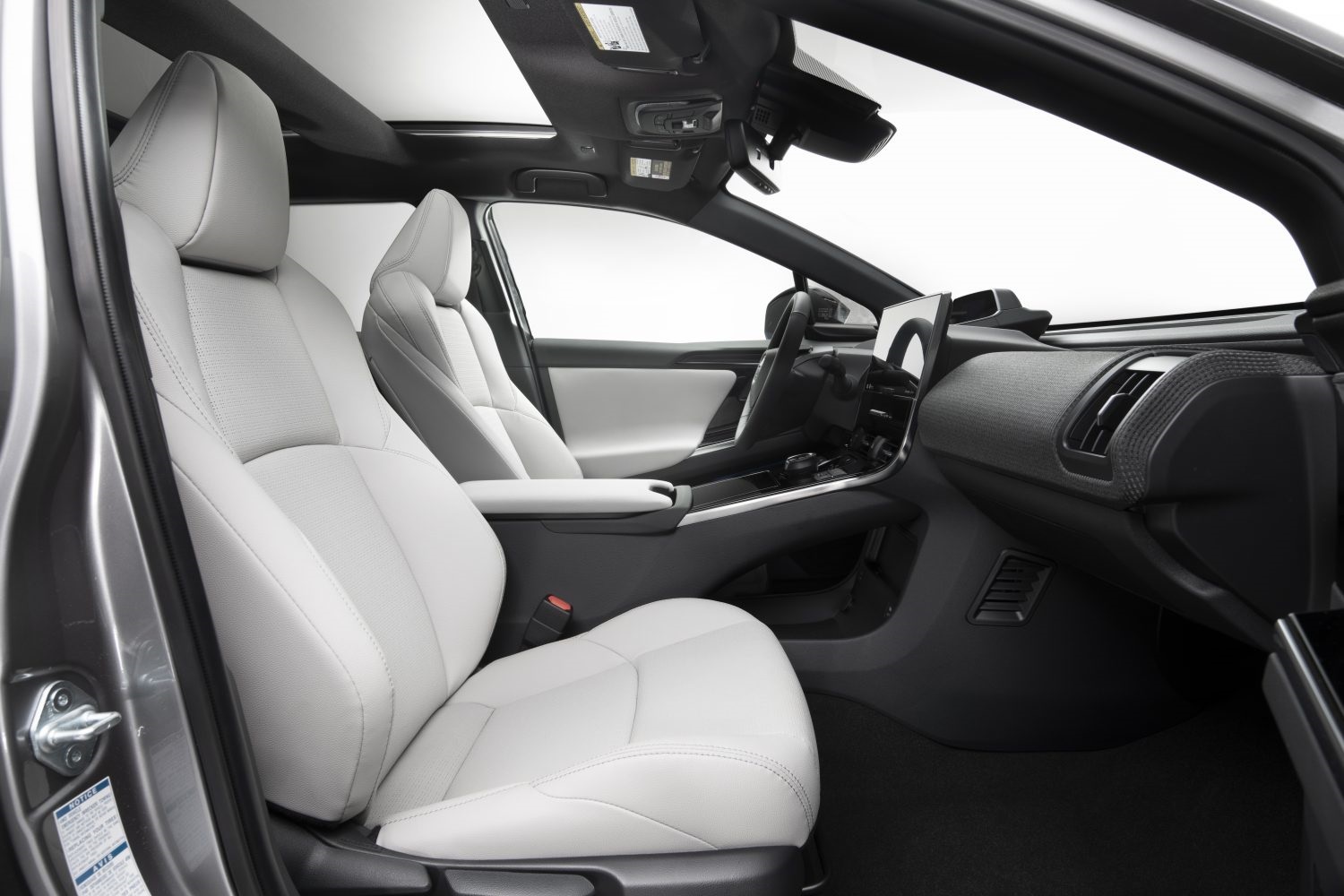
The interior design is more space shuttle than traditional car. Using the digital controls is Toyota 1-2-3 easy and most drivers will adapt without frustration.

Front headroom of 38.6 inches includes the standard panoramic roof. But the steep rake of the windshield could cause a duck-and-fold maneuver for some big-and-tall drivers. Legroom is long at 42.1 inches.

The tall glass of the cabin greenhouse creates a light-filled cabin. Sightlines are unobstructed at the side mirrors and over the shoulder.

The wide cabin, 59.6 inches from door to door, provides an open feel and generous shoulder room. Soundproofing glass and wind-noise-reduction features help quiet the cabin.

One of the first things new drivers will notice is the steering column. The cab-forward dashboard features an extended steering column and smallish steering wheel, which is at least a foot removed from the digital gauges of the 7-inch multi-information display. Shorter drivers, such as me, might have to decide between seeing the entire MID or being comfortable. I split the difference. In a few miles of driving it became a non-issue, but the text font in the MID is thin and somewhat challenging to see in bright sunlight.

(Note: In a product briefing last year, Toyota showed a yoke-style steering wheel, which likely would have made it easier to see the MID. However, the steering yoke will not be available for the U.S., but it has been previewed in photos of the Lexus RZ.)

Comfortably bolstered seats in the bZ4X Limited.

Comfortably bolstered seats in the bZ4X Limited.

Back Seat and Cargo Space

Back-seat space feels more compact than midsize. Headroom of 37.1 inches could be a tad short for 6-foot-tall passengers. And max legroom of 35.3 inches will be a squeeze when tall people are seated in front. Sitting on the bench seat feels perched, and it has a short seat bottom, making it better for family use than executive transport. But the 60/40 folding seatback has a few clicks of recline, which parents appreciate for sleeping youngsters.

The cargo area has a wide and low opening with a capacity of 27.7 cubic feet behind the seat (or 25.8 with the JBL audio system). The slant of the tailgate crops space for big-box items but fold the seatback for what looks like about 5 1/2 feet in length.

The bZ4X back seat.

Back-seat space feels more compact than midsize.

bZ4X Ride and Handling

One of the most distinctive elements of bZ4X engineering is its well-calibrated driving response. This car does not drive like an appliance or functional conveyance. Driving the bZ4X feels much like a “normal” car.

The electric steering actually feels organically hydraulic with no dead spots in the revolution of the wheel. Acceleration uptake is smoothly responsive and the torque gives near-immediate pull, despite a curb weight pushing 6,000 pounds with a pair of occupants.

Braking force seemed very capable without nosedive. And the stopping force engages without regeneration lag, which can be common in an EV. The four-wheel vented discs have 12.9-inch rotors front and 12.5 inches rear.

There is also a regenerative B mode to capture more energy when slowing or on downhills. To activate, the driver must press a button on the center console to engage B mode. It is not quite an “e-pedal” function., and it will not bring the vehicle to a stop, as do some e-pedal systems (which I prefer). Toyota says it is a safety intervention to keep the driver engaged.

Managing the hefty weight of an EV is an engineering challenge. Clunks and pothole jolts are somewhat common in the mainstream electric SUV with a steel-spring suspension. But the independent steel suspension of the bZ4X (front MacPherson struts and multilink rear with stabilizer bars front and rear) filters out all but the harshest road conditions.

Overall, the bZ4X is not particularly sporty to drive, but the suspension makes graceful weight transfers without falling all over itself. Its 40-foot turning circle, however, could be unwieldy in tight parking situations.

The open cargo area of the bZ4X

There is cargo space of 27.7 cubic feet behind the back seat.

Why Buy the Toyota bZ4X?

The bZ4X might have the outward appearance of a galaxian space traveler, but its drivability is traditional and reassuring. I preferred the nimbleness and responsive power of the front-drive XLE model. All-wheel-drive typically adds noticeable acceleration force, but it seemed lacking in the Limited AWD model I tested.

Critics will point to a driving range that is less than some of the competitors. Unless you are planning a road trip, a Level 2 home charger mitigates the worry of running out of juice. The discharge rate seemed to be real-world mile-to-mile, and not overly sensitive to bursts of speed. That type of steady battery reserve is important to hypermiling commuters, who will quickly learn their comfort zone and when not to panic.

The Toyota bZ4X might not have the longest driving range of its EV competition. It might not have the fastest recharging capability. It might not be the quickest to 60 mph. But it has been built with Toyota’s engineering mantra of “Do It Right The First Time.”

And build it with that Toyota badge of reliability.

A rear view of the bZ4X

The 2023 Toyota bZ4X will be arriving in dealerships later this month, but Toyota says there will be “extremely limited to no inventory available.”

 2023 Toyota bZ4X Specifications

Body style: 5-seat, 5-door midsize SUV, in front- or all-wheel drive

Motor type: AC synchronous electric generator

Battery type: lithium-ion, 355 volts

Total Battery Capacity: 71.4 kWh (FWD), 72.8 kWh (AWD)

0-60 mph acceleration: 7.1 seconds FWD, 6.5 seconds AWD

EPA Estimated Range

  • 252 miles (XLE FWD);
  • 228 miles (XLE AWD)
  • 242 miles (Limited FWD);
  • 222 miles (Limited AWD)

EPA Estimated MPGe Fuel Economy, (city/highway/combined MPGe)

  • XLE FWD 131/107/119;
  • XLE AWD 114/94/104;
  • Limited FWD 125/103/114;
  • Limited AWD 112/92/102

Maximum power output

  • Front motor: 201 hp (150 kW) 196 foot-pounds torque;
  • Dual motor AWD: 214 hp (107/107 hp) (80 kW/80 kW); max torque 124/124 lb.-ft. 124/124 lb.-ft.

Charging

SAE J1772 / CCS1 charging port compatibility

AC Level 1 (120-volt household current), AC Level 2 (240-volt) and DC Fast Charge compatibility

AC charger maximum input: 6.6 kW

DC charging maximum input: 150 kW (FWD), 100 kW (AWD

bZ4X BY THE NUMBERS

Length/wheelbase: 184.6/112.2 inches

Height/width: 65 (inc. antenna)/73.2 inches

Front head/legroom: 38.6/42.1 inches

Rear head/legroom: 37.1/35.3 inches

Cargo space: 27.7 (25.8 w/JBL audio)

Turning circle: 40 feet

Curb Weights

  • XLE FWD 4,266 pounds;
  • XLE AWD 4,332 lbs.;
  • Limited FWD 4,398 lbs.;
  • Limited AWD 4,464 lbs.

Basic limited warranty coverage

8-years/100,000-miles battery (10-years/150,000-miles in California)

3-years/36,000-miles bumper to bumper
5-years/60,000-miles powertrain

ToyotaCare: 2-years/25,000-miles free factory scheduled maintenance 24/7 roadside assistance

Where assembled: Japan

Hyundai IONIQ 5 Review

Hyundai IONIQ 5 Review

The 2022 Hyundai IONIQ 5 is an elevated experience of what can be expected in an electric vehicle

The 2022 Hyundai IONIQ 5 battery-electric SUV crossover is sold in rear- or all-wheel drive powertrains with driving ranges of 303 to 256 miles. Available incentives and rebates can total $10,250. (Photos courtesy of Hyundai)

Table of Contents

Next Level Design
10 IONIQ 5 Innovations
Pricing
Incentives and Rebates
Charging Times
Performance
Driver Assistance Systems
Ride and Handling
IONIQ 5 Interior Function
Back Seats and Cargo
Hyundai IONIQ 5 Awards
Why Buy the Hyundai IONIQ 5?
Specifications

BY MARK MAYNARD

The new Hyundai IONIQ 5 is almost iconic in how well it does everything. It’s not just a well-engineered electric vehicle, it is a well-designed car for family or executives.

The IONIQ 5 is Hyundai’s first dedicated electric vehicle and built on the Hyundai Electric Global Modular Platform (E-GMP). It and other electrified vehicles to follow will be marketed under the IONIQ subbrand. The upcoming battery-electric lineup will include the IONIQ 6 midsize sedan and IONIQ 7 large SUV.

At 118.1 inches, the IONIQ 5 has the longest wheelbase in Hyundai’s U.S. product lineup. It is almost 4 inches longer than the Hyundai Palisade large-midsize SUV, but the IONIQ’s overall length is nearly 14 inches shorter.

And Hyundai says the IONIQ 5 has more passenger volume (106.5 cubic feet) than the Ford Mustang Mach-E (101.1 cu. ft.) and the Volkswagen ID.4 (99.9 cu. ft.).

Sales currently are in the zero-emissions vehicle states of the Northeast plus Texas, Florida, Illinois, Pennsylvania, Arizona, Virginia, and Washington state. There will be a broader rollout later in 2022, Hyundai says.

Front seat area of the IONIQ5

The driver area is digitally sophisticated but easy to use.

Next Level Design

The IONIQ 5 exterior design is next level as a contemporary EV. Crafting a cohesive exterior appearance is a challenge when the electric powertrain is configured in a so-called “skateboard” layout. The battery-electric elements form a low and flat foundation. But the design challenge has been to build a body that doesn’t look like it is grafted onto the skateboard foundation.

Because that foundation raises the ride height of the vehicle, designers have adopted an SUV format. Adding SUV features to the body is one way to disguise the awkward foundation.

For the majority of mainstream EVs, exterior styling is a ground-up exercise. But the Hyundai designers appear to have created a top-down style for its IONIQ 5. From the outside, it looks more cosmic space shuttle than bulky SUV. And if there is such a thing as an open floor plan for a vehicle, the IONIQ 5 has it. The flat floor, spacious front-seat area, and long roofline create a light and inviting space.

Dual 12-inch digital screens in the IONIQ 5

Dual 12-inch screens with white backgrounds add to the lightness of the cabin. To the far left is the magnetic note board.

10 IONIQ 5 Innovations

Flush Mounted Automatic Door Handles. As an owner with the key nears the IONIQ 5, the door handles pivot outward. The design is for clean surface styling and enhanced aerodynamics. But the lever-type handle gives more leverage on opening and eliminates the fingernail scratches in the paint from a traditionally styled pull handle.

Sliding Center Console. The so-called Universal Island moveable center console can slide back and forth 5.5 inches.

Magnetic Note Board, for photos or a shopping list.

Power Reclining Driver’s Seat with Footrest. So thoughtful when killing time at a public charging station.

Fast Charging. IONIQ 5’s E-GMP architecture can support 400-volt and 800-volt fast-charging. The platform offers 800-V charging capability as standard, and it can accommodate 400-V charging without additional adapters. Hyundai says the multi-charging system is a world first.

Ownership by Subscription. A planned subscription service will feature a single, all-inclusive monthly payment, covering the vehicle, insurance, and maintenance.

Over-the-Air Updates. IONIQ 5 is the first Hyundai vehicle to offer free over-the-air wireless updates for maps and multimedia software.

V2L charging ability

The Vehicle-to-Load function creates a power source on wheels.

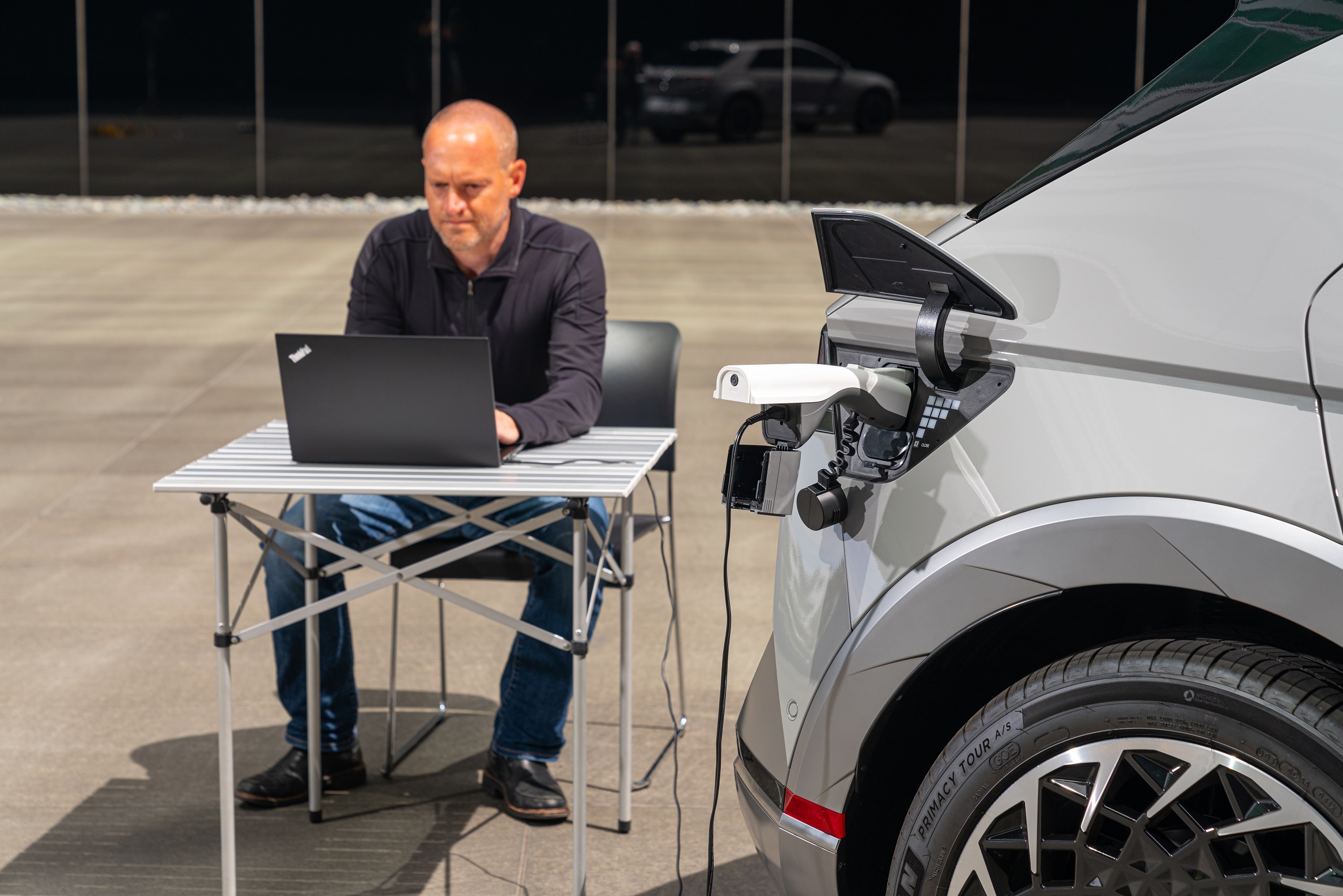
Vehicle-to-Load (V2L) Function. As a high-capacity electric source, the IONIQ 5 is part survival tool and charger on wheels. V2L allows charging of electric devices, such as electric bicycles, scooters, or camping equipment. Or it can be used to charge a stranded EV.

The 1.9 kW of peak power is tapped through a standard 120-volt outlet. The function won’t power an entire home, but it can power necessities during a power outage, tailgate parties, or outdoor projects.

Using the V2L function requires an optional accessory adaptor ($220) that plugs into the outside charging port. The Limited model also has an interior V2L outlet at the base of the back row seat for charging laptops, phones, and other devices.

Augmented Reality Head-Up Display. The IONIQ 5 head-up display uses an Augmented Reality mode, which essentially turns the windshield into a display screen. The projection appears to be nearly 4 feet in front of the driver’s line of sight and can include various information, such as turn-by-turn navigation, posted speed limits, and advanced safety alerts.

Free Fast Charging for 2 Years. Hyundai and Electrify America collaborated to provide 250 kWh of free DC fast charging for new owners of the IONIQ 5 or Hyundai Kona EV. Charging via app will be offered in unlimited 30-minute charging sessions for two years from the date of purchase.

Electrify America

Electrify America has about 800 charging stations with more than 3,500 ultra-fast chargers either open or in development, Hyundai says. See Electrify America’s plan for the

The movable center console

The Universal Island center console can slide back and forth 5.5 inches.

Suggested Retail Pricing

The IONIQ 5 is sold in three trim levels in rear- or dual-motor all-wheel drive with a lithium-ion polymer battery pack. Starting prices include the $1,245 freight charge from Ulsan, Korea.

Rear-drive models have a 168 kW, 225-hp motor with 258 foot-pounds of torque and battery capacity of 77.4 kWh for a driving range of 303 miles. AWD trims package a 74 kW front motor and a 165 kW rear motor for 320-hp with 446 ft.-lbs. of torque.

The Limited AWD tester was $55,940 with one option for carpeted floor mats, $195.

IONIQ 5 SE RWD starts at $44,895;

IONIQ 5 SEL RWD: $47,145;

IONIQ 5 Limited RWD: $51,845;

IONIQ 5 SE AWD: $48,395;

IONIQ 5 SEL AWD: $50,645;

IONIQ 5 Limited AWD: $55,745.

Available later this year will be the entry IONIQ 5 SE Standard; offered only in rear-wheel drive. It has a smaller electric motor — 125 kW, 168-hp — and smaller battery capacity (58 kWh) with fewer creature comforts but a full complement of safety and driver-assist technologies. It has a starting price of $39,700 and a driving range of 220 miles.

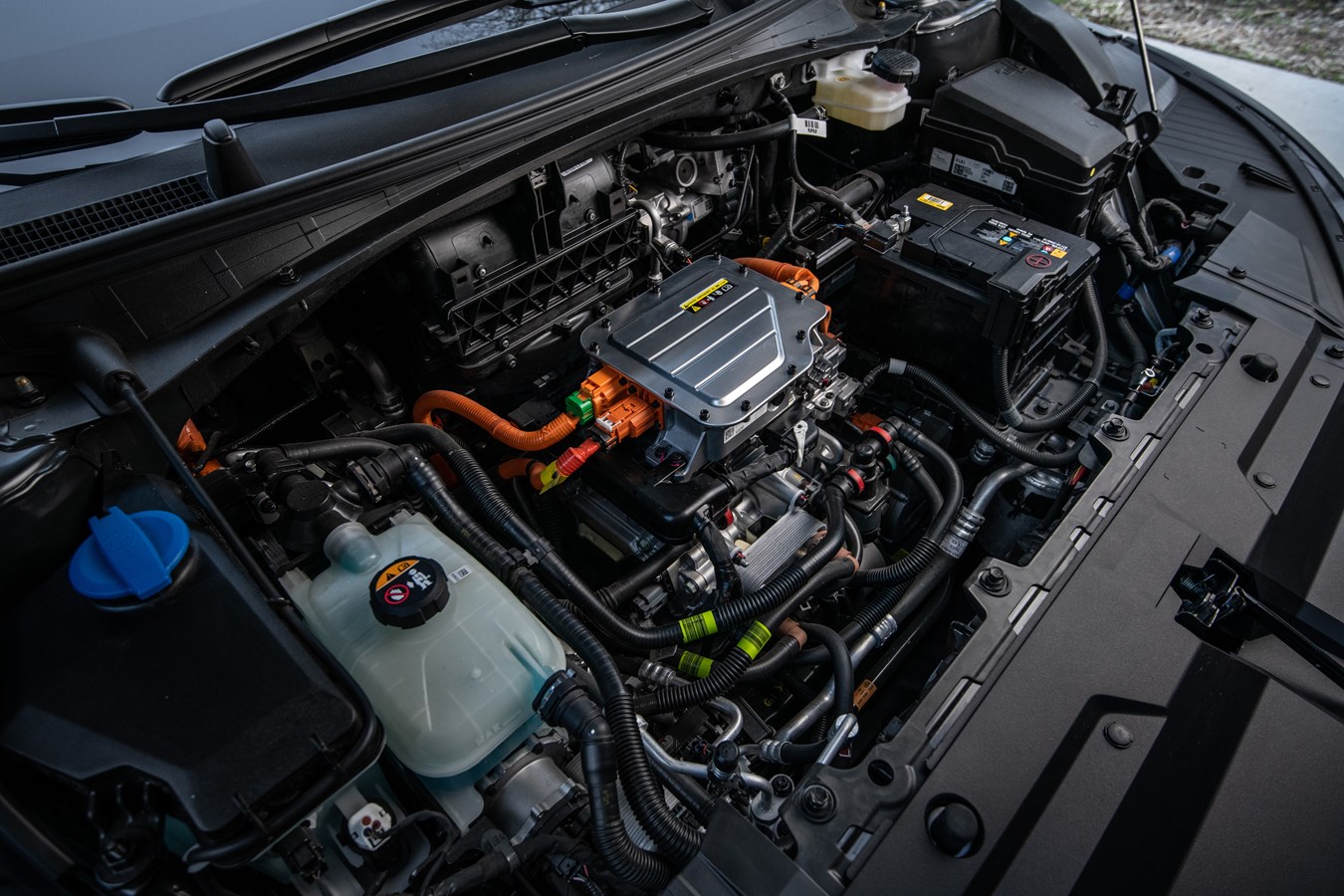
IONIQ 5 electric motor

The top box, above the AWD motor, has about a cubic foot of storage space.

Paint and Interior Colors

There are six paint colors, including five nature-inspired hues exclusive to IONIQ 5. The color choices are Phantom Black (Pearl), Cyber Gray (Metallic), Atlas White (Solid), Digital Teal (Green Pearl), Lucid Blue (Pearl), Shooting Star (Gray Matte).

The Digital Teal is a color-changing metallic paint. In various light conditions, it can look aquamarine, silver, or gray.

The interior has three color options Obsidian Black Monotone, Dark Pebble Gray/Dove Gray, Dark Teal/Dove Gray.

There is a lot of easily digested information in the digital gauge array.

There is a lot of easily digested information in the digital gauge array.

IONIQ 5 Incentives and Rebates

The 2022 Hyundai IONIQ 5 qualifies for up to $10,250 in federal and state rebates or incentives.

Federal Electric Vehicle Tax Credit: $7,500. IRS tax forms are here.

California Clean Fuel Reward: $750. Available toward the purchase or lease of a new electric vehicle with a battery capacity greater than 5. The customer must register the vehicle in California and the customer must reside in California.

California Clean Vehicle Rebate: $2,000.  Participants are eligible based on gross annual income, as stated on their federal tax return.

Find federal and state laws or incentives here.

And the IONIQ 5 qualifies for High-Occupancy-Vehicle freeway access, with the green DMV decal .

The Limited includes a V2L plug in the back seat

The Limited includes a V2L plug in the back seat

Ownership by Subscription

To help EV-intenders get comfortable with ownership, Hyundai plans to offer a simple automobile subscription service; it is now in the pilot phase. The subscription will have an all-inclusive monthly payment, covering the vehicle, insurance, and maintenance.

Parametic Pixel LED lighting.

Parametic Pixel LED lighting.

IONIQ 5 Charging Times

Rapid DC 150kW (400V): 25 minutes, estimated, from 10 percent to 80 percent charge

Rapid DC 250kW (800V): 18 minutes, from 10 percent to 80 percent

Level 2 240-volt home unit: 6 hours, 43 minutes

Hyundai Bluelink

Bluelink is a car-connectivity system on all new Hyundai models that gives drivers remote access to their vehicles. The Bluelink app for IONIQ vehicles has redesigned home-screen displays for driving range, battery state, and charging times when plugged into public or private chargers.

Users can access an advanced battery management system to select charging times, particularly for off-peak electricity rates.

Remote Climate Control allows scheduled pre-heating or pre-cooling when the IONIQ 5 is connected to a power source. It helps save battery power that would otherwise be needed to heat or cool the vehicle on the road.

The map section of the app has also been redesigned to let customers filter between charger providers and charge type. It also will show the availability of a charger when the driver arrives.

IONIQ 5 front seats

Eight-way power-adjustable seats for driver and passenger.

IONIQ 5 AWD Performance

The dual motors of the IONIQ 5 Limited AWD provide smooth uptake from the start and give strong acceleration when needed. There are performance modes of Eco, Normal, and Sport. And when you try a full-on launch in Sport mode, the digital gauge array turns red and the force of acceleration is bristling. Hyundai cites 0-60 acceleration in less than 5 seconds.

All models have a top speed of 115 mph and can tow up to 1,650 pounds.

The i-Pedal regeneration system helps recupe de-acceleration energy simply by lifting off of the accelerator. It is especially handy around town. With careful driving, the i-Pedal function can almost take the place of slow-speed, stop-and-go braking. The force of the regeneration can be adjusted with the steering wheel paddles.

IONIQ 5 Ride and Handling

Electric SUVs are heavier than internal-combustion vehicles, mainly because of the large battery pack needed to achieve 300 miles. The IONIQ 5 Limited AWD weighs 4,662 pounds. By comparison, the seven-passenger Palisade with all-wheel drive at 4,387 pounds. The Tesla Model X SUV weighs around 5,441 pounds. And the VW ID.4 weighs 4,824 pounds.

Hyundai achieved a lower weight without extensive use of aluminum in the body. Instead, the body is comprised of advanced high-strength steel and high tensile steel.

The Limited’s 20-inch aero-optimized wheels.

Aero-optimized wheels in sizes of 19 or 20 inches.

Suspension

The engineering challenge in hefting upward of 3 tons in a smallish vehicle is to provide a comfortable ride. It is common for an EV suspension to clunk and jolt over rough patches.

Hyundai engineers applied some secret sauce in its steel-spring suspension that mitigates the clunks and jolts. The setup of MacPherson struts at the front and a rear multilink includes high-performance shock absorbers.

Credit the long wheelbase for the smooth highway ride. Only a couple of times over very lumpy highway section did I notice any heave to the ride, but never a clunk. And that is without any electronics to quicken the suspension response time.

Brakes, Tires, and Wheels

Four-wheel-disc brakes have ventilated 12.8-inch front rotors and 12.8-inch solid rear rotors. The regenerative braking system includes brake control paddles at the steering wheel to maximize downhill regeneration.

With careful driving and attention to regen braking, the driving range can be extended by a few miles.

Highway road and wind noise are well controlled, aided by the 20-inch Michelin Primacy Touring “Acoustic” touring tires (255/45). For this tire, Michelin’s noise-reduction tuning combines frequency canceling shoulder grooves and block chamfers with ultra-smooth belts. I’d never before experienced these “acoustic” tires but highly recommend them. With a midrange treadwear rating of 540 (rubber hardness), the tires have a warranty of 55,000 miles and a standard limited warranty of 6 years. That coverage is important because the hefty EV curb weights tend to wear out tires sooner than expected, owners say.

The large 20-inch alloy wheels are aero-optimized for reduced turbulence. The wheels are also positioned at the very edge of the body to help block wind from entering the wheel well. And special aero-optimized fender overriders also help break up airflow and reduce drag.

There are many aerodynamic details to the IONIQ 5 body, such as the slash marks along the fender overriders.

There are many small aerodynamic elements on the body to trim drag, such as these slash marks on the fender overriders.

Driver-Assist Systems

The IONIQ 5 debuts Highway Driving Assist 2 as the next level of Hyundai’s SmartSense driver assistance systems. When driving on a highway, HDA 2 actively responds to close-range low-speed cut-ins by other drivers and motorcycles. The system also will automatically assist lane changes in certain conditions when the driver uses the turn signal. HDA 2 also adjusts the steering weight according to drive mode.

In my experience, the driver-assist systems functioned reliably and kept the IONIQ 5 well centered in the lane. That precision is reassuring in heavy commuting. I experienced no random system shut-offs, which can be caused by shadows, bright sunlight directly into the forward camera, and even white semi-trucks with white trailers. Because these systems are not foolproof, it is best to drive with both hands on the wheel, despite what some Tesla owners seem to believe.

Other driving-assistance systems include:

Smart Cruise Control with Machine Learning. The system tries to mimic the driver’s tendencies for acceleration and spacing with the vehicle ahead;

Forward Collision-Avoidance Assist;

Blind-Spot Collision-Avoidance Assist;

Intelligent Speed Limit Assist, to match the posted speed;

Blind-Spot View Monitor, uses side mirror-mounted cameras to show the driver views to the left and the right of the vehicle. The image is displayed in the digital gauge cluster screen when the turn signal is activated.

The gear selector is located behind the steering wheel.

The gear selector is located behind the steering wheel.

Interior Function

EV interior design is evolving and each manufacturer finds new ways to innovate and use space.

Slip behind the wheel of the IONIQ 5 and the dual 12-inch digital screens with white backgrounds are different, even alien. But after some exploration, the screens become completely functional and easy on the eyes.

The contiguous 2-foot span of screens connects gauges and infotainment with cabin controls. But at driver’s left is a magnetic board that extends the contiguous span to about 30 inches. Hyundai says the magnetic surface, about 5-by-5 inches, is ideal for posting pictures and notes just like on a refrigerator.

Many interior touchpoints in the IONIQ 5 — seats, headliner, door trim, floor, and armrest — are of sustainably sourced materials. These materials include recycled PET bottles, plant-based (bio PET) yarns and natural wool yarns and bio paint with plant extracts.

The raised ride height provides comfortable entry and exit. And the open interior of the IONIQ 5 has wide open driver visibility, across the hood or over the shoulder. Front headroom of 39.1 inches, with the panoramic roof, and legroom of 41.7 inches should accommodate taller drivers.

Both front seats in the Limited are eight-way power-adjustable and seat support is comfortable for the entire driving range. The leatherette upholstery with perforated centers is supple and neatly stitched.

Cabin audio and climate controls are not difficult to master through the infotainment screen, but I wished for external screen access for the heated seats or the Limited’s heated steering wheel and ventilated front seats. A rear wiper and washer are missing, but Hyundai says it will address that feature in the future.

The interior’s most notable feature might be the moveable Universal Island center console; it can slide back and forth 5.5 inches. The armrest of the sliding console also helps accommodate elbows of short and tall drivers. The open console also packages cup holders, a 15-watt wireless phone charger, and USB ports. The base of the console is big enough to hold a large handbag or a drive-through bag of food.

The console’s adjustability, flat floor, and gear selector located behind the steering wheel allow easier driver access if shoehorned into a narrow spot. Or just use the automated Remote Smart Parking Assist parking feature to solve the problem.

Also smart are the long door-side armrests that allow varied leverage points for closing the door. And just as important, the long grip helps control the force of opening the door and avoiding a ding in an adjacent vehicle.

The Surround View Monitor uses an array of cameras to give a 360-degree view of the area surrounding the vehicle. With guidance lines, it is helpful when parking to stay in the lines.

Back seat space is comfortable with 39.4 inches of legroom and adult-length thigh support.

The back seat has adult-length thigh support and max legroom of 39.4 inches.

Back Seat and Cargo Space

Back-seat roominess is a standout in the IONIQ 5. The door opening is large, the doors open wide, and there are 39.4 inches of max legroom (depending on who is sitting in front).

The second-row seats can slide forward up to 5.3 inches, recline, and have a 60/40 seatback fold.

The Limited’s panoramic glass roof is an extra-large sky view that makes the space feel very open. The fabric sunshade is divided in the middle and one half rolls open toward the front and the other rolls backward for full daydreaming capability. The light provided by the glass roof is helpful to those sensitive to motion or who are claustrophobic, particularly children and my girlfriend. And vertical b-pillar vents keep a friendly flow of air to trim that occasional urpy feeling.

With 57.7 inches of shoulder room (door to door) and the flat floor, three-across seating is reasonably comfortable. The bench seat has adult-class thigh support and there are a few inches of seatback recline.

Back-seat extras include a fold-down armrest with can holders, large door-panel storage with bottle slots, above-door grab handles (with a jacket hook on the left handle), two USB charging ports. And the Limited adds manual side-glass sunshades.

Cargo space is flexible and accommodating for weekend getaways. But the space is modestly cropped by the tall cargo floor and angle of the back glass and tailgate. The opening is 41 inches wide by 38 inches to the seatback for 27.2 cubic feet of space. Fold the 60/40 seatback for 6 feet of flat capacity. There also is slim subfloor storage for the tire-mobility kit and charging cable.

Fold the 60/40 seatback for 6 feet of flat cargo capacity.

Fold the 60/40 seatback for 6 feet of cargo length.

Hyundai IONIQ 5 Awards

The Hyundai IONIQ 5 was revealed globally on Feb. 23, 2021, and since its debut has earned many 2022 car-of-the-year awards. Among them:

  • New Zealand Car of The Year;
  • German Car Of The Year;
  • Best Import Cars of the Year, by Auto Bild, in the “Electric Car” category;
  • No.1 Electric Car by Auto Zeitung, receiving the highest score among electric cars;
  • Car of the Year 2021, Mid-size Company Car of the Year 2021; and Premium Electric Car of the Year 2021, by Auto Express;
  • 2021 IDEA Design Award’ Gold prize;
  • Best Design at the TopGear Electric Awards 2021.

Source: Wikipedia

Why Buy the Hyundai IONIQ 5?

Despite more than two dozen electric vehicles headed to market in the next two years, EVs are still in their pioneering stages of development.

For its ease of use, voluminous interior, and driving range, the IONIQ 5 is an elevated experience of what can be expected in an EV, and what more evolution will follow — by Hyundai and others.

The transition to a battery-electric vehicle will be an expensive lifestyle adjustment, including the purchase of a home charger. But the security of always having a full tank when you leave home will pay dividends as owners wave bye-bye to weekly visits to the neighborhood filling station.

The biggest obstacle to overcome will be explaining to friends why you choose not to drive around on 15 gallons of flammable liquid.

The rear view of the IONIQ 5

Every 2022 Hyundai IONIQ 5 (and 2022 Hyundai Kona Electric) includes 250 kWh of free DC fast charging through Electrify America.

Hyundai IONIQ 5 Limited AWD Specifications

Body style: Compact class 5-door crossover SUV; unibody construction of advanced high-strength steel and high tensile steel

Motors: Permanent-Magnet Synchronous; 165 kW rear motor, 74 kW front motor for AWD

Battery: 77.4 kWh lithium-ion polymer, 697 volts; 272kW output

Power: 320-hp with 446 ft.-lbs. of torque.

Transmission: Single-speed reduction gear with drive modes of Eco, Comfort, Sport, and Snow); steering-wheel-button selectable

Top speed: 115 mph

0-60 mph acceleration: less than 5 seconds in Sport mode

Driving range: 256 miles, AWD

MPGe: 110/87/98 mpg city/hwy/combined

CHARGING TIMES

Rapid DC 150kW (400V): 25 minutes, estimated, from 10 percent to 80 percent charge

Rapid DC 250kW (800V): 18 minutes, from 10 percent to 80 percent

Level 2 240-volt: 6 hours, 43 minutes

Onboard charger: 10.9kW

BY THE NUMBERS

Coefficient of Drag: 0.288

Cargo space: 27.2-59.3 cubic feet

Front head/leg room: 39.1*/41.7 inches *w/sunroof

Rear head/leg room: 37.5/39.4 inches

Length/wheelbase: 182.5/118.1 in.

Height/width: 63/74.4 inches

Curb weight: 4,662 pounds

Turning circle: 39.3 ft.

Maximum trailer weight: 1,650 pounds, with or without trailer brakes (towing not recommended for Standard Range RWD model)

FEATURES

Standard Limited equipment includes: Surround View Monitor, Driver Seat with “Relaxation” function, Blind-Spot View Monitor, premium door sill plates, reverse sliding center console, rear-door sunshades, panoramic fixed glass sunroof with power shade, Vehicle to Load (V2L) two-way onboard charger (2nd row), heads-up display with augmented reality functions, roller cargo cover, integrated memory system for driver seat, Digital Key, 8-way power front seats (heated and ventilated), remote smart parking assist, Bose Premium 8-speaker Audio, electric parking brake, 20-inch alloy wheels, battery heater, and heat pump

Safety features include: 6 air bags, blind-spot collision avoidance, lane-keeping assist and lane-following assist, rear cross-traffic-collision avoidance assist, high-beam assist, front and rear parking sensors, parking collision avoidance assist, hill-start assist, 4-channel ABS with brake-force distribution, brake assist and regen brake control paddles

PRICING

Limited AWD base price: $55,745, including $1,245 freight charge; price as tested $55,940

Options on test vehicle: carpeted floor mats $195

Where assembled: Ulsan, South Korea

Warranties: 10-years/100,000-miles electric-vehicle system; 10-years/100,000-miles powertrain limited warranty; 5-years/60,000-miles new vehicle limited warranty and 7-year anti-perforation warranty; free scheduled maintenance for 3-years/36-000 miles
Electrify America Shows Charging Station of the Future

Electrify America Shows Charging Station of the Future

Electrify America has plans to create a customer oasis with ultra-fast charging

Electrify America says its plans for unique charging stations will be influenced by the surrounding communities. (Photos courtesy of Electrify America)

BY MARK MAYNARD

Electrify America today announced a new design vision for some of its future charging stations. The customer-focused design is to exceed electric vehicle customer expectations as they transition to electric mobility, the company says. The company also plans to introduce its next-generation charger that will improve the hands-on charging experience for the customer.

The format of the “Charging Station of the Future, Today” will add elements such as solar canopies and awnings, customer waiting areas and other services at select locations.

The company plans to showcase this transition in 2022 and 2023 with installations in select new flagship charging facilities in California cities of San Diego (Fashion Valley), Santa Barbara, San Francisco, and Beverly Hills. Also planned are new flagship facilities in New York within Manhattan and Brooklyn. Currently, the company has flagship California charging stations in Baker (on the interstate to Las Vegas!) and Santa Clara.

The renderings for future stations evoke a dynamic new environment for electric vehicle charging, Giovanni Palazzo, president and CEO of Electrify America, said in a press release.

An Electrify America future charging station with valet charging.

A rendering of a Beverly Hills charging station that might offer valet service.

Customer-Centric Experience

Some of the new showcase stations will feature up to 20 ultra-fast DC chargers, the company says. Special features can include:

  • Customer lounges, electric vehicle showcase areas, dedicated event space;
  • Overhead solar canopies to shield customers from the sun and inclement weather;
  • Security cameras and additional lighting;
  • Valet charging and curbside delivery options at select shopping locations.
A planned San Diego charging station.

A planned charging station in San Diego’s Fashion Valley neighborhood.

Electrify America Next-Generation Charger

Electrify America will also begin the rollout of a redesigned and simplified electric vehicle charger. Features of the ultra-fast chargers, with up to 150 and 350 kilowatts, will also feature:

  • The new design of the Electrify America ultra fast charger.

    A redesigned Electrify America ultra-fast charger.

    A new design that refines the look and reduces the footprint of the charger;

  • A recessed and brighter digital screen to help reduce the glare from sunlight. The new style will make it easier for users to view the operational instructions and charging progress;
  • An easier-to-use single connector cable to ease the effort to plug in the cable, no matter the location of the charging port on a vehicle.

“The momentum moving us closer to an electric transportation system is accelerating with consumers finding more and more choices of EVs from virtually every manufacturer,” Palazzo said. “Our customer research shows the need to transition to a more inviting charging experience that accommodates the human experience with waiting areas and other conveniences.”

An enclosed charging station San Francisco.

An enclosed charging station in San Francisco might look like this.