Select Page

Ducati DesertX First Look

Ducati DesertX First Look

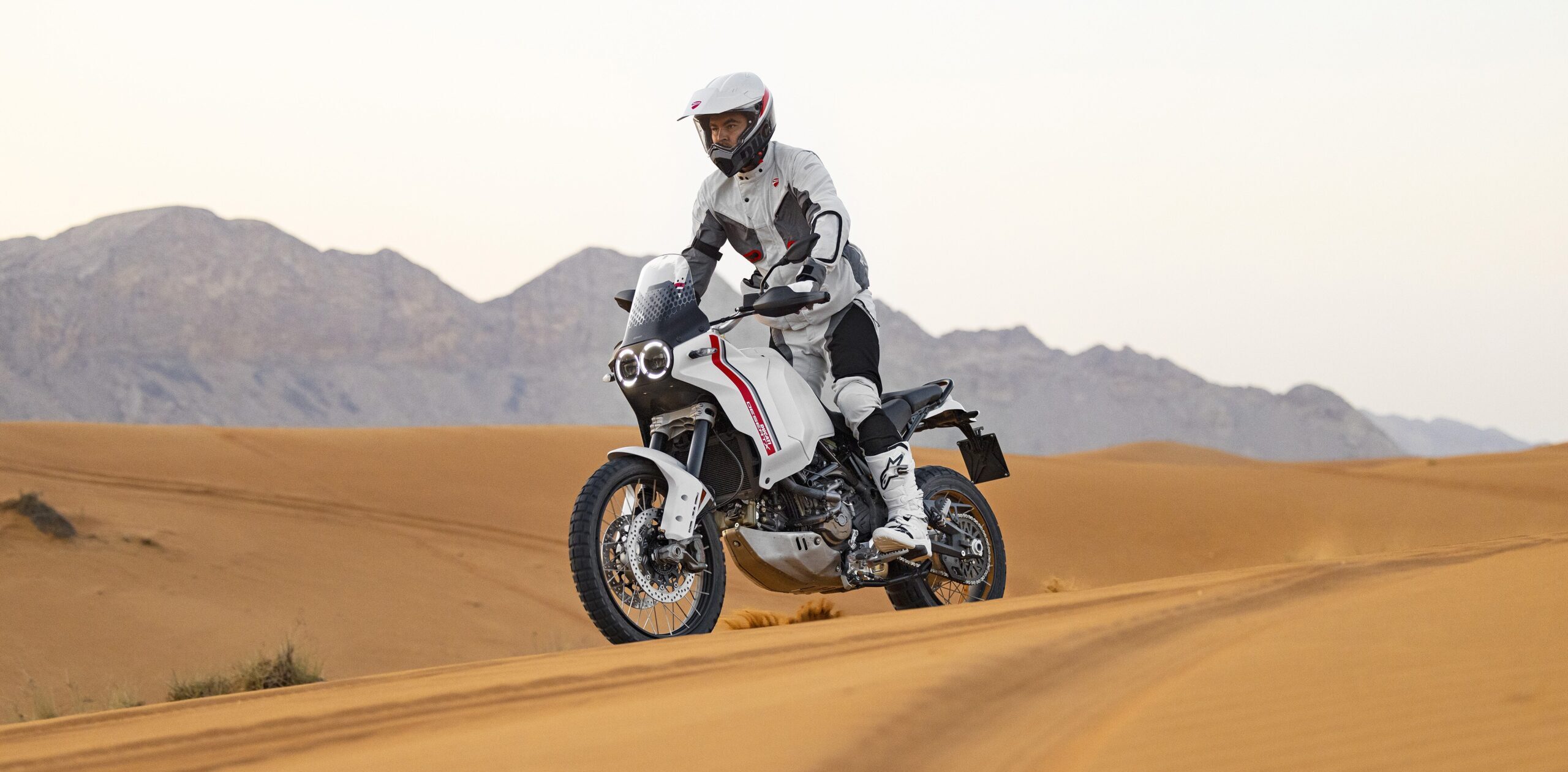
The 2022 Ducati DesertX Adventure Bike is a proper desert rider and a true Ducati

A rider in the desert on the 2022 Ducati DesertX adventure bike

The 2022 Ducati DesertX goes on sale in June with a starting price of $16,795. (Photos courtesy of Ducati)

Table of Contents

Overview
DesertX Technologies
Riding Features
DesertX accessories
Pricing
Why Buy the Ducati DesertX?
Ducati DesertX Specifications

BY JOE MICHAUD
Special to Maynard’s Garage

Development of the new Ducati DesertX started as a simple concept to grow the brand’s platform for the off-road Scrambler and Multistrada. But early on, the team realized it had the potential to build a proper desert rider — and a more dedicated machine that they believed could be a true Ducati.

“The chassis has been developed from the ground up specifically to go off road,” Jason Chinnock, CEO Ducati North America, said in a recent interview at the brand’s “Ready for Red” national tour of 21 cities to showcase new products. “While the X can ride anywhere in the world, the desert is the true spiritual home of this bike.”

Compared with the brand’s popular all-roads Multistrada, Chinnock said, “the Multistrada is on-road bike that can be ridden off-road, the DesertX is an off-road bike that can be ridden on the road.”

That’s the meat-and-potatoes of an Adventure Bike.

The DesertX four-valve 937cc 11-degree L-twin.

The DesertX four-valve 937cc 11-degree L-twin.

DesertX Overview

Italian motorcycle manufacturer Cagiva bought Ducati in 1985 and maintained ownership until 1996.

The stark white with red livery (the only paint scheme available), rally windscreen height, large fuel tank, stubby nose, and dual headlights of the Ducati DesertX borrow badass design cues from the successes of the Cagiva Elefant 906, which competed in the Paris-Dakar Rallies of the 1990s. It was heady times for the small Italian builder.

For the DesertX, Ducati borrowed the four-valve 937cc 11-degree L-twin from the Multistrada V2 with the desmodromic valve system. The engine was given a slight detune to 110 horsepower and 68 foot-pounds of torque to better suit its new off-road bias.

The DesertX gearbox, too, was modified with shortened ratios on gears one through five. First and second gears are especially for low-speed technical dirt work where the slip-assist clutch won’t need to be feathered to maintain balance. Sixth gear remains long for high-speed work on the dry lake beds of Baja California or urban pavement. A quick shifter is standard as well as cruise control.

The optional 2.1-gallon auxiliary fuel tank augments the main 5.5-gallon main tank.

The optional 2.1-gallon auxiliary fuel tank.

DesertX Technologies

Rider-assist technology is ubiquitous today, and DesertX has it deep. A Bosch Sensortec system monitors throttle-by-wire inputs and provides variable intervention for traction, wheelie, and engine braking. It’s common stuff on modern bikes but Ducati adds extra levels.

The DesertX has six riding modes that control the overall response characteristics of the bike. Along with the four self-explanatory standards of Sport, Touring, Urban, and Wet, Ducati has added dedicated modes of Rally and Enduro.

For experienced riders, Rally mode provides full-on 110-hp with minimal electronic interventions. Enduro mode provides 75-hp and more protection for riders with less experience. Engine power can be modified through four levels to match skill level, rider demand, or varying terrain.

The vertical 5-inch instrumentation display is positioned for clear visibility in stand-up riding.

The vertical 5-inch instrumentation display is positioned for stand-up riding.

Riding Features

DesertX lighting is full LED and the 5-inch color gauge display is oriented vertically for better viewing while standing. Three data-screen displays are available to provide custom information chosen for particular rider needs.

Braking is by Brembo, front and rear. Fronts are dual four-piston 320mm radial mounts while the rear is a single 265mm two-piston setup. Bosch Variable ABS Cornering controls and enhances snappy, rear-wheel dirt cornering. It’s primo Ducati engineering.

Rather than pulling stock from current production, the steel-tube trellis frame and aluminum swing-arm were developed specifically for off-road use. Kayaba provided the three-way adjustable suspension with bounteous travel of 9.06 inches front and 8.66 inches rear. Ground clearance is 9.8 inches. The seat is tall at 34 inches, but it can be lowered with a kit.

Rims are flange-spoked and tubeless, a 21-inch front and an 18-inch rear. A larger front hoop typically climbs off-road obstacles easier while transmitting less shock to chassis, suspension, and rider. It’s good dirt stuff. Ducati claims the 21-inch front is the first on a production bike since the 1970s.

Ducati homologated three tire choices, two from Pirelli and one from Metzler. Also, the aftermarket availability of 21- to 18-inch rubber is broad. Stock tires on the DesertX are Pirelli Scorpions.

The 21-inch front wheel is the first on a production bike since the 1970s, Ducati says.

The 21-inch front wheel is the first on a production bike since the 1970s, Ducati says.

 Accessories

Ducati has developed around 50 DesertX accessories, including crash protection, electronics, various trim levels, luggage, and extra racks. Here are a few of the options:

  • Aluminum panniers (2), $1,400 and $800 for the top case. The three hard-shell cases add a voluminous 117-liter capacity for the world traveler’s appearance;
  •  Two exhaust choices by Temignoni;
  •  A rear-mounted auxiliary 2.1-gallon fuel tank, $1,500. It augments the standard 5.5 U.S. gallons main tank with the push of a button;
  •  Heated grips ($388) and a center stand ($320).

The list of accessories can be found here.

The double front LED headlight has two bi-function poly-ellipsoidal modules

The double LED headlight has two bi-function poly-ellipsoidal modules.

Ducati DesertX Pricing

The new Ducati DesertX, first seen as a concept in 2019, will be in showrooms in June.

Competing with the Honda Africa Twin, BMW GS, and the Husqvarna Norden 901, Ducati has priced the DesertX dead center in the pack. U.S. pricing is expected to start at around $16,795 before options.

Learn more about DesertX here.

The DesertX has a long-stroke Kayaba suspension and generous off-roading ground clearance of 9.8 inches.

The DesertX has a long-stroke suspension and ground clearance of 9.8 inches.

Why Buy the Ducati DesertX?

Adventure bikes have changed the motorcycle landscape much like SUVs have done to the passenger-car market. They both promise adventure without limits by putting the off-road within reach. However, like SUVs, many ADVs rarely get used off road.

The Ducati DesertX is gorgeous in white, the shape is sexy, the technology is stunning. It’s a Ducati, and I am not immune to that virus. I just don’t have the skills to exploit it.

I’ll take mine with road tires, please. And I can at least dream of Abu Dhabi.

Joe Michaud is a San Diego-based motorcycle rider and restorer. Send him an email at jmichaud@san.rr.com.

A rider in the desert on the Ducati

The Ducati DesertX was developed from the ground up to go off-road.

Ducati DesertX Specifications

Style: 2 position adventure bike with tubular steel trellis frame

POWERTRAIN

Engine: 937cc Ducati Testastretta 11-degree, L-Twin cylinders, Desmodromic valvetrain, 4 valves per cylinder, liquid-cooled

Power: 110-hp at 9,250 rpm; 68 lb.-ft. torque at 6,500 rpm

Fuel injection: Bosch electronic, 53mm throttle bodies with ride-by-wire system

Exhaust: Stainless steel single muffler, catalytic converter, and 2 lambda probes

Transmission: 6-speed

Clutch: Slipper and self-servo wet multiplate clutch with hydraulic control

Fuel economy: NA

SUSPENSION

Front: KYB 46mm upside-down fork, fully adjustable; wheel travel, 9.1 inches; cross-spoked and tubeless wheel, 2.15 by 21 inches; Pirelli Scorpion Rally STR 90/90 tires, 21-inch M+S

Rear: KYB monoshock, fully adjustable, remote preload adjustment, aluminum double-sided swingarm; wheel travel, 8.66 inches; cross-spoked and tubeless wheel, 4.5 by 18 inches; Pirelli Scorpion Rally STR tire, 150/70 18-inch M+S

BRAKING

Front: 2 320mm aluminum flange semi-floating discs, radial-mount Brembo monobloc 4-piston calipers, Bosch Cornering ABS

Rear: 265mm disc, Brembo floating 2 piston caliper, Bosch cornering ABS

WEIGHTS

Dry weight: 445 pounds

Wet weight: 492 pounds

BY THE NUMBERS

Fuel tank: 5.5 gallons

Seat height: 34.4 inches

Cargo capacity: almost 4.1 cubic feet (120 liters) including bags and aluminum top case

Wheelbase: 63.3 inches (1,608mm)

FEATURES

Standard equipment includes: Riding modes, power modes, Ducati Wheelie Control, engine brake control, Ducati Quick Shift up/down, cruise control, full LED lighting system, DRL, Ducati brake light, USB power port, 12-volt socket, self-canceling turn indicators, steering damper

Optional features include: Ducati Multimedia System, antitheft system, turn by turn navigation via the app, fog lights, heated grips, auxiliary fuel tank

Safety features include: Ducati Safety Pack of cornering ABS and traction control

PRICING

Base price: $16,795

Where assembled: Bologna, Italy

WARRANTY AND MAINTENANCE

Warranty: 24 months, unlimited mileage

Maintenance service intervals: 9,000 miles or 24 months

Valve clearance check: 18,000 miles

DEUS Automobiles To Debut Electric Hypercar Concept

DEUS Automobiles To Debut Electric Hypercar Concept

New Electrifying Hypercar Concept to debut at the upcoming New York International Auto Show

Teaser image for DEUS Automobiles

EDITED BY MARK MAYNARD

Vienna, Austria, March 16, 2022 – DEUS Automobiles GmbH – established in Vienna, Austria, in 2020 – aims to stand out in the increasingly competitive hypercar sector by offering its fresh and objective vision and innovative concepts in terms of luxury, performance, and exclusivity.

The DEUS lightning bolt aligns with the company’s focus on 100-percent electric propulsion technology. The electrified ultra-limited, high-performance hypercars to be built by DEUS Automobiles have technical support from Italdesign and Williams Advanced Engineering.

Italdesign was founded in 1968 and is well known for its association with famed co-founder Giorgetto Giugiaro. Based in Torino, Italy, Italdesign has more than 50 years of expertise developing pre-series and limited and ultra-limited production vehicles at its headquarters.

Italdesign has offered DEUS Automobiles the strategic and technical support necessary to help get its creative visions ready for the road. The design and engineering firm enables and integrates emerging and innovative vehicle technologies.

Williams Advanced Engineering has provided its ground-breaking innovation and product development capability covering advanced battery and electrification technologies. The engineering company was established in 2010 as a subsidiary of Williams F1, well-regarded for its application of race technology. Most recently, its work was seen in the Paralympic Sit-Ski. The monoski made its debut at the recent Beijing 2022 Paralympics and was championed by Toyota and its paralympic downhill ski team.

DEUS Automobiles

DEUS Automobiles is part of a group of businesses with more than 30 years of success. The group of supporting industries ranges from publishing to packaging. The group also is active in today’s broader mobility ecosystem, committed to an exploratory approach toward new products, business, and collaborative innovation.

The company will debut its DEUS hypercar concept at the upcoming New York International Auto Show. Media days will be April 13-14 and public days will be April 15-24.

Follow DEUS Automobiles and Italdesign for updates on the concept vehicle.

Genesis GV70 AWD 3.5T Review

Genesis GV70 AWD 3.5T Review

Genesis thought outside the instrument panel to create the refined and sophisticated GV70

Starting prices for the 2022 Genesis GV70 range from about $43,000 to $55,000.

Starting prices for the 2022 Genesis GV70, including all-wheel drive, range from about $43,000 to $55,000. (Mark Maynard photos)

Table of Contents

Overview
Pricing
Performance
Ride and Handling
Driver Assist Technologies
Safety Features
Interior
Back Seats and Cargo
Why Buy the Genesis GV70?
Specifications

BY MARK MAYNARD

I had been eager to test the Genesis GV70 since the company announced the arrival of its new small SUV back in early December 2020. The images presented a compelling design, but a couple of other luxury elements stood out:

• Its elite styling resisted an SUV image with unnecessary humps and bulges to reinforce an off-roading image.
• In addition to its long new-vehicle warranty, Genesis leapfrogs ultra-luxury warranties with these no-cost coverages:

1. Free scheduled maintenance and Genesis Service Valet care for 3-years/36,000-miles;
2. Free Genesis Connected Services for 3 years;
3. 3 years of free annual multimedia and navigation updates and lifetime traffic data via HD+ Traffic radio.

And this frosting of largesse can be heaped onto the new vehicle warranty of 5-years/60,000-miles bumper to bumper, and 10-years/100,000-miles for the powertrain.

The stand-out perk, however, might be the free service valet care. Genesis says, “Let us pick up and service your vehicle for you.” Genesis will perform a remote diagnostic check, then retrieve your vehicle for service and leave a loaner vehicle, then return your Genesis washed and cleaned.

Now that’s how a carmaker reassures its customers. Such a time-saver in this class could make a $60,000 compact SUV a no-regrets purchase. And there is little to regret about owning the Genesis GV70.

Steering wheel of the GV70

Sightlines are open across the fenders, helped by the small corner glass.

Genesis GV70 Overview

The compact-class GV70 is the second Genesis SUV, joining the midsize GV80 and the brand’s fifth model overall. The GV70 shares an architecture with the G70 sport sedan (and the Kia Stinger) making it more of a sport SUV, though Genesis has no true sport division … yet.

Every luxury-class manufacturer has at least one small SUV crossover in its lineup. Most have traditional styling treatments to remind of a rugged SUV for that great escape, which automotive marketers think is so desired by U.S. drivers.

Mercedes-Benz and the Porsche Macan are on similar trajectories for an SUV crossover that has carlike manners. Genesis thought outside the instrument panel to create the refined and sophisticated GV70.

No apology is needed for its cargo-crimping, coupe-like roofline. And the GV70 has what might be the best-looking rear-end in the business today. And the rest of the GV70 walkaround is balanced and comment-provoking, too.

The fist-forward “Athletic Elegance” design theme has a sweeping parabolic arch that slashes rearward from the headlights and descends to the center of the taillight. It is a muscular treatment without contrived bulges.

Genesis design and engineering is a progressive presentation of everything drivers have become familiar with — but smartly re-created.
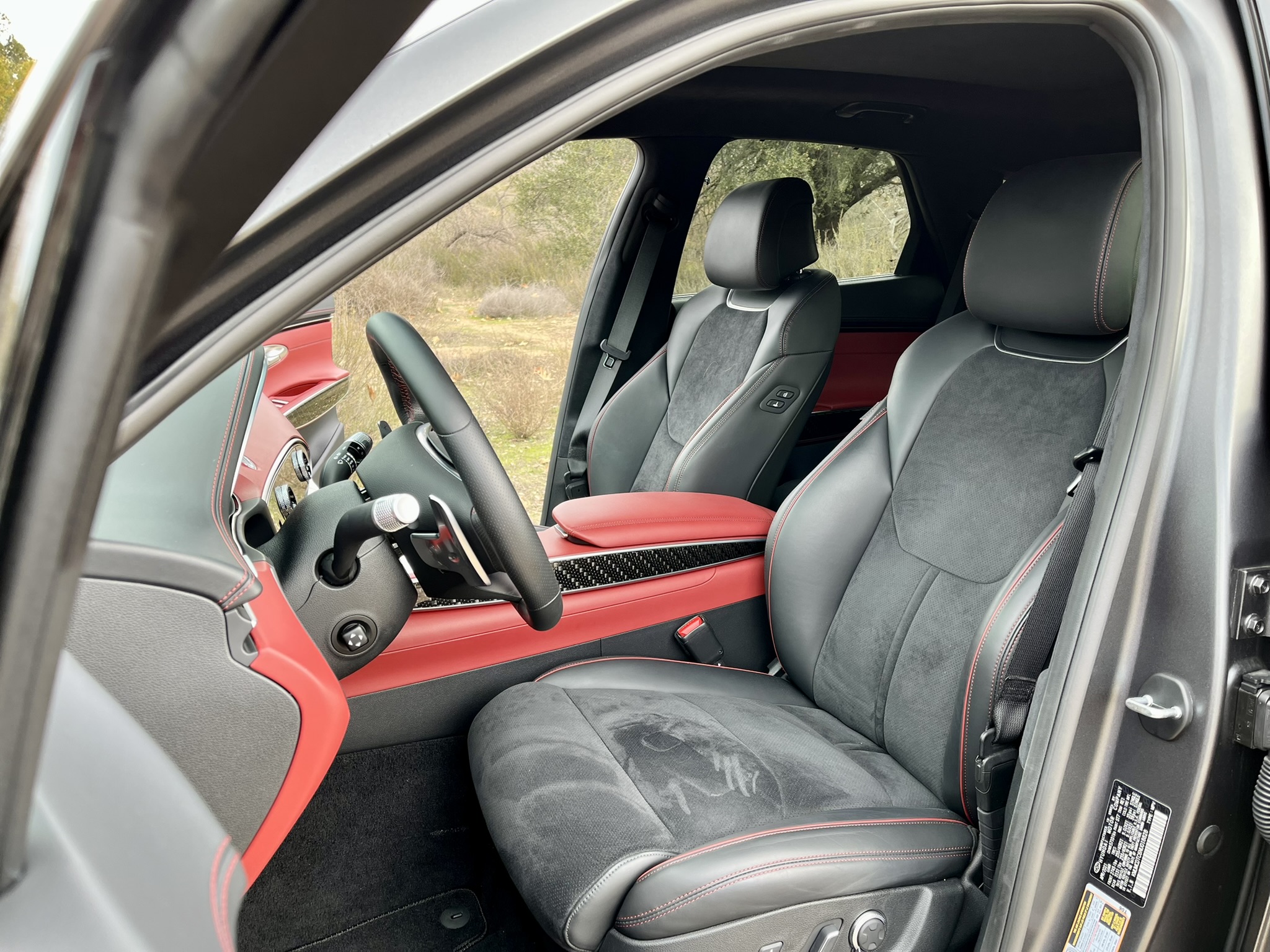
The front seats in the GV70

The Genesis GV70 shuts out the world with acoustic laminated glass.

Genesis GV70 Pricing

Globally, the GV70 drivetrain is rear-wheel drive with optional AWD. But in North America, the GV70 has standard all-wheel drive. There are two choices of turbocharged and direct-injected powertrains with eight-speed automatic transmissions. The electronic transmissions include steering wheel paddle shifters and selectable performance modes of Snow, Comfort, Eco, Sport, Sport-plus, and Custom, which allows individual preferences for steering weight, suspension firmness, etc.

GV70 2.5T AWD starts at $42,595. The 300-hp, single turbocharged 2.5-liter four-cylinder has 311 foot-pounds of peak torque from 1,650 to 4,000 rpm. Fuel-economy ratings are 22 mpg city, 28 highway, and 24 mpg combined, using the recommended premium fuel for peak performance.
GV70 3.5T starts at $54,195 and includes the standard Sport package of 19-inch alloy wheels, panoramic sunroof, and Highway Driving Assist II. The 375-hp, twin-turbocharged 3.5-liter V-6 has peak torque of 391 lb.-ft. from 1,300 to 4,500 rpm. Fuel-economy ratings are 19 mpg city, 25 highway, and 21 mpg combined, also using the recommended premium.

Today’s GV70 3.5T tester was $64,045. Options included the Melbourne Gray matte paint for $1,500, the Sport Advanced package, $5,000, and the Sport Prestige package, $4,900.

Of the 12 paint colors offered, only Alta White is a no-cost choice. The other hues are either $500 or $1,500. Interior color themes are black, red, or blue, depending on paint color.

Find current pricing and incentives for the GV70 here.

The red door panel of the GV70

There is satisfying quality to the artfully presented interior design.

GV70 3.5T Performance

I was not expecting the Genesis GV70 3.5T to be such a sleeper sport sedan, rich in visceral velocity. Dial up the performance mode of Sport-plus, pin the accelerator and the GV70 rears its beautiful head. This 4,451-pound SUV shows its German-inspired performance engineering with acceleration from 0 to 62 mph in 5.09 seconds, according to testing by Genesis Korea.

For the hot-shoe driver, there is a launch-control feature that when activated raises the engine speed to 2,000 rpm for the hole-shot.

Both GV70 engines have a manufactured “active engine sound,” but it is quite realistic. For good effect, the dual exhaust tips have downspout-sized proportions.

I did not like the V-6 engine’s auto stop-start at idle. It took just a split second too long to restart and it can be hesitant in stop-and-go traffic. In those situations, I switched off the system, but I do respect the potential for emissions and fuel savings.

Fuel Economy

Real world fuel-economy ratings are not far off the official ratings. In a week of testing, my driving averaged 16 mpg around town and I worked up to 21 mpg on the highway. Not good when crude oil is $130 a barrel. But the GV70 hauls ass when you need a defining validation for choosing the V-6.

The eight-speed automatic is almost intuitive at providing just the right gear at the right time. When driving for fun in Sport or Sport-plus, the transmission clicks off downshifts with just a brush of the brake pedal. Then the electronics hold the gear until you exit the corner and roll on power for the next twist. The transmission is so adept at being sporty that I seldom felt the need to use the steering-column shift paddles.

The 375-hp, twin-turbocharged 3.5-liter V-6 in the GV70 3.5T

The 375-hp, twin-turbocharged 3.5-liter V-6 in the GV70 3.5T.

GV70 3.5T Ride and Handling

Enjoy the traffic-calmed cabin, which is a good reason to buy a luxury vehicle. The Genesis GV70 shuts out the clamor with acoustic laminated glass at the windshield, front side, and rear side windows.

The body structure is as stiff as a full metal jacket, which reduces body flex and the resulting creaks and itchy sounds. Aerodynamic elements include the rear spoiler that helps smooth airflow at the top of the body and the front bumper air curtain that reduces airflow resistance around the sides and at the front wheels.

Road harshness is controlled by the tester’s 21-inch Michelin Primacy Touring tires, 255/40. The optional five-spoke sport alloy wheels — with sort of a twisted, waffled imprint — looked street wily with the Melbourne Gray paint.

E-Suspension

Genesis uses an electronically controlled suspension to minimize the vehicle’s body lean when cornering. And with electronic limited-slip differentials (part of the $4,900 Sport Prestige package), cornering levels are increased by distributing power left and right to the rear wheels, according to the road surface and driving conditions.

The e-suspension uses adaptive dampers with a road-preview feature. The system scans the road ahead and the sensors process that information in milliseconds to balance ride quality.

In my driving experience, the e-suspension gave precise turn-in responses, but it is not as magically smooth as a magnetorheological damper, such as is used in some performance vehicles. I experienced a few unexpected jolts along rough patches and noticeable head-toss across speed bumps.

With its towing capacity of 3,500 pounds and a full-bodied curb weight of 4,451 pounds, good brakes are essential. And the GV70 3.5T is prepared with ventilated four-wheel discs with 14.2-inch rotors at the front and 13.6-inch rotors rear. (2.5T models also have vented discs, with rotors that are 13.6 inches front, and 12.8 inches rear.

21-inch GV70 tire and wheel

Road harshness is well controlled by the Michelin Primacy Touring tires.

Driver Assist Technologies

Using a Level 2 driver-assist function is always helpful in heavy highway commuting. These systems keep watch when the driver doesn’t.

The Genesis system is reasonably consistent, but it will allow the vehicle to drift wide in a highway curve, crossing the white highway lines or Botts dots. The mapping for steering adjustments isn’t quite smooth and seems like an action of connecting the dots.

But I did appreciate the heads-up display (part of the Sport Prestige package). When using the driver-assist system, the HUD shows red alerts for side traffic. It is more visible during the day than warning lights in the side mirrors. And the heads-up display also shows gray profiles of nearby vehicles ahead and on either side.

Driver assist screen in the GV70

The Level 2 driver-assist system shows red alerts for side traffic.

GV70 Safety Features

The Insurance Institute for Highway Safety rated the Genesis GV70 a Top Safety Pick+ for 2021. The IIHS also gives Top Safety Pick+ ratings for the GV80 SUV, G80 executive sedan, and G90 flagship sedan.

The 2022 awards mark the third year in a row that the entire Genesis lineup of eligible vehicles has earned top honors.

All Genesis models are equipped with a comprehensive suite of state-of-the-art driver assistance and safety technologies including Forward Collision-Avoidance Assist with Pedestrian Detection, Lane Keeping Assist, and Blind-Spot Collision-Avoidance Assist.

Among eight air bags (including a front center air bag), other standard GV70 safety features include:

  • Forward Collision-Avoidance Assist with Junction Crossing and Turning. The system is intended to mitigate the risk of impacts when turning or crossing through an intersection;
  • Blind-Spot Collision-Avoidance Assist. This feature helps reduce the chance of potential impact with a moving vehicle when departing a parallel parking spot.
  • Advanced Rear Occupant Alert technology. Genesis says the GV70 is the first vehicle to feature radar-based detection of passengers in the rear seat, Genesis says. To alert drivers when a child or sleeping infant has been left in their seat, cabin sensors can detect when back-seat passengers move, and they can also detect small respiratory movements.
Double-line quad LED headlights on the GV70

Double-line quad LED headlights are intended to add a sense of speed.

GV70 Interior Function

There is a sweet spot of roominess in the GV70 cabin. Headroom with the panoramic sunroof is about 38 inches and should accommodate 95 percent of drivers; especially with legroom of 41.3 inches.

Sightlines are open across the fenders, with help from small corner glass at the windshield pillars. Over-the-shoulder views are somewhat slim but no worries when parking — the surround-view camera system with guidance lines has billboard proportions from the 14.5-inch high-definition infotainment screen at the top of the instrument panel.

The standard 16-way power driver seat can be electronically positioned by the optional Smart posture control. The feature will set an optimal position based on the driver’s height and weight. It also sets positions for the steering wheel, side mirrors, and head-up display. See the function here.

The front passenger has eight-away power adjustment — and both front seats are heated and ventilated. The passenger seat includes a “walk-in device,” which is merely a power switch for a back-seat occupant to move the seat forward for more legroom; it is a trickle-down feature from chauffeur-driven sedans.

The 3D electronic gauge array is unique with large dials for the speedometer and tachometer. The tach might have merit for the V-6 engine, but it is also is wasted space for most drivers.

There are two large flat dials on the shift console: one for the transmission and the other to access cabin functions, audio, and infotainment. The dials are similar in size, and in the first four days of driving my hand naturally fell to the dial for cabin function. In time, owners will gain the muscle memory to go straight for the shift dial.

GV70 back seat.

Rear legroom is adequate at 37.2 inches.

Back Seat and Cargo Space

Genesis provides a full luxury treatment to the back seat when some brands back off on the details and even soundproofing. Legroom is adequate at 37.2 inches — but hope for short people in the front seats. However, the doors open to near-90 degrees for easy entry, and the seats are comfortably supportive.

Cargo area of the GV70

Fold the back seat for 6 feet of length.

Cargo capacity is slightly compromised by the sloping roofline, but there is nearly 29 cubic feet of space behind the back seat, stacked to the headliner. The cargo opening is wide at 41 inches, and fold the 60/40 back seat for about 6 feet in length.

The area is finished in quality carpeting, with a pair of large side lights, and a slim storage area under the cargo floor.

Despite the $64K price, a cargo roller cover is not included but is available for $200. However, carpeted floor mats are included.

Sidelights in the cargo area of the GV70

Thick pile carpeting, large side lights (2), and robust seatback releases.

Why Buy the Genesis GV70 3.5T?

The Genesis brand is still an outlier among luxury auto buyers who might be more comfortable committing to an Audi, BMW, Lexus, or Mercedes-Benz. But, in 2020, J.D. Power named Genesis the most dependable automotive brand, and in 2021 the brand was lauded as the most technologically innovative in North America.

Time is money and the extensive warranty package is a time-saving answer to the GV70 $64,000 question.

A rear view of the Genesis GV70

Aerodynamic elements include the rear spoiler that helps smooth airflow.

Genesis GV70 3.5T Specifications

Body style: Compact, 5-seat 5-door SUV crossover in rear- or all-wheel drive

Engine: 375-hp, twin-turbocharged and direct-injected 3.5-liter V-6 with auto stop-start at idle; 391 lb.-ft. torque from 1,300-4,500 rpm

Transmission: 8-speed automatic with paddle shifters and 5 drive modes

Fuel economy: 19/25/21 mpg city/hwy/combined; premium fuel recommended for peak power

Max. towing capacity: 3,500 lbs. with trailer brakes

BY THE NUMBERS

Fuel tank: 17.43 gallons

Cargo space: 28.9 to 56.9 cubic feet

Front head/leg room: 39.6*/41.3 in. *without moonroof

Rear head/leg room: 39.1/37.2 in.

Length/wheelbase: 185.6/113.2 in.

Curb weight: 4,451 lbs.

Turning circle: 37.7 ft.

FEATURES

3.5T Standard equipment includes: Smartkey entry and locking with push-button ignition, with Nappa leather-trimmed upholstery, 16-way power driver seat (with power side bolsters and seat cushion), 14.5-inch high-definition infotainment screen, 12.3-inch 3D digital gauge array, 8-way power front passenger seat (with walk-in device), heated and ventilated front seats, 2 front USBs (data and charge) and 2 rear charging USBs, 9-speaker audio system with Android Auto and Apple CarPlay, electric parking brake with automatic hold, full LED lighting (headlights, taillights, running lights, and side mirror turn signals), power folding and heated (with a timer) side mirrors, outside approach lights with Genesis logo (at side mirrors), power one-touch panoramic sunroof, solar control tinted side and rear glass, acoustic laminated glass (windshield, front side and rear side windows), carpeted floor mats, power tilt-telescoping steering wheel, smart cruise control with stop-and-go, wireless charging, locking glove box, surround-view camera system with guidance lines

Packages on tester

Sport Advanced package, $5,000: Nappa Leather Seating Surfaces with Sport Pattern Quilting; Layered Edge Backlit Trim; Leatherette Upper Instrument and Door Panels; Suede Headliner; Heated Steering Wheel; Genesis Digital Key; Surround View Monitor; Blind-Spot View Monitor; Remote Smart Parking Assist
Parking Distance Warning – Front; Parking Collision-Avoidance Assist – Rear; Lexicon Premium Audio with 16-Speakers

Sport Prestige package, $4,900: 21-inch Sport Alloy Wheels; Electronic Limited Slip Differential; Nappa Leather Seating Surfaces with Suede Insert; Carbon Fiber Trim; Heated 2nd Row Seats; Manual Rear Side Sunshades; Acoustic Rear Door Glass; 3-Zone Climate control; 12.3-inch 3D Digital Cluster
Heads-Up Display

Safety features include: 8 air bags, Forward Collision Avoidance-Assist with Pedestrian and Cyclist Detection, Lane-Change Oncoming, and Junction Turning Highway Driving Assist; Driver Attention Warning; Lane Keeping Assist and Lane Following Assist; Blind-Spot Collision-Avoidance Assist; Rear Cross-Traffic Collision-Avoidance Assist; Safe Exit Assist; Intelligent Speed Limit Assist; Park Distance Warning – Rear; Launch Control and Hill Start Assist Control Vehicle Stability Management with stability and traction controls

PRICING

Base price: $53,645, including $1,045 freight charge; price as tested $64,045

Options on test vehicle: Melbourne Gray matte paint $500; Sport Advanced package, $5,000; Sport Prestige package, $4,900;

Where assembled: Ulsan, Korea

Warranties: 5-years/60,000-miles bumper to bumper; 10-years/100,000-miles powertrain; Genesis Service Valet for 3 years or 36,000 miles provides a remote diagnostic check, vehicle pick up, and a loaner vehicle and return of the vehicle

Maserati Boomerang Turns 50

Maserati Boomerang Turns 50
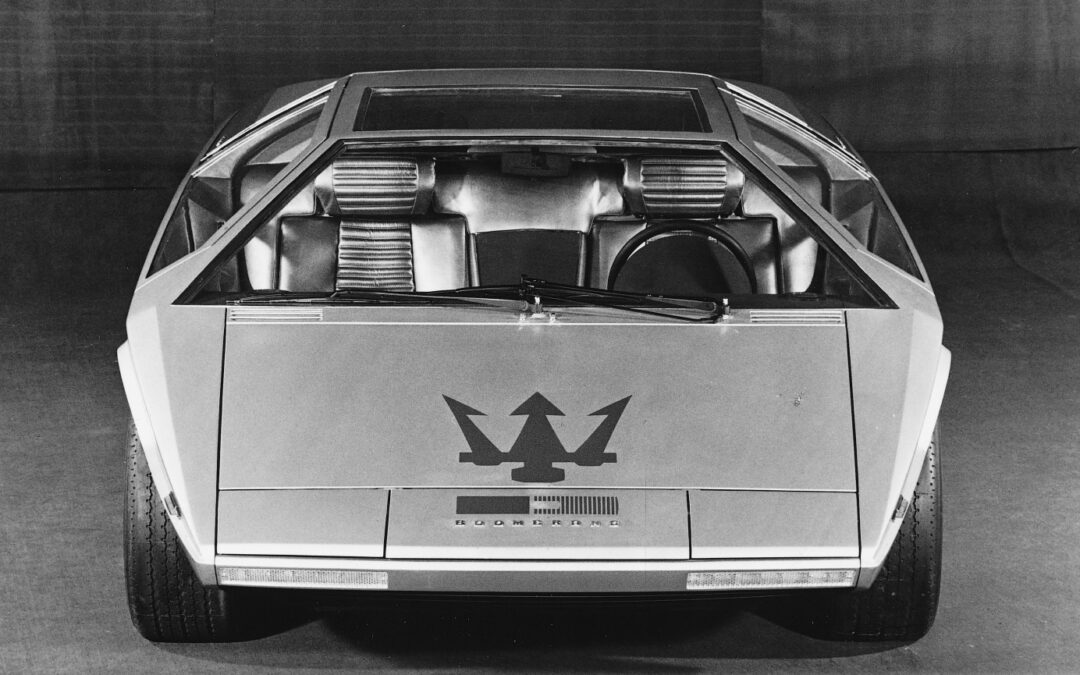
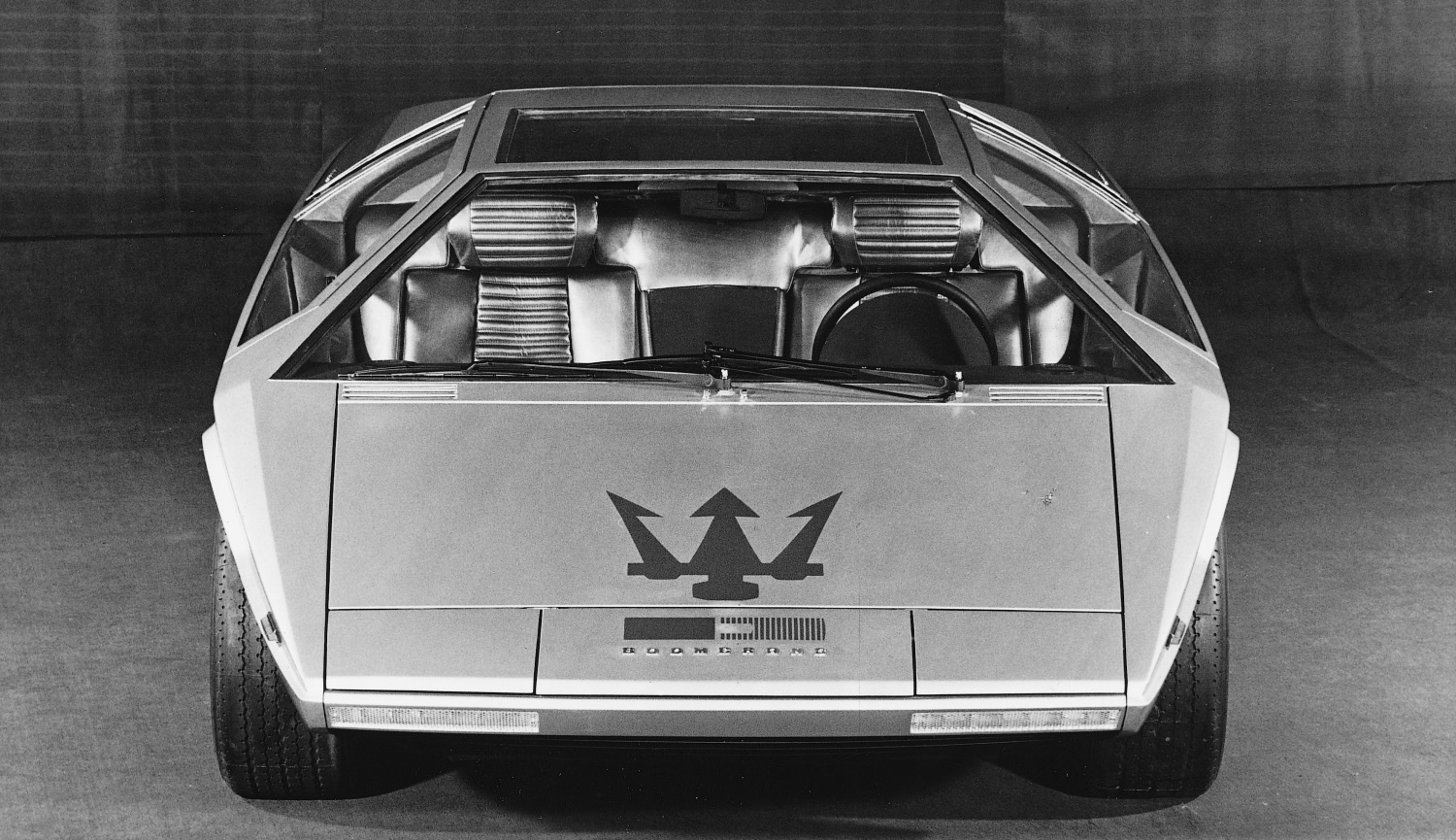
Maser Boomerang concept

The 1972 Maserati Boomerang concept conveyed an image of penetration, power and speed. (Photos courtesy of Maserati)

The Maserati Boomerang concept defined Maserati as a brand of iconic and avant-garde cars that  pioneered technology and style

BY MARK MAYNARD

A half century has passed since the Maserati Boomerang debuted at the Geneva Motor Show on March 9, 1972. It was a one-off concept created by the renowned Giorgetto Giugiaro and produced by Italdesign. Only one car was ever produced.

The Maserati Boomerang concept made an appearance at the 1971 Turin Motor Show.  And it was presented at the Geneva motor show in 1972 as a registered vehicle that ran perfectly, Maserati said in a release.

Italdesign started with the Maserati Bora for the Boomerang’s chassis and mechanics. The powertrain was a rear-mounted, 90-degree 4.7-liter V-8 engine. Channeled through a five-speed ZF manual gearbox, the 310-hp Bora would have a top speed of almost 186 mph (300 km/h).

A red Maserati Bora

The Maserati Bora.

The two-seat Maserati Boomerang sports coupé never went into production. But its stylistic legacy continued Giugiaro’s later creations. And it was inspiration for other automakers in Europe and the United States.

The influence of the Boomerang’s wedge shape can be seen in the 1973 Audi Asso di Picche concept, 1973 VW Passat Mk1, 1974 VW Golf Mk1, 1976 Lotus Esprit and Medici II show car, 1979 Lancia Delta and Maserati Quattroporte III, and 1976 designed and 1981 launched DeLorean.

Maserati Boomerang side view

The Maserati Bora was used for the Boomerang’s foundation.

Design Elements

The originality of the Maserati Boomerang was in its wedge shape and bold lines. The stance conveyed an image of penetration, power, and speed.

Stylistically, a horizontal line divided the Boomerang in two with a sloping windscreen and a panoramic sunroof. The original windows of the doors were divided by a metal strip. And the retractable square headlamps stood out, with horizontal lights in the rear.

A head-on view of the Boomerage

The Boomerang’s dashboard instruments were built into the spokeless steering wheel and the wheel rotated around the stationary gauges.

The interior was extremely modern and introduced fresh ideas. For example, the dashboard instruments were built into the spokeless steering wheel, and the seats were positioned very low.

The one production version of the Boomerang made other appearances in international competitions. It would change hands between various owners, and ended up as the feature car in a number of auctions; it was even used in commercials.

Considered by many to be a work of art, the Maserati Boomerang was revolutionary and influenced the designs of successive cars. It continued to define Maserati as a brand capable of creating unique automotive concepts, iconic and avant-garde cars that acted as pioneers of technology and style.

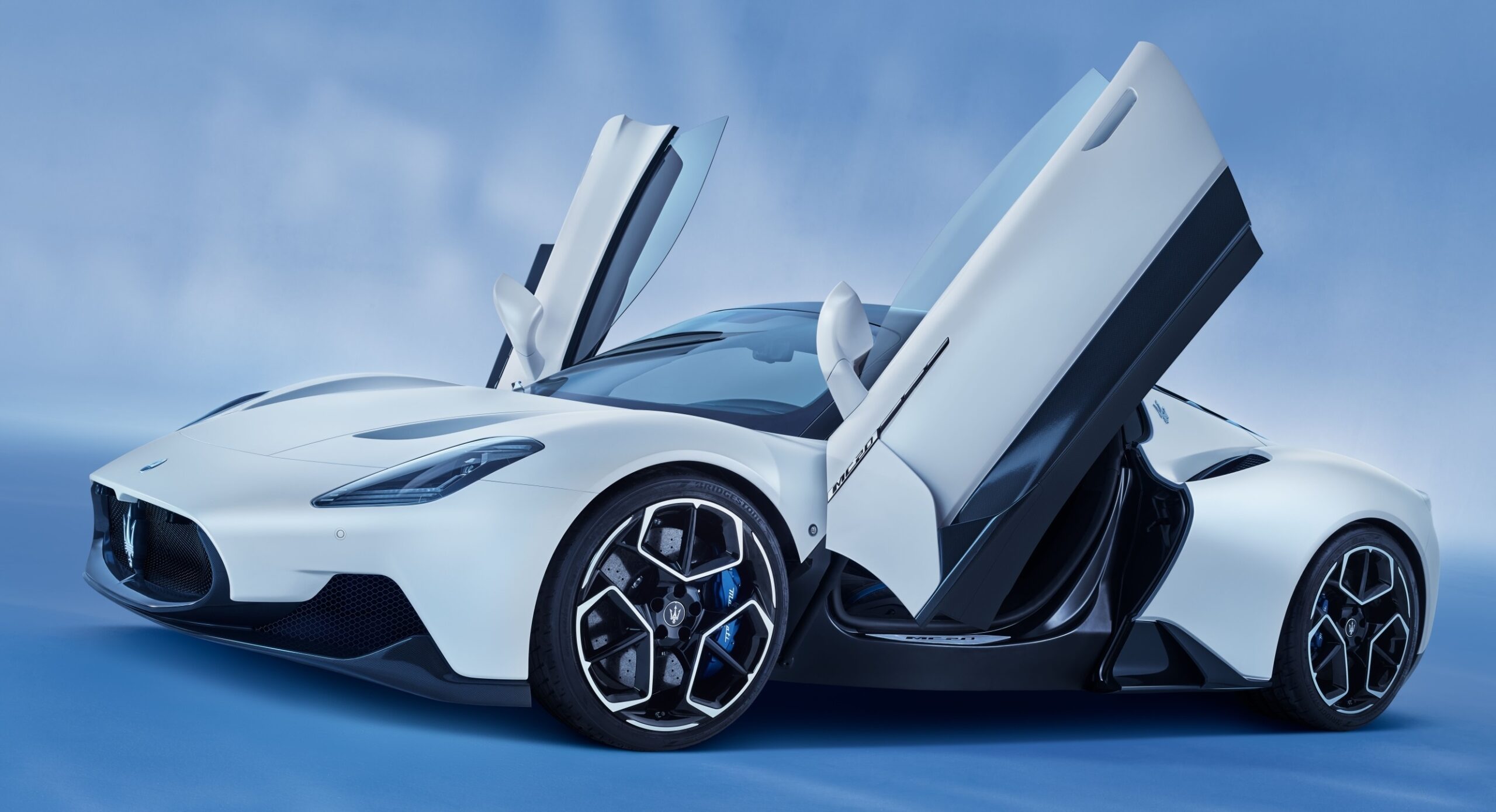
The Maserati MC20 supercar.

The Maserati MC20 supercar.

The Future for Maserati

Now more than ever, Maserati is unique for its design and innovation. It is moving forward with the new Grecale SUV and the 621-hp, MC20 super sports car. The 2022 MC20 debuts Maserati’s in-house designed new 3.0-liter V-6 Nettuno engine  that applies F1 technology for a road car. MC20 pricing starts at $212,000.

The Maserati Grecale prototype in camouflage.

Details for the Maserati Grecale small SUV will be released March 22.

VW ID Buzz World Premiere

VW ID Buzz World Premiere

European models of the VW ID Buzz go on sale this year, followed by a long-wheelbase passenger model for North America in 2024

An ID.Buzz in two-tone Energetic Orange and Candy White

Two-tone VW ID Buzz models will have the roof, upper areas and hood finished in Candy White. Areas below the character line are in a choice of four shades, such as this hue of Energetic Orange. (Photos courtesy of Volkswagen)

Table of Contents

Powertrain
Dimensions
Paint Colors
Interior Design
Cabin Electronics
Interactive ‘ID Light’
Driver Assist Systems
Sustainability

BY MARK MAYNARD

Official photos and many details were released today, March 9, for the much-anticipated debut of the electric-powered VW ID Buzz and ID Buzz Cargo. Both body styles, passenger and cargo variants, will go on sale in European markets in the third quarter of this year. For the U.S., a long-wheelbase passenger model will debut in 2023 and go on sale in 2024.

The zero-tailpipe emission vehicles transfer the design of the iconic 1950 Type 2 Microbus to the era of electric mobility. However, the ID Buzz is not the first microbus with an electric drivetrain. Fifty years ago at the Hannover Trade Fair Volkswagen showed a T2 bus powered by a rear-mounted electric motor with a maximum range of 52.8 miles.

ID Buzz Powertrain

European versions of the VW ID Buzz and ID Buzz Cargo will come to market with a high-voltage lithium-ion battery providing gross energy content of 82 kWh (77 kWh usable). With its 12 modules, the battery system supplies a 201 horsepower electric motor, driving the rear axle, with maximum torque of 229 foot-pounds. The top speed is limited to 90 mph.

The electric driving range of either model of VW ID Buzz has not been released. But industry sources report that the U.S. version will have a larger battery and electric driving range of around 260 miles. A dual-motor, all-wheel-drive configuration is expected to be added later. Details for the U.S. version will be available closer to launch.

The battery is mounted in the floor of the vehicle. An 11 kW (AC) charger is included for home and Level 2 systems. The ID Buzz also will have a CCS plug connector for use at DC fast-charging stations, at which the charging power increases to as much as 170 kW.

With DC-fast charging, the battery charge level rises from 5 to 80 percent in just 30 minutes, Volkswagen says. In the future, a Plug & Charge function will be offered.

For Europe, bi-directional charging will enable the VW ID Buzz and ID Buzz Cargo to feed power that they don’t need into the domestic grid (vehicle-to-home). VW says this can also make the power available for stabilizing the power grid. The power transfer and communication take place via an optional DC bi-directional wall box.

VW ID Buzz front seats

Sustainability measures include replacing leather with non-animal material.

ID Buzz Dimensions

On a wheelbase of 117.6 inches, both ID Buzz models are 185.5 inches long, 76.3 inches tall, and 78.1 inches wide, not including the side mirrors.

The ID Buzz has full LED lighting. At the front, are charismatically styled headlights, daytime running lights, and a slim lateral bar between the headlights.

In an homage to the original microbus, the VW logo is much larger than all other current Volkswagens. At the back, the ID Buzz has horizontally arranged LED taillights, which are connected by a full-width light strip.

ID Buzz Paint Colors

European versions of the passenger and cargo models will be available in base colors or two-tone styles. The spectrum consists of 11 single-color choices of Candy White (nonmetallic), Mono Silver, Lime Yellow, Starlight Blue, Energetic Orange, Bay Leaf Green, and Deep Black.

There will be four two-tone options. On two-tone ID Buzz models, the upper section, including roof and V-shaped hood, is finished in Candy White, while the areas below the character line are in a choice of four shades: Lime Yellow, Starlight Blue, Energetic Orange or Bay Leaf Green. Side mirrors and door handles are finished in body color.

Both European ID Buzz versions will come with 18-inch steel wheels as standard. On passenger vehicle models, aluminum-alloy wheels are available in sizes ranging from 18 to 21 inches.

ID Buzz two-tone paint colors

At the back, horizontal LED taillights are connected by a full-width light strip.

Interior Design

For passenger models of the ID Buzz, drivers will face a standard 10-inch Digital Cockpit display, which is paired with a 10-inch infotainment system centrally positioned in the dashboard. A 12-inch display with navigation is optional.

Both the Digital Cockpit and infotainment system are connected with the instrument panel only at the bottom, looking like free-floating tablets.

Beneath the infotainment system is a control bar with digital buttons and touch sliders to regulate temperature and audio volume. The digital buttons provide direct access to menus for the dual-zone Climatronic settings, driver assist systems, driving profiles, and parking functions.

The ID Buzz Cargo will launch with three seats in the cab as standard. The extended wheelbase version for North America will have a seven-seat configuration in three rows of 2/3/2 arrangement. The three-person bench in the second row can be folded flat or split 60/40, and it can be moved lengthways 5.9 inches.

Cargo capacity of 39.6 cubic feet will be expandable by an optional height-adjustable cargo floor to create a level load surface. Two side sliding doors are fitted as standard.

Driver area of the Buzz

The Digital Cockpit and infotainment screens appear as free-floating tablets.

Cabin Electronics

To the left of the multifunction steering wheel, there is an island of digital controls for activating the light functions, heating, and defrost for the windshield and rear window. To the right of the steering wheel are two USB-C plugs and a tray for wireless charging (wireless App-Connect is also standard).

In the center console, there are, depending on specification, two more USB-C plugs; there is a fifth in the front passenger door, another in each of the two sliding doors, and one by the rearview mirror for a dashcam.

Two cupholders fold out from the lower dashboard area. In the ID Buzz Cargo, there are two more cupholders near the A-pillars.

Side entry of the new VW microbus

U.S. models of the ID.Buzz will have three rows and seven seats.

Interactive ‘ID Light’

As with other models of Volkswagen’s all-electric vehicle family, the new ID Buzz comes with the interactive ID Light. It stretches across in front of the windshield in the driver’s field of vision above the instrument panel. The head-up style of display gives the driver information based on the color and position of the light signal. For example, a signal in the right-hand area of the strip advises of obstructions in this area or corresponds with a navigation instruction to change lanes. When the ID Light goes red, it is signaling danger and the need to brake.

Driver Assist Systems

European five-seater ID Buzz models are equipped with standard Front Assist, Lane Assist, and Dynamic Road Sign Display. Optional systems include Adaptive Cruise Control, Side Assist, Travel Assist, Emergency Assist, Park Assist, Light Assist, and Area View.

The open cargo area

An optional height-adjustable cargo floor will create a level load surface.

Sustainability

Both versions of ID Buzz are designed with sustainable measures, such as not using leather in the vehicle. The steering wheel cover is made of polyurethane but has a high-quality appearance and feels like leather.

Seat-cover materials, floor coverings, and the headliner of the ID Buzz incorporate recycled material. There will be a fabric made of what is known as Seaqual yarn. Its fibers consist of 10 percent collected ocean plastic and 90 percent recycled plastic bottles.

The two ID Buzz models will also use organically based vehicle paint and forgo cobalt in the high-voltage battery. The company’s sustainability measures include a plant that recycles the high-voltage batteries at the end of their automotive life cycle to prepare them for a second use.

The VW ID Buzz and ID Buzz Cargo models are being produced by Volkswagen Commercial Vehicles at its main plant in Hannover, Germany.