Select Page

2022 Acura MDX debuts most radical design transformation yet

2022 Acura MDX debuts most radical design transformation yet

The redesigned and larger 2022 MDX will go on sale Feb. 2 starting at $47,925 or $49,925 with AWD; Pricing includes the $1,025 freight charge from East Liberty, Ohio. (Acura)

Culmination of a five-year effort to rebuild the brand as a performance icon


BY MARK MAYNARD

A cura has leapfrogged the 2021 model year for a radically evolved 2022 MDX that represents the culmination of a five-year effort to rebuild the brand as a performance icon. The “all-new” MDX will arrive at dealers Feb. 2.

Revealed this week, Dec. 8, Acura calls its 2022 MDX “the most premium, performance-focused and technologically sophisticated SUV in Acura history.”

Replacing the RLX large sedan, the MDX has been elevated to be the brand’s new flagship vehicle. The next-generation MDX marks a quantum leap forward, Acura says, with a bold exterior design coupled with a sophisticated and elegant new interior featuring the most high-tech and advanced cockpit in the brand’s 35-year history.


Jon Ikeda, Acura’s chief brand officer, said the house of Acura is built around that performance mantra, culminating the new MDX.

“All the different pieces that we’ve been building up to the past 5 years to rebuild the brand are being culminated with the introduction of this brand new, revolutionarily designed MDX,” Ikeda said in the video. “It is a performance SUV because we are a performance brand.”

To fulfill its new role as the flagship model of the Acura brand, the MDX needed be something more than evolution, said Tom Nguyen, Global Development Lead. “And that something was the kind of unquantifiable value that doesn’t show up on engineering graphs or charts,” Nguyen said. “Call it desirability.

“As we defined our concept, we had a clear focus on taking MDX to a higher level, a true revolution that would invoke passion, excitement and emotions never before raised by MDX,” Nguyen said.

Cabin materials feature high-grade authentic materials such as open-pore wood, brushed aluminum and soft-touch Milano leather. (Acura)

Pricing

Sold in six trim levels in front- or Acura’s Super Handling All-Wheel Drive, with a special A-Spec model, the entry MDX starts at $47,925 or $52,625 with technology package. MDX Super Handling All-Wheel Drive $49,925; $54,625 with technology package. And the MDX A-Spec, with standard AWD is $58,125; MDX or $61,675 with the Advance Package. Pricing includes the $1,025 freight charge from the assembly facility in East Liberty, Ohio.

(Check here for special offers on a 2020 MDX)

The footprint

Dimensionally, the new MDX sits on a 2.8-inch longer wheelbase, with a stance that’s 1.4 inches wider in the front and rear. At 198.4 inches, the new model is 2.2 inches longer. Body width is up 1 inch to 78.7 inches but overall width is just a half inch wider, at 67.1 in. The new dimensions added 6.4 cubic feet of interior cabin space, now at 139.1 cu.ft. And cargo space grew by 1.5 cubic feet behind the third row to 16.3 cu.ft.; and 2.2 cu.ft. with the third row folded, to 39.1 cu.ft.

Dash-to-axle ratio

Perhaps the most significant dimensional change is the dash-to-axle ratio, which has been extended by more than 4 inches. This lengthens the hood line significantly, creating a “cab rearward” proportion, Acura says, that emphasizes the power under its long, sharply creased hood.

The multi-faceted Diamond Pentagon grille is a showcase with new four-element JewelEye LED headlights that embed Chicane daytime running lights. Three-dimensional sculpting under the headlights serve to visually widen the front, blending to the fog-light housing at the bottom.
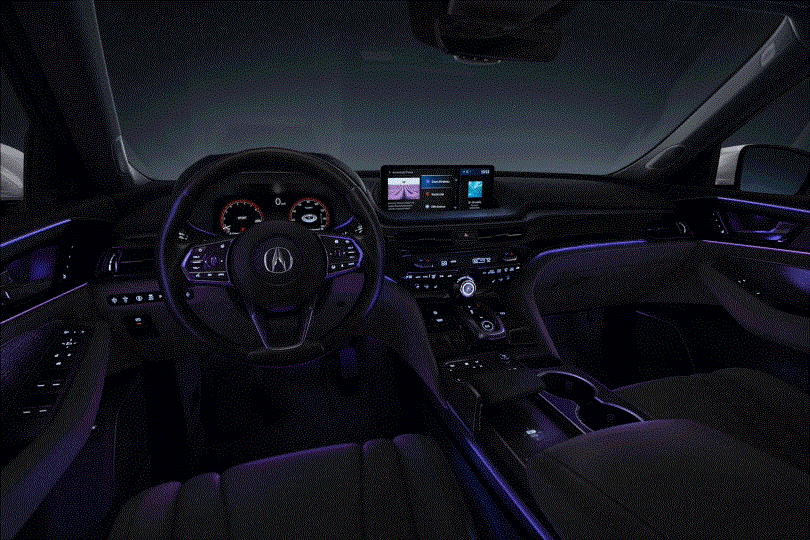
A hand-wrapped instrument panel with available top-stitching provides a premium touch beyond anything offered in MDX to date. (Acura)

New platform

The all-new light truck platform underpinning the 2022 MDX was designed in pursuit of Type S levels of performance. The MDX sports its first-ever double-wishbone front suspension, combined with an all-new multilink rear suspension. The combination, Acura says, provides incredibly precise road holding while maintaining a smooth ride.

New belt-driven electric power steering uses a high-output electric motor, essential for the quicker steering ratio afforded by the new variable gear ratio steering system, Acura says. The turning circle of 40.5 feet is not wider than some midsize sedans — but it is 1.8 feet wider than on the previous model.

Braking was enhanced with larger and thicker front brake rotors, and a new electric brake booster. The front rotors are 2mm thicker and 30mm larger in diameter, now at 13.8-inches with vented rotors. Solid rear discs have 13-inch rotors.

Repeated hard stops have reduced fade from a nearly 18-percent increase in heat capacity, Acura says. The new electric brake booster allows the collision mitigation braking system to react 230 milliseconds faster, reducing stopping distance from 30 mph by 12 feet.
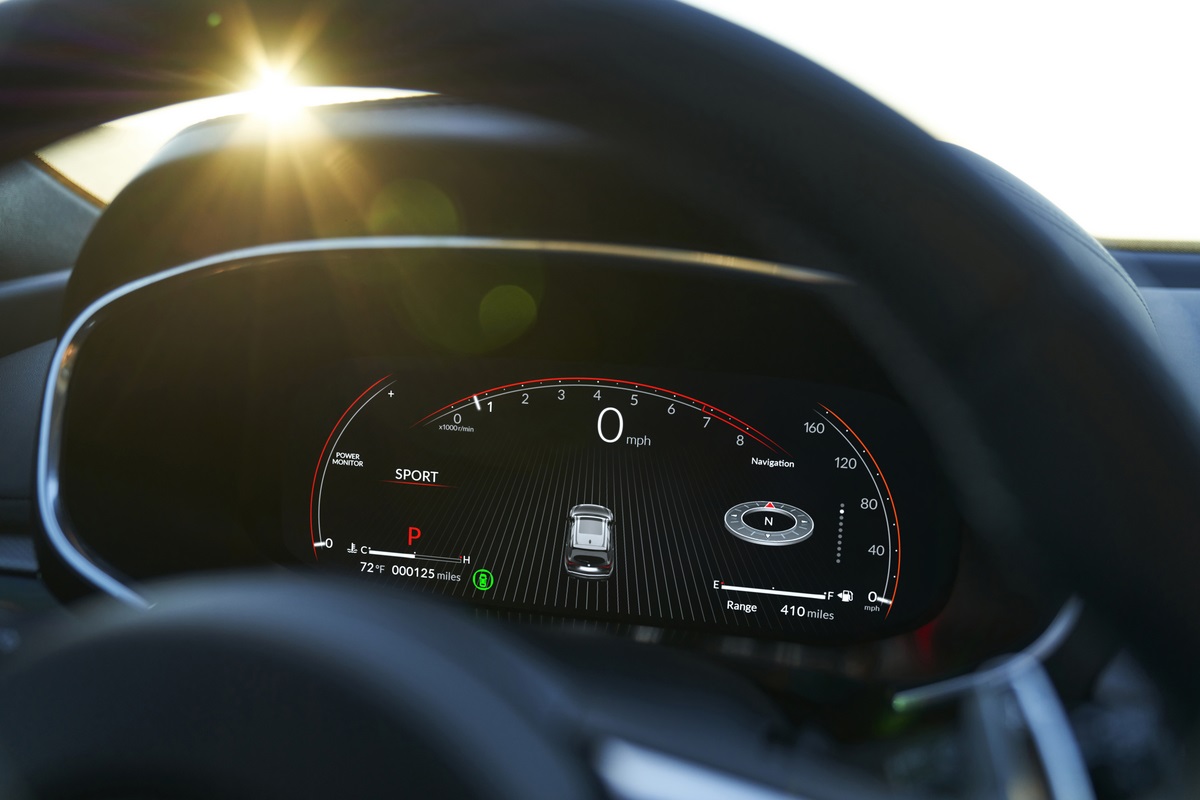
A 12.3-Inch HD Precision Cockpit digital instrument cluster is configurable for various drive modes. (Acura)

Wheels and tires

New and larger wheel and tire packages increase the contact patch stiffness by 15 percent in lateral loads for improved handling performance.

The standard 19×8.5 wheels (+1-inch diameter, +0.5-inch width) are paired with wider 255 (+10mm) series tires take advantage of the steering and suspension updates.

Optional 20×9.0 wheels (+0.5-inch width) use in-wheel resonators to reduce road noise at highway speeds. A new Bridgestone tire developed exclusively for MDX features a revised rubber compound, construction and tread pattern to reduce rolling resistance by 17 percent.
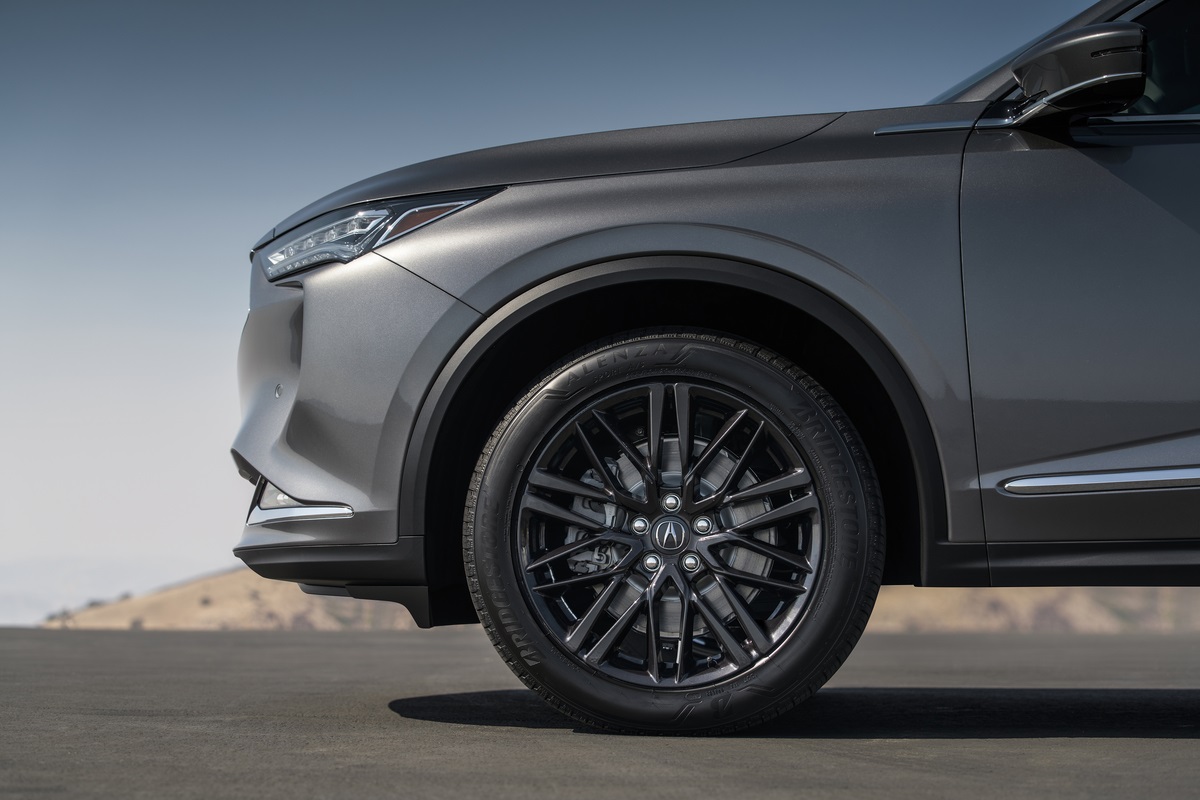
New and larger wheel and tire packages feature a standard wheel size of 19 inches with an option for 20s. (Acura)

Paint colors

The 2022 Acura MDX will be available in just two standard (non-metallic) paint colors but six premium colors including two new offerings — Phantom Violet Pearl first offered on the 2021 TLX and an all-new Liquid Carbon Metallic.

Apex Blue Pearl returns as an exclusive color offered on the MDX A-Spec. Gloss black accents front to rear, darkened headlight and taillight treatment and Shark-Gray wheels emphasize the A-Spec’s sport appearance.

Cabin details

Cabin materials feature high-grade authentic materials such as open-pore wood, brushed aluminum and soft-touch Milano leather. A hand-wrapped instrument panel with available top-stitching provides a premium touch beyond anything offered in MDX to date, Acura says.

Next-generation Acura sport seats have standard 12-way adjustment, three-way seat heating and three-position memory. The MDX A-Spec adds ventilated front seats while the Advance Package gains additional power-adjusting side bolsters and thigh extensions for 16-way adjustment.

The second row features a multi-function removable middle seat providing three seating options: a traditional bench for three-across seating and seven-passenger total capacity, a captain’s chair style wide center armrest with additional drink holders (middle seat down) or wide pass-through for access to the third row (middle seat removed), which is handy when child seats are installed in the outboard second-row seat.
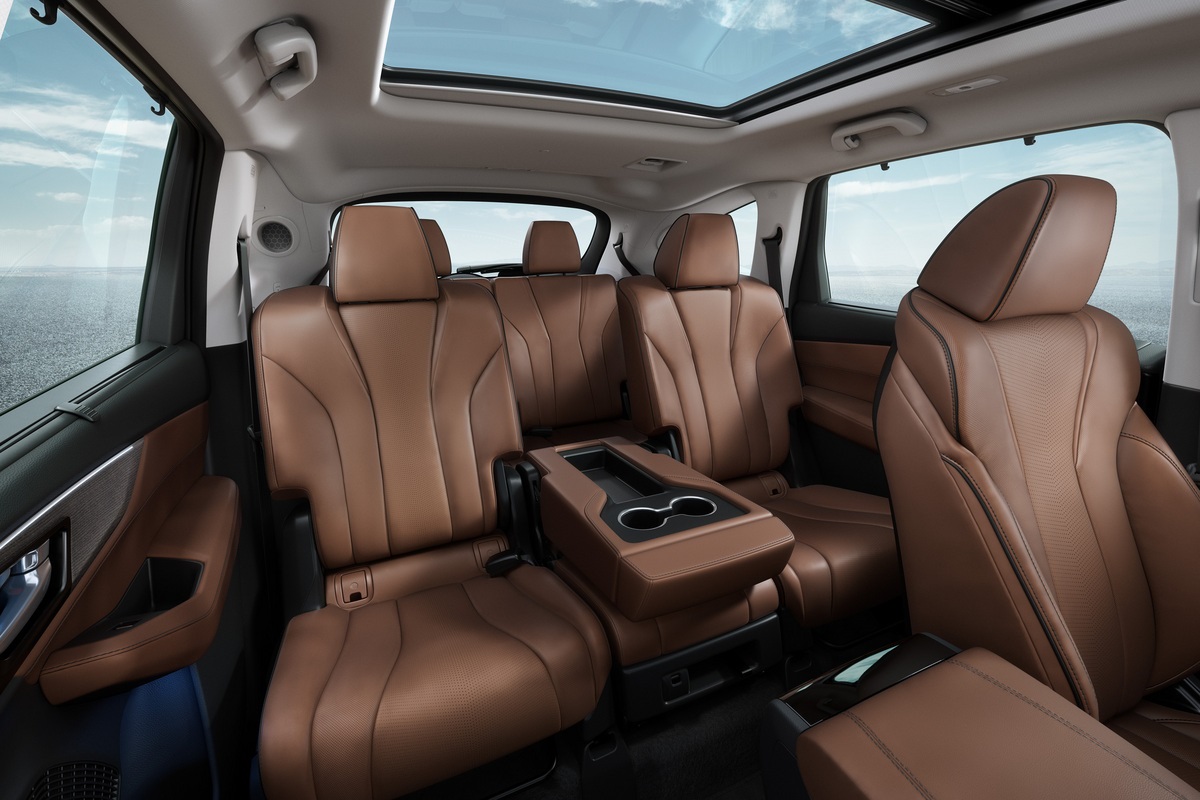
The second row features a multi-function removable middle seat. (Acura)

Connectivity

A pop-up socket in the center console packages USB-C and USB-A charging ports in front of a convenient pocket for smartphones. Also included rare standard wireless Apple CarPlay and Android Auto integration with standard wireless charging through a Qi-compatible 15-watt charger; the new charging pad is large enough for any size smartphone, Acura says.

For the first time, the MDX will have Amazon Alexa Built-In, allowing drivers to ask Alexa to navigate to a specific address or point of interest, play music, make calls, listen to audiobooks, check the weather, control smart home devices, find parking and more.

New convenience features include standard CabinControl, which enables passengers to control music, audio settings, rear climate controls, navigation and even the panoramic moonroof’s sunshade position using a downloadable smartphone app. With A-Spec and Advance Packages, MDX features CabinTalk, which amplifies the voices of front-seat passengers so they can be better heard in the second and third rows.

The 2022 MDX also features the latest generation of AcuraLink, with in-vehicle 4GLTE Wi-Fi compatibility, over-the-air software update capability and a wide array of available cloud-based services, including emergency roadside assistance, remote locking/unlocking and engine start, stolen vehicle tracking, remote diagnostics, geofencing, speed tracking and Acura concierge services.

Third row

The third row has an additional 0.4-inches of headroom, 2.4-inches of legroom and a seating position that’s 2-inches higher from the floor compared to the outgoing model. In MDX Advance trim, third-row occupants have their own USB charging ports on the left and right side of the cabin.

Cargo space ranges from 16.3 cubic feet to 39.1 cu. ft. with the second-row folded, or up to 71.4 cu.-ft.) with both rows folded. There also is 80 percent more basement storage under the cargo floor. The floor panel drops into the cargo well to expand the MDX’s rear cargo area behind the third row to 18.1 cubic feet, and is reversible, with a carpeted side and an easy-to-clean hard side for dirty or wet items.

Engine and transmission

Despite being considered “all-new” the MDX uses an enhanced version of the 3.5-liter V-6, which seems basically carryover, with same hp and torque as the 2020. The engine will need no tune-ups for 100,000 miles or more.
The in-house engineered 10-speed automatic transmission replaces a nine-speed automatic.

Fuel economy ratings, on the recommended premium octane, are 19 mpg city, 26 highway and 22 mpg combined; those are down by just 1 mpg in all categories despite another 239 pounds of curb weight. Ratings with AWD or the A-Spec are 19/25/ 21 mpg city/hwy/combined.

No Sport Hybrid is planned, which was the performance variant for the third-gen MDX. (It had 2020 fuel economy ratings of 26/27/27). “For this new MDX, Type S will assume that role, and push the performance envelope even farther for an Acura SUV,” a spokeswoman said.

LED headlights are embedded with Chicane daytime running lights. (Acura)

Safety

Next-generation passenger front air bag use a proprietary three-chamber design that functions much like a baseball catcher’s mitt. It is intended to more effectively cradle and protect the front seat occupant’s head to help mitigate potential injury, especially in angled frontal collisions.

All 2022 MDX trims have 10 air bags and has an expanded suite of standard AcuraWatch advanced safety and driver-assistive technologies. The various technologies include updated Road Departure Mitigation, Traffic Jam Assist, Traffic Sign Recognition, Pedestrian Detection and a new Driver Attention Monitor.

Working in conjunction with Adaptive Cruise Control with Low-Speed Follow, Traffic Jam Assist helps reduce driver stress in highly congested traffic situations by helping keep the vehicle in its lane and at a set interval behind a vehicle detected ahead.

In addition, MDX will feature a new front and rear automatic braking system called Low Speed Braking Control.

Included in the Technology Package, the new system uses the sonar-based parking sensors to sense solid objects at low speeds, such as in parking situations, and warn the driver or apply the brakes to help avoid or mitigate a collision.

Torque vectoring SH-AWD

The available rear-biased Super Handling All-Wheel Drive (SH-AWD) system uses Acura’s torque-vectoring all-wheel drive. Now in its fourth generation, SH-AWD has 40 percent more rear torque capacity and 30 percent quicker front-to-rear torque transfer than the third-generation system in the previous MDX.

The Acura SH-AWD system can transfer up to 70 percent of engine torque to the rear axle during normal driving conditions, while continuously apportioning up to 100 percent of that rear-axle torque between either the left or right rear wheels.

Next to arrive: High performance MDX Type S

Arriving at dealerships in late summer 2021, the MDX Type S joins the lineup as the brand’s first application of the Type S high performance nameplate to an SUV.

MDX Type S will deliver an even stronger performance styling statement, with an open diamond mesh grille, quad exhaust outlets and gloss black trim replacing the standard chrome.

Under the hood will be an all-new 3.0-liter turbocharged DOHC V-6, producing an estimated 355 horsepower and 354 lb.-ft. of torque, coupled with Acura’s SH-AWD. Maximizing grip, the new MDX Type S will feature standard 21-inch wheels with 275-series tires, and additional braking power coming from larger brakes and four-piston Brembo front calipers.

Inside, there are higher levels of refinement, with available nine-mode massaging front seats accented with curvilinear stitching, and unique colors and trim.

A new “Signature Edition” ELS STUDIO 3D audio system will be the most advanced and powerful audio system ever offered in an Acura vehicle. It has more than 1,000 watts of power, 22 discrete channels and 25 speakers.

More details on the highest-performing ever SUV from Acura will be released closer to its on-sale date late in the summer of 2021.

Arriving at dealerships in late summer 2021, the 355-hp MDX Type S joins the lineup as the brand’s first application of the Type S high performance nameplate to an SUV. (Acura)

The MDX is typically Acura’s top-selling vehicle, outpacing the smaller and less-expensive RDX. The MDX sold 4,491 units in Nov. 2020 vs. 4,155 for RDX.

2022 Acura MDX
Body style: large, 6- to 7-seat SUV with optional AWD
Engine: 290 hp, direct-injected 3.5-liter V-6, with auto stop-start at idle; 267 lb.-ft. torque at 4,700 RPM
Transmission: 10-speed automatic with sequential SportShift paddle shifters

Fuel economy:
FWD: 19/26/22 mpg city/hwy/combined, on premium fuel
SH-AWD and A-Spec: 19/25/21 mpg

SPECIFICATIONS
Fuel tank: 18.5 gal.
Cargo space: 16.2-39.1 cu. ft.
Front head/leg room: 38.5/41.6 in.
2nd row head/leg room: 38.1/38.5 in.
3rd row head/leg room: 36.2/29.1 in.

Length/wheelbase: 198.4/113.8 in.
Width/height: 78.7/67.1 in.
Curb weights: 4,271-4,565 lbs.
Turning circle: 40.5 ft.

STARTING PRICES
MDX with front wheel drive $46,900; $51,600 with technology package
MDX Super Handling All-Wheel Drive $48,900; $53,600 with technology package
MDX A-Spec, w/AWD $57,100; MDX with Advance Package $60,650.

Where assembled: East Liberty, Ohio
Warranty: 4-years/50,000-miles bumper to bumper; 6-years/70,000-miles powertrain
maynardsgarage@gmail.com

2020 Buick Encore GX

2020 Buick Encore GX

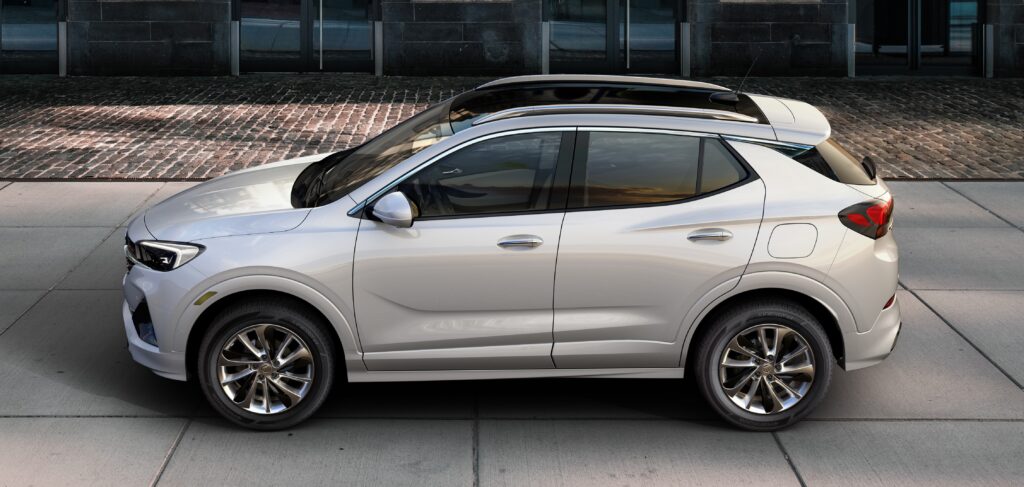
The Buick Encore GX is an inch wider and 3 inches longer than the original model, which fully elevates its real-world functionality

The Encore GX hits the sweet spot of Buick with more technologies, more power, and the soundproofing blanket of QuietTuning. (Buick)

BY MARK MAYNARD

A Buick Encore? Who wants to drive a Buuu-ick?” asked the girlfriend-wife. “They don’t even make Buicks, anymore, do they?” — adding with a snarky wince that she would not need to be driving a Buuu-ick.

Suit yourself, thought I. I’ve tested many new Buicks in recent years, with her in the passenger seat, yet somewhere those had been forgotten. And all this before she’d even seen touched the chrome strip on the door handle of the Encore GX Essence test car.

“Oh, hmmm, is that it, the black one?” she asked of the little SUV in the driveway. “Is it a cheesy car?”

No, but let the car speak for itself, as I handed over the key fob for a run to the market.

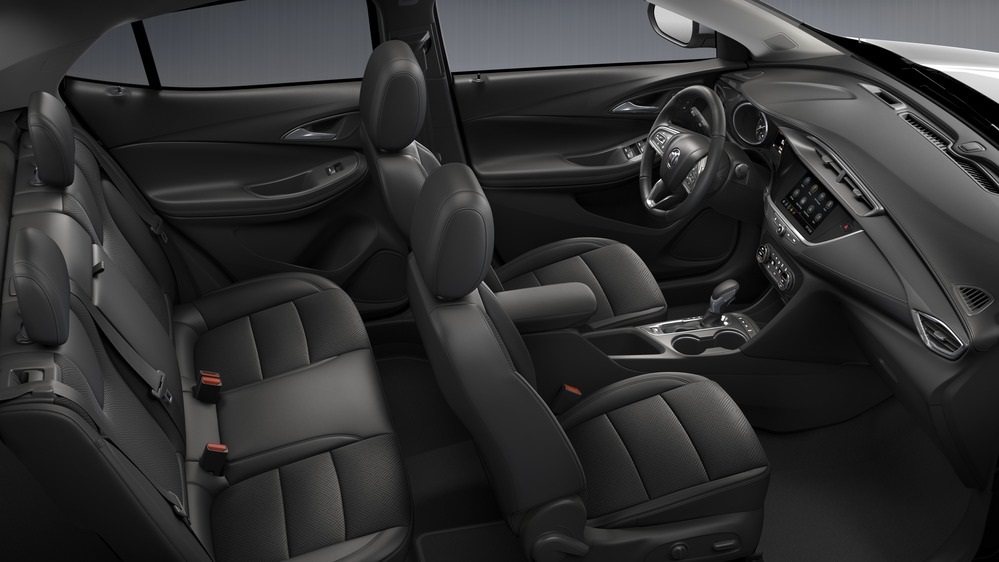
The Encore GX still is a small vehicle but with full-size adult headroom. (Buick)

Subcompact not substandard

Subcompact SUVs are the new sweet spot of getting a lot more space and function, while still generating a hefty sticker price over a sedan.

It was not long ago that a subcompact car or SUV was substandard in its comfort, drivability, and quality. These types of econoboxes were the manufacturers’ shoehorn to slide buyers into a larger and more profitable model. But today, a subcompact SUV, such as the Encore GX, has been hand-hammered from the inside out to be roomier and more accommodating to a wider range of drivers. It is smoothed over with a liberal layer of Buick refinements, including QuietTuning and a full suite of advanced technologies.

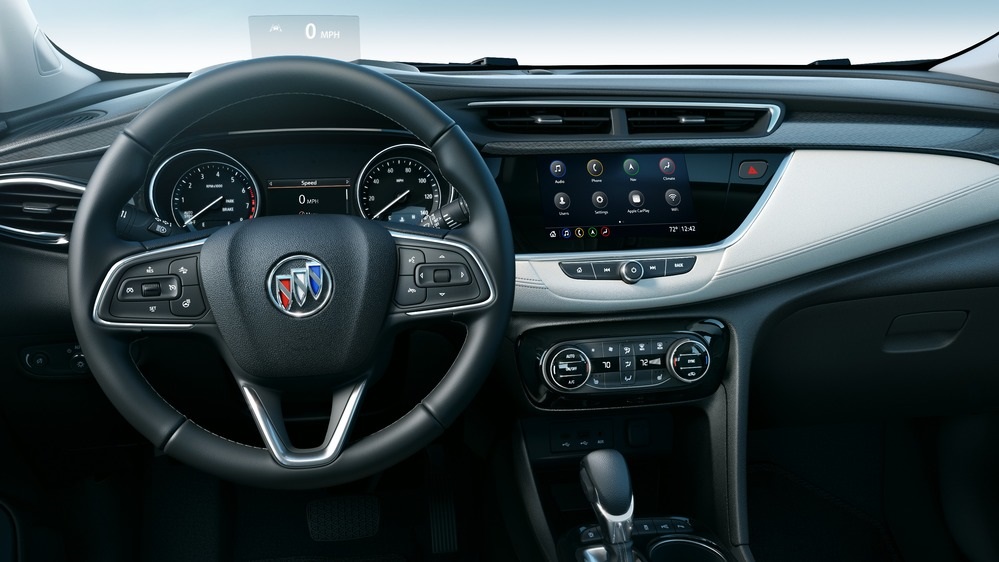
The tall headroom and shoulder room of 55.4 inches contribute to the roominess of the cabin.  (Buick)

Buick Encore Overview

Buick debuted the Encore nameplate in late 2012 as a 2013 model, the brand’s first subcompact model — car or SUV. The Encore is a GM global platform (and shared with the older and slightly smaller Chevrolet Trax) and is assembled at the GM Korea plant in Bupyeong, South Korea. The Chinese market Encore is assembled in Shanghai.

The updated and larger Encore GX, sort of a super-subcompact in size, joined the lineup as a 2020 model. It has more commonality with the new Chevrolet Trailblazer and, eventually, will replace its smaller sibling.

U.S. sales of Encore totaled almost 32,000 in 2013 and the pace leapfrogged consistently every year to 78,565 by 2016. It had a midcycle refresh in 2017 and sales continued to climb from 41,129 to 102,402 by 2019, the last year that sales numbers were available. (That’s according to Wikipedia; GM no longer posts monthly sales and now relies on quarterly tallies.)

Each month since June, the Encore GX has been Buick’s highest-selling nameplate, a spokeswoman said, “and we expect it to the end the year as the brand’s No. 1 selling vehicle, as well,” she said via email. “We expect the Encore GX/Encore split to be roughly 70/30.”

There are at least a dozen choices of subcompact crossovers with the Ford EcoSport, Honda HR-V, Nissan Kicks, and Toyota CH-R among them. But the luxury choices are fewer, namely the Audi Q3, BMW X1, Lexus UX, Mercedes-Benz GLA, and Volvo XC40. Most of the competitors, some with standard all-wheel drive, have starting prices that range from $34,695 (Volvo XC40) to $37,095 for the Audi with AWD.

The Encore GX starts at about $10,000 less than those top-tier competitors, but it is also more of a “premium” choice than entry-luxury. It might not have the depth of sophisticated engineering or refinement of the European makes, but it is more than a glam job of an economy model. And it will cost a lot less to maintain over the years.

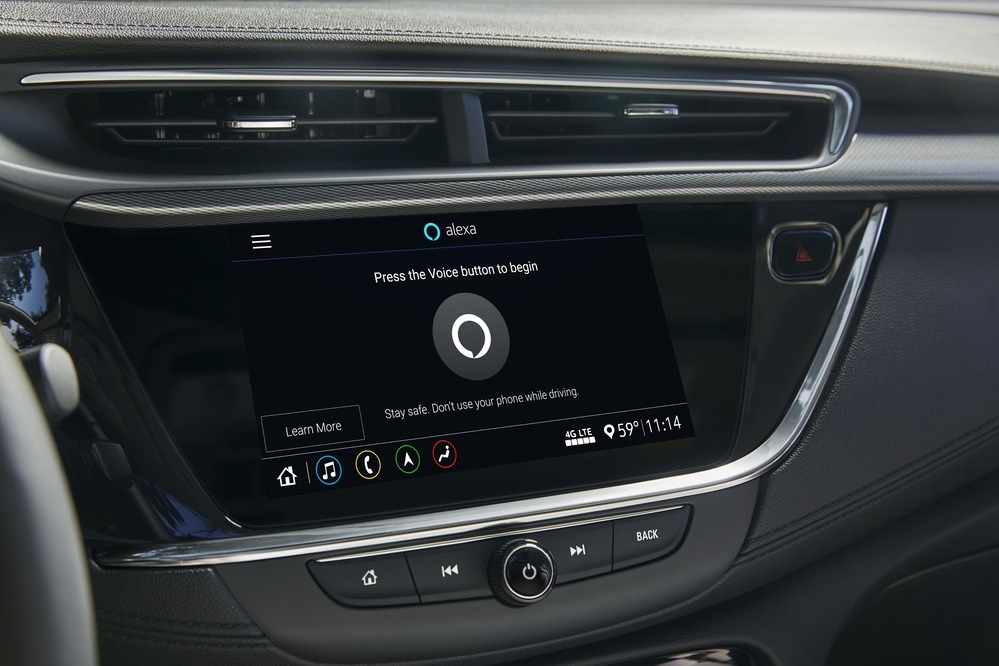
The 8-inch touch screen provides a good display for the surround-view camera. (Buick)

Encore GX Pricing

The Encore GX is sold in front- or all-wheel drive with a choice of two turbocharged and direct-injection three-cylinder engines — either a 137-horsepower 1.2-liter or 155-hp, 1.3-liter. Front-drive models use a continuously variable automatic transmission and AWD gets a nine-speed automatic.

2020 GX pricing starts at $25,095, including the $995 freight charge from Bupyeong, South Korea; AWD adds $2,000. A Sport Touring package, $1,100, is a cosmetic upgrade of body-color side and rocker moldings, unique grille with red accents, 18-inch dark high gloss wheels, and front and rear sport bumpers with red accents.

Buick says 2021 pricing increased by just $100 across all trim levels and the new model-year cars are now on sale.

The front-drive GX Essence tester had a 2020 starting price of $28,500 and came to $34,965 with six packages and options, including the bigger 1.3-liter engine, a modest $395 upgrade. Also worthwhile was the $495 Safety group that includes rear cross-traffic alert and side blind-zone alert.

At the time of posting this story, there were two pricing incentives:

The Encore GX FWD Preferred has an ultra low-mileage lease (for qualified lessees) of $265 per month for 39 months; $3,214 due at signing (after all offers) and no security deposit required. (Mileage charge of $0.25/mile over 30,000 miles at participating dealers.

And there was a cash offer of $3,250.

All Buick incentives can be found here (depending on ZIP code).

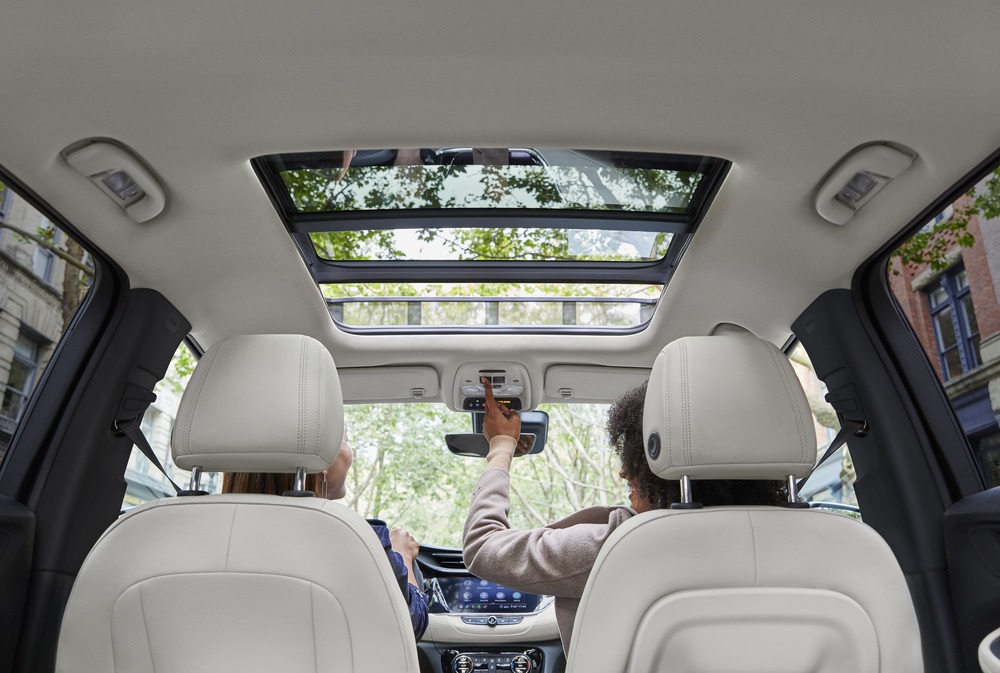
A panoramic moonroof is part of the Buick Experience package. (Buick)

2021 Encore GX Updates

Additions and changes for 2021 include:

  • 8-inch Buick Infotainment System with navigation was removed from the Experience Buick Package on the Select and Essence models.
  • The Bose seven-speaker system with amplifier and HD radio now requires adding the Safety Package. (It previously required the Experience Buick Package).
  •  Satellite radio is now standard on all models with wireless Apple CarPlay and Android Auto.
  •  Adaptive cruise control was added to the Preferred trim level.

Cargo space has flip-and-fold function. (Buick)

Interior Function

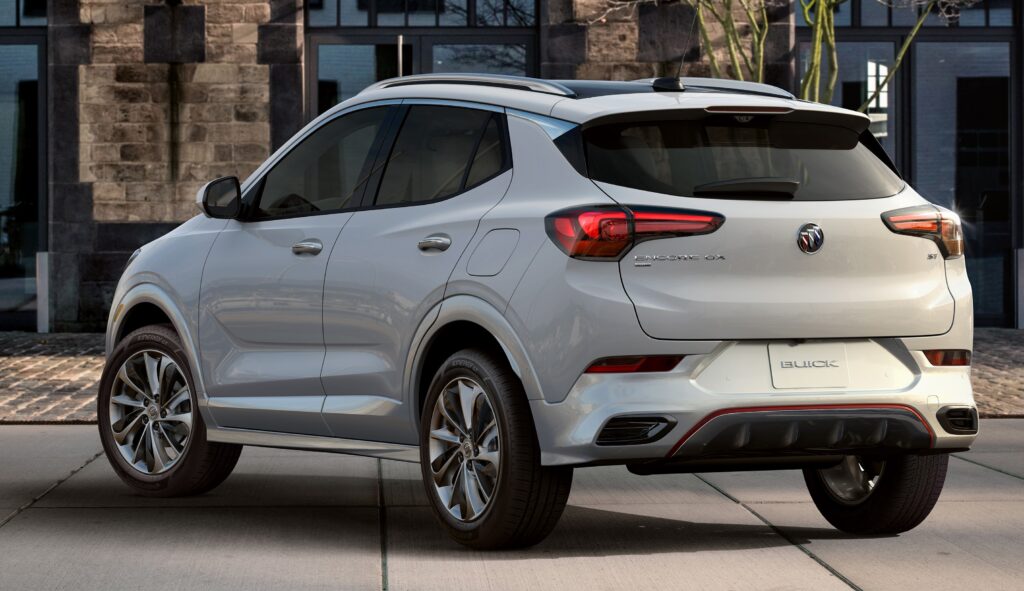
The Encore GX is an inch wider and 3 inches longer than the original model, which fully elevates its real-world functionality.

It still is a small vehicle, but with full-size adult headroom in the front of almost 38 inches and legroom of almost 41 inches. That space is more typical of a midsize sedan. The tall headroom and shoulder room of 55.4 inches contribute to the roominess of the cabin.

Back seat legroom of 36 inches and headroom of 38 inches will accommodate a 6-foot-tall passenger behind the driver. A flat floor helps foot space for three-across seating.

There are several areas for small-item storage and the tester was well equipped with accommodating features. Standard on the tester was wireless charging, four USB charging ports, heated seats and steering wheel, a big (8-inch) surround-view camera screen, a 10-way power driver’s seat, and an eight-way power front passenger seat.

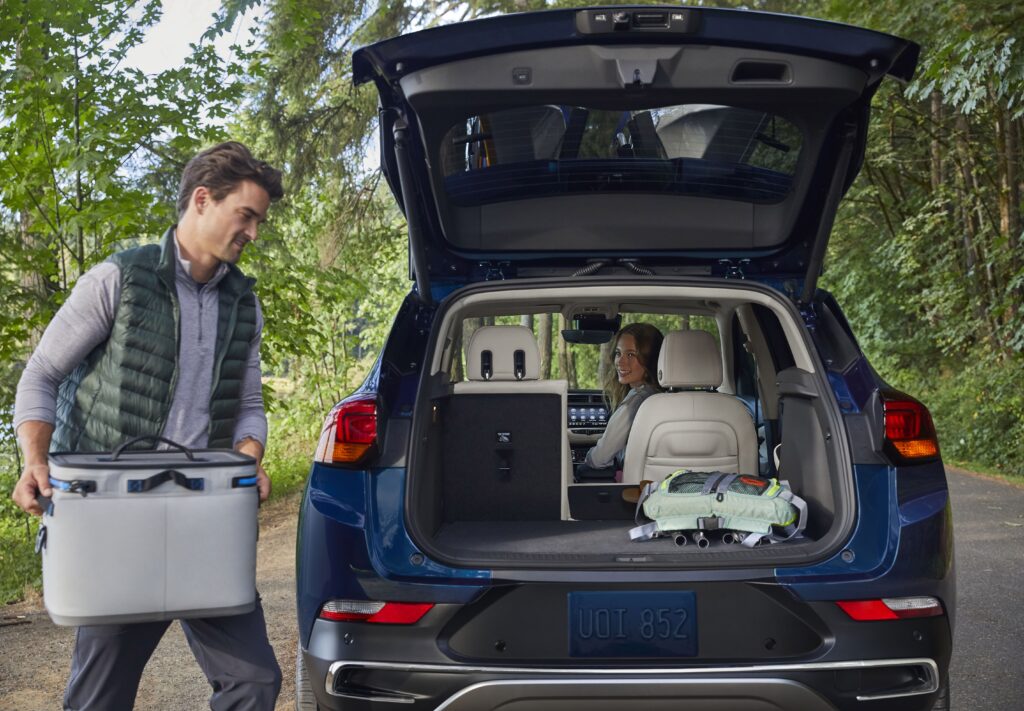
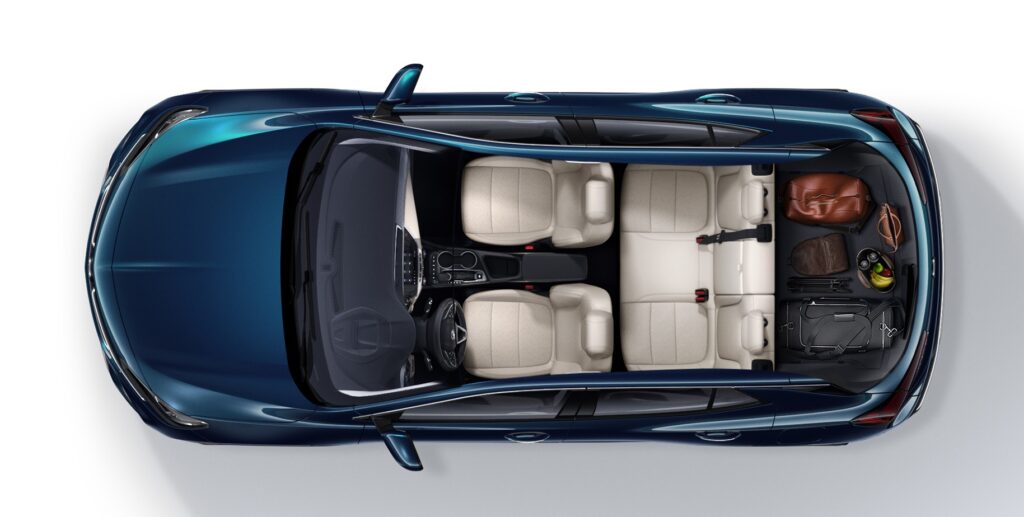
Cargo space of 23.5 to 50.2 cubic feet has flip-and-fold convertibility. The front passenger seat, for example, folds flat forward and there is a two-level cargo floor. The tall load floor limits the height of cargo capacity, but there is about 8.5 feet of length with the back seat folded.

The GX is an inch wider and 3 inches longer than the original Encore. (Buick)

Buick Encore Safety Features

Small cars like this aren’t what I would recommend as a hypermiling commuter, but the tester’s new size and its depth of safety technologies would be an exception. The raised ride height helps it to be seen and provides the driver an open view of traffic.

Standard safety features are extensive and include 10 air bags and a range of technologies. The GX safety technologies include Automatic Emergency Braking, Front Pedestrian Braking, Lane Keep Assist with Lane Departure Warning, Forward Collision Alert and Following Distance Indicator.

Four-wheel disc brakes easily handle the curb weight of 3,094 pounds and a tow rating of up to 1,000 pounds. The front rotors are 11.8-inches with 10.4-inch rotors rear.

2020 GX pricing starts at $25,095; AWD adds $2,000. (Buick)

Buick Encore powertrains

There’s not much of a fuel-economy advantage for the 1.2-liter engine. Front-drive models are rated for 26 mpg city, 30 highway and 28 mpg combined, on the recommended 87 octane. Those numbers compare to 30/32/31 mpg for the 1.3-liter or 26/29/28 with AWD.

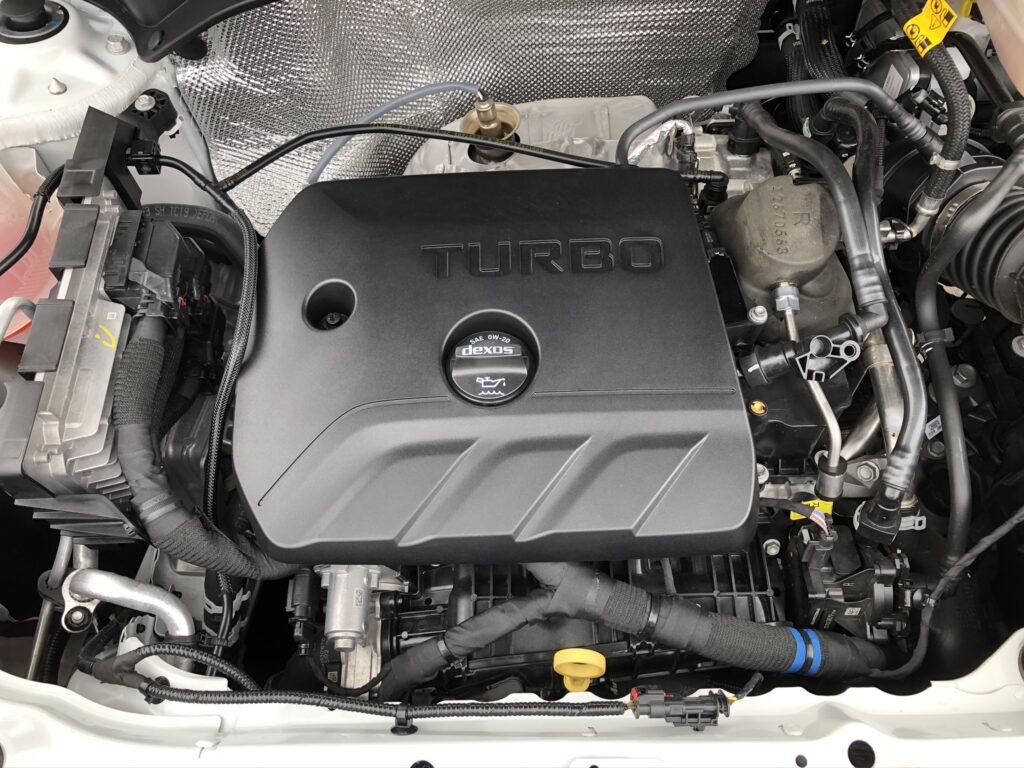
The “big” engine has more force than you might imagine from a 1.3-liter, though it sounds rattly at idle. Buick’s QuietTuning soundproofing muffles most engine noise around town, but there is some engine and wind noise at highway speeds. And the Hankook Synergy GT all-season tires have a high (hard) treadwear rating of 700, making the ride quality feel hard.

I’m not usually a fan of the CVT, but this one moves the Encore GX without delay from turbo spooling or the transmission taking hold. Using Sport mode can sharpen launch force and shift points, but I zipped around in the standard mode. My average fuel economy ranged from 24 to 25 mpg around town to a brief best of 48.5 with very long stretches of highway driving.

Compared to a four-cylinder, there is a little more engine vibration at idle, but it’s not distracting. And there is a more abrupt start-up after a stop-start at idle.

The size of the Encore GX is parking-garage friendly and it’s nimble to maneuver, with a 36.8-foot turning circle. Anybody can be a sloppy parker and still stay between the lines.

The “big” engine has more force than you might expect from three cylinders, though it sounds rattly at idle. (Mark Maynard)

Why Buick Encore GX?

The girlfriend’s Buick skepticism waned after a test run. She liked that the Encore GX wasn’t macho, and it connected with her feminine side.

“From a woman’s perspective, it’s cute and easy to get in and out of, and it’s really quiet,” she said. “And it goes like hell when you step on it.”

The Encore GX is a sweet package and a credible “premium” offering in a segment with more utilitarian competitors. You might gulp at the as-tested price, but its wealth of features will seem fair as a safe space to navigate a pandemic.

2020 Buick Encore GX Essence FWD

Body style: Subcompact, 5-seat, 5-door crossover SUV, in front or AWD

Engine: 155 hp, turbocharged and direct-injected 1.3-liter 3-cylinder with auto stop-start at idle; 176 lb.-ft. torque at 1,600 rpm

Transmission: CVT

Fuel economy: 30/32/31 city/hwy/combined; 87 octane

BY THE NUMBERS

Fuel tank: 13.2 gal.

Cargo space: 23.5-50.2 cu. ft.

Front head/leg room: 37.9*/40.9 in. *39.7 w/o moonroof

Rear head/leg room: 38/36 in.

Length/wheelbase: 171.4/102.2 in.

Curb weight: 3,094 lbs.

Turning circle: 36.8 ft.

Tow capacity: 1,000 lbs.

FEATURES

Standard equipment includes: smart key entry with push-button ignition, 10-way power driver’s seat with lumbar, 8-way power front passenger seat, perforated leather-trimmed upholstery, heated steering wheel, power (heated) side mirrors, LED headlights-taillights-fog-running lights, Quiet-tuning soundproofing with active noise (audio) cancellation, 8-inch color infotainment touch screen with voice command Bluetooth phone and audio, rearview camera, 4.2-inch color driver-info display, 4 USB ports (2 type C), 60/40 folding back seat, 2-level cargo floor, cargo roller cover

Safety features include: 10 air bags, automatic emergency braking, front pedestrian braking, forward collision alert with following distance indicator, lane-keep assist with lane departure warning; lane change alert with side blind zone alert and rear cross-traffic alert

PRICING

Base price: $29,495, including $995 freight charge; price as tested $34,965

Options on test vehicle: Ebony Twilight metallic paint $495; Ecotec 1.3-liter turbocharged engine $395; Advanced Technology package, $1,790, adds HD surround vision camera, head-up display, adaptive cruise control (w/camera), Buick infotainment system with navigation; Experience Buick package, $1,500, includes a power moonroof, 18-inch high-gloss alloy wheels; Convenience package, $770, includes automatic parking assist with braking, wireless charging, rear camera mirror with washer and rain-sensing wipers; Liftgate package, $560, adds a hands-free power liftgate

Where assembled: Bupyeong, South Korea

Warranty: 3-years/36,000-miles bumper to bumper; 5-years/60,000-miles powertrain with roadside assistance and courtesy vehicle; free scheduled first maintenance
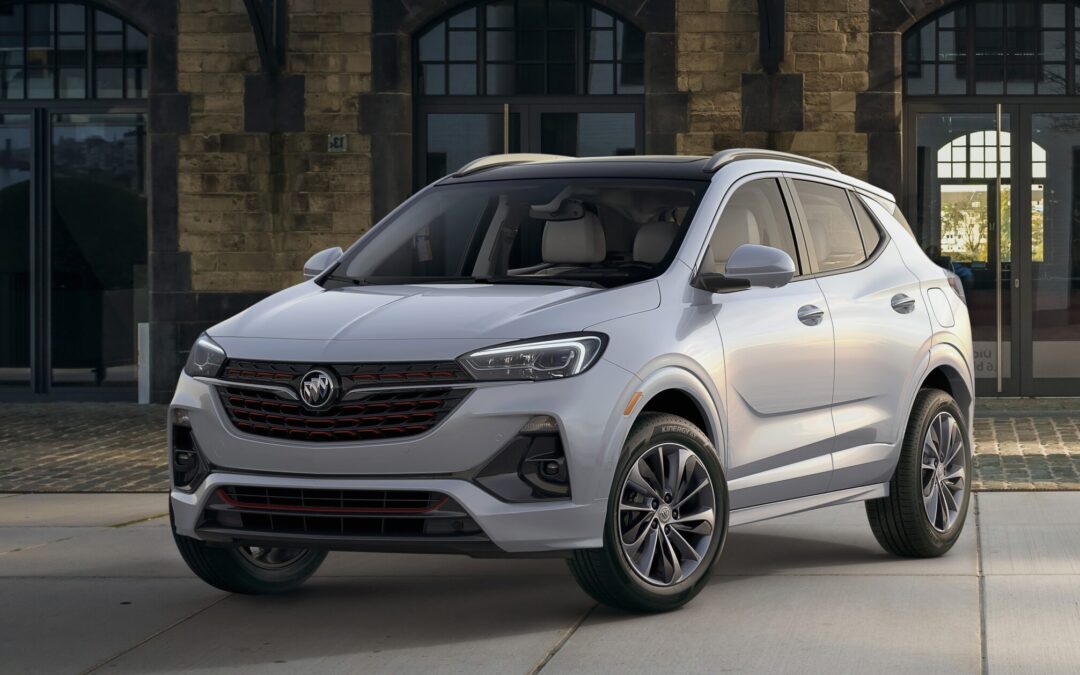
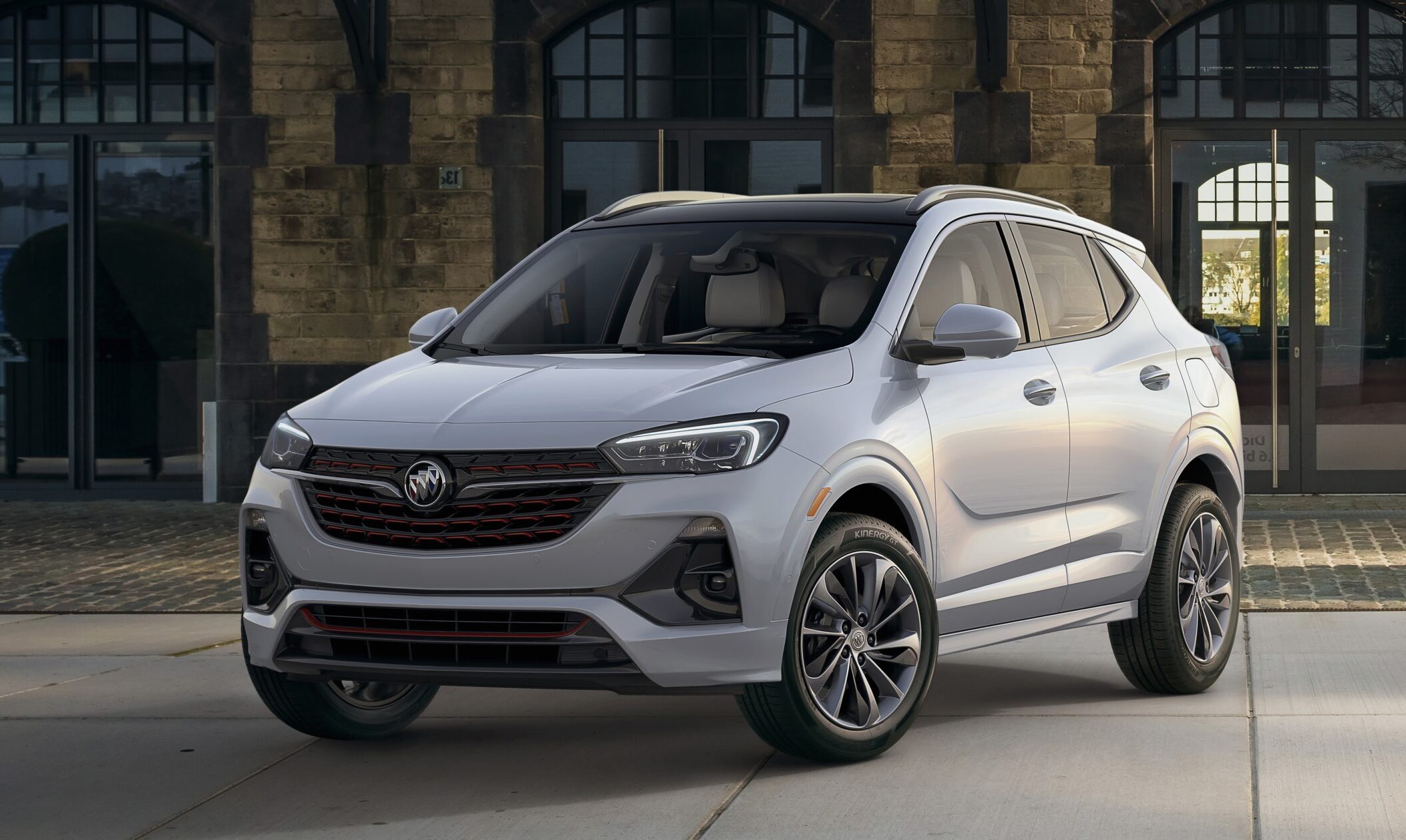
The updated and larger Encore GX joined the lineup as a 2020 model.  (Buick)

2020 Mercedes-Benz GLB 250: Charmed and ready

2020 Mercedes-Benz GLB 250: Charmed and ready
The GLB is sold in front- or all-wheel drive with a turbocharged 2.0-liter four-cylinder engine and eight-speed dual-clutch, automated-manual transmission. (M-B)

More utilitarian in its mission, the GLB introduces a different style from what might be expected of a Mercedes-Benz

Mercedes-Benz is working its way through the alphabet for its lineup of SUVS, with nameplates of GLA, GLB, GLC, GLE, GLS and the mighty G-Class. Including the so-called “coupe” body-style variants, there are eight SUVs in the lineup, from subcompact to compact, midsize, full-size and full-size plus. Globally, one in three Mercedes-Benz cars is now an SUV, and one in four is a compact model.

The company is following the trend of SUVs as a preferred body style, particularly in the U.S., where there is growing demand for vehicles that can tote six or more passengers.

In the last year, Mercedes-Benz has refreshed its entire SUV lineup — and added its latest delivery, the compact-class GLB, today’s tester. It is sold as a five- or seven-seater, which is just an $850 option for the pair of 50/50 third-row folding seats.

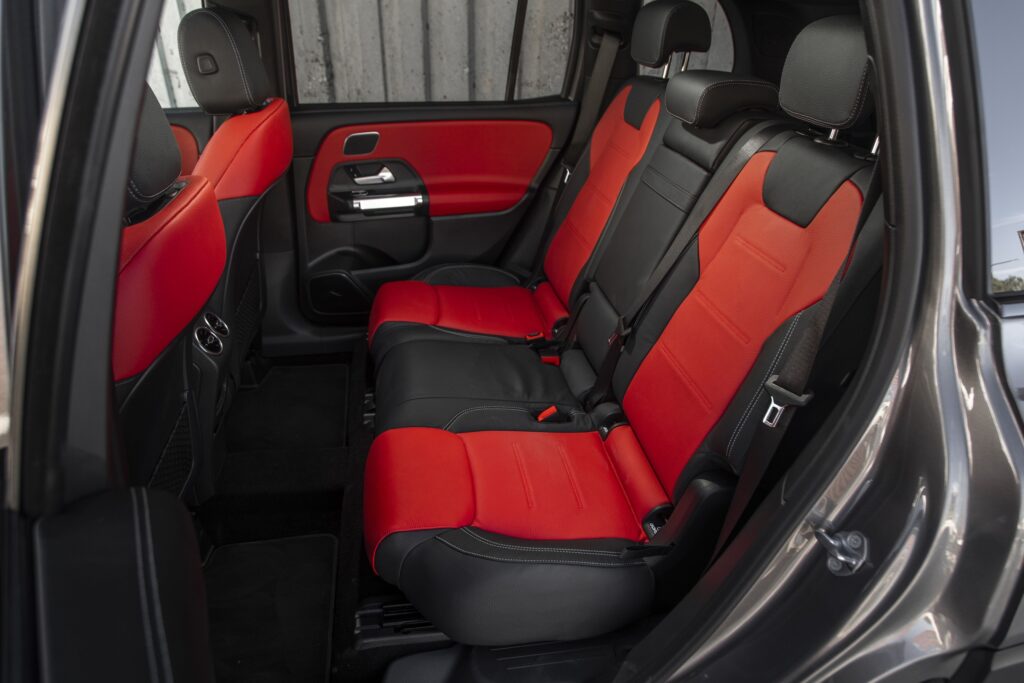
The M-B Tex upholstery looks leatherlike but without the tenderness of the real thing. The seats are European-firm and might feel hard to some after a couple hours on the road. (M-B)

Pricing

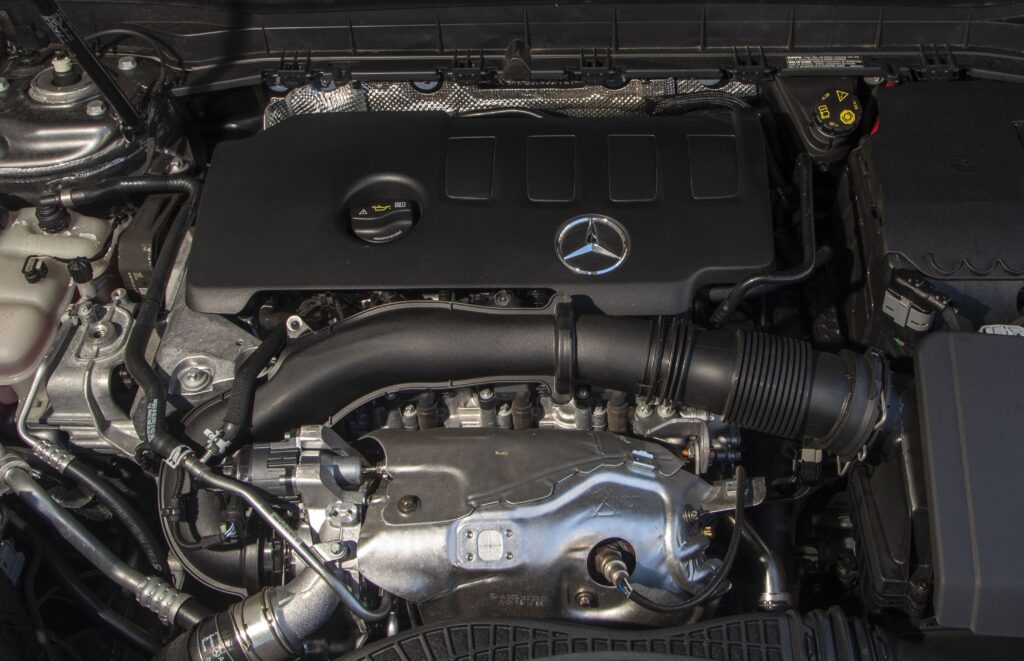
The GLB is sold in front- or all-wheel drive with a 221-horsepower, turbocharged 2.0-liter four-cylinder engine and eight-speed dual-clutch automated manual transmission.

Expected later this year will be a higher-performance Mercedes-AMG GLB 35, with 302-hp version of the turbocharged 2.0-liter engine. Follow its progress here. https://www.mbusa.com/en/future-vehicles/2021-glb-35

The front-drive GLB 250 starts at $37,595, including $995 freight charge from Aguascalientes, Mexico. The GLB 250 4Matic starts at $39,595.

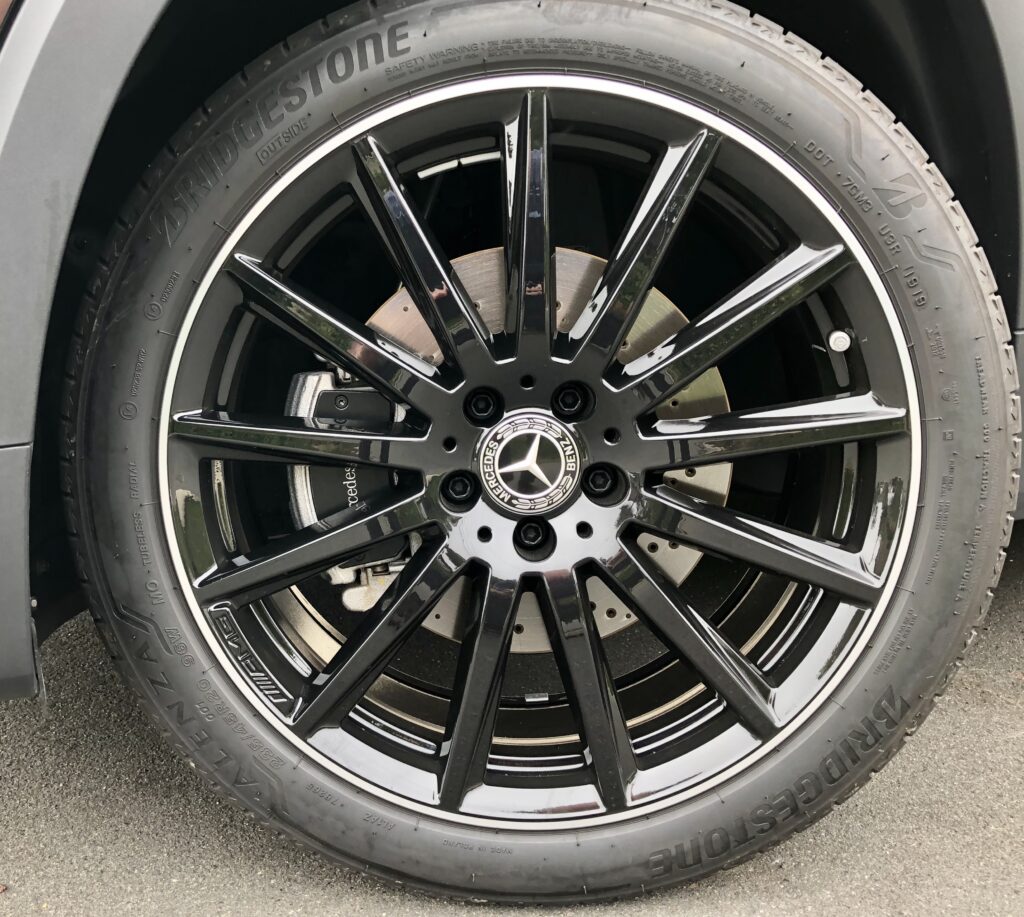
With options, the front-drive tester came to $49,050 and was equipped with several AMG-line style elements, such as the sport steering wheel ($360), 20-inch alloy wheels ($1,050) and a body kit of a front air dam, flared side sills and deep rear valance with a diamond-block grille, perforated front disc brakes with M-B lettering.

Check current pricing incentives here.

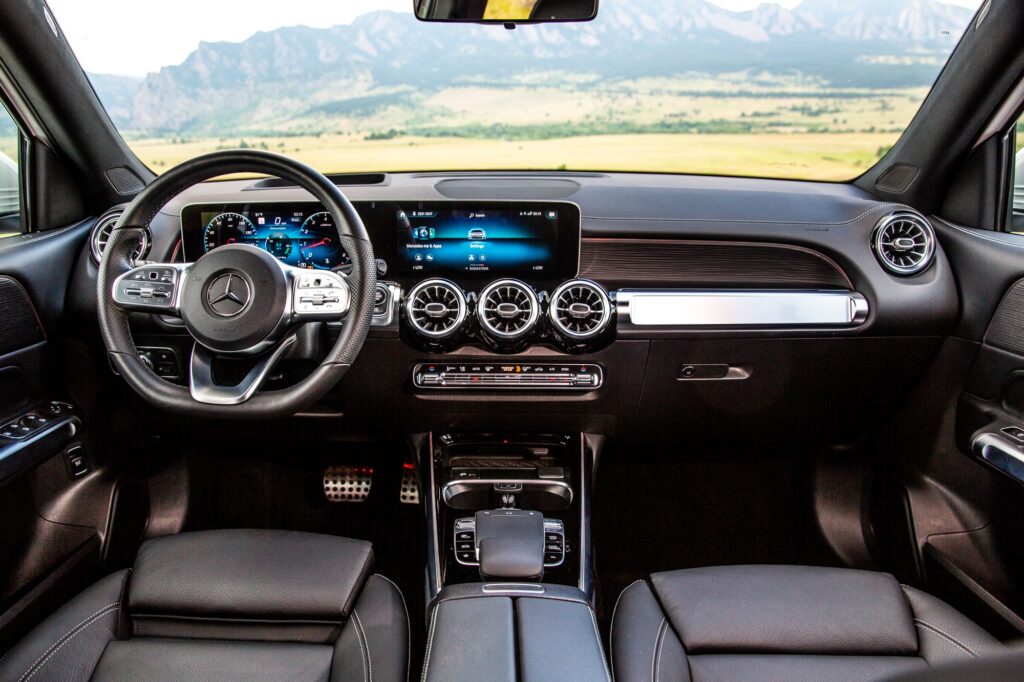
The optional dual 10.25-in high-resolution screens are an easy visual presentation of features, settings and themes. (Kristine Higgins)

Not the usual

The GLB is different from what might be expected of Mercedes-Benz as the purveyor of luxurious finery. While the GLB has the credibility of Mercedes engineering and solid quality, it is more utilitarian in its mission, which is appropriate for this class of small SUV. It is less pretentious in presence and function.

It is an upright body style, which maximizes interior room for people or cargo. But because of its more-blunt shape and roof rails, punching through the air at highway speeds isn’t as quiet in the cabin as might be expected of a Mercedes. The chassis, however, feels very solid, almost over-engineered, for potential off-road durability.

At 111.4 inches, the GLB’s wheelbase is 5.1 inches longer than the GLA and 1.7
inches shorter than the GLC. Headroom is quite tall for a compact vehicle at almost 41 inches (with the sunroof) with front-seat legroom of 41.4 inches, typical for the segment.

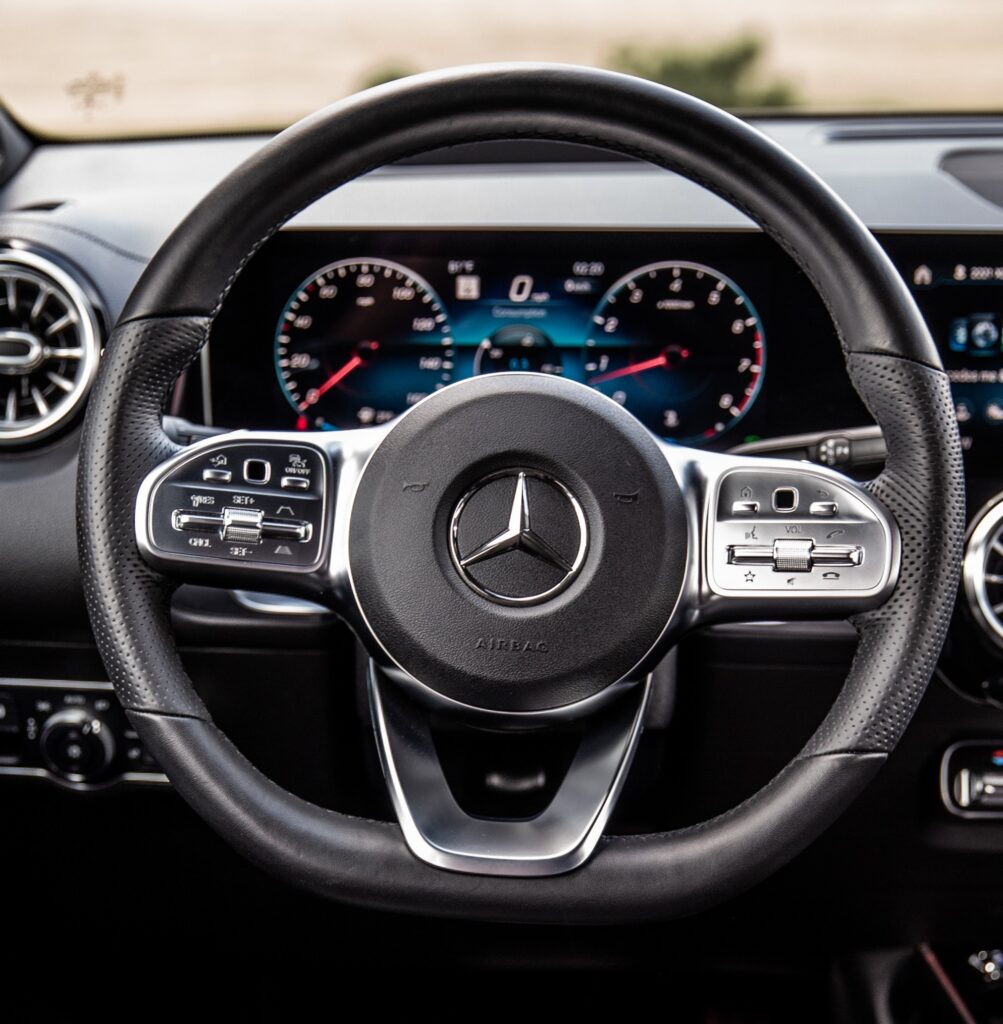
The AMG sport steering wheel ($360) is worth the cost for its reassuring and comfortable fit. (M-B)

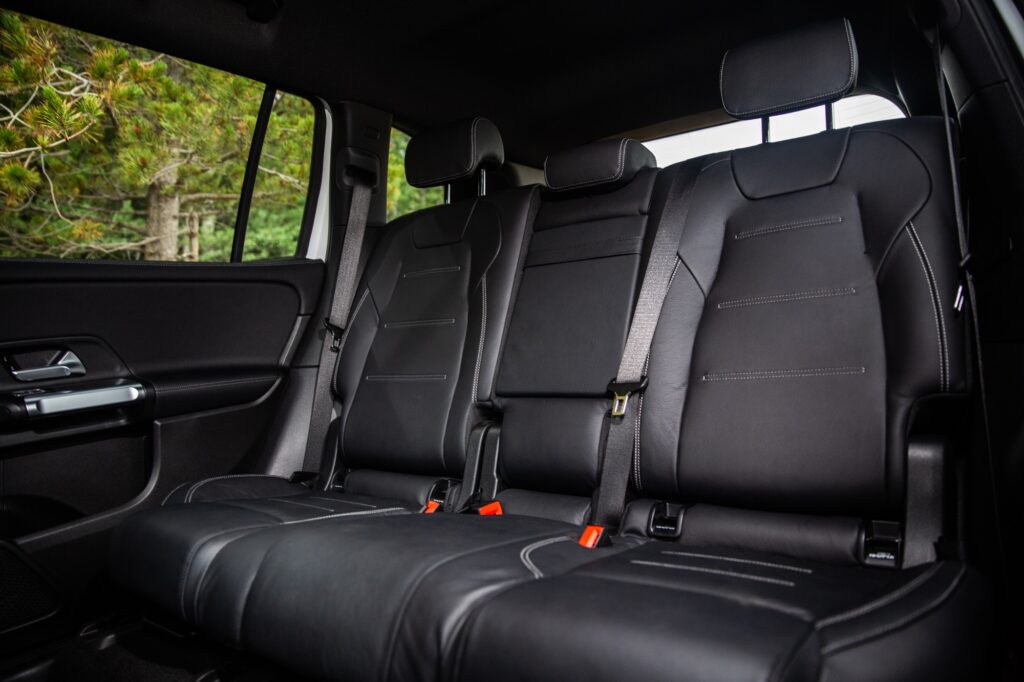
As a seven-seater, the third-row provides occasional use for small people with a snug 29.1 inches of legroom and 34.8 inches of headroom (The option is likely an incentive for global customers.). But the second-row seats have an easy-entry function for access to the pair of third-row seats, which include a pair of cup holders between the seats and two storage compartments, each with a USB-C port.

The second-row seats have fore-aft slide up to 3.5 inches or up to 8.7 inches with the third row. It is useful space flexibility for more legroom or more cargo space.

The second-row is raised with a smallish exhaust tunnel and a generous 38 inches of legroom and good footroom under the front seats. The seatbacks have nine settings of seatback recline, to help accommodate large adults or sleeping youngsters. A side window air bag protects the passengers in the third row.

20-inch wheels are set off by AMG Line perforated front discs. (Mark Maynard)

Functional style

It is a digital world inside, but not threateningly so for an analog type of driver. The optional “digital cockpit” is two 10.25-inch high-resolution screens with configurable displays and multimedia visuals. The central, horizontal touch-screen display is a finger’s reach from the steering wheel not complicated to access features, but changing settings and customizing themes should be done while parked.

The horizontal screen — rather than a deep vertical tablet — allows generous air flow from the three turbine-like vents below. The floor console (not a shift console) packages an e-bin and shelf for a wireless charging pad, cup holders and a wrist-rest to access the central controller for such functions as vehicle settings, navigation, phone and performance modes. The shift “lever” is a stalk on the steering wheel to electronically engage gears.

A side window air bag protects the passengers in the third row. (M-B)

Sightlines from the driver’s seat are open at the side mirrors and over the shoulder. The large back glass provides more visibility than some swoopier SUVs in this segment, which include the Audi Q3, BMW X1, VW Tiguan and Volvo XC40.

Shoulder room is fairly wide at 55.9 inches window to window and the entire interior space feels larger than a compact-class cabin.

The second-row is raised with a smallish exhaust tunnel and a generous 38 inches of legroom and good footroom under the front seats. (M-B)

There are number of areas for small-item storage, door-panel bottle holders and a large, locking glove box — and that’s not always easy to provide in compact space. But the visors are of modest depth, do not slide and leave gaps at the windshield pillars where morning and evening sun can glint through.

The M-B Tex upholstery looks leatherlike but without the tenderness of the real thing. The seats are European-firm and might feel hard to some after a couple hours on the road.

A smart design for the door skins extends over the door sills to prevent dirty scuffs on slacks or legs.

For almost $50,000, the tester didn’t include wireless charging, available for $200. But there are five USB-C charging and data ports.

But the adjustable suspension, $900, is worth it for the its adaptive damping, providing a truly comfortable ride, for a German-engineered car. Sport firms up the ride quality, but it is not harsh. And for $360 the flat-bottom AMG steering wheel will return years of pleasurable fit and feel.

In the last year, Mercedes-Benz has refreshed its entire SUV lineup — and added its latest delivery, the compact-class GLB. (M-B)

Powertrain
The 2.0-liter engine in the GLB 250 feels more powerful than is expected from a four cylinder. With 258 foot-pounds of torque pulling from 1,800-4,000 rpm, the engine fills big shoes. The transmission in standard mode gives mileage-calmed shifting, but sport mode removes any hesitance.

Mercedes’ engineering capably cancels the typical turbo lag and even the time-stealing launch of the dual-clutch automated manual transmission. The auto stop-start at idle function can be switched off, but the immediate response of the engine-restart makes it mostly unnecessary to do so.

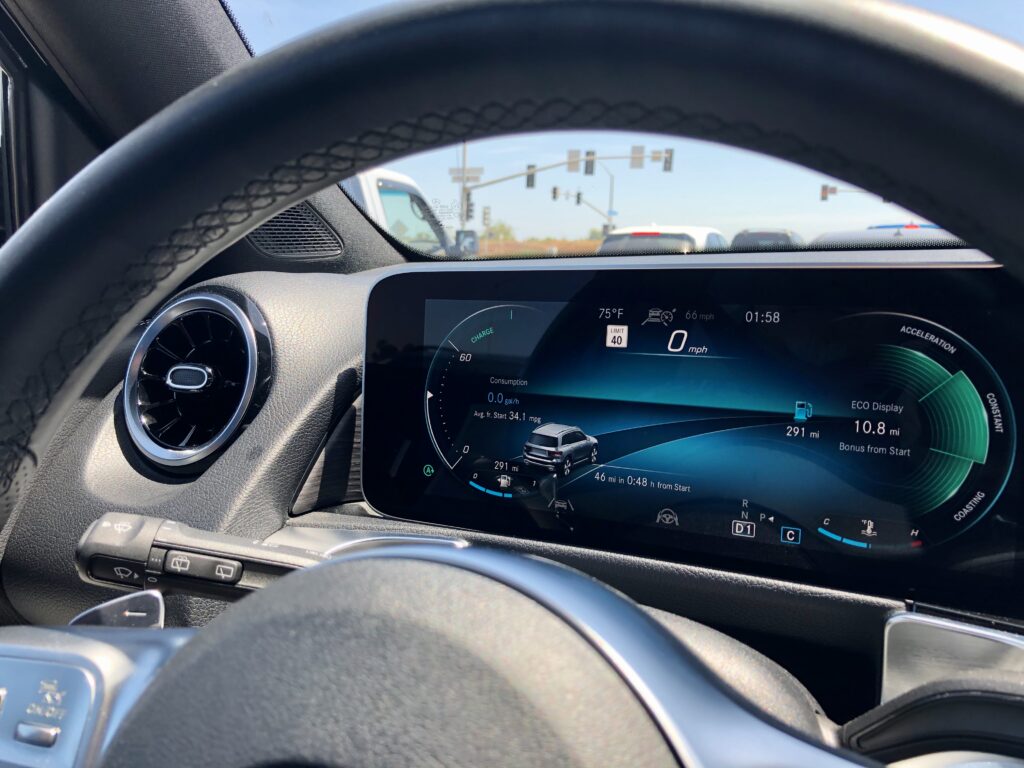
Official fuel economy estimates are 23 mpg city, 30 highway and 26 mpg combined, on the recommended premium fuel. (4Matic mileage is 23/31/26 mpg.) In the front-drive tester, I worked up to 34.1 mpg on the highway and had an overall average of 26.4 mpg, according to the onboard computer. The 15.9-gallon fuel tank gives a wide cruising radius.

Official fuel economy estimates are 23 mpg city, 30 highway and 26 mpg combined, on the recommended premium fuel. In the front-drive tester, I worked up to 34.1 mpg on the highway and had an overall average of 26.4 mpg, according to the onboard computer. (M-B)

Electronic oil-level check

It’s also interesting that the engine design has no dipstick to manually check the oil. The oil level is checked electronically through the vehicle’s onboard computer. The results are viewed in the multifunction display (in the gauges) of the digital cockpit. After the engine has warmed up for 30 minutes the system will respond with several messages including that the oil level is OK or if it is below minimum and how much oil to add or if the oil level is too full.

The large four-wheel disc brakes have 13-inch front rotors and 12.6-inch rotors rear. Towing is not recommended for the GLB.

Driver assists

The autonomous drive calibrations keep the car well centered in the lane with only occasional crossing of the Botts dots or white lines. And when it does, the system flashes a red steering-wheel warning light that somehow feels like an admonishment for me not paying attention when it was its own “hand” that crossed the line.

Overall, the support-assist is subtle and without alarming alerts but it will be made clear when driver takeover of steering is necessary.

The two-level floor can be moved to the lower slot for another 4 inches of load height. (M-B)

Cargo

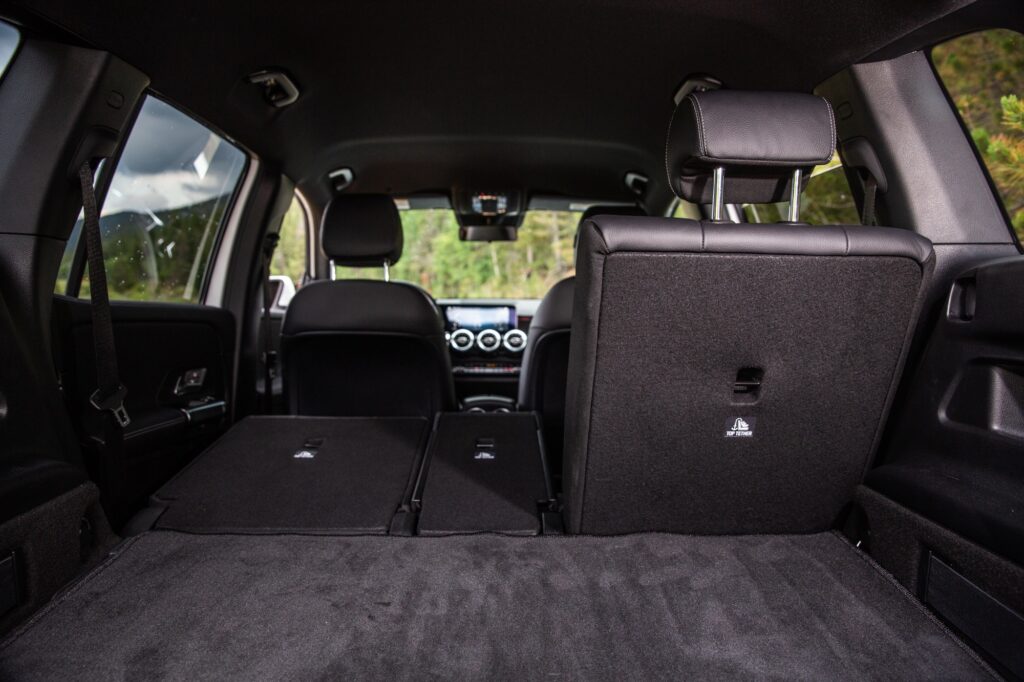
The rear quarters are cargo ready with a wide opening (42 ½ inches) and a low load-floor height. The two-level floor can be manually moved to the lower slot, which gives another 4 inches of load height. Or fold the back seat for about 6 feet of length.

Or in the floor’s upper position, the back seats can be folded flat fort 6 feet of length. (M-B)

Why GLB?

Compact SUVs are available from every manufacturer from mainstream to luxury. Pricing starts in the mid- to low-$30,000s for a very competent mainstream vehicle. But the difference between $50K and $25K is a lot of rewarding details. Among them, auto lock-unlock sensors for the back doors, not just the front; more meticulous engineering of door hinges for wider opening, nearly to right angles; a carpet-smooth ride; and uncompromising engine technology that transforms a 2.0-liter four-cylinder into a V-6.

The GLB shrugs off a precious luxury label and doubles up on everyday function as a fairly priced family vehicle — welcoming a new generation to the brand.

MarkMaynard@cox.net

The GLB is all about versatility, Mercedes-Benz says, whether for young families or people with an active lifestyle. (M-B)

2020 Mercedes-Benz GLB 250

Body style: compact, 5- or 7-seat, five-door SUV, in front or all-wheel drive
Engine: 221-hp, turbocharged 2.0-liter 4-cylinder w/auto stop-start at idle; 258 lb.-ft. torque from 1,800-4,000 rpm
Transmission: 8-speed DCT (dual clutch)
Fuel economy: 23/30/26 mpg city/hwy/combined; premium fuel recommended

SPECIFICATIONS
Fuel tank: 15.9 gal.
Cargo space: 24-62 cu. ft. (5.1 cu. ft. w/third row)
Front head/leg room: 40.7/41.4 in.
Rear head/leg room: 39.3/38.1 in.
Length/wheelbase: 182.4/111.4 in.
Curb weight: 3,638 lbs. *7-seat FWD, 3,759 lbs.
Turning circle: 38.4 ft.

FEATURES
Standard equipment includes: Keyless-start with push-button ignition, M-B Tex leatherette upholstery, rearview camera, power front seats w/lumbar and 3 memory presets, electric parking brake, 40/20/40 folding back seat, power liftgate, LED headlights-taillights and running lights, 5 USB-C ports, 7-inch Mercedes-Benz User Experience infotainment touch screen, touch-pad controller, Apple CarPlay or Android Auto apps, aluminum roof rails
Safety features include: 7 air bags, active brake assist, adaptive braking, crosswind assist, attention assist, predictive brake priming, automatic brake drying, hill-start assist, brake hold, electronic stability and traction controls, front fog lights

PRICING
Base price: $37,595, including $995 freight charge; price as tested $49,050
Options on test vehicle: Natural grain black Linden wood trim $325; AMG Line sport steering wheel $360; 20-inch AMG wheels $1,050; adaptive suspension $990; satellite radio trial $460; heated front seats $580; Driver assistance package, $2,250, includes active brake assist with cross-traffic function, active distance assist Distronic, active steering assist, active blind spot assist, active speed limit assist, active emergency stop assist, evasive steering assist, Pre-Safe Plus, route-based speed adaptation, extended restart in stop-and-go traffic; Multimedia package, $1,150, includes navigation with map updates for 3 years, MBUX augmented reality for navigation, speed-limit assist; Night package, $400, includes high gloss back grille, mirror covers and window trim; AMG Line body styling, $2,240, includes perforated front disc brakes and M-B lettering and diamond-block grille; Premium package, $1,650, 10.25-inch center touch screen display and 10.25-inch digital instrument panel, Keyless-Go package, auto-dimming rearview mirror and (folding) driver’s side mirrors
Where assembled: Aguascalientes, Mexico
Warranty: 4-years/50,000-miles bumper to bumper with roadside assistance; and 3 years of Mercedes Me connect services via smartphone app and over-the-air software updates and free map updates for 3 years

2020 Porsche Cayenne Coupe Review

2020 Porsche Cayenne Coupe Review

Midsize Porsche Cayenne Coupe will take corners with sports-car finesse and bring home a load of firewood

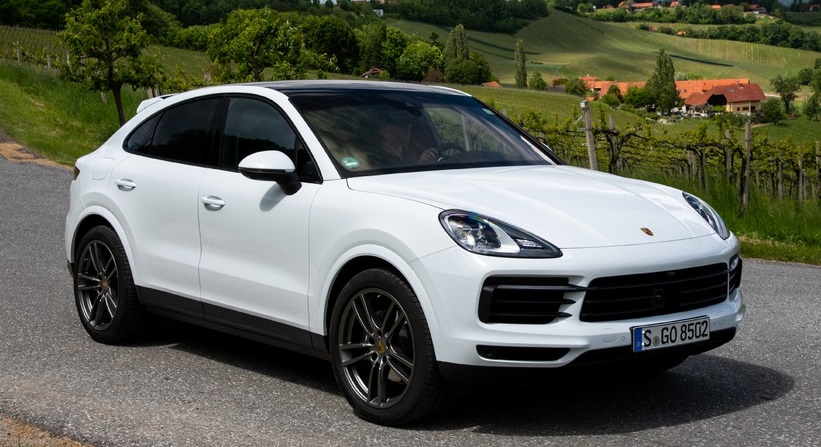
A front view of the Porsche Cayenne Coupe

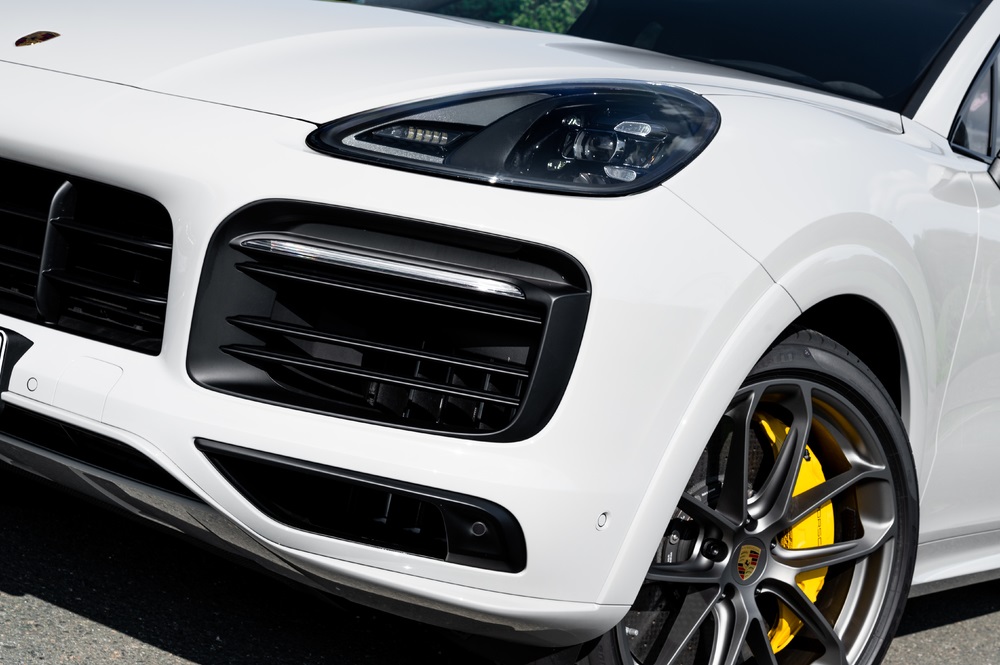
The Porsche Cayenne Coupe is sold in turbocharged V-6 and V-8 gasoline-powered models. (Photos courtesy of Porsche)

BY MARK MAYNARD

The Porsche Cayenne SUV is now the brand’s top seller in the U.S. Fortifying sales this year is the four-door, fastback Coupe model. Sharing a foundation and mechanicals with the squared-off Cayenne, the hunky stance of the Coupe is a fusion of style and skill.

And so what if this variant costs about $8,500 more than its donor for a few fewer cubic feet of cargo capacity?

It is the Cayenne Coupe’s muscular 911 lines for which the buyer will gladly pay to participate for the prestige of owning a Porsche. It’s not all about vanity, though — the Coupe will take corners with sports-car finesse and it can bring home a load of firewood.

This third-generation Cayenne is a Volkswagen Group architecture that has been repurposed, reformatted, and restyled as the Audi Q7 and Q8 Sportback, Lamborghini Urus and Bentley Bentayga, if not other nameplates in the global VW family.

To create the Coupe body, the windshield and A-pillars are shallower and the roofline is 0.78 inches lower with a fixed rear spoiler. For its more muscular stance, the rear track was widened by 0.70 inches and redesigned rear doors and quarter panels broaden the shoulders by 0.7 inch. To compensate for the lower roofline, the second-row 2+2 seats sit lower in the vehicle, but headroom is still accommodating at 37.4 inches.

The Cayenne Coupe front seats

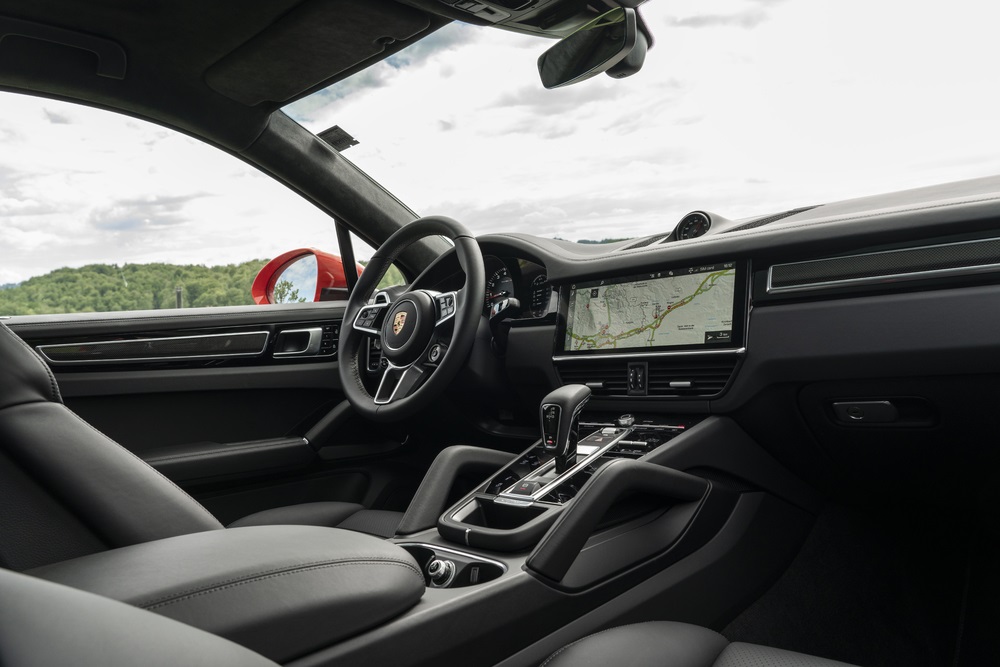
The midsize cabin is broad enough to ergonomically place controls and digital screens.

Cayenne Coupe Pricing

The Cayenne Coupe is a versatile variant sold in turbocharged V-6 and V-8 gasoline-powered models. And there are two gasoline-electric plug-in hybrid models that leverage power over fuel savings.

All models are all-wheel drive with an eight-speed automatic transmission. Starting prices for the gas models range from about $76,000 to $131,000 to the topline Turbo Coupe.

Today’s Cayenne S Coupe tester starts at $89,950, including the $1,350 freight charge from Bratislava, Slovakia. With options totaling $12,260 the as-tested price was $102,110. And I still would have wanted a few more convenience features.

Standard S Coupe features include the Sport Chrono performance package, eight-way sport seats, an adaptive roof spoiler, panoramic fixed glass roof, park assist tones (front and rear), and Porsche Active Suspension Management. Twenty-inch alloy wheels are standard with options for 21- and 22-inch tires and wheels.

Check current pricing and incentives here.

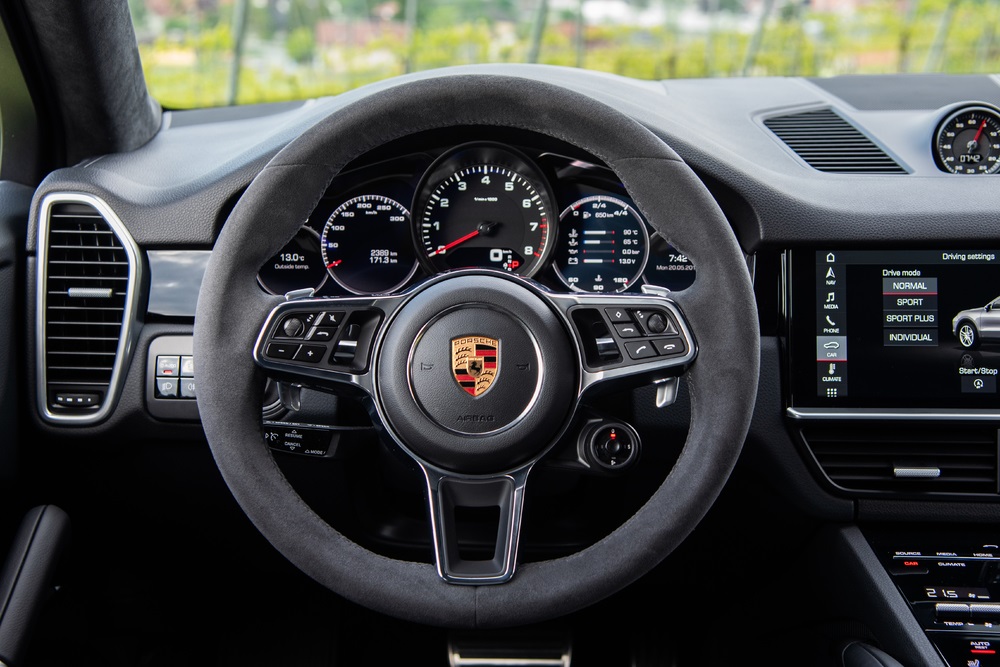
The Cayenne steering wheel

The hands-on relationship of the Coupe S is immediately sensed in the steering, braking, and suspension.

Cayenne Hybrid Models

There are two Porsche Cayenne E-Hybrid models.  Both use a 14.1 kWh lithium-ion battery and have estimated driving ranges of 20-22 miles and up to 41 mpg-e average fuel economy.

The E-Hybrid Coupe, $87,750, uses a single turbocharged 3.0-liter V-6 with a combined 455-hp. It can accelerate from 0-60 mph acceleration in 4.7 seconds — and that is with a curb weight of 5,265 pounds.

The Turbo S E-Hybrid Coupe, $165,750, launches to 60 mph in 3.6 seconds with its twin-turbocharged, 4.0-liter V-8. Its combined engine-motor horsepower is 670 with 567 lb.-ft. torque from 1,960-4,500 rpm. And it weighs 5,673 lbs.

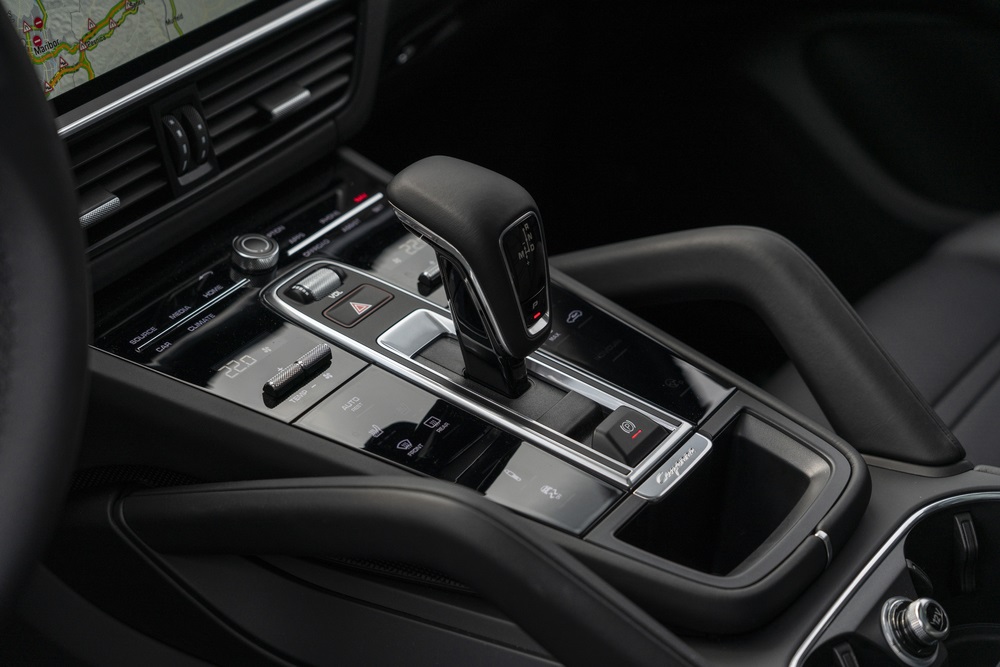
The Porsche Cayenne shift console

The shift console is an electronic array with touch-sensitive buttons with a haptic response to show activation.

Porsche Cayenne Coupe Powertrains

Buying a Porsche is a numbers exercise: How quick to 60? How fast from 60 to zero mph? And how much?

The base Coupe is the welcome wagon for those who don’t care about performance numbers but want the brand prestige and sexy styling. The S Coupe is the enthusiast’s number for the purity of Porsche performance. And the Turbo is for those who don’t have to ask “How much?”

The base model is powered by a 335-horsepower, single turbo 3.0-liter V-6 with 332 foot-pounds of torque from 1,340 to 5,300 rpm. Porsche cites 0-60 mph in 5.7 seconds.

For another $13,300, the S model is a full second quicker to 60 with its 434-hp 2.9-liter twin-turbo V-6 and 405 lb.-ft. torque from 1,800 to 5,500 rpm.

And the mighty Turbo Coupe, with its 541-hp twin-turbo 4.0-liter V-8, is yet another second quicker, propelled by 567 lb.-ft. torque from 1,960 to 4,500 rpm — for $41,500 above the S Coupe.

The Cayenne Coupe

The S model has an impressive 434-hp from its twin-turbocharged 2.9-liter V-6.

Cayenne Coupe Performance

The hands-on relationship of the S Coupe is immediately sensed in the steering, braking and suspension. It is a buffet of fine-driving skills neatly served with a platter of power.

Acceleration in standard driving mode is focused on meeting fuel economy, which isn’t egregious at 18 mpg city, 22 highway and 19 mpg combined on the required premium fuel. I was averaging 19-21 mpg in daily driving and up to 24.2 on extended highway driving. The hefty 23.7-gallon tank will allow a generous cruising range, even at 18 mpg.

But fuel efficiency depends on the performance mode: Normal, Individual, Sport and Sport-plus. My preference was Sport, which quickened throttle response and got me away from the light with no hesitation, but my go-to was Sport-plus for its overall tighter suspension, steering, and launch control. Engine stop-start at idle is also deactivated in the Sport modes.

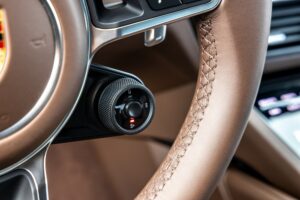
The performance modes are engaged via a small dial at the lower right spoke of the steering wheel. It seems like an odd placement, but it works well and takes away another switch on the shift console.

Sport Exhaust upgrade

To let others know of your arrival, there is a sport exhaust upgrade with more relaxed silencers for $3,220. But I felt the standard exhaust was communicative enough.

And while you are adding features, the performance package, $4,900, adds rear-axle steering, adaptive air suspension, and a sport exhaust system with tailpipes in black or silver. My driving style would not require such advanced levels and the tester was optioned with the adaptive air suspension, $2,170.

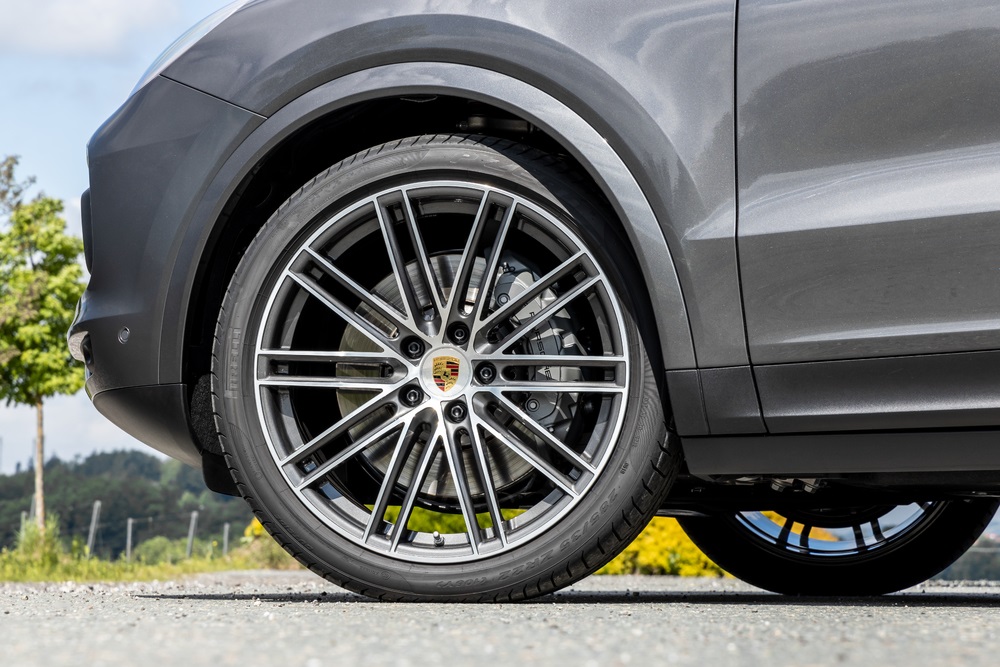
21-inch Pirelli P Zero tires, 285/40 ZR at the front

The S model rolls with 21-inch Pirelli P Zero tires, 285/40 ZR at the front and 315/35 ZR rear.

Ride and Handling

The Porsche Cayenne Coupe air suspension was never harsh, never soft but always ready to clip an apex and find a new way home. The driver can feel the steadiness of the chassis through the steering wheel. And there is barely any turn-in transition as the suspension prepares for cornering maneuvers or rolling across speed bumps.

Curb weights are substantial, even with the aluminum hood, tailgate, doors, fenders, roof and suspension pieces. Weights range from 4,663 pounds for the base model to 4,725 for the S model and on to 5,024 lbs. for the Turbo. Consequently, four-wheel disc braking is a three-bear choice:

  • The base model gets internally vented 13.8-inch rotors front, 13 inches rear with four-piston calipers front and two-pistons rear.
  • The S stopping power is enhanced with internally vented 15.3-inch rotors with six-piston calipers 13-inch rotors rear with four-piston calipers.
  • The Turbo gets 16.3-inch internally vented rotors front, 14.3 inches rear with 10-piston front, and four-piston rear calipers.

Cayenne Coupe Turbo Coupe Options

Turbo owners also can opt for a carbon-fiber roof option, $11,570, to save about 48 pounds. The big package includes a suite of upgrades:

  • Sport Design Package in exterior color
  • Carbon interior package
  • Carbon fiber rear diffuser
  • Heated multifunction steering wheel in Alcantara
  • 22-inch GT Design wheels in satin platinum
  • Standard Interior in black with silver houndstooth
  • Matte black air-intake grilles and matte black airblades
  • Alcantara headliner
  • Sport exhaust system
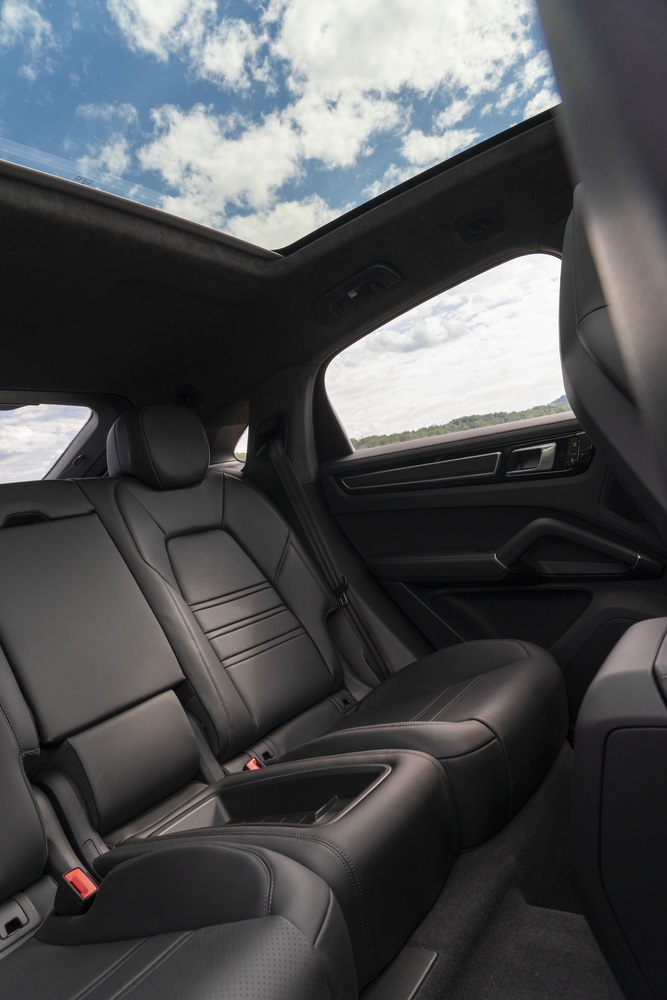
Cayenne Coupe back seats

To compensate for the lower roofline, the second-row 2+2 seats sit lower in the vehicle, but headroom is still accommodating at 37.4 inches.

Disc Brake Upgrades

For stable braking under extreme use, Porsche has added a new brake upgrade. The Porsche Surface Coated Brake system, $3,490 (but standard on Turbo Coupe), has an exceptionally hard tungsten-carbide coating, Porsche says, that is combined with fade-resistant brake pads. Compared to conventional gray cast-iron brakes, the new discs generate up to 90 percent less brake dust, Porsche says. A side effect of the disc treatment will be a polished surface after several hundred miles of driving. It is also intended to prevent the flash rust that appears on brake rotors when the vehicle sits after driving in the rain. The option includes white calipers to show off the brightness.

And when the cost is no matter, the $9,080 ceramic composite brake upgrade (with carbon fiber-reinforced discs) adds 17.3-inch internally vented and cross-drilled rotors at the front and 16.1-inch discs rear, with bright yellow 10-piston calipers front and four-piston rear. (Big steel disc brakes are very heavy and the ceramic option would cut the weight by around 50 percent, Porsche says. For those who participate in slalom racing, the cost to weight savings might be important. But for a daily driver, my choice would be the Surface Coated Brake system.)

Off-Roading, if you dare

Porsche offers an overkill for an off-road suspension package, $2,170, for those brave enough to risk an $800 metallic paint upgrade or a $3,150 special paint color (Cashmere Beige Metallic, Chalk or Lava Orange). The only no-cost colors are white and black.

The adaptive three-chamber air suspension (standard on Turbo Coupe), also adds forged aluminum suspension links at the rear. And there are five ride heights ranging from a load-level of 5.9 inches to 9.6 inches for trail driving, and up to about 20.6 inches of water-fording depth.

The standard panoramic fixed glass roof (with sunshade) is especially enjoyable for back-seat passengers.

Cayenne Safety Features

Standard safety features include 10 air bags, a forward collision warning with automated emergency braking, pedestrian and cyclist alerts. Other advanced and optional features include lane-keep assist and adaptive cruise control with stop-and-go function.

Porsche’s electronic co-pilot InnoDrive uses navigation data to calculate rates of optimum acceleration and deceleration for the next 1.8 miles. Controls are activated via the engine, transmission, and braking. The system factors corners, gradients, and maximum speeds and monitors current traffic conditions using radar and video sensors. Porsche says this exclusively developed system can even recognize roundabouts and will adjust vehicle speed to negotiate the circle.

The tester had none of the advanced technologies for assisted driving and instead relied on the driver to steer, stop, brake, and pay attention to the road. And that was just fine by me; there were no intrusive warning alerts or subtle steering assistance.

For commuters who want the electronic backup, the $6,240 assistance package adds a surround-view camera, head-up windshield display, InnoDrive co-pilot, adaptive cruise control and traffic jam assist, lane keep assist, traffic sign recognition and night vision assist.

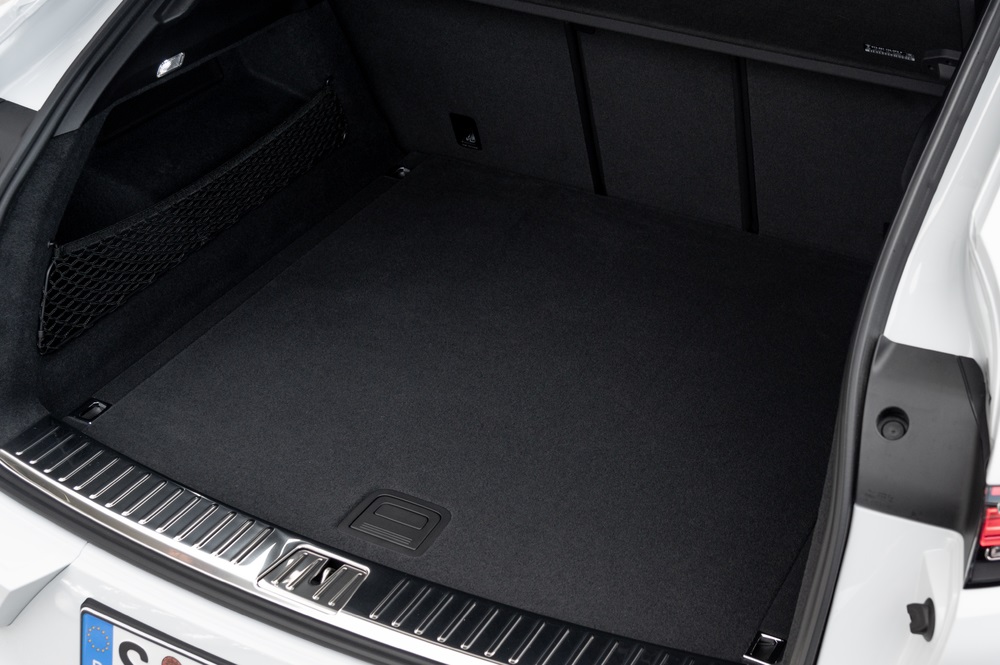
The cargo space

The Cayenne Cargo space has a low liftover, with ride-height switches.

Interior Function

The Porsche Cayenne Coupe is easy to live with and accommodating as your version of the 911 coupe but with legitimate back seats and usable cargo space. The turning circle is broad but manageable at 39.8 feet, but the rear-axle steering option ($1,620) will trim that span by almost 2 feet, to 37.8 ft.

The cabin and cockpit are driver and passenger-friendly. Sightlines are open at the side mirror and across the hood, but the rearview is cropped by the slim rear glass and wrap of the rear roof pillars.

The 12.3-inch wide infotainment screen isn’t prone to wash out in sunlight and is simple enough to use. The rearview camera image is large and while there are front and rear parking assist tones, a more helpful 360-degree camera system is a $1,200 option.

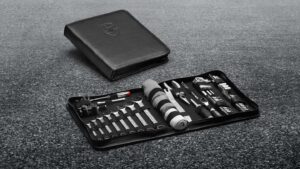
The Porsche Cayenne tool kit

Porsche offers a 55-piece tool set accessory in a leather case ($403).

The eight-way power-adjustable front sport seats are firm but still comfortable after a three-hour run. But for those who appreciate more lower back support, lumbar adjustment is added in the 14-way power seat upgrade, $1,290. And there is an 18-way power seat upgrade for $1,710.

With the tester’s leather upholstery upgrade ($3,750), I’d recommend the ventilated seat upgrade, $850, for those in warm climates. Seat heaters are $530 and a heated steering wheel is $280.

The midsize cabin is broad enough to ergonomically place controls and digital screens. The shift console is an electronic array with touch-sensitive buttons with a haptic response to show activation.

The console isn’t big on small-item storage, but there is a new phone slot and charging ports in the armrest console box. Wireless charging is an option. The visors do not slide and driver’s left coverage is poor with a gap between windshield and visor where morning or evening sun presents a problem.

performance modes are engaged via a small dial at the lower right spoke of the steering wheel.

The performance modes are engaged via a small dial at the lower right spoke of the steering wheel.

Comfort Access

The Comfort Access option, $940, gives a complete keyless unlocking setup and a foot-activated tailgate. Without it, the driver must use the key fob to unlock the doors, then put the fob back in pocket or purse and start the car using the ignition stub, to the left of the steering wheel, of course, in the Le Mans style.

The other notchy thing was the electric activation of the gear shift. After a week of driving, I was still fumbling to press the engagement button on the front of the shift lever. But at least there is a gear-shift console and not a shifter “stalk” on the steering column.

Back Seats and Cargo

The standard panoramic fixed glass roof (with sunshade) is especially enjoyable for back-seat passengers. Seat comfort is quite firm with adult-class thigh support and seatback recline. Conveniences with the S Coupe are spartan with no electronic temperature or fan-speed controls, but there are two charging USBs. The 2+2 seating configuration has a no-cost option for a 2+1 “comfort” back seat with a third seat belt for the narrow center position.

The back end has a square space of 22 cubic feet behind the second row or up to 54.3 cu. ft. with the seatbacks folded for about 6.3 feet of length. Access to the space is particularly smart because of the low liftover (with ride-height raising or lowering switches) and the wide 43-inch-wide opening offers comfortable tailgating potential because there is no protruding rear fascia. It’s a good space to sit and pull on shoes, boots, or wetsuits.

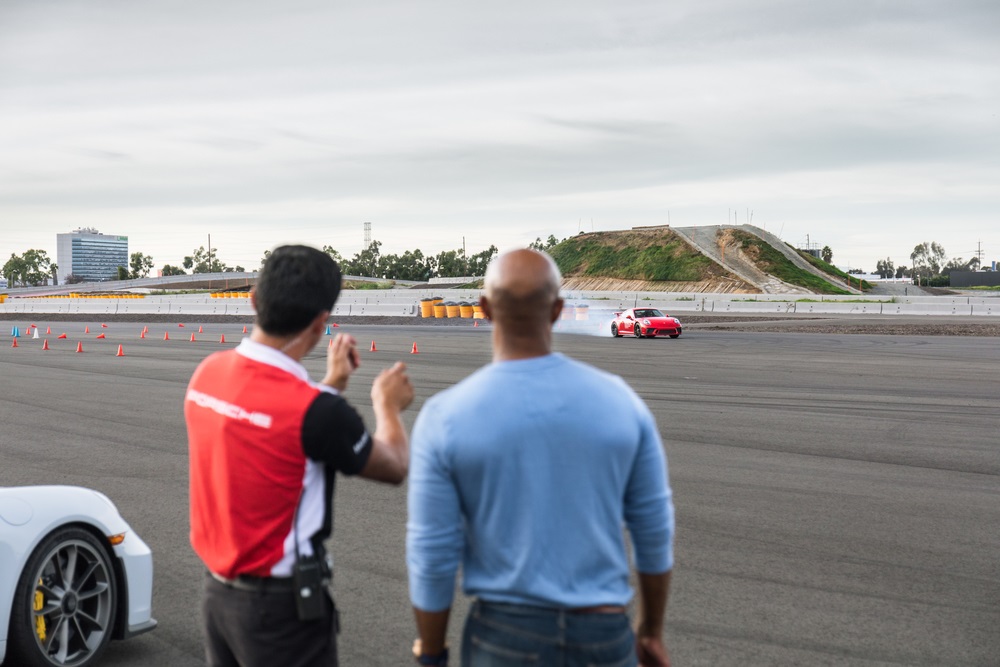
The Los Angeles Porsche Experience and track

New owners can take advantage of the Porsche Experience Center Delivery in Los Angeles for $535 or $465 in Atlanta.

Why Buy the Porsche Cayenne Coupe?

Buying a new Porsche is always special and new owners can christen their purchase with delivery and track time at a Porsche Experience Center, either in Los Angeles for $535 or $465 in Atlanta. The option includes special delivery of your new Coupe (or another model), a tour of the facility, lunch at Restaurant 356 overlooking the track, and a 90-minute instructed track session in an equivalent car.

The Cayenne Coupe has the purity of Porsche performance in an SUV with nothing to prove, except that there is almost no end to the customization options. Once a buyer chokes down the price, it tastes like “more” and there will be many rewards in ownership — with little remorse.

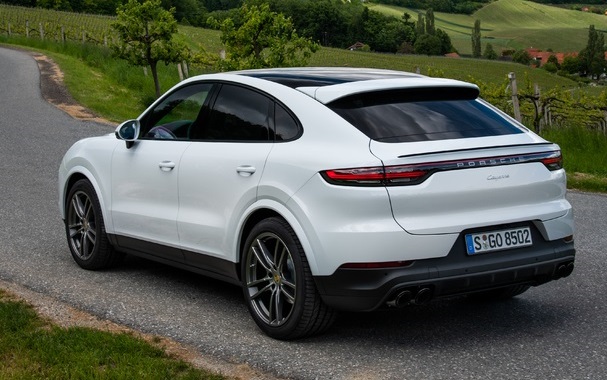
A rear view of the Cayenne Coupe

The Porsche Cayenne Coupe is easy to live with and accommodating as your version of the 911 coupe but with legitimate back seats and usable cargo space.

2020 Porsche Cayenne S Coupe AWD

Body style: midsize, 2+2 4- or 5-seat sportback SUV; w/aluminum hood, tailgate, doors, fenders and roof

Engine: 434-hp, direct-injection and twin-turbocharged 2.9-liter V-6 with auto stop-start at idle and coasting function; 405 lb.-ft. torque from 1,800-5,500 rpm

Transmission: 8-speed Tiptronic; active all-wheel drive with electronic and map-controlled multi-plate clutch with automatic brake differential and anti-slip regulation

0-60 mph: 4.7 seconds; w/Sport Chrono package; top track speed 163 mph

Fuel economy: 18/22/19 mpg city/hwy/combined; premium required

BY THE NUMBERS

Fuel tank: 23.7 gallons

Cargo space: 22-54.3 cu. ft.

Front head/leg room: 39/41 in.

Rear head/leg room: 37.4/40 in.

Length/wheelbase: 193.6/114 in.

Curb weight: 4,725 lbs.

Turning circle: 39.8 ft.

Tow capacity: 7,700 lbs.

FEATURES

Standard equipment includes: remote locking, 8-way power adjusted front sport seats, fixed panoramic roof, 10-speaker audio system, electric parking brake, electric folding and heated side mirrors, LED lighting (headlights, cornering lights, brake and running lights), stainless steel pedals, tinted and thermally insulated glass all around, park assist front and rear with reversing camera, analog dashboard clock and floor mats

Safety features include: 10 air bags, forward collision warning with automated emergency braking, pedestrian and cyclist alerts

PRICING

Base price: $89,950, including $1,350 freight charge; price as tested $102,110

Options on test vehicle: Carrera White metallic paint $800; slate gray leather interior $3,750; adaptive air suspension with PASM (stability management) $2,170; heated steering wheel $280; 21-inch RS Spyder design wheels and painted wheel arches $2,710; heated front seats $630; torque vectoring plus PTV+ $1,500; auto-dimming mirrors $420

Where assembled: Bratislava, Slovakia

Warranty: 4-years/50,000-miles bumper to bumper with 24-hour roadside assistance; 1-year/10,000-miles free first scheduled service

2020 Audi Q3: Largesse in a compact cute ute

2020 Audi Q3: Largesse in a compact cute ute
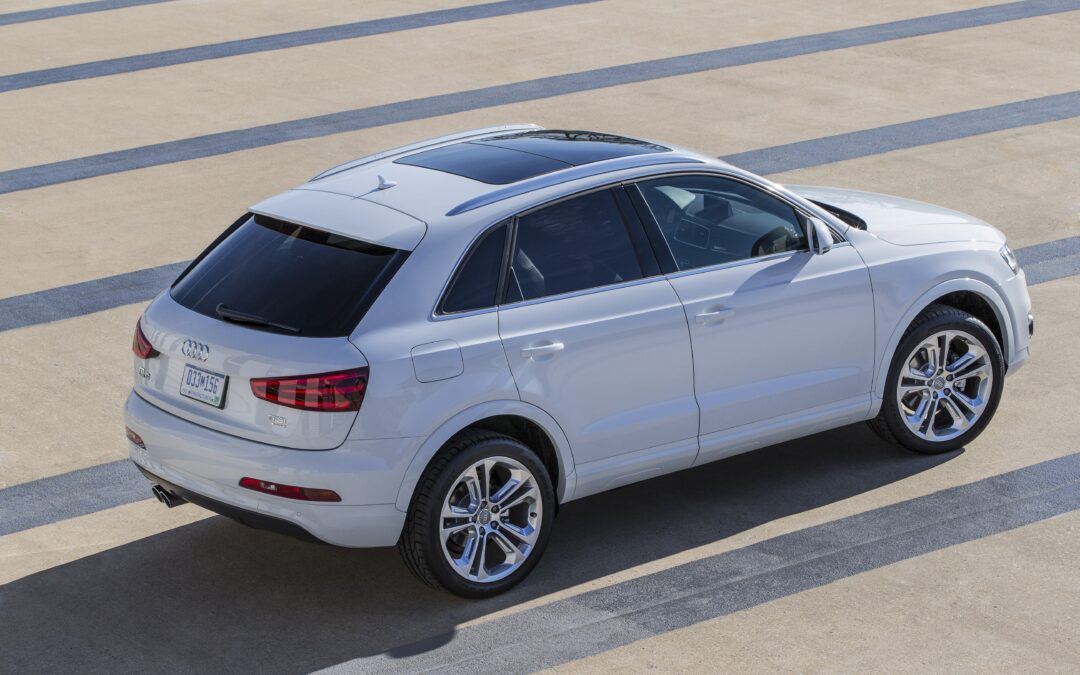
The Q3 was redesigned last year, standing 1.5 inches taller, 3.8 inches longer and nearly an inch wider than its predecessor. (Audi)

The Audi Q3 is a natural-born fun car to drive, which is somewhat unexpected for a small SUV crossover, even if it is an Audi. There is a palpable driver-machine synergy between steering, suspension set, braking and exhilaration. It is a nimble city runner and a safe commuter with all-wheel drive, eight air bags and supportive safety features.

Redesigned last year, the Q3 stands 1.5 inches taller, 3.8 inches longer and nearly an inch wider than its predecessor. And it has a new turbocharged and direct-injected 2.0-liter four-cylinder engine new eight-speed Tiptronic automatic transmission.


The cabin is handsomely crafted with an emphasis on driver focus. (Mark Maynard)

The bigger footprint translates to 2.6 inches more front headroom, now at 39.6 inches with the standard panoramic sunroof, and almost an inch more front shoulder room. Back seat headroom lost about an inch (now at 36.3 inches) due to the more athletic slope of the roofline, but legroom grew by 5 inches. And cargo space grew by 7 cubic feet behind the back seat and stayed about the same with the seats folded at 48 cu. ft., with about 5 ½ feet of length.

Headroom grew by 2.6 inches with almost an inch more shoulder room. (Mark Maynard)

Drivability

The engine has the same displacement as before but now with 228 horsepower, a boost of 28 hp, and 51 foot-pounds more torque, now at 258 lb.-ft. from 1,700-4,400 rpm.

But there is a slight delay from foot down to turbo spooling to forward motion, and then it can be a rush of force. There is fuzzy logic in how the transmission responds and if the driver had been driving lightly but then called for full force, the system takes precious split seconds to respond. Sport mode trims away some of the mileage-minded temperament, but it can feel abrupt and shift points do not feel luxurious, but the active engine-rev downshifts are fun.

The virtual cockpit graphic display is part of the navigation package, $2,000. (Mark Maynard)

The curb weight is up by 234 pounds at 3,916 lbs., but performance and fuel economy improved. Audi cites 0-60 acceleration in 7.0 seconds vs 7.8 seconds, with quattro all-wheel drive.

EPA fuel-economy estimates lost 1 mpg in all three categories, 19/27/22 mpg city/highway/combined. But the new engine runs on 87 octane rather than premium. I was averaging 19.7 mpg around town and worked up to 25 mpg on the highway, but I expect more range was possible.

The shift console includes an e-bin for wireless charging with two USBs. (Mark Maynard)

The new suspension has five drive modes — comfort, auto, dynamic off-road and individual. And the four-wheel vented disc brakes also were upgraded to 13.4-inch rotors front, 12.2-inch rear versus 12.3/11.1 inches.

The tester’s Goodyear Eagle Sport (235/50) 19-inch all-season tires were on the hard side (with a treadwear rating of 560) and with some tire noise at highway speeds. But they stuck well in cornering and braking with no whining. The tires have a warranty of 50,000 miles and are praised by owners at the various tire websites.

Cabin features

The cabin is handsomely crafted with an emphasis on driver focus, with a slight angling of the center control touch screen to the driver. Sightlines are open at the side mirrors and the little rear quarter glass helps over-the-shoulder views, with parking help from the rearview camera.

The new cabin width allows smart placement of screens, switches and buttons in logical succession for easy adjustment. The shift console is substantial with a large e-bin for wireless charging and two USBs, one of which is a Type C. There are several areas for small-item storage and a height-adjustable center armrest.

There are several areas for small-item storage, including the door panels. (Mark Maynard)

The seats are supportive and eight-way power adjustable, but with wedgie-inducing side cushion bolsters for those moments of sporty driving.

Back seat

The tall AWD tunnel makes the Q3 a great four-seater, with reclining seatbacks and extended thigh support at the window seats. But the space still feels compact for adult comfort with a slight butts-down, knees-up position. A wide fold-down center armrest has can holders and passengers have access to two charging USBs, grab handles above both doors, dry-cleaning hooks and are jacket hooks on the B-pillars.

Cargo

The working end of the Q3 is more functional than might appear. The opening is wide at 44 inches with 3 feet of length to the seatback or about 5½ feet with the 60/40 seat folded. There are side corner storage nooks but just four small sections for basement storage, which is full occupied by the temporary spare tire.

The tall AWD tunnel makes the Q3 a great four-seater, with reclining seatbacks and extended thigh support at the window seats. (Mark Maynard)

Sold in three trim levels of Premium, Premium Plus and Prestige, starting prices range from $35,695-$43,895, including the $995 freight charge from Gyor, Hungary. The S-line upgrade adds $3,100 to the Premium trim or $1,300 to the Premium Plus. Today’s Premium Plus S-Line tester was $43,295 with options for the navigation package, $2,000, which adds a 10.1-inch touch screen, Audi connect for six months and the 12.2-inch virtual (graphic display) cockpit. A 15-speaker, 680-watt Bang & Olufsen audio system added $850 and brown-gray natural wood and matte inlay trim added $350.

The S line’s sporty treatment includes a full-paint finish (front and rear bumpers and the side sills), and 19-inch five spoke alloy wheels with all-season tires, though an upgrade to 20-inch wheels with summer performance tires is offered.

The Premium Plus package is a substantial upgrade, including smart-key locking and push-button ignition, wireless charging, side assist with rear cross-traffic assist, lane departure warning and eight-way power front passenger seat.

Standard equipment includes leather-trimmed upholstery, rearview camera, heated front seats, panoramic sunroof, power tailgate, eight-way power driver’s seat and four USB ports (one Type C).

The warranty four years or 50,000 miles includes a free first scheduled maintenance and four years of roadside assistance.

Value rated

The Audi Q3 and Audi e-tron EV have earned top rankings in the ALG Residual Value Awards for 2020. The Automotive Lease Guide forecasts which vehicles in 27 categories are expected to retain the highest percentage of their manufacturer’s suggested retail price after a three-year period.
Cargo opening is wide at 44 inches with about 5½ feet of length, seats folded. (Mark Maynard)

Safety

The 2019 and 2020 Audi Q3 have earned the maximum overall safety rating of five stars by the U.S. National Highway Traffic Safety Administration in its New Car Assessment Program testing. The NCAP’s crashworthiness ratings focus on frontal, side and rollover tests.
Some of the credit goes to Audi’s advanced technologies in the so-called pre-sense basic, and pre-sense front, both standard on all models of Q3. Pre-sense basic helps prepare the vehicle for impact by beginning to close the side windows and sunroof and pretensioning the front safety belts. Pre-sense front uses a front camera and radar sensor to monitor the scene for potentially hazardous situations and then issues visual and acoustic warnings to alert the driver.

Standard safety features include eight air bags and rear cross-traffic assist with lane-departure warning.

The Q3’s bigger footprint is more practical as a young family’s starter car, even if they could soon outgrow the back-seat space. But it will be a welcome option for others seeking to simplify and downsize while living in congested urban space.

The Q3 has more substantial styling and more useable passenger and cargo space. (Audi)

2020 Audi Q3 S Line 45 quattro

Body style: compact, 5-seat AWD SUV crossover

Engine: 228-hp turbocharged and direct-injection 2.0-liter 4-cylinder; 258 lb.-ft. torque from 1,700-4,400 rpm

Transmission: 8-speed Tiptronic

Fuel economy: 19/27/22 mpg city/hwy/combined; 87 octane

SPECIFICATIONS

  • Fuel tank: 15.9 gal.
  • Cargo space: 23.7-48 cu. ft.
  • Front head/leg room: 39.6/40 in.
  • Rear head/leg room: 36.3/36.1 in. 
  • Length/wheelbase: 176.6/105.5 in. 
  • Curb weight: 3,916 lbs.
  • Turning circle: 38.4 ft.

FEATURES

  • Standard Premium Plus equipment includes: smart-key locking with push-button ignition, 3-zone climate control, heated front seats, panoramic sunroof, leather-trimmed upholstery, 8.8-inch touch screen display, electric parking brake, cruise control, Bluetooth phone and audio connections, 10-speaker audio system, LED headlights-taillights-running lights, high-beam assist, parking sensors front and rear, heated side mirrors with turn signals, 60/40 folding back seat, power tailgate, adjustable cargo floor with basement storage, 19-inch wheels
  • Safety Premium Plus features include: 8 air bags, rear cross-traffic assist with lane-departure warning, hill-descent control, stability and traction controls

PRICING

  • Base price: $38,095, including $995 freight charge; price as tested $43,295
  • Options on test vehicle: navigation package, $2,000, includes a 10.1-inch touch screen, Audi connect for six months and the 12.2-inch virtual (graphic display) cockpit; Bang & Olufsen audio system $850; and brown-gray natural wood and matte inlay trim $350
  • Where assembled: Gyor, Hungary
  • Warranty: 4-years/50,000-miles with free first scheduled maintenance and 4 years of roadside assistance