Select Page

2021 Toyota Venza Hybrid Crossover

2021 Toyota Venza Hybrid Crossover

The Toyota Venza Hybrid is a new urban crossover that focuses on technology, intuitive performance, and design

An exterior view of the 2021 Toyota Venza

The all-wheel-drive Toyota Venza has starting prices of $33,745 to $41,075. (Toyota)

Table of Contents

Overview
Pricing
Warranties
Safety Features
Interior
Performance
Ride and Handling
Why buy the Toyota Venza?
Specifications

BY MARK MAYNARD

On several levels, the new Toyota Venza hybrid is next-level transportation. Its advanced technologies are formidable but presented as a buffet to pick and choose, not to force-feed the user. It has user functionality for the electronically sophisticated or first-time user.

Venza is a very targeted vehicle in the popular sweet spot of midsize, five-seat crossover SUVs. Venza is more of an urban crossover that focuses on technology, intuitive performance and sophisticated design, Toyota says. The two-row Venza is positioned between the RAV4 and Highlander, which are considered more adventurous crossovers.

The Toyota Venza has an electrochromic

The electrochromic glass roof can switch views from transparent to frosted. (Toyota)

A Brought-Back Nameplate

The nameplate was brought back from a prior Toyota Venza that was sold in the U.S. from 2008-2015. The new 2021 Venza for North America shares a foundation with the Japanese-market Harrier crossover SUV. But the Venza is most comparable to the RAV4 Hybrid, with which it shares the majority of hybrid hardware.

Projector LED headlights on the Venza Limited.

Projector LED headlights on the Venza Limited. (Toyota)

2021 Toyota Venza Overview

For the U.S. the Venza is a hybrid-only model with standard on-demand all-wheel drive. The electronically smart system uses a separate rear-mounted electric motor to power the rear wheels when needed. The driver does nothing to engage the system, it’s all done through a multitude of sensors.

The gasoline-electric powertrain is comprised of a 2.5-liter direct-injection four-cylinder gas engine, three electric motors, and a lithium-ion battery pack.

Venza might be compared to such five-seat competition as the Ford Edge or Nissan Murano. But as an all-wheel-drive hybrid, it is in a class of its own. And with its high-quality interior materials, it is more of a premium choice than the Ford or Nissan.

Compared to the RAV4 hybrid, the Venza is 5.7 inches longer with a 1.3-inch lower roofline. And it is heavier by 133 pounds, which cuts about 1 mpg from fuel-economy ratings.

2021 Toyota Venza Pricing

Venza is sold in three all-wheel-drive trim levels. Starting prices range from $33,745 for the entry LE to $37,275 for the XLE and $41,075 for the Limited. Pricing includes the $1,175 freight charge from Aichi, Japan.

Today’s Limited tester was $43,200 with the Star Gaze panoramic roof ($1,400) and Advance Technology package ($725). The tech package includes a head-up windshield display with speed and hybrid-system indicators.

The expansive electrochromic Star Gaze roof is a unique luxury feature in this mainstream segment. The driver can switch the glass from a transparent view to a frosted one. Back-seat passengers will appreciate the softer light and reduced glare of direct sunlight. But it is a pricey courtesy that I’d like better for $400.

The Limited is well equipped with features like smart-key locking and push-button ignition, Softex-trimmed upholstery, a rearview camera with guidance lines, and a bird’s-eye view with perimeter scan. There’s even a rear camera lens washer.

Interior features include heated and ventilated front seats and heated steering wheel, digital rearview camera mirror, nine-speaker JBL premium audio, and a 12.3-inch touch screen and touch-capacitive controls. The dynamic navigation system features an enhanced 2D landmark display with lane guidance and freeway exit displays.

Connectivity features include Bluetooth phone and music, Apple CarPlay (with Siri), Android Auto (with Google Assistant), and Amazon Alexa.

Find lease and purchase pricing incentives here.

The capacitive touch screen in the Venza

The capacitive-touch controls for heat-fan-temp are logically grouped,  but it takes eyes from the road to make adjustments. (Toyota)

2021 Toyota Venza Warranties

Standard warranty coverage for Venza is 3 years or 36,000 miles bumper to bumper. It includes 2 years or 25,000 miles of factory scheduled maintenance with 24-hour roadside assistance. The powertrain is covered for 5 years or 60,000 miles.

Hybrid warranty coverage includes 10 years or 150,000 miles for the battery and 8 years or 100,000 miles for the hybrid system.

2021 Toyota Venza Performance

Venza’s gasoline-electric powertrain combines a 2.5-liter direct-injected four-cylinder engine with three electric motors. Two motors are at the front wheels and one at the rear for AWD.

The gas engine has 176 horsepower, which rises to an overall total of 219-hp with the 88-kW (118-hp) permanent-magnet synchronous motors. A rear 40 kW (54 hp) motor powers the AWD. The lithium-ion battery pack totals 252 volts among 70 cells at 3.6 volts per cell for 650 volts maximum.

The continuously variable transmission (eCVT) has a sequential shift mode and selectable driving modes of normal, eco, and sport. An EV mode allows electric-only driving at low speeds for short distances. There’s also a “downshift” feature to boost regenerative braking.

The regen-braking and EV modes will be engaging to some, but I did not feel the need.

The fuel economy ratings seem achievable at 40 mpg city, 37 highway, and 39 mpg combined, on 87 octane fuel. (That compares to the RAV’s 41/38/40 mpg.)

Setting cruise control at 68 mph, I quickly worked up to 38.4 mpg combined on highway runs. My around-town mileage was consistent at 32-35 mpg in my test week of 232 miles. When finished, the computer indicated 312 miles to empty. With the 14.5-gallon tank, a long-distance commuter could expect well over 500 miles to a fill-up.

The hybrid engine system in the Venza

Total system power is 219-hp with the gas engine and electric motors. (Toyota) 

Reading the Road

Among Venza’s advanced technologies is the driver-selectable Predictive Efficient Drive. It uses the navigation system to analyze driving habits and memorize road and traffic conditions to help optimize hybrid battery charging. The PED system learns repeating routes and can predict when and where the vehicle is likely to slow down or stop. Through so-called “optimum accelerator pedal release timing guidance” the system can help reduce fuel and battery consumption.

PED can also help optimize battery charging and discharge ahead of hills or traffic congestion. When approaching a downhill section, for example, the system is designed to apply more engine braking to boost the charge going to the hybrid battery.

Venza’s Driver-Assist Systems

The standard Toyota Safety Sense 2.0 allows Level 2 semi-autonomous driving. The system integrates all-speed dynamic radar cruise control and lane change assist, front cross-traffic alert, and pedestrian alert.

Always keep both hands on the wheel while using the semi-autonomous features.

The system capably keeps the car centered in the lane, but like most systems, it will randomly shut off. That might be due to variable light and road-surface conditions. This type of safety system will be beneficial for those drivers who have daily commutes in heavy traffic. The sensors are an extra six eyes on the road to watch for less-attentive drivers.

The safety system includes a pre-collision system with pedestrian detection, lane tracing assist, lane departure alert with steering assist, road sign assist, full-speed dynamic radar cruise control, and intelligent high beams.

2021 Toyota Venza Safety Features

Venza’s safety designs earn top stars from two testing agencies. The National Highway Safety Administration ranked it five stars overall, with five as the top rating. In frontal collisions, the Venza earned four stars for driver-side protection and five stars for the front passenger. It aced the overall side crash category with five stars each in side barrier and pole tests, front and rear seats. And four stars for rollover risk.

The Insurance Institute of Highway Safety gave it a Top Safety Pick for the XLE and Limited models with the LED projector headlights and high-beam assist.

Contributing to its high rankings is Toyota Safety Sense (TSS 2.0) active safety systems. Other standard safety features on all trim levels are eight air bags, stability and traction controls, brake-force distribution, brake assist, blind-spot monitor with rear cross-traffic alert.

Ride and Handling

The Venza might be considered a citified version of the RAV4 Hybrid, but I found it to be very different. The exterior styling is urban-attractive with the look of an electrified vehicle.

It is very quiet rolling over most highway surfaces even with the 19-inch Bridgestone Ecopia tires. These “green” tires have a fairly hard treadwear rating of 600, but that also translates to warranty coverage of 70,000 miles.

Braking is absolute with vented 12-inch front discs and 11.1-inch solid rear. It will take time for the driver to adjust to brake-pedal pressure. Stepping on the pedal can feel like an on-off switch as it passes through the inch or so of regen-gap to the actual grip of braking.

At 3,913 pounds, the Limited can feel weighty on lumpy road surfaces as the independent suspension works to control the heaves of imbalance. The ride quality is robust and secure, yet soft and comfortable. It’s more about easy driving than getting happy on a twisty road, but I’m sure that’s OK for this buyer.

2021 Toyota Venza Interior

Because Venza is an “electrified” platform, it needs some underfloor capacity for battery storage. The result is a high-riding vehicle but without tall interior space, which feels low and wide.

Aerodynamics are maximized by its sleek exterior design and sloping roof. Front headroom for some might be a bit low at 38.1 inches with the Star Gaze roof, or 38.6 inches without. The front legroom of 40.9 inches is competitive but potentially limiting to the big-and-tall set.

The Limited’s interior is well dressed in soft-touch materials. There is neat stitching and the plastics throughout have a quality appearance top to bottom.

A door panel in the Venza shows quality materials and assembly

The Limited’s interior is well-dressed. (Toyota)

All models have an eight-way power driver seat (with seat cushion tilt). The front passenger has just a four-way adjustment, but it should really be six-way, with height adjustment.

The power driver’s seat smartly includes an auto slide-away function, which automatically moves to the rearmost position. It will be a valued asset to drivers of all sizes. The rake of the windshield and roofline creates the potential for a duck-and-enter sequence.

There is a command-center design to the driver area, but it’s not all that efficient for small-item storage. The shift console is largely consumed by the shifter, but a row of shift buttons would allow more space for a place to lay a phone.

There is a charging e-bin just ahead of the shifter with a pair of USBs, an audio aux-in, and a wireless charging pad. But space might be slim for those with big hands.

The capacitive-touch controls for heat-fan-temp are logically grouped on a tier just above the shifter, but it takes eyes from the road to stab at raising the temp or adjusting the fan speed. Lower-trim models have a simpler pair of large dials for temp control and a tier of hard buttons for fan speed and vent flow.

Digital Mirror

The Limited also has a digital rearview mirror, which is intended to improve visibility behind the vehicle. It can be handy when passengers’ heads or stacked cargo gets in the way of rearward views. But because I wear glasses, my eyes struggle to focus quickly enough when I glance at the mirror, so I just flip it to manual mode.

Driver sightlines are generally open. There is a small corner glass at the windshield pillars for a snip of cornering view. Over-the-shoulder views are slightly crimped by the tapering rear side glass and the front seat’s broad upper shoulder bolsters also complicate peripheral views. But the wide bird’s-eye view camera system gives an around-view and a perimeter scan for fully functional parking.

The turning circle is tighter than many midsize sedans, at 37.4 feet with 19-inch tires or 36.1 ft. with 18s.

Back Seats and Cargo Area

The rear headroom isn’t bad at 36.9 inches or 38.1 without the pano roof. But it would help rear entry if the doors were engineered to open a few degrees wider or for easier access when buckling a child into a car seat.

Legroom of 37.8 inches is more than generous, but with long legs in front, the space seems almost cramped. A lowish exhaust tunnel benefits (occasional) three-across seating. But all passengers will enjoy the big pano roof and its light-switching mode.

The lithium-ion battery pack is small enough to be installed under the rear seats, so it does not take up any cargo or passenger space.

Cargo space is tight for a midsize SUV at 28.7 cubic feet behind the back seat. The roofline is low at 28 inches from floor to ceiling and the lift-up to the floor is tall at 32 ½ inches. The entry opening is wide at 39 inches. Fold the 60/40 back seat for 6 feet of long-item length.

There is some deep basement storage (where the standard tonneau cover can be stored) and there is an actual alloy wheel for the temporary spare.

The back seat in the Toyota Venza

Back seat legroom of 38.3 inches is generous unless someone tall is seated ahead.

Why Buy the Toyota Venza?

Carmakers can lead the public to fuel-saving vehicles, but the purchase rate is wildly variable. Toyota has been masterful at giving that cup of cold water rather than dumping a bucket of technology over the heads of buyers.

The Venza brings the number of 2021 Toyota hybrids to 10 – and the fuel-cell-powered Mirai makes it 11 electrified vehicles.

There is remarkable simplicity for the highly electrified Venza. Use as much or as little as you wish, while enjoying its forefront styling and upscale interior. It can be driven as “just a car” and still earn more than 35 mpg.

2021 Toyota Venza Hybrid Limited Specifications

Body style: midsize, 5-seat crossover SUV with on-demand all-wheel drive

Engine: 189-hp, direct-injection 2.5-liter 4-cylinder; 163 lb.-ft. torque at 5,200 rpm

Electric motors: 2 88-kW 118-hp, permanent-magnet synchronous front; 40 kW rear

Hybrid battery pack: Lithium ion; 252 volts; 70 cells; 3.6-volts per cell; 650 volts maximum

Combined net power: 219-hp

Transmission: eCVT with sequential shift mode

Fuel economy: 40/37/39 mpg city/hwy/combined; 87 octane

Base price: $41,075, including $1,175 freight charge; price as tested $43,200

Ford Maverick Pickup Pricing Dilemma

Ford Maverick Pickup Pricing Dilemma

2 Maverick pickups

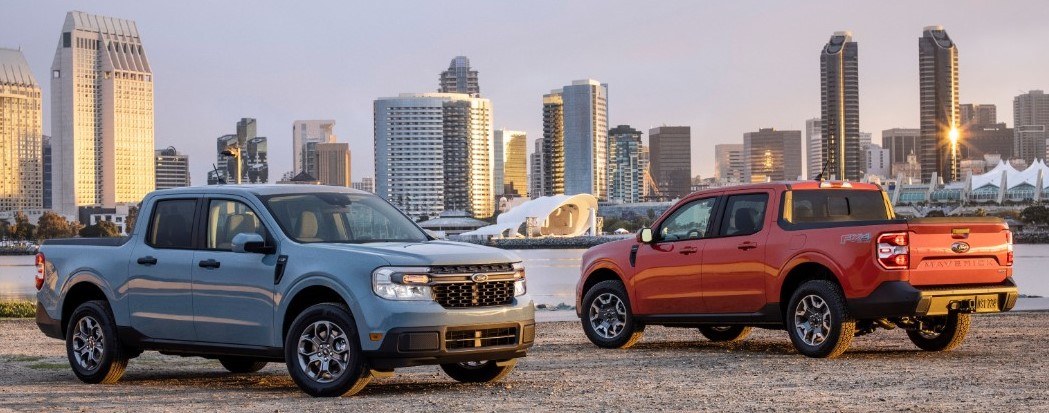
The 2022 Ford Maverick has good small-truck styling and stance. (Photos courtesy of Ford)

BY MARK MAYNARD

I grew up with a 1969 F100 on the farm and I still like pickups no matter how ugly or bad they smell. But they have gotten just too damn big, cumbersome and expensive.

Writing my story about the 2022 Ford Maverick, a possible return to pickup sanity, I considered how this good-looking compact might fit in my city life.

I don’t like the Ford Ranger. It’s too expensive and too cheaply outfitted, which is Ford’s plan to keep its F-150 the top-selling nameplate. And, to me, the Ranger felt to be an Americanized convert from another country, which it is.

Maybe the Maverick could be a truck for me.

I considered the midrange hybrid XLT 4WD, which starts at $23,775, including the freight charge from Mexico. But in spec’ing out “my” truck at Ford.com, I learned that 4WD is only available with the turbocharged 2.0 four-cylinder. That preference would add $3,305 for the engine and AWD and it pushed the starting price to $27,080.

I’ve lived with a front-drive 2008 Ford Escape since 2012 (and have had no major problems with it), so I figured I can let go of my wish for 4WD. And maybe there would be fewer electronic issues with the higher-tech features on the Lariat.

After noting the many compromises in “building” my Maverick, I pushed ahead.

I checked the box for a Maverick XLT SuperCrew hybrid in the no-cost color of Velocity Blue. Among the 10 color choices, Cyber Orange has a $495 premium and Alto Blue and Hot Pepper Red are $390 upgrades. Standard no-charge colors are black, silver, white, Area 51 (a medium gray), Cactus Gray (more the hue of caulking putty) and Carbonized Gray (a darker gray).

The hybrid powertrain was more important to me than 4WD. And I preferred the XLT’s two-tone Navy Pier fabric upholstery because Ford Leather is just ‘meh’ in appearance after a few months of use.

Prickly Price Points

I then added my picks for option packages and accessory items that were permitted for that trim level:

•Ford Co-Pilot360 driver-assist systems $540;

•XLT luxury package ($2,345), which included such features as eight-way power adjustable driver’s seat, 400-watt inverter, bed tiedown locking rails, spray-in bedliner, full-size spare, heated side mirrors with body-color skull caps, heated seats and leather-wrapped steering wheel, LED bed lighting and trailer hitch.

•Manual rear sliding window $155;

•Dual bed lights $200;

•Cargo bed net $70;

•All-weather floor liners (including carpeted mats) $175;

•Console vault $390

The options came to $3,310 toward the total of $27,085, not including other fees.

The two-tone fabric interior in the Maverick XLT hybrid

The two-tone fabric interior in the Maverick XLT.

Going through Ford Finance with a 5 percent APR and 10 percent down, the monthly would be a painful $461 for 60 months. A 3-year term would be $731. And pushing out to a 6-year term would be $393.

Before putting money down, I’d need to test drive this teacup pickup to be certain this Maverick is the disruptor Ford hopes it is.

Otherwise, I’ll wait a couple of years and buy used. Or whatever compact pickup comes along next.

What are your thoughts about compact pickups?

Ford Maverick Overview

Ford Maverick Overview

The compact-class Ford Maverick goes on sale this fall with innovative functionality and reasonable pricing

An exterior view of the Maverick pickup.Maverick’s exterior styling is upright and squared off. (All photos courtesy of Ford)
 

BY MARK MAYNARD

What this country needs is a tough little pickup truck that doesn’t require 84-month financing. Ford Motor hopes it has prepared such a segment disruptor with its 2022 Ford Maverick. This compact-class pickup was conceived as a doer, not a pretender and it is aimed at “people who never knew they wanted a truck,” Ford says.

Maverick goes on sale this fall as a five-passenger four-door pickup. It will have a choice of two four-cylinder engines — and most notably a gasoline-electric hybrid. Maverick will be sold in three trim levels in front- or all-wheel drive. Pricing starts at $21,490 and includes the $1,495 freight charge from the Hermosillo Assembly plant in Sonora, Mexico.

“Maverick challenges the status quo and the stereotypes of what a pickup truck can be,” Todd Eckert, Ford truck group marketing manager, said in a statement. “We believe it will be compelling to a lot of people who never before considered a truck.”

Maverick’s starting price makes it $150 less expensive than Ford’s least expensive vehicle, the EcoSport subcompact crossover. And it is $5,420 less than the starting price of the midsize rear-wheel-drive 2021 Ford Ranger SuperCab at $26,910.

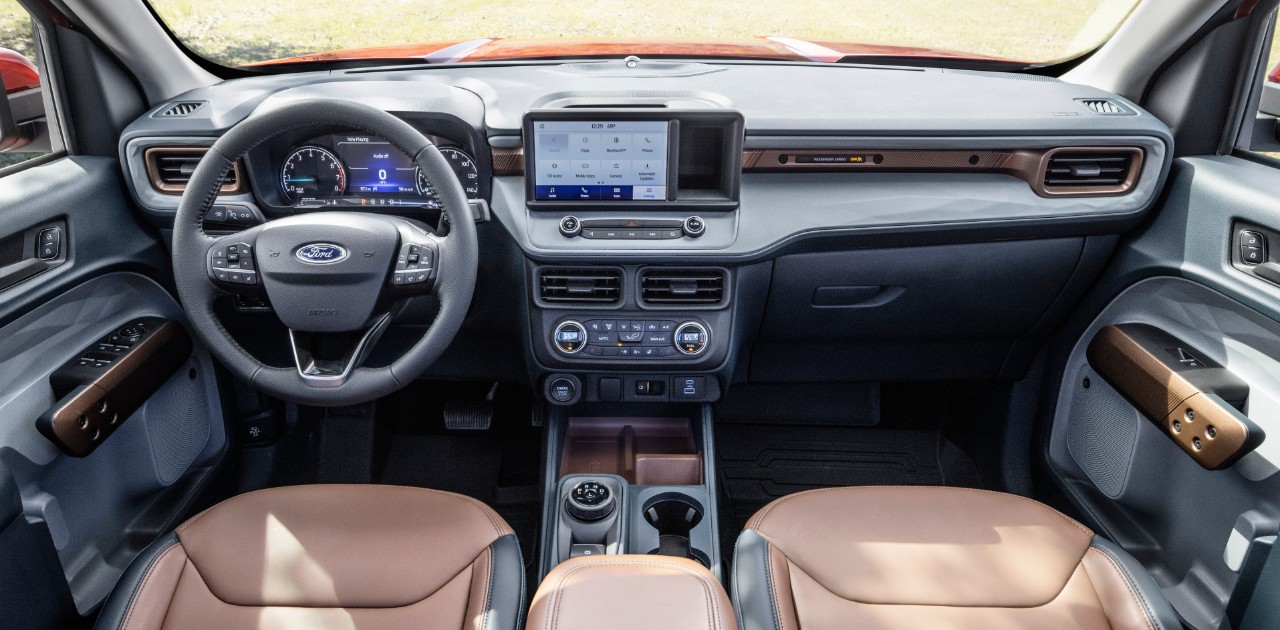
The front seats of the Maverick Lariat.The interior design is straightforward and durable.

Maverick Architecture

The Maverick is 11 inches shorter than the midsize Ranger. And is built on the unibody architecture with the Bronco Sport, Escape, and Lincoln Corsair SUVs. About 60 percent of the Maverick’s parts are shared with the Bronco Sport.

As a unibody pickup — not the typical ladder frame of larger pickups — there is no gap between the cab and the bed. Rail-cap protectors run the length of the bed and curve vertically to end at the top of the back window. The design adds dent and ding protection as users load and unload from the side of the bed, Ford says.

Maverick First Edition

Available for the first model year only is the Maverick First Edition, $32,360. It is built off the Lariat trim level. Its special features include graphics on the hood and lower doors, a soft tonneau cover, body-color door handles, and a gloss black roof and side mirrors. The hybrid model is fitted with 18-inch black-machined wheels and nonhybrid models ride on 17-inch aluminum wheels. Available paint colors will be Carbonized Gray, Area 51, or Rapid Red, which is special for the First Edition.

An FX4 off-road package ($800) is available for all-wheel-drive XLT and Lariat models. The package adds all-terrain tires and suspension tuning, additional underbody protection, and drive modes of mud-rut and sand.

Check the build and price website at Ford.com.

Maverick Powertrains

Maverick will have a choice of two powertrains. The standard, front-wheel-drive hybrid model has a 2.5-liter Atkinson-cycle four-cylinder with a continuously variable transmission. It has total system power of 191 horsepower and 155 foot-pounds of torque with the electric motor. The electric traction motor is engineered and manufactured in-house.

The hybrid powertrain has a projected EPA-estimated fuel-economy rating of 40 mpg city, Ford says. And owners can expect 500 miles of range on a tank of 87-octane gasoline.

The optional engine ($1,085) is the 250-hp turbocharged 2.0-liter EcoBoost four-cylinder with 277 lb.-ft. of torque. This engine is paired with an eight-speed automatic transmission. The tow rating doubles to 4,000 pounds when optioned with the 4K Tow Package ($745). That rating is enough to pull a 21-foot boat, Ford says.

Driver-Assist Systems

Ford’s Co-Pilot360 technology includes standard pre-collision assist with automatic emergency braking and automatic high beam headlamps.

Available options include Adaptive Cruise Control with Stop and Go, Blind Spot Information System with Cross-Traffic Alert and Lane Centering with Evasive Steering Assist.

Maverick Interior Design

Lead interior designer Daniel George calls Maverick “the ultimate first vehicle for my kids.”

What’s key, he said, was understanding how people actually use the stuff they bring in, rather than just expecting them to find places to stash it.

An example of such functionality is the door panels that have a split design to allow a one-liter water bottle to sit upright rather than rolling around on the seats. The door pockets are huge and have lots of vertical clearance to place a tablet or notebooks, George said in the release. There also is a storage bin under the rear seats that is large enough for such items as a volleyball, laptop bags, rollerblades, or tools.

The cleverly designed door panel in the Maverick pickup

Door panels can hold a one-liter water bottle and a tablet.

Simple But Not Basic Cabin

The Ford Maverick customer wants simple but not basic, said Barb Whalen, who led the team in choosing materials and colors.

The goal was to have an interior that is straightforward and durable with a well-built feel, she said. The interior was designed for function, purpose and ease of cleaning.

The infotainment system in the Maverick Lariat.

Electronic features include a standard 8-inch center touch screen.

Unique textures and materials were used, such as reground carbon fiber for strength and visual interest. The dash panel has a stonelike finish, Whalen said. It is similar in appearance to a super-durable synthetic countertop.

“We strategically placed pops of color for functionality — creating an energetic space you want to be in,” she said.

Electronic features include a standard 8-inch center touch screen with Apple CarPlay and Android Auto infotainment. The standard FordPass Connect feature has embedded Wi-Fi for up to 10 devices. FordPass also allows owners to use their smartphone to find the truck, check its fuel level, lock and unlock the doors and start or turn off the engine.

A view of the loaded bed of the 2022 Maverick pickup

The bedsides are low for easy unloading.

Multitasking systems

FITS — Ford Integrated Tether System — is a multitasking solution for passengers in the back seat. A FITS slot at the back of the front console will accommodate a variety of features in the accessory package. It includes cup holders, a trash or storage bin, and a double hook for grocery bags and purses.

There also are under-seat storage dividers. And Ford is working to publish the slot geometry so people can 3D-print their own solutions. Those accessories can be stored in multiple slots under the rear seats.

The unique tailgate of the Maveick can be propped open at 45 degrees.

The tailgate is rated for 500 pounds.

A “Flexbed” Makerspace

“The whole bed is a DIY fan’s paradise,” said Keith Daugherty, an engineering specialist who helped develop Maverick’s bed.

The team’s innovative “Flexbed” system will help ease cargo-packing dilemmas and transform the bed into a complete makerspace.

There is an optional bolt-in cargo-management system, Daugherty said. And owners can bolt steel C-section channels to the bed to create their own setups.

The Maverick pickup has storage under the back seat

Under-seat storage.

Segmented Storage Options

Storage can be segmented with by 2-by-4s or 2-by-6s fitted into slots stamped into the side of the bed. A raised floor can be created for flat transport of full plywood sheets. Special racks can be made for bikes,  kayaks, and other sporting gear. The bed also has two tie-downs, four D-rings, and threaded holes in the bedsides.

“Customers can scan the FLEXBED QR code in the bed for some interesting ideas to get started,” Daugherty said.

Sheets of plywood stacked into the bed of the Maverick.

The payload can accommodate up to 18 sheets of plywood.

Prewired Power

DIY projects, tailgating and camping will get a boost from prewired 12-volt electrical power on either side of the back of the Maverick’s bed.

There also are options for 110-volt, 400-watt outlets. One outlet is in the bed and one is in the cabin, said Gaby Grajales, an electrical engineer on the Ford Maverick team. The 110-volt outlets have enough juice to power phones, laptops or small TVs. The power source can also charge cordless tools or run a small corded tool, such as a jigsaw,

There’s also a storage cubby built into the bed side of the XLT that is large enough to keep a ball hitch or air pump. The Lariat has two cubbies.

A 110-volt household plug in the Maverick's bed.

A 110-volt household plug in the Maverick’s bed.

Ford Maverick By The Numbers

Maverick has a payload of 1,500 pounds and a tow rating of 2,000 pounds. That’s enough to haul a pair of personal watercrafts or a good-sized pop-up camper, Ford said in a release.

All models have four-wheel disc brakes with ABS.

A bedside storage box in the Ford Maverick.

A bedside storage cubby.

Tailgate Multifunction

Drop the tailgate to extend the 4.5-foot-long bed to 6 feet. Maverick’s tailgate has a halfway-open position that can be handy to support up to 18 sheets of 4-by-8-foot plywood on the tailgate lip and wheelhouses.

The tailgate can support 500 pounds and has tie-down clamps that double as bottle openers. Almost any size adult can reach over the sides and grab items off the floor, Ford says.

Segmented storage in the Maverick bed.

Segmented storage in the Maverick bed.

Inch Count

The Ford Maverick is 199.7 inches long on a wheelbase of 121.1 inches. It stands 68.7 inches tall and is 83.5 inches wide at the side mirrors. Lift-in height to the bed is 30.1 inches.

The bed is 54.4 inches long and 53.3 inches wide or 42.6 inches wide between the wheelhouses.

The base curb weight for the hybrid model is 3,674 pounds. The EcoBoost model has curb weights of 3,563-3,731 lbs.

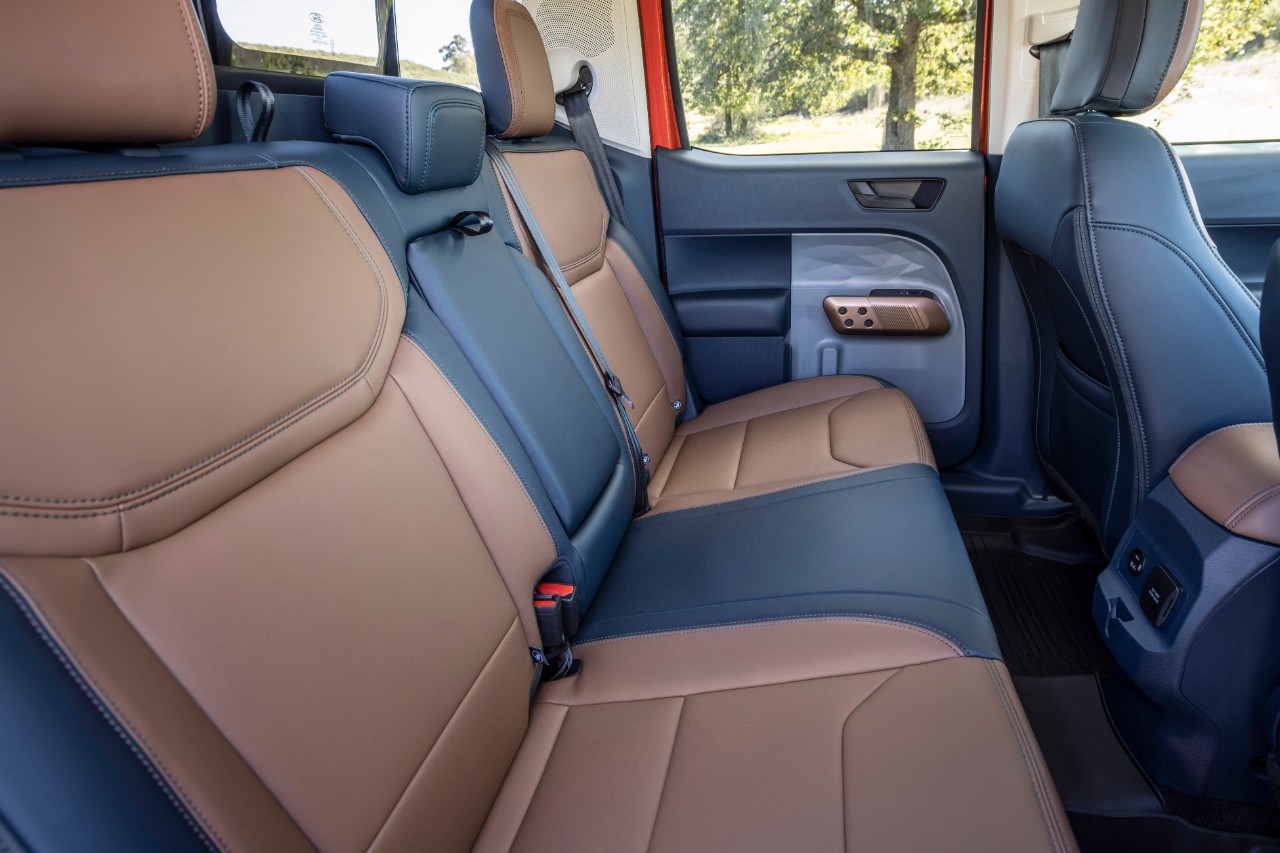
Ford Mavericks back seat.

The back seat in the Lariat model.

Maverick Competitors

Several midsize pickups have been redesigned or significantly updated this year. They include the Honda Ridgeline and Nissan Frontier. The Hyundai Santa Cruz is only size-comparable competitor to the Maverick, so far.  It goes on sale this summer.

A rear view of the 2022 Maverick

The 2022 Maverick will go on sale this fall.

Maverick Assets and Issues

Pickup trucks are an American institution. Many pickup-intenders, however, have lost interest because even the midsize models have gotten so large and expensive.

Maverick could be a refreshing choice that supports the lifestyles of mainstream motorists rather than the truck taking over the lifestyle. But there could be diminished appeal with only one cab configuration. An extended-cab model would be desirable for many.
The base $21,490 MSRP is attention-getting, but that is for the entry XL model. Most transaction prices for the XLT and Lariat will be closer to $27,000 or $35,000 with AWD and a few extras.

Maverick has a manageable 40-foot turning circle. Because of that owners won’t have to use their other, smaller car to run errands. And, in turn, the Maverick could become the family’s only “car.”

Mazda CX-30 Review — The Young Sophisticate

Mazda CX-30 Review — The Young Sophisticate

The 2021 Mazda CX-30 Turbo crossover doesn’t seem as small as a subcompact and is more premium in its interior presence than some in this segment

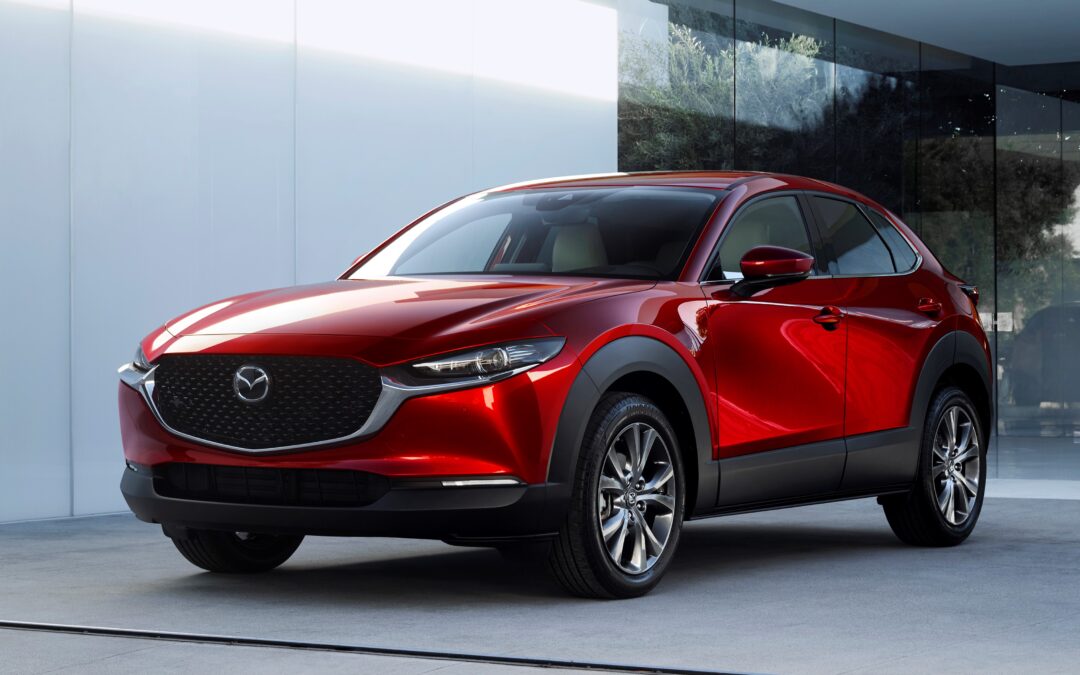
The front side view of the CX-30 Turbo

There is sophisticated simplicity to the Mazda CX-30 2.5 Turbo. (Photos courtesy of Mazda)

BY MARK MAYNARD

Horsepower isn’t everything at Mazda, but it makes a defining statement in the 2021 CX-30 Turbo subcompact crossover. This very likable SUV crossover debuted just a year ago as a callout to the brand’s drive toward premium — premium vehicles and premium dealership experiences.

The campaign focused on the refined touch points of vehicle interiors and fine-edge engineering under the skin. With, of course, the Mazda-infused love of driving.

For 2021, the 2.5-liter turbocharged four-cylinder builds on the standard 186-hp, 2.5-liter non-turbo engine. Mazda says the turbo engine has a peak 250 horsepower when feeding the engine premium fuel or 227-hp with 87-octane junk food. Peak torque comes on strong with 320 foot-pounds at 2,500 rpm with premium fuel or 310 lb.-ft. torque at 2,000 rpm on 87 octane.

Industry sources say to expect a CX-30 midcycle freshening in 2023.

Interior of the Mazda CX-30

Inside, the CX-30 environment is lean, dark, and determined.

Sizewise, the CX-30 slots between the subcompact CX-3 — which goes away after this year — and the compact CX-5. The CX-30 is marketed toward young drivers and couples starting a family. But its quiet and smartly designed interior will appeal to all ages.

Competitors include the Honda HR-V, Hyundai Venue, Jeep Compass, Mitsubishi Eclipse Cross and Nissan Rogue Sport.

Mazda CX-30 Pricing

Sold in four trim levels for the standard 2.5-liter model and three choices for the 2.5 Turbo, all with a six-speed automatic transmission. The non-turbo models are front- or optional all-wheel drive. The Turbo models include AWD.

Starting prices for non-turbo models range from $23,335 to $29,875, including the $1,175 freight charge from Salamanca, Mexico. Add $1,400 for AWD.

For those who enjoy the zoom of driving a Mazda, the move up to the Turbo from a 2.5 Premium is just $1,350. The 2.5T has starting prices of $31,225, $33,625 and $35,225 for base, Premium and Premium Plus, today’s tester.

With four options, the top-line CX-30 2.5 Turbo Premium Plus AWD tester was $36,220, which seemed fully priced for a subcompact vehicle. But it is a showcase of advanced technologies in a crossover that doesn’t seem as small as a subcompact and is more premium in its interior presence than some in this segment.

Options on the tester included Soul Red crystal metallic paint, $595; all-weather floor mats, $125; cargo cover $150; and stainless-steel rear bumper guard. But I would have happily added another $295 for wireless phone charging. For any new vehicle costing more than $35K that simple electronic aid should be included in the standard equipment.

The Premium Plus elements include content of the Premium model, such as the heads-up windshield driving display, adaptive (turning) headlights, 12-speaker Bose audio, LED headlights and taillights, heated steering wheel, leather-trimmed upholstery, Mazda Navigation (with 3-year Traffic and Travel Link Trial), paddle shifters, a power liftgate and satellite radio.

Premium Plus adds an auto-dimming driver’s side mirror, Traffic Jam Assist, parking sensors front and rear, 360-deree view monitor, Smart City Brake Support-Reverse and rear cross-traffic braking.

Find special pricing offers here.


Interior detail in the door panel of the Mazda CX-30

The interior has layers of depth in the interior design.

CX-30 Turbo Fuel Economy

I’d opt for the thoroughbred (premium) fuel, even though fuel economy isn’t what you might expect of a subcompact SUV, though the turbo CX-30 has standard all-wheel drive. The official ratings are 22 mpg city, 30 highway and 25 mpg combined. In a week’s test, my driving brought an average of 19 to 22 mpg around town and up to 34.6 mpg for highway driving, which might have risen a bit higher on a longer commute.

Commuters could expect nearly 400 miles of driving range from the 12-gallon fuel tank.

Gearshift console in the CX-30

The six-speed automatic gives quick shifts and keeps the engine in the power band.

Mazda CX-30 Turbo Performance

With a curb weight of 3,505 pounds, the CX-30 Turbo has good power to weight. And it brings the eagerness expected of a turbocharged Mazda. Sport mode fills the acceleration gap between fuel economy and fun.

True to Mazda’s philosophy, the CX-30’s keen drivability shows the harmony of the hardware. With a well-engineered steel-spring suspension, the CX-30 has an appetite for apex cornering, despite a torsion-beam rear axle. A torsion beam axle is often used in small utes because it is flat and doesn’t cut into cargo space. But in nearly all other applications, the torsion-beam setup feels unforgiving and clunky. Mazda engineering vaporized such concerns and the result is a sport sedan in little-ute pajamas.

Dive into a corner and there is no upsetting heave-ho as the suspension transitions the weight. The first time you experience this unexpected performance, you’ll want to do it again. The organically smooth electric steering and reassuring grip of four-wheel-disc braking have luxury-class refinement not expected of a mainstream subcompact.

Mazda Driver-Assist Technologies

Mazda’s i-Activsense safety package almost allows Level 2 semi-autonomous driving. The grouping of technologies includes radar cruise control with stop-and-go function (0 to 90 mph), lane departure warning with lane-keep assist and blind spot monitoring with rear cross-traffic alert.

The calibrations of lane-keeping assist will not prevent the car from crossing the highways lines or Botts dots. But it does alert the driver and will guide the car back into the lane when needed. Just don’t drive without hands on the wheel.

CX-30 Safety Features

The stars shine brightly for the CX-30 in NHTSA’s crash-test ratings: It earned the government agency’s highest five-star overall rating for driver and front passenger; five stars in the side crash test for front and rear seats; and four stars for low rollover risk. Learn more at SaferCar.gov.

Standard safety features include eight air bags, electronic brake-force distribution with brake-assist, driver attention alert and blind spot monitoring with rear cross-traffic alert.

Handcrafted Finesse

There is nothing disruptive in the exterior styling, which is pleasing and balanced, though the body looks large for its wheels. The separator is inside and how Mazda expanded roominess to almost compact-class accommodations.

There is handcrafted appeal in the Premium models. The leather-trimmed upholstery is tender to the touch and beautifully stitched for a patina that will age handsomely.

CX-30 Interior Function

Inside, the environment is lean, dark and determined with slender finesse. There is subtle use of brushed chrome, soft-touch manmade materials and gloss-black or carbon trim elements. Even the plastics appear to be of the same caliber throughout — without a ragged edge.

There is an openness to the front-seat area. There are 37.8 inches of headroom, with the sunroof, but it might not be suited to all members of the big and tall club. Sightlines are good at the side mirrors. They stand on their own and aren’t attached at base of the windshield pillars, which often creates a long blockage. But the smallish back glass and wrap of the pillar are limiting to rear-corner views.

Driver controls are refreshingly simple. The slim shelf of controls for heat-AC-fan works well for aim-and-touch adjustments while keeping eyes on the road. The 8.8-inch-wide top screen gives a broad view for navigation and vehicle info. But the rearview camera image uses a smaller portion of the screen when wider would be better. And even a front view would be helpful, or at least parking alerts, to avoid poking the shark nose into whatever is ahead.

The glove-soft leather of the three-spoke steering wheel made me want to keep both hands on the wheel, which is heated in the Premium Plus.

Back Seat and Cargo Area

The subcompactness of the CX-30  is felt in the back seat, but the doors open wide to aid access or to reach a child seat. The raised bench is comfortable — for smaller adults — with lots of footroom. There is a respectable 36.3 inches of max legroom, but the tall exhaust-transmission tunnel limits three-across comfort. There are no charging ports, though a cable stretched from the USB in the front armrest box could suffice.

There’s a usable square of cargo space, 20.2 cubic feet, but fold the 60/40 seats for about 5.3 feet of length.

CX-30 cargo area

There is a functional cargo space of 20.2 cubic feet. Fold the 60/40 seats for about 5.3 feet of length.

Why Buy the Mazda CX-30 Turbo?

There is a sophisticated simplicity to the CX-30 2.5 Turbo. It is a discriminating entry that demonstrates the Mazda mantra of “why, how and what a vehicle should be.” For drivers who enjoy driving, there are intangible rewards to ownership.

A rear view of the Mazda CX-30

The Soul Red Premium Plus AWD tester was $36,220.

2021 Mazda CX-30 2.5 Turbo Premium Plus AWD Specifications

Body style: subcompact, 5-seat, 5-door SUV crossover

Engine: Skyactiv-G direct-injected and turbocharged 2.5-liter 4-cylinder

Power: 250-hp using premium fuel or 227-hp with 87 octane); 320 lb.-ft. torque at 2,500 rpm on premium fuel or 310 lb.-ft. torque at 2,000 rpm with 87 octane

Transmission: 6-speed automatic

Fuel economy: 22/30/25 mpg city/hwy/combined; premium recommended

FEATURES

Standard equipment includes: smart-key locking with push-button ignition, power sliding-glass moonroof, rearview camera, radar cruise control with stop and go, 8-way power driver seat with power lumbar  and memory presets, heated front seats, electric parking brake,  60/40 split fold-down back seat, rear privacy glass, leather-wrapped steering wheel and shift knob

Safety features include: 8 air bags, electronic brake-force distribution and brake-assist, driver attention alert and blind spot monitoring with rear cross-traffic alert

PRICING

Base CX-30 Turbo price: $35,225, including $1,175 freight charge. Price as tested $36,220

Options on test vehicle: cargo cover $150; all-weather floor mats $125; Soul Red metallic paint $595; and stainless-steel rear bumper cover $150

Warranty: 3 years/36,000 miles bumper to bumper with roadside assistance and 5 years/60,000 miles powertrain

Mark Maynard

2021 Lexus IS 350 F Sport review

2021 Lexus IS 350 F Sport review

Coupe charisma in a born sport sedan

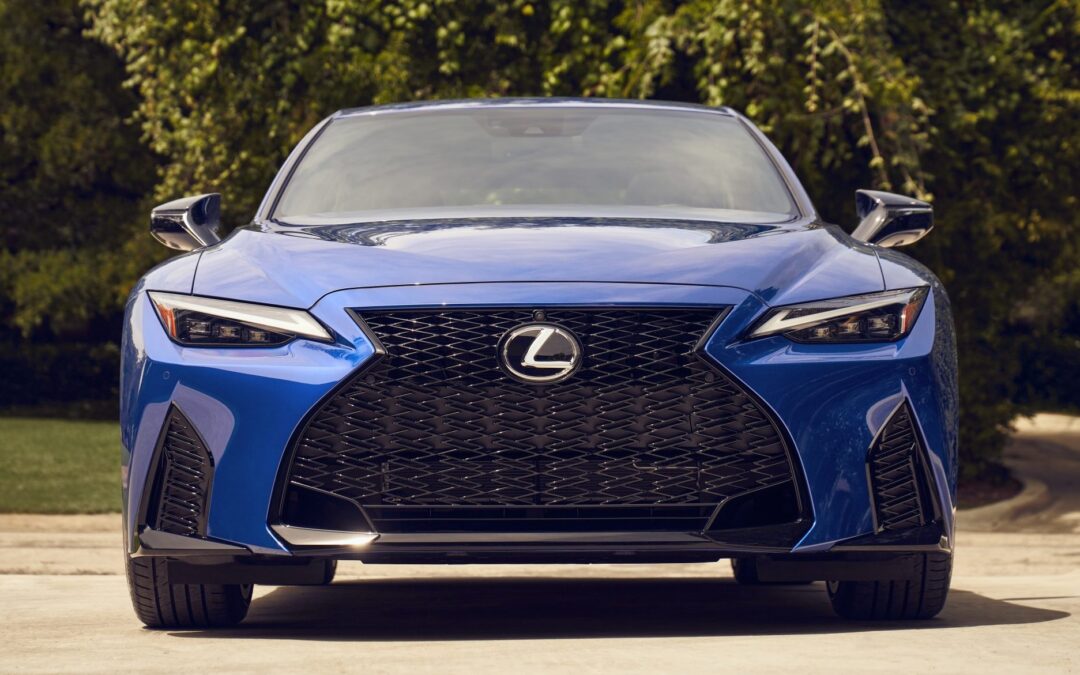
The Lexus IS 350 F Sport in bold blue.

With its 2021 mild redesign, Lexus appears to have positioned the compact-midsize IS sedan as a style-conscious choice. (Lexus)


BY MARK MAYNARD

Don’t expect to drive anywhere incognito in an Ultrasonic Blue Mica 2.0  2021 Lexus IS 350 F Sport. The mild refresh of this sport sedan has gone all-in to turn heads with coupe-charisma styling.

Maybe it was the searing blue paint or the slashing, swept-back body lines, but young men along street corners turned to give it an approving jaw-jut nod.

It’s a tough design job these days to lure drivers from their SUVs. Many of those high-riding vehicles have credible performance attributes concealed in a glorified family vehicle.

2021 Lexus IS 350 F Sport driver area

The driver area is hands-on, compact but orderly.

With its 2021 redesign, Lexus has positioned the compact-midsize IS sedan as a style-conscious choice. It’s a born sport sedan. If the Lexus loyalist wants a more traditional sedan, there is the midsize ES and it is one of the top-selling sedans in the luxury segment and the brand’s top-selling four-door.

The midsize luxury segment is dominated by the Audi A4, BMW 3-series, and Mercedes-Benz C-Class, with which the IS is most commonly compared. Those slightly larger competitors have taken the more formal styling direction for family function. And while those competitors also have fearsome performance models they also have fearsome pricing to create the badass family car.

2021 Lexus IS 350 F Sport infotainment screen.

An expansive new 10.3-inch touch screen is part of the Mark Levinson navigation package.

The IS is more of an alternate ego sedan — right-sized and contemporary.

For 2021, the lineup doesn’t rise to the peak performance levels of some competitors, but neither does its pricing. However, a more wicked variant is set to debut a new line of performance models this fall. The upcoming IS 500 F Performance will be gratuitously powered by a naturally aspirated 472-horsepower, 5.0-liter V-8 engine. With peak torque of 395 foot-pounds at 4,800 rpm, Lexus claims 0-60 acceleration in 4.5 seconds.

Lexus IS pricing

A side view of the Lexus IS 350 F Sport

Seemingly insignificant design elements for the 2021 Lexus IS 350 F Sport reinforce long-term ownership.

The current IS has three model choices, in rear- or all-wheel drive, with three power choices.

The entry rear-wheel-drive IS 300 has a 241-hp, 2.0-liter, turbocharged and intercooled four-cylinder engine and eight-speed automatic transmission. Its pricing starts at $41,525, including the $1,025 freight charge from Kyushu, Japan. The 2.0-liter engine was updated for 2021 with an adaptive transmission control that helps determine the most appropriate gear for each driving situation based on driver input.

The IS 300 AWD, powered by a 260-hp, 3.5-liter V-6 and six-speed automatic transmission, starts at $42,500.

The IS 350 F Sport is powered by a 311-hp, 3.5-liter V-6 and eight-speed automatic. Pricing starts at $43,975 for rear-drive or $45,974 for AWD.

Today’s tester, the 2021 Lexus IS 350 F Sport, was $55,220. Among its options were the Ultrasonic Blue Mica 2.0 paint ($595) and Dynamic Handling Package ($4,200).

Other options added up quickly, such as the power moonroof ($1,100), triple beam LED headlights with automatic dimming ($1,250) and navigation system with Mark Levinson audio ($2,750). And intuitive parking assist with auto braking, rear pedestrian detection, and panoramic view monitor added $1,400.

How does the F Sport drive?

2021 Lexus IS 350 F Sport engine

The 311-hp, 3.5-liter V-6.

The force of the V-6 just feels right in this car. The engine is not rabid in its bite, but it digs in with satisfying force. With 280 foot-pounds of peak torque at 4,800 rpm, there is quick uptake of launch power. Lexus cites acceleration to 60 mph in 5.6 seconds, which is competitive with the standard-model competitors.

The eight-speed automatic with paddle shifters provides timely shift points, but punch up Sport-plus and let the V-6 do the talking. There is a satisfying sense of tightness between steering input, braking, and absolute roll-on of throttle.

Close quarters 

2021 Lexus IS 350 F Sport red interior

2021 Lexus IS 350 F Sport red interior is only available with the F Sport dynamic handling package, $4,200.

The IS cabin has the close-quarters feel of a performance coupe. The front seat area is accommodating for the tall driver with 38.2 inches of headroom and a very long 44.8 inches of legroom.

It’s a hands-on experience for accessing switches and other controls — meaning that the area is compact and orderly. But there is not a lot of storage space for small items. The shift console, for example, is packed with the shifter, a touchpad to access the upper touch screen and a controller dial for performance modes, and a pair of cup holders. Oddly, there is no wireless phone charging.

Sightlines are open across the fenders at the front windshield corners and side mirrors, which are offset from the body. Over-the-shoulder views are more complicated with the fastback wrap of the rear glass, but it’s workable for lane changes.

The rearview camera, with its 360-degree view, is an asset in tight parking situations. And the turning circle of 34.2 feet is unbelievably tight for any four-door car.

With a trim curb weight of 3,748 pounds, the fuel economy ratings are competitive at 20/28/23 mpg city, highway and combined, using the required premium fuel. In a week of driving, my average fuel economy ranged from 23.4 to 25.7 mpg, with more highway driving. Its large, 17.4-gallon fuel tank helps extend the cruising range.

Performance of the 2021 Lexus IS 350 F Sport

2021 Lexus IS 350 F Sport tire and wheel.

The rear-drive F Sport has 19-inch staggered-width alloy wheels with summer tires; AWD models get all-season rubber.

As a sport sedan, the cabin is well soundproofed but the staggered-size,19-inch Bridgestone Potenza RE050A tires (235/40 front, 265/35 rear) are ultra-high performance. At highway speeds, the tires will spin up noise and even wander a bit on rain-grooved concrete interstate highways. The super-sticky treadwear rating (UTQG) of 140 is among the lowest I’ve tested on any performance car. Do not expect high mileage — and as Bridgestone advises, these tires are not intended to be driven in near-freezing temperatures, through snow or on ice.

The electronic adaptive variable suspension can get very busy on some stretches of concrete highway that feels like bobbling. But on blacktop and most other non-concrete roads, the F-Sport-tuned ride is a honed carving knife.

Safety

The stars shine brightly for the IS in NHTSA’s crash-test ratings. It earned the government agency’s top five-star overall rating with four stars for driver and front passenger; five stars in the side barrier and pole test for front and rear seats; and five stars for low rollover risk.

A-D-A-S

The Lexus Safety System+ 2.5 allows Level 2 semi-autonomous driving while keeping both hands on the wheel. The system integrates enhanced all-speed dynamic radar cruise control and lane change assist, front cross-traffic alert, and pedestrian alert.

The taillights in the 2021 IS 350 F Sport

The F Sport styling treatment includes unique front and rear bumpers, grille surround, rear spoiler and exhaust tips.

The driver-assist system capably keeps the car centered in the lane, but like most systems, it will randomly shut off. Sometimes the system gets confused by light-colored road-surface conditions and highway lines that are broken up and uneven. The safety system will be beneficial for those drivers who have daily commutes in heavy traffic. It is an extra six eyes on the road to watch for less-attentive drivers.

The safety system includes a pre-collision system with pedestrian detection, lane tracing assist, lane departure alert with steering assist, road sign assist and all-speed dynamic radar cruise control.

Back seat

The back seats in the 2021 Lexus IS 350 F Sport

As a five-seater, the back-seat legroom is tight at 32.2 inches, with a tall exhaust-AWD tunnel that compromises center-position footroom.

The smaller size of the IS is felt in the back seat. The area is quite compact with just 32.2 inches of a knees-up and butt-down legroom, divided by a tall exhaust-AWD tunnel.

At 10.8 cubic feet, trunk space is a couple of cubic feet smaller than the competition. But space is still very usable for travel getaways, and the back seat folds 60/40.

Why buy the Lexus IS 350 F Sport?

For those not needing to wedge a family into the back seats, the IS 350 F Sport is a flag of don’t-tread-on-me independent thinking.

And here is my review of the Lexus LS 500 F Sport

SPECIFICATIONS

2021 Lexus IS 350 F Sport RWD

Body style: compact, 5-seat, 4-door sedan with rear- or AWD

Engine: 311 hp, direct-injected 24-valve 3.5-liter V-6; 280 lb.-ft. torque at 4,800 rpm

Transmission: 8-speed automatic with paddle shifters

0-60 mph: 5.6 seconds

Fuel economy: 20/28/23 mpg city/hwy/combined; premium fuel required

SPECIFICATIONS

Fuel tank: 17.4 gal.

Trunk space: 10.8 cu. ft.

Front head/leg room: 38.2/44.8 in.

Rear head/leg room: 36.9/32.2 in.

Length/wheelbase: 185.4/110.2 in.

Curb weight: 3,748 lbs.

Turning circle: 34.2 ft.

Safety features include: 10 air bags, traction and stability controls, brake-force distribution, blind-spot monitor with rear cross-traffic alert

Lexus Safety System+ 2.5 includes pre-collision system with pedestrian detection, lane tracing assist, lane departure alert with steering assist, road sign assist, all-speed dynamic radar cruise control  and intelligent high beams

PRICING
Base price: $43,925, including $1,025 freight charge; price as tested $55,220

Options on test vehicle: Power moonroof $1,100; triple beam LED headlight with automatic dimming $1,250; navigation with Mark Levinson audio $2,750; intuitive parking assist with auto braking, rear pedestrian detection and panoramic view monitor $1,400; Ultrasonic Blue Mica 2.0 paint $595; Dynamic Handling Package, $4,200

Where assembled: Kyushu, Japan

Warranty: 4-years/50,000-miles basic with roadside assistance with free 1st and 2nd scheduled maintenance services and lodging for emergency breakdowns 100 miles from home; and 6-years/70,000-miles powertrain

The Battery-Electric Ford F-150 Lightning pickup

The Battery-Electric Ford F-150 Lightning pickup

The big reveal of the all-electric Ford F-150 Lightning was a massive moment for the automaker, said Ford President Jim Farley.

Ford world headquarters display

The F-150 Lightning is expected to go on sale in spring, 2022. (All photos courtesy of Ford Motor)


BY MARK MAYNARD

An electric pickup is one thing. An electric pickup that is also an emergency power generator for the home adds a whole new level of consumer usability in this complicated era of climate change.

Ford Motor pulled the camouflage from its striking, all-electric F-150 Lightning last night in a big reveal at its world headquarters in Dearborn, Mich. It was a massive moment for Ford, said Ford President and CEO Jim Farley.

The F-150 Lightning is expected to go on sale in spring, 2022. It will be sold in four series and two battery options.

The exterior styling looks traditional F-150, but much has been modified under the military-grade aluminum skin. The truck introduces an independent rear suspension, standard four-wheel drive, and dual in-board motors pushing 563 horsepower.

Two levels of lithium-ion battery packs will be offered. Ford has targeted a driving range of 230 miles with the standard-range battery and 300 miles with the extended-range battery.

A payload of 2,000 pounds is expected for base models with a max tow rating of 10,000 pounds. Official specifications will be released closer to the on-sale date.

“It’s quicker than a Raptor, with standard 4×4 and independent rear suspension,” said CEO Farley.

Ford F-150 Lightning pricing

3 F-150 Lightning pickups

2022 Ford F-150 Lightning Platinum, Lariat, and XLT. Available spring 2022.

The electric pickup will be sold in four series in crew-cab body styles with a 5.5-foot-long bed. The commercial-grade model starts at $39,974 before any federal or state tax credits. The mid-range XLT model starts at $52,974. Pricing was not announced for the top-line Platinum, but a spokesman said its MSRP could be around $90,000 with the extended range battery.

Pricing does not include the freight charge from the Rouge Electric Vehicle Center in Dearborn, Mich.

The 2022 F-150 Lightning can be reserved here with a $100 deposit.

Powertrain

2022 Ford F-150 Lightning schematic

The powertrain layout shows the two in-board motors and lithium-ion battery storage.

The powertrain of the F-150 Lightning targets 563-hp and 775 foot-pounds of near-instantaneous torque. That’s more than any F-150 ever, Ford says. Acceleration to 60 mph is in the mid-4-second range with the extended-range battery.

Power at home

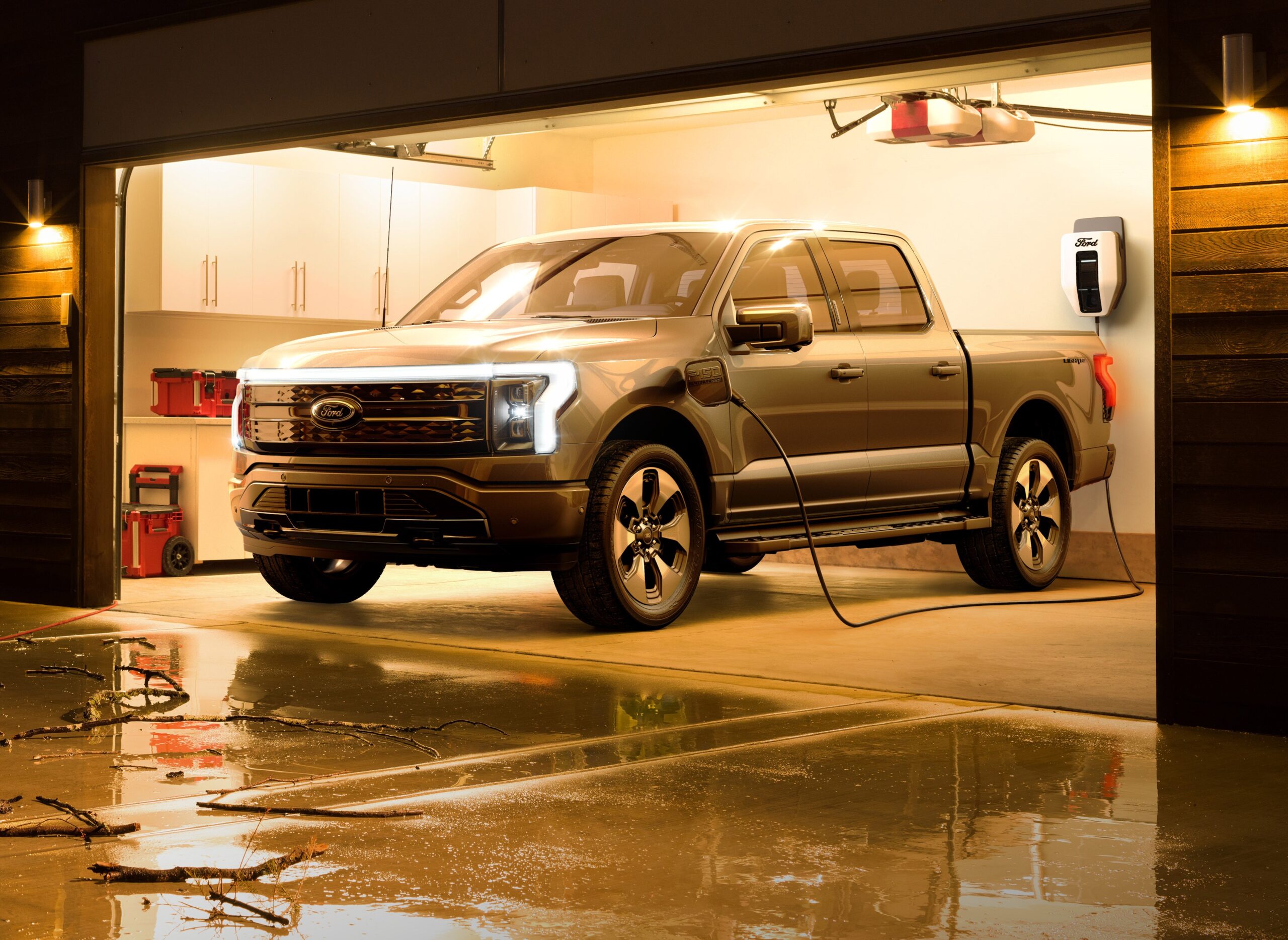
2022 Ford F-150 Lightning powering a home in an emergency

The Intelligent Backup Power system can power a home for three days, Ford says.

The debut of the Ford Intelligent Backup Power turns the truck into a substantial source of power for a home. The system can tap into 9.6 kilowatts of power — 9600 watts. That is enough backup power to maintain household lighting during an outage. It also will be enough to power other utilities, such as home appliances and security systems. (According to online reports, an average-size home in the U.S. uses about 900 kWh per month.)

The backup power system requires the optional 80-amp Ford Charge Station Pro and home management system (for which Ford can help with installation). In an emergency, the F-150 Lightning will automatically activate to power the house. Once power is restored, the truck automatically reverts to charging its battery.

Based on the average use of 30kWh per day, the entire system with an extended-range battery can provide full home power for up to three days. With careful use, the power can last as long as 10 days, Ford says.

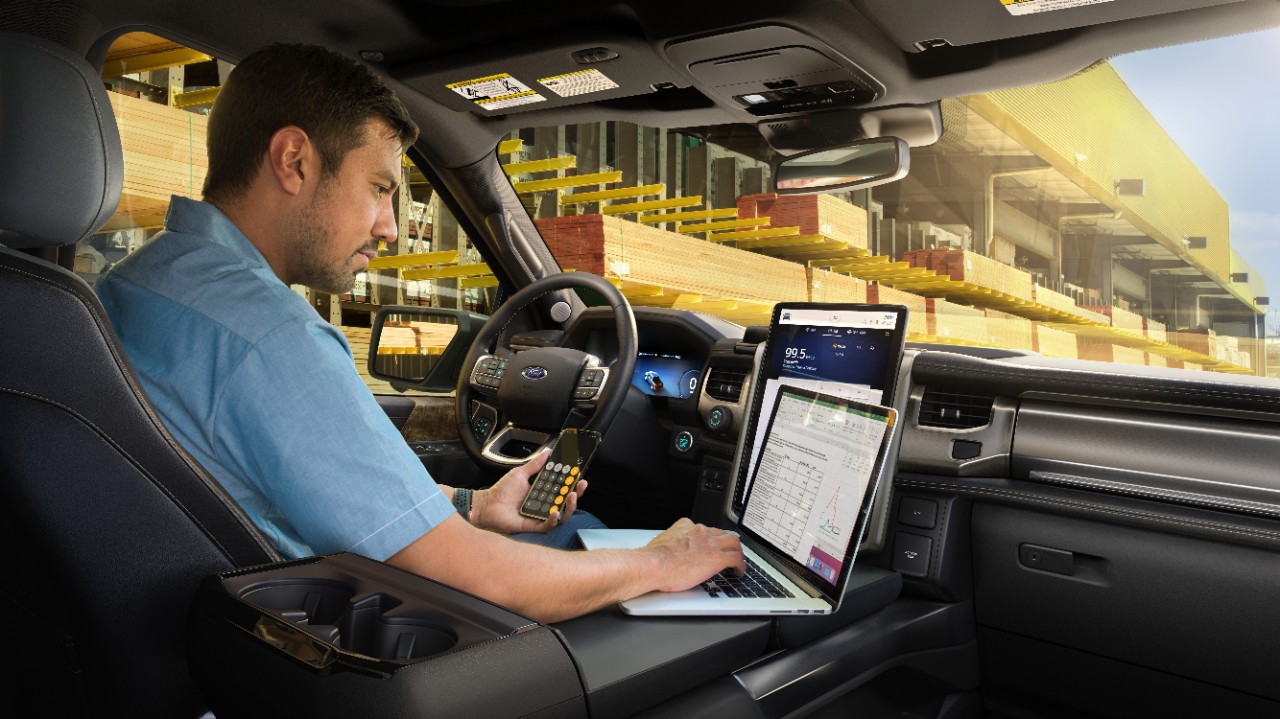
Ford F-150 Lightning optional work surface.

The optional fold-out Interior Work Surface.

For a later introduction, the Ford Intelligent Power system can use the truck to power homes during high-cost, peak-energy hours while taking advantage of low-cost overnight rates to charge the vehicle in time for the morning drive. The owner saves money on electricity while also taking pressure off the grid in peak usage times, Ford says.

Ford partnered with Sunrun, a leading solar company, to facilitate the installation of the 80-amp Ford Charge Station Pro and home integration system. Customers will also have the opportunity to install solar energy on their homes, tapping into clean, affordable energy and be able to charge their F-150 Lightning.

Battery power

Ford F-150 Lightning charge door on front left fender.

The secure charge door.

F-150 Lightning offers two levels of battery power: a standard-range battery targets 230 miles of EPA-estimated range and the extended-range battery targets 300 miles of EPA-estimated range.

Standard with the truck is an 80-amp charge station to maintain an extended-range truck at home. This system has a dual onboard charging system that can add an average range of 30 miles per charging hour. Fully charging an extended-range truck from 15 percent to 100 percent would take about eight hours, Ford says.

On the road, users have access to the ChargePoint public charging network, considered North America’s largest system. Using FordPass, drivers will have access to more than 63,000 charging plugs and growing. On a 150-kW DC fast charger, the extended-range battery is targeted to get up to 54 miles of range in 10 minutes and charge from 15 percent to 80 percent in about 41 minutes, Ford says.

The FordPass Power My Trip function identifies charging routes in advance of an extended drive. The truck’s, Intelligent Range mode calculates range while factoring in weather, traffic, payload, and towing weights, Ford says. Cloud-connected navigation on SYNC 4 also identifies public charging locations.

Truck as generator

Ford F-150 Lighting tailgate work suface.

The optional Tailgate Work Surface.

The enhanced Pro Power Onboard provides built-in electrical outlets to power a variety of tools, electronics, and appliances. Base trims have 2.4 kilowatts of power with the option for more. Lariat and Platinum models have 9.6 kilowatts of power — a combination of up to 2.4 kilowatts available through the frunk and up to 7.2 kilowatts through outlets in the cab and bed.

Customers will receive a FordPass notification if their truck’s battery falls below a third of its total range. And the truck can be programmed to stop using Pro Power Onboard if the battery level approaches the distance to the nearest charging station.

Front trunk

Ford F-150 Lightning frunk.

The front trunk, or frunk, is power opened and closed.

The newfound space under the hood allowed for a  lockable “mega power frunk” that is power opened and closed. The storage capacity has about 14 cubic feet of volume and a 400-pound payload. Ford says that’s enough space for two carry-on travel bags and one checked bag, or two sets of golf clubs.

The water-resistant space has four electrical outlets and two USB chargers. Drain holes in the floor allow the frunk to be used as a cooler. With 2.4 kilowatts of power, there’s enough electrical capacity to plug in power tools, TVs, laptops and speakers, or even a crockpot and other appliances.

Testing

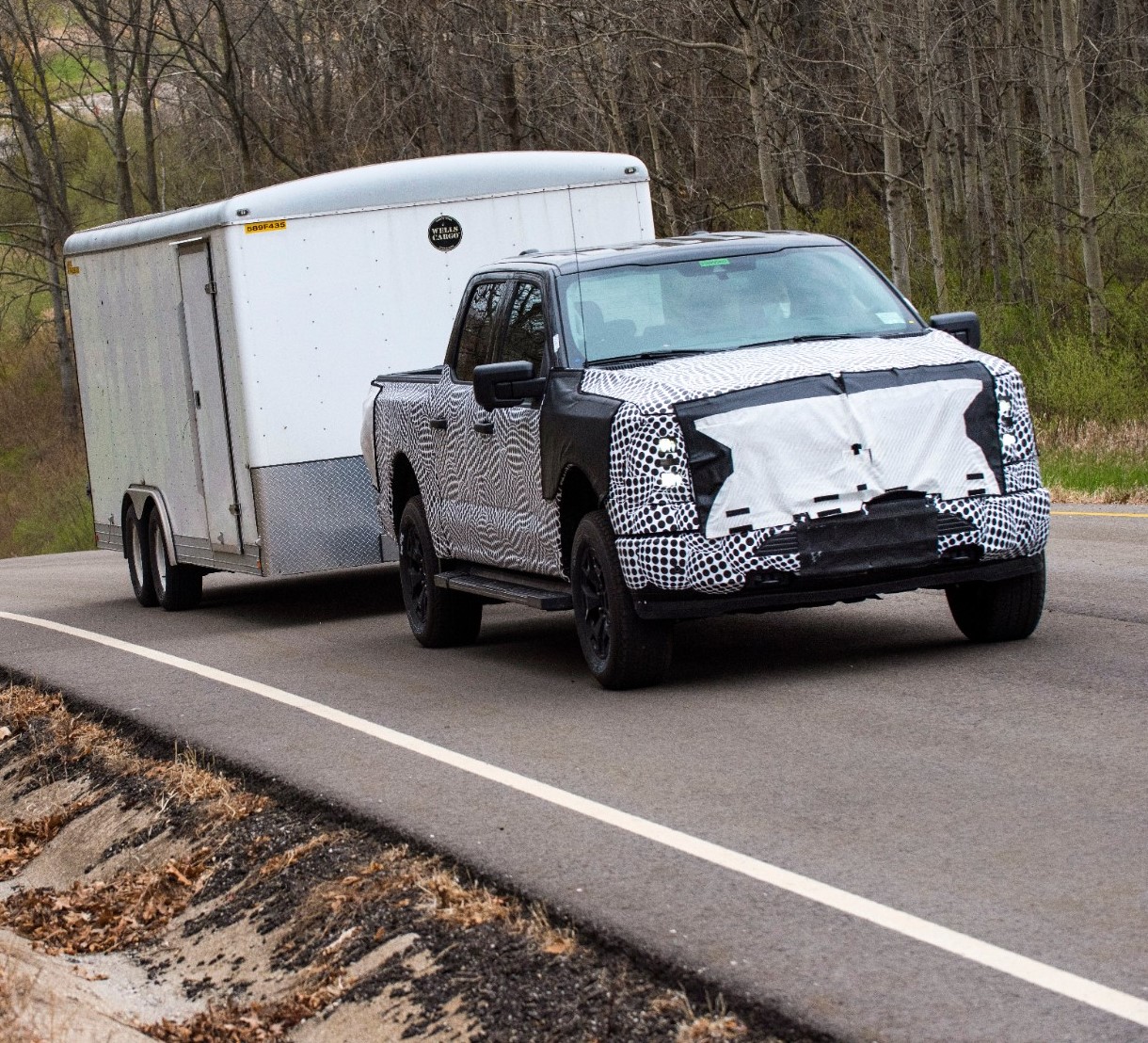
A Ford F-150 Lighting in camouflage while testing tow capacity.

Endurance testing included running the truck through Iowa Hill, Calif.

The F-150 Lightning was put through the same endurance testing as all F-Series trucks. The military-grade aluminum-alloy body and upgraded frame were engineered to support the advanced battery. The first F-Series independent rear suspension and low center of gravity help improve noise isolation from the road and provide a more stable ride.

No compromises on space or utility were made, Ford says. The cab and bed have the same dimensions as the gas models.

The truck’s four-wheel-drive system features four selectable drive modes: Normal, Sport, Off-Road, and Tow-Haul. Metal underbody skid plates protect the battery and inboard motors. The battery itself is secured inside a waterproof casing that is surrounded by crash-absorption protection. It has been tested at temperatures as extreme as minus-40 degrees.

To maintain steady thermal conditions, the F-150 Lightning was engineered with an advanced liquid cooling system and powertrain layout to manage heat distribution.

Endurance testing included running the truck through Iowa Hill, Calif. In the testing, loaded trailers were towed for long durations up and down the steep Iowa Hill Road, where there are no safety guardrails, according to Wikipedia

Ford F-150 Lightning aerodynamics

Ford F-150 Lightning payload capacity and tow ratings.

Base models are expected to have a max tow rating of 10,000 pounds.

F-150 Lightning is the most aerodynamic F-150 ever, Ford says. Styling enhancements include newly shaped running boards, a sculpted hood to reduce drag, and grilles with a smoother, textured surface.

2022 Ford F-150 Lightning specifications

Body style: full-size, 5-seat crew-cab pickup with a 5.5-foot-long bed

Electric motors: Two inboard three-phase fixed magnet AC

Battery type: Liquid-cooled lithium-ion pouch with battery management

Targeted horsepower: 426 hp standard range; 563-hp extended range

Targeted peak torque: 775 foot-pounds for both battery packs

Onboard charger power, (input/output): 11.3 kW/10.5 kW standard range; 19.2 kW/17.6 kW extended range

Targeted EPA driving range: 230 miles standard battery; 300 miles extended range battery

TARGETED CHARGING TIMES:
Level 3 fast charge: 15%-80% in 44 minutes standard range; 41 minutes extended range

Level 2 home charging: NA

80-amp Ford Charge Station Pro: 15%-100% in 10 hours standard range; 8 hours extended range

32-amp/240-watt onboard charger: 15%-100% in 14 hours standard range; 19 hours extended range

BY THE NUMBERS

Targeted maximum payload: 2,000 lbs. standard battery; 1,800 lbs. extended-range battery

Targeted maximum towing: 7,700 lbs. with the standard battery; 10,000 lbs. with the extended-range battery

Length/wheelbase: 232.7/145.5 inches

Cab height/width: 78.9/*96 inches. *w/mirrors folded 83.6 in.

Ground clearance: 8.9 inches

Open tailgate to the ground: 37.2 inches

Front trunk liftover height: 35 inches

Curb weight: NA

Turning circle: NA

WARRANTIES

Bumper to bumper: 3-years/36,000-miles

Roadside assistance: 5-years/60,000-miles;

Electric vehicle components: 8-years or 100,000-miles, including the battery that is expected to retain a minimum of 70% of its original capacity over that period