Select Page

Subaru BRZ tS Review

Subaru BRZ tS Review

The 2024 Subaru BRZ tS — tuned by STI — is the new pinnacle trim level, sold only with a six-speed manual transmission

A front three quarter low view of the Subaru BTZ ts

Subaru applied a couple of significant STI chassis upgrades to create the 2024 BRZ tS — tuned by STI — for a starting and well-equipped price of $36,465. (Photography by Subaru or as credited)

Table of Contents

BRZ Overview
tS Roots
Pricing
Standard Features
tS Strong
BRZ Styling
Interior Function
BRZ Powertrain
Why Buy the Subaru BRZ tS?
BRZ Specifications

BY MARK MAYNARD

Iknew before upshifting to third gear that the 2024 Subaru BRZ tS is a special car. First, it is the steering, how it takes just a jink to change course, and how controlled the wheel rolls through the hands. Close-ratio gear engagement slots with bolt-action. Then, the quickness of the throttle blip and the eager punch of the boxer four-cylinder has a 7,000-rpm redline. And then there is that all-knowing enthusiast’s smile when exercising a rascal.

This latest chapter in the legacy of the Subaru BRZ is the tS — tuned by STI. The pinnacle trim level is sold only with a six-speed manual transmission, and the same rear-wheel drive and a 228-horsepower 2.4-liter engine as the other two BRZ trim levels, Limited and Premium.

Hallmarks of the BRZ tS include an STI-tuned suspension and Brembo braking. And for the first time, EyeSight Driver Assist Technology is now standard with a manual transmission.

A view of the driver area showing the shifter and manual hand brake.

The 2024 BRZ tS driver area is hands-on and heads-up.

Subaru BRZ Overview

Since the first BRZ launched in 2012 as a 2013 model, it garnered rave reviews, but most critics wanted more power. The first-generation BRZ was basically a badge-engineered model of the Scion FR-S. And when the Scion brand died in 2016, Toyota adopted it as the 86, or “eight-six” to purists; now designated GR86. (In 2008, Toyota bought 16.5 percent of Fuji Heavy Industries, which includes the Subaru automotive brand.)

With its 200-hp, 2.0-liter engine (205-hp for automatic-equipped models), the first BRZ was a tepid performer that looked faster than it was.

That all changed with the redesigned and re-engineered second-generation 2022 BRZ. Subaru introduced the 2.4-liter engine — the gear-changer that transformed the BRZ from a “sporty” car to a sports car.

Moving the BRZ to the Subaru Global Platform gave the car a 50-percent boost in twisting stiffness. Stiffer is better for more responsive turn-in and throttle steering control.

With the redesign, the new body was made lighter by an aluminum roof, front fenders, and hood. With the reduced body weight, the center of gravity is now lower than the first-gen model, Subaru says — putting the BRZ on par with hyper-cars.

A view of the front sport seats with blue trim

Front sport seats hold the driver without intruding on entry or exit.

BRZ tS Roots

In 2013, a Subaru STI enhanced BRZ tS — Subaru Tecnica International — debuted in Japan. According to Wikipedia, the Japanese market BRZ tS also had an optional GT package of Recaro seats, black BBS wheels, and an adjustable carbon fiber rear wing. In 2015, Subaru released another 300 BRZ tS models.

In 2018, the BRZ tS came to the U.S. with a limited run of 500 cars. This run had a selection of STI-tuned suspension upgrades but with the same 205-hp, 2.0-liter four-cylinder engine.

A Subaru BRZ has always been irreverent fun to drive, but today, the 228-hp 2024 BRZ tS is the best version yet, with power, balance, and grit. But could there be more factory modifications to come? Could there be a more advanced BRZ? Subaru won’t say, but there are many more Subie STI performance parts available for most Subaru models in these online wishbooks: Subaru.com and STI.jp.

A view through the trunk into the BRZ cabin

6.3 cubic feet of space, expandable by folding the back seat. (Mark Maynard)

2024 Subaru BRZ Pricing

2024 Subaru BRZ models are sold in three trim levels: Premium ($31,315), Limited ($33,815), and tS ($36,465). The BRZ tS builds on the features of the Limited model. Starting prices are for manual-equipped cars and include the $1,120 freight charge from Gunma, Japan.

The red engine start button with the STI logo

Gentle driver, start the engine.

There are seven no-cost paint colors. The Premium and Limited models have interiors of black and red Ultrasuede and leather. (Premium and Limited models have the choice of a six-speed automatic transmission, $950). The tS interior is black with blue Ultrasuede and leather.

No packages are offered for any BRZ model, but there is a range of accessories. A tempting accessory is the STI aluminum and leather shift knob, but it is pricey at $215.

BRZ Features

  • Torsen limited-slip differential.
  • Keyless access with push-button start.
  • LED headlights (low and high beam) with automatic height adjustment.
  • Vehicle stability control with Track Mode.
  • Incline start assist.
  • Center console storage box with dual USB-A input and charge ports and auxiliary input jack.

Upgrades to the BRZ tS include:

  • Heated power side mirrors.
  • Upgraded audio system with a two-channel amplifier and two additional speakers.
  • Blind-spot detection with lane keep assist and rear cross-traffic alert.
  • Steering responsive headlights.
  • Starlink Safety and Security.
The metal and rubber clutch, brake, and accelerator pedals

Get a grip.

A more complete list of BRZ equipment is highlighted in the specs box below.

Get current Subaru BRZ pricing here.

And look for special Subaru offers here.

According to Automotive News, there are at least two more years of life in this generation of BRZ. It is not due for a freshening until 2026, along with the Toyota GR86.

tS Strong

The 2024 Subaru BRZ tS builds on everything enthusiasts loved about this generation BRZ but with a little more edge.

Hitachi dampers, STI-tuned front and rear. These specialized shock absorbers help wring out the BRZ’s light weight, low center of gravity, and 53/47 front/rear weight balance.

18-inch wheels, Michelin Pilot Sport 4 tires, and gold Brembo brake calipers.

18-inch wheels, Michelin Pilot Sport 4 tires, and gold Brembo brake calipers.

Brembo brakes. This high-performance braking system, with electric vacuum pump assist, improves stopping power, fade resistance, and pedal feel. The Brembos upsize the stock BRZ brake system with 12.8-inch vented rotors front, and 12.4-inch vented rotors rear. Stock BRZ brakes have 11.6-inch vented front discs with dual-piston floating calipers. Stock rear rotors are 11.4-inch ventilated disc, single-piston floating calipers.

The Brembo system includes:

  • Gold-painted four-piston front calipers.
  • Gold-painted two-piston rear calipers.
  • Larger pads and rotors.

18-inch wheel and tire package. The wheels in a dark gray finish are an inch taller than the base BRZ and are mounted with 215/40 R18 Michelin Pilot Sport 4 tires, which have a lower profile than the base BRZ, 215/45. Michelin categorizes the Pilot Sport 4 as a summer performance tire, but I felt confident pushing the BRZ on wet roads. The corner-holding Michelins have a soft treadwear rating of 320 and a tread warranty of 30,000 miles, max. Replacement tires are not ridiculously expensive at about $265 each.

EyeSight Driver Assist Technology. It is now standard equipment on any Subaru model with manual transmission for the first time. The advanced safety system includes adaptive cruise control, pre-collision braking, lane departure and sway warning, and lead vehicle start alert. Standard BRZ safety features include:

  • Seven air bags.
  • Blind-spot detection with lane change assist.
  • Rear cross-traffic alert.
  • High beam assist.
  • Hill-start assist.

Subaru BRZ Styling

The tidy coupe design cuts through the air with a low and wide stance. The front mug is set off by large functional air intakes and a low grille capped by prominent fender arches that allow just enough room for suspension points.

Other exterior cues that identify the BRZ tS:

  • tS badging in the front grille and on the rear decklid;
  • Side mirrors (power and foldable) and roof-mounted shark fin antenna in a Crystal Black Silica finish.
  • Gold Brembo brake calipers.

A tS badge on the rear spoiler of a blue car

BRZ Interior Function

Settle into the cockpit, and you will notice functional roominess for a subcompact coupe. Headroom of 37 inches will be limiting to some, but a 6-foot-6 friend had no problem getting comfortable behind the wheel. Sightlines are surprisingly open for such a low and swoopy body style.

Inside, the BRZ tS cabin is wrapped in black upholstery with tS-only contrasting blue stitching on the front seat bolsters, leather-wrapped steering wheel, shifter boot, and parking brake boot. There is no wireless phone charging, but the center console box has dual USB-A input, charge ports, and an auxiliary input jack.

The two back seats of the Subaru BRZ

The 2+2 space is tight but helpful when needed. (Mark Maynard)

Front sport seats have a blue leather stripe down the upper center of the seatback and on the seat cushion. The leather-wrapped steering wheel has redundant audio, cruise control, and Bluetooth controls. Subaru applies suede-like Brin Naub along the gauge hood (instrument panel visor) and door trim. The red starter button is emblazoned with the STI logo, and the customizable 7-inch digital instrument cluster has red tS elements.

Back seat space is a mere suggestion. Technically, there are 29.9 inches of legroom, but that becomes zero-inches with any occupant in the front seats. But fold the seatback, and there is about 5 feet in length for sports gear.

2024 BRZ tS Powertrain

The 2024 BRZ tS is powered by a 228-horsepower 2.4-liter (naturally aspirated) Subaru Boxer four-cylinder engine. The FA24 engine has direct and port injection and horizontally opposed “boxer” cylinders. Engine torque of 184 foot-pounds peaks at 3,700 rpm, easily manipulated with the accelerator.

The close-ratio six-speed manual transmission is light, which eases leg and foot stress when commuting — not that most buyers of this car would rack up distance commutes on the Michelin Pilot Sport 4 tires. The transmission includes a Track Mode for reduced traction control, and a TCS Off switch.

A low curb weight of 2,850 pounds makes the most of 228 horsepower. Compared to the first-gen model, the 2024 BRZ with manual transmission is just 88 pounds heavier.

At speed on the highway, the BRZ is a maelstrom of sounds. There is a rush of road noise and wind noise. But this is a sports car, and the rage of sounds can be forgiven. Tach it up, and revs in the higher rpms start speaking in enthusiast’s tongues.

The BRZ tS has fuel economy ratings of 20 mpg city, 27 highway, and 22 mpg combined, using the required premium fuel. I worked up to at least 29 mpg on the highway.

An open hood view of the 228 horsepower 2.4-liter FA24 “boxer” four-cylinder engine.

Subaru’s 228-horsepower 2.4-liter FA24 “boxer” four-cylinder engine.

Why Buy the Subaru BRZ tS?

You could spend twice as much, or even 3 times as much, for a sports car and not enjoy it more than owning the BRZ tS. And maintenance costs will be far less than any European competitor.

Unlike some high-strung performance coupes, the BRZ is an everyday driver that does not extract a pound of muscle pain upon entry or exit. It is an engineering asset that the car’s front chin is not prone to scraping at every dip or driveway. And the turning circle is a tidy 35.4 feet.

The BRZ has honest integrity and simplicity that are not convoluted with electronic interventions. It is built for fun, and the BRZ lets it rip with precision.

a rear view of the Subaru BRZ

Large fenders and a wide track flow into dual exhausts for a low and wide stance.

Subaru BRZ tS Specifications

Body style: subcompact 2+2 coupe; aluminum hood, front fenders, and roof; rear-wheel drive

Engine: 228-hp FA24 2.4-liter 4-cylinder with direct and port injection and horizontally opposed “boxer” cylinders; 184 lb.-ft. torque at 3,700 rpm

Transmission: 6-speed manual with Torsen limited-slip differential; vehicle stability control with Track Mode and traction control off switch

Fuel economy: 20/27/22 mpg city/hwy/combined manual transmission; premium fuel required

BY THE NUMBERS

Fuel tank: 13.2 gallons

Trunk space: 6.3 cubic feet

Front head/leg room: 37/41.5 inches

Rear head/leg room: 33.5/29.9 inches

Length/wheelbase: 167.9/101.4 inches

Width/height: 69.9/51.6 inches

Minimum road clearance: 5.1 inches

Curb weight: 2,850 pounds

Turning circle: 35.4 feet

FEATURES

Standard equipment includes: Keyless entry-locking with push-button start, leather and Ultrasuede-trimmed upholstery with blue contrast stitching, STI-design 7-inch LCD configurable digital gauge cluster with Normal and Track modes and red metallic accents, Starlink 8-inch multimedia plus digital screen, 8-speaker audio system, power (heated) side mirrors, leather-wrapped 3-spoke steering wheel (with integrated cruise, Bluetooth, display, and audio controls), manual tilt-telescoping steering column, welcome lighting, dual-zone automatic climate control, glove box with 12-volt power outlet, sun visors with covered vanity mirrors, bottle holder in door panels, LED steering responsive headlights, trunk spoiler, Crystal Black Silica-finished side mirrors

Safety features include: 7 air bags (front, seat-mounted front-seat side pelvis/torso, side curtain, driver’s knee bag), blind-spot detection with lane change assist and rear cross-traffic alert, high beam assist, hill-start assist

EyeSight Driver Assist Technology: adaptive cruise control, pre-collision braking system, lane departure, sway warning, and lead vehicle start alert

CHASSIS COMPONENTS

Brakes: 4-wheel discs with electric vacuum pump assist; 12.9-inch vented discs with 4-piston front Brembo calipers; rear, 12.4-inch vented discs with Brembo 2-piston calipers; brake assist

Steering: electric power assist quick-ratio rack and pinion

Tires-wheels: 18-inch 215/40 Michelin Pilot Sport 4 summer performance (w/tire-repair kit); dark gray metallic finish wheels 18 inch by 7.5-inch wide

Suspension: 4-wheel independent. Front, Hitachi MacPherson-type dampers with coil springs, lower L-arms, stabilizer bar, strut tower brace, and anti-dive geometry; rear, Hitachi double-wishbone dampers with coil springs, stabilizer bar, and anti-lift geometry

PRICING

Base price: $36,465, including $1,120 freight charge; price as tested $36,465

Options on test vehicle: none

Where assembled: Gunma, Japan

Warranties: 3-years/36,000-miles bumper-to-bumper with roadside assistance; 5-years/60,000-miles powertrain.

Lexus ES 300h Ultra Luxury Review

Lexus ES 300h Ultra Luxury Review

The 2024 Lexus ES 300h Ultra Luxury is luxurious, but its true beauty is outstanding fuel economy: 43 mpg city

A Moonbeam Beige 2024 Lexus ES 300h is parked in front of an old barn

The 2024 Lexus ES 300h Ultra Luxury is the most expensive of the five hybrid trim levels, starting at $53,480. (Photography by Lexus or as credited)

Table of Contents

Sedan vs. SUV
Lexus ES In the U.S.
2024 Lexus ES Pricing
Powertrain and Performance
Ride and Handling
Driver Assistance Finesse
Interior Function
Why Buy the 2024 Lexus ES 300h?
Specifications

BY MARK MAYNARD

Iconsider myself a card-carrying, sport-tuned car enthusiast, but a test week in an Ultra Luxury Lexus ES hybrid reminds me of a kinder and gentler driving experience.

As America has fled to sport-utility vehicles, many motorists have forgotten the simple pleasures of a well-done, four-door sedan. Automotive marketers believe their buyers are young and athletic trendsetters who want everything all at once. They disdain wagons and prefer SUVs to fit their lifestyle, even if they only use them as a station wagon. Buyers are teased with speed-line images of sporty-ish SUVS or adventure-tempting trail runners. Blacked-out trim, low-profile tires on black wheels, and dual exhaust tips deliver an outward message that this driver just rolled out of a pricey cologne advertisement.

Toyota’s luxury division Lexus has made the SUV transition, too. It now offers just three sedan body styles (IS, ES, and LS) — and 14 choices of sport utility vehicles, from subcompact to full size, with powertrains of gasoline, gasoline-electric hybrid, or plug-in hybrid.

There is still a heartbeat in the sedan segment, and the midsize Lexus ES has been the brand’s best-selling sedan for 15 years. Toyota has filled the ES lineup with 14 trim levels! Buyers can choose gasoline-electric hybrid powertrains, four-cylinder, or V-6 with starting prices from about $44,000 to $53,000, with some offering all-wheel drive.

Some popularity of the Lexus ES is its size-to-luxury factor. And any sedan will cost thousands less than a comparably sized SUV and get better fuel economy.

Front headroom of 37.4 inches with the moonroof should be acceptable to most 6-foot-plus drivers.

Front headroom of 37.4 inches with the moonroof should be acceptable to most 6-foot-plus drivers. (Mark Maynard)

Sedan vs. SUV

Motorists favor the raised ride height in an SUV but not so much the leg up to climb aboard. And then there’s the stiffer suspension to balance the weight and, with it, the jiggle, jarring, and head waggle of awkward road dips and transitions. Marketers refer to the rougher ride quality as “sporty,” and who doesn’t want to be considered sporty?

There is a confident swagger to sedans that has been bypassed in the rush to an SUV. However, not all midsize sedans are created equal. The Lexus ES is especially enjoyable because it is not extremely low riding and has unobscured sightlines for the driver. Other makers lowered their sedans to help nurse aerodynamics for fuel economy ratings but, in so doing, lost interest from buyers who complained of restricted headroom.

The big incentive for the 2024 Lexus ES 300h is its fuel economy: 43 mpg city, 44 highway, and 44 mpg combined on 87 octane. Fill its 13.2-gallon tank and hit the road for a possible 580 miles. Using Eco mode, I saw 44.5 mpg consistently while driving on the highway at 65 to 70 mph. Careful drivers might eke out a few more mpgs. Compare your vehicle at FuelEconomy.gov.

With that mileage, the ES 300h is a comfortable half-step into the electrified vehicle space.

The steering wheel and driver area of the Lexus ES

Open sightlines and hands-on control, with a 14-way power driver seat. (Mark Maynard)

Lexus ES In the U.S.

Now in its seventh generation, the Lexus ES had its U.S. debut in 1989. It is the second vehicle in the Lexus lineup and is based on the Toyota Camry. The second-generation ES ran from 1991 to 1994, with updates for 1995 and 1996. The third generation came out in 1996 for the 1997 model year, with a refresh for model year 2000. The fourth generation ran from 2001 to 2006, followed by the fifth generation for the 2007 model year, with a midcycle facelift in 2010. The sixth generation, 2012 through 2018, was moved to the architecture of the full-size Toyota Avalon, which had a roomier cabin. Also added was the hybrid ES 300h.

The seventh generation of the midsize sedan will be redesigned in 2025. It will then transition to the Lexus Interactive infotainment system and new driver-assistance and safety technology. The F Sport trim and all-wheel drive were also added for the seventh-gen model.

2024 Lexus ES Pricing

Powertrain choices for the 2024 Lexus ES are:

  • 203-horsepower 2.5-liter four cylinder;
  • 302-hp 3.5-liter V-6;
  • 215-hp gasoline-electric hybrid.

Four-cylinder Lexus ES 250 gas models have starting prices that range from $43,190 to $47,775, including all-wheel drive.

Lexus ES 350 gas models range from $43,190 (same as the entry ES 250) to $49,650 for the ES 350 F Sport Handling.

There are five trims of the ES 300h (hybrid), all front-wheel drive and ranging in price from $44,590 to $50,885 for the ES 300h F Sport Handling. The 300h F Sport is fully youth-enized with such style features as 19-inch gloss-black wheels, black grille, thumping 17-speaker Mark Levinson audio, and more advanced technologies, such as Intuitive Parking Assist and an option for Adaptive Variable Suspension. (Toyota does excellent engineering for smoothness in its AVS).

Today’s tester, a Lexus ES 300h Ultra Luxury, is the most expensive of the three Ultra Luxury hybrid trim levels. Its pricing starts at $53,480, including the $1,150 freight charge from Georgetown, Ky. This trim level has just three factory option packages: the 17-speaker, 1,800-watt Mark Levinson audio system ($1,080), triple-beam LED headlights ($1.215), and SmartAccess card key ($100). But there are many accessory choices, ranging from trunk and floor liners ($130-$190) to a dash cam ($375-$550), and around 20 Kurgo pet accessories.

Lexus warranty coverages are extensive, including 8 years or 100,000 miles for the hybrid system. Coverage includes the hybrid control module, hybrid battery control module, and inverter with converter. The hybrid battery has coverage of 10 years or 150,000 miles.

Check current Lexus pricing here. And check here for purchase or lease offers.

The 215-hp gasoline-electric powertrain in the Lexus ES 300h, good for 0-60 acceleration in 8.1 seconds.

The 215-hp gasoline-electric powertrain in the Lexus ES 300h.

Powertrain and Performance

The gasoline-electric powertrain in the Lexus ES 300h integrates a 2.5-liter Atkinson cycle, D-4S direct-injected four-cylinder engine with a 259-volt lithium-ion battery pack of 70 cells and a high-output, permanent-magnet, electric-drive motor. (D-4S uses direct and port fuel injection for a more complete and clean fuel burn. Here’s a D-4S explainer.)

Lexus says that total horsepower of 215 hp and maximum torque of 163 foot-pounds at 3,600 rpm is sufficient to launch the ES 300h to 60 mph in 8.1 seconds. There might be quicker midsize sedans, but the ES 300h does not feel power starved — except in Eco mode around town — and the acceleration uptake between 45 to 55 mph is sharp for freeway merging.

With a curb weight of 4,740 pounds, or closer to 5,000 pounds with a passenger or two, most owners will not object to 8.1 seconds, especially with 44 mpg.

An electronically controlled continuously variable transmission, e-CVT, simulates six gear shifts with complete smoothness.

a right front wheel and the grand touring tire

Bridgestone Turanza EL 440 grand touring tires.

ES 300h Ride and Handling

Close the door, shut out the noise of life, and just enjoy the drive.

The steel-spring suspension and the tester’s Adaptive Variable Suspension heft the curb weight without dive or wallow. Performance through sweeping exit arcs is controlled and confident — refreshing for a hybrid sedan. Four-wheel power discs have generously sized 12-inch ventilated rotors at the front and 11.1-inch solid rear rotors.

The tester’s 18-inch Bridgestone Turanza EL 440 grand touring all-season tires were not as quiet as I would have expected of a Lexus. The tires felt hard across seams in the road and uneven pavement. When replacing these Bridgestones, consider the Michelin Primacy Tour A/S or Pirelli P Zero All Season Plus Elect. Bridgestone Turanza replacements run about $300 a piece, while the Michelin Primacy Tour and Pirelli P Zero are around $250. Check Tire Rack.com for details.

Driver Assistance Finesse

Toyota and Lexus are leaders in their technologies for semi-autonomous driver assistance systems.

The package of technologies in the Lexus ES 300h — Lexus Safety System-plus 2.5 — gives consistent lane centering and holds true in cornering. However, when driving into sunlight, the system gets confused when the highway markings are obscured by glare or washout. In such situations, the car might follow dark lines on the concrete surface or struggle to determine the lane. These situations are common to all such semi-autonomous systems by all makers, so driving in assist mode must always be with both hands on the wheel. And the Toyota-Lexus system will only tolerate one-handed driving for a short period before firing off a warning.

10-way power adjustable front passenger seat in the ES Ultra Luxury

10-way power adjustable front passenger seat. (Mark Maynard)

ES Interior Function

There are large car proportions to the interior of the Lexus ES. The entry height is comfortable without a duck-and-drop maneuver. Headroom of 37.4 inches, with the sunroof, should be acceptable for tall but not overly tall drivers.

Sightlines are uncompromised over the shoulder and at the side mirrors, which are offset from the body (not attached to the windshield pillar), providing a snip more visibility and reduced wind noise.

And there is no fussy joystick controller to access cabin controls. Instead, a broad dash-top touchscreen is easily viewed in all light conditions.

Ultra luxury in the ES 300h is defined more by the long list of conveniences and technologies than a pampering experience. But the cabin has all the amenities for long-term rewards, such as heated and ventilated front seats, a heated steering wheel, a wireless charging pad, and semi-aniline perforated leather upholstery. The materials used in the cabin are modern and contemporary with appealing textures, such as the stylized gray wood trim, though some Toyota-grade plastics with rough edges can be seen in lower areas, such as door panel pockets.

The front seats have hours-long support, with a 14-way power driver seat with a seat-cushion extender. The passenger seat is 10-way power adjustable with lumbar support.

Back-seat legroom is long at 39.3 inches, and it is not cramped when tall people are up front. Rear seatbacks are at a comfortable angle, which also helps with headroom, 37.4 inches.

Trunk space of 13.9 cubic feet is typical of a midsize sedan, but the seatback does not fold to expand capacity. However, there is a ski passthrough.

The 13.9 cubic feet trunk

Trunk space of 13.9 cubic feet is typical of a midsize sedan, but the back seat does not fold to expand capacity, but there is a ski passthrough. Tire-changing tools are neatly held under the trunk floor, with the temporary spare below. (Mark Maynard photos)

Tire changing tools are neatly packed below the trunk floor liner

Why Buy the 2024 Lexus ES 300h?

I like chrome trim on a car, and I cannot lie. But I like high fuel economy and luxury.

My Ultra Luxury ES 300h tester came in the elegant paint hue of Moonbeam Beige, but I call it gold. Vapor Chrome wheels pulled all the styling elements together for a classy-looking experience.

Hybrid warranty coverage provides long-term security. After 8 years, this owner will be ready for the next new Lexus ES hybrid.

If the 2024 pricing is too steep, the same model from 2020-2023 is a good alternative. Shop dealership websites for the Certified Preowned Lexus ES 300h.

A review of the Lexus ES

The Lexus ES has been the best-selling Lexus sedan for more than 15 years.

2024 Lexus ES 300h Specifications

Body style: midsize, 4-door, 5-seat, front-wheel drive sedan; welded-steel unibody

Engine: 2.5-liter Atkinson Cycle, D-4S direct-injected 4 cylinder; 16-valve DOHC with VVT-iE; 163 lb.ft. torque at 3,600 rpm

Hybrid drive: high-output, permanent-magnet, electric-drive motor with EV mode

Total system power: 215 hp

Hybrid battery: 259-volt lithium ion with 70 cells

Battery power: 29.1/39 kW/hp

Transmission: e-CVT with paddle shifters

Fuel economy: 43/44/44 mpg city/hwy/combined

0-60 mph acceleration: 8.1 seconds

BY THE NUMBERS

Fuel tank: 13.2 gallons

Trunk space: 13.9 cubic feet

Front head/leg room: 37.4*/42.4 inches *37.5 w/o moonroof

Rear head/leg room: 37.4/39.3 inches

Front hip/shoulder room: 55/55.9 inches

Length/wheelbase: 195.9/113 inches

Curb weight: 4,740 pounds

Turning circle: 38.8 feet

FEATURES

Standard equipment includes: SmartAccess locking with push-button ignition, power moonroof, 14-way power driver seat with seat-cushion extender, wireless Apple CarPlay or Android Auto infotainment, Bluetooth and USB smartphone connectivity, Wi-Fi Connect hot spot (AT&T trial service), Lexus 10-speaker audio system, bi-led headlights, LED taillights;

Ultra Luxury features: Intuitive Parking Assist, panoramic view monitor, head-up windshield display, DriveConnect with cloud navigation (with Intelligent assist and Destination assist (3-year trial with 4G network), 12.3-inch touchscreen display, semi-aniline quilted and perforated leather-trimmed upholstery, heated and ventilated front seats, leather-and-wood trimmed steering wheel (with memory), wood trim with ambient lighting, wireless phone charging pad, power rear sunshade, manual rear side sunshades, Vapor Chrome 18-inch alloy wheels, power folding side mirrors (with memory), power trunk with kick sensor;

Safety features and technologies: 10 air bags, ABS, electronic
Brakeforce distribution, Brake Assist, traction and stability controls;

Lexus Safety System+ 2.5 includes a pre-collision system with pedestrian detection, dynamic radar cruise control, lane-tracing assist, road sign assist, pre-collision system with pedestrian detection, lane departure alert with steering assist, blind spot monitor, auto-dimming high-beam headlights.

SUSPENSION COMPONENTS

Brakes: 4-wheel power discs with ABS, brake force distribution, brake assist, and stability and traction controls. Front 12-inch ventilated rotors; rear 11.1-inch solid rotors

Steering: electric power assist, 38.8-foot turning circle

Tires-wheels: 18-inch split-five-spoke alloy noise-reduction wheels with Vapor Chrome finish; 235/45 18-inch grand-touring Bridgestone Turanza EL440 all-season tires;

Suspension: 4-wheel independent; front MacPherson struts; rear trailing wishbone.

PRICING

Base price: $53,480, including $1,150 freight charge; price as tested $53,480

Options on test vehicle: none

Where assembled: Georgetown, Ky.

Warranties: 4-years/50,000-miles bumper to bumper (all components other than normal wear and maintenance items); wheel alignment and balancing are covered for 12 months or 12,000 miles; powertrain 6-years/70,000-miles, whichever occurs first (engine, transmission/transaxle, front-wheel-drive system and rear-wheel drive); Hybrid Vehicle System: 8-years/100,000-miles, includes hybrid control module, hybrid battery control module, hybrid battery and inverter with converter

Lexus LX 600 4WD Review

Lexus LX 600 4WD Review

The 2024 Lexus LX 600 Ultra Luxury is ready for its red-carpet role, but it is also pure off-road elite, including an underbody trail cam

Side view LX

The 2024 Lexus LX 600 Ultra Luxury is the most expensive of five LX trim levels, starting at $133,490. The tester was $135,870 with five accessories. (Photography by Lexus or as credited)

Table of Contents

Heritage and Inheritance
2024 Lexus LX Pricing
Off-Road Credentials
Ride and Handling
Twin-Turbo V-6 Performance
Interior Function
Ultra Luxury Assets and Liabilities
Why Buy the 2024 Lexus LX 600 Ultra Luxury?
Specifications

BY MARK MAYNARD

The 2024 Lexus LX 600 Ultra Luxury is big, bold, brassy, and unapologetic. This body-on-frame SUV has a 6,000-pound curb weight, an 8,000-pound towing capacity, and a 409-hp V-6 that can return fuel economy of 22 mpg on the highway.

Since its launch in 1995, the Lexus LX was the luxurious counterpart to the vaunted Toyota Land Cruiser. But while Toyota discontinued the old-spec Land Cruiser for North America in 2021, Lexus powered forward with a completely redesigned and re-engineered LX 600 for 2022. (Toyota will continue the Land Cruiser nameplate with a slightly smaller and less expensive model based on the Lexus GX; it is expected in dealerships this spring. Take a look at it here. And read my review of the 2020 Toyota Land Cruiser)

Luxury SUVs are common now, but just a few are built with off-roading credentials. The most recognizable are the Land Rover Defender 110 ($96,950) and its prettier alter ego, the Range Rover Autobiography ($142,575), Mercedes-Benz G-Class ($140,000) and Mercedes-Benz GLS ($87,000).

Garden-variety gas-powered luxo-SUVS will include the BMW X7 ($95,000), Cadillac Escalade ($98,000), and Infiniti QX80 ($87,500).

A view of the front seats and instrument panel

Rich and rewarding interior materials, with a 10-way power driver seat. (Mark Maynard)

The ‘Golden Ratio’

Separating the Lexus LX 600 from most of its competitors is what Lexus calls the “golden ratio” of a 112-inch wheelbase. This stubbier span between axles has been carried over from the 1995 first generation. The LX 600 wheelbase is 7 inches shorter than the Land Rover Defender 110 and 6 inches shorter than the Range Rover.

A shorter wheelbase is nimbler for off-road maneuverability and to avoid the awkward potential of getting high-centered on a pointy trail crest. But creating a luxurious ride on a shorter wheelbase takes special finesse — an adaptable variable suspension.

There is much to unwrap about this credentialed but old-school SUV.

Sunflare semi-aniline leather upholstery, quilted and perforated, heated and ventilated.

Sunflare semi-aniline leather upholstery, quilted and perforated. (Mark Maynard)

Heritage and Inheritance

For its fourth generation, the Lexus LX was moved to a new 20 percent more rigid GA-F platform. Lexus says it is a robust and rigid foundation for its body-on-frame build. Compared to its predecessor, the curb weight is reduced by 441 pounds due in part to aluminum doors and a lighter engine.

Lexus grew its range of LX trim levels to five, including the entry LX Standard ($92,915) for those who actually would drive their LX off-road. And there is a new F Sport model for those who will not drive off-road and prefer a taut and tuned ride quality. (Pricing is listed below.)

Where once there was a V-8 powering the LX, there is now a high-output, high-torque 409-hp, 3.4-liter V-6 twin-turbo gasoline engine. With a new Direct Shift 10-speed automatic transmission, the LX 600 has some of this segment’s best achievable fuel economy ratings.

On-road or off-road, Lexus credits refined vehicle control to the electronically controlled brake system and electric power steering. With 22-inch wheels, the LX has a turning circle of 39.4 feet, which is 2.7 feet tighter than the Land Rover Defender.

Automotive News reports that the Lexus LX will be due for a reengineering in 2027.

Heated wood and leather steering wheel

Heated wood and leather steering wheel. (Mark Maynard)

2024 Lexus LX 600 Pricing

The big Lexus SUV is sold in five trim levels with seat configurations of seven, five, or four. All trims have permanent four-wheel drive, a 409-horsepower, twin-turbocharged 3.4-liter V-6, and 10-speed automatic transmission.

Each trim level is well equipped with just limited option packages, but there is a range of accessories for pet carrying and sporting gear, and off-roading equipment by ARB.

The entry LX 600 starts at $92,915, including the $1,350 freight charge from Toyota, Aichi, Japan;

  • LX 600 Premium: $100,865;
  • LX 600 F Sport Handling: $107,125;
  • LX 600 Luxury: $108,865;
  • LX 600 Ultra Luxury: $133,490

There are seven paint colors. Three are no-cost choices (Atomic Silver, Nori Green Pearl, and Caviar); Eminent White Pearl is $500, and Manganese Luster is $595. Black Onyx and Ultra White are exclusive no-cost colors for the LX 600 F Sport Handling.

There are five interior color choices: Palomino, White/Peppercorn, Circuit Red, Black, and Sunflare.

Today’s LX 600 Ultra Luxury tester in Atomic Silver with Sunflare semi-aniline leather and Takanoha wood trim came to $135,870 with five accessories (highlighted in the specs box at the end of this review). The Ultra Luxury base MSRP is $2,735 more than in 2023, not including a $5 bump to the freight charge.

Find current pricing here. And find special offers here.

A digital screen shows climate controls and driving modes

7-inch screen for climate controls and drive-mode settings. (Mark Maynard)

LX 600 Safety Features

All LX trim levels have 10 air bags and extensive safety technologies in the Lexus Safety System 2.5. The collection of features allows level II semi-autonomous driving that is state-of-the-technology accurate. System features include:

  • All-speed dynamic cruise control,
  • Precollision system with pedestrian detection,
  • Lane-tracing assist,
  • Lane-departure alert with steering assist,

(Other safety features are listed below in the specs box.)

A left front fender view of the 22 inch tire

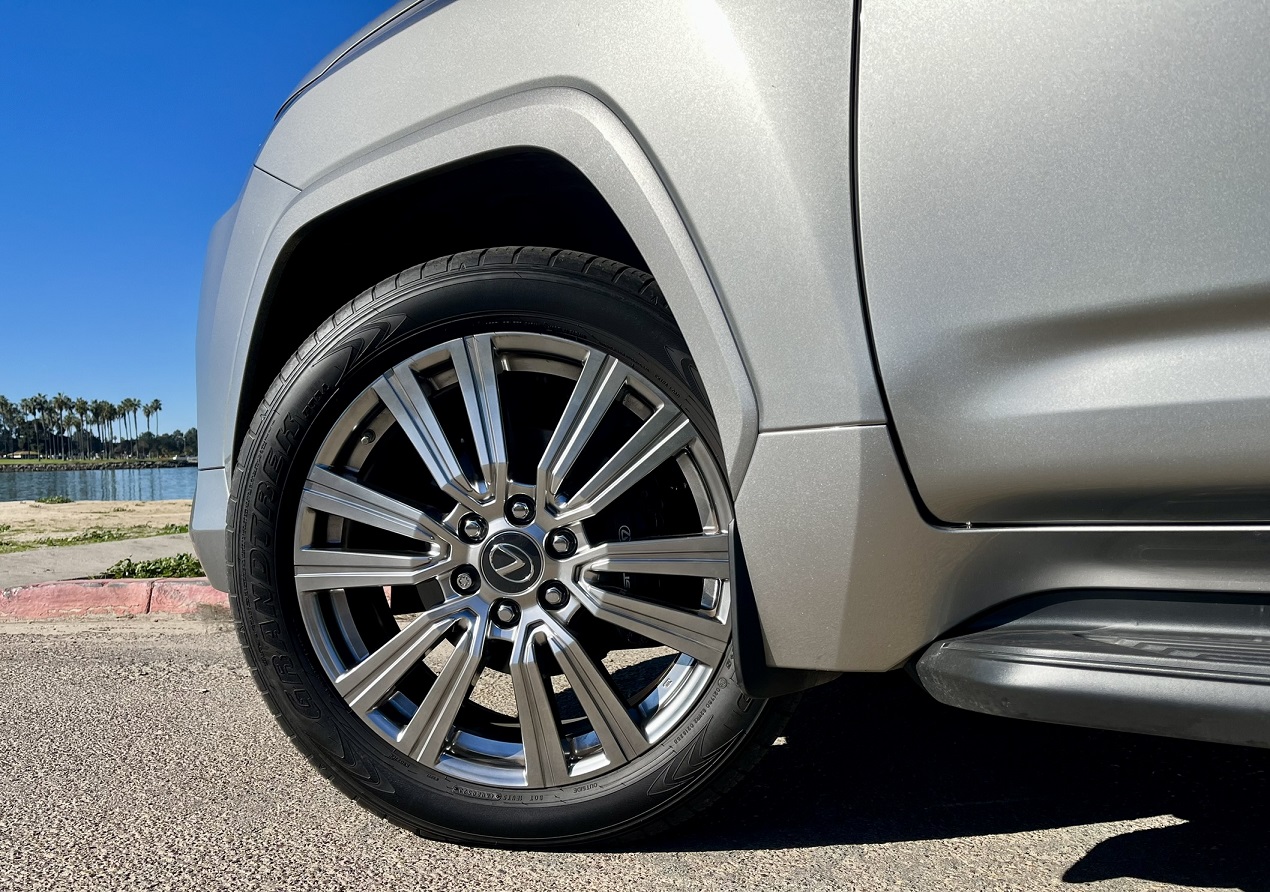
22-inch Dunlop Grandtrek PT5A 265/50 tires on forged alloy wheels. (Mark Maynard)

Off-Roading Credentials

Toyota says the LX inherits the golden ratio of a 112-inch wheelbase, carried over from the first generation in 1995. The LX has a climbing ability of 45 degrees and a maximum water crossing depth of 27.5 inches, the same level as the previous model.

Active height control can raise or lower the ride height from 1 to 3.3 inches. When parking, the ride drops another inch below the standard ride height, making the standard step rails unnecessary, except for loading gear to the roof rails (with the $450 cross bars).

LX 600 Ride and Handling

It is an engineering marvel that Lexus has created such a vaultlike and secure presence for the LX 600. The cabin is just so quiet that every drive feels like a respite from the calamity of traffic.

There doesn’t seem to be a wide difference in driving modes between Comfort and Sport-plus, except more body lean in the Comfort and Eco modes. And Eco is annoyingly resistant to throttle input for something this big and heavy.

For around-town driving, I kept the transmission in Sport or Sport-plus for its quicker acceleration uptake. Comfort mode is tuned for fuel savings and rolls out at a more relaxed pace.

It is somewhat surprising for Lexus to source the Dunlop Grandtrek PT5A tires. These 22-inch Dunlops are summer touring tires, which do not get great rave owner reviews for winter driving, and the tread face doesn’t appear traction-ready for the trail. But a full-size spare will fit under the cargo area. Replacing one of the Dunlops will run about $350 each, but alternatives are limited for a 22-inch 265/50 tire.

Backup camera showing guidance lines

The 12.3-inch top screen. (Mark Maynard)

Suspension

A lot is going on under the skin of this SUV. Much of the LX performance is focused on a high level of off-road driving performance — carried over from previous years — but also its on-road handling and stability.

The real magic is in the adaptive vehicle suspension, a sophisticated array of sensors, actuators, and advanced algorithms. These electronics monitor such elements as vehicle speed, steering input, body roll, and road conditions, then make immediate adjustments for stability and control.

Though the LX 600 is 74.6 inches tall, it absorbs speed bumps, driveway dips, and street transitions with next-to-no head toss. I’ve tested luxury sedans that are not as composed.

An open hood view of the LX 3.4 liter V-6

The 409-hp, twin-turbocharged and direct-injected four-cam 3.4-liter V-6.

Twin-Turbo V-6 Performance

The twin-turbo 3.4-liter V-6 gasoline engine (V35A-FTS) is more powerful than the outgoing naturally aspirated 5.7-liter V-8. The V-6 produces 409 hp and peak torque of 479 foot-pounds at 2,000 to 3,600 rpm.

Fuel economy ratings are 17 mpg city, 22 highway, and 19 mpg combined, using the recommended premium fuel. At 18.5 mpg, I got close to the official combined rating and would not complain in this market of $100,000 SUVs. The 21.5-gallon tank is large enough by today’s engineering, but for off-road exploring or vacation travel, I’d prefer 25 gallons or more, as you’d get in the old days. But weight savings are crucial to meeting EPA mileage standards, and the added weight of more fuel in a bigger tank is an awkward calculation. And fitting a full-size, 22-inch spare in the undercarriage takes more space where a bigger tank could go.

The Direct Shift-10AT is heavy duty for managing the curb weight, climbing power, and Sport-plus performance. Gear shifts are unnoticeably smooth, but the transmission has a low ratio first gear for steady starts on a hill, street, or trail. High gearing in 10th keeps the engine speed low at interstate speeds, benefiting mileage and a quieter ride.

Takanoha wood trim on the top door panel

The distinctive Takanoha wood trim. Can you see the hawk feather pattern? (Mark Maynard)

Interior Function

Inside the LX 600 is a leather-wrapped sanctuary with a charcoal-color headliner, muted and soft-touch accents, and Takanoha wood trim. The glossy wood treatment around the shifter console and upper doors is a wooden mosaic with a hawk feather pattern. Japanese woodworkers hone, polish, and then shave the piece three times while changing angles to bring out the feather pattern.

The instrument panel features Lexus Interface with dual display screens. A 12.3-inch navigation and infotainment screen is at the top, with a 7-inch screen just below for climate controls and drive-mode settings.

Upon first view of the driver area, there might seem to be an overwhelming array of buttons, switches, and knobs, all with graphic readouts. The access points span from the door panel window and lock controls to the digital gauge array, the steering wheel and side stalks, and the stack of center screens. Like any computer, I quickly figured out what I needed and the ones I could ignore until needed, like locking differential controls and multi-terrain switches.

Lexus sells an accessory dash cam for $375

The Lexus dash cam, $375. (Mark Maynard)

True to the LX heritage as a superior off-roader, the camera system includes an underfloor view of transparent-underfloor images showing wheel positions, front and rear. While on the trail, knowing where the differentials are is imperative to avoid that steel-busting rock in the road.

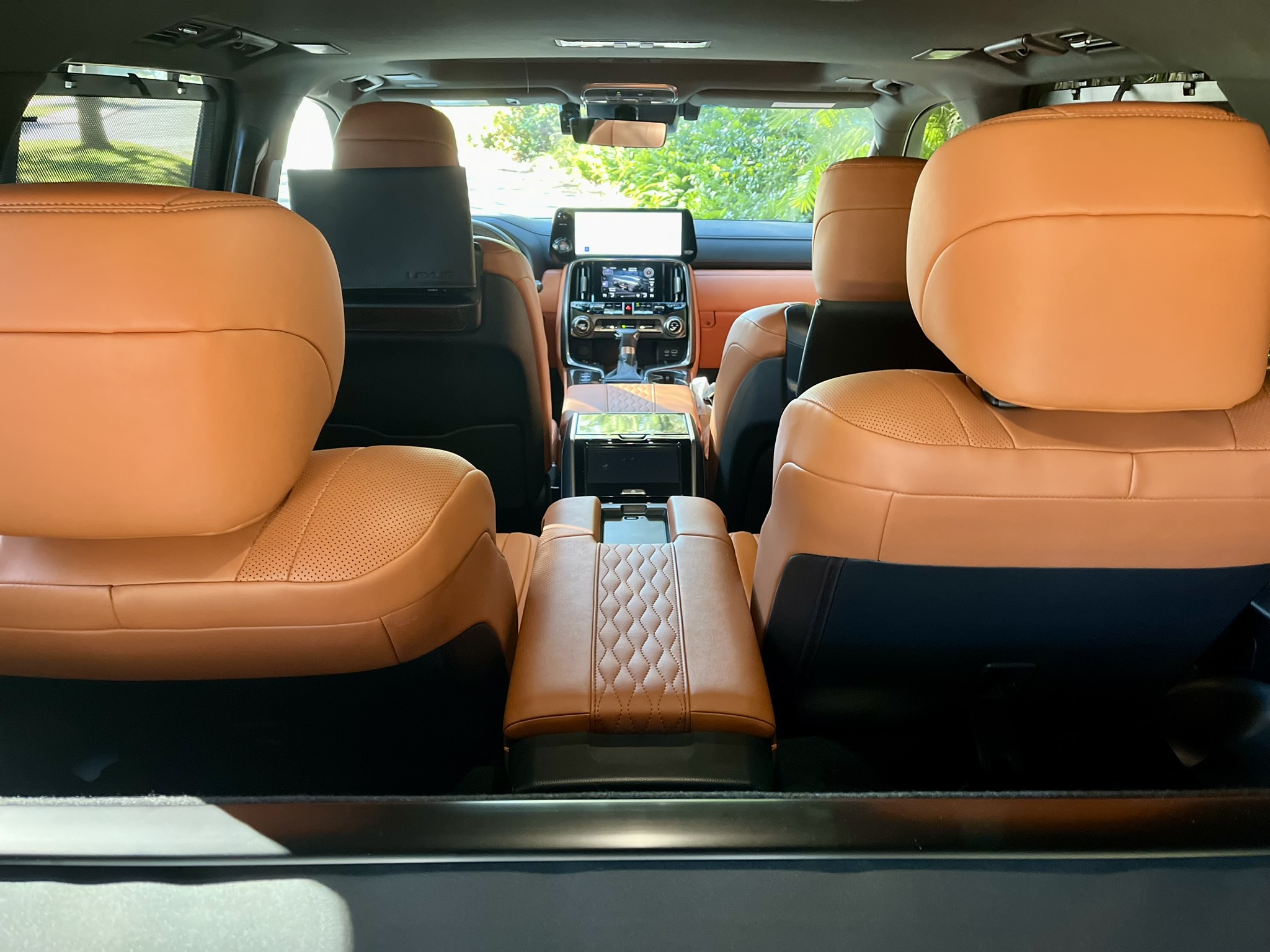
Notable Ultra Luxury features include power door closers, second-row massaging and reclining captain’s chairs, a right-rear power recliner with sliding ottoman, heated and ventilated front and rear seats, dual-screen rear entertainment system, a front center console cool box, active ride height control, and 25-speaker 2,400-watt Mark Levinson surround-sound system.

Looking from the cargo area forward from the back seats to the windshield.

VIP seating. (Mark Maynard)

Ultra Luxury Assets and Liabilities

Creating this four-seat LX 600 Ultra Luxury seems like a progressive choice for an executive-class “car.” Typically, an off-roadable SUV has a tall transmission-exhaust tunnel that compromises rear center seat footroom, so why not add a commanding console of entertaining features and a pair of massaging seats fit for a VIP?

Elements of the Ultra Lux package are all about Hollywood glam — for the two back-seat celebs. However, packing all the luxury features into this size of SUV creates a feeling of close quarters, in the front or back seat.

The second-row captain’s chairs look rich and regal, but legroom is tight at 33.8 inches. It is a chauffeur-like configuration. The front passenger seat can be moved forward for more legroom (up to 43 inches), and the seatback reclined. The curbside seat also has a footrest, but nothing for the seat behind the driver. There is also a separate air conditioning system with overhead ceiling vents.

This 2+2 configuration, however, takes away nearly all cargo versatility. The seatbacks do not fold, nor is there a ski passthrough. Cargo space is OK at 41 cubic feet stacked to the headliner.

And while there is a full 22-inch spare under the rear cargo area, the spindly jacking equipment is concerning for a three-ton lift, especially if performed on a trail.

Looking though the open doors of the LX 600 captain's chair seating.

Living not so large in the back seat space. (Mark Maynard)

Why Buy the 2024 Lexus LX 600 Ultra Luxury?

The LX 600 Ultra Luxury is a formidable choice for its luxurious refinement and tractor-like determination in snowy travel or to access the country property.

But it will be a specific buyer who seeks a four-seat, $134,000 SUV that makes molehills out of mountain trails on the way to the red carpet.

A rear view while kicking up dust on a trail

The big Lexus LX 600 SUV is sold in five trim levels with starting prices that range from $92,915 to $133,490. The top-line LX 600 Ultra Luxury tester was $135,870 with five accessories.

2024 Lexus LX 600 Specifications

Body style: Large, 4-seat, 5-door full-time 4WD body-on-frame SUV

Engine: 409-hp, twin-turbocharged and direct-injected four-cam 3.4-liter V-6 with four valves per cylinder; 479 lb.-ft. torque at 2,000 rpm

Transmission: 10-speed direct-shift automatic with paddle shifters and multi-terrain select modes; full-time 4WD with electronic locking center differential; crawl control with turn assist

Fuel economy: 17/22/19 mpg city/hwy/combined; premium fuel recommended

0-60 mph acceleration: 6.9 seconds, per Lexus

Tow rating: 8,000 pounds

BY THE NUMBERS

Fuel tank: 21.1 gallons

Cargo space: 41 cubic feet

Front head/leg room: 37.8/41.1 inches

Rear head/leg room: 38.7/33.8 inches

Length/wheelbase: 200.5/112.2 inches

Width/height: 78.3/74.6 inches

Curb weight: 5,945 pounds

Turning circle: 39.4 feet

FEATURES

LX 600 Ultra Luxury features include: 4-passenger diamond-stitch leather upholstery with embossed headrests, 2nd row massaging and reclining captain’s chairs, right-rear power recliner with sliding ottoman, heated and ventilated front and rear seats, dual-screen rear entertainment system, driver Lexus memory system, 4-zone climate control system with console cool box, heated wood and leather steering wheel, rear side sunshades, active ride height control, power door closers, 25-speaker 2,400-watt Mark Levinson surround-sound audio system, 2nd-row wireless charger, illuminated door scuff plates, thematic ambient illumination;

Exterior Ultra Luxury features include: triple-beam LED headlights and taillights, 22-inch forged alloy wheels with 22-inch Dunlop Grandtrek PT5A 265/50, roof rails, tow package and hitch;

Standard equipment includes: Smartkey entry and push-button ignition, Takanhoha wood trim, power heated side mirrors, 10-way power driver seat with cushion extender, 8-way power front passenger seat with cushion extender, digital rearview mirror, 12.3-inch digital infotainment touch screen, wireless Apple CarPlay and Android Auto, panoramic view monitor with guidance lines, power moonroof, power tailgate with kick sensor, intuitive parking assist with rear cross-traffic alert and auto-braking, rear center armrest and table, headlight washers;

Safety features include: 10 air bags, trailer sway control, stability and traction controls, hill-start assist;

Lexus Safety System 2.5 includes:

  • All-speed dynamic cruise control,
  • Precollision system with pedestrian detection,
  • Lane-tracing assist,
  • Lane-departure alert with steering assist,
  • Road sign assist (readout in gauge array),
  • Intelligent (auto-dimming) high beams;

SUSPENSION COMPONENTS

Brakes: 4-wheel vented discs, 13.1 inches front, 13.9 inches rear; w/4-sensor, 4-channel multi-terrain ABS, brakeforce distribution, brake assist, and four-piston front calipers;

Steering: electric power; 39.4-foot turning circle

Tires-wheels: 22-inch 265/50 tires; forged alloy wheels with silver finish

Suspension: adaptive variable with active height control; front wishbone, rear multilink;

PRICING

Base price: $133,490, including $1,350 freight charge; price as tested $135,870

Options on test vehicle: 3M door edge film $95; illuminated cargo sills $475; dash cam $375; wheel locks $95; cross bars $450; all-weather floor protection $340

Where assembled: Toyota, Aichi, Japan

Warranties: 4-years/50,000-miles bumper to bumper with roadside assistance, free first and second scheduled maintenance appointments, and lodging expense for emergency breakdown 100 miles from home; 6-years/70,000-miles powertrain

Audi RS 5 Competition Coupe Review

Audi RS 5 Competition Coupe Review

 A package-price reduction with added standard equipment makes the 2024 Audi RS 5 Competition a near-value statement 

The Ascari Blue color of the RS 5

The 444-hp 2024 Audi RS 5 Competition Coupe starts at $80,790, which is $6,525 less than in 2023.  (Photography by Audi or as credited)

Table of Contents

New for the 2024 RS 5
RS 5 Competition Package
Pricing
RS 5 Performance
Competition Ride and Handling
Interior Function
Why Buy the 2024 Audi RS 5 Competition?
Specifications

BY MARK MAYNARD

There is good news for the 2024 Audi RS 5 Competition Coupe and Sportback models. First, the bad news: the base price for the 2024 model is up a trifling $700, now starting at $80,790. The good news is an overall price reduction for the Competition Package saved $6,525.

An Audi RS 5 Competition coupe that cost $100,585 in 2023 is now $94,040, with the same five options and packages. In 2023, the RS 5 Competition package cost $16,100. For 2024, the package is $10,300. The main deletion from the package is the front ceramic brakes. The 15.7-inch front ceramic brakes save weight and improve brake disc cooling for on-track performance. The default choice for 2024 are 14.8-inch steel rotors. Both rotors are ventilated with six-piston fixed calipers. Steel rear disc brakes are unchanged with 13-inch ventilated rotors.

There were availability issues with the carbon fiber brakes, Audi says, and made this decision: “Rather than allow a customer to order the carbon brakes and us not be able to build the car immediately, keeping a customer waiting, we decided to proactively remove the option for this model year. As supplier availability issues get resolved, we may re-evaluate this,” a spokesman wrote in an email.

Trimming the cost of the Competition package and adding a lot of new standard equipment makes the RS 5 Competition more of a value tease, and some of its new standard elements are optional in the competition.

The Competition

Audi RS5 Coupe prime competitors include:

505-hp Alfa Romeo Giulia Quadrifoglio, base price $83,365, includes $500 paint option.

503-hp BMW M4 Competition xDrive Coupe, base price $91,245 with 3 driving-assist technologies.

503 hp Mercedes-AMG C63 S (2023), $94,975 with six options comparable to RS 5 tester.

472-hp Cadillac CT4-V Blackwing, $73,770.

565-hp Nissan GT-R, $123,000

*Suggested retail pricing includes the freight charge.

The front seat area with alcantara upholstery and carbon fiber trim accents

The Competition package adds Pearl Nappa and Dinamica upholstery. Front sport seats have power bolster and seat-bottom adjustment.

New for 2024?

There are no exterior or powertrain changes for the 2024 RS 5 lineup, just the following features now as standard equipment:

  • Adaptive cruise control (ACC);
  • Audi active lane assist;
  • Parking system-plus;
  • Heated steering wheel with Hands on Detection (HoD);
  • Remote engine start via myAudi app.
  • The Navigation package now adds traffic sign recognition, activating Predictive adaptive cruise control (pACC).
  • All RS 5 models have a Navigation package ($1,450) that now includes a six-month trial subscription to Audi Connect PLUS with the Audi app store.
  • Progressive Red metallic paint replaces Tango Red metallic.
A cool "runway" Sport mode to the gauge array.

A “Runway” mode is exclusive to the RS Virtual Cockpit layout. (Mark Maynard)

What’s in the $10,300 Competition Package?

The 2024 Audi RS 5 Competition package, $10,300, includes:

  • 20-inch 5-Y-spoke design milled-cut wheels in bi-color phantom black finish;
  • Pirelli P Zero Corsa tires;
  • 180 mph top track speed;
  • Sport direct steering;
  • Coil-over suspension system with front and rear sport sway bars;
  • RS Sport exhaust system with matte black tailpipes;
  • Red brake calipers;
  • RS carbon matte inlays;
  • Matte carbon front splitter, rear diffuser, and exterior mirror housings;
  • High-gloss black exterior trim, black Audi rings and badges;
  • Pearl Nappa and Dinamica seat upholstery with piano black front seat side trim
  • Alcantara covered steering wheel, shift lever, and center console;
  • Seatbelts with red edging and RS logo floor mats with red edging.

2024 Audi RS 5 Pricing

The U.S. was first introduced to the midsize RS 5 for the 2013 model year. The second-gen RS 5 came out for 2018, followed in 2021 with a significant refresh. The RS 5 Competition package was added for 2023.

Sold in two-door Coupe and five-door Sportback models, both RS 5 variants have the same powertrain. RS 5 Competition Coupe pricing starts at $80,790 vs. $79,995 for the Sportback; pricing includes the $1,095 freight charge from Ingolstadt, Germany.

Of the eight paint colors, only Nardo Gray is a no-cost choice. Six hues are a $595 upgrade, including the tester’s Ascari Blue metallic. Named for Spain’s Circuito Ascari track, the deep sky blue hue has sublet flecks of purple. Sebring Black Crystal, $1,095, is exclusive to the Competition package.

Find current Audi RS 5 pricing here. And look for special offers here.

The engine with carbon fiber dress up kit

With 444 twin-turbocharged and intercooled horsepower, the 2.9-liter is Audi’s most potent V-6 in the A5 lineup. (Mark Maynard)

Competition Performance

With 444 twin-turbocharged and intercooled horsepower, the 2.9-liter is Audi’s most potent V-6 in the A5 lineup. With peak torque holding steady from 2,000-5,000 rpm, there is no delay in the spooling of power, though the standard drive mode is turned for fuel economy. Audi cites 0-60 acceleration in 3.7 seconds for the Coupe and 3.8 seconds for the Sportback. With all-wheel drive, that’s a righteous launch for a curb weight of 3,990 pounds, or around 4,300 pounds with driver and a friend.

The RS 5 engine has a determined engine note that gets better with a heavier foot. Reduced insulation between the engine compartment and interior gives a grand exhaust recital. Press the steering wheel button for RS mode and let the howling begin. The eight-speed feeds shifts with rapid-fire precision, with a lovely crackle and snort on downshifts.

Competition models boost maximum top track speed to 180 mph, up 25 mph from the non-Comp RS 5. Trimming the soundproofing also saved nearly 18 pounds, Audi says.

Fuel economy ratings of 18 mpg city, 26 highway, and 21 mpg combined on the recommended premium fuel are reasonable, especially with the 15.3-gallon tank. During my week of testing, my around-town average ranged between 14 and 18 mpg; on highway runs, it clicked along at 22.4 mpg.

Denting my mileage was liberal use of Sport mode. It’s just the way to go with this powertrain. And I so enjoy how Audi provides easy Sport-mode access with just a slap of the shifter down for Sport and another pull for standard Drive mode.

Driver Assistance

On the daily commute, the Comfort mode suspension is forgiving, though still taut. Crowded urban driving is helped by the RS driver assistance package, which is $3,000. The active lane assist gives good centering, but the reaction is skitzy in cornering, likely due to controlling the very wide Pirelli P Zero motorsport tires. And I’d also add the Side Assist package, $500, which includes matte aluminum side mirror caps.

RS 5 Competition Ride and Handling

With its slightly lower roofline, the Audi RS 5 Coupe might be more track competitive than the slightly taller and heavier Sportback on a longer wheelbase (111.3 vs. 108.9). However, the Sportback has larger cargo-trunk capacity (21.3 vs. 10.9 cu.ft.) and easier access to the back seats, with 2.4 inches more legroom.

Acceleration to 60 mph for both trim levels is a bellowing 3.8 seconds in the Sportback and 3.7 in the coupe.

Street or track, the RS 5 steers with planted precision; the steering weight is light but responsive with minimal input. The Sport Direct Steering in the Competition package has a quicker ratio of 13.1:1 vs. for the standard 15.9:1 box.

For added handling control, Audi includes a set of tools to manually lower the front and rear spring height by 10mm; that’s an overall ride height 20mm lower than the regular RS 5.

The stock Pirelli P Zero Corsa motorsport tires have “racing type compounds,” earning them a sticky treadwear rating (UTQG) of 80 with the highest AA traction rating. The compounding is rubber cement for traction, but many runs on a hot track day event would likely scrub tread to the wear bars; replacements will run around $425 each, or $469. At the Audi dealer, installing four tires would cost around $1,726, not including sales tax.

The driver area of the audi RS 5

Alcantara upholstery with Crescendo Red stitching dresses up the three-spoke heated steering wheel, shift lever, and center console.

RS 5 Interior Function

Audi interiors are handsome and refined. The Competition package amps visual energy with Pearl Nappa and Dinamica front-seat upholstery; Piano Black side-seat trim replaces the standard Fine Nappa leather seats. Matte carbon inlays reinforce a performance focus. Alcantara faux suede with crescendo red stitching dresses up the three-spoke heated steering wheel, shift lever, and center console. Safety belts and floor mats also are edged in red.

The midsize cabin proportions of the RS 5 are a comfort fit. The ride height accommodates without a drop-and-twist sequence into the seat. Even the seat bolsters’ side and bottom are unrestrictive, but they can be snugged for control in cornering switchbacks.

Cabin width allows front shoulder room of 55.3 inches vs. 55.7 in the Sportback. The broad front seat area allows enough instrument panel width to include the necessities: a wireless charging pad, cup holders, and easy access to cabin controls. However, engagement of the driver-assist function is awkwardly positioned on the end of the hard-to-see cruise-control stalk.

Headroom of 37.4 inches with the moonroof will fit tall drivers without looking through the windshield header. However, that head space might be tight when wearing a helmet.

Rear legroom is snug at 32.7 inches, but kids won’t notice, and adults will gladly pull up their knees.

A rear three quarter view

The RS 5 Competition package adds 20-inch milled-cut wheels in a bi-color phantom black finish, Pirelli P Zero Corsa tires, and a carbon trunk-lid spoiler.

Why Buy the 2024 Audi RS 5 Competition?

Some motorists will spend $85,000 for a loaded pickup — before adding accessories, special paint, or tooled leather. And then their truck might be used to haul soil from the home improvement center, the kid’s gear to college, or a Christmas tree. It doesn’t matter, it is a personal choice.

The Audi RS 5 might be a little more subtle than its competitors in its display of supersport engineering. But when paying $100,000 for the RS 5, that driver will feel and hear the engineering that makes their car special. He or she will have no regrets . . . until the redesigned 2025 Audi RS 5 coupe debuts.

2024 Audi RS 5 Competition Specifications

Body style: Midsize 2-door 4-seat 2+2 all-wheel-drive Coupe or Sportback

Engine: 444-hp, twin turbocharged and intercooled 2.9-liter V-6; 442 lb.-ft. torque from 2,000-5,000 rpm

Maximum turbo boost: 21 psi

Transmission: 8-speed Tiptronic automatic

Fuel economy: 18/26/21 mpg city/hwy/combined; premium fuel

0-60 mph acceleration: 3.7 seconds

Top track speed: 155 mph

Drag coefficient: 0.32

BY THE NUMBERS

Fuel tank: 15.3 gallons

Trunk space: 10.9 cubic feet

Front head/leg room: 37.4/41.3 inches

Rear head/leg room: 36.1/32.7 inches

Length/wheelbase: 185.9/108.9 inches

Curb weight: 3,990 pounds

Turning circle: 38.4 feet

FEATURES

Standard equipment includes: Advanced key for lock-unlock and push-button ignition, Audi virtual cockpit (with appearance modes of Sport and S Performance), electric parking brake, rearview camera, Fine Nappa leather upholstery, honeycomb stitched S sport seats with RS embossing, RS carbon inlays, power side bolsters, and massage function, power sunroof, Bang & Olufsen audio system with 3D sound, Matrix-design LED headlights with Audi laser light, LED interior lighting;

Safety features include: 8 air bags, stability control with sport mode, front and rear parking sensors, lane-departure warning;

Driver assistance features include: Audi Pre-sense basic (preventative occupant protection; Audi Pre-sence City with forward collision warning and avoidance assistance;

SUSPENSION COMPONENTS

Steering: Electromechanical progressive system

Suspension: RS sport front and rear

Brakes: 4-wheel steel discs, 14.8-inch rotors front, 13-inch rear;

Tires-Wheels: 20-inch 5-Y spoke design forged wheels in bi-color finish; Pirelli P zero Corsa motorsport tires

PRICING

Base RS 5 Competition Coupe price: $80,790, including $1,095 freight charge; price as tested $94,040

Options on test vehicle:

  • Ascari Blue metallic paint $595;
  • RS driver assistance package, $1,500, adds head-up display, Park assist (parking entry functionality), top view camera system, traffic sign recognition;
  • Navigation package with side assist $1,500;
  • Competition package with standard brakes, $10,300.

Where assembled: Ingolstadt, Germany

Warranty: 4-years/50,000-miles bumper to bumper with roadside assistance

Acura Integra Type S Review

Acura Integra Type S Review

The race-engineered 2024 Acura Integra Type S is a variant of the Honda Civic Type S, but there are notable separators, including body styles and horsepower

An Apex Blue Acura Integra Type S with an ocean mural in the background

The Acura Integra had a complete redesign for 2022, and the Integra Type S was added for 2023. There are no changes for the 2024 Type S. (Photos by Mark Maynard or as credited)

Table of Contents

The Integra Legacy
Type S Pricing
Type S vs. Type R
Powertrain
Ride and Handling
Safety Features
Why Buy the 2024 Acura Integra Type S?
Specifications

BY MARK MAYNARD

While tooling about in the 2024 Acura Integra Type S, I successfully debunked the dad adage that a manual-transmission car will get better fuel economy than one with an automatic. The best I could muster in the test car was a combined 21.4 mpg — and that was hard-earned with mostly careful acceleration. EPA fuel economy estimates are 21 mpg city, 28 highway, and 24 mpg combined. (While testing the Honda Civic Type R stablemate, I reached a highway mileage reading of 26.8 mpg.)

I’m not typically reserved while testing a hot compact with a slick six-speed, but during my test week, premium fuel was $6 a gallon, and it doesn’t take long to burn through the 12.4-gallon tank. The highest octane available is recommended for max performance from the turbocharged 320-horsepower 2.0-liter four-cylinder engine.

Of course, I would not cheap out on the fuel grade for the Integra Type S. It deserves the best. And it is just too enjoyable to grab it by the scruff of the neck and shake it out.

This five-door, four-seat wily rascal has two levels of performance. The first is of the type that even a mother, or the dedicated hang-wringer in the relationship, would give the nod of approval. The sport bucket seats have an ominous appearance, but they are surprisingly comfortable while being secure support when driving enthusiastically. Get hard on the gas, and the 2.0-liter breathes with machined precision, with just enough crackle and rasp through the triple-tip exhaust outlets. And look at the open cargo space of this compact-class liftback.

The Type S steering wheel and driver area

The driver area is designed for hands-on control.

An Engineering Masterwork

The second level of Type S go-power can get blistering through a road course or out on your favorite run where the wild things are. Its wide, 19-inch Michelin Pilot Sport 4S tires are loathe to squeal in pain when pushed hard. And the tread width is essential for stability in a high-power front-drive sports car.

And just look at its bank of safety features and technologies. Integrating race-engineered performance with a powerhouse of electronic driver-assistance functions is an engineering marvel — none of which gets in the way of a good time. (Find more safety technologies in the specs chart at the end of this article.)

The six-speed is keenly precise with electronic rev-matching downshifts. The rev-match can be automatically engaged or canceled. The electronic downshifts can be confusing for those who know how to manually heel-toe downshift. However, I got accustomed to the rev shifts around town and liked the reminder that soon I would be back in the outback for the unfettered pleasure of manual downshifts.

The Type S front seats in Orchid with black microsuede trim

The Type S Orchid interior has baseball stitching and is trimmed in perforated black microsuede.

The Acura Integra Legacy

The Acura Integra had a complete redesign for 2022, and the Integra Type S was added for 2023. The Type S is now in its fifth generation, including the first-gen car for Japan.

The legacy began in North America with the second-generation 1992-93 Integra GS-R. It was followed by the 1997-2001 Integra Type R, then the 2005-06 RSX Type S. The early performance models were coupes, and the 2023 model is the first five-door body style.

Sport Compact Competition

This segment of reasonably priced, high-performance compacts is a storied gathering that includes the Hyundai Elantra N, Subaru WRX, Toyota GR Corolla, VW Golf R, and the Civic Type R.

The Elantra N, Civic Type R, and Acura Integra Type S are front-wheel drive, while the other competing models have all-wheel drive. Some are available with an automatic transmission, but Acura preserves the integrity of hot-shoe driving with only a six-speed manual for the Integra Type S.

It is the Acura-Honda skill at race-spec engineering that transforms a premium sport compact sedan into a purpose-engineered track athlete.

2024 Acura Legacy Type S Pricing

The Acura Integra Type S is a one-spec choice for engine, manual transmission, and equipment. Manufacturer pricing for the Integra Type S starts at $51,995, including the $1,195 freight charge from Marysville, Ohio. The Apex Blue tester came to $55,971, which includes the pearl paint for $600, the carbon fiber tailgate spoiler ($950), premium carpeted floor mats ($240), and the very attractive 19-inch copper alloy wheels for a significant bump of $2,186.

Unique Type S interior features include a serial-number plate, high-bolstered front sport seats in red-and-black microsuede fabric with double red stitching, red floor mats, red ambient LED interior lighting, metal-trimmed sport pedals, aluminum shift knob, red illuminated front door panels.

On the outside, look for the Brembo four-piston aluminum front brake calipers, 19-inch Michelin Pilot Sport 4S tires, gloss black side sills and wing spoiler, center-mounted, and the car’s signature triple outlet exhaust.

There is one no-cost paint color of Lunar Silver Metallic and but six optional colors for $600 each: Apex Blue Pearl, Liquid Carbon Metallic, Majestic Black Pearl, Performance Red Pearl, Tiger Eye Pearl (gold), and Platinum White Pearl.

More Type S features are listed below in the specifications chart.

Finding a new Acura Integra Type S isn’t overly difficult, compared with the outrageous dealer markups for the Civic Type R and its limited availability.

For current Acura pricing check here.  For Acura’s special offers check here.

A front door panel in the Type S shows the bottle holder and some usable storage

Usable front door-panel storage.

Type S vs. Type R

The Integra Type S is a variant of the Honda Civic Type R, but there are notable separators, including body styles. The Integra Type S is the five-door liftback version of the Civic, while the Type R is a four-door sedan. Both have a four-seat 2-plus-2 cabin.

An Acura spokesman said both cars were developed by wholly different teams, with unique buyer and performance targets.

Credentials for the Integra Type S begin with its development by the same team that created the fifth-gen Integra. Led by chief engineer Yoshiaki Akimoto, his previous projects include the second-gen Integra GS-R motor, Honda’s first four-cylinder with VTEC; the S2000 AP1 motor; and Honda’s 2005 F1 engine program.

While both sport compacts share the basic 2.0-liter powertrain, the Integra gets a 5-hp boost. Both, however, have the same torque rating of 310 lb.-ft. from 2,600 to 4,000 rpm. Acura says the Integra Type S has a noticeably different throttle map than the Type R, specifically at half throttle, whereas Integra offers significantly more torque, the spokesman explained.

For the $7,105 price difference for the Integra, it adds such convenience extras as:

Sound deadening is removed for Type R (vs. Civic Touring), whereas Integra Type S maintains the same level of sound isolation as the standard Integra;

Added interior features include:

  • Heated front seats;
  • Power driver seat;
  • ELS 3D Studio Audio;
  • Head Up Display.
The 10.7 inch wide front tire tread

A wide footprint for full contact acceleration.

Integra Type S Assets

  • Vented aluminum hood;
  • A third interior color choice of Orchid (cream) and black is in addition to black, and black and red.
  • A much more compliant suspension tune. The most aggressive mode for Type S (Sport-plus) is comparable to the middle mode (Sport) in the Type R. Type S Sport mode is comparable to the Honda’s Comfort mode. Even in similar settings, the damping profile is quite different (street vs. track focus), the spokesman said;
  • Unique Michelin Pilot Sport 4S tire developed specifically for the Integra Type S. The tread pattern and compound are distinct from the Type R. No CUP2 is offered for Type S.
  • The 19-inch Integra Type S wheel is actually lighter than the Civic Type R wheel.
  • Integra Type S curb weight is just 31 pounds heavier at 3,219 pounds;

Type S Style

The liftback body style gives the Integra Type S a hunky stance with a “flares and chairs” treatment. The Type S is 2.8 inches wider and 0.2-inch longer than the standard Acura Integra. The front track is 3.5 inches wider (to accommodate the wide Michelins), and the rear track is 1.9 inches wider.

The big Acura grille has enhanced engine and brake cooling with a more open diamond pattern (boosting airflow by 170 percent, Acura says). The vented aluminum hood channels air pulled in at the grille to flow up and over the windshield. Large Godfather-like air intakes left and right in the lower front fascia channel airflow through three canards in the inner fender to the big Brembo discs. The smooth rear fascia is designed as a diffuser to channel air and reduce lift.

A view of the engine with a matted red cover over the injectors

A matte red engine cover. (It is in memory of the second-gen Integra Type R.)

Integra Type S Powertrain

The K20C four-cylinder engine is the stuff of dreams for Acura-Honda disciples. In the Type S, the turbocharged and direct-injected VTEC 2.0-liter 4-cylinder has 320 hp, five more than the Civic Type R.

There is an enjoyable rise and fall to the revs to neatly stitch a gear. With the engine’s wide spread of peak torque, shifts do not have to be rushed.

Ease into first gear, roll on power to second, and get ready for liftoff as the torque begins to rush at about 2,400 rpm. Powering through a second-gear turn at 4,000 rpm is inspiring as I lift and slot the shifter for third, then roll on the power — and smile at the reassuring pushback in the seat. That’s when these sport seats are in their element.

And that is also when the 19-inch Michelin Pilot Sport 4 S tires (265/30) are in their playground. These 10.7-inch-wide rollers bring an attack attitude to performance driving.

The tires have an asymmetric tread pattern and a treadwear rating (UTQG, or Uniform Tire Quality Grade)
of 300, which is sticky but not as soft as a racing tire. Acura advises that these “unique high-performance tires” are not designed for winter driving and “will wear more rapidly than normal passenger car tires.”

Replacing a tire will run about $350 — and do not cheap out when it’s time for replacements or risk a compromise to handling performance.

The back end showing the three exhaust tips.

The lower fascia is a diffuser to channel airflow.

Type S Ride and Handling

Acura has mercifully tempered the stiffness of the ride with an adaptive damper system. It takes away the daily bump and grind yet immediately stiffens under pressure.

There also is more soundproofing, but the ride is still a whirlwind at highway speeds. The Acura ELS Studio audio system (unique from the Type R) has 16 speakers, but even this system with 530 watts can’t tame the noise. The ride around town is grainy, which seems contrary to the fairly soft Michelin tires.

The 12-way power driver seat is a major improvement over the Civic’s sport seat. And both front seats seem to have less restrictive shoulder and thigh bolsters.

A consideration is the awkwardly wide 40-foot turning circle. And care must be taken to guard the low front splitter from scraping on driveway entries and road irregularities.

The 2-plus-2 back seat in the Integra Type S

The 2+2 back seat space has snug legroom of 37.4 inches.

Integra Safety Features

Type S safety features include 10 air bags and a complete set of driving-assist technologies (listed below in the specs box). Level 2 semi-autonomous driving assist felt a little skitzy and insistent at the steering wheel. Lane-centering, however, was accurate and reassuring in heavy traffic.

One of my most appreciated technologies is the Traffic Sign Recognition system. It is vital to know the speed limits in this speed-capable Type S.

Driving-Assistance Technologies

Layered into the safety electronics of all Acura Integras are:

Collision Mitigation Braking; Road Departure Mitigation; Adaptive Cruise Control; Lane Keeping Assist; Forward Collision Warning; Lane Departure Warning; Traffic Sign Recognition System; Auto High-Beam Headlights; Driver Attention Monitor; Blind Spot Information System with Cross Traffic Monitor;

Cargo space showing two bags of garden soil.

Functional cargo space for weekend tasks or gear for the autocross.

Chassis Components

Suspension: Adaptive damper system; dual-axis MacPherson front struts, rear multi-link; stabilizer bars front (tubular) and rear (solid);

Steering: Dual-pinion, variable-ratio electric power steering; 2.1 turns lock to lock;

Brakes: Power-assisted and ventilated 2-piece front discs, solid rear; 13.8-inch rotors front, 12 inches rear; Brembo 4-piston aluminum front calipers;

Tires-Wheels: 19-inch Michelin Pilot Sport 4S tires (265/30); 19-inch matte black alloy wheels; tire-repair kit.

A front end close up to show the Large air intakes aid aerodynamics by channeling air through three canards to the inner fender.

Large air intakes aid aerodynamics by channeling air through three canards to the inner fender.

Why Buy the 2024 Acura Integra Type S?

There are decades of Honda race-engineering woven into the character of the Type S, which is a badge of honor to those who know. But it comes at a significant price. I did not see value in the $950 carbon fiber tailgate spoiler or the copper alloy wheels ($2,186), saving $3,136. And there is only one no-cost paint color of Lunar Silver Metallic, so most buyers will likely choose one of the other six $600 paint colors.

Don’t waste your money if you don’t value the mechanics of driving. It’s the rev of the engine, the machined smoothness of the manual transmission, and how the suspension loads and unloads as the driver navigates a winding road. It’s a delicious sensation, too good not to be repeated.

Compared with the Honda Civic Type R, the Integra Type S is the car for grown-ups. The Type S is a little more compliant and a little more comfortable, though I wouldn’t want to commute long distances in either. But the driving rush felt the same to me.

With my recent CTR test, I couldn’t sense that much difference between the two. My choice would be the Type S. Its cargo space makes it a little more of a dual-use sports car, and mom or the significant other would undoubtedly approve.

2024 Acura Integra Type S Specifications

Body style: compact, front-wheel-drive 5-door, 4-seat high-performance sedan

Engine: 320-hp, turbocharged and direct-injected 2.0-liter 4-cylinder; 310 lb.-ft. torque from 2,600-4,000 rpm

Transmission: 6-speed manual with rev-matching downshifts

Fuel economy: 21/28/24 mpg city/hwy/combined; premium fuel recommended

0-60 mph acceleration: 5.1 seconds (per zeroto60times.com)

BY THE NUMBERS

Fuel tank: 12.4 gallons

Cargo space: 24.3 cubic feet

Front head/leg room: 38.6/42.3 inches

Rear head/leg room: 36.4/37.4 inches

Length/wheelbase: 186/107.7 inches

Height/width: 55.4/74.8 inches

Curb weight: 3,219 pounds

Turning circle: 39.7 feet

FEATURES

Standard equipment includes: Smartkey entry with push-button start, multi-angle rearview camera with dynamic guidelines, 12-way power front seats with lumbar, 10.2-inch driver info screen, 12-speaker Bose sound System with subwoofer, 9-inch color touchscreen (with volume knob, customizable feature settings and smart shortcuts), electric parking brake, Bluetooth phone and audio, Apple CarPlay and Android Auto, 2.5-amp USB smartphone-audio port (front), 2.5-amp USB charging port, 12-volt power outlet (front), wireless charging pad, sliding sun visors, LED map lights, cargo area cover;

Type S features, interior: Type S sport-appearance package, serial-number plate, high-bolstered front sport seats with black or Orchid microsuede fabric, black floor mats, ambient LED interior lighting, leather-wrapped steering wheel, metal-trimmed sport pedals, leather-wrapped shift knob, illuminated front door panels, active sound control;

Type S Exterior: Brembo 4-piston aluminum front brake calipers, 19-inch matte black alloy wheels, Michelin Pilot Sport 4S tires, aluminum hood, Type S badges front and rear, gloss black side sills, gloss black wing spoiler, center-mounted, triple outlet exhaust with active exhaust valve, gloss black side mirrors with LED turn signals;

Safety features include: 10 air bags, stability and traction controls, brake distribution, brake assist, and hill-start assist

Driving-Assist Technologies

Collision Mitigation Braking, Road Departure Mitigation; Adaptive Cruise Control;
Lane Keeping Assist; Forward Collision Warning; Lane Departure Warning;
Traffic Sign Recognition System; Auto High-Beam Headlights; Driver Attention Monitor; Blind Spot Information System with Cross Traffic Monitor;

PRICING

Base Type S price: $51,995, including $1,195 freight charge; price as tested $55,971

Options on test vehicle: Apex Blue Pearl paint $600; carbon fiber tailgate spoiler $950; premium carpet floor mats $240; 19-inch copper alloy wheels $2,186

Where assembled: Marysville, Ohio

Warranty: 4-years/50,000-miles bumper to bumper; 6-years/70,000-miles powertrain